Wednesday, August 19, 2009

Antony and Cleopatra


Shakespeare. William. 1608?. Antony and Cleopatra.

Nay, but this dotage of our general's
O'erflows the measure: those his goodly eyes,
That o'er the files and musters of the war
Have glow'd like plated Mars, now bend, now turn,
The office and devotion of their view
Upon a tawny front: his captain's heart,
Which in the scuffles of great fights hath burst
The buckles on his breast, reneges all temper,
And is become the bellows and the fan
To cool a gipsy's lust.

Antony and Cleopatra is a tragedy. One of those Shakespeare plays that end with a massive heap of bodies. Personally--each to their own and all--I'm not all that into Shakespeare's tragedies. Even those tragedies that are reportedly tragic love stories. I suppose they're human enough stories--tales of men and women with natural flaws and the unfortunate circumstances that ultimately lead to hopelessness, despair, and death for those involved.
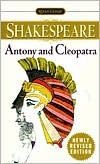
Cleopatra and Antony are lovers doomed for a tragic end. And they are to blame in part--as most 'tragic lovers' are, I suppose. Antony loves Cleopatra well enough in his own way. But he also loves himself, his sense of duty to his country, his glorious political and military career. He likes to be thought well of. He likes being a Roman hero, a political somebody. Cleopatra, likewise, is a political somebody. She understands--in a way--because she definitely has her own sense of love and duty for her country, for Egypt. Both lovers have big egos and the personalities and temperaments that go along with them. I would classify both as high-maintenance; neither would be easy to live with. (Personally, even without outside influences l think these two could not have had their happily ever after.) The problem with these two is a sense of imbalance. Each have two selves: the public persona and the private individual. So their love affair bleeds through into both. Their relationship has just as much to do with politics and power and authority and military majesty as it does the bedroom.
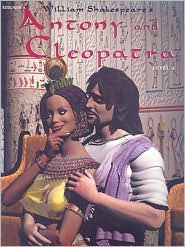
So who is Cleopatra? Is she "cunning past man's thought" or "a wonderful piece of work"? Who is Mark Antony? Is he "a man who is the abstract of all faults"? Does she bring out the best or the worst in Mark Antony? For that matter, does he bring out the best or worst in her? Is their affair one based on love or lust. Oh, I'm not denying that there is plenty of lust to go around. Their relationship is a passionate one. But does it go beyond that? How true is their love? How solid is it? Does their 'love' for one another make them weak or strong? Is Cleopatra right to mistrust Antony? Is she right to believe the old saying, once a cheater always a cheater. If he really, truly loves Cleopatra why is it so easy for him to agree to marry someone else?

What did I think of this one? Well, I liked parts of it. There were some lines that were just beautiful. Lines like, "the bright day is done, and we are for the dark" and "eternity was in our lips and eyes." But did I like the characters? Not really. Cleopatra was manipulative--that is when she wasn't being a nag. Did she have every reason in the world to be jealous and suspicious? Sure. I think she had more than a little reason. What with him having been married when their relationship began. And then after his first wife died, having him choose to marry another woman instead of her. Anytime he is away from her, she's suspicious. She always thinks the worst. If it weren't so tragic, it would be funny. The way she carries on. Antony was just stupid. I'm sorry, that's the way I see it. He chose not to think with his brains. And that's all I have to say about that. If I had to pick a favorite character it would be Enobarbus.

Have you read this one? Did you think it was romantic? Did you like Antony and Cleopatra as a couple?

This is one I read for Liv's Shakespearean Summer challenge.

© Becky Laney of Becky's Book Reviews

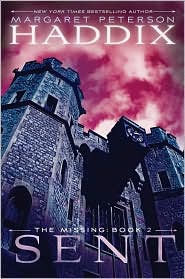
Sent (MG)


Haddix, Margaret Peterson. 2009. Sent (The Missing, Book 2). Simon & Schuster. 313 pages.

Jonah was falling, tumbling over and over, down and down, through nothingness and absence and void.

Jonah and his sister, Katherine--being true friends--couldn't let Chip go alone. True, they didn't know where he was going exactly, though they had a handle on why, but whatever hardships come their way, they'll face together. Jonah and Chip are both adopted. But their mothers, their birth mothers, didn't come from the twenty-first century or even the twentieth. No, Jonah, Chip, and others like them--like Alex--are children "rescued" by future time travelers. You can read all about this mystery in the first novel in the series...Found.

Who is Chip? Who is Alex? I mean who are they really? These two kids are royalty. Chip being Edward V, and Alex, his younger brother, being Richard, the Duke of York. And now all four children are being sent back in time--by one faction of the future time travelers--to the fourteenth century. Chip and Alex were sent back in time to restore the past to what it should have been, to try to prevent damages to the timeline. But now that Katherine and Chip are part of it, plans have shifted a bit.

How well do you know your history? What do you know about the fourteenth century? If you're like Chip, Alex, Katherine, and Jonah, the answer is not much. What they do know--what soon becomes obvious--is that Chip/Edward and Alex/Richard are in danger. Richard of Gloucester is making a power play for the throne. And if history is destined to repeat itself, then these two may not be long for this world.

What did I like about this one, I mean, besides the time traveling bits? Well, I liked that Margaret Peterson Haddix uses a great historical mystery to tell her own story. What happened to those two boys has always been a mystery. Was Richard III a murderer? Did he hire someone to kill these two boys? If they did die of unnatural causes, how did they die...and when. Where the two skeletons unearthed centuries later really and truly their remains? Where these two smuggled to safely? Did they live out their lives in hiding? Is Richard III a monster like William Shakespeare portrayed him? Is Richard III evil incarnate? Or has history done him a great injustice?

This one offers a little history and mystery which combined with the more science fiction elements of the story make for a compelling read.

© Becky Laney of Becky's Book Reviews

Tuesday, August 18, 2009

Babymouse: Dragonslayer


Holm, Jennifer L. and Matthew Holm. 2009. Babymouse: Dragonslayer (#11) Random House. 94 pages.

Earlier in the day, I reviewed Babymouse The Musical. Babymouse is the star of a highly addictive--albeit very girly and pinkish--graphic novel series by the successful brother-sister team Jennifer and Matthew Holm. For those that are familiar with Babymouse, you won't need any convincing on my part to pick up this newest installment. For those that aren't familiar with Babymouse, you really don't know what you're missing. This imaginative (and bookish) mouse is just too much fun.

In this eleventh volume, Babymouse is imagining herself in some fabulous fantasies--I'm sure you'll recognize a few of these! It all starts when Babymouse fails a math quiz (or is it a test?). She's given a second chance by her teacher who tells her that if she'll join the mathlete team, she'll earn extra credit. You wouldn't think joining a mathlete team and training for the math olympics would be the jumpstart into a great fantasy adventure, but then again you may not be familiar with Babymouse. She can imagine just about anything!

Do I have a favorite part of this one? Yes and no. I think I knew we were made for each other when she opens up her locker--(a locker she has a love/hate relationship with by the way which brings me back to my own school days, but that's a whole other story) and finds herself in Narnia.

I definitely recommend this one.

© Becky Laney of Becky's Book Reviews
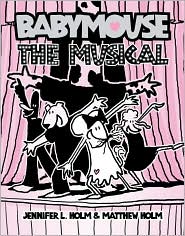
Babymouse: The Musical


Holm, Jennifer L. and Matthew Holm. 2009. Babymouse The Musical (#10). Random House. 94 pages.

I love Babymouse. I do. The Babymouse graphic novels are really great books for younger readers. (Each graphic novel can stand on its own. So don't worry about trying to read them all in a certain order.) What do you need to know about Babymouse? She's a mouse with a BIG imagination, and a lot of heart; she also is not so fond of math. Or Felicia Furrypaws for that matter.

In this one, Babymouse is persuaded--by the ever-so-cute, new student (Henry Higgins)--to try out for the school musical. She doesn't get the lead, but she does get the role of understudy. That's the short premise of this one.

This one is clever and witty and fun. It's not so much what happens as to how it happens. Throughout the book, Babymouse parodies some really great musical numbers. Some may be more familiar to readers than others. But I think all work well.

It would be hard to pick an absolute favorite scene, but I think the one--in math class--where Babymouse imagines herself at Rydell High comes close to perfection. (They sing "Tell Me More" only it's about math class and fractions.)

Tell me more
Tell me more
Did you study real hard?
Tell me more
Tell me more
Did you try the flash cards?

I definitely recommend this one!


© Becky Laney of Becky's Book Reviews

Monday, August 17, 2009

Weekly Geeks: Second Chances

This week's topic:
There have been times in my life where I reread a book (or author) I hated--or thought I hated--but the second time around ended up loving. Has this ever happened to you? Have you ever changed your mind about a book or author the second time around? Have you ever given a book or author a second chance?

If you have, I'd love to hear your stories. Blog about your experience(s) in giving second chances.

If you haven't, I'd like you to consider giving a book or an author a second chance. You can blog about your intentions to do so--or if you're a quick reader, maybe you can even squeeze something in!

Can't think of a single book or author? Don't worry, you can stretch this one to include movies or music if you prefer.

It is just very interesting to me how time can change tastes and perceptions. How subjective the reading experience is and always will be.

How I Came To Love A Monster, A Rambling Review of Mary Shelley's Frankenstein.

The True Meaning of Smek Day by Adam Rex. Glowing review (second review). Not so glowing review (first mini-review). One was written November 9, 2007...the second was written November 18th, 2007. Short amount of time between the two. But oh-such-a-difference those days in between must have made in my mood.

Octavian Nothing by M.T. Anderson (the first book). The oh-I-hate-it review from November 30, 2006. The oh-I-love-it-so-much-I-want-to-read-it-for-my-book-club review from October 24, 2008.

These books represent different 'cases' of why I gave a book a second chance:

  • Giving assigned reading from years-gone-by a second try. Hated a book (or author) when it was assigned to me in high school. Curious to see if my "adult" self will appreciate the book more. Frankenstein falls into this case. As does Silas Marner.
  • Series books. Didn't particularly care for the first book in the series, but for whatever reason, felt compelled to read the second. Octavian Nothing by M.T. Anderson is a good example of this. I needed to read the second novel, for Cybils purposes, and knew that I'd have to reread the first one in order to be fair. It'd been too many years since I'd read the first one. And I felt I would have a hard time picking up the story again. The Shadow Thieves is another good example of this. The link is for the newest review...here's the link for the first review.
  • Completing Abandoned Books. Sometimes I give abandoned/discarded books a second try. These are books that I've read some in. In the case of The True Meaning of Smek Day, I was only seventy-five pages from the end. But I was hating it so much, I stopped reading. About eight or nine days later, I revisited my decision. Couldn't I finish it? It wasn't that much further after all. Surely those last pages could be done quickly. But I found myself confused. When did this character get introduced? When did that happen? How did I miss that? After a few pages, I decided to start from the beginning. I was just looking to re-orient myself to the story, the characters. But I found that I couldn't put it down. I ended up loving it. Really loving it. I couldn't believe that this book that had annoyed and frustrated me so very much just a week or two before was now my new favorite. But it happened.

It's a bit scary (in a way) to realize how big a role moods can play in how much you like, love, or hate a book.

Now, I have read a small handful of books that didn't improve upon second reading. (Wuthering Heights comes to mind.)

Which book will I never, ever, ever reread no matter what? JUDE THE OBSCURE by Thomas Hardy.

© Becky Laney of Becky's Book Reviews