Showing posts with label Tor. Show all posts

Friday, November 16, 2018

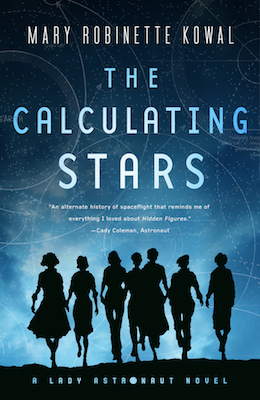
The Calculating Stars

The Calculating Stars (Lady Astronaut #1) Mary Robinette Kowal. 2018. Tor. 432 pages. [Source: Library]
First sentence: Do you remember where you were when the Meteor hit? I've never understood why people phrase it as a question, because of course you remember.

Premise/plot: The Calculating Stars is set in an alternate reality 1950s. There are two what-ifs. One is small. One is big. What if Dewey had won the presidential election instead of Truman? What if a meteor--an extinction event--had struck earth in 1952? The heroine of the book is a former WASP, a current computer for NACA, a wife of an engineer, Nathaniel York. Her name is Elma York and within Kowal's fictional universe she may be better known to the world as LADY ASTRONAUT.

In the weeks following he devastating event, Elma York realizes that the worst is yet to come. It's just a matter of time--mere decades--before the earth becomes uninhabitable. The earth will experience great climate change. The earth will begin to heat up and will keep heating up. If humanity is to survive, it needs to find a way to leave the planet. But can she--and her fellow scientists--convince the powers of the dangers? Or will politics get in the way? (For example, there are a few convinced that the meteor wasn't a meteor but something that originated from the Soviet Union. Yet another example, some are convinced that men should go into space and colonize--but only men. Don't they realize that women would be absolutely essential to any colony? How can you "save" the human race without women?)

The book is about the struggle to get men--and women--into space in an effort to save humanity. It won't be easy. There's the science and engineering aspect of it. There's also the political and social aspect. Issues of sexism and racism play a large role in the novel. It is interesting to consider how some things stay the same--in this alternate reality--and how other things change. (For example, the Soviet Union dissolves; the Korean war ceases; there is no space race between nations. The world comes together as one to solve the problem. Astronauts can come from all nations.)

My thoughts: I didn't love, love, love this one. In many ways it was a compelling read. I loved Hidden Figures. I do have an interest in the history of the space program. I enjoy science fiction. I found it interesting that our hero and heroine are Jewish. But two things kept me from loving it.

I prefer my fiction on the cleaner side. This one had profanity--blasphemy--and smut. Way too much detail is given about Elma and Nathaniel's intimate life. But even this isn't my number one complaint of the book....

My number one complaint is a technical one. Kowal consistently uses WASPs instead of WASP. WASP stands for Women Airforce Service Pilots. PILOTS plural. WASP is already plural--it never needs an S added to it. Never. Every time I saw WASPs in the text, it was like finger nails on a chalkboard. I am not sure how much Kowal actually researched the WASP. I think she spent her time researching other things. (She does have a bibliography, but she lists no books about the WASP.) There was also one place where she mentions a WASP delivering planes overseas during the war. This is not something WASP did. (I think she did this because it was a convenient way to have had two characters met in the past.)

I spent almost four years of my life editing and proofreading oral histories of the WASP. I read up on books about the WASP as job training (in addition to watching documentaries) and often read biographies and autobiographies as well. Writers would come to the special collections library and do research.

© 2018 Becky Laney of Becky's Book Reviews

Friday, February 10, 2017

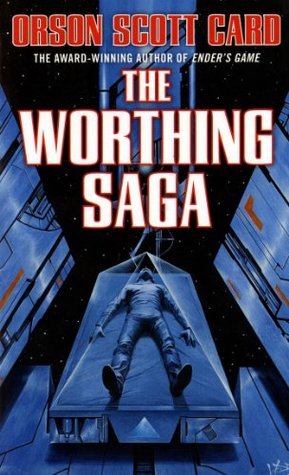
Worthing Saga

The Worthing Saga. Orson Scott Card. 1992. Tor. 463 pages. [Source: Bought]

First sentence: In many places in the Peopled Worlds, the pain came suddenly in the midst of the day's labor. It was as if an ancient and comfortable presence left them, one that they had never noticed until it was gone, and no one knew what to make of it at first, though all knew at once that something had changed deep at the heart of the world.

Premise/plot: Imagine living in a world where there is no pain, no suffering, no grief, no fear, no anger, no violence, no injury. Wrong actions, in a sense, have ceased to have consequences. If a person were to hurt himself/herself chopping wood or tending the fires, then there would be instant--almost magical--healing. Even morally wrong actions are prevented, on this world there are no children out of wedlock; and the child is always the husband's never the lover's if you're an adulteress. Yes, there is an occasional death, but never for the very young, never for the able-bodied. It is hard to imagine for us this life of easy contentment. A life with no struggles? A life truly worry-free? A world where fire doesn't burn you and ice doesn't freeze you? Surely there must be a catch, right? Some reason why this world isn't a perfect paradise...

The change came in the middle of the night. Imagine going to bed with everything being quite all right, and waking up to find that life is not what you thought it was. Pain. Grief. Suffering. Worry. Fear. Anger. And it wasn't just emotional, as the village learned. It was physical, too. As one accident after another occurred, the villagers soon realized that they could not only be hurt, but they could also DIE. With the whole village (and indeed the whole world) in confusion, no one knows quite what to think. Is God dead? If God is still watching over them, why then is there suffering? Why suffering after all these centuries of watchful care? Folks are going along muttering that God doesn't look out for them anymore.
The old clerk trembled and nodded and his voice quivered as he spoke. 'I have read the books of ancient times,' he began, and all eyes turned to him. 'I have read the books of ancient times, and in them the old ones spoke of wounds that bleed like slaughtered cattle, and great griefs when the living suddenly are dead, and anger that turns to blows among people. But that was long, long ago, when men were still animals, and God was young and inexperienced. (5-6)
Yes, no one understands this Day of Pain. Least of all, Lared, our young hero. But it is Lared who will become the chosen speaker that will write the story and tell the tales that will explain this Day and give it meaning. Two strangers come to the inn, the inn that Lared's parents own, and it is Lared and his sister, Sala, who befriend them. Jason. Justice. A man and woman. The two are mysterious, no doubt about it, and more than one person suspects that they're coming is linked with the Day of Pain.

The two share their stories mostly through dreams and waking visions. Jason will occasionally share one the old-fashioned way, but most are transmitted directly into Lared's mind. Lared doesn't know what to think. He doesn't like the dreams. He doesn't like the uneasy feelings they leave him with...but he also knows that he has been called, chosen, if you will, to write this down. To record them. It is not his place to understand everything, just to write it down as it's been given to him.

Lared and his village provide the framework for the stories that Jason and Justice share. It is a story of two men, one empire, and one powerful drug.

Abner Doon. A name that still strikes fear in people thousands of years after his death. Some even say that he was the devil himself. But was he really? His name is associated with death and destruction, and in some ways, it is easy to understand why. He caused the death and destruction of the EMPIRE. The very arrogant, often corrupt, very stagnant empire. But was the fall of the empire really that bad? Wasn't it better for humanity in general? Jason Worthing certainly thinks so.

Jason Worthing. Another name that people fear to speak aloud. Why? It is a name of reverence. Many people feel that Jason Worthing is God. The creator of life. The sustainer of the universe, even. But was he really? Yes, he had a hand in establishing life and building civilization, at least on one planet, but the creator of all life? No. Just an ordinary man with unusual psychic powers who came from a technologically advanced society.

The empire. It's not that the empire was completely evil. Sure the empire had its fair share of corrupt and power-hungry politicians. More than its fair share. Every branch of the empire had its corrupt officials. And there was nothing that couldn't be bought--as long as you had money. But that wasn't the real crime of the empire. The real crime was that humanity was being robbed of its very soul, its very essence. They had lost the point of living. They were corrupting the very nature of our existence.

Somec. Perhaps the most powerful drug the empire had ever known. What did it do? It put the user into a deep sleep, a coma, if you will. First, the user would have his/her memories downloaded or recorded, if you will, onto a tape or into a bubble. I forget quite how they did it. I just know that there was a way of downloading and uploading memory. Then the assistant would inject somec. It wasn't a pretty picture. It burned. It hurt. It caused severe physical problems--sweating, discomfort, pain--but the user would forever be unaware of it because the memories would never include this part of the experience. Who was it for? At first, it was just for starship pilots. Their skills would be needed throughout a long voyage. And if a trip took hundreds or perhaps thousands of years, then they'd need Somec to function. The computer would always be able to wake them up in case of an emergency. But they'd arrive at their destination intact. So for colonization vessels, it really couldn't be any better. A ship would carry three hundred or so passengers and all the supplies needed to create and establish a civilization on another planet. So there were a few valid uses of the drug, I suppose. But the real corruption began when somec became a common necessity for the people.

Imagine the possibility of immortality. Somec offered immortality. The wealthy. The elite. The powerful. The brilliant minds of society were all given the chance for immortality. The more valuable society deemed you, the longer you would sleep between waking cycles. The common people lived and died naturally enough. But a good portion of society, became obsessed with immortality. But is living a thousand years natural if you spend 70% of it or so asleep? What does it accomplish really? You're not able to have friendships with others unless you're on the same sleep cycle. You're not able to maintain family relationships either. People could theoretically outlive their great-great-great-great-great-grandchildren. Love becomes to a certain extent irrelevant. Most things become irrelevant. No time for the finer things in life. Love. Romance. Music. Art. For not only do most people spend most of their times asleep, what little time they're awake they're obsessed with power, money, fame, greed, control. They always want more, more, more. Never content. There is no longer any joy in living life. But really too few people notice what they're missing. Except for one. The aforementioned Abner Doon.

Abner "rescues" Jason, if you will, and offers him a chance to become a part of something great. Jason becomes a starship pilot, a very famous starship pilot, and he eventually leads a colonization ship. Abner's big plan--besides the fall of the Empire--is to recreate life as it used to be. His plan? To spread humanity throughout the galaxy. To have human civilizations sprout up on thousands of planets. He knows that with the fall of the Empire, with the fall of technology, it will be thousands upon thousands of years before ANY civilization becomes advanced enough for star flight. He sees this as a way for humanity to wipe the slate clean and begin anew.

The Worthing Saga is the story of Jason's planet. How Jason "fathered" or "created" that world. And what happened to its inhabitants. What happened to his descendants. All these stories--and there are many--span thousands of years. Everything is leading the reader back to Lared. Back to the Day of Pain.

The Worthing Saga contains the previously published The Worthing Chronicle and nine short stories.

My thoughts: The Worthing Saga is about the meaning of life. It is about what it means to be human. It asks important questions. It goes where few novels do. It asks what the meaning of pain and suffering is. It asks what the meaning of struggles are. It is ethical in nature. It asks the hard questions. But it is philosophical as well.

I love the world-building. I find the three settings within the book to be fascinating. (There is Lared's home planet which is the present-day setting; there is Capital, the planet from Jason Worthing's memory and stories, Capital becomes "real" to Lared as he experiences Worthing's memories through dreams; there is Worthing, the planet that Jason colonized with a handful of colonists thousands of years before the novel opens, again this planet becomes "real" to Lared as he experiences other people's memories through Justice, Jason's descendent.) Readers get a taste of all these societies and communities.

I love the characterization. I love getting to know Lared, Sala, Jason, and Justice. Not to mention all the men and women from the memories and stories. (I have a soft spot for Hoom.) I love the storytelling. I love the dialogue. I love how everything is layered together. How the story all comes together. How Lared slowly but surely pieces things together and comes to understand--if understand is the right word--the world. Card's characters are so very human, so vulnerable, so fallible. Readers see humans at their best and at their absolute worst within The Worthing Saga. Moments of compassion and redemption make it so worth while.

I love the ideas. I love the depth and substance. That is not to say that I agree absolutely with every single philosophical idea within the book. But it goes places most fiction doesn't. It asks real questions, tough questions. It explores ideas. One also sees the consequences (or possible consequences) of ideas.


© 2017 Becky Laney of Becky's Book Reviews

Tuesday, July 07, 2015

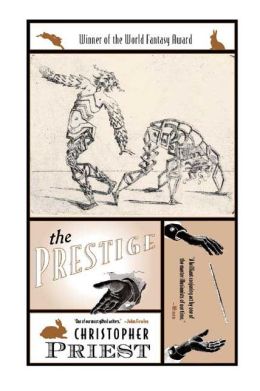
The Prestige

The Prestige. Christopher Priest. 1995/1997. Tor. 360 pages. [Source: Library]

It began on a train, heading north through England, although I was soon to discover that the story had really begun more than a hundred years earlier. 

I saw the movie first. I think there are some benefits to having seen the movie first. It's impossible not to compare the two--the book and the movie--especially since I finished the movie and rushed to put the book on hold at the library. So this "review" will talk about both the book and the movie. I will try my best to keep it spoiler free, especially the opening paragraphs!

The book is different than the movie. The book has a contemporary framework. Andrew Westley, the narrator, has received a magic book from a stranger, the hint being that it was written by one of his ancestors, an Alfred Borden, a Victorian magician. Andrew was adopted, and he knows nothing at all about his Borden relatives. He's manipulated into meeting a woman, Kate Angier. She has much to tell him, for, she believes him to be Nicholas Borden. The two met when he was three, just before he was adopted. He, of course, remembers nothing. And the idea that there is a historic feud between the Borden and Angier families doesn't really intrigue him all that much. But he stays to hear her out.

The book consists of several stories: Andrew's story, Kate's story, Alfred Borden's autobiography, and Rupert Angier's diary. (Andrew's narration opens and closes the novel.) By the end of the book, a fantastic, strange story has been told.

At its simplest here is the plot: Alfred Borden and Rupert (Robert) Angier are rival magicians ever in competition with one another to be the best, to be recognized as being the best. Both the book and the movie convey this. It is HOW it is conveyed that allows for such big differences between the two.

The movie is more dramatic than the book. It makes the rivalry more intense, more personal, more life-and-death. From start to finish the movie is all about REVENGE and LOSS and doing WHATEVER it takes. The book is quite different. For example, in the movie, Angier blames Borden for the death of his wife who drowned during a performance in a water tank. In the book, however, Angier becomes angry with Borden when Borden disrupts his seance and reveals him to be a fake spiritist. Quite a difference! Especially since the "loss of family" angle is huge in the movie. But in the book, Angier has a family: a wife and three children, I believe. That is the only difference I'll mention in the review since I do want it to remain mostly spoiler free.

The Prestige has plenty of twists and turns in the plot. Especially the movie. But also in some ways the novel. Though if you've seen the movie, then, the book will be essentially spoiled. I think you could say the same if you'd read the book first: the movie would be spoiled.

Which did I prefer? I enjoyed both. I did. I really enjoyed the movie. I thought it was great. I watched it twice in one week. I read the novel in one day. There were sections that were quite compelling. My favorite probably being Alfred Borden's autobiography. And then perhaps Angier's diary. I wasn't as drawn to the contemporary story of Kate and Andrew. Though it does intensify the creepy factor greatly. The Prestige would be PERFECT to read for Carl's R.I.P. challenge in the fall.

Have you seen the movie or read the book? Did you like it? love it? hate it? I'd love to know what you thought of it. If you've seen the movie and read the book, which would you recommend first to others?


© 2015 Becky Laney of Becky's Book Reviews

Friday, October 17, 2014

Reread #42 The Eye of the World

The Eye of the World (Wheel of Time #1) Robert Jordan. 1990. Tor. 814 pages. [Source: Bought]

The Wheel of Time turns, and Ages come and pass, leaving memories that become legend. Legend fades to myth, and even myth is long forgotten when the Age that gave it birth comes again. In one Age, called the Third Age by some, an Age yet to come, an Age long past, a wind rose in the Mountains of Mist. The wind was not the beginning. There are neither beginnings nor endings to the turning of the Wheel of Time. But it was a beginning.

The Eye of the World is the first in Robert Jordan's Wheel of Time series. I first reviewed this one in October 2012. I thought the book was promising, that it had great potential. As the first book in a long series, it also serves as an introduction. An introduction not just to the world or to the main characters, but an introduction to the writing style: the details, the descriptions, the narration, the foreshadowing. It also hints at the complexity. Hints. (If you think there are a lot of names--both people and place--to keep up with in the first book, then you should know it only becomes more challenging in later books. It isn't necessarily good or bad that this is so. It just is.)

To keep it very simple, The Eye of the World is a coming-of-age adventure-quest story. It is all about the journey, or, you could just as easily say it is all about the chase. Eye of the World is essentially setting the stage for a big battle between the forces of good and evil.

The Eye of the World introduces readers to a handful of characters. Three young men who could potentially change the world for better or worse: Rand, Perrin, and Mat. Two young women who follow them into danger: Egwene and Nynaeve. Both have significant roles to play in the books ahead. Neither really steal the show in this first book. We learn that both women are able to touch the True Source (One Power) though they've not received training. Both women intrigue Moiraine, the Aes Sedai who has promised to protect them all--to the best of her ability. She knows that the Dark One seeks to destroy these three men, and quite possibly all those that stand in his way. Moiraine and Lan, her warder, will do what they can but they know it will be a continual struggle, a challenge, to stay a step or two ahead of the evil that pursues them.

There are also other characters introduced in this book that I'd like to mention. I love, love, love Loial. He's introduced relatively late in this one. But I adore him! He's an Ogier. There is also Thom Merrilin. He's a gleeman--an entertainer, storyteller, musician, juggler, etc. He travels with this group at the very beginning. There's also a young girl, Min, who is able to a certain degree to see the future. Readers also briefly meet Elayne, Gawyn, and Galad. And Queen Morgase. And the queen's Aes Sedai, Elaida.

It had been two years since I'd read this one. It was interesting to see what I remembered, and what I'd completely forgotten. I liked this one very much upon rereading. I enjoyed so many things about it still.

Quotes:
Not more than twenty spans back down the road a cloaked figure on horseback followed them, horse and rider alike black, dull and ungleaming. It was more habit than anything else that kept him walking backward alongside the cart even while he looked. The rider’s cloak covered him to his boot tops, the cowl tugged well forward so no part of him showed. Vaguely Rand thought there was something odd about the horseman, but it was the shadowed opening of the hood that fascinated him. He could see only the vaguest outlines of a face, but he had the feeling he was looking right into the rider’s eyes. And he could not look away. Queasiness settled in his stomach. There was only shadow to see in the hood, but he felt hatred as sharply as if he could see a snarling face, hatred for everything that lived. Hatred for him most of all, for him above all things.
He was hoping his father had not noticed he was afraid when Tam said, “Remember the flame, lad, and the void.” It was an odd thing Tam had taught him. Concentrate on a single flame and feed all your passions into it—fear, hate, anger—until your mind became empty. Become one with the void, Tam said, and you could do anything.
Strangers and a gleeman, fireworks and a peddler. It was going to be the best Bel Tine ever.
Aes Sedai and wars and false Dragons: those were the stuff of stories told late at night in front of the fireplace, with one candle making strange shapes on the wall and the wind howling against the shutters. On the whole, he believed he would rather have blizzards and wolves. Still, it must be different out there, beyond the Two Rivers, like living in the middle of a gleeman’s tale. An adventure. One long adventure. A whole lifetime of it.
“What kind of need would be great enough that we’d want the Dragon to save us from it?” Rand mused. “As well ask for help from the Dark One.”
“I still think you shouldn’t come,” he said. “I wasn’t making it up about the Trollocs. But I promise I will take care of you.” “Perhaps I’ll take care of you,” she replied lightly. At his exasperated look she smiled and bent down to smooth his hair. “I know you’ll look after me, Rand. We will look after each other. But now you had better look after getting on your horse.”
The Aes Sedai you will find in Tar Valon are human, no different from any other women except for the ability that sets us apart. They are brave and cowardly, strong and weak, kind and cruel, warm-hearted and cold. Becoming an Aes Sedai will not change you from what you are.
But hope is like a piece of string when you’re drowning; it just isn’t enough to get you out by itself.

© 2014 Becky Laney of Becky's Book Reviews
Thursday, August 07, 2014

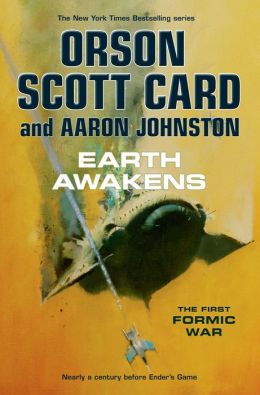
Earth Awakens (2014)

Earth Awakens. Orson Scott Card and Aaron Johnston. 2014. Tor. 400 pages. [Source: Library]

I enjoyed reading Earth Awakens the third in a new series by Orson Scott Card. At first, I had a hard time reconnecting to all the characters because it's been a year since the last book. There are many characters to keep up with after all. But by the time I was halfway through this one, I was hooked once more. I liked the characters. I didn't always like how they acted. But Card can write flawed characters that I actually like.

In this third book, all the characters are trying to fight the Formics. Some are working together officially to defeat the aliens. Others are more on their own with their own plan. For example, some characters are fighting them on earth; other characters are fighting them in space. But by the end of this one, all the characters stories have merged into one which is probably for the best.

Series books are always so difficult to review because to talk about plot reveals spoilers from the other books. But essentially I liked this one. Maybe not love, love, love but a good, solid like.

© 2014 Becky Laney of Becky's Book Reviews
Friday, August 30, 2013

Solstice (2013)

Solstice by P.J. Hoover. 2013. Tor. 384 pages. [Source: Review Copy]

Solstice hints at being a dystopian novel, but, in truth it is a retelling of a Greek myth. It is set in the future in a devastated world, a world with endless summer and no changing seasons. For eighteen years, the world has suffered tremendously, Piper, our heroine, has never known the world to be any different.

Solstice won't please every reader. Some readers find romance-driven dystopias to be sickening--especially when there are two men madly in love with the same young woman, when it appears that she cannot make up her mind. I can see why Piper might annoy some readers. The author offers readers an excuse, some might see it as completely valid, others might dismiss it.

The two men in Piper's life are Reese and Shayne. Reese is the son of a councilmen. He encourages Piper to break the rules set by her mother, and the two share a memorable first date. Piper has a busy night, however, for that is also her first date with Shayne, a classmate. She finds both men completely irresistible. Though she never really has a second date with Reese, he's never out of influence.

Shayne fascinates Piper, and she loves seeing where he lives...how he lives...though some of what she learns she finds unsettling at times.

Greek mythology is at the heart of this YA romance. It worked for me at times, though not ever  perfectly.   

© 2013 Becky Laney of Becky's Book Reviews

Saturday, December 22, 2012

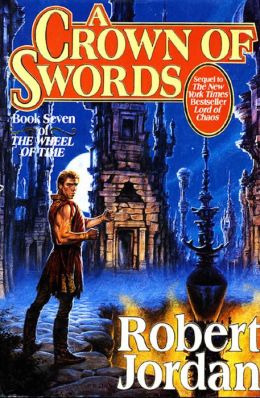
A Crown of Swords

A Crown of Swords. Robert Jordan. 1996. Tor. 896 pages.

I enjoyed A Crown of Swords more than Lord of Chaos. (Though Lord of Chaos had a few GREAT scenes in it.) I took my time with A Crown of Swords knowing that if I forced myself to stick to a certain pace, I wouldn't enjoy it as much. I wanted to want to keep reading this one--not out of obligation, not out of a need to get to the next book, but for the enjoyment of taking it one book at a time, one story at a time, one character at a time.

One of the reasons I didn't feel connected to Lord of Chaos were the ever changing perspectives. A Crown of Swords visits many characters, provides many points of views, follows dozens of stories. But the changes from one to the other flowed much better in my opinion. We'd spend several chapters with Rand, then spend several chapters with Mat, etc. I feel we got to spend at least a  little time with (almost) all the characters. We did get to spend more time with Mat and Min in this book. Min being friendly with Rand. Mat keeping an eye on some of the Aes Sedai (Nynaeve, Elayne, etc.) I still don't feel we get to spend enough time with all the characters. There are some favorites of mine which I'd love to follow more closely.

Several things happen in this one, though, I admit things happen very slowly except for when they don't. Some changes happen quickly, others seem to take several books to give the appearance of budging.

This book isn't as satisfying perhaps as earlier books in the series, but, I still was happy to spend time reading it. 

Read A Crown of Swords
  • If you enjoy LONG fantasy series that move at their own leisurely speed
  • If you love world-building in fantasy novels
  • If you've enjoyed previous books in this series. This is #7.

© 2012 Becky Laney of Becky's Book Reviews
Saturday, October 20, 2012

The Great Hunt

The Great Hunt. (Wheel of Time #2) Robert Jordan. Tor. 600 pages.

A few weeks ago I read The Eye of the World the first book in Robert Jordan's Wheel of Time series. I loved it. I loved the promise of it especially. From the start, I felt it was going to be a just-right series for me, that it was going to have characters that I could love and appreciate. The Great Hunt was a great second book. Perhaps the second-half wowed me more than the first half, but, I definitely reached a place where the book became wonderfully intense and almost magical. The Great Hunt features some of the same characters as the first book, but it also introduces a few new characters. And this second book has the characters on somewhat separate journeys.

The men (Rand, Mat, Perrin) join soldiers on a mission to find the Horn of Valere. The women (Egwene, Nynaeve, Elayne) begin their studies at the White Tower in Tar Valon; Nynaeve undergoes a test and becomes Accepted while Egwene and Elayne are novices still. The second half of the book truly focuses on these three characters--and Min--and these chapters were easily my favorite!!! There are three women--Min, Egwene, and Elayne--who have interest in Rand and his uncertain future. All are concerned about where his journey will take him--now and in the future. Will his "destiny" lead to madness and destruction? Can he be saved? '

In The Great Hunt, I felt the story truly begins. I continue to love the series so far.

Read The Great Hunt
  • If you've read and enjoyed The Eye of the World
  • If you enjoy fantasy and adventure
  • If you like world-building and storytelling  
© 2012 Becky Laney of Becky's Book Reviews

Tuesday, October 16, 2012

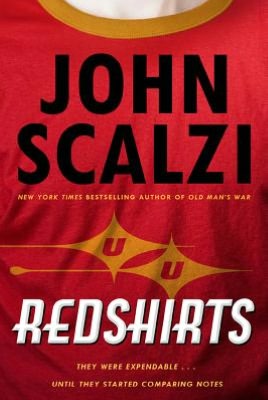
Redshirts

Redshirts. John Scalzi. 2012. Tor. 320 pages.

Redshirts is definitely a quick read. And it was fun in places, I admit. It definitely had a fun and playful premise. There were a few scenes that I enjoyed very much, but then there were a couple of scenes that disgusted bothered me. The premise was interesting and would probably make this one a good read no matter what. But I found the characterization a bit uneven, and there were a few characters that I just did NOT like at all. I really liked the hero, Andrew Dahl, and I enjoyed spending time with him. But unfortunately, I didn't like the company he kept. One friend really irritated me. I hated every conversation and scene with this one person.

I wish this one had been a cleaner read. So much of the adult content was completely needless in my opinion. I do think others will enjoy this one more than I did. 


Read Redshirts
  • If you like Galaxy Quest and/or Star Trek 
  • If you like science fiction
  • If you like (adult) humor
  • If you're a fan of John Scalzi

© 2012 Becky Laney of Becky's Book Reviews
Saturday, October 06, 2012

The Eye of the World

The Eye of the World (Wheel of Time #1) Robert Jordan. 1990. Tor. 814 pages. 

Perhaps I was just in the perfect mood for The Eye of The World, or maybe it's just that good. I do know that it was an experience. I read this one in just three days!!! I knew within a chapter or two that this one was just right for me, one that I'd really enjoy through and through. I enjoyed the world-building, the characterization, the storytelling, and, of course, the quest and adventure. If you don't like quests or journeys, or heroes-in-the-making setting out for long, uncertain journeys then perhaps this one wouldn't thrill you.

Three young men (Rand, Mat, and Perrin) are escaping danger and setting forth on a very dangerous journey with a couple of strangers (Moraine and Lan) whom they have reason both to trust and mistrust. On the one hand, Moraine has proven herself by helping to heal the wounded in Two Rivers after a devastating Trolloc attack. She saved Rand's father, Tam, when no one else would even try. So Rand, at least, owes her something. And she is trying to save all their lives--she knows all three are in great danger. On the other hand, Moraine is Aes Sedai, and Lan is her Warder. There has never been a story or tale told where Aes Sedai are good and trustworthy and safe. Also along for the journey are Egwene, a young woman who cares for Rand deeply, and Thom Merrilin, a gleeman--entertainer, storyteller, musician, etc. They are also joined by Nynaeve, a young woman, the local Wisdom, intent on one thing getting all three men back where they belong: Two Rivers.

There is definitely a good amount of uncertainty, mystery, and danger in The Eye of the World. Danger comes in many, many shapes and sizes. And there's plenty of action along the way leading up to some intense chapters at the end. I enjoyed it for the journey just as much as the end. I enjoyed the narrative style, for the most part.

I definitely LOVED it.

Read The Eye of the World
  • If you enjoy fantasy
  • If you really enjoy fantasy
  • If you like coming-of-age, going-on-a-quest fantasy
  • If you like world-building and storytelling

© 2012 Becky Laney of Becky's Book Reviews

Tuesday, April 24, 2012

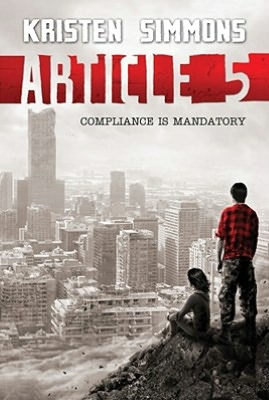
Article 5 (YA)

Article 5. Kristen Simmons. Tor. 368 pages.

Beth and Ryan were holding hands. It was enough to risk a formal citation for indecency, and they knew better, but I didn't say anything. Curfew rounds wouldn't begin for another two hours, and freedom was stolen in moments like these.

If you enjoy YA dystopias, then you should give Kristen Simmons' Article 5 a try. There's no guarantee that you'll love it or even like it. You may not even want to finish it. But. I think it's worth trying for yourself--especially if your library has a copy. There are so very, very many dystopias available now that it is easy to tire of them. You do have to be in the proper mood to enjoy a dystopia, and if you're already tired of the genre, well, give it time--plenty of time. It's better to wait and get back in the mood than to push it.

And if romance annoys you, well, Article 5 may be one that you're never in the mood to read. BUT. That isn't a bad thing. I am not against *some* dystopias having *some* romance. I'm just of the opinion that the romance should be natural, should feel authentic and not forced. Romance should never, ever, ever be a requirement for dystopian novels. And when 90% of the focus is on romance and only 10% given over to world-building, well, it can get annoying very quickly. If you LOVE romance, then there shouldn't be a problem with Article 5. (Though I'm not saying that every reader will love this hero and heroine.)

I honestly don't know how I feel about Article 5. So I'll stick with what I do know. Article 5 was not a painful read. I read it in two days. And it was, for the most part, an easy read. It was a book that I definitely wanted to finish. And at the end of it, I didn't regret my time. But did I like it enough to say that I liked it? I'm not sure. Ember, our heroine, was an odd heroine. She didn't seem all that smart. And some of her rigid ideas of right and wrong seemed a little out of place considering the world she lived in. I can't really give an example without spoiling the book. But when you're trying to survive, fighting to live, and there are people hunting you down, people who are very brutal, who wouldn't hesitate to shoot you dead no questions asked, then you shouldn't be lecturing your boyfriend on how he was wrong to use violence to protect you from being raped and possibly killed. You just shouldn't. There were a couple of scenes where Ember was just impossible to like, impossible to understand. Chase is the boyfriend that she has a love/hate relationship with. (She feels she always knows what is best, what is right, what they should do, how they should do it, even though Chase has way, way, way more experience in dealing with the real world.)

Read Article 5
  • If you enjoy YA dystopias, YA science fiction
  • If you like YA romances
  • If you like action/survival novels
© 2012 Becky Laney of Becky's Book Reviews
Thursday, February 03, 2011

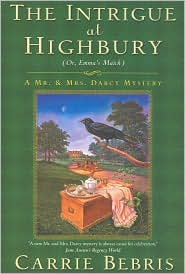
The Intrigue at Highbury

The Intrigue at Highbury: Or, Emma's Match. Carrie Bebris. 2010. Tor. 317 pages.

Emma Woodhouse Knightley, handsome, clever, and rich, with a comfortable home and happy disposition--a happiness recently compounded by her marriage to a gentleman of noble character and steadfast heart--seemed to unite some of the best blessings of existence; and had lived nearly twenty-two years in the world with very little to distress or vex her.
With two notable exceptions: the Reverend and Mrs. Philip Elton.

I loved this one. I just LOVED it. Every time I pick up a Mr. and Mrs. Darcy mystery novel, I think I've found it, the one that I love above the rest. And such is the case with The Intrigue at Highbury. In this fifth mystery, Mr. and Mrs. Darcy find themselves at Highbury, the victims of gypsies! While most of their belongings are safe, they've lost two very precious heirlooms: a christening gown (soon to be needed for Anne Fitzwilliam) and a ring.

They seek the local magistrate--who happens to be Mr. George Knightley. Problem is, Mr. Knightley has concerns of his own. He was hosting a dinner party, a special celebration in honor of the recent marriage between Frank Churchill and Jane Fairfax. And in the middle of the party, Frank's uncle, his adopted father, dies. The cause of death is suspicious at best. The local apothecary, Mr. Perry, feels he was poisoned. But who is the murderer? Frank Churchill, no doubt, has the greatest motive, but is he capable of the crime?

This one is told through multiple narrators. I equally loved Emma Knightley and Elizabeth Darcy. Carrie Bebris completely redeemed my perception of Jane Austen's Emma. I loved how Austen's original characters are depicted in this one. I loved seeing the "feud" between Emma and Mrs. E continue! I loved Emma's growth--how tender she is with Miss Bates now. And, of course, I loved Bebris' depiction of Elizabeth and Darcy. It felt so natural, so right, for Mr. Darcy and Mr. Knightley to become friends so quickly. As I said, I loved this one. I just LOVED, LOVED, LOVED it.

See also: Pride and Prescience, North by Northanger, The Matters at Mansfield.

© 2011 Becky Laney of Becky's Book Reviews
Thursday, January 20, 2011

The Lost Gate (YA/Adult)

The Lost Gate. Orson Scott Card. 2011. January 2011. Tor. 384 pages.


Danny North grew up surrounded by fairies, ghosts, talking animals, living stones, walking trees, and gods who called up wind and brought down rain, made fire from air and drew iron out of the depths of the earth as easily as ordinary people might draw up water from a well.

I enjoyed The Lost Gate. It's a fantasy novel with mythological elements. Danny North is from one of powerful families--former gods, you might say--cut off for centuries from their home-world. But he's not the family's greatest hope--far from it. He's grown up being less-than. His aunts, his uncles, his cousins, his parents, everyone in his life has a gift, a calling. But Danny? Well, he runs fast and he's smart when it comes to book-learning, to languages especially. Not exactly magical, is it?

But Danny is about to learn just how special he is when the novel opens--and this knowledge puts him in great danger. He can't go home again--for the truth--if revealed--will lead to his death. So how does a young boy (12 or 13) survive in the real world? A world he's been kept separate from? How fast can Danny learn the necessary skills to survive? He won't be alone for long, but when there are people who want you dead, it's not easy to know who to trust.

Speaking of trust, there is a second story within The Lost Gate. Readers aren't quite sure (exactly) how these stories connect since they seem to be disconnected--separated by great time or distance.

The Lost Gate is a fantasy novel. Orson Scott Card crafts a new world (or two) within The Lost Gate. He's peopled the 'real' world with some fantastical beings--some more obvious than others. I enjoyed the world Card has created. I'm not sure I "love" this new world yet. But. I can say that The Lost Gate kept me reading. I found it compelling, enjoyable, satisfying. The time I spent with the book was happy. It felt right to be reading Card again.


© 2011 Becky Laney of Becky's Book Reviews
Tuesday, January 18, 2011

The Matters at Mansfield

The Matters at Mansfield: Or The Crawford Affair. A Mr. & Mrs. Darcy Mystery. Carrie Bebris. 2008. Tor. 288 pages. 

It is a truth less frequently acknowledged, that a good mother in possession of a single child, must be in want of sleep. 

Who has killed Henry Crawford, and why should Elizabeth and Darcy care?! In The Matters at Mansfield, readers see a different side of Anne de Bourgh, the 'weak' daughter of Lady Catherine. With a little encouragement from Elizabeth Darcy, Miss de Bourgh has decided to follow her heart and disobey the command of her mother. For better or worse. Literally. The book sees Anne running away with her lover! Who's her lover? Three guesses! The scoundrel from Jane Austen's Mansfield Park, Henry Crawford. Has Carrie Bebris redeemed Mr. Crawford? Read for yourself and see all the excitement unfold...you can imagine, no doubt, what Lady Catherine will make of this affair...

I am just LOVING these mystery novels by Carrie Bebris. I love the writing, the style, the language, the witty dialogue, the just-right characterizations. I would definitely recommend these books! They are so well-written.

See also: Pride and Prescience and North by Northanger.

© 2011 Becky Laney of Becky's Book Reviews

Saturday, December 18, 2010

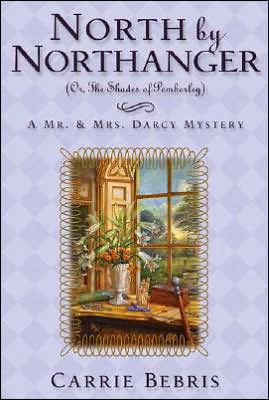
North by Northanger

North by Northanger: Or, The Shades of Pemberley. A Mr. & Mrs. Darcy Mystery. Carrie Bebris. 2006. Tor. 320 pages.

Less than a year into the marriage that made her mistress of one of England's finest houses, Elizabeth Darcy knew she still had much to learn about the place she now called home. Of one thing, however, she was certain. A ghost haunted Pemberley.
She was not a ghost in the traditional sense. She did not moan, or shriek, or rattle chains. She did cause rooms to grow cold, objects to fall, or fires to sputter. She did not manifest at midnight to pace on creaking floorboards, visiting in death the rooms she had occupied in life.
Yet the continued presence of Lady Anne Fitzwilliam Darcy was as real and pervasive as that of any spectre.

I definitely enjoyed Pride and Prescience, the first in Carrie Bebris' series of mysteries starring Elizabeth and Darcy. Sadly, my library does not have the second volume in this series, Suspense and Sensibility: Or, First Impressions Revisited, so I was unable to read it. (Though based on B&N's description, it unites characters from Sense & Sensibility with Pride and Prejudice. Specifically a Bennet sister with a Dashwood cousin.) But. I was delighted to pick the third one up!

Elizabeth is pregnant with their first child. And while she's not as nervous as her husband, she's not completely anxiety free. Distractions exist to keep her mind off of upcoming labor, however. She discovers a letter from Darcy's mother. It's addressed to her, to Mrs. Fitzwilliam Darcy. It was written the day of Lady Anne's death--the day Darcy's sister was born. She speaks of a charm, a statue, that she has hidden but could not find in her time of need. Something that she hoped would protect her and her unborn child. Elizabeth shares this with her husband, of course, and one mystery begins.

It is a mystery that will--for better or worse--lead them to Northanger Abbey and the questionable Tilney family.

This one is a mystery. It is intense in places--as Darcy is charged with a crime he did not commit. But it is also a charming read with plenty of wit and humor. In part, because Lady Catherine is (by necessity) on an extended visit to Pemberley (until Darcy's trial can be held). Can Elizabeth tolerate Lady Catherine during these difficult months? Can she tolerate her "advice"? Can she work with her husband to prove his innocence?

I enjoyed spending time with these characters. I'm still loving Bebris' interpretation of Darcy and Elizabeth. Still finding her characters, and her stories satisfying.

© Becky Laney of Becky's Book Reviews

Thursday, December 16, 2010

Pride and Prescience

Pride and Prescience: Or A Truth Universally Acknowledged. A Mr. and Mrs. Darcy Mystery. 2004. Tor. 288 pages.

On the day Miss Elizabeth Bennet wed Mr. Fitzwilliam Darcy, she did not mind dividing with her elder sister, Jane, the notice due a bride. Indeed, she had been delighted when Jane chose to marry Mr. Charles Bingley in a double ceremony. It seemed only right that two sisters and two men who were themselves particular friends should all embark on their new lives together, and she hoped the event presaged many happy hours spent in each other's company in the years ahead.
Elizabeth did mind, however, sharing the stage with Mr. Bingley's sister Caroline.

I wouldn't exactly say I loved this one. As in love, love, love. But I did enjoy this one. I was surprised by how much I enjoyed this one. Because whether it is a truth universally acknowledged or not, most Austen sequels have a difficult time in successfully capturing the characters and narrative style of Austen's original novels. (A good many exist purely as an excuse to write in great detail of intimacies between the couples.) Carrie Bebris's Elizabeth and Darcy were well done. Their conversations felt right. The chemistry between them felt right. (Not over done, not explicit. Yet you knew they were deeply in love.) It was just delightful to spend time with these two.

This novel begins with the wedding of Jane and Charles and Elizabeth and Darcy. Elizabeth is unhappy that Caroline decided to use this gathering as a chance to make a big announcement: she's getting married to a wealthy American, Mr. Parrish. They're getting married in a week. And, of course, Elizabeth and Darcy feel obligated to attend. Despite the fact that they hoped to be on their way to Pemberley by then. A trip that keeps getting postponed time and time again. For better or worse, these two have a difficult time escaping the company of Caroline and her new husband! And that is where the mystery begins...


At the first, it seems that Caroline (Bingley) Parrish is the target. But. The Darcys soon realize that the threat includes the whole Bingley family. Can Elizabeth and Darcy solve this mystery in time?

I enjoyed many things about this one. I enjoyed spending time with these characters. I liked how Bebris developed Austen's original characters--Caroline Bingley, Charles, Jane, Elizabeth, Darcy, etc. I liked her new characters too. Even the "bad guys" felt properly developed. I will definitely be interested in reading more Mr. and Mrs. Darcy mystery novels.

© Becky Laney of Becky's Book Reviews
Monday, December 13, 2010

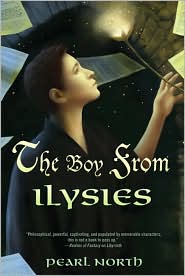
The Boy From Ilysies (YA)


The Boy From Ilysies. Pearl North. 2010. Tom Doherty Associates. 320 pages.

Po had offended the Princess of Ilysies. 

I didn't enjoy The Boy from Ilysies as much as I enjoyed the first novel, Libyrinth. Perhaps because this novel is told from a different perspective. I found Haly's "gift" of reading books to be charming. I loved reading all the bookish quotes. I particularly enjoyed how The Diary of A Young Girl was incorporated into the plot. It was just an interesting premise, an interesting world--a complex world peopled with many cultures.

The Boy From Ilysies occurs after "the redemption." Po, our narrator, isn't the only Ilysian who has chosen to remain in the new community of Libyrinth, but he is the only male. He struggles (to put it mildly) to find a place within the community. He has a way of easily offending others, and a way of being easily offended by others. Po is a sensitive guy who cries and cries and cries...but at the same time, a guy who can't resist a fight. There are many who just don't understand him. At all. How he can be weak and strong at the same time.

Part of this is culture clash. Readers are told about how Ilysian males are trained to be consorts. They're trained to serve women, to fulfill women's needs and desires. Women are to be respected, honored, admired, loved, served, etc. So Po sees many invitations--some intended, some not--in small things. (If a woman says she's tired and going to go take a bath, then that's an "invite" for company.) He's NOT in Ilysia anymore. And he's not learned enough about the world to really survive or function.

This novel is more about politics, gender roles, culture clashes, sexuality, etc., than the first novel. The community is still being threatened by various groups--including the Queen of Ilysia. Not all are happy about this so-called "Redemption." So there are still adventures to be had, and dangers to be faced.

© Becky Laney of Becky's Book Reviews

Sunday, November 21, 2010

Libyrinth (MG/YA)


Libyrinth. Pearl North. 2009. Tor. 336 pages.

The wind howled and the flames roared, but the books, as they died, merely fell silent.

I enjoyed Pearl North's Libyrinth. Haly, one of our two heroines, is a young girl with a great gift--a secret gift. The books talk to her. Without opening a book, she can "read" the pages within--the words on the page being a voice in her mind. Haly is a Libyrarian--or on her way to becoming one at any rate. Clauda, our second heroine, is a servant who sees and hears much. Some might even call her a gossip. But she brings word to both Haly and Selene of the danger to come. The threat that the Eradicants--the book burners--pose.

Haly is about to get a chance to know the Eradicants well. For she is captured, but even as a prisoner she holds some power over her captors. But this is one you should read on your own. I'm afraid of saying too much.

I really enjoyed this one. I enjoyed the world the author created. The different cultures. Their strengths and weaknesses. I enjoyed the style--how Pearl North incorporates books within her work. Her use of quotes was fun!
After the burning, Haly fled to the maze of bookshelves beneath the Libyrinth, to the books that had not been burned. "Two houses, both alike in dignity"; "He was just a country boy"; "In a hole in the ground there lived a hobbit." The multitude of familiar voices comforted her even as she grieved those she'd lost. (13)  
She does provide readers with a list of books she quoted throughout the novel. I liked the characterization too. I didn't quite love it--but I'd definitely still recommend it!

© Becky Laney of Becky's Book Reviews
Sunday, April 25, 2010

Enclave


Enclave by Kit Reed. 2009. Tor. 368 pages.

Departure Day. It's almost time. Gangplank up, repel all boarders. Destination: the last safe place.

Where to start? Sargent, one of our narrators, has started Clothos Academy. He is claiming it is the last safe place on Earth for our children. For the right price, of course, parents can rest assured that their child will be safe come what may. The world may end tomorrow, but this Academy on the top of a mountain, can withstand anything. Or so he claims. But is he really doing it for the children? And is the world really on the brink of destruction?

The Enclave has multiple narrators. This can be hit or miss with me. I don't always appreciate novels with that approach. But with The Enclave I think it works. I liked seeing the different perspectives. Because the truth is this isn't one person's story to tell.

One of my favorite characters was Killer Stade. He was one of the reasons I kept reading. He is one of the teens being "saved" in these end times. And I thought his voice worked a bit better than some of the adult ones.

The Enclave had an interesting premise. I picked it up thinking it was one thing, and while it wasn't quite what I expected, I don't regret reading it. But. I had some issues with this one. I thought the ending was a bit rushed, a bit fragmented. The epilogue didn't quite work for me.


© Becky Laney of Becky's Book Reviews