Showing posts with label books reviewed in 2013. Show all posts

Tuesday, December 31, 2013

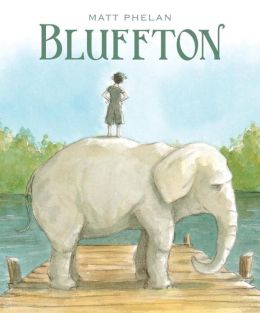
Bluffton (2013)

Bluffton: My Summer with Buster Keaton. 2013. Candlewick Press. 240 pages. [Source: Review Copy]

Bluffton is a graphic novel with a historical setting (1908-1910?). The book focuses on the summer vacations of a young Buster Keaton. These special summer days are told not from his point of view, however, but from a local boy named Henry Harrison who absolutely idolizes the show people.

Henry Harrison is thrilled when a troupe of vaudeville performers settles down to summer near Muskegon, Michigan. There are boys his own age among the troupe. One of these boys is Buster Keaton. Henry had not heard of Buster before, but he becomes mesmerized by his new friend. Buster? Well, he enjoys clowning around and making the local folk laugh now and then, but, mainly he wants to play ball. He wants to play, have fun, relax. He's shown as wanting to pack a whole summer into each and every day. I got the impression that Henry didn't really see things clearly; he saw what he wanted to see: the glamor, the wow.

The story of several summers (and winters) are told through art and dialogue. An epilogue informs readers of Buster Keaton's transition from stage to film.


© 2013 Becky Laney of Becky's Book Reviews

Monday, December 30, 2013

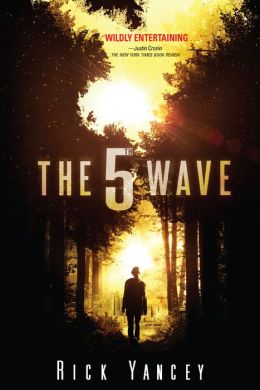
The 5th Wave (2013)

The 5th Wave. Rick Yancey. 2013. Penguin. 457 pages. [Source: Review copy]

The 5th Wave is probably one of the best books I've read this year. It is definitely one of the best science fiction novels I've read this year. Alien Invasion. That alone may be enough to draw some readers in, though I know it won't be enough to draw all readers into this oh-so-compelling story of survival.

The 5th Wave is an intense sci-fi thriller. There are multiple narrators, perhaps with Cassie being the 'main' narrator. Each voice adds something to the book. Together the story they tell is quite unforgettable.

If Cassie has learned one thing since it happened, she's learned not to trust another soul, to see every single person--no matter their age or gender--as a threat to her survival. That is because the alien invasion has taken an oh-so-human twist. One can't discern the enemy, for the enemy might just be the boy next door or a former classmate.

But the truth is Cassie needs desperately to trust someone. It is incredibly difficult to take care of yourself, to survive, when you've been injured. So when Cassie wakes up in someone's house--after a big injury (a gunshot wound, I believe) she is almost forced to relax while she's being nursed back to health. The name of her rescuer is Evan Walker. Cassie will have to decide if he is just as he seems or if he has a couple of secrets...

Readers also meet other characters, for example, Cassie's younger brother, and Cassie's former crush. But The 5th Wave is such a difficult book to write about because it is so very good and because the less you know before you pick it up, the better.

The sequel The Infinite Sea is scheduled to be released in September 2014.

© 2013 Becky Laney of Becky's Book Reviews

Friday, December 27, 2013

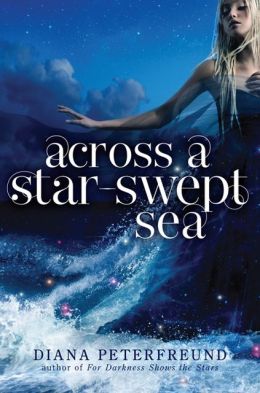
Across A Star-Swept Sea (2013)

Across A Star-Swept Sea. Diana Peterfreund. 2013. HarperCollins. 464 pages. [Source: Library]

I think I enjoyed this one more than the For The Darkness Shows The Stars. The two are companion books. Across A Star-Swept Sea is a futuristic retelling of The Scarlet Pimpernel. (In this reimagining, it is THE WILD POPPY; Galatea = France and Albion = England, of course.) Lady Persis Blake was a delightful heroine. I really enjoyed all of her personas. Readers see her as silly, vain, and gossip-driven. Readers see her brave, resilient, strong, and compassionate. Readers also see her doubts and fears, her vulnerability was touching. The romance, I felt, was well done. I thought the book captured the essence of Percy and Marguerite's troubled attraction. I thought the book also went to great lengths to be thought provoking in terms of gender roles and expectations. For example, in Albion women absolutely cannot inherit. So the Regent, Princess Isla, is just standing in for her brother--a mere toddler. Lady Persis also knows that all of her family's wealth will go to her husband; he will rule and manage it all. The world-building is complex, more complex than you might imagine. I would definitely recommend this one!

© 2013 Becky Laney of Becky's Book Reviews

Thursday, December 26, 2013

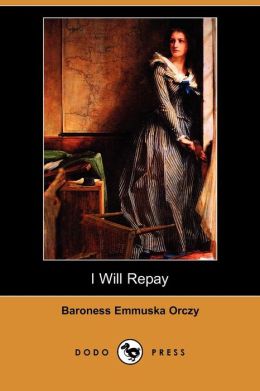
I Will Repay (1906)

I Will Repay. Baroness Orczy. 1906. 220 pages. [Source: Book I Bought]

As much as I love, love, love The Scarlet Pimpernel movie adaptations, I didn't quite love the novel. I wasn't quite sure if I wanted to read the sequels. I procrastinated a very long time. But once I decided to actually read I Will Repay, it was a quick read: two days!

What you should know: First, the Scarlet Pimpernel does make an appearance, but, you have to be really, really patient because he is a long time in coming. Second, it is a romantic adventure set during the French Revolution, emphasis on the romance. If you HATE romance, if you hate the drama and dialogue found in romance novels, then this one might not be for you. But. If you do, you're in for a real treat!

The prologue starts ten years or so before the French Revolution. It begins with a "fair" duel between two men. The hero, Paul Déroulède, is a reluctant participant. But the other guy, Vicomte de Marny is not backing down at all, is determined to make the fight to the death, if you will. He dies. His father makes his young daughter promise to get revenge on her brother's murderer. Her name is Juliette de Marny.
"Repeat the words after me, my child." "Yes, father." "Before the face of Almighty God, who sees and hears me ..." "Before the face of Almighty God, who sees and hears me," repeated Juliette firmly. "I swear that I will seek out Paul Déroulède." "I swear that I will seek out Paul Déroulède." "And in any manner which God may dictate to me encompass his death, his ruin or dishonour, in revenge for my brother's death." "And in any manner which God may dictate to me encompass his death, his ruin or dishonour, in revenge for my brother's death," said Juliette solemnly. "May my brother's soul remain in torment until the final Judgment Day if I should break my oath, but may it rest in eternal peace the day on which his death is fitly avenged." "May my brother's soul remain in torment until the final Judgment Day if I should break my oath, but may it rest in eternal peace the day on which his death is fitly avenged."
Ten years later, Juliette has finally found him, found a way to get close to him. He "saves" her from an angry mob, invites her into his home, introduces her to his family. She remains with him, getting close, for a bit. She begins to develop her plan. Meanwhile, of course, he is falling madly in love with her...
"Gratitude? What have I done?" "You committed a foolish, thoughtless act outside my door, and gave me the chance of easing my conscience of a heavy load." "In what way?" "I had never hoped that the Fates would be so kind as to allow me to render a member of your family a slight service."
"I always meant to tell you," he continued somewhat hurriedly; "for it almost seemed to me that I have been cheating you, these last few days. I don't suppose that you can quite realise what it means to me to tell you this just now; but I owe it to you, I think. In later years you might find out, and then regret the days you spent under my roof. I called you childish a moment ago, you must forgive me; I know that you are a woman, and hope therefore that you will understand me. I killed your brother in fair fight. He provoked me as no man was ever provoked before ..."
Not everyone is charmed by this young woman. And the Scarlet Pimpernel has some advice for our hero...
"You are a mad idealist, my dear Déroulède!" "How can I help it? I have lived under the same roof with her for three weeks now. I have begun to understand what a saint is like." "And 'twill be when you understand that your idol has feet of clay that you'll learn the real lesson of love," said Blakeney earnestly. "Is it love to worship a saint in heaven, whom you dare not touch, who hovers above you like a cloud, which floats away from you even as you gaze? To love is to feel one being in the world at one with us, our equal in sin as well as in virtue. To love, for us men, is to clasp one woman with our arms, feeling that she lives and breathes just as we do, suffers as we do, thinks with us, loves with us, and, above all, sins with us. Your mock saint who stands in a niche is not a woman if she have not suffered, still less a woman if she have not sinned. Fall at the feet of your idol an you wish, but drag her down to your level after that—the only level she should ever reach, that of your heart."
I will admit there is drama. But. I enjoyed every moment of it.
Love, the great, the strong, the conquering god—Love that subdues a world, and rides roughshod over principle, virtue, tradition, over home, kindred, and religion—what cares he for the easy conquest of the pathetic being, who appeals to his sympathy? Love means equality—the same height of heroism or of sin. When Love stoops to pity, he has ceased to soar in the boundless space, that rarefied atmosphere wherein man feels himself made at last truly in the image of God.

She would have stilled, an she could, the beating of her heart, which went out to him at last with all the passionate intensity of her great, pent-up love. Every word he spoke had its echo within her very soul, and she tried not to hear his tender appeal, not to see his dark head bending in worship before her. She tried to forget his presence, not to know that he was there—he, the man whom she had betrayed to serve her own miserable vengeance, whom in her mad, exalted rage she had thought that she hated, but whom she now knew that she loved better than her life, better than her soul, her traditions, or her oath. Now, at this moment, she made every effort to conjure up the vision of her brother brought home dead upon a stretcher, of her father's declining years, rendered hideous by the mind unhinged through the great sorrow.

They were all alone these two in the mad and beautiful world, which man has created for himself—the world of romance—that world more wonderful than any heaven, where only those may enter who have learned the sweet lesson of love.
The god of love may be blind, tradition has so decreed it, but the demon of jealousy has a hundred eyes, more keen than those of the lynx.
What neither fear nor remorse, sorrow nor joy, could do, that the great and mighty Shadow accomplished in a trice. Juliette, looking death bravely in the face, held out her hand, and sought that of the man she loved. There was not one word spoken between them, not even a murmur. Déroulède, with the unerring instinct of his own unselfish passion, understood all that the tiny hand wished to convey to him. In a moment everything was forgotten save the joy of this touch. Death, or the fear of death, had ceased to exist. Life was beautiful, and in the soul of these two human creatures there was perfect peace, almost perfect happiness.
I loved this one. I did. It was a perfectly satisfying read. 

© 2013 Becky Laney of Becky's Book Reviews

Tuesday, December 24, 2013

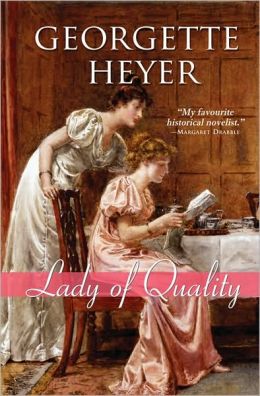
Lady of Quality (1972)

Lady of Quality. Georgette Heyer. 1972. Sourcebooks. 300 pages. [Source: Review Copy]

It is finished. My gloriously grand goal of reading all of Georgette Heyer's romance novels in one year, in order of publication! And it ended on a wonderful note as well. Lady of Quality is among the best of her romances. If you enjoy the friction of Much Ado About Nothing and Pride and Prejudice, you may just adore Lady of Quality. Oh how the sparks fly between the hero and heroine! These two who simply can't stand to be in the same room together, right?!

Miss Annis Wychwood is almost thirty years old. And in that time, the Regency period, thirty might as well have been sixty. Spinster is spinster no matter if you're thirty, blond, and witty or wrinkly, gray, and stubborn. But Annis is comfortable in her singleness. Or at least she prefers to see herself as comfortable. It helps that in Annis' situation, she's wealthy enough to have her own house and household. (By household I mean servants and such). If Annis had to live under her brother's roof, well, it would be a different story altogether. She does NOT get along with her brother, Geoffrey, though she does get along in a way with her sister-in-law. Yes, folks might think it a bit strange that she'd rather be independent and living on her own--and a good day's travel away from her brother and his wife--but they've become accustomed to it. But when our novel opens, Annis is about to do something a bit more unexpected, a bit more shocking.

Lucilla Carleton is just a young thing--not even eighteen--when she decides to run away from her aunt. (Her aunt is her primary guardian.) Her aunt wants her to marry the son of her father's best friend. A man, Ninian, that she's practically grown up with. It's not that she doesn't like him. But she doesn't like him like him. At least she says as much. As does he when given the opportunity. (The two like to bicker about how they don't want to be together.) Annis comes across this bickering pair on her way to Bath. Their carriage (or vehicle) has broken down--a problem with one of the wheels. Annis is too much of a lady to leave the poor girl in distress. She invites the young woman to come with her, to stay with her. Through their trip and the first day back at home, Annis hears all about Lucilla, her aunt, Ninian, and his over-bearing parents the Lord and Lady Iverley. Lucilla has runaway it's true but it's because her aunt is passive aggressive. She manipulates through tears and pleas and looks.

What is Annis to do? Welcome her home to this girl she barely knows yet instantly likes? Or send her packing with much tears of distress? She decides that the girl must write a letter to an aunt. She'll be allowed to stay with Miss Wychwood in Bath, it's true, but it's a temporary solution to the girl's problem. But this nice letter home has unattended results. Her aunt being of the nervous sort on the best of days writes a letter--a tear-soaked and illegible letter to the girl's legal guardian--Lucilla's Uncle Oliver. Oliver Carleton.

The last thing Annis expected was to be visited by Oliver Carleton. A man (from London) with the reputation of the worst sort. A truly grumpy, stubborn sort of man who speaks without thinking of the consequences, who enjoys speaking the truth, the whole truth, and nothing but the truth come what may. Obey society's nicety-nice rules? Not a chance! A man with a sharp but witty tongue comes to Bath to get to the bottom of this mess. He doesn't want Lucilla. He's not there to take her away, he's there to investigate this woman, this stranger who has interfered and butted into his business, his family.

Let the fun begin.

Oliver and Annis. Oh the sparks will fly. Despite her claims of being ancient and spinsterly, Oliver can't help thinking that she's entirely unsuitable for chaperoning his niece. She should be the one being courted and pursued and wooed by men. She's beautiful. She's witty. She's intelligent. There's just a certain something about her that he can't ignore. Annis never in a million years thought she'd feel this way, this maddeningly confusingly wonderful feeling. She can't stand him; and yet, she keeps hoping she'll see him again.


© 2013 Becky Laney of Becky's Book Reviews

Monday, December 23, 2013

The Story of Britain (2003)

The Story of Britain. Rebecca Fraser. 2003. Norton. 828 pages. [Source: Library]

Fraser has a clear purpose for writing The Story of Britain:
some kind of easy framework was still needed to guide the average person through the confusing shoals of disputed facts, to give a broad-brush picture of the past to those not in the van of historical research. The national curriculum today enables many young people to grow up used to handling esoteric historical documents yet without any real chronological sense of the years between, say, the Stuarts and the Victorians. Many children might be forgiven for believing that the Egyptians and the Aztecs once lived on these islands too. The aim of this history is to attempt to return to those old rules of 'who, when, what, how.' (xv)
This chunkster is divided into sections: Roman, Anglo-Saxon, Norman and Angevin, Plantagenet, Lancastrian and Yorkist, Tudor, Stuart, Hanoverian, Saxe-Coburg, Windsor. Most of the chapters are titled with the name of the monarch (king or queen) and years of their reign. But that doesn't mean the book is solely focused on royalty to the exclusion of everything else.

Is it readable? Yes and no. I struggled with the beginning and the ending. It just wasn't a thrilling read. There were sections that held my interest very well. There were sections that were more than informative, they were fascinating too. Other sections were packed with information but exceedingly dull. The sections that worked best were peopled with CHARACTERS that were memorable, dramatic, tragic, or vulnerable. The sections that dealt with human nature and dysfunctional families were quite good. But at some point in this history book, Fraser's focus shifts a bit. Starting perhaps with the Hanoverians (or perhaps even earlier with James II, William and Mary, and Anne), the focus is less on royalty and more focused on prime ministers and parliament personalities. As this one goes on, there is barely a glimpse at all of any royal personality. The last two or three hundred pages of this one were horribly boring.

I thought the book was helpful in some ways. I thought she did a great job conveying information from William the Conqueror through Charles II. There were chapters that were definitely accessible and interesting.

© 2013 Becky Laney of Becky's Book Reviews

Friday, December 20, 2013

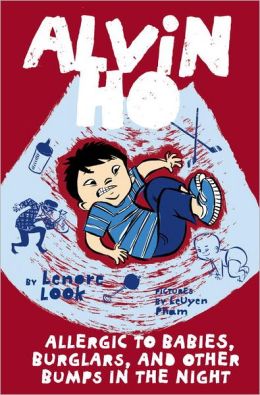
Alvin Ho: Allergic to Babies, Burglars, and Other Bumps in the Night (2013)

Alvin Ho: Allergic to Babies, Burglars, and Other Bumps in the Night. Lenore Look. Illustrated by LeUyen Pham. 2013. Random House. 183 pages. [Source: Review Copy]

With each book in the series, I find myself liking the series less. In this fifth book in the series, Alvin Ho is dealing with something tragic: the pregnancy of his mother. I had never thought of Alvin Ho as being particularly stupid and/or hard of hearing, yet, when the book opens with his mother nearly nine months pregnant and him acting as if the news is brand new, I lost respect for Alvin. It is not as if this would be his first younger sibling. If that was the only slight issue I had with the book, I wouldn't have found it that bothersome. But what bothered me the most is the "sympathetic pregnancy" of Alvin, the fact that everyone: his mother, his older brother, ALL of his classmates, his teacher, his mom's doctor, everyone teases Alvin about his fat little belly that looks "eight months pregnant." Granted, not every one who mentions Alvin's pregnancy mentions an exact month. But this teasing about his belly, his weight, made me uncomfortable at best. Alvin and his classmates go to the library and read books on pregnancy; they look at pictures and decide amongst themselves how "far along" each boy is based on the size of his belly. It was just very strange. I could understand how children might get confused and misunderstand the language of adults, or the origin of babies in general. But, when Alvin openly walks around saying things like he's about to have a baby, that he obviously believes his "sympathetic pregnancy" is a real pregnancy and there are no adults in his life (or an older brother even) who tells him the truth, well, it just bothered me. Alvin's gullibility even makes him appear foolish ON television. I don't enjoy cringe-worthy books. The humor felt all wrong in this book. I don't really understand why there was a second story about burglary if there wasn't going to be much resolution to it. Alvin is afraid of enough without adding to it.

© 2013 Becky Laney of Becky's Book Reviews

Thursday, December 19, 2013

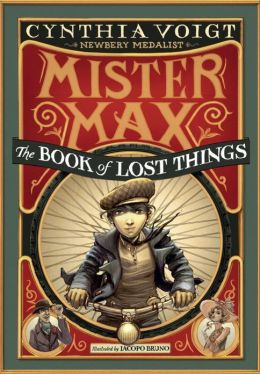
Book of Lost Things (2013)

The Book of Lost Things. (Mister Max #1). 2013. Random House. 400 pages. [Source: Review copy]

I definitely liked The Book of Lost Things. Perhaps I didn't LOVE it as much as The Very Nearly Honorable League of Pirates, but, it was still a very good read. Mister Max is set in England at the turn of the twentieth century.

Max's parents are famous actors in the theatre. The novel opens with his parents receiving an invitation to go on a special tour. It seems a luxurious offer. Max's grandmother, a librarian, feels the offer is too good to be true. Though she's not allowed to look at the actual invitation or the tickets it contained. Max was to be included in the trip, but, he was to meet his parents at the ship before it departed. When he arrives, quite on time, his parents are gone, the ship has gone too. Or so it appears. In truth, the invitation was a trap. The name of the ship was part of the deception, as was the destination. Max has no idea what happened to his parents. They were able to write a quick note to be given to the "boy on the bicycle" (Max), however, which has a message of sorts for him. So Max is partly on his own, partly under the supervision of his grandmother.

This is NOT a book about Max searching for clues as to what happened to his parents. Max is NOT involved in anyway with that search or research. Once his parents have vanished, well, Max's concerns are mainly economic. This is a book about a somewhat creative boy finding a way to make money while he waits for others to solve the BIG mystery of what happens to his parents. He has two or three little mysteries to solve. And at these little mysteries he excels. These little mysteries might be predictable to adult readers. But despite the fact that adult readers may see how the end will come together, the story itself is enjoyable enough. The book has a handful of interesting characters, Max included.

For readers looking for a quest, a desperate boy willing to risk it all and go on a fantastic journey to find and save his parents, you may be disappointed. But depending on your expectations, you might find yourself surprised by how entertaining it is. 

© 2013 Becky Laney of Becky's Book Reviews

Wednesday, December 18, 2013

Charity Girl (1970)

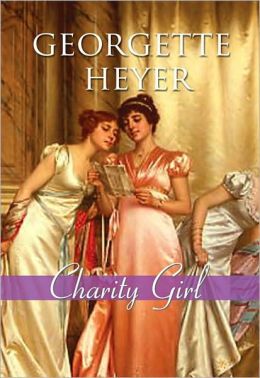
Charity Girl. Georgette Heyer. 1970/2008. Sourcebooks. 282 pages. [Source: Review copy]

Charity Girl is a pleasant but not outstanding historical romance. Viscount Desford (first name, Ashley) "rescues" a young "orphan" girl named Charity. Cherry has been staying with her aunt, but, she's had enough and is desperate enough to travel on her own to London in search of a grandfather she's never met. He takes her with him to London, drives straight to her grandfather's residence and discovers much too late that he has left town. He decides right then and there to take her to Henrietta's house and place her in her keeping. Henrietta is his good, good friend. The families, at one time at least, were hoping the two lifelong friends would make a match of it. He begins the search for the grandfather on his own. The whole book focuses in on his search to find her family, find someone who cares about her. Now and then readers learn of Henrietta and Cherry and what they've been doing, but, not that often. His adventures aren't packed with action and excitement so much as dialogue and travel updates. By the end, there is some life to be found in the novel. Cherry's father whom everyone believed to be dead returns and he's always a step or two before or a step or two behind Desford. I enjoyed this one well enough to keep reading. It wasn't a slow read for me. But it lacks some of the liveliness and fun of previous Heyer novels. It didn't WOW me.

© 2013 Becky Laney of Becky's Book Reviews

Tuesday, December 17, 2013

Flora and Ulysses: The Illuminated Adventures (2013)

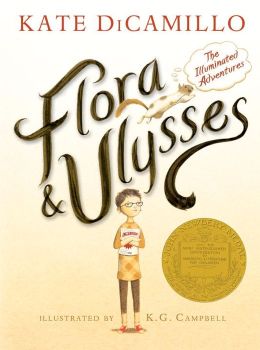
Flora and Ulysses: The Illuminated Adventures. Kate DiCamillo. 2013. Candlewick Press. 240 pages. [Source: Review Copy]

What a quirky and lovely book by Kate DiCamillo. I loved the two points of view. I loved the little girl, Flora, and I loved the super-hero squirrel, Ulysses. The writing was just lovely; the story was quite fun and just as odd as I've come to expect from DiCamillo!

It has a great cast of minor characters, particularly both neighbors. Flora's parents are separated and most-probably getting a divorce. Her father's neighbor was great. Her mother's neighbor was great too. I had mixed feelings about Flora's parents. On the one hand, it was oh-so-easy to feel empathy for the father. I am not sure I could find sympathy for the mother. This is in part the fault of the squirrel! The mother is the nemesis of the squirrel. She's out to get him: out to kill him. But there is more to the mother than being a rodent-hater. She's also a writer, a writer of REALLY bad formulaic romances. Flora is at odds with her mother for almost the whole novel, so we see the mother mainly through the eyes of two characters that dislike her: the squirrel and the daughter. There is one confrontation scene that was heartbreaking for me. I felt for the daughter so, so, so much. I could identify with her in that moment. That last poem was oh-so-magical for me.

I would definitely recommend this one!

© 2013 Becky Laney of Becky's Book Reviews

Monday, December 16, 2013

Viking: Norse Warrior's Manual (2013)

Viking: The Norse Warrior's (Unofficial) Manual. John Haywood. 2013. Thames & Hudson. 208 pages. [Source: Library]


The world needs more history books like this one. Viking is written in second person present tense. The reader is addressed directly, and the material--though unofficial--blends what you want to know with what you need to know...if you want to become a Viking. The book is set in December 991 AD.

The book is arranged topically.
  • Why Become a Viking
  • Joining Up
  • The Novice Viking's Guide to the Great War Leaders
  • Weapons and Tactics
  • Going to Sea
  • Have Longship, Will Travel
  • Life On Campaign
  • Battle
  • The Spoils of War
  • The Sword's Sleep
 I found many sections entertaining and enjoyable. But probably my favorite section to grin about was "Have Longship, Will Travel." In this section, the author rates lands to potentially plunder. The name of each country is given, of course, as well as essential information such as location, inhabitants, key resources, several descriptive paragraphs, and the all-important section describing how hard it is to raid. (England is rated five stars; Ireland three stars). It reads in part:
Rich, green and fertile, England is the destination for the ambitious Viking at the present time. Since 978 England has been ruled by a foolish and unpopular king, Aethelred. (101)
Overall, this one is just a fun, light history book. 

© 2013 Becky Laney of Becky's Book Reviews

Sunday, December 15, 2013

Two Christmas Books

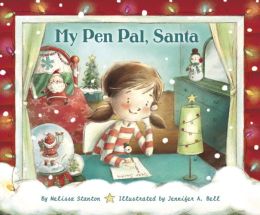
My Pen Pal, Santa. Melissa Stanton. Illustrated by Jennifer A. Bell. 2013. Random House. 32 pages. [Source: Review Copy]

January
Soon after Christmas, Ava wrote a thank-you note to Santa Claus.
Dear Santa,
Thank you for my Christmas presents. I really like them. But why didn't you eat the cookies I left you? Were you full from the cookies at our neighbors' houses? I'm six years old and I go to kindergarten, or did you already know that?
Love, 
your friend Ava

I really loved this picture book. Ava is a little girl that I just adored. She decides to write a thank-you note to Santa. When he replies, the correspondence continues through all twelve months. I loved this premise. Writing letters to Santa in November or December, very common indeed. But to write to him in April and July? It's one thing to write letters to Santa "asking" (or should I say begging?) for gifts. It's quite another to write chatty letters with Santa, to truly become friends.
Dear Ava,
Thank you for the great drawing. People usually don't think of me on Valentine's Day. Well, Mrs. Claus does, of course, and I think of her. I love giving gifts, but it's also nice to receive them. I say Merry Christmas all year long, so....
Merry Christmas!
Santa
It's a cute picture book. I thought Ava was sweet, and I liked reading Santa's replies. I also loved, loved, loved the illustrations.

The Smallest Gift of Christmas. Peter H. Reynolds. 2013. Candlewick. 40 pages. [Source: Review Copy]

Roland was eager for Christmas Day. He raced downstairs to see what was waiting for him. But when he saw his present, he was not impressed. It was the smallest gift he had ever seen. Had he waited the whole year for this tiny gift? Roland closed his eyes and hoped and wished as hard as he could for a bigger gift.

Peter H. Reynolds is the author of The Dot, Ish, and Sky Color. I have really loved some of his picture books in the past. They are certainly a little different and a bit unique. But that's a good thing.

The Smallest Gift of Christmas is a tale of greed and selfishness. It's a tale of what happens when wishes come true. The first clue that Roland is more than a little greedy comes early. The illustrations on the first page show that Roland's stocking is ten times the size of the other stockings. He must be expecting great things. So his fit when his gift is oh-so-small isn't that big of a surprise. As Roland learns that his wishes are being granted, his true heart is revealed. He is very greedy indeed!

It's a true tale in that I think Roland is a good example of the I-can-never-ever-get-enough-stuff mindset which is a big problem in society. More, more, more, bigger, better, always wanting, never satisfied.

Roland learns his lesson, as you might expect. As he's searching the universe for the biggest and best present ever, he realizes that earth--his home, his family--are very small, very tiny, and so far away as seen through his telescope. In that moment, he realizes that great things can be "small things." His desire for home is just as real as his prior greed.

I definitely liked this one.

© 2013 Becky Laney of Becky's Book Reviews

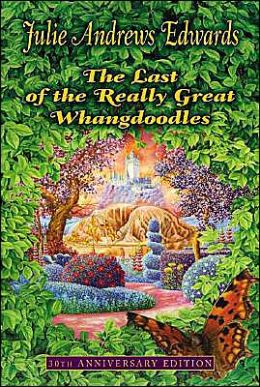
Sunday Salon: The Last of the Really Great Whangdoodles

The Last of the Really Great Whangdoodles. Julie Andrews Edwards. 1974. Scholastic. 288 pages. [Source: Bought]

It was a crisp, sunny October afternoon and Benjamin, Thomas, and Melinda Potter were visiting the Bramblewood Zoo. 

Have you read The Last of the Really Great Whangdoodles? What did you think of this children's fantasy novel? I personally loved it a good deal! I enjoyed spending time with Ben, Tom, and Lindy. Their adventures begin with their excursion to the zoo. At the zoo, the children happen to meet a strange man, a professor it turns out. They are resting and discussing among themselves WHAT animal they would take home with them, if they could. This strange man interrupts them and asks if they've ever "considered" a whangdoodle. A what?!?! they essentially respond. That encounter might not have changed their lives too much, been easily forgotten in a week or so, IF, it hadn't been followed up by a trick-or-treating adventure soon after! Lindy was dared by one of her brothers to knock on the door of the local "haunted house." The haunted house, you guessed it, is where this strange professor happens to live. He himself started the rumors so that children would leave him to his work. He's busy making advances in genetics and marveling in studying the nature of DNA...remember this is 1974!

Friendship. These three children find a friend and fellow adventurer in Professor Savant. Someone who challenges them to open up their minds to the world of possibility, a world that allows for just about anything and everything that you can imagine. The four decide to go big, they will work to imagine themselves all the way to Whangdoodleland. Half the book focuses on their time in Whangdoodleland. Readers meet many fanciful creatures...but will they meet...at last...a Whangdoodle?!

If you enjoy fantasy novels with action and adventure and a LOT of imagination, then this one shouldn't be missed!

© 2013 Becky Laney of Becky's Book Reviews

Saturday, December 14, 2013

Do you know Pete?

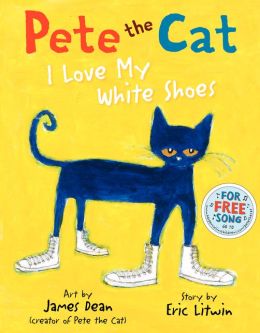
Pete the Cat: I Love My White Shoes. Eric Litwin. Illustrated by James Dean. 2010. HarperCollins. 40 pages. [Source: Library]

Pete the Cat was walking down the street in his brand-new white shoes. Pete loved his white shoes so much, he sang this song:
"I love my white shoes,
I love my white shoes,
I love my white shoes."

I love, love, love, REALLY REALLY love Pete the Cat. He is my kind of cat. You should definitely download the free song(s) as well, so you can really sing right along with the book(s). True, you could make up your own tune, but, the song is so perfectly catchy.

So. Pete the Cat has white shoes which he loves. But, when he steps in some unpleasant things: strawberries, blueberries, a mud puddle, a bucket of water, does Pete cry?! Goodness no! He just keeps on walking and singing his song! Is this a concept book about colors (white, red, blue, brown)? Is this a book teaching necessary coping skills to preschoolers and kids? A bit of both. But. It is also just a really fun, very entertaining story about a groovy cat! I absolutely LOVE the repetition, and the fact that this is a book everyone can participate and join in on!

To get the full experience, watch this video with the narration/song!

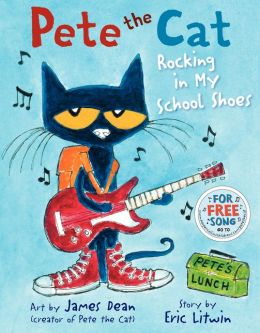
Pete the Cat: Rocking In My School Shoes. Eric Litwin. Illustrated by James Dean. 2011. HarperCollins. 40 pages. [Source: Library]

Here comes Pete strolling down the street, rocking red shoes on his four furry feet. Pete is going to school, and he sings this song: I'm rocking in my school shoes, I'm rocking in my school shoes, I'm rocking in my school shoes."

I really liked this one. I loved seeing Pete go to school. I loved seeing him read in his school shoes (the library), eating in his school shoes (the cafeteria), playing in his school shoes (the playground), etc. (There is also singing, painting, adding, and writing). I loved the descriptions of the school environment, the participatory way in which it's written so it gets everyone involved, and most of all the repetition. DOES PETE WORRY? Goodness no!!!

Here is a fan video of the book, I loved seeing the Pete the Cat doll.


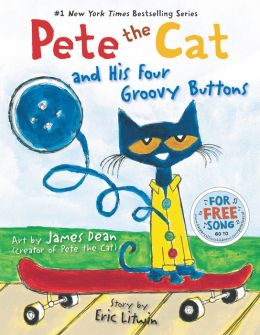
Pete the Cat And His Four Groovy Buttons. Eric Litwin. Illustrated by James Dean. 2012. HarperCollins. 40 pages. [Source: Library]

Pete the Cat put on his favorite shirt with four big, colorful, round, groovy buttons. He loved his buttons so much, he sang this song: 
"My buttons, my buttons,
my four groovy buttons.
My buttons, my buttons,
my four groovy buttons."

This one was the first Pete the Cat book I read, and I must say it is probably my favorite. I love, love, love it so much!!! If I Love My White Shoes was "teaching" colors, then Four Groovy Buttons is "teaching" subtraction. For, Pete the Cat loses each of his four buttons one by one. But does Pete cry?! Goodness no! I absolutely love the end of this one!!! And the moral this time: "I guess it simply goes to show that stuff will come and stuff will go. But do we cry? Goodness, NO! We keep on singing."

I'll share two videos this time. One with the HarperCollins narration, and the second of a teacher reading it aloud.

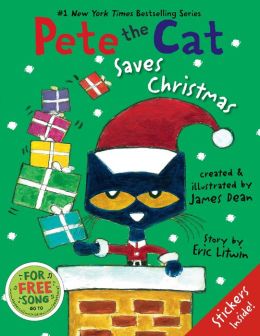
Pete The Cat Saves Christmas. Eric Litwin. Illustrated by James Dean. 2012. HarperCollins. 40 pages. [Source: Library]

Twas the day before Christmas and Santa was ill. In the cold winter wind he had caught a bad chill. Will Christmas be canceled? Will it come to that? "NEVER!" cried Santa. "Let's call Pete the Cat!" Santa asked Pete to deliver the toys to all the good girls and to all the good boys. "I'll do it!" says Pete. "And though I am small, at Christmas we give, so I'll give it my all."

I definitely liked this one! In this adventure, Pete the Cat helps Santa and thereby "saves" Christmas. It's a cute story. Not my favorite from the entire series, but, it's got a redeeming message all the same.

A video read aloud.

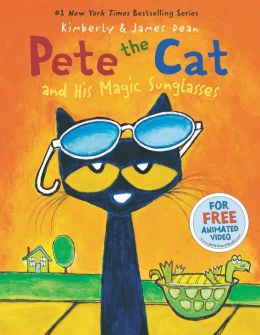
Pete the Cat And His Magic Sunglasses. Kimberley and James Dean. 2013. HarperCollins. 40 pages. [Source: Library]

Pete the Cat did not feel happy. Pete had never, ever, ever, ever been grumpy before. Pete had the blue cat blues. Then, as if things were not bad enough, along came Grumpy Toad. Grumpy Toad was never happy! He always wore a frown. But Grumpy Toad was not grumpy today. He said, "These cool, blue, magic sunglasses make the blues go away. They help you see things in a whole new way." Pete put on the cool, blue, magic sunglasses. He looked all around. "Right on! The birds are singing. The sky is bright. The sun is shining. I'm feeling alright!"

If only it were this easy to get rid of bad moods! Pete the Cat has the blues, but, a friend soon shows him a new way of looking at things. Not content to keep this to himself, Pete the Cat is soon helping everyone he meets cheer up. Lots of folks need magic sunglasses....

I enjoy this series very much. This book doesn't have an official song, but, this video gives you a tune to sing with it.

© 2013 Becky Laney of Becky's Book Reviews

Friday, December 13, 2013

The Long Way Home (2013)

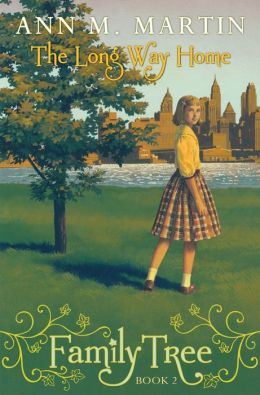
The Long Way Home (Family Tree #2) Ann M. Martin. 2013. Scholastic. 240 pages. [Source: Review copy]

If you have to "like" a heroine to "like" a book, then this book may be in trouble!!! Dana, the heroine of Martin's second book in the Family Tree series, is many things but likeable doesn't come to mind. For better or worse, each chapter reveals Dana--or almost always reveals--in conflict with someone. And it may be unfair, but I always found myself identifying more with the other characters, able to connect with what they are feeling, how they are seeing the scene. Dana comes across as self-centered, inconsiderate, proud, and worst of all: whiny! Dana has a poor relationship with her mother. She has a better relationship with her father, but, perhaps that is because they are so much alike. Her father is, inconsiderate, proud, and selfish too. Her father has a drinking problem, a big problem. And Dana hates her mother for speaking up about it, for telling him NOT to drink, for telling him NOT to party, for being honest. For the record, she isn't talking about her husband negatively in front of her children, but Dana has a (bad) habit of eavesdropping. These are conversations spoken when Dana should be in bed asleep. Perhaps because I connected so much with Abby in the first book, I hated to see her in this bad marriage.

Like Better To Wish, The Long Way Home has its share of drama. Better to Wish is set in Maine; The Long Way Home is set in New York City and briefly in Maine.

I think the biggest problem I had with Dana is her general philosophy: because I am oh-so-talented, because I have THIS INCREDIBLE GIFT (she's an artist), I can treat people horribly and they just have to make allowances for me because that's just how I am.
© 2013 Becky Laney of Becky's Book Reviews
Thursday, December 12, 2013

Better To Wish (2013)

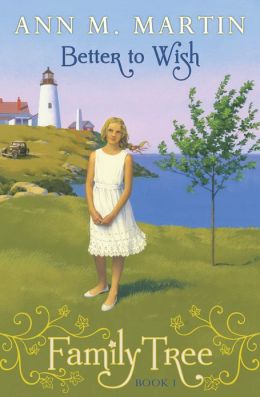
Better To Wish. (Family Tree #1) Ann M. Martin. 2013. Scholastic. 240 pages. [Source: Review copy]

I definitely enjoyed reading Ann M. Martin's Better To Wish. I connected with Abby almost from the start. I thought Abby was a very grounded character, there was depth and substance to her. I enjoyed reading her memories, the short vignettes of the moments through the years that changed or defined her. 

Some chapters were quite ordinary: the small moments, the ones that you almost never appreciate until much later. Some chapters were focused on holidays (or birthdays): Thanksgiving, Christmas, Halloween, Fourth of July, etc.

Other chapters were quite dramatic, the moments where you know that life will NEVER be the same again no matter how hard you wish or how big you dream. I liked the focus on family, friendship, and community. Readers meet Abby exactly as she is in her closest relationships. Loved seeing Abby's relationship with her sisters, her mother, and her best friend. All the characters felt authentic, felt human. Martin has done a great job in bringing this time period to life. I would definitely recommend this one. I look forward to the others in the series!

© 2013 Becky Laney of Becky's Book Reviews

Wednesday, December 11, 2013

Serafina's Promise (2013)

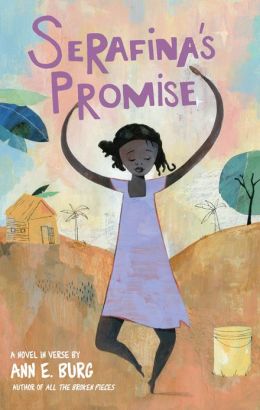
Serafina's Promise. Ann E. Burg. 2013. Scholastic. 304 pages. [Source: Review copy]

I loved, loved, loved Ann E. Burg's verse novel, All the Broken Pieces. I was equally impressed with her newest verse novel: Serafina's Promise. This novel wowed me. I enjoy verse novels, but they don't always work for me as verse. Often, I feel, they might as well be written in prose. But that is not the case in Serafina's Promise. There were so many beautiful sentences, so many poetic, just-right sentences. The story itself is so compelling. But the way it is told, well, it's beautiful and incredible. I would love to see this book win something!

Serafina's Promise is set in Haiti. Serafina, our heroine, is a young girl who works hard alongside her family. She does not have any brothers or sisters to help her with the chores that have to be done. She doesn't have time to play with some of the other children, but, Serafina doesn't whine or complain. She dreams. She holds onto the hope that one day she WILL be a doctor. One way or another, she will make a difference in the lives of those around her. She will be able to fight against hunger and poverty and disease. She will save lives. Serafina longs to go to school. Her family cannot afford school or uniforms. But Serafina is determined and diligent. She will work even harder, do even more, to help her family save money--coins in a jar--so that her dream will come true.

I loved this one so much. It is one of those books I just want to tell everyone: READ THIS BOOK!!! I loved Serafina. I loved her family. I loved her grandmother, her mother, her father. I loved seeing the family scenes. Loved seeing Serafina with her new baby brother. This was a story to be felt and experienced. I cared so much about all the characters. (Serafina has a best friend, Julie Marie). It is a compelling, beautiful story--rich in detail. It is one of my favorites of the year.

Quotes:
When Papa talks,
the anger in Manman's eyes
softens
like stingers soaked in honey (27)
I wonder what hunger is like
without a family
to fill the emptiness. (43)
A child who doesn't sleep at night
is a crocodile in the morning! (52)
Manman's worries
are like the mosquitoes
at the ravine, so many
you could never count them
or get rid of them all. (81)

© 2013 Becky Laney of Becky's Book Reviews

Tuesday, December 10, 2013

Various Star Wars Books

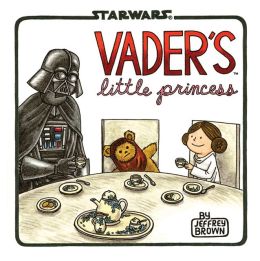
Vader's Little Princess. Jeffrey Brown. 2013. Chronicle Books. 64 pages. [Source: Library]

I read this one several times. Most pages stand alone; the book is more a collection of comic strips than a graphic novel telling one, big story. The premise behind this one and in Jeffrey Brown's previous book, Darth Vader and Son, is simple. Brown has reimagined the evil Darth Vader as a single dad raising two kids. He's still evil, but, he's actively involved with Luke and Leia's upbringing. Some pages are hilarious and just fun. Others not so much. I think there is something for everyone to enjoy, however!

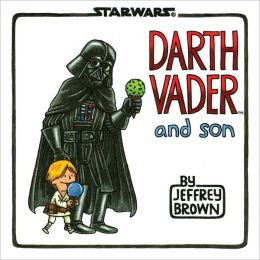
 Darth Vader and Son. Jeffrey Brown. 2012. Chronicle Books. 64 pages. [Source: Library]

I read Darth Vader and Son after reading Vader's Little Princess. I really, really, really enjoyed both books very much. However, I must say that I laughed more with this first book. I liked the parenting advice. I liked how they used or nearly used, I should say, direct quotes from the trilogies and gave the words a whole new meaning! For example, "This is not the toy you are looking for..." instead of "This is not the droid you are looking for." (It was also fun seeing WHICH toy it was (Jar Jar). These comic strips are just fun. I'd recommend these easily!

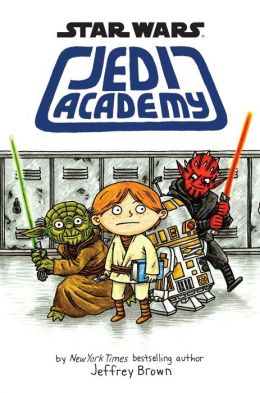
Star Wars: Jedi Academy. Jeffrey Brown. 2013. Scholastic. 160 pages. [Source: Library]

Roan Novachez, our young hero, desperately wants to be accepted into the pilot academy. It is not to be. Just when Roan thinks he'll be stuck on Tatooine forever, he receives a letter he wasn't expecting. Been accepted into Jedi School, he has. A student of Master Yoda, he will be. He goes. He tries. He really tries. But the other younglings have been using the force for years, have grown up knowing or at least hoping to become Jedi. It is their first choice, not second choice or last choice for a vocation. The book is a blend of journal entries and comic strips. The book captures his awkwardness of growing up and adapting to new situations with a generous dose of humor.

I liked it. There were definitely some funny scenes in it. I'm not sure I LOVED it however.


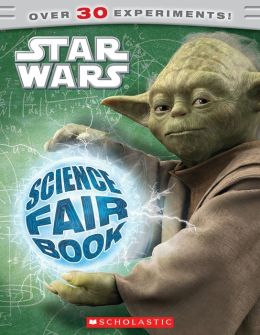
Star Wars Science Fair Book. Samantha Margles. 2013. Scholastic. 128 pages. [Source: Review Copy]

This is an interesting book for upper elementary on up. (The recommended age is 10 and up.) The introduction reads:
Have you ever wondered how much of the science-fiction world of Star Wars is based on real-life science? Are some of the situations in the films possible or simply part of a fantastic story? Now you have a chance to find out. In this book we've pulled together an assortment of experiments and activities that examine the science of Star Wars. Some of the experiments are inspired by the planets, creatures, droids, and technology from the films, and some go a step further to answer related scientific questions you'll find exciting and fun. Perhaps one day you'll find yourself on a path toward becoming a scientist and explorer of galaxies far, far away! May the Force be with you!
The book is a step-by-step guide to experimenting. Sometimes they give clues about the results, other times not a bit. Here's an idea of the types of experiments to expect:
  • creating a lava lamp
  • making icicles
  • water in the desert
  • sound in space
  • create lightning
  • make your own clouds
  • homemade periscope
  • grow your own crystals
  • your very own lie detector 

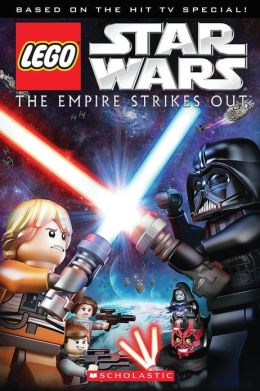
Lego Star Wars: The Empire Strikes Out. Based on the TV Special. 2013. Scholastic. 48 pages. [Source: Review Copy]

It is oh-so-easy to recommend the TV special, Empire Strikes Out. It has some great scenes in it! And the Darth Vader and Darth Maul scenes work so much better in the special than they do in the book! But the book is nice. It's a typical novelization. I do like seeing the mostly-Lego illustrations, however.
You might be able to catch part of it online

Star Wars Episode IV: A New Hope. George Lucas, Alan Dean Foster. 1977. 247 pages. [Source: Own] 

I managed to read this one at last. I'd started it a few years ago, but I thought the writing was so poor in the opening chapter or two that I just wasn't motivated to continue on. As soon as the action really begins, once Luke Skywalker is introduced, this one gets much better! That is not to say that reading the story adds anything substantive and wonderful to the movie experience. I think an appreciation of the movie is a big help. It helps to make sense of the text of the book. There are some pages that are a bit messy--jumping back and forth between characters and locales. It makes complete sense if you are familiar with the movie, if you know the order of things. But transitions of points of views isn't all that well done.

Years ago, I read other Star Wars novels including a novelization of the second movie. That book added SO MUCH to the story, really filled in anything and everything I wanted in terms of characterization and motivation and intent. This one, not as much. Still, it was a fun read.

Star Wars: Episode V: Empire Strikes Back. Donald F. Glut. 1980. 214 pages.  [Source: Bought]

This one was good for the most part. I enjoyed reading it, noticing the tiny differences between the book and the movie. I was looking for any differences in dialogue between the two. I was in particular watching the developing romance between Han and Leia. Another relationship I was paying attention to is Yoda and Luke. I was looking for something more, little things, perhaps, that made the book add something to the overall Star Wars experience. I will say I liked this one. It had a few confusing moments now and then, again with the transitions, for the most part I liked it though.

Star Wars: Episode VI Return of the Jedi. James Kahn, George Lucas, Lawrence Kasdan. 1983. 181 pages. [Source: Bought]

The dialogue was truly awful in places in this one. Once I gave myself permission to skip entire sections of dialogue of certain characters, I began to enjoy it a little bit. There was much to suffer through in this one, but, it had a few scenes that made it all worth while! The writing I felt wasn't wonderful, if these books in the trilogy weren't movies, I'm not sure they'd be anything fantastic to recommend them, to make them classics. 

Star Wars: A Very Vader Valentine's Day. Scholastic. 2013. 16 pages. [Source: Review Copy]

What can you expect from this one? A silly introduction, a tribute to five friendships, two pages of awful jokes, four comic strips, two word search puzzles, a maze puzzle, a mad lib, two how-to-draw features, and thirty-six removable Valentine's Day cards. How bad are the jokes? Well, you be the judge: "Where does the Emperor go when he wants to buy something cheap? He looks for a sale at the Maul." There were several relatively cute cards. Like C-3PO's "I want to be the droid you're looking for" and Han Solo in carbonite: "Valentine, don't make me spend the day SOLO."

© 2013 Becky Laney of Becky's Book Reviews
Monday, December 09, 2013

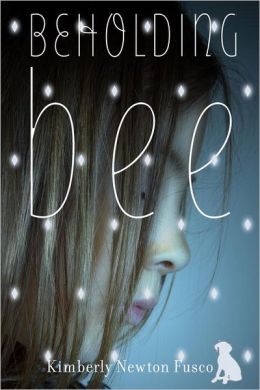
Beholding Bee (2013)

Beholding Bee. Kimberly Newton Fusco. 2013. Random House. 336 pages. [Source: Review Copy]

I loved so many things about Beholding Bee. Beholding Bee has just a touch of fantasy to it, but, otherwise it has a very historical feel to it. The book is set during the early days of World War II. The heroine, Bee, is, in my opinion, quite unforgettable. She's eleven or so. She's an orphan. Her upbringing has been unusual to say the least. She travels with a carnival. She helps with the food stand: hotdogs, popcorn, honey buns, lemonade, etc. She has a close bond with Pauline, a woman with the carnival who has basically raised her since she was four. Bee has a birthmark. She does not necessarily like people staring at her, pointing at her, laughing at her, making rude comments. The owner of the carnival treats her like she's an attraction to the show itself, a freak on display. So, whenever possible, Bee tries to keep her birthmark covered with either her hair or her hand. She also likes to try to face a certain way so her birthmark isn't quite so obvious to strangers. But when Pauline falls in love (a bit too quickly), things change for Bee very quickly. Changes are coming quickly for many people. Men everywhere are joining up in the forces, and men who aren't army material, well, they still feel like they should be doing something more. Bobby, Bee's other best friend, has been rejected by the army, but, he's determined to get a factory job so he too can serve his country. One day life in the carnival becomes too much for her. Bee takes the dog (her forbidden pet) and runs away...what happens next is a bit fantastical. But it is wonderful too.

I loved every twist in this story. I loved seeing Bee live in that quaint house with her two aunts. I loved seeing Bee struggle to join the community and attend school. I loved meeting Bee's classmates. That 'educational' aspect of the novel was quite something! So many things we take for granted now, but, fairness has to be fought for sometimes.

I would definitely recommend Beholding Bee!
© 2013 Becky Laney of Becky's Book Reviews
Friday, December 06, 2013

Shift Omnibus (2013)

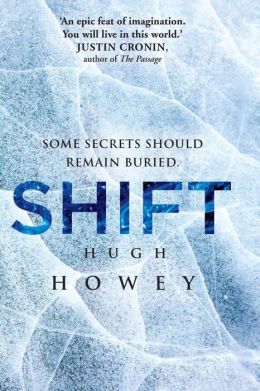
Shift by Hugh Howey. 2013. CreateSpace. 608 pages. [Source: Book I Bought]

Although Shift is a prequel, Shift should definitely be read after Wool. The novel tells of the creation of the fifty silos, of the politics that led to the end of the world--as they knew it--and to the beginning of a new world--an underground world. This story is told in alternating points of view and alternating time periods.

From before, readers meet Donald an architect who designed the silo and helped make the project happen. He was told that the silos were for just in case. In a way, he was manipulated by others, but, that's another story.

From Silo 1, readers come to know Troy through several of his shifts. In between shifts, Troy is frozen. He and the others in Silo 1 are from before. Those working shifts take pills to help them forget what they want to forget, but, Troy is not like the others. He doesn't want to forget, he wants to remember everything. Even if what he remembers breaks his heart.

Several other silos are visited throughout Shift, usually in connection to failures and rebellions and chaotic times. The last half of Shift, which is perhaps the most haunting narrative portion, tells of a young boy essentially left alone after a failed rebellion. Readers of Wool will recognize him as Solo, but, this is HIS very personal story.

Shift tells a very different story from Wool, but, it is equally compelling. I loved the blending of Shift and Wool towards the end. Reading Shift truly puts a new perspective on Wool. I would definitely recommend both books!

© 2013 Becky Laney of Becky's Book Reviews