Showing posts with label YA Historical. Show all posts

Tuesday, May 27, 2025

52. Scarlet


52. Scarlet. A.C. Gaughen. 2012. 287 pages. [Source: Library] [YA Fiction, YA Historical, YA Romance, 5 stars]

First sentence: No one really know 'bout me. I'm Rob's secret, I'm his informant, I'm his shadow in dark places. No one ever takes me for more than a knockabout lad, a whip of a boy. They never really see. And I don't mind that they don't see. Like, when you walk through a room full of big men drunk off their skulls, it ain't so bad to be ignored.

Premise/plot: Scarlet is a young adult twist on Robin Hood. It is narrated by 'Scar' [aka 'Will Scarlet' or 'Scarlet'). Only Robin's gang know her secret--that she's a young woman in disguise. To the rest of the world she's just a thief, one of Robin's gang. If you're familiar with Robin Hood--and who isn't--you can fill in the blanks. Robin Hood is trying to help the poor and save them from the injustices of the powers that be [local sheriffs and such as well as 'King' John]. Readers get to know Rob, Scarlet, John Little, Much, etc. as they try to stop the thief-hunter Gisbourne from destroying everything. Gisbourne has a strong dislike for Scarlet whom he knew before...under her real name. He is the one who in fact gave her her scar.

My thoughts: It's been over ten years since I visited this series. But I've always intended to reread this series. Scarlet is far from perfect. I know this. But I enjoyed spending time with her and all the others. I think the characters have some depth. The story is somewhat familiar, to be sure, but I have always liked it.

Quotes:

  • Rob's head pressed harder against mine. "I know what it's like to look into your past and see nothing but your mistakes," he said. My fingers crushed tight into his skin, clawing him like if I could break the skin we'd be connected by blood, and I could comfort him and he could see into me without me having to speak out loud. "They were your orders, Rob. You were a soldier for the King's Crusade. It can't be a mistake if you didn't have a choice."
  • "More people care about you than you know, Scarlet. No matter how you got your scars. Not just those scars. The ones that make you think you're unlovable."


© 2025 Becky Laney of Becky's Book Reviews

Monday, April 21, 2025

41. Rebellion 1776

41. Rebellion 1776. Laurie Halse Anderson. 2025. 405 pages. [Source: Library] [YA historical; MG historical, 4 stars]

First sentence:  "Take away this puke bucket, girl, and bring me a clean one!"

Premise/plot: Laurie Halse Anderson's newest book is historical fiction--set during the American Revolution--in the city of Boston, Massachusetts. Elsbeth Culpepper, our heroine, is a maid. Her mother is dead; her father is otherwise occupied and it is not a bit unusual, I believe, for young adults to be either hired out or apprenticed out. Her current employer--a Loyalist--flees the city leaving Elsbeth scrambling to find a new job or perhaps a new employer in the same home. She finds work--again as a maid, but essentially all-servants-in-one maid--this time for the Pike family. But there's not much time for relaxation when there's a small pox epidemic in town....and your employer has seven children! 

My thoughts: I enjoyed this one. I did. This isn't my first book to read on a) small pox and b) the Revolution war c) inoculations controversy. Though it has been a while since I've read up on this particular sub-sub-sub genre. It was a good read. It is the kind of historical fiction I like. The type that immerses you in the time and doesn't try to manipulate the past into an indoctrinating sermon for today. Those tend to be both a) obnoxious and b) dated.

I am torn between four and five stars. I am. I found it a compelling read. I enjoyed the depth of the characters. I thought it did really well in world-building for this historical time period. There were some great relationships explored. I'm just not absolutely convinced that it is one I would want to read again and again. (Which is almost how I determine five star reads.) Still I would definitely recommend this one. And I might revisit the rating at some point.


© 2025 Becky Laney of Becky's Book Reviews

Friday, January 03, 2025

1. A Queen's Game


1. A Queen's Game. Katharine McGee. 2024 [November]. 368 pages. [Source: Library] [YA Historical, YA Romance, YA Fiction] [3 stars]

First sentence: May of Teck hated weddings.

Premise/plot: A Queen's Game is YA historical fiction. The three main characters--protagonists--were historical figures, in varying degrees of royalty. Many of the "main" characters (and/or their love interests) were grandchildren of Queen Victoria--though not all. The three young women at the center of this one are May (May of Teck, aka future Queen Mary) Hélène d’Orléans (daughter of an exiled King of France), and Alix of Hesse (aka future Empress of Russia). 

The book follows the ups and downs of their love lives--or lack thereof. May of Teck is descended from a first cousin of Queen Victoria, she's always been on the fringe instead of front and center in the royal family. She has ambitions of marrying *into* the family but Queen Victoria may have other plans for her grandsons. A fictional American, Agnes, tries to influence May of Teck to be more bold, daring, ambitious, to fight dirty. WHY? No one quite knows except the book needs to be more Gossip Girl.  Hélène follows her heart and gives into her passions--quite literally, of course. Of the three narrators her chapters almost always lead to some degree of smut. Alix's story has its own obstacles--from within and without--she is falling head over heals in love with he who would be the next Tsar--Nicholas. Everyone opposes the match. She has her own reservations--though real or fictionally imagined who knows--because of medical/genetic concerns.

My thoughts: The book does NOT give a year (which in my opinion is a CRIME for historical fiction based on real people and somewhat real events). My best guess is 1890 to 1891. One of the love interests dies in  January 1892, so definitely before then. Could it be set earlier? Sure. 

The book is driven by gossip, scandal and/or the potential of such. It is frothy for sure. Like in her American Royals series, this has alternating narrators, the male love interests do not get their own point of view although they play huge roles in all the chapters. 

It is on the lighter, frothier, fluffier side of historical fiction. But it might serve as an introduction to a later period of the British royal family. Teens may not be familiar with all that happens next in their stories.

 Wikipedia links
Mary of Teck (referred to throughout the book as May)
Alix of Hesse (Alexandra Feodorovna) 
Hélène d’Orléans
Prince "Eddy" (aka Albert Victor Christian Edward, Duke of Clarence)

© 2025 Becky Laney of Becky's Book Reviews

Tuesday, September 26, 2023

164. The Librarian of Auschwitz


The Librarian of Auschwitz. Based on the novel by Antonio Iturbe. Adapted by Salva Rubio. Translated by Lilit Zekulin Thwaites. Illustrated by Loreto Aroca. 2023. 144 pages. [Source: Library] [Graphic novel; YA graphic novel]

First sentence: Back then, she was just a child...but books were already a window.

My thoughts, part one: This one is a [young adult] graphic novel adaptation of an award-winning novel. I have read both the original novel and the graphic novel. 

Premise/plot: Though it is a work of fiction, The Librarian of Auschwitz is based on a true story: the story of a super-small library and its young librarian, Dita. Block 31 is different, special, almost miraculous and too good to be true. Here Jewish children come together every day while their parents labor under the watchful eyes of their guards. School is forbidden; learning is forbidden. But. A school it is. There are teachers and teenage helpers. Dita is one of the helpers or assistants. She's also the librarian. For what is a school without a library? This library collection, like the school, is completely forbidden. It consists of EIGHT books plus additional living books. Dita's job is risky, but important. Block 31 exists for one reason only: to fool the world in case someone comes looking for answers. The Germans mistreat Jews? You've got to be kidding. Just look! Here's a camp of families. We even see that the children are taken care of during the day and laugh and play and sing. The prisoners are not fooled for a minute, but, the children are fortunate in some ways.

My thoughts, part two: THE graphic novel condenses the story considerably. The illustrations may add something to the story for some readers. Graphic novels aren't exactly my favorite and best. I read a few per year. I can find them incredibly engaging at times.

Having read both the graphic novel and the original novel it is based on, I prefer the original. But I can appreciate why this one was adapted to a new format to potentially reach different readers.


© 2023 Becky Laney of Becky's Book Reviews

Friday, August 25, 2023

149. I'll Tell You No Lies


I'll Tell You No Lies. Amanda McCrina. 2023. [August] 224 pages. [Source: Library] [YA Historical fiction; YA Fiction; Cold War]

First sentence: Mom died on Monday morning, June 6, 1955, about half an hour after she dropped me off at school in Kaiserslautern. 

Premise/plot: Shelby Blaine is in for a whirlwind experience the summer after her mother dies. The family rushes back to the states. Her military father has a new mission. (Air Force Intelligence officer). He will be one of the men debriefing a Russian defector. Shelby never thought to be involved with Maksym (the Russian defector). But their chance meeting at a social event changes everything...just a day or two later (maybe just a day???) he's on the loose--escaped from custody.

Is he trustworthy? Maybe. Maybe not. Are the agents "protecting" or "guarding" him trustworthy? Maybe. Maybe not. So many stories. So many lies. Can Shelby make sense of anything at all? 

Shelby will be forced to question everything and everyone.

MY thoughts: I like this one. I don't know that I loved it. It keeps your head spinning for sure, which was the goal, I suppose. Having seen Alias multiple times, I kept expecting twists and turns--even though Shelby is not in intelligence at all. (She's eighteen and getting ready to go to college.) There were twists and turns. There was a LOT of action. I'm not sure that there needed to be hints of romance. (But there was).


© 2023 Becky Laney of Becky's Book Reviews

Tuesday, June 20, 2023

120. Projekt 1065


Projekt 1065. Alan Gratz. 2016. 320 pages. [Source: Library] [Middle Grade, Young Adult Historical Fiction, World War II]

First sentence: It's hard to smile when you're having dinner with Nazis.

Premise/plot: Michael O'Shaunessey may be a boy, but he's also a spy from a family of spies. His father is the Irish ambassador to Germany, and the family has lived in Berlin for over seven years. He belongs to the Hitler Youth for one reason only, to help his cover and his parents' cover. Michael is essential to his family's work because he has a photographic memory.

My thoughts: Thank you, Alan Gratz for your short chapters! Each chapter left me wanting more, and because the next chapter was so short I could keep going and going and going. This historical novel was compelling and packed with action. The characters were developed well. It was interesting to see Michael take an interest in the banned books and take up reading mystery novels! Loved the Rex Stout Golden Spiders reference. Simon was a memorable character as well. I'll refrain from elaborating because I don't want to include spoilers. Fritz was an interesting character as well. I am glad there was some complexity to some of the boys in the Hitler Youth. 
 

ETA: I reread this one in June 2023. I remember loving Alan Gratz's work. I knew he wrote several set during the Second World War. This one was such a mighty (aka INTENSE) read. One thing I noticed in my reread were the details about books and the talk about banned books. One of my favorite scenes is when he's talking with either Simon OR his father (maybe both???) about books. He's challenged to rethink an issue. Michael's family has a hidden stash of banned books that would be burned if discovered. There's a certain risk if these books are discovered. Yet despite having access to books, Michael is not a reader. There's a line like IF YOU AREN'T READING THESE BOOKS, if you're not valuing these books, the contents of these books, they might as well be burned. I'm sure I got the scene a little wrong. Unlike Michael I don't have a photographic memory. But it reminded me of Fahrenheit 451. 


© 2023 Becky Laney of Becky's Book Reviews

Monday, May 01, 2023

87. Queen Bee


Queen Bee. Amalie Howard. 2023. 368 pages. [Source: Library]

First sentence: Wincing at the ache in my ribs--I could have sworn I'd heard one of them creak--I sucked in a shallow breath, my fingers white-knuckling the chair as Sally, my lady's maid and friend, pulled the laces of my stays. Traditional long stays weren't ever truly laced tight, just enough to underscore the lines of the gown, but I could barely breathe as the stiffly woven twill fabric pinched my upper torso. The pressure in my chest was most likely due to nerves. I was about to take down the reigning queen and king of this year's social season, which meant the evening had to be perfect...everything had to be perfect. First impressions were a valuable tool, and a person usually had only one chance at them.

Premise/plot: This one is subtitled an Anti-Historical Regency Romp. Emphasis on Anti-Historical. Some may cheer at this rebellion while others may cringe. The first sentence, likewise, may cause some to cringe. (There are so many (period drama, historical) YouTubers who talk about how cringe it is to hear inaccuracies about corsets and how they were worn. They point out how tight-lacing was rarely done--especially in the Regency period with Regency fashions being what they were.) 

Getting back on track, Miss Lyra Whitley (aka Lady Ela Dalvi) is the protagonist of Queen Bee. She's OUT for revenge. Poppy Landers orchestrated her so-called "ruin" and forced her father's hand in sending her to a seminary/reform school to purify her. Her love interest at the time, Lord Keston Osborn (Marquess of Ridley) stood by and believed the scandalous gossip. It's been a couple of years--three years?--and now SHE WANTS THEM BOTH TO PAY. (Not literally. It isn't a financial downfall she's after. But public/social humiliation.) 

The chapters alternate (for most of the novel) between past and present. 

The other thing of note: This one features many POC characters.

My thoughts: I have strong feelings on anti-historical novels. So I'll try to be clear in my review:

Pros: Frothy, predictable, unoriginal
Cons: Frothy, predictable, unoriginal

My point is that what makes one reader LOVE a book is often what makes another reader HATE a book.

I personally thought that the characterization was weak overall. The characters are one dimensional; they tend to have one trait and one trait only. Such as Miss Poppy Landers (the villain) being 100% evil through and through--just insanely mean 24/7 from the moment she was born.  Keston Osborn, the love interest, is 100% stupid. He may be easy on the eyes (and Lyra/Ela talks incessantly about how seeing his body makes her body react/respond. She's 100% lusty, lusty, lusty. I just need more than one trait per person. Sorry.

I thought the story was predictable, formulaic. This can be an amazing, great, awesome thing. If you happen to like the story. It can be incredibly satisfying. 

Let's get back to the anti-historical nature of this one. I think this is where it will be polarizing. Readers will either welcome with open hearts and minds the ANTI-HISTORICAL-ness of it all. Or they will hate it.

© 2023 Becky Laney of Becky's Book Reviews

Tuesday, February 14, 2023

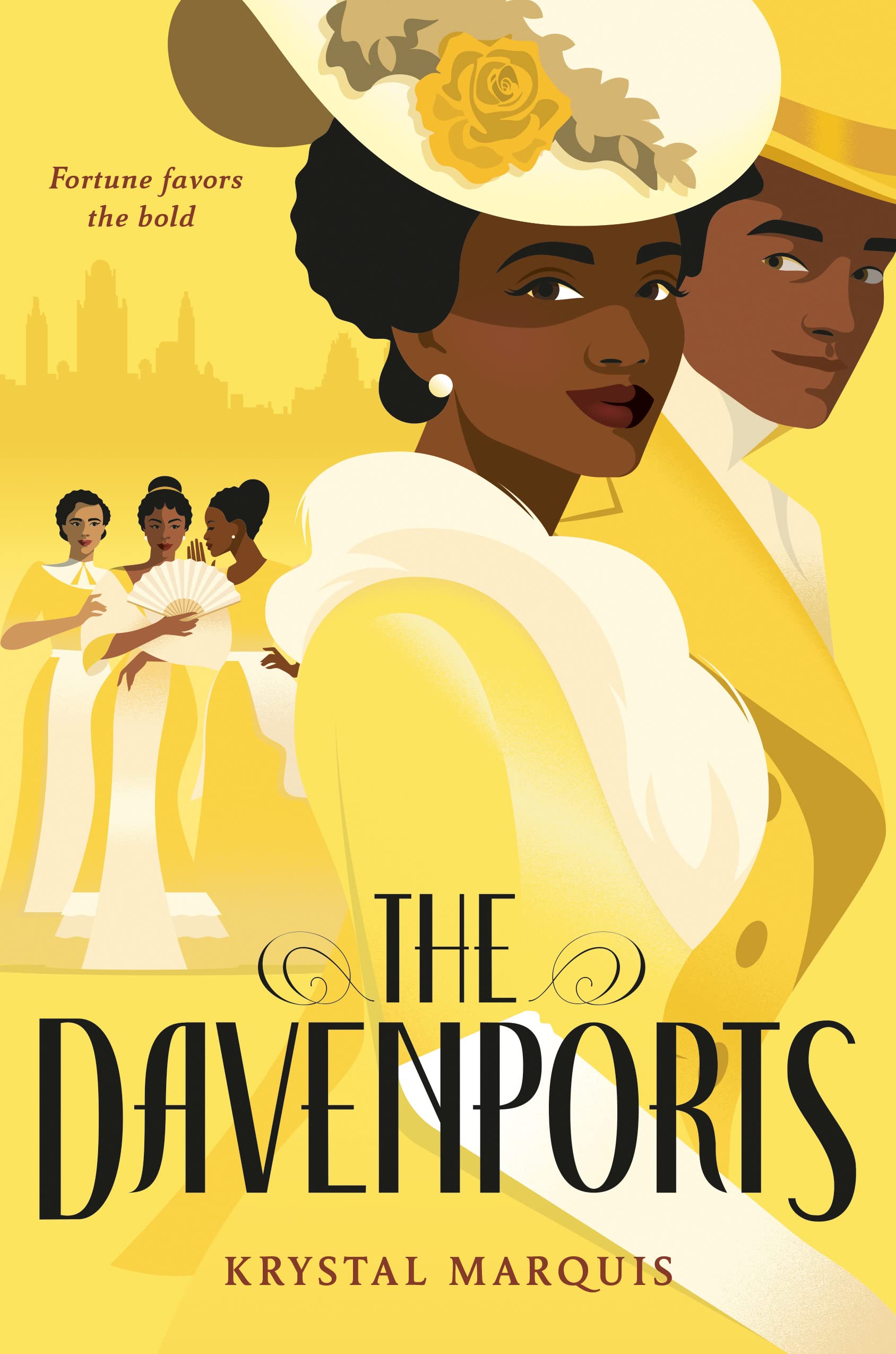
32. The Davenports


The Davenports (Davenports #1) Krystal Marquis. 2023. 384 pages. [Source: Library]

First sentence: Olivia Elise Davenport pulled a bolt of vibrant yellow silk from the display and held it to her dark complexion. She was drawn to the bright fabric nearly hidden behind the muted pastels, a shock of sunshine peeking through the clouds, and wondered if it was too bright for so early in the season. In her free hand, she held a sample of beaded lace and tried to imagine the sound it would make whispering around her ankles while she danced. There will be a lot of dancing, she thought.

Premise/plot: Set circa 1910 in Chicago, Illinois, The Davenports is an historical soap opera for young adults [and adults]. The Davenports are a socially elite, wealthy Black family. Mr. Davenport is a successful business man [carriage company]. They are the Somebodies of the [black] community. This soap opera features three Davenport siblings--Olivia (the oldest daughter), John (the only son), and Helen (the youngest daughter). Olivia is 'on the market' if you will. Her parents want her to make a great match. To find someone equally well-thought-of [admired, respected, successful]. The novel opens with Olivia and her best friend, Ruby shopping. John wants to go beyond mere carriages and get into the automobile business. He doesn't reject  the family business necessarily, but, he wants to take it in a new direction, expand upon it. The family assumes that Ruby and John will eventually make a match of it. But John, well, he's been noticing the maid, Amy-Rose. Helen, the youngest, I believe, is closest to John. The two of them really like automobiles and mechanics. Her parents frown her doing anything with mechanics or the family business really. She should be preparing herself for the marriage market. True, it isn't quite her turn in the spotlight, but she really should be mindful of her reputation, of her manners, of her appearance. Helen's practical, no-nonsense manner make her a good companion. Certainly Jacob Lawrence [Laurence???] thinks so. He's supposedly courting/wooing her older sister, Olivia. But. Helen and Jacob are drawn together. While Olivia is drawn to someone her parents do not at all approve of--an activist lawyer of a lower social standing, Washington DeWright. Ruby, her best friend, can relate. While her parents are pushing, pushing, pushing for her to get with John Davenport, she falls in love with someone she's "pretending" to court to make John jealous. (I don't remember his first name, but his last name is Barton). Her feelings turn all-too-real. John, meanwhile, is pursuing the maid, Amy-Rose, who has dreams of her own. She is head-over-heels in love with her employers' son, but, she also has more realistic 'impossible' dreams of opening up her own hair salon for black women. Many of the romances in this one have conflicts--obvious ones--which will require courage and boldness to defy expectations.

My thoughts: I'm not sure if the intended audience--actual preteens and teens--will see the similarities between this one and LUXE by Anna Godbersen. The first Luxe novel released in 2007. [Many teens wouldn't have even been born yet. Some would have been mere babies.]  Luxe features white characters in Manhattan circa 1899. Davenports feature a mostly-if-not-exclusively black cast of characters in Chicago in 1910. So there are certainly some differences. And not just surface-differences. The Davenports does address heavier issues, mainly in regards to race, race expectations, how to best 'serve the race,' 'represent the race,' 'raise the race,' etc.  

The Davenports is a soap opera. It is what it is. It isn't 100% fluff. That's not what I'm implying. Nor am I suggesting that the characterization is weak. It just follows a predictable formula in regards to how the drama [or melodrama] unfolds. 


© 2023 Becky Laney of Becky's Book Reviews

Wednesday, November 23, 2022

159. Winterkill


Winterkill. Marsha Forchuk Skrypuch. 2022. [September] 288 pages. [Source: Library]

First sentence: Tato and I had just entered the village after inspecting our wheat field.

Premise/plot: Marsha Forchuk Skrypuch's newest historical novel is set in [Soviet] Ukraine in the early 1930s. Nyl [and his family, his friends, his community, his country] will soon be in the fight of their lives. Not a fight with weapons, perhaps, but a fight all the same. The Soviets [Communists] are there with Stalin's "five year plan." And compliance, well, it isn't optional. No matter how wary, skeptical, or concerned--one "must" comply. Even if complying defies all logic, all reason, all common sense. Nyl and his family are farmers. They farm. It's a HARD life, no doubt, no question. Packed with plenty of concern and worry in any year. But since Stalin, well, the biggest fears and worries have changed. 

The novel opens with foreigners--Canadian Communists--who have come to live the glorious life under Stalin taking inventory of their farm. Nyl [and family] are mostly nervous and wary. What could this mean for them down the road? They didn't expect "down the road" to occur literally within a day's time. Life for Nyl [and his family, friends, community] will NEVER, EVER, EVER be the same.

And as the novel unfolds, it only goes one direction from there--and it isn't up. Skrypuch is writing about the Holodomor. The powers that be have decided to starve the Ukrainians and erase them--quite literally--from the landscape. Genocide by starvation. This, of course, was phrased with a million promises. Well, "promises," I suppose. 

 My thoughts: The cover might not be bleak enough for the contents. This is INTENSE. This is bleak. This is based on history. And I'm going to guess MOSTLY unknown history. I learned so much. It was heartbreaking knowledge. Truly heart-smashing-and-shattering. It was brutal. Yet I feel it was an important story to tell. History is sometimes horrifying, brutal, terrible. But I think it would be worse to cover it up, to hush it up, to deny, to ignore. 

While this one may not be for every single reader--it is BRUTAL, I tell you--it is so very well-written. It was impossible to put down. It was a book that will leave a mighty big impression on me.

© 2022 Becky Laney of Becky's Book Reviews

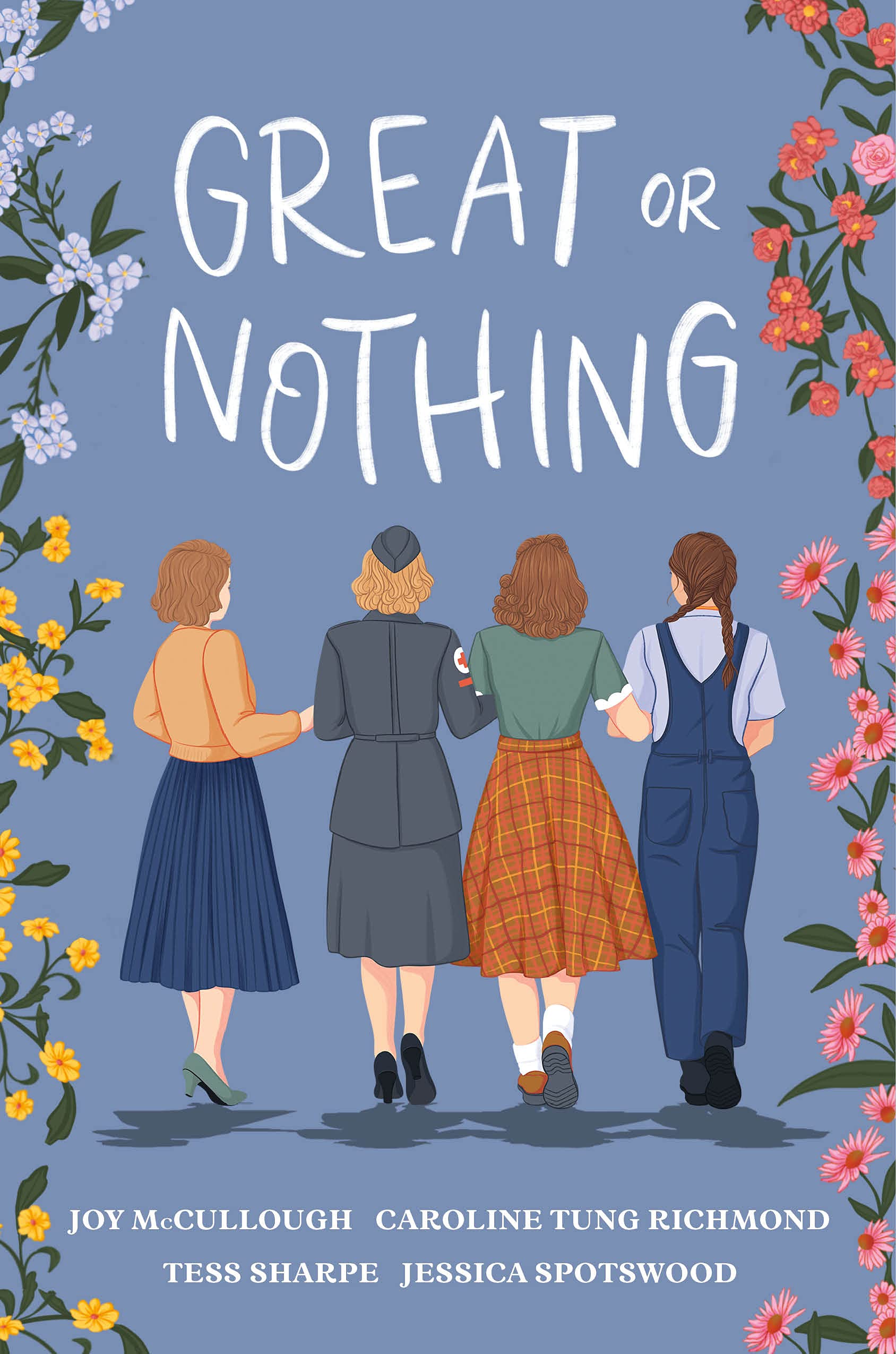
158. Great or Nothing


Great or Nothing. Joy McCullough, Caroline Tung Richmond, Tess Sharpe, and Jessica Spotswood. 2022. 400 pages. [Source: Review copy]

First sentence: There was a moment in each day where she forgot. It never came at the same time; if it had, perhaps then Jo could have been prepared for it. But how could you prepare for forgetting, just for a moment, that what once was a quartet had been reduced to a trio? There was no rhyme or reason to the moments she stumbled. 

Premise/plot: Four authors have teamed up to spin a retelling of Louisa May Alcott's Little Women. This retelling is set during World War II. It opens AFTER Beth's death. Amy, the youngest, is seemingly at art school [not really!], Jo is off working at a factory, and Meg is teaching at the local school. The sisters aren't really in the best place. Jo, in particular, is choosing not to speak with any of her sisters--in particular, Meg, or her mother. She is still dazed [hurt, confused, out of sorts] by Laurie's most unwelcome proposal. [How dare he?!?!?!] And she does not want to stay at home missing Beth. None of the girls do, not really. Meg stays because she loves teaching, loves her mother, and I think she's wise enough to know that no matter where she goes she'll always be missing Beth, still worried about the war. In alternating chapters, the story comes together. It is a coming of age story for all three. Don't let Meg staying at home fool you, she is still living life. She's not a "nobody" because she chooses to stay at home. 

Beth, though deceased, is still holding the family--and this book!!!--together. Her sections are told in verse. 

My thoughts:  My curiosity was very high. A World War II retelling?!?!?! I loved the premise of these young women coming of age during this time period! It seemed to me to make absolute perfect sense that Jo would, of course, be doing her part and getting work at a factory. Meg as a teacher, likewise, felt right. [Meg doesn't always get the love and appreciation she deserves.] Amy is VERY Amy. I was going to not spoil it, but, since the book description says it clearly--well, so will I. Amy has "stolen" the identity of another applicant and is a Red Cross volunteer in London. Conveniently located to bump into the dreamy Laurie. 

Though I'm normally not a fan of alternating narrators, I ABSOLUTELY LOVED, LOVED, LOVED it in this one. I didn't love all the narrators perfectly equally--I didn't. [But that is perhaps to be expected. I feel the same way with the source material.] Beth's poems made the novel for me. I loved them oh-so-much. In one of the Marvel movies--I think the second Spider-man movies--Peter Parker is gifted these awesome glasses with the acronym E.D.I.T.H which stands for EVEN DEAD, I'M THE HERO. And such is the case with Beth and her poetry. For me at least.

As for Jo being queer, I think this is one of many [yes, many] ways her character could be interpreted. I don't have a problem necessarily having it as one of a handful, one of many, "a" possible interpretation or reading of the character. It is when it becomes the predominant "of course" this is the "best" way to read, to interpret, to understand the character that I get slightly annoyed. Like the only "reasonable" or "conclusive" reason why she would reject Laurie's proposal is because she's lesbian. I can think of hundreds of reasons [slight exaggeration] why these two are NOT a good match. We don't all have to come to the same agreement, same conclusion.

Quotes:

Practice

I spoke to my dolls,
dressed the, brushed
their hair,
sat them up for stories
and laid them down for
bed,
long after my sisters
had given up their dolls.
I took in stray creatures,
stayed up nursing
kittens,
fed them with bottles
like I'd never feed
an infant.
Not my own.
It wasn't practice
since I'd never play the role.
Not everyone can be a
mother.

The Fireplace

The mantel
above our fireplace
was always crowded
as a train platform
just as the train arrives.
Photos and trinkets,
books and flowers,
an entire family hsitory
on one narrow shelf of brick.
Such a stark contrast,
the mantel at Aunt March's.
A showy vase, some
candlesticks.
I never saw them lit.
I sometimes wonder, had I lived,
would I have ended up alone?
Perhaps she'd leave me
the house,
for you all would have
had other lives to live.
But if she had, I would
have filled
that barren mantel with
my own platform
of travelers with their
joys and sorrows, busy
lives,
Photos, trinkets,
mementos from my
sisters
and their families, my
family too.

Falling

It's a little like falling in
love, dying.
At least, I think so.
I've only done one of
those things.
The more you fight it, the
harder it is.
Some parts are bound to
be painful.
It's messier than you
expect.
You have to give up
control.
But you end up
somewhere
you never could have
imagined.

© 2022 Becky Laney of Becky's Book Reviews

Tuesday, November 08, 2022

146. The Door of No Return


The Door of No Return. Kwame Alexander. 2022. 432 pages. [Source: Library]

First sentence: There was even a time...many seasons ago...when our people were the sole supplier of the purest and most valuable gold in the world...

Premise/plot: Set in the Asante Kingdom [modern day Ghana] circa 1860, The Door of No Return is a heart-crushing verse novel. Kofi Offin, our protagonist, is a boy--oh-so-close to being recognized as a man--whose world is about to be turned upside down. But before that--oh before that--readers are immersed completely in his world, in his village, in his family life. His family, his friends, his hopes and dreams. Everything is so fleshed-out; the world building is excellent; the characters are so fully human. If only the "before" had not been interrupted. But that is not his story. 

My thoughts: Heart-crushing is how I'd describe this one. It was bittersweet. The sweet comes early on in the novel. It was easy to get swept up in the story, to fall in love with the characters, to get HOOKED. I was so engaged with the characters that when the dreaded-horrible-tragic event occurs, it felt heart-crushing. It would have been sad if it had happened in chapter one or two. But coming when it did, it had more impact. In my humble opinion, it had more impact. Again, it would have been sad and tragic if it had happened chapter one, page one. But oh-my-heart, the fall was so much greater having been built up. 

I'm not sure how I feel about this one. Obviously, it is well-written. Obviously, it is engaging, compelling. Obviously it is bitter-sweet, or BITTER-sweet. Obviously, I will want to read more, more, more when the story continues. But, it was so incredibly sad, upsetting, disturbing. His story NEEDS to be heard--obviously. But my heart needs cheering up. 


© 2022 Becky Laney of Becky's Book Reviews

Friday, November 04, 2022

142. Marmee


Marmee. Sarah Miller. 2022. [October] 432 pages. [Source: Library]

First sentence: All day long, Amos’s letter waited in my pocket—the most perfect of Christmas gifts. 

Premise/plot: Little Women retold through Marmee's eyes. That is essentially the bare bones premise of the newest historical fiction novel by Sarah Miller. The book is told through a series of diary entries. Marmee [and her husband, Amos] have kept journals/diaries for years--decades. But this book consists of diary entries December 24, 1861 through December 25, 1868. The Christmas of 1868 is when [the real Louisa May Alcott] presented her [actual real] mother with the novel LITTLE WOMEN. So it is a fitting conclusion.

The book consists of diary entries, as I mentioned above, so there are no chapters--just two sections. One section, I believe, covers most of the war years. The second section, I believe, covers from the Christmas of 1865 [I believe?????? perhaps January of 1865] through Christmas of 1868. I am going to take an educated guess that this may reflect the two sections of Louisa May Alcott's Little Women, which was originally published in two books. 

This new perspective allows us to see the events of Little Women through new eyes. But it also expands the context of the original novel and to look at the bigger picture of what women's lives [typically] were like during this time in American history. Our heroine, like Louisa's real life mother, Abigail May Alcott, has strong opinions and "sharp" edges. Marmee may have a fierce and feisty temper that she tries to conceal--most of the time--but she can also be incredibly empathetic, compassionate, a true advocate. 

My thoughts: I mostly have only gushy things to say about this one. [Mostly]. I love how personal it is. It felt genuinely authentic to the times. For example, though Marmee wouldn't ever openly talk about it--especially with her own children, her own little women--she's had eight pregnancies and only four lived. This is her heartache and burden, yet, she lives and keeps on living. It's just what you do. You stay strong. You face what life gives you. There is no entitlement or presumption that life will be all roses and no thorns.

I loved that they brought the 'loyal servant' Hannah to life--given her quite a back story. And a story that sheds light on the struggles women have faced throughout the centuries. Readers also see the contrast between Marmee and Aunt March--in terms of what it means to live out "faith." Marmee is forever compassionate, loving, helpful. Aunt March, mostly, is more judgmental and rigid. Don't let "those people" get too close to you. If you absolutely have to do something to "help" the "least of these" the "dregs" of society, then keep a good, long distance. 

I never really gave much thought to HOW Marmee would have felt towards the two Laurences--the grandfather and grandson. But reading Miller's Marmee, it makes complete and total sense how she might have seen him as "her" son, or the "son of her heart" early on. She lost her own baby boy--he only lived a few minutes--but if he had lived he would have been almost old enough to fight in the war. It makes sense how she has a son-shaped hole in her heart that is filled by Laurie and then Mr. Brooke [who was so helpful in caring for Mr. March when he was injured.] 

 Yes, we see Marmee as a mother. But we also see her as a WOMAN. So much more than "just" a mother.

I thought it was interesting to see how Marmee reflectively thinks about her four girls, her four little women. I think these insights feel mostly right. 

Quotes:

  • The urge to do and be our best in the face of Amos’s daily sacrifice is irrepressible. I am thankful my girls’ burdens are still so light, that they do not have to bear the added weight I do. Vanity, shyness, and selfishness are all worthy dragons to conquer. Only Jo does not recognize her true burden. The fire in her, what she calls being rough and wild, is not what worries me. I would not tame her of that. The way she flares, though, when something ignites her anger, makes me wince. I have singed too many of the people I love with the sparks of my own temper. Sometimes I believe the flames that burned my face and hand as an infant took up permanent residence within me.
  • Of all the many forms of starvation, the hunger for respect is hardest to cure.
  • If I could only teach people not to be ashamed of asking for what they need! Every belly deserves to be filled, no matter what sin or folly or misfortune has caused it to be empty.
  • The possibility forces me to contemplate whether contentment is not so elusive for other women as it is for me. Before my own hearth, surrounded by my Family, I am entirely satisfied with what I have. These walls contain riches beyond measure. But the moment I consider the world outside, and what is denied to me and others due to the accident of their race or sex, I can hardly sit still for wanting to remedy all that ails our society.
  • What she fears is invisible to me. I have spent most of my life wishing for more ways to make my presence felt in the world, to make my voice heard. For Beth, the prospect of being seen, looked at, watched, is paralyzing. I could better sympathize if it were only strangers that unnerve her so, but any kind of attention makes her curl up within herself. Even on her birthday, with none but those she loves best orbiting her like planets around a cherished sun, she always looks as though she’d like to bolt under the table at the first chance. There is no one I can turn to for counsel.
  • IT is not only that she is afraid—it is that she is ashamed of being afraid.
  • If her mind was so crowded with apprehensions that there was no room for learning, I asked myself, what was the good of schooling? A mind must have space to expand.
  • I do not want her to choose home and hearth because it is the place she dreads least, but because it is is the place she loves most. Home should indeed be a refuge, not the metaphorical bed she cowers under.
  • Oh, my Beth. Her world may be narrow, but those of us fortunate enough to exist within its boundaries have been uncommonly blessed.
  • I cannot help but wonder sometimes if some wisp of the spirit of that stillborn boy inhabits my Jo. There is something in her that most girls—indeed, most women—lack. If not for my other three I would think all girls are born with it, only to have it tamed out of them. It is not solely ambition; Amy has that, and is as prim and feminine as a fashion plate. It is the brash sort of confidence that men have, though being female, Jo is not permitted to feel it as such. She feels only the uncomfortable way she scrapes against the world’s expectations. Life would be smoother for her if we sanded away the edges that do not fit neatly. But then Jo would not be Jo at all.
  • I have at last fitted up a German word of my own. It is made of more than one piece, as all the best German words are. First, Herz. That is the word for heart. Then Mutti. Birte’s children do not call her Mutter, the proper word for mother, but Mutti. You might say it is their family’s way of saying Marmee. And so, Herz-Mutti. That is who I should like to be to Laurie. And so it follows that he may be a Herz-Junge to me. Heart-boy.

I think there are many ways to "read" Little Women. And by read I mean interpret. It is certainly not unheard of to try to make Jo into a forerunner--of sorts--for the lgbt+ community. [That's not how I personally read/interpret Jo's character, by the way]. Marmee's reflections about Jo could definitely be interpreted by today's readers as nodding [agreeing] to this idea of Jo using the pronouns they/them, of being non-binary. Miller doesn't out and out say this--she doesn't. But read between the lines of some of what Marmee writes in her diary entries, and you get the feeling that this might be the modern-day, contemporary conclusion. Also, I get the impression that Jo's asexual. [Again, that's now how I personally read Alcott's text. It's not. But every person has the freedom to read and interpret books--especially classics with the authors long deceased--how they want.] Marmee writes in multiple entries how she has never noticed Jo *desiring* either men or women. Yes, Marmee questions if her daughter might have secret, hidden desires for women, but Marmee has not noticed any interest/leaning in this direction. Marmee questions if her daughter has any sexual desires at all and if that lack of sexual drive might be the reason behind her not wanting to marry at all. She writes a note to her daughter that essentially says there is more to marriage than just physical desire[s]. It's a meeting of the minds and hearts more than the bodies themselves.  

I may not read the original Little Women along these same lines. But overall--big picture BIG--I enjoyed Marmee by Sarah Miller. 


© 2022 Becky Laney of Becky's Book Reviews

Friday, August 05, 2022

94. African Town


African Town: Inspired by the True Story of the Last American Slave Ship. Irene Latham and Charles Waters. 2022. 448 pages. [Source: Library]

First sentence: Be still, my children. Listen with your ears
and your heart. Our story starts with this
mark on my right cheek, these chipped teeth.
See? This is how you know I am who I say I am.
De town where I was born is called Bante.
It's nowhere near here, not in African Town, not
in Alabama. This town's way across de ocean,
on de west coast of Africa in de kingdom
of Dahomey. My family's home was a round,
two-story adobe with a terrace. Surrounded by hills,
about eight days' walk to de sea. Someday maybe
you will see de world de way I have seen it
in Bante. Then you will know how de sun
kisses de earth, melts like honey over de land--
it's no wonder I believed all of life would be
bright and sweet. No wonder it still shocks me
that de world can be so hard, so dark.
But that darkness, it brought me here.
It brought you here. This is our story.

Premise/plot: African Town is a verse novel based on or inspired by a true story. Long after the importation of slaves was illegal--though not slavery itself--one ship, the Clotilda, was used to smuggle in a shipment of slaves. The year was 1860. 

It is a verse novel that spans a little over four decades. It opens around 1859/1860 and closes around 1901. The poems alternate narrators...and in doing so alternates perspectives. Though by far the greatest representation are the men and women captured, enslaved, sold. Other narrators include white men in the slave trade, slave owners, and VERY VERY VERY oddly the ship Clotilda. 

It isn't "just" the story of African slaves. It is the story of how these last slaves bonded and formed a community--literally and figuratively. This is the story of the formation of African Town or Africatown.

My thoughts: Powerful. Compelling. Important. These are the words I'd use to describe this verse novel. It is a heavy novel in its subject matter. The characters--[loosely] based on real people--are well developed. The characters were easy to care about. I got swept up into this one. I knew a little bit about the Clotilda from previous reading. But this was an absorbing read. I thought the verse novel format was a perfect fit for this one.

© 2022 Becky Laney of Becky's Book Reviews

Friday, July 22, 2022

87. The Star That Always Stays


The Star That Always Stays. Anna Rose Johnson. 2022. 224 pages. [Source: Library]

First sentence: I'm standing before the castle-like structure of Boyne City High School, staring at its gleaming windows, my heart filling with the anticipation of beginning the journey into higher education. 

Premise/plot: The Star That Always Stays is historical fiction set circa 1914/1915. It very roughly follows the protagonist's first year of high school. It is very much a coming of age novel. Norvia Nelson, our protagonist, is processing a LOT. Her father is long gone; her mother is remarrying after their divorce; she'll have new step-siblings; she'll be in a new house; she'll be starting high school...and she's Ojibwe. (Or half-Ojibwe). Perhaps because of how her father cruelly used their heritage against them in arguments (he was verbally abusive) perhaps because of the times, Norvia's mother has asked all of her children to keep their native heritage hush-hush. 

At first Norvia is hesitant and skeptical of "Uncle Virgil" and her new step-brother, Vernon. She's worried that her mother is being foolish and naive. That this rushed marriage is a big, big mistake. They come from two different worlds after all. But slowly and surely over the course of an entire year, Norvia changes her mind. 

My thoughts: The Star That Always Stays is an incredibly slow novel that is character-driven. Don't expect action, adventure, or excitement. The most excitement you can expect (and do expect it!) is when Norvia discovers a new book to love, a new character to emulate or admire. She's a sensible character not prone to dramatic hysterics. She does have a younger sister (Dicta) that is an absolute HOOT. She's a scene-stealer for sure. But this is a quiet-book with a quiet-heroine with subtle themes and tones.

I didn't fall for this novel from the start. I did think it was a bit slow. But somewhere in the middle, well, I can't even explain when or where or how, I realized that I was in love with this book. 

I loved, loved, loved, loved, loved the slow-build relationship between Norvia and her stepfather....and her slow-build relationship with her step-brother. (The other step-siblings are older and married. And they don't enter into the story as much.)

The book is based on the author's own family history. 

Quotes:

"But you have to realize that life does change. Things will be different, always. There's only one thing you can control."
"What?" Norvia murmured.
"The way you handle those changes. You're in complete control of yourself and how you adjust and respond. And," said Uncle Virgil, breaking off and smiling, "there is Someone on whom you can always rely--completely. He will never fail you. Christmas is a good time to remember that Jesus is always there for us, caring for us."


© 2022 Becky Laney of Becky's Book Reviews

Saturday, June 04, 2022

67. The Peach Rebellion


The Peach Rebellion. Wendelin Van Draanen. 2022. 416 pages. [Source: Library]

First sentence from the prologue: It's August sixteenth. My birthday. I wake up before sunup, excited.

Premise/plot: The Peach Rebellion is historical fiction with dual narration. Our two heroines are Peggy Simmons and Ginny Rose Gilley. These two were friends as children, but life has pulled them in different directions, until now. Now eleven years later, these two friends are reuniting. But they've grown and changed in oh so many ways. The Gilley family migrated to California from Oklahoma during the Dust Bowl. Life has been HARD, tremendously hard. The Simmons family isn't rich by any means, but they are rich by comparison. They have their own farm--growing and selling peaches. Neither family is super-excited that the girls are becoming friends again. Another person who shows some dissatisfaction with this new (old) friendship is Lisette Bovee, the banker's daughter. 

The historical setting is California in the summer of 1947.

My thoughts: I wanted to (but didn't) love this one. There were things that I liked about it. I think I liked the characters at their core. I liked Peggy and Ginny Rose. I even grew to tolerate Lisette. (Mostly I wanted to yell at Lisette.) But I definitely did not like the story or the direction the story goes. A different story with these characters I could easily see myself enjoying more. I liked the coming-of-age elements of this one. And how each of the girls is handling the new responsibilities that come with growing up. Including an interest in boys. There is a we're-in-this-together element that I definitely enjoyed.

So what didn't I like about the story itself? I thought it was MORBID. Morbid and weird. The major plot of this one involves, well, something a bit unusual...and dark. In my opinion. Reading is subjective. Maybe other readers won't find it so unpleasant?

S
P
O
I
L
E
R

A
L
E
R
T

Read at your own risk, spoilers ahead.

So in the prologue (when the main characters are around seven), Ginny Rose goes with her father to bury her younger (twins???) brothers who died of disease in one of the migrant camps. (Remember this was during the Dust Bowl, the big migration to California, and during the Great Depression as well.) That's not the morbid part, not really. Now as a teen (seventeen? eighteen?) Ginny Rose is determined (with the help of her friends) to go on a journey to discover the unmarked grave of her brothers and bring home their bodies. Maybe it is 100% me. Maybe teens wouldn't mind at all trekking across the country in a "borrowed" family truck with a couple of shovels on a mission to dig up dead bodies. But for me, well, it isn't so much the desire to give closure to the family by giving them a proper burial and an actual marked grave that is disturbing, but the hands-on and SURPRISE element of it. They are going to sneak out on their own and SURPRISE their family with the bodies in the back of the truck. And that just doesn't sound like something you should just surprise someone with. Or maybe again that's just me???

© 2022 Becky Laney of Becky's Book Reviews

Friday, April 29, 2022

53. Sense and Second-Degree Murder


Sense and Second Degree Murder. Tirzah Price. 2022. [April] 416 pages. [Source: Library]

First sentence: On the day that her life was to change forever, Elinor Dashwood awoke late with a wild hope fluttering in her rib cage. But, being the sensible sort, she kept it hidden as she rose, dressed, and joined her family for breakfast, stifling a yawn as she sat down at the table. It was a sunlit, cheerful morning, but her mind was still tucked between the pages of the book she'd stayed up far too late reading, so she didn't notice her younger sister's arched brow.

Premise/plot: Elinor and Marianne Dashwood team up to solve their father's murder in Tirzah Price's Sense and Second-Degree Murder. Their father has a detective company, Norland and Company, but all (house, business, estate) is left to their older (half) brother and his narcissistic wife by an outdated will. (Though the house, I believe, was entailed. But he could have left them money and the business). Their lives are turned topsy-turvy; they are snubbed by former friends now that they are down on their luck. But all the young women care about are solving the case of WHO murdered their father...and if they happen to solve a few of his open cases at the same time...so be it. 

My thoughts: I liked this one. I didn't love, love, love it like the first book in the series. I don't know that I really felt Elinor and Marianne resembled--in any way--the Austen characters. The book also felt slightly rushed and under-developed. Perhaps because I feel it took a few shortcuts along the way both with plot and characters. Granted the original novel might drag here and there perhaps. I'm not one to judge readers who might wish to rush things along with the original. (I don't. I like the journey just as much if not more than the final destination.) 

Elinor's "big" thing (if you will) is science and in particular chemistry. Since I love the Flavia De Luce novels, I thought I'd probably enjoy this one too. Marianne's "big" thing is detecting. But I don't think she's suited for it because she has some major blind spots and prejudices, if you will. (Like determining if a person is a potential suspect based on attractiveness. If she likes-likes a guy, well, then obviously he has to be innocent. If she finds a guy a bore and not worth her time, well, then obviously he could be a murderer.) Margaret, the younger sister, has some potential but isn't given enough time.

I do think it is interesting that the focus is on laudanum and opium and drug abuse...this was very much an issue in the nineteenth century.  


© 2022 Becky Laney of Becky's Book Reviews

Friday, February 25, 2022

31. Rima's Rebellion


Rima's Rebellion: Courage In a Time of Tyranny. Margarita Engle. 2022. [February] 208 pages. [Source: Library]

First sentence: During the lull between protests
we ride bareback
no bridle
or bit
no spurs
just silent messages
sent to our horses
through the pressure
of hands
knees
feet
weight
seat.
Balance
is the magic
that helps us gallop
side by side
as we ride
in dazzling
formations...

Premise/plot:  Rima's Rebellion is Margarita Engle's newest verse novel. All of her novels (or at least most of her novels) are set in Cuba in varying time periods. This verse novel spans 1923-1936. At the center of the book is our heroine, Rima, an illegitimate or "natural" born daughter. Women do not have rights--equal rights, voting rights, etc. Natural born children do not have rights--they are not recognized and are lacking some basic rights. Rima takes up both causes alongside other members of her family. She's twelve when the novel opens in 1923.

My thoughts: The novel is beautifully written. I will not deny that. Here are some of my favorite bits:

Rhythm
is the power
of hoofbeats.
Courage
is the essence
of triumph...
but bravery comes and goes, ebbs, then flows
like a tide on the shore of my turbulent childhood.


Fear is like a shadow, always present
but sometimes hidden.


Strength of character is just as powerful
as muscles.
Hope soars like a spirited horse,
crossing fences and streams.
Confidence flutters and flies far away,
then returns, just as loyal
as a homing pigeon.


My mare is my wing,
her hoofs the feathers
as she rises
sun-bound
cloud-fueled
soaring high
over fences
and streams....
When we leap
I escape.
The enemy I run away from
is my own thought-trapped self,
all these doubts born within me.
If only I could mount a horse of hope
day and night, airborne, free!


Even when I'm surrounded
by men and boys who expect me to fail,
I try to remember that I belong
to a sisterhood
of endless
determination.

But I didn't feel as strong a personal connection with the story or characters as I was hoping. I have read and loved, loved, loved, loved some of her works in the past. I wanted to be in love with this novel. I just wasn't. I don't know if it spanned too many years??? tried to do too much??? Or if the decades spent working for the cause were a little too same-same-same.


© 2022 Becky Laney of Becky's Book Reviews

Tuesday, January 25, 2022

15. My Fine Fellow


My Fine Fellow. Jennieke Cohen. 2022. [January] 352 pages. [Source: Review copy]

First sentence: In the year 1833 of the Common Era, a fair ten years since King George IV died and his much beloved daughter, Princess Charlotte, succeeded him as Queen Charlotte of England, Ireland, Hanover, and so on and so forth, one Miss Penelope Pickering stood in the shadowed portico of St. Paul's London, wondering how much longer she'd have to wait for her dear friend Helena Higgins.

My Fine Fellow is a YA adaptation--a spin--on the classic musical My Fair Lady which is an adaptation of Pygmalion. Helena Higgins and Penelope Pickering team up to teach a young street vendor, Elijah Little, how to become a gentlemen chef. The two young heroines are still in training themselves, mind you, but they feel that with their "expertise" and a little luck, they can fool everyone with their finished project. If all goes well, he'll be cooking for Queen Charlotte herself.

The novel is told primarily through Penelope Pickering's perspective--with perhaps a few moments here and there from other characters. 

It is set in an alternate history one where Princess Charlotte survives childbirth and goes on to reign as Queen. Queen Charlotte is ALL about women's rights, women's equality, opening up all education and careers to women.

The novel definitely is heavier than you might expect. You might suppose that this would be a light, entertaining, silly read. And it is--in places. The heaviness comes in with race and racism. In some ways there's no recovering from that. 

The book provides an opportunity for rants. If you've ever had a strong opinion on HENRY HIGGINS (from the original), then you might enjoy the ranting against Helena Higgins. But really, the characterization is minimal. 

I feel this book is too 'modern' for its own good. Just my opinion. I think the dishes they were having the characters prepare scream out Food Network from the past ten years AND not like any recipe you'd find in any book from the nineteenth or even twentieth centuries. Granted, this is an alternate history, but, still.


© 2022 Becky Laney of Becky's Book Reviews

Monday, September 27, 2021

124. Walls


Walls. L.M. Elliott. 2021. [July] 352 pages. [Source: Library]

First sentence: Standing in the doorway, Drew hesitated, his freckles burning crimson like a thousand flares of anxiety.

Premise/plot: Drew, our protagonist, is an army brat. His father has been stationed in West Berlin; the year is 1960. Drew and his siblings--Joyce (older sister) and Linda (little sister) have some trouble adjusting to life in Germany. Their mother is German and has family living in East Berlin. She would love nothing more than for her children to become good, good friends with their cousins. Matthias is their closest cousin in age. But the cousins seem to be worlds apart...

Each chapter is preceded by a graphic portion. Black and white photographs with some explanatory captions. Each chapter represents one month. The novel opens in August 1960 and closes in August 1961. What can happen in one year??? A lot!

My thoughts: Each chapter is almost a vignette--a moment in time captured. The chapters rarely cover more than a few hours of time. So readers get a few snippets here and there. We do not get a continual, immersive experience in Drew's life. We get moments. I personally--and again this is all subjective--had a hard time connecting with the story. I felt almost a disconnect from the characters. I was interested in the story, the time period, the setting. But I didn't feel I really truly got to know any of the characters in a deep and meaningful way. This might be a timing issue on my part--perhaps I wasn't in the right mood to experience this one?

This historical fiction novel for middle grade (???) is about the building of the Berlin Wall.


© 2021 Becky Laney of Becky's Book Reviews

Friday, September 24, 2021

119. Pride and Premeditation


Pride and Premeditation. (Jane Austen Murder Mystery #1) Tirzah Price. 2021. [April] 368 pages. [Source: Review copy]

First sentence: It is a truth universally acknowledged that a brilliant idea, conceived and executed by a clever young woman, must be claimed by a man. Elizabeth Bennet stood in the offices of the optimistically named law firm of Longbourn & Sons and fixed her father's junior partner, Mr. Collins, with her fiercest glare.

Premise/plot: Tirzah Price's spin on Jane Austen's Pride and Prejudice is a delight from start to finish. It is set in the Regency--like the original--but it intentionally plays around with history. Taking something that would be absolutely impossible--a young woman working in a law firm and pursuing a career in law--and makes it instead something rare, unique, out of the ordinary....but not impossible. 

Elizabeth Bennet, our heroine, has ambitions to follow in her father's footsteps. This has her investigating a potential case for Longbourn & Sons. Mr. Bingley has been arrested and charged with murdering his brother-in-law, Mr. Hurst. Elizabeth would like to use this case to prove her abilities. She is determined to investigate the case, follow the clues, and find the real murderer. This has her at odds with Mr. Darcy a lawyer (solicitor) at Pemberley and Associates. If the real murderer is to be found--and Mr. Bingley's innocence proven--it might just take both of them working together despite their personal feelings.

My thoughts: I love, love, love, love, love this adaptation. It is so delightful. It has all the characters from the original novel. (Well, most of them. I can think of a few that are missing.) Some of the original dialogue--all the best bits--reworked to fit this new situation. And it works surprisingly well. Mrs. Bennet is still very active in trying to get her daughters married off. She is still a nervous woman. Mr. Bennet is still favoring Elizabeth. Elizabeth is still super close with Jane who is a calming influence on her.

I would absolutely LOVE to see a film version of Pride and Premeditation. There's even a scene that could easily accommodate a wet shirt scene with Mr. Darcy.


© 2021 Becky Laney of Becky's Book Reviews