Showing posts with label Elizabeth Gaskell. Show all posts

Saturday, February 06, 2021

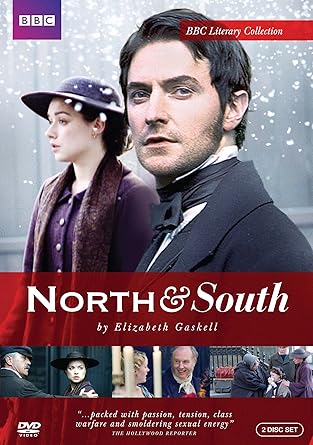
Movie Review: North and South (2004)


North and South
2004
Starring Daniela Denby-Ashe and Richard Armitage
Directed by Brian Percival
Music: Martin Phipps

In December I reread Elizabeth Gaskell's North and South. In January I watched (for the first time) the 1975 adaption of North and South (starring Patrick Stewart). This month I rewatched the 2004 North and South.

Overall, I really love and adore this movie. Is it faithful to the book? Not really. Is it faithful to the spirit/essence of Gaskell's characters? No, not really. But does it tell a whole story and stand on its own? YES, yes, yes. The characters though perhaps miles away from being like what Gaskell actually wrote are so well written--so well cast--that it WORKS. Here's where this adaptation shines. It is all about RELATIONSHIPS and (viewer) INVESTMENT and EMOTIONS/FEELS. 

Though John Thornton and Margaret Hale are not Elizabeth 2.0 and Darcy 2.0 in Gaskell's original novel, in the movie they sort of are. And it's a formula that works well. 

I could point out all the hundreds of ways this adaptation differs from the novel. (The first happening withing a minute or two of the movie's opening. Mrs. Hale (Margaret's mother) does NOT attend Edith's wedding. Mrs. Hale and her sister live in two different social worlds, have different incomes, and different wardrobes. Mrs. Hale is too embarrassed and too proud to either ask to borrow a dress or to appear in a super-shabby dress that is decades out of style as well. Perhaps Margaret is unaware of this reasoning, she's not always intuitive--rarely intuitive--but certainly Gaskell emphasizes this.) To me the biggest difference is the two John Thorntons. 

The question isn't is this a good/great/decent adaptation...the question is this a good/great/awesome/wonderful movie. And while it fails at the first, it exceedingly succeeds at the second. It is a WONDERFUL movie that doesn't need to rely on a book. 

The characters, the actors, the costumes, the MUSIC, the romance....all is perfectly perfect especially if you divorce it almost completely from Gaskell's novel.


© 2021 Becky Laney of Becky's Book Reviews

Tuesday, January 26, 2021

7. Ruth


Ruth. Elizabeth Gaskell. 1853. 432 pages. [Source: Bought]

First sentence: There is an assize-town in one of the eastern counties which was much distinguished by the Tudor sovereigns, and, in consequence of their favour and protection, attained a degree of importance that surprises the modern traveller.

Ruth Hilton, a beautiful, young apprenticed seamstress, makes a mistake when she falls in love with a wealthy young man, Henry Bellingham. The two run away together--to Wales, I believe. When he becomes sick, his mother comes and rescues him from the "evil tramp" Ruth. What will Ruth's future be now? Is there hope for this 'fallen woman'?

Why do they run away together? She is late coming home on her afternoon off. She'd been out walking with Mr. Henry Bellingham. When her boss sees that she's walking with a fellow, she's THROWN OUT OF THE HOUSE. No questions or interrogations, no chance to explain. Being an orphan, she has no one to turn to. Granted, he is quite enchanted with her and eager to keep company with her. Granted, he being older and wiser and more aware of how the world works could have taken more care to protect her reputation. But he didn't. Would Ruth have become a fallen woman if she hadn't been pushed out the door with malice??? Didn't her former boss push her DIRECTLY into the arms of Mr. Bellingham? 

The book doesn't make a distinction between kind and tender AND reprobate sinner sin sinner. I don't see Mr. Henry Bellingham as EVIL per se. I think in some ways he was more mature and worldly wise; she was more naive and innocent. But I do get the idea he genuinely cared for and loved her. In other words it wasn't 100% lust on his part. 

So the book skims the surface of their time together. Is it a few weeks, a few months, half a year or more? Readers don't know for sure. Long enough for her to conceive a child. (Which could lend itself to a mere week or two). But their days are full of happiness in one another. Until he becomes ill and requires nursing. She's his full-time nurse and she's tender, loving, and all kinds of wonderful. But someone else writes his mother to come and fetch him. 

His mother sees Ruth as an EVIL TRAMP, a seductress. She WENT AFTER HER SON. She forced him to live a debauched life. The best thing--the only thing--is to keep these two apart forever and ever. Whether Ruth lives or dies is no concern to her. She must reap what she has sown--bear the consequences for her wickedness. Readers can put two and two together and see that her perspective on Ruth is unkind--though not shocking or out of touch with the times.

But their holiday in Wales wasn't all that secluded. Ruth also made acquaintances and friends with others during her stay. One of those is Mr. Benson, a minister. He knows that Ruth is "living in sin" with a young man (though I don't believe these two meet at this point). But he also sees her as a young, naive, deeply troubled young woman who has hit rock bottom. Almost literally. Ruth has lost the will to live. She's sunken to the 'depths of despair' (to borrow a phrase from Anne Shirley). He doesn't see Ruth as reprobate past the point of no return. No, he sees her as a human being in need of a Savior. Mr. Benson knows that ALL have fallen and come short. Mr. Benson knows that NONE are worthy. Mr. Benson knows a mighty, mighty Savior who will graciously welcome her into His Kingdom with open arms. God's grace is AMAZING and his love knows no bounds. What Ruth needs is not stern judgment and to be cast out from society, what Ruth needs is to be welcomed wholly and loved. 

Mr. Thurstan Benson and his sister, Faith, take Ruth with them to their own community (remember Wales was a vacation, a holiday), to their own home. Ruth becomes one with them and gets a new beginning. And a new beginning it is, Ruth has been born again, born from above. She has been forgiven, fully forgiven. And she loves abundantly and graciously. Leonard, her son, is a wonderful little boy. 

Not content to live off of charity, Ruth first becomes a governess and then later a sick nurse. The novel illustrates through its characters--Ruth, Faith, Sally, Thurstan, etc.--faith in action.

The novel is a tragedy--but not for the reasons one might expect. Elizabeth Gaskell is no Nathaniel Hawthorne or Thomas Hardy. The novel's treatment of a woman bearing an illegitimate child is revolutionary for its time--in my opinion. Ruth was treated with GRACE, BOUNTIFUL, OVERFLOWING grace. She was LOVED unconditionally without judgment, without scorn. Mr. Benson loved her with the truth: There is a God who SAVES. There is a God who FORGIVES. There is a God who LOVES, who SEES and HEARS. Even if the world doesn't forgive, even if the world doesn't give second chances, even if the world rejects--there is a God who will never leave nor forsake. 

The novel features many conversations that I imagine would have been shocking, offensive, challenging to the status quo at the time it was published. I imagine that this novel might have been a bit controversial in some circles.What is 'the Christian' way to treat a fallen woman? a single mother? Were the Bensons being too lenient? By extending love and grace to Ruth were they compromising the truth and their witness? 

There were several opportunities for Thurstan Benson to show grace. The most obvious being to Ruth herself and to her son. But a second was when he was wronged by a neighbor. He shows grace both times and advocates for grace in strong language. But there was one opportunity where he did NOT show grace nor give the benefit of the doubt. 

Thurstan Benson, for better or worse, does not see Mr. Bellingham (aka Mr. Donne) as being anything other than a reprobate. He sees him as a SINNER SIN SINNER through and through. Though he graciously sees Ruth as being REDEEMED (her past completely wiped clean; spotless), he doesn't seem to think that God could work a mighty wonder in Henry too. Benson is not civil to him and utterly rejects all of his offers to help with Leonard, to provide for him, to be even a little part in his life. Is it fair of Mr. Benson to offer the grace of the gospel to Ruth but withhold it from Henry Bellingham??? Is Leonard better never knowing his father's name, better never having a relationship with him, better without a cent from his father? I am not saying absolutely that a relationship between Leonard and Henry Bellingham would have been perfectly perfect and the ideal way to end the novel. But in the real world, I would hope that a child would be able to have a relationship with both parents even if one parent isn't a saintly saint saint.

Quotes:

  • "Well, my dear, you must learn to think and work too; or, if you can't do both, you must leave off thinking. Your guardian, you know, expects you to make great progress in your business, and I am sure you won't disappoint him."
  • The night before, she had seen her dead mother in her sleep, and she wakened, weeping. And now she dreamed of Mr Bellingham, and smiled. And yet, was this a more evil dream than the other?
  • Ruth was innocent and snow-pure. She had heard of falling in love, but did not know the signs and symptoms thereof; nor, indeed, had she troubled her head much about them.
  • "My dear, remember the devil goeth about as a roaring lion, seeking whom he may devour; remember that, Ruth."
  • The old man sighed as he watched them away. "The Lord may help her to guide her steps aright. He may. But I'm afeard she's treading in perilous places. I'll put my missis up to going to the town and getting speech of her, and telling her a bit of her danger. An old motherly woman like our Mary will set about it better nor a stupid fellow like me."
  • "Ruth, would you go with me to London? My darling, I cannot leave you here without a home; the thought of leaving you at all is pain enough, but in these circumstances—so friendless, so homeless—it is impossible. You must come with me, love, and trust to me."
  • Low and soft, with much hesitation, came the "Yes;" the fatal word of which she so little imagined the infinite consequences. The thought of being with him was all and everything.
  • "In the eye of God, she is exactly the same as if the life she has led had left no trace behind. We knew her errors before, Faith."
  • "Yes, but not this disgrace—this badge of her shame!" "Faith, Faith! let me beg of you not to speak so of the little innocent babe, who may be God's messenger to lead her back to Him. Did she not turn to God, and enter into a covenant with Him—'I will be so good?' Why, it draws her out of herself! If her life has hitherto been self-seeking, and wickedly thoughtless, here is the very instrument to make her forget herself, and be thoughtful for another. Teach her (and God will teach her, if man does not come between) to reverence her child; and this reverence will shut out sin,—will be purification."
  • "I think you, Thurstan, are the first person I ever heard rejoicing over the birth of an illegitimate child. It appears to me, I must own, rather questionable morality."
  • Oh, Faith! once for all, do not accuse me of questionable morality, when I am trying more than ever I did in my life to act as my blessed Lord would have done."
  • She is about to become a mother, and have the direction and guidance of a little tender life. I fancy such a responsibility must be serious and solemn enough, without making it into a heavy and oppressive burden, so that human nature recoils from bearing it. While we do all we can to strengthen her sense of responsibility, I would likewise do all we can to make her feel that it is responsibility for what may become a blessing.
  • Oh, Father! listen to my prayer, that her redemption may date from this time. Help us to speak to her in the loving spirit of thy Holy Son!
  • Let us try simply to do right actions, without thinking of the feelings they are to call out in others. We know that no holy or self-denying effort can fall to the ground vain and useless; but the sweep of eternity is large, and God alone knows when the effect is to be produced.
  • My dear Ruth, you don't know how often I sin; I do so wrong, with my few temptations. We are both of us great sinners in the eyes of the Most Holy; let us pray for each other. Don't speak so again, my dear; at least, not to me!
  •  Everything may be done in a right way or a wrong; the right way is to do it as well as we can, as in God's sight; the wrong is to do it in a self-seeking spirit, which either leads us to neglect it to follow out some device of our own for our own ends, or to give up too much time and thought to it both before and after the doing.' 
  • Just try for a day to think of all the odd jobs as has to be done well and truly as in God's sight, not just slurred over anyhow, and you'll go through them twice as cheerfully, and have no thought to spare for sighing or crying."  
  • Those summer mornings were happy, for she was learning neither to look backwards nor forwards, but to live faithfully and earnestly in the present.
  • "Now I wish God would give me power to speak out convincingly what I believe to be His truth, that not every woman who has fallen is depraved; that many—how many the Great Judgment Day will reveal to those who have shaken off the poor, sore, penitent hearts on earth—many, many crave and hunger after a chance for virtue—the help which no man gives to them—help—that gentle, tender help which Jesus gave once to Mary Magdalen."
  • "Come, come, Mr Benson, let us have no more of this morbid way of talking. The world has decided how such women are to be treated; and, you may depend upon it, there is so much practical wisdom in the world that its way of acting is right in the long run, and that no one can fly in its face with impunity, unless, indeed, they stoop to deceit and imposition."
  • "Is it not time to change some of our ways of thinking and acting? I declare before God, that if I believe in any one human truth, it is this—that to every woman who, like Ruth, has sinned, should be given a chance of self-redemption—and that such a chance should be given in no supercilious or contemptuous manner, but in the spirit of the holy Christ."
  • I state my firm belief, that it is God's will that we should not dare to trample any of His creatures down to the hopeless dust; that it is God's will that the women who have fallen should be numbered among those who have broken hearts to be bound up, not cast aside as lost beyond recall. If this be God's will, as a thing of God it will stand; and He will open a way."
  • Be brave and faithful. It is to God you answer, not to men. The shame of having your sin known to the world, should be as nothing to the shame you felt at having sinned. We have dreaded men too much, and God too little, in the course we have taken.
  • My child, it is Christ the Lord who has told us of this infinite mercy of God. Have you faith enough in it to be brave, and bear on, and do rightly in patience and in tribulation?"
  • "The world is not everything, Ruth; nor is the want of men's good opinion and esteem the highest need which man has. Teach Leonard this. You would not wish his life to be one summer's day. You dared not make it so, if you had the power. Teach him to bid a noble, Christian welcome to the trials which God sends—and this is one of them.
  • Teach him not to look on a life of struggle, and perhaps of disappointment and incompleteness, as a sad and mournful end, but as the means permitted to the heroes and warriors in the army of Christ, by which to show their faithful following. Tell him of the hard and thorny path which was trodden once by the bleeding feet of One.
  • "God's omnipotence did not need our sin."
  • The most shallow person dislikes to be told that any one can gauge his depth.
  • "I don't know. The wonder comes into my mind sometimes; but never into hers, I think. It is part of her character—part perhaps of that which made her what she was—that she never looks forward, and seldom back. The present is enough for her."
  • "We have no right to weigh human lives against each other." "No! I know we have not. But it's a way we doctors are apt to get into; and, at any rate, it's ridiculous of you to think of such a thing. Just listen to reason."            

© 2021 Becky Laney of Becky's Book Reviews

Tuesday, December 29, 2020

157. North and South


North and South. Elizabeth Gaskell. 1855. 521 pages. [Source: Bought]

First sentence: 'Edith!' said Margaret, gently, 'Edith!' But, as Margaret half suspected, Edith had fallen asleep.

Premise/plot: Sometimes I think the more I've read a book, the harder it is to summarize...well. Margaret Hale, our heroine, is uprooted from her Southern (rural) home when her father leaves the Church and moves the family north to the industrial town of Milton. It is a time of much adjustment--her father making the transition the smoothest of all perhaps; her mother having the roughest time of it. For Margaret it marks a 'wilderness' time of sorts--as she grows more self aware and begins to look and listen more closely to the world around her. She dares to think of others more and her own comfort less. It's definitely a growing time--with some awkwardness thrown in, because it's realistic. Margaret is far from a perfect, ideal woman. 

Mr. John Thornton, our hero, is drawn to Margaret despite their differences of opinion. He's much more forgiving of her pride and prejudice--her immaturity and innocence--than many others might be. This isn't so much a growing time for him. Not really. True, he has lessons in patience and actually LISTENING. But from the start he is considerate and compassionate. Though some might readily compare North and South to Pride and Prejudice and only Pride and Prejudice, I see some Gilbert Blythe in John Thornton. 

The novel is bittersweet. Margaret endures MUCH LOSS throughout the years chronicled in the novel. 

My thoughts: I love this one so much. It is one of my all-time favorite favorite favorite FAVORITE books. The movie and the book are different as night and day. Really in the movie, it's very much a re-do of Pride and Prejudice. Mr. John Thornton is just cut and pasted from Mr. Darcy. This just isn't true to the book at all. 

It is my opinion that Margaret is like MR. DARCY and ELIZABETH BENNET all at the same time. She is the one who has to GROW UP and mature. She is so very proud and extremely prejudiced. She is a bit insufferable at times!!! But her character arc is lovely to see. The Margaret we see at the end of the novel is not the Margaret we first meet. 

Quotes:

  • Whenever I have seen you lately, you have been carried away by a whirlwind of some other person's making.
  • But the cloud never comes in that quarter of the horizon from which we watch for it.
  • But the truth was, that Dixon, as do many others, liked to feel herself ruled by a powerful and decided nature.
  • 'I cannot bear it. I cannot bear to see the sufferings of others. I think I could go through my own with patience. Oh, is there no going back?'
  • But the future must be met, however stern and iron it be.
  • The question always is, has everything been done to make the sufferings of these exceptions as small as possible? Or, in the triumph of the crowded procession, have the helpless been trampled on, instead of being gently lifted aside out of the roadway of the conqueror, whom they have no power to accompany on his march?
  • 'Oh, mamma, that shows you never saw Mr. Thornton. He looks like a person who would enjoy battling with every adverse thing he could meet with--enemies, winds, or circumstances. The more it rains and blows, the more certain we are to have him.
  • 'Take care you don't get caught by a penniless girl, John.' 'I am not easily caught, mother, as I think you know. But I must not have Miss Hale spoken of in that way, which, you know, is offensive to me. I never was aware of any young lady trying to catch me yet, nor do I believe that any one has ever given themselves that useless trouble.'
  • Perhaps our Milton girls have too much spirit and good feeling to go angling after husbands; but this Miss Hale comes out of the aristocratic counties, where, if all tales be true, rich husbands are reckoned prizes.'
  • 'Papa, I do think Mr. Thornton a very remarkable man; but personally I don't like him at all.'
  • 'I believe, perhaps, more than yo' do o' what's to come. I read the book o' Revelations until I know it off by heart, and I never doubt when I'm waking, and in my senses, of all the glory I'm to come to.'
  • And looking back upon the year's accumulated heap of troubles, Margaret wondered how they had been borne. If she could have anticipated them, how she would have shrunk away and hid herself from the coming time!
  • And yet day by day had, of itself, and by itself, been very endurable--small, keen, bright little spots of positive enjoyment having come sparkling into the very middle of sorrows.
  • 'Loyalty and obedience to wisdom and justice are fine; but it is still finer to defy arbitrary power, unjustly and cruelly used-not on behalf of ourselves, but on behalf of others more helpless.'
  • 'I know we differ in our religious opinions; but don't you give me credit for having some, though not the same as yours?'
  • I never lived in a place before where there were two sets of people always running each other down.'
  • 'Nay, Bessy--think!' said Margaret. 'God does not willingly afflict. Don't dwell so much on the prophecies, but read the clearer parts of the Bible.' 'I dare say it would be wiser; but where would I hear such grand words of promise--hear tell o' anything so far different fro' this dreary world, and this town above a', as in Revelations? Many's the time I've repeated the verses in the seventh chapter to myself, just for the sound. It's as good as an organ, and as different from every day, too. No, I cannot give up Revelations. It gives me more comfort than any other book i' the Bible.'
  • She seems to have a great notion of giving herself airs; and I can't make out why. I could almost fancy she thinks herself too good for her company at times. And yet they're not rich, from all I can hear they never have been.' 'And she's not accomplished, mamma. She can't play.'
  • 'I cannot forgive her her pride,' said his mother; 'I will befriend her, if there is need, for your asking, John. I would befriend Jezebel herself if you asked me.
  • Only, he knew what she was doing--or not doing--better than he knew the movements of any one else in the room.
  • I shall put myself at her feet--I must. If it were but one chance in a thousand--or a million--I should do it.'
  • How dared he say that he would love her still, even though she shook him off with contempt?
  • Read me--not a sermon chapter, but a story chapter; they've pictures in them, which I see when my eyes are shut. Read about the New Heavens, and the New Earth; and m'appen I'll forget this.'
  • 'No one loves me,--no one cares for me, but you, mother.' He turned away and stood leaning his head against the mantel-piece, tears forcing themselves into his manly eyes.
  • 'Margaret!' said Mrs. Hale, rather querulously, 'you won't like anything Mr. Thornton does. I never saw anybody so prejudiced.'
  • Margaret the Churchwoman, her father the Dissenter, Higgins the Infidel, knelt down together. It did them no harm.
  • And it was no thought of her son, or of her living daughter Fanny, that stirred her heart at last; but a sudden remembrance, suggested by something in the arrangement of the room,--of a little daughter--dead in infancy--long years ago--that, like a sudden sunbeam, melted the icy crust, behind which there was a real tender woman.
  • Thinking has, many a time, made me sad, darling; but doing never did in all my life.
  • My theory is a sort of parody on the maxim of "Get money, my son, honestly if you can; but get money." My precept is, "Do something, my sister, do good if you can; but, at any rate, do something."'
  • 'Not excluding mischief,' said Margaret, smiling faintly through her tears. 'By no means. What I do exclude is the remorse afterwards.
  • Sorrows is more plentiful than dinners just now;
  • Oh papa! it's a hard world to live in!'
  • 'The exact truth!' said he. 'Very few people do speak the exact truth. I have given up hoping for it. Miss Hale, have you no explanation to give me? You must perceive what I cannot but think.'
  • 'I will walk slower for your own sake. I like you twenty times better than Hamlet.' 'On the principle that a living ass is better than a dead lion?' 'Perhaps so. I don't analyse my feelings.'
  • 'I begin to understand now what heaven must be--and, oh! the grandeur and repose of the words--"The same yesterday, to-day, and for ever." Everlasting! "From everlasting to everlasting, Thou art God."
  • I must not think so much of how circumstances affect me myself, but how they affect others, if I wish to have a right judgment, or a hopeful trustful heart.
  • Margaret herself had probably the worst temper of the three, for her quick perceptions, and over-lively imagination made her hasty, and her early isolation from sympathy had made her proud;
  • but she had an indescribable childlike sweetness of heart, which made her manners, even in her rarely wilful moods, irresistible of old; and now, chastened even by what the world called her good fortune, she charmed her reluctant aunt into acquiescence with her will.
  • 'How shall I ever tell Aunt Shaw?' she whispered, after some time of delicious silence. 'Let me speak to her.' 'Oh, no! I owe to her,--but what will she say?' 'I can guess. Her first exclamation will be, "That man!"' 'Hush!' said Margaret, 'or I shall try and show you your mother's indignant tones as she says, "That woman!"' 

© 2020 Becky Laney of Becky's Book Reviews

Friday, December 14, 2018

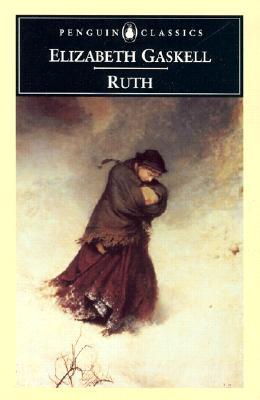
Ruth

Ruth. Elizabeth Gaskell. 1853. 432 pages. [Source: Bought]
First sentence: There is an assize-town in one of the eastern counties which was much distinguished by the Tudor sovereigns, and, in consequence of their favour and protection, attained a degree of importance that surprises the modern traveller.


Premise/plot: Ruth Hilton, a young apprenticed seamstress, makes a mistake when she falls in love with a wealthy young man, Henry Bellingham. The two run away together--to Wales, I believe. When he becomes sick, his mother comes and rescues him from the "evil tramp" Ruth. What will Ruth's future be now? Is there hope for this 'fallen woman'?

Thankfully Elizabeth Gaskell is NOT Nathaniel Hawthorne. And there are plenty of kind, warm-hearted Christian souls who extend grace, compassion, and actual care. Mr. Thurstan Benson (a Dissenting minister) and his sister, Faith, open up their home and their hearts to the pregnant Ruth. She will remain with them for years raising her son Leonard.

Not content to live off of charity, Ruth first becomes a governess and then later a sick nurse. The novel illustrates through its characters--Ruth, Faith, Sally, Thurstan, etc.--faith in action.

My thoughts: I love, love, love Elizabeth Gaskell. This novel is a tragedy. A beautiful, well-written tragedy with unforgettable characters. I had forgotten the sadness and just remembered the goodness. I knew I loved it. I knew I needed to reread it at some point. I knew I considered the characters good friends. I forgot all the sads. The fact that I find it a devastating read--emotionally--only testifies that the characterization is excellent.

Quotes:
  • Well, my dear, you must learn to think and work too; or, if you can't do both, you must leave off thinking.
  • The night before, she had seen her dead mother in her sleep, and she wakened, weeping. And now she dreamed of Mr Bellingham, and smiled. And yet, was this a more evil dream than the other?
  • The future lay wrapped in a golden mist, which she did not care to penetrate; but if he, her sun, was out of sight and gone, the golden mist became dark heavy gloom, through which no hope could come. He took her hand.
  • Low and soft, with much hesitation, came the "Yes;" the fatal word of which she so little imagined the infinite consequences. The thought of being with him was all and everything.
  • Poor Ruth! her faith was only building up vain castles in the air; they towered up into heaven, it is true, but, after all, they were but visions.
  • "In the eye of God, she is exactly the same as if the life she has led had left no trace behind. We knew her errors before, Faith." "Yes, but not this disgrace—this badge of her shame!" "Faith, Faith! let me beg of you not to speak so of the little innocent babe, who may be God's messenger to lead her back to Him.
  • "I think you, Thurstan, are the first person I ever heard rejoicing over the birth of an illegitimate child. It appears to me, I must own, rather questionable morality." 
  • You yourself have not greater sorrow over this young creature's sin than I have: the difference is this, you confuse the consequences with the sin."
  • We are both right: I, in the way in which the child ought to be viewed; you, dear good Faith, for thinking of taking her home with us. God bless you, dear, for it!
  • It is better not to expect or calculate consequences. The longer I live, the more fully I see that. Let us try simply to do right actions, without thinking of the feelings they are to call out in others.
  • My dear Ruth, you don't know how often I sin; I do so wrong, with my few temptations. We are both of us great sinners in the eyes of the Most Holy; let us pray for each other.
  • I cannot abide the way some folk has of denying there's trouble or pain to be met; just as if their saying there was none, would do away with it.
  • There's a right and a wrong way of setting about everything—and to my thinking, the right way is to take a thing up heartily, if it is only making a bed.
  • 'Sally, do you think God has put us into the world just to be selfish, and do nothing but see after our own souls? or to help one another with heart and hand, as Christ did to all who wanted help?'
  •  Everything may be done in a right way or a wrong; the right way is to do it as well as we can, as in God's sight; the wrong is to do it in a self-seeking spirit, which either leads us to neglect it to follow out some device of our own for our own ends, or to give up too much time and thought to it both before and after the doing.
  • Those summer mornings were happy, for she was learning neither to look backwards nor forwards, but to live faithfully and earnestly in the present.
  • I dare not think of happiness—I must not look forward to sorrow. God did not put me here to consider either of these things.
  • The time that has pressed down my life like brands of hot iron, and scarred me for ever, has been nothing to you.
  • "Leonard—when I was very young I did very wrong. I think God, who knows all, will judge me more tenderly than men—but I did wrong in a way which you cannot understand yet"
  •  I declare before God, that if I believe in any one human truth, it is this—that to every woman who, like Ruth, has sinned, should be given a chance of self-redemption—and that such a chance should be given in no supercilious or contemptuous manner, but in the spirit of the holy Christ."I state my firm belief, that it is God's will that we should not dare to trample any of His creatures down to the hopeless dust;
  • Now, let us stand firm on the truth. You have no new fault to repent of. Be brave and faithful. It is to God you answer, not to men.
  • The shame of having your sin known to the world, should be as nothing to the shame you felt at having sinned. We have dreaded men too much, and God too little, in the course we have taken.
  • Any fastidiousness I shall have to get rid of, and I shall be better without; but any true refinement I am sure I shall find of use;    
  • Would you not rather be nursed by a person who spoke gently and moved quietly about than by a loud bustling woman?
  • There is always something aggravating in being told, that the mood in which we are now viewing things strongly will not be our mood at some other time. It implies that our present feelings are blinding us, and that some more clear-sighted spectator is able to distinguish our future better than we do ourselves.
  • Her left hand truly knew not what her right hand did; and Leonard was overwhelmed now to hear of the love and the reverence with which the poor and outcast had surrounded her. 
  • From that day forward Leonard walked erect in the streets of Eccleston, where "many arose and called her blessed."
  •  "We have no right to weigh human lives against each other."
 

© 2018 Becky Laney of Becky's Book Reviews

Monday, November 26, 2018

My Victorian Year #49

I am currently reading RUTH by Elizabeth Gaskell and CAN YOU FORGIVE HER? by Anthony Trollope. I am enjoying both of these books very much. Both are rereads.

Quotes from Can You Forgive Her?
  • “And have I been too liberal, Mrs Greenow? What is a young turkey and a stick of celery when a man is willing to give everything that he has in the world?”
  • “There is nothing on earth, Mrs Greenow, I desire so much, as permission to dry those tears.” “Time alone can do that, Captain Bellfield; — time alone.”
  • “But cannot time be aided by love and friendship and affection?” “By friendship, yes. What would life be worth without the solace of friendship?”
  • “And how much better is the warm glow of love?” Captain Bellfield, as he asked this question, deliberately got up, and moved his chair over to the widow’s side.
  • “You shouldn’t think about handsome men, child,” said Mrs Greenow. “And I’m sure I don’t,” said Jeannette. “Not no more than anybody else; but if a man is handsome, ma’am, why it stands to reason that he is handsome.”    
Quotes from Ruth
  • I want to know how I am to keep remembering how old I am, so as to prevent myself from feeling so young?

© 2018 Becky Laney of Becky's Book Reviews

Saturday, November 17, 2018

My Victorian Year #48

I am currently reading RUTH by Elizabeth Gaskell and CAN YOU FORGIVE HER? by Anthony Trollope. I am enjoying both of these books very much. Both are rereads.

Quotes from Can You Forgive Her?
  • Yarmouth is not a happy place for a picnic. A picnic should be held among green things. Green turf is absolutely an essential.
  • She had a wondrous power of smiling; and could, upon occasion, give signs of peculiar favour to half a dozen different gentlemen in as many minutes. 
  • “You can’t suppose that any girl will like to be drenched with sea-water when she has taken so much trouble with her starch,” said Kate.  “Then she shouldn’t come fishing,” said Mr Cheesacre. “I hate such airs.” 
  • When ladies have made up their minds to dance they will dance let the circumstances of the moment be ever so antagonistic to that exercise.
  • A woman’s life is important to her, — as is that of a man to him, — not chiefly in regard to that which she shall do with it. The chief thing for her to look to is the manner in which that something shall be done. It is of moment to a young man when entering life to decide whether he shall make hats or shoes; but not of half the moment that will be that other decision, whether he shall make good shoes or bad. 
  • Babbling may be a weakness, but to my thinking mystery is a vice. 
 Quotes from Ruth
  • As she ran, she prayed with wild eagerness; she prayed that she might see his face once more, even if she died on the spot before him.
  • It was one of those prayers which God is too merciful to grant; but despairing and wild as it was, Ruth put her soul into it, and prayed it again, and yet again.
  • "In the eye of God, she is exactly the same as if the life she has led had left no trace behind. We knew her errors before, Faith." 
  • "Yes, but not this disgrace—this badge of her shame!" "Faith, Faith! let me beg of you not to speak so of the little innocent babe, who may be God's messenger to lead her back to Him.
  • Teach her (and God will teach her, if man does not come between) to reverence her child; and this reverence will shut out sin,—will be purification."
  • You yourself have not greater sorrow over this young creature's sin than I have: the difference is this, you confuse the consequences with the sin."
  • We are both right: I, in the way in which the child ought to be viewed; you, dear good Faith, for thinking of taking her home with us. God bless you, dear, for it!"
  • It is better not to expect or calculate consequences. The longer I live, the more fully I see that. Let us try simply to do right actions, without thinking of the feelings they are to call out in others.
  • My dear Ruth, you don't know how often I sin; I do so wrong, with my few temptations. We are both of us great sinners in the eyes of the Most Holy; let us pray for each other.
  • I cannot abide the way some folk has of denying there's trouble or pain to be met; just as if their saying there was none, would do away with it. Some folk treats one like a babby, and I don't like it. I'm not meaning you, Master Thurstan
  • "But Sally is not 'people.'" "Oh, I see it must be done; she'll talk as much as all the other persons put together, so that's the reason I call her 'people.' Shall I call her?"
  • There's a right and a wrong way of setting about everything—and to my thinking, the right way is to take a thing up heartily, if it is only making a bed.
  • 'Sally, do you think God has put us into the world just to be selfish, and do nothing but see after our own souls? or to help one another with heart and hand, as Christ did to all who wanted help?' ...because everything may be done in a right way or a wrong; the right way is to do it as well as we can, as in God's sight; the wrong is to do it in a self-seeking spirit, which either leads us to neglect it to follow out some device of our own for our own ends, or to give up too much time and thought to it both before and after the doing.'
  • Just try for a day to think of all the odd jobs as has to be done well and truly as in God's sight, not just slurred over anyhow, and you'll go through them twice as cheerfully. 
  • Those summer mornings were happy, for she was learning neither to look backwards nor forwards, but to live faithfully and earnestly in the present.


© 2018 Becky Laney of Becky's Book Reviews
Saturday, November 10, 2018

My Victorian Year #47

I am currently reading RUTH by Elizabeth Gaskell and CAN YOU FORGIVE HER? by Anthony Trollope. I am enjoying both of these books very much. Both are rereads.

Quotes from Can You Forgive Her?
  • The eschewing of marquises is not generally very difficult. Young ladies living with their fathers on very moderate incomes in or about Queen Anne Street are not usually much troubled on that matter.
  • It’s a very fine theory, that of women being able to get along without men as well as with them; but, like other fine theories, it will be found very troublesome by those who first put it in practice.
  • People always do seem to think it so terrible that a girl should have her own way in anything.
  • I haven’t much of my own way at present; but you see, when I’m married I shan’t have it at all. You can’t wonder that I shouldn’t be in a hurry. A person may wish for a thing altogether, and yet not wish for it instantly.
  • In this world things are beautiful only because they are not quite seen, or not perfectly understood.
  • Poetry is precious chiefly because it suggests more than it declares.
  • You are never cross, though you are often ferocious. 
  • A man never likes having his tooth pulled out, but all men do have their teeth pulled out, — and they who delay it too long suffer the very mischief.
  • I was thinking of something. Don’t you ever think of things that make you shiver?”  “Indeed I do, very often; — so often that I have to do my shiverings inwardly. Otherwise people would think I had the palsy.”
  • “What don’t you understand, aunt?” “You only danced twice last night, and once you stood up with Captain Bellfield.” “But what harm can Captain Bellfield do me?” “What good can he do you? That’s the question. You see, my dear, years will go by.
Quotes from Ruth
  • The daily life into which people are born, and into which they are absorbed before they are well aware, forms chains which only one in a hundred has moral strength enough to despise, and to break when the right time comes—when an inward necessity for independent individual action arises, which is superior to all outward conventionalities.
  • Well, my dear, you must learn to think and work too; or, if you can't do both, you must leave off thinking. Your guardian, you know, expects you to make great progress in your business, and I am sure you won't disappoint him. 
  • The night before, she had seen her dead mother in her sleep, and she wakened, weeping. And now she dreamed of Mr Bellingham, and smiled. And yet, was this a more evil dream than the other? 
  • The poor old labourer prayed long and earnestly that night for Ruth. He called it "wrestling for her soul;" and I think his prayers were heard, for "God judgeth not as man judgeth." 
  • The future lay wrapped in a golden mist, which she did not care to penetrate; but if he, her sun, was out of sight and gone, the golden mist became dark heavy gloom, through which no hope could come. He took her hand. 
  • Low and soft, with much hesitation, came the "Yes;" the fatal word of which she so little imagined the infinite consequences. The thought of being with him was all and everything.
  • I always think it right, for my own morals, to put a little scorn into my manners when such as her come to stay here; but, indeed, she's so gentle, I've found it hard work to show the proper contempt. 
  • Poor Ruth! her faith was only building up vain castles in the air; they towered up into heaven, it is true, but, after all, they were but visions. 
 
© 2018 Becky Laney of Becky's Book Reviews

Thursday, November 01, 2018

Wives and Daughters

Wives and Daughters. Elizabeth Gaskell. 1866. 649 pages. [Source: Bought]

First sentence: To begin with the old rigmarole of childhood.

Premise/plot: Molly Gibson is a doctor's daughter. Many view her as just a simple, ordinary village girl--nothing extraordinary about her. But to those that see Molly's worth--really see it--she is anything but ordinary.

Molly's world has a way of being turned upside down and shaken about.

Her mother died when she was a child. Her father has done a good job raising her by himself, but, he is a man, a doctor, with just one way of seeing the world. When her father is confronted by reality--his daughter is growing UP and the opposite sex may just start noticing her as a woman--he panics. He packs up his daughter and sends her to a neighbor's house.

Squire Hamley and his wife are happy to take her in--temporarily at least. They have two sons, but no living daughter. Osbourne and Roger are away at school. The squire doesn't want either son to fall in love with a mere doctor's daughter. But his wife takes to Molly like she's her own flesh and blood. She loves her sons--no doubt--but Molly is a faithful friend and companion, an excellent listener. 

While his daughter is being looked after elsewhere, HE meanwhile is courting a woman and contemplating a second marriage. Hyacinth Clare was a governess for a local family. (The family divides its time between the countryside estate and the city.) She married and had a daughter, Cynthia. After her husband's death, she opened up a (pitiful) school. Her daughter has only ever been a burden to her. She is looking for someone--anyone--to "save" her. This marriage doesn't touch her heart, not really. But Mr. Gibson is fooled enough--at least at the start.

After the two marry, the families try to blend together. Mr. Gibson will have to adapt to living with a new wife and a step-daughter. Cynthia and Molly are as different as night and day. Molly and Cynthia love one another--but not because they are peas in a pod. Molly knows that Cynthia is a different creature altogether. Cynthia recognizes that Molly is truly good, the real deal; there is no hypocrisy or phoniness to her. Cynthia recognizes her own nature. She is not "good." She is morally weak. She spends most of her time putting on a front. She doubts if she's capable of being sincere, honest, constant. She blames this on her father's death and her mother's lack of attention. Her mother is selfish, self-centered, self-absorbed, incapable of feeling affection or concern, vain, manipulative.

Molly will have to adapt to living with Cynthia and her step-mother. Living with Cynthia--loving Cynthia--doesn't fill like work, like a full-time job. But Molly cannot see eye to eye with her new mother. At all. There is something tedious or draining about having to get along with her. And Molly is determined to live in peace with her new stepmother--to not add to her father's worries with fights and fusses. Now peace in the household does not depend on Molly. Even if Molly and Cynthia were out of the house altogether that would not guarantee that Mr. and Mrs. Gibson would get along peacefully and smoothly.

Men in the neighborhood notice Cynthia's arrival, of course, and soon there are would-be suitors paying call to the Gibson household. Will Molly find love too?

My thoughts: I first read Wives and Daughters in 2008. I enjoyed it then. I did. It was my first novel by Elizabeth Gaskell. But I loved it even more the second time. I appreciated it more. I noticed more. I've also read more Victorian literature since the first time.

I didn't remember all the details of the novel. I kept expecting Cynthia to have committed a Hardy-esque or Eliot-esque sin. I kept expecting it to come out that Cynthia had had a child with Mr. Preston. (It didn't come out because it didn't happen.) I also kept suspecting that perhaps Miss Clare (aka Mrs. Gibson) perhaps had an entanglement herself with Mr. Preston in the past. I may have a vivid imagination.

I shared quotes from the first half of the novel here.

Quotes:
  • 'I don't think she did take it coolly; I believe I don't quite understand her either, but I love her dearly all the same.' 'Umph; I like to understand people thoroughly; but I know it's not necessary to women.' (395)
  • Oh, Molly, you don't know how I was neglected just at a time when I wanted friends most. Mamma does not know it; it is not in her to know what I might have been if I had only fallen into wise, good hands. (435)
  • How easy it is to judge rightly after one sees what evil comes from judging wrongly! (465)
  • Oh, don't call them lies, sister; it's such a strong, ugly word. Please call them tallydiddles, for I don't believe she meant any harm. (506)
  • My dear, don't repeat evil on any authority unless you can do some good by speaking about it, said Miss Browning, laying her hand on Mrs. Dawes' shoulder. I'm not a good woman, but I know what is good, and that advice is. (508)
  • 'It's all a mystery. I hate to have you mixed up in mysteries.' 'I hate to be mixed up. But what can I do? I know of another mystery which I'm pledged not to speak about. I cannot help myself.' 'Well, all I can say is, never be the heroine of a mystery that you can avoid, if you can't help being an accessory.' (516)
  • People may flatter themselves just as much by thinking that their faults are always present to other people's minds as if they believe that the world is always contemplating their individual charms and virtues. (534)
  • I like everybody to have an opinion of their own; only when my opinions are based on thought and experience, which few people have had equal opportunities of acquiring, I think it is but proper deference in others to allow themselves to be convinced. (604)

© 2018 Becky Laney of Becky's Book Reviews

Saturday, October 27, 2018

My Victorian Year #45

I am currently reading Anthony Trollope's Small House at Allington and Elizabeth Gaskell's Wives and Daughters. I am also currently listening to Agnes Grey by Anne Bronte.

Quotes from Small House at Allington:
  • I’ve always had a sort of aptitude for living in a pigsty; — a clean pigsty, you know, with nice fresh bean straw to lie upon.
  • “Are you going to forgive me before I go?” “Forgive you for what?” said she. “For daring to love you; for having loved you almost as long as you can remember; for loving you better than all beside. This alone you should forgive; but will you forgive me for having told it?”
  • Alas! alas! a man cannot so easily repent of his sins, and wash himself white from their stains!
  • “It was a matter of course,” said Bell. “It always is right in the novels. That’s why I don’t like them. They are too sweet.” “That’s why I do like them, because they are so sweet. A sermon is not to tell you what you are, but what you ought to be, and a novel should tell you not what you are to get, but what you’d like to get.”  
  • But if we are to have real life, let it be real.
  • Those slanders always are absurd; but what can we do? We can’t tie up people’s tongues.
  •  Mr Palliser had barely spoken to Mr Crosbie at Courcy, but then in the usual course of his social life he seldom did more than barely speak to anybody.
  • The speech was respectable, dull, and correct. Men listened to it, or sat with their hats over their eyes, asleep, pretending to do so;

Quotes from Wives and Daughters:
  •  'Papa, I should like to get a chain like Ponto's just as long as your longest round, and then I could fasten us two to each end of it, and when I wanted you I could pull, and if you did not want to come, you could pull back again; but I should know you knew I wanted you, and we could never lose each other.' (27)
  • 'I gave her the best advice in my power.' 'Advice! you ought to have comforted her. Poor little Molly!' 'I think that if advice is good it's the best comfort.' (120)
  • 'I did try to remember what you said, and to think more of others, but it is so difficult sometimes; you know it is, don't you?' (136)
  • 'It is difficult,' he went on, 'but by and by you will be so much happier for it.' 'No, I shan't!' said Molly, shaking her head. 'It will be very dull when I shall have killed myself, as it were, and live only in trying to do, and to be, as other people like. I don't see any end to it. I might as well never have lived. And as for the happiness you speak of, I shall never be happy again.' (136)
  • 'I used to think I managed her, till one day an uncomfortable suspicion arose that all the time she had been managing me. Still, it's easy work to let oneself be managed; at any rate till one wakens up to the consciousness of the process, and then it may become amusing, if one takes it in that light.' 'I should hate to be managed,' said Molly, indignantly. 'I'll try and do what she wishes for papa's sake, if she'll only tell me outright; but I should dislike to be trapped into anything.' (160)
  • 'Tell the truth, now and evermore. Truth is generally amusing, if it's nothing else!' (163)
  • Molly knew her father's looks as well as she knew her alphabet; his wife did not; and being an unperceptive person, except when her own interests were dependent upon another person's humour, never found out how he was worried by all the small daily concessions which he made to her will or her whims. (178)
  • 'I wish I could love people as you do, Molly!' 'Don't you?" said the other, in surprise. 'No. A good number of people love me, I believe, or at least they think they do; but I never seem to care much for any one. I do believe I love you, little Molly, whom I have only known for ten days, better than any one.' (219)
  • 'I wish I was good!' 'So do I,' said Molly, simply. 'Nonsense, Molly! You are good...I am not good, and I never shall be now. Perhaps I might be a heroine still, but I shall never be a good woman, I know.' 'Do you think it easier to be a heroine?' 'Yes as far as one knows of heroines from history. I'm capable of a great jerk, an effort, and then a relaxation--but steady, everyday goodness is beyond me. I must be a moral kangaroo.' (220)
  • 'Molly, I cannot have you speaking so to Lady Harriet,' said Mrs. Gibson as soon as she was left alone with her stepdaughter. 'You would never have known her at all if it had not been for me, and don't be always putting yourself into our conversation.' 'But I must speak if she asks me questions,' pleaded Molly. 'Well! if you must, you must, I acknowledge. I'm candid about that, at any rate. But there's no need for you to set up to have an opinion at your age.' 'I don't know how to help it,' said Molly. (293)
  • 'If there is one thing I hate more than another, it is the trying to make out an intimacy with great people.' (293)
  • 'Oh, how good you are, Molly! I wonder, if I had been brought up like you, whether I should have been as good. But I've been tossed about so.' 'Then, don't go and be tossed about no more,' said Molly, softly. (327)

© 2018 Becky Laney of Becky's Book Reviews

Monday, October 15, 2018

Sylvia's Lovers

Sylvia's Lovers. Elizabeth Gaskell. 1863/1997. Everyman Paperbacks. 560 pages. [Source: Bought]
First sentence: On the north-eastern shores of England there is a town called Monkshaven, containing at the present day about fifteen thousand inhabitants.

Premise/plot: The heroine of Elizabeth Gaskell's Sylvia's Lovers is Sylvia Robson. (Relatively) soon after the novel opens, Sylvia falls in love with a specksioneer Charley Kinraid. This frustrates the plans of her cousin, Philip Hepburn. He is also in love with Sylvia. He hasn't been courting her, but, he has been tutoring her. Philip has heard a few rumors that Kinraid essentially has left a string of girls all madly in love with him. (He is a sailor.) But Sylvia isn't going to be warned or lectured or bossed about by her cousin!

One day Philip witnesses Kinraid being pressed into service--being taken up by the press gang. (Military service not being all voluntary at that time). Charley begs Philip to tell Sylvia what has happened, begs him to let her know that his disappearance was not of his doing. By the time Philip makes his way to visit Sylvia and her family--his family too mind you--word has reached them--the town/village--that Kinraid is DEAD. Some of his belongings have washed up from the sea. Philip decides--for better or worse--to keep quiet.

But Kinraid's disappearance does not necessarily mean that Philip will succeed in his efforts to woo the young and beautiful Sylvia. In fact, if Sylvia's father, Daniel, had stayed out of trouble, I'm confident that his efforts would have continued to fail. But. Daniel Robson acted the fool--a noble fool, perhaps. He decided to participate in a RIOT. He was right there in the heart of the action--no mistaking his intentions.

Who was there to take care of the family when Daniel Robson was arrested? imprisoned? taken away to face trial and sentencing? Good, kind, dependable Philip, that's who. He was so good, so kind, so compassionate, so faithful. When he does propose, she says yes. Even if there's a tiny bit of doubt at the back of her mind if it's the right thing to do. She doesn't love-love Philip. But. She does care for him some.

Philip thinks that there's a good chance that Charley will die in action during the war--the English are fighting the French--or at sea--storms do happen. But Charley returns. And Philip and Sylvia are in for quite a SHOCK when he does...

My thoughts: I really enjoyed Sylvia's Lovers. If there was a movie adaptation of it, I would definitely watch it. (Most of Gaskell's other novels have been adapted for film.) I think fans of Poldark may enjoy this one.

Oddly enough, I was Team Philip for most of the book. In some ways, I find him the most developed character of the book. Sylvia was developed to some extent, but she felt a bit distant to me.

I loved the religious/spiritual themes of this one. 

Quotes:
  • Will our descendants have a wonder about us, such as we have about the inconsistency of our forefathers, or a surprise at our blindness that we do not perceive that, holding such and such opinions, our course of action must be so and so, or that the logical consequence of particular opinions must be convictions which at present we hold in abhorrence? (63)
  • Then he went on to wonder if the lives of one generation were but a repetition of the lives of those who had gone before, with no variation but from the internal cause that some had greater capacity for suffering than others. (218)
  • I tell thee my flesh and blood wasn't made for forgiving and forgetting. Once for all, thou must take me at my word. When I love I love, and when I hate I hate, and him as has done harm to me, or to mine, I may keep fra' striking or murdering, but I'll niver forgive. (300)
  • It seemed to be Sylvia's fate to captivate more people than she cared to like back again. (313)
  • God pities us as a father pities his poor wandering children; the nearer I come to death the clearer I see him. (445)

© 2018 Becky Laney of Becky's Book Reviews

Saturday, March 03, 2018

My Victorian Year #9

This week I finished Mary Barton by Elizabeth Gaskell. This one was a reread for me. I liked it so much more the second time. Sometimes you just have to be in the right mood for a book. And sometimes an author has to grow on you. I read Mary Barton before I discovered I LOVED, LOVED, LOVED Elizabeth Gaskell.
Our Lord Jesus was not above letting folk minister to Him, for He knew how happy it makes one to do aught for another. It's the happiest work on earth.
The firm faith which her mind had no longer power to grasp, had left its trail of glory; for by no other word can I call the bright happy look which illumined the old earth-worn face. Her talk, it is true, bore no more that constant earnest reference to God and His holy Word which it had done in health, and there were no deathbed words of exhortation from the lips of one so habitually pious.
And death came to her as a welcome blessing, like as evening comes to the weary child. Her work here was finished, and faithfully done.
If they've been worthy to be heartily loved while alive, they'll not be forgotten when dead; it's against nature. And we need no more be upbraiding ourselves for letting in God's rays of light upon our sorrow, and no more be fearful of forgetting them, because their memory is not always haunting and taking up our minds, than you need to trouble yourself about remembering your grandfather's face, or what the stars were like—you can't forget if you would, what it's such a pleasure to think about.
"Let my trespasses be unforgiven, so that I may have vengeance for my son's murder." There are blasphemous actions as well as blasphemous words: all unloving, cruel deeds, are acted blasphemy.
He fell to the narrative now afresh, with all the interest of a little child. He began at the beginning, and read on almost greedily, understanding for the first time the full meaning of the story. He came to the end; the awful End. And there were the haunting words of pleading. He shut the book, and thought deeply. All night long, the Archangel combated with the Demon.
"God be merciful to us sinners.—Forgive us our trespasses as we forgive them that trespass against us!" And when the words were said, John Barton lay a corpse in Mr. Carson's arms.
Well! God does not judge as hardly as man, that's one comfort for all of us!
But still, you see, one's often blind to many a thing that lies right under one's nose, till it's pointed out.
You can never work facts as you would fixed quantities, and say, given two facts, and the product is so and so. God has given men feelings and passions which cannot be worked into the problem, because they are for ever changing and uncertain.
If fellow-creatures can give nought but tears and brave words, we take our trials straight from God, and we know enough of His love to put ourselves blind into His hands. You say our talk has done no good. I say it has.
I see the view you take of things from the place where you stand. I can remember that, when the time comes for judging you; I shan't think any longer, does he act right on my views of a thing, but does he act right on his own.
There are stages in the contemplation and endurance of great sorrow, which endow men with the same earnestness and clearness of thought that in some of old took the form of Prophecy.
To those who have large capability of loving and suffering, united with great power of firm endurance, there comes a time in their woe, when they are lifted out of the contemplation of their individual case into a searching inquiry into the nature of their calamity, and the remedy (if remedy there be) which may prevent its recurrence to others as well as to themselves.

© 2018 Becky Laney of Becky's Book Reviews

Thursday, March 01, 2018

Mary Barton

Mary Barton. Elizabeth Gaskell. 1848. 437 pages. [Source: Bought]

First sentence: There are some fields near Manchester, well known to the inhabitants as "Green Heys Fields," through which runs a public footpath to a little village about two miles distant.

Premise/plot: Elizabeth Gaskell's first novel is largely set in the manufacturing town of Manchester. Readers first meet Mary as a young girl on the eve of an all-too-common tragedy: the death of her mother due to complications from childbirth. Mary is raised by her father, John. Life is difficult--even in good years, when work is to be found and food relatively easy to come by. When Mary is old enough, she too goes to work. It is through her work that she meets a mill-owner's son, Harry Carson. He flatters and flirts and flirts and flatters. Her head is turned, but it doesn't stay turned. After receiving a proposal from a boy she's known practically since she was a toddling baby, Jem Wilson, she realizes her mistake...realizes too late. She's said NO to the worthy man. When Harry Carson is found murdered, people suspect Jem. For their battle of words over Mary were overheard. No one seems to be aware that the unsatisfied workers essentially drew lots to see who got the privilege of killing the mill owner's son. Will Jem be hanged for a crime he didn't commit? Or will Mary be able to save him with her quick-thinking and decisive actions?

My thoughts: I do hope that potential readers will forgive the initial slow-pacing. I don't think the slow pace is a waste. I don't. It allows for character development--relationship development. Mary Barton has friends--close friends--that we come to know and love. Jem's "Aunt Alice" for example, and the young Margaret and not-so-young Job (Margaret's grandfather). These characters become essential to the plot later on.

The first half of the novel definitely focuses on ideas and principles. John Barton is a man of opinions. Aunt Alice is an amazing spiritual role model. The second half of the novel is a fast-paced mystery-novel. A crime has been committed. A suspect has been arrested. A court date has been set. Time is running out to prove his innocence. Mary holds his fate in her hands--at least it feels so to her.

The last few chapters beautifully come together and were absolutely WONDERFUL.

FAVORITE QUOTES:
  • Don't think to come over me with th' old tale, that the rich know nothing of the trials of the poor; I say, if they don't know, they ought to know.
  • Opportunities are not often wanting where inclination goes before, and ere the end of that winter Mary looked upon Margaret almost as an old friend.
  • People admire talent, and talk about their admiration. But they value common sense without talking about it, and often without knowing it.
  • The vices of the poor sometimes astound us HERE; but when the secrets of all hearts shall be made known, their virtues will astound us in far greater degree. Of this I am certain.
  • Errands of mercy—errands of sin—did you ever think where all the thousands of people you daily meet are bound?
  • Such is the contrariness of the human heart, from Eve downwards, that we all, in our old Adam state, fancy things forbidden sweetest.
  • This disparity between the amount of the earnings of the working classes and the price of their food, occasioned, in more cases than could well be imagined, disease and death. Whole families went through a gradual starvation. They only wanted a Dante to record their sufferings. And yet even his words would fall short of the awful truth. So a petition was framed, and signed by thousands in the bright spring days of 1839, imploring Parliament to hear witnesses who could testify to the unparalleled destitution of the manufacturing districts. Nottingham, Sheffield, Glasgow, Manchester, and many other towns, were busy appointing delegates to convey this petition, who might speak, not merely of what they had seen, and had heard, but from what they had borne and suffered.
  • Life-worn, gaunt, anxious, hunger-stamped men, were those delegates.
  • Remember, too, that though it may take much suffering to kill the able-bodied and effective members of society, it does NOT take much to reduce them to worn, listless, diseased creatures, who thenceforward crawl through life with moody hearts and pain-stricken bodies.
  • Real meekness of character is called out by experience of kindness.
  • Her love for him was a bubble, blown out of vanity; but it looked very real and very bright.
  • "But it's so hard to be patient," pleaded Mary. "Ay, dear; being patient is the hardest work we, any of us, have to do through life, I take it. Waiting is far more difficult than doing. I've known that about my sight, and many a one has known it in watching the sick; but it's one of God's lessons we all must learn, one way or another." After a pause—"Have ye been to see his mother of late?"
  • "It's hard work to be patient to all of us," said Mary; "I know I find it so, but I did not know one so good as you did, Alice; I shall not think so badly of myself for being a bit impatient, now I've heard you say you find it difficult."
  • I sometimes think I am a child, whom the Lord is hushabying to my long sleep. For when I were a nurse-girl, my missis always telled me to speak very soft and low, and to darken the room that her little one might go to sleep; and now all noises are hushed and still to me, and the bonny earth seems dim and dark, and I know it's my Father lulling me away to my long sleep. I'm very well content; and yo mustn't fret for me. I've had well-nigh every blessing in life I could desire.
  • The actions of the uneducated seem to me typified in those of Frankenstein, that monster of many human qualities, ungifted with a soul, a knowledge of the difference between good and evil. The people rise up to life; they irritate us, they terrify us, and we become their enemies. Then, in the sorrowful moment of our triumphant power, their eyes gaze on us with mute reproach. Why have we made them what they are; a powerful monster, yet without the inner means for peace and happiness?
  • As the man who has had his taste educated to love reading, falls devouringly upon books after a long abstinence, so these poor fellows, whose tastes had been left to educate themselves into a liking for tobacco, beer, and similar gratifications, gleamed up at the proposal of the London delegate. Tobacco and drink deaden the pangs of hunger, and make one forget the miserable home, the desolate future.
  • Oh! much what all doctors say: he puts a fence on this side, and a fence on that, for fear he should be caught tripping in his judgment.
  • It is the woes that cannot in any earthly way be escaped that admit least earthly comforting. Of all trite, worn-out, hollow mockeries of comfort that were ever uttered by people who will not take the trouble of sympathising with others, the one I dislike the most is the exhortation not to grieve over an event, "for it cannot be helped." I mourn because what has occurred cannot be helped. The reason you give me for not grieving, is the very sole reason of my grief.
  • Oh! surest way of conversion to our faith, whatever it may be— regarding either small things, or great—when it is beheld as the actuating principle, from which we never swerve! When it is seen that, instead of overmuch profession, it is worked into the life, and moves every action!
  • Our Lord Jesus was not above letting folk minister to Him, for He knew how happy it makes one to do aught for another. It's the happiest work on earth.
--
Our Lord Jesus was not above letting folk minister to Him, for He knew how happy it makes one to do aught for another. It's the happiest work on earth.

The firm faith which her mind had no longer power to grasp, had left its trail of glory; for by no other word can I call the bright happy look which illumined the old earth-worn face. Her talk, it is true, bore no more that constant earnest reference to God and His holy Word which it had done in health, and there were no deathbed words of exhortation from the lips of one so habitually pious.
And death came to her as a welcome blessing, like as evening comes to the weary child. Her work here was finished, and faithfully done.
If they've been worthy to be heartily loved while alive, they'll not be forgotten when dead; it's against nature. And we need no more be upbraiding ourselves for letting in God's rays of light upon our sorrow, and no more be fearful of forgetting them, because their memory is not always haunting and taking up our minds, than you need to trouble yourself about remembering your grandfather's face, or what the stars were like—you can't forget if you would, what it's such a pleasure to think about.
"Let my trespasses be unforgiven, so that I may have vengeance for my son's murder." There are blasphemous actions as well as blasphemous words: all unloving, cruel deeds, are acted blasphemy.
He fell to the narrative now afresh, with all the interest of a little child. He began at the beginning, and read on almost greedily, understanding for the first time the full meaning of the story. He came to the end; the awful End. And there were the haunting words of pleading. He shut the book, and thought deeply. All night long, the Archangel combated with the Demon.
"God be merciful to us sinners.—Forgive us our trespasses as we forgive them that trespass against us!" And when the words were said, John Barton lay a corpse in Mr. Carson's arms.
Well! God does not judge as hardly as man, that's one comfort for all of us!
But still, you see, one's often blind to many a thing that lies right under one's nose, till it's pointed out.
You can never work facts as you would fixed quantities, and say, given two facts, and the product is so and so. God has given men feelings and passions which cannot be worked into the problem, because they are for ever changing and uncertain.
If fellow-creatures can give nought but tears and brave words, we take our trials straight from God, and we know enough of His love to put ourselves blind into His hands. You say our talk has done no good. I say it has.
I see the view you take of things from the place where you stand. I can remember that, when the time comes for judging you; I shan't think any longer, does he act right on my views of a thing, but does he act right on his own.
There are stages in the contemplation and endurance of great sorrow, which endow men with the same earnestness and clearness of thought that in some of old took the form of Prophecy.
To those who have large capability of loving and suffering, united with great power of firm endurance, there comes a time in their woe, when they are lifted out of the contemplation of their individual case into a searching inquiry into the nature of their calamity, and the remedy (if remedy there be) which may prevent its recurrence to others as well as to themselves.


© 2018 Becky Laney of Becky's Book Reviews