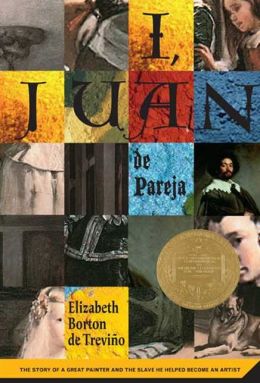
I, Juan de Pareja. Elizabeth Borton de Trevino. 1965/2008. Square Fish. 192 pages. [Source: Review copy]
I, Juan de Pareja, was born into slavery early in the seventeenth century. I am not certain of the year.
I am so glad I read I, Juan de Pareja. The cover may not have said, read me, read me, but I found this historical novel to be quite compelling overall.
I, Juan de Paraja is set in Spain (and Italy) in the seventeenth century. Juan's master--for the most part--was Diego Velazquez, an artist. Both were real men. (Juan de Pareja) The first part of the novel introduces readers to Juan, and has him traveling to meet his new master after his former mistress' death. The rest of the novel spans several decades of his life and service. The focus is mainly on art--on painting portraits. Juan becomes quite interested in painting, and longs to be allowed to learn how to paint himself. (He's not allowed because he's a slave.) He observes and absorbs, waiting, perhaps for an opportunity to try for himself. Opportunity comes, and his secret life begins...
I found the book to be a quick read. I found it to be fascinating as well. I liked reading about both men, and I liked how focused it was on art.
© 2015 Becky Laney of Becky's Book Reviews
Showing posts with label Square Fish. Show all posts
Sunday, May 10, 2015
Sunday, February 08, 2015
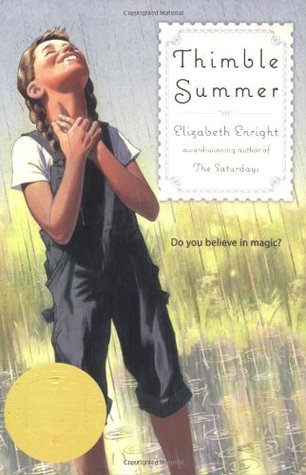
Thimble Summer (1938)
Thimble Summer. Elizabeth Enright. 1938/2008. SquareFish. 144 pages. [Source: Review copy]
Garnet thought this must be the hottest day that had ever been in the world. Every day for weeks she had thought the same thing, but this was really the worst of all.
Thimble Summer won the Newbery in 1939. Thimble Summer is about the 'magical' summer Garnet Linden (the heroine) experiences after finding a silver thimble in a dried up riverbed. (The book opens with a drought. It is hot, hot, hot, and rain is much needed.)
Thimble Summer celebrates life and family. I loved it.
In the first chapter, readers meet Garnet, her family, and her best friend. This is the chapter where she finds the thimble that "changes" everything. (She certainly believes it changes her luck).
In the second chapter, Garnet and her best friend, Citronella, visit Citronella's great-grandmother and hear a story about when she was very naughty. (I loved this bit!) The third and fourth chapters go together. The family is building a new barn, and a lime kiln is needed. During their time watching the kiln, a stranger is introduced to the family, a young boy named Eric. After listening to his story, well, the family just has to 'keep' him. In the fifth chapter, Citronella and Garnet accidentally get locked-in at the library. Chapters six and seven are about when Garnet runs away from home to the 'big' city for a day. Chapters eight and nine are about the fair--and all the fun to be had. Her pig also won a blue ribbon. Chapter ten is Garnet reflecting at how WONDERFUL the summer has been, and how much she loves life just as it is.
I loved this one. I loved Garnet. I loved her family. I loved getting to know Jay, her older brother, and Eric, her new 'adopted' brother. (She has more brothers. But they are all younger, and, Garnet hardly has much to do with them.) I loved her adventures with or without Citronella! It's just a satisfying read from cover to cover.
© 2015 Becky Laney of Becky's Book Reviews
Garnet thought this must be the hottest day that had ever been in the world. Every day for weeks she had thought the same thing, but this was really the worst of all.
Thimble Summer won the Newbery in 1939. Thimble Summer is about the 'magical' summer Garnet Linden (the heroine) experiences after finding a silver thimble in a dried up riverbed. (The book opens with a drought. It is hot, hot, hot, and rain is much needed.)
Thimble Summer celebrates life and family. I loved it.
In the first chapter, readers meet Garnet, her family, and her best friend. This is the chapter where she finds the thimble that "changes" everything. (She certainly believes it changes her luck).
In the second chapter, Garnet and her best friend, Citronella, visit Citronella's great-grandmother and hear a story about when she was very naughty. (I loved this bit!) The third and fourth chapters go together. The family is building a new barn, and a lime kiln is needed. During their time watching the kiln, a stranger is introduced to the family, a young boy named Eric. After listening to his story, well, the family just has to 'keep' him. In the fifth chapter, Citronella and Garnet accidentally get locked-in at the library. Chapters six and seven are about when Garnet runs away from home to the 'big' city for a day. Chapters eight and nine are about the fair--and all the fun to be had. Her pig also won a blue ribbon. Chapter ten is Garnet reflecting at how WONDERFUL the summer has been, and how much she loves life just as it is.
I loved this one. I loved Garnet. I loved her family. I loved getting to know Jay, her older brother, and Eric, her new 'adopted' brother. (She has more brothers. But they are all younger, and, Garnet hardly has much to do with them.) I loved her adventures with or without Citronella! It's just a satisfying read from cover to cover.
© 2015 Becky Laney of Becky's Book Reviews
Wednesday, September 10, 2014
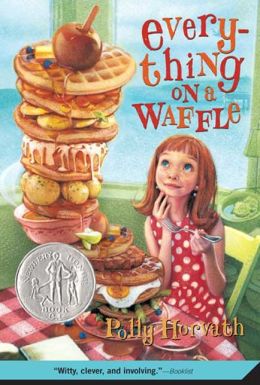
Everything on a Waffle (2001)
Everything on a Waffle. Polly Horvath. 2001/2008. Square Fish. 176 pages. [Source: Review copy]
There were things about Polly Horvath's Everything On a Waffle that I liked. I liked the heroine, Primrose Squarp. I liked how unique she was. She had a unique way of seeing the world around her, a unique perspective on just about everyone in town. The novel opens with tragedy, what most people would call tragedy. Primrose loses her mom and dad to a storm. Her dad was out sailing, her mom saw how horrible the storm was, got worried and left in another boat to go find him. Every single person in town, and, most every person from out of town who hears the story, concludes that Primrose's parents are dead. Their bodies have not been recovered, but, they are most certainly dead. Primrose arrives at the opposite conclusion. Her parents are not dead. They are not. They may be marooned on an island. They may be missing for a time. But her parents are most definitely alive. Many well intentioned folks in town encourage Primrose to come to terms with what has happened, to grieve her parents, to react and feel. But instead of Primrose coming to terms with her loss, it is the town who ends up coming to terms with Primrose and her unending optimism. No one is quite sure what to make of Primrose, she's just Primrose.
After a few weeks, Uncle Jack comes to stay with Primrose. Uncle Jack doesn't demand much from Primrose. He doesn't demand that she get in touch with her emotions and talk it all out. He lets Primrose be herself. And he accepts Primrose pretty much as is. And she does the same. Both are flawed beings, if you will. They seem to fit together well enough.
Miss Honeycut watches Primrose closely. She does not think Primrose is doing well at all. She thinks Primrose needs something that Uncle Jack could never give her.
One of the things that sets the book apart are the recipes at the end of every chapter. Also the small town quirky charm. I absolutely loved the idea of THE GIRL IN THE SWING restaurant. I loved the owner. I loved the idea that EVERYTHING on the menu came with waffles. Very unique.
As I said, I liked this one. I didn't love it.
© 2014 Becky Laney of Becky's Book Reviews
There were things about Polly Horvath's Everything On a Waffle that I liked. I liked the heroine, Primrose Squarp. I liked how unique she was. She had a unique way of seeing the world around her, a unique perspective on just about everyone in town. The novel opens with tragedy, what most people would call tragedy. Primrose loses her mom and dad to a storm. Her dad was out sailing, her mom saw how horrible the storm was, got worried and left in another boat to go find him. Every single person in town, and, most every person from out of town who hears the story, concludes that Primrose's parents are dead. Their bodies have not been recovered, but, they are most certainly dead. Primrose arrives at the opposite conclusion. Her parents are not dead. They are not. They may be marooned on an island. They may be missing for a time. But her parents are most definitely alive. Many well intentioned folks in town encourage Primrose to come to terms with what has happened, to grieve her parents, to react and feel. But instead of Primrose coming to terms with her loss, it is the town who ends up coming to terms with Primrose and her unending optimism. No one is quite sure what to make of Primrose, she's just Primrose.
After a few weeks, Uncle Jack comes to stay with Primrose. Uncle Jack doesn't demand much from Primrose. He doesn't demand that she get in touch with her emotions and talk it all out. He lets Primrose be herself. And he accepts Primrose pretty much as is. And she does the same. Both are flawed beings, if you will. They seem to fit together well enough.
Miss Honeycut watches Primrose closely. She does not think Primrose is doing well at all. She thinks Primrose needs something that Uncle Jack could never give her.
One of the things that sets the book apart are the recipes at the end of every chapter. Also the small town quirky charm. I absolutely loved the idea of THE GIRL IN THE SWING restaurant. I loved the owner. I loved the idea that EVERYTHING on the menu came with waffles. Very unique.
As I said, I liked this one. I didn't love it.
© 2014 Becky Laney of Becky's Book Reviews
Labels:
2001,
2008,
books reviewed in 2014,
J Fiction,
MG Fiction,
Newbery Honor,
review copy,
Square Fish
Thursday, April 23, 2009
Emil and Karl
Glatshteyn, Yankev. 2006. Emil and Karl. Square Fish. (Roaring Book Press) 194 pages.
There is an immediacy and urgency to Emil and Karl. Written in 1938--in Yiddish--it was only recently (2006) translated and published in English. Set in Austria, Vienna to be exact. The Third Reich is in power, yet the horror of World War II has not yet dawned. The full wrath unleashed during the Holocaust--the organized full-scale murdering of the Jewish people*--has yet to begin. Though the hate is strong and ever-present. Meet Emil and Karl. Best friends. One is Jewish. The other is not. But despite it being in Karl's "best interest" to forget about his Jewish friend, Emil, he can't brush him off.
The seriousness of the novel is apparent from the very beginning. When we first meet Karl, he is alone.
"Karl sat on a low stool, petrified. The apartment was as still as death. He looked at the pieces of the broken vase scattered on the floor. Several times he reached out with one hand to pick up an overturned chair lying beside him. The chair looked like a man who had fallen on his face and couldn't get up. But each time Karl tried, he could only lift the chair up a little bit, and then it fell down again. It was even quieter in the kitchen and the bedroom--so quiet he was afraid to go in there. It wasn't that Karl minded being in the apartment by himself. He'd been left alone there more than once before; he could even go to bed by himself without being afraid. He wasn't scared of spooks or devils. Instead, he loved to stare, wide-eyed, into the darkness and make up stories." (1)
Why is he afraid? He witnessed what I imagine would have seemed the unthinkable. He watched them take his mother. He watched them hurt her. He heard their threats. He heard them threaten to come back...for him. In one night, everything in Karl's world is turned upside down.
When he does move, act, it is to go see his friend, Emil. He seeks the comfort of a true friend. What he learns is that Emil too has changed. Emil and Karl have an enemy in common now. Both have been orphaned. Both have only each other. Can these two children find a way to survive in this topsy-turvy ever-dangerous world where hate rules supreme?
What makes Emil and Karl unique--in my opinion--is its urgency. When it was written, this wasn't a distant event in the past. This wasn't historical fiction. This was current events. This was the threat and danger facing the world. And at the time it was written, it was a threat that had not been conquered. There's a suspenseful quality to it. A sense of the unknown. There was no happy ending light at the end of the tunnel to brighten it up. In fact, the worse was yet to come. It's an emotional novel; it's brilliantly and intelligently written to make you feel that you are there, that you are witness.
*I'm not forgetting that the Holocaust also was about murdering other people as well. There were political prisoners as well as the targeting of gays and gypsies.
© Becky Laney of Becky's Book Reviews
If you're reading this post on another site, or another feed, the content has been stolen.
Labels:
1940,
2006,
J Fiction,
Roaring Book Press,
Square Fish,
YA Fiction
Subscribe to:
Posts (Atom)