Showing posts with label Harcourt. Show all posts

Friday, December 23, 2011

Hound Dog True (MG)

Hound Dog True. Linda Urban. 2011. Harcourt. 152 pages.

Uncle Potluck said when he talked to the moon, the moon talked back.

I just loved, loved, loved A Crooked Kind of Perfect. (I've read it three times!!!) And I wanted to love, love, love Hound Dog True too. Did I? Well. For the most part. What I loved about A Crooked Kind of Perfect--the humor--was missing a little in Hound Dog True.

Hound Dog True feels more serious perhaps. The heroine, a young girl named Mattie, is extremely shy. And she's super-super nervous about starting school at a new school after yet another move. She has never really had a friend--a close friend. And while she can manage being friendly, she has yet to find a friend. So she's scared and nervous and unsure and oh-so-lovable. She's afraid of rejection, afraid of being laughed at, afraid of not belonging, of never belonging. And I, for one, could never laugh at this situation.

Hound Dog True is charming and quirky. In its own way. I just loved, loved, loved Mattie's writing. The way she carried around a notebook. And the developing friendship between Quincy and Mattie was great. Just very, very sweet.

There were so many details that made this one work well. I would definitely recommend it.

© 2011 Becky Laney of Becky's Book Reviews

Tuesday, March 22, 2011

Cupid (YA)

Cupid. Julius Lester. 2007. Houghton Mifflin Harcourt. 208 pages.

A long time ago, when Time was still winding its watch and Sun was trying to figure out which was east and which was west, there was a king and queen. I don't know what country they were were king and queen of. That information was not in the story when it came down to me. Sometimes, stories don't understand; what may not be important to them is very important to us.
Now I'm sure there are people who can tell this particular story without having a name for the kingdom this king and queen ruled. Jupiter bless them. I guess I'm not that good of a storyteller, because I need a name for the kingdom. I asked the story if it would mind my giving the place a name. It didn't see any harm in it, so I am going to call it the Kingdom-by-the-Great-Blue-Sea.
The story also does not have names for the king and queen. I know they had names, but nobody would say to them, "What's up, Chuck?" or say, "Looky here, Liz," if those happened to be their names. I am in agreement with the story this time. If nobody could use their names, there is no need to have them in the story. As for what the king and queen called each other, they were probably like any other married couple and he called her "Honey" and "Sweetheart," and she called him "Good Lips" and things like that, which we don't need to pursue any further.
The king and queen had three daughters. I know what you are thinking: the daughters didn't have names, either. That is partly true. Two of the girls were name-naked. I'm not even into the story yet and already we have four people that the Internal Revenue Service could not send a letter to. (1-2)
I absolutely LOVE the narrator of Cupid. Lester rewrote this classic tale of Cupid and Psyche (a tale originally found in Apuleius' The Golden Ass) in the voice of a Southern black storyteller. I'm not sure it works for every reader--I've found a handful of negative reviews--but for me it worked well. I just fell in love with it, and stayed in love with it! I would recommend listening to this one--there is a great audio production of it!

I thought the storytelling was lyrical. The story focuses on the not name-naked daughter of the king and queen, Psyche, the most beautiful girl in the world--most beautiful mortal girl anyway.
I tried to write something that would give you an idea of how beautiful she was, but the letters of the alphabet got so confused and jumbled up trying to arrange themselves into words to describe someone for whom there were no words, they ended up crying in frustration. I hate trying to make words out of letters that have been crying and are so wet they can't stay on the page. Later on in the story, after the letters dry off, I'll try again to arrange them into enough words so you'll have some idea of what Psyche looked like. For now you'll just have to believe me when I say she was the most beautiful woman in the world (3).
Who should be jealous of our young princess other than the great goddess of love herself, Venus.

Yes, Venus is jealous. She wants revenge. She wants it now. And who better to deliver it than her winged son, Cupid? Cupid's mission? To make Psyche fall in love with someone she shouldn't. Someone ridiculously ugly or inappropriate. Or some inanimate object, perhaps. Anything to bring shame on the mortal girl will do in Venus' opinion.

Cupid is the story of what happens when this "god of love" falls madly in love himself, falls for the one girl his mother would NEVER approve of! 

Cupid did not understand what had happened to him. If you think about it, that's kind of funny. He was the god of love, but he had never been in love. Love had been a game to him, a game that he controlled with his bow and arrows. But after he saw Psyche, his life would never be again what it had been. (30) 

Like me and like you, Cupid accepted that it was not only possible but rational to love someone to whom he had not spoken--to love someone whose voice he had heard, whose face he had seen for, what? Five minutes? Ten? Certainly no more than that. Yet, this was all it took for him to feel as if he could lift mountains, polish stars, and hold the sun in his hands (35).

But love is never easy. Especially if it's true. One thing is clear. Cupid must choose between his mother and his new love. Who will he choose? What will he do to prove himself to his new love?

© 2011 Becky Laney of Becky's Book Reviews

Thursday, March 17, 2011

This World We Live In (YA)

This World We Live In. Susan Beth Pfeffer. 2010. Houghton Mifflin Harcourt. 239 pages.

I'm shivering, and I can't tell if it's because something strange is going on or because of the dream I had or just because I'm in the kitchen, away from the warmth of the woodstove. It's 1:15AM, the electricity is on, and I'm writing in my diary for the first time in weeks. 

This World We Live In is the sequel to Susan Beth Pfeffer's Life As We Knew It and the dead & the gone. The novel opens at the end of April, it has almost been a full year since the asteroid collided with the moon and life forever changed. In the second novel starring Miranda Evans (and her family), life beyond the sunroom is explored more fully. In Life As We Knew It, there was a routine dullness. Since Miranda, Matt, Jon, and their mom, Laura, rarely ventured out of their two-or-three room sanctuary, there was a sameness to the end of the world. That isn't quite the case with This World We Live In. For this book is ALL about change. Everything is changing--and these changes are coming quite quickly, surprising just about everyone! Soon Miranda's world will include more people--expanding from four to eleven! Among the new people in Miranda's life are Alex and Julie Morales first introduced to readers in the dead & the gone. How will her world change? Will these changes bring hope and love to her bleak life?

This is the second time I've read the novel--the third time if you count listening to the audio book. The first time left me shocked. I couldn't feel satisfied. I couldn't feel hopeful. I couldn't feel much of anything. I needed time and space. I needed to reread the whole trilogy. I needed to see the big picture--to see if there was a big picture.

This World We Live In is a challenging read. It requires readers to care deeply and passionately about these characters, to become a part of their lives, and a part of Pfeffer's strange, cruel world. There is much to contemplate, much to discuss. Particularly when it comes to this ending. I won't go there for this review. I won't. I don't think it's fair to those who have not read the book.

While this one isn't my favorite of the trilogy, I do recommend it.

A year ago I was sixteen years old, a sophomore in high school. Matt was in his freshman year at Cornell and Jon was in middle school. Dad and Lisa had asked me to be godmother to their new baby. Mom was between book projects. I know I've gained a lot in the past year, but I woke up this morning and all I could think about was everything I've lost. No, that's not right. Not everything, everybody. Everything doesn't matter, not really. After a while you get used to being cold, and hungry, and living in the dark. But you can't get used to losing people. Or if you can, I don't want to. So many people in the past year, people I've loved, have vanished from my life. Some have died; others have moved on. It almost doesn't matter. Gone is gone. (61)

If you'd asked me a week ago what it would take for me to feel better, I would've said knowing how Dad and Lisa and the baby were, meeting a boy my own age, and running water.
Now I have all three. I guess I must feel better. (101)

"You don't have to beg here," I said. "We're happy to share."
"No one is happy to share," he said.
Alex looked down then or I looked up. I don't know how it happened, but we made eye contact, and for a moment I was drawn into his soul. I could see everything, the depth of his sorrow, his anger, his despair.
I feel sorrow and anger and despair. I don't think there's a person alive who doesn't. I sometimes feel like my sorrow and anger and despair burn inside me the way the sun used to burn on a hot July day.
But that was nothing compared to what I sensed in Alex. His sorrow, his despair was like a thousand suns, like a galaxy of suns. It physically hurt me to look into his eyes, but I couldn't break away. He turned his head first, and then he apologized, or maybe he thanked me. For Alex I think they're the same thing. (107-8)

© 2011 Becky Laney of Becky's Book Reviews

Saturday, December 05, 2009

This World We Live In (YA)

Pfeffer, Susan Beth. 2010. (April 2010). This World We Live In. Harcourt. 256 pages.

I'm shivering, and I can't tell if it's because something strange is going on or because of the dream I had or just because I'm in the kitchen, away from the warmth of the woodstove. It's 1:15 AM, the electricity is on, and I'm writing in my diary for the first time in weeks.

This World We Live In is the sequel to both Life As We Knew It and the dead and the gone. How would I describe this oh-so-anticipated sequel? Intense and bleak. There's bleakity-bleak and bleakity-bleak. This is definitely as bleak as they come.

Miranda opens up her diary--after a month off give or take a week or two--by recounting some of her nightmares. And who could blame her really for having trouble sleeping? What with life as she knew it forever gone and so many unanswered questions and so many uncertainties burdening her. What hope does a month full (or year full) of tomorrows hold for her?

I haven't written in my diary in a month. I used to write all the time. I stopped because I felt like things were as good as they were ever going to get, that nothing was going to change again.

Only now it's raining.
Something's changed.
And I'm writing again. (4)

Soon the rain isn't the only change in her life--in their lives. Matt and Jon have the brilliant idea to go off fishing, to see what they can catch now that the ice is beginning to melt as spring continues to thaw the ashy world. Matt returns with a wife, Syl--and a couple of garbage bags of fish to be salted and preserved. (Jon returns too.) Soon after, there's another knock at the door. Surprise! Dad and Lisa and company have arrived. Gabriel, a baby boy, brings joy to their lives again. But Dad's also brought three others: Julie and Alex (whom we met in the dead and the gone) and an older man, Charlie. These six teamed up traveling East and have become such good friends that they're family now. But though in some ways Miranda's world is expanding more than she ever thought possible, in some ways her world is just as bleak as before. More people to love means more people to worry about. More people struggling to survive with limited resources.

While the world Pfeffer has created here is dark and bleak--more the stuff of nightmares--I couldn't help but be drawn back into Miranda's story. It was one of those instances where you hated to read on yet couldn't help it. I had to keep reading until the very end. It was intense.

ARC provided by the publisher at request of the author. All quotes are subject to change.

© Becky Laney of Becky's Book Reviews

Monday, April 13, 2009

Jessica's Guide To Dating on the Darkside


Fantaskey, Beth. 2009. Jessica's Guide to Dating on The Dark Side. Harcourt. 354 pages.

The first time I saw him, a heavy, gray fog clung to the cornfields, tails of mist slithering between the dying stalks.

Jessica, our heroine, never set out to fall in love with a vampire. It wasn't on her to do list. It wasn't a fantasy of hers--not by a long shot--but such is the case when a strange--but strangely handsome--guy appears in her life claiming to be an 'exchange' student. The truth? The two were betrothed back when they were infants back in Romania. Before Jessica (then named Antanasia) became an orphan. Before she was adopted by an American couple and taken to the states to live. Our hero, Lucius Vladescu, is here to remind her that not only are they supposed to be engaged...she is really, truly a vampire princess. But she's not a vampire yet*. Does she want to be a vampire princess? Not at first. No, her crush is the ever-adorable-but-oh-so-ordinary Jake Zinn. And she's more than thrilled that Jake seems to be crushing on her too. But Lucius is ever-lurking about. Watching. Protecting. Generally being creepy and in the way. But ever-so-slowly, Jessica starts liking her lurker-would-be-lover. Starts being tempted by his charms--craves his touch, his kiss, his bite. But as she starts falling for him, he begins having second thoughts. Does he really want to turn Jessica into a vampire? Isn't her American upbringing a major weakness in being a vampire? Isn't she unsuited to the task of ruling as a vampire? Why would he want to do this to her? The more he resists, the more she desires. It also helps things along that he begins dating another girl, Faith, that her desire (Jessica's desire) is magnified by jealousy. If he is going to be biting anyone's neck, it should be her neck. This is another will-he/won't-he vampire romance.

I liked this one. It was fun in a way. If I was annoyed with anything in this one, it was Lucius' voice. I'm not sure what century "old-fashionedness" he was trying to channel for being a proper vampire. But I didn't buy him as a modern hero, a modern vampire, a modern Romanian who just happens to be a vampire. True, it's not like there are any direct correlations between this and real life so you can say he should sound like this, not that. But still, he didn't come across as authentic anything. He sounded stereotypically speaking-English-in-a-weird-movie-supposed-to-be-European-accent vampire. That's not a big problem. I was able to get used to in during the course of the novel. But it did jolt me a few times in the narrative. But I was able to get right back into it. So no big deal.

*(A concept that takes some getting used to. Her parents were vampires, yes. But she's not a vampire until she's bitten by her vampire lover/husband? But as she grows up, matures, her body starts craving that vampire bite, that change? But does that mean Lucius was born a vampire and was raised that way? Raised on blood? Did he have to be bitten? Or was his being a vampire something that happened at puberty? And how are all these vampires having babies to begin with? How do the undead reproduce? Are these vampires even among the undead? Lucius acts like he's alive--growing, changing, maturing into an adult, BUT he does drink blood.)

© Becky Laney of Becky's Book Reviews
If you're reading this post on another site, or another feed, the content has been stolen.

Wednesday, April 08, 2009

Travel the World: Australia: The Reformed Vampire Support Group


Jinks, Catherine. 2009. The Reformed Vampire Support Group.

Interesting cover and premise. But only moderately pleasing (to me). Nina is a vampire. She's been a vampire since 1973. She's been trapped in a teenagers body for what seems like forever. Nina in her own words, "The plain fact is, I can't do anything much. That's part of the problem. Vampires are meant to be so glamorous and powerful, but I'm here to inform you that being a vampire is nothing like that. Not one bit. On the contrary, it's like being stuck indoors with the flu watching daytime television, forever and ever." (5) Nina and her vampire family don't sparkle, thank goodness, but they're also not fast or strong or powerful. These vampires are nothing like what you read about; instead we find them weak, sickly, powerless, resigned to their oh-so-boring lifestyles. But when one of their own ends up dead--turned to ash--the threat becomes a little too real and pushes them all out of their comfort zones and somewhat unwillingly into an adventure all their own. For what they find is that someone--a stranger--is onto them. Suspects that they are vampires. And is out to kill them "for the good" of mankind. Can they convince this unknown threat that they're no threat?

I was only moderately entertained by this one. The plot seemed a bit too flimsy for me. The storytelling too clumsy. At one point, the author interrupts the action sequence to spoil her own mystery. Something that I found a bit weird and definitely unnecessary. I mean why work up any suspense at all if you're just going to tell your readers the secrets before reaching what should be the climax and explain every little clue away before the "big reveal" that turned out to be mostly deflated by that point.

© Becky Laney of Becky's Book Reviews
If you're reading this post on another site, or another feed, the content has been stolen.

Friday, March 27, 2009

Streams of Babel


Plum-Ucci, Carol. 2008. Streams of Babel. Harcourt. 424 pages.

I sat very still, waiting for the police and ambulance to arrive.

I liked this one. I really liked it. It wasn't quite what I was expecting. But I liked it all the same. Told through multiple narrators, the book follows a terrorist attack on "Colony One". The water lines for a neighborhood have been poisoned with "Red Vinegar." And the race is on to find just what this Red Vinegar agent is, and to discover a cure before (even more) people die from drinking tap water. At the heart of this story are teenagers. The year is 2002. The threat of terrorism--the doomsday fear--is large. But for this New Jersey community, it is all too real. Unfortunately. With two fatalities already, this is no laughing matter. Can the case be solved? And quickly?! Help may come from two unlikely sources: a boy named Shahzad Hamdani, a v-spy who for some of the book at least lives on the other side of the world (Pakistan); and an American hacker-boy, Tyler Ping, who suspects his own mother of wrongdoing (though not necessarily in this terror cell). They along with the American teenagers of Owen and Scott Eberman, Rain Steckerman, and Cora Holman, are the narrators of the novel. It is through their perspectives that we grasp the terrifying (and isolating) situation.

It's a complex novel, but a good one.

© Becky Laney of Becky's Book Reviews
If you're reading this post on another site, or another feed, the content has been stolen.

Monday, March 16, 2009

Graceling


Cashore, Kristin. 2008. Graceling. Harcourt. 471 pages.

In these dungeons the darkness was complete, but Katsa had a map in her mind.

I loved this book. I did. It's YA Fantasy at its best. A story of seven not-so-perfect kingdoms: Nander, Wester, Estill, Sunder, Monsea, Middluns, and Lienid. The story of the Graced--and those royalty who seek to control and manipulate them. A story of a girl, Katsa, and the boy that loves her, Po. A story with secrets and betrayals. A story with plenty of punches. A bit violent? Maybe. But that's because our heroine, is "graced" with the power of killing. Or is she?! Who are the graced? Well, the graced are those born with two different eye colors. For example, Po has one silver eye, one gold eye. I can't quite remember what two colors Katsa has...(don't hate me!) but I know that those that are graced are often ostracized by others. It's hard for others to look them in the eye, to treat them as "normal." The graced are those with special abilities, enhanced traits. The power might be a gift with livestock or the power to read minds. True, a large part of the people's fear... for both Po and Katsa... is that both are graced in fighting, in combat. Po is the Prince--seventh prince--of Lienid. Katsa is the niece of the king of Middlun, Randa.

When we first meet Katsa she is on a mission. A mission to save an old man, a Lienid, a man in the royal family of that kingdom who has been kidnapped and held prisoner; he is the grandfather of Prince Po, though when she seeks out to rescue him, she doesn't know of Po. It is on her way out--mission successful--that she stumbles into Po. Though she knows that it would be safer if she killed him--he's a witness to her "crime" after all. Yet something about him makes her hesitate. She gets a feeling that they're on the same side. That he is not her enemy--witness though he may be. So she merely bonks him on the head and lets him be.

Doesn't sound quite like love at first sight, does it? Yet as these two born-fighters struggle with each other, train with each other, struggle with their feelings, a great love is born...but is it a love that can last?

I won't go into all the details. I don't want to spoil the plot. But life seems to have thrown these two together for a reason...and it will take everything they have for the good guys to win...this is one exciting read!

© Becky Laney of Becky's Book Reviews
If you're reading this post on another site, or another feed, the content has been stolen.

Sunday, February 08, 2009

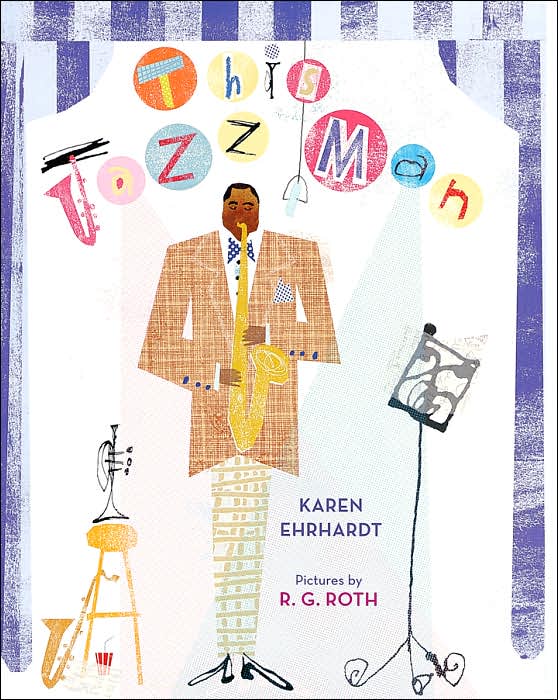
This Jazz Man


Ehrhardt, Karen. 2006. This Jazz Man. Harcourt.

Karen Ehrhardt's This Jazz Man is a fun picture book that adapts the classic song "This Old Man." This is the kind of premise that could go either way--be really, really good and clever, or be really, really bad. In my opinion, This Jazz Man is successful in its attempt to make this song swing. Like all jazz books should, it starts with Louis Armstrong.

This jazz man, he plays one,
He plays rhythm with his thumb,
With a snap! snap! snazzy-snap!
Give the man a hand,
This jazz man scats with the band.

Of course it continues counting through the jazz band.

This jazz man, he plays nine,
He plucks strings that sound divine,
With a thimp-thump! Dumple-thump!
Give the man a hand,
This jazz man jams with the band.

What the book doesn't make obvious from the get go is the fact that each number pays tribute to a jazz legend--that big reveal comes at the end of the book. 2 is Bill "Bojangles" Robinson. 3 is Luciano "Chano" Pozo y Gonzalez. 4 is Edward Kennedy "Duke" Ellington. 5 is Charlie "Bird" Parker. 6 is Art "Bu" Blakey. 7 is John Birks "Dizzy" Gillespie. 8 is "Thomas Wright "Fats" Waller. 9 is Charles "Baron" Mingus. Together these make for one great band...

The illustrations are by R.G. Roth. The book would be great for showing onomatopoeias--snap, bippity-bop, bomp, doodly-doot, etc. And for introducing jazz vocabulary--scats, jams, stomps, pounds, blows, beats, wails, swings, etc. But even if you're not looking to use the book in a classroom (or home school setting), the book is just fun--delightful even. I loved it.

© Becky Laney of Becky's Book Reviews