Showing posts with label "F" Authors. Show all posts

Monday, April 13, 2009

Jessica's Guide To Dating on the Darkside


Fantaskey, Beth. 2009. Jessica's Guide to Dating on The Dark Side. Harcourt. 354 pages.

The first time I saw him, a heavy, gray fog clung to the cornfields, tails of mist slithering between the dying stalks.

Jessica, our heroine, never set out to fall in love with a vampire. It wasn't on her to do list. It wasn't a fantasy of hers--not by a long shot--but such is the case when a strange--but strangely handsome--guy appears in her life claiming to be an 'exchange' student. The truth? The two were betrothed back when they were infants back in Romania. Before Jessica (then named Antanasia) became an orphan. Before she was adopted by an American couple and taken to the states to live. Our hero, Lucius Vladescu, is here to remind her that not only are they supposed to be engaged...she is really, truly a vampire princess. But she's not a vampire yet*. Does she want to be a vampire princess? Not at first. No, her crush is the ever-adorable-but-oh-so-ordinary Jake Zinn. And she's more than thrilled that Jake seems to be crushing on her too. But Lucius is ever-lurking about. Watching. Protecting. Generally being creepy and in the way. But ever-so-slowly, Jessica starts liking her lurker-would-be-lover. Starts being tempted by his charms--craves his touch, his kiss, his bite. But as she starts falling for him, he begins having second thoughts. Does he really want to turn Jessica into a vampire? Isn't her American upbringing a major weakness in being a vampire? Isn't she unsuited to the task of ruling as a vampire? Why would he want to do this to her? The more he resists, the more she desires. It also helps things along that he begins dating another girl, Faith, that her desire (Jessica's desire) is magnified by jealousy. If he is going to be biting anyone's neck, it should be her neck. This is another will-he/won't-he vampire romance.

I liked this one. It was fun in a way. If I was annoyed with anything in this one, it was Lucius' voice. I'm not sure what century "old-fashionedness" he was trying to channel for being a proper vampire. But I didn't buy him as a modern hero, a modern vampire, a modern Romanian who just happens to be a vampire. True, it's not like there are any direct correlations between this and real life so you can say he should sound like this, not that. But still, he didn't come across as authentic anything. He sounded stereotypically speaking-English-in-a-weird-movie-supposed-to-be-European-accent vampire. That's not a big problem. I was able to get used to in during the course of the novel. But it did jolt me a few times in the narrative. But I was able to get right back into it. So no big deal.

*(A concept that takes some getting used to. Her parents were vampires, yes. But she's not a vampire until she's bitten by her vampire lover/husband? But as she grows up, matures, her body starts craving that vampire bite, that change? But does that mean Lucius was born a vampire and was raised that way? Raised on blood? Did he have to be bitten? Or was his being a vampire something that happened at puberty? And how are all these vampires having babies to begin with? How do the undead reproduce? Are these vampires even among the undead? Lucius acts like he's alive--growing, changing, maturing into an adult, BUT he does drink blood.)

© Becky Laney of Becky's Book Reviews
If you're reading this post on another site, or another feed, the content has been stolen.

Tuesday, January 20, 2009

The ABC's of Kissing Boys


Ferraro, Tina. 2009. The ABC's of Kissing Boys. Delacourte. 215 pages.

Can a girl fall for the boy next door even if he's a freshman...and she's a junior? That's the question in Tina Ferraro's latest novel, The ABC's of Kissing Boys. Parker Stanhope's life is on a downward turn. She plays soccer. That's who she is. Yet when she begins her junior year playing junior varsity--again--instead of moving up with her peers to varsity, she's angry, frustrated, bitter, disappointed. Dropped by her friends and former teammates, Parker is having to redefine herself. But Parker's not going to let her dreams go all of a sudden. No, Parker has a plan. And for that plan to work, she needs a man or two in her life to step up.

Luke. Her brother's friend. She's paying him to do her a favor. It's complicated. But it will involve a very public kiss at the school's sports fair's kissing booth.

Problem is, she doesn't know how to kiss--really kiss. So she needs a tutor. Enter the boy next door, Tristan--never mind the fact their families are feuding. He's tall enough and cute enough...but there's one big problem...he's a freshman. Still, despite his status, he might just be the man for the job. Can he teach her what she needs to know to get her life back on track? Maybe. Possibly. But will she be able to let him go when the job's done?

The book is a bit more involved than that--more than just the kissing bits--there's a good bit about friendship and popularity and finding yourself. You know, typical YA drama.

I liked this one. I did. I liked Tristan. It was a fun little book. A satisfying one.

© Becky Laney of Becky's Book Reviews

Tuesday, December 16, 2008

Swimming with the Sharks


fischer, Debbie Reed. 2008. Swimming with the Sharks.

The list is titled Top Ten Guys Who Are Still Virgins. Dorkowitz tops it off at number one, of course.

I didn't care for this one. I'll be honest. It's a book about mean girls--mean cheerleaders to be exact--who go to great lengths to torture the newest cheerleader, Ellika, and 'persuade' her into quitting. Why is she on the team to begin with? Her family is rich, they made a very large contribution to the school--to the gym I believe--and this was one of the stipulations: a place for their chunky/plus-size daughter on the varsity cheering squad. Our narrator, Peyton Grady, goes along with Operation Smellika--in fact she commits several of these cruelties personally--including smashing Ellika's glasses to pieces. It isn't until bones get broken and heads get concussed that Peyton sees the bigger picture and decides to break the pact. And even then it's a tough decision for her.

I suppose we're supposed to 'like' Peyton. This bystander who silently questions but still acts and goes along with the others on the team. Peyton has a conscience, but she's choosing to not listen to what her instincts are telling her. Peyton is clueless about many things. Things that the reader won't be. It's easy to predict each twist and turn in this one. Only Peyton and Ellika seem not to see the truth that's right in front of their faces.

Ellika. I have a hard time in believing in Ellika as a character. Yes, I feel sorry for her--in a way--but I have a hard time believing she could be so stupid or naive. Ellika is used to being teased, used to being called names, so why she goes and seeks out the popular crowd is beyond me. She's a new student, and she wants to 'buy' her way into the 'in' crowd? She thinks it will work? That she'll suddenly become popular? become accepted? That she'll be like that girl in the movies--the ugly duckling who transforms herself into the most popular, beautiful girl in the school. The fact that she perseveres no matter how much abuse--physical, mental, emotional--is piled onto her by her teammates...that she doesn't quit the team, that she doesn't tell her parents, that she doesn't want to change schools, etc. That she honestly believes that she can outlast and outwit the cheerleaders. That if she endures the pain, the torment, the abuse, that by the end of the school year she'll have made it, made new friends, found a place to belong. Why would she want to "belong" in the first place? Why would she want these bullies to be her friends? Why does she seek out their acceptance knowing how cruel and mean and stupid they all are? I have a hard time believing that anyone could ever welcome that much abuse into their lives.

© Becky Laney of Becky's Book Reviews

Sunday, November 16, 2008

The Possibilities of Sainthood


Freitas, Donna. 2008. The Possibilities of Sainthood.

I'm in like with this book. It's cute. It's funny. The narrative voice works for me. I found the main character, Antonia Lucia Labella, to be lovable. I found Michael, her "friend" who is only a friend to be crush-worthy. Antonia's crush, Andy, was predictable and a bit undeveloped. (No reader doubts that he is filler, just a pawn in the story.) Maria was a nice sidekick. I loved the Labella family as a whole. This book had atmosphere--plenty of atmosphere--and delightful characters as well.

Antonia Lucia Labella wants to be the first living saint. She writes the Vatican once a month with her ideas--always fresh, innovative, down-to-earth and practical--with ideas for new patron saints. So far no luck. The book begins with her idea of having a new patron saint for figs and fig trees. That's only the beginning. This premise is cute, but it doesn't grow old...at least not in my opinion. Antonia is just too likeable.

When she's not writing to the Vatican, praying to the saints, doing her homework, or working with her mom in her business, she's crushing on Andy. Andy's her dream guy. But the only guy in her life, Michael, is there uninvited. He's always closer than Antonia likes. Though Michael insists that he's just there to be her friend. Her friend on her terms. Her head is full of hopes and dreams of having her first kiss...and having that kiss come from the ever-dreamy Andy. Will Antonia be the last to notice how thoroughly kissable Michael is?

© Becky Laney of Becky's Book Reviews

Monday, November 10, 2008

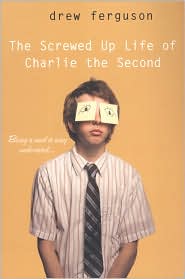
The Screwed-Up Life of Charlie the Second


Ferguson, Drew. 2008. The Screwed Up Life Of Charlie the Second.

Okay, so maybe getting my scrawny ass pushed into the back of a Crystal Lake cop car wasn't the smartest thing I've done, but Dana's party last night--it sucked. She should thank me. The only thing anyone'll remember about the party is me getting busted.

What can I say about this one? I think you'll either love it or hate it. If you're looking for a book about the awkwardness and glory of a guy having his first boyfriend--plenty of firsts elaborately and graphically described--then this one may be for you. Not that you have to be looking for that to enjoy it. Drew Ferguson does a great job with characterization in general. From our main narrator, Charlie, to his boyfriend, Rob, to his best friend, Bink, to the families of Rob and Bink. Good characters. Good plotting. This is a nerdy coming-of-age story that no doubt is authentic--the awkwardness of being that age in general, the uncertainty of what to expect out of a more intimate relationship, the bittersweetness of life itself at any age--the loves lost and gained.

The writing is full of humor. But it isn't without heart. Charlie falls--and hard--for Rob. And the joys of learning that that love is returned brings happiness and joy. But it also adds complications. Rob is going through a rough time. His mom is dying (and does in fact die through the course of the novel). And Rob and his father are going through the stages of grief--shock, denial, anger, etc. Charlie is young and inexperienced (in more ways than one). He doesn't know how to deal with Rob's heartaches. Rob is on an emotional roller coaster, and Charlie doesn't know how to deal with the situation. I think few people his age would.

Friendship. Love. Heartache. Life lessons learned the hard way. Not for everyone certainly--no one book is for everyone.

A much better review is at Bookshelves of Doom.

© Becky Laney of Becky's Book Reviews

Saturday, November 08, 2008

The Girl Who Could Fly


Forester, Victoria. 2008. The Girl Who Could Fly.

Piper decided to jump off of the roof. It wasn't a rash decision on her part.

The Girl Who Could Fly is an odd little book that I couldn't help enjoying. Piper McCloud, she flies. A girl who flies. When her flying catches attention, mysterious strangers show up on the family farm promising her family that they've got the perfect school for her. A school where her specialness will be appreciated. So away Piper goes. Leaving behind her family and her home. The school or institute (initials I.N.S.A.N.E) is different alright. And everyone Piper meets is unusual from the adults to her fellow classmates.

I hesitate to say anymore because I don't want to reveal too much. The plot twists are best enjoyed firsthand.

The Girl Who Could Fly is a quirkier Mysterious Benedict Society. Unique, quirky characters. Fast-paced plot. A good mix of fun.


© Becky Laney of Becky's Book Reviews

Tuesday, February 27, 2007

Julia's Kitchen

Ferber, Brenda A. 2006. Julia's Kitchen.

There are not enough words to describe how much I loved Julia's Kitchen by Brenda A. Ferber. I enjoy much of what I read. I love many. But there are a few that touch my heart and I know that I'll always alwayslove. Julia's Kitchen is now one of them. It is the story of a young girl, Cara Segal, as she goes through a heartbreaking journey of grief and sorrow when her mother and sister die in a fire. When we first meet Cara she is happy and carefree. Having stayed overnight at a friend's house she is unaware that her life is forever changed. One phone call changes everything. Suddenly a happy family of four is a confused and grief-stricken family of two. Having been her mother's pet, the two liked to bake together, she is struggling trying to connect with her father emotionally. Her mother, Julia, owned her own catering business "Julia's Kitchen" and Cara loved helping her mother. Now she's vowed never to eat another dessert. Cara's journey of how she learns to live again, love again, believe in God again, and yes, even bake chocolate chip cookies again is unforgettably touching. And there is even a recipe for those cookies in the book!

Sydney Taylor Book Award Winner 2007

VOYA Top Shelf Fiction for Middle School Readers 2006

Junior Library Guild Selection 2006

http://www.brendaferber.com/books.htm
http://www.brendaferber.com/aboutme.htm
http://www.brendaferber.com/index.htm

Friday, January 12, 2007

One of the Best

Freedman, Russell. 2006. Freedom Walkers: The Story of the Montgomery Bus Boycott.

Russell Freedman is an award-winning, well-respected author of nonfiction books for children and young adults. You can always count on him to tell both an informational (and accurate) and interesting story. FREEDOM WALKERS is the story of the Montgomery Bus Boycott an important and significant event within the Civil Rights Movement. The introduction and first two chapters provide readers with necessary background information in regards to how African-Americans were treated in the South. In particular the first two chapters present the stories of Jo Ann Robinson and Claudette Colvin who also made a stand in regards to segregation on buses in Montgomery, Alabama. However, for whatever reason, it wasn’t until Rosa Parks that African-American leaders in the city decided to make this personal struggle into a plea for racial unity to passively stand and fight for justice. Chapters three through seven tell the story of Rosa Parks and other key individuals involved in starting the Montgomery Bus Boycott and seeing it through to the end. What was the Montgomery Bus Boycott? For those that don’t know it is when African-Americans decided that it would be better to walk to work--no matter how great the distance--than to face discrimination and prejudice by riding the buses. Why should they pay the bus system to be treated unjustly? In addition to walking, a complex system of carpooling was organized. Both African American and white citizens participated in this carpool system. The boycott was successful. Due to their rallying at churches across the city, all of the buses were empty--empty of African-American passengers who formerly made up the bulk of their passengers. In response, city officials urged whites to ride the buses to keep the business alive, but found it harder to gain support. Many whites viewed traveling by buses below them since they had their own cars. Although facing financial hardship or even ruin, the city remained firm on its policy. They would not even begin to consider comprimising with African-American leaders. They even responded with violence. But Martin Luther King, Jr. urged African-Americans to above all remain nonviolent and act in Christianly love. This drama was also played out in several courtrooms across the country. Leaders knew that this local incident would eventually become a national issue in the Supreme Court. Knowing that the South would never side in favor of justice for African Americans, they hoped for justice on the national level. Chapter eight concludes with the follow up story of the Civil Rights movement in the sixties and seventies. Well-researched, Russell Freedman uses photographs and primary sources to document an important time in American history. Includes chapter notes (foot notes), selected bibliography, and index.

Thursday, December 28, 2006

Escape

Fleischman, Sid. 2006. Escape: The Story of The Great Houdini.

I remember reading Sid Fleischman’s autobiography five or six years ago, The Abracadabra Kid: A Writer’s Life, and learning how much of an impact magic had on his childhood. Magic was this author’s first passion, and it clearly shows in this biography of his childhood hero, Harry Houdini. It must have been an act of love writing such a biography--an enjoyable and accessible biography at that--for young readers. How can I describe it? It is well-written. It is enjoyable. It is well-organized. It is full of black and white photographs. It is well-researched. It features a selected bibliography and index. If only I could share the same interest as the writer. But magic has never been all that ‘magical’ to me. So I do recommend the book for readers of all ages if they show some interest in magic in general, or in the legend of Houdini himself, or if they just enjoy reading interesting biographies of famous people. It really is quite well done.

Krull, Kathleen. 2005. Houdini: World's Greatest Mystery Man and Escape King.

Written by Kathleen Krull (one of my favorite authors) and illustrated by Eric Velasquez (one of my favorite illustrators), HOUDINI is an enjoyable picture book biography. The deep, rich colors (black, red, and gold) add lushness and life to Krull’s text. The text presents a summary or overview of Houdini’s life and his most famous magic tricks. The author’s note brings Houdini’s life to a close and summarizes how Houdini’s life impacted the world. A bibliography is included.

Tuesday, November 21, 2006

Alphabet of Dreams

Fletcher, Susan. 2006. Alphabet of Dreams.

Set in the Ancient MiddleEast (Persia/Babylon/Judea), Mitra and her brother Babak are beggars who are not what they appear to be: royal children on the run hiding from an evil king who murdered their parents. They have escaped notice from the adults so far, but when Babak starts having "true" dreams about other people, attention begins to fall on them. In some ways, they are better off than before. They now can pay for food instead of steal it, but in some ways it is dangerous for people are talking about these strange foreigners who have dreams that foretell the future. When Babak is 'captured' by a/the magus (magi), he begins dreaming of stars, kings, and a newborn baby. Mitra and Babak travel with the three magi on a long journey that ends in Bethlehem.

http://www.susanfletcher.com/

Monday, November 20, 2006

The Braid

Frost, Helen. 2006. The Braid.

Set in Scotland and Canada in the nineteenth century, The Braid tells through a series of poems the story of two sisters separated by an ocean but still fiercely devoted to one another. Jeannie narrates the poems told from Canada, and Sarah narrates the poems told from Scotland. How did the sisters become separated? The family was living in Scotland when their landlord forced them off the land and gave them a deadline. The grandmother refused to go with the rest of the family to Canada. She wanted to return to the village where she grew up. One sister, Sarah, didn't want to be separated from her grandmother and didn't like the idea of her being alone. She was also, of course, rather attached to the land herself. So when the day comes for the family to depart, Sarah disappears in the middle of the night leaving in the bed she shared with her sister Jeannie a braid of her hair. Filled with emotion and heartache, each sister tells her own story, yet their stories connect in some ways as the reader discovers as the plot unfolds...

http://www.helenfrost.net/