Showing posts with label bullying. Show all posts

Saturday, January 21, 2023

14. The Worlds We Leave Behind


The Worlds We Leave Behind. A.F. Harrold. Illustrated by Levi Pinfold. 2023. [February] 256 pages. [Source: Review copy]

First sentence: Hex wasn't entirely sure how the girl had come to be hurt. That morning he and Tommo had got on their bikes and they'd headed over the train tracks and down the hill, down to the woods. On a map, the woods were a fat finger pointing away from town.

Premise/plot: Twilight Zone times ten--that's how I'd describe A.F. Harrold's The Worlds We Leave Behind. It begins with two friends--Hex (short for Hector) and Tommo (short for Thomas) hanging out together. They had absolutely NO plans at all of hanging out with a "baby" (Sascha). But this neighbor-kid, Sascha, tags along despite the two trying their hardest to get rid of her. (Who wants to be responsible for a strange neighbor kid in the woods??? Certainly not these two.) Playing on a rope swing turns tragic--in more ways than one. She falls off the swing and breaks her arm--it is way more complicated than that...and the world (yes, the world) will never be the same.

Be careful who you meet in the woods. That's all I have to say about that. I know the jacket flap goes into much more detail....but why purposefully spill twists and turns????? 

My thoughts: The Worlds We Leave Behind is certainly atmospheric and creepy. It isn't just horror lite. I think it could qualify as horror-horror. The pace was quick and intense. The premise and plot--stranger danger times a thousand--is uniquely odd and strangely familiar. It does feel like a blend of horror and fairy tale. 

Sensitive readers might want to stay away. But for upper elementary grades and middle school who are looking for something spooky/scary/suspenseful/mysterious packed with twists and turns...this one might be a good fit. I do recommend it for adults who are nostalgic for the Twilight Zone.


© 2023 Becky Laney of Becky's Book Reviews

Friday, July 22, 2022

87. The Star That Always Stays


The Star That Always Stays. Anna Rose Johnson. 2022. 224 pages. [Source: Library]

First sentence: I'm standing before the castle-like structure of Boyne City High School, staring at its gleaming windows, my heart filling with the anticipation of beginning the journey into higher education. 

Premise/plot: The Star That Always Stays is historical fiction set circa 1914/1915. It very roughly follows the protagonist's first year of high school. It is very much a coming of age novel. Norvia Nelson, our protagonist, is processing a LOT. Her father is long gone; her mother is remarrying after their divorce; she'll have new step-siblings; she'll be in a new house; she'll be starting high school...and she's Ojibwe. (Or half-Ojibwe). Perhaps because of how her father cruelly used their heritage against them in arguments (he was verbally abusive) perhaps because of the times, Norvia's mother has asked all of her children to keep their native heritage hush-hush. 

At first Norvia is hesitant and skeptical of "Uncle Virgil" and her new step-brother, Vernon. She's worried that her mother is being foolish and naive. That this rushed marriage is a big, big mistake. They come from two different worlds after all. But slowly and surely over the course of an entire year, Norvia changes her mind. 

My thoughts: The Star That Always Stays is an incredibly slow novel that is character-driven. Don't expect action, adventure, or excitement. The most excitement you can expect (and do expect it!) is when Norvia discovers a new book to love, a new character to emulate or admire. She's a sensible character not prone to dramatic hysterics. She does have a younger sister (Dicta) that is an absolute HOOT. She's a scene-stealer for sure. But this is a quiet-book with a quiet-heroine with subtle themes and tones.

I didn't fall for this novel from the start. I did think it was a bit slow. But somewhere in the middle, well, I can't even explain when or where or how, I realized that I was in love with this book. 

I loved, loved, loved, loved, loved the slow-build relationship between Norvia and her stepfather....and her slow-build relationship with her step-brother. (The other step-siblings are older and married. And they don't enter into the story as much.)

The book is based on the author's own family history. 

Quotes:

"But you have to realize that life does change. Things will be different, always. There's only one thing you can control."
"What?" Norvia murmured.
"The way you handle those changes. You're in complete control of yourself and how you adjust and respond. And," said Uncle Virgil, breaking off and smiling, "there is Someone on whom you can always rely--completely. He will never fail you. Christmas is a good time to remember that Jesus is always there for us, caring for us."


© 2022 Becky Laney of Becky's Book Reviews

Thursday, June 23, 2022

77. Garvey's Choice

Garvey's Choice. Nikki Grimes. 2016. 120 pages. [Source: Library]

First sentence: When I was seven/ and crazy for Mr. Spock,/ a Star Trek lunch box/ was all I craved. Instead, Dad/ bought one blaring the logo/ of some football team/ I'd never heard of./ I shoved that thing in/ the coal black of my closet,/ then celebrated with cake.

Premise/plot: Garvey's Choice is a verse novel. (The verse is written in tanka.) Garvey is an overweight teen who'd much rather sing or read than play sports. There exists between father and son a gap that nothing seems to fill. At least at first. Garvey tries--unsuccessfully--to fill this gap with food. Garvey's dad may talk about sports--a lot--but I don't get the impression that he's actually cruel to his son. The two just aren't speaking the same love languages. 

In the novel, Garvey makes several choices. Will he choose to try out for chorus and risk rejection or humiliation? He ultimately decides that he has nothing to lose and everything to gain. After all, he's already being teased by his classmates; he's already hating lunch time. What he finds out is that he's really talented at singing; and his singing not only makes him happy in the process, but makes others happy too. That and he makes a second friend. Another choice he makes regards his weight. Will he try to lose weight? Should he try to lose weight? How should he go about it? What can he change in his life to be healthier and happier?

This aspect of the verse novel was a bit iffier for me. I hated to see him get in the cycle of dieting in unhealthy ways, ways that are doomed to fail. I was yelling DON'T DO IT. JUST DON'T. 

My thoughts: I think the verses are authentic in that many, many, many, many people turn to food as a way to deal with emotions they don't know how to handle any other way. It's not the best way perhaps, but it is the easy way. I liked how singing took the place of food in some ways as a way to cope with the ups and downs of life.

One of the songs mentioned throughout the book is "Dance with My Father." I encourage you to give it a listen if you pick this one up.

One of my favorite poems: "Summer Lost and Found"

Stories are breadcrumbs.
Just follow the trail of books
and you will find me
lost among the galaxies
of scorched stars and ships to Mars. (4)
And here's another: "Alien"
Over breakfast, Dad
eyes me like an alien
never seen before.
Sometimes, I could swear that he's
hoping to make first contact. (17)

 My new thoughts: I first read this one in February 2017. I reread it in June 2022 because a sequel is coming!!! I am so excited to get another book starring Garvey!!! The poems still resonate. SO much can be communicated in just a few lines.


© 2022 Becky Laney of Becky's Book Reviews

Friday, February 05, 2021

15. Worst-Case Collin


Worst-Case Collin. Rebecca Caprara. 2021. [September] 256 pages. [Source: Review copy]

First sentence: I used to dream about normal stuff like making the swim team, acing my social studies quiz, getting revenge on Liam for pranking me all the time. These days my main goal is to prevent disaster from striking again. Or, at the very least, to be better prepared. Which is harder than it sounds when you're in middle school and calamities of various sorts occur daily.

Premise/plot: Collin, our twelve-year-old protagonist, is a worrier carrying the weight of the world on his shoulders. It wasn't always like this. There was a Before. But he's been living in the After for almost two years now. Life without his mom is barely life. Collin has some great friends--Liam and Georgia--who are clueless about the secrets he's been keeping from them. There's a good reason he hasn't invited them inside his house--ever, ever, ever. But keeping secrets and hiding out can only take you so far...

Worst-Case Collin is a coming of age novel--with a school setting, with a strong theme of friendship--written in verse. It's also what you might call a problem novel. (That is one reason why I am reviewing it here at Becky's Book Reviews instead of Young Readers.)

My thoughts: I have many thoughts. On the one hand, WHAT A STORY. I loved meeting Collin and his friends, Liam and Georgia. I thought his two friends continually offered a ray of hope and happiness. Collin and the reader needed that hope. (I also thought Liam's mom was superb!!! It was so nice to see a good parenting role model.) On the other hand, IT IS HEAVY AND INTENSE. I think it is good heavy and good intense. But also potentially triggering--depending on the reader's home environment. 

Collin is juggling many, many, many emotions: sadness, worry, fear, frustration, anger, regret, bitterness, anxiety, hopelessness, grief, and SHAME. Collin only has a tiny amount of places where he feels safe. On the one hand, he wants to tell someone--anyone--what is going on at home and how things are different since his mom died. On the other hand, he fears what might happen if anyone ever learns the truth. He struggles daily with this dilemma. Can I go on living like this? Will it ever get better? 

Quotes:

Gravity might always win,
but I've got a choice:
fall
or
dive.
I choose to dive.
She bends her knees.
Preferably with style!
She leaps, twists, splashes.

Georgia says
there is space inside
the human heart
for infinite love
and infinite sadness
and all the messiness
in between.


© 2021 Becky Laney of Becky's Book Reviews

Monday, October 08, 2018

The Hundred Dresses

The Hundred Dresses. Eleanor Estes. Illustrated by Louis Slobodkin. 1944/2004. Houghton Mifflin Harcourt. 96 pages. [Source: Library]

First sentence: Today, Monday, Wanda Petronski was not in her seat. But nobody, not even Peggy and Madeline, the girls who started all the fun, noticed her absence. Usually Wanda sat in the next to the last seat in the last row in Room 13. She sat in the corner of the room where the rough boys who did not make good marks on their report cards sat; the corner of the room where there was more scuffling of feet, most roars of laughter when anything funny was said, and most mud and dirt on the floor.

Premise/plot: The heroine of Eleanor Estes' The Hundred Dresses is a young girl named Maddie. The book chronicles her awakening of conscience. Peggy and Maddie began "having fun" with Wanda Petronski several months before this chapter book opens. Fun. That's how Peggy sees it. And perhaps that's how Maddie viewed it the first few times. But lately Maddie has been thinking the "fun" they're having is wrong--is in fact unkind. But if she spoke up to Peggy, would Peggy listen to her and stop? Or would Peggy turn her back on her? Would Maddie lose her best friend?

"The fun" started when Wanda said she had a hundred dresses in her closet. Wanda--the girl who has worn the same dress every single day of the school year. Wanda--the girl with the funny last name. Wanda--the girl who lives on the wrong side of town. How could that Wanda really, truly have hundred dresses in her closet. She has to be lying, right?! If she's going to tell such a bold lie as that, is teasing her all that wrong?

Maddie comes to think it is. But her change of heart may be too late. Will Wanda ever know that Maddie is sorry for the way she's behaved?

My thoughts: I first read this one a few years ago. I think I love it even more now upon second reading. The book has a gentleness to it, but don't underestimate the power of meekness. This book has a message for young readers.

Wanda. By the time the book opens, Wanda has essentially already left school. We see her through Maddie's eyes--in a flashback of sorts. We see her through her artwork. We see her through her letter to the teacher. The impression I get of Wanda is that she's incredible, a girl worth knowing and befriending. For it seems that despite the teasing, she is willing to forgive. She's not angry. She's not bitter. She's not hateful. She's kind. Turning the other cheek, kind. The embodiment of the golden rule: "do unto others."

Maddie. This is a coming-of-age for Maddie. It is her character growth the book chronicles. Maddie was not "the instigator" of the bullying. She was a follower--a somewhat reluctant participant. But by the end of the book Maddie realizes that even observing "the fun" and standing by and doing nothing--saying nothing--is a wrongful act. Maddie realizes her own cowardice, her own weakness. She makes a resolution to change, to be a better person, to make amends, to never follow the crowd again, to always do what is right no matter what.

Peggy. This is the girl we know the least about. We know that she is one who first started teasing Wanda. But we don't know her heart--just her actions. Did she know it was wrong? Did she stop "the fun" only because Wanda moved away, or did she too experience a change of heart? I get the impression that she feels guilty, but not the impression that she's genuinely repentant and wanting to make amends. If Maddie wasn't so eager to make amends, would Peggy's guilty feeling last all that long? We just don't know. We can guess. But we can't know.

Have you read the Hundred Dresses? What did you think of it?!

© 2018 Becky Laney of Becky's Book Reviews
Wednesday, April 11, 2018

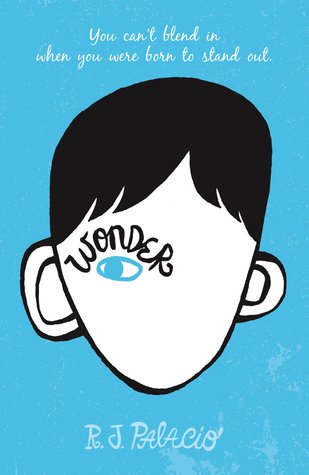
Wonder

Wonder. R. J. Palacio. 2012. Random House. 320 pages.

First sentence: I know I'm not an ordinary ten-year-old kid. I mean, sure, I do ordinary things. I eat ice cream. I ride my bike. I play ball. I have an Xbox. Stuff like that makes me ordinary. I guess. And I feel ordinary. Inside. But I know ordinary kids don't make other ordinary kids run away screaming in playgrounds. I know ordinary kids don't get stared at wherever they go. If I found a magic lamp and I could have one wish, I would wish that I had a normal face that no one ever noticed at all. I would wish that I could walk down the street without people seeing me and then doing that look-away thing. Here's what I think: the only reason I'm not ordinary is that no one else sees me that way.

Premise/plot: Wonder has many narrators but one central focus: August Pullman. Auggie is a wonder-ful kid but is he ordinary or extraordinary? Does looking different from everyone else make you abnormal and less human?

The book opens with August about to begin fifth grade at a new school. He's been home-schooled previously. Both for practical--medical--reasons and for personal--more emotional--reasons. But. The time has come. He is as ready as he'll ever be to enter the 'real' world and face the best and worst of human nature.

Before the school year begins, he meets the middle school principal, Mr. Tushman, and three of his future classmates: Julian, Jack Will, and Charlotte. But Auggie's first friend isn't a "buddy" assigned from the principal. It is a girl named Summer who joins him at the lunch table that first difficult day of school.

Via, August's older sister, has her own terrible first day of school. She's lost her best friend, Miranda, to an edgy "popular" crowd. Both Via and Auggie struggle to find that just-right "belonging" place in the wild and crazy jungle of school. Her story, in a small way, goes to show that looking normal, being pretty, isn't a guarantee of a problem-free life.

In fact, if the book has a message, it is that every single person struggles and faces challenges.

My thoughts: It is surprising that I'm just now rereading Wonder considering how much I loved, loved, loved it. Looking back, I see I reviewed it one month after its release. (Perhaps that was the best time of all to read it. Before the hype. Before the movie. I'm speaking generally.)

I loved the story, the writing, the characterization, the happy ending. What I didn't quite love was the not-so-happy ending for the dog. Don't get attached.

Favorite quotes:
When given the choice between being right or being kind, choose kind. (48)
"Why do I have to be so ugly, Mommy?" I whispered.
"No, baby, you're not..."
"I know I am."
She kissed me all over my face. She kissed my eyes that came down too far. She kissed my cheeks that looked punched in. She kissed my tortoise mouth. She said soft words that I know were meant to help me, but words can't change my face. (60)
August is the Sun. Me and Mom and Dad are planets orbiting the Sun. The rest of our family and friends are asteroids and comets floating around the planets orbiting the Sun. The only celestial body that doesn't orbit August the Sun is Daisy the dog, and that's only because to her little doggy eyes, August's face doesn't look very different from any other human's face. (82)
"Dad, I loved that helmet! It meant a lot to me! I was bummed beyond belief when it got lost--don't you remember?"
"Of course, I remember, Auggie," he said softly. "Ohh, Auggie, don't be mad. I'm sorry. I just couldn't stand seeing you wear that thing on your head anymore, you know? I didn't think it was good for you." He was trying to look me in the eye, but I wouldn't look at him. "Come on, Auggie, please try to understand," he continued, putting his hand under my chin and tilting my face toward him. "You were wearing that helmet all the time. And the real, real, real, real truth is: I missed seeing your face, Auggie. I know you don't always love it, but you have to understand...I love it. I love this face of yours, Auggie, completely and passionately. And it kind of broke my heart that you were always covering it up." (291)

© 2018 Becky Laney of Becky's Book Reviews

Tuesday, September 19, 2017

Forget Me Not

Forget Me Not. Ellie Terry. 2017. 336 pages. [Source: Library]

First sentence: I open my dresser drawers, find them empty, empty, empty.

Premise/plot: Calliope June is the young heroine in Ellie Terry's Forget Me Not. This middle grade novel actually has two narrators. Calli's narrates in verse while Jinsong narrates in prose. Here's what you need to know about Calli: a) she HATES moving; b) she HATES having to introduce herself to her classmates; c) she struggles to make friends; d) she wishes her mom would grow up; e) she has Tourette syndrome. Here's what you need to know about Jinsong: a) he LOVES baseball b) he's popular; c) he like-likes Calli; d) he's afraid to be friends with her in public; e) he cares too much about what others think of him; f) he's self-aware enough to know he's being a big jerk and a coward.

My thoughts: I found this to be a quick, compelling read. I enjoyed the characterization. Readers really only get to know Jinsong and Calli, but, these two are well developed in my opinion. The relationship that tortured me the most was between Calli and her mom. I really wanted Calli's mom to grow up and get the help she needed. I hated that Calli's life was being turned upside down every few months because of her mom's love life. The ending leaves me worried. I think Calli has matured a great deal, but, her mom is still a big, big mess.

Does this one "need" to be a verse novel? I'm not sure it does. The verse isn't spectacular poetry. Calli could have told her story in prose just as well. I am glad Calli's story got told. I like her as a narrator. And being in verse does make it go quicker because there are fewer words.

Do we "need" Jinsong's narration? I'm not sure we do. But I am conflicted on this. His narrative does allow readers to see Calli from a different perspective, an outside perspective. We see most of the bullying from his perspective. He's a mostly silent bystander. He does some much-needed growing up in this one.

© 2017 Becky Laney of Becky's Book Reviews

Sunday, July 02, 2017

Extremely Cute Animals Operating Heavy Machinery

Extremely Cute Animals Operating Heavy Machinery. David Gordon. 2016. 48 pages. [Source: Library]

First sentence: One beautiful summer day, Karen, an extremely cute animal, was the playground, making a sand castle....Skyler appeared out of nowhere.

Premise/plot: This picture book is about playground bullies. Karen and her extremely cute friends are bullied--repeatedly--by Skyler, Mike, and Trent. Karen and her friends--mainly girls, I believe, though it's hard to tell--never give up, never surrender. As the bullying progresses, they get MAD. And when they get mad, they prepare to operate HEAVY machinery. They ultimately end up building an amusement park on the playground--instead of a sandcastle in the sandbox.

My thoughts: I picked it up because of the title. I suppose that books about bullying are needed. And I suppose that books about bullies can be entertaining at the same time. But I'm not sure this one is. I didn't like the language in this one (stupid, butts); the message is appropriate, but, the language while realistic perhaps might be deemed inappropriate by some families and even some classrooms. (I know there are words that you are not allowed to say at school.) Overall, I was disappointed with this one.

Text: 2 out of 5
Illustrations: 2 out of 5
Total: 4 out of 10

© 2017 Becky Laney of Becky's Book Reviews
Friday, September 02, 2016

Wolf Hollow

Wolf Hollow. Lauren Wolk. 2016. 304 pages. [Source: Library]

First sentence: The year I turned twelve, I learned how to lie.

Premise/plot: Annabelle, the heroine, faces her hardest struggle yet in the year 1943 when a new girl at school, Betty, begins to bully her. Annabelle is reluctant to tell her parents--or her teacher--what is going on. Afraid that Betty won't stop bullying her and will start to bully her brothers as well. But one adult, a near-homeless war veteran named Toby, witnesses Betty in action. When one of Betty's pranks goes too far, Annabelle's world is turned upside down. Life will never be the same, could never be the same.

My thoughts: Wolf Hollow might suit other readers better than it suits me. The depiction of Annabelle's aunt, Lily, bothered me. "A tall, thin, ugly woman who might have been handsome as a man, Aunt Lily spent her days working as a postmistress and her nights praying and reading from her Bible...her big, square teeth and her feverish devotion to God frightened me." In every single scene with Lily, she's presented as a villain. And at least in Annabelle's eyes, part of the villainy, part of the "getting it wrong, being in the wrong" is connected with her aunt's Christian faith. If Lily was more than a one-dimensional character, if she was perhaps a complex creature with strengths and weaknesses, then perhaps I could forgive much. I don't mind characters with weaknesses. I really don't. In fact, give me a HUMAN character each and every time. But don't give me someone who is 100% wrong because she's 100% devoted to Christ and call it characterization.

That being said, Annabelle is a solid narrator. I really enjoyed getting to know her. She is a young girl in a difficult position forced to remain in a difficult position. There is plenty of drama and action and conflict in this one. I would say the drama almost overpowers the characterization, however. In particular, Betty and Andy were lacking in character development which is a pity. What motivates a person to act a certain way? What is going on in his or her life behind the scenes? I could think of half a dozen more WHY questions. And perhaps it's asking too much for an author to get inside the head of a bully or two. But I've read other novels--even for this audience--that go there better. I didn't "need" a redemption story where Annabelle and Betty become best friends over the course of a school year, and, all this misunderstanding is swept aside as both girls experience forgiveness and new beginnings. So I wasn't disappointed exactly with the turn of this story.

There are definitely things I like about Wolf Hollow--just not everything.

© 2016 Becky Laney of Becky's Book Reviews
Thursday, July 09, 2015

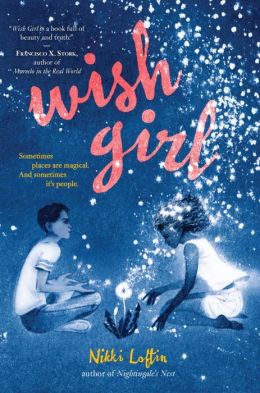
Wish Girl (2015)

Wish Girl. Nikki Loftin. 2015. Penguin. 256 pages. [Source: Library]
 The summer before I turned thirteen, I held so still it almost killed me.
Did I enjoy reading Nikki Loftin's Wish Girl? Yes, very much. It does have its melancholic moments: Peter is a troubled boy--the victim of bullying--and he becomes close friends with a girl dying of cancer. But overall, the focus is on the magical properties of friendship, art, and nature.

Peter and his family have recently moved to Texas. The dad is out of a job, and, his parents are fighting A LOT. But part of the tension in the family comes from everyone worrying about Peter. Why they are so worried about him remains a mystery for much of the book, though adults may guess early on.

It's true enough that Peter is troubled. But for Peter it was never just the fact that he was physically bullied in the past--and the present. It was the fact that he felt he was never heard, never understood, never appreciated for being who he is, accepted as is. It's this feeling out of place--even at home--that leads him into depression and despair.

So Peter may not be thrilled about every aspect of the move, but, he discovers a special place, a valley, I believe, that changes EVERYTHING in his mindset. It is in this place that he meets the wish girl for the very first time. And being a bit clueless, he doesn't catch on that she's got cancer and is in fact dying. But eventually, these two strangers become very close friends... and in that process he learns more about himself, how to be true to himself.

 I liked this one.

© 2015 Becky Laney of Becky's Book Reviews
Thursday, January 15, 2015

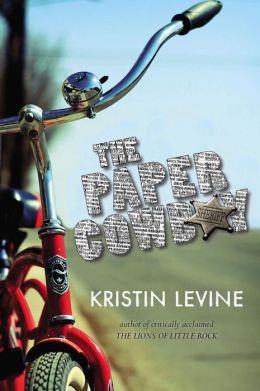
The Paper Cowboy (2014)

The Paper Cowboy. Kristin Levine. 2014. Penguin. 352 pages. [Source: Library]

"Hands up!"
My best friend, Eddie Sullivan, had a newspaper rolled and pointed at me like a gun. He was only twelve, but over the summer he'd grown so much, he looked big enough to be in high school. 

I've yet to be disappointed by Kristin Levine's fiction. I loved, loved, loved The Best Bad Luck I Ever Had. I loved, loved, loved The Lions of Little Rock. I still would love to find time to reread both books. Her newest book is The Paper Cowboy. The author's note reveals much: The Best Bad Luck I Ever Had is loosely based on her maternal grandfather's memoirs; The Lions of Little Rock was inspired by her mother's childhood in Arkansas. This newest book? Well, it is based on/influenced by her father's childhood. It is set during the McCarthy era, when the threat of communist spies was very strong no matter how big or small the community.

I'm tempted to keep it brief: READ THIS. But would that do it justice? Probably not. But I don't want to give away too much either.

I love The Paper Cowboy for its humanity. It almost aches with its humanity. There's not one perfect, flawless character within. Tommy, the protagonist, is far from perfect. In fact, he's a bit of a bully. But it's almost impossible to keep standing in judgment of Tommy once you get a glimpse of his home life. Time and time again, readers see a powerless Tommy in heartbreaking situations.

I love The Paper Cowboy for its look at family life. Every member of the family is fully developed. (Well, perhaps with the exception of the baby. Tommy's youngest sister is just three months old when the novel opens!!!) But one really gets relationships in this book. Tommy in relationship with his dad, with his mom, with his older sister, with his younger sisters. And the relationships--no matter if they're "good" or "healthy" or not-so-much, the relationships feel completely authentic. The sibling Tommy is closest to is his sister, Mary Lou, who is badly burned--an accident--near the start of the novel.

I love The Paper Cowboy for its sense of community. I loved getting to know folks in his community. Particularly, I loved his developing relationships with several adults within the community: Mr. McKenzie and Mrs Glazov, Mrs. Scully and Pa and Ma Konecky. I just came to CARE for all the characters, no matter how 'minor.' For example, Mrs. Glazov never felt 'minor' to me at all! I just LOVED, LOVED, LOVED her.

I love The Paper Cowboy for its look at friendship and school life and even bullying. I didn't "love" the book because of its examination or treatment on bullying. I wasn't seeking out a book on bullying. I certainly wasn't expecting a book on the subject of bullying told primarily from the bully's point of view. But sometimes a book just finds you, you don't have to seek it out. I do think it's interesting to consider Tommy as a whole person. Yes, at recess at his school, he can pick on his classmates and get away with it because he has a way with his teachers. But the reader sees deeper and sees beneath the surface. Yes, absolutely Tommy's actions are just WRONG. But when a character is fleshed out so completely, so thoroughly that compassion may just come easier than judgment. One friendship comes about so slowly that it deserves attention. I loved the character of Sam McKenzie. 

I love The Paper Cowboy because its one that makes you feel--sometimes so much it leaves you aching. It's an emotionally intense read. There are just some TOUGH moments to witness in this coming-of-age novel.

© 2015 Becky Laney of Becky's Book Reviews
Saturday, June 04, 2011

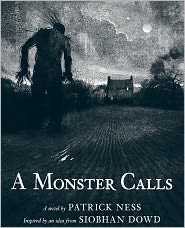
A Monster Calls (MG/YA)

A Monster Calls. Patrick Ness. Inspired by an idea from Siobhan Dowd. 2011. September 2011. Candlewick Press. 224 pages.

The monster showed up just after midnight. As they do.
Conor was awake when it came.
He'd had a nightmare. Well, not a nightmare. The nightmare.
The one he'd been having a lot lately. The one with the darkness and the wind and the screaming. The one with the hands slipping from his grasp, no matter how hard he tried to hold on. The one that always ended with--

There's a part of me that doesn't want to tell you anything at all about this book. The part that says that there is nothing I could say that would do it justice. The part that says this one is best discovered by readers in the moment. That knowing even the littlest things about it--the things the reader can conclude from the second or third chapter--would be knowing too much.

So I could simply tell you that it is beautiful and haunting and emotional and original. I could ask you just to trust me that it's worth a read. But would you believe me?

Conor, our hero, has been having nightmares. But it's the monster he meets shortly after midnight--on more than one occasion--that intrigues him the most. For it is this monster that he's brave enough to face. This monster that he's brave enough to speak with face to face. And if the monster is to believed, this is the monster that the boy called himself. This is the monster that both promises and threatens. He's got three stories--three tales--to share with the boy. But in return, he asks the boy to tell him a true story, his true story. And it is the threat of having to speak the truth out loud that causes Conor anxiety.

I could say more. I could mention the things going on in Conor's life--his daily life in his home and at school. But I really do think this is one you need to read for yourself, to experience for yourself.

© 2011 Becky Laney of Becky's Book Reviews

Sunday, January 31, 2010

Under the Dome


Under the Dome by Stephen King. 2009. [November 2009]. Simon & Schuster. 1088 pages.

From two thousand feet, where Claudette Sanders was taking a flying lesson, the town of Chester's Mill gleamed in the morning light like something freshly made and just set down.

How many books can you think of that make you thankful--really thankful--for fresh air, for oxygen?

Stephen King's Under the Dome is quite a book. At over a thousand pages, it has plenty of drama to offer readers. King's message that absolute power corrupts absolutely is well played out in its pages. As readers meet some really dirty, really corrupt, downright evil politicians.

The book begins by introducing us to Dale Barbara, one of the heroes--one of the good guys; he is on his way out of town. After having one too many confrontations with "Junior" the son of the most evil politician (who just happens to be a used car salesman too) in town, Barbie has decided he's had enough. It's time to move on. And quickly. But. He never makes it out of town. Something stops him. The dome. On the day the dome appears (October 21), life changes dramatically and drastically. The dome isolates this little town. No one can get in or out. In fact, nothing can get in or out. Not water. Not wind. Not rain. Not air. (Not much air at any rate.)

What's to keep the residents from panicking? Not much! Especially with Jim Rennie in charge. In fact, he thinks Dome Day is just about the best thing that ever happened to him. Suddenly, he's the guy in charge. There is no one to stop him. He can implement anything in the name of "doing good for the city" and who can challenge his authority? The fact that the President of the United States has chosen Dale Barbara to take command? Not gonna stop Big Jim! It's just one more reason why Barbie (or Baaarbie needs to be taken care of). And Barbie knows it. As do his friends.

How long can a community stay a community? How long before residents start turning on one another? How long before they become "us" and "them"? How long before the mob mentality takes over completely? Will any one be safe under the dome?

I imagine it has enough appeal for readers of horror and readers of science fiction. Is it for everyone? No. I don't think a book has to be for everyone. This one has plenty of horrific details. The language. The graphic nature of death and violence and sex and drug use. It's going to turn some readers off. Also this one could definitely be offensive to those who are religious. King's depiction of Christianity is abrasive, harsh. (No question about that!) What I wasn't expecting exactly in this very dark, very horrific book is the humor. (Though it was often a dark sense of humor.) Like this description of a trucker colliding with the Dome:

The trucker might have been overloaded and moving too fast, Barbie thought, but at least he was getting a Viking funeral. (41)
Or this one of an unlucky farmer:
On God Creek Road, Bob Roux had been digging potatoes. He came in for lunch (more commonly known as "dinnah" in those parts), sitting astride his old Deere tractor and listening to his brand new iPod, a gift from his wife on what would prove to be his final birthday. His house was only half a mile from the field he'd been digging, but unfortunately for him, the field was in Motton and the house was in Chester's Mill. He struck the barrier at fifteen miles an hour, while listening to James Blunt sing "You're Beautiful." He had the loosest of grips on the tractor's steering wheel, because he could see the road all the way to his house and there was nothing on it. So when his tractor came to a smash-halt, the potato-digger rising up behind and then crashing back down, Bob was flung forward over the engine block and directly into the Dome. His iPod exploded in the wide front pocket of his bib overalls, but he never felt it. He broke his neck and fractured his skull on the nothing he collided with and died in the dirt shortly thereafter, by one tall wheel of his tractor, which was still idling. Nothing, you know, runs like a Deere. (34)
Expect plenty of drama and devastation. But I found the book to be an engaging read.

© Becky Laney of Becky's Book Reviews
Monday, January 04, 2010

Food, Girls, And Other Things I Can't Have (YA)


Food, Girls, And Other Things I Can't Have. By Allen Zadoff. 2009 [September 2009] Egmont USA. 320 pages.

My name is Andrew Zansky. I'm fifteen years old, and I weigh 307 pounds.

What harm can a little lie do? What about a bunch of little lies? Can they change who you are? Make you unrecognizable even to yourself? Andrew, our narrator, never expected to be found out. About any of his little lies. Especially since some of these lies were ones he was telling himself, that he believed to be true. Who is Andrew? What is his story?

Andrew doesn't want to be "the fat boy" who is always getting picked on, teased, and bullied. He wants to be the one who gets the girl for a change. So when a fairy godmother* of a football player (O) takes him under his wing, under his protection, gets him a tryout for the football team, teaches him what he needs to know about girls, sports, parties, and how to be one of the team, well, life becomes a bit of a fairy tale for a while. Until Andrew starts asking himself some tough questions...

A good coming-of-age story is enjoyable. And while Food, Girls, and Other Things I Can't Have has more than its fair share of predictable moments and insights, it is still enjoyable. What is it about? It's about a boy wanting oh-so-much more than what he has. It's about a boy not knowing what he really wants or needs. And because that is true for so many of us--so many of us have felt confused and frustrated in our lives be it past or present--it makes him--his story--easy to relate to.

*Okay, so he's not really a fairy godmother type. He's the captain of the football team. The most popular guy in school. But he does in a way appear to Andrew to be the means of how he gets all his wishes, all his dreams.

© Becky Laney of Becky's Book Reviews
Tuesday, November 24, 2009

Bystander (MG)


Preller, James. 2009. Bystander. Feiwel and Friends. 226 pages.

The first time Eric Hayes ever saw him, David Hallenback was running, if you could call it that, running in a halting, choppy-stepped, stumpy-legged shamble, slowing down to look back over his shoulder, stumbling forward, pausing to catch his breath, then lurching forward again.

Bystander is a book about bullying. Eric, our narrator, fits strangely into his new school. New and slightly confused, he begins associating with the wrong crowd. Kids he knows to be bullies. Because--at least at first--he's not the target of the bullying, he accepts everything. There are a few instances here and there that make him squirm. But at the same time, it's easy to laugh along with the other kids, the other witnesses or bystanders. As long as the bullying isn't too much--then he's not willing to speak up about it. But there comes a time when it does get to be too much. When what he witnesses makes him so uncomfortable that he wakes up and gets a conscience. But now that he doesn't want to be all buddy-buddy with his former friends, will he become the next target? Will standing up for what he knows to be right lead to his own fall? And can he live with that if it is?

What's a boy to do when so many of the kids around him are bullies? True, not everyone bullies with kicks and punches, but there are so many different ways of bullying. Why does everyone have to be so mean in middle school?

This is more of a message-oriented novel.

© Becky Laney of Becky's Book Reviews

Friday, April 17, 2009

Jumped


Williams-Garcia, Rita. 2009. Jumped. HarperCollins. 168 pages

Zero Period. You got that right. Fail one math test and you're up before the first chirp of day. Up before street-lights turn off and sun rays shoot through the blinds. Fail one math test and you're stepping over a snow-covered homeless lump to get to the stop, shiver, and wait for the city bus to pull up to your boots. (1)

Wow. Rita Wialliams-Garcia not only had me at hello--hooked from the very first chapter--she kept amazing me time and time again. What a book this is!

Jumped is the story of three girls. Three teens who are so very different from one another. But who--on one fateful day--just happen to intersect.

Leticia. Trina. Dominique. One bully. One victim. One witness. (Note, I didn't say who was who!) The book is narrated by all three, they take turns revealing the events of one day in high school. And oh what a world of difference there is in the perspectives! It brings to mind so many questions. As each girl shares her perspective, the reader gets an inside glimpse into her life. A glimpse that reveals the inner struggles and emotional waves that each tries to hide from others--in a way.

This novel made me think, really think, and that's a good thing. I'd definitely recommend this book. It treats the subject of girl violence in a very compelling--always gripping--and authentic way.

© Becky Laney of Becky's Book Reviews
If you're reading this post on another site, or another feed, the content has been stolen

Tuesday, December 16, 2008

Swimming with the Sharks


fischer, Debbie Reed. 2008. Swimming with the Sharks.

The list is titled Top Ten Guys Who Are Still Virgins. Dorkowitz tops it off at number one, of course.

I didn't care for this one. I'll be honest. It's a book about mean girls--mean cheerleaders to be exact--who go to great lengths to torture the newest cheerleader, Ellika, and 'persuade' her into quitting. Why is she on the team to begin with? Her family is rich, they made a very large contribution to the school--to the gym I believe--and this was one of the stipulations: a place for their chunky/plus-size daughter on the varsity cheering squad. Our narrator, Peyton Grady, goes along with Operation Smellika--in fact she commits several of these cruelties personally--including smashing Ellika's glasses to pieces. It isn't until bones get broken and heads get concussed that Peyton sees the bigger picture and decides to break the pact. And even then it's a tough decision for her.

I suppose we're supposed to 'like' Peyton. This bystander who silently questions but still acts and goes along with the others on the team. Peyton has a conscience, but she's choosing to not listen to what her instincts are telling her. Peyton is clueless about many things. Things that the reader won't be. It's easy to predict each twist and turn in this one. Only Peyton and Ellika seem not to see the truth that's right in front of their faces.

Ellika. I have a hard time in believing in Ellika as a character. Yes, I feel sorry for her--in a way--but I have a hard time believing she could be so stupid or naive. Ellika is used to being teased, used to being called names, so why she goes and seeks out the popular crowd is beyond me. She's a new student, and she wants to 'buy' her way into the 'in' crowd? She thinks it will work? That she'll suddenly become popular? become accepted? That she'll be like that girl in the movies--the ugly duckling who transforms herself into the most popular, beautiful girl in the school. The fact that she perseveres no matter how much abuse--physical, mental, emotional--is piled onto her by her teammates...that she doesn't quit the team, that she doesn't tell her parents, that she doesn't want to change schools, etc. That she honestly believes that she can outlast and outwit the cheerleaders. That if she endures the pain, the torment, the abuse, that by the end of the school year she'll have made it, made new friends, found a place to belong. Why would she want to "belong" in the first place? Why would she want these bullies to be her friends? Why does she seek out their acceptance knowing how cruel and mean and stupid they all are? I have a hard time believing that anyone could ever welcome that much abuse into their lives.

© Becky Laney of Becky's Book Reviews
Wednesday, November 19, 2008

Travel the World: Canada: Getting The Girl


Juby, Susan. 2008. Getting the Girl.

Getting The Girl is about as subtle as a skunk. That's not to say it stinks. It's just that the topic of this one--social hierarchies, school bullies, self-esteem--is in your face and a bit over the top. I'm not even saying that the book is unrealistic or unbelievable. I think kids--rather you want to call them tweens or teens--can be cruel. This cruelty can manifest itself in several ways--either the cool iciness of making people invisible OR in the more direct confrontational style--using words and physical actions. Or in this day and age--online bullying through social network sites and blogs. And I think situations like the ones in the book could exist in that extreme.

You don't want to get D-listed. Trust me. That's the fear of all teen girls attending Harewood Technical School. Sherman Mack is a boy-on-a-mission. A ninth grader who is out to save his crush from getting D-Listed by the Defilers. Once you're "D-Listed" or "Defiled" no one--no matter how cool or uncool will talk to you. You essentially vanish from the hierarchy altogether. Not even teachers want to acknowledge those unfortunate students.

Sherman Mack is a wanna-be detective. He's read a few detective stories--mainly borrowed from his good friend, Vanessa--and he's watched more than his fair share of cop shows like the three Law & Orders. When his crush, Dini, begins dating Lester, Sherman is more than flustered. He fears that she'll be D-Listed. Lester's previous girlfriend, Farrah, was D-Listed last year. Vanessa thinks it's a good idea--at least at the first--but she thinks his motivations are all wrong. He should be investigating this cruel caste system--identifying the nameless Defilers--for the sake of all girls, not just one in particular.

So he begins his investigation.

Sherman is more than a little dorky. More than a little awkward. Yet his quirky voice works most of the time. To be honest, I spent half the time thinking that the book was clever and funny in just the right amounts. But the other half thinking that it was just too much--too silly, too unrealistic. While I can admire much of the book, I felt that it was uneven in times. Sherman I loved. But his friends weren't as developed as they might have been. Particularly Rick. Something about him just felt flat to me. I did enjoy the secondary story line, however, Sherman's interest in cooking. At first, I felt it didn't quite belong. I couldn't quite see the connection, but the ending made it work for me and tied it all together.

Other reviews: Reading Rants, The Compulsive Reader,

© Becky Laney of Becky's Book Reviews

Wednesday, November 05, 2008

Mousetraps


Schmatz, Pat. 2008. Mousetraps.

Mousetraps is a busy little book. In a way it reminds me of Sweethearts by Sara Zarr. And it feels like a cousin once or twice removed from a Barry Lyga novel*. At the heart of this novel, is the story of an almost-friendship. Once upon a time (back in elementary school) there was a girl, Maxie, who was quite good friends with a boy, Roddy Nash. After a violent (bullying) incident in middle school (seventh grade, I think), Roddy moves away...only to resurface several years later in high school. He is now calling himself Rick. Maxie is shocked to see him in her chemistry class. Not happy. Not upset. Just shocked. You see in the last year (or two) when she'd known him she had begun to distance herself from him. His nerdiness was becoming more apparent--or perhaps, she just began caring that he was a bit different from the other kids.

Now that he's back, Maxie is trying to decide what their relationship--if any--should be. Just lab partners? Just friends? Just friends outside of school? Boyfriend and girlfriend?

As I said, this is a busy book. There are many different complicating layers to the basic plot. Her cousin, Sean, and his biracial jock boyfriend, Dexter, who is still in the closet. Her best friend, Tay, who is becoming more and more distant as she experiments with drugs. And there are the assumptions and burdens of memory. How traumatized was Roddy from all those years before? Is Rick gay? Is Rick in denial? Does Rick have an anger problem? Now that it's written out, it doesn't seem like those additional story lines would cloud up the text...but it just felt like this was too much of a "problem" novel.

I think the book tried to do too much in a way. (Especially towards the end.) Yes, life is complicated. Yes, people often have more than one problem to deal with at a time. But the characters and the plot seemed to only have dimensions because of the problems. Take away the problems, and what you're left with are very flat characters. The problems define the characters. That isn't true of everyone. There are a few that are multi-dimensional.

Another review of Moustraps: Amanda,
*I'm thinking of The Astonishing Adventures of Fanboy and Goth Girl.

© Becky Laney of Becky's Book Reviews

Friday, November 30, 2007

This Is What I Did


Ellis, Ann Dee. 2007. This Is What I Did.

Imagine if you had witnessed something horrific.
Imagine if it had happened to your friend.
And imagine if you hadn't done anything to help.


Logan is our young narrator. He is an outcast when our narrative opens--someone who's awkward and troubled. Troubled for two reasons--the way others treat him either through ignoring him or bullying him, and troubled by his past. One day, one night changed his life. One troubling event caused his parents to decide to move neighborhoods, change schools. This event is revealed slowly, piece by piece. Logan, our narrator, is used to lying, used to keeping secrets, used to being alone.

This is how the narrative opens:

Last week Bruce kicked me in the balls at Scouts and all his buddies were there laughing and I started crying. I was lying there crying.

But he doesn't feel comfortable, doesn't feel right, telling his parents--his dad--about the bullying, the abuse, the taunts. Afraid and ashamed he lets everything slide.

A year ago I was fine. That's when there was nothing wrong. A year ago, in seventh grade, I was fine. We were living on Mulholland with the hills and the lake and the freeway and the Minute Man Gas Stop and my best friend, Zyler, ate Twinkies and Coke and hated girls, except one.
I couldn't eat Twinkies or Coke because of Mom, but I hated girls too, except one.
At school we weren't so cool but we weren't so not cool.
Zyler and I would sit and talk about whatever we wanted: aerodynamics, space-time continuum, Cami Wakefield, fencing, the Denver Nuggets, Lamborghinis, and soggy Tater Tots for darts in the school lunchroom.
No one cared what we said and we didn't care what anyone else said.
(3)

Eighth grade isn't easy for Logan--that would be an understatement--but with the help of a quirky girl that loves palindromes and a counselor, Logan might just find a way to survive it all.

I liked this one. Logan was a great narrator. And you could really feel his pain--his angst. I disliked some of the adult characters--but then again, I think we were supposed to. I can't really get into it without spilling some of the secrets, but I liked it. I suppose it could be described as a "problem" novel since it dealt with some heavy issues, but I felt that it did so in a realistic and authentic way. It wasn't always pretty to watch the drama unfold, but ugly things happen in life.

http://www.anndeeellis.com/