Wednesday, May 20, 2026
38. Wombat Waiting
38. Wombat Waiting. Katherine Applegate. 2026. 336 pages. [Source: Library] [4 stars, animal fantasy, j fiction, wildfires, dogs, pets, animals]
First sentence: Yep,
her name is Wombat,
and nope,
she's not a wombat.
True, there's
a passing resemblance,
If you squint just right.
She's stout and sturdy,
stubby-legged,
with silly ears
that look like furry cookies,
but just for the record,
she is,
most definitely,
a dog.
Premise/plot: Wombat Waiting is a novel in verse starring a destiny dog, Wombat. Wombat and Henry are meant to be--a matter of destiny. But Henry is scared of dogs and Wombat is a stray. They live miles apart. Have never met. A wildfire starts. Wombat hears a voice, the voice of destiny, telling her to run towards the fire, to get closer and closer to where the fire is burning. Henry, meanwhile, is fleeing (with his two moms and some neighbors and their bunnies?) away from the fire. Life becomes not regular at all. But Wombat knows that she is running towards her destiny. But it may take a lot of WAITING, waiting, and more waiting before Henry knows that Wombat is his dog.
My thoughts: I like this one. I do. I have enjoyed many of Katherine Applegate's books. I don't love, love, love this one. But I do like it. I do think it has a few great quotes. (I'll share my favorite below).
Quotes:
How could she say
I will be more than a friend--
I will be your beating heart?
© 2026 Becky Laney of Becky's Book Reviews
Friday, February 13, 2026
20. All The Blues in the Sky
20. All the Blues in the Sky. Renee Watson. 2025. 208 pages. [Source: Library] [4 stars, Newbery, verse novel, grief, problem novel]
First sentence: I didn't know
best friends could die.
Premise/plot: After Sage's best friend, Angel, dies, Sage begins attending a grief counseling group with those her own age. She feels that some understand because the people they lost died suddenly, but she's angry that others in the group are included because the people they lost didn't die suddenly. Her logic is that losing someone through hospice isn't the same, couldn't ever be the same. Or losing a grandmother is one thing but losing a best friend another. She rolls her eyes when others share knowing that her pain is greater, better. That's her logic at any account. By the end of the novel--after Sage rages a bit--Sage will have an opportunity to rethink her logic when she learns that her great-aunt is dying.
My thoughts: All the Blues in the Sky was the Newbery this year. It is a verse novel. It was a quick read. It is an emotional read. It checks a lot of the boxes for award winners. It just does. But that doesn't always mean it's a great fit for kids. Not that there's anything objectionable or inappropriate. I just mean kid-appeal. The greater the number of tears shed the better the chances for adults to LOVE it and want to give it all the awards. I'm not sure kid logic works quite like that. THOUGH again if this one is read and loved by kids, that's great.
I personally didn't love Sage's logic. It felt slightly obnoxious. BUT it might be extremely authentic. I do wish that the book focused more on Sage's whole life--and not just her attendance of grief counseling. But again, it's never, never fair to review the book you want instead of the book that is.
Note: I'm not sure if this is a children's book or lower middle grade. But there is a boyfriend and kissing. Which I'm not sure many Newbery medals feature a romantic element.
© 2026 Becky Laney of Becky's Book Reviews
Tuesday, February 03, 2026
13. Eureka
13. Eureka. Victoria Chang. 2026. 272 pages. [Source: Library] [4 stars, YA Historical Fiction, MG Historical Fiction, verse novel]
First sentence: "Eat before you go out,"
says Ma Ma. "And be
back for Chinese school!"
Ma Ma says this to me
every single day.
I'm not allowed to go to a public school
in San Francisco
with the American kids.
Premise/plot: Eureka is historical fiction set in 1884/1885 California. When Mei Mei's parents feel their young daughter is in danger if she remains in San Francisco (in danger of being taken and sold), they send her--for her own good--to Eureka, California, little knowing that they are sending her to even greater danger. In just a few months, all the Chinese will be expelled--much violence--from Eureka. Mei Mei and her new friends will have to find their own way back to San Francisco in the hope of finding refuge.
My thoughts: I enjoy verse novels. I enjoy historical fiction. I definitely enjoyed this one. It was a quick read.
© 2026 Becky Laney of Becky's Book Reviews
Thursday, June 12, 2025
56. Home of the Brave
56. Home of the Brave. Katherine Applegate. 2007. 256 pages. [Source: Library] [mg fiction, mg realistic fiction, mg verse novel, 4 stars]
First sentence: When the flying boat
returns to earth at last,
I open my eyes
and gaze out the window.
What is all the white? I whisper.
Where is all the world?
Premise/plot: Kek is newly arrived in America after spending time in a refugee camp. He's been separated from his family. Some he knows are gone forever, but, he holds out home that his mother is alive somewhere and that someday the two will be reunited. He is staying with his aunt and older cousin. He's coming of age in a strange-to-him country unsure of his future and mourning his past. He takes comfort where he can. One of his great comforts is working on a farm part time and befriending the cow, Gol.
My thoughts: Home of the Brave is a verse novel, a coming of age novel, a refugee story. It was a quick read, a mostly compelling read. The narrative captures his awe, his confusion, his frustration, his aching heart. In some ways it's a heavy read. I'm not sure how realistic the ending is.
© 2025 Becky Laney of Becky's Book Reviews
Thursday, May 08, 2025
47. The Trouble with Heroes
47. The Trouble with Heroes. Kate Messner. 2025. 368 pages. [Source: Library] [4 stars, j fiction, coming of age, verse novel, mg fiction, poetry]
First sentence: If I were a better kid, this story would begin with my seventh-grade diploma. Instead it starts with this.
Premise/plot: Finn Connelly is in trouble. Over one summer he has the opportunity to set things right, mostly. He'll be making reparations for knocking over a gravestone in the cemetery. (An arrangement with the daughter of the woman's whose gravestone was knocked over, and I believe agreed upon by the court?). He'll be making up missed hours for PE. He'll be making up a poetry assignment--twenty poems on the subject of HEROES. Mission: climb all forty-six mountains in the Adirondack High Peaks. He'll have 'guides' for most of the climbs--men and women who have volunteered to help him out, men and women who love climbing mountains and/or have an interest in helping the kid out. (I could not tell if the coach was particularly interested in hiking so much as that he wanted to help Finn out.)
Finn is going to hike and climb....write....and grieve. His firefighter father has recently died and his father had PTSD from serving on 9/11.
My thoughts: It made sense for this to be a verse novel. Not all verse novels pass this 'makes sense' test. He is being forced to 'write poetry' and he discovers that it isn't the worst thing in the world. That the process of writing--of writing poems--can be personally helpful. It is very much a coming of age novel. It was good to watch him grow/change throughout the story. This one does offer a few twists and turns on the way. Perhaps I should have seen one of them coming....but I didn't.
This 'problem novel' is heavy at times but it also contains lighter moments. Finn loves baking for instance.
© 2025 Becky Laney of Becky's Book Reviews
Monday, December 02, 2024
98. Unsinkable Cayenne
98. Unsinkable Cayenne. Jessica Vitalis. 2024. [October 29] 304 pages. [Source: Library] [5 stars] [verse novel, historical fiction, realistic fiction, mg fiction, coming of age]
First sentence: I don't know what the owners
have against trees
but I wish they'd plant a few
between their squished sites.
Premise/plot: Cayenne has spent most of her life living in a van with her family. Her parents like the free-spirited, nomadic, no roots lifestyle). But life in the van is cramped with five people. (She has twin [younger] siblings.] But her father has recently taken a job in a small Montana town. Cayenne wants to a) fit in, b) fit in, c) fit in. She knows that this will take a LOT of hard work since she'll need to change everything about herself. It will take concealing her unusual past and her family's poverty. Will Cayenne make friends? make the right sort of friends? Can she fit in with the "normal" crowd?
This book is full of struggles, struggles, and more struggles. Yet it isn't without its bright moments of hope and joy.
It is set in the fall of 1985. The recent discovery of the wreck of the Titanic is a hot topic in her history class. Though perhaps it is the teacher who is most thrilled.
This verse novel is sprinkled with PLENTY of eighties details. However I am not convinced that all the eighties details fit in for the fall of 1985. I have no proof either way.
My thoughts: I really LOVED this one. Perhaps it didn't have to be written in verse. However, this coming of age novel has so much heart. I really loved spending time with these characters.
The ending IS not tied in bows. This is probably for the best.
© 2024 Becky Laney of Becky's Book Reviews
Tuesday, November 26, 2024
97. Lifeboat 5
Lifeboat 5. Susan Hood. 2024. 272 pages. [Source: Library] [4 stars, verse novel, historical novel, based on true events, world war II]
First sentence: It's not safe inside.
It's not safe outside.
I close my eyes
and try to turn off the noise
in my head.
Stop!
Premise/plot: Lifeboat 5 is a companion novel to Susan Hood's Lifeboat 12. (I believe). Bess Walder, our heroine, is one of many child refugees fleeing England for the safety of Canada during the Second World War. Joining her is her younger brother. But new friends are easily made on board the ship Benares. But while the promise of safety provides much hope, the ship has to arrive before all is well....
You can [easily] deduce from the title that all does not go well aboard the ship. It is war time, and, though the ship has many escorts, anything can happen during war time. Will Bess survive? How many will lose their lives in their pursuit of safety?
My thoughts: I am so glad this one was a verse novel. This one was an intense read, and the format helped keep the pages turning. I would definitely recommend to readers who enjoy survivor historical books. Or for those that seek out all things world war II.
© 2024 Becky Laney of Becky's Book Reviews
Sunday, April 14, 2024
41. One Big Open Sky
One Big Open Sky. Lesa Cline-Ransome. 2024. 304 pages. [Source: Library]
First sentence: On the ride back from church
every time Charly
trotted faster
or trotted out the way
of a too-big hole in the road
my head fell against
Daddy's soft Sunday shirt
blue as a clear sky
Momma was humming
the hymns to herself
in the back of the wagon
we just finished
singing out loud
in the pews
Riding next to Daddy
listening to Momma
I asked Daddy
What was your momma and daddy like?
and he pulled back
hard on the reins
enough to make Charly start
and lift his head
wondering what Daddy wanted
Charly knew there wasn't no need
for Daddy to be pulling
in the middle of his trotting
in the middle of the road
when he knew just where he was going
Daddy heard my asking
but didn't answer straitaway...
Premise/plot: Historical verse novel written for middle grade about the pioneer life--that essentially describes this one. Set circa 1879, this one follows a wagon train of black pioneers or homesteaders. All are heading west for a chance to improve upon their lives--a chance to own their own land and embrace more freedom, to break with their pasts. There are three points of view.
My thoughts: Verse novels can be hit or miss for me. I sometimes do enjoy verse novels, but sometimes I'm more why is this written in verse??? why wouldn't prose be a better fit???? Personally--and this is completely subjective--I think prose would have worked better for me.
Pioneer life was DIFFICULT. This book doesn't shy away from death, death, death, and more death.
I was slightly bothered by the lack of punctuation throughout the novel. I think you can tell that from the first sentence.
© 2024 Becky Laney of Becky's Book Reviews
Tuesday, January 02, 2024
2. Facing the Enemy
Facing the Enemy: How a Nazi Youth Camp in America Tested a Friendship. Barbara Krasner. 2023. [December] 359 pages. [Source: Library]
Genre(s): Historical fiction, MG fiction, World War II, Verse Novel, Dual Narrators
First sentence: It's late spring, almost summer, 1937.
Premise/plot: Facing the Enemy is set in America [in New Jersey] in the late 1930s and early 1940s. It has dual narrators: Benjy Puterman and Thomas Anspach. These two friends will spend years not being friends because of ideology. Thomas's parents want him [essentially] to attend a Nazi Youth Camp right in New Jersey. For years--YEARS--Benjy witnesses his former best-best-best friend from childhood transform into someone unrecognizable. The town the two live in has a large Jewish population, but right in their metaphorical "backyard" they are facing Nazis of their own. There is an author's note about the time period; there really was a Nazi Youth Camp in New Jersey that was eventually shut down early in the 1940s.
My thoughts: I wanted to like this one more than I actually liked it. I did learn something from reading this one. I knew that there were Nazi sympathizers in the United States, and those who were just against the war. I didn't know there were actual-actual Nazi Youth Camps training up young men to hate, indoctrinating them, etc.
This one presents a challenge having dual narrators. Readers spend half their time--at least--living in the headspace of Thomas Anspach. There's this squirmy space. Is it okay ever to empathize with his struggles? I think the answer is yes. But it takes work--a lot of work--to see beyond crisp clear lines of black and white, good and evil. Thomas is more complex than that. His home life is more complex than that. And it isn't that a bad home life equals free forgiveness for life no matter what. Thomas from page one isn't the same Thomas by the end of the book. That arc exists for a reason.
© 2024 Becky Laney of Becky's Book Reviews
Friday, October 13, 2023
173. All That Shines
All That Shines. Ellen Hagan. 2023. [September] 405 pages. [Source: Library] [Verse novel; YA verse novel; YA Realistic fiction; YA romance]
First sentence: "Mom, can I borrow your earrings?
The diamonds? I think they'd match,"
I say, twirling, my new dress
swinging just above my knees.
And throwing myself back onto her chaise.
Premise/plot: Chloe Brooks is RICH-rich. But her oh-so-fabulous life among the rich-and-wealthy is about to slip away--and it's a long, hard fall. Her and her mother watch "helplessly" as her father is arrested and charged with crimes. Her old life being forfeit and her friends mostly being brats, the two brainstorm to find a way to start over...together. Fortunately, her mother has a little of her own that was not shared property...and it's an apartment complex on "the wrong side of town." Can Chloe survive her social missteps long enough to find true love and new besties?
My thoughts: Most of the book is Chloe apologizing for saying the wrong thing in the wrong way to the wrong people and offending just about everybody just by existing. I get that this is supposed to be a feel-good young adult romance, but it has all the makings of a made for TV movie. In my opinion. That could be a good thing for some readers.
I didn't love this one. I found Chloe insufferable at times. Not because she WAS rich and now isn't. But because she's literally apologizing every other page for saying something "wrong" and "offensive." But what she is saying is what she actually is thinking. I also found it very sitcom-ish in that the resolution happens EXTREMELY quickly and without as much groundwork as would be necessary. In a movie with a montage scene to a great song, it would definitely work better.
© 2023 Becky Laney of Becky's Book Reviews
Wednesday, October 04, 2023
167. Something Like Home
Something Like Home. Andrea Beatriz Arango. 2023. 256 pages. [Source: Library] [verse novel; middle grade]
First sentence: The drive to Titi's house takes exactly eighteen minutes.
I know because my current Rubik's Cube solving time
is about two minutes,
and I solve my scratched-up, faded cube
a grand total of nine times.
Premise/plot: Something Like Home is a middle grade 'problem' novel written in verse. Laura Rodríguez Colón, our protagonist, is living with her aunt...temporarily...or not??? So much is up in the air since being separated from her parents. Life wasn't perfectly perfectly perfect living with her parents. But it was in some ways familiar chaos. Now there is SO much change and it's all happening so quickly. She's living in a new (to her) home with an aunt that is practically a stranger. She's going to a new school, has new teachers, new classmates. She has no idea what the future holds....enter a DOG, an adorable dog. Her situation doesn't necessarily change, but, her perspective starts to slowly but surely.
My thoughts: This isn't really an action-driven, big-things-happening novel. It is all about the main character's growth, her coming of age. There's also a dog, of course.
I liked this one. However I almost feel like I blinked and missed the ending. It could be ALL on me. Perhaps my brain tuned out the last dozen or so poems and I missed vital changes. But the last few poems seemed to come out of nowhere in terms of character growth. Again, this could be all me. I missed the AHA moment perhaps? I missed the moment where her and her aunt came together and decided to be besties.
© 2023 Becky Laney of Becky's Book Reviews
Monday, May 15, 2023
98. When Clouds Touch Us
When Clouds Touch Us. Thanhhà Lại. 2023. [May] 256 pages. [Library]
First sentence: First refugee year
I didn't know to ask
for a day-of-birth party.
Last year Mother reminded us
all Vietnamese gain an age
together at Tet.
Our flip of the lunar calendar
was celebrated back home
as if combining Christmas,
western New Year's,
Thanksgiving, July 4th,
plus millions of days of birth.
This year,
Pam and I, April babies,
will invite twenty friends
to a rolling-shoe party
like Amy's last autumn.
I vow fewer
purple quail eggs
on my swollen knees
while Pam plots around
her religion's no-music rule.
Pam insists on April 10th,
my day, not hers,
to mark my first party.
So like her.
We were each
a maple seed,
spinning unclaimed
until we rooted
as best friends.
Premise/plot: When Clouds Touch Us is the sequel to Inside Out and Back Again (2011), a Newbery Honor book. Hà, our heroine, is settling into Alabama and loving life (mostly) with her best friend. But all is upended when her mother decides to move the family to Texas for better employment opportunities. Hà is crushed. Making friends--or a friend--and settling down in school wasn't easy in Alabama a year (or so) ago, and she fears that Texas will prove equally difficult. This verse novel follows Hà and her family for about a year--give or take a month.
My thoughts: Is it easier to move from Alabama to Texas than to move across the world from Vietnam to the United States? Maybe. Maybe not. Both books are coming of age novels written in verse. Both capture the uncertainty of her life and complexity of emotions. Both books are set in the 1970s. I have not read the first book since 2012 when I initially reviewed it. I am relying on my review of the first book to help me out here. I have, of course, just read the second book.
I wish I'd taken the time to reread the first book. (But I didn't). I liked the second book. I don't know that I loved it. I think the potential for love might have been there if I'd read the books back to back. If I was more invested in this family and their story.
© 2023 Becky Laney of Becky's Book Reviews
Thursday, February 09, 2023
30. Iveliz Explains It All
Iveliz Explains It All. Andrea Beatriz Arango. 2022 [September] 272 pages. [Source: Library]
First sentence: Why is it that principals
love giving second chances?
Love reminding me they were kids too?
Love acting like they're doing me a favor,
doing my mom a favor,
by sitting me down all serious
and asking what they can do?
Well, guess what.
This is seventh grade now,
And I don't need anyone's help but my own.
I've moved on from everything
that happened,
I've made lists and I've made goals,
and if I"m in the principal's office,
you can 100% bet
that it wasn't my fault.
Premise/plot: Iveliz Explains It All is a verse novel that is a Newbery Honor book. Iveliz is writing poems in her diary/journal. (As well as writing lists of goals in her diary). This coming of age novel unfolds a bit like a mystery. Readers aren't quite sure why Iveliz is always [or nearly always] getting in trouble at school, why she always has in-school suspension or actual suspension, why she struggles to keep friends or to make friends in the first place. Readers may not have the answers to these questions by the end of the novel, but, perhaps they will have walked in her shoes and gotten the chance to understand/empathize.
This verse novel is a "problem" novel. Iveliz, our heroine, is struggling with life in many ways. At home, she struggles to get along with her mother and her grandmother. Her issues with her mother are complex, for sure. Her issues with her grandmother are simpler. She has dementia and stays a bit out of touch with reality. But when she is "with it" if you will, she strongly disagrees with the decision that Iveliz is taking medication for her mental health. At school, she struggles with getting along with anyone/everyone. Even her friend(s) have a hard time dealing with her impulsive [sometimes violent] reactions.
My thoughts: I'm debating my thoughts and reactions. On the one hand, part of me is curious. What is her diagnosis? What exactly is going on with Iveliz? How strongly is it connected with the trauma that is revealed so incredibly slowly? On the other hand, is it really any of our business? Do we really have to know the specifics in order to be kind and compassionate and empathetic? We are not "owed" an explanation.
Is this one that will appeal to children? actual children? I'm curious--super curious. So often the books that do win Newbery awards or recognized as honor books don't necessarily appeal to actual children. [They appeal to adults--to teachers, to librarians, to parents.] They often feel "Significant" or "Important." I do think that at the very, very least this one would be a good fit for adults who work with children--teachers, librarians, principals, etc. I think it is a thought-provoking read in that regard. No person can know everything going on in the private, personal lives of their students. This gives a good, long pause. A reminder that so much can be going on underneath the surface.
Just because I feel adults might be a better fit doesn't mean that I think this one is inappropriate or out of place for younger readers. It's just a slightly heavy novel.
© 2023 Becky Laney of Becky's Book Reviews
Tuesday, November 08, 2022
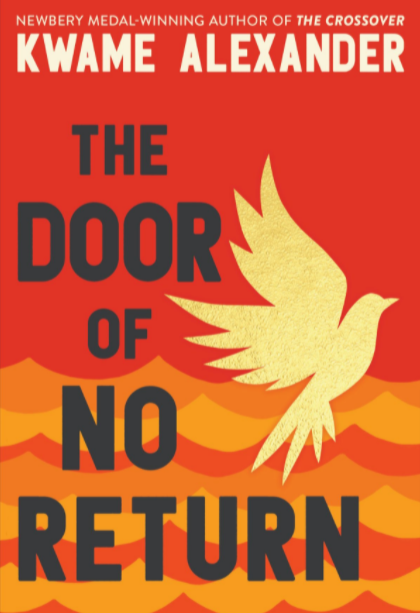
146. The Door of No Return
The Door of No Return. Kwame Alexander. 2022. 432 pages. [Source: Library]
First sentence: There was even a time...many seasons ago...when our people were the sole supplier of the purest and most valuable gold in the world...
Premise/plot: Set in the Asante Kingdom [modern day Ghana] circa 1860, The Door of No Return is a heart-crushing verse novel. Kofi Offin, our protagonist, is a boy--oh-so-close to being recognized as a man--whose world is about to be turned upside down. But before that--oh before that--readers are immersed completely in his world, in his village, in his family life. His family, his friends, his hopes and dreams. Everything is so fleshed-out; the world building is excellent; the characters are so fully human. If only the "before" had not been interrupted. But that is not his story.
My thoughts: Heart-crushing is how I'd describe this one. It was bittersweet. The sweet comes early on in the novel. It was easy to get swept up in the story, to fall in love with the characters, to get HOOKED. I was so engaged with the characters that when the dreaded-horrible-tragic event occurs, it felt heart-crushing. It would have been sad if it had happened in chapter one or two. But coming when it did, it had more impact. In my humble opinion, it had more impact. Again, it would have been sad and tragic if it had happened chapter one, page one. But oh-my-heart, the fall was so much greater having been built up.
I'm not sure how I feel about this one. Obviously, it is well-written. Obviously, it is engaging, compelling. Obviously it is bitter-sweet, or BITTER-sweet. Obviously, I will want to read more, more, more when the story continues. But, it was so incredibly sad, upsetting, disturbing. His story NEEDS to be heard--obviously. But my heart needs cheering up.
© 2022 Becky Laney of Becky's Book Reviews
Tuesday, September 13, 2022
112. Singing with Elephants
Singing with Elephants. Margarita Engle. 2022. [May] 224 pages. [Source: Library]
First sentence: Musical elephants are like
mountains with windy whispers,
the sea when it roars or chants a lullaby,
tree branches that clack like maracas,
and every animal that opens its mouth
to howl, bark, or chant
about the freedom
to walk, walk, walk,
rejoicing in the sheer joy
of touching
green earth
with rhythmic feet
and dancing
minds.
Premise/plots: Singing with Elephants is set in 1947 in Santa Barbara, California. Oriol, our heroine, is in absolute love with words. Inspired by a newcomer--a poet--Gabriela Mistral, she begins writing day and night, night and day. Little knowing--at least at first--that Gabriela Mistral is world-famous. Her other love is animals. Her parents are veterinarians. Oriol especially loves the new elephant--a PREGNANT elephant who is due to give birth soon....
But life is complicated, and this elephant family is threatened...it is up to Oriol--and other like-minded folks--to save the day.
My thought: ELEPHANTS IN PERIL. I don't know why I entered this novel without a care in the world little thinking that all wouldn't be happy-comfy-cozy. So I want to warn sensitive readers especially that this one will keep you tense. That isn't a bad thing necessarily. Just a thing.
It is a verse novel. It is a coming of age novel. It is well written. But just so very tense when it comes to the well being of these animals...
Quotes:
Poetry is like a planet, she says,
each word spins
orbits
twirls
and radiates
reflected
starlight.
---
Maybe
all I need
is a purpose
it's a word
filled with echoes
of other words
like courage
and hope
© 2022 Becky Laney of Becky's Book Reviews
Friday, August 05, 2022
94. African Town
African Town: Inspired by the True Story of the Last American Slave Ship. Irene Latham and Charles Waters. 2022. 448 pages. [Source: Library]
First sentence: Be still, my children. Listen with your ears
and your heart. Our story starts with this
mark on my right cheek, these chipped teeth.
See? This is how you know I am who I say I am.
De town where I was born is called Bante.
It's nowhere near here, not in African Town, not
in Alabama. This town's way across de ocean,
on de west coast of Africa in de kingdom
of Dahomey. My family's home was a round,
two-story adobe with a terrace. Surrounded by hills,
about eight days' walk to de sea. Someday maybe
you will see de world de way I have seen it
in Bante. Then you will know how de sun
kisses de earth, melts like honey over de land--
it's no wonder I believed all of life would be
bright and sweet. No wonder it still shocks me
that de world can be so hard, so dark.
But that darkness, it brought me here.
It brought you here. This is our story.
Premise/plot: African Town is a verse novel based on or inspired by a true story. Long after the importation of slaves was illegal--though not slavery itself--one ship, the Clotilda, was used to smuggle in a shipment of slaves. The year was 1860.
It is a verse novel that spans a little over four decades. It opens around 1859/1860 and closes around 1901. The poems alternate narrators...and in doing so alternates perspectives. Though by far the greatest representation are the men and women captured, enslaved, sold. Other narrators include white men in the slave trade, slave owners, and VERY VERY VERY oddly the ship Clotilda.
It isn't "just" the story of African slaves. It is the story of how these last slaves bonded and formed a community--literally and figuratively. This is the story of the formation of African Town or Africatown.
My thoughts: Powerful. Compelling. Important. These are the words I'd use to describe this verse novel. It is a heavy novel in its subject matter. The characters--[loosely] based on real people--are well developed. The characters were easy to care about. I got swept up into this one. I knew a little bit about the Clotilda from previous reading. But this was an absorbing read. I thought the verse novel format was a perfect fit for this one.
© 2022 Becky Laney of Becky's Book Reviews
Monday, June 27, 2022
78. Garvey in the Dark
Garvey in the Dark. Nikki Grimes. 2022. [October] 176 pages. [Source: Review copy]
First sentence: Different. The same... That's my answer if you ask how I am after the Invisible Beast broke into our house, and our world.
Premise/plot: Garvey (from Garvey's Choice) returns for a second book in Garvey in the Dark. Garvey's life has been looking up, up, and up. Things are good, really good. He's playing music; he's singing; he's got good, solid friends; he's beginning to have a strong, solid relationship with his father; he's comfortable in his own skin. But life is about to be turned upside down because of COVID-19. The book is set in the spring and summer of 2020. The poems process his experiences and emotions.
My thoughts: I wonder if this was a book that *needed* to be written. In other words, did Nikki Grimes need to write this book in order to help process the messy-messy-mess that was 2020? Between COVID-19 and the murder of George Floyd and the subsequent protests, 2020 was just...there aren't even words. There are ten billion memes but no words. Garvey, our protagonist, seems an authentic narrator who is trying day by day to survive 2020 and make sense of it all. He's got questions, doubts, worries, concerns. The poems are very straight-forward and honest. Like when his dad has COVID and he's standing outside his dad's bedroom door just listening to make sure he's still breathing. The pain is almost touchable, if that makes any sense at all.
It was not an easy read. I'm being fair, I think. I don't mean the poetry isn't wonderful. I don't. I mean reading these poems takes you right back in time and it's like you're living through 2020 a second time. Which has its pros and cons. On the one hand, I do think it's a time capsule of sorts. I also imagine that writing the poetry had its healing moments. A way to put into words your thoughts, emotions, etc. Also I think it could be a reminder that you can share your emotions and talk through your stuff. There's no reason that you *have* to keep it bottled up inside, hiding your pain and worries. Another point is that this will be an authentic way to share what it was like to future generations. On the other hand, it's like living through 2020 a second time. It took me RIGHT BACK.
© 2022 Becky Laney of Becky's Book Reviews
Thursday, June 23, 2022
77. Garvey's Choice
First sentence: When I was seven/ and crazy for Mr. Spock,/ a Star Trek lunch box/ was all I craved. Instead, Dad/ bought one blaring the logo/ of some football team/ I'd never heard of./ I shoved that thing in/ the coal black of my closet,/ then celebrated with cake.
Premise/plot: Garvey's Choice is a verse novel. (The verse is written in tanka.) Garvey is an overweight teen who'd much rather sing or read than play sports. There exists between father and son a gap that nothing seems to fill. At least at first. Garvey tries--unsuccessfully--to fill this gap with food. Garvey's dad may talk about sports--a lot--but I don't get the impression that he's actually cruel to his son. The two just aren't speaking the same love languages.
In the novel, Garvey makes several choices. Will he choose to try out
for chorus and risk rejection or humiliation? He ultimately decides that
he has nothing to lose and everything to gain. After all, he's already
being teased by his classmates; he's already hating lunch time. What he
finds out is that he's really talented at singing; and his singing not
only makes him happy in the process, but makes others happy too. That
and he makes a second friend. Another choice he makes regards his
weight. Will he try to lose weight? Should he try to lose weight? How
should he go about it? What can he change in his life to be healthier
and happier?
This aspect of the verse novel was a bit iffier for
me. I hated to see him get in the cycle of dieting in unhealthy ways,
ways that are doomed to fail. I was yelling DON'T DO IT. JUST DON'T.
My thoughts: I
think the verses are authentic in that many, many, many, many people
turn to food as a way to deal with emotions they don't know how to
handle any other way. It's not the best way perhaps, but it is the easy
way. I liked how singing took the place of food in some ways as a way to
cope with the ups and downs of life.
One of the songs mentioned throughout the book is "Dance with My Father." I encourage you to give it a listen if you pick this one up.
One of my favorite poems: "Summer Lost and Found"
Stories are breadcrumbs.And here's another: "Alien"
Just follow the trail of books
and you will find me
lost among the galaxies
of scorched stars and ships to Mars. (4)
Over breakfast, Dad
eyes me like an alien
never seen before.
Sometimes, I could swear that he's
hoping to make first contact. (17)
My new thoughts: I first read this one in February 2017. I reread it in June 2022 because a sequel is coming!!! I am so excited to get another book starring Garvey!!! The poems still resonate. SO much can be communicated in just a few lines.
© 2022 Becky Laney of Becky's Book Reviews
Monday, April 11, 2022
44. Alias Anna
Alias Anna: A True Story of Outwitting the Nazis. Susan Hood. 2022. 352 pages. [Source: Library]
First sentence: Dear Grandma (Z), Hi, how are you doing? I hope everything is going well for you right now. I am writing this letter for a school history project we are doing. The project is to find out as much as possible about our grandparents and what was going on when they were thirteen years old...
Premise/plot: Alias Anna is a historical novel for middle graders based on a true story. Inspired by her granddaughter's letter, a grandmother begins to share with granddaughter and son her life story. That is the framework of this one. This story is communicated with readers through verse. Readers learn of Zhanna (alias Anna) and her younger sister, Frina. The story begins in the days before the terror. Well, the majority of the terror. I'm not sure easy would be the best way to describe life in Communist Russia (Ukraine) for a Jewish family (or any family). But music fills their lives....and may just be the girls' salvation.
My thoughts: On the one hand, this is a solidly good story. The narrative is compelling. The book is packed with so much. It's dramatic without being melodramatic. The sisters' bond is touching. And the twist that it was ultimately her unwillingness to be separated from her sister that saved her life (and gave birth to future generations of family) is something. I can't regret for a minute meeting these characters and learning their stories. On the other hand, I'm not exactly sure why it has to be written in verse. The narrative isn't one that begs to be written in verse. Prose would have done just as well in my opinion. That being said, I would have been hooked either way.
© 2022 Becky Laney of Becky's Book Reviews
Friday, February 25, 2022
31. Rima's Rebellion
Rima's Rebellion: Courage In a Time of Tyranny. Margarita Engle. 2022. [February] 208 pages. [Source: Library]
First sentence: During the lull between protests
we ride bareback
no bridle
or bit
no spurs
just silent messages
sent to our horses
through the pressure
of hands
knees
feet
weight
seat.
Balance
is the magic
that helps us gallop
side by side
as we ride
in dazzling
formations...
Premise/plot: Rima's Rebellion is Margarita Engle's newest verse novel. All of her novels (or at least most of her novels) are set in Cuba in varying time periods. This verse novel spans 1923-1936. At the center of the book is our heroine, Rima, an illegitimate or "natural" born daughter. Women do not have rights--equal rights, voting rights, etc. Natural born children do not have rights--they are not recognized and are lacking some basic rights. Rima takes up both causes alongside other members of her family. She's twelve when the novel opens in 1923.
My thoughts: The novel is beautifully written. I will not deny that. Here are some of my favorite bits:
Rhythm
is the power
of hoofbeats.
Courage
is the essence
of triumph...
but bravery comes and goes, ebbs, then flows
like a tide on the shore of my turbulent childhood.
Fear is like a shadow, always present
but sometimes hidden.
Strength of character is just as powerful
as muscles.
Hope soars like a spirited horse,
crossing fences and streams.
Confidence flutters and flies far away,
then returns, just as loyal
as a homing pigeon.
My mare is my wing,
her hoofs the feathers
as she rises
sun-bound
cloud-fueled
soaring high
over fences
and streams....
When we leap
I escape.
The enemy I run away from
is my own thought-trapped self,
all these doubts born within me.
If only I could mount a horse of hope
day and night, airborne, free!
Even when I'm surrounded
by men and boys who expect me to fail,
I try to remember that I belong
to a sisterhood
of endless
determination.
But I didn't feel as strong a personal connection with the story or characters as I was hoping. I have read and loved, loved, loved, loved some of her works in the past. I wanted to be in love with this novel. I just wasn't. I don't know if it spanned too many years??? tried to do too much??? Or if the decades spent working for the cause were a little too same-same-same.
© 2022 Becky Laney of Becky's Book Reviews


