Showing posts with label grandparents. Show all posts

Saturday, July 08, 2023

129. Miss Irwin


Miss Irwin. Allen Say. 2023. [April] 32 pages. [Source: Library]

First sentence: On his way home, a boy stops by a small house. "Grandma!" he calls from the front steps. "Your door is open!" 

Premise/plot: Miss Irwin is a picture book for older readers. Andy is visiting his grandma. The problem? She doesn't remember him. At all. She thinks he's a student, a former student. Miss Irwin used to be a teacher (before she retired). Their visit is bittersweet, in my opinion, and extremely focused on one subject: birds. Still, Andy can't help loving his grandma.

My thoughts: Would I love this one more if it didn't feature birds so dominantly? Maybe. Probably. I love the idea of loving this book. I love seeing depictions of grandchildren and grandparents in fiction. I love books that focus on that relationship. Alzheimer's effects on relationships is depicted in this one. I think it will "hit a chord" so to speak with some readers--perhaps those that have experienced this in their own lives. This is actually one of several books I've read this year that deals with grandparents with Alzheimer's. (The others being middle grade novels.)

© 2023 Becky Laney of Becky's Book Reviews

Thursday, February 16, 2023

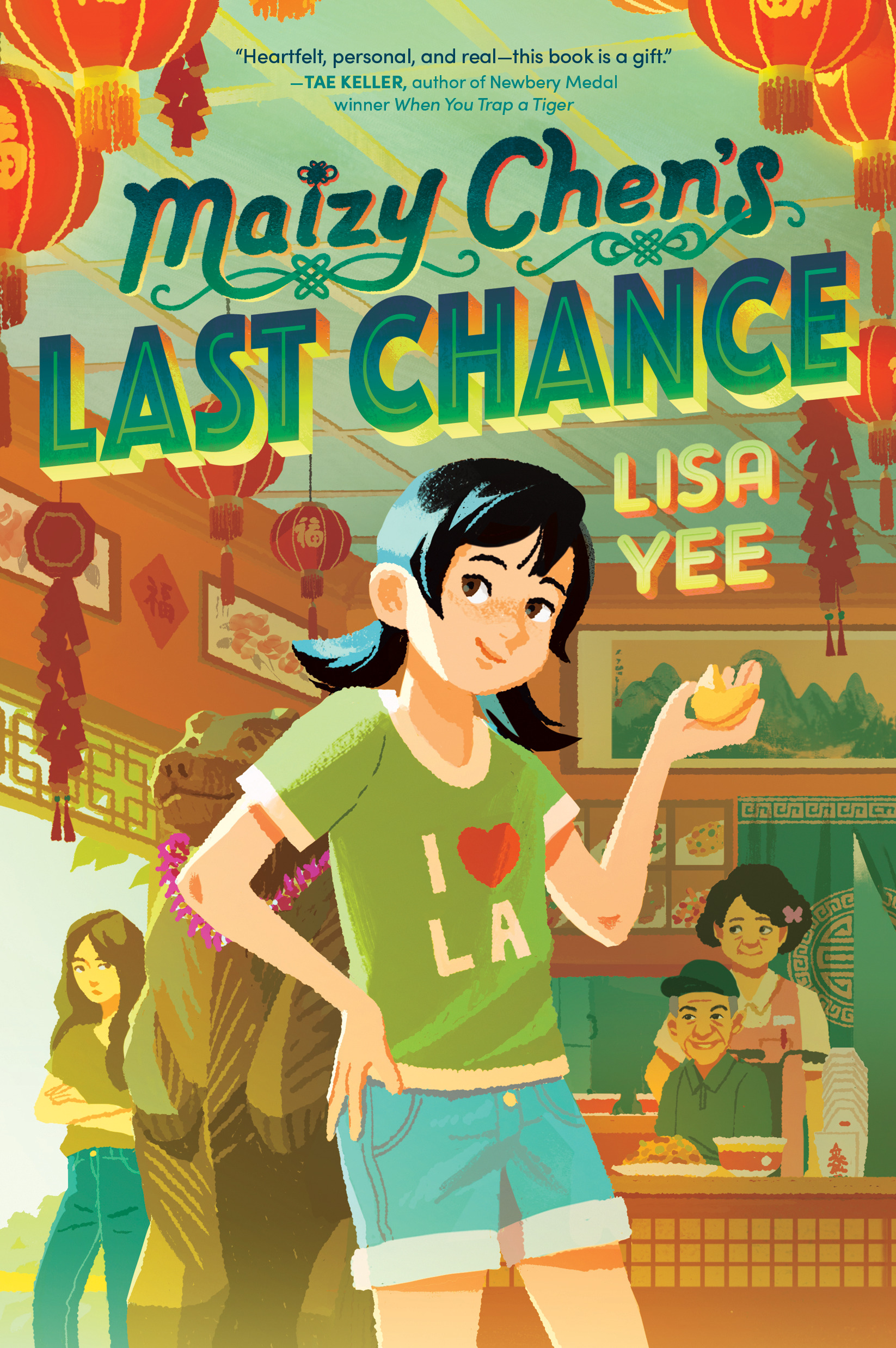
37. Maizy Chen's Last Chance


Maizy Chen's Last Chance. Lisa Yee. 2022. 276 pages. [Source: Library]

First sentence: The pies were fake, but my grandparents didn't know that. Not at first, anyway. My mother had invited them to watch her work on a Tasty Flaky Pie Crust commercial. 

Premise/plot: Maizy Chen and her mom go "home" to Last Chance, Minnesota, to visit her [maternal] grandparents, Opa and Oma. Opa [her grandfather] is in poor health. Though Oma isn't ready to say it out loud, he is dying. They've come to help out, mend fences, etc. This is the first time that Maizy is spending time with her grandparents. And she finds herself loving them and their "Lucky" stories. (Lucky is her second-great-grandfather, I believe. Her grandfather's grandfather.) He is the one who started Golden Palace in Last Chance. The restaurant has been in the family ever since.

Maizy Chen's Last Chance is a coming-of-age story focusing on family, friendship, and larger life lessons. For example, she's hearing about discrimination and prejudice in the Lucky stories of the past. AND ahe's learning first hand about discrimination and prejudice as she walks the streets in town. (Well, as she is encountering the townsfolk. Not everyone, of course, but there are a few rude people who are directly or indirectly hateful.) Race plays heavily in this NEWBERY honor book. 

My thoughts: I loved so many things about this one. I liked Maizy getting to know--really, truly know--her grandparents. Particularly she bonds with her Opa. I love their scenes together. I love all the family scenes really. Though she doesn't always understand all the complexity--the tension--of her family relationships. She also starts making a few friends. I enjoyed her writing the fortunes for the family restaurant. I loved her interest in researching the paper sons. 

There were times, however, I felt it was slightly info-dump-y. I loved so many things about this one. But there were places here and there where I wished it was a little less heavy. (Though the mystery in the middle was a plus.)

Overall, I liked this one.


© 2023 Becky Laney of Becky's Book Reviews

Thursday, February 09, 2023

30. Iveliz Explains It All


Iveliz Explains It All. Andrea Beatriz Arango. 2022 [September] 272 pages. [Source: Library]

First sentence: Why is it that principals
love giving second chances?
Love reminding me they were kids too?
Love acting like they're doing me a favor,
doing my mom a favor,
by sitting me down all serious
and asking what they can do?
Well, guess what.
This is seventh grade now,
And I don't need anyone's help but my own.
I've moved on from everything
that happened,
I've made lists and I've made goals,
and if I"m in the principal's office,
you can 100% bet
that it wasn't my fault.

Premise/plot: Iveliz Explains It All is a verse novel that is a Newbery Honor book. Iveliz is writing poems in her diary/journal. (As well as writing lists of goals in her diary). This coming of age novel unfolds a bit like a mystery. Readers aren't quite sure why Iveliz is always [or nearly always] getting in trouble at school, why she always has in-school suspension or actual suspension, why she struggles to keep friends or to make friends in the first place. Readers may not have the answers to these questions by the end of the novel, but, perhaps they will have walked in her shoes and gotten the chance to understand/empathize. 

This verse novel is a "problem" novel. Iveliz, our heroine, is struggling with life in many ways. At home, she struggles to get along with her mother and her grandmother. Her issues with her mother are complex, for sure. Her issues with her grandmother are simpler. She has dementia and stays a bit out of touch with reality. But when she is "with it" if you will, she strongly disagrees with the decision that Iveliz is taking medication for her mental health. At school, she struggles with getting along with anyone/everyone. Even her friend(s) have a hard time dealing with her impulsive [sometimes violent] reactions. 

My thoughts: I'm debating my thoughts and reactions. On the one hand, part of me is curious. What is her diagnosis? What exactly is going on with Iveliz? How strongly is it connected with the trauma that is revealed so incredibly slowly? On the other hand, is it really any of our business? Do we really have to know the specifics in order to be kind and compassionate and empathetic? We are not "owed" an explanation. 

Is this one that will appeal to children? actual children? I'm curious--super curious. So often the books that do win Newbery awards or recognized as honor books don't necessarily appeal to actual children. [They appeal to adults--to teachers, to librarians, to parents.] They often feel "Significant" or "Important." I do think that at the very, very least this one would be a good fit for adults who work with children--teachers, librarians, principals, etc. I think it is a thought-provoking read in that regard. No person can know everything going on in the private, personal lives of their students. This gives a good, long pause. A reminder that so much can be going on underneath the surface. 

Just because I feel adults might be a better fit doesn't mean that I think this one is inappropriate or out of place for younger readers. It's just a slightly heavy novel.


© 2023 Becky Laney of Becky's Book Reviews

Saturday, August 27, 2022

103. Cookies and Milk


Cookies and Milk. Shawn Amos. 2022. 320 pages. [Source: Library]

First sentence: Sometimes you gotta take a chance. This is it. My last moment to go out on top. Summer is one minute away. All eyes are on me. 

Premise/plot: Ellis Johnson doesn't necessarily want to stay with his dad over the summer. Especially since staying with his dad means investing long, hard hours into setting up a COOKIE shop. (Their store will sell chocolate chip cookies and only chocolate chip cookies.)  The year is 1976. The place is Sunset Boulevard in Hollywood. Ellis will grow over the summer (and he does want to be taller) in many ways...learning many things about family, life, and love. 

The book stars Ellis, his father, his grandmother, and his best friend....to name a few. 

My thoughts: I really ENJOYED this one. And not just because it's semi-autobiographical. Shawn Amos, the author, is the SON of THE ONE AND ONLY FAMOUS AMOS. I wouldn't say I lived on Famous Amos cookies in college, but, well, I mostly did. (Not really.) I loved the storytelling. I loved the 70s setting. (Though I am curious why he set it in 1976 if the store actually opened in 1975). I loved the GRANDMA. Seriously, her catchphrase of NOT TODAY SATAN was priceless. I liked Ellis' adventures and misadventures. Life was sticky/messy. But he kept trying even when it felt like a constant struggle. I loved the flow of the story--all the people brought together by cookies.


© 2022 Becky Laney of Becky's Book Reviews

Monday, December 20, 2021

149. Born Behind Bars


Born Behind Bars. Padma Venkatraman. 2021. [September] 272 pages. [Source: Review copy]

First sentence: Beyond the bars, framed by the high, square window, slides a small patch of sky. For months, it's been as gray as the faded paint flaking off the walls, but today it's blue and gold. Bright as a happy song. My thoughts, always eager to escape, shoot out and try to picture the whole sky--even the whole huge world. But my imagination has many missing pieces, like the jigsaw puzzle in the schoolroom. All I've learned here in nine years from my mother and my teachers is not enough to fill the gaps.

Premise/plot: Padma Venkatraman's newest middle grade novel opens in a prison (in Chennai, India). Kabir, our young hero, has spent his whole life--all nine years--in prison with his Amma (mom). He's friends with the other cellmates, his 'aunties,' and he loves, loves, loves his teacher. But though he's physically small for his age, he is past the age--technically speaking--of when he'd be allowed to stay with his mom in prison. So he's being released--without his mom--into the world. He's upset, anxious, and a tiny bit excited. What is the WORLD like? And where does he belong in it?

He looks at the world with WONDER and hope. He's heard stories, tales, even legends...but he's never lived "in the real world."

Born Behind the Bars mainly chronicles his time OUTSIDE bars. Readers join Kabir on his quest to find his paternal side of the family. (His mom was Hindu; his dad was Muslim). Can he find his dad? or his dad's family? Will he be welcomed into the family? Is there ANY way for him to 'save' his mom?

My thoughts: I would not want to read this story in the hands of any other author. But Venkatraman manages to tell this heavy story with hope and wonder. It's not that she scrubs out or erases the injustice and cruelty. It's that she's given Kabir the ability to see the world--in all its shades and colors--with hope. Yet at least to me Kabir does not come across as irritatingly naive like David Copperfield or Pinocchio.

I read this book in one sitting. I loved the short chapters. I breezed my way through this book with all the feels.


© 2021 Becky Laney of Becky's Book Reviews

Monday, September 27, 2021

125. Barefoot Dreams of Petra Luna


Barefoot Dreams of Petra Luna. Alda P. Dobbs. 2021. [September] 288 pages. [Source: Library]

First sentence: The smoking star lit the night sky as women wept, holding their babies close. Men kept quiet while the old and the weak prayed for mercy. It was on that night that all of us huddled under the giant crucifix, the night when everyone—everyone but me—awaited the end of the world. Everything was a sign to us mestizos, from eclipses to new moons to burned tamales in a pot. I learned early on that all signs were bad. When sparks flew out of a fire, it meant an unwelcome visitor would show up. A sneeze meant someone was talking bad about you. If a metate—a grinding stone—broke, it meant death to its owner or a family member. But the biggest sign of all was citlalin popoca, the smoking star. Papá’s big boss at the mine called it a comet.

Premise/plot: Barefoot Dreams of Petra Luna is set in Mexico in 1913. Petra Luna, our heroine, has made a promise to her father to keep the family together and safe. But some promises are hard to keep--no matter how big the heart. With the Revolution in progress, there is so much uncertainty from day to day to day. The family--Petra, her grandmother, her younger sister, her baby brother--is forced to flee their village with nothing but the clothes on their backs. Everything is gone; there is no assurance for tomorrow. Still, Petra dreams big dreams. She dreams of learning to read and write...of a better future. Most of all she dreams of the day when her father will find them again.

My thoughts: Absolutely beautiful and compelling. The writing is gorgeous. Truly a poetic work of art. I absolutely loved every bittersweet moment of this one. There's depth and substance. The characters are oh-so-human.

Quotes:

Promise. The word churned inside my head day and night. Six months ago, I had made the biggest promise ever when Papá was given the choice to join the Federales or be placed in front of a firing squad. On that day I had run across town looking for Papá, and when I found him, I knew he had chosen not to join. Papá stood against a wall blindfolded, his hands tied behind his back. He faced a line of soldiers with rifles aimed at him. All I heard next were my bare feet running across the line of fire toward Papá and my screams, begging to be shot along with him. I held on to Papá as two soldiers came to pull me away. I kicked with all my strength, and over my screams I heard Papá shouting for them to let me go, but the soldiers didn’t stop until Papá said he’d join their war. Before Papá was dragged away, I promised to take care of Amelia, Luisito, and our grandmother, Abuelita. He then swore to return.

The Federales were the army of the government, of our current president, Victoriano Huerta, whom Papá had called a tyrant. This was the second time they’d charged into our village. The first time, they’d shot men as old as sixty and boys as young as eight for not joining them. They’d dragged Papá away and had also shot one woman who’d protested against her sons’ forced conscription. They were monsters

I rushed into the burning hut, dropped to my hands and knees, and crawled across the long room. The smoke burned my eyes, and the flood of tears blinded me, but I pressed on. I felt my way around the floor, across the broken crates and pots, until my hand found it—my black rock. It was the only thing I had left from Papá.

I don’t want to grow any thorns,” said Amelia. “Thorns are ugly.”
“M’ija”—Abuelita wiped the corners of her mouth with her fingers—“your first breath was in the desert. The cord that connected you to your mamá was buried under a mesquite tree so that you’d always be part of this land. You already have thorns, and thorns are beautiful—they make you strong.” Abuelita spat out the chewed mesquite seeds. “Always be grateful for what you have. The day you take things for granted, your heart will swell with poison.”
Amelia looked down at her elbow and rubbed it. “You’re right, Abuelita. The other day I felt something prickly here, and I think—”
“Abuelita meant thorns in your heart, Amelia,” I said.
Abuelita nodded. “En tu corazón y en tu espírito.” She patted her chest, pointing to her heart and spirit inside her.

Are you scared, Petra?” Amelia whispered.
“Scared of what?”
“Of the Federales or of never seeing Papá again.”
“We’ll see Papá again,” I said. “And right now, I’m much too tired to worry about the Federales.”
“How about un apapácho?” said Amelia. “Are you too tired for that?”
Unlike me at her age, Amelia never asked for a story or a song before going to sleep. Instead, she’d ask for an apapácho. If I had to guess, I’d say apapácho was Amelia’s favorite word. It meant cuddling or embracing someone with your soul.
“Come here,” I said and stretched my arms around her. I squeezed her tight and used one hand to pat her back. And like Mamá, I ended the apapácho with a head rub and a kiss on the forehead.

I lay restless for most of the night. My feet, my back, and everything in between throbbed. I wanted to stretch out the pain, but my muscles cramped with every attempt. My mind stirred too. I thought about my promise to Papá and how it’d been a constant struggle to keep in Esperanzas. I was now in the middle of the desert with a little girl and a baby in tow and an old woman with rickety knees. How would I ever fulfill it? And my dreams of learning to read and write—those drew further away each day. By now they were as distant and unreachable as the stars above.

You’ve come to the right place,” said the priest. “You’ll be safe here.”
Abuelita kissed the priest’s hand. “Dios lo bendiga, Padre. God bless you.”
Suddenly, the sweet smell of pan pobre, poor bread, hit my nose. The scent awakened my stomach and tugged strongly at my heart. I looked around, sniffing the air, wondering where the smell came from. It was a scent that had always brought feelings of comfort and safety. I didn’t believe in signs, but if I did, I’d bet we were safe here.

I lay down and pulled out my black rock from the hem of my skirt. I brought it close to me. It was a piece of coal Papá had given me for my birthday two years ago. It was more than a black rock, though. It was a baby diamond.
“That’s how diamonds are born,” Papá had often explained. “When a piece of coal gets squeezed very hard for a very long time, it becomes a diamond.”

My name is Adeline. What’s yours?”
“Petra,” I said.
“My mamá says Spanish names always mean something. What does yours mean?”
“It means rock,” I said.
“Like the one you’re holding?”
I looked down at my black rock and put it back in its safe place.
“My name doesn’t mean anything,” said Adeline. “But my last name, Wilson, is the same as the American president’s. His name is Woodrow Wilson, but my papá says we’re not related.”
“Why didn’t you leave with your papá?”
“My papá worked at a silver mine,” said Adeline. “He was an engineer there, and when the bad guys came to his work, he had to leave fast before anyone saw him. Later, a man came to our house and gave us a letter from Papá telling us to leave and meet him in Texas. We took a coach and got here two days ago.”
“Do you have brothers and sisters?” I asked.
“No.” Adeline frowned. “It’s just me.”
Adeline continued to talk, and she talked a lot, but she also listened to everything I said. She shared her dreams of being an animal doctor, and I told her mine of learning to read and write. She told me stories she’d read about an orphan girl who lived with two evil sisters and another about a princess who’d been poisoned with an apple

Adeline handed me the slate before covering our legs with the ivory blanket. “My mamá told me that when good, hardworking people have dreams, it’s always nice to help make them come true.”
The slate had letters written on it already.
“What does this say?” I asked.
“That’s your name.”
I took a second look at the slate. The white, chalky letters looked strong and beautiful.

First, we’re going to learn to write your name,” said Adeline. “This is how you hold the chalk. Here, you try it.”
Adeline wrapped my finger around the white, blocky stick. My hand trembled as Adeline guided me to outline P-E-T-R-A across the slate. I sounded out each letter along with her as I traced it over and over. I struggled to hold the chalk straight at first, but by my fiftieth time, I was able to write my name all on my own, without tracing it.
“So?” Adeline asked as I erased my name. “What happens now?” Her tone was sad.
“I write my name all over again and keep practicing,” I said, steadying the chalk over the slate, pretending to have misunderstood Adeline. I was sure she meant what would happen after the church, but I didn’t want to think about it. Not right now. I wanted to keep chatting, to keep learning. I wanted to, for a moment, forget all my pain and anguish. My day with Adeline had been like a sweet siesta, and I refused to be awoken.
“No, I mean where will you go from here

After Adeline notated the champurrado recipe, she threw her arms around me. “Gracias, Petra.”
I didn’t tell Adeline, but recipes were also family secrets for us, and if Abuelita knew I’d just given two away, she’d probably have a patatús. I understood all about not sharing recipes, but after a long day with Adeline, she felt like a sister to me.
Suddenly, a tall, blond woman with striking blue eyes approached us.
“Petra,” said Adeline, standing up, “this is my mamá.”
I shot up and stood straight.
Adeline’s mamá smiled and brushed my hair back with her long, slender fingers. She said something in English, and I quickly turned to Adeline to learn what she’d said.

Abuelita pushed air through her nose. “Barefoot dreams,” she muttered and turned to her side, facing away from us.
“I’ll ask Adeline tomorrow,” I said to Amelia. “I’m sure she’ll say yes.”

I turned back to Abuelita. She had always scorned my talk of letters, teachers, or learning to read. Her words had never bothered me, but now that Mamá and Papá were gone, they stung.
“Why did you say ‘barefoot dreams’?” I asked.
Abuelita remained silent and still.
Amelia and I exchanged glances before she gently patted Abuelita’s back. “Abuelita, Petra wants to—”
Abuelita gave an exasperated sigh and turned to us.
“Wanting to learn to read is a big dream, and big dreams are dangerous,” said Abuelita. “You’ll do better when you accept things as they are, when you accept your lot in life.”
I closed my eyes for a moment. Those words—lot in life—always turned my insides; they made me feel sick.
“Petra, I know you mean well,” said Abuelita. Her tone had softened. “But dreams like yours are barefoot dreams. They’re like us barefoot peasants and indios—they’re not meant to go far. Be content with what you have.”
I thought back to my village, to Esperanzas. No one there knew how to read or write except for the well-to-do. That bothered me, but what angered me the most were people like Abuelita who simply accepted it.


Why hadn’t I been smarter? Why hadn’t I asked Adeline to teach me to write something more useful like train or station?
A heavy, invisible force pressed down on my shoulders. The force pushed through me, reaching my soul and sapping away my last shred of strength. I fell on my haunches and hung my head. I wanted to cry but had no tears. I wanted to scream but had no strength. Instead, I cracked open my mouth, and a small squeak escaped my lips. I’d been defeated. I would never fulfill my promise to Papá or shine like the diamond I longed to be. I’d remain a lump of coal for the rest of my life.

So, what now?” she asked. “Where do you go from here?”
“We’re going north, to el otro lado,” I said. “The other side.”
Marietta looked shocked. “The United States? Why?”
“It’s too dangerous here,” I said. “I was told we’d be safe across el Río Bravo.”
Marietta turned her gaze to the fire. She pressed her lips together and gave a subtle nod.
“Besides,” I said, “I want to learn to read and write, and there aren’t any schools here.”
“You know who Pancho Villa is?” asked Marietta.
I nodded. Papá had told me about him. Pancho Villa led the rebels in northern Mexico. Many folk songs called corridos were sung about him, his bravery, and his love for the poor. Even children’s riddles mentioned him. He was loved by many, feared by many, and was known to have a weak spot for children, especially poor ones.

Villa’s opening schools everywhere,” said Marietta. “He wants all kids to learn to read and write. Maybe you can go to one of his schools.”
I glanced over at Luisito, who slept on Abuelita’s lap, and then at Amelia, who yawned but still clapped. She swayed her bandaged feet from side to side. My family looked so peaceful and content, but how long would it last?
“How did you become a soldier?” I asked Marietta.
“It’s a long story,” she said.
I shrugged my shoulders, smiling.
“Where to start?” said Marietta. Her eyes locked on the campfire in front of us.
“It’d always been my papá and me,” she said. “My mother died giving birth, and I had no siblings. Since my papá never remarried, he focused solely on me and taught me everything he knew.” Marietta lifted her chin and her face lit up as she continued. “Papá was great. He was the best vaquero, cowboy, in the region. Everyone always brought horses for him to tame, and he trained them so well, you barely had to touch the reins to let the horse know what to do.”
Marietta sighed, and the glow in her eyes faded. “Almost three years ago, two Federales stopped at our home. I was preparing dinner when I heard a scuffle outside.

Marietta nodded. “After winning five battles as a captain, I unpinned my braids and let them loose. No one could believe it. But since I’d proven myself many times, they let me be. I went from Mario back to Marietta and still kept everyone’s respect.”
I was speechless. I wanted to be like Marietta. I wanted to learn things, to teach things. I wanted people’s respect.
“Why do you fight?” I asked. “To avenge your father’s death?”
“I did at first. I was outraged, but as time passed, I remembered talks I had with my father about the injustices in our lives. We both wanted a better Mexico. A Mexico that belonged to everyone, not just the rich, and especially not the foreigners.”
Marietta picked up a handful of desert dust and held it in a clenched fist in front of her. She released a thin, almost invisible trickle of sand through the bottom of her fist.

You probably won’t believe this,” said Marietta. “But a hundred years from now, Mexico will be unrecognizable. It’ll be such a rich, beautiful country that the gringos up north will be the ones crossing the river into Mexico for a better life.”
Marietta chuckled at her own words, and I smiled, hoping there was some truth to them. She remained quiet, staring at the campfire, then at me. “Petra, what do you want in life? Deep down inside your heart, what is it you want most?”
I looked up at the sky and thought about my answer. “I want peace,” I said. “I want peace for me and my family, and I want my papá back in our lives. I also want land, not much, just a small piece to live on. I want to go to school and for my sister and brother to go to school too.

Join us,” said Marietta.
“Join who, the rebels?”
Marietta nodded, “Yes. This army needs good, smart fighters like—”
“But I want peace,” I said, raising my voice. I quickly lowered my eyes, realizing I’d been disrespectful.
“I know.” Marietta nodded repeatedly. “Every soul in this camp wants peace. We’re all tired of fighting, but in order to achieve peace and attain the land and freedom we want, we need to fight.”

Someway, somehow, I hoped Papá could find us. I knew I would never see Esperanzas again, at least not the town I’d known since birth. Despite these harsh truths, I was hopeful to one day see Mexico flourish into a country full of peace and prosperity for the people who’d fought and given up so much for her. For now, I was eager to explore this new land, eager to meet its people and welcome new opportunities. Every struggle and challenge I’d grapple with and every failure and victory that lay ahead would dig deep into me and help chisel out my true character.
And I knew then, with all my heart, that one day I would burst with light and shine like the baby diamond I have always longed to be.

Author’s Note
The Inspiration for Barefoot Dreams of Petra Luna

I am blessed to have grown up listening to stories of my ancestors, especially stories of my grandmother, Güela Pepa, and my great-grandmother, Güelita Juanita. Both women grew up surrounded by harsh poverty and prejudice, but always faced adversity with bold spirits and resilience.
My great-grandmother, Juanita Martínez, inspired the core of Barefoot Dreams of Petra Luna. She, along with her family, escaped her burning village in 1913 during the Mexican Revolution. Unlike Petra, my great-grandmother was nine years old when she, her father, two younger siblings, and two cousins crossed the scorching desert by foot and reached the border town of Piedras Negras, Coahuila. At the border, their entry into the United States was denied along with hundreds of other refugees

I found an article that described my great-grandmother’s story. The event occurred in the early afternoon of October 6, 1913, and it wasn’t hundreds of people who’d tried to flee across like she’d stated, it was thousands. Over six thousand, to be exact. Everything else—the desperation, the pleading, and the rage of the Federales—was exactly as she’d recounted it.
Working on this book has fulfilled me in many ways, and despite my grandmother and great-grandmother no longer living, I feel closer to them than ever. Thanks to them and my mother, I learned stories that I would have never learned from books or school. Unfortunately, many stories like my great-grandmother’s or like Petra’s remain in the shadows. How do we fix this? I believe we fix it with curiosity. We need to be curious. We need to look to our ancestors and ask questions. We need to listen to their stories, write them down, on paper or on our hearts, and pass them on. By doing this, we bring stories of bravery, of humanity, and of great compassion to the light and, in turn, we learn more about ourselves and keep the bold spirits of our ancestors alive.


© 2021 Becky Laney of Becky's Book Reviews

Sunday, August 22, 2021

91. In the Wild Light


In the Wild Light. Jeff Zentner. 2021. [August] 432 pages. [Source: Library]

First sentence: The human eye can discern more shades of green than of any other color. My friend Delaney told me that. She said it’s an adaptation from when ancient humans lived in forests. Our eyes evolved that way as a survival mechanism to spot predators hiding in the vegetation. There are as many tinges of understanding as there are hues of green in a forest. Some things are easy to understand. There’s a natural logic, a clear cause and effect. Like how an engine works.

Premise/plot: Cash Pruitt is offered a once in a lifetime opportunity: a scholarship to an elite boarding school where his best, best friend, Delaney Doyle, is attending. But it will mean leaving everything--and everyone--he loves behind for a few years. It will mean moving from Tennessee to Connecticut. Just at a time when he wants to be with his Papaw the most. But...ONCE in a lifetime. And everyone is telling him that he'd be a complete fool to pass this up...

In the Wild Light is a coming of age novel that chronicle's Cash's (first) year away at school. It is a GROWING time but also a grieving time.

My thoughts: The characters are oh-so-human. It is an emotional roller coaster of a book. It's tough in some places because the emotions are so genuinely raw. I dare anyone--who's lost a grandparent--to not *feel* that chapter. Not that every page of this one is about punching you in the heart. The strength of this one is in the writing--the narrative--and the characters. BOTH are so well done.

Quotes:

She’s tried to explain how her mind functions, without success. How do you tell someone what salt tastes like? Sometimes you just know the things you know. It’s not her fault we don’t get it. People still treat her like she’s to blame.
Some aren’t okay with not understanding everything. But I’m not afraid of a world filled with mystery. It’s why I can be best friends with Delaney Doyle.

A ray catches a crack in the windshield and illuminates it, a tiny comet. I’ve always loved when the light finds the broken spots in the world and makes them beautiful.

“I got an offer to go to a boarding school up north.”
My heart plummets. With all the press she’s been getting, I knew this day would come.
I swallow, then nod for her to continue. “Oh wow.” The unease in my voice is obvious to my own ears even as the words leave my lips.
“Middleford Academy. In New Canaan, Connecticut.”
“Sounds fancy.” My head swims.
“It’s one of the top five prep schools in America. This lady from Alabama named Adriana Vu, who made hundreds of millions in biotech, went to Middleford. She donated a shitload of money to the school to fund this amazing lab and STEM program. She contacted me and said she’d talked to Middleford and she’d pay for me to go there.”

Ever since I first became aware that the world contains mysteries and incomprehensible wonders, I’ve tried to live as a witness to them. As we came to know each other, I began to see something in Delaney that I’d never seen in another person. I can’t name that thing. Maybe it has no name, the way fire has no shape. It was something ferocious and consuming, like fire.
And I wanted to be close to it, the way people want to stand near a fire.

Where’s my Tess at? No Longmire tonight?” Tess is short for Tesla, which is what he started calling Delaney after she told him that Nikola Tesla was her favorite scientist. Before that, he called her Einstein.
“Tending her half brothers.”
“Y’all are like to have ruint my Saturday night.

Life has given me little reason to feel large, but I see no need to make myself feel smaller.

“Death’s all around us. We live our whole lives in its shadow. It’ll do what it will. So we need to do what we will while we can.”
With that, our conversation dwindles.
I rock and feel on my face the caress of the cool evening air, scented by the damp green of broken vines and cut grass. Beside me, Mamaw and Papaw hold hands but don’t speak.
Above us is an immaculate chaos of white stars and drifting moonlit-silver clouds. I remember how I would sit under the sanctuary of the night sky, into the late hours, waiting for my mama to get home. Or to escape her dopesick moaning and thrashing. Or to avoid the red-rimmed, whiskey-fogged glare of a new boyfriend. Or because I needed to feel like there was something beautiful in this world that could never be taken from me.
Papaw coughs and coughs. Eventually, he collects himself.
I listen to his shallow, uneven respiration. Ask me to number the breaths I wish for you. One more. Ask me a thousand times. The answer will always be one more

I thought the predawn tranquility would help me find some peace. But the quiet is just another clamor in my head, calling me in every direction I can’t choose between.

This must be what it’s like to die. You look around you and see how much of what you love you leave behind.

Delaney nestles herself into my side and asks me, “If you could know everyone who’s ever loved you, would you want to know?”
I think about my answer for a few moments. Would I? Would it be better to know that someone you never thought loved you did love you? Or would it be worse to know that someone you always thought loved you didn’t?
It’s not a question you can answer, like so many she poses, and I go to tell her so. By the time I do, though, she’s sound asleep—soon twitching and jerking as her slumber deepens. Careful not to rouse her, I pull a hoodie out of my backpack and drape it over her. I sit with my ghostly reflection in the finger-smudged window for company, as the new and sprawling American countryside blurs past us in the darkness.

We try to put new students with other new students.” Yolanda scans a paper. “So…Cash. You’ll be rooming with Patrick McGrath III—he goes by Tripp. He’s from Phoenix, Arizona. His father was actually just elected to the US House of Representatives.”
My newly full stomach roils. Hope you’re a good guy, Tripp. Sounds like you’re a rich and powerful one.
“Now for you, Delaney.” Yolanda leafs through her papers. “Here we go. Viviani Xavier. I think I’m saying that right? The X is a sh sound. She comes to us from Rio de Janeiro, Brazil.”
“You better brush up on your Spanish,” I tell Delaney.
“They speak Portuguese in Brazil,” Delaney says. “It’s the language most spoken in South America.”
“Viviani speaks excellent English,” Yolanda says. “You’ll have no trouble communicating.”

“I think of poetry lovers as people who love beautiful things.” He stops to catch his breath. “You love the beauty in this world. Ain’t a reason I can think of you don’t belong in a poetry class.

I’d thought about how funny it would be if when you got to heaven, God could give you a printout with all of your life’s vital statistics. How much hair you produced. How many colds you defeated. How many times you skinned your knees. How many nightmares you endured. How many pancakes you ate.
Every brave thing you did.
Every heartbreak you overcame.
Everyone you mourned.
Everyone you ever loved.
Everyone who ever loved you.

Before I left, Papaw told me that if I’m ever hanging out with a group, I should be the one to suggest getting ice cream, because it’ll always be a good time and it’ll be my doing. So before it’s time to leave, I do exactly that, and he’s right.

But we don’t choose our dreams; they choose us. So instead I dream of doors sealed by death and wake up sweating in the mute darkness, my roommate sleeping in blissful oblivion a few feet away and a world apart.
Memory is a tether. Sometimes you get some slack in the line and you can play it out for a while. You forget and think you’re free. But you’ll always get to the end and realize it’s still there, binding you, reminding you of itself, reminding you that you belong to each other.

Poetry is one of the highest artistic achievements of humankind.
“I told you that there are many things that poetry won’t do. But there are many things poetry will do. Poetry makes arguments. It presents cases for better ways of living and seeing the world and those around us. It heals wounds. It opens our eyes to wonder and ugliness and beauty and brutality. Poetry can be the one light that lasts the night. The warmth that survives the winter. The harvest that survives the long drought. The love that survives death. The things poetry can do are far more important than the things it can’t.”

Life often won’t freely give you moments of joy. Sometimes you have to wrench them away and cup them in your hands, to protect them from the wind and rain. Art is a pair of cupped hands. Poetry is a pair of cupped hands.”

Poets use language in ways I’ve never considered, to describe things I thought defied description.
Dr. Adkins picked poets who write about the world. About rivers and fireflies and formations of geese and deer and rain and wind. Things I love.
By the time I’m done reading at least one poem out of each book (usually more), I’m experiencing a deep calm, like I feel after being on a river, under the sun, in the wind, feeling the spray off my paddle. For those brief moments strolling through the forest of words, everything had disappeared. Papaw wasn’t dying while I was far from him at a place where I didn’t belong, always on the precipice of disappointing him. I had stolen moments of joy from a hungry world that devours them and protected them for a while in cupped hands.
I sit with the feeling for as long as I can before it fades and loses definition, like a cloud formation.
Then I remember the second part of my assignment. To write a poem. This part makes me more apprehensive.

Vi gets to the end of her twig.
“You deserve to do what you love in life.” I pick up another twig and hand it to her.
She gives me a melancholy smile and accepts my offering. “I love my parents, but I think they don’t always know who I am very well.”
“There anything I can do?”
She snaps off a piece of the twig, reaches over, and gently sets it upright in my hair. “Let me grow apple trees on your head so every time we hang out I can have free apples.”
My entire body hums at her closeness and touch. The crackle I felt last night at the game is still present. I sit stone-still. “Anything you want.” I’ve never meant something more.

Sometimes you don’t even realize you are ravenous until you start eating. Dr. Adkins’s story has identified that feeling I get when I read and write poetry: satiety. I didn’t know to call it a hunger until now. I think about my mama. Maybe the Oxys and fentanyl were her attempted cure for a nagging craving she was never able to identify. All she knew was what killed it for a while.
While we talk, the room fills even more with the sumptuous smell of cooking. Alex’s kimchi fried rice adds to the aromatic symphony. We hear Desiree and Alex laughing and talking cheerily in the kitchen. Periodically, one will say something like Nice touch! or Never thought to do that!

Words make me feel strong. They make me feel powerful and alive.
They make me feel like I can open doors.

If only heartbreak were truly what it claims to be, it might not be so bad. But here’s the thing—your heart never gets broken quite enough to stop wanting who broke it.

When he recovers, he says, “Tell you what, Mickey Mouse. You find that right someone, and ever’ minute you spend with them is like a Hawaiian vacation. She’s out there. You’ll figure it out.”
He’s never been to Hawaii.
It feels like he’s bequeathing me an inheritance of the only wealth he possesses—his memories, his quiet joys.

Dignity dies as the body does.
He pulls off his oxygen mask, and it makes a rushing sound, like the advance of wind before a storm. “Tell you a story,” Papaw says in his pale whisper, barely audible above the noise of his mask, as he visibly summons himself from the gloaming. “You was just born. Your mama’s trailer weren’t fit for a baby, so we brought you both home from the hospital. Your mama slept in her old room. Your room.” He pauses to muster his strength and continues. “Your mamaw was wore out too. It was springtime, so I took you out on the porch and sat, just you and me, in the rocker. Had you wrapped up so tight you weren’t but a head poking out of a blanket.” He stops and gathers himself. “Watched you feel the breeze on your face for the first time. Watched you open your little gray eyes and squint out at the trees swaying in the wind. And I says to you, ‘That wind you feel on your face is called wind. Them trees you see are called trees.’ Holiest thing I ever witnessed—you feeling the wind for the first time. Seeing a tree for the first time. Speaking their names to you. Saw the face of God in you that day. Ever’ time you tell a story, it becomes a little more ordinary. So I swore I’d only tell this one the once.” He pauses once more, and with what remains of himself, says, “There was a last time I held you in my arms, and I didn’t even know it.”
He finishes, spent by this effort. He murmurs something else, but I can’t make it out. Something Mickey Mouse.
I wriggle closer to him and pull his arm over me. Let this be the last time you hold me in your arms.
I slip his oxygen mask back on him. He drifts off, and I hold his hand until it goes limp and heavy.
“I love you. I’ll always love you,” I whisper again and again to his unconscious ear, hoping he absorbs it somehow.
Hoping he takes it with him to whatever unmapped land he’s journeying to.
Hoping he returns.
If only once more.

I cried until I was empty—not of feeling but of tears.

I wish our love was enough to keep whole the people we love.

Some people can lift your heart up to the light, reading the truth of you written on it.
I was afraid that being a man meant waging war on what’s beautiful.
I wanted to love the world without taking anything from it.
He knew all this. This is what you remember of the people you love when they’re gone—the ways they knew you that no one else did—even you. In that way, their passing is a death of a piece of yourself.

I don’t know how I’ll do this. I barely managed when I was only cracked. Now I’m broken wide open.

We ordinarily encourage sharing of rooms, to teach students compromise and conflict resolution and to forge lifelong friendships. But you have certainly earned the right to a solo room.”
That sounds pretty great. “What’s the other option?”
“One of your fellow students, who currently resides in a single room, has come forward and asked to be placed as your roommate if you so choose. I believe you know him. Alex Pak. An exceptional young man, from what I gather.”
An ecstatic bloom spreads through me. “Yeah, I know Alex. He is pretty exceptional. Let’s go with that.”

I’ll tell you the truest thing I know: You are not a creature of grief. You are not a congregation of wounds. You are not the sum of your losses. Your skin is not your scars. Your life is yours, and it can be new and wondrous. Remember that.”
“Always.”
“Goodbye for now, Cash.”
“Goodbye for now, Dr. Adkins.”
“My friends call me Bree.”
“Bree?”
She looks at me.
“You said something at Thanksgiving I keep thinking about: that you didn’t inherit your mamaw’s gift for healing. But you did,” I say.

I remember first seeing her across the room at that Narateen meeting. Now we’re gazing at the lights of New York City together.
I wonder where I’d be at this moment, the smaller life I would have led if we’d never spoken.
You can feel when your mind’s building a palace for a memory. A place it lives, glowing and dancing in marble halls. A place you can visit when you need to feel less of the world’s gravity.
I feel my mind building such a palace for Delaney and me.
Sometimes I imagine the two of us at an all-night diner, drawing faces on pancakes with ketchup, drunk on each other, and laughing like nothing beautiful ever dies.
I’ll always love her.
Every wound, every hurt that brought us together—I regret none of it.

I once thought of memory as a tether. I still do, in a way. But now I also see memory as the roots from which you grow toward the sun.
The dreams of closed doors still come, but less now.
I sit with my notebook and pen in the wild light of the day’s end.
In the place where I learned the names of trees and wind, I write.


© 2021 Becky Laney of Becky's Book Reviews

Wednesday, July 21, 2021

65. Measuring Up


Measuring Up. Lily LaMotte. Illustrated by Ann Xu. 2020. [October 27] 208 pages. [Source: Library]

First sentence: My life in Taiwan is sweet.

Premise/plot: Cici, our heroine, is reluctant to move to Seattle with her family. She loves how things are in Taiwan. And she'll have to leave her grandmother behind. As she adjusts to life in a new country--new city, new school--she finds her own way to belong. But, of course, her missing her grandmother continues despite the making of new friends. Then Cici has an idea, what if she can win enough money in a cooking contest to buy her grandmother a plane ticket to come visit! (Her grandmother's birthday is coming up!)

But does Cici have what it takes to win BIG?

My thoughts: I definitely loved this graphic novel. I loved Cici's special relationship with her grandmother. I loved how the two bonded over cooking. I loved how they were able to stay in touch. I love how thoughtful, sweet, and sensitive Cici is. Readers see Cici at home, at school, at the library, and yes, at the cooking contest! I loved how the cooking contest is presented throughout the book.

One of my favorite things was how Cici was inspired by Julia Child. Watching her shows and reading her book(s), she walks away with the notion of conviction of courage. "I'm going to try and flip this over, which is a daring thing to do. When you flip anything, you really must have the courage of your convction...the only way to learn how to flip things is to just flip them" (122/123).

This coming of age novel was lovely. Loved the celebration of family, friendship, and new beginnings. Definitely recommended.


© 2021 Becky Laney of Becky's Book Reviews

Wednesday, November 13, 2019

World at War: White Bird

White Bird: A Wonder Story. R.J. Palacio. 2019. 224 pages. [Source: Library]

First sentence: Julian, no more video games. Do your homework. This IS my homework. I’m FaceTiming Grandmere for my humanities project.

Premise/plot: White Bird is a Wonder story told in graphic novel form. The framework of the story stars Julian, a character first introduced in Wonder. If you need a refresher, he was one of the main bullies tormenting Auggie Pullman. But the heart and soul of this one is Julian’s assignment. His grandmother, Sara, is sharing her war story, her life-changing experiences as a Jewish girl in hiding. When the Second World War begins, Sara and her family aren’t panicking yet. They live in Free France, not the Occupied Zone. But changes come one after another. Soon there are all sorts of restrictions, rules, and dangers. Jewish people have even begun to be rounded up. Sara didn’t exactly plan out a place to hide, or even to hide at all. But a series of events soon leave her just one choice to trust a “crippled” often bullied and teased boy with her life. His name is Julian.

My thoughts: I was unfamiliar with this story. Though apparently much of it is told in a previously published novella/short story. I absolutely loved the story. I loved the relationship between Sara and Julian—both Julians. It is a heartwarming, heartbreaking story of love, endurance, kindness, and hope.

I believe that Holocaust stories both nonfiction and fiction are important—even essential. Children need to be introduced to the Holocaust. We cannot afford as a society to forget.

This is a love, love, love for me.

I believe that all people have a light that shines inside of them. This light allows us to see into other people’s hearts, to see the beauty there. The love. The sadness. The humanity. Some people, though, have lost this light. They have darkness inside them, so that is all they see. In others: darkness. No beauty. No love. Why do they hate us? Because they cannot see our light. Nor can they extinguish it. As long as we shine our light, we win. That is why they hate us. Because they will never take our light from us.

You might forget many things in your life, but you never forget kindness. Like love, it stays with you forever.


© 2019 Becky Laney of Becky's Book Reviews

Wednesday, August 28, 2019

World at War: A Place to Belong

A Place to Belong. Cynthia Kadohata. Illustrated by Julia Kuo. 2019. 416 pages. [Source: Library]

First sentence: This was the secret thing Hanako felt about old people: she really didn’t understand them.

Premise/plot: Hanako and her brother Akira are traveling to Japan with their parents. It will be the first time they meet their grandparents. There will be many, many firsts both on the journey by ship, the train ride to Hiroshima, and life in a small country village. The year is 1946; Hanako’s family is one of hundreds that have renounced their American citizenship. (The parents have—not the children, at least in this case.) Hanako thought any life outside the camps (internment camps) would be an improvement. One thing the family has in abundance love and affection. There is a sweet, tender, compassionate side to all the relationships. The two children love, love, love their grandfather and grandmother. It is mutual. These two grandparents have been unconditionally loving them since they were born. But there are many, many hardships—namely lack of food. There isn’t enough food to feed six people. Even if everyone works every day all day. Hunger is ever present and it gnaws at the family’s hope. It is important for them all that the children hold onto hope. Is there a future for them all in Japan? Is Japan the place the family belongs? Or is America still home despite the way they were treated?

My thoughts: What a tender and compelling read! Hanako touched me and I believe she’ll touch you too. What I loved most about her was her heart. She is kind, generous, thoughtful, sensitive to others. She is the model of empathy. And not in a goody two shoes way. She sees how the war—particularly the dropping of the atomic bomb has devastated a community and impacted so many. She sees the pain and seeks to do something—anything, even if it’s just a small gesture.

I also loved the family as a whole. Unconditional love, sacrificial love, selfless love. There was just something lovely and tender yet bittersweet as well. I just wanted to hug all the characters.

The book is character-driven. It told a story that I was unfamiliar with and found fascinating. I had no idea that some families chose to leave America and “return” to Japan after the war. I had no idea that many later hired a lawyer to fight on their behalf to have their citizenships reinstated. Did the families truly choose or were they pressured to renounce? The book also gives readers a behind the scenes glimpse at life in Japan in the immediate aftermath of the war.

Highly recommended.
© 2019 Becky Laney of Becky's Book Reviews
Friday, July 26, 2019

The True History of Lyndie B. Hawkins

The True History of Lyndie B. Hawkins. Gail Shepherd. 2019. 304 pages. [Source: Library]

First sentence: There is such a thing as honorable lying.

Premise/plot: The True History of Lyndie B. Hawkins is set in a small town, Love's Forge, in Tennessee in 1985. Lyndie B. Hawkins, our heroine, is having a time of it. Her family has recently moved in with her grandparents (Lady and Grandpa Tad). Her home life is full of TENSION and STRESS. Her dad--a Vietnam war veteran--may think he's hiding his alcohol problem from the rest of the family and the whole community...but...few are fooled. Lyndie knows SOMETHING is wrong even if she doesn't have a label--or a solution--for it. Half the stress for Lyndie is knowing that she can't share the stress; she has to keep her family's secrets. No matter what questions her pastor, her teachers, her friends, her neighbors ask...she knows that she has to be ready with a lie that protects her family's honor and privacy. This is endangering the relationship with her best friend, Dawn, who comes from a somewhat nosy neighboring family. Lyndie trusts Dawn as much as she trusts anyone...but is that enough to go against her family?!

Dawn's family is one of the kindest in town. They are taking in a juvenile delinquent, D.B., for a year. He's been sentenced to Pure Visions until he's eighteen; but the place is the stuff of nightmares. Lyndie becomes chummy with D.B., and she wants to fix his problems even if she can't fix her own...

My thoughts: This was a tough read for personal reasons. That's mostly a good thing. I think it's a sign that the author has written characters that are all-too-human and placed them in realistic situations that feel true to life. I loved, loved, loved Lyndie's interest in history and genealogy. I could relate to both. In addition, Lyndie LOVES research and libraries. I ached for Lyndie in places. I'm glad that this one ends with a bit of hope that this family can be helped, that patterns can be changed.

© 2019 Becky Laney of Becky's Book Reviews

Friday, February 15, 2019

The Boxcar Children

The Boxcar Children. Gertrude Chandler Warner. 1942. 160 pages.

First sentence: One warm night four children stood in front of a bakery. No one knew them. No one knew where they had come from. The baker's wife saw them first, as they stood looking in at the window of her store. The little boy was looking at the cakes, the big boy was looking at the loaves of bread, and the two girls were looking at the cookies. 

Premise/plot: Four orphan children are on the run in Gertrude Chandler Warner's classic children's novel. The children are aware that they have a grandfather; they even know the town where he lives. But...the children fear this man they've never met. They'd rather struggle to survive than risk falling into his hands. (What if he's mean? cruel? what if he doesn't want them? what if he does? what if he separates them?) The four children--Henry, Jessie, Violet, and Benny--begin their new life living in an abandoned boxcar on an abandoned track. Henry is old enough to walk into nearby towns and work for food. The others mostly scrounge around and find useful junk that they can re-purpose into a few necessities. All seems to be going well...until one of the children gets really sick....

My thoughts: I liked  The Boxcar Children. I did. I had read it more than a few times growing up, but it had been at least fifteen or twenty years since I'd last read it. It was such a treat to read it again. It's a simple book, in many ways, yet it's got its charms. I liked how these children do make a home for themselves. How they work together as a family. While I wouldn't say that I ever loved this one as much as Mandy or Anne of Green Gables or The Secret Garden, I have definitely always liked it.

© 2019 Becky Laney of Becky's Book Reviews

Thursday, December 20, 2018

The House Without a Christmas Tree

The House Without a Christmas Tree. Gail Rock. 1974. 84 pages. [Source: Bought]

First sentence: Carla Mae and I were sitting in our little kitchen at the old wooden table, with our spoons poised in mid-air. In front of each of us was a hard-boiled egg perched in an egg cup. We both stared intently at the faces we had drawn on our eggs. The longer the stare, the better the hex. "Who's yours today?" she asked. "Billy Wild," I said, making a face.


Premise/plot: The book is set in a small town in 1946. Addie lives with her father and grandmother. Her grandmother is a "character" in all the best ways. Unfortunately, some of her classmates mean it in a bad way. She has a super-complicated relationship with her father. He doesn't understand her; she doesn't understand him. Neither one is good at expressing exactly what they mean to one another.

The plot, of course, appears to mainly be about her wanting a Christmas tree. He said no; he meant no. No, no, no. But the heart wants what the heart wants, and Addie wants a Christmas tree desperately.

My thoughts: I really enjoy rereading this one every few years. It's a lovely quick read. If you enjoy historical fiction OR holiday stories, this one is a treat.

I read it this year with my family tree challenge in mind. Addie--if real--would have been born around the same time as my great-aunts.

© 2018 Becky Laney of Becky's Book Reviews

Friday, November 09, 2018

Joy

Joy. Corrine Averiss. Illustrated by Isabelle Follath. 2018. 32 pages. [Source: Library]

First sentence: Fern loved Nanna. She loved her butterfly cakes, her mantelpiece mice, and her cat, Snowball. Most of all, she loved her smile. But recently, Nanna had stopped baking cakes, the mice were dusty, and Snowball was more like a ball of fuzz. Worst of all, Nanna hardly ever smiled.

Premise/plot: In Corrine Averiss' Joy, Fern, our lovable narrator, goes on a mission--a mission to CATCH or capture joy. She wants to give this captured-joy to her grandmother--her Nanna. Will her hunt for joy succeed? Perhaps. Fern finds herself surrounded by whooshes of joy all over the place. But how do you capture a feeling? How can you give it away?

My thoughts: I really loved this one the first time I read it. I love it when picture books focus on the oh-so-special relationship between child and grandparent--in this case a girl and her grandmother. I loved, loved, loved seeing Nanna's huge SMILE when she was talking to her granddaughter. "You bring me all the joy in the world just by being you." It's SUPER-SUPER sweet.

I didn't love it quite so much the second time I read it. I don't suspect--I know--that I am now overthinking things. Is Fern genuinely worried about Nanna's mental and emotional health? Is Fern being empathetic and compassionate or selfish? Does Fern just want her fun playmate back? Does she just miss the butterfly cakes? Why are the butterfly cakes mentioned first in the things she loves about her grandmother? Doesn't she realize that there will be a time when her Nanna no longer is able to bake cakes?! Doesn't she realize that she's blessed just to have her Nanna around? The cakes are ultimately meaningless. It's Nanna that matters. Not what Nanna can do for her.  She probably doesn't. Fern is in a happy little innocent bubble. She's taking everything for granted. And perhaps that is the way it should be.

But what really bothered me the second time around were the illustrations. Nanna is in a wheel chair. Fern is pushing her chair through the park. The last spread shows Nanna and Fern relaxing on a blanket at the park. Surrounded by multiple cakes. No chair in sight. How did Nanna get down on the ground? How will she get back up again? Getting grandparents back up off the floor--even if they've never spent time in a wheel chair--usually isn't easy. I got down here but how am I going to get back up again. This conversation happens. It's real. So I'm worried even if Fern isn't.

Text: 4 out of 5
Illustrations: 4 out of 5
Total: 8 out of 10

© 2018 Becky Laney of Becky's Book Reviews

Tuesday, September 18, 2018

Bob

Bob. Wendy Mass and Rebecca Stead. 2018. Feiwel & Friends. 208 pages. [Source: Library]

First sentence: I feel bad that I can't remember anything about Gran Nicholas's house. On the table in her kitchen Gran has lined up three things I do not remember: A green stuffed elephant in overalls; a net bag full of black chess pieces; a clunky old tape recorder. "You loved these things when you were here before," Gran Nicholas tells me.

Premise/plot: Livy last visited her Australian grandmother when she was five. She is ten now. She'll be spending a week or two with her grandmother as her mother travels around Australia visiting old friends and showing off her new baby. Livy's genuine memories of her time here before are few and far between. She remembers playing a bump-bump game on the stairs. She thinks she might remember a special chicken that was a bit different than the others. But as she settles in, a few things come back to her. First and foremost there is BOB who is waiting for her in "her" closet. Bob, a "zombie" in a "chicken suit" has been waiting patiently/impatiently for her to return. She's both shocked and overjoyed. How could she have forgotten BOB?! But now that she's older and wiser, she can't help thinking WHAT IS BOB? WHY CAN I SEE HIM? CAN OTHERS SEE HIM TOO? WHERE DOES HE COME FROM? DOES HE HAVE FAMILY?

The chapters alternate between Livy and Bob. Livy is determined to find out all she can about Bob before she has to return to the United States.

My thoughts: I really loved this fantasy novel for young readers. At first I thought Bob might be purely imaginary. That would have been a fun story too, but, this wasn't that story. There is a definite mystery surrounding Bob. And Livy has quite a task ahead of her. I loved both narratives.


© 2018 Becky Laney of Becky's Book Reviews

Saturday, July 29, 2017

Tea with Grandpa

Tea with Grandpa. Barney Saltzberg. 2014. 40 pages. [Source: Library]

First sentence: Every day at half past three...Me and Grandpa. Time for Tea. I can pour so carefully. Grandpa holds his cup for me.

Premise/plot: What you see is what you get...or is it?! Every day a little girl and her grandpa have tea together. The book shares what they do every day at tea time: tell stories, laugh and joke, sing and dance. What the book waits a while to reveal....is....that the grandpa and the little girl are not "together" for tea time. They are communicating via computer.

My thoughts: I enjoyed this one. I love the illustrations. So simple yet so emotionally genuine or expressive. I like the message that you don't have to be in the same room with someone to be with them in spirit. There are many ways to stay in touch with your loved ones. This tea-time ritual being one way to stay connected.

Text: 4 out of 5
Illustrations: 4 out of 5
Total: 8 out of 10


© 2017 Becky Laney of Becky's Book Reviews

Saturday, July 22, 2017

How To Babysit a Grandpa

How to Babysit a Grandpa. Jean Reagan. Illustrated by Lee Wildish. 2012. 32 pages. [Source: Library]

First sentence: Babysitting a grandpa is fun--if you know how.

Premise/plot: A grandson shares all his personal how-to tips for babysitting his grandpa. Some of his tips include what to feed a Grandpa, what to play with Grandpa, how to entertain a Grandpa, how to get a Grandpa to take a nap, etc.

My thoughts: I liked it okay. I did. I have a feeling that there are millions of ways to babysit a Grandpa, and that each grandchild has their own unique way of doing so. This book is universal by no means. (Though hopefully LOVING to spend time with your Grandpa is universal.) I love, love, love the end papers of this picture book. I love the kid drawings.

Text: 3 out of 5
Illustrations: 4 out of 5
Total: 7 out of 10
© 2017 Becky Laney of Becky's Book Reviews

Wednesday, November 23, 2016

House My Grandpa Built

The House My Grandpa Built. Geraldine Everett Gohn. Illustrated by Bonnie and Bill Rutherford. 1971. Whitman. 30 pages. [Source: Bought]

First sentence: This is the lot my grandparents found, with maple trees and high, dry ground. These are the plans that Grandpa drew, showing the rooms and outside view--a small sort of house, for their children have grown and left the big house for homes of their own.

Premise/plot: Grandpa and Grandma are moving into a house that he is having built. The book follows the construction of the house from beginning to end. And it's all done in rhyme--for better or worse!

My thoughts: I liked this one. I like that we get to see the plans of this house too. I'm an addict for HGTV, I admit. And even before that This Old House was one of my favorite, favorite shows. So this cute little book has a just right feel for me.

Text: 3 out of 5
Illustrations 3 out of 5
Total: 6 out of 10

© 2016 Becky Laney of Becky's Book Reviews

Sunday, August 09, 2015

Walk Two Moons

Walk Two Moons. Sharon Creech. 1994. HarperCollins. 280 pages. [Source: Bought]

Gramps says that I am a country girl at heart, and that is true. I have lived most of my thirteen years in Bybanks, Kentucky, which is not much more than a caboodle of houses roosting in a green spot alongside the Ohio River. 

Did I love Sharon Creech's Walk Two Moons? Yes and no. On the one hand, it's a book that I know I would have either--as a kid-- avoided at all costs (if anyone had dropped hints of how sad it was) OR found myself hating, bitterly regretting having picked it up in the first place. There was a time I thought all sad books should be labeled. So at least you were making an informed decision before you got swept up in the story and invested a part of yourself in it. On the other hand--as an adult--I couldn't help finding it a beautiful and compelling story.

Sal--the heroine--is on a road trip with her grandparents (Gram and Gramps). They are on their way to "see" Sal's mother. That's what readers are told, and, as an adult I connected the dots early on. (Sal's world is upset when her Dad moves them to a new town after learning that the mom wouldn't be coming back.) But much is left a mystery for the reader. I can't honestly say how I would have interpreted the text as a kid. It doesn't really matter. The trip is enlivened by Sal's storytelling. She is telling the story of her new friend, her classmate, her almost-neighbor: Phoebe. (Readers also hear of other friends--classmates--including a boy named Ben.) Phoebe's life is also becoming something of a mess. Though Sal is better at spotting the signs than Phoebe herself. The book alternates between focusing on the past--Sal's new life, her friendships, her memories, her emotions--and the present, the road trip. Both stories are compelling. Mainly through dialogue, the grandparents become fully fleshed characters that you can't help loving and admiring. The way they love Sal, and, cherish her. There is just something sweet about this family. And readers do get to know them better than any other adult in the novel. Unfortunately, I think that is why the book left me angry. Part of me angry anyway. THE ENDING. I did not see it coming. And it was beyond cruel to this reader. Was it realistic? Yes. Looking back were their signs that it was coming? Probably. But though I guessed one reason why the novel was one of those dreaded SAD books. I didn't the second. And the second HURT so much.

Walk Two Moons is the 1995 Newbery winner.

Have you read Walk Two Moons? What did you think? Like it? Love it? Hate it? Do you like sad books? Or do you avoid them when you can?

© 2015 Becky Laney of Becky's Book Reviews

Tuesday, August 07, 2012

Kindred Souls

Kindred Souls. Patricia MacLachlan. 2012. HarperCollins. 119 pages.

My grandfather, Billy, hears the talk of birds. He leans out the open bedroom window with his head tilted to listen in the warm prairie morning.

Kindred Souls is the kind of children's book I have come to appreciate as an adult, but, the kind of book that I would NEVER have wanted to read as a child. In other words, it's one of those books. You know, the kind, the kind that introduces you to a wonderful old man AND a dog. And you have every right to be suspicious that the end will destroy your emotional well-being.

Jake, our narrator, is ten and confident; confident that everything will stay the same, confident that life is good and will stay that way. Sure, his grandfather, Billy, is eighty-eight, sure he's moved in with them. But he will live FOREVER. Don't ask him how he knows, it's enough that he believes. The novel begins with the two going on their usual walk. Billy is talking--again--about the sod house where he was born. He is wishing--again--that it hadn't fallen into such horrible condition. He is telling Jake--again--about the old days. This time Billy seems extra-sad, so Jake asks him a simple question: "How hard is it to cut a brick of sod?" And so the idea is born that a new sod house will be built...

And then there is the arrival of Lucy, a stray dog, that seems to be the perfect companion for Billy. Billy and Lucy seem to be best, best, best friends from the very first moment they meet.

This book is about an unforgettable summer.

Read Kindred Souls
  • If you like bittersweet children's books
  • If you like emotional family stories
  • If you are a fan of Patricia MacLachlan
  • If you like dog stories
© 2012 Becky Laney of Becky's Book Reviews