Showing posts with label Newbery Honor. Show all posts

Monday, February 03, 2025

11. Magnolia Wu Unfolds It All


11. Magnolia Wu Unfolds It All. Chanel Miller. 2024. 160 pages. [Source: Library] [4 stars, Newbery Honor, mg realistic, family, friendship, light mystery]

First sentence: Magnolia Wu was almost ten. She was eager to turn ten, because the number 9 looked like a sprout coming out of the ground, small and easily stomped. Ten was a strong, two-digit number that looked like a sword and a shield that belonged to someone who was about to conquer the world.

Premise/plot: Magnolia Wu, whose parents own a laundromat, finds a new friend in this coming of age mystery that has Magnolia and friend (Iris) trekking all over New York City reuniting lost socks with their owners. 

My thoughts: Magnolia Wu Unfolds It All is a Newbery Honor book. I may not have picked this one up--necessarily--if it hadn't been brought to my attention last week during the awards announcements. It is solidly good middle grade fiction. I enjoyed the themes of friendship and family--being/becoming proud of who you are and where you come from. I enjoyed Magnolia opening herself up and 'blossoming' as she adventures across the city. On her quest to reunite socks with their owners--which I find requires a bit of suspension of disbelief--it has her becoming more confident.


© 2025 Becky Laney of Becky's Book Reviews

Thursday, February 01, 2024

14. Mexikid


Mexikid: A Graphic Memoir. Pedro Martin. 2023. 320 pages. [Source: Library] [Nonfiction Graphic Novel; MG Graphic Novel; Newbery Honor]

First sentence: They call me Peter...but my real name is Pedro.

Premise/plot: This one is a graphic novel MEMOIR. It is set in the summer of 1977. Pedro Martin is recalling/chronicling the adventures/misadventures of a family (round trip) road trip from California to Mexico (and Mexico to California). Being the seventh in a family of nine kids, he's got plenty of stories to share. Long story short, his family is going to Mexico to spend time with the grandfather and make preparations for his return with them to the United States. 

My thoughts: This one is great when it comes to details. I'll try to explain what I mean. His details help put you right there in the scene. The sights, sounds, smells, tastes, etc. He is especially good at grounding the book in TIME and presumably in culture. 

I enjoyed this one much more than I thought I would. I am not usually a graphic novel reader. It's not my usual type of book to read. 

I will say that this one might not be for super-sensitive readers. Namely, his grandfather's "mission" to accomplish before they leave for the United States might make some readers squeamish. 


© 2024 Becky Laney of Becky's Book Reviews

Tuesday, January 30, 2024

13. Elf Dog & Owl Head


Elf Dog and Owl Head. M.T. Anderson. Illustrated by Junyi Wu. 2023. 240 pages. [Source: Library] [MG Fiction; MG Fantasy; J Fantasy; J Fiction]

First sentence: It was Monday, so they were hunting wyrms in the petrified forest. That's what the Queen Under the Mountain always scheduled for Monday. The pack of elf-hounds bounded past stone trees, barking and howling. They poured through the wood like a tide. Behind them rode dukes and duchesses, lords and ladies, servants and sorcerers. Huntsmen blew huge, curling horns.

Premise/plot: Would I have read Elf Dog and Owl Head if it had not been named a Newbery Honor last week? Probably not. So what is it about? What should YOU expect? Elf Dog and Owl Head is set during the late spring/early summer of 2020. Clay, our main character, is struggling. His parents are worried about COVID, finances, and supplies. Clay and his two sisters are struggling with a) getting along with each other b) missing their social lives (no school, no seeing friends in person), c) monotony of their lives. Clay comes across a stray dog (an elf hound) whom he brings home. He subsequently has adventures (and misadventures) with his new dog in the nearby woods. The magical dog can travel between worlds and so long as Clay is following behind her, he can too. He sees much, hears much, gets into some trouble. One of the worlds he visits has OWL PEOPLE. People with human bodies and OWL HEADS. Almost all the worlds have super-strict rules about NOT interacting with humans and harming those that do stumble into their world. So Clay's adventures are not without consequences--or potential consequences. But he does make a few friends. His sister even joins him once or twice in these adventures. But traveling worlds isn't exactly safe...will Clay live to explore another day?

My thoughts: This book would be a good fit for young readers who enjoy visiting OTHER worlds. Some fantasy novels are set exclusively in one fantasy world. This one features the "real world" (of 2020) and a handful of other worlds. These worlds are, I believe, "layered" upon one another. All exist in the same woods, but travel between worlds is rare--except for Midsummer. The fantasy world(s) to me were odd. This is something completely subjective. Other readers may greatly enjoy these other worlds. 

Because this one is "about Covid" in a way, it is interesting that this will be a lasting legacy. I'll try to explain what I mean. Newbery winners and honor books tend to stay in print longer and be kept in libraries longer. They have a longer shelf-life. Not indefinite. Books can fall out of favor even if they win awards or are named honor books. But this one will be read by children decades from now who did not live through 2020. This may be their "exposure" to this time in history. This one is not the first book about this time--nor will it be the last. But I do *think* (and correct me if I'm wrong) it is the first book about Covid to get attention from the Newberys.


© 2024 Becky Laney of Becky's Book Reviews

Saturday, April 15, 2023

77. The Long Winter


The Long Winter (Little House #6) Laura Ingalls Wilder. 1940. 334 pages. [Source: Library]

First sentence: The mowing machine's whirring sounded cheerfully from the old buffalo wallow south of the claim shanty, where bluestem grass stood thick and tall and Pa was cutting it for hay.

Premise/plot: The Ingalls family--and the whole community/territory--face a brutal, harsh, and terribly long winter full of blizzards. 

This first chapter is called "Make Hay While the Sun Shines" and if it's found within a book called THE LONG WINTER, the reader knows what to expect even if the characters don't. The book opens with Ma and Pa and family getting ready for harvest and winter. Laura is helping out Pa. Mary and Carrie are helping out Ma. Laura is especially pleased that she's old enough (around 14 now) to help Pa and do outdoor chores.

The Ingalls family is living in their claim shanty. This would be the first fall/winter they've been there. And they know it will be tough, but when the first blizzard comes in October, they know that it wouldn't only be tough to survive but impossible to survive if they were to try to stay on their homestead. Fortunately, Pa owns property in town. A place where they can be nice and warm and cozy for the winter. Or so they think.

What no one could know is just how hard, how long, how tough this winter was going to be. Some folks are prepared--the Wilder boys for instance--but most are not. Most are relying on the train making regular stops in town. The trains are essential for stocking the stores of supplies. But when almost every day brings a blizzard--with clear days coming only one at a time and never on a predictable schedule--it soon becomes clear that the trains will not be saving the day. Not til spring. The town's survival, the Ingalls' family survival, is a big if at this point.

Cold. Hunger. Starvation. No supplies. What's not to love?

My thoughts: The Long Winter has always been one of my favorites of the Little House series. I'll admit it tends to make you cold and hungry. But that's not a bad thing, right? I didn't think so. Only two books can trick my mind and body--okay maybe three--into thinking it's cold and hungry. One, of course, is The Long Winter. The other two are by Susan Beth Pfeffer. I think one of the reasons I love The Long Winter is that it introduces Almanzo Wilder onto the scene. True, there was Farmer Boy, but not every reader takes the time to read Farmer Boy. I spent forty plus years avoiding it. I read it earlier this year for the first time. But this Almanzo is a man--a young man it's true--19 years of age. And he's acting "manly" alright when it's time to save the day. I love every scene Almanzo is in. Laura first meets him when she's lost and trying to find her Pa in the slough of hay. Here is the description: "His blue eyes twinkled down at her as if he had known her a long time." Anyway, I love this book.

Is it my favorite and best from the series? Probably. I do love These Happy Golden Years. So those two are my favorite and best. But I really LOVE, LOVE, LOVE this one so much.

© 2023 Becky Laney of Becky's Book Reviews

Thursday, February 16, 2023

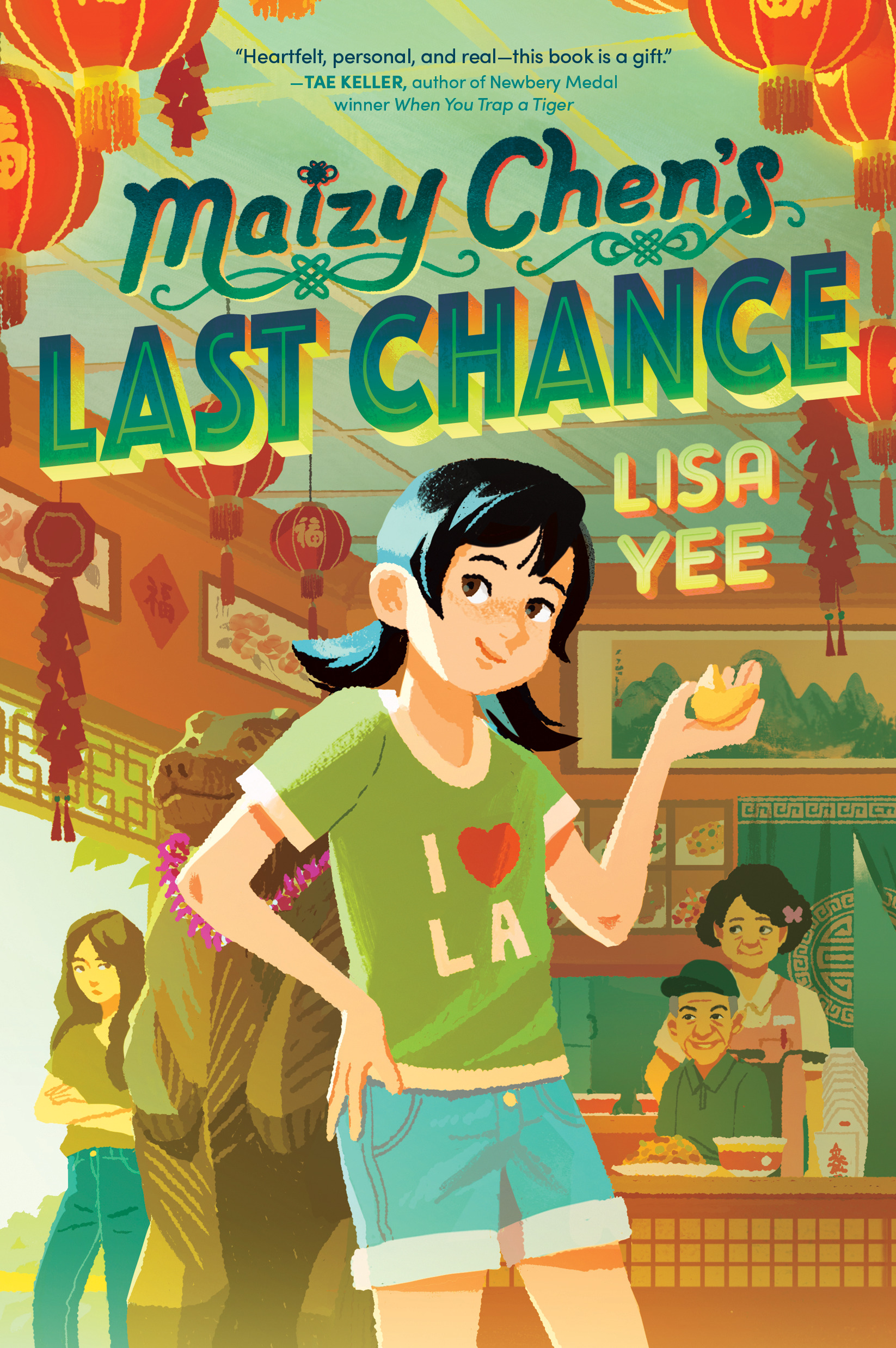
37. Maizy Chen's Last Chance


Maizy Chen's Last Chance. Lisa Yee. 2022. 276 pages. [Source: Library]

First sentence: The pies were fake, but my grandparents didn't know that. Not at first, anyway. My mother had invited them to watch her work on a Tasty Flaky Pie Crust commercial. 

Premise/plot: Maizy Chen and her mom go "home" to Last Chance, Minnesota, to visit her [maternal] grandparents, Opa and Oma. Opa [her grandfather] is in poor health. Though Oma isn't ready to say it out loud, he is dying. They've come to help out, mend fences, etc. This is the first time that Maizy is spending time with her grandparents. And she finds herself loving them and their "Lucky" stories. (Lucky is her second-great-grandfather, I believe. Her grandfather's grandfather.) He is the one who started Golden Palace in Last Chance. The restaurant has been in the family ever since.

Maizy Chen's Last Chance is a coming-of-age story focusing on family, friendship, and larger life lessons. For example, she's hearing about discrimination and prejudice in the Lucky stories of the past. AND ahe's learning first hand about discrimination and prejudice as she walks the streets in town. (Well, as she is encountering the townsfolk. Not everyone, of course, but there are a few rude people who are directly or indirectly hateful.) Race plays heavily in this NEWBERY honor book. 

My thoughts: I loved so many things about this one. I liked Maizy getting to know--really, truly know--her grandparents. Particularly she bonds with her Opa. I love their scenes together. I love all the family scenes really. Though she doesn't always understand all the complexity--the tension--of her family relationships. She also starts making a few friends. I enjoyed her writing the fortunes for the family restaurant. I loved her interest in researching the paper sons. 

There were times, however, I felt it was slightly info-dump-y. I loved so many things about this one. But there were places here and there where I wished it was a little less heavy. (Though the mystery in the middle was a plus.)

Overall, I liked this one.


© 2023 Becky Laney of Becky's Book Reviews

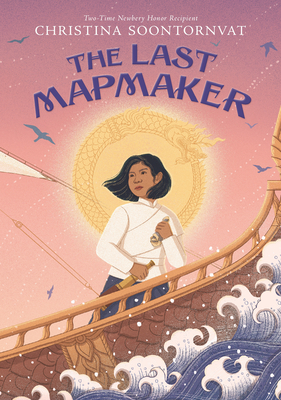
36. The Last Mapmaker


The Last Mapmaker. Christiana Soontornvat. 2022. 368 pages. [Source: Library]

First sentence: I must have looked like all the other Assistants standing in line for breakfast that morning at the Three Onions Cafe. We all wore the same starched white shirts, gray trousers, and stiff black cotton aprons with deep pockets. The Assistant's uniform was meant to put each of us on the same level, making us equals for the one year we would spend in service. What a joke.

Premise/plot: Sai is an assistant to the mapmaker Paiyoon. It's a job she keeps secret from her father--for good reasons. Her family background isn't the "best" and she's from the "wrong side" of town. She hides her work clothes and her earnings from her father--and his associates. The best part of her life is her days spent with the mapmaker. At one point, she's given an opportunity, to accompany her employer on a sea voyage. Their country is seeking the 'legendary' and 'fabled' land. It has not been mapped--officially at least. But her country--Mangkon, I believe--wants more than a map at the end of the day. They want to stake claim to this "new" country, this "new" land. 

My thoughts: This was a Newbery Honor for 2023. I wanted to enjoy it, I did. And at first, I did. But I got turned around once the voyage started. I became confused and disoriented. This may be all on me. I wouldn't be surprised. At one point, I skipped to the end and read the last chapter. I then went back and tried to read it through. But I just stayed confused. Again, this could be just me. Reading is so subjective.


© 2023 Becky Laney of Becky's Book Reviews

Thursday, February 09, 2023

30. Iveliz Explains It All


Iveliz Explains It All. Andrea Beatriz Arango. 2022 [September] 272 pages. [Source: Library]

First sentence: Why is it that principals
love giving second chances?
Love reminding me they were kids too?
Love acting like they're doing me a favor,
doing my mom a favor,
by sitting me down all serious
and asking what they can do?
Well, guess what.
This is seventh grade now,
And I don't need anyone's help but my own.
I've moved on from everything
that happened,
I've made lists and I've made goals,
and if I"m in the principal's office,
you can 100% bet
that it wasn't my fault.

Premise/plot: Iveliz Explains It All is a verse novel that is a Newbery Honor book. Iveliz is writing poems in her diary/journal. (As well as writing lists of goals in her diary). This coming of age novel unfolds a bit like a mystery. Readers aren't quite sure why Iveliz is always [or nearly always] getting in trouble at school, why she always has in-school suspension or actual suspension, why she struggles to keep friends or to make friends in the first place. Readers may not have the answers to these questions by the end of the novel, but, perhaps they will have walked in her shoes and gotten the chance to understand/empathize. 

This verse novel is a "problem" novel. Iveliz, our heroine, is struggling with life in many ways. At home, she struggles to get along with her mother and her grandmother. Her issues with her mother are complex, for sure. Her issues with her grandmother are simpler. She has dementia and stays a bit out of touch with reality. But when she is "with it" if you will, she strongly disagrees with the decision that Iveliz is taking medication for her mental health. At school, she struggles with getting along with anyone/everyone. Even her friend(s) have a hard time dealing with her impulsive [sometimes violent] reactions. 

My thoughts: I'm debating my thoughts and reactions. On the one hand, part of me is curious. What is her diagnosis? What exactly is going on with Iveliz? How strongly is it connected with the trauma that is revealed so incredibly slowly? On the other hand, is it really any of our business? Do we really have to know the specifics in order to be kind and compassionate and empathetic? We are not "owed" an explanation. 

Is this one that will appeal to children? actual children? I'm curious--super curious. So often the books that do win Newbery awards or recognized as honor books don't necessarily appeal to actual children. [They appeal to adults--to teachers, to librarians, to parents.] They often feel "Significant" or "Important." I do think that at the very, very least this one would be a good fit for adults who work with children--teachers, librarians, principals, etc. I think it is a thought-provoking read in that regard. No person can know everything going on in the private, personal lives of their students. This gives a good, long pause. A reminder that so much can be going on underneath the surface. 

Just because I feel adults might be a better fit doesn't mean that I think this one is inappropriate or out of place for younger readers. It's just a slightly heavy novel.


© 2023 Becky Laney of Becky's Book Reviews

Monday, October 17, 2022

129. The Jumping-Off Place


The Jumping-Off Place. Marian Hurd McNeely. Illustrated by William Siegel. 1929. 321 pages. [Source: Review copy]

First sentence: Down on their knees, a boy and girl were taking up the kitchen linoleum. It was a queer time to be at that work--half past eight in the evening--and there was an air of strangeness about the house; an unusual silence, a hollowness and a fragrance of crushed flowers in the air. 

Premise/plot: Four kids (Becky, Joan, Phil, and Dick)--doubly orphaned, first by their parents and then their uncle-guardian--set off for Tripp County, South Dakota, in 1910 to homestead on their Uncle's filed claim. And this is to be accomplished almost always on their own. Yes, there are supportive adults who share advice and sometimes an extra pair of hands, but, hundred percent of the blood, sweat, and tears of farming/homesteading will be on these four youngsters. (The oldest is sixteen or seventeen.) The book chronicles about a year's worth of time--give or take a couple of weeks. We definitely go through [late] spring, summer, fall, winter, and the beginning of another spring. Becky, the oldest sibling, I believe, becomes a "teacher" of sorts in a one-room schoolhouse. She isn't certified, but, she's a) willing b) gone through school herself so she's educated enough to teach younger ones c) wanting to go to "normal college" to get her teacher's certificate. There is the almost obligatory chapter where a blizzard strands kids at school. 

My thoughts: This one was published in 1929. It was recognized with a Newbery Honor in 1930. This book was published half a decade (at least) before Laura Ingalls Wilder began writing her children's stories about the homesteading life. (Some of Wilder's books would be set in South Dakota, though decades earlier.) The 1910 setting is interesting. We've got some modern touches--the kids have lived in a city and had city conveniences before--but we've got hints of the older 'pioneer' lifestyle as well. To original readers, 1910 wouldn't have seemed all that "historical" in all likelihood. Today's readers will definitely consider it 'historical' in nature. Perhaps a bit quaint and dated, perhaps outdated. 

Anytime you have an older book, you'll always have people curious about the content and if it is problematic. This one has at least one instance of the n-word--just so you know that up front. It is in relation to working hard and long hours in the field. The children obviously didn't see anything wrong with this word as a descriptor. (Modern readers, if this book has any, may not agree.) There was not really a presence--or notable presence--of Native Americans or "Indians" in this one. You could argue that their absence from the story raises its own issues. But you won't find any scenes like in Little House On the Prairie. So one could definitely look for ways to talk about context and content with children if you're reading this one with children. 


© 2022 Becky Laney of Becky's Book Reviews

Sunday, October 10, 2021

127. Abel's Island

Abel's Island. William Steig. 1976. 117 pages. [Source: Bought]

First sentence: Early in August 1907, the first year of their marriage, Abel and Amanda went to picnic in the woods some distance from the town where they lived.

Premise/plot: Abel is separated from Amanda as a result of a sudden storm. Both seek shelter, of course, but Abel finds himself situated far from home (from a mouse's perspective) and on an island. Cut off by nature from the home he loves, Abel's challenged in more ways than one. He has to learn how to physically survive in a strange-to-him environment. He also has to deal with the emotional and mental stress caused by loneliness and depression. Will he ever see Amanda again? Will he ever get off the island? What does his future hold for him?

My thoughts: This was my second time to read the novel. I did know what to expect the second time around. Since I read it the first time, I've read Robinson Crusoe and ventured into Swiss Family Robinson. This is survival fiction that just happens to star animals.

I also noticed the second time around that it was his romantic (idealistic) gesture that led to their separation and isolation. Readers get his perspective,  not hers, but it must have been truly terrifying for her. To see him get swept away. And to not know if he even survived. She might have thought he died and blamed herself (for better or worse) for what happened. (Not that she asked him to save the scarf.)

2020 has also happened since I first read this one. I think the isolation and loneliness aspects of this one--and the NOT knowing when--if ever--things could/would get back to "normal" comes into play. Certainly the past two years have impacted how I read this one.


© 2021 Becky Laney of Becky's Book Reviews

Monday, February 24, 2020

32. Other Words for Home

Other Words for Home. Jasmine Warga. 2019. 352 pages. [Source: Library] [Coming-of-age, mg fiction; mg realistic fiction; Newbery honor; family; verse novel]

First sentence: It is almost summer and everywhere smells like fish, except for right down by the sea where if you hold your nose just right you can smell the sprawling jasmine and the salt water instead.

Premise/plot: Other Words for Home is a coming of age verse novel set in Syria and the United States. When the novel opens readers meet Jude and her family in Syria. We get to know her parents, her older brother, her aunt and best friend. When Syria becomes increasingly dangerous, Jude and her mother immigrate to the U.S. Jude’s uncle (her mom’s brother) lives with his family in Cincinnati. Jude has to adjust to America as it really is, not as it is in her favorite nineties movies starring Julia Roberts and Sandra Bullock. Will Jude come to accept this as her new home or will home always be half a world away. Does she have to choose between them?

My thoughts: I enjoyed this compelling story. I thought the characters were fleshed out well. I got a definite sense of her life at home, at school, and a sense of who she was. I liked that Jude became involved with the school musical. I really enjoyed the developing friendships—Jude and Layla, Jude and Miles, etc.

It was a good read. I am glad it was a Newbery honor book so it caught my attention. 


 © 2020 Becky Laney of Becky's Book Reviews

Wednesday, February 27, 2019

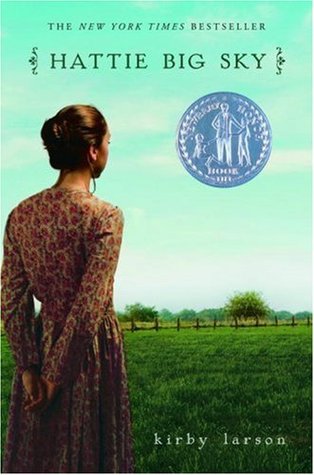
World at War: Hattie Big Sky

Hattie Big Sky. Kirby Larson. 2006. 289 pages. [Source: Library]

First sentence:
December 19, 1917
Arlington, Iowa

Dear Charlie,
Miss Simpson starts every day with a reminder to pray for you--and all the other boys who enlisted. Well, I say we should pray for the Kaiser--he's going to need those prayers once he meets you!
Premise/plot: Hattie Brooks, our heroine, has recently inherited her uncle's claim in Montana. She'll have a little under a year to finish proving her claim. It will require much of her--mentally, physically, emotionally. She's just sixteen--there are grown men, rugged men, who end up failing. Farming isn't ever easy. But some of the biggest challenges she'll face aren't from the land or the country itself. The people. America is at war and the people at home are feeling it. Hattie's closest neighbors--closest friends--are Germans. The community--with a few exceptions--has turned against them and against those that show their support. But Hattie isn't one to abandon her friends. Hattie proves herself to be an incredible woman even if not an incredible farmer.

My thoughts: I first read this one in February 2007. I loved it then. I loved it now. I think I may have loved it even more the second time. It is a compelling, heart-felt story.


© 2019 Becky Laney of Becky's Book Reviews

Saturday, February 02, 2019

The Night Diary

The Night Diary. Veera Hiranandani. 2018. 272 pages. [Source: Library]

First sentence: 
July 14, 1947
Dear Mama,
I know you know what happened today at 6:00 a.m., twelve years ago. How could you not? It was the day we came and you left, but I don't want to be sad today. I want to be happy and tell you everything.
Premise/plot:The Night Diary is a Newbery Honor book for 2019. It is set in India/Pakistan in the summer of 1947--the year that India broke free from British rule and was divided into two countries. It is not a time of peace and harmony. Far from it.

Nisha, our heroine, has just received a diary for her birthday. She lives with her twin brother, Amil, her father, and her grandmother. All her diary entries are written to her mother. Her family finds themselves living on the Pakistan side of the border--but it's not safe for them to stay since they are Hindu. Can they get across the border to India safely?

My thoughts: I loved, loved, LOVED this one. It is beautifully written. The story is compelling. I really felt a strong connection to Nisha and Amil. It was packed with suspense.

Quotes:
  • It feels scary to talk, because once the words are out, you can't put them back in. But if you write words and they don't come out the way you want them to, you can erase them and start over. (12)
  • I took in Kazi's words, let them dance and twirl in my head, replayed them over and over like a beautiful piece of music. I can't stop thinking about it, Papa having secrets with you. Papa cooking before Kazi came. You and Papa marrying against everyone's wishes in secret. What would it have been like if you lived, Mama? These things Kazi tells me are the memories I was supposed to have. They explode in my mind like firecrackers. (26)
  • It's one thing to understand facts and another thing to understand why those facts are facts. (86)
  • Sometimes I like to hold on to my upsets, like if I let them go I'm admitting that they weren't that important. (104)

© 2019 Becky Laney of Becky's Book Reviews
Monday, October 08, 2018

The Hundred Dresses

The Hundred Dresses. Eleanor Estes. Illustrated by Louis Slobodkin. 1944/2004. Houghton Mifflin Harcourt. 96 pages. [Source: Library]

First sentence: Today, Monday, Wanda Petronski was not in her seat. But nobody, not even Peggy and Madeline, the girls who started all the fun, noticed her absence. Usually Wanda sat in the next to the last seat in the last row in Room 13. She sat in the corner of the room where the rough boys who did not make good marks on their report cards sat; the corner of the room where there was more scuffling of feet, most roars of laughter when anything funny was said, and most mud and dirt on the floor.

Premise/plot: The heroine of Eleanor Estes' The Hundred Dresses is a young girl named Maddie. The book chronicles her awakening of conscience. Peggy and Maddie began "having fun" with Wanda Petronski several months before this chapter book opens. Fun. That's how Peggy sees it. And perhaps that's how Maddie viewed it the first few times. But lately Maddie has been thinking the "fun" they're having is wrong--is in fact unkind. But if she spoke up to Peggy, would Peggy listen to her and stop? Or would Peggy turn her back on her? Would Maddie lose her best friend?

"The fun" started when Wanda said she had a hundred dresses in her closet. Wanda--the girl who has worn the same dress every single day of the school year. Wanda--the girl with the funny last name. Wanda--the girl who lives on the wrong side of town. How could that Wanda really, truly have hundred dresses in her closet. She has to be lying, right?! If she's going to tell such a bold lie as that, is teasing her all that wrong?

Maddie comes to think it is. But her change of heart may be too late. Will Wanda ever know that Maddie is sorry for the way she's behaved?

My thoughts: I first read this one a few years ago. I think I love it even more now upon second reading. The book has a gentleness to it, but don't underestimate the power of meekness. This book has a message for young readers.

Wanda. By the time the book opens, Wanda has essentially already left school. We see her through Maddie's eyes--in a flashback of sorts. We see her through her artwork. We see her through her letter to the teacher. The impression I get of Wanda is that she's incredible, a girl worth knowing and befriending. For it seems that despite the teasing, she is willing to forgive. She's not angry. She's not bitter. She's not hateful. She's kind. Turning the other cheek, kind. The embodiment of the golden rule: "do unto others."

Maddie. This is a coming-of-age for Maddie. It is her character growth the book chronicles. Maddie was not "the instigator" of the bullying. She was a follower--a somewhat reluctant participant. But by the end of the book Maddie realizes that even observing "the fun" and standing by and doing nothing--saying nothing--is a wrongful act. Maddie realizes her own cowardice, her own weakness. She makes a resolution to change, to be a better person, to make amends, to never follow the crowd again, to always do what is right no matter what.

Peggy. This is the girl we know the least about. We know that she is one who first started teasing Wanda. But we don't know her heart--just her actions. Did she know it was wrong? Did she stop "the fun" only because Wanda moved away, or did she too experience a change of heart? I get the impression that she feels guilty, but not the impression that she's genuinely repentant and wanting to make amends. If Maddie wasn't so eager to make amends, would Peggy's guilty feeling last all that long? We just don't know. We can guess. But we can't know.

Have you read the Hundred Dresses? What did you think of it?!

© 2018 Becky Laney of Becky's Book Reviews
Thursday, February 22, 2018

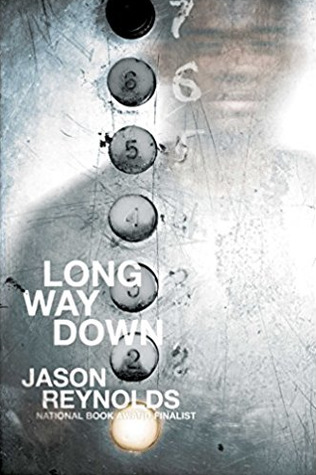
Long Way Down

Long Way Down. Jason Reynolds. 2017. [October 24] 320 pages. [Source: Library]

First sentence: Don't nobody believe anything these days which is why I haven't told nobody the story I'm about to tell you. And truth is, you probably ain't gon' believe it either...

Premise/plot: Will Holloman is about to take an elevator ride into the Twilight Zone. If I had to give a one sentence summary of the book, that's what I'd go with. Will is a young boy--young man--ripped apart by grief. His brother, Shawn, was murdered the day before. Will thinks he knows who did it; he knows what he must do. He knows the rules. No crying. No snitching. Always take revenge. On his way to get revenge, he takes an elevator ride.

Long Way Down is written in verse.

My thoughts: Long Way Down was named a Newbery Honor Book, a Printz Honor Book, and a Coretta Scott King Author Honor Book.

When I think of Newbery and Newbery Honor books I think of books that are the exact opposite of Long Way Down. Long Way Down is a dark book featuring a troubled, broken narrator. A narrator that is open and honest about a crime he's about to commit: premeditated murder. (That is if he's a reliable narrator in the first place.) All of the poems either directly or indirectly deal with guns, violence, murder. Many show the impact of violence on the family, on the community and neighborhood. My impression wasn't that Reynolds was trying to influence readers with WHAT to think, just to get them THINKING in the first place.

The subject matter wouldn't be my first choice to read about in general, or more specifically in a Newbery Honor Book. But the world that kids are growing up in these days is dramatically different than the world I grew up in. It only makes sense that the Newbery Medal would adapt along the way.

The writing was compelling. I was surprised at how much characterization Reynolds was able to achieve in so few words. Many of the poems are VERY short.

Is Will a reliable narrator? Is the story he's telling true? What happened in the book? What didn't happen? Was he alone on the elevator? Did he go through with his plan? What were the ghosts trying to teach him--if anything? Was he perhaps already dead? If he is dead--who is he telling his story to? If he isn't dead--what choice did he make? Was it all a dream?

© 2018 Becky Laney of Becky's Book Reviews

Friday, February 16, 2018

Crown: An Ode to the Fresh Cut

Crown: An Ode to the Fresh Cut. Derrick Barnes. Illustrated by Gordon C. James. 2017. 32 pages. [Source: Library]

First sentence: When it's your turn in the chair, you stand at attention and forget about who you were when you walked through that door. You came in as a lump of clay, a blank canvas, a slab of marble. But when my man is done with you, they'll want to post you up in a museum! 

Premise/plot: A young boy--a man in the making--talks about the pride and happiness he feels every time he walks into and out of a barber shop. 

My thoughts: This past Monday, Crown got a lot of love on awards day. How much love? A Coretta Scott King Illustrator Honor. A Coretta Scott King Author Honor. A Caldecott Honor. A Newbery Honor. I had actually noticed this one at the library on display, picked it up and turned a few pages, and put it back down a few days before. So I can't boast that I knew about the book before it won all the glory.

My recommendation: Before you read a single word of this one, read the author's note. But if you can't help reading it cover-to-cover, at the very least don't skip the author's note. I had never really thought of the picture book format as being a place for a coming-of-age story, but after reading this one, I see that it can be.

Text: 3 out of 5
Illustrations: 3 out of 5
Total: 6 out of 10

© 2018 Becky Laney of Becky's Book Reviews

Sunday, February 12, 2017

Freedom Over Me

Freedom Over Me: Eleven Slaves, their Lives and Dreams Brought to Life. Ashley Bryan. 2016. 56 pages. [Source: Library]

First sentence: I mourn the passing of my husband, Cado Fairchilds. He managed our estate alone. Eleven Negro slaves, they carried out the work that made our estate prosper.

Premise/plot: After the death of her husband, Mrs. Fairchilds decides to sell her estate--all of her estate including eleven slaves--and return to Britain. The eleven slaves were: Peggy, John, Athelia, Betty, Qush, Jane, Stephen, Mulvina, Bacus, Charlotte and Dora.

What you should know: Ashley Bryans, the author and illustrator, was inspired to write this picture book by slave documents he'd acquired. This estates appraisal dates from 1828. This picture book is written almost exclusively in verse. The book begins with Mrs. Fairchilds poem, her reasoning as to why she's selling the slaves and leaving the South. The remaining poems are all from the point of view of the eleven slaves. Each slave gets two poems. One poem for how things are; one poem for their dreams, how they want things to be.

From John:
Secretly, Stephen and Jane
are teaching me to read and write.
They say, "We'll be free one day!
And you will teach others."
My thoughts of escaping
to freedom
grow stronger every day.
Oh Freedom, Oh Freedom,
Oh Freedom over me!
From John Dreams:
I plan one day
to draw freely
from free Negro people.
I will create
loving portraits
of their strength
and beauty.
 You should also know that this is a Newbery Honor book, a Coretta Scott King Author Honor book, a Coretta Scott King Illustrator Honor book.

My thoughts: Freedom Over Me is worth reading no matter your age. (By that I mean you're never too old to read a 'children's book.' You can definitely be too young for a book, but never too old.) It would pair well with Julius Lester's Day of Tears--if memory serves--or his To Be A Slave. This is such compelling, emotional book.

© 2017 Becky Laney of Becky's Book Reviews

Saturday, January 21, 2017

Abel's Island

Abel's Island. William Steig. 1976. 117 pages. [Source: Bought]

First sentence: Early in August 1907, the first year of their marriage, Abel and Amanda went to picnic in the woods some distance from the town where they lived.

Premise/plot: Abel is separated from Amanda as a result of a sudden storm. Both seek shelter, of course, but Abel finds himself situated far from home (from a mouse's perspective) and on an island. Cut off by nature from the home he loves, Abel's challenged in more ways than one. He has to learn how to physically survive in a strange-to-him environment. He also has to deal with the emotional and mental stress caused by loneliness and depression. Will he ever see Amanda again? Will he ever get off the island? What does his future hold for him?

My thoughts: I don't know what I was expecting, but it wasn't this! There is very little that is cutesy about this animal fantasy. Abel is thrust into a harsh environment and there are no easy happily-ever-after answers. It's not a matter of persevere or get creative. Abel's stuck, stuck, stuck, STUCK on that island. And he has to reevaluate everything he thought he knew about himself and life.

This is a contemplative animal fantasy. It has a tiny bit of adventure thrown in now and then. But it is certainly no thriller.

© 2017 Becky Laney of Becky's Book Reviews

Sunday, January 01, 2017

The Apple and the Arrow

The Apple and the Arrow. Mary and Conrad Buff. 1951/2001. HMH. 80 pages. [Source: Bought]

First sentence: "Missed it again. Go and find the arrow, Rudi, will you? It fell near that old rotten log over there--the one with the big hole in it."

Premise/plot: Walter Tell loves his father William very much. He's proud to be his son, the son of one of the best bowmen ever. And he's a bit proud that he's old enough and responsible enough to hold such important secrets, secrets that could endanger the lives of his father and other men of the community of Uri. You see, come New Year's Day, the men are planning to revolt against the Austrians. The year is 1291. And the nation of Switzerland is a mere idea in the minds of men and women who long for freedom.

My thoughts: I'd heard a tiny bit about William Tell before. (The shooting an apple off his son's head thing.) I liked this one so much more than I thought I would. It is a Newbery Honor book from the 1950s. (So many Newbery winners and honors are set in medieval times.) I liked the faith elements in this one. So little is said about God and about prayer.

Favorite quotes:
War means starvation and death, not only for soldiers, but for women and children too. War always means that. (17)
Dear Lord, Father of all men, look down upon us this great night. Be with us when the bells ring, when the signal fires burn. Help us throw from our shoulders the yoke of the tyrant. But, good Lord, let no blood flow this night in the land of Uri. Even in this, our greatest hour, help us to remember that all men, even evil men, are our brothers. Keep our hearts pure, our arms strong. For the Virgin's sake. Amen."(74)
Now he knew why his mother had wished him to be here on this night of nights. He felt it all dimly, but he felt it nevertheless. He knew what the wise have always known, that men lives by faith, and that faith can be stronger than fear.(76)

© 2017 Becky Laney of Becky's Book Reviews
Monday, February 15, 2016

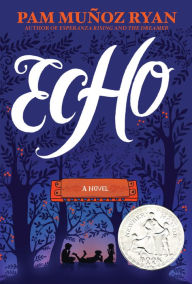
Echo

Echo. Pam Munoz Ryan. 2015. Scholastic. 592 pages. [Source: Library]

Did I enjoy reading Echo by Pam Muñoz Ryan? Yes. I found it both unique and compelling. Echo is unique in that it has three-in-one feel to it. Essentially Echo being three middle-grade novels in one. The three are held together by a fairy-tale-esque frame of a story, and, also a physical object: an harmonica. The framework of the story would lead me to think of it as "fantasy" or magical realism. But without that framework--which consists of just a few pages at the beginning and the end--the book IS historical fiction. Nothing happens within the three stories that couldn't--wouldn't--happen in the real world.

The book has three main characters. Friedrich living in Nazi Germany in the early 1930s; Mike living in Pennsylvania in the mid-1930s; Ivy living in California in the early 1940s. Music is a big part of each story, and, each have played the same harmonica.

So which story did I find most compelling? That's not a fair question at all! Friedrich perhaps would be my answer. He is very gifted, but, also publicly and privately shamed because of a birthmark and the fact that he had had epilepsy as a baby/toddler. His "imperfections" may prove too costly for him and his family with Hitler now in control. That and the fact that his father--a musician--is friendly with Jews. Is he "different"? Yes. But in a good way--a BRILLIANT way. When he hears a piece of music, he really HEARS it and REMEMBERS it. And he can play and replay it in his mind, it can "continue" to sweep him away each time. And the fact that he likes to pretend to conduct the music he hears in his head, well, that makes him horribly odd to outsiders. A handful of adults really see him as something special, but, others see him as an embarrassment, a disgrace, a mistake. This story had a few heartbreaking scenes in it. Scenes with the sister, Elizabeth, for example.

The other two stories are set in America. Mike's story features him and his little brother--both orphans. Both are musically gifted which proves to be fortunate. For a wealthy woman has to adopt a musical boy into her family in order to inherit her father's money. The problem? She doesn't *want* to be reminded of heartbreak in her own past. Can Mike and Frankie thaw her heart? Ivy's story is definitely centered on World War II. Her story is slightly more complex than the other two to summarize clearly. Essentially, Ivy (and her family) are Hispanic. They have moved a LOT through Ivy's young life. But the father receives an once-in-a-lifetime opportunity. If he will manage a piece of property for another family--a Japanese-American family being forced to resettle in an internment camp--then he will be hired on as manager or kept on as manager after the war and receive a small bit of property/house. The family experiences some prejudice after the move. Ivy can't attend school with white children. But she can participate in after school activities at the main school--including orchestra.

Overall, this one worked for me. Perhaps some scenes are better--stronger--than others. It is a long novel for middle-graders. As I said, it's like three-in-one! But I essentially enjoyed it


© 2016 Becky Laney of Becky's Book Reviews

Wednesday, February 03, 2016

Roller Girl

Roller Girl. Victoria Jamieson. 2015. 240 pages. [Source: Library]

Do I typically read graphic novels? Not really. I want to admit that from the very beginning of this review! I might average about two or three a year. And I usually just read the ones that are getting Newbery buzz or actually do get a Newbery or Newbery Honor. Roller Girl IS a graphic novel. It IS a Newbery Honor book for 2016.

Roller Girl is a coming-of-age graphic novel set mainly in the summer as the heroine, Astrid, goes to Roller Derby summer camp. Astrid is a bit angsty that her friend, Nicole, is no longer her best-best friend who wants to do every little thing with her. For example, Nicole does NOT want to go to roller derby camp, she wants to go to dance camp. She also wants to start hanging out with and dating boys. Astrid? Not really her thing--at least not yet. There is some jealousy mixed in with frustration. It isn't just that Nicole is interested in different hobbies. It is that Nicole is spending time--a lot of time--with other people. And one of those people she's now spending a LOT of time with is her nemesis, Rachel. Rachel and Astrid have some ancient history--way back in second grade, I believe?!

Astrid is confused and frustrated and moody and angry and DETERMINED. Roller derby is, by far, the hardest thing she's ever done--ever attempted. And it does not come easy. She is not a natural on skates--not by any stretch of the imagination. And it is physically, emotionally, mentally challenging to her. She WANTS it so bad that she pushes, pushes, pushes to improve. It is because she struggles that I believe she is so relatable.

I also liked how Astrid begins to make other friends outside of Nicole, and, that she is given the opportunity to find her own thing, to become her own person. True, part of that journey involves dyeing her hair BLUE. But having blue hair isn't the "worst" of her crimes--in the eyes of her mom. It is the fact that Astrid is less than honest. Still, I think the two are depicted as having a mostly-positive relationship. Which is nice to see in fiction. That Moms and daughters can get along and talk through their differences.

Astrid also finds a mentor--of sorts--in Rainbow Bite. Readers do learn a good bit about the sport of Roller Derby.

So overall, I enjoyed the characterization. I enjoyed the coming-of-age aspect of it. And despite the fact that it is a graphic novel, and, despite the fact that it is sports-focused, I did enjoy it. I read it quickly, in one setting.

© 2016 Becky Laney of Becky's Book Reviews