Showing posts with label 1951. Show all posts

Friday, April 26, 2019

Duplicate Death

Duplicate Death. (Inspectors Hannasyde and Hemingway #7) Georgette Heyer. 1951/2019. Sourcebooks. 400 pages. [Source: Review copy]

First sentence: There were several promising-looking letters in the pile laid on Mrs. James Kane's virgin breakfast-plate on Monday morning, but, having sorted all the envelopes with the air of one expectant of discovering treasure-trove, she extracted two addressed to her in hands indicative either of illiteracy or of extreme youth.

Premise/plot: Duplicate Death should never, ever, ever be read before They Found Him Dead. Trust me--please. The novel opens and closes with the stars of They Found Him Dead now happily married and the parents of four children. (Patricia Allison and James "Jim" Kane). Why the novel opens and closes with them remains a mystery to me.

Timothy HARTE is madly in love with a young woman, Miss Beulah Birtley. Miss Birtley is working for a difficult woman, Mrs. Haddington; Mrs. Haddington has a beautiful daughter, Cynthia. If it was up to Mrs. Haddington--which it isn't--Cynthia and Timothy would make a match of it. Both young people are at a bridge party at the Haddington house--though I don't quite remember if Miss Birtley is a "guest" or "staff" at the time--when a murder occurs. The investigators from the case are Hannasyde and Hemingway. Both remember Timothy Harte from their previous acquaintance. Both are listed among the suspects, though neither tops the list of SUSPECTS. A second murder throws the investigation off--for a while.

My thoughts: It annoys me that the jacket copy is INACCURATE for this one. Is it really so terribly hard to get a name right? Timothy KANE is not a character in the book. He doesn't exist. Not existing, he doesn't have a fiancee who's a prime suspect. However, Timothy HARTE does exist and does have a fiancee, though she's not really a prime suspect. Also the book stresses the friendship between Timothy KANE and the inspectors; I would say that is misleading as well. Fourteen years--give or take--have gone by without them speaking to each other or "hanging out." I doubt that the Inspectors were thinking of or missing Timothy in all those years. And probably the same could be said for Timothy. They were acquaintances that were on friendly terms--nothing more, nothing less.

All that being said, I liked this one well enough.

'Look here, I--the thing is--there are things in my life you don't know anything about!'
'Good God, I should hope there were!' retorted Timothy. "I've only known you a month!'
'And some of them you wouldn't like!'
'I daresay. Come to think of it, I can tell you of one thing in your young life I don't like right now, and that's Mr. Daniel Seaton-Carew.'

'I have no wish to appear boastful,' returned young Mr. Harte, 'but from my earliest days it has been said of me by all who know me best that I talk enough for two, or even more.'

'Seaton-Carew is considered to be rather an attractive type.'
'What does he attract? Pond-life?'

'Wireless programmes are neither primarily or secondarily intended for cultured persons,' replied Timothy, quite unruffled. 'Too often they appear to be intended either for the entirely witless, or for those desirous of acquiring without effort a little easy knowledge. I remember that someone once gave a fifteen minute talk on the Battle of Waterloo. A sobering thought.'

The Chief Inspector groaned. 'Any line on it at all?'
'Might be, might not. Doesn't sound like a cinch, from the first report. There were forty-nine people in the house at the time--'
'What?'
'Fifty-five, counting the servants,' said the Superintendent.

'What you [Pershore] want to do is to hire a hall, and give a series of lectures on police work,' interposed Hemingway. 'You'll probably make a lot of money: people will pay to listen to anything! I wouldn't, of course, but that's because I have to listen to you, and even the Department wouldn't expect me to pay for doing what I can't help. Now you stop trying to annoy me, and tell me what's been happening here without any trimmings!'

'Good God!' said Mr. Harte, staring at him between narrowed eyelids. 'You're the Sergeant!'
'Well, I was once, but I've been promoted,' he replied. 'Did you happen to know me when I was a Sergeant, sir?'
'Of course I did!' said Timothy, rising, and going towards him, with his hand held out. 'You probably don't remember me, but don't you remember the Kane case?'

'Perhaps you are confusing popularity with usefulness. Unattached men, Chief Inspector, are greatly in demand amongst hostesses.'

If you were to have given Mr. Godfrey Poulton the choice between having a sewer-rat loose in his house or the late Seaton-Carew, it's my belief he'd have chosen the rat.

The only thing that would surprise me about his case would be if I was able to get a real lead.

Ever add two and two together and get five for an answer? No, you wouldn't because you've got no imagination, but it's what I can see myself doing. All the same, taking your bit of dirt with what I gathered from Lady Nest's way of carrying on, I think this'll bear looking into.

'Look here, I don't mind you making two and two five, but when you start making it six, your'e going too far, Sandy!' expostulated Hemingway.


© 2019 Becky Laney of Becky's Book Reviews

Tuesday, May 01, 2018

The Magnificent Century

The Magnificent Century (The Plantagenets #2). Thomas B. Costain. 1951. 324 pages. [Source: Library]

First sentence: October 19, 1216. King John was dead.

Premise/plot: The Magnificent Century is the second volume in Thomas B. Costain's history of the Plantagenets. The first volume is The Conquering Family.

The first volume focused mainly on the royal family itself over several generations--centuries. The second volume has a much broader--yet narrower focus. (Narrower in that it just covers the reign of one king, Henry III. Broader in that it goes way beyond the royal family.) History. Religion. Science. Architecture. Politics. King vs. Parliament. Wars. Costain believes the thirteenth century to be a MAGNIFICENT century. In this volume, readers learn about Henry III and his family, the Marshal family, Hubert de Burgh, Simon de Montfort, and Roger Bacon.

My thoughts: I was less familiar with this time period. I was not equally interested in ALL the chapters. The chapters on war and civil war confused me a bit. I'm not sure if that's because war interests me less than other subjects of if Costain's narrative was unclear. Either is possible.

My absolute favorite chapter was probably "Queen's Men, King's Men, and the Villain of the Piece." Apparently there was a LOT of strife caused in England by the king's extended family. Namely Henry III's half brothers who came to England from France AND his in-laws. Henry's wife was unpopular, but his his wife's family was REALLY unpopular. Everyone WANTED something from Henry.

© 2018 Becky Laney of Becky's Book Reviews

Monday, March 05, 2018

Daughter of Time

The Daughter of Time. Josephine Tey. 1951/1995. Simon & Schuster. 208 pages. [Source: Bought]

First sentence: Grant lay on his high white cot and stared at the ceiling. Stared at it with loathing. He knew by heart every last minute crack on its nice clean surface. He had made maps of the ceiling and gone exploring on them; rivers, islands, and continents. He had made guessing games of it and discovered hidden objects; faces, birds, and fishes. He had made mathematical calculations of it and rediscovered his childhood; theorems, angles, and triangles. There was practically nothing else he could do but look at it.

Premise/plot: What is a police inspector to do when he's stuck in a hospital bed with a broken leg? Uninterested in solving any recent cold cases, he turns to the past for inspiration. He sets out to solve the mystery of who killed the two princes in the tower. He begins his investigation by looking at the so-called prime suspect: King Richard III. But he's troubled by what he's discovered. All the evidence "against" Richard is faulty, weak, unsubstantiated; in short in a modern case, everything would be inadmissible. The evidence feels contrived--pieced together decades after the boys disappeared. More importantly, it feels politically motivated all being written during the Tudor dynasty--in the reigns of Henry VII and Henry VIII. But if Alan Grant has pardoned Richard III--eliminated him as a suspect--who does he think committed the crime? And did the crime occur when everyone thinks it did? Could the boys have been alive when Henry VII defeated Richard III at Bosworth Field?!

My thoughts: I love, love, love, LOVE this mystery novel by Josephine Tey. It was the first mystery novel that I LOVED. (My very first mystery novel was also by Tey. But I didn't "love" it.) I found the writing to be enjoyable and quite quotable!!! That is rarely the case in a mystery novel where it is all about who did it.

Alan Grant on popular fiction authors:

The Sweat and the Furrow was Silas Weekley being earthly and spade-conscious all over seven hundred pages. The situation, to judge from the first paragraph, had not materially changed since Silas's last book: mother lying-in with her eleventh upstairs, father laid-out after his ninth downstairs, eldest son lying to the Government in the cow-shed, eldest daughter lying with her lover in the the hayloft, everyone else lying low in the barn. The rain dripped from the thatch, and the manure steamed in the midden. Silas never omitted the manure. It was not Silas's fault that its steam provided the only uprising element in the picture. If Silas could have discovered a brand of steam that steamed downwards, Silas would have introduced it. (13)
Did no one, any more, no one in all this wide world, change their record now and then? Was everyone nowadays thirled to a formula? Authors today wrote so much to a pattern that their public expected it. The public talked about "a new Silas Weekley" or "a new Lavinia Fitch" exactly as they talked about "a new brick" or a "new hairbrush." They never said "a new book by" whoever it might be. Their interest was not in the book but in its newness. They knew quite well what the book would be like. (14)
The Rose of Raby proved to be fiction, but at least easier to hold than Tanner's Constitutional History of England. It was, moreover, the almost-respectable form of historical fiction which is merely history-with-conversation, so to speak. An imaginative biography rather than an imagined story. Evelyn Payne-Ellis, whoever she might be, had provided portraits and a family tree, and had made no attempt, it seemed, to what he and his cousin Laura used to call in their childhood "write forsoothly." There were no "by our Ladys," no "nathelesses" or "varlets." It was an honest affair according to its lights. And its lights were more illuminating than Mr. Tanner. Much more illuminating. It was Grant's belief that if you could not find out about a man, the next best way to arrive at an estimate of him was to find out about his mother. (59)
Alan Grant on Sir Thomas More
He came to the surface an hour later, vaguely puzzled and ill at ease. It was not that the matter surprised him, the facts were very much what he had expected them to be. It was that this was not how he had expected Sir Thomas to write. "He took ill rest at nights, lay long waking and musing; sore wearied with care and watch, he slumbered rather than slept. So was his restless heart continually tossed and tumbled with the tedious impression and stormy remembrance of his most abominable deeds." That was all right. But when he added that "this he had from such as were secret with his chamberers" one was suddenly repelled. An aroma of back-stair gossip and servants' spying came off the page. So that one's sympathy tilted before one was aware of it from the smug commentator to the tortured creature sleeping on his bed. The murderer seemed of greater stature than the man who was writing of him. Which was all wrong. Grant was conscious too of the same unease that filled him when he listened to a witness telling a perfect story that he knew to be flawed somewhere... (71)
He was five. When that dramatic council scene had taken place at the Tower, Thomas More had been five years old. He had been only eight when Richard died at Bosworth. Everything in that history had been hearsay. And if there was one word that a policeman loathed more than another it was hearsay. Especially when applied to evidence. He was so disgusted that he flung the precious book on to the floor before he remembered that it was the property of a Public Library and his only by grace and for fourteen days. More had never known Richard III at all. He had indeed grown up under a Tudor administration. That book was the Bible of the whole historical world on the subject of Richard III--and it was from that account that Holinshed had taken his material, and from that Shakespeare had written his--and except that More believed what he wrote to be true it was of no more value than what the soldier said.... Grant had dealt too long with the human intelligence to accept as truth someone's report of someone's report of what that someone remembered to have seen or been told. (81)
Other favorite quotes:
"One would expect boredom to be a great yawning emotion, but it isn't, of course. It's a small niggling thing." (16)
"I'm feeling like a policeman. I'm thinking like a policeman. I'm asking myself the question that every policeman asks in every case of murder: Who benefits? And for the first time it occurs to me that the glib theory that Richard got rid of the boys to make himself safer on the throne is so much nonsense. Supposing that he had got rid of the boys. There were still the boys' five sisters between him and the throne. To say nothing of George's toy: the boy and girl. George's son and daughter were barred by their father's attainder; but I take it that an attainder can be reversed, or annulled, or something. If Richard's claim was shaky, all those lives stood between him and safety."
"And did they all survive him?"
"I don't know. But I shall make it my business to find out. The boys' eldest sister certainly did because she became Queen of England as Henry's wife." (105)
It was brought home to him for the first time not only what a useless thing the murder of the boys would have been, but what a silly thing. And if there was anything that Richard of Gloucester was not, beyond a shadow of a doubt, it was silly. (137)
"Of course I'm only a policeman," Grant said. "Perhaps I never moved in the right circles. It may be that I've met only nice people. Where would one have to go to meet a woman who became matey with the murderer of her two boys?"
"Greece, I should think," Marta said. "Ancient Greece."
"I can't remember a sample even there."
"Or a lunatic asylum, perhaps. Was there any sign of idiocy about Elizabeth Woodville?"
"Not that anyone ever noticed. And she was Queen for twenty years or so."
...
"Yes of course. It's the height of absurdity. It belongs to Ruthless Rhymes, not to sober history. That is why historians surprise me. They seem to have no talent for the likeliness of any situation. They see history like a peepshow; with two-dimensional figures against a distant background."
"Perhaps when you are grubbing about with tattered records you haven't time to learn about people. I don't mean about the people in the records, but just about People. Flesh and blood. And how they react to circumstances." (151)
The spectacle of Dr. Gairdner trying to make his facts fit his theory was the most entertaining thing in gymnastics that Grant had witnessed for some time... As a contortionist Dr. Gairdner was the original boneless wonder. More than ever Grant wondered with what part of their brains historians reasoned. It was certainly by no process of reasoning known to ordinary mortals that they arrived at their conclusions. (173)
 Historians should be compelled to take a course in psychology before they are allowed to write. (201) 

© 2018 Becky Laney of Becky's Book Reviews

Sunday, September 10, 2017

The Case of the Fiery Fingers

The Case of the Fiery Fingers. Erle Stanley Gardner. 1951. 192 pages. [Source: Bought]

First sentence: Perry Mason had just returned to the office after a long day in court.

Premise/plot: Perry is far from impressed when Nellie Conway shows up at his office needing his legal advice. (She pays him a dollar.) She is a nurse--a night nurse--working for the Bain family. Mrs. Bain has been seriously injured in a car accident and is estranged from her husband. Nurse Nellie claims that Mr. Bain has offered to pay her money to give his wife "special medicine." Nellie is convinced that the medicine he's given her is really poison. Perry Mason wasn't her first choice; she went to the police first and was laughed out of the building. Mason, well, he's not taking Nurse Conway seriously either. But he does have one of the tablets tested to see what it is, if it is poison. Within days--if not hours--Nurse Conway finds herself in need of a lawyer for another reason altogether. She's been accused of theft by her employer, Mr. Bain. Will Mason represent her? He says yes, but more to annoy other people than to help her out. Mason soon regrets ever hearing the name of Bain....

My thoughts: This murder mystery is enjoyable. It involves TWO trials. Mason has two different clients.
Judge Peabody:
The vice of a leading question, of course, consists in having asked it.
Perry Mason:
A lawyer isn't paid to consider probabilities. He's paid to consider possibilities.
Perry Mason:
A good lawyer must always remember one thing. Never get mad unless someone pays him to do it.
Charlotte Moray:
He likes his pastures while they're green and while they're on the other side of the fence. Give him the key to the gate and it would mean nothing.
Lt. Tragg:
You know lots of things, Mason. Sometimes you amaze me when I find out what you do know, and then again there are times when I am afraid I never do find out what you know. So I have to try to keep you from finding out what I know.
Lt. Tragg:
Winners never explain. Losers always do.


© 2017 Becky Laney of Becky's Book Reviews

Friday, April 14, 2017

Up and Down the River

Up and Down the River (Fairchild Family #3). Rebecca Caudill. Illustrated by Deci Merwin. 1951/2009. 143 pages. [Source: Library]

First sentence: "I do wish we could find some way to get rich, like Althy!" said Bonnie.

Premise/plot: Bonnie and her older sister Debby really want to find a way to make money over the summer. A way to make money without spending money, or much money. They settle on a magazine scheme--offer. Selling picture cards for ten cents each, and selling bluing for ten cents a sheet. They get enough to sell--just paying for stamps to mail the company--to earn two dollars. (The company would be mailed two dollars too.) This involves a lot of walking up and down the river to visit each of their neighbors. At one of their neighbor's farms they get a newly orphaned lamb to take home as a pet. It won't be the only pet of the summer either! A duck, two Bantam chickens--a king and queen--and three kittens complete the assortment! There is a story behind each pet! But some stories are bittersweet. (Poor ducks!)

My thoughts: I always enjoy spending time with Bonnie and her family. I like this one but I am not sure it is my favorite from the series. The message might be on learning responsibility. Or it might be something to do with our greatest riches are friends and family and the memories we share together.


© 2017 Becky Laney of Becky's Book Reviews

Sunday, January 01, 2017

The Apple and the Arrow

The Apple and the Arrow. Mary and Conrad Buff. 1951/2001. HMH. 80 pages. [Source: Bought]

First sentence: "Missed it again. Go and find the arrow, Rudi, will you? It fell near that old rotten log over there--the one with the big hole in it."

Premise/plot: Walter Tell loves his father William very much. He's proud to be his son, the son of one of the best bowmen ever. And he's a bit proud that he's old enough and responsible enough to hold such important secrets, secrets that could endanger the lives of his father and other men of the community of Uri. You see, come New Year's Day, the men are planning to revolt against the Austrians. The year is 1291. And the nation of Switzerland is a mere idea in the minds of men and women who long for freedom.

My thoughts: I'd heard a tiny bit about William Tell before. (The shooting an apple off his son's head thing.) I liked this one so much more than I thought I would. It is a Newbery Honor book from the 1950s. (So many Newbery winners and honors are set in medieval times.) I liked the faith elements in this one. So little is said about God and about prayer.

Favorite quotes:
War means starvation and death, not only for soldiers, but for women and children too. War always means that. (17)
Dear Lord, Father of all men, look down upon us this great night. Be with us when the bells ring, when the signal fires burn. Help us throw from our shoulders the yoke of the tyrant. But, good Lord, let no blood flow this night in the land of Uri. Even in this, our greatest hour, help us to remember that all men, even evil men, are our brothers. Keep our hearts pure, our arms strong. For the Virgin's sake. Amen."(74)
Now he knew why his mother had wished him to be here on this night of nights. He felt it all dimly, but he felt it nevertheless. He knew what the wise have always known, that men lives by faith, and that faith can be stronger than fear.(76)

© 2017 Becky Laney of Becky's Book Reviews

Saturday, November 26, 2016

Child's Geography of the World

A Child's Geography of the World. V.M. Hillyer. 1929/1951. 472 pages.

First sentence: When I was a boy, my nurse used to take me to the railroad station to see the trains.

Premise/plot: A Child's Geography of the World was first published in 1929. The edition I found was revised and published in 1951. The tone is casual conversation. There are a few black and white illustrations throughout the book. The book is full of information, but what kind?

The truth is some information stays the same no matter the decade. (For example the location of the The Great Lakes, the Empire State Building, the Leaning Tower of Pisa). But plenty of things have changed and changed dramatically! Nations have passed away, governments have been toppled, revolutions have taken place. Also the United States has more than 48 states! Mount Everest has been climbed. Man has gone to the moon and back.

The last war mentioned is World War 2. Communists are mentioned, or perhaps I should say warned against!

Race is definitely an issue if you're reading this with children. (God created black men at night and many black people in Africa eat each other. The narrator makes an offhandedly comment that you will likely never see a real live Indian because there are few left. The narrator later makes an aside that the U.S. does it's best to keep out the Chinese.) I would say adults can throw away the bad and keep the good and have the discernment needed to tell the difference between the two. I would not recommend young children read this on their own for several reasons. One being that unless this text has been updated and revised recently, you'd have more misinformation than correct information.

My thoughts: I find vintage books entertaining. I do. Rare, long out-of-print books call to me. It's a way to capture a glimpse of the past, for better or worse. Not a historical writer's idea of the past. Good Morning, Miss Dove is one of my favorite, favorite books--and movies. This book would have been published at exactly the right time for Miss Dove to use!

The information is dated, true, I won't lie, but it is also a strong narrative. If there weren't problematic sections, I could easily call it charming.

© 2016 Becky Laney of Becky's Book Reviews

Tuesday, July 21, 2015

Daughter of Time

The Daughter of Time. Josephine Tey. 1951/1995. Simon & Schuster. 208 pages. [Source: Bought]

Grant lay on his high white cot and stared at the ceiling. Stared at it with loathing. He knew by heart every last minute crack on its nice clean surface. He had made maps of the ceiling and gone exploring on them; rivers, islands, and continents. He had made guessing games of it and discovered hidden objects; faces, birds, and fishes. He had made mathematical calculations of it and rediscovered his childhood; theorems, angles, and triangles. There was practically nothing else he could do but look at it.

Is The Daughter of Time my favorite mystery? I've read it five times, the most recent being in August 2014. At the very least it is my favorite mystery by Josephine Tey. And also one of my favorite books about Richard III. So it's a definite favorite. Unfortunately, the actual clip of the Richard III song from Horrible Histories has been removed, but this one in remains. And here is a live version of it.

Inspector Alan Grant has broken his leg and is hospitalized. In his boredom, he resorts to solving one of history's unsolvable cases. He becomes quite interested in Richard III and in figuring out if he was a cruel murdering tyrant. Is he responsible for the deaths of the two princes in the tower? Or was he framed to take the blame by the conquering Tudors? Readers get a behind-the-scenes glimpse at Grant's thought process as he seeks to solve the mystery.

The book is so well-written. It's unique. It's funny--in places. I loved the narrative voice. I loved the subject as well. I think everyone should give it a try.

Alan Grant on popular fiction authors:

The Sweat and the Furrow was Silas Weekley being earthly and spade-conscious all over seven hundred pages. The situation, to judge from the first paragraph, had not materially changed since Silas's last book: mother lying-in with her eleventh upstairs, father laid-out after his ninth downstairs, eldest son lying to the Government in the cow-shed, eldest daughter lying with her lover in the the hayloft, everyone else lying low in the barn. The rain dripped from the thatch, and the manure steamed in the midden. Silas never omitted the manure. It was not Silas's fault that its steam provided the only uprising element in the picture. If Silas could have discovered a brand of steam that steamed downwards, Silas would have introduced it. (13)
Did no one, any more, no one in all this wide world, change their record now and then? Was everyone nowadays thirled to a formula? Authors today wrote so much to a pattern that their public expected it. The public talked about "a new Silas Weekley" or "a new Lavinia Fitch" exactly as they talked about "a new brick" or a "new hairbrush." They never said "a new book by" whoever it might be. Their interest was not in the book but in its newness. They knew quite well what the book would be like. (14)
The Rose of Raby proved to be fiction, but at least easier to hold than Tanner's Constitutional History of England. It was, moreover, the almost-respectable form of historical fiction which is merely history-with-conversation, so to speak. An imaginative biography rather than an imagined story. Evelyn Payne-Ellis, whoever she might be, had provided portraits and a family tree, and had made no attempt, it seemed, to what he and his cousin Laura used to call in their childhood "write forsoothly." There were no "by our Ladys," no "nathelesses" or "varlets." It was an honest affair according to its lights. And its lights were more illuminating than Mr. Tanner. Much more illuminating. It was Grant's belief that if you could not find out about a man, the next best way to arrive at an estimate of him was to find out about his mother. (59)
Alan Grant on Sir Thomas More
He came to the surface an hour later, vaguely puzzled and ill at ease. It was not that the matter surprised him, the facts were very much what he had expected them to be. It was that this was not how he had expected Sir Thomas to write. "He took ill rest at nights, lay long waking and musing; sore wearied with care and watch, he slumbered rather than slept. So was his restless heart continually tossed and tumbled with the tedious impression and stormy remembrance of his most abominable deeds." That was all right. But when he added that "this he had from such as were secret with his chamberers" one was suddenly repelled. An aroma of back-stair gossip and servants' spying came off the page. So that one's sympathy tilted before one was aware of it from the smug commentator to the tortured creature sleeping on his bed. The murderer seemed of greater stature than the man who was writing of him. Which was all wrong. Grant was conscious too of the same unease that filled him when he listened to a witness telling a perfect story that he knew to be flawed somewhere... (71)
He was five. When that dramatic council scene had taken place at the Tower, Thomas More had been five years old. He had been only eight when Richard died at Bosworth. Everything in that history had been hearsay. And if there was one word that a policeman loathed more than another it was hearsay. Especially when applied to evidence. He was so disgusted that he flung the precious book on to the floor before he remembered that it was the property of a Public Library and his only by grace and for fourteen days. More had never known Richard III at all. He had indeed grown up under a Tudor administration. That book was the Bible of the whole historical world on the subject of Richard III--and it was from that account that Holinshed had taken his material, and from that Shakespeare had written his--and except that More believed what he wrote to be true it was of no more value than what the soldier said.... Grant had dealt too long with the human intelligence to accept as truth someone's report of someone's report of what that someone remembered to have seen or been told. (81)
Other favorite quotes:
"One would expect boredom to be a great yawning emotion, but it isn't, of course. It's a small niggling thing." (16)
"I'm feeling like a policeman. I'm thinking like a policeman. I'm asking myself the question that every policeman asks in every case of murder: Who benefits? And for the first time it occurs to me that the glib theory that Richard got rid of the boys to make himself safer on the throne is so much nonsense. Supposing that he had got rid of the boys. There were still the boys' five sisters between him and the throne. To say nothing of George's toy: the boy and girl. George's son and daughter were barred by their father's attainder; but I take it that an attainder can be reversed, or annulled, or something. If Richard's claim was shaky, all those lives stood between him and safety."
"And did they all survive him?"
"I don't know. But I shall make it my business to find out. The boys' eldest sister certainly did because she became Queen of England as Henry's wife." (105)
It was brought home to him for the first time not only what a useless thing the murder of the boys would have been, but what a silly thing. And if there was anything that Richard of Gloucester was not, beyond a shadow of a doubt, it was silly. (137)
"Of course I'm only a policeman," Grant said. "Perhaps I never moved in the right circles. It may be that I've met only nice people. Where would one have to go to meet a woman who became matey with the murderer of her two boys?"
"Greece, I should think," Marta said. "Ancient Greece."
"I can't remember a sample even there."
"Or a lunatic asylum, perhaps. Was there any sign of idiocy about Elizabeth Woodville?"
"Not that anyone ever noticed. And she was Queen for twenty years or so."
...
"Yes of course. It's the height of absurdity. It belongs to Ruthless Rhymes, not to sober history. That is why historians surprise me. They seem to have no talent for the likeliness of any situation. They see history like a peepshow; with two-dimensional figures against a distant background."
"Perhaps when you are grubbing about with tattered records you haven't time to learn about people. I don't mean about the people in the records, but just about People. Flesh and blood. And how they react to circumstances." (151)

© 2015 Becky Laney of Becky's Book Reviews
Tuesday, May 05, 2015

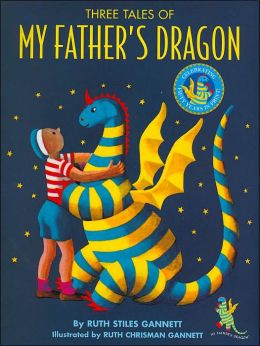
Three Tales of My Father's Dragon

Three Tales of My Father's Dragon. Ruth Stiles Gannett. Illustrated by Ruth Chrisman Gannett. 1987. Random House. 242 pages. [Source: Library]

I really enjoyed reading My Father's Dragon (1948), Elmer And the Dragon (1950), and The Dragons of Blueland (1951), all by Ruth Stiles Gannett. (My Father's Dragon was a Newbery Honor book for 1949.) I'd read My Father's Dragon before many years ago--long before I started blogging--but this was my first opportunity, I believe, to read the two sequels.

I loved the way My Father's Dragon opens:
One cold rainy day when my father was a little boy, he met an old alley cat on his street. The cat was very drippy and uncomfortable so my father said, "Wouldn't you like to come home with me?" This surprised the cat--she had never before met anyone who cared about old alley cats--but she said, "I'd be very much obliged if I could sit by a warm furnace, and perhaps have a saucer of milk." "We have a very nice furnace to sit by, said my father, "and I'm sure my mother has an extra saucer of milk." My father and the cat became good friends but my father's mother was very upset about the cat. She hated cats, particularly ugly old alley cats. "Elmer Elevator," she said to my father, "if you think I'm going to give that cat a saucer of milk, you're very wrong. Once you start feeding stray alley cats you might as well expect to feed every stray in town, and I am not going to do it!"
 This opening hooked me. It is through the cat--his cat--that he learns of a baby dragon in desperate need of help. He tells of the Island of Tangerina and Wild Island. He learns about the captive dragon and the dangerous residents of the island. He is determined to help free the dragon. The cat helps him form a plan...

The first book is all about his going to the islands, his adventures and misadventures as he's looking for the dragon--it's a good thing he came to the island well-prepared! Does he find the dragon? You can guess the answer to that. Of course he does!

My Father's Dragon is a delightful fantasy book for very young readers. It's short and quite satisfying.

In Elmer and the Dragon, Elmer starts his journey home--by dragon. His new dragon friend will fly him home. But neither Elmer or the dragon know the way home precisely. Elmer ends up having just as many adventures returning home as he did running away from home. One of the stops along the way is Feather Island, the home of all 'lost' canaries.

In The Dragons of Blueland, the dragon sets off to return to his own family that he hasn't seen since his captivity. He's anxious to be reunited. But when he returns, he learns that his own family--his very large family--has been trapped in their cave. The entrance is guarded by men intent on capturing them or perhaps even killing them. He needs to find a way to help his family! So he seeks out Elmer...

All three books are great. It's oh-so-easy to recommend these.

© 2015 Becky Laney of Becky's Book Reviews

Thursday, September 18, 2014

My Cousin Rachel (1951)

My Cousin Rachel. Daphne du Maurier. 1951. 374 pages. [Source: Library]

Years ago I read and enjoyed Rebecca by Daphne du Maurier. I've been meaning to read more of her books ever since. My Cousin Rachel is the second of hers that I've read. I enjoyed it. I'm not sure I enjoyed it more than Rebecca. But I think it is safe to say that if you enjoyed Rebecca you will also (most likely) enjoy My Cousin Rachel.

My Cousin Rachel is narrated by Philip Ashley. He is the heir to his cousin Ambrose's estate. Ambrose took him in and raised him essentially. These two are close as can be. Daphne du Maurier knows how to do foreshadowing. In both Rebecca and My Cousin Rachel, she uses it generously giving readers time to prepare for tough times ahead. In this case, the foreshadowing is about Ambrose's trip abroad and his surprise wedding to a young woman, coincidentally a distant cousin, named Rachel. Rachel is a widow he meets in Italy. Instead of returning home to England, these two settle down in Italy--Florence, I believe. Philip is angsty to say the least. How dare my cousin do this to me! How dare he marry someone he barely knows! Philip spends months imagining Rachel's character and personality. She has to have an agenda! She has to be manipulative and scheming. She has to be TROUBLE. Now Philip doesn't voice his concerns to everyone he meets. He is more guarded, almost aware that it's silly of him to have this strong a reaction to someone he's never met. But Ambrose's happily ever after is short-lived. And not just because he dies. Ambrose wrote mysterious letters to Philip over several months. In these letters, Philip sees that all is not well. That there is something to his prejudice against Rachel. It seems that Ambrose has regrets, big regrets, about Rachel. The moodiest of all these letters reaches Philip after Ambrose's death.

So. What will Philip think of Rachel once he actually meets her? What will she think of him? Will they be friends or enemies? Will they trust one another? Should they trust one another? Whose story is based in reality? Is Rachel's accounting of Ambrose's last months true? Or was Ambrose right to mistrust Rachel? Will Philip be wise enough and objective enough to know what is going on?

The author certainly gives readers plenty to think about. Readers get almost all their information filtered through Philip's perspective. But I suppose the dialogue in the book might provide more. If one can trust Philip's recollection of it.

I think My Cousin Rachel is a character-driven gothic novel. It is certainly creepy and weird.

© 2014 Becky Laney of Becky's Book Reviews

Friday, August 29, 2014

#35 Daughter of Time

The Daughter of Time. Josephine Tey. 1951/1995. Simon & Schuster. 208 pages. [Source: Bought]

Grant lay on his high white cot and stared at the ceiling. Stared at it with loathing. He knew by heart every last minute crack on its nice clean surface. He had made maps of the ceiling and gone exploring on them; rivers, islands, and continents. He had made guessing games of it and discovered hidden objects; faces, birds, and fishes. He had made mathematical calculations of it and rediscovered his childhood; theorems, angles, and triangles. There was practically nothing else he could do but look at it.


It's hard for me to imagine that just a little over four years ago I was not a mystery reader. While I was willing to try a new genre and a new author based on my best friend's recommendation, I didn't think I'd actually enjoy it, as in LOVE what I'm reading. In July 2010, I read two Josephine Tey books: The Man in the Queue, which I've read only once, and The Daughter of Time, which I've reread again and again. This is the fourth time I've read The Daughter of Time!

The Daughter Of Time isn't a typical mystery. The hero, Inspector Grant, is stuck in a hospital bed with a broken leg. He sees visitors. He sees doctors and nurses. He could spend his time reading. But. He isn't really satisfied with the fiction close at hand provided by his friends. What he really wants is to have a case to solve. That seems impossible until someone suggests he solve a case from the past. He seeks out a mystery from history. He chooses Richard III. The action in the novel comes from thinking, reading, researching, and brainstorming with his friends.

Since I've read it four times, you have to know that I LOVE, LOVE, LOVE this one. I love it even more each time I read it! And this SONG is a must!!!!  

It was brought home to him for the first time not only what a useless thing the murder of the boys would have been, but what a silly thing. And if there was anything that Richard of Gloucester was not, beyond a shadow of a doubt, it was silly. (137)

 "Of course I'm only a policeman," Grant said. "Perhaps I never moved in the right circles. It may be that I've met only nice people. Where would one have to go to meet a woman who became matey with the murderer of her two boys?"
"Greece, I should think," Marta said. "Ancient Greece."
"I can't remember a sample even there."
"Or a lunatic asylum, perhaps. Was there any sign of idiocy about Elizabeth Woodville?"
"Not that anyone ever noticed. And she was Queen for twenty years or so."
...
"Yes of course. It's the height of absurdity. It belongs to Ruthless Rhymes, not to sober history. That is why historians surprise me. They seem to have no talent for the likeliness of any situation. They see history like a peepshow; with two-dimensional figures against a distant background."
"Perhaps when you are grubbing about with tattered records you haven't time to learn about people. I don't mean about the people in the records, but just about People. Flesh and blood. And how they react to circumstances." (151)

© 2014 Becky Laney of Becky's Book Reviews
Sunday, July 27, 2014

To Love And Be Wise (1951)

To Love And Be Wise. (Inspector Grant #4) Josephine Tey. 1951. Simon & Schuster. 208 pages. [Source: Bought]

I definitely liked To Love And Be Wise. It is an Inspector Grant mystery. Some of the Grant series I've loved, others, not quite so much.

Inspector Grant is at a party with a friend, Marta Hallard, the event is to celebrate the release of a new Lavinia Fitch novel. While there he happens to see an oh-so-beautiful young man. People's gaze just seems to follow him, he's that beautiful. He talks to Grant and asks him to point out Lavinia Fitch. He claims he wants an introduction to Fitch's nephew, Walter Whitmore. The young man's name is Leslie Searle. Introductions are made, and Leslie is even invited into their country home--indefinitely.

Several weeks later, Mr. Grant is called down to investigate a crime or potential crime. Mr. Searle has gone missing. He was working on a project with Walter Whitmore. (Walter Whitmore is apparently a radio celebrity and Searle is a famous photographer.) He hasn't been seen in a day or two. There is no body, though they have dragged the river repeatedly. Searle had definitely argued with several in town, including Walter. Could he have been murdered?

I liked this one. I did. I liked the community in which it was set. I liked meeting Silas Weekley and Lavinia Fitch, for example, mainly because they're referenced in my favorite, favorite, favorite book Daughter of Time.

By the way, isn't this a horrible cover?!

Favorite quotes:
"Why do you listen to him?" [him = Walter Whitmore]
"Well, there's a dreadful fascination about it, you know. One thinks: Well, that's the absolute sky-limit of awfulness, than which nothing could be worse. And so next week you listen to see if it really can be worse. It's a snare. It's so awful that you can't even switch off. You wait fascinated for the next piece of awfulness, and the next. And you are still there when he signs off." (12)
"Perhaps the old saying is true and it is not possible to love and be wise." (42)
"I suppose you don't read Lavinia Fitch?"
"No, but Nora does."
Nora was Mrs. Williams, and the mother of Angela and Leonard.
"Does she like them?"
"Loves them. She says three things make her feel cosy in advance. A hot-water bottle, a quarter-pound of chocolates, and a new Lavinia Fitch."
"If Miss Fitch did not exist, it seems, it would be necessary to invent her," Grant said. (73)
"You really ought, just for once, to try those pickles, sir," Williams said. "They're wonderful."
"For the five hundred and seventh time, I do not eat pickles. I have a palate, Williams. A precious possession. And I have no intention of prostituting it to pickles." (92)
Silas has his own success, his family, the books he is going to write in the future (even if they are just the same old ones over again in different words). (136)
"I was just thinking how shocked the writers of slick detective stories would be if they could witness two police inspectors sitting on a willow tree swapping poems." (151)
© 2014 Becky Laney of Becky's Book Reviews
Sunday, September 15, 2013

Sunday Salon: Reading All-of-a-Kind-Family (1951)

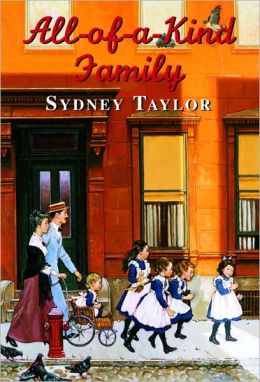
All-of-a-Kind-Family. Sydney Taylor. 1951. 190 pages. [Source: Bought]

I enjoyed rereading All-of-a-Kind Family by Sydney Taylor. This historical fiction novel is set in New York City around 1912. When the novel opens, there are five sisters: Ella, Henrietta (Henny), Sarah, Charlotte, and Gertie. They are a "steps-and-stairs" family according to the oh-so-friendly librarian Miss Allen. (Yes, the librarian plays a good role in this one!) The chapters are episodic, occurring over the course of a year. The chapters detail what life was like in a Jewish household during the early years of the new century. Some chapters are about everyday things like shopping, cleaning, going to the library, eating in bed, picky-eating at the table, etc. Other chapters are about holidays or vacations: Purim, Passover, 4th of July, visiting Coney Island, etc. My least favorite chapter remains the same: the hiding of buttons to motivate the sisters into cleaning.

I liked this one. I like it because it is old-fashioned and simple and just good. I like it because it captures a special time and place in American history.

Have you read this one? What did you think?

© 2013 Becky Laney of Becky's Book Reviews
Friday, August 02, 2013

The Quiet Gentleman (1951)

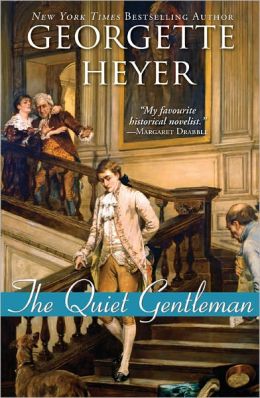
The Quiet Gentleman. Georgette Heyer. 1951/2005. Arrow. 320 pages. [Source: Library]

This year I am attempting to read all of Georgette Heyer's historical romances in chronological order. The Quiet Gentleman is one of the few I had not read before. (Though it seems very familiar to me.) Gervase Frant is the Seventh Earl of St. Erth. He is his father's heir, despite not always being on the best of terms with him. He has a half-brother, Martin, who was more of the favorite. A year after his father's death, Gervase has returned to England from the war. His family--his step-mother, his half-brother, his half-sister, his cousin--were all hopeful that he would have died in battle by now. Why couldn't he have died? It's just not fair. From the very first night back in his old home, Gervase receives friendly warnings from his cousin, Theo, warnings about how his very life is in danger.

The entire book chronicles the failed attempts on his life. Someone wants him dead, but they are doing a clumsy job of it. There are a few other things that happen in the book, readers meet various young men and women who are courting one another, a ball is held, I believe, but mainly The Quiet Gentleman attempts to be a mystery.

I see The Quiet Gentleman as one of Georgette Heyer's weaker novels. Heyer has successfully made her romances mysteries before. And she's told stories mainly from a male point of view before. It didn't work for me because I guessed the would-be-murderer from the very first. It took Gervase about three-hundred pages to reach the same conclusion. However, I really enjoyed Druscilla, the heroine. Perhaps if she'd been the narrator, I would have liked it more?

© 2013 Becky Laney of Becky's Book Reviews
Thursday, May 30, 2013

Duplicate Death (1951)

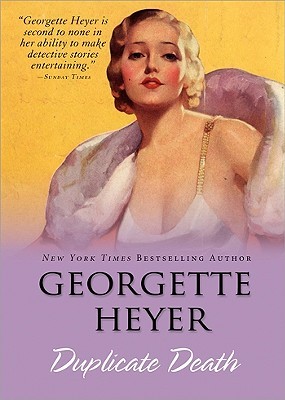
Duplicate Death. Georgette Heyer. 1951/2010. Sourcebooks. 352 pages.

I didn't enjoy Duplicate Death quite as much as Envious Casca. I thought the description on the back of the book was deceptive and confusing. The back of the book mentions a certain "Timothy Kane" and the book itself is clear throughout that it is Mr. Timothy Harte. Since this character is first introduced in chapter two as YOUNG MR. HARTE, it can be confusing until you realize that the book description is off. (The description also asserts that this character is friends with Inspector Hemingway; I found this not quite true. Inspector Hemingway apparently met this person when he was a teenager--14--and they've not seen each other in over a decade. Not exactly how I'd define a friendship. It is true that Inspector Hemingway is on friendly enough terms with Timothy once they're reacquainted on this case, which is something since Mr. Harte is technically one of a handful of suspects that had the opportunity to murder the victim.) I also didn't enjoy the ODD narration of the first and last chapters. While it isn't exactly an unsatisfactory beginning, it definitely didn't work for me as an ending.

The characters we get to know best are Timothy Harte and his girl, Miss Beulah Birtley. Miss Birtley is employed by the oh-so-disagreeable Mrs. Haddington. It is at one of her bridge parties that the first murder occurs.

There are two murders to be solved in this one; there are also additional crimes to be handled. This was one of the first mysteries I've read that deal with drug dealing and drug addiction. I didn't enjoy the characterization in this one as much as in Envious Casca, and some of the dialogue didn't work for me.

© 2013 Becky Laney of Becky's Book Reviews
Wednesday, January 30, 2013

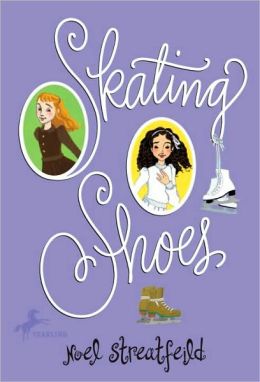
Skating Shoes (1951)

Skating Shoes. Noel Streatfeild. 1951. 224 pages.

I really loved reading Noel Streatfeild's Skating Shoes. Harriet Johnson is recovering from an illness. Part of her recovery involves daily exercise. At first, this involved tedious, dreary walks. But after visiting her doctor again (well, the doctor visits her), he prescribes something much different. Wouldn't it be wonderful if she could skate daily?! He's happy to make arrangements with the owner of the rink, but her family will have to cover the cost of renting ice skates six days a week. One of her older brothers volunteers to get a paper route which will provide just enough money to pay for the skates. (It will also allow two shillings a week to go into his savings account.) A bit timid, Harriet takes her mother with her that first day at the rink. But she happens to meet a girl her own age, Lalla Moore, and Nana. The two girls become very friendly, and though it takes some plotting on the part of Nana, it soon becomes routine for the two girls to go everywhere together. Lalla envies Harriet her large family at times. And Harriet envies Lalla's natural abilities on the ice. After a few months, these two are soon inseparable. Lalla even spends Christmas day with the Johnson family while her own aunt and uncle choose to holiday on their own. This includes having lessons together on and off the ice. (Harriet still not being allowed back in school just yet.)

Skating Shoes is a lovely book. I loved getting to know Harriet and her family. I did like Lalla. Yes, she could be obnoxious at times, showing how spoiled she was, but I felt sorry for her too. 


Read Skating Shoes
  • If you have an interest in ice skating (figure skating)
  • If you enjoy coming-of-age stories with strong friendship and family themes
  • If you enjoy Noel Streatfeild's children's books
  • If you enjoy books set in Britain 
© 2013 Becky Laney of Becky's Book Reviews

Friday, December 21, 2012

Daughter of Time

The Daughter of Time. Josephine Tey. 1951/1995. Simon & Schuster. 208 pages.

I have been wanting to reread Josephine Tey's The Daughter of Time for quite a while now. The more I read on Richard III, the more I want to read. I just find this time period to be oh-so-fascinating. And the more you read, the easier it is to keep track of who's who and who's loyal and who's not. In this Alan Grant mystery, a bed-ridden Grant turns to solving a historical mystery since he can't be working on any actual cases. A friend knowing of his boredom, of his whining, brings him a stack of portraits, hoping that one face will interest him more than the others perhaps. Grant chooses Richard III. He vaguely remembers his story, but, he wants to refresh his memory. So he begins by reading school books, then historical fiction, and then biography, etc. Grant becomes very opinionated on what he reads, judging that what passes as historical fact wouldn't be acceptable as evidence or proof in court. In other words, he finds the history books to be all gossip. For example, the biography that is supposedly so esteemed, the author would have been FIVE years old when Richard III was on the throne. Yet he writes as if he was an eyewitness to the dramatic events. Grant argues (mostly with himself and perhaps also with his two nurses) that at best the man's facts would be just stories he'd heard from others and written down. Since the biographer grew up and came into power during the Tudors--who had every reason in the world for hating and slandering Richard III--then the stories passed down to him would have bias to them. Who would make a hero out of Richard III when Henry VII or Henry VIII reigned?! He finds a kindred spirit in an American researcher named Brent Carradine. Since Grant is stuck in bed, Carradine is the man doing the hard work, digging into research. Together they discuss the facts as they see them, Grant arranges the facts seeing what he can piece together, seeing if he can make a narrative that works. He just can't believe that Richard III murdered his two nephews. Grant believes that Richard is the one with the least motive to want them dead. For their deaths do him no good whatsoever, just harm.

The Daughter of Time isn't your typical mystery novel. The detective essentially just stays in bed and reads one book after another after another. He also discusses Richard III with anyone who enters his hospital room. (His nurses don't find Richard III as fascinating as Grant does.) For readers who do enjoy history, historical fiction, this one can prove satisfying. There is a chance that mystery lovers may enjoy this one too, after all Grant himself HATES history or hates reading history, but, it may not be for everyone.  


And this SONG is a must!!!! 

You might also be interested in: The White Queen by Philippa Gregory, The Tudor Rose: A Novel of Elizabeth of York by Margaret Campbell Barnes, Richard III by William Shakespeare, The Stolen Crown by Susan Higginbotham, Sent by Margaret Peterson Haddix. Rose of York: Love & War by Sandra Worth. The Sunne in Splendour by Sharon Kay Penman. The Kingmaker's Daughter by Philippa Gregory. The Red Queen by Phillipa Gregory. The Lady of the Rivers by Philippa Gregory.

© 2012 Becky Laney of Becky's Book Reviews
Monday, February 06, 2012

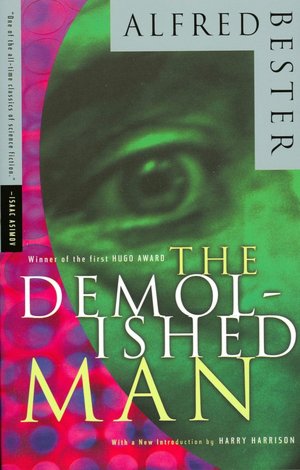
The Demolished Man

The Demolished Man. Alfred Bester. 1951. Random House. 245 pages.

Explosion! Concussion! The vault doors burst open. And deep inside, the money is racked ready for pillage, rapine, loot. Who's that? Who's inside the vault? Oh God! The Man With No Face! Looking. Looming. Silent. Horrible. Run....Run...

The Demolished Man is the winner of the first Hugo Award. I am not sure it's an absolute must-read. But. If you're a fan of science fiction, I think you should definitely consider reading this one! Depending on your expectations, of course, you might just find yourself surprised at how clever and literary well written it is.

The mystery elements of The Demolished Man made it a great read for me. The novel stars two characters. One, Ben Reich, who is determined to murder his business rival, Craye D'Courtney. With (future) society being what it is, murder is unheard of because telepaths (espers) always, always are able to read the minds of the would-be murderers and stop them before the crime is committed. But Reich plans to bribe a few high(er) level telepaths to help him cover his tracks, AND he plans on using a catchy song to distract other mind-readers in the area, to keep them from peeping his intentions.

Eight, sir; seven, sir;
Six, sir; five, sir;
Four, sir; three, sir;
two, sir; one!
'Tenser' said the Tensor.
'Tenser,' said the Tensor.
'Tension, apprehension,
And dissension have begun.' 

The second main character is Lincoln Powell, the detective on the case. (The murder is successful.) Both characters narrate this one. So readers get the view points of both the detective and the criminal. I wasn't sure how I felt about this--at first. But I think it works well, for the most part!

Have you read this one? What did you think? What did you think of the ending? Of what happens to criminals... And what did you think of the "romance"?!

This one surprised me. It did. I really liked it so much more than I thought I would. In fact, I think I may even love it. I couldn't help thinking of this Alfred Bester when I read it.

Read The Demolished Man
  • If you're a fan of classic science fiction
  • If you want to read the FIRST Hugo Winner
  • If you're interested in reading science fiction with a focus on telepaths
  • If you're a fan of mysteries and detective fiction

© 2012 Becky Laney of Becky's Book Reviews

Friday, February 03, 2012

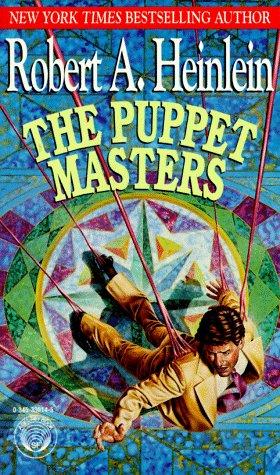
The Puppet Masters

The Puppet Masters. Robert A. Heinlein. 1951. Del Rey. 340 pages.

Were they truly intelligent? By themselves, that is? I don't know and I don't know how we can ever find out. I'm not a lab man; I'm an operator. 

I honestly don't know which Heinlein is my favorite, but it would definitely be either The Puppet Masters or The Door Into Summer. At least of the ones I've read so far. The Door Into Summer is about cold sleep and time travel. The Puppet Masters is about an alien invasion--where the aliens are parasites that take on human hosts. Both books are good--really, really good. Though if you hate science fiction, I doubt either would change your mind. (Connie Willis might change your mind though!)

So. The Puppet Masters is a novel that I think you should definitely try. I am SO SO glad I bought myself a copy.

The narrator of The Puppet Masters is an agent named "Sam." (His real name is revealed, but most people do call him Sam, so that's what I'll call him too.) When the novel opens, he's getting a new assignment. He'll be working with two other agents--his Old Man, and his "sister" "Mary" (that's not her real name either) to investigate the landing of a flying saucer in a small town in Iowa. What they discover changes everything...but it may take some convincing to be believed.

Read The Puppet Masters
  • If you're a fan of classic or vintage science fiction
  • If you're a fan of alien-invasion novels
  • If you're a fan of Robert Heinlein
  • If you like reading about how different authors have envisioned the future. (The novel is set in 2007, I believe).

© 2012 Becky Laney of Becky's Book Reviews

Thursday, July 01, 2010

Daughter of Time


The Daughter of Time. Josephine Tey. 1951/1995. Simon & Schuster. 208 pages.

Grant lay on his high white cot and stared at the ceiling. Stared at it with loathing. He knew by heart every last minute crack on its nice clean surface. He had made maps of the ceiling and gone exploring on them; rivers, islands, and continents. He had made guessing games of it and discovered hidden objects; faces, birds, and fishes. He had made mathematical calculations of it and rediscovered his childhood; theorems, angles, and triangles. There was practically nothing else he could do but look at it.

What is a man like Inspector Grant supposed to do in bed all day long? He's got a broken leg. And he's bored, bored, bored...until he becomes interested in Richard III. In the 'mystery' of what happened to Richard's two nephews. Grant reads quite matter-of-factly in the history books about this murder. But something doesn't feel right to Grant. He's looking for answers. He's looking to investigate this case for himself. What really happened to those two young boys? Why did Richard III get the blame? And why has history turned this man--who was quite well liked at the time--into a vicious monster?

I loved this one. I LOVED, LOVED, LOVED this one. Grant is a great narrator. You might think it would be boring since a) Grant never leaves his bed, let alone his room b) the mystery is a historical one, an academic one. But. This book is anything but boring! Hate reading history books? So does Inspector Grant! So whether you love or hate "history" I think you'll find much to appreciate in The Daughter of Time.

One of the reasons I loved The Daughter of Time was I thought it was unique. The book is about a man becoming fascinated with history, with a mystery within history. And how he goes about "solving" the case since he can't very well go about interviewing the witnesses and investigating the crime scene. Most of his research is done by reading. But he doesn't accept everything he reads. No, he questions everything. He thinks, really thinks, about everything closely. And I loved that. I loved how Inspector Grant pulls others in on this investigation. I loved how enthusiastic everyone becomes while 'working' on this case.

I enjoyed Josephine Tey's The Man in the Queue. I enjoyed this one even more. Grant is a great character. (I just love him!) And Tey is a great writer. I love her descriptions, her observations. She has quite a few to share on books, on authors.
Did no one, any more, no one in all this wide world, change their record now and then? Was everyone nowadays thirled to a formula? Authors today wrote so much to a pattern that their public expected it. The public talked about "a new Silas Weekley" or "a new Lavinia Fitch" exactly as they talked about "a new brick" or "a new hairbrush." They never said "a new book by" whoever it might be. Their interest was not in the book but in its newness. They knew quite well what the book would be like. (14)
Here is his description of Silas Weekley's "new" book, The Sweat and the Furrow:
The Sweat and the Furrow was Silas Weekley being earthly and spade-conscious all over seven hundred pages. The situation, to judge from the first paragraph, had not materially changed since Silas's last book: mother lying-in with her eleventh upstairs, father laid-out after his ninth downstairs, eldest son lying to the Government in the cow-shed, eldest daughter lying with her lover in the hayloft, everyone else lying low in the barn. The rain dripped from the thatch, and the manure steamed in the midden. Silas never omitted the manure. It was not Silas's fault that its steam provided the only uprising element in the picture. If Silas could have discovered a brand of steam that steamed downwards, Silas would have introduced it. (13)
You might also be interested in: The White Queen by Philippa Gregory, The Tudor Rose: A Novel of Elizabeth of York by Margaret Campbell Barnes, Richard III by William Shakespeare, The Stolen Crown by Susan Higginbotham, Sent by Margaret Peterson Haddix.

Other reviews of Daughter of Time: Booklust, Things Mean A Lot, Shelf Love, Adventures of An Intrepid Reader, Between the Covers.

© Becky Laney of Becky's Book Reviews