Red Again. Barbara Lehman. 2017. Houghton Mifflin Harcourt. 32 pages. [Source: Review copy]
Premise/plot: Does a book need words to tell a story? Red Again is a companion picture book to Barbara Lehman's The Red Book. Both, I believe, are wordless picture books. I have read Red Again. I have not--so far as I recall--read the Red Book.
In the book, a boy finds a red book in an unexpected place. The book--as it is read--leads him to the unexpected. It leads him to another reader--of the same book. The magic continues as the red book is lost and found yet again.
My thoughts: Typically my answer is "Yes, a book needs words to tell a story." But there are always exceptions to the rule. And to be clear the question does not have a 'right' or 'wrong' answer.
I think Red Again works for me because it is about the wonder and magic of books, of the reading experience. It is all about the act of reading and the delight it can bring you.
Text: 0 out of 0
Illustrations: 3 out of 5
Total: 3 out of 5
© 2018 Becky Laney of Becky's Book Reviews
Showing posts with label books reviewed in 2017. Show all posts
Monday, June 25, 2018
Wednesday, December 27, 2017
Uncle Tom's Cabin
Uncle Tom's Cabin. Harriet Beecher Stowe. 1852. 438 pages. [Source: Bought]
Dear Uncle Tom's Cabin,
I'm so sorry it took me this long to read you. You see, I blame The King and I. My only frame of reference to you was through that movie--and, well, let's be honest, that part of The King and I is hard to sit through. I didn't know you were better than that, and for that I do owe you an apology.
So why did I read you now? The Classics Club. I included you on my list in the first place because you came recommended from one of my best, best, best friends. I trust her opinion. So on the list you went. But it took the 'classics club spin' to prompt me to read you NOW. And the truth is, I was hoping you were the one--the one to get picked. (And no, I'm not just saying that.)
You're a rare gem of a novel. You are premise-driven AND character-driven--and dare I say plot-driven? The premise is simple: slavery is wrong for a million and one different reasons and there is no possible good defense to keeping it around. Some of the characters within the book are pro-slavery; some of the characters are anti-slavery. A few are confused or on the fence. Within your pages, these ideas do BATTLE. If you were just an idea-driven novel, you'd still be worth reading.
But you're not just an idea-driven novel. You're more than that.
You are definitely, without a doubt, a character-driven novel. Your characters LIVE and BREATHE. Uncle Tom. George Harris. Eliza. Miss Ophelia. Eva. St. Clare. Cassy. Emmeline. To name just a few. You might think, well, this book has an agenda--all of her characters will sound the same, act the same, hammer in the point--stick to the agenda: slavery is evil; down with slavery. And many of her characters--not just the slaves--are anti-slavery. There is an intense longing for freedom, for liberty. There is also anger and sorrow. But each slave is presented as an individual, as unique as can be. I really loved hearing each voice, learning each story. Every voice matters.
If I had to pick just one favorite character--and I don't want to, mind you--I would pick Uncle Tom. I loved Tom's faith. I loved Tom's reliance on God's daily-given-grace to endure. I loved Tom's hope. Hope that the Lord does indeed hear his prayers, see his miseries, care about him. Hope that the victory is the Lord's, that justice will be done. Hope that the Lord will see him through, that he'll be an overcomer, that heaven is HIS. I loved Tom's heart. He loved. He was compassionate. He was an encourager. He also forgave. He lived the gospel--day in, day out. He didn't just live it by example; he also spoke it. He was a seed-planter. Even when his words fell on "deaf ears," so to speak, he continued to hold true to the gospel. He didn't see sharing the good news of Jesus Christ as a waste of breath. He wanted to see others around him KNOW Jesus as he knew Jesus. Whether they were white or black, free or slave. He prayed for the salvation of Augustine, of Simon Legree, of Sambo and Quimbo, of Cassy. He knew that God can save anyone, no one was beyond God's ability to save. And because he believed so strongly in heaven and hell, he CARED. He didn't want to see anyone in hell. Tom is in many ways, a saint, just like Eva. Faith didn't come easy to Tom. It wasn't like he was all: bring on the suffering, bring on the pain, do your worst and I'll smile and grin through it all. He prayed for deliverance. He prayed for the suffering to go away. He prayed for better circumstances. He longed for freedom. Being a Christian didn't stop him from wanting, from needing. But he was content that the Lord was his lot, his portion, his reward. Near the end he proclaims, "The Lord’s bought me, and is going to take me home,—and I long to go."
As a Christian, it matters to me to see faith represented in fiction. And you do that so well. I wish there were more contemporary examples like you. Books with characters living, breathing the faith day in and day out--no matter how hard, no matter their doubts, no matter their weaknesses. Books that uphold that the Bible is the BOOK OF BOOKS. But. I'm getting distracted.
Plot-driven. Yes, you're plot-driven too. There are scenes with such intensity, such drama, such danger and peril that I was worried and on the edge of my seat. Sometimes your action wasn't so much physical as emotional. What a roller coaster of a book. My poor heart.
To sum it up, I LOVE YOU. And thank you for being you. I will do my best to encourage others to pick you up and read you. Oh. I also plan to come back and read you again.
Love, Becky
P.S. I've also reviewed you at Operation Actually Read Bible. I've included LOADS of quotes.
© 2017 Becky Laney of Becky's Book Reviews
Dear Uncle Tom's Cabin,
I'm so sorry it took me this long to read you. You see, I blame The King and I. My only frame of reference to you was through that movie--and, well, let's be honest, that part of The King and I is hard to sit through. I didn't know you were better than that, and for that I do owe you an apology.
So why did I read you now? The Classics Club. I included you on my list in the first place because you came recommended from one of my best, best, best friends. I trust her opinion. So on the list you went. But it took the 'classics club spin' to prompt me to read you NOW. And the truth is, I was hoping you were the one--the one to get picked. (And no, I'm not just saying that.)
You're a rare gem of a novel. You are premise-driven AND character-driven--and dare I say plot-driven? The premise is simple: slavery is wrong for a million and one different reasons and there is no possible good defense to keeping it around. Some of the characters within the book are pro-slavery; some of the characters are anti-slavery. A few are confused or on the fence. Within your pages, these ideas do BATTLE. If you were just an idea-driven novel, you'd still be worth reading.
But you're not just an idea-driven novel. You're more than that.
You are definitely, without a doubt, a character-driven novel. Your characters LIVE and BREATHE. Uncle Tom. George Harris. Eliza. Miss Ophelia. Eva. St. Clare. Cassy. Emmeline. To name just a few. You might think, well, this book has an agenda--all of her characters will sound the same, act the same, hammer in the point--stick to the agenda: slavery is evil; down with slavery. And many of her characters--not just the slaves--are anti-slavery. There is an intense longing for freedom, for liberty. There is also anger and sorrow. But each slave is presented as an individual, as unique as can be. I really loved hearing each voice, learning each story. Every voice matters.
If I had to pick just one favorite character--and I don't want to, mind you--I would pick Uncle Tom. I loved Tom's faith. I loved Tom's reliance on God's daily-given-grace to endure. I loved Tom's hope. Hope that the Lord does indeed hear his prayers, see his miseries, care about him. Hope that the victory is the Lord's, that justice will be done. Hope that the Lord will see him through, that he'll be an overcomer, that heaven is HIS. I loved Tom's heart. He loved. He was compassionate. He was an encourager. He also forgave. He lived the gospel--day in, day out. He didn't just live it by example; he also spoke it. He was a seed-planter. Even when his words fell on "deaf ears," so to speak, he continued to hold true to the gospel. He didn't see sharing the good news of Jesus Christ as a waste of breath. He wanted to see others around him KNOW Jesus as he knew Jesus. Whether they were white or black, free or slave. He prayed for the salvation of Augustine, of Simon Legree, of Sambo and Quimbo, of Cassy. He knew that God can save anyone, no one was beyond God's ability to save. And because he believed so strongly in heaven and hell, he CARED. He didn't want to see anyone in hell. Tom is in many ways, a saint, just like Eva. Faith didn't come easy to Tom. It wasn't like he was all: bring on the suffering, bring on the pain, do your worst and I'll smile and grin through it all. He prayed for deliverance. He prayed for the suffering to go away. He prayed for better circumstances. He longed for freedom. Being a Christian didn't stop him from wanting, from needing. But he was content that the Lord was his lot, his portion, his reward. Near the end he proclaims, "The Lord’s bought me, and is going to take me home,—and I long to go."
As a Christian, it matters to me to see faith represented in fiction. And you do that so well. I wish there were more contemporary examples like you. Books with characters living, breathing the faith day in and day out--no matter how hard, no matter their doubts, no matter their weaknesses. Books that uphold that the Bible is the BOOK OF BOOKS. But. I'm getting distracted.
Plot-driven. Yes, you're plot-driven too. There are scenes with such intensity, such drama, such danger and peril that I was worried and on the edge of my seat. Sometimes your action wasn't so much physical as emotional. What a roller coaster of a book. My poor heart.
To sum it up, I LOVE YOU. And thank you for being you. I will do my best to encourage others to pick you up and read you. Oh. I also plan to come back and read you again.
Love, Becky
P.S. I've also reviewed you at Operation Actually Read Bible. I've included LOADS of quotes.
© 2017 Becky Laney of Becky's Book Reviews
Wednesday, December 20, 2017
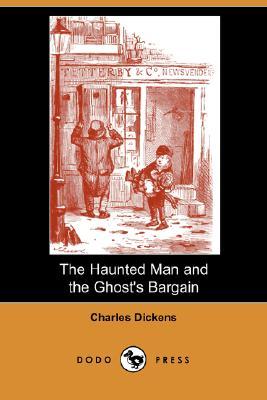
The Haunted Man and the Ghost's Bargain
The Haunted Man and the Ghost's Bargain. Charles Dickens. 1848. 100 pages. [Source: Bought]
First sentence: Everybody said so. Far be it from me to assert that what everybody says must be true. Everybody is, often, as likely to be wrong as right. In the general experience, everybody has been wrong so often, and it has taken, in most instances, such a weary while to find out how wrong, that the authority is proved to be fallible. Everybody may sometimes be right; “but THAT’S no rule,” as the ghost of Giles Scroggins says in the ballad. The dread word, GHOST, recalls me. Everybody said he looked like a haunted man. The extent of my present claim for everybody is, that they were so far right. He did.
Premise/plot: Redlaw (aka the Chemist) learns an important lesson near Christmas time. In the first chapter, he's tempted by a Phantom to give up what makes him human--though he doesn't realize the consequences, of course. The Spectre (ghost, phantom, spirit, etc.) takes away ALL of Redlaw's memories of sorrow, wrong, and trouble. And this is the gift that keeps on giving.
In the second chapter, there are CONSEQUENCES. And these consequences bring him to his knees. He learns that without feeling sorrow and remembering trouble, you have no empathy, no compassion, no concern for others. He sees the Spectre again and begs and pleads for change.
In the third chapter, readers see the curse lifted--little by little, person by person.
© 2017 Becky Laney of Becky's Book Reviews
First sentence: Everybody said so. Far be it from me to assert that what everybody says must be true. Everybody is, often, as likely to be wrong as right. In the general experience, everybody has been wrong so often, and it has taken, in most instances, such a weary while to find out how wrong, that the authority is proved to be fallible. Everybody may sometimes be right; “but THAT’S no rule,” as the ghost of Giles Scroggins says in the ballad. The dread word, GHOST, recalls me. Everybody said he looked like a haunted man. The extent of my present claim for everybody is, that they were so far right. He did.
Premise/plot: Redlaw (aka the Chemist) learns an important lesson near Christmas time. In the first chapter, he's tempted by a Phantom to give up what makes him human--though he doesn't realize the consequences, of course. The Spectre (ghost, phantom, spirit, etc.) takes away ALL of Redlaw's memories of sorrow, wrong, and trouble. And this is the gift that keeps on giving.
The gift that I have given, you shall give again, go where you will. Without recovering yourself the power that you have yielded up, you shall henceforth destroy its like in all whom you approach. Your wisdom has discovered that the memory of sorrow, wrong, and trouble is the lot of all mankind, and that mankind would be the happier, in its other memories, without it. Go! Be its benefactor! Freed from such remembrance, from this hour, carry involuntarily the blessing of such freedom with you. Its diffusion is inseparable and inalienable from you. Go! Be happy in the good you have won, and in the good you do!”
In the second chapter, there are CONSEQUENCES. And these consequences bring him to his knees. He learns that without feeling sorrow and remembering trouble, you have no empathy, no compassion, no concern for others. He sees the Spectre again and begs and pleads for change.
“What have you done?” returned the other, catching at his cloak. “What change have you wrought in me? What curse have you brought upon me? Give me back MYself!” “Give me back myself!” exclaimed Redlaw like a madman. “I am infected! I am infectious! I am charged with poison for my own mind, and the minds of all mankind. Where I felt interest, compassion, sympathy, I am turning into stone. Selfishness and ingratitude spring up in my blighting footsteps. I am only so much less base than the wretches whom I make so, that in the moment of their transformation I can hate them.”
“Shadow of myself! Spirit of my darker hours!” cried Redlaw, in distraction, “come back, and haunt me day and night, but take this gift away! Or, if it must still rest with me, deprive me of the dreadful power of giving it to others. Undo what I have done. Leave me benighted, but restore the day to those whom I have cursed. As I have spared this woman from the first, and as I never will go forth again, but will die here, with no hand to tend me, save this creature’s who is proof against me — hear me!”
“Oh, tell me,” exclaimed Redlaw, catching at the hope which he fancied might lie hidden in the words. “Can I undo what I have done?” “No,” returned the Phantom. “I do not ask for restoration to myself,” said Redlaw. “What I abandoned, I abandoned of my own free will, and have justly lost. But for those to whom I have transferred the fatal gift; who never sought it; who unknowingly received a curse of which they had no warning, and which they had no power to shun; can I do nothing?” “Nothing,” said the Phantom. “If I cannot, can any one?”
“I have no learning, and you have much,” said Milly; “I am not used to think, and you are always thinking. May I tell you why it seems to me a good thing for us, to remember wrong that has been done us?” “Yes.” “That we may forgive it.” “Pardon me, great Heaven!” said Redlaw, lifting up his eyes, “for having thrown away thine own high attribute!” “And if,” said Milly, “if your memory should one day be restored, as we will hope and pray it may be, would it not be a blessing to you to recall at once a wrong and its forgiveness?”
Redlaw fell upon his knees, with a loud cry. “O Thou, he said, “who through the teaching of pure love, hast graciously restored me to the memory which was the memory of Christ upon the Cross, and of all the good who perished in His cause, receive my thanks, and bless her!”My thoughts: This one was good. I almost think it would improve upon rereading. I also think it would pair really well with a much longer work like Les Miserables. It hits upon some of the same themes and is essentially one of those "what life is all about" books. That being said, it is so short it's hard to get truly, deeply attached to the characters. This is definitely an ISSUE-driven book and not a character-driven book.
© 2017 Becky Laney of Becky's Book Reviews
Tuesday, December 19, 2017
Among the Free
Among the Free (Shadow Children #7) Margaret Peterson Haddix. 2006. 208 pages. [Source: Library]
First sentence: Luke Garner stood shoulder to shoulder with a dozen other boys, waiting.
Premise/plot: Among the Free is the final book in the Shadow Children series by Margaret Peterson Haddix. This one is all about bringing the whole series together and giving it a mostly tidy ending. Luke, and most of the other children we've met, are now in the ranks of the Population Police. These would-be rebels and spies are not having an easy time communicating with one another. Fortunately, the population police and the government are on the verge of collapse anyway. A few individual acts here and there seem to be enough to start society's downfall. Luke is at first overjoyed; but skepticism sets in, and not without reason. The new leader is not new to readers. His name: Oscar. Luke does not trust him even a little bit. And Luke's suspicions grow more as he watches the new government come together. He's been hesitant to speak up and play a role in the movement in the past, but, in this final novel he finds the motivation he needs. Will it be enough? Or is it too late?
My thoughts: I enjoyed the whole series. I think I enjoyed it even more upon rereading it. I am not sure I appreciated the various narrators the first time around. I wanted Luke and only Luke. But the series is stronger, I feel, because of the various narrators and points of view. One thing I realized is that each narrator illustrates a different way to be strong, to be brave, to take action. There is no one cookie-cutter way to get things done. Also the right action is rarely the easy, comfortable action.
© 2017 Becky Laney of Becky's Book Reviews
First sentence: Luke Garner stood shoulder to shoulder with a dozen other boys, waiting.
Premise/plot: Among the Free is the final book in the Shadow Children series by Margaret Peterson Haddix. This one is all about bringing the whole series together and giving it a mostly tidy ending. Luke, and most of the other children we've met, are now in the ranks of the Population Police. These would-be rebels and spies are not having an easy time communicating with one another. Fortunately, the population police and the government are on the verge of collapse anyway. A few individual acts here and there seem to be enough to start society's downfall. Luke is at first overjoyed; but skepticism sets in, and not without reason. The new leader is not new to readers. His name: Oscar. Luke does not trust him even a little bit. And Luke's suspicions grow more as he watches the new government come together. He's been hesitant to speak up and play a role in the movement in the past, but, in this final novel he finds the motivation he needs. Will it be enough? Or is it too late?
My thoughts: I enjoyed the whole series. I think I enjoyed it even more upon rereading it. I am not sure I appreciated the various narrators the first time around. I wanted Luke and only Luke. But the series is stronger, I feel, because of the various narrators and points of view. One thing I realized is that each narrator illustrates a different way to be strong, to be brave, to take action. There is no one cookie-cutter way to get things done. Also the right action is rarely the easy, comfortable action.
© 2017 Becky Laney of Becky's Book Reviews
Monday, December 18, 2017
Among the Enemy
Among the Enemy. (Shadow Children #6) Margaret Peterson Haddix. 2005. 240 pages. [Source: Library]
First sentence: Matthias was sound asleep when the Population Police arrived at Niedler School.
Premise/plot: Among the Enemy is the sixth book in Margaret Peterson Haddix' Shadow Children series. Haddix rarely has the same narrator twice in this series. The narrator of this one is Matthias. (We've met him before in book three, Among the Betrayed.) He's still protective of Percy and Alia so when all three are taken into custody by the Population Police--along with all the other students--he feels responsible for anything and everything that goes wrong in their attempt to escape. He feels he must do something to help--if not Percy and Alia--then ALL the other shadow children whose lives are being threatened every day by the enemy. How can he best help them? Ultimately by going among them--becoming one of them, learning their plans, passing along information to the rebels.
My thoughts: Matthias is a complex character. I loved him. I did. I think he's one of my favorite characters in the series. I love his sensitivity, his thoughtfulness, his bravery. I love how quick-paced Haddix's novels are as well. I'm so glad I decided to reread this series.
© 2017 Becky Laney of Becky's Book Reviews
First sentence: Matthias was sound asleep when the Population Police arrived at Niedler School.
Premise/plot: Among the Enemy is the sixth book in Margaret Peterson Haddix' Shadow Children series. Haddix rarely has the same narrator twice in this series. The narrator of this one is Matthias. (We've met him before in book three, Among the Betrayed.) He's still protective of Percy and Alia so when all three are taken into custody by the Population Police--along with all the other students--he feels responsible for anything and everything that goes wrong in their attempt to escape. He feels he must do something to help--if not Percy and Alia--then ALL the other shadow children whose lives are being threatened every day by the enemy. How can he best help them? Ultimately by going among them--becoming one of them, learning their plans, passing along information to the rebels.
My thoughts: Matthias is a complex character. I loved him. I did. I think he's one of my favorite characters in the series. I love his sensitivity, his thoughtfulness, his bravery. I love how quick-paced Haddix's novels are as well. I'm so glad I decided to reread this series.
© 2017 Becky Laney of Becky's Book Reviews
Sunday, December 17, 2017
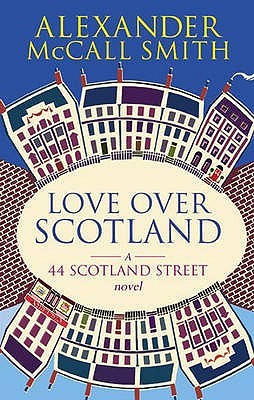
Love Over Scotland
Love Over Scotland (44 Scotland Street #3) Alexander McCall Smith. 2006. 355 pages. [Source: Library]
First sentence: Pat let her gaze move slowly round the room, over the figures seated at the table in the seminar room.
Premise/plot: Love Over Scotland is the third book in the series by Alexander McCall Smith. I have loved each and every one. (44 Scotland Street, Espresso Tales). It is set in Edinburgh. It follows the lives of a handful of characters. Some of the characters are CHARACTERS. Each chapter is short and episodic, the book originally appeared in serial form in the newspaper. It is exactly like a soap opera in print, minus the graphic smut.
My thoughts: I really love some of these characters. My favorite character is without a doubt Bertie. The scene with Bertie and his therapist was one of the funniest I've ever read. The therapist thinks that Bertie has created an imaginary friend named Tofu. Now readers know that Tofu is a real child in his class. But this therapist won't be convinced otherwise! And Bertie finally lets the matter go. He knows what's real and what isn't. And his doctor is NUTS. Bertie also joins a teenage orchestra in this one and goes to PARIS, FRANCE. The good news is that he's at last free from his mother. The bad news is, well, I'm not sure there is bad news. True, the group technically leaves him behind. But that leads to Bertie having the BEST DAY EVER. I also enjoyed Angus and his dog in this one. These two are always great fun. There were so many great moments in this one. (I do like that Pat and Matthew finally start dating in this one. I really like Matthew, but he just can't compete with the six year old Bertie in terms of stealing scenes.
© 2017 Becky Laney of Becky's Book Reviews
First sentence: Pat let her gaze move slowly round the room, over the figures seated at the table in the seminar room.
Premise/plot: Love Over Scotland is the third book in the series by Alexander McCall Smith. I have loved each and every one. (44 Scotland Street, Espresso Tales). It is set in Edinburgh. It follows the lives of a handful of characters. Some of the characters are CHARACTERS. Each chapter is short and episodic, the book originally appeared in serial form in the newspaper. It is exactly like a soap opera in print, minus the graphic smut.
My thoughts: I really love some of these characters. My favorite character is without a doubt Bertie. The scene with Bertie and his therapist was one of the funniest I've ever read. The therapist thinks that Bertie has created an imaginary friend named Tofu. Now readers know that Tofu is a real child in his class. But this therapist won't be convinced otherwise! And Bertie finally lets the matter go. He knows what's real and what isn't. And his doctor is NUTS. Bertie also joins a teenage orchestra in this one and goes to PARIS, FRANCE. The good news is that he's at last free from his mother. The bad news is, well, I'm not sure there is bad news. True, the group technically leaves him behind. But that leads to Bertie having the BEST DAY EVER. I also enjoyed Angus and his dog in this one. These two are always great fun. There were so many great moments in this one. (I do like that Pat and Matthew finally start dating in this one. I really like Matthew, but he just can't compete with the six year old Bertie in terms of stealing scenes.
© 2017 Becky Laney of Becky's Book Reviews
Labels:
2006,
adult fiction,
books reviewed in 2017,
library book
Friday, December 15, 2017
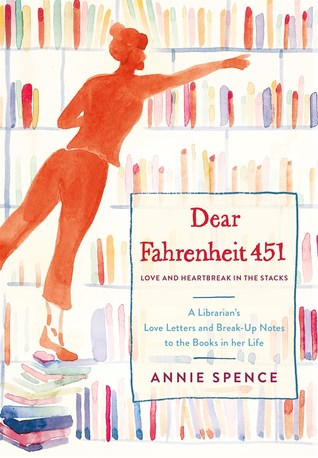
Dear Fahrenheit 451
Dear Fahrenheit 451: Love and Heartbreak in the Stacks: A Librarian's Love Letters and Breakup Notes to the Books in Her Life. Annie Spence. 2017. 256 pages. [Source: Library]
Premise/plot: Most of the book consists of "letters" to various books from the author's life--personal and professional, read and unread. Some letters are 100% snark. Others are more sentimental and gushy. A good many contain profanity, the profanity that isn't so much necessary (warranted) as deemed entertaining and "cool."
My thoughts:
Dear Fahrenheit 451,
I wanted to love you. I mean just LOOK at that cover. It promises great things. And it wasn't just your cover I was drawn to, it was also your premise. A book about books, what is there not to love? But I could have done with a little more sincerity and a little less snark. Don't get me wrong, I can appreciate snark. But it has its time and place. A pickle goes great with many meals, but who would want to eat a meal consisting solely of pickles?!
What I loved best was the premise. I would love to start writing letters to the books in my life--past and present. I think I will.
I do think you will find a readership. There are plenty of readers--of all ages--who will find themselves nodding their heads, smiling, wanting to read some of your passages aloud to anyone and everyone who will listen, or pretend to listen. (I loved her letter to Color Me Beautiful).
Becky
Favorite quotes:
Premise/plot: Most of the book consists of "letters" to various books from the author's life--personal and professional, read and unread. Some letters are 100% snark. Others are more sentimental and gushy. A good many contain profanity, the profanity that isn't so much necessary (warranted) as deemed entertaining and "cool."
My thoughts:
Dear Fahrenheit 451,
I wanted to love you. I mean just LOOK at that cover. It promises great things. And it wasn't just your cover I was drawn to, it was also your premise. A book about books, what is there not to love? But I could have done with a little more sincerity and a little less snark. Don't get me wrong, I can appreciate snark. But it has its time and place. A pickle goes great with many meals, but who would want to eat a meal consisting solely of pickles?!
What I loved best was the premise. I would love to start writing letters to the books in my life--past and present. I think I will.
I do think you will find a readership. There are plenty of readers--of all ages--who will find themselves nodding their heads, smiling, wanting to read some of your passages aloud to anyone and everyone who will listen, or pretend to listen. (I loved her letter to Color Me Beautiful).
Becky
Favorite quotes:
[Dear Miss Maple Series,]
Who would have thought a gossipy spinster from St. Mary Mead could bring us all together? Sometimes I wonder if the library could get by on a collection that was just you, A Child Called It, The Five Love Languages, and some Rick Steve travel DVDs. Honestly, I think we'd make it a week before someone complained. But you're my favorite, Miss M. My good-time gal. Props, Annie. (18-9)
Dear Frog and Toad Storybook Treasury,
I've been with a lot of books and had other characters who've imprinted themselves on my heart. But your main character Toad is my spirit animal. For starters, we are both pear shaped. But it's so much more than body types. Toad's very character aligns so closely with my own that I find myself going to some of your stories for advice. What would Toad do, I ask myself, when faced with a challenge. Would he go home and sleep or make some food? Either way, it's excellent counsel...(42-3)
Dear Fahrenheit 451,© 2017 Becky Laney of Becky's Book Reviews
Don't ever change. And stay here with us, always. You were created in a library, and I'm comforted by the fact that you'll remain on library shelves around the world...(85-6)
Thursday, December 14, 2017
Raid of No Return
Raid of No Return. (Nathan Hale's Hazardous Tales #7) Nathan Hale. 2017. [November] Abrams. 128 pages. [Source: Library]
First sentence: On March 8th, 1862, near the entrance to the Chesapeake Bay, the confederate ironclad CSS Virginia steamed into battle.
Premise/plot: Raid of No Return is part of a graphic-novel historical series written by Nathan Hale and starring Nathan Hale. Nathan Hale is joined by his executioners. He is delaying his execution by telling super-exciting action-packed stories from history, from the future. In this seventh adventure, he is turning to the second world war. This book is ALL about the Doolittle Raid or the Tokyo Raid of 1942. The adventure begins with the Japanese training to attack the United States.
My thoughts: I love, love, love this series. This is a good addition to that series. I love that the book follows all sixteen planes and their crews that took part in the raid. A few of the names were familiar to me, but not all of them. I would definitely recommend this one to anyone who enjoys history. You don't have to "love" graphic novels to be swept up into this story.
© 2017 Becky Laney of Becky's Book Reviews
First sentence: On March 8th, 1862, near the entrance to the Chesapeake Bay, the confederate ironclad CSS Virginia steamed into battle.
Premise/plot: Raid of No Return is part of a graphic-novel historical series written by Nathan Hale and starring Nathan Hale. Nathan Hale is joined by his executioners. He is delaying his execution by telling super-exciting action-packed stories from history, from the future. In this seventh adventure, he is turning to the second world war. This book is ALL about the Doolittle Raid or the Tokyo Raid of 1942. The adventure begins with the Japanese training to attack the United States.
My thoughts: I love, love, love this series. This is a good addition to that series. I love that the book follows all sixteen planes and their crews that took part in the raid. A few of the names were familiar to me, but not all of them. I would definitely recommend this one to anyone who enjoys history. You don't have to "love" graphic novels to be swept up into this story.
© 2017 Becky Laney of Becky's Book Reviews
Wednesday, December 13, 2017
The Nutcracker Mice
The Nutcracker Mice. Kristin Kladstrup. Illustrated by Brett Helquist. 2017. [October 24] 336 pages. [Source: Review copy]
First sentence: There were mice at the Mariinsky.
Premise/plot: The Nutcracker Mice is set in Saint Petersburg, Russia in 1892. It takes place mostly in the theatre. A new ballet is about to premiere, The Nutcracker. The humans and the mice are hard at work on their productions. The mice face a more difficult challenge. They fear mice will not come to see--pay to see--a play where mice are the villains and are killed. They also fear that mice that are interested in seeing the new ballet, would choose to see the humans--with their elaborate costumes and sets--perform for free. And then there's the challenge of staying alive in the first place--finding enough food and avoiding mouse traps.
The heroine of The Nutcracker Mice is a young mouse named Esmerelda. She befriends a young girl, Irina, the daughter of a janitor and costume maker. Esmerelda's quick-thinking may just save the day.
My thoughts: I really LOVED this one. I loved, loved, loved that Esmerelda and the mice decided to rewrite the Nutcracker, to adapt it to suit their audience. This one was just satisfying to read. I loved every minute of it. Much like I love every minute of the Nutcracker Suite.
© 2017 Becky Laney of Becky's Book Reviews
First sentence: There were mice at the Mariinsky.
Premise/plot: The Nutcracker Mice is set in Saint Petersburg, Russia in 1892. It takes place mostly in the theatre. A new ballet is about to premiere, The Nutcracker. The humans and the mice are hard at work on their productions. The mice face a more difficult challenge. They fear mice will not come to see--pay to see--a play where mice are the villains and are killed. They also fear that mice that are interested in seeing the new ballet, would choose to see the humans--with their elaborate costumes and sets--perform for free. And then there's the challenge of staying alive in the first place--finding enough food and avoiding mouse traps.
The heroine of The Nutcracker Mice is a young mouse named Esmerelda. She befriends a young girl, Irina, the daughter of a janitor and costume maker. Esmerelda's quick-thinking may just save the day.
My thoughts: I really LOVED this one. I loved, loved, loved that Esmerelda and the mice decided to rewrite the Nutcracker, to adapt it to suit their audience. This one was just satisfying to read. I loved every minute of it. Much like I love every minute of the Nutcracker Suite.
© 2017 Becky Laney of Becky's Book Reviews
Tuesday, December 12, 2017
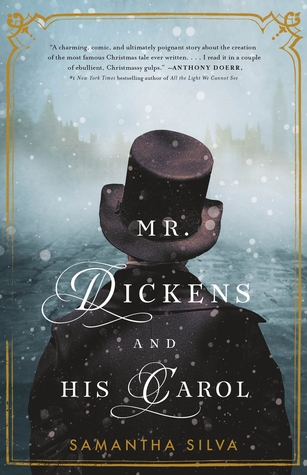
Mr. Dickens and His Carol
Mr. Dickens and His Carol. Samantha Silva. 2017. 288 pages. [Source: Review copy]
First sentence: On that unseasonably warm November day at One Devonshire Terrace, Christmas was not in his head at all. His cravat was loose, top button of his waistcoat undone, study windows flung open as far as they’d go. Chestnut curls bobbed over his dark slate eyes that brightened to each word he wrote: this one, no, that one, scribble and scratch, a raised brow, a tucked chin, a guffaw. Every expression was at the ready, every limb engaged in the urgent deed. Nothing else existed. Not hunger or thirst, not the thrumming of the household above and below—a wife about to give birth, five children already, four servants, two Newfoundlands, a Pomeranian, and the Master’s Cat, now pawing at his quill. Not time, neither past nor future, just the clear-eyed now, and words spilling out of him faster than he could think them.
Premise/plot: Mr. Dickens and His Carol is a fictionalized account of how Charles Dickens wrote A Christmas Carol. It contains several true facts: the necessity of writing/publishing a Christmas book in such a short period of time; the name of Charles Dickens and his family members; quotes from A Christmas Carol. But it is largely fictional.
It is just a few weeks before Christmas. His wife has just given birth. His publisher has come to him with a demand: write a Christmas book...or else. His last book--his current book, Martin Chuzzlewit--isn't doing well...at all. His publishers NEED a successful book. There is no other way.
Dickens finds himself in need of a MUSE.
My thoughts: This was an extremely entertaining and mostly satisfying read. It is divorced from truth, perhaps. But I found it almost impossible to put down. The chapters just beg to be read right then and there. It helps that they are short chapters too. The writing was delicious. I'll do my best to show you what I mean:
© 2017 Becky Laney of Becky's Book Reviews
First sentence: On that unseasonably warm November day at One Devonshire Terrace, Christmas was not in his head at all. His cravat was loose, top button of his waistcoat undone, study windows flung open as far as they’d go. Chestnut curls bobbed over his dark slate eyes that brightened to each word he wrote: this one, no, that one, scribble and scratch, a raised brow, a tucked chin, a guffaw. Every expression was at the ready, every limb engaged in the urgent deed. Nothing else existed. Not hunger or thirst, not the thrumming of the household above and below—a wife about to give birth, five children already, four servants, two Newfoundlands, a Pomeranian, and the Master’s Cat, now pawing at his quill. Not time, neither past nor future, just the clear-eyed now, and words spilling out of him faster than he could think them.
Premise/plot: Mr. Dickens and His Carol is a fictionalized account of how Charles Dickens wrote A Christmas Carol. It contains several true facts: the necessity of writing/publishing a Christmas book in such a short period of time; the name of Charles Dickens and his family members; quotes from A Christmas Carol. But it is largely fictional.
It is just a few weeks before Christmas. His wife has just given birth. His publisher has come to him with a demand: write a Christmas book...or else. His last book--his current book, Martin Chuzzlewit--isn't doing well...at all. His publishers NEED a successful book. There is no other way.
Dickens finds himself in need of a MUSE.
My thoughts: This was an extremely entertaining and mostly satisfying read. It is divorced from truth, perhaps. But I found it almost impossible to put down. The chapters just beg to be read right then and there. It helps that they are short chapters too. The writing was delicious. I'll do my best to show you what I mean:
“To whom shall I make it?” “Marley, sir. Jacob. A man who’s never missed a word you’ve written.” “My favorite sort of reader.” Dickens signed with a flourish. He sensed his children watching, felt Mamie squeeze his arm. He handed the album back with a satisfied smile. “Jacob Marley, I am ever in your service.” The gentleman flipped to the page to review his newest get. “Dickens? I thought you was Thackeray!” He tore it out, crumpled it into a ball, and tossed it into the street, stomping away.
The children watched their father’s autograph be further insulted by the wheel of an omnibus clip-clopping past. Dickens narrowed his eyes. “Well. How sad Mr. Marley will be when I introduce him in my new number, only to kill him off in the next.” “He should be dead to begin with,” said young Charley. “Dead as a doornail,” said Katey. “So he shall. So he shall.” The matter settled, Dickens turned for home. His children trooped behind in cautious silence.
“A tree?” demanded Dickens. “Inside the house?” “A Christmas tree. From Germany.” “Have we no trees in England?” “The Queen and Prince Albert insist on it. It’s a new tradition.” “Traditions are not new, Catherine. They are old. And we cannot afford the ones we have!”
“Your past is quicker than you are and will catch you soon enough.”
“Writers told what to write. Readers told what to read. People who do whatever you do … told what to do!” Dickens waved his arms like a windmill gone mad. “And once again, everyone making money on me but me!”
She nodded, her voice quiet as a prayer. “But every book you’ve ever written is a book about Christmas. About the feeling we must have for one another, without which we are lost.”
Ebenezer Scrooge was waking to a new world, a new self, tears still wet on his face. For a miserable bean counter who had long made a business out of men, he now knew that his business was all mankind. Dickens wept and laughed and wept again.
© 2017 Becky Laney of Becky's Book Reviews
Monday, December 11, 2017
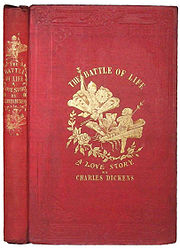
The Battle of Life
The Battle of Life. Charles Dickens. 1846. 88 pages. [Source: Bought]
First sentence: Once upon a time, it matters little when, and in stalwart England, it matters little where, a fierce battle was fought. It was fought upon a long summer day when the waving grass was green.
Premise/plot: Doctor Jeddler has two daughters, Grace and Marion. Marion, the younger daughter, is engaged to Alfred Heathfield. No one could be happier for the couple than Grace. In fact, Grace talks about Alfred morning, noon, and night. The engagement is to be a long one, of several years. As the time nears for Alfred's return, Marion begins acting strangely. This is about the same time that Michael Warden makes plans to leave the country--due to financial disgrace/ruin. Could these two be in love? Perhaps. One thing is certain, Marion does meet secretly with him before Alfred's return. Clemency Newcome, a servant in the home, witnesses this arrangement.
My thoughts: I loved this one. I at least loved it more than I ever thought possible. Dickens introduces some great characters. Dr. Jeddler has a STRANGE philosophy about the meaning of life. As do some of the other characters in this one. (I can't remember now if it was Snitchey or Craggs that philosophizes. But here is the man's philosophy: "Everything appears to me to be made too easy, now-a-days. It’s the vice of these times. If the world is a joke (I am not prepared to say it isn’t), it ought to be made a very difficult joke to crack. It ought to be as hard a struggle, sir, as possible. That’s the intention. But, it’s being made far too easy. We are oiling the gates of life. They ought to be rusty. We shall have them beginning to turn, soon, with a smooth sound.") I really loved Clemency Newcome and Ben Britain, the two servants. They may be my favorite characters in the novella. I hoped that these two would end up together. I was so SATISFIED when they did.
The relationship between Marion and Grace was interesting and strange. I was certainly fooled by Dickens' presentation of Marion. For most of the novella, Marion is portrayed as being completely disinterested in Alfred and matrimony. Certainly there was not any indication that she's madly in love with him. Grace's crush on Alfred was obvious, and once Marion was out of the picture, it was equally obvious that these two would console each other all the way to the altar. Is it a good sign or a bad one that they choose Marion's birthday to be their wedding day?! Marion's big reveal was surprising--when it came. Is it realistic? Is it romantic? Or is it just all kinds of strange?
It did begin in an odd way, I admit. Several pages spent describing in detail a bloody battlefield. Centuries later--I'm supposing, though it could just be decades--all traces of the battle, of the blood and gore, are gone. What remains is a village full of life.
Quotes:
© 2017 Becky Laney of Becky's Book Reviews
First sentence: Once upon a time, it matters little when, and in stalwart England, it matters little where, a fierce battle was fought. It was fought upon a long summer day when the waving grass was green.
Premise/plot: Doctor Jeddler has two daughters, Grace and Marion. Marion, the younger daughter, is engaged to Alfred Heathfield. No one could be happier for the couple than Grace. In fact, Grace talks about Alfred morning, noon, and night. The engagement is to be a long one, of several years. As the time nears for Alfred's return, Marion begins acting strangely. This is about the same time that Michael Warden makes plans to leave the country--due to financial disgrace/ruin. Could these two be in love? Perhaps. One thing is certain, Marion does meet secretly with him before Alfred's return. Clemency Newcome, a servant in the home, witnesses this arrangement.
My thoughts: I loved this one. I at least loved it more than I ever thought possible. Dickens introduces some great characters. Dr. Jeddler has a STRANGE philosophy about the meaning of life. As do some of the other characters in this one. (I can't remember now if it was Snitchey or Craggs that philosophizes. But here is the man's philosophy: "Everything appears to me to be made too easy, now-a-days. It’s the vice of these times. If the world is a joke (I am not prepared to say it isn’t), it ought to be made a very difficult joke to crack. It ought to be as hard a struggle, sir, as possible. That’s the intention. But, it’s being made far too easy. We are oiling the gates of life. They ought to be rusty. We shall have them beginning to turn, soon, with a smooth sound.") I really loved Clemency Newcome and Ben Britain, the two servants. They may be my favorite characters in the novella. I hoped that these two would end up together. I was so SATISFIED when they did.
The relationship between Marion and Grace was interesting and strange. I was certainly fooled by Dickens' presentation of Marion. For most of the novella, Marion is portrayed as being completely disinterested in Alfred and matrimony. Certainly there was not any indication that she's madly in love with him. Grace's crush on Alfred was obvious, and once Marion was out of the picture, it was equally obvious that these two would console each other all the way to the altar. Is it a good sign or a bad one that they choose Marion's birthday to be their wedding day?! Marion's big reveal was surprising--when it came. Is it realistic? Is it romantic? Or is it just all kinds of strange?
It did begin in an odd way, I admit. Several pages spent describing in detail a bloody battlefield. Centuries later--I'm supposing, though it could just be decades--all traces of the battle, of the blood and gore, are gone. What remains is a village full of life.
Quotes:
My private opinion is, and I hope you agree with me, that we might get on a great deal better than we do, and might be infinitely more agreeable company than we are.
‘Don’t you know it’s always somebody’s birth-day? Did you never hear how many new performers enter on this — ha! ha! ha! — it’s impossible to speak gravely of it — on this preposterous and ridiculous business called Life, every minute?’
She was about thirty years old, and had a sufficiently plump and cheerful face, though it was twisted up into an odd expression of tightness that made it comical. But, the extraordinary homeliness of her gait and manner, would have superseded any face in the world. To say that she had two left legs, and somebody else’s arms, and that all four limbs seemed to be out of joint, and to start from perfectly wrong places when they were set in motion, is to offer the mildest outline of the reality. To say that she was perfectly content and satisfied with these arrangements, and regarded them as being no business of hers, and that she took her arms and legs as they came, and allowed them to dispose of themselves just as it happened, is to render faint justice to her equanimity. Her dress was a prodigious pair of self-willed shoes, that never wanted to go where her feet went; blue stockings; a printed gown of many colours, and the most hideous pattern procurable for money; and a white apron. She always wore short sleeves, and always had, by some accident, grazed elbows, in which she took so lively an interest, that she was continually trying to turn them round and get impossible views of them.
Such, in outward form and garb, was Clemency Newcome; who was supposed to have unconsciously originated a corruption of her own Christian name, from Clementina (but nobody knew, for the deaf old mother, a very phenomenon of age, whom she had supported almost from a child, was dead, and she had no other relation); who now busied herself in preparing the table, and who stood, at intervals, with her bare red arms crossed, rubbing her grazed elbows with opposite hands, and staring at it very composedly, until she suddenly remembered something else she wanted, and jogged off to fetch it.
‘The combatants are very eager and very bitter in that same battle of Life. There’s a great deal of cutting and slashing, and firing into people’s heads from behind. There is terrible treading down, and trampling on. It is rather a bad business.’ ‘I believe, Mr. Snitchey,’ said Alfred, ‘there are quiet victories and struggles, great sacrifices of self, and noble acts of heroism, in it — even in many of its apparent lightnesses and contradictions -not the less difficult to achieve, because they have no earthly chronicle or audience — done every day in nooks and corners, and in little households, and in men’s and women’s hearts — any one of which might reconcile the sternest man to such a world, and fill him with belief and hope in it, though two-fourths of its people were at war, and another fourth at law; and that’s a bold word.’
Snitchey and Craggs were the best friends in the world, and had a real confidence in one another; but Mrs. Snitchey, by a dispensation not uncommon in the affairs of life, was on principle suspicious of Mr. Craggs; and Mrs. Craggs was on principle suspicious of Mr. Snitchey.
‘What! overcome by a story-book!’ said Doctor Jeddler. ‘Print and paper! Well, well, it’s all one. It’s as rational to make a serious matter of print and paper as of anything else. But, dry your eyes, love, dry your eyes. I dare say the heroine has got home again long ago, and made it up all round — and if she hasn’t, a real home is only four walls; and a fictitious one, mere rags and ink. What’s the matter now?’
‘Lor!’ replied his fair companion, with her favourite twist of her favourite joints. ‘I wish it was me, Britain!’ ‘Wish what was you?’ ‘A-going to be married,’ said Clemency. Benjamin took his pipe out of his mouth and laughed heartily. ‘Yes! you’re a likely subject for that!’ he said. ‘Poor Clem!’ Clemency for her part laughed as heartily as he, and seemed as much amused by the idea. ‘Yes,’ she assented, ‘I’m a likely subject for that; an’t I?’ ‘YOU’LL never be married, you know,’ said Mr. Britain, resuming his pipe. ‘Don’t you think I ever shall though?’ said Clemency, in perfect good faith. Mr. Britain shook his head. ‘Not a chance of it!’ ‘Only think!’ said Clemency. ‘Well! — I suppose you mean to, Britain, one of these days; don’t you?’
‘I can’t help liking you,’ said Mr. Britain; ‘you’re a regular good creature in your way, so shake hands, Clem. Whatever happens, I’ll always take notice of you, and be a friend to you.’ ‘Will you?’ returned Clemency. ‘Well! that’s very good of you.’ ‘Yes, yes,’ said Mr. Britain, giving her his pipe to knock the ashes out of it; ‘I’ll stand by you. Hark! That’s a curious noise!’
A month soon passes, even at its tardiest pace. The month appointed to elapse between that night and the return, was quick of foot, and went by, like a vapour. The day arrived. A raging winter day, that shook the old house, sometimes, as if it shivered in the blast.
We count by changes and events within us. Not by years.
© 2017 Becky Laney of Becky's Book Reviews
Saturday, December 09, 2017
The Cricket on the Hearth
The Cricket on the Hearth. Charles Dickens. 1845. 84 pages. [Source: Bought]
First sentence: The kettle began it! Don’t tell me what Mrs. Peerybingle said. I know better. Mrs. Peerybingle may leave it on record to the end of time that she couldn’t say which of them began it; but, I say the kettle did. I ought to know, I hope! The kettle began it, full five minutes by the little waxy-faced Dutch clock in the corner, before the Cricket uttered a chirp.
Premise/plot: This novella doesn't have chapters, it has chirps. Readers meet a happily married couple with a baby: Mr. and Mrs. Peerybingle. (His name is John. Her name is Dot). The couple's wedding anniversary is nearing, and an acquaintance of theirs is soon to be wed. But Tackleton, the groom-to-be is nothing like John. And the bride-to-be, May, is not in love. Tackleton knows this, and is rather proud. He feels Mr. Peerybingle is foolish for loving his wife as he does, and plants seeds of doubt in his mind. Does Dot really truly love him? Or is he blinded by his own love for her? Could his wife even be carrying on with another man behind his back?!
Mr. Peerybingle is not quite as bad as Othello in terms of jealousy. But is that because he's got a Cricket in the hearth watching over his home and preventing the worst of it?! Perhaps. His wife is keeping a secret from her husband, but, it's a good secret. One concerning a friend. She isn't the only one with a secret that's a burden.
Caleb Plummer has been lying to his blind daughter, Bertha, for YEARS. The biggest lie of all is that the man who employs them to make toys--Tackleton--is a kind, good, pleasant man. The problem is, he's mean, inconsiderate, and extremely UNpleasant. She's fallen in love with a lie--a man of her father's creation. Her heart is breaking that Tackleton is marrying.
With Dot's help, Caleb is going to tell her the truth. John will learn the truth as well; some details come from his wife, but others come from the Cricket and the household fairies.
Will May and Tackleton marry? Or does the day hold surprises of its own?
My thoughts: This was my first time to read The Cricket on the Hearth. It had its worrying moments. In the hand of Thomas Hardy, I don't think I could have gone on. John has to walk down a dark valley and be sorely tempted. This one could easily have gone the way of Othello. Fortunately, Dickens did not go that route! Perhaps because this one provides such a contrast of human emotion, the happy ending was all the more joyful.
Favorite quotes:
© 2017 Becky Laney of Becky's Book Reviews
First sentence: The kettle began it! Don’t tell me what Mrs. Peerybingle said. I know better. Mrs. Peerybingle may leave it on record to the end of time that she couldn’t say which of them began it; but, I say the kettle did. I ought to know, I hope! The kettle began it, full five minutes by the little waxy-faced Dutch clock in the corner, before the Cricket uttered a chirp.
Premise/plot: This novella doesn't have chapters, it has chirps. Readers meet a happily married couple with a baby: Mr. and Mrs. Peerybingle. (His name is John. Her name is Dot). The couple's wedding anniversary is nearing, and an acquaintance of theirs is soon to be wed. But Tackleton, the groom-to-be is nothing like John. And the bride-to-be, May, is not in love. Tackleton knows this, and is rather proud. He feels Mr. Peerybingle is foolish for loving his wife as he does, and plants seeds of doubt in his mind. Does Dot really truly love him? Or is he blinded by his own love for her? Could his wife even be carrying on with another man behind his back?!
Mr. Peerybingle is not quite as bad as Othello in terms of jealousy. But is that because he's got a Cricket in the hearth watching over his home and preventing the worst of it?! Perhaps. His wife is keeping a secret from her husband, but, it's a good secret. One concerning a friend. She isn't the only one with a secret that's a burden.
Caleb Plummer has been lying to his blind daughter, Bertha, for YEARS. The biggest lie of all is that the man who employs them to make toys--Tackleton--is a kind, good, pleasant man. The problem is, he's mean, inconsiderate, and extremely UNpleasant. She's fallen in love with a lie--a man of her father's creation. Her heart is breaking that Tackleton is marrying.
With Dot's help, Caleb is going to tell her the truth. John will learn the truth as well; some details come from his wife, but others come from the Cricket and the household fairies.
Will May and Tackleton marry? Or does the day hold surprises of its own?
My thoughts: This was my first time to read The Cricket on the Hearth. It had its worrying moments. In the hand of Thomas Hardy, I don't think I could have gone on. John has to walk down a dark valley and be sorely tempted. This one could easily have gone the way of Othello. Fortunately, Dickens did not go that route! Perhaps because this one provides such a contrast of human emotion, the happy ending was all the more joyful.
Favorite quotes:
- The kettle had had the last of its solo performance. It persevered with undiminished ardour; but the Cricket took first fiddle and kept it. Good Heaven, how it chirped! Its shrill, sharp, piercing voice resounded through the house, and seemed to twinkle in the outer darkness like a star. There was an indescribable little trill and tremble in it, at its loudest, which suggested its being carried off its legs, and made to leap again, by its own intense enthusiasm. Yet they went very well together, the Cricket and the kettle. The burden of the song was still the same; and louder, louder, louder still, they sang it in their emulation.
- When she came back, and sat down in her former seat, the Cricket and the kettle were still keeping it up, with a perfect fury of competition. The kettle’s weak side clearly being, that he didn’t know when he was beat. There was all the excitement of a race about it. Chirp, chirp, chirp! Cricket a mile ahead. Hum, hum, hum — m — m! Kettle making play in the distance, like a great top. Chirp, chirp, chirp! Cricket round the corner. Hum, hum, hum — m — m! Kettle sticking to him in his own way; no idea of giving in. Chirp, chirp, chirp! Cricket fresher than ever. Hum, hum, hum — m — m! Kettle slow and steady. Chirp, chirp, chirp! Cricket going in to finish him. Hum, hum, hum — m — m! Kettle not to be finished. Until at last they got so jumbled together, in the hurry-skurry, helter-skelter, of the match, that whether the kettle chirped and the Cricket hummed, or the Cricket chirped and the kettle hummed, or they both chirped and both hummed, it would have taken a clearer head than yours or mine to have decided with anything like certainty.
- Tackleton the Toy-merchant, pretty generally known as Gruff and Tackleton — for that was the firm, though Gruff had been bought out long ago; only leaving his name, and as some said his nature, according to its Dictionary meaning, in the business — Tackleton the Toy-merchant, was a man whose vocation had been quite misunderstood by his Parents and Guardians.
- ‘We have arranged to keep our Wedding-Day (as far as that goes) at home,’ said John. ‘We have made the promise to ourselves these six months. We think, you see, that home —’ ‘Bah! what’s home?’ cried Tackleton. ‘Four walls and a ceiling! (why don’t you kill that Cricket? I would! I always do. I hate their noise.) There are four walls and a ceiling at my house. Come to me!’ ‘You kill your Crickets, eh?’ said John. ‘Scrunch ’em, sir,’ returned the other, setting his heel heavily on the floor. ‘You’ll say you’ll come? it’s as much your interest as mine, you know, that the women should persuade each other that they’re quiet and contented, and couldn’t be better off. I know their way. Whatever one woman says, another woman is determined to clinch, always. There’s that spirit of emulation among ’em, sir, that if your wife says to my wife, “I’m the happiest woman in the world, and mine’s the best husband in the world, and I dote on him,” my wife will say the same to yours, or more, and half believe it.’
- Caleb and his daughter were at work together in their usual working-room, which served them for their ordinary living-room as well; and a strange place it was. There were houses in it, finished and unfinished, for Dolls of all stations in life. Suburban tenements for Dolls of moderate means; kitchens and single apartments for Dolls of the lower classes; capital town residences for Dolls of high estate. Some of these establishments were already furnished according to estimate, with a view to the convenience of Dolls of limited income; others could be fitted on the most expensive scale, at a moment’s notice, from whole shelves of chairs and tables, sofas, bedsteads, and upholstery. The nobility and gentry, and public in general, for whose accommodation these tenements were designed, lay, here and there, in baskets, staring straight up at the ceiling; but, in denoting their degrees in society, and confining them to their respective stations (which experience shows to be lamentably difficult in real life), the makers of these Dolls had far improved on Nature, who is often froward and perverse; for, they, not resting on such arbitrary marks as satin, cotton-print, and bits of rag, had superadded striking personal differences which allowed of no mistake.
- When, suddenly, the struggling fire illumined the whole chimney with a glow of light; and the Cricket on the Hearth began to Chirp! No sound he could have heard, no human voice, not even hers, could so have moved and softened him. The artless words in which she had told him of her love for this same Cricket, were once more freshly spoken; her trembling, earnest manner at the moment, was again before him; her pleasant voice — O what a voice it was, for making household music at the fireside of an honest man! — thrilled through and through his better nature, and awoke it into life and action.
- ‘All things that speak the language of your hearth and home, must plead for her!’ returned the Cricket. ‘For they speak the truth.’
- Friends, one and all, my house is very lonely to-night. I have not so much as a Cricket on my Hearth. I have scared them all away. Be gracious to me; let me join this happy party!’ He was at home in five minutes. You never saw such a fellow. What HAD he been doing with himself all his life, never to have known, before, his great capacity of being jovial! Or what had the Fairies been doing with him, to have effected such a change!
Friday, December 08, 2017
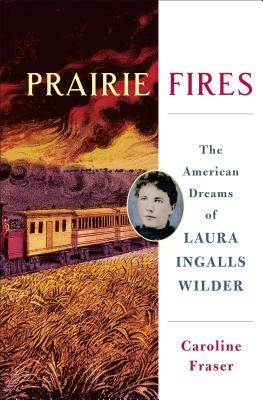
Prairie Fires
Prairie Fires: the American Dreams of Laura Ingalls Wilder. Caroline Fraser. 2017. 640 pages. [Source: Review copy]
First sentence: On a spring day in April of 1924, Laura Ingalls Wilder, a fifty-seven-year-old farm wife in the Missouri Ozarks, received a telegram from South Dakota. Her mother, Caroline Ingalls, had just died. Wilder hadn’t seen her for more than twenty years.
Premise/plot: This book examines the life and works of Laura Ingalls Wilder and places both within the context of American history. Fraser writes, "For those of us seeking to understand the settlement of the frontier, she offers a path, perhaps our best path, to the past."
Is it a biography? Yes and no. If it is a biography, it is a biography of both Laura Ingalls Wilder and Rose Wilder Lane. But I'm leaning more towards it being a history book. The book's focus is on the American story; the personal lives of the Ingalls and Wilder families provide an entry point to this bigger story. Politics. Economics. Policies. Personalities.
Close to a third of the book focuses on the written works of Wilder and Lane. The book provides a behind the scenes glimpse into the writing and publishing process. One definitely gets the sense that the books were crafted with intent and purpose to tell a specific story, to impart certain morals and lessons. Fraser writes, "Her story, spanning ninety years, is broader, stranger, and darker than her books, containing whole chapters she could scarcely bear to examine. She hinted as much when she said, in a speech, “All I have told is true but it is not the whole truth.”"
My thoughts: If I have one complaint about the book, it is this: the chapters are LONG. Overall, I enjoyed reading this one. It is a bit on the dry, scholarly side. It is not a straightforward biography. It is anything but concise. IT is packed with details--not just details about the family--but details about the times in which she lived. These historical "asides" aren't really on the side. They are front and center to the book. If you don't love history, then this one probably isn't for you. That being said, I LOVE history.
© 2017 Becky Laney of Becky's Book Reviews
First sentence: On a spring day in April of 1924, Laura Ingalls Wilder, a fifty-seven-year-old farm wife in the Missouri Ozarks, received a telegram from South Dakota. Her mother, Caroline Ingalls, had just died. Wilder hadn’t seen her for more than twenty years.
Premise/plot: This book examines the life and works of Laura Ingalls Wilder and places both within the context of American history. Fraser writes, "For those of us seeking to understand the settlement of the frontier, she offers a path, perhaps our best path, to the past."
Is it a biography? Yes and no. If it is a biography, it is a biography of both Laura Ingalls Wilder and Rose Wilder Lane. But I'm leaning more towards it being a history book. The book's focus is on the American story; the personal lives of the Ingalls and Wilder families provide an entry point to this bigger story. Politics. Economics. Policies. Personalities.
Close to a third of the book focuses on the written works of Wilder and Lane. The book provides a behind the scenes glimpse into the writing and publishing process. One definitely gets the sense that the books were crafted with intent and purpose to tell a specific story, to impart certain morals and lessons. Fraser writes, "Her story, spanning ninety years, is broader, stranger, and darker than her books, containing whole chapters she could scarcely bear to examine. She hinted as much when she said, in a speech, “All I have told is true but it is not the whole truth.”"
My thoughts: If I have one complaint about the book, it is this: the chapters are LONG. Overall, I enjoyed reading this one. It is a bit on the dry, scholarly side. It is not a straightforward biography. It is anything but concise. IT is packed with details--not just details about the family--but details about the times in which she lived. These historical "asides" aren't really on the side. They are front and center to the book. If you don't love history, then this one probably isn't for you. That being said, I LOVE history.
© 2017 Becky Laney of Becky's Book Reviews
Thursday, December 07, 2017
Among the Brave
Among the Brave. (Shadow Children #5) Margaret Peterson Haddix. 2004. 256 pages. [Source: Library]
First sentence: Great, Trey thought. I do one brave thing in my entire life, and now it's like, 'Got anything dangerous to do? Send Trey. He can handle it.' Doesn't anyone remember that Cowardice is my middle name?
Premise/plot: Among the Brave is the fifth book in Margaret Pertson Haddix's Shadow Children series. Trey, the narrator, faces great challenges in this one. For Trey, going outside is an act of bravery. So when all of his friends disappear, and the trustworthy adults in his life disappear as well, he's at a loss. He teams up for a while with Luke's brother, Mark. But Mark is CAPTURED leaving Trey on his own to brainstorm a rescue plan. Can Trey find a way to save everyone?
My thoughts: The world Haddix created is turned upside down by revolution. But it's a revolution that won't do third children any favors. Freedom still seems to be an impossible dream. I don't know how Haddix manages to pack so much ACTION into her novels. Usually the more action a book has, the less important character development is. That's so far from the case in this series. The books remain thoughtful--contemplative. Yet there's so much going on! Danger abounds.
© 2017 Becky Laney of Becky's Book Reviews
First sentence: Great, Trey thought. I do one brave thing in my entire life, and now it's like, 'Got anything dangerous to do? Send Trey. He can handle it.' Doesn't anyone remember that Cowardice is my middle name?
Premise/plot: Among the Brave is the fifth book in Margaret Pertson Haddix's Shadow Children series. Trey, the narrator, faces great challenges in this one. For Trey, going outside is an act of bravery. So when all of his friends disappear, and the trustworthy adults in his life disappear as well, he's at a loss. He teams up for a while with Luke's brother, Mark. But Mark is CAPTURED leaving Trey on his own to brainstorm a rescue plan. Can Trey find a way to save everyone?
My thoughts: The world Haddix created is turned upside down by revolution. But it's a revolution that won't do third children any favors. Freedom still seems to be an impossible dream. I don't know how Haddix manages to pack so much ACTION into her novels. Usually the more action a book has, the less important character development is. That's so far from the case in this series. The books remain thoughtful--contemplative. Yet there's so much going on! Danger abounds.
© 2017 Becky Laney of Becky's Book Reviews
Wednesday, December 06, 2017
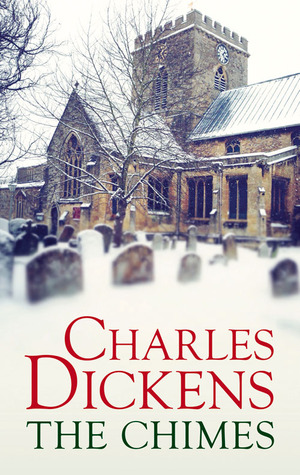
The Chimes
The Chimes. Charles Dickens. 1844. 116 pages. [Source: Bought]
© 2017 Becky Laney of Becky's Book Reviews
First sentence: Here are not many people — and as it is desirable that a story-teller and a story-reader should establish a mutual understanding as soon as possible, I beg it to be noticed that I confine this observation neither to young people nor to little people, but extend it to all conditions of people: little and big, young and old: yet growing up, or already growing down again — there are not, I say, many people who would care to sleep in a church. I don’t mean at sermon-time in warm weather (when the thing has actually been done, once or twice), but in the night, and alone.
Premise/plot: Toby Veck is the hero of Charles Dickens' Christmas novella, The Chimes. Is Veck as guilty as Ebeneezer Scrooge in terms of being out of touch with reality? Maybe, maybe not.
One wintry night, he meets with his daughter, Meg, and his future son-in-law, Richard. They are greeted by a horrid little man who is full of hot air. His words are hateful and penetrating. Will those words dissuade Meg and Richard from marrying because they are poor? Will those words strip Veck of his hope in humanity? Will Veck, in fact, become persuaded to the horrid man's way of thinking? Veck later carries a letter to another man who is only slightly less horrible. That night Veck finds himself going to hear the chimes; he feels himself irresistibly called to visit the bells in person. The ghosts--or goblins--that inhabit the bells convict him. They convict him BEFORE showing him visions of the future. But is Veck awake--and dead--or asleep? The ending of The Chimes can be just as ambiguous as say the movie Inception.
My thoughts: I found the Chimes to be very confusing at times. I stuck with it, however, and am glad I did. I love Dickens' writing style:
Premise/plot: Toby Veck is the hero of Charles Dickens' Christmas novella, The Chimes. Is Veck as guilty as Ebeneezer Scrooge in terms of being out of touch with reality? Maybe, maybe not.
One wintry night, he meets with his daughter, Meg, and his future son-in-law, Richard. They are greeted by a horrid little man who is full of hot air. His words are hateful and penetrating. Will those words dissuade Meg and Richard from marrying because they are poor? Will those words strip Veck of his hope in humanity? Will Veck, in fact, become persuaded to the horrid man's way of thinking? Veck later carries a letter to another man who is only slightly less horrible. That night Veck finds himself going to hear the chimes; he feels himself irresistibly called to visit the bells in person. The ghosts--or goblins--that inhabit the bells convict him. They convict him BEFORE showing him visions of the future. But is Veck awake--and dead--or asleep? The ending of The Chimes can be just as ambiguous as say the movie Inception.
My thoughts: I found the Chimes to be very confusing at times. I stuck with it, however, and am glad I did. I love Dickens' writing style:
- A weak, small, spare old man, he was a very Hercules, this Toby, in his good intentions. He loved to earn his money. He delighted to believe — Toby was very poor, and couldn’t well afford to part with a delight — that he was worth his salt.
- Perhaps he was the more curious about these Bells, because there were points of resemblance between themselves and him. They hung there, in all weathers, with the wind and rain driving in upon them; facing only the outsides of all those houses; never getting any nearer to the blazing fires that gleamed and shone upon the windows, or came puffing out of the chimney tops; and incapable of participation in any of the good things that were constantly being handled, through the street doors and the area railings, to prodigious cooks.
- They were so mysterious, often heard and never seen; so high up, so far off, so full of such a deep strong melody, that he regarded them with a species of awe; and sometimes when he looked up at the dark arched windows in the tower, he half expected to be beckoned to by something which was not a Bell, and yet was what he had heard so often sounding in the Chimes.
- In short, they were very often in his ears, and very often in his thoughts, but always in his good opinion; and he very often got such a crick in his neck by staring with his mouth wide open, at the steeple where they hung, that he was fain to take an extra trot or two, afterwards, to cure it.
- The wintry sun, though powerless for warmth, looked brightly down upon the ice it was too weak to melt, and set a radiant glory there.
- The New Year, like an Infant Heir to the whole world, was waited for, with welcomes, presents, and rejoicings. There were books and toys for the New Year, glittering trinkets for the New Year, dresses for the New Year, schemes of fortune for the New Year; new inventions to beguile it. Its life was parcelled out in almanacks and pocket-books; the coming of its moons, and stars, and tides, was known beforehand to the moment;
- The New Year, the New Year. Everywhere the New Year! The Old Year was already looked upon as dead; and its effects were selling cheap, like some drowned mariner’s aboardship. Its patterns were Last Year’s, and going at a sacrifice, before its breath was gone. Its treasures were mere dirt, beside the riches of its unborn successor!
- A blast of air — how cold and shrill! — came moaning through the tower. As it died away, the Great Bell, or the Goblin of the Great Bell, spoke. ‘What visitor is this!’ it said. The voice was low and deep, and Trotty fancied that it sounded in the other figures as well.
- ‘I thought my name was called by the Chimes!’ said Trotty, raising his hands in an attitude of supplication. ‘I hardly know why I am here, or how I came. I have listened to the Chimes these many years. They have cheered me often.’ ‘And you have thanked them?’ said the Bell. ‘
- ‘Listen!’ said the Shadow. ‘Listen!’ said the other Shadows. ‘Listen!’ said the child’s voice. A solemn strain of blended voices, rose into the tower. It was a very low and mournful strain — a Dirge — and as he listened, Trotty heard his child among the singers. ‘She is dead!’ exclaimed the old man. ‘Meg is dead! Her Spirit calls to me. I hear it!’ ‘The Spirit of your child bewails the dead, and mingles with the dead — dead hopes, dead fancies, dead imaginings of youth,’ returned the Bell, ‘but she is living. Learn from her life, a living truth. Learn from the creature dearest to your heart, how bad the bad are born. See every bud and leaf plucked one by one from off the fairest stem, and know how bare and wretched it may be. Follow her! To desperation!’
- Had Trotty dreamed? Or, are his joys and sorrows, and the actors in them, but a dream; himself a dream; the teller of this tale a dreamer, waking but now? If it be so, O listener, dear to him in all his visions, try to bear in mind the stern realities from which these shadows come; and in your sphere — none is too wide, and none too limited for such an end — endeavour to correct, improve, and soften them.
© 2017 Becky Laney of Becky's Book Reviews
Labels:
1844,
adult classics,
books reviewed in 2017,
Charles Dickens,
Christmas,
classics
Tuesday, December 05, 2017
The Librarian of Auschwitz
The Librarian of Auschwitz. Antonio Iturbe. Translated by Lilit Thwaites. 2017. 424 pages. [Source: Library]
First sentence: The Nazi officers are dressed in black. They look at death with the indifference of a gravedigger.
Premise/plot: Though it is a work of fiction, The Librarian of Auschwitz is based on a true story: the story of a super-small library and its young librarian, Dita. Block 31 is different, special, almost miraculous and too good to be true. Here Jewish children come together every day while their parents labor under the watchful eyes of their guards. School is forbidden; learning is forbidden. But. A school it is. There are teachers and teenage helpers. Dita is one of the helpers or assistants. She's also the librarian. For what is a school without a library? This library collection, like the school, is completely forbidden. It consists of EIGHT books plus additional living books. Dita's job is risky, but important. Block 31 exists for one reason only: to fool the world in case someone comes looking for answers. The Germans mistreat Jews? You've got to be kidding. Just look! Here's a camp of families. We even see that the children are taken care of during the day and laugh and play and sing. The prisoners are not fooled for a minute, but, the children are fortunate in some ways.
The book is an intense, important read.
My thoughts: I would definitely recommend this one! It is a powerful, memorable story. It is well-written. Here are two of my favorite quotes:
First sentence: The Nazi officers are dressed in black. They look at death with the indifference of a gravedigger.
Premise/plot: Though it is a work of fiction, The Librarian of Auschwitz is based on a true story: the story of a super-small library and its young librarian, Dita. Block 31 is different, special, almost miraculous and too good to be true. Here Jewish children come together every day while their parents labor under the watchful eyes of their guards. School is forbidden; learning is forbidden. But. A school it is. There are teachers and teenage helpers. Dita is one of the helpers or assistants. She's also the librarian. For what is a school without a library? This library collection, like the school, is completely forbidden. It consists of EIGHT books plus additional living books. Dita's job is risky, but important. Block 31 exists for one reason only: to fool the world in case someone comes looking for answers. The Germans mistreat Jews? You've got to be kidding. Just look! Here's a camp of families. We even see that the children are taken care of during the day and laugh and play and sing. The prisoners are not fooled for a minute, but, the children are fortunate in some ways.
The book is an intense, important read.
My thoughts: I would definitely recommend this one! It is a powerful, memorable story. It is well-written. Here are two of my favorite quotes:
"A book is like a trapdoor that leads to a secret attic; You can open it and go inside. And your world is different" (193)
"Life, any life, is very short. But if you've managed to be happy for at least an instant, it will have been worth living" (289)© 2017 Becky Laney of Becky's Book Reviews
Thursday, November 30, 2017
How the Queen Found the Perfect Cup of Tea
How The Queen Found the Perfect Cup of Tea. Kate Hosford. Illustrated by Gabi Swiatkowska. 2017. 40 pages. [Source: Library]
First sentence: Every morning when the Queen woke up, two maids dressed her, two more styled her hair, and the butler made her tea. Each day, she sipped her tea, alone. And each day, her tea started to taste a bit worse. Finally, she could stand it no longer.
Premise/plot: The Queen sets out on an adventure in this picture book. She travels by hot air balloon to three different countries: Japan, India, and Turkey. She meets a local child in each place; the child invites her to have a cup of tea, and shows her how to make it. The Queen becomes used to company while drinking her tea, and it is this human companionship and warmth that help make her cup of tea perfect. The book concludes with the Queen having a tea party and inviting all her new friends.
My thoughts: I liked this one. I did. I'm not sure I loved, loved, loved it. But I found it charming in many ways.
Text: 4 out of 5
Illustrations: 3 out of 5
Total: 7 out of 10
© 2017 Becky Laney of Becky's Book Reviews
First sentence: Every morning when the Queen woke up, two maids dressed her, two more styled her hair, and the butler made her tea. Each day, she sipped her tea, alone. And each day, her tea started to taste a bit worse. Finally, she could stand it no longer.
Premise/plot: The Queen sets out on an adventure in this picture book. She travels by hot air balloon to three different countries: Japan, India, and Turkey. She meets a local child in each place; the child invites her to have a cup of tea, and shows her how to make it. The Queen becomes used to company while drinking her tea, and it is this human companionship and warmth that help make her cup of tea perfect. The book concludes with the Queen having a tea party and inviting all her new friends.
My thoughts: I liked this one. I did. I'm not sure I loved, loved, loved it. But I found it charming in many ways.
Text: 4 out of 5
Illustrations: 3 out of 5
Total: 7 out of 10
© 2017 Becky Laney of Becky's Book Reviews
Labels:
2017,
books reviewed in 2017,
library book,
picture books
Wednesday, November 29, 2017
The One
The One. John Marrs. 2018. (2016 UK) 416 pages. [Source: Review copy]
First sentence: Mandy stared at the photograph on her computer screen and held her breath.
Premise/plot: What if finding "the one" was as simple as taking a DNA test and waiting to be matched with your one and only perfect match? The premise of this one is simple: for the past ten to twelve years, people have been joining Match Your DNA. Some wait weeks to hear back about their match; for others the wait is longer--much longer, YEARS longer. Once your match has been found, you're emailed the results. But, of course, love is a business, and you have to pay for contact information. The One follows the lives of five characters: Mandy, Christopher, Jade, Nick, and Ellie. All have recently got that all-important email. But their results differ.
The One is supposed to eliminate the "prejudices" and "biases" of dating, changing your expectations if you will. You might be matched with a male or female. (The process never once asks you your sexual orientation.) You might be matched with someone (much) older or (much) younger. Your perfect match might be a different religion and live on the opposite side of the world. Your perfect match might be rich or poor. Your perfect match might be married--with or without children--to someone else. Love has no boundaries or limitations. People are using the idea of a "perfect match" to end engagements, end marriages, abandon their children, quit jobs, and/or move around the world. Gone is the idea that love is a choice.
Who should read The One? Those that love HORROR just as much as SOAP OPERAS. It's melodramatic like a soap opera--with some near-graphic sexual scenes--but also GORY. It is not a suspense, in my opinion, because one of the main characters is up-front about being a serial killer. In that character's introductory chapter, readers learn this. And while other characters face dangers of their own, I personally saw most of the twists coming. The stories of these five characters do not really ever connect with one another.
My thoughts: Objectively, I suppose I don't have any problems with The One. The chapters are short; the action is well-paced. The narrators are unique enough that you can easily tell their voices--their stories--apart even if they weren't clearly marked. The characters, if not well-developed, are developed enough. What it lacks in suspense, it makes up for with some twists and turns.
Subjectively, I didn't care for it at all. I didn't realize it was published by Harlequin until I'd already said yes to reviewing it. I usually have a strict policy in terms of "adult" romance and a book's graphic-ness. I was looking for a suspense with plenty of action. But not Harlequin-type action. I also prefer less GORE.
That being said, the narrators alternate chapters. If this one was a book with five novellas, I definitely would have enjoyed some stories more. I preferred the stories of Mandy, Jade, and Ellie. Though there were elements within those stories that I didn't care for completely. And here's the thing: many of these elements weren't really all that necessary to the plot.
© 2017 Becky Laney of Becky's Book Reviews
First sentence: Mandy stared at the photograph on her computer screen and held her breath.
Premise/plot: What if finding "the one" was as simple as taking a DNA test and waiting to be matched with your one and only perfect match? The premise of this one is simple: for the past ten to twelve years, people have been joining Match Your DNA. Some wait weeks to hear back about their match; for others the wait is longer--much longer, YEARS longer. Once your match has been found, you're emailed the results. But, of course, love is a business, and you have to pay for contact information. The One follows the lives of five characters: Mandy, Christopher, Jade, Nick, and Ellie. All have recently got that all-important email. But their results differ.
The One is supposed to eliminate the "prejudices" and "biases" of dating, changing your expectations if you will. You might be matched with a male or female. (The process never once asks you your sexual orientation.) You might be matched with someone (much) older or (much) younger. Your perfect match might be a different religion and live on the opposite side of the world. Your perfect match might be rich or poor. Your perfect match might be married--with or without children--to someone else. Love has no boundaries or limitations. People are using the idea of a "perfect match" to end engagements, end marriages, abandon their children, quit jobs, and/or move around the world. Gone is the idea that love is a choice.
Who should read The One? Those that love HORROR just as much as SOAP OPERAS. It's melodramatic like a soap opera--with some near-graphic sexual scenes--but also GORY. It is not a suspense, in my opinion, because one of the main characters is up-front about being a serial killer. In that character's introductory chapter, readers learn this. And while other characters face dangers of their own, I personally saw most of the twists coming. The stories of these five characters do not really ever connect with one another.
My thoughts: Objectively, I suppose I don't have any problems with The One. The chapters are short; the action is well-paced. The narrators are unique enough that you can easily tell their voices--their stories--apart even if they weren't clearly marked. The characters, if not well-developed, are developed enough. What it lacks in suspense, it makes up for with some twists and turns.
Subjectively, I didn't care for it at all. I didn't realize it was published by Harlequin until I'd already said yes to reviewing it. I usually have a strict policy in terms of "adult" romance and a book's graphic-ness. I was looking for a suspense with plenty of action. But not Harlequin-type action. I also prefer less GORE.
That being said, the narrators alternate chapters. If this one was a book with five novellas, I definitely would have enjoyed some stories more. I preferred the stories of Mandy, Jade, and Ellie. Though there were elements within those stories that I didn't care for completely. And here's the thing: many of these elements weren't really all that necessary to the plot.
© 2017 Becky Laney of Becky's Book Reviews
Monday, November 27, 2017
Waylon: One Awesome Thing
Waylon! One Awesome Thing. Sara Pennypacker. Illustrated by Marla Frazee. 2016. 208 pages. [Source: Library]
First sentence: Waylon craned his neck. "Moon at the nearest point in its orbit--check. Clouds--check. But Joe, I'm telling you--"
Premise/plot: Waylon is in fourth grade, and it's complicated. Most of the time, he's happy to just be--to be himself, to be excited about anything and everything connected to science and nature. But some of the time, well, he starts to imagine how he appears to others. "As though he was outside his body watching himself. Not extraterrestrial others. Extraterrestrials watching wouldn't bother him at all. If they were looking down from their space pods. Waylon felt sure they would grok him. Grok was a word he'd learned in a science fiction story. It meant to understand something so completely you practically merged with it. No, it wasn't extraterrestrials he worried about, it was other human kids. And when Waylon imagined other human kids watching him, he imagined them laughing--not nice laughs, but mean smirks" (22-3). In the past few weeks, his class has started dividing into teams. And he HATES that. Why do they need to divide into an "us" and "them." And which team would he want to be on if he has to be on a team. But the arrival of a not-so-new-kid, Baxter, changes the class dynamics. Is there hope for Waylon after all?
My thoughts: I loved Sara Pennypacker's Clementine series. LOVED. This fourth grade class has Clementine in it, but the narrator is Waylon. And to be honest, Waylon is more interested in science, sports, and dogs than in girls. I really enjoyed this chapter book. Some names will be familiar to readers--since so many elements of Clementine's stories focused on her school life. It didn't take many chapters for me to love Waylon for himself.
I loved the characters, the writing, the story, and the illustrations.
© 2017 Becky Laney of Becky's Book Reviews
First sentence: Waylon craned his neck. "Moon at the nearest point in its orbit--check. Clouds--check. But Joe, I'm telling you--"
Premise/plot: Waylon is in fourth grade, and it's complicated. Most of the time, he's happy to just be--to be himself, to be excited about anything and everything connected to science and nature. But some of the time, well, he starts to imagine how he appears to others. "As though he was outside his body watching himself. Not extraterrestrial others. Extraterrestrials watching wouldn't bother him at all. If they were looking down from their space pods. Waylon felt sure they would grok him. Grok was a word he'd learned in a science fiction story. It meant to understand something so completely you practically merged with it. No, it wasn't extraterrestrials he worried about, it was other human kids. And when Waylon imagined other human kids watching him, he imagined them laughing--not nice laughs, but mean smirks" (22-3). In the past few weeks, his class has started dividing into teams. And he HATES that. Why do they need to divide into an "us" and "them." And which team would he want to be on if he has to be on a team. But the arrival of a not-so-new-kid, Baxter, changes the class dynamics. Is there hope for Waylon after all?
My thoughts: I loved Sara Pennypacker's Clementine series. LOVED. This fourth grade class has Clementine in it, but the narrator is Waylon. And to be honest, Waylon is more interested in science, sports, and dogs than in girls. I really enjoyed this chapter book. Some names will be familiar to readers--since so many elements of Clementine's stories focused on her school life. It didn't take many chapters for me to love Waylon for himself.
I loved the characters, the writing, the story, and the illustrations.
© 2017 Becky Laney of Becky's Book Reviews
Friday, November 24, 2017
Far From the Tree
Far from the Tree. Robin Benway. 2017. HarperCollins. 384 pages. [Source: Library]
First sentence: Grace hadn't really thought too much about homecoming.
Premise/plot: Far from the Tree is YA fiction at its best. I'm not the only one who thinks so. It won the National Book Award for Young People's Literature this year. The novel opens with Grace, one of the heroines, giving birth to 'Peach.' She decided to give her baby up for adoption early on in the pregnancy. And she carefully picked out the adoptive parents. But giving up the baby wasn't easy. It was the hardest thing she's ever done. It is as she's on this emotional roller coaster that her parents bring up the fact that she has two siblings, an older brother and a younger sister. Would she like to get to know them? They all live close by. They share a birth mom. Maya is fifteen; Joaquin is seventeen. (Grace is sixteen). Far From The Tree is narrated by all three teens. Each teen is experiencing some drama and hardship. Three main characters, three sets of parents, three sets of friends. This novel has the potential to either be awesome or a HUGE mess.
My thoughts: I loved this one. I didn't expect to love it. It is YA; I'm more a middle grade fan. It uses the f-word quite a bit; this usually keeps me from 'liking' a book let alone loving it. But. The characterization is so good; and characterization is for me the MOST important thing in a book. There's depth and substance to this one. Not just with the three main characters, but with all the characters. In fact, one of my favorite characters was a side character, Rafe. There are certainly romantic elements to this one, but by far it is about family. I loved the story and the storytelling. The dialogue was great.
© 2017 Becky Laney of Becky's Book Reviews
First sentence: Grace hadn't really thought too much about homecoming.
Premise/plot: Far from the Tree is YA fiction at its best. I'm not the only one who thinks so. It won the National Book Award for Young People's Literature this year. The novel opens with Grace, one of the heroines, giving birth to 'Peach.' She decided to give her baby up for adoption early on in the pregnancy. And she carefully picked out the adoptive parents. But giving up the baby wasn't easy. It was the hardest thing she's ever done. It is as she's on this emotional roller coaster that her parents bring up the fact that she has two siblings, an older brother and a younger sister. Would she like to get to know them? They all live close by. They share a birth mom. Maya is fifteen; Joaquin is seventeen. (Grace is sixteen). Far From The Tree is narrated by all three teens. Each teen is experiencing some drama and hardship. Three main characters, three sets of parents, three sets of friends. This novel has the potential to either be awesome or a HUGE mess.
My thoughts: I loved this one. I didn't expect to love it. It is YA; I'm more a middle grade fan. It uses the f-word quite a bit; this usually keeps me from 'liking' a book let alone loving it. But. The characterization is so good; and characterization is for me the MOST important thing in a book. There's depth and substance to this one. Not just with the three main characters, but with all the characters. In fact, one of my favorite characters was a side character, Rafe. There are certainly romantic elements to this one, but by far it is about family. I loved the story and the storytelling. The dialogue was great.
© 2017 Becky Laney of Becky's Book Reviews
Subscribe to:
Posts (Atom)


