Showing posts with label 1852. Show all posts

Thursday, June 18, 2020

87. The History of Henry Esmond, Esq

The History of Henry Esmond, Esq. A Colonel in the Service of Her Majesty Queen Anne. William Makepeace Thackery. 1852. 528 pages. [Source: Bought] [dull books; classic; Victorian literature]

First sentence: When Francis, fourth Viscount Castlewood, came to his title, and presently after to take possession of his house of Castlewood, county Hants, in the year 1691, almost the only tenant of the place besides the domestics was a lad of twelve years of age, of whom no one seemed to take any note until my Lady Viscountess lighted upon him, going over the house with the housekeeper on the day of her arrival.


Premise/plot: Henry Esmond is an orphan being raised by his distant cousins, Francis and Rachel Esmond. He is brought up with their two children Beatrix and Frank. He is in that awkward space between servant and adopted son. The moods of this couple vary greatly. He is either greatly beloved or scorned and rejected. For example, when the plague comes--I believe it is the plague--he is REJECTED because he's blamed for the family's exposure to it. The couple's relationship is never quite the same after that--the plague--and the happy marriage becomes miserable. Of course, Henry is to blame. But the two are determined to see him educated--and at Cambridge University. While their moods are completely volatile and unreliable, Henry feels only love, loyalty, and gratitude. Perhaps to the point of being ridiculous?

(Henry comes from a long line of Stuart-supporters and Stuart-defenders. In fact, I believe, his father and grandfather both died in battle because of their allegiance.) 

So when Henry isn't being a soldier--he's a Colonel by the end of the book--he's madly, truly, deeply in love with the unattainable, cold-hearted Beatrix. That is until he isn't. Who's the love of his life? Well, in a surprise twist that comes on the last page or second to last page, it's revealed he marries his FOSTER MOTHER. (Never mind that he's spent probably ten to twelve years at least thinking of her as HIS MOTHER.)

My thoughts: I don't know what's worse being bored to death with all the war talk (though, the fact that he had encounters with famous men of the time like Richard Steele and Jonathan Swift, and others, etc. was slightly interesting) OR being grossed out by the fact that he falls in love with his mother. Yes, she's not technically his mother--biologically. But she is his foster mother, adopted mother, recognized guardian.

Quotes:
  • 'Tis not the dying for a faith that's so hard, Master Harry—every man of every nation has done that—'tis the living up to it that is difficult, as I know to my cost," he added with a sigh.
  • To see a young couple loving each other is no wonder; but to see an old couple loving each other is the best sight of all.
  • 'Tis a hard task for women in life, that mask which the world bids them wear. But there is no greater crime than for a woman who is ill used and unhappy to show that she is so.
  • "I never had a mother, but I love this lady as one. I worship her as a devotee worships a saint. To hear her name spoken lightly seems blasphemy to me. Would you dare think of your own mother so, or suffer any one so to speak of her? It is a horror to me to fancy that any man should think of her impurely. I implore you, I beseech you, to leave her. Danger will come out of it."
  •  "Yes, I did, Harry," said she; "I thought of it; and think of it. I would sooner call you my son than the greatest prince in Europe—yes, than the greatest prince. For who is there so good and so brave, and who would love her as you would? But there are reasons a mother can't tell."
  • "I am your mother, you are my son, and I love you always," she said, holding her hands over him: and he went away comforted and humbled in mind, as he thought of that amazing and constant love and tenderness with which this sweet lady ever blessed and pursued him.
  • I suppose a man's vanity is stronger than any other passion in him;
  • Parting and forgetting! What faithful heart can do these? Our great thoughts, our great affections, the Truths of our life, never leave us.
     

© 2020 Becky Laney of Becky's Book Reviews

Wednesday, December 27, 2017

Uncle Tom's Cabin

Uncle Tom's Cabin. Harriet Beecher Stowe. 1852. 438 pages. [Source: Bought]

Dear Uncle Tom's Cabin,

I'm so sorry it took me this long to read you. You see, I blame The King and I. My only frame of reference to you was through that movie--and, well, let's be honest, that part of The King and I is hard to sit through. I didn't know you were better than that, and for that I do owe you an apology.

So why did I read you now? The Classics Club. I included you on my list in the first place because you came recommended from one of my best, best, best friends. I trust her opinion. So on the list you went. But it took the 'classics club spin' to prompt me to read you NOW. And the truth is, I was hoping you were the one--the one to get picked. (And no, I'm not just saying that.)

You're a rare gem of a novel. You are premise-driven AND character-driven--and dare I say plot-driven? The premise is simple: slavery is wrong for a million and one different reasons and there is no possible good defense to keeping it around. Some of the characters within the book are pro-slavery; some of the characters are anti-slavery. A few are confused or on the fence. Within your pages, these ideas do BATTLE. If you were just an idea-driven novel, you'd still be worth reading.

But you're not just an idea-driven novel. You're more than that.

You are definitely, without a doubt, a character-driven novel. Your characters LIVE and BREATHE. Uncle Tom. George Harris. Eliza. Miss Ophelia. Eva. St. Clare. Cassy. Emmeline. To name just a few. You might think, well, this book has an agenda--all of her characters will sound the same, act the same, hammer in the point--stick to the agenda: slavery is evil; down with slavery. And many of her characters--not just the slaves--are anti-slavery. There is an intense longing for freedom, for liberty. There is also anger and sorrow. But each slave is presented as an individual, as unique as can be. I really loved hearing each voice, learning each story. Every voice matters.

If I had to pick just one favorite character--and I don't want to, mind you--I would pick Uncle Tom. I loved Tom's faith. I loved Tom's reliance on God's daily-given-grace to endure. I loved Tom's hope. Hope that the Lord does indeed hear his prayers, see his miseries, care about him. Hope that the victory is the Lord's, that justice will be done. Hope that the Lord will see him through, that he'll be an overcomer, that heaven is HIS. I loved Tom's heart. He loved. He was compassionate. He was an encourager. He also forgave. He lived the gospel--day in, day out. He didn't just live it by example; he also spoke it. He was a seed-planter. Even when his words fell on "deaf ears," so to speak, he continued to hold true to the gospel. He didn't see sharing the good news of Jesus Christ as a waste of breath. He wanted to see others around him KNOW Jesus as he knew Jesus. Whether they were white or black, free or slave. He prayed for the salvation of Augustine, of Simon Legree, of Sambo and Quimbo, of Cassy. He knew that God can save anyone, no one was beyond God's ability to save. And because he believed so strongly in heaven and hell, he CARED. He didn't want to see anyone in hell. Tom is in many ways, a saint, just like Eva. Faith didn't come easy to Tom. It wasn't like he was all: bring on the suffering, bring on the pain, do your worst and I'll smile and grin through it all. He prayed for deliverance. He prayed for the suffering to go away. He prayed for better circumstances. He longed for freedom. Being a Christian didn't stop him from wanting, from needing. But he was content that the Lord was his lot, his portion, his reward. Near the end he proclaims, "The Lord’s bought me, and is going to take me home,—and I long to go."

As a Christian, it matters to me to see faith represented in fiction. And you do that so well. I wish there were more contemporary examples like you. Books with characters living, breathing the faith day in and day out--no matter how hard, no matter their doubts, no matter their weaknesses. Books that uphold that the Bible is the BOOK OF BOOKS. But. I'm getting distracted.

Plot-driven. Yes, you're plot-driven too. There are scenes with such intensity, such drama, such danger and peril that I was worried and on the edge of my seat. Sometimes your action wasn't so much physical as emotional. What a roller coaster of a book. My poor heart.

To sum it up, I LOVE YOU. And thank you for being you. I will do my best to encourage others to pick you up and read you. Oh. I also plan to come back and read you again.

Love, Becky

P.S. I've also reviewed you at Operation Actually Read Bible. I've included LOADS of quotes.

© 2017 Becky Laney of Becky's Book Reviews

Monday, July 17, 2017

Camille: A Play in Five Acts

Camille: A Play in Five Acts. Alexandre Dumas, fils. Translated by Matilda Heron. 1852. 72 pages. [Source: Library]

First sentence: Some one has rung the bell.

Premiseplot: Alexandre Dumas fils adapted his novel, Camille, into a five act play. There are just eleven characters: Armand Duval, Camille, Count de Varville, Nichette, Gustave, Olimpe, Gaston, Prudence, Nanine, and Monsieur Duval (Armand's father).

How does the play differ from the novel? The play removes the framework. The novel begins after Camille, our heroine, has died. Readers of the novel first meet a grief-stricken lover, Armand, who only slowly reveals the details of their romance. The play begins by introducing Camille's close circle of friends. Are all the people in this play her friends? Maybe, maybe not. Certainly most of them are. But a few do seem to be using Camille to their own advantage. Prudence, for example, stands out as someone taking full advantage of Camille. Olimpe is a rival of hers, so their friendship is more "friendship." Readers--viewers--watch the romance blossom, grow, mature in the play. Quite a difference emotionally, I believe.

 My thoughts: I really loved the play. I enjoyed the novel very much. I didn't think the story could be improved upon. But I'm glad that Dumas also gave us the play version. By simplifying the story, I feel we get a better impression of who the characters are.

Quotes:
Armand: Will you be loved?
Camille: For how long?
Armand: For eternity!
Camille: Alas! my life may yet be happy--it cannot be long--and short as it may be, it may outlive your promise.
Armand: Now, who is melancholy?
Camille: Not I. The weight that chained me to her throne's removed, and all around breathes ecstasy! But it grows late, and you must away.
Armand: When shall I see you again?
Camille: [Giving him a Camelia] When this little flower is faded, bring it to me again.
Armand: Ah, Camille, you have made me blessed.
Camille: It is a strange flower, Armand--pale, scentless, cold; but sensitive as purity itself. Cherish it, and its beauty will excel the loveliest flower that grows; but wound it with a single touch, you never can recall its bloom, or wipe away the stain. Take it, and remember me. Now go.
Armand: Adieu! (19)

© 2017 Becky Laney of Becky's Book Reviews

Saturday, June 18, 2016

Bleak House

Bleak House. Charles Dickens. 1852-1853. 912 pages.  [Source: Bought]

It has been almost six years since I first read Charles Dickens' Bleak House. Did I enjoy it more the second time? Yes, I think so. I really, really liked it the first time I read it. Though to be honest, there were a few times I almost gave up on it until I discovered a good adaptation of it. But the second time around, I really LOVED IT.

I think the 'romance' worked better for me the second time around because I knew who Esther would choose and I was prepared for it. When I first read the book, I was so under-impressed by the doctor that I forgot him once he went away to sea. I did not see him as the love of her life that she dared not hope return her love. This time I paid for attention and tried to see him through her eyes. I still really, really LOVE John Jarndyce (can I have him, please?!?!) but I've come to accept that she rightly belongs with the doctor.

I also came to a better appreciation for Inspector Bucket. I trusted him more and didn't see him as a villain. 

Read Bleak House
  • If you enjoy Charles Dickens
  • If you enjoy reading classics
  • If you enjoy reading LONG books
  • If you enjoy Victorian literature
  • If you enjoy classic mysteries, Inspector Bucket is one of the first fictional detectives
  • If you enjoy stories about law and inheritance
  • If you enjoy understated romance
  • If you enjoy guardianship stories
  • If you enjoy stories with angelic heroines
  • If you enjoyed watching the miniseries
Read my first review for the particulars of the plot. 

One sentence summary: Bleak House is about a long, often-thought-hopeless, law case that seems to doom all involved with it, perhaps with the exception of John Jardyce and his favorite ward, Esther Summerson.

© 2016 Becky Laney of Becky's Book Reviews

Monday, June 09, 2014

A Child's History of England (1854)

A Child's History of England. Charles Dickens. 1851-1853.  390 pages. [Source: Book I Bought]

What a treat to discover Charles Dickens' A Child's History of England. I enjoyed Dickens style. I liked the action and characterization. It was also rich in description. Here's the first sentence,
"In the old days, a long, long while ago, before Our Saviour was born on earth and lay asleep in a manger, these Islands were in the same place, and the stormy sea roared round them, just as it roars now. But the sea was not alive, then, with great ships and brave sailors, sailing to and from all parts of the world. It was very lonely. The Islands lay solitary, in the great expanse of water. The foaming waves dashed against their cliffs, and the bleak winds blew over their forests; but the winds and waves brought no adventurers to land upon the Islands, and the savage Islanders knew nothing of the rest of the world, and the rest of the world knew nothing of them."
Not that every sentence is that scripted or forced. The book itself is very readable. The chapters are rarely--if ever--boring. That being said, some chapters are more exciting than others.

I recently read Jane Austen's History of England. Dickens is definitely partial and prejudiced in his historical approach as well, even, if his book tries (with varying success) to carry more authority and substance. While I think Austen approached her work in fun with a good amount of playfulness, Dickens takes his subject much more seriously. While one can entertain doubts that Austen truly means every word she wrote in A History of England, Dickens opinions, which are even harsher in some ways, sound genuine enough. For better or worse. I don't have a problem with historians having opinions, and being passionate about the subject. But it's always nice to know that they know it's all so very subjective. Dickens and I would definitely disagree in places!!! Especially when he includes women in his history. And especially about Richard III!

Strengths:
  • Begins around the time of the Romans, ends around 1688 Revolution
  • Covers centuries of stories and legends and facts
  • Mainly focuses on royalty
  • Seeks to explain big subjects simply
  • Written with emphasis on characters and personalities
  • Shows the subjectivity of history
Quotes:
Hengist and Horsa drove out the Picts and Scots; and Vortigern, being grateful to them for that service, made no opposition to their settling themselves in that part of England which is called the Isle of Thanet, or to their inviting over more of their countrymen to join them. But Hengist had a beautiful daughter named Rowena; and when, at a feast, she filled a golden goblet to the brim with wine, and gave it to Vortigern, saying in a sweet voice, ‘Dear King, thy health!’ the King fell in love with her. My opinion is, that the cunning Hengist meant him to do so, in order that the Saxons might have greater influence with him; and that the fair Rowena came to that feast, golden goblet and all, on purpose.
But the Duke showed so little inclination to do so now, that he proposed to Canute to marry his sister, the widow of The Unready; who, being but a showy flower, and caring for nothing so much as becoming a queen again, left her children and was wedded to him.
The King’s brother, Robert of Normandy, seeming quite content to be only Duke of that country; and the King’s other brother, Fine-Scholar, being quiet enough with his five thousand pounds in a chest; the King flattered himself, we may suppose, with the hope of an easy reign. But easy reigns were difficult to have in those days. [The King was William II]
Although King Stephen was, for the time in which he lived, a humane and moderate man, with many excellent qualities; and although nothing worse is known of him than his usurpation of the Crown, which he probably excused to himself by the consideration that King Henry the First was a usurper too — which was no excuse at all; the people of England suffered more in these dread nineteen years, than at any former period even of their suffering history. In the division of the nobility between the two rival claimants of the Crown, and in the growth of what is called the Feudal System (which made the peasants the born vassals and mere slaves of the Barons), every Noble had his strong Castle, where he reigned the cruel king of all the neighbouring people. Accordingly, he perpetrated whatever cruelties he chose. And never were worse cruelties committed upon earth than in wretched England in those nineteen years. The writers who were living then describe them fearfully. They say that the castles were filled with devils rather than with men; that the peasants, men and women, were put into dungeons for their gold and silver, were tortured with fire and smoke, were hung up by the thumbs, were hung up by the heels with great weights to their heads, were torn with jagged irons, killed with hunger, broken to death in narrow chests filled with sharp-pointed stones, murdered in countless fiendish ways. In England there was no corn, no meat, no cheese, no butter, there were no tilled lands, no harvests. Ashes of burnt towns, and dreary wastes, were all that the traveller, fearful of the robbers who prowled abroad at all hours, would see in a long day’s journey; and from sunrise until night, he would not come upon a home. The clergy sometimes suffered, and heavily too, from pillage, but many of them had castles of their own, and fought in helmet and armour like the barons, and drew lots with other fighting men for their share of booty. The Pope (or Bishop of Rome), on King Stephen’s resisting his ambition, laid England under an Interdict at one period of this reign; which means that he allowed no service to be performed in the churches, no couples to be married, no bells to be rung, no dead bodies to be buried. Any man having the power to refuse these things, no matter whether he were called a Pope or a Poulterer, would, of course, have the power of afflicting numbers of innocent people. That nothing might be wanting to the miseries of King Stephen’s time, the Pope threw in this contribution to the public store — not very like the widow’s contribution, as I think, when Our Saviour sat in Jerusalem over-against the Treasury, ‘and she threw in two mites, which make a farthing.’
He had four sons. Henry, now aged eighteen — his secret crowning of whom had given such offence to Thomas à Becket. Richard, aged sixteen; Geoffrey, fifteen; and John, his favourite, a young boy whom the courtiers named Lackland, because he had no inheritance, but to whom the King meant to give the Lordship of Ireland. All these misguided boys, in their turn, were unnatural sons to him, and unnatural brothers to each other. Prince Henry, stimulated by the French King, and by his bad mother, Queen Eleanor, began the undutiful history, First, he demanded that his young wife, Margaret, the French King’s daughter, should be crowned as well as he. His father, the King, consented, and it was done. It was no sooner done, than he demanded to have a part of his father’s dominions, during his father’s life. This being refused, he made off from his father in the night, with his bad heart full of bitterness, and took refuge at the French King’s Court. Within a day or two, his brothers Richard and Geoffrey followed. Their mother tried to join them — escaping in man’s clothes — but she was seized by King Henry’s men, and immured in prison, where she lay, deservedly, for sixteen years. [Henry II and his children]
Nothing can make war otherwise than horrible.
Ah! happy had it been for the Maid of Orleans, if she had resumed her rustic dress that day, and had gone home to the little chapel and the wild hills, and had forgotten all these things, and had been a good man’s wife, and had heard no stranger voices than the voices of little children!
Sir Robert Brackenbury was at that time Governor of the Tower. To him, by the hands of a messenger named John Green, did King Richard send a letter, ordering him by some means to put the two young princes to death. But Sir Robert — I hope because he had children of his own, and loved them — sent John Green back again, riding and spurring along the dusty roads, with the answer that he could not do so horrible a piece of work. The King, having frowningly considered a little, called to him Sir James Tyrrel, his master of the horse, and to him gave authority to take command of the Tower, whenever he would, for twenty-four hours, and to keep all the keys of the Tower during that space of time. Tyrrel, well knowing what was wanted, looked about him for two hardened ruffians, and chose John Dighton, one of his own grooms, and Miles Forest, who was a murderer by trade. Having secured these two assistants, he went, upon a day in August, to the Tower, showed his authority from the King, took the command for four-and-twenty hours, and obtained possession of the keys. And when the black night came he went creeping, creeping, like a guilty villain as he was, up the dark, stone winding stairs, and along the dark stone passages, until he came to the door of the room where the two young princes, having said their prayers, lay fast asleep, clasped in each other’s arms. And while he watched and listened at the door, he sent in those evil demons, John Dighton and Miles Forest, who smothered the two princes with the bed and pillows, and carried their bodies down the stairs, and buried them under a great heap of stones at the staircase foot. And when the day came, he gave up the command of the Tower, and restored the keys, and hurried away without once looking behind him; and Sir Robert Brackenbury went with fear and sadness to the princes’ room, and found the princes gone for ever.
We now come to King Henry the Eighth, whom it has been too much the fashion to call ‘Bluff King Hal,’ and ‘Burly King Harry,’ and other fine names; but whom I shall take the liberty to call, plainly, one of the most detestable villains that ever drew breath. You will be able to judge, long before we come to the end of his life, whether he deserves the character.
Her bad marriage with a worse man came to its natural end. Its natural end was not, as we shall too soon see, a natural death for her.
Henry the Eighth has been favoured by some Protestant writers, because the Reformation was achieved in his time. But the mighty merit of it lies with other men and not with him; and it can be rendered none the worse by this monster’s crimes, and none the better by any defence of them. The plain truth is, that he was a most intolerable ruffian, a disgrace to human nature, and a blot of blood and grease upon the History of England.
Mary was now crowned Queen. She was thirty-seven years of age, short and thin, wrinkled in the face, and very unhealthy. But she had a great liking for show and for bright colours, and all the ladies of her Court were magnificently dressed. She had a great liking too for old customs, without much sense in them; and she was oiled in the oldest way, and blessed in the oldest way, and done all manner of things to in the oldest way, at her coronation. I hope they did her good. She soon began to show her desire to put down the Reformed religion, and put up the unreformed one: though it was dangerous work as yet, the people being something wiser than they used to be. They even cast a shower of stones — and among them a dagger — at one of the royal chaplains who attacked the Reformed religion in a public sermon. But the Queen and her priests went steadily on.
It would seem that Philip, the Prince of Spain, was a main cause of this change in Elizabeth’s fortunes. He was not an amiable man, being, on the contrary, proud, overbearing, and gloomy; but he and the Spanish lords who came over with him, assuredly did discountenance the idea of doing any violence to the Princess. It may have been mere prudence, but we will hope it was manhood and honour. The Queen had been expecting her husband with great impatience, and at length he came, to her great joy, though he never cared much for her.
She was clever, but cunning and deceitful, and inherited much of her father’s violent temper. I mention this now, because she has been so over-praised by one party, and so over-abused by another, that it is hardly possible to understand the greater part of her reign without first understanding what kind of woman she really was... The Queen always declared in good set speeches, that she would never be married at all, but would live and die a Maiden Queen. It was a very pleasant and meritorious declaration, I suppose; but it has been puffed and trumpeted so much, that I am rather tired of it myself... It is very difficult to make out, at this distance of time, and between opposite accounts, whether Elizabeth really was a humane woman, or desired to appear so, or was fearful of shedding the blood of people of great name who were popular in the country. [About Queen Elizabeth]
‘Our cousin of Scotland’ was ugly, awkward, and shuffling both in mind and person. His tongue was much too large for his mouth, his legs were much too weak for his body, and his dull goggle-eyes stared and rolled like an idiot’s. He was cunning, covetous, wasteful, idle, drunken, greedy, dirty, cowardly, a great swearer, and the most conceited man on earth... While these events were in progress, and while his Sowship was making such an exhibition of himself, from day to day and from year to year, as is not often seen in any sty... [About King James I]
Baby Charles became King Charles the First, in the twenty-fifth year of his age. Unlike his father, he was usually amiable in his private character, and grave and dignified in his bearing; but, like his father, he had monstrously exaggerated notions of the rights of a king, and was evasive, and not to be trusted. If his word could have been relied upon, his history might have had a different end... With all my sorrow for him, I cannot agree with him that he died ‘the martyr of the people;’ for the people had been martyrs to him, and to his ideas of a King’s rights, long before.
There never were such profligate times in England as under Charles the Second. Whenever you see his portrait, with his swarthy, ill-looking face and great nose, you may fancy him in his Court at Whitehall, surrounded by some of the very worst vagabonds in the kingdom (though they were lords and ladies), drinking, gambling, indulging in vicious conversation, and committing every kind of profligate excess. It has been a fashion to call Charles the Second ‘The Merry Monarch.’ Let me try to give you a general idea of some of the merry things that were done, in the merry days when this merry gentleman sat upon his merry throne, in merry England. The first merry proceeding was — of course — to declare that he was one of the greatest, the wisest, and the noblest kings that ever shone, like the blessed sun itself, on this benighted earth. The next merry and pleasant piece of business was, for the Parliament, in the humblest manner, to give him one million two hundred thousand pounds a year, and to settle upon him for life that old disputed tonnage and poundage which had been so bravely fought for. 
King James the Second was a man so very disagreeable, that even the best of historians has favoured his brother Charles, as becoming, by comparison, quite a pleasant character.
As you can see, Dickens is very, very, very opinionated! A Child's History of England is an interesting and entertaining read for the history lover.
© 2014 Becky Laney of Becky's Book Reviews
Thursday, September 30, 2010

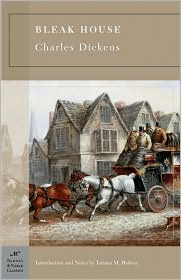
Bleak House

Bleak House. Charles Dickens. 1852-1853. 912 pages.

London. Michaelmas Term lately over, and the Lord chancellor sitting in Lincoln's Inn Hall. Implacable November weather. As much mud in the streets, as if the waters had but newly retired from the face of the earth, and it would not be wonderful to meet a Megalosaurus, forty feet long or so, waddling like an elephantine lizard up Holborn Hill.

How did I feel about Bleak House? Overall, I liked it. I more than liked it. I really, really liked it. What did I like best? The characters, the story, or the writing style? Hard to choose--for me. I think some readers may be so intimidated by the writing style--Dickens way of using a thousand words to paint a picture--that it becomes almost impossible to connect with the characters and enjoy the story.

The characters and story. Esther, a young woman who's clueless about the identity of her parents, becomes a companion to Ada, one of the wards in the legal dispute of Jarndyce and Jarndyce. These two young women--along with Richard, the second ward in the case--are under the guardianship of a Mr. John Jarndyce of Bleak House. Their guardian is kind, compassionate, generous, and an all-around good fellow. He hates, hates, hates Jarndyce and Jarndyce and wants absolutely nothing to do with the matter. Richard loves Ada. He desperately wants to marry her, but Mr. Jarndyce disapproves of the match because Richard doesn't have a way to provide for her. He feels Rick needs to grow up a little and find a career. Unfortunately, Rick doesn't take to this idea of having a profession--of making a living. Though he isn't quite as childish--as shallow--as Mr. Harold Skimpole, a man who borrows freely from anybody and everybody. (He's also fond of philosophizing about how wonderfully childish he is!) Through the course of the novel: Esther discovers the identity of her parents and falls in love; Rick fails at one profession after another until he decides once and for all to devote his entire energy to a law case that his been in the system for several generations, all the while Ada continues to love Rick unconditionally. Then there's the mysterious side of Bleak House. The murderous side. Lady Dedlock has a secret from her husband, Sir Leicester. A secret that Dedlock's lawyer, Mr. Tulkinghorn, discovers, after much unscrupulous searching and digging. There are MANY characters who are despicable. MANY characters who have enemies. MANY characters who have strong motives.

Dickens did a great job with his characters. You'll find characters that you'll absolutely love and adore. You'll find characters that are so enjoyable, so fun, to spend time with. You'll find characters that make you laugh--or at least smirk. You might find a few characters that you love to hate, or hate to love. You'll find characters that are just so despicable, so nasty, so horrid that you hate them--with a passion. There might even be a few that drive you crazy! But I hope that you'll find a few characters that genuinely surprise you! I know a few surprised me! There are so many characters. Some are very important to the plot. Others are very minor. But just because they're minor doesn't mean they're pointless. (For example, I *liked* Mr. Chadband!)

The writing. I won't lie. It took me more than a few chapters to make any sense of this one to begin to like this one. The style of the first chapter is very off-putting. In my opinion. That and the fact that so many characters are introduced in the early chapters.  It's not until the reader is introduced to Esther, Ada, and Richard--not until these three are taken to Bleak House--that it began to work for me. But. I did like this one. I really came to like the style. I came to appreciate his descriptions, his details.

A word from Esther:
I don't know how it is, I seem to be always writing about myself. I mean all the time to write about other people, and I try to think about myself as little as possible, and I am sure, when I find myself coming into the story again, I am really vexed and say, "Dear, dear, you tiresome little creature, I wish you wouldn't!" but it is all of no use. I hope any one who may read what I write, will understand that if these pages contain a great deal about me, I can only suppose it must be because I have really something to do with them and can't be kept out. (102-3)
A description of Sir Leicester:
Sir Leicester is generally in a complacent state, and rarely bored. When he has nothing else to do, he can always contemplate his own greatness. It is a considerable advantage to a man, to have so inexhaustible a subject. (139)
A description of Mr. Smallweed:
Everything that Mr. Smallweed's grandfather ever put away in his mind was a grub at first, and is a grub at last. In all his life he has never bred a single butterfly. (257)
From Lady Dedlock to Mr. Tulkinghorn:
"Of repentance or remorse, or any feeling of mine," Lady Dedlock presently proceeds, "I say not a word. If I were not dumb, you would be deaf. Let that go by. It is not for your ears." (509)
I liked the flavor of Bleak House. It has its difficulties--I suppose. (Though no more than any other classic of its size, its substance). But. I really enjoyed this one. There were so many things that I just loved about it. (For example, Mr. Jarndyce's growlery. I loved that! Don't we all need a place to go when we're out of humor?!)

Is it worth reading?! I think so! I think the characters are very well done--very human, very memorable. I think the writing--especially once the mystery begins--is very suspenseful.

Is it worth watching?! I think many people who might be intimidated by reading the novel would enjoy seeing an adaptation of it. I saw the 2005 adaptation. It was long--fifteen episodes--but I enjoyed it. It definitely has its differences--it's not the book--but I did enjoy the drama. It was DRAMA! It was very compelling.

© Becky Laney of Becky's Book Reviews