Showing posts with label 1854. Show all posts

Sunday, August 13, 2017

Hide and Seek

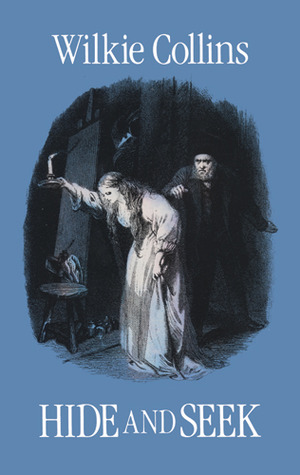
Hide and Seek. Wilkie Collins. 1854. 384 pages. [Source: Bought]

First sentence: At a quarter to one o'clock, on a wet Sunday afternoon, in November 1837, Samuel Snoxell, page to Mr. Zachary Thorpe, of Baregrove Square, London, left the area gate with three umbrellas under his arm, to meet his master and mistress at the church door, on the conclusion of morning service.

Premise/plot: Mr. Valentine Blyth is an artist. While working in the country side--painting portraits of babies and sometimes painting portraits of horses--he sees a deaf/dumb girl named Mary. She's ten or so. He and his wife don't have any children, and, he pities her since she's literally the property of a circus. Mrs. Peckover (the wife of one of the clowns) is raising her as best she can but she agrees that Mr. and Mrs Blyth might make more suitable parents. She tells Mr. Blyth all she knows about Mary's (Madonna's) origins. She gives him a hair bracelet--all that is left of the mother's belongings. Many years later, Mr. Blyth welcomes into his home a Mr. Zack Thorpe. Zack has aspirations for being an artist; at the moment he's a semi bad-boy. He isn't past all hope yet, but, he's certainly not hanging out with the right people and doing as he should--if he wants to be a respectable, honorable gentleman. One day, however, he does a good deed for a stranger, a "wild" man named Mat Grice. Mat swears that he will always, always think of Zack as a brother. The two move in together, and Zack introduces him to Mr. Blyth. While a guest in Blyth's home, he becomes a bit sly and seems very shady. Thus the mystery begins...Who is Madonna's father? Who was her mother? How is Mat connected--if at all--to Madonna? What kind of man is Mat?

My thoughts: Hide and Seek is Wilkie Collins' third novel. I've not read either of his previous novels: Antonina (1850) or Basil (1852). It is his first mystery novel, I believe.

I definitely enjoyed this one. I can't say that I loved, loved, loved it. But I definitely wanted to keep reading. I did not guess everything ahead of time. But I did get a strong sense in the beginning of the novel that the romance between Zack and Madonna was doomed some way, some how. The character that surprised me most was Mat. I really had my doubts about him when he was first introduced. But by the end of the novel, I definitely wanted him to have a happy ending.

s
p
o
i
l
e
r

One word about the plot, I do think it seems a bit ridiculous how Mat pieces EVERYTHING together based on two locks of hair being the EXACT SAME SHADE. Hair color does not equal a DNA test. That is all. 

Quotes:

Our destinies shape the future for us out of strange materials: a traveling circus sufficed them, in the first instance, to shape a new future for Mr. Blyth. (41)
Art wouldn't be the glorious thing it is, if it wasn't all difficulty from beginning to end. (120)


© 2017 Becky Laney of Becky's Book Reviews

Sunday, February 15, 2015

Hard Times (1854)

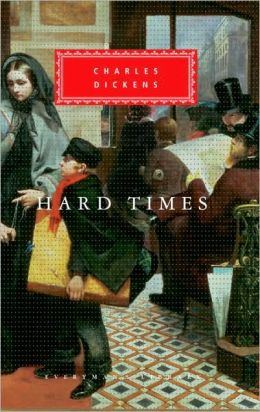
Hard Times. Charles Dickens. 1854/1992. Everyman's Library. 336 pages.  [Source: Library]

'Now, what I want is, Facts. Teach these boys and girls nothing but Facts. Facts alone are wanted in life. Plant nothing else, and root out everything else. You can only form the minds of reasoning animals upon Facts: nothing else will ever be of any service to them. This is the principle on which I bring up my own children, and this is the principle on which I bring up these children. Stick to Facts, Sir!'

Did I like Hard Times? Did I love Hard Times? I'm not sure which--like or love--at the moment. I can only say that I was surprised that I found this book to be so quick and entertaining. I'm used to spending weeks with Dickens, not a day. Yes, I sped through this one. Not because I had to, but, because I wanted to. I found it easy to follow, but, I'm finding it difficult to summarize.

Readers meet Mr. Gradgrind and two of his children whom he's bringing up on facts: Louisa and Tom. On the surface perhaps, the book is about how this philosophical upbringing works out for them as adults. Or how it doesn't, as the case may be. Louisa marries one of her father's closest associates, Josiah Bounderby, who is several decades (at least) older. Tom goes to work at Bounderby's bank. If you've read Dickens before, you know to expect plenty of characters and side stories. This is also the case in Hard Times. Readers also meet: Sissy Jupe, Mr. Sleary, Stephen Blackpool, Rachael, Mrs. Sparsit, Bitzer, James Harthouse, and Mrs. Pegler. There were characters that I really liked, and there were characters that I really didn't like at all!

I liked this one very much. I liked the writing style. I liked the pacing. I liked the characterization. I liked the dialogue. I'm so glad I've made a friend of Dickens! This definitely was not the case when I was in high school and struggling with Great Expectations!

© 2015 Becky Laney of Becky's Book Reviews
Sunday, October 19, 2014

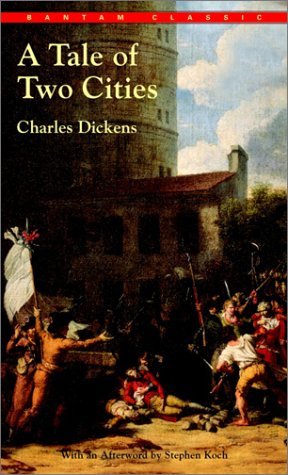
A Tale of Two Cities (1854)

A Tale of Two Cities. Charles Dickens. 1854/2003. Bantam Classics. 382 pages. [Source: Bought]

I didn't love A Tale of Two Cities. Or should I say I didn't love it as much as I hoped I would OR even thought I would. A Tale of Two Cities is definitely a subject-driven novel. The focus, I would even say sole focus, is on the French Revolution. We meet individual characters within that setting, to make the French Revolution more personal, perhaps, but, in my opinion, Dickens characterization is not as strong in A Tale of Two Cities as it is in some of his other novels. That doesn't mean his characters are not memorable. In fact, I imagine that there are at least two or three characters in this one that are very memorable indeed. A Tale of Two Cities is also a very heavy novel thematically. It's just dark and oppressive. Dickens won't be bringing any smiles to readers in this one. Personally, I love it when Dickens makes me laugh!

The novel begins with a reunion. A daughter, Lucie Manette, learns that the father she has long presumed to be dead is, in fact, alive. His existence seems to be news to quite a few people. Lucie Manette and Mr. Jarvis Lorry travel to France from England to meet him and bring him back. The name of this section is "Recalled to Life." And it's a very fitting title, in my opinion. Lorry and Lucie never really learn the whole story, all the ugly details of the past. Seeing Lucie with her father reminded me--in a good way--of the relationship between Jean Valjean and Cosette.

The second book, "The Golden Thread," introduces readers to Charles Darnay and Sydney Carton. These two men become very well known to Dr. Manette and his daughter. Both men love and admire her, as you would expect. But she can only love one of them, and, her heart belongs to Charles. Of course, this is a very simple summary!

The third book is "The Track of A Storm." Let's just say, Dickens can do bleakity-bleak. This book follows Charles Darnay into France during the early days of the French Revolution. I had a hard time reading this section, because I didn't want to experience it. Darnay is NOT alone in France. And he's far from forgotten. Dr. Manette and his daughter and granddaughter are there, for one, and so is Sydney Carton. Of course, there are others as well to round out the plot.

Throughout all three sections, readers have also followed a few people from France, mainly Monsieur Defarge and his not-so-lovely wife, Madame Defarge. I'm not sure I've ever hated a character more. I am sure that I have. Probably. Still, this book made me so very angry in places!!!

I won't talk about the ending. I won't. I don't want to. I probably don't even need to. A Tale of Two Cities left me needing a comfort read as a follow-up.

© 2014 Becky Laney of Becky's Book Reviews

Monday, June 09, 2014

A Child's History of England (1854)

A Child's History of England. Charles Dickens. 1851-1853.  390 pages. [Source: Book I Bought]

What a treat to discover Charles Dickens' A Child's History of England. I enjoyed Dickens style. I liked the action and characterization. It was also rich in description. Here's the first sentence,
"In the old days, a long, long while ago, before Our Saviour was born on earth and lay asleep in a manger, these Islands were in the same place, and the stormy sea roared round them, just as it roars now. But the sea was not alive, then, with great ships and brave sailors, sailing to and from all parts of the world. It was very lonely. The Islands lay solitary, in the great expanse of water. The foaming waves dashed against their cliffs, and the bleak winds blew over their forests; but the winds and waves brought no adventurers to land upon the Islands, and the savage Islanders knew nothing of the rest of the world, and the rest of the world knew nothing of them."
Not that every sentence is that scripted or forced. The book itself is very readable. The chapters are rarely--if ever--boring. That being said, some chapters are more exciting than others.

I recently read Jane Austen's History of England. Dickens is definitely partial and prejudiced in his historical approach as well, even, if his book tries (with varying success) to carry more authority and substance. While I think Austen approached her work in fun with a good amount of playfulness, Dickens takes his subject much more seriously. While one can entertain doubts that Austen truly means every word she wrote in A History of England, Dickens opinions, which are even harsher in some ways, sound genuine enough. For better or worse. I don't have a problem with historians having opinions, and being passionate about the subject. But it's always nice to know that they know it's all so very subjective. Dickens and I would definitely disagree in places!!! Especially when he includes women in his history. And especially about Richard III!

Strengths:
  • Begins around the time of the Romans, ends around 1688 Revolution
  • Covers centuries of stories and legends and facts
  • Mainly focuses on royalty
  • Seeks to explain big subjects simply
  • Written with emphasis on characters and personalities
  • Shows the subjectivity of history
Quotes:
Hengist and Horsa drove out the Picts and Scots; and Vortigern, being grateful to them for that service, made no opposition to their settling themselves in that part of England which is called the Isle of Thanet, or to their inviting over more of their countrymen to join them. But Hengist had a beautiful daughter named Rowena; and when, at a feast, she filled a golden goblet to the brim with wine, and gave it to Vortigern, saying in a sweet voice, ‘Dear King, thy health!’ the King fell in love with her. My opinion is, that the cunning Hengist meant him to do so, in order that the Saxons might have greater influence with him; and that the fair Rowena came to that feast, golden goblet and all, on purpose.
But the Duke showed so little inclination to do so now, that he proposed to Canute to marry his sister, the widow of The Unready; who, being but a showy flower, and caring for nothing so much as becoming a queen again, left her children and was wedded to him.
The King’s brother, Robert of Normandy, seeming quite content to be only Duke of that country; and the King’s other brother, Fine-Scholar, being quiet enough with his five thousand pounds in a chest; the King flattered himself, we may suppose, with the hope of an easy reign. But easy reigns were difficult to have in those days. [The King was William II]
Although King Stephen was, for the time in which he lived, a humane and moderate man, with many excellent qualities; and although nothing worse is known of him than his usurpation of the Crown, which he probably excused to himself by the consideration that King Henry the First was a usurper too — which was no excuse at all; the people of England suffered more in these dread nineteen years, than at any former period even of their suffering history. In the division of the nobility between the two rival claimants of the Crown, and in the growth of what is called the Feudal System (which made the peasants the born vassals and mere slaves of the Barons), every Noble had his strong Castle, where he reigned the cruel king of all the neighbouring people. Accordingly, he perpetrated whatever cruelties he chose. And never were worse cruelties committed upon earth than in wretched England in those nineteen years. The writers who were living then describe them fearfully. They say that the castles were filled with devils rather than with men; that the peasants, men and women, were put into dungeons for their gold and silver, were tortured with fire and smoke, were hung up by the thumbs, were hung up by the heels with great weights to their heads, were torn with jagged irons, killed with hunger, broken to death in narrow chests filled with sharp-pointed stones, murdered in countless fiendish ways. In England there was no corn, no meat, no cheese, no butter, there were no tilled lands, no harvests. Ashes of burnt towns, and dreary wastes, were all that the traveller, fearful of the robbers who prowled abroad at all hours, would see in a long day’s journey; and from sunrise until night, he would not come upon a home. The clergy sometimes suffered, and heavily too, from pillage, but many of them had castles of their own, and fought in helmet and armour like the barons, and drew lots with other fighting men for their share of booty. The Pope (or Bishop of Rome), on King Stephen’s resisting his ambition, laid England under an Interdict at one period of this reign; which means that he allowed no service to be performed in the churches, no couples to be married, no bells to be rung, no dead bodies to be buried. Any man having the power to refuse these things, no matter whether he were called a Pope or a Poulterer, would, of course, have the power of afflicting numbers of innocent people. That nothing might be wanting to the miseries of King Stephen’s time, the Pope threw in this contribution to the public store — not very like the widow’s contribution, as I think, when Our Saviour sat in Jerusalem over-against the Treasury, ‘and she threw in two mites, which make a farthing.’
He had four sons. Henry, now aged eighteen — his secret crowning of whom had given such offence to Thomas à Becket. Richard, aged sixteen; Geoffrey, fifteen; and John, his favourite, a young boy whom the courtiers named Lackland, because he had no inheritance, but to whom the King meant to give the Lordship of Ireland. All these misguided boys, in their turn, were unnatural sons to him, and unnatural brothers to each other. Prince Henry, stimulated by the French King, and by his bad mother, Queen Eleanor, began the undutiful history, First, he demanded that his young wife, Margaret, the French King’s daughter, should be crowned as well as he. His father, the King, consented, and it was done. It was no sooner done, than he demanded to have a part of his father’s dominions, during his father’s life. This being refused, he made off from his father in the night, with his bad heart full of bitterness, and took refuge at the French King’s Court. Within a day or two, his brothers Richard and Geoffrey followed. Their mother tried to join them — escaping in man’s clothes — but she was seized by King Henry’s men, and immured in prison, where she lay, deservedly, for sixteen years. [Henry II and his children]
Nothing can make war otherwise than horrible.
Ah! happy had it been for the Maid of Orleans, if she had resumed her rustic dress that day, and had gone home to the little chapel and the wild hills, and had forgotten all these things, and had been a good man’s wife, and had heard no stranger voices than the voices of little children!
Sir Robert Brackenbury was at that time Governor of the Tower. To him, by the hands of a messenger named John Green, did King Richard send a letter, ordering him by some means to put the two young princes to death. But Sir Robert — I hope because he had children of his own, and loved them — sent John Green back again, riding and spurring along the dusty roads, with the answer that he could not do so horrible a piece of work. The King, having frowningly considered a little, called to him Sir James Tyrrel, his master of the horse, and to him gave authority to take command of the Tower, whenever he would, for twenty-four hours, and to keep all the keys of the Tower during that space of time. Tyrrel, well knowing what was wanted, looked about him for two hardened ruffians, and chose John Dighton, one of his own grooms, and Miles Forest, who was a murderer by trade. Having secured these two assistants, he went, upon a day in August, to the Tower, showed his authority from the King, took the command for four-and-twenty hours, and obtained possession of the keys. And when the black night came he went creeping, creeping, like a guilty villain as he was, up the dark, stone winding stairs, and along the dark stone passages, until he came to the door of the room where the two young princes, having said their prayers, lay fast asleep, clasped in each other’s arms. And while he watched and listened at the door, he sent in those evil demons, John Dighton and Miles Forest, who smothered the two princes with the bed and pillows, and carried their bodies down the stairs, and buried them under a great heap of stones at the staircase foot. And when the day came, he gave up the command of the Tower, and restored the keys, and hurried away without once looking behind him; and Sir Robert Brackenbury went with fear and sadness to the princes’ room, and found the princes gone for ever.
We now come to King Henry the Eighth, whom it has been too much the fashion to call ‘Bluff King Hal,’ and ‘Burly King Harry,’ and other fine names; but whom I shall take the liberty to call, plainly, one of the most detestable villains that ever drew breath. You will be able to judge, long before we come to the end of his life, whether he deserves the character.
Her bad marriage with a worse man came to its natural end. Its natural end was not, as we shall too soon see, a natural death for her.
Henry the Eighth has been favoured by some Protestant writers, because the Reformation was achieved in his time. But the mighty merit of it lies with other men and not with him; and it can be rendered none the worse by this monster’s crimes, and none the better by any defence of them. The plain truth is, that he was a most intolerable ruffian, a disgrace to human nature, and a blot of blood and grease upon the History of England.
Mary was now crowned Queen. She was thirty-seven years of age, short and thin, wrinkled in the face, and very unhealthy. But she had a great liking for show and for bright colours, and all the ladies of her Court were magnificently dressed. She had a great liking too for old customs, without much sense in them; and she was oiled in the oldest way, and blessed in the oldest way, and done all manner of things to in the oldest way, at her coronation. I hope they did her good. She soon began to show her desire to put down the Reformed religion, and put up the unreformed one: though it was dangerous work as yet, the people being something wiser than they used to be. They even cast a shower of stones — and among them a dagger — at one of the royal chaplains who attacked the Reformed religion in a public sermon. But the Queen and her priests went steadily on.
It would seem that Philip, the Prince of Spain, was a main cause of this change in Elizabeth’s fortunes. He was not an amiable man, being, on the contrary, proud, overbearing, and gloomy; but he and the Spanish lords who came over with him, assuredly did discountenance the idea of doing any violence to the Princess. It may have been mere prudence, but we will hope it was manhood and honour. The Queen had been expecting her husband with great impatience, and at length he came, to her great joy, though he never cared much for her.
She was clever, but cunning and deceitful, and inherited much of her father’s violent temper. I mention this now, because she has been so over-praised by one party, and so over-abused by another, that it is hardly possible to understand the greater part of her reign without first understanding what kind of woman she really was... The Queen always declared in good set speeches, that she would never be married at all, but would live and die a Maiden Queen. It was a very pleasant and meritorious declaration, I suppose; but it has been puffed and trumpeted so much, that I am rather tired of it myself... It is very difficult to make out, at this distance of time, and between opposite accounts, whether Elizabeth really was a humane woman, or desired to appear so, or was fearful of shedding the blood of people of great name who were popular in the country. [About Queen Elizabeth]
‘Our cousin of Scotland’ was ugly, awkward, and shuffling both in mind and person. His tongue was much too large for his mouth, his legs were much too weak for his body, and his dull goggle-eyes stared and rolled like an idiot’s. He was cunning, covetous, wasteful, idle, drunken, greedy, dirty, cowardly, a great swearer, and the most conceited man on earth... While these events were in progress, and while his Sowship was making such an exhibition of himself, from day to day and from year to year, as is not often seen in any sty... [About King James I]
Baby Charles became King Charles the First, in the twenty-fifth year of his age. Unlike his father, he was usually amiable in his private character, and grave and dignified in his bearing; but, like his father, he had monstrously exaggerated notions of the rights of a king, and was evasive, and not to be trusted. If his word could have been relied upon, his history might have had a different end... With all my sorrow for him, I cannot agree with him that he died ‘the martyr of the people;’ for the people had been martyrs to him, and to his ideas of a King’s rights, long before.
There never were such profligate times in England as under Charles the Second. Whenever you see his portrait, with his swarthy, ill-looking face and great nose, you may fancy him in his Court at Whitehall, surrounded by some of the very worst vagabonds in the kingdom (though they were lords and ladies), drinking, gambling, indulging in vicious conversation, and committing every kind of profligate excess. It has been a fashion to call Charles the Second ‘The Merry Monarch.’ Let me try to give you a general idea of some of the merry things that were done, in the merry days when this merry gentleman sat upon his merry throne, in merry England. The first merry proceeding was — of course — to declare that he was one of the greatest, the wisest, and the noblest kings that ever shone, like the blessed sun itself, on this benighted earth. The next merry and pleasant piece of business was, for the Parliament, in the humblest manner, to give him one million two hundred thousand pounds a year, and to settle upon him for life that old disputed tonnage and poundage which had been so bravely fought for. 
King James the Second was a man so very disagreeable, that even the best of historians has favoured his brother Charles, as becoming, by comparison, quite a pleasant character.
As you can see, Dickens is very, very, very opinionated! A Child's History of England is an interesting and entertaining read for the history lover.
© 2014 Becky Laney of Becky's Book Reviews

Saturday, February 26, 2011

North and South (Revisited)

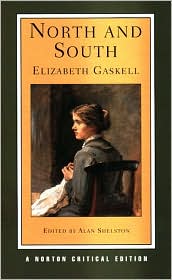
North and South. Elizabeth Gaskell. 1854-1855. 452 pages.

'Edith!' said Margaret, gently, 'Edith!'
But, as Margaret half suspected, Edith had fallen asleep.


Last spring I discovered North and South by Elizabeth Gaskell. It was a story that I couldn't forget. I read the book. I listened to the audio book. I watched the movie. (I watched the movie twice.) When I wrote in my review that I loved it--I meant it. No question about that. But at the same time, I questioned the intensity of that love. Would it prove a lasting love? Would North and South prove to be a true favorite? Yes, the characters, the stories made an impression on me. But would it make a lasting impression? I knew that sooner or later I would have to reread this one.

So what do I think after rereading this one? I love it even more than I did before! And I didn't think that was quite possible! Because I was very enthusiastic the first time around.

There were things that I noticed for the first time. There were things that I was only able to appreciate the second time through. Little details that may not seem like much, but taken together add to the beauty and complexity of the whole.

I was able to focus on the relationships more, I think.  John's relationship with his mother and sister. And the relationship between Margaret and her mother and father and brother. And, of course, I was paying attention to every sign of affection between John and Margaret! Knowing the characters--knowing their strengths and weaknesses--it affected how I read the novel.
 
This was such a satisfying, comfort read.

North and South is bittersweet. I think the contrast between life's joys and sorrows is one reason why I love this one so very much. Because of everything that Margaret endures, her happily ever after means just that much more to me. I think I love John and Margaret more because of all the obstacles along the way.


Some of my favorite lines:

As she realized what might have been, she grew to be thankful for what was. (68)

'Take care you don't get caught by a penniless girl, John'
'I am not easily caught, mother, as I think you know. But I must not have Miss Hale spoken of in that way, which, you know is offensive to me. I never was aware of any young lady trying to catch me yet, nor do I believe that any one has ever given themselves that useless trouble. (78)

'Papa, I do think Mr. Thornton a very remarkable man; but personally I don't like him at all.' (88)

'Bessy, don't be impatient with your life, whatever it is--or may have been. Remember who gave it you, and made it what it is!' (91)

'Loyalty and obedience to wisdom and justice are fine; but it is still finer to defy arbitrary power, unjustly and cruelly used -- not on behalf of ourselves, but on behalf of others more helpless.' (109)

'I cannot forgive her pride,' said his mother; 'I will befriend her, if there is need, for your asking, John. I would befriend Jezebel herself if you asked me. But this girl, who turns up her nose at us all--who turns up her nose at you--'
'Nay, mother; I have never yet put myself, and I mean never to put myself, within reach of her contempt.'
'Contempt, indeed! Don't go speaking of Miss Hale, John, if I've to be kind to her. When I'm with her, I don't know if I like or dislike her most; but when I think of her, and hear you talk of her, I hate her.' (143)

'Don't dwell so much on the prophecies, but read the clearer parts of the Bible.'
'I dare say it would be wiser; but where would I hear such grand words of promise--hear tell o' anything so far different fro' this dreary world, and this town above as in Revelations? Many's the time I've repeated the verses in the seventh chapter to myself, just for the sound. It's as good as an organ, and as different from every day, too. No, I cannot give up Revelations. It gives me more comfort than any other book i' the Bible.' (137)

'I suspect my "gentleman" includes your "true man."'
'And a great deal more, you would imply. I differ from you. A man is to me a higher and completer being than a gentleman.'
'What do you mean?' asked Margaret. 'We must understand the words differently.'
'I take it that "gentleman" is a term that only describes a person in his relation to others; but when we speak of him as "a man," we consider him not merely with regard to his fellow-men, but in relation to himself, - to life - to time - to eternity. A cast-away lonely as Robinson Crusoe - a prisoner immured in a dungeon for life - nay, even a saint in Patmos, has his endurance, his strength, his faith, best described as being spoken of as "a man." I am rather weary of this word "gentlemanly," which seems to me to be often inappropriately used, and often, too, with such exaggerated distortion of meaning, while the full simplicity of the noun "man," and the adjective "manly" are unacknowledged - that I am induced to class it with the cant of the day.' (163)

'He is the first specimen of a manufacturer - of a person engaged in trade - that I had ever the opportunity of studying, papa. He is my first olive, let me make a face while I swallow it. I know he is good of his kind, and by and by I shall like the kind. I rather think I am already beginning to do so. (165)

'Speak to your workmen as if they were human beings. Speak to them kindly. Don't let the soldiers come in and cut down poor creatures who are driven mad. I see one there who is. If you have any courage or noble quality in you, go out and speak to them, man to man.' (175)

'I hardly know if it is pain or pleasure, to think that I owe it to one - nay, you must, you shall hear - to one whom I love, as I do not believe man ever loved woman before.' (192)

'One word more. You look as if you thought it tainted you to be loved by me. You cannot avoid it. Nay, I, if I would, cannot cleanse you from it. But I would not, if I could. I have never loved any woman before: my life has been too busy, my thoughts too much absorbed with other things. Now I love, and will love. But do  not be afraid of too much expression on my part. (194)

'I see a great deal of difference between Miss Hale and Fanny. I can imagine that the one may have weighty reasons, which may and ought to make her overlook any seeming impropriety in her conduct. I never knew Fanny have weighty reasons for anything. Other people must guard her. I believe Miss Hale is guardian to herself.' (305)

'The exact truth! Very few people do speak the exact truth. I have given up hoping for it.' (320)

'He may care for her, though she really has been almost rude to him at times. But she! - why, Margaret would never think of him, I'm sure! Such a thing has never entered her head.'
'Entering her heart would do. But I merely threw out a suggestion of what might be.' (329)


© 2011 Becky Laney of Becky's Book Reviews

Saturday, May 15, 2010

North and South


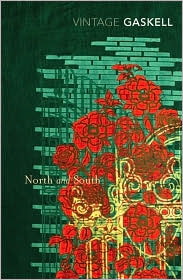
North and South. Elizabeth Gaskell. 1854-1855.* 452 pages.

'Edith!' said Margaret, gently, 'Edith!'
But, as Margaret half suspected, Edith had fallen asleep.


I loved this one. I really loved this one. I think it is easily my favorite Elizabeth Gaskell. So far. I've read Wives and Daughters. Mary Barton. And Cranford. (Though perhaps if Wives and Daughters had been finished, then they'd be some competition.)

Is it a romance? Is it a novel of two different social classes battling it out? Is it a novel about the industrial revolution that was for better or worse changing the world, changing life as they knew it at least, transforming it into who knows what? Is it about the ethics of business, and the responsibilities of the middle class? Maybe a little bit of all the above.

Margaret, our heroine, is a dutiful daughter. (But that doesn't mean she doesn't have opinions. And that doesn't mean she'll keep quiet about having opinions either.) She accompanies her parents to the Northern town of Milton. Though she'd much rather have stayed in the South, in the comfy-cozy parsonage where she spent so many happy years. But after her father, Mr. Hale, decides he has to split from the Church--that he has to give up his vicarage, well, the family moves to the North. (It's not so much what is best for the family that is to be considered, but what is best for Mr. Hale has to be what's best for his wife and daughter.) Mr. Hale becomes a tutor, a teacher to the young men (and some older men) in this manufacturing town. (Not that the town has high goals for education. No, it's all work all the time, in some ways.)

One of her father's favorite students is Mr. John Thornton. He is a mill owner. One of the wealthier folks in the town of Milton. He is one of the first people in town that Margaret meets. And you might say that neither got a fair impression--a true impression--of the other. And Miss Hale doesn't make the best of impressions on John's family either. His mother. His sister. But John--for better or worse--can't help being distracted by Margaret. It doesn't matter what his mother has to say on the subject. There's just something about Margaret that keeps her on his mind. All the time. Even when he has no reason at all to hope...

What does Margaret think of John? Well, it's complicated! It almost always is in these classics isn't it!

I loved this one. I loved its depth. I loved its characters. I loved its twists and turns. I loved its descriptions.** It is definitely bittersweet. (You should probably know that going into it. At least if you're sensitive to such things.) But it is oh-so-good. I would definitely recommend this one. I thought it was an amazing read.

If you listen to audio books, you should consider listening to North and South. Naxos released an unabridged edition of the novel this past February. (I believe there is an abridged version available as well.) It is read by Clare Wille. I'm not quite finished with the audio book. (I read faster than I listen.) But what I've heard so far has been good.

*The Oxford edition I read was published in 1998. It doesn't match the cover though. The cover is from the 2008 Oxford edition.
**One of my favorite descriptions comes towards the end of the novel. When Margaret returns to her old town, and learns about the new vicar and some of the changes that have happened during the years she's been away:
'Times is changed, miss; our new Vicar has seven children, and is building a nursery ready for more, just out where the arbour and tool-house used to be in old times. And he has had new grates put in, and a plate-glass window in the drawing room. He and his wife are stirring people, and have done a deal of good; at least they say it's doing good; if it were not I should call it turning things upside down for very little purpose.' (387)
That is such a GREAT description of a church, a congregation, getting a new preacher. At least in my experience.


© Becky Laney of Becky's Book Reviews