Showing posts with label 1800-1900. Show all posts

Monday, June 10, 2013

Phineas Finn (1869)

Phineas Finn (Palliser #2). Anthony Trollope. 1869. 752 pages.

If you love politics and love triangles, then Phineas Finn might be a good match for you. It is the second in the Palliser series by Anthony Trollope. It is quite different from Can You Forgive Her? (I have to say I LOVE Can You Forgive Her especially in comparison with Phineas Finn.)

If I had to give a brief summary: Phineas Finn is an incredibly-handsome young man with "luck" on his side. He's "fortunate" to achieve a seat in parliament so young especially since he's not got much money of his own. There are those, of course, who think that this deal is too good to be true, that Finn hasn't "earned" his political success and that he isn't grounded enough to handle it. But Finn is good to listen only to those who flatter him. Much of the novel focuses on Phineas Finn's handful of years in parliament. The years where he listens to his elders and does what he's told as far as voting goes. But at least a third of the novel is focused on Finn's love life, or, his love interests. There are essentially three different women whom he at one time or another "loves." Readers also spend some time with a very wealthy widow who's definitely in love with Phineas Finn.

The four women in his life include: Mary Flood Jones (his local Irish sweetheart),  Lady Laura Standish (his closest confidante), Violet Effingham (Lady Laura's best friend), and Madame Max Goesler (the wealthy widow). Of the four women, readers really get a chance to know Lady Laura best. I found her story definitely more appealing than the politics!

Phineas Finn isn't the first Trollope novel to explore women's roles or women's options. I am so glad that Lady Laura was in the hands of Anthony Trollope instead of Thomas Hardy! Readers meet a young woman too scared to marry for love. She sees that she is falling in love with Phineas Finn. He's poor, ambitious, and his future is so uncertain. When Robert Kennedy proposes, she accepts. She thinks that her match will be safe enough. She may never "love" Robert, but she doesn't fear him exactly. But that was before the marriage. Robert Kennedy is NOT Plantagenet Palliser OR John Grey. Their unhappy marriage is one of the main focuses of the novel. Lady Laura regrets her foolishness every single day, and her heart breaks as she sees Phineas Finn fall in and out of love with other women for her love has remained constant.

Violet Effingham is another love interest of Phineas Finn. Unlike Lady Laura, however, Violet never finds herself "in love" with Phineas. She enjoys his company, especially in a crowd when he isn't so intent on getting her alone. But Violet is suffering in a different way from Lady Laura. Her heart tells her to go ahead and marry Lord Chiltern (Laura's brother, Phineas Finn's good friend). She's known him most of her life. But her head KNOWS him as well. She knows that he isn't always responsible, wise, considerate, or "good." He has done some foolish things in his life; some just a little foolish. Part of her wants to "fix" him, wants to believe that he can be fixed, that he can be changed, that they can be happy together as man and wife. The other part of her says RUN.

I definitely enjoyed this one. I wouldn't say I loved it, however. While I found some of the characters--especially the women--interesting, I had a hard time really "loving" Phineas Finn the same way that I have loved other Trollope heroes in the past.

Quotes:
I never knew a government yet that wanted to do anything.
It's very little that ever is done, and that little is generally too much.
The people can take care of themselves a great deal better than we can take care of them. 
It was considered that the speech in which Mr. Daubeny reviewed the long political life of Mr. Mildmay, and showed that Mr. Mildmay had been at one time a bugbear, and then a nightmare, and latterly simply a fungus, was one of the severest attacks, if not the most severe, that had been heard in that House since the Reform Bill. 
They're for promising everything before they's elected; but not one in twenty of 'em is as good as his word when he gets there.
"I sometimes think you despise poetry," said Phineas. "When it is false I do. The difficulty is to know when it is false and when it is true."
"There are moments, Robert, when even a married woman must be herself rather than her husband's wife. It is so, though you cannot understand it."
"For myself," said Mr. Palliser gravely, "I think I may say that I always am really anxious to carry into practice all those doctrines of policy which I advocate in theory."
I suppose there must be government. But the less of it the better.
Talk of love! I tell you, sir, that your heart is one in which love can have no durable hold.
"Must we be strangers, you and I, because there was a time in which we were almost more than friends?"
There is nothing in the world so difficult as that task of making up one's mind.
"What man likes to be denied anything by a woman at any age? A woman who denies anything is called cruel at once,—even though it be her very soul."

© 2013 Becky Laney of Becky's Book Reviews

Monday, July 23, 2012

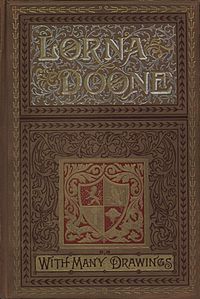
Lorna Doone

Lorna Doone. R.D. Blackmore. 1869. 658 pages.

If anybody cares to read a simple tale told simply, I, John Ridd of the parish of Oare, in the county of Somerset, yeoman and churchwarden, have seen and had a share in some doings of this neighborhood, which I will try to set down in order, God sparing my life and memory. 

Lorna Doone was a classic that I almost almost loved. However, while I didn't "love" it, I certainly liked it. What I liked best about Lorna Doone was the romance. There were a few love scenes in this one--scenes where John Ridd is wooing Lorna Doone and professing his unending love for her. And those scenes work the best of any in the novel. But those scenes make up just a fraction of the novel, and to be honest I found most of this one to be boring. Now, I enjoy a rambling novel, I do. I love Anthony Trollope, Charles Dickens, and Wilkie Collins. I don't mind an author that takes his time telling a story--so long as the asides are written in a charming, entertaining way. But I didn't feel that was the case in Lorna Doone.

This historical romance is set in Exmoor (Devon and Somerset England) in the 17th Century) during the reigns of King Charles II and James II. John Ridd falls in love with Lorna Doone, but there are a few big obstacles standing in the way of their true love. First, she is a Doone. The Doone clan murdered John's father. John himself forgives this flaw easily since Lorna is so incredibly beautiful. The rest of his family may not be eager to welcome a woman from the outlaw clan. And the Doone clan, well, they are definitely not wanting to lose "their" Lorna to John Ridd. Second, Lorna's mysterious past. She doesn't remember a time before the Doones, but, that doesn't mean there wasn't one. And this big reveal causes some to believe that John Ridd isn't good enough--worthy enough-- for her. I will not say more than that. Third, the general times in which they lived: the political mess of the battle for the kingdom between James II and the Duke of Monmouth. John is mistakenly taken for a soldier on Monmouth's side--that is not the case, but it does pose some problems. Fourth, the pure evil that is Carver Doone.

Favorite scenes:
I would have leaped into the valley of the shadow of death (as described by the late John Bunyan), only to hear her call me "John"; though Apollyon were lurking there, and Despair should lock me in.
She stole across the silent grass; but I strode hotly after her; fear was all beyond me now, except the fear of losing her. I could not but behold her manner, as she went before me, all her grace, and lovely sweetness, and her sense of what she was.
She led me to her own rich bower, which I told of once before; and if in spring it were a sight, what was it in summer glory? But although my mind had notice of its fairness and its wonder, not a heed my heart took of it, neither dwelt it in my presence more than flowing water. All that in my presence dwelt, all that in my heart was felt, was the maiden moving gently, and afraid to look at me.
For now the power of my love was abiding on her, new to her, unknown to her; not a thing to speak about, nor even to think clearly; only just to feel and wonder, with a pain of sweetness. She could look at me no more, neither could she look away, with a studied manner—only to let fall her eyes, and blush, and be put out with me, and still more with herself.
I left her quite alone; though close, though tingling to have hold of her. Even her right hand was dropped and lay among the mosses. Neither did I try to steal one glimpse below her eyelids. Life and death to me were hanging on the first glance I should win; yet I let it be so.
After long or short—I know not, yet ere I was weary, ere I yet began to think or wish for any answer—Lorna slowly raised her eyelids, with a gleam of dew below them, and looked at me doubtfully. Any look with so much in it never met my gaze before.
"Darling, do you love me?" was all that I could say to her.
"Yes, I like you very much," she answered, with her eyes gone from me, and her dark hair falling over, so as not to show me things.
"But do you love me, Lorna, Lorna; do you love me more than all the world?"
"No, to be sure not. Now why should I?"
"In truth, I know not why you should. Only I hoped that you did, Lorna. Either love me not at all, or as I love you for ever."
"John I love you very much; and I would not grieve you. You are the bravest, and the kindest, and the simplest of all men—I mean of all people—I like you very much, Master Ridd, and I think of you almost every day."
"That will not do for me, Lorna. Not almost every day I think, but every instant of my life, of you. For you I would give up my home, my love of all the world beside, my duty to my dearest ones, for you I would give up my life, and hope of life beyond it. Do you love me so?"
"Not by any means," said Lorna; "no, I like you very much, when you do not talk so wildly; and I like to see you come as if you would fill our valley up, and I like to think that even Carver would be nothing in your hands—but as to liking you like that, what should make it likely? (214-5)
and
She made for awhile as if she dreamed not of the meaning of my gaze, but tried to speak of other things, faltering now and then, and mantling with a richer damask below her long eyelashes.
"This is not what I came to know," I whispered very softly, "you know what I am come to ask."
"If you are come on purpose to ask anything, why do you delay so?" She turned away very bravely, but I saw that her lips were trembling.
"I delay so long, because I fear; because my whole life hangs in balance on a single word; because what I have near me now may never more be near me after, though more than all the world, or than a thousand worlds, to me." As I spoke these words of passion in a low soft voice, Lorna trembled more and more; but she made no answer, neither yet looked up at me.
"I have loved you long and long," I pursued, being reckless now, "when you were a little child, as a boy I worshipped you: then when I saw you a comely girl, as a stripling I adored you: now that you are a full-grown maiden all the rest I do, and more—I love you more than tongue can tell, or heart can hold in silence. I have waited long and long; and though I am so far below you I can wait no longer; but must have my answer."
"You have been very faithful, John," she murmured to the fern and moss; "I suppose I must reward you."
"That will not do for me," I said; "I will not have reluctant liking, nor assent for pity's sake; which only means endurance. I must have all love, or none, I must have your heart of hearts; even as you have mine, Lorna."
While I spoke, she glanced up shyly through her fluttering lashes, to prolong my doubt one moment, for her own delicious pride. Then she opened wide upon me all the glorious depth and softness of her loving eyes, and flung both arms around my neck, and answered with her heart on mine,—
"Darling, you have won it all. I shall never be my own again. I am yours, my own one, for ever and for ever."
I am sure I know not what I did, or what I said thereafter, being overcome with transport by her words and at her gaze. Only one thing I remember, when she raised her bright lips to me, like a child, for me to kiss, such a smile of sweet temptation met me through her flowing hair, that I almost forgot my manners, giving her no time to breathe.
"That will do," said Lorna gently, but violently blushing; "for the present that will do, John. And now remember one thing, dear. All the kindness is to be on my side; and you are to be very distant, as behoves to a young maiden; except when I invite you. But you may kiss my hand, John; oh, yes, you may kiss my hand, you know. Ah to be sure! I had forgotten; how very stupid of me!"
For by this time I had taken one sweet hand and gazed on it, with the pride of all the world to think that such a lovely thing was mine; and then I slipped my little ring upon the wedding finger; and this time Lorna kept it, and looked with fondness on its beauty, and clung to me with a flood of tears.
"Every time you cry," said I, drawing her closer to me "I shall consider it an invitation not to be too distant. There now, none shall make you weep. Darling, you shall sigh no more, but live in peace and happiness, with me to guard and cherish you: and who shall dare to vex you?" But she drew a long sad sigh, and looked at the ground with the great tears rolling, and pressed one hand upon the trouble of her pure young breast.
"It can never, never be," she murmured to herself alone: "Who am I, to dream of it? Something in my heart tells me it can be so never, never." (261-2)
Isn't the "I love you more than tongue can tell, or heart can hold in silence" lovely?

Lorna Doone isn't just a romance, however; John Ridd has a few adventures all his own, including more than a few fight/battle scenes.

Read Lorna Doone
  • If you like classics
  • If you like historical romances

© 2012 Becky Laney of Becky's Book Reviews

Sunday, December 25, 2011

Pride and Prejudice

Pride and Prejudice. Jane Austen. 1813. 386 pages.

It is a truth universally acknowledged, that a single man in possession of a good fortune, must be in want of a wife.

Pride and Prejudice is the first Austen novel I remember reading. And it's such a lovely, lovely read. There is something wonderfully satisfying about it. The characters, the dialogue, the letters.

I reread it this month hoping to recapture some of the joy of that first experience. I don't know if that's even possible. To reread something with new eyes, to seek to feel exactly the same way about it as you did before, but I tried my best.

Did I love it? Yes. Of course. It's Pride and Prejudice. But while other Austen novels have improved upon rereads--me liking them more than I did before, there is no improving Pride and Prejudice.
That's not a bad thing.

Is Pride and Prejudice your favorite Austen? It probably isn't mine. Mine would probably be Persuasion. I love and adore Persuasion. I do. There's just something oh-so-magical about it for me. But Pride and Prejudice though it isn't my favorite it is definitely special. Would I have gone on to read other Austen novels if I hadn't loved Pride and Prejudice? Would I have sought out every Austen movie adaptation if I hadn't loved it so much? Probably not.

© 2011 Becky Laney of Becky's Book Reviews
Monday, November 28, 2011

Revisiting Jane Eyre

Jane Eyre. Charlotte Bronte. 1847.  300 pages.

There was no possibility of taking a walk that day.

I know not everyone sees value in rereading books. But. I just can't help it. If I love a book once, I'm going to want to revisit it. Again and again and again. After all, if I never wanted to read it again...ever...could I even really say I loved it? Or loved, loved, loved it?

Jane Eyre was a pleasure to reread. It really was. From the first page to the last, it kept me satisfied. There was so much to savor, so much to slowly absorb. I didn't rush this one. I didn't want to rush this one. I wanted to enjoy every moment of this one. Because books as wonderful as Jane Eyre just aren't that easy to find.

Though Jane Eyre has been adapted to films many times, I don't think it's a novel that adapts particularly well. The novel is told in first person. We see EVERYTHING through Jane's eyes. It is a very personal connection the reader has to make with Jane if the novel is to be appreciated and loved. If you don't come to love Jane, if you don't come to understand Jane, if you don't come to see the world through Jane's eyes, if you don't see Mr. Rochester as Jane does, if you don't LOVE him as Jane does, then you're not getting the full experience.

I was disappointed with the 2011 adaptation. Especially with Mr. Rochester. Why? Well, if you didn't already LOVE Mr. Rochester, then you would have no real reason--other than appearance, perhaps?--to love him. By taking the words out of his mouth, by eliminating almost all of his dialogue with Jane, by eliminating the oh-so-crucial gypsy scene, viewers see only a slightly teasing Mr. Rochester with a very deep, very dark secret. We see him only at his very, very worst, for the most part. And the scene after Jane knows the truth, well, it just seems so far removed from anything in the book. It was seeking out that scene in the book, it was wanting to know how the *real* Mr. Rochester treated Jane after the big shocking reveal, that led me to reread the book.

The BBC production (from early 1980s) starring Timothy Dalton and Zelah Clarke is a much, much, much better adaptation. In my opinion. I loved, loved, loved how Jane's relationship with Mr. Rochester developed. I loved their scenes together. I loved the dialogue. I loved how we really got to know both characters through the episodes. (It is over five hours long!) Everything that I loved about the book (almost everything) was present in this adaptation. It just felt right!!!

Do you have a favorite adaptation of Jane Eyre?


My original review.

© 2011 Becky Laney of Becky's Book Reviews
Tuesday, October 18, 2011

Oliver Twist

Oliver Twist. Charles Dickens.  1838. 425 pages.

Among other public buildings in a certain town, which for many reasons it will be prudent to refrain from mentioning, and to which I will assign no fictional name, there is one anciently common to most towns, great or small: to wit, a workhouse; and in this workhouse was born; on a day and date which I need not trouble myself to repeat, inasmuch as it can be of no possible consequence to the reader, in this stage of the business at all events; the item of mortality whose name is prefixed to the head of this chapter.

While Oliver Twist isn't my new favorite Dickens's novel, I must say that I really really enjoyed it. I enjoyed the characters; I enjoyed the storytelling. The recent movie adaptation may have been slightly more compelling, but for me there was something just right about the book.

Oliver Twist is the hero of this one. This young orphan boy has a few misadventures before finding his happily ever after. But those misadventures make for quite a read, I must admit! He meets a lot of interesting characters, some more villainous than others. There are quite a few sympathetic characters, however.

I found Oliver Twist a great read, a surprisingly quick one! Perhaps because I just did not want to put it down! Generally, Dickens is one of those authors whose books I savor over two to three weeks, but that wasn't the case with Oliver Twist!


© 2011 Becky Laney of Becky's Book Reviews
Friday, August 26, 2011

Twenty Thousand Leagues Under the Sea

Twenty Thousand Leagues Under the Sea. Jules Verne. 1870. Puffin Classics. 280 pages.

In the year 1866 the whole maritime population of Europe and America was excited by a mysterious and inexplicable phenomenon.

I didn't seek out an abridged version of this Jules Verne classic. But when I discovered that the edition I'd checked out from the library was abridged--after I was four or five chapters into it--I didn't try to 'fix' it either.

I'll start with the good news. I definitely liked this one more than Journey to the Center of the Earth! There were times I actually thought Twenty Thousand Leagues Under the Sea was a good read. That the story had action and adventure and mystery.

Basic plot: A professor and his servant are 'captured' by a 'sea monster' created by the cranky Captain Nemo.

While reading this one, I started thinking about Frankenstein--which is a good thing, I think. I never did quite decide how the characters matched up between the two. But I think that there are definite similarities in theme. Frankenstein is one of my comfort reads--a book I love and adore. Twenty Thousand Leagues Under the Sea is a good read, but I'm not sure I'll ever want to reread it. If I ever do read it again, I might try the unabridged version.

© 2011 Becky Laney of Becky's Book Reviews

Friday, August 19, 2011

The Story of the Treasure Seekers (MG)

The Story of the Treasure Seekers. E. Nesbit. 1899. Puffin. 250 pages.

This is the story of the different ways we looked for treasure, and I think when you have read it you will see that we were not lazy about the looking. 

I just loved The Story of the Treasure Seekers. I loved the Bastables. There are six children: Dora, Oswald, Dicky, Noel and Alice, and H.O. (Horace Octavius). The children have a father, but no mother. But the father, for the most part, is absent from their day to day lives. This one has a simple plot. The children know that the family is in desperate need of money, and, well, they decide to look for treasure. Each child has an opportunity (or two) to come up with a plan for 'finding' treasure (getting money). Some of the plans are silly and over the top. (Like Noel's plan to marry a princess when he grew up.) But many of their plans lead to a FUN adventure!

I definitely enjoyed this one and would recommend it! It's a great adventure story with many satisfying moments. IF you've only read Nesbit's fantasy, you should give this one a try.

© 2011 Becky Laney of Becky's Book Reviews
Sunday, August 14, 2011

The Book of Dragons (MG)

The Book of Dragons. E. Nesbit. 1900. 180 pages.

The Book of Dragons is a collection of eight short stories by E. Nesbit. While I enjoy fantasy--especially when I'm in the right mood for it, especially when it is written by someone as talented as E. Nesbit--I am not always a big fan of short stories--no matter the genre.

I did enjoy this collection. I didn't love every story within the book, but I enjoyed many of them. The writing was just so delightful, so right, so satisfying. The eight stories are: The Book of Beasts, Uncle James or the Purple Stranger, The Deliverers of Their Country, The Ice Dragon Or Do As You Are Told, The Island of the Nine Whirlpools, The Dragon Tamers, The Fiery Dragon Or the Heart of Stone and the Heart of Gold, and Kind Little Edmund Or The Caves and the Cockatrice.

My favorite stories were The Island of The Nine Whirlpools and The Book of Beasts.

© 2011 Becky Laney of Becky's Book Reviews
Thursday, July 21, 2011

The Light Princess

The Light Princess. George MacDonald. 1864. 110 pages.

Once upon a time, so long ago that I have quite forgotten the date, there lived a king and queen who had no children. And the king said to himself, "All the queens of my acquaintance have children, some three, some seven, and some as many as twelve; and my queen has not one. I feel ill-used." So he made up his mind to be cross with his wife about it. But she bore it all like a good patient queen as she was. Then the king grew very cross indeed. But the queen pretended to take it all as a joke, and a very good one too.
"Why don't you have any daughters, at least?" said he. "I don't say sons; that might be too much to expect." 
"I am sure, dear king, I am very sorry," said the queen.
"So you ought to be," retorted the king; "you are not going to make a virtue of that, surely."
But he was not an ill-tempered king, and in any matter of less moment would have let the queen have her own way with all his heart. This, however, was an affair of state. The queen smiled. 
"You must have patience with a lady, you know, dear king," said she.
She was, indeed, a very nice queen, and heartily sorry that she could not oblige the king immediately. (1-2)

The Light Princess is such a DELIGHTFUL book. It seems obvious in a way to call it delightful and charming and oh-so-magical. But it's true. There are no other words that could do it justice. It's the story of what happens when this childless king and queen have a baby girl of their own. It's the story of what happens when one of the princesses (who is also a witch) is NOT invited to the christening.
The king tried to have patience, but he succeeded very badly. It was more than he deserved, therefore, when, at last, the queen gave him a daughter--as lovely a little princess as ever cried.
The day drew near when the infant must be christened. The king wrote all the invitations with his own hand. Of course somebody was forgotten.
Now it does not generally matter if somebody is forgotten, only you must mind who. Unfortunately, the king forgot without intending to forget; and so the chance fell upon the Princess Makemnoit, which was awkward. For the princess was the king's own sister; and he ought not to have forgotten her. But she had made herself so disagreeable to the old king, their father, that he had forgotten her in making his will; and so it was no wonder that her brother forgot her in writing his invitations. But poor relations don't do anything to keep you in mind of them. Why don't they? The king could not see into the garret she lived in, could he?
She was a sour, spiteful creature. The wrinkles of contempt crossed the wrinkles of peevishness, and made her face as full of wrinkles as a pat of butter. If ever a king could be justified in forgetting anybody, this king was justified in forgetting his sister, even at a christening. She looked very odd, too. Her forehead was as large as all the rest of her face, and projected over it like a precipice. When she was angry, her little eyes flashed blue. When she hated anybody, they shone yellow and green. What they looked like when she loved anybody, I do not know; for I never heard of her loving anybody but herself, and I do not think she could have managed that if she had not somehow got used to herself. But what made it highly imprudent in the king to forget her was--that she was awfully clever. In fact, she was a witch; and when she bewitched anybody, he very soon had enough of it; for she beat all the wicked fairies in wickedness, and all the clever ones in cleverness. (3-5)
Of course, the uninvited guest comes, and of course they bring an unwelcome gift. In this case, the princess-witch deprived the baby of gravity. So from the day of the christening on, she floated. The king and queen tried to find some positive aspects to it, but, really what could they do when their apologies failed? Just go on loving their daughter as she was with all their hearts.

But their daughter was different in another way too. She had no gravity in matters of the heart and mind too. She could not take anything seriously. Her reaction to life--to all of life--was laughter. Which is just as serious a curse as the other, in my opinion. For there was an emptiness in all her emotions, her actions.

The Light Princess is the story of what happens when she meets a prince. Will the young woman incapable of falling, be capable of falling in love?

I loved this one. I really loved it. It was charming, delightful, and witty. I loved the writing. Some of the descriptions just had me at hello. Like this one, "The wrinkles of contempt crossed the wrinkles of peevishness, and made her face as full of wrinkles as a pat of butter." To any reader who likes fairy tales, this one is a must!!! It's a beautiful, sweet story. And it's such a quick read. You can easily read it in one sitting.


© 2011 Becky Laney of Becky's Book Reviews
Tuesday, July 19, 2011

Heidi (MG)

Heidi. Johanna Spyri. 1880/2009. Puffin Classics/Penguin.  320 pages.

The pretty little Swiss town of Mayenfeld lies at the foot of a mountain range, whose grim rugged peaks tower high above the valley below.

If the cover to Heidi had looked this pretty, this inviting, this appealing, when I was a kid, there's a good chance I wouldn't have spent most of my life avoiding it. (It didn't help that the cover of the Heidi we had was AWFUL.) What I discovered was that Heidi is a nice, satisfying read. One that may just improve upon a reread. I can easily see why Eva Ibbotson, who wrote the introduction to this edition, described reading this one as feeling like you're coming home. There's just something cozy-and-comfortable about it.

So Heidi is an orphan, she's been one since the age of one. She has spent the next four years with her Aunt Detie. But at the start of the novel, at age five, she's being "given" to her grandfather. Detie has decided that enough is enough. She's not the only relative this kid has, and, well, she wants to live her own life without being a mother to her dead sister's kid. If my description is blunt and ugly, it's because Detie is. The way she speaks of the child--of Heidi--well it made me take an instant disliking to her. (And nothing in the book makes me change my opinion of her.) So Heidi and Detie are on their way up the mountain. The grandfather has a moment or two of doubt, but, Heidi erases his fears early on. He takes an instant liking to his granddaughter. And he notices how bright and wonderful she really is. Readers see this bond grow and grow as the two spend time together. No one could love grandfather more than Heidi, and no one could love Heidi more than her grandfather. Heidi has found her a home at last. And all seems right with the world. Heidi loves her grandfather, loves her new home, loves the mountains, loves the flowers, loves the goats, loves the goat herder, Peter, loves Peter's Grannie. Here is a girl that has a love of life, who doesn't want for anything.

But. All that changes with (boo, hiss) the arrival of Aunt Detie who seems to think that Heidi will be better off away from her grandfather. It has been arranged for Heidi to become the companion of a sickly little girl, Clara. Heidi has no choice in the matter. And is told that she can't have an opinion about it--essentially. Now, Heidi does like Clara well enough. It's not like she HATES Clara. I'm not sure it's in Heidi's nature to HATE anybody. But Heidi is definitely upset that she's been taken from everybody she loves, the home she loves, etc. And city life just isn't the same. Heidi doesn't feel like she belongs there.

The highlight of her time in the city may just be when Clara's grandmother comes to visit. This grandmother takes the time to get to know Heidi. She comes to love Heidi and care deeply about her. She encourages Heidi and gives her attention. She says you can learn to read and write. You are smart, you are capable, you can do it. Which is just the message this little girl needs to hear! When Heidi does learn to read, she is given a lovely picture book by this grandmother. But perhaps even more important than that gift is the gift of faith. For this grandmother--Mrs. Sesemann--talks to Heidi of God and prayer. She encourages the young girl to pray to God, to seek Him. She teaches Heidi that when God doesn't answer prayers right away--in the way we expect, in the time period we expect--that doesn't mean God hasn't heard. It's just that God knows what is best for us, he knows what we need, and when we need it. God may seem to be delaying his promises, or slow to working his promises, but God is a God who makes all things beautiful in HIS time.

So does Heidi get to return to her grandfather? What do you think?! Would it be so satisfying and happy-making if she didn't?

While I'm not quite sure that Heidi herself is flawed--she seems to represent everything pure and innocent and good in the world--the rest of the characters within the novel are flawed. And many--though not all--are lovable. Two of my favorites are Heidi's Grandfather (Uncle Alp) and Dr. Classen.

One of my favorite scenes with Dr. Classen:
"When you can do no more yourself," said Heidi confidently, "tell God."
"Those are good words, my dear," said the doctor, "but suppose it was God Himself who sent the sorrow."
Heidi sat pondering for a while. She was sure God could always help, but was trying to find the answer out of her own experiences. "I think you have to wait," she said at last, "and keep on thinking that God has something good which He's going to give you out of the sad thing, but you have to be patient. You see, when something's awfully bad, you don't know about the good bit coming, and you think it's going on for ever."
"I hope you will always feel like that, Heidi," he said, and fell silent, drinking in the scene before him.  (202)
And my favorite scene with the Grandfather--well, there are many, many scenes that I love between these two--is when she reads him the story of the prodigal son from her picture story book. The quote comes from an online edition of Heidi, not the exact same translation as the Puffin classic. (And I liked the Puffin classic better. In the book this comes from pages 172-175.)
"If God had let me come at once, as I prayed, then everything would have been different, I should only have had a little bread to bring to grandmother, and I should not have been able to read, which is such a comfort to her; but God has arranged it all so much better than I knew how to; everything has happened just as the other grandmother said it would. Oh, how glad I am that God did not let me have at once all I prayed and wept for! And now I shall always pray to God as she told me, and always thank Him, and when He does not do anything I ask for I shall think to myself, It's just like it was in Frankfurt: God, I am sure, is going to do something better still. So we will pray every day, won't we, grandfather, and never forget Him again, or else He may forget us."
"And supposing one does forget Him?" said the grandfather in a low voice.
"Then everything goes wrong, for God lets us then go where we like, and when we get poor and miserable and begin to cry about it no one pities us, but they say, You ran away from God, and so God, who could have helped you, left you to yourself."
"That is true, Heidi; where did you learn that?"
"From grandmamma; she explained it all to me."
The grandfather walked on for a little while without speaking, then he said, as if following his own train of thought: "And if it once is so, it is so always; no one can go back, and he whom God has forgotten, is forgotten for ever."
"Oh, no, grandfather, we can go back, for grandmamma told me so, and so it was in the beautiful tale in my book--but you have not heard that yet; but we shall be home directly now, and then I will read it you, and you will see how beautiful it is." And in her eagerness Heidi struggled faster and faster up the steep ascent, and they were no sooner at the top than she let go her grandfather's hand and ran into the hut. The grandfather slung the basket off his shoulders in which he had brought up a part of the contents of the trunk which was too heavy to carry up as it was. Then he sat down on his seat and began thinking.
Heidi soon came running out with her book under her arm. "That's right, grandfather," she exclaimed as she saw he had already taken his seat, and in a second she was beside him and had her book open at the particular tale, for she had read it so often that the leaves fell open at it of their own accord. And now in a sympathetic voice Heidi began to read of the son when he was happily at home, and went out into the fields with his father's flocks, and was dressed in a fine cloak, and stood leaning on his shepherd's staff watching as the sun went down, just as he was to be seen in the picture. But then all at once he wanted to have his own goods and money and to be his own master, and so he asked his father to give him his portion, and he left his home and went and wasted all his substance. And when he had nothing left he hired himself out to a master who had no flocks and fields like his father, but only swine to keep; and so he was obliged to watch these, and he only had rags to wear and a few husks to eat such as the swine fed upon. And then he thought of his old happy life at home and of how kindly his father had treated him and how ungrateful he had been, and he wept for sorrow and longing. And he thought to himself, "I will arise and go to my father, and will say to him, 'Father, I am not worthy to be called thy son; make me as one of thy hired servants.'" And when he was yet a great way off his father saw him . . . Here Heidi paused in her reading. "What do you think happens now, grandfather?" she said. "Do you think the father is still angry and will say to him, 'I told you so!' Well, listen now to what comes next." His father saw him, and had compassion, and ran, and fell on his neck and kissed him. And the son said to him, "Father, I have sinned against heaven and in thy sight, and am no more worthy to be called thy son." But the father said to his servants, "Bring forth the best robe, and put it on him; and put a ring on his hand and shoes on his feet: and bring hither the fatted calf and kill it; and let us eat and be merry, for this my son was dead and is alive again; he was lost and is found." And they began to be merry.
"Isn't that a beautiful tale, grandfather," said Heidi, as the latter continued to sit without speaking, for she had expected him to express pleasure and astonishment.
"You are right, Heidi; it is a beautiful tale," he replied, but he looked so grave as he said it that Heidi grew silent herself and sat looking quietly at her pictures. Presently she pushed her book gently in front of him and said, "See how happy he is there," and she pointed with her finger to the figure of the returned prodigal, who was standing by his father clad in fresh raiment as one of his own sons again.
A few hours later, as Heidi lay fast asleep in her bed, the grandfather went up the ladder and put his lamp down near her bed so that the light fell on the sleeping child. Her hands were still folded as if she had fallen asleep saying her prayers, an expression of peace and trust lay on the little face, and something in it seemed to appeal to the grandfather, for he stood a long time gazing down at her without speaking. At last he too folded his hands, and with bowed head said in a low voice, "Father, I have sinned against heaven and before thee and am not worthy to be called thy son." And two large tears rolled down the old man's cheeks.
Early the next morning he stood in front of his hut and gazed quietly around him. The fresh bright morning sun lay on mountain and valley. The sound of a few early bells rang up from the valley, and the birds were singing their morning song in the fir trees. He stepped back into the hut and called up, "Come along, Heidi! the sun is up! Put on your best frock, for we are going to church together!"
Not that Heidi is free from some oddities! I read somewhere that Johanna Spyri didn't really "like" school. And perhaps that shows in Heidi and Peter's reluctance to go to school and learn to read. Peter especially seems angry about it. Heidi, well, initially hers was thinking that she was too stupid to ever learn anything. So when Heidi does return to the mountain, to her grandfather, to Peter, she wants to help him learn to read. But as a modern reader, I can't really say I *like* her method of teaching the alphabet! Was this little rhyme something she learned from Clara's tutor? Perhaps. But maybe she should have recalled how it was the kind, encouraging, you-can-do-it words of Clara's grandmother that inspired her the most in her own learning.
If A B C you do not know
Before the judge you'll have to go

If D E F you cannot say
Bad luck is sure to come your way

If you forget your H J K
You'll have misfortune all the day

If L and M you can't say clear
You'll have to pay a fine, I fear.

Trouble will be in store for you
If you can't say N O P Q

If you get stuck at R S T
A dunce's cap your lot will be

If you confuse a V with U,
You'll find yourself in Timbuctoo

If over W you fall,
Beware the rod upon the wall

If letter X you can't recall,
You'll get no food today at all

If you find Y is hard to say,
They'll laugh at you at school today.

If Z should tie you up in knots
They'll send you to the Hottentots.
Heidi seems to be an optimistic hope-filled novel about brokenness. There were some very touching moments--very human moments--and then there were the purely satisfying sweet moments. And I definitely enjoyed it!!! 

© 2011 Becky Laney of Becky's Book Reviews

Thursday, July 14, 2011

Sense and Sensibility

Sense and Sensibility. Jane Austen. 1811. (The Complete Novels) Random House. p. 3-175.

The family of Dashwood had been long settled in Sussex. Their estate was large, and their residence was at Norland Park, in the centre of their property, where for many generations they had lived in so respectable a manner as to engage the general good opinion of their surrounding acquaintances.

I don't know why I didn't love Sense and Sensibility the first time I read it. I really don't. Because it's just as good as all the other Austen I've read--or reread as the case may be. Could it be that some Austen novels just need to be read twice to be appreciated? Or could it be that this novel was just in the right place at the right time for me to love it? Mood does factor into my experience after all! Could me loving Colonel Brandon's Diary by Amanda Grange have something to do with it? And I couldn't help making comparisons between Sense and Sensibility with Anthony Trollope's The Small House of Allington. Couldn't help concluding that if Austen had been writing it, readers would have had a FULLY, FULLY satisfying ending! (And if Trollope had been writing Sense and Sensibility, well, Marianne might not have given up some of her notions.) Let's just be thankful that Thomas Hardy did not write Sense and Sensibility or The Small House of Allington!

I almost feel silly not including a summary, but it also feels silly to include a summary. I feel so many people will already be familiar with the basics of the story. So here it goes.

Soon after the novel opens, Mr. Dashwood dies. The second Mrs Dashwood has three daughters and not much money. For most everything went to Mr. John Dashwood, the eldest son, the son of the first Mrs. Dashwood. He promised his father--promised--that he would provide for his half-sisters and step-mother. (For the father was very distraught about his family and how they would be able to live.) To borrow from Dr. Seuss, he said and said and said those words, he said them but he lied them*. Is that exactly fair? Yes and no. He just didn't remember that he's not allowed to have thoughts and opinions of his own. He forgot to take into account his wife, Fanny Dashwood. He forgot that she would most definitely have an opinion on his her their newly inherited money. The scene between the two is quite remarkable and clever. If you can view them as villains providing comic relief. If you consider them as human beings, well, their actions can't be justified so don't even try.

So after many uncomfortable months sharing a home with John and Fanny Dashwood (and their son), Mrs. Dashwood decides she's had enough. She agrees to move with her three daughters to a small cottage (on the estate of Barton Park) where they can afford the rent. It isn't a perfect situation because it brings them into the company of Sir John Middleton, Lady Middleton, and Mrs. Jennings, just to name a few. (A little of their company goes a long, long way). But they are happy enough in their own way.

So Elinor is the oldest daughter, Marianne is the middle daughter, and Margaret is the youngest daughter. Marianne is the one most like her mother. And Marianne and Mrs. Dashwood can clash quite a bit with Elinor. Not in a needing Dr. Phil way. Not in an outrageous way. Just that they have different ideas about love and life and the finer things in life like art, music, poetry, novels, etc. To be quite honest, I found myself taking Elinor's side for many of these conversations. Marianne's strong opinions, well, they irritated me in many ways. And quite a few actually disgusted me. I had to keep telling myself, she's seventeen, she's seventeen, she's seventeen. She just hasn't experienced enough of life, of love, to know any better. Not that I believe she needed to outgrow her spirit. For her passionate spirit, her love of life, isn't a bad thing.

So Sense and Sensibility is a romance. Readers meet the men in Marianne and Elinor's lives. We meet Edward Ferrars, the brother of Fanny. Perhaps because she is already connected--for better or worse--with Fanny, Elinor doesn't hold that against him. It helps that he's not really anything like his sister. We meet John Willoughby, Marianne's ideal romantic hero. He wins Marianne and Mrs. Dashwood over with very little effort. They're just convinced that he's the best thing ever. The problem may just be that he knows it. He knows the effect he has on women--the more romantic, the more passionate, the sillier, the easier it is for him to make them swoon. And then there is Colonel Brandon. The man that perhaps only Elinor can fully appreciate--at least at the beginning. Marianne being too silly, going "he's so old, he's so ancient, who could ever love someone so old and decrepit?" Never considering that he is close to her mother's age--give or take a few years. How old is old? Well, he's 35. (Not so old in my opinion! Definitely not so old that he should just give up living life.)

I loved Sense and Sensibility. I did. I wouldn't say it was like I was reading it for the first time. Because goodness knows that when I read it the first time I was obviously not paying attention to the little things or even the not-so-little things. I suppose I was reading with a limited attention span? Or maybe I just wanted to get done quickly? I read with attention and appreciation this time. I read for pleasure. I read at my own pace. I took in each scene without rushing, without pushing. I saw just how much there was to see.

For example, I noticed that sometimes it wasn't always what was being said that mattered. That sometimes it was all about what was NOT being said. There were many, many times when the words that were being said, weren't meant at all. There were conversations veiled in polite words that were actually quite mean-spirited, full of insult, and revealing some jealousy. The text actually has quite a bit of sarcasm and humor or wit to it. That Elinor might say all the right things--at times--but that doesn't mean she's always sincere. "It was impossible for [Marianne] to say what she did not feel, however trivial the occasion; and upon Elinor, therefore, the whole task of telling lies when politeness required it always fell" (57). And so I was able to "see" more of Elinor this time through, perhaps, in her conversations with the Middletons and Palmers and Steeles and Mrs. Jennings. Like this little gem:
"I have a notion," said Lucy, "you think the little Middletons rather too much indulged; perhaps they may be the outside of enough; but it is so natural in Lady Middleton; and for my part, I love to see children full of life and spirits; I cannot bear them if they are tame and quiet."
"I confess," replied Elinor, "that while I am at Barton Park, I never think of tame and quiet children with any abhorrence." (58)
Almost from start to finish, I thought about each conversation, each relationship. Was it all pretense and politeness? Was it sincere or genuine? What wasn't being said? Was what being said the truth and nothing but the truth? Who did Elinor feel comfortable with? Who was she real with?

So there was much to think about this time through. And I wasn't solely thinking of Elinor throughout. I was trying my best to appreciate all the characters--even the ones I didn't especially like....like Willoughby. What I noticed was that Austen created plenty of flawed characters. That there are characters that have a few quirks, a few flaws, a few weaknesses, but that also have their good qualities too.

So I definitely LOVED this one and would recommend it. I would suggest that you go at your own pace, that you don't read it in a hurry. That you let yourself enjoy it in the moment, enjoying each scene as part of the whole, instead of trying to rush to the happily ever after ending.

*Adapted from "What Was I Scared Of?"

© 2011 Becky Laney of Becky's Book Reviews

Friday, April 01, 2011

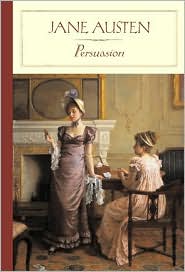
Persuasion

Persuasion. Jane Austen 1818/1992. Knopf Doubleday. 304 pages.

Sir Walter Elliot, of Kellynch-hall, in Sometsetshire, was a man who, for his own amusement, never took up any book but the Baronetage; there he found occupation for an idle hour, and consolation in a distressed one; there his faculties were roused into admiration and respect, by contemplating the limited remnant of the earliest patents; there any unwelcome sensations, arising from domestic affairs, changed naturally into pity and contempt, as he turned over the almost endless creations of the last century -- and there, if every other leaf were powerless, he could read his own history with an interest which never failed -- this was the page at which the favorite volume always opened: Elliot of Kellynch-Hall.

Oh how I love Persuasion. It's not every book I read that inspires this type of devotion, attention. A could-talk-for-hours-and-hours-and-never-tire-of-gushing love and devotion. In her younger days, Anne Elliot fell madly in love with (Captain) Frederick Wentworth. In chapter four, we read:
He was, at that time, a remarkably fine young man, with a great deal of intelligence, spirit and brilliancy; and Anne an extremely pretty girl, with gentleness, modesty, taste, and feeling. Half the sum of attraction, on either side, might have been enough, for he had nothing to do, and she had hardly any body to love; but the encounter of such lavish recommendations could not fail. They were gradually acquainted, and when acquainted, rapidly and deeply in love. It would be difficult to say which had seen highest perfection in the other, or which had been the happiest; she, in receiving his declarations and proposals, or he in having them accepted. (25)
But this happiness does not last. For a "wise" friend standing in the place of a mother, the only kind and caring person in young Anne's life, counsels her against the match. For Wentworth is penniless, at the moment, he has no way to support her. And, Anne is young. Maybe Wentworth is the love of her life, but what if he isn't? Wouldn't it be wiser to wait, to not marry so young? Two hearts are then broken by her decision to part.

The novel opens eight years later. Fate will bring Anne Elliot and Captain Wentworth into each other's lives again. What will happen when these two meet again? She's never stopped loving him. But how does he feel now? Does he love her still? Or did he forget her? Has he forgiven her? Is he angry? bitter?

Anne is taken advantage of by her family. Her father and older sister pay her no mind. They talk at her, mind you. Try to direct her so they can tell her how not to embarrass them.  But they've never listened to anything she's ever said. We read in chapter one:
Anne, with an elegance of mind and sweetness of character, which must have placed her high with any people of real understanding, was nobody with either father or sister: her word had no weight, her convenience was always to give way; she was only Anne. (5)
She's too intelligent, too wise, too observant, too kind, has too much common sense to do them any good. What her father loves best is his own reflection. And her older sister isn't that much better. No, it is their pride, vanity, selfishness, shortsightedness that has endangered their estate. They are moving to Bath to maintain appearances, but their estate will be rented to a naval officer. (But some people can't be humbled.)

Anne does have a second sister, Mary, who's married to Charles, a man who would have much preferred marrying her. (Mary is his second choice, at best, and though he may not act like it in their encounters, there are those in his family who can't forget that Anne is the better woman.) So is Mary better than Elizabeth?  She does have use for Anne. She does enjoy Anne's company. She just loves confiding in Anne. Everyone loves confiding in Anne. (Or should I say complaining to Anne?) Still, her time with the Musgroves isn't horrid. And if she wasn't there, who would love those nephews? They certainly receive no love or care from their mother!
To be claimed as a good, though in an improper style, is at least better than being rejected as no good at all; and Anne, glad to be thought of some use, glad to have any thing marked out as a duty, and certainly not sorry to have the scene of it in the country, and her own dear country, readily agreed to stay. (32)
While her father and sister have gone ahead to Bath, she remains behind. And it is while she's visiting the Musgroves--her sister Mary--that she sees Captain Wentworth again. He appears to have gotten over her. He appears to be falling in love with one of the Musgrove sisters. But. appearances can be deceiving. Will Anne get a second chance?

I love this one. I do. I love Anne. I love Captain Wentworth. I love so many of the secondary characters--maybe love isn't quite the right word. Since most are very flawed, each with his or her own quirks. But still. I enjoy spending time with this novel. I like visiting these characters again and again and again. And that letter!!!! I just LOVE, LOVE, LOVE Captain Wentworth's letter to Anne in which he declares how much he still loves her, wants her, needs her!
I can listen no longer in silence. I must speak to you by such means as are within my reach. You pierce my soul. I am half agony, half hope. Tell me not that I am too late, that such precious feelings are gone forever. I offer myself to you again with a heart even more your own than when you almost broke it eight years and a half ago. Dare not say that a man forgets sooner than woman, that his love has an earlier death. I have loved none but you. Unjust I may have been, weak and resentful I have been, but never inconstant. You alone have brought me to Bath. For you alone I think and plan. (234)
This romance is so wonderful, so giddy-making. I can't recommend it enough!!!

© 2011 Becky Laney of Becky's Book Reviews

Saturday, March 26, 2011

Mansfield Park

Mansfield Park. Jane Austen. 1814/1998. Norton. 520 pages.

About thirty years ago Miss Maria Ward, of Huntingdon, with only seven thousand pounds, had the good luck to captivate Sir Thomas Bertram, of Mansfield Park, in the county of Northampton, and to be thereby raised to the rank of a baronet's lady, with all the comforts and consequences of an handsome house and large income.

What should you know about Mansfield Park? Well, it's not this movie or that movie*. Our heroine is a young woman named Fanny Price. She has been 'adopted' by the Bertram family. She has been "rescued" from poverty by her two aunts and uncle. (Aunt Norris is the most vocal of Fanny's aunts. She HAS opinions and then some!) She has been raised with her cousins--Maria and Julia and Tom and Edmund. The glimpses of joy and happiness in Fanny's life comes through her relationships with the two important men in her life. William, her brother, who comes to visit her at Mansfield Park. And Edmund, of course, the only one of the family to truly love her and accept her and embrace her as part of the family, a valued friend, a trusted companion. It's not a big surprise to learn that Fanny is secretly, deeply in love with Edmund. She lives for him. She treasures every word he's ever spoken to her. It would be impossible for me, as a reader, to love Edmund as much as Fanny does. But she has enough love for the both of us perhaps!

This one will contain a few spoilers. Nothing new if you've seen the movies. But I have to discuss the development of the romances!

So when Mr. Bertram is away on a very extended business trip, the Bertrams become acquainted with two young people new to the neighborhood. (These are half-relations to the Grants, whom the Bertrams already know.) The brother, Henry Crawford, accepts the flirtations of two sisters, Maria and Julia. Both women see him as oh-so-desirable, and who is he to argue? If they want to believe that he is swoon-worthy, he's not going to stop them! So he flirts a little with this one, a little with that one. Fanny is one of the few that see this 'naughty' behavior. What makes things worse, perhaps, is that Maria is to be married to Mr. Rushworth**. (Of course, Henry's sister, Mary, also notices that he is "interested" in both sisters.) So Mary has her own decisions to make. Which brother is the better brother? She soon settles on Edmund even if he is the younger, the poorer. For Mary can't fail to notice that Edmund is absolutely smitten. He's just head over heels in love with her. But Mary's idea of happily ever after is to mold Edmund into her image of the perfect man. Changing everything that makes him Edmund. Mary can't help showing her true colors to Fanny now and then--especially when she writes that horrible, horrible letter! And Edmund has moments where he's rational enough to see that Mary is the wrong woman for him. That she's entirely selfish and greedy and not above showing cruelty. But, as Fanny notices, these moments never last long.

While I have little (if any) sympathy for Mary Crawford, I can't help LOVING Henry Crawford. I don't know why. I see nothing wonderful, nothing redeeming in Frank Churchill, Willoughby, or Wickham. Yet, Henry Crawford, I want to believe that Fanny almost saved him from his dark side. For I can't help believing that Henry Crawford truly--for the very first time--felt love, real love, for Fanny. While Edmund was busy wooing Mary. While Edmund was busy being stupid over Mary, it was Henry that was saying the most wonderful things to Fanny.

So who should readers cheer for? The practically-nearly reformed flirt whose life is beginning to shape up. A man who speaks kind words, loving words. A man who seems devoted, committed. A man with much to offer. A man who has done much for her brother, William. A man who sees her, truly sees her. Not as a poor relation. Not as a nobody. But someone worthy of love, of respect. Someone who could make him happy forever and ever. Or the cousin who has always been kind to Fanny, but a man who has never once thought of loving Fanny in that way. Does he notice her as a woman? A woman fully grown as Tammy would say. A man who speaks only of another woman. Edmund is a fool for Mary. And Fanny is witness to all his silliness. She's been his companion, someone he talks to about his relationship problems.

Could Fanny be happy with Henry? Would she outgrow her feelings for Edmund? If Edmund had married Mary, would Fanny have settled down with Henry? Or would she have remained single? Would Henry be happy with Fanny? I think he would have been happy with Fanny. I think she might have--just by being herself--brought out all the good that was in him. I think that Henry had the potential to be the hero. Would Mary have been happy with Edmund? Would Edmund have been happy with Mary? No and no. I think those two would have been a mess. I do. I think that there would be no improving Mary, no redeeming Mary. I don't think Edmund would have been capable of changing her. And I'm not sure that Mary could have changed him either. I think that they'd have been miserably stuck with each other. I just don't see Mary as being a good wife or mother.

Can you tell how much I connected with these characters? I never expected to find such depth in this Austen novel! I have something to say about almost everyone! Aunt Norris--one you love to hate! So opinionated, so horrible, yet she livens up a conversation! Mr. Bertram, the father, the movie got him all wrong, I think. I saw him as a dear, for the most part. He surprised me the most, perhaps because I'd only seen the movies. Anyway, I am VERY glad I read this one!

On Shakespeare:

But Shakespeare one gets acquainted with without knowing how. It is a part of an Englishman's constitution. His thoughts and beauties are so spread abroad that one touches them every where, one is intimate with him by instinct. No man of any brain can open at a good part of one of his plays, without falling into the flow of his meaning immediately. (229)

Edmund to Fanny:

"He will make you happy, Fanny, I know he will make you happy; but you will make him every thing." (238)

Mary to Fanny:

"If any man ever loved a woman for ever, I think Henry will do as much for you." (246)

Henry to Fanny:

"I know Mansfield, I know its way, I know its faults towards you. I know the danger of you being so far forgotten, as to have your comforts give way to the imaginary convenience of any single being in the family. (279)

Edmund to Fanny:

"I cannot give her up, Fanny. She is the only woman in the world whom I could ever think of as a wife." (286)

About Aunt Norris:

She was regretted by no one at Mansfield. She had never been able to attach even those she loved best, and since Mrs. Rushworth's elopement, her temper had been in a state of such irritation, as to make her every where tormenting. Not even Fanny had tears for aunt Norris--not even when she was gone for ever. (316)

*If I had to choose between the 1999 movie and the 2007 one, I'd choose the 1999 one. Even though the names are the only things that carry over from book to film. I haven't seen the 1983 adaptation yet, so maybe there's hope that someone got it right. I can see myself watching the 1999 one again, but I'll 'never again' the newest one.

 **Readers notice along with Maria and everyone else--even Mr. Bertram--how big a fool Mr. Rushworth is. So it's not like Maria would have had much of a chance at a blissful marriage. She tired of him before they married.

© 2011 Becky Laney of Becky's Book Reviews
Thursday, March 10, 2011

Small House At Allington

The Small House at Allington. Anthony Trollope. 1864. 752 pages.

Of course there was a Great House at Allington. How otherwise should there have been a Small House? Our story will, as its name imports, have its closest relations with those who lived in the less dignified domicile of the two; but it will have close relations also with the more dignified, and it may be well that I should, in the first instance, say a few words as to the Great House and its owner. 

The Small House at Allington is the fifth in the Chronicles of Barsetshire series by Anthony Trollope, my favorite bearded Victorian. It follows The Warden, Barchester Towers, Doctor Thorne, and Framley Parsonage. Did I love it? Yes! I just LOVED it. After my less than enthusiastic reading of Framley Parsonage, I was needing this one to be incredible, and it was! From start to finish, it was love--true love.

The Dales are the stars of this one. We're primarily focused on the two Dale sisters, Lily and Bell, and the men who for better or worse fall in love with them, John Eames, Adolphus Crosbie, Bernard Dale (cousin), and Dr. Crofts. Bernard brings his new acquaintance, Adolphus Crosbie, home one autumn, which changes their lives forever. Soon he's declared himself truly, madly, deeply in love with the young practically penniless girl, Lily. She's his soul mate and nothing will keep them apart. But is he worthy of her love? her respect? Or is he good for nothing? John Eames is also in love with Lily. Though he's never professed it privately or publicly. His love for her is sure and steady. If only she would see him as more than a friend...

As for Bell, there are two men who would have her for a wife. Bernard, her cousin, who has only recently discovered that his feelings are so in line with his uncle's wishes. If she says yes, they'll inherit nicely. But despite the promise of monetary gain, I do believe that Bernard is sincere in his devotion to Bell. Her other would-be suitor is Dr. Crofts, Trollope spends less time (at least as far as I can remember) with him, but Bell, unlike readers, is able to know him much better...

I loved this one. I loved the characters, the storytelling, the writing. It was charming. It was satisfying. It was entertaining. It was just a great, great read! There were characters that I just loved and adored. And there were characters that I loved to hate!
If the question was ever asked plainly, Bernard Dale had asked it plainly. Shall we be man and wife? Few men, I fancy, dare to put it all at once in so abrupt a way, and yet I do not know that the English language affords any better terms for the question. (75)

'Don't you like the moon?' she said, as she took his arm, to which she was now so accustomed that she hardly thought of it as she took it.
'Like the moon--well; I fancy I like the sun better. I don't quite believe in moonlight. I think it does best to talk about when one wants to be sentimental.'
'Ah; that is just what I fear. That is what I say to Bell when I tell her that her romance will fade as the roses do. And then I shall have to learn that prose is more serviceable than poetry, and that the mind is better than love. It's all coming, I know; and yet I do like the moonlight.'
'And the poetry--and the love?'
'Yes. The poetry much, and the love more. To be loved by you is sweeter even than any of my dreams--is better than all the poetry I have read.'
'Dearest Lily,' and his unchecked arm stole round her waist.
'It is the meaning of the moonlight, and the essence of the poetry,' continued the impassioned girl. 'I did not know then why I liked such things, but now I know. It was because I longed to be loved.'
'And to love.'
'Oh, yes. I would be nothing without that. But that, you know, is your delight--or should be. The other is mine. And yet it is a delight to love you; to know that I may love you.'
'You mean that this is the realization of your romance.'
'Yes; but it must not be the end of it, Adolphus. You must like the soft twilight, and the long evenings when we shall be alone; and you must read to me the books I love, and you must not teach me to think that the world is hard, and dry, and cruel--not yet. I tell Bell so very often; but you must not say so to me.'
'It shall not be dry and cruel, if I can prevent it.'
'You understand what I mean, dearest. I will not think it dry and cruel, even though sorrow should come upon us, if you--I think you know what I mean.'
'If I am good to you.'
'I am not afraid of that--I am not the least afraid of that. You do not think that I could ever distrust you? But you must not be ashamed to look at the moonlight, and to read poetry, and to--'
'To talk nonsense, you mean.'
But as he said it, he pressed her closer to his side, and his tone was pleasant to her.
'I suppose I'm talking nonsense now?' she said pouting. 'You liked me better when I was talking about the pigs, didn't you?'
'No; I like you best now.' (87-8)


'We all try, my dear, but many of us fail to try with sufficient energy of purpose. It is only by doing our duty that we can hope to be happy, whether in single life or in married.' (119)

We constantly talk of the thoughtlessness of youth. I do not know whether we might not more appropriately speak of its thoughtfulness. It is, however, no doubt, true that thought will not at once produce wisdom. It may almost be a question whether such wisdom as many of us have in our mature years has not come from the dying out of the power of temptation, rather than as the results of thought and resolution. (133)

Love does not follow worth, and is not given to excellence;--nor is it destroyed by ill-usage, nor killed by blows and mutilation. (306)

A sermon is not to tell you what you are, but what you ought to be, and a novel should tell you not what you are to get, but what you'd like to get. (422)

'I hate books I can't understand,' said Bell. 'I like a book to be clear as running water, so that the whole meaning may be seen at once.'
'The quick seeing of the meaning must depend a little on the reader, must it not?' said Mrs. Dale.
'The reader mustn't be a fool, of course,' said Bell.
'But then so many readers are fools,' said Lily. 'And yet they get something out of their reading.' (445)


© 2011 Becky Laney of Becky's Book Reviews
Sunday, March 06, 2011

Little Dorrit

Little Dorrit. Charles Dickens. 1855-1857. Penguin. 928 pages.

Thirty years ago, Marseilles lay burning in the sun, one day. 

Little Dorrit is the third full-length Dickens that I've read*. Last fall, I read Bleak House, and last month I read Our Mutual Friend. Did I like Little Dorrit? Not as much as Bleak House. Not as much as Our Mutual Friend. But there were plenty of things I liked about it. Like the heroine, Amy Dorrit, and her love-interest, Arthur Clennam.

Arthur first meets 'Little Dorrit' in his mother's home. He is returning from a LONG absence, returning after his father's death. His parents marriage being a disaster, he spent part of his time with his mother in England, part of his time with his father in China. Little Dorrit (Amy) is quiet, not one to call attention to herself. But there is something about her that intrigues him. So he sets out to befriend, to learn all he can about her. What he learns is that she was born to her father and mother in Marshalsea--a debtor's prison. Her father has been a long-time resident. She's never known freedom, she leaves the gates most every day to earn what she can--she's a good seamstress, happy to find work where she can, like at the Clennams. But to Marshalsea she returns each evening before the gates are locked. She's happy to have a friend in Arthur. But while she may think of him as something-more-than-a-friend, he's settled into thinking of her as a daughter. He's twenty years older than Amy, and, well, he's not the smartest of men when it comes to realizing the obvious. (He has to be TOLD by someone he barely knows that Amy is in love with him, has always been in love with him.) He decides that the best way to help Amy is to help get her father out of debtor's prison. So with the help of a few friends, he sets out to do just that. But is Amy suited to riches?! Does society really hold a place for Amy, Fanny (her older sister), Tip (her older brother), her father, and her uncle? Can money buy happiness? Can money redeem past wrongs? What do you think?!


The minor characters and subplots didn't thrill me in Little Dorrit. Don't get me wrong, there were times when I found it very comical. Dickens had a good sense of humor. And there are some great sketches of characters here and there. Arthur's old love-interest, for example, is almost always good for a laugh. Though it is a laugh at her expense. And Mr. Sparkler, Fanny's love interest, is good for comic relief too. There's a scene between him and Fanny--after they're married--that had me laughing a great deal! (And just when I needed it too!) And Little Dorrit offers a certain amount of drama--drama that for me might have been spoiled by having seen the adaptation two years ago. I thought that the book would clarify things for me, that characters that didn't make a lot of sense in the film would become clearer when I read the book. But I didn't find that to be the case. There are still pieces of the puzzle that I'm missing. There are still characters that leave me confused and puzzled. Which I suppose is why Little Dorrit isn't a book that I can love, love, love. However, I do like it. I am glad I read it.

He had a certain air of being a handsome man--which he was not; and a certain air of being a well-bred man--which he was not. It was mere swagger and challenge; but in this particular, as in many others, blustering assertion goes for proof, half over the world (25).

In our course through life we shall meet the people who are coming to meet us, from many strange places and by many strange roads and what is set to us to do to them, and what it is set to them to do to us will be done. (39)

Flora, always tall, had grown to be very broad too, and short of breath; but that was not much. Flora, whom he had left a lily, had become a peony; but that was not much. Flora, who had seemed enchanting in all she said and thought, was diffuse and silly. That was much. Flora, who had been spoiled and artless long ago, was determined to be spoiled and artless now. That was a fatal blow. This is Flora! (165)


*Not including GREAT EXPECTATIONS which was required reading in high school. Or A Christmas Carol which is so familiar that I'm not sure it should count.  

© 2011 Becky Laney of Becky's Book Reviews
Saturday, March 05, 2011

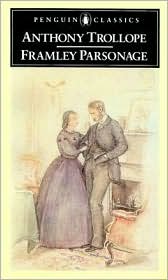
Framley Parsonage

Framley Parsonage. Anthony Trollope. 1861. 576 pages.

First sentence: When young Mark Robarts was leaving college, his father might well declare that all men began to say all good things to him, and to extol his fortune in that he had a son blessed with so excellent a disposition. 


 Framley Parsonage is the fourth in the Chronicles of Barsetshire series by Anthony Trollope, one of my favorite bearded Victorians. The first three are The Warden, Barchester Towers, and Doctor Thorne. I wish I could say that I absolutely loved it. That Trollope didn't disappoint in any way. But. I can't quite say that. Not this time around. I enjoyed Framley Parsonage. I enjoyed visiting some of my favorite characters from previous novels--Mr. and Mrs. Proudie, Mr. and Mrs. Grantley, Lady Arabella, Miss Dunstable, Dr. Thorne, Mr. and Mrs. Gresham, etc. I enjoyed meeting Mark Robarts, his wife, Fanny, and his sister, Lucy. (Lucy was my favorite new character.) I found Lady Lufton to be quite a character. And her son, Lord Lufton, had his moments. There were some great scenes in this one. Some very dramatic. Some very romantic. Some very comedic. But despite how much I almost loved this one, it stayed an almost throughout. I did like it. I am glad I read it.

Mark Robarts should have known better. That's the truth. He should have NEVER signed his name to his friend's bill. For Mr. Sowerby is no friend of his. You would think that after watching his friend, Lord Lufton, be cheated out of money by Mr. Sowerby that he would have known better, would not have been so gullible, so foolish, so silly. But. Mark Robarts does not always make wise decisions. In fact, he can be very foolish. Good thing his wife and sister are so wise, so compassionate, so forgiving. I enjoyed spending time with Fanny and Lucy. I thought they were great characters. I spent most of the time wanting to scold Mark, however. (Though his transformation by the end into a man of character did help me like him better.)

When the novel wasn't talking about financial messes, it alternated between being political and romantic. It focused on several romances: that of Lucy, that of Griselda Grantley, and that of Miss Dunstable! These sections kept me reading. These sections kept me happy.

"It is no doubt very wrong to long after a naughty thing. But nevertheless we all do so. One may say that hankering after naughty things is the very essence of the evil into which we have been precipitated by Adam's fall. When we confess that we are all sinners, we confess that we all long after naughty things." (37)

"A man's own dinner is to himself so important that he cannot bring himself to believe that it is a matter utterly indifferent to every one else. A lady's collection of baby-clothes, in early years, and of house linen and curtain-fringes in later life, is so very interesting to her own eyes, that she cannot believe but what other people will rejoice to behold it." (123)

"A man always can do right, even though he has done wrong before. But that previous wrong adds so much difficulty to the path--a difficulty which increases in tremendous ratio, till a man at last is choked in his struggling, and is drowned beneath the waters." (150)

"If the ears be too delicate to hear the truth, the mind will be too perverse to profit by it." (181)

"I think it is more proper-looking, and better suited, too, for the world's work, when it goes about with some sort of a garment on it. We are so used to a leaven of falsehood in all we hear and say, nowadays, that nothing is more likely to deceive us than the absolute truth." (290)

"A man does not wish to marry a statue, let the statue be ever so statuesque." (301)

"A man may be very imperfect and yet worth a great deal. A man may be as imperfect as Lord Lufton, and yet worthy of a good mother and a good wife. If not, how many of us are unworthy of the mothers and wives we have!" (367)

"All unmarried women are necessarily in the market; but if they behave themselves properly they make no signs." (451)

"It would be a terrible curse to have to talk sense always." (458)

"Think about the happiness of those around you, and your own will come without thinking." (480)


© 2011 Becky Laney of Becky's Book Reviews
Saturday, February 26, 2011

North and South (Revisited)

North and South. Elizabeth Gaskell. 1854-1855. 452 pages.

'Edith!' said Margaret, gently, 'Edith!'
But, as Margaret half suspected, Edith had fallen asleep.


Last spring I discovered North and South by Elizabeth Gaskell. It was a story that I couldn't forget. I read the book. I listened to the audio book. I watched the movie. (I watched the movie twice.) When I wrote in my review that I loved it--I meant it. No question about that. But at the same time, I questioned the intensity of that love. Would it prove a lasting love? Would North and South prove to be a true favorite? Yes, the characters, the stories made an impression on me. But would it make a lasting impression? I knew that sooner or later I would have to reread this one.

So what do I think after rereading this one? I love it even more than I did before! And I didn't think that was quite possible! Because I was very enthusiastic the first time around.

There were things that I noticed for the first time. There were things that I was only able to appreciate the second time through. Little details that may not seem like much, but taken together add to the beauty and complexity of the whole.

I was able to focus on the relationships more, I think.  John's relationship with his mother and sister. And the relationship between Margaret and her mother and father and brother. And, of course, I was paying attention to every sign of affection between John and Margaret! Knowing the characters--knowing their strengths and weaknesses--it affected how I read the novel.
 
This was such a satisfying, comfort read.

North and South is bittersweet. I think the contrast between life's joys and sorrows is one reason why I love this one so very much. Because of everything that Margaret endures, her happily ever after means just that much more to me. I think I love John and Margaret more because of all the obstacles along the way.


Some of my favorite lines:

As she realized what might have been, she grew to be thankful for what was. (68)

'Take care you don't get caught by a penniless girl, John'
'I am not easily caught, mother, as I think you know. But I must not have Miss Hale spoken of in that way, which, you know is offensive to me. I never was aware of any young lady trying to catch me yet, nor do I believe that any one has ever given themselves that useless trouble. (78)

'Papa, I do think Mr. Thornton a very remarkable man; but personally I don't like him at all.' (88)

'Bessy, don't be impatient with your life, whatever it is--or may have been. Remember who gave it you, and made it what it is!' (91)

'Loyalty and obedience to wisdom and justice are fine; but it is still finer to defy arbitrary power, unjustly and cruelly used -- not on behalf of ourselves, but on behalf of others more helpless.' (109)

'I cannot forgive her pride,' said his mother; 'I will befriend her, if there is need, for your asking, John. I would befriend Jezebel herself if you asked me. But this girl, who turns up her nose at us all--who turns up her nose at you--'
'Nay, mother; I have never yet put myself, and I mean never to put myself, within reach of her contempt.'
'Contempt, indeed! Don't go speaking of Miss Hale, John, if I've to be kind to her. When I'm with her, I don't know if I like or dislike her most; but when I think of her, and hear you talk of her, I hate her.' (143)

'Don't dwell so much on the prophecies, but read the clearer parts of the Bible.'
'I dare say it would be wiser; but where would I hear such grand words of promise--hear tell o' anything so far different fro' this dreary world, and this town above as in Revelations? Many's the time I've repeated the verses in the seventh chapter to myself, just for the sound. It's as good as an organ, and as different from every day, too. No, I cannot give up Revelations. It gives me more comfort than any other book i' the Bible.' (137)

'I suspect my "gentleman" includes your "true man."'
'And a great deal more, you would imply. I differ from you. A man is to me a higher and completer being than a gentleman.'
'What do you mean?' asked Margaret. 'We must understand the words differently.'
'I take it that "gentleman" is a term that only describes a person in his relation to others; but when we speak of him as "a man," we consider him not merely with regard to his fellow-men, but in relation to himself, - to life - to time - to eternity. A cast-away lonely as Robinson Crusoe - a prisoner immured in a dungeon for life - nay, even a saint in Patmos, has his endurance, his strength, his faith, best described as being spoken of as "a man." I am rather weary of this word "gentlemanly," which seems to me to be often inappropriately used, and often, too, with such exaggerated distortion of meaning, while the full simplicity of the noun "man," and the adjective "manly" are unacknowledged - that I am induced to class it with the cant of the day.' (163)

'He is the first specimen of a manufacturer - of a person engaged in trade - that I had ever the opportunity of studying, papa. He is my first olive, let me make a face while I swallow it. I know he is good of his kind, and by and by I shall like the kind. I rather think I am already beginning to do so. (165)

'Speak to your workmen as if they were human beings. Speak to them kindly. Don't let the soldiers come in and cut down poor creatures who are driven mad. I see one there who is. If you have any courage or noble quality in you, go out and speak to them, man to man.' (175)

'I hardly know if it is pain or pleasure, to think that I owe it to one - nay, you must, you shall hear - to one whom I love, as I do not believe man ever loved woman before.' (192)

'One word more. You look as if you thought it tainted you to be loved by me. You cannot avoid it. Nay, I, if I would, cannot cleanse you from it. But I would not, if I could. I have never loved any woman before: my life has been too busy, my thoughts too much absorbed with other things. Now I love, and will love. But do  not be afraid of too much expression on my part. (194)

'I see a great deal of difference between Miss Hale and Fanny. I can imagine that the one may have weighty reasons, which may and ought to make her overlook any seeming impropriety in her conduct. I never knew Fanny have weighty reasons for anything. Other people must guard her. I believe Miss Hale is guardian to herself.' (305)

'The exact truth! Very few people do speak the exact truth. I have given up hoping for it.' (320)

'He may care for her, though she really has been almost rude to him at times. But she! - why, Margaret would never think of him, I'm sure! Such a thing has never entered her head.'
'Entering her heart would do. But I merely threw out a suggestion of what might be.' (329)


© 2011 Becky Laney of Becky's Book Reviews