Showing posts with label 1861. Show all posts

Friday, January 12, 2018

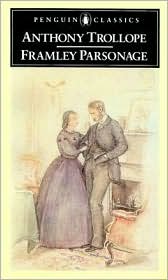
Framley Parsonage

Framley Parsonage. Anthony Trollope. 1861. 573 pages. [Source: Bought]

 First sentence: When young Mark Robarts was leaving college, his father might well declare that all men began to say all good things to him, and to extol his fortune in that he had a son blessed with so excellent a disposition.


Premise/plot: Framley Parsonage is the fourth novel in the Barsetshire series by Anthony Trollope. In my opinion, the women characters are the greatest strength of this novel. Mark's wife, Fanny; Mark's sister, Lucy; Miss Dunstable; Mrs. Crawley; even more difficult to like characters like Mrs. Harold Smith, Mrs. Proudie,  and Lady Lufton.

So what is this one about? Mark Robarts is a vicar at Framley. He is married to a wonderful woman, Fanny, whose true strength and courage is not obvious at first or second glance perhaps. He gets into big, big trouble when he decides to sign his name alongside his new friend's name on a bill. Embarrassed that he could be held responsible for the money if his friend proves to be anything but, he keeps it a secret from almost everyone in his life. That bill--and another that follows it--haunt him throughout the novel until he has his epiphany moment.

At one point, Mark's sister, Lucy, comes to stay at the parsonage. Lord Lufton, Mark's close friend, falls in love with Lucy. But their love seems doomed almost from the start since Lady Lufton (Lord Lufton's (busybody) mother has set ideas about who is and isn't appropriate for her son to marry. She visits Fanny and tells her that Lord Lufton is off limits and that Lucy should make herself scarce. Fanny tells Lucy that she shouldn't fall in love with Lord Lufton, but it's too late.) Will Lord Lufton stand up to his mother? Will Lucy agree to be his wife? Will the novel end with a wedding?

Lady Lufton wants her son to marry Griselda Grantly. She throws them together at multiple social events--both in Barsetshire and in London. But to no avail. Griselda does get some attention from another Lord however.

Miss Dunstable, whom we met before, is still very much single. There are still men in pursuit of her. Mrs. Harold Smith would have her unworthy brother--admittedly unworthy, a scoundrel--Mr. Sowerby marry the incredibly wealthy Miss Dunstable. She even proposes on his behalf. But Miss Dunstable doesn't want that kind of husband. The man she has in mind, well, is more honorable: Dr. Thorne!

Here is part of his letter to her:
We have known each other now somewhat intimately, though indeed not very long, and I have sometimes fancied that you were almost as well pleased to be with me as I have been to be with you. If I have been wrong in this, tell me so simply, and I will endeavour to let our friendship run on as though this letter had not been written. But if I have been right, and if it be possible that you can think that a union between us will make us both happier than we are single, I will plight you a word and troth with good faith, and will do what an old man may do to make the burden of the world lie light on your shoulders.
I do not know that I could add anything to the truth of this, if I were to write three times as much. All that is necessary is, that you should know what I mean. If you do not believe me to be true and honest already, nothing that I can write will make you believe it.
Mr. Sowerby features a lot in this one, for better or worse. But every novel, make that every Victorian novel, needs a character to boo and hiss at when they enter the scene, right?!

My thoughts: This was a reread for me. I think I liked it more the second time. I still struggled to like Mark for most of the novel. I think that is because it was hard for me to respect him. But when Mark comes to his senses, and stands strong and courageous, well, then my opinion began to change.

I really LOVED the characters of Lucy and Fanny and Miss Dunstable. The story line where Mary is trying to play matchmaker with her uncle, Dr. Thorne, and Miss Dunstable were priceless. I adored this couple so much.

Lucy was such a gem of a heroine. She was witty and compassionate. Her observations were great.

I also REALLY loved the fact that so many familiar faces pop up in this one. Even if old friends just show up for a couple of scenes, they're still there, still a reminder that Barchester is a place I'd love to visit.

Quotes: For my favorite quotes from the first half of the novel, see My Victorian Year #1.
  • Is it not a good thing that grapes should become sour which hang out of reach? Is he not wise who can regard all grapes as sour which are manifestly too high for his hand?
  • A man does not wish to marry a statue, let the statue be ever so statuesque. She could not teach her daughter to be impulsive, any more than she could teach her to be six feet high; but might it not be possible to teach her to seem so?
  • That, I believe, is always the first thought in the mind of a good wife when her husband returns home. Has he had his dinner? What can I give him for dinner? Will he like his dinner? Oh dear, oh dear! there is nothing in the house but cold mutton.
  • You are like a great many other people that I know. You want to eat your cake and have it. You have been eating it for the last twenty years, and now you think yourself very ill-used because the duke wants to have his turn.
  • What wretchedness can exceed that of remembering from day to day that the race has been all run, and has been altogether lost; that the last chance has gone, and has gone in vain; that the end has come, and with it disgrace, contempt, and self-scorn — disgrace that never can be redeemed, contempt that never can be removed, and self-scorn that will eat into one’s vitals for ever?
  • You have had your cake, and eaten it — eaten it greedily. Is not that sufficient for you? Would you eat your cake twice? Would you have a succession of cakes? No, my friend; there is no succession of these cakes for those who eat them greedily.
  • But you must detest a man who professes to stand by his party, and then does his best to ruin it.
  • All is fair in love and war, — why not add politics to the list? If we could only agree to do that, it would save us from such a deal of heartburning, and would make none of us a bit the worse.
  • In society Griselda’s toes were more serviceable to her than her tongue, and she was to be won by a rapid twirl much more probably than by a soft word.
  • Lord Lufton had not offered to her, nor given any signs that he intended to do so; and to give Griselda Grantly her due, she was not a girl to make a first overture. Neither had Lord Dumbello offered; but he had given signs, — dumb signs, such as birds give to each other, quite as intelligible as verbal signs to a girl who preferred the use of her toes to that of her tongue.
  • “I wonder whether you will ever be sorry for the cruelty of your doings, or whether these things are really a joke to you.”
  • A man in love seldom loves less because his love becomes difficult. And thus, when those moments were over, he would determine to tell his mother at once, and urge her to signify her consent to Miss Robarts.
  • It would be a terrible curse to have to talk sense always.
  • Any allusion to Mr. Slope acted on Mrs. Proudie as a red cloth is supposed to act on a bull; but when that allusion connected the name of Mr. Slope in a friendly bracket with that of Mrs. Proudie’s future son-in-law it might be certain that the effect would be terrific.
  • Fanny, I shall always call you Don Quixote, and some day or other I will get somebody to write your adventures.
  • They say that prosperity makes a man selfish. I have never tried that, but I am quite sure that adversity does so.
  • Of the faults which a man commits he must bear the punishment.
  • Success does beget pride, as failure begets shame.
© 2018 Becky Laney of Becky's Book Reviews

Saturday, March 05, 2011

Framley Parsonage

Framley Parsonage. Anthony Trollope. 1861. 576 pages.

First sentence: When young Mark Robarts was leaving college, his father might well declare that all men began to say all good things to him, and to extol his fortune in that he had a son blessed with so excellent a disposition. 


 Framley Parsonage is the fourth in the Chronicles of Barsetshire series by Anthony Trollope, one of my favorite bearded Victorians. The first three are The Warden, Barchester Towers, and Doctor Thorne. I wish I could say that I absolutely loved it. That Trollope didn't disappoint in any way. But. I can't quite say that. Not this time around. I enjoyed Framley Parsonage. I enjoyed visiting some of my favorite characters from previous novels--Mr. and Mrs. Proudie, Mr. and Mrs. Grantley, Lady Arabella, Miss Dunstable, Dr. Thorne, Mr. and Mrs. Gresham, etc. I enjoyed meeting Mark Robarts, his wife, Fanny, and his sister, Lucy. (Lucy was my favorite new character.) I found Lady Lufton to be quite a character. And her son, Lord Lufton, had his moments. There were some great scenes in this one. Some very dramatic. Some very romantic. Some very comedic. But despite how much I almost loved this one, it stayed an almost throughout. I did like it. I am glad I read it.

Mark Robarts should have known better. That's the truth. He should have NEVER signed his name to his friend's bill. For Mr. Sowerby is no friend of his. You would think that after watching his friend, Lord Lufton, be cheated out of money by Mr. Sowerby that he would have known better, would not have been so gullible, so foolish, so silly. But. Mark Robarts does not always make wise decisions. In fact, he can be very foolish. Good thing his wife and sister are so wise, so compassionate, so forgiving. I enjoyed spending time with Fanny and Lucy. I thought they were great characters. I spent most of the time wanting to scold Mark, however. (Though his transformation by the end into a man of character did help me like him better.)

When the novel wasn't talking about financial messes, it alternated between being political and romantic. It focused on several romances: that of Lucy, that of Griselda Grantley, and that of Miss Dunstable! These sections kept me reading. These sections kept me happy.

"It is no doubt very wrong to long after a naughty thing. But nevertheless we all do so. One may say that hankering after naughty things is the very essence of the evil into which we have been precipitated by Adam's fall. When we confess that we are all sinners, we confess that we all long after naughty things." (37)

"A man's own dinner is to himself so important that he cannot bring himself to believe that it is a matter utterly indifferent to every one else. A lady's collection of baby-clothes, in early years, and of house linen and curtain-fringes in later life, is so very interesting to her own eyes, that she cannot believe but what other people will rejoice to behold it." (123)

"A man always can do right, even though he has done wrong before. But that previous wrong adds so much difficulty to the path--a difficulty which increases in tremendous ratio, till a man at last is choked in his struggling, and is drowned beneath the waters." (150)

"If the ears be too delicate to hear the truth, the mind will be too perverse to profit by it." (181)

"I think it is more proper-looking, and better suited, too, for the world's work, when it goes about with some sort of a garment on it. We are so used to a leaven of falsehood in all we hear and say, nowadays, that nothing is more likely to deceive us than the absolute truth." (290)

"A man does not wish to marry a statue, let the statue be ever so statuesque." (301)

"A man may be very imperfect and yet worth a great deal. A man may be as imperfect as Lord Lufton, and yet worthy of a good mother and a good wife. If not, how many of us are unworthy of the mothers and wives we have!" (367)

"All unmarried women are necessarily in the market; but if they behave themselves properly they make no signs." (451)

"It would be a terrible curse to have to talk sense always." (458)

"Think about the happiness of those around you, and your own will come without thinking." (480)


© 2011 Becky Laney of Becky's Book Reviews

Friday, February 27, 2009

Silas Marner


Eliot, George. 1861. Silas Marner. Bantam Classics. (My edition was mid 1980s) 186 pages.

In the days when the spinning-wheels hummed busily in the farmhouses--and even great ladies, clothed in silk and thread-lace, had their toy spinning-wheels of polished oak--there might be seen, in districts far away among the lanes, or deep in the bosom of hills, certain pallid undersized men, who, by the side of the brawny country folk, looked like the remnants of a disinherited race.


Shocker of all shockers: I liked this one. Quite a lot, in fact. Why is that shocking? When I read this little volume--and no, it's not the same copy--in tenth grade I absolutely hated it. Hate is really too kind a word for what I felt. Needless to say, it held the title of most-hated-book until my college days when Jude the Obscure took its place. (It still holds the honor, in case you're curious.) Which just goes to show you that almost without a doubt classics--at least some classics--fail to be appreciated by high schoolers. Maybe that's inaccurate. I'll rephrase, anytime a person--especially a teen person--is required to read a book, no matter how good or great that book is (sometimes they're really bad, I'm not saying all are good) then it's an uphill battle to have him/her have a positive response to it. It just goes against human nature to like something we're forced against our will to read. And its understandable to me. What could a fifteen year old have in common with Silas Marner, a middle-aged weaver obsessed with gold? He's old (relatively speaking at least!). He's strange. No one likes him in his village of Raveloe. He's an outsider, it's true, a loner. And arguably some teens could see themselves in that way. But is that enough?

Silas Marner, in case you've never been subjected to it, is the story of a man, a weaver, who takes refuge in Raveloe after escaping his unfortunate past. He is living only for himself. The money he makes from his trade, he hoards. He loves his gold. Treasures it. He's not the only one keeping secrets in the village. There's a man, Godfrey Cass, who has quite a secret. Something in his past that he's willing to do just about anything, pay just about anything to prevent from coming to light. His brother, Dunstan Cass, is blackmailing him. He'll tell all to their father--Squire Cass--if Godfrey doesn't do things his way. Why does Godfrey care? really really care? He wants to marry Nancy Lammeter. The secret? He already has a wife, a wife his father would never approve of, a wife he's ashamed of, a woman he'd never claim in a hundred million years. Dunstan (and Godfrey) are in need of money, Silas Marner has plenty. Put the two together and you've got a robbery destined to happen. But things don't always go according to plan, Dunstan disappears the same night as Silas' gold. But that's just the beginning. Silas doesn't know it then, but things are about to start looking up! His life is about to change for the better! Why? His "gold" will be returned to him--providentially according to Silas and his friends--in the form of a golden-haired baby girl whom he names Hepzibah (Eppie) whom he adopts and raises to the satisfaction of all but one....Godfrey Cass.

This one had themes that I couldn't even begin to grasp as a sophomore. And the language? the style? I didn't appreciate the little things. The phrases. But here's the thing. I can now. Everything that I missed then, I can appreciate now. Here is one of my favorite passages:

I suppose one reason why we are seldom able to comfort our neighbors with our words is, that our goodwill gets adulterated, in spite of ourselves, before it can pass our lips. We can send black puddings and pettitoes without giving them a flavour of our own egoism; but language is a stream that is almost sure to smack of a mingled soil. There was a fair proportion of kindness in Raveloe; but it was often of a beery and bungling sort, and took the shape least allied to the complimentary and hypocritical. (77)


I liked the characters--some more eccentric than others--too. I came to appreciate the flavor of this one.

© Becky Laney of Becky's Book Reviews
If you're reading this post on another site, or another feed, the content has been stolen.