Showing posts with label St. Martin's Press. Show all posts

Saturday, September 09, 2017

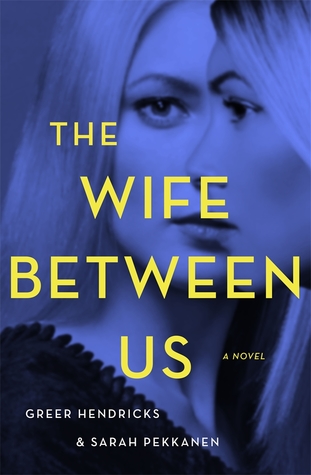
The Wife Between Us

The Wife Between Us. Greer Hendricks and Sarah Pekkanen. 2018. St. Martin's Press. 352 pages. [Source: Review copy]

First sentence: She walks briskly down the city sidewalk, her blond hair bouncing against her shoulders, her cheeks flushed, a gym bag looped over her forearm. When she reaches her apartment building, her hand dips into her purse and pulls out her keys. The street is loud and busy, with yellow cabs racing by, commuters returning from work, and shoppers entering the deli on the corner. But my eyes never stray from her.

Premise/plot: Who knew that reading Macy McMillan and the Rainbow Goddess by Shari Green would ultimately help me to review The Wife Between Us?! Shari Green has her character, Macy, thinking:
Why do we think
we can know anything about a person
by how they look
what they can do
what life is like for them now?
Because it turns out
we really can't.
The only way to know that stuff
is if someone
tells you the story.
Which, in my opinion, is a perfect spoiler-free description of the premise/plot of The Wife Between Us. 

My thoughts: Have you ever judged a book by its cover? Be honest. To judge a person--a book--by appearances, by what we think we know--by what we're so sure we know--can be a dangerous thing indeed.

I read The Wife Between Us in three days. In a perfect, perfect world, I would have finished in just one. If I'd ignored eating, sleeping, and other people. (I'm much too fond of all the above these days.) Yet I want to stress that this is a compelling read.

The Wife Between Us is a rare read indeed. Let me explain--or try to explain. To those seeking a thriller, a plot-driven thriller with twists and turns, I can honestly say that The Wife Between Us satisfies. Readers meet a woman--an emotionally distraught woman--and follow her through the darkness, into the darkness, and perhaps out of the darkness too. (Or I could be trying to trick you.) Through this woman's story readers get to know Richard and "the replacement." (One woman is getting replaced by another. One woman has been cast aside. Another has been chosen as the perfect wife.) It's all about the suspense and drama. Who wronged who. Who's telling the truth. Who's lying. Is it a matter of life and death? To those seeking a character-driven novel that is complex and thought-provoking, The Wife Between Us more than satisfies. I can honestly say that to me more than anything it's the CHARACTERS that stand out as unforgettable. It's a rare read because it's both.

I loved the characterization. I loved that the characters lived. I loved the brokenness and vulnerability. I loved the fragility of everything. I loved the writing. There was never a place you "wanted" to stop reading. Because the moment you read the opening sentence of the next chapter, you needed to keep going.

I loved that it would pair so well with many classics I've read and loved in the past. Jane Eyre. Rebecca. To name just two.

I think this could easily be a great movie. But would a movie trailer spoil it all?! Probably. There are three trailers for the book. One. Two. Three.

One of my favorite quotes:
In my marriage, there were three truths, three alternate and sometimes competing realities. There was Richard’s truth. There was my truth. And there was the actual truth, which is always the most elusive to recognize. This could be the case in every relationship, that we think we’ve entered into a union with another person when, in fact, we’ve formed a triangle with one point anchored by a silent but all-seeing judge, the arbiter of reality.

© 2017 Becky Laney of Becky's Book Reviews

Sunday, August 02, 2015

Meet Elizabeth Parker

Murder at Longbourn. (Elizabeth Parker #1) Tracy Kiely. 2009. St. Martin's Press. 320 pages. [Source: Library]

I enjoyed reading Tracy Kiely's Murder at Longbourn. It is first and foremost a cozy mystery. It is not a retelling or adaptation of any particular Austen novel. So don't expect that, and you won't be disappointed, or as disappointed.

As I said, I enjoyed this holiday-themed mystery novel. Elizabeth Parker, the heroine, goes to visit her great-aunt for New Year's Eve/Day. There is a party hosted at her great-aunt's bed and breakfast. It is a themed party--there will be a "murder" at the party. She meets plenty of new people at her great-aunt's bed and breakfast. Some of them being guests staying at the b&b. Some being guests (from the town) invited to the New Year's party. But one person is not a new acquaintance at all, but, an old "nemesis" named Peter. The two knew each other as children, and, as far as Elizabeth is concerned, there's nothing but hate between them: past, present, and future.

The party goes horribly, of course, and a real murder is committed. Elizabeth is convinced that there is a lot of framing going on--and her aunt may suffer for it--but can she with a tiny bit of help from Peter--find the real murderer in time?

I liked Elizabeth well enough. I didn't love everything about her. There were times she came across as not too bright. And I did find quite a few things about this one to be predictable. But. In the moment, as I was reading it, I cared more than I didn't. I wanted to keep reading it. I wasn't annoyed or frustrated or disgusted or disappointed. It was a very pleasant read. Now, a week after finishing it, the in-the-moment pleasure of it all has faded a bit.

© 2015 Becky Laney of Becky's Book Reviews

Monday, May 25, 2015

The Sound of Music Story

The Sound of Music Story: How A Beguiling Young Novice, A Handsome Austrian Captain and Ten Singing von Trapp Children Inspired the Most Beloved Film of All Time. Tom Santopietro. 2015. St. Martin's Press. 324 pages. [Source: Library]

I enjoyed reading Tom Santopietro's The Sound of Music Story. Did I enjoy each chapter equally? Probably not. But what I was interested in, I was REALLY interested in, and, I was fine skimming the rest.

The book focuses on several things: 1) the story of the actual von Trapp family, both before and after the Sound of Music, 2) the Sound of Music on Broadway (its creation, duration, etc.) 3) the filming and reception of The Sound of Music (focus on the directing, producing, filming, acting, costuming, etc.) 4) the legacy of the Sound of Music, five decades worth of trivia on the film and the soundtrack, etc.

I loved reading about the filming of the movie. I did. I loved reading about the filming of particular scenes and particular songs. It was just fun. There were chapters of this one that were just giddy-making.

Not all of the book was equally captivating to me. But I appreciated the thoroughness of it.

© 2015 Becky Laney of Becky's Book Reviews

Tuesday, September 23, 2014

The Late Scholar (2014)

The Late Scholar. Jill Paton Walsh. 2014. St. Martin's Press. 368 pages. [Source: Library]

I enjoyed The Late Scholar enough while reading it, for the most part, but the more I think about it, the more disappointed I am. I have liked or enjoyed Jill Paton Walsh's sequels to Dorothy Sayer's Lord Peter mysteries. The Late Scholar is set in the 1950s. (I'm not sure if it's early, mid, or late 50s. But Queen Elizabeth is on the throne, I believe.) The novel opens with the Duke of Denver (aka Lord Peter Wimsey) learning that he is a Visitor at Oxford. He is being called upon to settle a dispute among the fellows. The person--ultimately one of many suspects, I suppose--who initially requested his interference comes to regret it. Lord Peter is thorough. He doesn't want to just cast a vote on a controversial topic without any thought. He wants to study the situation, learn both sides, draw his own conclusions about what is best. The dispute is about selling a medieval book to get the money to buy land next door that has come up for sell. Is land more valuable to the college than one book in the library? Or is the ancient book more valuable to the college than a piece of real estate? It wouldn't be a mystery book if it didn't turn to violence and murder. Lord Peter, Harriet Vane, and Bunter must follow all the clues to catch a murderer or two.

There were a few things that felt a bit off, that kept this one from feeling like a genuine, authentic Lord Peter/Harriet Vane mystery. I allow some change would be natural enough. Two decades would change a person, would change a couple. But the changes in a way have a very surface feel to them. I'm not sure the characters have the depth that they need, they are very much reliant on familiarity with the original.

I have not reread the whole (original) series, but, Lord Peter seems changed and not always for the better. I could not show you a passage where Lord Peter reveals a personal faith in God. But I have a feeling I would have remembered if Lord Peter revealed a cold mockery for Christianity and/or stated openly and unashamedly that he did NOT believe in God. There were a few uncomfortable scenes in Late Scholar where Peter's atheism comes to light, I suppose. It was done in an almost ha, ha, don't be silly, of course I don't believe in God kind of way. It just struck me as wrong. I'm not saying that I consider Lord Peter evangelical. But. I always got the impression that he believed there was a God, that at the very least he was agnostic. The reason this strikes me as wrong is that Dorothy Sayers was a Christian, she wrote Christian books. I've read some of her theological essays and they are quite good. I just don't see HER Lord Peter being one to make light of or mock Christianity or the Bible or the fundamental belief that there is a God. Of course times have changed. Decades have passed since his creation, so maybe modern readers assume that naturally Lord Peter is "smart enough" to have outgrown any idea of God.

© 2014 Becky Laney of Becky's Book Reviews
Monday, August 18, 2014

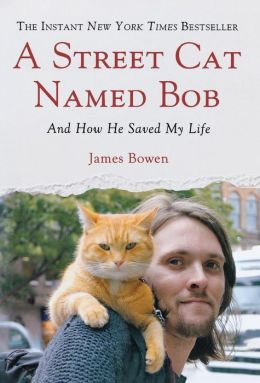
A Street Cat Named Bob

A Street Cat Named Bob: And How He Saved My Life. James Bowen. 2013. St. Martin's Press. 279 pages. [Source: Library]

A Street Cat Named Bob is a simple story in many ways. It's the story of one man and his cat: how they found each other, how they changed each other's lives, how they got to be so close, so fast. At the time the book opens, James Bowen was a street musician--a busker--and a recovering drug addict. He had taken steps to get off the street--at one time he was homeless and addicted to drugs--but the road ahead was still long and uncertain. He sees a stray cat, "a ginger tom," near his building, he sees that it could use a little help. He's injured. He's hungry. He decides to take the cat in and nurse him back to health. He didn't know it at the time, but, Bob wouldn't be going anywhere. Bob had found his home.

If Bob had been an ordinary cat, readers would never have heard of him or James Bowen. Bob would not have become a YouTube star. But ordinary doesn't exactly describe Bob.

Bob wasn't content to stay at home and let James go off busking. He wanted to go along. He wanted in on the action. James found that with a cat, he was irresistible, or rather Bob was irresistible. Wherever he and Bob went, Bob got ATTENTION and ADORATION. Busking became a LOT easier for him when Bob was there sitting on his guitar case and looking cute and adorable. People wanted to take Bob's picture. People wanted to take video. People wanted to pet him. People wanted to give him treats. People wanted to KNIT him clothes. But busking was still rough and unpredictable as the book shows. Eventually, James and Bob gave it up and pursued one of the few things possible. He was still on the streets, still out with Bob, but, now he was selling a magazine, Big Issue, instead of a song.

The book, as I mentioned, is in a way simple, a story of man meets cat. Happy cat. Happy man. But it's also got a bit of a message. And by message, I don't mean the preachy kind. It's the story of a man who went from invisible to visible. He talks about how having the cat gave him back his humanity, his dignity. The book, in a way, is about how we see others. Do we see the homeless, the poor? Do we see them or brush them aside?

© 2014 Becky Laney of Becky's Book Reviews
Thursday, August 01, 2013

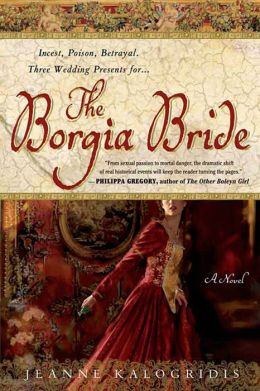
The Borgia Bride (2005)

The Borgia Bride. Jeanne Kalogridis. 2005. St. Martin's Press. 528 pages. [Source: Library]

The Borgia Bride is not a romance novel. If you expect it to be strictly a "romance novel", you may be shocked at how unromantic it is. If you're reading it because you love history, you may also be disappointed, because of the way Kalogridis has decided to interpret history--or "the facts" as she sees them. (I think she was going for shock.) If you are looking for a book with well-rounded characters, look elsewhere.

The novel is set in Renaissance Italy, roughly around 1492-1503. The heroine of the novel is Sancha of Aragon, the wife of Jofre Borgia. It was an arranged marriage, as many were at the time. The trouble for Sancha truly begins when the couple goes to Rome to live with the rest of the Borgia family. It is then that Sancha meets her father-in-law (Rodrigo Borgia, Pope Alexander VI), her sister-in-law, Lucrezia, and her brother-in-law Cesare. The author has Sancha falling into instant love (or should that be lust?) with Cesare. This is perhaps helped along by the fact that Cesare "saves" her from being raped by her father-in-law. The two speak the next day, and when he apologizes for wanting to seduce her himself, she confesses that she wouldn't mind--she loves him so it would be different. But Sancha though an adulteress soon realizes that the Borgia family is way too immoral for her to ever belong. She discovers the sick, disturbing secrets of the family; if the family learns that she knows these secrets, well, it wouldn't be pretty. For Sancha realizes that Cesare may be oh-so-dreamy and have a voice like velvet (the book does say that, his voice and manners were like velvet), but he is a murderer; he is cold, calculating, selfish. She's brave enough to end the relationship, but, she still remains trapped in this horribly dysfunctional family. Over half the novel is about Sancha gaining the strength and perhaps stealth needed to defeat evil and make a stand for justice.

The Borgia Bride definitely has adult content. It is historical fiction. Its focus is on the outrageous, scandalous, reprehensible behavior of the Borgia family. I'm not sure how much of this is based on actual historical evidence--not historical allegations, because allegations are sometimes known to be questionable or controversial or completely false. The Borgias as depicted by Kalogridis are evil through and through with absolutely no good to them at all. The father, the sons, the daughter. They are not a little bad, a little dangerous--they are pure evil. Cesare is not a Byronic hero; he's the devil. There is absolutely no character depth in this novel. Villains can be exciting or fascinating. (Would Alias be the same without Arvin Sloane? Would Once Upon A Time be the same without Regina or Mr. Gold? There has to be substance even to villains for the story to work.)

The Borgia Bride's biggest weakness is it is almost impossible to truly care about any of the characters. 


© 2013 Becky Laney of Becky's Book Reviews

Monday, June 25, 2012

Tempest (YA)

Tempest. Julie Cross. 2012. St. Martin's Press. 352 pages. 


Saturday, April 11, 2009,
Okay, so it's true. I can time-travel. But it's not as exciting as it sounds. I can't go back in time and kill Hitler. I can't go to the future and see who wins the World Series in 2038. So far, the most I've ever jumped is about six hours in the past. Some superhero, right?

Tempest is a great example of why you should never judge a book by its cover. For me this cover just doesn't work, it doesn't shout out time-traveling-spies, does it? And with a premise as appealing as time travel (in general) AND featuring mysterious secret agents fighting evil-time-travelers, it should have an awesome cover.

Jackson Meyer is our time-traveling hero with a girlfriend named Holly. But within chapters, Holly's life is in danger--she's dying before his eyes--and Jackson does the only thing he can do: panic as he jumps backwards in time. Because of the traumatic events leading to the jump, Jackson does something he's never done before which traps him in the past--in the year 2007. Once there, he'll have plenty of time to find out who he is, who his father is--why his Dad is so very, very weird and out-of-touch with him, and much much more. He has tons of questions, and he wants some answers at least. Mainly: can he change the future, is there anything he can do to prevent the tragic events leading up to Holly's (alleged) death? Also: can he find a way to jump back to the future, or is he stuck in 2007? Will he have to relive two years of his life? And then there's all the super-super mysterious stuff about himself, his father, his mother, his abilities, etc.

So how does he spend his time? Well, he a) time-travels back and forth in his own past trying to piece together clues b) meets his girlfriend, Holly, years before he "really" meets her c) meets his best friend, Adam, years before he's supposed to really meet him d) confronts his Dad with some super-tough questions.

This one has dangers, thrills, mysteries, secrets, lies, spies, and time-travel. What is NOT to love?! Seriously!!! The book has a GREAT premise. Jackson is a fully developed character whom we get to know surprisingly well considering how this is an action/plot/premise-driven book. Loved the emotional range we get, not only all the scenes about Holly or with Holly, but all the scenes about his twin-sister, Courtney. There was even a great heart-to-heart with his Dad towards the end. The book has a quite a few complex relationships, and I appreciated how they were developed. I loved also the exploration of consequences. I really appreciated the ending, I thought it was just right.

Read Tempest
  • Time travel
  • Good vs. Evil
  • Secret Agents/Secret Agencies
  • Romance from a guy's perspective


© 2012 Becky Laney of Becky's Book Reviews
Monday, June 18, 2012

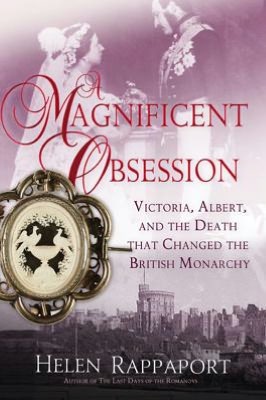
Magnficient Obsession

Magnificent Obsession: Victoria, Albert, and the Death that Changed the British Monarchy. Helen Rappaport. 2012. St. Martin's Press. 352 pages.

 A Magnificent Obsession is a nonfiction book that chronicles the last year of Prince Albert's life--focusing on his work load, health problems, and the tedious family dramas that weighed on him. In great detail it shares with readers what the last few weeks of his life were like, day by day, night by night, who visited him, who nursed him, what he ate or didn't eat, the number of hours he slept or didn't sleep, the bulletins the family released to the press, etc. Readers get a glimpse of what this experience might have been like for his wife, Queen Victoria, and his daughter, Princess Alice, who was his chief nurse. After his death, readers get a glimpse of private and public mourning. The rest of the book focuses on the first ten (or perhaps eleven?) years after his death. It discusses the Queen's private and public life. The way the people felt about the Queen. It focuses on the people's doubts and worries, etc. The book concludes with the Queen regaining some popularity with the people. The last chapter, unfortunately, goes in a direction I didn't quite care for, but, for the most part I found this one interesting. I wouldn't quite say compelling. Because if I'm being honest, I was curious but not THAT curious. It was informative without a doubt, but not necessarily written in such a way to make it fascinating.

Why didn't I like the last chapter? Well, the way I read the text--this may not have been the author's intent--I felt Rappaport was saying that Queen Victoria was great because her husband died; her husband's death freed her to become the strong, independent, vibrant monarch she could have been or should have been all along. That she only became QUEEN when Albert died, before she was a weak woman, a woman whose reign was weakened by her private life; that being a wife and mother made her a weak monarch or a monarch in name only. That her so-called "obsessive" love (devotion, passion) for her husband made her weak and dependent and pliable. I must not be alone in my interpretation because a Library Journal review reads along the lines that it wasn't until her husband's death that "she was allowed" to emerge as a great monarch. Albert's death is made to be this great thing that transforms Victoria into a great woman. And that talk just bothered me. And I'm almost sure it would have bothered her as well. I imagine Queen Victoria was VERY strongly opinionated, and I'm sure she'd have something to say here.

Read Magnificent Obsession: Victoria, Albert, and The Death That Changed the British Monarchy
  • If you are interested in history, particularly the 1860s and early 1870s
  • If you are interested in the British royal family
© 2012 Becky Laney of Becky's Book Reviews
Tuesday, December 27, 2011

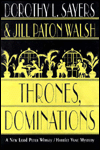
Thrones, Dominations

Thrones, Dominations. Dorothy L. Sayers and Jill Paton Walsh. 1998. St. Martin's Press. 312 pages.


'I do not,' said Monsieur Theophile Daumier, 'understand the English.'
'Nor does anybody,' replied Mr Paul Delagardie, 'themselves least of all.'

Lord Peter Wimsey and Harriet return to London after their honeymoon, Harriet hasn't been unconditionally accepted by all of Peter's family--at least not yet. And let's be honest, she may never be welcomed by Peter's sister-in-law, Helen. But she is happy as a new wife. Though she'd admit it feels strange to not have to write detective stories anymore. She still wants to write, but her writing is not prompted by absolute necessity. And so she's still trying to figure out what that means to her writing, how to get focused on her work--or should I say stay focused on her work. She's being introduced to new people all the time. Some of these new acquaintances she welcomes, some are more forced upon her. The Harwell couple, for example. Neither Lord Peter or Harriet "enjoy" spending time with Laurence Harwell and his wife, Rosamund Harwell; and it should be said that Laurence Harwell and Rosamund Harwell don't truly "enjoy" spending time with them either. But. Society is society and the connection may prove useful at some point.

Thrones, Dominations provides an intimate (not that kind of intimate) look at two marriages. Peter and Harriet and Laurence and Rosamund. The two marriages do share certain similarities. Husbands who at some point in the past 'rescued' their wives. The husbands being of higher social class than their wives. But a closer examination proves the differences outweigh any similarities. For it becomes clear that Lord Peter and Harried LOVE each other truly--with a forever-kind-of-love. And for Rosamund and Laurence, what love might have existed is buried under disinterest, neglect, and manipulative games. She wants her husband to be jealous of her, possessive of her, to want her to be his and his alone. And he just doesn't care who she talks to, who she dines with, who she goes about with in town, etc.

Halfway through the novel, once the reader gets a chance to know both couples and the society they share, the mystery begins. Lord Peter is once again called upon to solve the mystery and find the murderer.

I enjoyed this one. I did. I particularly liked seeing Harriet and Peter together. I thought she did a great job with their dialogue and the development of their relationship. I would recommend this one to those that can't get enough of this couple!

Harriet and Lady Severn
"Well, how do you like it?"
"Like what, Lady Severn?"
"Being part of the Wimsey Estate."
"Peter doesn't treat me as part of the estate."
"I suppose not. He always had good manners. An excellent bedside manner, too, or so they tell me."
Harriet said gravely, "I don't think they ought to have told."
In spite of herself, the corners of her mouth twitched and the vulture chuckled again.
"You're quite right, my dear, they oughtn't. You won't tell, I can see. Never tell me anything; I always repeat it. Are you in love with him?"
"Yes. I don't mind having that repeated."
"Then why didn't you marry him sooner?"
"Obstinacy," said Harriet, and this time she grinned openly.
"Humph! You're probably the first woman that ever kept him waiting. What do you do with him, now you've got him, hey? Lick his toes, or make him sit up and beg?"
"What do you advise?"
"Honest dealing," said the old lady, sharply. "A man's none the better for being fretted to fiddle-strings. You're going to amuse me. Most of these young women are very dull. They either take offence or think I'm a scream. What do you think?"
"I think," said Harriet, feeling she might as well be hanged for a sheep as a lamb, "you are behaving like a character in a book. And I think you are doing it on purpose."
"That's rather shrewd of you," said the vulture.
"When I put you in a book," pursued Harriet, "I shall make that aspect of your psychology quite clear."
"All right," said Lady Severn. "I'll take six copies. And I'll promise to live till it's published." (41-42)
Lord Peter to Harriet on her writing:

"How I envy you your capacity to take facts or leave them," said Peter. (51)

Harriet to Mr. Amery:

"You should never say thank you for a good review," said Harriet. "That would imply that one had done a favour to the author, whereas one has simply done justice to the book." (101)

Lord Peter and Harriet:

"It is perfectly possible, I suppose," said Lord Peter to his wife, over breakfast, "for someone to be murdered while doing something she does not usually do, or behaving in a way unaccustomed to her. But it is an affront to the natural feelings of a criminologist, all the same."
"It has a feeling of lightning striking twice in the same spot, you mean?"
"It does rather. I would greatly prefer it if in every tiny break in precedent was in some way connected to the crime. And therefore could be constructed as a clue by a brainy enough person."
"Well, if this were a work of fiction, one would certainly make sure that was the case," said Harriet. "But in real life, Peter, don't people usually do unusual things? Aren't they always going to places for the first time, mildly surprising their friends by little switches in behavior, suddenly getting bored, or headachy, and dashing out to parties, or going early to bed, or buying a red dress instead of a blue one, or suddenly marrying, at the age of forty-five, a highly unsuitable person?"
"Do you mean that unpredictable behavior may simply reveal the secret truth of someone's inner man or woman?"
"In a novel, of course, it would. Things have to be connected or the reader would not believe them."
"It's odd, that, isn't it?" said Peter. "If unconnected and spur-of-the-moment things keep happening in the real world, why shouldn't they be plausible in novels? Shouldn't the most plausible picture of life be a portrait of reality in all its bizarre and incoherent confusion?"
"I think a novel has to deal in a different kind of truth," said Harriet. "For example, if poor Rosamund's death were in a novel, readers would know at once that the Sunbury attacker who so alarmed Laurence Harwell could not have done it. If a wholly unconnected stranger arrived in a story just in time to commit the crime and disappear, there would be no plot."
"But in real life random things occur, and there may actually be no plot, in that sense of the word," said Wimsey, thoughtfully. (137-38)

Lord Peter to Inspector Parker
"I wish you wouldn't get so obsessed by motives, Charles. Motives are ten a penny. There's always a motive for anybody doing anything. Just find out who had the opportunity, and you can make up the motive."
"I don't really agree with you," said Charles. "Juries like motives, you know." (141)

Lord Peter and Harriet
"Frivolity can give a good deal of pleasure," he said, mildly. "But I don't like to hear you call detective stories frivolous."
"But aren't they? Compare to the real thing?"
"What do you call the real thing?"
"Great literature; Paradise Lost; novels like Great Expectations, or Crime and Punishment or War and Peace. Or on the other hand real detection, dealing with real crimes."
"You seem not to appreciate the importance of your special form," he said. "Detective stories contain a dream of justice. They project a vision of a world in which wrongs are righted, and villains are betrayed by clues that they did not know they were leaving. A world in which murderers are caught and hanged, and innocent victims are avenged, and future murder is deterred."
"But it is just a vision, Peter. The world we live in is not like that."
"It sometimes is," he said. "Besides, hasn't it occurred to you that to be beneficent, a vision does not have to be true?"
"What benefits could be conferred by falsehood?" she asked.
"Not falsehood, Harriet; idealism. Detective stories keep alive a view of the world which ought to be true. Of course people read them for fun, for diversion, as they do crossword puzzles. But underneath they feed a hunger for justice, and heaven help us if ordinary people cease to feel that." (151)
Dowager Duchess in a letter:

Sent Franklin to Hatchards for copy of War and Peace, thinking today good time to start long book...Silly woman came back with Anna Karenina, saying it was the nearest thing she could find. Got as far as first sentence, then stopped to think. "All happy families resemble one another, but each unhappy family is unhappy in its own way." Great author has got that the wrong way round. I think unhappiness is much the same whatever the reasons for it, and happiness is a quirky odd sort of thing... (312)


© 2011 Becky Laney of Becky's Book Reviews

Friday, January 28, 2011

Everybody Kills Somebody Sometime

Everybody Kills Somebody Sometime. Robert J. Randisi. 2006. St. Martin's Press. 288 pages.

When I spotted Joey Bishop walking toward me across the Sands casino floor, I figured he wasn't heading for a blackjack table.

This adult mystery is set during 1960, during the filming of Ocean's 11 in Las Vegas. It stars the Rat Pack: Frank Sinatra, Dean Martin, Sammy Davis Jr., Joey Bishop, and Peter Lawford. It's narrated by Eddie Gianelli (Eddie G) a pit boss at the Sands hotel. When the novel opens, he's being given an opportunity to do a favor for Frank Sinatra. Though he's flattered that Frank even knows he exists--to some degree--he is a bit hesitant too. What kind of "favor" could Sinatra want? And how dangerous would it be to say no? to say yes? Either way, it's a risk, a gamble. He certainly doesn't want to make enemies...

 But after a "friendly" discussion with his boss, Eddie G. decides to meet with Frank Sinatra, to do this special favor. What is the favor? Well, it's to figure out who is sending threatening letters to Dean Martin. Is it dangerous? Yes! But not quite for the reasons you might think.

I liked this one. I thought it was an interesting premise for a new mystery series. A bit playful, but full of drama. The others in the series include: Luck Be A Lady, Don't Die, Hey There (You With The Gun In Your Hand), You're Nobody Til Somebody Kills You, and I'm A Fool To Kill You.

© 2011 Becky Laney of Becky's Book Reviews

Thursday, November 11, 2010

Bellfield Hall

Bellfield Hall: Or The Observations of Miss Dido Kent. Anna Dean. 2010. St. Martin's Press. 300 pages.

Bellfield Hall,
Monday 23rd September 1805


My dear Eliza,
I must begin another letter to you, although it is not six hours since I sent my last. I have some news to communicate which I think will surprise you not a little.

Miss Dido Kent hesitated, her pen suspended over the page. All her education and almost thirty years' experience of writing letters had not quite prepared her for this situation. As well as she could recall, the rules of etiquette said nothing about the correct way in which to convey the news that she now had to impart. However, her governess had once told her that the very best style of writing was that which gave information simply and clearly without any excess of sensibility.
She dipped her pen into the ink and continued.
There has been a woman found dead here -- in the shrubbery -- this evening. (13-14)
I really enjoyed this mystery novel set during one of my favorite time periods--the Regency. I enjoyed the narrator, Miss Dido Kent, very much. I found her pleasant company. This was one of those nice books to settle in with--perhaps not the most compelling read, when it comes to pace--but a pleasant, satisfying read all the same. 

Miss Dido Kent is visiting her niece, Catherine, who is distraught at the disappearance of her betrothed, Richard Montague. True, he sent her a note--a note begging her to break off their engagement. But she doesn't know why he wants to break it off. She doesn't know where he's gone. Until she knows why, she can't fathom breaking the engagement. Does he still love her? She needs to find him, to talk to him. But before that mystery can be solved, another begins. In fact, this dead body opens the novel.

Miss Dido didn't plan on solving a mystery--on trying to solve a murder case--but she happens to be in the right time and place. Who is the dead woman found in the shrubbery? How was she shot in the middle of the day with no one on the estate hearing it? Who among the house guests would have a motive for killing this mystery woman? Can Miss Dido solve this mystery while trying to comfort her niece? How many family secrets will she uncover in the process? 

I liked this one. I really liked it. I liked the setting. I liked the characters. It was interesting to meet all the different characters. I thought she did a great job with them! It was a very pleasant novel.

© Becky Laney of Becky's Book Reviews
Saturday, May 29, 2010

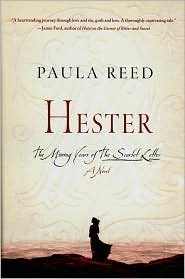
Hester


Hester. Paula Reed. 2010. February 2010. St. Martin's Press. 308 pages.

If it is a lonely life to be the embodiment of sin, lonelier still it is to be a legend.

This may sound strange, but I read The Scarlet Letter so I could read Hester. And I wanted to read Hester because I fell for the first line of the prologue.

How does Hester compare to The Scarlet Letter? Well, it's easier to read for one thing. The characters are actually well-drawn, quite human. The characters stand for more than a single symbol (or two). Pearl is more than just a wild child--a wicked little devil in the making. Hester is more than her shame, her guilt.

Hester focuses on the "missing years" of The Scarlet Letter. The beginning sees her setting sail for England with Pearl, and the close sees her returning--alone--to America, to New England. Paula Reed imagines Hester becoming involved--for better or worse--with the politics of the day. Reed imagines Hester with a unique gift of sensing others' sins. Not reading their minds, exactly, but sensing their sins, their secrets. Her time wearing the scarlet letter has left her with the ability to reflect people's sins, their hypocrisies. Oliver Cromwell learns of her "gift" and wants to use her, manipulate her, "for the good of the country." He hopes that Hester can determine which men are traitors, which men are plotting his downfall, which men are secretly Royalists wanting the return of Charles II.

But just because Hester has this "gift" doesn't mean that she is comfortable using it. That she is happy that the men in her life want to use her in their political games. Because Cromwell isn't the only man in her life. (There is one man much, much closer. A man Hester finds difficult to read. A man who urges Hester to doubt everything--to question sin, guilt, shame, prayer, God, etc. He says sin doesn't exist, that if you don't believe in sin, well, then you're free from the guilt, the shame. Sin is just something you're taught to believe in. If you let go of those beliefs, then you can be happy, you can make your own choices. Her friendship with John Manning causes her to reflect on her past, on her relationship with Arthur...

I didn't love everything about this one. (I didn't like Manning's beliefs, for example.) But I did enjoy seeing the characters come to life. I had a hard time connecting with the one-dimensional characters of Hawthorne.

The premise. I was very skeptical. And in a way, I still am. But when I was reading the novel, I was so in the moment that I didn't stop to think about it all that closely. Because the writing kept me reading. I may not have loved every minute of it, but I was still engaged for the most part. The book did make me curious. I'd love to read other books set in this time period--to read more about Oliver Cromwell and Charles II.


© Becky Laney of Becky's Book Reviews

Sunday, May 02, 2010

Some Girls Are


Some Girls Are. Courtney Summers. 2010. January 2010. St. Martins Press. 256 pages.

Hallowell High:
You're either someone or you're not.
I was someone. I was Regina Afton, Anna Morrison's best friend. These weren't small things, and despite what you may think, at the time they were worth keeping my mouth shut for.


Regina was someone. Now she's not. It's just that simple. (Except nothing is ever that simple, is it?) Her downfall started with a party where she was the designated driver. By Monday morning, Regina's friends have turned on her. Why? They've heard how she betrayed her friend at the party. (But is it true? Does anyone even care?)

Who will Regina eat lunch with now? The answer may be surprising because it's not only that Regina was popular. It's that Regina and Anna--her former best friend--were bullies. Together they ruled over everyone. Making anyone who wasn't "someone" hate them, fear them. Those students--her former victims--now have reason to smile and celebrate. They're more than happy to join the I Hate Regina Afton YourSpace group to leave nasty comments. Regina is finally getting what she deserves. (But is she?) Is there anyone left to stand up for Regina? Anyone willing to give her a second chance? Anyone willing to forgive?

Regina isn't always an easy narrator to like. The reader learns about Regina's past behavior through the course of the novel and some of the things Regina's done are ugly, hateful, cruel, thoughtless. Is Regina capable of change?

Some Girls Are is a complex novel dealing with a couple of difficult issues including bullying. Regina is very human. I thought the author did great in showing her strengths and weaknesses.
I found Some Girls Are to be a compelling story. Very intense.

It does have mature content so it may not be for every reader.

You might also enjoy Speak, 13 Reasons Why, Story of a Girl, and Just Listen.

Other reviews: Presenting Lenore, The YA YA YAs, Steph Su Reads, S. Krishna Books, The Story Siren, Confessions of a Bibliovore, Angieville, Read this Book!, My Overstuffed Bookshelf, Pop Culture Junkie.

© Becky Laney of Becky's Book Reviews

Friday, March 20, 2009

The Chosen One


Williams, Carol Lynch. 2009. The Chosen One. St. Martin's Press. 224 pages. (MAY PUBLICATION)

"If I was going to kill the Prophet," I say, not even keeping my voice low, "I'd do it in Africa."

This one had me at hello, with that first sentence. Even if I wasn't already persuaded by the premise--which I was. (The premise: "Thirteen-year-old Kyra has grown up in an isolated community without questioning the fact that her father has three wives and she has twenty brothers and sisters. Or at least without questioning them much--if you don't count her secret visits to the Mobile Library on Wheels to read forbidden books, or her meetings with the boy she hopes to choose for herself instead of having a man chosen for her. But when the Prophet decrees that Kyra must marry her sixty-year old uncle--who already has six wives--Kyra must make a desperate choice in the face of violence and her own fears of losing her family.")

Several things caught my eye. Primarily the part about her love of reading despite the fact that all books are forbidden...to her and the others in her commune. For it is this love of reading that sustains her, that gives her hope, that gives her joy, that gives her normalcy. Small though it may seem, it is this act of disobedience, this strange-confidence of approaching the outside world, of speaking even briefly with an outsider, that is a catalyst in her life.

If you love books, you'll relate to Kyra. She names a handful of books throughout. The book shows her discovering these books, these characters. Kyra was out walking outside the boundaries of her community when she first notices the mobile library. Two or three weeks she notices him driving by. The third week, he stops. And that changes everything...for better or worse.

Dust billowed up around us. I could taste the dirt. Crunched sand between my teeth.
He rolled down the window. "You want a library card," he said adjusting the ball cap he wore. It wasn't even a question.
And I nodded, like he'd done to me these past weeks.
"You can take four books out at a time," he said when I inched my way into the truck, cooled by fans and air-conditioning.
I'd never seen so many books. Never. The sight made my eyes water. I mean, tear right up.
"Four?" I said. There was that sand on my tongue, gritting between my back teeth.
"Four."
I eyed the man. Eyed the books. Stood still, my heart thumping.
"Maybe just one," I said.
"You could start with this," he said and handed me something from a basket near his feet. "A girl just your age turned it in on my last stop. She said she loved it. I loved it myself."
His last stop? Another girl? He'd read this book?
I took the novel from him and glanced at the cover. Bridge to Terabithia.
I was there just a minute and I only took the one. One, I knew, would be easier to hide.
But oh, how my life changed with his stopping. My life changed when I started reading. I was different with these sinful words.
Who was this Katherine Paterson? Who was this Jesse and Leslie? People the writer knew? I could hardly read this book fast enough.
And when I did
when I got to the end
when I got to the end and
Leslie died
and Jesse was left alone without his best friend
I cried so hard that coming in from my hiding place, my tree, the book stashed in the branches, high in the prickles, Mother Victoria said, "Where have you been, Kyra? I needed help making bread." Then she looked at my face and said, her voice all worried, "Honey, what happened?"
I couldn't tell her a thing. Not about Leslie or May Belle or Jesse all alone. I couldn't tell Mother Victoria a thing about drowing or running or painting.
Instead, I threw my arms around her waist and said, my head on her shoulder, crying my eyeballs out, "I love you so much, Mother Victoria."
Then I set out delivering bread to my other mothers and to Sister Allred, who just had a baby, half-crying the whole way. (15-16)
But this book isn't just a book about a girl who loves to read...it's a book about a girl who's in love with a boy. Joshua Jackson. Their love innocent and pure as it may be is forbidden. Kyra--just thirteen--has been ordered by the Prophet and the elders to marry her uncle. Or else. Or else her family will pay the price for her 'sins'. No one in her family--her father or her mothers--wants to see her married to her creepy-old-uncle. But none are really willing to sacrifice that much for her. (I am not going to tell you what that sacrifice would involve because I think it would be too big a spoiler.)

This book is well-written; fascinating; compelling; powerful. I HIGHLY HIGHLY recommend this one. I just loved it. Loved Kyra. Loved her story. It's an emotional roller coaster, no doubt, but definitely worth it!

© Becky Laney of Becky's Book Reviews
If you're reading this post on another site, or another feed, the content has been stolen.