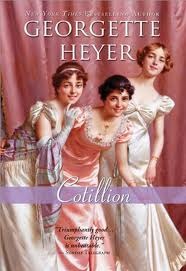
Cotillion. Georgette Heyer. 1953/2007. Sourcebooks. 355 pages. [Source: Review copy]
First
sentence: The saloon, like every other room in Arnside House, was large
and lofty, and had been furnished, possibly some twenty years earlier,
in what had then been the first style of elegance.
Premise/plot: Kitty, our heroine, will inherit a LOT of money if only she'll marry one of her cousins. Technically they're not blood relatives, she's been raised by her guardian. These "cousins" are his great-nephews. There are four single cousins to choose from...but this situation is far from ideal for everyone concerned. Kitty wants to live life a little and see what there is to see--namely go to London for the first time and mingle with society. She knows that her guardian will never allow such a thing. But if she was engaged...if she was taken under the wing of her fiance's family...then she could get what she wants. What she doesn't account for is her wants changing. She had no inkling that her sham engagement would prove to be real deal. That her ridiculous cousin, Freddy, would be her soul mate....
My thoughts: This is the third time I've read Cotillion. I will admit that it has a slow beginning. The first half of the novel moves so slow and there seems to be little reward for the effort. However, the second half is quick-paced. The characters are enjoyable--at last. The situations are comical. The dialogue turns witty. There is something about it that is very satisfying.
© 2019 Becky Laney of Becky's Book Reviews
Showing posts with label share-a-tea challenge. Show all posts
Tuesday, February 12, 2019
Saturday, January 26, 2019
Abridged Classics
Abridged Classics: Brief Summaries of Books You Were Supposed to Read But Probably Didn't. 2018. 160 pages. [Source: Library]
First sentence: Ulysses. James Joyce. Dublin, something, something, something, run-on sentence.
Moby Dick. Herman Melville. Man vs. whale. Whale wins.
War and Peace. Leo Tolstoy. Everyone is sad. It snows.
Premise/plot: What you see is what you get...for the most part. Each classic book featured has an illustration (sometimes two) and a few sentences. It's as concise as can be.
© 2019 Becky Laney of Becky's Book Reviews
First sentence: Ulysses. James Joyce. Dublin, something, something, something, run-on sentence.
Moby Dick. Herman Melville. Man vs. whale. Whale wins.
War and Peace. Leo Tolstoy. Everyone is sad. It snows.
Premise/plot: What you see is what you get...for the most part. Each classic book featured has an illustration (sometimes two) and a few sentences. It's as concise as can be.
Peter Pan. J.M. Barrie. Some kids and a crocodile pester an amputee.
Wuthering Heights. Emily Bronte. A sort-of brother and sister fall in love. It's foggy.
Sense and Sensibility. Jane Austen. Two sisters catch husbands. And one catches a cold.My thoughts: I read this one in one sitting. Anyone could. I read it with a cup of tea in hand. It was delightful--for the most part, both the tea and the book. I could write BOOKS about how they summarized the Bible wrong. But. I won't. (For those that are curious, the summary is "Be good or else.") I would recommend this one for anyone who enjoys a super-quick read. Especially if your library has it. (I don't know that I could ever justify buying it--at least to myself. It just took me about fifteen minutes to read.)
© 2019 Becky Laney of Becky's Book Reviews
Friday, January 25, 2019
Death in the Stocks
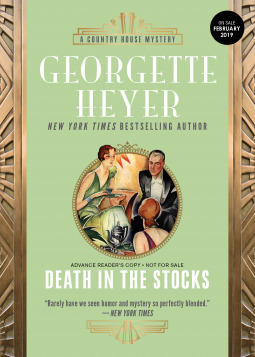
Death in the Stocks. Inspectors Hannasyde & Hemingway #1) Georgette Heyer. 1935/2019. Sourcebooks. 384 pages. [Source: Review copy]
First sentence: It was past midnight, and the people who lived in the cottages that clustered round the triangular green had long since gone to bed and to sleep.
Premise/plot: You know how some murder mysteries seem to take forever before the body appears and the detectives arrive? Not Death in the Stocks. Within the first two pages we have a corpse: Arnold Vereker. He was found stabbed to death in the village stocks. How peculiar indeed. He only comes down to the village occasionally on weekends--usually with a woman. His family isn't surprised that he's dead. He wasn't well-loved--or even liked. It could even be likely--in terms of motive--that one of his own family did the crime.
Throughout the novel readers get a chance to know his family quite well: Antonia, "Tony," and her brother, Kenneth. Giles Carrington, their cousin and lawyer. Tony is engaged to a man who was pilfering money from Arnold Vereker's company. Kenneth is engaged to a gold digger. No doubt the inspectors soon realize this family is CRAZY ECCENTRIC. But is anyone in the family capable of murder?
My thoughts: I loved, loved, loved this one. I believe this was my second time to read this one. I love the characters. I love the dialogue. I love the pacing. It was just a delight to spend time with the characters.
Quotes:
© 2019 Becky Laney of Becky's Book Reviews
First sentence: It was past midnight, and the people who lived in the cottages that clustered round the triangular green had long since gone to bed and to sleep.
Premise/plot: You know how some murder mysteries seem to take forever before the body appears and the detectives arrive? Not Death in the Stocks. Within the first two pages we have a corpse: Arnold Vereker. He was found stabbed to death in the village stocks. How peculiar indeed. He only comes down to the village occasionally on weekends--usually with a woman. His family isn't surprised that he's dead. He wasn't well-loved--or even liked. It could even be likely--in terms of motive--that one of his own family did the crime.
Throughout the novel readers get a chance to know his family quite well: Antonia, "Tony," and her brother, Kenneth. Giles Carrington, their cousin and lawyer. Tony is engaged to a man who was pilfering money from Arnold Vereker's company. Kenneth is engaged to a gold digger. No doubt the inspectors soon realize this family is CRAZY ECCENTRIC. But is anyone in the family capable of murder?
My thoughts: I loved, loved, loved this one. I believe this was my second time to read this one. I love the characters. I love the dialogue. I love the pacing. It was just a delight to spend time with the characters.
Quotes:
- And I have one of those cast-iron alibis which I understand render one instantly suspect.
- 'People who start a sentence with personally (and they're always women) ought to be thrown to the lions. It's a repulsive habit.'
- 'Whatever will you say next, Miss Tony? Your own brother too, as wouldn't hurt a fly.' 'If you had a fly-swotting competition, he'd win it.' Antonia replied sensibly.
- 'She can't possibly not talk at all, Kenneth,' said Antonia reasonably. 'What he means is, Don't talk Art.' 'Thank you. I'm quite aware that nobody but Kenneth knows anything about Art.'
- 'My fiancee says it's such a rotten story you're bound to believe it. She ought to know. She reads about seven detective thrillers a week, so she's pretty well up on crime.'
- 'That boy is either an incorrigibly truthful young ass, or a brilliantly clever actor.'
- 'Obviously if you were clever enough to commit a murder and plant yourself down in the murdered man's house afterwards you ought to have told as many people as you could that you were going down to have it out with Arnold. No one'd believe you killed him after that.'
- 'But I don't like policemen. Some people feel the same about cats. Always know the instant one comes into the room, and begin to get creepy. Not that I've any objection to cats, mind you. Far from it. In fact, if I had to be bothered with any sort of animal, I think I should choose a cat.'
- If there's one thing that wears me out quicker than anything it's having to choose a lot of food for someone else to eat.
© 2019 Becky Laney of Becky's Book Reviews
Tuesday, January 22, 2019
Winnie the Pooh
Winnie the Pooh. A.A. Milne. Illustrated by Ernest H. Shepard. 1926. 163 pages. [Source: Review copy]
First sentence: Here is Edward Bear, coming downstairs now, bump, bump, bump, on the back of his head, behind Christopher Robin. It is, as far as he knows, the only way of coming downstairs, but sometimes he feels that there really is another way, if only he could stop bumping for a moment and think of it. And then he feels that perhaps there isn't. Anyhow, here he is at the bottom, and ready to be introduced to you. Winnie-the-Pooh.
Premise/plot: Christopher Robin has MANY friends who live in the forest. Among them are Winnie the Pooh (or Winnie-ther-Pooh), Piglet, Owl, Rabbit, Kanga, Roo, and EEYORE. (Who I am sure just now is saying,"You didn't forget about me which is more than I expected.") There are ten chapters in all; each chapter is a new adventure:
Quotes:
© 2019 Becky Laney of Becky's Book Reviews
First sentence: Here is Edward Bear, coming downstairs now, bump, bump, bump, on the back of his head, behind Christopher Robin. It is, as far as he knows, the only way of coming downstairs, but sometimes he feels that there really is another way, if only he could stop bumping for a moment and think of it. And then he feels that perhaps there isn't. Anyhow, here he is at the bottom, and ready to be introduced to you. Winnie-the-Pooh.
Premise/plot: Christopher Robin has MANY friends who live in the forest. Among them are Winnie the Pooh (or Winnie-ther-Pooh), Piglet, Owl, Rabbit, Kanga, Roo, and EEYORE. (Who I am sure just now is saying,"You didn't forget about me which is more than I expected.") There are ten chapters in all; each chapter is a new adventure:
- In Which We Are Introduced to Winnie-the-Pooh and Some Bees, and the Stories Begin
- In Which Pooh Goes Visiting and Gets Into A Tight Place
- In Which Pooh and Piglet Go Hunting and Nearly Catch a Woozle
- In Which Eeyore Loses a Tail and Pooh Finds One
- In Which Piglet Meets a Heffalump
- In Which Eeyore Has a Birthday and Gets Two Presents
- In Which Kanga and Baby Roo Come to the Forest, And Piglet Has a Bath
- In Which Christopher Robin Leads an Expotition to the North Pole
- In Which Piglet Is Entirely Surrounded by Water
- In Which Christopher Robin Gives Pooh a Party and We Say Goodbye
Quotes:
"I think the bees suspect something!" "What sort of thing?" "I don't know. But something tells me that they're suspicious!" "Perhaps they think that you're after their honey." "It may be that. You never can tell with bees." (19)
"I think," said Christopher Robin, "that we ought to eat all our Provisions now, so that we shan't have so much to carry." "Eat all our what?" said Pooh. "All that we've brought," said Piglet, getting to work. "That's a good idea," said Pooh, and he got to work too. "Have you all got something?" asked Christopher Robin with his mouth full. "All except me," said Eeyore. "As usual." He looked round at them in his melancholy way. "I suppose none of you are sitting on a thistle by any chance?" "I believe I am," said Pooh. "Ow!" He got up, and looked behind him. "Yes, I was. I thought so." "Thank you, Pooh. If you've quite finished with it." He moved across to Pooh's place, and began to eat. "It don't do them any Good, you know, sitting on them," he went on, as he looked up munching. "Takes all the Life out of them. Remember that another time, all of you. A little Consideration, a little Thought for Others, makes all the difference." (113)
"When you wake up in the morning, Pooh," said Piglet at last, "what's the first thing you say to yourself?" "What's for breakfast?" said Pooh. "What do you say, Piglet?" "I say, I wonder what's going to happen exciting today?" said Piglet. Pooh nodded thoughfully. "It's the same thing," he said. (147-48)Original audience born circa 1920 to 1924.
© 2019 Becky Laney of Becky's Book Reviews
Saturday, January 19, 2019
Evelina
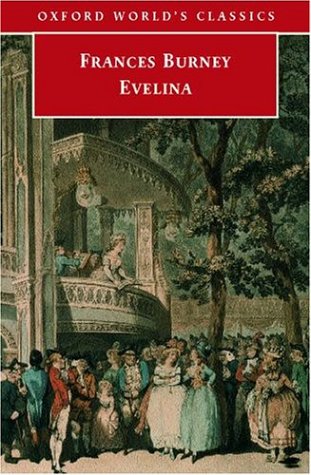
Evelina. Fanny Burney. 1778. 455 pages. [Source: Bought]
First sentence: CAN any thing, my good Sir, be more painful to a friendly mind, than a necessity of communicating disagreeable intelligence?
Premise/plot: Fanny Burney's Evelina is an epistolary novel that was first published in 1778. Most of the letters are between Evelina and her guardian, Mr. Villars. Though others are included as well.
Evelina has been raised by Reverend Arthur Villars. She has been happy and content with her lot in life--even if she's never known her mother or father. Her life has been a bit sheltered in the past, but now that she's a young woman she's gaining opportunities to go out into the world. The book is a series of letters chronicling this new-and-exciting-adventure of growing up. It begins when Evelina goes to visit a friend of the family, Lady Howard. But that is just the start of her journey...
My thoughts: I really LOVED this one. There are EIGHTY-FOUR letters in all. A handful of those are lengthy, but most are not. Most just take a few minutes to read. Because the letters tend to be on the short side, it was easy to get swept up in this one saying just one more, just one more, just one more.
The novel is peopled with CHARACTERS. Some of them are oh-so-easy to love. A few of them fall into the hate-to-love or love-to-hate category. (For example, she meets her maternal grandmother and some of her cousins. They are so UNLIKE anyone she's ever met before.) And then there's Evelina's stalker, Clement Willoughby (boo, hiss). I haven't figured out exactly WHAT is going on in his world--I mean his mind--but I know he's TROUBLE. Evelina is in danger several times in this one. Evelina is a super-super-innocent heroine. The men in her life vary in shades of honor. Lord Orville stands in contrast to the villainy of Willoughby.
Evelina would make for a lovely period drama. Jane Austen was NOT the only woman writer in her day, and others deserve attention as well.
Quotes:
© 2019 Becky Laney of Becky's Book Reviews
First sentence: CAN any thing, my good Sir, be more painful to a friendly mind, than a necessity of communicating disagreeable intelligence?
Premise/plot: Fanny Burney's Evelina is an epistolary novel that was first published in 1778. Most of the letters are between Evelina and her guardian, Mr. Villars. Though others are included as well.
Evelina has been raised by Reverend Arthur Villars. She has been happy and content with her lot in life--even if she's never known her mother or father. Her life has been a bit sheltered in the past, but now that she's a young woman she's gaining opportunities to go out into the world. The book is a series of letters chronicling this new-and-exciting-adventure of growing up. It begins when Evelina goes to visit a friend of the family, Lady Howard. But that is just the start of her journey...
My thoughts: I really LOVED this one. There are EIGHTY-FOUR letters in all. A handful of those are lengthy, but most are not. Most just take a few minutes to read. Because the letters tend to be on the short side, it was easy to get swept up in this one saying just one more, just one more, just one more.
The novel is peopled with CHARACTERS. Some of them are oh-so-easy to love. A few of them fall into the hate-to-love or love-to-hate category. (For example, she meets her maternal grandmother and some of her cousins. They are so UNLIKE anyone she's ever met before.) And then there's Evelina's stalker, Clement Willoughby (boo, hiss). I haven't figured out exactly WHAT is going on in his world--I mean his mind--but I know he's TROUBLE. Evelina is in danger several times in this one. Evelina is a super-super-innocent heroine. The men in her life vary in shades of honor. Lord Orville stands in contrast to the villainy of Willoughby.
Evelina would make for a lovely period drama. Jane Austen was NOT the only woman writer in her day, and others deserve attention as well.
Quotes:
A youthful mind is seldom totally free from ambition; to curb that, is the first step to contentment, since to diminish expectation is to increase enjoyment.
I have just had my hair dressed. You can’t think how oddly my head feels; full of powder and black pins, and a great cushion on the top of it.
I believe you would hardly know me, for my face looks quite different to what it did before my hair was dressed. When I shall be able to make use of a comb for myself I cannot tell; for my hair is so much entangled, frizzled they call it, that I fear it will be very difficult.
Indeed, the more forcibly you are struck with improprieties and misconduct in another, the greater should be your observance and diligence to avoid even the shadow of similar errors.
“Indeed,” cried Sir Clement, “I must own myself no advocate for hats; I am sorry the ladies ever invented or adopted so tantalizing a fashion: for, where there is beauty, they only serve to shade it; and, where there is none, to excite a most unavailing curiosity. I fancy they were originally worn by some young and whimsical coquette.”
The play was Love for Love; and though it is fraught with wit and entertainment I hope I shall never see it represented again; for it is so extremely indelicate-to use the softest word...
“O yes, Sir, yes, very frequently: I have no time to read play-bills; one merely comes to meet one’s friends, and shew that one’s alive.” “Ha, ha, ha!-and so,” cried the Captain, “it costs you five shillings a-night just to shew you’re alive! Well, faith, my friends should all think me dead and underground before I’d be at that expense for ‘em. But, now I think of it, I believe I have a bill in my pocket; O, ay, here it is-Love for Love, ay,-true, ha, ha!-how could I be so stupid!” “O, easily enough, as to that, I warrant you,” said the Captain;
Generosity without delicacy, like wit without judgment, generally gives as much pain as pleasure.
How strange it is, Sir, that this man, not contented with the large share of foppery and nonsense which he has from nature, should think proper to affect yet more!
“So Miss,” said Mr. Branghton, “you’re quite in the fashion, I see-so you like operas? Well, I’m not so polite; I can’t like nonsense, let it be never so much the taste.”
“There is nothing,” answered he, “which requires more immediate notice than impertinence, for it ever encroaches when it is tolerated.”
Indeed the more I reflect upon it, the more angry I am. I was entirely in his power, and it was cruel in him to cause me so much terror.
I felt myself very uneasy in his presence; for I could not look at him, nor hear him speak, without recollecting the chariot adventure; but, to my great amazement, I observed that he looked at me without the least apparent discomposure, though, certainly, he ought not to think of his behaviour without blushing.
The passion he pretends for you has neither sincerity nor honour; the manner and the opportunities he has chosen to declare it, are bordering upon insult.
She lost her patience, and I my time.
But alas, my dear child, we are the slaves of custom, the dupes of prejudice, and dare not stem the torrent of an opposing world, even though our judgements condemn our compliance!
Nothing is so delicate as the reputation of a woman; it is at once the most beautiful and most brittle of all human things.
My heart beat with resentment; I pushed him away from me with all my strength, and demanded how he dared treat me with such insolence? “Insolence!” repeated he. “Yes, Sir Clement, insolence; from you, who know me, I had a claim for protection,-not to such treatment as this.”
“The long alleys!” repeated Mr. Branghton, “and pray, what had you to do in the long alleys? why, to be sure, you must all of you have had a mind to be affronted!”
Where any thing is doubtful, the ties of society, and the laws of humanity, claim a favourable interpretation;
“My dear Ma’am, you must be a little patient; I assure you I have no bad designs, I have not upon my word; but, really, there is no resolving upon such a thing as matrimony all at once; what with the loss of one’s liberty, and what with the ridicule of all one’s acquaintance,-I assure you Ma’am you are the first lady who ever made me even demur upon this subject; for, after all, my dear Ma’am, marriage is the devil.”
“Your opinion, Sir,” answered I, “of either the married or the single life, can be of no manner of consequence to me; and therefore I would by no means trouble you to discuss their different merits.”
“Why, really, Ma’am, as to your being a little out of sorts, I must own I can’t wonder at it; for, to be sure, marriage is all in all with the ladies; but with us gentlemen it’s quite another thing!
How little has situation to do with happiness!
She is not, indeed, like most modern young ladies, to be known in half an hour: her modest worth, and fearful excellence, require both time and encouragement to show themselves.
She does not, beautiful as she is, seize the soul by surprise, but, with more dangerous fascination, she steals it almost imperceptibly.”
“You are in the right,” said Mrs. Selwyn, “not to watch time, lest you should be betrayed, unawares, into reflecting how you employ it.” “Egad, Ma’am,” cried he, “if Time thought no more of me than I do of Time, I believe I should bid defiance, for one while, to old age and wrinkles; for deuce take me, if ever I think about it at all.”
© 2019 Becky Laney of Becky's Book Reviews
Labels:
1778,
adult classics,
adult fiction,
adult romance,
classics,
quotes,
share-a-tea challenge
Saturday, January 12, 2019
The Black Moth
The Black Moth. Georgette Heyer. 1921/2009. Sourcebooks. 355 pages. [Source: Review Copy]
Premise/plot: The Black Moth was Georgette Heyer's first novel; it is a historical romance set in the Georgian period. There are many, many characters and the relationships between the characters can be complicated at times. To clarify, NOT complicated for the reader to understand. But instead complicated to summarize in a review.
But. Essentially it's the story of two brothers: John Carstares and Richard Carstares. (John is also called JACK, Anthony Ferndale, Earl of Wyndam,Wyndam, Mr. Carr, to name a few). Richard, the younger brother, cheated at cards. John thought he was being a hero when he took the blame--the dishonor. He left the country and disappeared from public view. Richard married the woman--Lavinia--that they were both in love with. Richard has been plagued with his wife and HER BROTHERS ever since. One of those brothers is a dashing womanizer, the 'black moth' of which the title speaks. His real name is Tracy Clare Belmanoir, Duke of Andover. (He has aliases as well.)
The novel opens with Jack back in England. He's taken up an eccentric hobby: highway robbery. (Though he is far more principled, I imagine, than an actual highway robber.) Only a few know his real identity--at least so far--but he does have some business to handle. His father has died and he is the heir. He wants Richard to keep everything, but Richard is disgusted by his brother's endless generosity. He is determined to come clean and go public. There's only one thing stopping him, perhaps two: his wife and his lack of backbone.
The Black Moth has a love triangle: Both TRACY and JACK fall for the same woman, Diana...
My thoughts: I can't believe it's been six years since I last read Georgette Heyer!!! I do hope to reread many--if not most--of her romance novels in 2019! I'm not sure I'll take the same approach--chronological--but I might.
I enjoyed this one. I loved, loved, loved Jack. And the romance between Jack and Diana is great. Jack definitely qualifies a sweep-you-off-your-feet, larger-than-life, HERO. But his heroic qualities shine bright because of the blackness of the villain, Tracy.
Diana would definitely have ample cause to join the #metoo movement. She finds herself TWICE kidnapped. Tracy's idea of "wooing" is extreme--no matter the century. There's no excuse for his behavior. Actions speak louder than words. He may profess great, deep, abiding love for Diana. That he HAS to have her to live. He can't live without her. But if he really loved her, he wouldn't kidnap her, hold her hostage, threaten her. It matters little whether the marriage ceremony is before or after the consummation--to him. He boasts that her FAMILY will be so THRILLED to get him as a son-in-law--any family would--that it doesn't matter if he "ruins" her. They'll welcome him with open arms and consider themselves lucky and blessed.
Does Tracy get away with too much? Yes. Probably. He does NOT get the girl. But he doesn't ever get punished or ostracized because of his behavior. He gets to stay a dashing, daring social darling--though a known rake--and the happy couple allows him. After all, they will be in-laws in a fashion. Lady Lavinia--Richard's wife--is his sister.
This one certainly has characters that you can just LOVE. But it also has characters that you love-to-hate and hate-to-love.
The writing tends to the witty side. And when Heyer isn't delighting us with dialogue...she's giving us ACTION and DRAMA.
A scene between Lavinia and her brother, Tracy, (Duke of Andover)
Where have all the good men goneFirst sentence: Chadber was the name of the host, florid of countenance, portly of person, and of manner pompous and urbane.
And where are all the gods?
Where's the streetwise Hercules to fight the rising odds?
Isn't there a white knight upon a fiery steed?
Late at night I toss and I turn
And I dream of what I need ... ~ Bonnie Tyler, "Holding Out For a Hero"
Premise/plot: The Black Moth was Georgette Heyer's first novel; it is a historical romance set in the Georgian period. There are many, many characters and the relationships between the characters can be complicated at times. To clarify, NOT complicated for the reader to understand. But instead complicated to summarize in a review.
But. Essentially it's the story of two brothers: John Carstares and Richard Carstares. (John is also called JACK, Anthony Ferndale, Earl of Wyndam,Wyndam, Mr. Carr, to name a few). Richard, the younger brother, cheated at cards. John thought he was being a hero when he took the blame--the dishonor. He left the country and disappeared from public view. Richard married the woman--Lavinia--that they were both in love with. Richard has been plagued with his wife and HER BROTHERS ever since. One of those brothers is a dashing womanizer, the 'black moth' of which the title speaks. His real name is Tracy Clare Belmanoir, Duke of Andover. (He has aliases as well.)
The novel opens with Jack back in England. He's taken up an eccentric hobby: highway robbery. (Though he is far more principled, I imagine, than an actual highway robber.) Only a few know his real identity--at least so far--but he does have some business to handle. His father has died and he is the heir. He wants Richard to keep everything, but Richard is disgusted by his brother's endless generosity. He is determined to come clean and go public. There's only one thing stopping him, perhaps two: his wife and his lack of backbone.
The Black Moth has a love triangle: Both TRACY and JACK fall for the same woman, Diana...
My thoughts: I can't believe it's been six years since I last read Georgette Heyer!!! I do hope to reread many--if not most--of her romance novels in 2019! I'm not sure I'll take the same approach--chronological--but I might.
I enjoyed this one. I loved, loved, loved Jack. And the romance between Jack and Diana is great. Jack definitely qualifies a sweep-you-off-your-feet, larger-than-life, HERO. But his heroic qualities shine bright because of the blackness of the villain, Tracy.
Diana would definitely have ample cause to join the #metoo movement. She finds herself TWICE kidnapped. Tracy's idea of "wooing" is extreme--no matter the century. There's no excuse for his behavior. Actions speak louder than words. He may profess great, deep, abiding love for Diana. That he HAS to have her to live. He can't live without her. But if he really loved her, he wouldn't kidnap her, hold her hostage, threaten her. It matters little whether the marriage ceremony is before or after the consummation--to him. He boasts that her FAMILY will be so THRILLED to get him as a son-in-law--any family would--that it doesn't matter if he "ruins" her. They'll welcome him with open arms and consider themselves lucky and blessed.
Does Tracy get away with too much? Yes. Probably. He does NOT get the girl. But he doesn't ever get punished or ostracized because of his behavior. He gets to stay a dashing, daring social darling--though a known rake--and the happy couple allows him. After all, they will be in-laws in a fashion. Lady Lavinia--Richard's wife--is his sister.
This one certainly has characters that you can just LOVE. But it also has characters that you love-to-hate and hate-to-love.
The writing tends to the witty side. And when Heyer isn't delighting us with dialogue...she's giving us ACTION and DRAMA.
A scene between Lavinia and her brother, Tracy, (Duke of Andover)
She stamped angrily. 'Oh, where's the good in being flippant?'A scene between Lavinia and her husband, Richard...
'My dear Lavinia, where's the good in being anything else? The situation strikes me as rather amusing. To think of the worthy Richard so neatly overturning all my plans!'
'If it had not been for you, I might never have married him. Why did you throw them both in my way? Why did I ever set eyes on either?'
'It should have been a good match, my dear, and, if I remember rightly, no one was more alive to that fact than yourself.'
'Still,' he continued reflectively, 'I admit that for the smart lot we are, we do seem rather to have bungled the affair.' (63)
'Richard, I was coming in search of you! Tracy has invited me to Andover for a week--he purposes to ask several people to stay, and there will be parties--and entertainment! You will let me go? Say yet, Dicky--say yes, quickly!'A scene between Lavinia and Tracy...
Carstares bowed to his Grace, who stood watching them from the stairs. The bow was returned with exaggerated flourish. Carstares looked down at his wife.
'So soon, Lavinia?' he remonstrated, and indicated her mourning. She shook his hand off impatiently.
'Oh, Dicky, does it matter? What can it signify? I do not ask you to come--'
'No,' he said half-sadly, half-amusedly. 'I notice that, my dear.'
'No, no! I did not mean to be unkind--you must not think that! You don't think it, do you, Dick?'
'Oh, no,' he sighed.
'Good Dicky!' She patted his cheek coaxingly. 'Then you will allow me to go--ah, but yes, yes, you must listen! You know how dull I am, and how silly--'tis because I need change, and I want to go to Andover. I want to go!'
'Yes, dear, I know. But my father is not yet dead six weeks and I cannot think it seemly--'
'Please, Dick, please! Please do not say no! Twill make me so unhappy! Oh you will not be so unkind? You will not forbid me to go!'
'I ask you not to, Lavinia. If you need a change, I will take you quietly to Bath, or where you will. Do not pain me by going to Andover just now.'
'Bath! Bath! What do I want with Bath at this time of the year? Oh, 'tis kind in you to offer, but I want to go to Andover and I want to see all the old friends again. And I want to get away from everything here--'tis all so gloomy--after--after my lord's death!'
'Dearest, of course you shall go away--but if only you would remember that you are in mourning--'
'But 'tis what I wish to forget! Oh, Dicky, don't don't, don't be unkind.'
'Very well, dear. If you must go--go.'
She clapped her hands joyfully.
'Oh thank you, Dicky! And you are not angry with me?'
'No, dear, of course not.' (66-7)
'In love? You? Nonsense! Nonsense! Nonsense! You do not know what the word means. You are like a--like a fish, with no more of love in you than a fish, and no more heart than a fish, and--'Diana meets Tracy
'Spare me the rest, I beg. I am very clammy, I make no doubt, but you will at least accord me more brain than a fish?'
'Oh, you have brain enough!' she raged. 'Brain for evil! I grant you that!'...
'Altogether she's as spirited a filly as you could wish for. All she needs is bringing to heel.'
'Does one bring a filly to heel? I rather thought--'
'As usual, my dear Lavinia, you are right: one does not. One breaks in a filly. I beg leave to thank you for correcting my mixed metaphor.' (75)
Then came his Grace of Andover upon the stage.Frank to Tracy
He drew Diana's attention from the first moment that he entered the Pump Room--a black moth amongst the gaily-hued butterflies. (83)
'If you will not try the straight and narrow way, I can only hope that you will fall very deeply and very honestly in love; and that the lady will save you from yourself.'Jack to his servant, Jim
'I have conceived a dislike--nay, a veritable hatred--for puce. I will wear blue.' (150)© 2019 Becky Laney of Becky's Book Reviews
Thursday, January 10, 2019
Ivanhoe
Ivanhoe. Walter Scott. 1819. 544 pages. [Source: Bought]
First sentence: In that pleasant district of merry England which is watered by the river Don, there extended in ancient times a large forest, covering the greater part of the beautiful hills and valleys which lie between Sheffield and the pleasant town of Doncaster.
Premise/plot: Wilfred of Ivanhoe is the hero of Walter Scott's historical adventure novel. He has returned from the Crusades but not to a warm, happy welcome from his family. His father, a stubborn Saxon named Cedric, will have none of him. Some of Cedric's servants remain loyal, however, as does his one true love, Rowena. Cedric is determined that Rowena will wed Athelstane and that union will strengthen the Saxon cause. Most everyone else appears to have given up the idea of Saxons uniting and conquering the Norman invaders. But Cedric is the very definition of hard-headed.
When Ivanhoe is injured at a tournament he is rescued by Isaac of York and his daughter, Rebecca--both Jews. Rebecca is a healer with a heart of gold. They are in the act of transporting him when they are deserted by their escorts. They happen to join up with another party--among that party Cedric and Rowena. All--or almost all--are taken captive by a group of Norman villains. Notably among them, Maurice de Bracy who would have Rowena for his wife and Brian de Bois-Guilbert who fancies Rebecca.
Not all of their party are captured and they are able to find support to rescue everyone....
If the novel has a heroine it is Rebecca and not Rowena. So much of the novel's tension focuses on the fate of Rebecca...
This adventure novel features ROBIN HOOD and KING RICHARD I. There is plenty of dashing, daring adventure. Also quite a bit rambling. If you expect ACTION and DRAMA to be equally intense on every page, you'd be disappointed. It's undeniably there, but you have to take it as it comes--on its own terms.
My thoughts: I love, love, love, LOVE the movie starring Anthony Andrews as Ivanhoe. I still do. This movie was my motivation in seeking out the novel. I am glad I finally read it.
Honestly I'm not sure if I "love" Ivanhoe--the novel--or if I love, love, love it. There were certainly chapters that I LOVED and found to be wonderfully exciting. Reading those passages, those scenes, you could see WHY so many people have been drawn into the story and wanted it brought to life on the screen. But there were also plenty of chapters that dragged a bit. The pacing was quite naturally uneven. It's packed with details and description.
Would I read it again? Probably yes. It may be another year or two, but I'm sure I'll read it again.
Quotes:
First sentence: In that pleasant district of merry England which is watered by the river Don, there extended in ancient times a large forest, covering the greater part of the beautiful hills and valleys which lie between Sheffield and the pleasant town of Doncaster.
Premise/plot: Wilfred of Ivanhoe is the hero of Walter Scott's historical adventure novel. He has returned from the Crusades but not to a warm, happy welcome from his family. His father, a stubborn Saxon named Cedric, will have none of him. Some of Cedric's servants remain loyal, however, as does his one true love, Rowena. Cedric is determined that Rowena will wed Athelstane and that union will strengthen the Saxon cause. Most everyone else appears to have given up the idea of Saxons uniting and conquering the Norman invaders. But Cedric is the very definition of hard-headed.
When Ivanhoe is injured at a tournament he is rescued by Isaac of York and his daughter, Rebecca--both Jews. Rebecca is a healer with a heart of gold. They are in the act of transporting him when they are deserted by their escorts. They happen to join up with another party--among that party Cedric and Rowena. All--or almost all--are taken captive by a group of Norman villains. Notably among them, Maurice de Bracy who would have Rowena for his wife and Brian de Bois-Guilbert who fancies Rebecca.
Not all of their party are captured and they are able to find support to rescue everyone....
If the novel has a heroine it is Rebecca and not Rowena. So much of the novel's tension focuses on the fate of Rebecca...
This adventure novel features ROBIN HOOD and KING RICHARD I. There is plenty of dashing, daring adventure. Also quite a bit rambling. If you expect ACTION and DRAMA to be equally intense on every page, you'd be disappointed. It's undeniably there, but you have to take it as it comes--on its own terms.
My thoughts: I love, love, love, LOVE the movie starring Anthony Andrews as Ivanhoe. I still do. This movie was my motivation in seeking out the novel. I am glad I finally read it.
Honestly I'm not sure if I "love" Ivanhoe--the novel--or if I love, love, love it. There were certainly chapters that I LOVED and found to be wonderfully exciting. Reading those passages, those scenes, you could see WHY so many people have been drawn into the story and wanted it brought to life on the screen. But there were also plenty of chapters that dragged a bit. The pacing was quite naturally uneven. It's packed with details and description.
Would I read it again? Probably yes. It may be another year or two, but I'm sure I'll read it again.
Quotes:
"We shall meet again, I trust," said the Templar, casting a resentful glance at his antagonist; "and where there are none to separate us."
"If we do not," said the Disinherited Knight, "the fault shall not be mine. On foot or horseback, with spear, with axe, or with sword, I am alike ready to encounter thee." (106)
In finding herself once more by the side of Ivanhoe, Rebecca was astonished at the keen sensation of pleasure which she experienced, even at a time when all around them both was danger, if not despair. (284)© 2019 Becky Laney of Becky's Book Reviews
Monday, January 07, 2019
Tisha
Tisha: The Wonderful True Love Story of a Young Teacher in the Alaskan Wilderness. As told to Robert Specht. 1976. 342 pages. [Source: Bought]
First sentence: I've lived in the Forty Mile country of Alaska for a long time, but even now, every so often when I'm out rock-hunting or looking for fossils, I get lost.
Premise/plot: This novel is based on the life of a real woman, Anne Hobbs, who in 1927 arrived in Chicken, Alaska, as a teacher. Anne, originally from Colorado, was the daughter of a miner. Though young and lacking perhaps in great life experiences, she felt ready--mostly--to tackle anything and everything. Challenges and obstacles there would be PLENTY. Especially when she found herself falling in love with a half-breed, Fred Purdy, in a town with many, many biases. (To clarify, that is how he's referred to in the book by those living in the community at the time.) Especially when she found herself essentially adopting two Indian children after their mother's death.
"Before you leave this office I'd like to give you a bit of advice. I have the feeling that you are a pretty tolerant young lady--young enough to be open to new ideas. Where you're going you'll find that most people are not. They have their own code and they don't take to anybody who tries to go against that code or change it. In short, I hope you're not going into this job with, well...shall I say a missionary zeal?" (66)
My thoughts: I really LOVED this one. I found it at my local charity bookshop. It was so worth the $1 I spent. I would recommend it to anyone who enjoys historical fiction, romance, or drama. The drama not only comes from the community and tense relationships within Chicken but also the natural environment. Tisha is best read under warm blankets or with a cup of hot tea in hand.
Anne Hobb's heart was BIG and she was STUBBORN in all the right ways. I love how she welcomed everyone--even the town outcasts into her heart and home.
Anne married Fred and they raised eleven children together--all adopted, I believe.
© 2019 Becky Laney of Becky's Book Reviews
First sentence: I've lived in the Forty Mile country of Alaska for a long time, but even now, every so often when I'm out rock-hunting or looking for fossils, I get lost.
Premise/plot: This novel is based on the life of a real woman, Anne Hobbs, who in 1927 arrived in Chicken, Alaska, as a teacher. Anne, originally from Colorado, was the daughter of a miner. Though young and lacking perhaps in great life experiences, she felt ready--mostly--to tackle anything and everything. Challenges and obstacles there would be PLENTY. Especially when she found herself falling in love with a half-breed, Fred Purdy, in a town with many, many biases. (To clarify, that is how he's referred to in the book by those living in the community at the time.) Especially when she found herself essentially adopting two Indian children after their mother's death.
"Before you leave this office I'd like to give you a bit of advice. I have the feeling that you are a pretty tolerant young lady--young enough to be open to new ideas. Where you're going you'll find that most people are not. They have their own code and they don't take to anybody who tries to go against that code or change it. In short, I hope you're not going into this job with, well...shall I say a missionary zeal?" (66)
My thoughts: I really LOVED this one. I found it at my local charity bookshop. It was so worth the $1 I spent. I would recommend it to anyone who enjoys historical fiction, romance, or drama. The drama not only comes from the community and tense relationships within Chicken but also the natural environment. Tisha is best read under warm blankets or with a cup of hot tea in hand.
Anne Hobb's heart was BIG and she was STUBBORN in all the right ways. I love how she welcomed everyone--even the town outcasts into her heart and home.
Anne married Fred and they raised eleven children together--all adopted, I believe.
© 2019 Becky Laney of Becky's Book Reviews
Saturday, January 05, 2019
Into the Jungle: Stories for Mowgli
Into the Jungle: Stories for Mowgli. Katherine Rundell. Illustrated by Kristjana S. Williams. 2018. 240 pages. [Source: Library]
First sentence: Father Wolf wedged his human child between his paws and began to lick him clean.
Premise/plot: Mowgli's day is packed full of stories as he visits--romps, if you will--with his best jungle friends. Rundell provides entertaining origin stories for many of Kipling's original characters. There are five stories in all: "Before Mother Wolf Was a Mother, She Was a Fighter," "Bagheera's Cage," "Baloo's Courage," "Kaa's Dance," and "Mowgli."
The stories are not short. The shortest is a little over thirty pages, and the longest is over fifty.
Each story features beautiful illustrations.
The book cries out instant classic and not just because it's inspired by Rudyard Kipling's classic, Jungle Book. Rundell's storytelling is wonderful.
My thoughts: I enjoyed this one very much. I'm tempted to even say that I loved, loved, loved it. It certainly went above and beyond my expectations. I found myself getting drawn into each story. My favorite story was always the one I was in at the moment. Perhaps with the slight exception of the last story. I read that story with some sadness--not because it was tragic--but because it was the last one.
I read this one in two days. Both days I enjoyed reading it while drinking tea. It was LOVELY and satisfying to cozy up with this one.
Original (intended) audience: Born circa 2008 to 2011.
© 2019 Becky Laney of Becky's Book Reviews
First sentence: Father Wolf wedged his human child between his paws and began to lick him clean.
Premise/plot: Mowgli's day is packed full of stories as he visits--romps, if you will--with his best jungle friends. Rundell provides entertaining origin stories for many of Kipling's original characters. There are five stories in all: "Before Mother Wolf Was a Mother, She Was a Fighter," "Bagheera's Cage," "Baloo's Courage," "Kaa's Dance," and "Mowgli."
The stories are not short. The shortest is a little over thirty pages, and the longest is over fifty.
Each story features beautiful illustrations.
The book cries out instant classic and not just because it's inspired by Rudyard Kipling's classic, Jungle Book. Rundell's storytelling is wonderful.
My thoughts: I enjoyed this one very much. I'm tempted to even say that I loved, loved, loved it. It certainly went above and beyond my expectations. I found myself getting drawn into each story. My favorite story was always the one I was in at the moment. Perhaps with the slight exception of the last story. I read that story with some sadness--not because it was tragic--but because it was the last one.
I read this one in two days. Both days I enjoyed reading it while drinking tea. It was LOVELY and satisfying to cozy up with this one.
Original (intended) audience: Born circa 2008 to 2011.
© 2019 Becky Laney of Becky's Book Reviews
Thursday, April 26, 2018
Here Be Dragons
Here Be Dragons. Sharon Kay Penman. 1985. 704 pages. [Source: Borrowed]
But being together--staying together--will bring challenges. One of the biggest threats to their marriage? The fact that her father is King John. Llewelyn and John's "alliance" doesn't last long. These two will wage war upon one another relentlessly. Joanna often feels forced to choose between her husband and children and her father.
King John is....well, most people in the novel don't have a hard time describing him as despicable, wicked, cruel. Joanna, well, she has seen another side of him. And she wants there to be some good within him. But is there?
Another huge challenge to overcome is Llewelyn's (illegitimate but) firstborn son, Gruffydd. Joanna tries really hard--especially when Gruffydd is a young child--to get along with her stepson. But he is angry all the time, resentful of her presence.
My thoughts: I enjoyed reading this one! Is it historical fiction or historical romance? It offers more than just romance. It follows politics and warfare in England and Wales during this time.
The book also examines the rights or lack of rights of women. Welsh women had more rights than Norman women, for example.
Marriages were arranged, for the most part, and brides were sometimes super-young. As in married at ten, twelve, or fourteen. (In the case of the ten year old, I believe readers are assured that the marriage was not consummated until she was fourteen or fifteen.) John's bride, Isabella, was thirteen or fourteen. He did not wait for her to grow up any which makes for some awkward seduction scenes early in the novel.
But it is clearly also a romance. The 'romance' between Llewelyn and Joanna is the main story line. Of course, it's not a traditional romance novel in that all of the romance occurs after the wedding. These two didn't meet, I believe, until their wedding. Is it smutty? Yes. To a certain degree. A few scenes here and there. But in a novel this large, the percentage of smut is small and not overwhelming.
There is an author's note to clarify for readers which characters are real (real historical figures) and which are fictional. All of the main characters and many of the minor ones were real.
© 2018 Becky Laney of Becky's Book Reviews
Shropshire, EnglandPremise/plot: Here Be Dragons by Sharon Kay Penman is a historical romance novel set in thirteenth century England starring King John's illegitimate (but claimed) daughter Joanna. When she's still practically a child--fourteen, I believe--her father arranges her marriage to a Welsh prince--the strongest political/military leader in Wales. His name is Llewelyn. Will it be a love match? Yes.
July 1183
He was ten years old and an alien in an unfriendly land, made an unwilling exile by his mother's marriage to a Marcher border lord. His new stepfather seemed a kindly man, but he was not of Llewelyn's blood, not one of the Cymry, and each dawning day in Shropshire only intensified Llewelyn's heartsick longing for his homeland.
But being together--staying together--will bring challenges. One of the biggest threats to their marriage? The fact that her father is King John. Llewelyn and John's "alliance" doesn't last long. These two will wage war upon one another relentlessly. Joanna often feels forced to choose between her husband and children and her father.
King John is....well, most people in the novel don't have a hard time describing him as despicable, wicked, cruel. Joanna, well, she has seen another side of him. And she wants there to be some good within him. But is there?
Another huge challenge to overcome is Llewelyn's (illegitimate but) firstborn son, Gruffydd. Joanna tries really hard--especially when Gruffydd is a young child--to get along with her stepson. But he is angry all the time, resentful of her presence.
My thoughts: I enjoyed reading this one! Is it historical fiction or historical romance? It offers more than just romance. It follows politics and warfare in England and Wales during this time.
The book also examines the rights or lack of rights of women. Welsh women had more rights than Norman women, for example.
Marriages were arranged, for the most part, and brides were sometimes super-young. As in married at ten, twelve, or fourteen. (In the case of the ten year old, I believe readers are assured that the marriage was not consummated until she was fourteen or fifteen.) John's bride, Isabella, was thirteen or fourteen. He did not wait for her to grow up any which makes for some awkward seduction scenes early in the novel.
But it is clearly also a romance. The 'romance' between Llewelyn and Joanna is the main story line. Of course, it's not a traditional romance novel in that all of the romance occurs after the wedding. These two didn't meet, I believe, until their wedding. Is it smutty? Yes. To a certain degree. A few scenes here and there. But in a novel this large, the percentage of smut is small and not overwhelming.
There is an author's note to clarify for readers which characters are real (real historical figures) and which are fictional. All of the main characters and many of the minor ones were real.
© 2018 Becky Laney of Becky's Book Reviews
Tuesday, March 13, 2018
How To Stop Time
How To Stop Time. Matt Haig. 2018. 336 pages. [Source: Review copy]
First sentence: I am old. That is the main thing to tell you. The thing you are least likely to believe. If you saw me you would probably think I was about forty, but you would be very wrong. I am old –old in the way that a tree, or a quahog clam, or a Renaissance painting is old. To give you an idea: I was born well over four hundred years ago on the third of March 1581, in my parents’ room, on the third floor of a small French château that used to be my home.
Premise/plot: Tom Hazard has had to live with regrets for a long time--a very long time. His biggest regret is leaving his daughter, Marion, behind all those centuries ago. At the time, he didn't know she'd inherited his gift, his curse. He left for her good--their good. His wife, Rose, and his daughter are in danger so long as he's near. Tainted by his "witchcraft" and "sorcery" by never aging. He doesn't want their fate to be like that of his mother.
The narrative is ever-shifting in time. In the present, Tom is a teacher, a history teacher, in London. He's falling for another teacher, Camille, who teaches French. He hates being part of the Albatross Society, but he fears the only way he'll ever find his daughter is with their help. These sections of the book provide some thriller action. Most of the book, however, is flashes of his past.
My thoughts: I enjoyed How To Stop Time. It was an odd book. A fast-slow book. Fast in that it provides action, suspense, and mystery. There is a showdown coming. Readers can feel it coming closer and closer. But also it is a slow novel in that it philosophizes a good deal. Much of the book is spent inside Tom's mind. And it's a reflective, inspective novel.
It would be interesting to see this as a film; interesting to see how this strange balance could come across.
What I enjoyed most was the writing:
© 2018 Becky Laney of Becky's Book Reviews
First sentence: I am old. That is the main thing to tell you. The thing you are least likely to believe. If you saw me you would probably think I was about forty, but you would be very wrong. I am old –old in the way that a tree, or a quahog clam, or a Renaissance painting is old. To give you an idea: I was born well over four hundred years ago on the third of March 1581, in my parents’ room, on the third floor of a small French château that used to be my home.
Premise/plot: Tom Hazard has had to live with regrets for a long time--a very long time. His biggest regret is leaving his daughter, Marion, behind all those centuries ago. At the time, he didn't know she'd inherited his gift, his curse. He left for her good--their good. His wife, Rose, and his daughter are in danger so long as he's near. Tainted by his "witchcraft" and "sorcery" by never aging. He doesn't want their fate to be like that of his mother.
The narrative is ever-shifting in time. In the present, Tom is a teacher, a history teacher, in London. He's falling for another teacher, Camille, who teaches French. He hates being part of the Albatross Society, but he fears the only way he'll ever find his daughter is with their help. These sections of the book provide some thriller action. Most of the book, however, is flashes of his past.
My thoughts: I enjoyed How To Stop Time. It was an odd book. A fast-slow book. Fast in that it provides action, suspense, and mystery. There is a showdown coming. Readers can feel it coming closer and closer. But also it is a slow novel in that it philosophizes a good deal. Much of the book is spent inside Tom's mind. And it's a reflective, inspective novel.
It would be interesting to see this as a film; interesting to see how this strange balance could come across.
What I enjoyed most was the writing:
- History isn’t something you need to bring to life. History already is alive. We are history. History isn’t politicians or kings and queens. History is everyone. It is everything.
- Forever, Emily Dickinson said, is composed of nows. But how do you inhabit the now you are in? How do you stop the ghosts of all the other nows from getting in? How, in short, do you live?
- All we can ever be is faithful to our memories of reality, rather than the reality itself, which is something closely related but never precisely the same thing.
- That, I suppose, is a price we pay for love: the absorbing of another’s pain as if our own.
- I have long convinced myself that the piano is like a drug, seductive and strong, and it can mess you up, it can awaken dead emotions, it can drown you in your lost selves. It is a nervous breakdown waiting to happen.
- I realise there is a reason I am doing this. Why I want to become a history teacher. I need to tame the past. That is what history is, the teaching and telling of it. It is a way to control it and order it. To turn it into a pet. But history you have lived is different to history you read in a book or on a screen. And some things in the past can’t be tamed.
- The key to happiness wasn’t being yourself, because what did that even mean? Everyone had many selves. No. The key to happiness is finding the lie that suits you best.
- All you can do with the past is carry it around, feeling its weight slowly increase, praying it never crushes you completely.
- Change is just what life is. It is the only constant I know.
- Truth is a straight line you sometimes need to curve, you should know that by now.
- Music simply uncovers what is there, makes you feel emotions that you didn’t necessarily know you had inside you, and runs around waking them all up. A rebirth of sorts.
- People are only ever half present where they are these days. They always have at least one foot in the great digital nowhere.
- You are not the only one with sorrows in this world. Don’t hoard them like they are precious. There is always plenty of them to go around.
- To be good at writing is to be good at pulling out your own hair. What use is a talent that pains you? It is a gift that smells to heaven and it smells of fox shit. You should rather be a whore in the Cardinal’s Hat than be a writer. My quill is my curse.
- It is strange how close the past is, even when you imagine it to be so far away. Strange how it can just jump out of a sentence and hit you. Strange how every object or word can house a ghost.
- The past is not one separate place. It is many, many places, and they are always ready to rise into the present. One minute it is the 1590s, the next it is the 1920s. And it is all related. It is all the accumulation of time. It builds up and builds up and can catch you violently off guard at any moment.
- There is no possible way of living in a world without books or trees or sunsets. There just isn’t.
- Love at first sight might or might not be a thing, but love in a single moment is. Maybe that is what it takes to love someone. Finding a happy mystery you would like to unravel for ever. We sit in silence for a while, like a couple, watching Abraham gallop around with a Springer spaniel. And I am enjoying the happy weight of her head on my shoulder, for two minutes or so.
- Life has a strange rhythm. It takes a while to fully be aware of this. Decades. Centuries, even. It’s not a simple rhythm. But the rhythm is there. The tempo shifts and fluctuates; there are structures within structures, patterns within patterns. It’s baffling. Like when you first hear John Coltrane on the saxophone. But if you stick with it, the elements of familiarity become clear. The current rhythm is speeding up. I am approaching a crescendo. Everything is happening all at once. That is one of the patterns: when nothing is happening, nothing continues to happen, but after a while the lull becomes too much and the drums need to kick in.
- There comes a time when the only way to start living is to tell the truth. To be who you really are, even if it is dangerous.
- That’s the thing with time, isn’t it? It’s not all the same. Some days –some years –some decades –are empty. There is nothing to them. It’s just flat water. And then you come across a year, or even a day, or an afternoon. And it is everything. It is the whole thing.’
- The time ahead of you is like the land beyond the ice. You can guess what it could be like but you can never know. All you know is the moment you are in.
- To teach feels like you are a guardian of time itself, protecting the future happiness of the world via the minds that are yet to shape it. It isn’t playing the lute for Shakespeare, or the piano at Ciro’s, but it’s something as good. And goodness has its own kind of harmony.
© 2018 Becky Laney of Becky's Book Reviews
Thursday, March 01, 2018
Mary Barton
Mary Barton. Elizabeth Gaskell. 1848. 437 pages. [Source: Bought]
First sentence: There are some fields near Manchester, well known to the inhabitants as "Green Heys Fields," through which runs a public footpath to a little village about two miles distant.
Premise/plot: Elizabeth Gaskell's first novel is largely set in the manufacturing town of Manchester. Readers first meet Mary as a young girl on the eve of an all-too-common tragedy: the death of her mother due to complications from childbirth. Mary is raised by her father, John. Life is difficult--even in good years, when work is to be found and food relatively easy to come by. When Mary is old enough, she too goes to work. It is through her work that she meets a mill-owner's son, Harry Carson. He flatters and flirts and flirts and flatters. Her head is turned, but it doesn't stay turned. After receiving a proposal from a boy she's known practically since she was a toddling baby, Jem Wilson, she realizes her mistake...realizes too late. She's said NO to the worthy man. When Harry Carson is found murdered, people suspect Jem. For their battle of words over Mary were overheard. No one seems to be aware that the unsatisfied workers essentially drew lots to see who got the privilege of killing the mill owner's son. Will Jem be hanged for a crime he didn't commit? Or will Mary be able to save him with her quick-thinking and decisive actions?
My thoughts: I do hope that potential readers will forgive the initial slow-pacing. I don't think the slow pace is a waste. I don't. It allows for character development--relationship development. Mary Barton has friends--close friends--that we come to know and love. Jem's "Aunt Alice" for example, and the young Margaret and not-so-young Job (Margaret's grandfather). These characters become essential to the plot later on.
The first half of the novel definitely focuses on ideas and principles. John Barton is a man of opinions. Aunt Alice is an amazing spiritual role model. The second half of the novel is a fast-paced mystery-novel. A crime has been committed. A suspect has been arrested. A court date has been set. Time is running out to prove his innocence. Mary holds his fate in her hands--at least it feels so to her.
The last few chapters beautifully come together and were absolutely WONDERFUL.
FAVORITE QUOTES:
--
© 2018 Becky Laney of Becky's Book Reviews
First sentence: There are some fields near Manchester, well known to the inhabitants as "Green Heys Fields," through which runs a public footpath to a little village about two miles distant.
Premise/plot: Elizabeth Gaskell's first novel is largely set in the manufacturing town of Manchester. Readers first meet Mary as a young girl on the eve of an all-too-common tragedy: the death of her mother due to complications from childbirth. Mary is raised by her father, John. Life is difficult--even in good years, when work is to be found and food relatively easy to come by. When Mary is old enough, she too goes to work. It is through her work that she meets a mill-owner's son, Harry Carson. He flatters and flirts and flirts and flatters. Her head is turned, but it doesn't stay turned. After receiving a proposal from a boy she's known practically since she was a toddling baby, Jem Wilson, she realizes her mistake...realizes too late. She's said NO to the worthy man. When Harry Carson is found murdered, people suspect Jem. For their battle of words over Mary were overheard. No one seems to be aware that the unsatisfied workers essentially drew lots to see who got the privilege of killing the mill owner's son. Will Jem be hanged for a crime he didn't commit? Or will Mary be able to save him with her quick-thinking and decisive actions?
My thoughts: I do hope that potential readers will forgive the initial slow-pacing. I don't think the slow pace is a waste. I don't. It allows for character development--relationship development. Mary Barton has friends--close friends--that we come to know and love. Jem's "Aunt Alice" for example, and the young Margaret and not-so-young Job (Margaret's grandfather). These characters become essential to the plot later on.
The first half of the novel definitely focuses on ideas and principles. John Barton is a man of opinions. Aunt Alice is an amazing spiritual role model. The second half of the novel is a fast-paced mystery-novel. A crime has been committed. A suspect has been arrested. A court date has been set. Time is running out to prove his innocence. Mary holds his fate in her hands--at least it feels so to her.
The last few chapters beautifully come together and were absolutely WONDERFUL.
FAVORITE QUOTES:
- Don't think to come over me with th' old tale, that the rich know nothing of the trials of the poor; I say, if they don't know, they ought to know.
- Opportunities are not often wanting where inclination goes before, and ere the end of that winter Mary looked upon Margaret almost as an old friend.
- People admire talent, and talk about their admiration. But they value common sense without talking about it, and often without knowing it.
- The vices of the poor sometimes astound us HERE; but when the secrets of all hearts shall be made known, their virtues will astound us in far greater degree. Of this I am certain.
- Errands of mercy—errands of sin—did you ever think where all the thousands of people you daily meet are bound?
- Such is the contrariness of the human heart, from Eve downwards, that we all, in our old Adam state, fancy things forbidden sweetest.
- This disparity between the amount of the earnings of the working classes and the price of their food, occasioned, in more cases than could well be imagined, disease and death. Whole families went through a gradual starvation. They only wanted a Dante to record their sufferings. And yet even his words would fall short of the awful truth. So a petition was framed, and signed by thousands in the bright spring days of 1839, imploring Parliament to hear witnesses who could testify to the unparalleled destitution of the manufacturing districts. Nottingham, Sheffield, Glasgow, Manchester, and many other towns, were busy appointing delegates to convey this petition, who might speak, not merely of what they had seen, and had heard, but from what they had borne and suffered.
- Life-worn, gaunt, anxious, hunger-stamped men, were those delegates.
- Remember, too, that though it may take much suffering to kill the able-bodied and effective members of society, it does NOT take much to reduce them to worn, listless, diseased creatures, who thenceforward crawl through life with moody hearts and pain-stricken bodies.
- Real meekness of character is called out by experience of kindness.
- Her love for him was a bubble, blown out of vanity; but it looked very real and very bright.
- "But it's so hard to be patient," pleaded Mary. "Ay, dear; being patient is the hardest work we, any of us, have to do through life, I take it. Waiting is far more difficult than doing. I've known that about my sight, and many a one has known it in watching the sick; but it's one of God's lessons we all must learn, one way or another." After a pause—"Have ye been to see his mother of late?"
- "It's hard work to be patient to all of us," said Mary; "I know I find it so, but I did not know one so good as you did, Alice; I shall not think so badly of myself for being a bit impatient, now I've heard you say you find it difficult."
- I sometimes think I am a child, whom the Lord is hushabying to my long sleep. For when I were a nurse-girl, my missis always telled me to speak very soft and low, and to darken the room that her little one might go to sleep; and now all noises are hushed and still to me, and the bonny earth seems dim and dark, and I know it's my Father lulling me away to my long sleep. I'm very well content; and yo mustn't fret for me. I've had well-nigh every blessing in life I could desire.
- The actions of the uneducated seem to me typified in those of Frankenstein, that monster of many human qualities, ungifted with a soul, a knowledge of the difference between good and evil. The people rise up to life; they irritate us, they terrify us, and we become their enemies. Then, in the sorrowful moment of our triumphant power, their eyes gaze on us with mute reproach. Why have we made them what they are; a powerful monster, yet without the inner means for peace and happiness?
- As the man who has had his taste educated to love reading, falls devouringly upon books after a long abstinence, so these poor fellows, whose tastes had been left to educate themselves into a liking for tobacco, beer, and similar gratifications, gleamed up at the proposal of the London delegate. Tobacco and drink deaden the pangs of hunger, and make one forget the miserable home, the desolate future.
- Oh! much what all doctors say: he puts a fence on this side, and a fence on that, for fear he should be caught tripping in his judgment.
- It is the woes that cannot in any earthly way be escaped that admit least earthly comforting. Of all trite, worn-out, hollow mockeries of comfort that were ever uttered by people who will not take the trouble of sympathising with others, the one I dislike the most is the exhortation not to grieve over an event, "for it cannot be helped." I mourn because what has occurred cannot be helped. The reason you give me for not grieving, is the very sole reason of my grief.
- Oh! surest way of conversion to our faith, whatever it may be— regarding either small things, or great—when it is beheld as the actuating principle, from which we never swerve! When it is seen that, instead of overmuch profession, it is worked into the life, and moves every action!
- Our Lord Jesus was not above letting folk minister to Him, for He knew how happy it makes one to do aught for another. It's the happiest work on earth.
Our Lord Jesus was not above letting folk minister to Him, for He knew how happy it makes one to do aught for another. It's the happiest work on earth.
The firm faith which her mind had no longer power to grasp, had left its trail of glory; for by no other word can I call the bright happy look which illumined the old earth-worn face. Her talk, it is true, bore no more that constant earnest reference to God and His holy Word which it had done in health, and there were no deathbed words of exhortation from the lips of one so habitually pious.
And death came to her as a welcome blessing, like as evening comes to the weary child. Her work here was finished, and faithfully done.
If they've been worthy to be heartily loved while alive, they'll not be forgotten when dead; it's against nature. And we need no more be upbraiding ourselves for letting in God's rays of light upon our sorrow, and no more be fearful of forgetting them, because their memory is not always haunting and taking up our minds, than you need to trouble yourself about remembering your grandfather's face, or what the stars were like—you can't forget if you would, what it's such a pleasure to think about.
"Let my trespasses be unforgiven, so that I may have vengeance for my son's murder." There are blasphemous actions as well as blasphemous words: all unloving, cruel deeds, are acted blasphemy.
He fell to the narrative now afresh, with all the interest of a little child. He began at the beginning, and read on almost greedily, understanding for the first time the full meaning of the story. He came to the end; the awful End. And there were the haunting words of pleading. He shut the book, and thought deeply. All night long, the Archangel combated with the Demon.
"God be merciful to us sinners.—Forgive us our trespasses as we forgive them that trespass against us!" And when the words were said, John Barton lay a corpse in Mr. Carson's arms.
Well! God does not judge as hardly as man, that's one comfort for all of us!
But still, you see, one's often blind to many a thing that lies right under one's nose, till it's pointed out.
You can never work facts as you would fixed quantities, and say, given two facts, and the product is so and so. God has given men feelings and passions which cannot be worked into the problem, because they are for ever changing and uncertain.
If fellow-creatures can give nought but tears and brave words, we take our trials straight from God, and we know enough of His love to put ourselves blind into His hands. You say our talk has done no good. I say it has.
I see the view you take of things from the place where you stand. I can remember that, when the time comes for judging you; I shan't think any longer, does he act right on my views of a thing, but does he act right on his own.
There are stages in the contemplation and endurance of great sorrow, which endow men with the same earnestness and clearness of thought that in some of old took the form of Prophecy.
To those who have large capability of loving and suffering, united with great power of firm endurance, there comes a time in their woe, when they are lifted out of the contemplation of their individual case into a searching inquiry into the nature of their calamity, and the remedy (if remedy there be) which may prevent its recurrence to others as well as to themselves.
© 2018 Becky Laney of Becky's Book Reviews
Wednesday, February 21, 2018
The Ladies' Paradise
The Ladies' Paradise by Emile Zola. 1883/2012. Oxford University Press. 438 pages. [Source: Library]
First sentence: Denise had come on foot from the Gare Saint-Lazare. She and her two brothers had arrived on a train from Cherbourg and had spent the night on the hard bench of a third-class carriage. She was holding Pepe by the hand, and Jean was walking behind her, all three exhausted from the journey, frightened, and lost in the midst of the vast city of Paris.
Premise/plot: Denise Baudu and her two brothers have come from the country to the big city believing that their uncle will make room in his heart and his home for them. That is not the case. But Denise is able to be hired on as a sales girl at the Ladies Paradise, a one-stop-shopping-palace that is bedazzling. At first she struggles enormously. The others hate her, tease her, torment her. Because of how her fellow sales girls treat her, she barely makes any commissions and doesn't receive a salary. She is working to support herself and her two brothers. And one of her brothers is selfish and greedy and a PEST. Denise's boss is Octave Mouret; he is the charismatic "genius" behind the Ladies' Paradise. His presence gets Denise a bit flustered--first from severe shyness and embarrassment, then from attraction. The attraction is mutual, though not from the start. Mouret is not used to being flustered himself. It doesn't take much chasing, much effort, on his part to get what he wants: until Denise.
My thoughts: I LOVED this one. I did. It is different from the recent BBC adaptation. It is set in Paris, not London, and the mentalities and moralities reflect that difference. That is not to say that The Ladies Paradise is a smutty, sensual read. It isn't. Anything that occurs of that nature happens off the page or behind the scenes.
Other than Denise and Mouret, there are very few characters in common. Mouret does have a wealthy love interest in the book. But she is a widow who has for years had various lovers come and go. Mouret is one of those lovers, but he's never seen as a suitor. And the idea of marriage hasn't occurred to either.
Another difference is Denise's uncle. In the adaptation, he is sweet, gentle, and stubborn bachelor. He's even given a love story of his own. In the book, he's married with a wife and daughter. He is even MORE stubborn than in the show. And he's selfish and thoughtless. He's so focused in on "saving" his business that he doesn't care about his family. His daughter has spent most of her life engaged to a storekeeper, an apprentice of her father, this of her father's doing. He keeps the two from wedding, and the guy falls madly, deeply, passionately in love with a hussy salesgirl from across the street. This does NOT end well.
Is it a romance? I would say yes. It is perhaps a slow-moving romance. But once the romance starts, it really gets started. If I'd read this as a young teen, I'm sure I would have read my copy until it was battered and falling apart.
Quotes:
Mouret describes himself:
© 2018 Becky Laney of Becky's Book Reviews
First sentence: Denise had come on foot from the Gare Saint-Lazare. She and her two brothers had arrived on a train from Cherbourg and had spent the night on the hard bench of a third-class carriage. She was holding Pepe by the hand, and Jean was walking behind her, all three exhausted from the journey, frightened, and lost in the midst of the vast city of Paris.
Premise/plot: Denise Baudu and her two brothers have come from the country to the big city believing that their uncle will make room in his heart and his home for them. That is not the case. But Denise is able to be hired on as a sales girl at the Ladies Paradise, a one-stop-shopping-palace that is bedazzling. At first she struggles enormously. The others hate her, tease her, torment her. Because of how her fellow sales girls treat her, she barely makes any commissions and doesn't receive a salary. She is working to support herself and her two brothers. And one of her brothers is selfish and greedy and a PEST. Denise's boss is Octave Mouret; he is the charismatic "genius" behind the Ladies' Paradise. His presence gets Denise a bit flustered--first from severe shyness and embarrassment, then from attraction. The attraction is mutual, though not from the start. Mouret is not used to being flustered himself. It doesn't take much chasing, much effort, on his part to get what he wants: until Denise.
My thoughts: I LOVED this one. I did. It is different from the recent BBC adaptation. It is set in Paris, not London, and the mentalities and moralities reflect that difference. That is not to say that The Ladies Paradise is a smutty, sensual read. It isn't. Anything that occurs of that nature happens off the page or behind the scenes.
Other than Denise and Mouret, there are very few characters in common. Mouret does have a wealthy love interest in the book. But she is a widow who has for years had various lovers come and go. Mouret is one of those lovers, but he's never seen as a suitor. And the idea of marriage hasn't occurred to either.
Another difference is Denise's uncle. In the adaptation, he is sweet, gentle, and stubborn bachelor. He's even given a love story of his own. In the book, he's married with a wife and daughter. He is even MORE stubborn than in the show. And he's selfish and thoughtless. He's so focused in on "saving" his business that he doesn't care about his family. His daughter has spent most of her life engaged to a storekeeper, an apprentice of her father, this of her father's doing. He keeps the two from wedding, and the guy falls madly, deeply, passionately in love with a hussy salesgirl from across the street. This does NOT end well.
Is it a romance? I would say yes. It is perhaps a slow-moving romance. But once the romance starts, it really gets started. If I'd read this as a young teen, I'm sure I would have read my copy until it was battered and falling apart.
Quotes:
Mouret describes himself:
'What! Do I enjoy myself! What's this nonsense you're saying? You're in a sorry state! Of course I enjoy myself, even when things go wrong, because then I'm furious at seeing them go wrong. I'm a passionate fellow; I don't take life calmly, and perhaps that's just why I'm interested in it.' (67)Mouret's potential investor makes an observation about the Paradise:
'You sell cheaply in order to sell a lot and you sell a lot in order to sell cheaply....But you must sell, and I repeat my question: whom will you sell to? How do you hope to keep up such colossal sales? (74)Mouret on selling:
"You can sell as much as you like when you know how to sell! There lies our success." (75)
If he could have found a way of making the street run right through his shop, he would have done so. (236)One of the customers:
You're right, there's no system in this shop. You lose your way, and do all sorts of silly things. (260)Mouret on life and love:
'Of course, I've never lived so intensely...Ah! Don't laugh, old man, the moments when you seem to die of suffering are the briefest of all!' (322)
© 2018 Becky Laney of Becky's Book Reviews
Thursday, January 18, 2018
Florence Nightingale
Florence Nightingale: The Courageous Life of the Legendary Nurse. Catherine Reef. 2016. Houghton Mifflin Harcourt. 197 pages. [Source: Review copy]
First sentence: Things happening at night had the look of old paintings.
Premise/plot: Catherine Reef has written a biography of Florence Nightingale. I would recommend it to those interested in Florence Nightingale (obviously), the Victorian period in general, the Crimean War specifically, and last but not least those interested in women's roles and rights in the nineteenth century. Readers learn about Florence Nightingale's struggle to follow God's call on her life: to be a nurse.
At the time she was growing up, nurses were held in little respect. Nurses were held to have few morals--be drunkards and prostitutes. Nurses also did not have to be trained professionals. So to say her parents were shocked or disappointed or frustrated with their daughter would be on target. Florence didn't want what other young women wanted; her interests were her own. Though her parents didn't always accept her, there were other adults in her life who did; there were those who encouraged her and enabled her, in fact, to pursue a career in nursing. (She received training in a nursing school in Germany).
One relationship that stayed rocky for decades was her relationship with her sister. Those two did not get along, and her sister really did not understand why her sister had to be so weird. There were times these two seemed allergic to one another's company.
There was a LOT of name dropping in this one. Even before she became THE FAMOUS FLORENCE NIGHTINGALE of Crimean war fame, she met some famous or would-be-famous Victorians. And Victorians being Victorians, there are diaries and letters about such meetings and impressions.
My thoughts: I liked this one. I didn't love it. Perhaps I'm just more interested in Queen Victoria? Perhaps it was just bad timing on my part. I am glad I read it. I don't regret my time. It just didn't captivate or fascinate me.
If Catherine Reef would like to write more books about Victorians, I can think of a few suggestions: George Eliot, Elizabeth Gaskell, Margaret Oliphant, Mary Elizabeth Braddon, Ada Lovelace, to name a few.
OR possibly Fanny Burney, Maria Edgeworth, or Mary Shelley if you opened up the field.
© 2018 Becky Laney of Becky's Book Reviews
First sentence: Things happening at night had the look of old paintings.
Premise/plot: Catherine Reef has written a biography of Florence Nightingale. I would recommend it to those interested in Florence Nightingale (obviously), the Victorian period in general, the Crimean War specifically, and last but not least those interested in women's roles and rights in the nineteenth century. Readers learn about Florence Nightingale's struggle to follow God's call on her life: to be a nurse.
At the time she was growing up, nurses were held in little respect. Nurses were held to have few morals--be drunkards and prostitutes. Nurses also did not have to be trained professionals. So to say her parents were shocked or disappointed or frustrated with their daughter would be on target. Florence didn't want what other young women wanted; her interests were her own. Though her parents didn't always accept her, there were other adults in her life who did; there were those who encouraged her and enabled her, in fact, to pursue a career in nursing. (She received training in a nursing school in Germany).
One relationship that stayed rocky for decades was her relationship with her sister. Those two did not get along, and her sister really did not understand why her sister had to be so weird. There were times these two seemed allergic to one another's company.
There was a LOT of name dropping in this one. Even before she became THE FAMOUS FLORENCE NIGHTINGALE of Crimean war fame, she met some famous or would-be-famous Victorians. And Victorians being Victorians, there are diaries and letters about such meetings and impressions.
My thoughts: I liked this one. I didn't love it. Perhaps I'm just more interested in Queen Victoria? Perhaps it was just bad timing on my part. I am glad I read it. I don't regret my time. It just didn't captivate or fascinate me.
If Catherine Reef would like to write more books about Victorians, I can think of a few suggestions: George Eliot, Elizabeth Gaskell, Margaret Oliphant, Mary Elizabeth Braddon, Ada Lovelace, to name a few.
OR possibly Fanny Burney, Maria Edgeworth, or Mary Shelley if you opened up the field.
© 2018 Becky Laney of Becky's Book Reviews
Tuesday, January 16, 2018
Victoria
Victoria: Portrait of a Queen. Catherine Reef. 2017. [November] Houghton Mifflin Harcourt. 256 pages. [Source: Review copy]
First sentence: If another princess had not died tragically and young, Victoria never would have been born.
Premise/plot: Catherine Reef has written a lovely biography of Queen Victoria. Readers hoping to learn more about Victoria, her personal and public life--what she was like as a Sovereign, a wife, a mother, a grandmother--will likely not be disappointed. The book isn't exclusively about Queen Victoria; it is also about the times in which she lived: the industrial revolution, the (much-needed) reforms, the wars.
My thoughts: I loved this biography. I just wish that there had been biographies like this one when I was growing up. Not just the subject matter--though that is part of the appeal to me now--but the style and layout. So many illustrations, colored illustrations, even full-page illustrations--this one is packed with appeal.
Victoria is presented as thoroughly human; she's not presented as the world's worst mother nor as a saint. The truth is Victoria was far from perfect--she was not a saintly, well-tempered wife; she was not a sweet, gentle, nurturing mother. Anyone looking for absolute perfection will be disappointed in any honest presentation of Victoria.
I found the book to be fascinating. It is just the right length--especially for the audience. It isn't too short; it isn't too long. There are biographies that are easily three times as long, more comprehensive and thorough. I appreciate that it covers a little bit about all of her life: not just her difficult childhood, not just her early years as Queen, not just the golden age of a golden age.
I read this one while watching--or "watching"--the season two premiere of Victoria on PBS. I have a love/hate relationship with the show. I really do. But I did not have a love/hate relationship with Reef's biography.
© 2018 Becky Laney of Becky's Book Reviews
First sentence: If another princess had not died tragically and young, Victoria never would have been born.
Premise/plot: Catherine Reef has written a lovely biography of Queen Victoria. Readers hoping to learn more about Victoria, her personal and public life--what she was like as a Sovereign, a wife, a mother, a grandmother--will likely not be disappointed. The book isn't exclusively about Queen Victoria; it is also about the times in which she lived: the industrial revolution, the (much-needed) reforms, the wars.
My thoughts: I loved this biography. I just wish that there had been biographies like this one when I was growing up. Not just the subject matter--though that is part of the appeal to me now--but the style and layout. So many illustrations, colored illustrations, even full-page illustrations--this one is packed with appeal.
Victoria is presented as thoroughly human; she's not presented as the world's worst mother nor as a saint. The truth is Victoria was far from perfect--she was not a saintly, well-tempered wife; she was not a sweet, gentle, nurturing mother. Anyone looking for absolute perfection will be disappointed in any honest presentation of Victoria.
I found the book to be fascinating. It is just the right length--especially for the audience. It isn't too short; it isn't too long. There are biographies that are easily three times as long, more comprehensive and thorough. I appreciate that it covers a little bit about all of her life: not just her difficult childhood, not just her early years as Queen, not just the golden age of a golden age.
I read this one while watching--or "watching"--the season two premiere of Victoria on PBS. I have a love/hate relationship with the show. I really do. But I did not have a love/hate relationship with Reef's biography.
© 2018 Becky Laney of Becky's Book Reviews
Friday, January 12, 2018
Framley Parsonage
Framley Parsonage. Anthony Trollope. 1861. 573 pages. [Source: Bought]
First sentence: When young Mark Robarts was leaving college, his father might well declare that all men began to say all good things to him, and to extol his fortune in that he had a son blessed with so excellent a disposition.
Premise/plot: Framley Parsonage is the fourth novel in the Barsetshire series by Anthony Trollope. In my opinion, the women characters are the greatest strength of this novel. Mark's wife, Fanny; Mark's sister, Lucy; Miss Dunstable; Mrs. Crawley; even more difficult to like characters like Mrs. Harold Smith, Mrs. Proudie, and Lady Lufton.
So what is this one about? Mark Robarts is a vicar at Framley. He is married to a wonderful woman, Fanny, whose true strength and courage is not obvious at first or second glance perhaps. He gets into big, big trouble when he decides to sign his name alongside his new friend's name on a bill. Embarrassed that he could be held responsible for the money if his friend proves to be anything but, he keeps it a secret from almost everyone in his life. That bill--and another that follows it--haunt him throughout the novel until he has his epiphany moment.
At one point, Mark's sister, Lucy, comes to stay at the parsonage. Lord Lufton, Mark's close friend, falls in love with Lucy. But their love seems doomed almost from the start since Lady Lufton (Lord Lufton's (busybody) mother has set ideas about who is and isn't appropriate for her son to marry. She visits Fanny and tells her that Lord Lufton is off limits and that Lucy should make herself scarce. Fanny tells Lucy that she shouldn't fall in love with Lord Lufton, but it's too late.) Will Lord Lufton stand up to his mother? Will Lucy agree to be his wife? Will the novel end with a wedding?
Lady Lufton wants her son to marry Griselda Grantly. She throws them together at multiple social events--both in Barsetshire and in London. But to no avail. Griselda does get some attention from another Lord however.
Miss Dunstable, whom we met before, is still very much single. There are still men in pursuit of her. Mrs. Harold Smith would have her unworthy brother--admittedly unworthy, a scoundrel--Mr. Sowerby marry the incredibly wealthy Miss Dunstable. She even proposes on his behalf. But Miss Dunstable doesn't want that kind of husband. The man she has in mind, well, is more honorable: Dr. Thorne!
Here is part of his letter to her:
My thoughts: This was a reread for me. I think I liked it more the second time. I still struggled to like Mark for most of the novel. I think that is because it was hard for me to respect him. But when Mark comes to his senses, and stands strong and courageous, well, then my opinion began to change.
I really LOVED the characters of Lucy and Fanny and Miss Dunstable. The story line where Mary is trying to play matchmaker with her uncle, Dr. Thorne, and Miss Dunstable were priceless. I adored this couple so much.
Lucy was such a gem of a heroine. She was witty and compassionate. Her observations were great.
I also REALLY loved the fact that so many familiar faces pop up in this one. Even if old friends just show up for a couple of scenes, they're still there, still a reminder that Barchester is a place I'd love to visit.
Quotes: For my favorite quotes from the first half of the novel, see My Victorian Year #1.
© 2018 Becky Laney of Becky's Book Reviews
First sentence: When young Mark Robarts was leaving college, his father might well declare that all men began to say all good things to him, and to extol his fortune in that he had a son blessed with so excellent a disposition.
Premise/plot: Framley Parsonage is the fourth novel in the Barsetshire series by Anthony Trollope. In my opinion, the women characters are the greatest strength of this novel. Mark's wife, Fanny; Mark's sister, Lucy; Miss Dunstable; Mrs. Crawley; even more difficult to like characters like Mrs. Harold Smith, Mrs. Proudie, and Lady Lufton.
So what is this one about? Mark Robarts is a vicar at Framley. He is married to a wonderful woman, Fanny, whose true strength and courage is not obvious at first or second glance perhaps. He gets into big, big trouble when he decides to sign his name alongside his new friend's name on a bill. Embarrassed that he could be held responsible for the money if his friend proves to be anything but, he keeps it a secret from almost everyone in his life. That bill--and another that follows it--haunt him throughout the novel until he has his epiphany moment.
At one point, Mark's sister, Lucy, comes to stay at the parsonage. Lord Lufton, Mark's close friend, falls in love with Lucy. But their love seems doomed almost from the start since Lady Lufton (Lord Lufton's (busybody) mother has set ideas about who is and isn't appropriate for her son to marry. She visits Fanny and tells her that Lord Lufton is off limits and that Lucy should make herself scarce. Fanny tells Lucy that she shouldn't fall in love with Lord Lufton, but it's too late.) Will Lord Lufton stand up to his mother? Will Lucy agree to be his wife? Will the novel end with a wedding?
Lady Lufton wants her son to marry Griselda Grantly. She throws them together at multiple social events--both in Barsetshire and in London. But to no avail. Griselda does get some attention from another Lord however.
Miss Dunstable, whom we met before, is still very much single. There are still men in pursuit of her. Mrs. Harold Smith would have her unworthy brother--admittedly unworthy, a scoundrel--Mr. Sowerby marry the incredibly wealthy Miss Dunstable. She even proposes on his behalf. But Miss Dunstable doesn't want that kind of husband. The man she has in mind, well, is more honorable: Dr. Thorne!
Here is part of his letter to her:
We have known each other now somewhat intimately, though indeed not very long, and I have sometimes fancied that you were almost as well pleased to be with me as I have been to be with you. If I have been wrong in this, tell me so simply, and I will endeavour to let our friendship run on as though this letter had not been written. But if I have been right, and if it be possible that you can think that a union between us will make us both happier than we are single, I will plight you a word and troth with good faith, and will do what an old man may do to make the burden of the world lie light on your shoulders.
Mr. Sowerby features a lot in this one, for better or worse. But every novel, make that every Victorian novel, needs a character to boo and hiss at when they enter the scene, right?!I do not know that I could add anything to the truth of this, if I were to write three times as much. All that is necessary is, that you should know what I mean. If you do not believe me to be true and honest already, nothing that I can write will make you believe it.
My thoughts: This was a reread for me. I think I liked it more the second time. I still struggled to like Mark for most of the novel. I think that is because it was hard for me to respect him. But when Mark comes to his senses, and stands strong and courageous, well, then my opinion began to change.
I really LOVED the characters of Lucy and Fanny and Miss Dunstable. The story line where Mary is trying to play matchmaker with her uncle, Dr. Thorne, and Miss Dunstable were priceless. I adored this couple so much.
Lucy was such a gem of a heroine. She was witty and compassionate. Her observations were great.
I also REALLY loved the fact that so many familiar faces pop up in this one. Even if old friends just show up for a couple of scenes, they're still there, still a reminder that Barchester is a place I'd love to visit.
Quotes: For my favorite quotes from the first half of the novel, see My Victorian Year #1.
- Is it not a good thing that grapes should become sour which hang out of reach? Is he not wise who can regard all grapes as sour which are manifestly too high for his hand?
- A man does not wish to marry a statue, let the statue be ever so statuesque. She could not teach her daughter to be impulsive, any more than she could teach her to be six feet high; but might it not be possible to teach her to seem so?
- That, I believe, is always the first thought in the mind of a good wife when her husband returns home. Has he had his dinner? What can I give him for dinner? Will he like his dinner? Oh dear, oh dear! there is nothing in the house but cold mutton.
- You are like a great many other people that I know. You want to eat your cake and have it. You have been eating it for the last twenty years, and now you think yourself very ill-used because the duke wants to have his turn.
- What wretchedness can exceed that of remembering from day to day that the race has been all run, and has been altogether lost; that the last chance has gone, and has gone in vain; that the end has come, and with it disgrace, contempt, and self-scorn — disgrace that never can be redeemed, contempt that never can be removed, and self-scorn that will eat into one’s vitals for ever?
- You have had your cake, and eaten it — eaten it greedily. Is not that sufficient for you? Would you eat your cake twice? Would you have a succession of cakes? No, my friend; there is no succession of these cakes for those who eat them greedily.
- But you must detest a man who professes to stand by his party, and then does his best to ruin it.
- All is fair in love and war, — why not add politics to the list? If we could only agree to do that, it would save us from such a deal of heartburning, and would make none of us a bit the worse.
- In society Griselda’s toes were more serviceable to her than her tongue, and she was to be won by a rapid twirl much more probably than by a soft word.
- Lord Lufton had not offered to her, nor given any signs that he intended to do so; and to give Griselda Grantly her due, she was not a girl to make a first overture. Neither had Lord Dumbello offered; but he had given signs, — dumb signs, such as birds give to each other, quite as intelligible as verbal signs to a girl who preferred the use of her toes to that of her tongue.
- “I wonder whether you will ever be sorry for the cruelty of your doings, or whether these things are really a joke to you.”
- A man in love seldom loves less because his love becomes difficult. And thus, when those moments were over, he would determine to tell his mother at once, and urge her to signify her consent to Miss Robarts.
- It would be a terrible curse to have to talk sense always.
- Any allusion to Mr. Slope acted on Mrs. Proudie as a red cloth is supposed to act on a bull; but when that allusion connected the name of Mr. Slope in a friendly bracket with that of Mrs. Proudie’s future son-in-law it might be certain that the effect would be terrific.
- Fanny, I shall always call you Don Quixote, and some day or other I will get somebody to write your adventures.
- They say that prosperity makes a man selfish. I have never tried that, but I am quite sure that adversity does so.
- Of the faults which a man commits he must bear the punishment.
- Success does beget pride, as failure begets shame.
Subscribe to:
Posts (Atom)


