Showing posts with label humor. Show all posts

Tuesday, December 23, 2025

126. Hitchhiker's Guide to the Galaxy


126. The Hitchhiker's Guide to the Galaxy. Douglas Adams. Illustrated by Chris Riddell. 1979/2021. 289 pages. [Source: Library] [4 stars, speculative fiction, humor, science fiction, audio book]

First sentence: The house stood on a slight rise just on the edge of the village. It stood on its own and looked out over a broad spread of West Country farmland. Not a remarkable house by any means – it was about thirty years old, squattish, squarish, made of brick, and had four windows set in the front of a size and proportion which more or less exactly failed to please the eye. The only person for whom the house was in any way special was Arthur Dent, and that was only because it happened to be the one he lived in. He had lived in it for about three years, ever since he had moved out of London because it made him nervous and irritable. He was about thirty as well, tall, dark haired and never quite at ease with himself. The thing that used to worry him most was the fact that people always used to ask him what he was looking so worried about. He worked in local radio, which he always used to tell his friends was a lot more interesting than they probably thought. It was, too – most of his friends worked in advertising.

The Hitchhiker's Guide to the Galaxy is all about the journey and NOT the destination. Arthur Dent, one of our heroes, is one of two survivors of Earth's destruction--the other being a stranded alien named Ford Prefect. Earth was 'set' to be demolished on the same day that Arthur Dent's house was set to be demolished... many adventures or misadventures follow once these two hitch a ride on a spaceship (or two). 

The Hitchhiker's Guide to the Galaxy follows a dream logic of sorts. The less you think about it, the more you go with the flow, you can almost relax into the story and it works. It's silly and outrageous, but, you're content to go along for the laughs. It helps that it is quite quotable in places. But like a dream, the ending is abrupt. You can't help wanting to close your eyes and try to get back into the dream to see if you can wrap things up. 

The ending was my least favorite part. The humor was my most favorite part.

Quotes:

I like the cover,’ he said. ‘Don’t Panic. It’s the first helpful or intelligible thing anybody’s said to me all day.’
‘I’ll show you how it works,’ said Ford. He snatched it from Arthur who was still holding it as if it was a two-week-dead lark and pulled it out of its cover.
‘You press this button here, you see, and the screen lights up giving you the index.’
A screen, about three inches by four, lit up and characters began to flicker across the surface.
‘You want to know about Vogons, so I enter that name so.’ His fingers tapped some more keys. ‘And there we are.’
The words Vogon Constructor Fleets flared in green across the screen.
Ford pressed a large red button at the bottom of the screen and words began to undulate across it. At the same time, the book began to speak the entry as well in a still quiet measured voice. This is what the book said.
‘Vogon Constructor Fleets. Here is what to do if you want to get a lift from a Vogon: forget it. They are one of the most unpleasant races in the Galaxy – not actually evil, but bad-tempered, bureaucratic, officious and callous. They wouldn’t even lift a finger to save their own grandmothers from the Ravenous Bugblatter Beast of Traal without orders signed in triplicate, sent in, sent back, queried, lost, found, subjected to public inquiry, lost again, and finally buried in soft peat for three months and recycled as firelighters. The best way to get a drink out of a Vogon is to stick your finger down his throat, and the best way to irritate him is to feed his grandmother to the Ravenous Bugblatter Beast of Traal.
‘On no account allow a Vogon to read poetry at you.’
Arthur blinked at it.
‘What a strange book. How did we get a lift, then?’
‘That’s the point, it’s out of date now,’ said Ford, sliding the book back into its cover. ‘I’m doing the field research for the new revised edition, and one of the things I’ll have to do is include a bit about how the Vogons now employ Dentrassi cooks, which gives us a rather useful little loophole.’
A pained expression crossed Arthur’s face. ‘But who are the Dentrassi?’ he said. ‘Great guys,’ said Ford. ‘They’re the best cooks and the best drinks mixers and they don’t give a wet slap about anything else. And they’ll always help hitchhikers aboard, partly because they like the company, but mostly because it annoys the Vogons.


Vogon poetry is of course the third worst in the Universe. The second worst is that of the Azgoths of Kria. During a recitation by their Poet Master Grunthos the Flatulent of his poem ‘Ode To A Small Lump of Green Putty I Found In My Armpit One Midsummer Morning’ four of his audience died of internal haemorrhaging, and the President of the Mid-Galactic Arts Nobbling Council survived by gnawing one of his own legs off. Grunthos is reported to have been ‘disappointed’ by the poem’s reception, and was about to embark on a reading of his twelve-book epic entitled My Favourite Bathtime Gurgles when his own major intestine, in a desperate attempt to save life and civilization, leapt straight up through his neck and throttled his brain.
The very worst poetry of all perished along with its creator Paula Nancy Millstone Jennings of Greenbridge, Essex, England in the destruction of the planet Earth.

All right,’ said Ford, ‘just stop panicking!’
‘Who said anything about panicking?’ snapped Arthur. ‘This is still just the culture shock. You wait till I’ve settled down into the situation and found my bearings. Then I’ll start panicking!’
‘Arthur, you’re getting hysterical. Shut up!’ Ford tried desperately to think, but was interrupted by the guard shouting again. ‘Resistance is useless!’


All right,’ said Deep Thought. ‘The Answer to the Great Question…’
‘Yes…!’
‘Of Life, the Universe and Everything…’ said Deep Thought.
‘Yes…!’
‘Is…’ said Deep Thought, and paused.
‘Yes…!’
‘Is…’
‘Yes …!!! …?’
‘Forty-two,’ said Deep Thought, with infinite majesty and calm.


© 2025 Becky Laney of Becky's Book Reviews

Wednesday, January 29, 2025

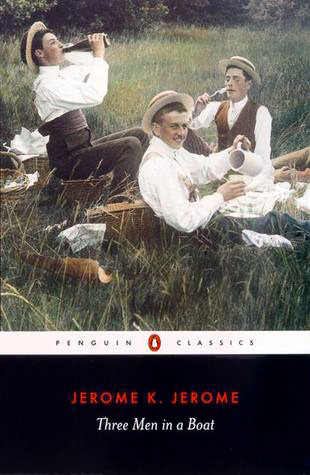
10. Three Men In a Boat


Three Men in a Boat. Jerome K. Jerome. 1889. 174 pages. [Source: Bought] [4 stars, adult classic, travel, humor]

 First sentence: There were four of us—George, and William Samuel Harris, and myself, and Montmorency. 

 
 Premise/plot: Three men and a DOG set sail on a boating holiday. Hilarity follows--or in other words nothing goes as planned and nature--both nature nature and human nature gets the last laugh.

My thoughts: I love this one. I can't believe I've only read and reviewed it once twice-and that back in 2009 and 2019. One of the things I love about the book is the narrator, J. He had me at hello. [ETA: I recently watched my first adaptation of the book on film. (1956 adaptation). At the time I wasn't sure how faithful it was. I think they captured several scenes well. They ADDED a lot in an attempt to make it cohesive. The book itself is rambles, rambles, more rambles. They definitely added a lot of nonsense with women and flirting and the like. But overall, I am glad I watched the adaptation.]
It is a most extraordinary thing, but I never read a patent medicine advertisement without being impelled to the conclusion that I am suffering from the particular disease therein dealt with in its most virulent form. The diagnosis seems in every case to correspond exactly with all the sensations that I have ever felt.
I remember going to the British Museum one day to read up the treatment for some slight ailment of which I had a touch—hay fever, I fancy it was. I got down the book, and read all I came to read; and then, in an unthinking moment, I idly turned the leaves, and began to indolently study diseases, generally. I forget which was the first distemper I plunged into—some fearful, devastating scourge, I know—and, before I had glanced half down the list of “premonitory symptoms,” it was borne in upon me that I had fairly got it.
I sat for awhile, frozen with horror; and then, in the listlessness of despair, I again turned over the pages. I came to typhoid fever—read the symptoms—discovered that I had typhoid fever, must have had it for months without knowing it—wondered what else I had got; turned up St. Vitus’s Dance—found, as I expected, that I had that too,—began to get interested in my case, and determined to sift it to the bottom, and so started alphabetically—read up ague, and learnt that I was sickening for it, and that the acute stage would commence in about another fortnight. Bright’s disease, I was relieved to find, I had only in a modified form, and, so far as that was concerned, I might live for years. Cholera I had, with severe complications; and diphtheria I seemed to have been born with. I plodded conscientiously through the twenty-six letters, and the only malady I could conclude I had not got was housemaid’s knee.
I felt rather hurt about this at first; it seemed somehow to be a sort of slight. Why hadn’t I got housemaid’s knee? Why this invidious reservation? After a while, however, less grasping feelings prevailed. I reflected that I had every other known malady in the pharmacology, and I grew less selfish, and determined to do without housemaid’s knee. Gout, in its most malignant stage, it would appear, had seized me without my being aware of it; and zymosis I had evidently been suffering with from boyhood. There were no more diseases after zymosis, so I concluded there was nothing else the matter with me.
I sat and pondered. I thought what an interesting case I must be from a medical point of view, what an acquisition I should be to a class! Students would have no need to “walk the hospitals,” if they had me. I was a hospital in myself. All they need do would be to walk round me, and, after that, take their diploma.
Then I wondered how long I had to live. I tried to examine myself. I felt my pulse. I could not at first feel any pulse at all. Then, all of a sudden, it seemed to start off. I pulled out my watch and timed it. I made it a hundred and forty-seven to the minute. I tried to feel my heart. I could not feel my heart. It had stopped beating. I have since been induced to come to the opinion that it must have been there all the time, and must have been beating, but I cannot account for it. I patted myself all over my front, from what I call my waist up to my head, and I went a bit round each side, and a little way up the back. But I could not feel or hear anything. I tried to look at my tongue. I stuck it out as far as ever it would go, and I shut one eye, and tried to examine it with the other. I could only see the tip, and the only thing that I could gain from that was to feel more certain than before that I had scarlet fever.
I had walked into that reading-room a happy, healthy man. I crawled out a decrepit wreck.
I went to my medical man. He is an old chum of mine, and feels my pulse, and looks at my tongue, and talks about the weather, all for nothing, when I fancy I’m ill; so I thought I would do him a good turn by going to him now. “What a doctor wants,” I said, “is practice. He shall have me. He will get more practice out of me than out of seventeen hundred of your ordinary, commonplace patients, with only one or two diseases each.” So I went straight up and saw him, and he said:
“Well, what’s the matter with you?”
I said:
“I will not take up your time, dear boy, with telling you what is the matter with me. Life is brief, and you might pass away before I had finished. But I will tell you what is not the matter with me. I have not got housemaid’s knee. Why I have not got housemaid’s knee, I cannot tell you; but the fact remains that I have not got it. Everything else, however, I have got.”
And I told him how I came to discover it all.
Then he opened me and looked down me, and clutched hold of my wrist, and then he hit me over the chest when I wasn’t expecting it—a cowardly thing to do, I call it—and immediately afterwards butted me with the side of his head. After that, he sat down and wrote out a prescription, and folded it up and gave it me, and I put it in my pocket and went out.
and

In the present instance, going back to the liver-pill circular, I had the symptoms, beyond all mistake, the chief among them being “a general disinclination to work of any kind.”
What I suffer in that way no tongue can tell.  From my earliest infancy I have been a martyr to it.  As a boy, the disease hardly ever left me for a day.  They did not know, then, that it was my liver.  Medical science was in a far less advanced state than now, and they used to put it down to laziness.
“Why, you skulking little devil, you,” they would say, “get up and do something for your living, can’t you?”—not knowing, of course, that I was ill.
And they didn’t give me pills; they gave me clumps on the side of the head.  And, strange as it may appear, those clumps on the head often cured me—for the time being.  I have known one clump on the head have more effect upon my liver, and make me feel more anxious to go straight away then and there, and do what was wanted to be done, without further loss of time, than a whole box of pills does now.
You know, it often is so—those simple, old-fashioned remedies are sometimes more efficacious than all the dispensary stuff.
Other favorite quotes:

Why a boat trip...

Harris said he didn’t think George ought to do anything that would have a tendency to make him sleepier than he always was, as it might be dangerous.  He said he didn’t very well understand how George was going to sleep any more than he did now, seeing that there were only twenty-four hours in each day, summer and winter alike; but thought that if he did sleep any more, he might just as well be dead, and so save his board and lodging.
 J on packing:
We must not think of the things we could do with, but only of the things that we can’t do without.
J turns philosophical:
Let your boat of life be light, packed with only what you need—a homely home and simple pleasures, one or two friends, worth the name, someone to love and someone to love you, a cat, a dog, and a pipe or two, enough to eat and enough to wear, and a little more than enough to drink; for thirst is a dangerous thing.
J on stinky cheese:
Cheese, like oil, makes too much of itself. It wants the whole boat to itself. It goes through the hamper, and gives a cheesy flavour to everything else there. You can't tell whether you are eating apple-pie or German sausage, or strawberries and cream. It all seems cheese. There is too much odour about cheese.
I remember a friend of mine, buying a couple of cheeses at Liverpool. Splendid cheeses they were, ripe and mellow, and with a two hundred horse-power scent about them that might have been warranted to carry three miles, and knock a man over at two hundred yards. I was in Liverpool at the time, and my friend said that if I didn't mind he would get me to take them back with me to London, as he should not be coming up for a day or two himself, and he did not think the cheeses ought to be kept much longer.
"Oh, with pleasure, dear boy," I replied, "with pleasure."
I called for the cheeses, and took them away in a cab. It was a ramshackle affair, dragged along by a knock-kneed, broken-winded somnambulist, which his owner, in a moment of enthusiasm, during conversation, referred to as a horse. I put the cheeses on the top, and we started off at a shamble that would have done credit to the swiftest steam-roller ever built, and all went merry as a funeral bell, until we turned the corner. There, the wind carried a whiff from the cheeses full on to our steed. It woke him up, and, with a snort of terror, he dashed off at three miles an hour. The wind still blew in his direction, and before we reached the end of the street he was laying himself out at the rate of nearly four miles an hour, leaving the cripples and stout old ladies simply nowhere.
It took two porters as well as the driver to hold him in at the station; and I do not think they would have done it, even then, had not one of the men had the presence of mind to put a handkerchief over his nose, and to light a bit of brown paper.
I took my ticket, and marched proudly up the platform, with my cheeses, the people falling back respectfully on either side. The train was crowded, and I had to get into a carriage where there were already seven other people. One crusty old gentleman objected, but I got in, notwithstanding; and, putting my cheeses upon the rack, squeezed down with a pleasant smile, and said it was a warm day.
A few moments passed, and then the old gentleman began to fidget.
"Very close in here," he said.
"Quite oppressive," said the man next him.
And then they both began sniffing, and, at the third sniff, they caught it right on the chest, and rose up without another word and went out. And then a stout lady got up, and said it was disgraceful that a respectable married woman should be harried about in this way, and gathered up a bag and eight parcels and went. The remaining four passengers sat on for a while, until a solemn-looking man in the corner, who, from his dress and general appearance, seemed to belong to the undertaker class, said it put him in mind of dead baby; and the other three passengers tried to get out of the door at the same time, and hurt themselves.
I smiled at the black gentleman, and said I thought we were going to have the carriage to ourselves; and he laughed pleasantly, and said that some people made such a fuss over a little thing. But even he grew strangely depressed after we had started, and so, when we reached Crewe, I asked him to come and have a drink. He accepted, and we forced our way into the buffet, where we yelled, and stamped, and waved our umbrellas for a quarter of an hour; and then a young lady came, and asked us if we wanted anything.
"What's yours?" I said, turning to my friend.
"I'll have half-a-crown's worth of brandy, neat, if you please, miss," he responded.
And he went off quietly after he had drunk it and got into another carriage, which I thought mean.
From Crewe I had the compartment to myself, though the train was crowded. As we drew up at the different stations, the people, seeing my empty carriage, would rush for it. "Here y' are, Maria; come along, plenty of room." "All right, Tom; we'll get in here," they would shout. And they would run along, carrying heavy bags, and fight round the door to get in first. And one would open the door and mount the steps, and stagger back into the arms of the man behind him; and they would all come and have a sniff, and then droop off and squeeze into other carriages, or pay the difference and go first.
From Euston, I took the cheeses down to my friend's house. When his wife came into the room she smelt round for an instant. Then she said:
"What is it? Tell me the worst."
I said:
"It's cheeses. Tom bought them in Liverpool, and asked me to bring them up with me."
And I added that I hoped she understood that it had nothing to do with me; and she said that she was sure of that, but that she would speak to Tom about it when he came back.
My friend was detained in Liverpool longer than he expected; and, three days later, as he hadn't returned home, his wife called on me. She said:
"What did Tom say about those cheeses?"
I replied that he had directed they were to be kept in a moist place, and that nobody was to touch them.
She said:
"Nobody's likely to touch them. Had he smelt them?"
I thought he had, and added that he seemed greatly attached to them.
"You think he would be upset," she queried, "if I gave a man a sovereign to take them away and bury them?"
I answered that I thought he would never smile again.
An idea struck her. She said:
"Do you mind keeping them for him? Let me send them round to you."
"Madam," I replied, "for myself I like the smell of cheese, and the journey the other day with them from Liverpool I shall ever look back upon as a happy ending to a pleasant holiday. But, in this world, we must consider others. The lady under whose roof I have the honour of residing is a widow, and, for all I know, possibly an orphan too. She has a strong, I may say an eloquent, objection to being what she terms 'put upon.' The presence of your husband's cheeses in her house she would, I instinctively feel, regard as a 'put upon'; and it shall never be said that I put upon the widow and the orphan."
"Very well, then," said my friend's wife, rising, "all I have to say is, that I shall take the children and go to an hotel until those cheeses are eaten. I decline to live any longer in the same house with them."
She kept her word, leaving the place in charge of the charwoman, who, when asked if she could stand the smell, replied, "What smell?" and who, when taken close to the cheeses and told to sniff hard, said she could detect a faint odour of melons. It was argued from this that little injury could result to the woman from the atmosphere, and she was left.
The hotel bill came to fifteen guineas; and my friend, after reckoning everything up, found that the cheeses had cost him eight-and-sixpence a pound. He said he dearly loved a bit of cheese, but it was beyond his means; so he determined to get rid of them. He threw them into the canal; but had to fish them out again, as the bargemen complained. They said it made them feel quite faint. And, after that, he took them one dark night and left them in the parish mortuary. But the coroner discovered them, and made a fearful fuss.
He said it was a plot to deprive him of his living by waking up the corpses.
My friend got rid of them, at last, by taking them down to a sea-side town, and burying them on the beach. It gained the place quite a reputation. Visitors said they had never noticed before how strong the air was, and weak-chested and consumptive people used to throng there for years afterwards.
J on his toothbrush:
My tooth-brush is a thing that haunts me when I’m travelling, and makes my life a misery.  I dream that I haven’t packed it, and wake up in a cold perspiration, and get out of bed and hunt for it.  Of course, I found George’s and Harris’s eighteen times over, but I couldn’t find my own.  I put the things back one by one, and held everything up and shook it. 

J on weather forecasts:
I do think that, of all the silly, irritating tomfoolishness by which we are plagued, this “weather-forecast” fraud is about the most aggravating.  It “forecasts” precisely what happened yesterday or a the day before, and precisely the opposite of what is going to happen to-day. But who wants to be foretold the weather?  It is bad enough when it comes, without our having the misery of knowing about it beforehand.  For the man that prophesies us bad weather, on the contrary, we entertain only bitter and revengeful thoughts.
J philosophizes again:
It seems to be the rule of this world.  Each person has what he doesn’t want, and other people have what he does want. 
J on Harris' singing:
It is one of Harris’s fixed ideas that he can sing a comic song; the fixed idea, on the contrary, among those of Harris’s friends who have heard him try, is that he can’t...Harris never sees what an ass he is making of himself, and how he is annoying a lot of people who never did him any harm. 
J on tea kettles:
That is the only way to get a kettle to boil up the river.  If it sees that you are waiting for it and are anxious, it will never even sing.  You have to go away and begin your meal, as if you were not going to have any tea at all.  It is a good plan, too, if you are in a great hurry, to talk very loudly to each other about how you don’t need any tea, and are not going to have any. 
You get near the kettle, so that it can overhear you, and then you shout out, “I don’t want any tea; do you, George?” to which George shouts back, “Oh, no, I don’t like tea; we’ll have lemonade instead—tea’s so indigestible.”  Upon which the kettle boils over, and puts the stove out.
 J on stomachs:
How good one feels when one is full—how satisfied with ourselves and with the world!  People who have tried it, tell me that a clear conscience makes you very happy and contented; but a full stomach does the business quite as well, and is cheaper, and more easily obtained.  We cannot work, we cannot think, unless our stomach wills so.  It dictates to us our emotions, our passions.  We are but the veriest, sorriest slaves of our stomach.  Reach not after morality and righteousness, my friends; watch vigilantly your stomach, and diet it with care and judgment.  
J on peeling potatoes:
I should never have thought that peeling potatoes was such an undertaking. The more we peeled, the more peel there seemed to be left on; by the time we had got all the peel off and all the eyes out, there was no potato left—at least none worth speaking of.  George came and had a look at it—it was about the size of a peanut. He said: “Oh, that won’t do!  You’re wasting them.  You must scrape them.” So we scraped them, and that was harder work than peeling.  They are such an extraordinary shape, potatoes—all bumps and warts and hollows.    
J on musical instruments:
It must be disheartening work learning a musical instrument.  You would think that Society, for its own sake, would do all it could to assist a man to acquire the art of playing a musical instrument.  But it doesn’t!
There is, it must be confessed, something very sad about the early efforts of an amateur in bagpipes.  
J on work:
It always does seem to me that I am doing more work than I should do.  It is not that I object to the work, mind you;
I like work: it fascinates me.  I can sit and look at it for hours.  I love to keep it by me: the idea of getting rid of it nearly breaks my heart.
You cannot give me too much work; to accumulate work has almost become a passion with me: my study is so full of it now, that there is hardly an inch of room for any more.  I shall have to throw out a wing soon. And I am careful of my work, too.  Why, some of the work that I have by me now has been in my possession for years and years, and there isn’t a finger-mark on.
 No man keeps his work in a better state of preservation than I do. But, though I crave for work, I still like to be fair.  I do not ask for more than my proper share.
J on heroines:
The heroine of a modern novel is always “divinely tall,” and she is ever “drawing herself up to her full height.” 
J on sleeping while camping:
It is surprising how early one can get up, when camping out.  One does not yearn for “just another five minutes” nearly so much.
Their final toast:
Here’s to Three Men well out of a Boat!”


© 2025 Becky Laney of Becky's Book Reviews

Saturday, July 20, 2024

57. Beezus and Ramona

Beezus and Ramona. Beverly Cleary. 1955. HarperCollins. 208 pages. [Source: Library] [Star rating: 5/5]

First sentence: Beezus felt that the biggest trouble with four-year-old Ramona was that she was just plain exasperating. If Ramona drank lemonade through a straw, she blew into the straw as hard as she could to see what would happen.


Unlike other books in the Ramona series, this one is narrated by Beezus. Like all other books in the Ramona series, it has a just-right feel about it. Beverly Cleary's greatest talent may be in her capturing what it feels like to be a kid.

Beezus, as you probably know, is Ramona's big sister. Ramona does steal the show in almost every book in which she appears. There's something unforgettable about her. But though the focus is on Ramona, this is still very much Beezus' book. It captures how she feels about her family, about Ramona.

"Beezus and Her Little Sister." Ramona LOVES, LOVES, LOVES to have The Littlest Steam Shovel read to her. Her parents are unwilling to read it to her--they have come to have no tolerance for it. But Beezus, well, she'll read it to Ramona, not that she likes it, but, she'll give in now and then. She gets the idea to take Ramona to the library to get a brand new book--for two weeks. Ramona picks a new book, but, it is still about steam shovels. She likes it so much, that she does something NAUGHTY so she can keep it for always. What will Beezus do since it was checked out on her card? Just how sympathetic will the librarian be?

"Beezus and Her Imagination" Beezus is in an art class. Ramona isn't supposed to be in the class with her, she's supposed to be playing outside in the sandbox. But on this occasion, Beezus finds Ramona in class with her. Could she get inspired by her sister's imaginary pet?! Could she earn her teacher's attention?!

"Ramona and Ribsy" Beezus invites Henry Huggins (and his dog, Ribsy) to her house to play checkers. It doesn't go well. Both Ribsy and Ramona have fits of sorts. And Ribsy ends up locked in the bathroom?! Beezus wishes Ramona was more like other people's sisters.

"Ramona and the Apples" Beezus is supposed to be watching Ramona while their mother does the grocery shopping. But. Ramona proves too much to handle. She sneaks into the basement and has her way with all the apples...taking one bite and just one bite from each apple. Will Beezus get in trouble? Can anything good come from all those ruined apples?

"A Party at the Quimbys" Ramona decides to have a party and invite other kids over to the house--without permission of course. What will Beezus and their mother do? This one ends in a parade. Among the guests, Howie and Willa Jean.

"Beezus's Birthday" Will Beezus have a cake for her tenth birthday?! It might not be as easy as you might think. Not with Ramona around. But with a little help from Aunt Beatrice, all might be well after all. Hint: If you have a sister like Ramona, don't read the story of Hansel and Gretel to her when your cake is in the oven!

I love the Ramona series. I do. I love, love, love the Ramona books. I think I read them dozens of more times than the Little House books. (I've recently reread these too.) I'm not sure Beezus and Ramona is my favorite of the series, but, it's a great start to a great series.


© 2024 Becky Laney of Becky's Book Reviews

Monday, September 04, 2023

154. Love, Clancy: Diary of a Good Dog


Love, Clancy: Diary of a Good Dog. W. Bruce Cameron. 2023. [January] 336 pages. [Source: Library] [adult fiction; animal fantasy; rom-com]

First sentence: Dear Diary, The cat is despicable. Even her name is dreadful: Kelsey. My name, Clancy, carries with it all the fun and love that a wonderful dog can bring to the world. 

Premise/plot: Though W. Bruce Cameron does write for children often, this is an adult novel. 

Clancy's person, his human, is JayB. JayB is currently in-between jobs...but his life is far from dull. He's got a "girlfriend" (Maddy) he can't seem to shake off. (They went on maybe two dates, she ended the relationship; she is a bit, well, a character for sure.) He's got an elderly neighbor, Helen, who has a dog named Odin. There are other dogs and other neighbors as well.... Everyone assumes that JayB is a dog walker and treats him accordingly.

His father, Walter, has teamed up with his so-called "best friend" Rodney...which is proving concerting. Rodney seems to see Walter as big money. (Walter being gullible and Rodney being scummy).

There are MANY adventures and misadventures--this is more COM than rom-com. But the romance is definitely there...if you wait for it. 

My thoughts: I don't know that I've ever read a novel told first person from a dog's point of view. I've read dozens if not hundreds of children's novels from pets points of view. Clancy is a good dog. Obviously. There is a dog on the cover...do you need to be warned? Yes and no. No, in that this is an adult novel and I don't know that adult readers are as super-sensitive as younger readers are. Yes, in that, well, there are some sad scenes in this one. 

This is a smooth-flowing often humorous romp. I could see it easily being adapted into a rom-com. I think it works well for what it is. Silly, adventurous, full of characters that are CHARACTERS.

© 2023 Becky Laney of Becky's Book Reviews

Sunday, August 20, 2023

145. Code Name Bananas


Code Name Bananas. David Walliams. 2020/2023. 384 pages. [Source: Library] [J Historical Fiction; MG Historical Fiction]

First sentence: Life. Love. Laughter. The world had been plunged into a war of unimaginable horror, so these three things were more important than ever.

Premise/plot: Eric, an orphan, considers Gertrude, a gorilla in the London Zoo, his best friend. His uncle, Sid, a zoo keeper, works at the zoo. Eric loves to hang out at the zoo even when he's not supposed to be there. Like at night during air raids. Gertrude's life becomes endangered--other zoo keepers and the powers that be--think it best she be put down before she can escape (if, for example, bombs should damage the structure and integrity of the cage. After all, you wouldn't want a wild and dangerous gorilla running loose in the zoo or the streets. Sid and Eric, of course, disagree...but can they find a way to save her life?

My thoughts: What didn't I like about this one? After all, I generally love historical fiction, especially historical fiction set during the second world war. This one could have been animal fantasy--based on the cover--but it wasn't. (Which is fine. A book doesn't have to deliver on what's promised in the cover.) So what didn't I like???? Well. Imagine that it was written, directed, and stars the Three Stooges. Instead of anything substantive and potentially heart-warming, you've got three-hundred plus pages of slapstick and screwball so-called "comedy." Which again, could be fine. I have nothing against humor--in general. But if "bottom burps" aren't your cup of tea, well, you may be disappointed. Just when you think the book can't get any worse--as far as intelligence goes--it keeps sinking and sinking and sinking. Again, some people enjoy ridiculous, absurd, over-the-top, slightly-crude fiction. This one was not for me.


© 2023 Becky Laney of Becky's Book Reviews

Monday, April 17, 2023

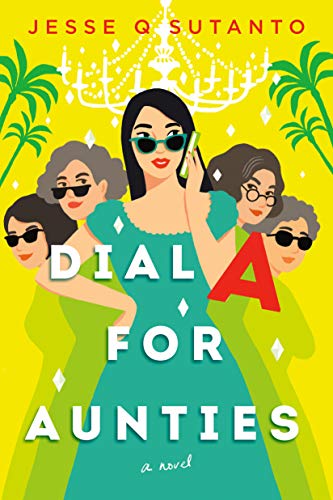
79. Dial A for Aunties


Dial A for Aunties. Jesse Q. Sutanto. 2021. 299 pages. [Source: Library]

First sentence: There is a curse in my family. It's followed us all the way from China, where it took my great-grandfather (freak accident on the farm that involved a pregnant sow and an unfortunately placed rake), to Indonesia, where it claimed my grandfather (a stroke at the age of thirty, nothing quite so dramatic as great-grandfather's demise but still rather upsetting.) My mom and aunts figured that a Chinese curse wouldn't follow them to the West, so after they all got married, they moved to San Gabriel, California. But not only did the curse find them, it mutated. Instead of killing the men in my family, it made them leave, which is so much worse.

Premise/plot: Meddelin Chan is a wedding photographer in her family's wedding business. (Don't leave your big day to chance, leave to the Chans!) The novel opens with her family setting her up on a blind date. Well, an arranged date. I believe it is her mom who has been chatting up a guy on a dating app pretending to be Meddelin. Surprise, you're meeting tonight after months of texting/chatting. The date goes horribly wrong almost from the start. It ends in disaster. Literally. It will take a whole family to get Meddelin out of this mess....but are they up for the job? 

The family has a BIG, BIG, BIG wedding--on an island--the next day. On this island, Meddelin will bump into her old college boyfriend...Nathan. The wedding is a huge disaster... can anything good come from this weekend???

My thoughts: This book has a weird/odd sense of humor. It is definitely a slapstick style comedy....but with a dead body as a prop for most of the novel. It is not a murder mystery. (No mystery to it). It isn't really seen as a grave situation (pun intended) but rather an over-the-top slapstick comedy. 

It features flashbacks. I liked some of them. But the flashbacks definitely added some graphic-ness to this one. Definitely not clean. But I personally think it was sneakily done. The first half (or perhaps first third) is relatively clean, no obvious red flags. Then BOOM it is a graphic romance novel--in flashback form. By this point I was hooked enough to *need* to keep reading. But I felt bad about it. (Not a win-win situation). 

The jacket flap is all about "four aunties" this and that. But NONE of the aunts had names--just numbers. The first aunt, I believe, was called Big Aunt, but the rest were just numbers. And I *think* though I'm not positive that Meddelin's own mother was one of the four aunts. Which is just weird that she's lumped in as an auntie. Yes, she's a sister. But she's not Meddelin's auntie. I suppose it is possible that there was a mother + 4 aunties. It really BOTHERED me that the aunts did not have names. 

This one just wasn't my personal 'cup of tea' if you will. My sense of humor did not align with the book's sense of humor.


© 2023 Becky Laney of Becky's Book Reviews

Sunday, February 26, 2023

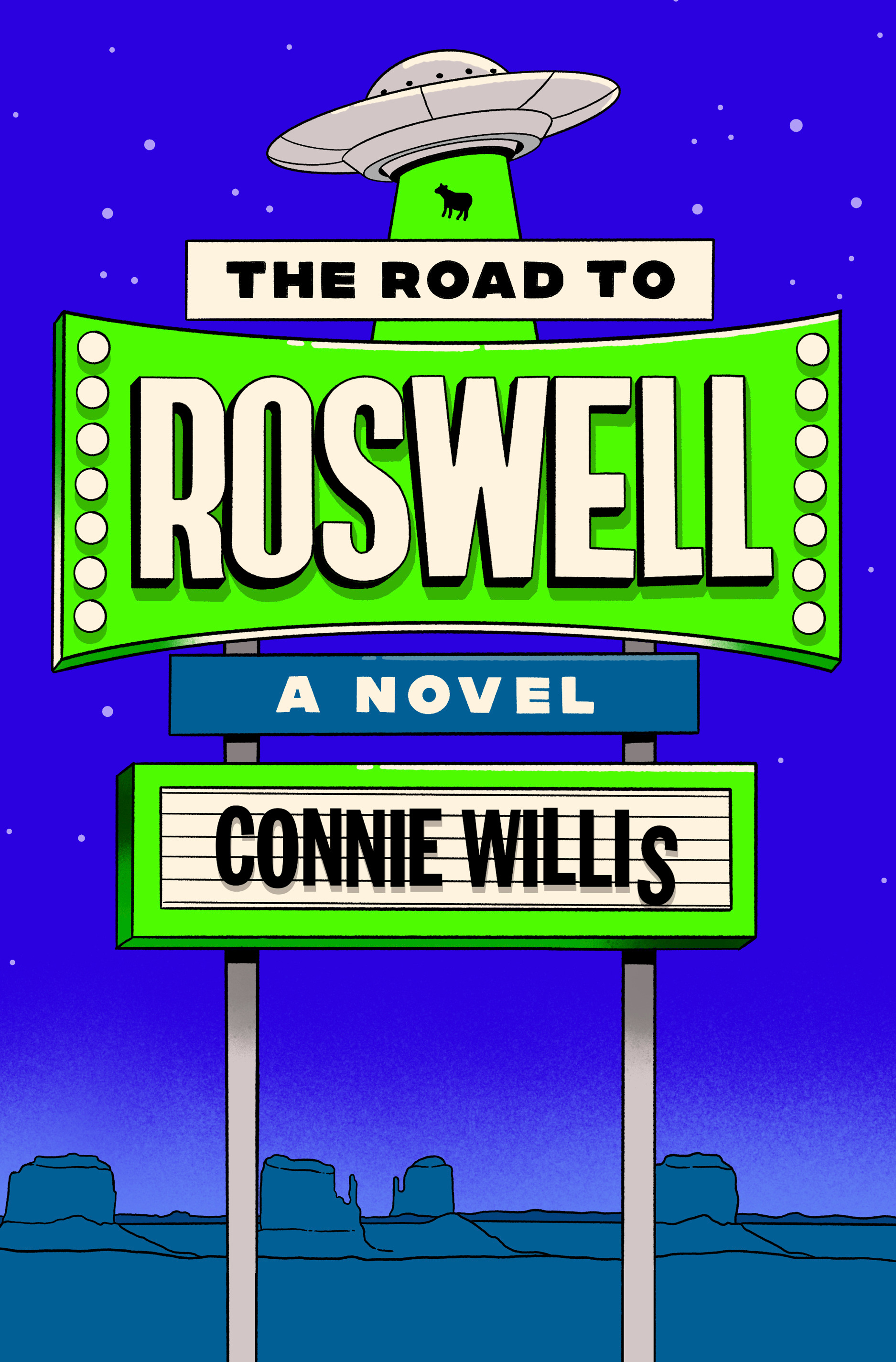
45. The Road to Roswell


The Road to Roswell. Connie Willis. 2023 [June] 416 pages. [Source: Review copy]

First sentence: Serena wasn't in the airport waiting area when Francie got off the plane in Albuquerque, but a man carrying a sign reading FIRST CONTACT COMMITTEE--WELCOME TO THE UFO FESTIVAL was. UFO festival? Serena hadn't said anything about a UFO festival going on at the same time as her wedding. Maybe it's not in Roswell, Francie thought hopefully. But of course it was. Where else was a UFO festival be?

My thoughts: I know, I know. I usually start with "premise/plot". But I just wanted to pop in to say THERE BETTER BE A SEQUEL. And all the better if that sequel is also published this year. Like tomorrow. I wanted MORE, MORE, MORE, MORE. This is easily the best book I've read in 2023. I'll clarify that a bit. The best adult book I've read in 2023. 

Premise/plot: Francie goes to Roswell hoping to stop her friend--her former college roommate--from marrying a "true-believer." It's a UFO themed wedding coinciding with a UFO Festival. This won't be the first time Francie has persuaded her friend to be a runaway bride. But before she has a chance to have a heart-to-heart chat with Serena, but after she's tried on her maid of honor dress--it's horrific, of course--she's abducted...by an alien. The alien, whom Francie eventually nicknames Indy (short for Indiana Jones), and Francie start off on a road trip of the most unusual kind. And as they travel--Indy indicates which direction to drive--they soon pick up more "guests" (or abductees). Wade. Lyle. Eula Mae. Joseph. The original car not being big enough for all the crew...they soon find themselves in a "borrowed" RV crisscrossing the Southwest. (It's Joseph's). What is Indy searching for? What does he want? What does he need? 

My thoughts (part 2): I loved, loved, loved this one. It was giddy-making. It has literally everything. This is a funny sci-fi rom-com. It would make an AWESOME movie. (In my opinion). I loved the characters. I loved the relationships. I loved the world-building. Nothing was tedious. I loved the amount of characterization. Yes, it's premise-driven. Yes, it pokes fun at at least a couple of sub-genres. (Lyle, a true believer, of sorts, has seen EVERY alien movie ever made. Joseph is a die-hard western fan. He's seen EVERY western ever made.) But it was such a delightful read. 

Did I love the ending???? I'm mad at it. Not mad-mad. Not angry, I mean. It's just like when a movie flashes up a big TO BE CONTINUED sign right in the middle of a scene. (Though the words were not to be continued. So there better be a sequel.) 


© 2023 Becky Laney of Becky's Book Reviews

Friday, December 09, 2022

170. A Town Divided by Christmas


A Town Divided by Christmas. Orson Scott Card. 2017. 134 pages. [Source: Library] 

First sentence: When Spunky was invited to a meeting in The Professor's office, she didn't know what to expect. She had taken two classes from him, but she didn't major in genetics or even in a biological field--she was an economics post-doc, shopping for a tenured faculty position somewhere on plane Earth, preferably a place with flush toilets, clean water, and a good internet connection.  It didn't ease her confusion when she arrived at The Professor's office at the same time as Elyon Dewey.

Premise/plot: Spunky and Elyon--a reluctant pair--head to Good Shepherd, North Carolina, to do research. Can they find a gene [or genome???] to "prove" that some people are homebodies? This small town has a good track record. While plenty have left over the decades, almost all seem to come back home and settle down again. This "science" will involve getting genetic samples, data input, and interviews. [Elyon is not trusted with interviews.] Both will have to "settle" down in this super small town while they are working for The Professor. Both are a bit surprised with how things unfold...

Elyon who has very little social skills find himself falling in love with a young woman....and Spunky likewise is finding herself falling head over heels in love with someone as well. Everyone teases about how this is so similar to a Hallmark movie.

My thoughts: This one was an almost for me. Perhaps it would be more of a sell if it was actually a Hallmark movie. I didn't quite "get" the science-y grant side of this one. Elyon reminded me of Sheldon Cooper. Spunky and her love interest, Eggie, are Hallmark material.

I wish more had been about the two battling churches/battling nativities. We learn a little. But at least to my reckoning, this situation was never resolved--or resolved satisfactorily. Spunky and Elyon seem to learn a "secret" that no one else knows, but this doesn't lead anywhere. It's more of an afterthougt/aftertaste. There isn't any "love" or "forgiveness." Unless I fell asleep and missed it completely.


© 2022 Becky Laney of Becky's Book Reviews
Tuesday, November 15, 2022

150. The Twelve Topsy-Turvy, Very Messy Days of Christmas


The Twelve Topsy-Turvy, Very Messy Days of Christmas. James Patterson and Tad Safran. 2022. 288 pages. [Source: Library]

First sentence: What is the worst present you ever received for Christmas? A pair of socks? A pair of scratchy socks? A pair of scratchy socks in a vile color? A pair of scratchy socks in a disgusting color that rub your big toes every step you take? A pair of coarse socks in a foul color that rub your big toes and you're forced to wear them because your grandmother gave them to you and she's coming to stay? That's pretty bad. But for Will and Ella Sullivan, the worst thing they ever got for Christmas was a dead mother.

Premise/plot: Kate Sullivan was dead, to begin with. There is no doubt whatever about that. Since this one is being marketed as "the next Christmas Carol" and an "instant classic" that will become a "must read for every holiday season," I thought it only fitting to introduce it properly. So it's been three--or so--years since she's died. The husband, Henry, has NOT gotten over it. He's been a total and complete wreck ever since. And Will and Ella, well, they've had to mainly raise themselves because of Henry's absent-while-present parenting style. But this Christmas, they are determined to find their dad a new wife. If he is happy then maybe Christmas can be Christmas again. So they write a dating profile for their dad...and begin corresponding with a "Ms. Truelove." The results...well...not quite what anyone expected.

It starts with a partridge in a pear tree. Literally. But it isn't until the FIVE GOLDEN RINGS are delivered to their doorstep that the family realizes with ever-growing DOOM AND GLOOM that things are about to get so much worse.

Essentially the premise is simple: the TWELVE DAYS OF CHRISTMAS literally being delivered to one family's house for the twelve days leading up to Christmas. Just take a minute or two to imagine that...

The book is about how the family reacts to these "gifts" from a "true love." Just WHO IS THIS TRUE LOVE????? And what is the motivation behind these "gifts" that feel like a curse.

My thoughts: I liked this one. I loved some chapters. I didn't quite love other chapters. It was definitely entertaining--for the most part. It is 100% premise-driven. Not many characters are fleshed out. There are plenty of comical scenes.

But for me, personally, this was no Christmas Carol.


© 2022 Becky Laney of Becky's Book Reviews
Wednesday, January 27, 2021

9. The Importance of Being Earnest


The Importance of Being Earnest. Oscar Wilde. 1895. 76 pages. [Source: Bought]

First sentence:

Algernon.  Did you hear what I was playing, Lane?

Lane.  I didn’t think it polite to listen, sir.

Algernon.  I’m sorry for that, for your sake.  I don’t play accurately—any one can play accurately—but I play with wonderful expression.  As far as the piano is concerned, sentiment is my forte.  I keep science for Life.

Premise/plot: The Importance of Being Earnest is romantic comedy--a play--written by Oscar Wilde. It concerns two friends and their adventures/misadventures in the town and country. Algernon Moncrieff, one of our two heroes, claims to be a confirmed bachelor. Marriage is NOT on his to do list. John Worthing (aka Jack) has entirely different plans. He's madly in love with a young woman--a woman who happens to be Algernon's first cousin--Gwendolen Fairfax. The problem? Well, Jack is living a double life. In the COUNTRY he's Jack Worthing (with a ward named Cecily). In the CITY (London) he's ERNEST B. WORTHING. His naughty, wicked brother Ernest is Jack's excuse for going to the city so often and staying away. Algernon thinks it's all good fun--when he stumbles onto his friend's secret--because he has such an acquaintance himself (though he's not pretending to be anyone else--yet), Mr. Bunbury is his COUNTRY friend who's always on death's door. 

If Gwendolen accepts his proposal, then Jack plans to kill off Ernest Worthing. (Even if it makes his ward, Cecily, upset. She fancies herself madly, deeply in love with Ernest Worthing. She wants to REFORM that BAD BOY.  

When Jack returns to the country and informs the reverend of his brother's death, he's in for a shock. His "brother" just arrived and plans on staying a week at least! 

There's plenty to laugh about in this three act play.

My thoughts: I really LOVED this one. It was just a joy to read. Mom said that this was my grandma's favorite play. I can see why! It is hilarious and oh-so-quotable. 

Quotes:

When one is in town one amuses oneself. When one is in the country one amuses other people. (Jack)

Oh! it is absurd to have a hard and fast rule about what one should read and what one shouldn’t. More than half of modern culture depends on what one shouldn’t read. (Algernon)

Some aunts are tall, some aunts are not tall. That is a matter that surely an aunt may be allowed to decide for herself. You seem to think that every aunt should be exactly like your aunt! (Jack)

The truth is rarely pure and never simple. Modern life would be very tedious if it were either, and modern literature a complete impossibility! (Algernon)
 
I hate people who are not serious about meals. It is so shallow of them. (Algernon)
 
Lady Bracknell. Good afternoon, dear Algernon, I hope you are behaving very well.
Algernon. I’m feeling very well, Aunt Augusta.
 
Gwendolen. Yes, I am quite well aware of the fact. And I often wish that in public, at any rate, you had been more demonstrative. For me you have always had an irresistible fascination. Even before I met you I was far from indifferent to you. [Jack looks at her in amazement.] We live, as I hope you know, Mr. Worthing, in an age of ideals. The fact is constantly mentioned in the more expensive monthly magazines, and has reached the provincial pulpits, I am told; and my ideal has always been to love some one of the name of Ernest. There is something in that name that inspires absolute confidence. The moment Algernon first mentioned to me that he had a friend called Ernest, I knew I was destined to love you.
Jack. You really love me, Gwendolen?
Gwendolen. Passionately!
Jack. Darling! You don’t know how happy you’ve made me.
Gwendolen. My own Ernest!
Jack. But you don’t really mean to say that you couldn’t love me if my name wasn’t Ernest?
Gwendolen. But your name is Ernest.
Jack. Yes, I know it is. But supposing it was something else? Do you mean to say you couldn’t love me then?
 
Lady Bracknell. [Pencil and note-book in hand.] I feel bound to tell you that you are not down on my list of eligible young men, although I have the same list as the dear Duchess of Bolton has. We work together, in fact. However, I am quite ready to enter your name, should your answers be what a really affectionate mother requires. Do you smoke?
Jack. Well, yes, I must admit I smoke.
Lady Bracknell. I am glad to hear it. A man should always have an occupation of some kind. There are far too many idle men in London as it is. How old are you?
Jack. Twenty-nine.
Lady Bracknell. A very good age to be married at. I have always been of opinion that a man who desires to get married should know either everything or nothing. Which do you know?
Jack. [After some hesitation.] I know nothing, Lady Bracknell.
Lady Bracknell. I am pleased to hear it. I do not approve of anything that tampers with natural ignorance. Ignorance is like a delicate exotic fruit; touch it and the bloom is gone. The whole theory of modern education is radically unsound. Fortunately in England, at any rate, education produces no effect whatsoever. If it did, it would prove a serious danger to the upper classes, and probably lead to acts of violence in Grosvenor Square.

Jack. I am sick to death of cleverness. Everybody is clever nowadays. You can’t go anywhere without meeting clever people. The thing has become an absolute public nuisance. I wish to goodness we had a few fools left.
Algernon. We have.
Jack. I should extremely like to meet them. What do they talk about?
Algernon. The fools? Oh! about the clever people, of course.
Jack. What fools!
 
Miss Prism. Memory, my dear Cecily, is the diary that we all carry about with us.
Cecily. Yes, but it usually chronicles the things that have never happened, and couldn’t possibly have happened. I believe that Memory is responsible for nearly all the three-volume novels that Mudie sends us.
Miss Prism. Do not speak slightingly of the three-volume novel, Cecily. I wrote one myself in earlier days.
Cecily. Did you really, Miss Prism? How wonderfully clever you are! I hope it did not end happily? I don’t like novels that end happily. They depress me so much.
Miss Prism. The good ended happily, and the bad unhappily. That is what Fiction means.

Algernon. When I am in trouble, eating is the only thing that consoles me. Indeed, when I am in really great trouble, as any one who knows me intimately will tell you, I refuse everything except food and drink. At the present moment I am eating muffins because I am unhappy. Besides, I am particularly fond of muffins. [Rising.]
Jack. [Rising.] Well, that is no reason why you should eat them all in that greedy way. [Takes muffins from Algernon.]
Algernon. [Offering tea-cake.] I wish you would have tea-cake instead. I don’t like tea-cake.
Jack. Good heavens! I suppose a man may eat his own muffins in his own garden.
Algernon. But you have just said it was perfectly heartless to eat muffins.
Jack. I said it was perfectly heartless of you, under the circumstances. That is a very different thing.
Algernon. That may be. But the muffins are the same. [He seizes the muffin-dish from Jack.]

Gwendolen. The fact that they did not follow us at once into the house, as any one else would have done, seems to me to show that they have some sense of shame left.
Cecily. They have been eating muffins. That looks like repentance.
Gwendolen. [After a pause.] They don’t seem to notice us at all. Couldn’t you cough?
Cecily. But I haven’t got a cough.

© 2021 Becky Laney of Becky's Book Reviews

Friday, January 15, 2021

5. Reuben and the Amazing Mind Machine


Reuben and the Amazing Mind Machine. Jonathan M. Hughes. 2021 [January] 128 pages. [Source: Review copy]

First sentence: “Hey Simon, I’ve got something brilliant to tell you,” said Reuben, his mobile phone pressed up against his ear as he walked up his grandfather’s garden path.

Premise/plot: Reuben's grandfather's tinkering has paid off...or has it? He has invented a mind machine and found a way to manipulate other people's minds. It starts with playing around with the neighbors he doesn't like and then broadens in scope. Reuben, a teenage boy, is quite taken with the notion of making all the people he dislikes look foolish, stupid, embarrassed. The more awkward a situation becomes, the better he feels. Reuben has quite a few 'enemies' at school, so, of course, the perfect place to play around with the mind machine is at school...on his teachers. 

My thoughts: It's a quick read. That's about the most honest AND most positive thing I can say about it. Keep in mind that I am not the target audience. Reuben and the Amazing Mind Machine is not a character-driven novel. That's okay. Not every book is. No problem there. It is 100% premise driven. Again, no problem there. I do wish there'd been a bit more characterization because what we do get is very one dimensional and bare minimum. 

Reuben and the Amazing Mind Machine is the opposite of a problem novel. Reuben has lost his parents perhaps recently and is being raised by his aunt who is a bit clueless about parenting. Reuben essentially has stopped attending school in any meaningful way--thoroughly enabled by his aunt. The teachers at the school might as well have been inspired by Roald Dahl. They are caricatured to absolute absurdity. They HATE Reuben--and there's no sign that they actively like any student or the act of teaching itself. So instead of seeing Reuben as a person who may need some help--some counseling, some guidance, some adult who actually sees, hears, cares--they hate him, again to a degree of absurdity. 

You would think that his grandfather would be an adult who sees, hears, cares, but, nope, he's too busy being cantankerous and eccentric. His aunt's care amounts to her doing whatever he wants without any real oversight or guidance. 

But you have to dig deep to pick up on what would be the focus of many other YA novels. This is not in any way a problem novel. It's a slapstick comedy. Think Three Stooges type intelligence. The situations are a bit absurd and I think exist just so that poop jokes can be introduced one right after the other. 

I'm not saying this book won't find an audience. Just that it is not for me.


© 2021 Becky Laney of Becky's Book Reviews

Monday, March 18, 2019

Miss Buncle's Book

Miss Buncle's Book. D.E. Stevenson. 1934. 304 pages. [Source: Bought] 

First sentence: One fine summer’s morning the sun peeped over the hills and looked down upon the valley of Silverstream.

Premise/plot: Miss Barbara Buncle lives in the quiet and peaceful village of Silverstream. But Miss Buncle has a secret which is so BIG, so EXPLOSIVE, that it will shake up an entire community. Her secret? Necessity has driven her to write a book, and since she lacks an imagination, her book is peopled with her actual neighbors. In some ways no one is more surprised that the book will be published than Miss Buncle herself. Can she keep her secret intact and protect herself from a potential mob? The book is published under the name JOHN SMITH. This gives Miss Buncle some time at least! But there are a few people who will dedicate their lives to uncovering the REAL identity of the author. While there are busybodies trying to discover John Smith's identity, Miss Buncle is spending her time WRITING A SEQUEL.

My thoughts: I loved, loved, LOVED this one. I wish I'd known about it sooner in my life. I loved spending time with Miss Buncle. I loved meeting everyone in the village. I especially loved the doctor's wife, Sarah, and the young Sally Carter. (I also loved, loved, loved the publisher, Mr. Abbott.)

This is a novel that is just OH-SO-RIGHT that you can't help wanting to live in it and savor every single minute of it. I loved the characterization, as I've hinted at, but I also loved the WRITING. One could almost open it up to any page and find something worthy of quoting.

I loved how the events of Miss Buncle's books start happening in real life...

Favorite quotes:
What fools the public were! They were exactly like sheep…thought Mr. Abbott sleepily…following each other’s lead, neglecting one book and buying another just because other people were buying it, although, for the life of you, you couldn’t see what the one lacked and the other possessed. But this book, said Mr. Abbott to himself, this book must go—it should be made to go. Pleasant visions of bookstalls piled with neat copies of Chronicles of an English Village and the public clamoring for more editions passed dreamily through his mind.
John Smith, what a name! An assumed name, of course, and rather a good one considering the nature of the book. Every single character breathed the breath of life. There was not a flat two-dimensional character in the book—rather unusual that!
It was queer, it was unusual, it was provocative, and, strangely enough, it was also extremely funny.
“Why did you write it? How did you feel when you were writing it? Have you ever written anything before?” he explained. “I wanted money,” said Miss Buncle simply. Mr. Abbott chuckled. This was a new kind of author. Johnson’s dictum that nobody but a donkey wrote for anything except money was as true today as it had ever been and always would be, but how few authors owned to the fact so simply! They either told you that something stronger than themselves compelled them to write, or else that they felt they had a message to give the world. 
In his opinion Disturber of the Peace was a golden egg, but whether Miss Goose Buncle would lay anymore was beyond the power of man to tell.
 Barbara watched it all with interest; it was such fun to watch people and see how they reacted to one another’s personality.
Nobody in Silverstream cared what Barbara Buncle thought; the woman was nothing but an idiot.
She had lived for so long among these people and had suffered so many afternoon teas that she was able to say the expected thing without thinking about it at all. You simply put a penny in the machine and the expected thing came out at once, all done up in a neat little packet, and suitably labeled.
He had already noticed that Miss Buncle was either monosyllabic and completely inarticulate, or else overpowered by a stream of words which forced themselves between her lips like water from a bursting dam.
(It was almost as if she were on oath to speak the truth, the whole truth, and nothing but the truth all day long and every day of the week).  
“Ugh, damn and blast!” he cried, rubbing his ear with a thoroughly grimy hand, and decided for a bath. The decision had been made for him by a spider (not for the first time had this intelligent insect helped a gallant soldier to make an important decision at a critical moment. It will be remembered that Robert the Bruce was similarly guided).
She tried to fix her mind on the sermon. It was all about loving your neighbor, and how you must seek out the good in people and only see the good. Mr. Hathaway said that was the way to make people good—by refusing to see the evil. Barbara wondered if this were true, and, if so, how deep it went. If you refused to see the evil in a murderer, did that cure him? Doubtful.
 “Ladies and gentlemen, we have met together today to discuss this book—Disturber of the Peace—which has been flung into our peaceful village like a poison bomb. Before the publication of this book we were all living together like a big happy family, but now there are rifts in the lute and the music is discordant and harsh.”
A person can read when they’re knitting, but they can’t write, can they? 
“What about history?” suggested Sally. “I’m awfully ignorant about history, you know.” “We had better start with history, then,” Ernest said. “Everyone should know something about history, shouldn’t they?” Sally demanded.
“Nobody even thought of you. You could never have written Disturber of the Peace. Sarah Walker has brains. I don’t care for the woman at all—never did. She has no idea of how a lady ought to behave. Barbara was hurt, and amused, intensely relieved, and very much annoyed all at the same time.
Christmas came and went; Silverstream went to church and gave each other small and somewhat useless presents just as it always did at this season of the year.
Ernest learned quite as much as Sally at these history lessons—not much history, of course, but there are other things just as important as history.
 Mr. Abbott had never before read a novel about a woman who wrote a novel about a woman who wrote a novel—it was like a recurring decimal, he thought, or perhaps even more like a perspective of mirrors such as tailors use, in which the woman and her novel were reflected back and forth to infinity. It made your brain reel if you pursued the thought too far, but there was no need to do so, unless you wanted to, of course. So much for the main theme.
 Miss Buncle’s writing had come on a lot, and yet it had not lost the extraordinary simplicity which some people had taken for satire.
Mr. Abbott sat and thought about it for a long time, and then he smiled. He saw the end of the book quite clearly, and it was an end that satisfied him—he hoped sincerely that it would satisfy Miss Buncle. He found a sheet of foolscap and outlined his idea for the completion of The Pen is Mightier—. The letter which he enclosed with the manuscript and the notes took him much longer to write, and he re-wrote it several times before he was satisfied with its wording.
An episode that has actually happened in real life cannot be said to be too improbable for a novel.
 
© 2019 Becky Laney of Becky's Book Reviews

Thursday, February 28, 2019

Three Men in A Boat

Three Men in a Boat. Jerome K. Jerome. 1889. 174 pages. [Source: Bought]

 First sentence: There were four of us—George, and William Samuel Harris, and myself, and Montmorency. 
 
 Premise/plot: Three men and a DOG set sail on a boating holiday. Hilarity follows--or in other words nothing goes as planned and nature--both nature nature and human nature gets the last laugh.

My thoughts: I love this one. I can't believe I've only read and reviewed it once--and that back in 2009. One of the things I love about the book is the narrator, J. He had me at hello.
It is a most extraordinary thing, but I never read a patent medicine advertisement without being impelled to the conclusion that I am suffering from the particular disease therein dealt with in its most virulent form. The diagnosis seems in every case to correspond exactly with all the sensations that I have ever felt.
I remember going to the British Museum one day to read up the treatment for some slight ailment of which I had a touch—hay fever, I fancy it was. I got down the book, and read all I came to read; and then, in an unthinking moment, I idly turned the leaves, and began to indolently study diseases, generally. I forget which was the first distemper I plunged into—some fearful, devastating scourge, I know—and, before I had glanced half down the list of “premonitory symptoms,” it was borne in upon me that I had fairly got it.
I sat for awhile, frozen with horror; and then, in the listlessness of despair, I again turned over the pages. I came to typhoid fever—read the symptoms—discovered that I had typhoid fever, must have had it for months without knowing it—wondered what else I had got; turned up St. Vitus’s Dance—found, as I expected, that I had that too,—began to get interested in my case, and determined to sift it to the bottom, and so started alphabetically—read up ague, and learnt that I was sickening for it, and that the acute stage would commence in about another fortnight. Bright’s disease, I was relieved to find, I had only in a modified form, and, so far as that was concerned, I might live for years. Cholera I had, with severe complications; and diphtheria I seemed to have been born with. I plodded conscientiously through the twenty-six letters, and the only malady I could conclude I had not got was housemaid’s knee.
I felt rather hurt about this at first; it seemed somehow to be a sort of slight. Why hadn’t I got housemaid’s knee? Why this invidious reservation? After a while, however, less grasping feelings prevailed. I reflected that I had every other known malady in the pharmacology, and I grew less selfish, and determined to do without housemaid’s knee. Gout, in its most malignant stage, it would appear, had seized me without my being aware of it; and zymosis I had evidently been suffering with from boyhood. There were no more diseases after zymosis, so I concluded there was nothing else the matter with me.
I sat and pondered. I thought what an interesting case I must be from a medical point of view, what an acquisition I should be to a class! Students would have no need to “walk the hospitals,” if they had me. I was a hospital in myself. All they need do would be to walk round me, and, after that, take their diploma.
Then I wondered how long I had to live. I tried to examine myself. I felt my pulse. I could not at first feel any pulse at all. Then, all of a sudden, it seemed to start off. I pulled out my watch and timed it. I made it a hundred and forty-seven to the minute. I tried to feel my heart. I could not feel my heart. It had stopped beating. I have since been induced to come to the opinion that it must have been there all the time, and must have been beating, but I cannot account for it. I patted myself all over my front, from what I call my waist up to my head, and I went a bit round each side, and a little way up the back. But I could not feel or hear anything. I tried to look at my tongue. I stuck it out as far as ever it would go, and I shut one eye, and tried to examine it with the other. I could only see the tip, and the only thing that I could gain from that was to feel more certain than before that I had scarlet fever.
I had walked into that reading-room a happy, healthy man. I crawled out a decrepit wreck.
I went to my medical man. He is an old chum of mine, and feels my pulse, and looks at my tongue, and talks about the weather, all for nothing, when I fancy I’m ill; so I thought I would do him a good turn by going to him now. “What a doctor wants,” I said, “is practice. He shall have me. He will get more practice out of me than out of seventeen hundred of your ordinary, commonplace patients, with only one or two diseases each.” So I went straight up and saw him, and he said:
“Well, what’s the matter with you?”
I said:
“I will not take up your time, dear boy, with telling you what is the matter with me. Life is brief, and you might pass away before I had finished. But I will tell you what is not the matter with me. I have not got housemaid’s knee. Why I have not got housemaid’s knee, I cannot tell you; but the fact remains that I have not got it. Everything else, however, I have got.”
And I told him how I came to discover it all.
Then he opened me and looked down me, and clutched hold of my wrist, and then he hit me over the chest when I wasn’t expecting it—a cowardly thing to do, I call it—and immediately afterwards butted me with the side of his head. After that, he sat down and wrote out a prescription, and folded it up and gave it me, and I put it in my pocket and went out.
and

In the present instance, going back to the liver-pill circular, I had the symptoms, beyond all mistake, the chief among them being “a general disinclination to work of any kind.”
What I suffer in that way no tongue can tell.  From my earliest infancy I have been a martyr to it.  As a boy, the disease hardly ever left me for a day.  They did not know, then, that it was my liver.  Medical science was in a far less advanced state than now, and they used to put it down to laziness.
“Why, you skulking little devil, you,” they would say, “get up and do something for your living, can’t you?”—not knowing, of course, that I was ill.
And they didn’t give me pills; they gave me clumps on the side of the head.  And, strange as it may appear, those clumps on the head often cured me—for the time being.  I have known one clump on the head have more effect upon my liver, and make me feel more anxious to go straight away then and there, and do what was wanted to be done, without further loss of time, than a whole box of pills does now.
You know, it often is so—those simple, old-fashioned remedies are sometimes more efficacious than all the dispensary stuff.
Other favorite quotes:

Why a boat trip...

Harris said he didn’t think George ought to do anything that would have a tendency to make him sleepier than he always was, as it might be dangerous.  He said he didn’t very well understand how George was going to sleep any more than he did now, seeing that there were only twenty-four hours in each day, summer and winter alike; but thought that if he did sleep any more, he might just as well be dead, and so save his board and lodging.
 J on packing:
We must not think of the things we could do with, but only of the things that we can’t do without.
J turns philosophical:
Let your boat of life be light, packed with only what you need—a homely home and simple pleasures, one or two friends, worth the name, someone to love and someone to love you, a cat, a dog, and a pipe or two, enough to eat and enough to wear, and a little more than enough to drink; for thirst is a dangerous thing.
J on stinky cheese:
Cheese, like oil, makes too much of itself. It wants the whole boat to itself. It goes through the hamper, and gives a cheesy flavour to everything else there. You can't tell whether you are eating apple-pie or German sausage, or strawberries and cream. It all seems cheese. There is too much odour about cheese.
I remember a friend of mine, buying a couple of cheeses at Liverpool. Splendid cheeses they were, ripe and mellow, and with a two hundred horse-power scent about them that might have been warranted to carry three miles, and knock a man over at two hundred yards. I was in Liverpool at the time, and my friend said that if I didn't mind he would get me to take them back with me to London, as he should not be coming up for a day or two himself, and he did not think the cheeses ought to be kept much longer.
"Oh, with pleasure, dear boy," I replied, "with pleasure."
I called for the cheeses, and took them away in a cab. It was a ramshackle affair, dragged along by a knock-kneed, broken-winded somnambulist, which his owner, in a moment of enthusiasm, during conversation, referred to as a horse. I put the cheeses on the top, and we started off at a shamble that would have done credit to the swiftest steam-roller ever built, and all went merry as a funeral bell, until we turned the corner. There, the wind carried a whiff from the cheeses full on to our steed. It woke him up, and, with a snort of terror, he dashed off at three miles an hour. The wind still blew in his direction, and before we reached the end of the street he was laying himself out at the rate of nearly four miles an hour, leaving the cripples and stout old ladies simply nowhere.
It took two porters as well as the driver to hold him in at the station; and I do not think they would have done it, even then, had not one of the men had the presence of mind to put a handkerchief over his nose, and to light a bit of brown paper.
I took my ticket, and marched proudly up the platform, with my cheeses, the people falling back respectfully on either side. The train was crowded, and I had to get into a carriage where there were already seven other people. One crusty old gentleman objected, but I got in, notwithstanding; and, putting my cheeses upon the rack, squeezed down with a pleasant smile, and said it was a warm day.
A few moments passed, and then the old gentleman began to fidget.
"Very close in here," he said.
"Quite oppressive," said the man next him.
And then they both began sniffing, and, at the third sniff, they caught it right on the chest, and rose up without another word and went out. And then a stout lady got up, and said it was disgraceful that a respectable married woman should be harried about in this way, and gathered up a bag and eight parcels and went. The remaining four passengers sat on for a while, until a solemn-looking man in the corner, who, from his dress and general appearance, seemed to belong to the undertaker class, said it put him in mind of dead baby; and the other three passengers tried to get out of the door at the same time, and hurt themselves.
I smiled at the black gentleman, and said I thought we were going to have the carriage to ourselves; and he laughed pleasantly, and said that some people made such a fuss over a little thing. But even he grew strangely depressed after we had started, and so, when we reached Crewe, I asked him to come and have a drink. He accepted, and we forced our way into the buffet, where we yelled, and stamped, and waved our umbrellas for a quarter of an hour; and then a young lady came, and asked us if we wanted anything.
"What's yours?" I said, turning to my friend.
"I'll have half-a-crown's worth of brandy, neat, if you please, miss," he responded.
And he went off quietly after he had drunk it and got into another carriage, which I thought mean.
From Crewe I had the compartment to myself, though the train was crowded. As we drew up at the different stations, the people, seeing my empty carriage, would rush for it. "Here y' are, Maria; come along, plenty of room." "All right, Tom; we'll get in here," they would shout. And they would run along, carrying heavy bags, and fight round the door to get in first. And one would open the door and mount the steps, and stagger back into the arms of the man behind him; and they would all come and have a sniff, and then droop off and squeeze into other carriages, or pay the difference and go first.
From Euston, I took the cheeses down to my friend's house. When his wife came into the room she smelt round for an instant. Then she said:
"What is it? Tell me the worst."
I said:
"It's cheeses. Tom bought them in Liverpool, and asked me to bring them up with me."
And I added that I hoped she understood that it had nothing to do with me; and she said that she was sure of that, but that she would speak to Tom about it when he came back.
My friend was detained in Liverpool longer than he expected; and, three days later, as he hadn't returned home, his wife called on me. She said:
"What did Tom say about those cheeses?"
I replied that he had directed they were to be kept in a moist place, and that nobody was to touch them.
She said:
"Nobody's likely to touch them. Had he smelt them?"
I thought he had, and added that he seemed greatly attached to them.
"You think he would be upset," she queried, "if I gave a man a sovereign to take them away and bury them?"
I answered that I thought he would never smile again.
An idea struck her. She said:
"Do you mind keeping them for him? Let me send them round to you."
"Madam," I replied, "for myself I like the smell of cheese, and the journey the other day with them from Liverpool I shall ever look back upon as a happy ending to a pleasant holiday. But, in this world, we must consider others. The lady under whose roof I have the honour of residing is a widow, and, for all I know, possibly an orphan too. She has a strong, I may say an eloquent, objection to being what she terms 'put upon.' The presence of your husband's cheeses in her house she would, I instinctively feel, regard as a 'put upon'; and it shall never be said that I put upon the widow and the orphan."
"Very well, then," said my friend's wife, rising, "all I have to say is, that I shall take the children and go to an hotel until those cheeses are eaten. I decline to live any longer in the same house with them."
She kept her word, leaving the place in charge of the charwoman, who, when asked if she could stand the smell, replied, "What smell?" and who, when taken close to the cheeses and told to sniff hard, said she could detect a faint odour of melons. It was argued from this that little injury could result to the woman from the atmosphere, and she was left.
The hotel bill came to fifteen guineas; and my friend, after reckoning everything up, found that the cheeses had cost him eight-and-sixpence a pound. He said he dearly loved a bit of cheese, but it was beyond his means; so he determined to get rid of them. He threw them into the canal; but had to fish them out again, as the bargemen complained. They said it made them feel quite faint. And, after that, he took them one dark night and left them in the parish mortuary. But the coroner discovered them, and made a fearful fuss.
He said it was a plot to deprive him of his living by waking up the corpses.
My friend got rid of them, at last, by taking them down to a sea-side town, and burying them on the beach. It gained the place quite a reputation. Visitors said they had never noticed before how strong the air was, and weak-chested and consumptive people used to throng there for years afterwards.
J on his toothbrush:
My tooth-brush is a thing that haunts me when I’m travelling, and makes my life a misery.  I dream that I haven’t packed it, and wake up in a cold perspiration, and get out of bed and hunt for it.  Of course, I found George’s and Harris’s eighteen times over, but I couldn’t find my own.  I put the things back one by one, and held everything up and shook it. 

J on weather forecasts:
I do think that, of all the silly, irritating tomfoolishness by which we are plagued, this “weather-forecast” fraud is about the most aggravating.  It “forecasts” precisely what happened yesterday or a the day before, and precisely the opposite of what is going to happen to-day. But who wants to be foretold the weather?  It is bad enough when it comes, without our having the misery of knowing about it beforehand.  For the man that prophesies us bad weather, on the contrary, we entertain only bitter and revengeful thoughts.
J philosophizes again:
It seems to be the rule of this world.  Each person has what he doesn’t want, and other people have what he does want. 
J on Harris' singing:
It is one of Harris’s fixed ideas that he can sing a comic song; the fixed idea, on the contrary, among those of Harris’s friends who have heard him try, is that he can’t...Harris never sees what an ass he is making of himself, and how he is annoying a lot of people who never did him any harm. 
J on tea kettles:
That is the only way to get a kettle to boil up the river.  If it sees that you are waiting for it and are anxious, it will never even sing.  You have to go away and begin your meal, as if you were not going to have any tea at all.  It is a good plan, too, if you are in a great hurry, to talk very loudly to each other about how you don’t need any tea, and are not going to have any. 
You get near the kettle, so that it can overhear you, and then you shout out, “I don’t want any tea; do you, George?” to which George shouts back, “Oh, no, I don’t like tea; we’ll have lemonade instead—tea’s so indigestible.”  Upon which the kettle boils over, and puts the stove out.
 J on stomachs:
How good one feels when one is full—how satisfied with ourselves and with the world!  People who have tried it, tell me that a clear conscience makes you very happy and contented; but a full stomach does the business quite as well, and is cheaper, and more easily obtained.  We cannot work, we cannot think, unless our stomach wills so.  It dictates to us our emotions, our passions.  We are but the veriest, sorriest slaves of our stomach.  Reach not after morality and righteousness, my friends; watch vigilantly your stomach, and diet it with care and judgment.  
J on peeling potatoes:
I should never have thought that peeling potatoes was such an undertaking. The more we peeled, the more peel there seemed to be left on; by the time we had got all the peel off and all the eyes out, there was no potato left—at least none worth speaking of.  George came and had a look at it—it was about the size of a peanut. He said: “Oh, that won’t do!  You’re wasting them.  You must scrape them.” So we scraped them, and that was harder work than peeling.  They are such an extraordinary shape, potatoes—all bumps and warts and hollows.    
J on musical instruments:
It must be disheartening work learning a musical instrument.  You would think that Society, for its own sake, would do all it could to assist a man to acquire the art of playing a musical instrument.  But it doesn’t!
There is, it must be confessed, something very sad about the early efforts of an amateur in bagpipes.  
J on work:
It always does seem to me that I am doing more work than I should do.  It is not that I object to the work, mind you;
I like work: it fascinates me.  I can sit and look at it for hours.  I love to keep it by me: the idea of getting rid of it nearly breaks my heart.
You cannot give me too much work; to accumulate work has almost become a passion with me: my study is so full of it now, that there is hardly an inch of room for any more.  I shall have to throw out a wing soon. And I am careful of my work, too.  Why, some of the work that I have by me now has been in my possession for years and years, and there isn’t a finger-mark on.
 No man keeps his work in a better state of preservation than I do. But, though I crave for work, I still like to be fair.  I do not ask for more than my proper share.
J on heroines:
The heroine of a modern novel is always “divinely tall,” and she is ever “drawing herself up to her full height.” 
J on sleeping while camping:
It is surprising how early one can get up, when camping out.  One does not yearn for “just another five minutes” nearly so much.
Their final toast:
Here’s to Three Men well out of a Boat!”

© 2019 Becky Laney of Becky's Book Reviews