Showing posts with label road trip. Show all posts

Sunday, February 26, 2023

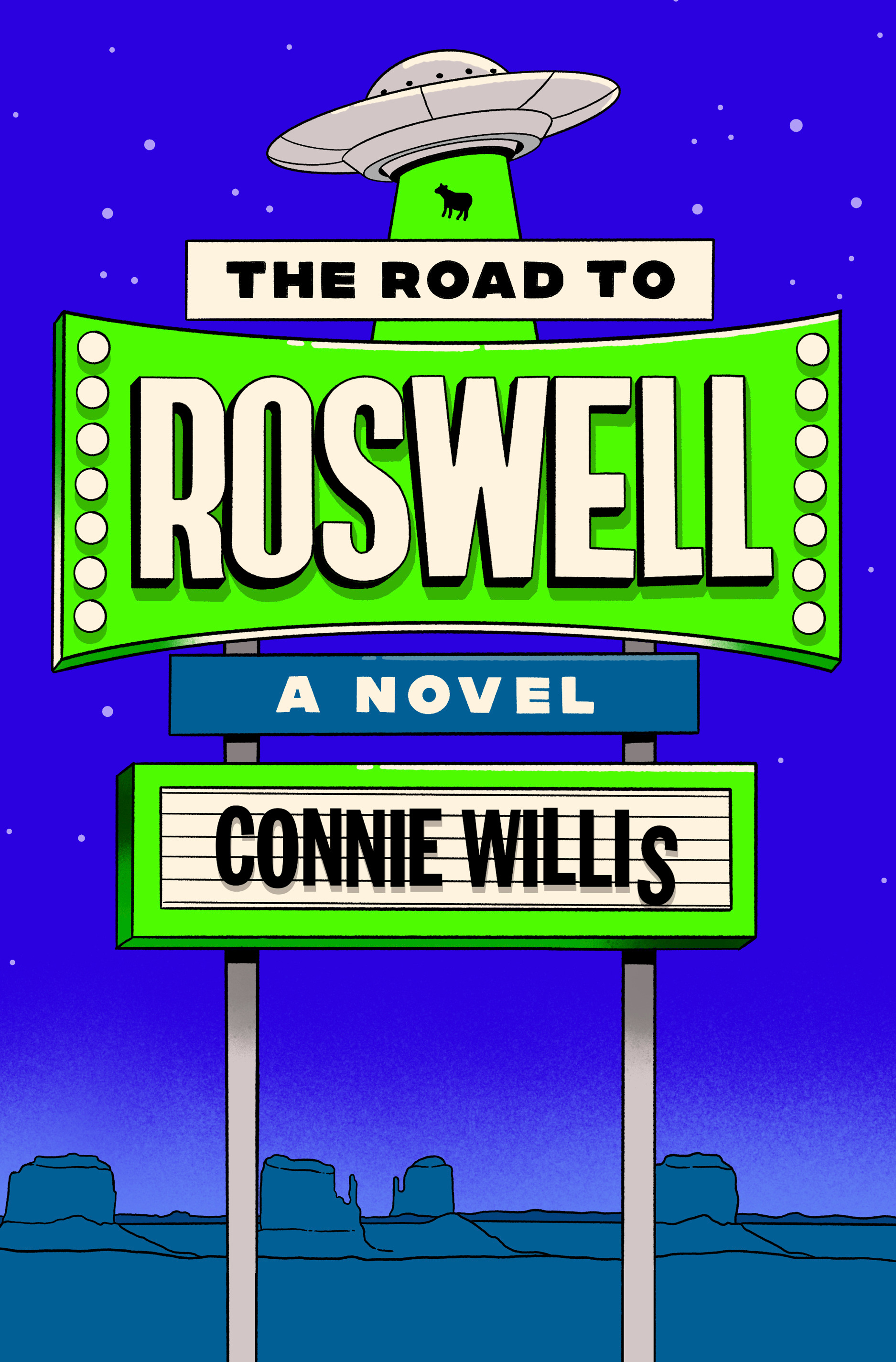
45. The Road to Roswell


The Road to Roswell. Connie Willis. 2023 [June] 416 pages. [Source: Review copy]

First sentence: Serena wasn't in the airport waiting area when Francie got off the plane in Albuquerque, but a man carrying a sign reading FIRST CONTACT COMMITTEE--WELCOME TO THE UFO FESTIVAL was. UFO festival? Serena hadn't said anything about a UFO festival going on at the same time as her wedding. Maybe it's not in Roswell, Francie thought hopefully. But of course it was. Where else was a UFO festival be?

My thoughts: I know, I know. I usually start with "premise/plot". But I just wanted to pop in to say THERE BETTER BE A SEQUEL. And all the better if that sequel is also published this year. Like tomorrow. I wanted MORE, MORE, MORE, MORE. This is easily the best book I've read in 2023. I'll clarify that a bit. The best adult book I've read in 2023. 

Premise/plot: Francie goes to Roswell hoping to stop her friend--her former college roommate--from marrying a "true-believer." It's a UFO themed wedding coinciding with a UFO Festival. This won't be the first time Francie has persuaded her friend to be a runaway bride. But before she has a chance to have a heart-to-heart chat with Serena, but after she's tried on her maid of honor dress--it's horrific, of course--she's abducted...by an alien. The alien, whom Francie eventually nicknames Indy (short for Indiana Jones), and Francie start off on a road trip of the most unusual kind. And as they travel--Indy indicates which direction to drive--they soon pick up more "guests" (or abductees). Wade. Lyle. Eula Mae. Joseph. The original car not being big enough for all the crew...they soon find themselves in a "borrowed" RV crisscrossing the Southwest. (It's Joseph's). What is Indy searching for? What does he want? What does he need? 

My thoughts (part 2): I loved, loved, loved this one. It was giddy-making. It has literally everything. This is a funny sci-fi rom-com. It would make an AWESOME movie. (In my opinion). I loved the characters. I loved the relationships. I loved the world-building. Nothing was tedious. I loved the amount of characterization. Yes, it's premise-driven. Yes, it pokes fun at at least a couple of sub-genres. (Lyle, a true believer, of sorts, has seen EVERY alien movie ever made. Joseph is a die-hard western fan. He's seen EVERY western ever made.) But it was such a delightful read. 

Did I love the ending???? I'm mad at it. Not mad-mad. Not angry, I mean. It's just like when a movie flashes up a big TO BE CONTINUED sign right in the middle of a scene. (Though the words were not to be continued. So there better be a sequel.) 


© 2023 Becky Laney of Becky's Book Reviews

Tuesday, August 24, 2021

94. Sisters


Sisters. Raina Telgemeier. 2014. 199 pages. [Source: Library]

First sentence: Are you sure you're all packed? You're not forgetting anything? What about the tent?

Premise/plot: Raina's family (her mom, her two siblings Amara and Will) are preparing to DRIVE to a family reunion in Colorado. (The dad will be flying to meet them there a bit later on in the week). As the family heads out for their adventures (and misadventures!) Raina has time to REFLECT on her life. Readers are treated to a series of flashback sequences. We see a young Raina anxious and eager to have a baby SISTER. We see Raina ecstatic--at first--until she realizes that her new sister doesn't do much at all. We see the tension between the two--they aren't all that close! We also see them both react to the news of having a baby brother! Meanwhile, there's plenty of action happening in the present both on the way and on the way back. In fact the climax of the book (in my opinion) happens on the way back!!!!

My thoughts: I really liked Smile. I did. I enjoyed Raina's perspective. I thought she was a great character. (It is an autobiographical graphic novel). But I really LOVED, LOVED, LOVED, LOVED the second book in the series. Sisters was all kinds of awesome! I loved the flashback scenes especially. I won't mention my absolute favorite, favorite, favorite, favorite scene because SPOILERS but, seriously, this book is unforgettable. I loved the author including photographs there at the end.

Definitely recommend this series.


© 2021 Becky Laney of Becky's Book Reviews

Wednesday, July 25, 2018

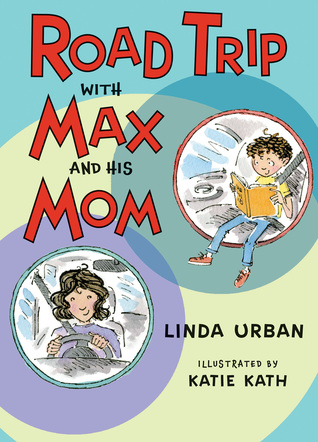
Road Trip With Max and His Mom

Road Trip with Max and His Mom. Linda Urban. Illustrated by Katie Kath. 2018. Houghton Mifflin Harcourt. 160 pages. [Source: Review copy]

First sentence: On Monday morning after breakfast, Mom made an announcement. "We are going on an adventure. Max was surprised. Mom was not the sort of mom who made announcements about adventures. She was the sort of mom who made announcements about the laundry needing to be put away, or how proud she was of Max's report card, or that Max's hair was getting long and it was time for a trim.

Premise/plot: Road Trip with Max and His Mom is a sequel to Linda Urban's Weekends with Max and His Dad. In the first book, readers met Max and his dad. Max is adjusting to his parents recent divorce. In the second book, Max is skipping one of his weekends with his dad to go with his mom on a trip. Great-Great-Aunt Victory is turning 100 and having a family-reunion-birthday-party at an amusement park. It sounds like an adventure just right for an explorer like Max.

My thoughts: I love, love, love Max. I came to love him in the first book. That's the wonderful thing about series. If you get attached to the characters in the first book, you can just pick up future books with the love already there. Max is over being a spy these days, and now he is all about exploring. He has been LOVING reading biographies about famous and should-be-famous explorers. And I just have to say that having a narrator who gets so excited about books, about reading, about learning is just delightful.

I would definitely recommend both books.


© 2018 Becky Laney of Becky's Book Reviews

Friday, April 20, 2018

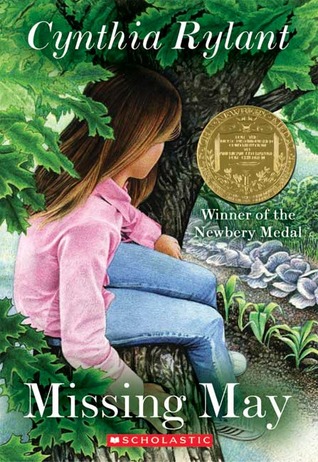
Missing May

Missing May. Cynthia Rylant. 1992. Scholastic. 89 pages. [Source: Library]

First sentence: When May died, Ob came back to the trailer, got out of his good suit and into his regular clothes, then went and sat in the Chevy for the rest of the night.

Premise/plot: Missing May won the Newbery Medal in 1993. This novel for young readers explores grief. Summer and Ob are the central characters; they are the ones most 'missing' May. All the happiness Summer has known has been in the home of her aunt and uncle. May and Ob took her in and adopted her; times were good, love abounded. But May died in her garden, and life hasn't been the same since she's left.

Ob wants more than anything to make contact with May's spirit. Summer isn't sure that that is even possible, but she hopes it is for Ob's sake. Cletus is relatively new friend of the family. He's around Summer's age. But he has a way--a knack--with Ob that is healing and comforting. Together these three set out on a road trip. The destination? A spiritualist church that Cletus read about with a medium as a pastor. Will May reach out from beyond the grave with a message for Ob? for May?

My thoughts: Did I like it? No. Yes. No. Maybe. I'll start with what I did like. Rylant is a strong writer. She did a great job with the setting. It's set in West Virginia a place where she herself grew up. She captures a specific place--if not a specific time. Which brings me to her characterization. Her characters were human--there's a rawness to them, a take-me-like-I-am rawness. I think Cletus may just be my favorite among them. Her writing was GREAT.

Here is one of her descriptions of May:
She understood people and she let them be whatever way they needed to be. She had faith in every single person she ever met, and this never failed her, for nobody ever disappointed May. Seems people knew she saw the very best of them, and they'd turn that side to her to give her a better look. (15-16)
And one of Cletus:
Cletus had some gifts--I was learning this bit by bit--and knowing when to talk and when not to was turning out to be one of them. (37)
I can certainly see why it was honored with the Newbery award.

So what didn't I like? I didn't like the content, the story. Specifically, I did not like the ongoing quest to make contact with the dead--either through Cletus (that attempt failed) or through a professional medium (that one failed as well). In a way, it is thought-provoking. When someone you love dies--where is your hope? Is your hope in making contact with them again in the here and now? Is your hope in finding messages in feelings, signs, visions, dreams? Is your hope in mediums and psychics?

Or is your hope found in the resurrection of Jesus Christ? Is your hope in heaven? That you will spend eternity with them in heaven because you both believed that Jesus is the way, the truth, the life--the only way to the Father? Is your comfort found in the Word of God? Can you find peace and comfort through the Spirit and the fellowship of believers?

Summer and Ob are both searching for peace and comfort. Specifically Summer wants Ob to come to a place of peace so that he will start living again. She fears that he has lost all the will to live. And if he's lost the will to live, then who will take care of her? who will love her?

As a Christian, I saw the lost-ness, the despair of Summer and Ob. Ob is in need of answers, in need of peace, in need of comfort. But he's seeking in the wrong places in the wrong ways. Summer is young and confused. She doesn't believe strongly--one way or the other--about the after life. I pitied them both. I'm not sure readers are supposed to pity them. I'm not sure readers are not supposed to pity them either.

Grief wears many faces. There isn't one right way to grieve. Each person is different. Christian or not--every person grieves in his or her unique way. And it's not like anyone--insider or outsider--can say a handful of phrases to 'snap someone out of their grief' to 'fix them' or 'heal them.' There are plenty of WRONG things to say that hurt instead of help. I think everyone could learn from Cletus--a bit--in just BEING there and listening. (But to be fair, Cletus is far from perfect, it is Cletus who suggests going to a professional medium.)

Would I have liked Missing May as a child? I probably would not have read it. a) I was still AVOIDING all books that had the potential for sadness. b) I was certainly reading in 1992/1993, but probably not books for this age group. c) I attended a Christian school with a small library budget and high standards of what was appropriate and inappropriate. I don't think a book with talk of mediums and contacting the dead would have made the cut. But I could be wrong. It DID win the Newbery. And I honestly can't say if the librarian was reading every book before it was ordered and placed within the collection.

Christian families shouldn't necessarily avoid the book at all costs. But if you do read it, you may want to read it together and use it as a discussion opportunity. As I said, it is thought-provoking.

© 2018 Becky Laney of Becky's Book Reviews

Wednesday, January 18, 2017

Utopia Drive

Utopia Drive. Erik Reece. 2016. FSG. 368 pages. [Source: Library]

First sentence: The corner of Fifth and Elm Streets in Cincinnati, Ohio, has held a certain significance for me since the day I stood there with my parents, as an eight-year-old in 1976, and watched the Cincinnati Reds return to the city after their seven-game victory over the Boston Red Sox in what was, as my father told me then and as I still believe, the greatest World Series ever.

Premise/plot: Erik Reece chronicles his ROAD TRIP through the Eastern United States. This isn't just any road trip. He's unpacking the IDEAS behind a handful of America's historical (for the most part) Utopian communities. (I believe only one or possibly two of the communities he visited were founded in the twentieth century and still active as utopian communities.) He includes biographical sketches of some really, really free or radical outside-the-box thinkers. There's some philosophy, politics, and economics as well. (And plenty of talk about nature and preserving nature and the environment.)

The first and last chapters essentially serve as an introduction and conclusion to the road trip. The remaining chapters chronicle the trip. He visited Pleasant Hill, Kentucky, Bardstown Kentucky, New Harmony, Indiana, Cincinnati, Ohio, Utopia, Ohio, Louisa, Virginia, Queens, New York, Long Island, New York, Concord, Massachusetts, Oneida, New York and Niagara Falls, Canada.

My thoughts: It was interesting. No doubt about that. Did I agree with any of the founders of various Utopian communities? I'm not sure I did. I'm okay with that. Some communities were most interested in transforming religion and spirituality. Others seemed to be more concerned with economics and social class. A few really seemed focus on turning upside down social structures like marriage and parenting. (One, for example, banned sex completely. Men and women lived completely separate lives and rarely conversed. Another, for example, promoted sex and was all about free love and "complex marriage." Both communities, however, agreed that parents should not raise their own children. That children should be raised by the community and belong to no one in particular but to everybody to a certain extent.) I did not always agree with Reece's conclusions. Reece, in my reckoning, tried to find at least one or two positive things about every utopian community. And while he discussed how they "failed," or why they "failed," he was not quick to dismiss any of the ideas as actually being impossible.

Favorite quotes:
Americans live in a world we are too ready to accept. We acquiesce too easily to the inevitability of the way things are. indeed, many of us think of our consumer culture as its own version of utopia, where we are absolved of the responsibility to question where our food, our clothes, our cellular devices, our energy come from. (Erik Reece, 5) 
Erik Reece quoting Milton Friedman, "Only a crisis--actual or perceived--produces real change. When that crisis occurs, the actions that are taken depend on the ideas lying around. That, I believe, is our basic function: to develop alternatives to existing policies, to keep them alive and available until the politically impossible becomes politically inevitable." (6) 
Utopia, by definition, is a product of the imagination, and therein lies its power: it imagines something better, then calls on us to enact that vision. (Erik Reece, 10)

© 2017 Becky Laney of Becky's Book Reviews

Sunday, August 09, 2015

Walk Two Moons

Walk Two Moons. Sharon Creech. 1994. HarperCollins. 280 pages. [Source: Bought]

Gramps says that I am a country girl at heart, and that is true. I have lived most of my thirteen years in Bybanks, Kentucky, which is not much more than a caboodle of houses roosting in a green spot alongside the Ohio River. 

Did I love Sharon Creech's Walk Two Moons? Yes and no. On the one hand, it's a book that I know I would have either--as a kid-- avoided at all costs (if anyone had dropped hints of how sad it was) OR found myself hating, bitterly regretting having picked it up in the first place. There was a time I thought all sad books should be labeled. So at least you were making an informed decision before you got swept up in the story and invested a part of yourself in it. On the other hand--as an adult--I couldn't help finding it a beautiful and compelling story.

Sal--the heroine--is on a road trip with her grandparents (Gram and Gramps). They are on their way to "see" Sal's mother. That's what readers are told, and, as an adult I connected the dots early on. (Sal's world is upset when her Dad moves them to a new town after learning that the mom wouldn't be coming back.) But much is left a mystery for the reader. I can't honestly say how I would have interpreted the text as a kid. It doesn't really matter. The trip is enlivened by Sal's storytelling. She is telling the story of her new friend, her classmate, her almost-neighbor: Phoebe. (Readers also hear of other friends--classmates--including a boy named Ben.) Phoebe's life is also becoming something of a mess. Though Sal is better at spotting the signs than Phoebe herself. The book alternates between focusing on the past--Sal's new life, her friendships, her memories, her emotions--and the present, the road trip. Both stories are compelling. Mainly through dialogue, the grandparents become fully fleshed characters that you can't help loving and admiring. The way they love Sal, and, cherish her. There is just something sweet about this family. And readers do get to know them better than any other adult in the novel. Unfortunately, I think that is why the book left me angry. Part of me angry anyway. THE ENDING. I did not see it coming. And it was beyond cruel to this reader. Was it realistic? Yes. Looking back were their signs that it was coming? Probably. But though I guessed one reason why the novel was one of those dreaded SAD books. I didn't the second. And the second HURT so much.

Walk Two Moons is the 1995 Newbery winner.

Have you read Walk Two Moons? What did you think? Like it? Love it? Hate it? Do you like sad books? Or do you avoid them when you can?

© 2015 Becky Laney of Becky's Book Reviews

Saturday, May 28, 2011

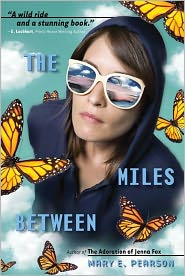
The Miles Between (YA)

The Miles Between. Mary E. Pearson. 2009. Henry Holt. 272 pages. 

I was seven the first time I was sent away. This raised eyebrows, even among by parent's globe-trotting friends, and I was brought back home in short order. Rumors are embarrassing, you know? A nanny was employed, but that only partially solved their problem. I was still in the house. I was seen and heard. When I turned eight years old, it seemed reasonable enough to send me off again. And they did. They never kept me at any one place for long. 

Des (Destiny) Faraday, our narrator, doesn't have many friends. Then again, she doesn't want any friends. Readers meet her on October 19th, a day that Des has come to dread year after year, though readers aren't quite sure why. Wanting to take control of her life, Des rips the page right off her calendar. Things seem to be off on a shaky start. Until she meets a stranger. Until she asks for one fair day in the universe. Until she finds a car with a running engine. Until she finds three companions that need escape from Hedgebrook Academy--a boarding school--just as much as she does. Can one day of freedom on the road change lives? Perhaps.

I enjoyed The Miles Between. It was emotional--very emotional in places. Though the novel only covers one day, there is so much growth and development. Destiny is changed by this day--and it's a wonderful thing to see. And the writing is lovely. I would compare it to Jellicoe Road by Melina Marchetta, but I think The Miles Between is an easier read, a less-intimidating read.

There are so many different ways of being good. It's all about perspective. (35)

The world before us is a postcard, and I imagine the story we are writing on it. (45)

© 2011 Becky Laney of Becky's Book Reviews

Friday, March 25, 2011

Rules of the Road (YA)

Rules of the Road. Joan Bauer. 1998/2005. Penguin. 208 pages.

I leaped onto the sliding ladder in the back room of Gladstone's Shoe Store of Chicago, gave it a shove, and glided fast toward the end of the floor to ceiling shelves of shoeboxes.

I love Rules of the Road. I think it is my favorite and best Joan Bauer book. (In case you haven't read her, you should! You really should! She's fabulous!) I read this one in pre-blog days, so this is my first opportunity to gush about how wonderful it is.

Jenna Boller, our heroine, has a part-time job selling shoes. And it's a job that she enjoys very much--especially on days when her drunk father doesn't show up at the store to embarrass her. So Jenna is quite surprised when Mrs. Gladstone, the owner of the Gladstone company, asks her to drive her across country to visit all her stores before the big meeting in August. Surprised because Jenna is relatively a new driver. Surprised because she could have hired anyone, confided in anyone. But these two have a way of bringing out the best in one another. And a wonderfully odd friendship begins. Together these two will cover many, many miles. They'll have many opportunities to discuss the meaning of life. (Not that they'd ever call it that, mind you!) Each woman has their own battle to fight. Mrs. Gladstone struggling to hold onto her company, fighting her greedy son and stockholders. Jenna struggling to deal with her life, her father. Does he have any place in her life? Should she work at forgiving him so she can move on with her life? Is the anger and anxiety worth it? How do you stop worrying though? How do you stop hating? How can you turn your feelings off and on? She has a dad-shaped hole in her life, and it's a hole that is hard to ignore...

I loved this one. I loved the characters. I loved the writing. I would definitely recommend it!

I thought of all the good drivers I'd ever seen, and I couldn't for the life of me figure out what made them that way. They just got behind the wheel, drove, and didn't run into things. The not running into things was important. (25)

Opal couldn't cope with my dateless state and kept trying to fix me up with sub-par guys like Morris, her second cousin twice removed, who, believe me, you want to be removed from at least twice. (31)

My grandma always said that people who snored were sleeping with enthusiasm. I tried to remember this, but there's just so much enthusiasm a person can handle in close quarters. (49)

I learned great road truths that teenagers aren't always exposed to.
Never go into a restaurant with a sign that says GOOD EATS.
Never eat at a place called MOM'S, because it's a safe bet Mom's been dead for years and whoever's in the kitchen didn't have a working relationship with her.
If you see four or more pickups in front of a diner, chances are you'll get a good meal. (113-4)

"I thought people in Texas were laid back," I shouted as two mega-trucks thundered by.
"They are," Mrs. Gladstone said happily, "except on the road." (121)

My grandma always said that God made libraries so that people didn't have any excuse to be stupid. Close to everything a human being needed to know was somewhere in the library. There was plenty I needed to know. (142)

It's the little things, not just in selling, but in life that make the difference. The small moments when you can touch another person. Harry Bender was always looking for them and he found more than any person I'd ever met. (146)

You know the thing about hope, how it sneaks up behind you when you're sure everything's in the toilet, and starts whispering to you that maybe, just maybe, things could turn around. That's the gift Harry gave us that night. Some people, all you have to do is stand next to them and you feel protected. Mrs. Gladstone said he was always like that, too, a presence of hope, even after all he'd been through, able to laugh darkness in the face. I wondered if that came from knowing the darkness so well, he'd figured out how to beat it. (153)

You never know where the road's going to take you. I think sometimes it's less important that you get to your destination than the sidetrips you take along the way. (165)
© 2011 Becky Laney of Becky's Book Reviews

Saturday, July 17, 2010

Amy & Roger's Epic Detour (YA)


Amy & Roger's Epic Detour. Morgan Matson. 2010. Simon & Schuster. 343 pages.

I sat on the front steps of my house and watched the beige Subaru station wagon swing too quickly around the cul-de-sac.

Meet Amy Curry and Roger Sullivan. Two strangers who are about to bond on a cross-country trip from California to Connecticut.

The Curry family is in crisis. Amy's dad died in a car accident. Her brother, Charlie, is a drug addict. He's in North Carolina in rehab when the novel opens. Her mom? Well, she's in Connecticut preparing for the move. She's setting up the new home and leaving her daughter, Amy, to get the old house ready to sell. How's Amy doing? Well, she's coping. Barely. So long as no one asks her questions about how she's doing. Or questions her about the accident. Or offers condolences. And she still can't bring herself to drive. Her mom has arranged--with Roger's mom--for the two to drive together. Roger will be heading to Philadelphia to spend the rest of the summer with his dad. And he doesn't seem to mind doing them a favor. Turns out Roger has plans for this trip as well...

What Amy didn't expect was for Roger--the boy she barely remembers in the first place--to have turned into such a cute guy. She also didn't expect to throw her mom's plans out the window on the first day. For the trip to be detour after detour after detour as two teens embark on a soulful journey together looking for some peace of mind.

I liked this one. I liked both Amy and Roger. I liked how the relationship develops. I love how talking to Roger, being vulnerable, frees Amy up and enables her to start the healing process. I didn't love everything about this one. But I did like it.

© Becky Laney of Becky's Book Reviews

Saturday, March 13, 2010

Mare's War (YA)


Mare's War. Tanita S. Davis. Random House. 352 pages.

It's just a sporty red car parked across our driveway, but when I see it, my stomach plummets. It's my grandmother.

Mare is no ordinary grandma, that's for sure! As her two granddaughters discover one summer when all three embark on a cross country road trip. There are rules to be decided; and compromises to be made. But in the end, it will be a summer the two sisters (Octavia and Tali) will never forget. (It will also be a healing summer for Mare.)

What makes this inter-generational book such a great read is that the narration is broken into 'then' and 'now' segments. As the two girls learn about their grandmother's not-so-tame past, readers learn first hand what America was like in the past. Things that they take for granted--have always taken for granted--were not so easy back in the day. There are a few scenes, for example, that really stand out in showing how far we've come. (The scene on the bus moved me. It was so emotional, but not overly done.)

But this isn't an issue book. Not really. The characters are too human for that for one thing. The two granddaughters have never given much thought to Mare's life, her history, her past, her story. They haven't thought about her as a person, a real person with hopes, dreams, disappointments, regrets, etc. Mare's broken home is haunting. As are her stories of joining the Women's Army Corps during World War II. And as these two teens learn to listen, really, truly listen, something significant, something personal happens. In some ways, this is a quiet book about families coming together--listening, loving, understanding, bonding. But it isn't a slow novel. Mare's story is compelling. I think the framework works well, helps keep history in context.

© Becky Laney of Becky's Book Reviews
Thursday, August 20, 2009

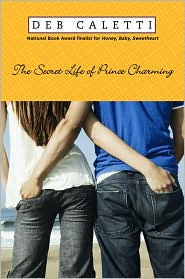
The Secret Life of Prince Charming (YA)


Caletti, Deb. 2009. The Secret Life of Prince Charming. Simon & Schuster. 322 pages.

When it came to love, my mother's big advice was that there were WARNING SIGNS.

I haven't always appreciated each and every Deb Caletti novel. Some I've loved, some I've only liked, and one I've disliked quite a bit. But what Caletti does--and quite well--is write beautifully and authentically. She has a way with words, a way with phrasing things just right so that the reader can relate. She's good at capturing the little things, the small details, that make up ordinary life. The Secret Life of Prince Charming is the story of a girl. It's not an ordinary, traditional romance. If anything it is more of an un-romance. Here we have all the gritty little details of the unhappily ever afters.

Quinn, our heroine, has heard all these stories about men all her life. How they can disappoint you, hurt you, break you, scar you, anger and frustrate you as well. Her mother. Her grandmother. Her aunt. Just to name a very few. Quinn has taken these words of warning seriously. Opting to go for the obviously-safe choices when it comes to love than the more dangerous (albeit more temptingly fun and passionate) choices. But even being safe when it comes to her love life--the ever-boring Daniel--doesn't keep her safe. Boring doesn't mean safe; nice doesn't always mean good. Does Daniel breaking up with her hurt her? Yes and no. Her pride more than anything, since her relationship lacked spark and life. He was there, but that was about it.

But the more significant relationship--though a bit off screen--is the relationship between Quinn and her father. Though her parents have been divorced a long time, though her mother never loses an opportunity to complain about her ex, Quinn feels the need to have him in her life. She wants to have a good relationship with him, even if it means allowing for his mistakes and ignoring the stupid things her father does.

But some things can't be ignored. When she discovers that her father has 'stolen' sentimental (and sometimes quite valuable) items from many (if not all) of his former lovers, then Quinn along with her two sisters (one older, one younger) set out on a quest, a road trip, to return all these items to their rightful owners. Along the way, she'll speak with each ex and learn more about her father; she's trying to piece together why her father is the way he is. Trying to make sense of who he is from what he has done.

If you're looking for a young adult book that is strictly romance, then this one may disappoint. If however you're looking for a complex story showcasing humanity--for better or worse--then this one should satisfy. It's about dynamic family relationships--Quinn's relationship with her mother, her father, her younger sister, Sprout, her older half-sister, Frances. It's a coming-of-age story as well.

© Becky Laney of Becky's Book Reviews

Wednesday, July 15, 2009

Three Men on the Bummel

Jerome, Jerome K. 1900. Three Men On the Bummel. 168 pages.

J, George, and Harris are back. The stars of Three Men In A Boat return for a second adventure. This time round they're not boating. No, these three good friends are biking--biking round Germany. This travel-book (that is anything but a 'travel' book) is much too fun to be missed.

Two of the three gentlemen are married. And at first, there is some concern over how to convince their wives that this trip is a good idea. Why these men should leave their wives (and children) behind to go away together. But to their surprise--almost dismay--the wives seem a bit eager for their husbands to go. So the preparations begin. And that's where the fun starts.

How does this one compare with the first? I don't know how to answer that fairly. I loved, loved, loved the first one. And I really loved the second one as well. There is one place in this second book that had me laughing out loud for a good five or ten minutes. I don't know that ANY book has ever had me laughing so hard and so long. It was enjoyable. It was charming.

About bicycle seats:
There may be a better land where bicycle saddles are made out of rainbow, stuffed with cloud; in this world the simplest thing is to get used to something hard. (199)

About "helpful" travel books:

He handed me a small book bound in red cloth. It was a guide to English conversation for the use of German travellers. It commenced “On a Steam-boat,” and terminated “At the Doctor’s”; its longest chapter being devoted to conversation in a railway carriage, among, apparently, a compartment load of quarrelsome and ill-mannered lunatics: “Can you not get further away from me, sir?”—“It is impossible, madam; my neighbour, here, is very stout”—“Shall we not endeavour to arrange our legs?”—“Please have the goodness to keep your elbows down”—“Pray do not inconvenience yourself, madam, if my shoulder is of any accommodation to you,” whether intended to be said sarcastically or not, there was nothing to indicate—“I really must request you to move a little, madam, I can hardly breathe,” the author’s idea being, presumably, that by this time the whole party was mixed up together on the floor. The chapter concluded with the phrase, “Here we are at our destination, God be thanked! (Gott sei dank!)” a pious exclamation, which under the circumstances must have taken the form of a chorus.

At the end of the book was an appendix, giving the German traveller hints concerning the preservation of his health and comfort during his sojourn in English towns, chief among such hints being advice to him to always travel with a supply of disinfectant powder, to always lock his bedroom door at night, and to always carefully count his small change.

“It is not a brilliant publication,” I remarked, handing the book back to George; “it is not a book that personally I would recommend to any German about to visit England; I think it would get him disliked. But I have read books published in London for the use of English travellers abroad every whit as foolish. Some educated idiot, misunderstanding seven languages, would appear to go about writing these books for the misinformation and false guidance of modern Europe.”

“You cannot deny,” said George, “that these books are in large request. They are bought by the thousand, I know. In every town in Europe there must be people going about talking this sort of thing.”

“Maybe,” I replied; “but fortunately nobody understands them. I have noticed, myself, men standing on railway platforms and at street corners reading aloud from such books. Nobody knows what language they are speaking; nobody has the slightest knowledge of what they are saying. This is, perhaps, as well; were they understood they would probably be assaulted.”

George said: “Maybe you are right; my idea is to see what would happen if they were understood. My proposal is to get to London early on Wednesday morning, and spend an hour or two going about and shopping with the aid of this book. There are one or two little things I want—a hat and a pair of bedroom slippers, among other articles. Our boat does not leave Tilbury till twelve, and that just gives us time. I want to try this sort of talk where I can properly judge of its effect. I want to see how the foreigner feels when he is talked to in this way.”

It struck me as a sporting idea. In my enthusiasm I offered to accompany him, and wait outside the shop. I said I thought that Harris would like to be in it, too—or rather outside.

George said that was not quite his scheme. His proposal was that Harris and I should accompany him into the shop. With Harris, who looks formidable, to support him, and myself at the door to call the police if necessary, he said he was willing to adventure the thing.

We walked round to Harris’s, and put the proposal before him. He examined the book, especially the chapters dealing with the purchase of shoes and hats. He said:

“If George talks to any bootmaker or any hatter the things that are put down here, it is not support he will want; it is carrying to the hospital that he will need.”

That made George angry.

“You talk,” said George, “as though I were a foolhardy boy without any sense. I shall select from the more polite and less irritating speeches; the grosser insults I shall avoid.”

This being clearly understood, Harris gave in his adhesion; and our start was fixed for early Wednesday morning. (207-209)

About the teaching of French to English school children:

For they have a way of teaching languages in Germany that is not our way, and the consequence is that when the German youth or maiden leaves the gymnasium or high school at fifteen, “it” (as in Germany one conveniently may say) can understand and speak the tongue it has been learning. In England we have a method that for obtaining the least possible result at the greatest possible expenditure of time and money is perhaps unequalled. An English boy who has been through a good middle-class school in England can talk to a Frenchman, slowly and with difficulty, about female gardeners and aunts; conversation which, to a man possessed perhaps of neither, is liable to pall. Possibly, if he be a bright exception, he may be able to tell the time, or make a few guarded observations concerning the weather. No doubt he could repeat a goodly number of irregular verbs by heart; only, as a matter of fact, few foreigners care to listen to their own irregular verbs, recited by young Englishmen. Likewise he might be able to remember a choice selection of grotesquely involved French idioms, such as no modern Frenchman has ever heard or understands when he does hear.

...

I confine my remarks to French, because that is the only language we attempt to teach our youth. An English boy who could speak German would be looked down upon as unpatriotic. Why we waste time in teaching even French according to this method I have never been able to understand. A perfect unacquaintance with a language is respectable. But putting aside comic journalists and lady novelists, for whom it is a business necessity, this smattering of French which we are so proud to possess only serves to render us ridiculous. (240, 242)


© Becky Laney of Becky's Book Reviews

Monday, April 27, 2009

Review of Savvy


Law, Ingrid. 2008. Savvy.

Savvy is another book that had me at hello. "When my brother Fish turned thirteen, we moved to the deepest part of inland because of the hurricane and, of course, the fact that he'd caused it." Isn't that a great first sentence? Puzzling enough to hook you? I think so. A few pages later we read, "Monday through Wednesday, we called our thin stretch of land Kansaska. Thursday through Saturday, we called it Nebransas. On Sundays, since that was the Lord's Day, we called it nothing at all, out of respect for His creating our world without the lines already drawn on its face like all my grandpa's wrinkles." (4) So right from the beginning, the reader knows to expect the unexpected. Our narrator, a young girl named Mississippi (Mibs), has quite a way with words. She's fantastic. She's fun. And she's almost thirteen.

Mibs comes from a "special" family. Around the age of 13, every member of the family comes into their own on their thirteenth birthday. They discover their savvy, their special know-how power. For Fish, it was power of water--rain, thunder, winds, etc. For her brother Rocket it was electricity. Her mother's savvy is perfection. She can do things perfectly or mess up perfectly. Each member of her mother's side of the family is special like that--all unique, all special, all a bit weird.

Mibs is curious, super-super curious to get her savvy. Listen to this description of her waiting, "The itch and scritch of birthday buzz was about all I was feeling on the Thursday before the Friday before the Saturday I turned thirteen." But a few days before--the very day this passage was taken from the narrative--her birthday, her father is in a serious car accident. He's in a hospital almost 100 miles a way. While her mother and brother, Rocket, go to be with him, the rest of the kids-- Fish, Mibs, Samson, and Gypsy--are left at home.

Soon Mibs becomes convinced that her savvy will cure her father, will heal him, make him all better. But as you might imagine, savvy powers, don't quite work like that.

The novel focuses on her impromptu journey to visit her father--no matter what--and the lives she changes along the way on her special birthday weekend.

Definitely recommended.

A Christian Worldview of Fiction, All About Children’s Books, Becky’s Book Reviews, Booking Mama, Cafe of Dreams, Dolce Bellezza, Fireside Musings, Hyperbole, KidzBookBuzz.com, Looking Glass Reviews, Maw Books Blog, Never Jam Today, Olive Tree, Our Big Earth, The 160 Acrewoods, Through a Child’s Eyes

© Becky Laney of Becky's Book Reviews
If you're reading this post on another site, or another feed, the content has been stolen.

Monday, November 24, 2008

How To Be Bad


How To Be Bad by E. Lockhart, Sarah Mlynowski, Lauren Myracle. 2008.

How To Be Bad is a collaborative novel between three well-known, often-beloved YA authors. It is the story of three girls--three teens--three waitresses from a small-town Waffle House in Florida. Jesse is an uptight religious sort running away from her mom's diagnosis, Vicks is Jesse's best friend who is feeling more and more like a was. The growing distance between the two is unacknowledged, unspoken, but definitely present. Vicks has a boyfriend in Miami. He is also feeling more distant and lost than ever. His name is Brady. Mel is the third wheel. She's a hostess at the Waffle House. New to town. New in so many other ways as well. She's not really friends with anyone--but she wants to be. She wants to belong, to fit in, to be a part of something. These three head off on a road trip to Miami. Mel included only because she offers to pay...and because her presence will help disguise the tension between Vicks and Jesse.

This road trip will in many ways act as a catalyst for the girls' coming-of-age. Life. Friendship. Love. A few mistakes. A few embarrassing moments. A few fights. Can Vicks save her relationship with Brady? Can Vicks save her friendship with Jesse? Will Jesse ever come clean with the truth? Will Mel ever find a friend?

I'll be honest. I didn't much like this one. I guess I just felt the writing was bland...almost boring. (I've had difficulty getting into some of the authors' individual books in the past.)
I'm sure other readers would disagree with me in parts at least. Because I've seen this one get good reviews on other blogs. But it just wasn't for me.

© Becky Laney of Becky's Book Reviews
Saturday, November 01, 2008

Jerk, California


Friesen, Jonathan. 2008. Jerk, California.

"Sam has it. Question is, how bad?"

What is "it"? It is Tourette's Syndrome. Our narrator, Sam, (or should that be Sam/Jack) is a teen struggling with it among other things--an awful and sometimes abusive stepfather, the loss of his father whom he can't even remember, his lack of friends and a love life, etc. He has a tendency to blame the disease for most of his problems. And he's not all wrong. His stepfather, Bill, does hate him because of it. Every time he witnesses Sam jerking or blurting, he has a tendency to take it out on his wife--be it physical, emotional, or verbal abuse. Bill is not without issues of his own. He's got OCD, and it's to the extent that it's interfering with his life and his work. It's pretty safe to say that the Sam readers are first introduced to is angry and bitter and antisocial.

What if anything changes all that? Well, Sam's life changes soon after he graduates from high school. He's hired by one of the odder men in town, a guy named George. He's to help him with his gardening business. Room and board are included in the job description, one of the chief reasons he takes the job--to get away from his stepfather. George has a few secrets though. For one, George knew Sam's father. But the strangest thing about George is his insistence that Sam be called Jack. Jack Keegan. Sam is just beginning to ask questions about his father when George dies somewhat unexpectedly. What he leaves behind is priceless to Sam/Jack. Almost everything has been left to him. But more importantly, he's been left with instructions for a road trip. He's been told to go to Jerk, California.

Naomi is George's granddaughter. She's the same age as Sam/Jack. Though the two are from different social circles of course. She invites herself along on this road trip...and the trip becomes a learning experience for the two of them.

I won't go into all the details, of course, but this is one trip, one summer they'll never forget.
It is a journey to self-acceptance for one thing. A journey to discover himself, to find his "real" identity.

© Becky Laney of Becky's Book Reviews
Sunday, September 28, 2008

When You Wish


Harmel, Kristin. 2008. When You Wish.

I enjoyed this much more than I thought I would. Typically books written about teens who have it all--money, popularity, good looks, etc--don't do much for me. And on the surface, this book is about that. About a teen girl who supposedly "has it all."

Star Beck. A sixteen year old pop star who already has more than a few bestselling, record-breaking albums to her name. A beautiful long-haired, red-haired princess of pop. But Star is missing a few things--a real mother who is there for her, who listens, who is kind, who is supportive, who isn't all about the money and fame; a real father, one who didn't abandon her when she was three only to resurface when she's one of the most famous teens on the planet; a real boyfriend, one who isn't all about showy kisses for the media and making a big entrance; a real friend, one who won't sell her out to the tabloids. Of course her job is far from average, and her schooling is as well. She's got her GED, but she's not been to a real school in forever. Not since Disney (I think it was Disney in the book, it might have been Nickelodeon.) plucked her out of her ordinary existence and made her the rich and famous "it" girl of the moment. The only girl who doesn't want to be Star Beck is Star Beck.

So after a particularly bad day, Star gives herself a hair cut (at least it wasn't a shave), dyes her hair, and runs away from her hotel room (she's on tour). Now calling herself Amanda, she is determined to make her way to Florida. On her way to see her dad for the first time in thirteen years. Can a pop star on her own survive in the real world? Can she survive without being surrounded by her entourage, her people? Will she like it? Will she love it?

This book is a coming-of-age story, in a way, of a girl realizing who she is and isn't. About a girl realizing that she should have some say in her own life.

I definitely liked it. I think it complements Audrey, Wait well.

© Becky Laney of Becky's Book Reviews

Thursday, July 24, 2008

Paper Towns


Green, John. 2008. Paper Towns. October release.

Prologue opening paragraph: The way I figure it, everyone gets a miracle. Like, I will probably never be struck by lightning, or win a Nobel Prize, or become the dictator of a small nation in the Pacific Islands, or contract terminal ear cancer, or spontaneously combust. But if you consider all the unlikely things together, at least one of them will probably happen to each of us. I could have seen it rain frogs. I could have stepped foot on Mars. I could have been eaten by a whale. I could have married the queen of England or survived months at sea. But my miracle was different. My miracle was this: out of all the houses in all the subdivisions in all of Florida, I ended up living next door to Margo Roth Spiegelman.

First sentence: The longest day of my life began tardily.

My favorite quote: I spent the next three hours in classrooms, trying not to look at the clocks above various blackboards, and then looking at the clocks, and then being amazed that only a few minutes had passed since I last looked at the clock. I'd had nearly four years of experience looking at these clocks, but their sluggishness never ceased to surprise. If I am ever told that I have one day to live, I will head straight for the hallowed halls of Winter Park High School, where a day has been known to last a thousand years. (18)

Quentin Jacobsen, our narrator, has been trying to puzzle out the mystery that is Margo for years now. And as their senior year comes to a close, the mystery is only deepening as far as he's concerned. It all starts with a late night visit. Margo appears at his bedroom window asking Quentin to join her in some mischievous revenge--she needs his car, or rather she needs his mom's car. And Quentin, or Q as she calls him, would do anything and everything for this once-in-a-lifetime opportunity to spend some quality time with the girl of his dreams.

What happens that night and in the following weeks will shape Quentin in ways he never would--never could have--expected.

John Green's first novel, Looking for Alaska, won the Printz award in 2006. Green's second novel, An Abundance of Katherines, earned a Printz honor. And, of course, along the way he's picked up an enormous number of fans both through his books and his vlogging with the Brotherhood 2.0. (And though that's over and done with, more videos and blogging can be seen on the Nerdfighters Ning site.

Note: I'm reviewing an ARC, so keep that in mind when I'm pulling a few quotes out. They may or may not be the same as what makes it into the finished book that will be released in October.

Now for some Weekly Geeks Q&A fun:

Bart's Bookshelf asks, "I've not read any John Green, so have you a favourite quote/line from Paper Towns that best sums up the relationship of the main protagonists?"

I've already quoted a bit of this one. But here are two more that will give you a feel for the book:

"Margo always loved mysteries. And in everything that came afterward, I could never stop thinking that maybe she loved mysteries so much that she became one." (8)

"I smiled. She smiled. I believed the smile. We walked to the stairs and then ran down them. At the bottom of each flight, I jumped off the bottom step and clicked my heels to make her laugh, and she laughed. I thought I was cheering her up. I thought she was cheerable. I thought maybe if I could be confident, something might happen between us. I was wrong." (58)

Jennie asks, "Is Paper Towns everything that we've now come to expect from John Green? Because I'm DYING to read this one!!! Will I just be disappointed, so is my internal hype well-deserved?"

Yes. If you've followed his vlogging and come to love his personality just as much as his fiction, then you won't be disappointed. Green's personality shines through on this one. I haven't read An Abundance of Katherines yet, but this one is just as good as Looking for Alaska.

M. Molly says, "John Green said that Paper Towns was written as a response to Looking for Alaska. Do you see signs of this in PT? Also, does PT break out of JG's "Nerdy boy meets awesome girl who changes his life" equation (not that I mind it...)?"

Yes and no. In some ways the two books are similar. Two guys on the fringe of 'the-in-crowd' find a few wacky friends, two unforgettable girls to dream about and idolize, and thus "come of age". Both have humor and sarcasm in just the right amount. Both have their serious and meaningful layers. Where they differ, in my opinion, is in the mixing. Looking for Alaska is very bittersweet, very contemplative. And Paper Towns has this too. But it's not as bittersweet. It's a bit wackier than Looking for Alaska. Miles and Quentin are not mirror images or anything. Quentin has enough of a personality--as does his friends and dream-girl--to make this one unique. It is not Looking for Alaska part two. But if you boiled it down to the basics, it would have many of the same ingredients, just in different amounts.

Suey says, "I 2nd everything everyone's said about Paper Towns. Dying to know if it's like his others. Better maybe even?"

It's good. It's very good. I won't say I think it's the best, best, best book ever written. But it's definitely one of the better books I've read of YA published in 2008. It would make my top ten list--so far at least--for YA novels published this year. I can't say it's better necessarily. But I can say it met my expectations. I expected really good work, and it delivered. I was surprised by Looking for Alaska. I read it before it was published. It was his first book. I didn't know quite what to expect. And it just blew me away, I thought it was one of the BEST books of the year. So it's hard to match my enthusiasm and passion since with this one I went into with different expectations.

Melissa asks, "Trying to say something different about Paper Towns: how does it compare to his other two? Better? Worse? Different? Do you think that his style works well for the story? (I don't even know the story!)"

I think Green is great at coming-of-age stories about awkward guys who come into their own and get comfortable with who they are and what they want. And he's great at depicting the highs and lows of teen life. The best and worst and most embarrassing. He definitely is a great storyteller.

I haven't read An Abundance of Katherines, but I thought this one was just as good as his first one, Looking for Alaska.

Joy Renee asks, "I'm interested in the technique and art of storytelling itself so anything along that line would interest me. My questions are for any or all of the fiction titles in your list:

How was Point-of-View handled? Was there a single POV character or did it alternate among two or more. Was it always clear whose eyes and mind were filtering?

It was written in first person. And I think this was an effective way to tell a very personal story.

How does the title relate to the story? Was it fitting?" It was very fitting. I can't really go into it all here because it would contain spoilers. I think if you *know* ahead of time what the title is all about, then you might approach the book differently. It's best just to go with it and learn as the character grows.

© Becky Laney of Becky's Book Reviews