Showing posts with label "G" Authors. Show all posts

Monday, May 18, 2009

Dragon Spear (MG, YA)


George, Jessica Day. 2009. Dragon Spear. Bloomsbury.

"It's a bucket of sand," I said.
"Yes, yes, it is!" Luka was still grinning at me with delight. "Black sand. And we got six bucketfuls!"


Dragon Slippers. Dragon Flight. And now Dragon Spear. This novel continues the adventures of Creel and her friends both human and dragon. If you haven't read the first two books, then this review may reveal spoilers for the first two books. If you've read the first two books, then you'll probably want to read the third one regardless of what I have to say about it! But I will try my best to not have any spoilers about the third one.

Creel is engaged! She's marrying Prince Luka! The date has been set. The plans are underway. Including elaborate plans for her wedding gown--but will the plans go off without a hitch? What do YOU think? Can any wedding really truly go according to plan down to the last little detail? Luka wants the marriage, not the wedding, so he'd be more than thrilled if she'd consent to elope with him. Or if she'd settle for a very small, very private wedding. But Creel--dressmaker that she is--wants to make the PERFECT dress. And a perfect dress needs to be admired, right? If only she could uninvite some of her guests. If only her true friends could be there for her big day. Why oh why did the dragons have to be banished? Why oh why did her family have to come. Her bossy mean old aunt! Her scheming aunt that thinks this is the perfect opportunity for her daughters to marry well. The only person she's happy to meet again is her brother, Hagen.

When the novel opens, Creel and Luka are preparing to go on an extended vacation together to go visit the dragons in their new home, their very beautiful and exotic island home. (Complete with fainting goats). How are the dragons settling into their new home? Are her dragon friends doing well since 'peace' has come into the land?

The heart and soul of this one--like the others--is found in the dragons. Creel has a special bond with the dragons. And her destiny seems to be tied in with hers. The book presents a new danger complete with life-threatening adventures and challenges.

Did I like it? Yes! I don't know that it was as magically thrillingly wonderful as the first in the series. But I love these characters and want to read about them. I'm always happy to get reacquainted with Luka and Creel.

Can it stand alone? Yes and no. I think it's best read as part of the whole. But the book does include little asides--especially in the beginning--that stand as explanations about this world George has created. These catcher-uppers help with characters and setting. So everything you *need* to know for the book to make sense is there within this one volume. Not all fantasy books are that helpful. And some fantasy books that do are too helpful. This information can bog down and be too obvious. But not in this case. Not at all. So if it's been a while since you read the others, or if you're just jumping in now, then I think you'll do fine.

© Becky Laney of Becky's Book Reviews
If you're reading this post on another site, or another feed, the content has been stolen.

Friday, April 03, 2009

Eon Dragoneye Reborn


Goodman, Alison. 2008. Eon Dragoneye Reborn. Viking. 531 pages.

I let the tips of both my swords dig into the sandy arena floor. It was the wrong move, but the dragging pain in my gut was pulling me into a crouch.

Perhaps it doesn't get off to the best start, what with menstrual cramps and all, but if you can just get past that, I think you'll be swept along into Eon's world. Eon isn't really really Eon. "He" is a she. Eona. But since girls can't be warriors (or Dragoneyes), a false life is a small price to pay for this determined-but-crippled young woman. Trained for most of her life for this test, to reveal her secret identity would be to forfeit not only her training, her dreams, her gifts, but her life as well. Only a few know who she really is. And they've got reasons to keep her secret. This is a compelling story set in a fascinating world. A power-hungry world in a way. A world with plenty of corruption. But an intriguing place all the same. Secrets. Mysteries. Ambition. Greed. Betrayal. The universal struggle of good versus evil. Good stuff.

Every year, twelve young boys are tested to see which will become a Dragoneye apprentice for the ascending dragon of that year (ox, tiger, rabbit, dragon (mirror dragon), snake, horse, goat, monkey, rooster, dog, pig, and rat). If the dragon chooses him, he'll become an apprentice and eventually a master dragoneye. When the book opens, Eon is preparing for such a test.


© Becky Laney of Becky's Book Reviews
If you're reading this post on another site, or another feed, the content has been stolen.

Thursday, December 11, 2008

The Opposite of Invisible


Gallagher, Liz. 2008. The Opposite of Invisible.

Some girls have journals. I talk to my poster.

Once you meet Alice, you'll want to either be her, or be her best friend. Okay, maybe I can't safely guarantee that. But I sure did love Alice. When we first meet Alice, we see an invisible girl. Not an outcast, not a loner. But someone usually invisible with the popular people in her school. Her best friend is a guy named Jewel. But he's not just her best friend, in a way he's her only friend. But then Simon enters the picture. He's newish. He's popular. And he notices--really notices--Alice. The more time she spends with Simon, the less time she spends with Jewel. And soon that friendship is threatened. What's a girl to do when two guys want to be with her? When she likes them both?

There is something so right about Gallagher's writing. It's satisfying, appealing, easily accessible. The characters. The storytelling. This one just begs to be read.

He looks at me.
He keeps looking at me. With those eyes.
Then he does something amazing. Puts his fingers under my chin.
Simon Murphy, whose perfect girl had to be a cheerleader. That's what I thought. That's what Jewel and I joked about.
He kisses me. He kisses me with candy still on his lips.
So quickly I'm not sure it really was a kiss.
If it was, it was my first.
My heart is trying to beat itself out of my chest. I hope he can't feel it. I hope he can. My toes are bent up in my shoes.
Then he kisses me again, for real. (43)


And here's her description of her planet wobbling moment with Jewel

Jewel is just ahead of me. I stumble and he turns around to grab my hand. We each have our junk shop bag in one hand, and now we have each other's fingers in the other...Jewel keeps my hand. We let our bags rest on the stone.
Then my planet wobbles.
His hand.
That wanting-to-be-close feeling starts to come over me again. I have the urge to lay my head on Jewel's sweatshirt, on his shoulder. To feel how solid he is.
Did kissing Simon release something in me? Or would I feel this way toward Jewel right now anyway?
As if we're at the slow-motion point in a movie, Jewel reaches across my body to my cheek. He pulls my face toward his. His fingers feel like hot ice. They're cold but they burn me.
My eyes close as he kisses me.
I kiss him back, a dream I've never had.
This kiss is so soft, it's almost like rain falling on my face.
I've never realized the softness of Jewel's hair before.
His skin.
Jewel kissing me, me kissing him, feels like a rocket.
Like blastoff.
Finally, I pull away.
I'm thinking we shouldn't be doing this. I'm thinking it feels too real...
He says "Wow."
I think, Tell me about it.
I think, Have you honed your mind-reading skills yet, 'cause I hope not...(52-53)


I'll leave the rest to your imagination...as to who she chooses. The Opposite of Invisible is the perfect kind of teen romance. I definitely recommend it.

© Becky Laney of Becky's Book Reviews

Friday, November 14, 2008

Alive and Well In Prague, New York


Grab, Daphne. 2008. Alive and Well in Prague, New York.

Matisse Osgood is our struggling narrator. She's unhappy that she's had to move from New York City to Prague, New York. She's upset that her father has Parkinson's disease. She's frustrated with having to start a new school and make new friends. The truth is Matisse has very little control over her own life, and everything is changing so quickly. Too much is going on at once. It's too hard for her to absorb, to accept. But life has a habit of going on in spite of it...in spite of everything. For better or worse, Matisse must learn this as well.

I liked this one. It's about family, friends, life, and love.

© Becky Laney of Becky's Book Reviews

Monday, October 27, 2008

Something Wicked: A Horatio Wilkes Mystery


Gratz, Alan. 2008. Something Wicked: A Horatio Wilkes Mystery.

Horatio Wilkes is back in his second adventure, Something Wicked. We first met our mystery-solving hero (who is wonderfully snarky) in Something Rotten. A modern adaptation of Shakespeare's Hamlet set in Denmark, Tennessee. In this second adventure, we have a modern-day spin on Shakespeare's Macbeth set on Mount Birnam during the Scottish Highland Fair. (And although this is his second book, it is not necessary to have read Something Rotten in order to enjoy Something Wicked.)

So who are the stars of Something Wicked? Well, there's Mac (Joe Mackenzie), Beth (Mac's girl friend with attitude), Banks (Wallace Banks, cousin and friend to Mac), Duncan (Mac's grandfather, owner of the mountain and founder of the fair), Mal (Duncan's son and Mac's uncle), Mona (Desdemona, Horatio's older sister), and Megan Sternwood (Horatio's love interest from the Macduff clan). Of course, there are many others as well including a fortune-telling road-side psychic named Madame Hecate.

Here's how the novel begins:
History is full of guys who did stupid things for women. Paris started the Trojan War over Helen. Mark Antony abandoned Rome for Cleopatra. John Lennon gave up the Beatles for Yoko Ono. You can say I'm a dreamer, but they're not the only ones. Like my friend, Joe Mackenzie: He was about to jump off a five-story building just to impress a girl.
"Come on, you wuss!" Mac's girlfriend Beth yelled. "If you don't jump off that tower, you're not getting any more of this!" She lifted her sweater up over her head, showing her bra and her extraordinary breasts to Mac, me, Banks, and the five or six other people milling around Kangaroo Kevin's Bungee Jump-O-Rama in Pigeon Forge, Tennessee. They actually inspired a small round of applause. I won't say what they did to me, but Beth's fun cushions certainly inspired Mac. With a Scottish war cry he charged the end of the platform and jumped headfirst, screaming all the way down. His kilt opened like a daisy as he fell, and everyone saw his stamen. (1)
This group of friends is on their way to the Highland Fair. (Horatio is the only one NOT wearing a kilt.) But before they arrive, they stop and several have their fortunes read by a woman who calls herself Madame Hecate. An activity that proves rather fateful and which sets the tone for the book. Mac is told that he will compete in the decathlon, he will win, and he will become king of the mountain. Banks is told that he is "lesser than your friend, but greater" and "not so happy, yet much happier" and that he will one day own the mountain. These "prophecies" set off a chain of events...

Something Wicked is a mystery. The mystery in this case? Who murdered Duncan Macrae? The man, the founder of the Fair and highly respected and beloved by all the clans, is found murdered in his tent on opening night. Horatio is the one who discovers the body. Who sees the name 'Malcolm' written in blood. Who reports the crime to the police. Who becomes friends with Sheriff Wood. It is Horatio who starts to piece together just who had the motive, means, and opportunity. He may not like being in the center of this unfolding mystery. (Especially as he discovers he has his own role to play in solving the case.) But Horatio plays a crucial role in bringing justice about.

I loved so many things about this one. It's a smart novel. Great writing. Good humor. Interesting twists.

From the author's site:

Something wicked this way comes,
and only Horatio Wilkes can stop it.

A Scottish Highland Fair turns foul when Horatio discovers the games' founder, Duncan MacRae, dead in his tent. All signs point to Duncan's son as the murderer, but Horatio's not so sure--especially when his friend Mac and Mac's girlfriend Beth start acting like they own the place. And that's just one of many mysteries: Like why are Mac's and Beth's fathers acting so suspiciously? What's the deal with the goth-punk bagpiper corps threatening Horatio's friend Banks? Who is the hot girl spying on everyone? And why, exactly, are there men in kilts tossing telephone poles around?

Horatio will need all his snark and smarts--and maybe a little amazing grace--to thwart the fate a road-side psychic laid out for him and his friends. Not that Horatio believes in that kind of thing anyway . . .

Kilts, Celts, and killers: the sequel to Something Rotten is "Macbeth" as you've never seen it before!

For a limited time, you can read Something Rotten for free.

Other reviews: Genre Go Round, Readers' Rants.

To learn more about Alan Gratz, Something Wicked, and/or Shakespeare...visit these other stops on the tour:

the 160acrewoods, A Christian Worldview of Fiction, All About Children’s Books, Becky’s Book Reviews, By The Book Reviews Book Review Maniac, Cafe of Dreams, Dolce Bellezza, Hyperbole, KidzBookBuzz.com, Looking Glass Reviews, Maggie Reads, Never Jam Today, Reading is My Superpower


© Becky Laney of Becky's Book Reviews

Saturday, October 25, 2008

The Graveyard Book


Gaiman, Neil. 2008. The Graveyard Book. With illustrations by Dave McKean.

I really loved this one. The atmosphere, the pacing, the characters, everything is just right with this one. The Graveyard Book is the story of a young boy, Nobody Owens, whose parents (and sister) have been murdered. The young baby--toddler--wanders into the neighboring graveyard and happens to escape the killer. The residents of the graveyard take pity on him. They adopt him. Mr. and Mrs. Owens especially. (Along with Silas.) Give him the freedom of the grave yard. They raise him. They teach him. He is one of their own. And yet...and yet he's not quite of them. He's alive. Can the dead really and truly raise the boy right? Silas is his guardian. He is one of the few that can leave the graveyard. He walks amongst the living and the dead. Him being quite neither. They only know this. Someone is out to kill 'Bod' (their nickname for Nobody). And it is only if the boy remains there that he is safe. But how long will the boy be content with them, with only the dead for company, alone from others his own kind?

This is an adventure-filled story with great characters and amazing atmosphere. The book is slightly unusual in that it is episodic. The book spans a dozen years or so. We see Bod grow from a toddler to a young man--a teen boy of fifteen or sixteen. We see him learn to walk and talk and fade and haunt and dreamwalk. We see him learn to explore the world around him both in and out of the graveyard.

Definitely recommended.

First sentence: There was a hand in the darkness, and it held a knife.

© Becky Laney of Becky's Book Reviews

Saturday, October 18, 2008

Poison Ink


Golden, Christopher. 2008. Poison Ink.

In a way, Poison Ink reminded me of Devilish, Zombie Blondes, and Dead Is The New Black. It is the story of friendship that becomes warped and twisted by...you guessed it...poison ink. Sammi (only her parents can get away with calling her Samantha) has four best friends--T.Q., Letty, Caryn, and Katsuko (don't even think about calling her Kat). And while at a last-chance-slumber party (the weekend before school starts), one of them suggests that they should all get tattoos to show how bonded and super-loyal they are. Each of the five girls having the exact same tattoo. True, they're all under eighteen. And true, none of them would have the consent of their parents. But surely there is someone out there willing and able to help these girls out, right?

Enter Dante. A smooth-talking tattoo artist who just happens to be inspired to create a unique tattoo on the spot for these strange-but-attractive girls that have stumbled into his tattoo parlor. What's the problem? Don't get me started. But it's really quite simple. Sammi starts having doubts about getting a tattoo. She has BIG doubts. And so she refuses. Only problem is that all four of her friends now seriously hate her.

Friendless or almost so at any rate, Sammi is one of the first to notice just how strange her friends--or former friends--are becoming. It is like they're completely different people. Angry. Bitter. Slutty. Violent. And there is even a rumor or two that they're on drugs. And did I mention they've all started cutting classes?

What's a girl to do. Sammi to the rescue! She's determined to figure out why her friends have become "possessed" (for lack of a better word) and to do all that she can--at no small risk--to get her friends back.

© Becky Laney of Becky's Book Reviews

Saturday, October 11, 2008

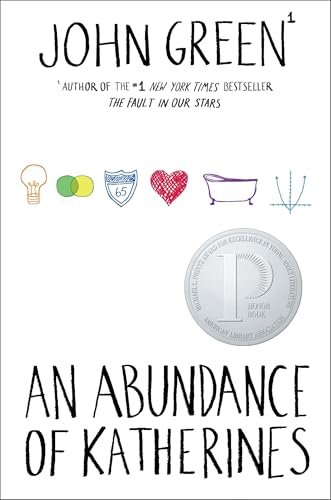
An Abundance of Katherines


Green, John. 2006. An Abundance of Katherines.

An Abundance of Katherines is about nothing and everything all at the same time. If it has a message at all, the message is that you write your own message, tell your own story. Our hero is recent high school graduate, Colin Singleton. And Singleton's problem is that he's single. He's got a long history of being the dumpee (as opposed to being the dumper). He's been dumped nineteen times--so he says--all by girls named Katherine. We first meet Colin after his nineteenth break-up.

Hassan is the best friend a half-Jewish boy could ever hope to have. (Did I mention he was Muslim?) He is Colin's sidekick. And their relationship--this friendship--is quite the motivating force behind the narrative. Two individuals who on their own might be a wee bit odd, but together they make a great team. A hilarious team. Colin is stuck within himself. As a person. He defines himself as the boy who's doomed to fall in love with Katherines and get dumped. That and he defines himself as a child prodigy (high I.Q) who's bound to grow up and NOT be a genuius, NOT matter. He defines himself as a failure. He hasn't found true love. He hasn't made a difference in the world. Half the time he doesn't even know if it's possible for his life to matter when it all comes down to it. He's stuck focusing on himself. All the time. Worrying about his future. Worrying about who's going to dump him next. Worrying if he's ever NOT going to be dumped.

Fortunately, Hassan wants Colin to get it. To learn that life is for living. So the two embark on a road trip. A road trip that soon takes an unexpected turn to an out-of-the-way town of Gutshot. There he meets Lindsay. A girl who while not a Katherine may just be the best thing that ever happened to him. Maybe. But first, he has to stop and ponder the meaning of the universe and write this unbelievably complex theorem on why his love life is so ridiculously awful.

First sentence: The morning after noted child prodigy Colin Singleton graduated from high school and got dumped for the nineteenth time by a girl named Katherine, he took a bath.

© Becky Laney of Becky's Book Reviews

Thursday, July 24, 2008

Paper Towns


Green, John. 2008. Paper Towns. October release.

Prologue opening paragraph: The way I figure it, everyone gets a miracle. Like, I will probably never be struck by lightning, or win a Nobel Prize, or become the dictator of a small nation in the Pacific Islands, or contract terminal ear cancer, or spontaneously combust. But if you consider all the unlikely things together, at least one of them will probably happen to each of us. I could have seen it rain frogs. I could have stepped foot on Mars. I could have been eaten by a whale. I could have married the queen of England or survived months at sea. But my miracle was different. My miracle was this: out of all the houses in all the subdivisions in all of Florida, I ended up living next door to Margo Roth Spiegelman.

First sentence: The longest day of my life began tardily.

My favorite quote: I spent the next three hours in classrooms, trying not to look at the clocks above various blackboards, and then looking at the clocks, and then being amazed that only a few minutes had passed since I last looked at the clock. I'd had nearly four years of experience looking at these clocks, but their sluggishness never ceased to surprise. If I am ever told that I have one day to live, I will head straight for the hallowed halls of Winter Park High School, where a day has been known to last a thousand years. (18)

Quentin Jacobsen, our narrator, has been trying to puzzle out the mystery that is Margo for years now. And as their senior year comes to a close, the mystery is only deepening as far as he's concerned. It all starts with a late night visit. Margo appears at his bedroom window asking Quentin to join her in some mischievous revenge--she needs his car, or rather she needs his mom's car. And Quentin, or Q as she calls him, would do anything and everything for this once-in-a-lifetime opportunity to spend some quality time with the girl of his dreams.

What happens that night and in the following weeks will shape Quentin in ways he never would--never could have--expected.

John Green's first novel, Looking for Alaska, won the Printz award in 2006. Green's second novel, An Abundance of Katherines, earned a Printz honor. And, of course, along the way he's picked up an enormous number of fans both through his books and his vlogging with the Brotherhood 2.0. (And though that's over and done with, more videos and blogging can be seen on the Nerdfighters Ning site.

Note: I'm reviewing an ARC, so keep that in mind when I'm pulling a few quotes out. They may or may not be the same as what makes it into the finished book that will be released in October.

Now for some Weekly Geeks Q&A fun:

Bart's Bookshelf asks, "I've not read any John Green, so have you a favourite quote/line from Paper Towns that best sums up the relationship of the main protagonists?"

I've already quoted a bit of this one. But here are two more that will give you a feel for the book:

"Margo always loved mysteries. And in everything that came afterward, I could never stop thinking that maybe she loved mysteries so much that she became one." (8)

"I smiled. She smiled. I believed the smile. We walked to the stairs and then ran down them. At the bottom of each flight, I jumped off the bottom step and clicked my heels to make her laugh, and she laughed. I thought I was cheering her up. I thought she was cheerable. I thought maybe if I could be confident, something might happen between us. I was wrong." (58)

Jennie asks, "Is Paper Towns everything that we've now come to expect from John Green? Because I'm DYING to read this one!!! Will I just be disappointed, so is my internal hype well-deserved?"

Yes. If you've followed his vlogging and come to love his personality just as much as his fiction, then you won't be disappointed. Green's personality shines through on this one. I haven't read An Abundance of Katherines yet, but this one is just as good as Looking for Alaska.

M. Molly says, "John Green said that Paper Towns was written as a response to Looking for Alaska. Do you see signs of this in PT? Also, does PT break out of JG's "Nerdy boy meets awesome girl who changes his life" equation (not that I mind it...)?"

Yes and no. In some ways the two books are similar. Two guys on the fringe of 'the-in-crowd' find a few wacky friends, two unforgettable girls to dream about and idolize, and thus "come of age". Both have humor and sarcasm in just the right amount. Both have their serious and meaningful layers. Where they differ, in my opinion, is in the mixing. Looking for Alaska is very bittersweet, very contemplative. And Paper Towns has this too. But it's not as bittersweet. It's a bit wackier than Looking for Alaska. Miles and Quentin are not mirror images or anything. Quentin has enough of a personality--as does his friends and dream-girl--to make this one unique. It is not Looking for Alaska part two. But if you boiled it down to the basics, it would have many of the same ingredients, just in different amounts.

Suey says, "I 2nd everything everyone's said about Paper Towns. Dying to know if it's like his others. Better maybe even?"

It's good. It's very good. I won't say I think it's the best, best, best book ever written. But it's definitely one of the better books I've read of YA published in 2008. It would make my top ten list--so far at least--for YA novels published this year. I can't say it's better necessarily. But I can say it met my expectations. I expected really good work, and it delivered. I was surprised by Looking for Alaska. I read it before it was published. It was his first book. I didn't know quite what to expect. And it just blew me away, I thought it was one of the BEST books of the year. So it's hard to match my enthusiasm and passion since with this one I went into with different expectations.

Melissa asks, "Trying to say something different about Paper Towns: how does it compare to his other two? Better? Worse? Different? Do you think that his style works well for the story? (I don't even know the story!)"

I think Green is great at coming-of-age stories about awkward guys who come into their own and get comfortable with who they are and what they want. And he's great at depicting the highs and lows of teen life. The best and worst and most embarrassing. He definitely is a great storyteller.

I haven't read An Abundance of Katherines, but I thought this one was just as good as his first one, Looking for Alaska.

Joy Renee asks, "I'm interested in the technique and art of storytelling itself so anything along that line would interest me. My questions are for any or all of the fiction titles in your list:

How was Point-of-View handled? Was there a single POV character or did it alternate among two or more. Was it always clear whose eyes and mind were filtering?

It was written in first person. And I think this was an effective way to tell a very personal story.

How does the title relate to the story? Was it fitting?" It was very fitting. I can't really go into it all here because it would contain spoilers. I think if you *know* ahead of time what the title is all about, then you might approach the book differently. It's best just to go with it and learn as the character grows.

© Becky Laney of Becky's Book Reviews

Thursday, June 26, 2008

Looks


George, Madeleine. 2008. Looks.
Start in the sky. Look down at the valley. Green, plush, peaceful landscape. Drop down a little, towards the town, then skim over it, past the low beige buildings of the university, the clean white spires of the Congregational churches, the flat green welcome mat of the town common, out towards the edge of town, towards Valley Regional High School, a rambling, one-story brick building surrounded by soccer fields, field hockey fields, football fields, parking lots. Hover above Valley Regional High. Watch the crowd of kids as it streams into the school like water sucked down a storm drain. And listen: Even from high up you can hear the hum of a school on the first day back in September.
Now drop, plummet straight down like a stone, through the pebbly roof and the air-conditioning ducts and the bundles of wiring and the soft acoustic tiles, until you burst into the teeming front hall of the school. Float up by the ceiling where you can take it all in, the blended smoothie of backpacks and T-shirts and freckled shoulders and tank tops, ponytails and crew cuts and hoop earrings and knotted leather necklaces. Wince at the noise, the crashing surf of screeching, laughing, yelling.
Now pivot, face the light blue cinderblock wall next to the main doors of the school. Someone is standing there, pressed into the auditorium door alcove, someone so huge and still she might be mistaken for a piece of architecture if it weren't for the sky blue windbreaker that marks her as human, the backpack sitting limply on the floor by her feet. Look at her. Nobody else is, but you look at her. Look at Meghan Ball. (1-2)
Meghan Ball, one of our two narrators, is obese. "Meghan Ball is at once the most visible and invisible person in school. In the obvious way, she is unbearably visible. She takes up the most space of any person in the entire school--in the entire town, in fact. She is impossible to overlook in class pictures or on the risers during chorus concerts--they always make her stand in the back row, where her round head hovers above a space big enough to accommodate three normal-sized kids. She has a back as wide as a basketball backboard, perfect for spitting on and pelting things at. In this way, Meghan is a walking bull's-eye target. But then, just when she feels like she can't get any bigger, when she's feeling brontosaurically huge and exposed, someone will walk right past her--right past her--saying something totally private they would never want anyone else to hear, just as if Meghan wasn't there at all--like right now, right this very second, watch." (3)

Heavy on descriptions and details, Looks examines high school life through two sets of eyes. Meghan, whom we've already met, and Aimee Zorn, a girl with an obvious eating disorder, a girl obviously in pain who is struggling with her life the only way she knows how: by controlling what goes in and out of her mouth and by writing poetry. In alternating voices, Looks explores most facets of high school life.

There are moments when the observations, the descriptions, are right on:

"It's amazing what people will say right in front of you when you're obese, like you're deaf or something, like you're retarded. Or like you don't even speak the language, like you're a tourist lost in the land of the thin." (5)

"The fat girl who loses her only friend sees, all at once, how everything works. She sees that all promises are fictions, all friendships are games with winners and losers. The fat girl left alone in the world sees that every human being has a value assigned to them that they are helpless to change no matter what they do, and she sees that people trade each other like baseball cards: three cheap friends for two valuable friends, a whole group of worthless friends for one popular friend. It's like dying and coming back to life, being a fat girl who loses her only friend; it gives you an insight into the people around you that the average person couldn't bear to have.
But if it doesn't break her, this insight makes the friendless fat girl strong. The fat girl left alone in the world becomes the ultimate outsider, and outsiders always know the insiders' secrets, because insiders don't care what's happening on the outside--they never check to see what the outsiders know. They usually don't even know who the outsiders are. The person on the bottom sees what's happening on top, the person at the back sees what's happening in front, the person on the outside sees what's happening at the center, and the fat girl who loses her only friend is under, behind, and outside all at once; if she cares to look, she can see everything in every direction. God must be a friendless fat girl, because only friendless fat girls are as omniscient as God." (144)
But for me, the narrative was too detached. The third person present tense which surprisingly blended seamlessly with passages written directly to address the reader (that would be second person plural???) just didn't work well for me all the time. I became impatient. I became annoyed. While I wanted to love this book--really wanted to love it--I found myself increasingly annoyed by a few things. Nothing major. But the fact that "the fat girl" was always "the fat girl" and sometimes the "friendless fat girl" or the "lonely fat girl" but hardly ever just Meghan was something that really really really really annoyed me. Fat wasn't only a label, it was the defining characteristic for Meghan. And that just doesn't sit well with me. I felt that a bit more fleshing out for all the characters was in order. I felt Aimee Zorn got the better treatment, better back story, more heart and soul. At the end of the book, I felt I still didn't know Meghan. She was still just the fat girl. She may be the fat girl who now has a friend. But still. I didn't feel that way with Aimee. I felt she was more developed as a character. This was her story. Fat girl was just there along to help skinny girl win the day.

Based on what reviews I've read, I'm alone in seeing that this one has a few flaws. Most seem to really really enjoy it. And it's not that I didn't enjoy aspects of it. But it seemed impersonal and detached in places. Unemotional even in a few spots. And while detachment doesn't make a novel good or bad or whatnot. It does make it slightly less satisfying. Would I recommend it? Yes. Other people seem to be enjoying this one a good deal. And the story is a good one even if it reads closer to a parable (is that the right word???) than an actual story.


Other reviews: Little Willow, Bookshelves of Doom, Sarah Miller, Teen Book Review.

Also of interest: Publishers' Weekly article, author's website.

© Becky Laney of Becky's Book Reviews

Saturday, June 07, 2008

The Red Necklace


Gardner, Sally. 2008. The Red Necklace.

This one was good, almost but not quite deliciously good. I think if I hadn't been reading for the 48 Hour Challenge, I could have savored this one a bit more. But even with my focus being a teeny bit distracted by the clock, I must say this one is good. It's historical fiction. It's set in France during the French Revolution. It features some magic-working gypsies. It's got some light romance. But mainly it is all about secrets, mysteries, and murders. Definitely got a dark vibe to it. There are some fantasy elements as well.

It's well written. It's very readable. The prologue:

This is Paris; here the winds of change are blowing, whispering their discontent into the very hearts of her citizens. A Paris waiting for the first slow turn of a wheel that will bring with it a revolution the like of which Europe has never known. In the coming year the people will be called upon to play their part in the tearing down of the Bastille, in the destruction of the old regime, in the stopping of the clocks. This is where the devil goes walking, looking with interest in at the window of Dr. Guillotine, who works night and day to perfect his humane killing machine, sharpening his angled blade on the innocent necks of sheep. Little does the earnest doctor know that his new design will be center stage, a bloody altarpiece in the drama that is about to unfold. But wait, not so fast, King Louis XVI and his queen, Marie Antoinette, are still outside Paris, at Versailles. This is the winter of 1789, one of the worst in living memory. Jack Frost has dug his fingers deep into the heart of this frozen city, so that it looks almost unrecognizable under its thick blanket of snow. All still appears as it should be. All has yet to break...
Isn't the UK book cover lovely? I think it's truer to the book than the American cover. (Though it is pleasing to the eyes as well.) My only problem is that about 70% of the book (at the very least) is narrated by Yann, a young boy who comes to age during the course of the novel.

Definitely recommended.


© Becky Laney of Becky's Book Reviews

Thursday, May 29, 2008

Rumors by Anna Godbersen


Godbersen, Anna. 2008. Rumors: A Luxe Novel.

It's sad (but in this case sad-but-true) when the best thing about a novel is the cover. Releasing (according to Amazon) on June 3, 2008, Rumors is the sequel to the largely delightful but lusty teen novel Luxe. (Read my review here.) The first novel I found to be a guilty but highly enjoyable indulgence. A soap opera in historical costumes if you will. But this second one was a huge disappointment. Don't hate me. I'm just being honest. I found it boring. Really really boring. The characters seem lifeless. It's one thing for characters to be fleshed-out stereotypes. It's quite another when even the superficialness of the stereotypes lack the appearance of the appearance of life. Penelope. Diana. Lina. They all lacked the spark of life, of interest. Never have I been so bored with a novel. That along with the ending, killed any pleasure I might have gotten from reading this one.

Rumors, for me, is such a contrast to the first novel, Luxe. Luxe had life. It sparkled with interest. I cared about the characters--for the most part--and I wanted to know what happened next. Unfortunately that interest didn't transfer over to the sequel. The characters that before I had found so interesting, so fun...now were as dull and lifeless and as pointless as could be.

Penelope wants Henry. Diana wants Henry. Henry wants Diana but won't go after her because of Elizabeth's so-called "death." Henry's friends tell him NOT to go after Diana. No one is happy. Everyone is manipulative or calculating. There are a few new characters introduced, but it wasn't enough to keep me interested in this mindless entertainment.


© Becky Laney of Becky's Book Reviews

Monday, May 19, 2008

See How They Run


Goodman, Susan E. 2008. See How They Run: Campaign Dreams, Election Schemes, and the Race to the White House. Illustrated by Elwood H. Smith. Bloomsbury USA. 96 pages.

If you're looking for a down-to-earth, straight-forward, reader-friendly guide to politics that is appropriate for children--probably eight and up if I had to guess--then look no further than Susan E. Goodman's See How They Run. Its engaging text (in combination with photographs, illustrations, and sidebars) makes a complex and often complicated subject a bit easier to digest. This would be a good example of what makes children's (or YA) fiction so accessible to adults. This subject (for most) could have so easily been dull and lifeless and difficult to wade through. But it isn't. It's accessible. It's well researched. It's interesting. Dare I say it--it's fun EVEN if you don't have an assignment due. I'm a big believer in I-didn't-know-that facts saving the day when it comes to nonfiction. And this book has plenty. Recommended for children AND adults.

© Becky Laney of Becky's Book Reviews

Friday, May 09, 2008

The Patron Saint of Butterflies

Galante, Cecilia. 2008. The Patron Saint of Butterflies.

The Patron Saint of Butterflies is good. It's not always a comfortable read. But it's good and powerful and memorable. Narrated by two young girls--Agnes and Honey--it is the story of two children (among many) growing up in a religious commune, a cult, if you will. Agnes, of the two, is the most devout, the most brainwashed by the leaders. Honey, unlike most of the others, has doubts on most days. Perhaps this is because Honey is not as accepted, not as loved, not as "important" as Agnes. Honey lives alone from the others. Maybe Honey has been inside the "Regulation Room" a few too many times to believe than any man who is that cruel could be holy. The two girls are very different, and sometimes they're more enemies than friends. But their lives are connected in more ways than one as the story unfolds.

Honey after a horrible beating is looking for escape, she finds that escape in Agnes' grandmother, Nana Pete, a yearly visitor to Mount Blessing. She tells her secret; she tells her truth hoping and praying that this kind woman will intervene, will stand up for what must be right. Honey is a good judge of character. The event that triggers their exodus, however, is an injury. Agnes' brother, Benny, needs medical treatment. His parents refuse. They trust in Emmanuel, their leader, to "heal" their son. Fortunately, this grandma isn't going to stand by and watch her grandson be treated thus...at the best, he'd just lose the use of his hand, at the worst he could very well die. She must act and quickly.

Honey, Agnes, Benny, and Nana Pete are soon on the road and seeking freedom. But not everyone wants to be free...

The book is intense and powerful and well written.

© Becky Laney of Becky's Book Reviews

Wednesday, May 07, 2008

Bronte's Book Club


Gregory, Kristiana. 2008. Bronte's Book Club.

Bronte's Book Club is a fun title that is just right for the eight to ten crowd. Bronte Bella has just recently moved with her family from New Mexico to California. Wanting to use the move to her advantage, Bronte is determined to make a new start. Typically shy and hesitant in the friend department, she wants more than anything to make a few friends before school starts in the fall. She's nervous but brave. After a few days in her new house, she's inspired to start a book club. A club that will meet every Wednesday for the rest of the summer. She makes fliers and hangs them up around town. But what Bronte realizes is that the perfect book club doesn't just happen overnight. Friendships don't happen overnight either. The book Bronte chooses? Island of the Blue Dolphins by Scott O'Dell.

Books. Friendship. Summer adventures. And snacks. This is perfect light reading for young readers.

© Becky Laney of Becky's Book Reviews

Thursday, January 04, 2007

Saint Iggy

Going, K.L. 2006. Saint Iggy.

Iggy Corso is a troubled teen. The truth is, he didn’t become troubled. He was born that way. With a mother addicted to drugs, he was born addicted too. Now as a sixteen-year-old, everyone expects him to be a trouble-maker, a drug addict, just like his no-good family. Living in the projects with his father who is drunk or stoned most of the time, he rarely sees his mother anymore. Although when he does, he knows she’s still as addicted to drugs and the druggie lifestyle. So it shouldn’t come as a big surprise that Iggy has a problem with authority figures. When he follows a ‘hot chick’ into a class that is not his own--he dropped it the first week of school--the teacher challenges him and accuses him of trying to assault her. What he really guilty of? Following a girl into a classroom, sitting down, trying to blend in, and answering sarcastically when the teacher asked why he was there. He’s not violent. He’s not prone to making threats. But because of who he is--his poverty stricken, drug-infested household--everyone always assumes the worst. SAINT IGGY follows his adventures and misadventures as this sixteen year old boy tries to get his life back on track. It’s not easy. It’s not pretty. It’s a harsh portrayal of drugs, crime, and violence.

Wednesday, December 13, 2006

Keeping God In Your Pocket

Grimes, Nikki. 2006. The Road to Paris.

Paris is a young girl whose never had a home of her own. Not really. Her mother's bad habits and taste in boyfriends/husbands has never created a healthy environment for a growing child. Paris and her brother, Malcolm, have been in dozens of foster homes over the years. Some were horrible, some were livable. But the truth of the matter is, even when they were physically provided for, they've never been loved. When the two run away from their current foster home where they'd been physically and verbally abused, the two flee to their grandmother's house. Surely in this chaotic world, grandma will have pity on them, right? Wrong. She gives them two days and then she's putting them back into the system. Only this time they're being separated.

Now Paris, lonely away from her brother, is nervous and unsure about her newest foster home. The Lincolns seem nice--really nice. There's an older girl--a teen--who's a foster child. And the couple has two sons both younger than Paris. But can Paris ever learn to trust and open up her heart? She just might because one of her 'brothers' David has just let Paris in on a secret to never being afraid: keeping God in your pocket.

Home was such a funny word. For most kids, home was where your mom and dad lived, where you felt safe, where the bogeyman was merely make-believe. Home was where you knew every square inch of the place by heart, where you could wake up in the middle of the night and know exactly where you were without opening your eyes. Paris didn't have a place like that. She didn't even have an address she'd lived at long enough to memorize, no single place that felt familiar as all that. Except maybe the city itself. For Paris, home was more a person, and that person was Malcolm. (30)

The next evening, when Paris and David were alone in the dining room setting the table, David said out of the blue, "I used to be afraid of the dark. And of the bogeyman, and of spiders--all sorts of things." "Really?" said Paris. "Really." "What did you do?" "I started keeping God in my pocket." "Huh?" "It's something my mom told me once. To keep God in my pocket." "I don't understand. How can God fit inside your pocket?" "No that's not it. It just means to keep God close, you know, like he's right there, in your pocket, close enough to call on, or to talk to. That's what I do when I'm afraid." "And that helps?" "Yup. Sure does." And that was all he said on the subject. But it was enough. It was something she'd never forget. (41)

She wasn't afraid anymore. Not of being beaten, or being locked in the closet. Not of the dark, or of never seeing Malcolm again, or of nobody wanting her. . .Paris could hardly recognize the fearless person she was turning into. . .She was learning to keep God in her pocket, and because she had him to talk to, she was beginning to have faith that she'd be all right. (103)

The Road to Paris tells the story of one girl's journey of healing and recovery. A lot can happen in a year. Life can become normal, an address can become more than numbers on a piece of paper, and family can become more than just a word in the dictionary. (145)

http://www.nikkigrimes.com/

Thursday, October 19, 2006

Defining New Ways To Be Stupid

Gerber, Michael. 2006. Freshman.

If you're worried about losing brain cells, don't bother picking up Michael Gerber's new book Freshman. It is 340 pages spent describing and defining new and old ways of being stupid and wasting one's life. Perhaps that wasn't his outset, I believe his intentions were to create a funny and lighthearted story about a guy and his dumb friends and what they like to do to waste their time their freshman year of college. But essentially there is no difference between the two. Guys might find it funny, I wouldn't know and couldn't begin to judge. But unless you're the kind of girl who laughs at the crudest, crassest humor--essentially 90% bathroom humor at that--then don't bother with Freshman. (If you find pee the most funny fascinating subject in the world, this is the book for you!)

Hart Fox is your average guy. He's smart, but not rich enough to go to the college of his dreams. Trip Darling is his enemy. The rich kid. The jock. The very definition of brainless. But Mr. Darling has a plan. He will pay for Hart to go to college IF he takes all of Trip's classes for him in addition to his own. But he's not a saint. He's running for political office. And his generosity doesn't include funds for living OR for books. But deluded into thinking college life at this particular college so incredible it would be worth doing anything even for his biggest enemy...he agrees.

Whan ensues is a rather long description of random events mostly centering on drinking, doing pranks, having sex, and to some extent going to school and studying--barely. But even at its highest moments where the book is enjoyable, it does not make up for the rest of the journey. Perhaps its weakest and stupidest moments are when Mr. Darling offers several fraternities the opportunity to KILL--literally kill--Hart Fox because he's won the election and he doesn't want him around. And then the reader is forced to read about one botched attempt after another.

The author's description of his book: It's school like it ought to be: loud, eventful, and full of swearing!

http://www.mikegerber.com/

Wednesday, September 27, 2006

A Mother's Legacy

Gantos, Jack. 2006. The Love Curse of the Rumbaughs.

Most people wouldn’t equate the word love with a curse. Love is a gift, right? Or is there such a thing as loving someone too much? Wanting to prove that horror stories don’t need “gothic” settings with harsh environments--like Mary Shelley’s Frankenstein--Jack Gantos sets out to prove that nothing is scarier than a psychotic mind convinced that its genetically cursed and free from guilt since it’s playing out its predetermined role set by nature. But be warned, The Love Curse of the Rumbaughs is not for the weak-hearted. (If taxidermy freaks you out, don’t even think about reading this book.) While I can’t say more about the book--I wouldn’t want to give away the ending--The Love Curse of the Rumbaughs is a book that I know will appeal to some readers. (I am not one of them!!!)

Tuesday, September 19, 2006

Spotlight on Laura Gallego Garcia

Laura Gallego Garcia won the prestigious El Barco de Vapor award at the age of twenty-one for her novel, Apocalypse, then won it again three years later for The Legend of the Wandering King. The author of fourteen published books, she is currently completing her doctorate in medieval literature at the University of Valencia. Laura lives in Alboraya, Spain. Two of her books have been translated and published in English.

About Laura Gallego Garcia
Official Laura Gallego Garcia site (in Spanish)
Spanish Lords, Swords, And Magic: An Article about Laura Gallego Garcia's work in Criticas

Garcia, Laura Gallego. 2005. THE LEGEND OF THE WANDERING KING. Translated by Dan Bellm. New York: Arthur Levine (Scholastic). ISBN 0439585562

As a young man, Walid (Wah-leed) ibn Hujr dreamed of being a great man, a great ruler, and a great poet. He wanted to be loved, admired, appreciated, and respected. And since he was born a prince, son of King Hujr ruler of Kinda (in Arabia), he thought his dreams would be easily attained—especially since many thought he’d been touched by a djinn at birth. (Djinn being a genie). However, Walid failed to consider what fate had in mind.

A gifted and beloved prince, Walid was certain that he was the best poet in Kinda. Wanting to earn his father’s approval to go to Ukaz to enter a poetry contest, he organizes a smaller poetry contest for the kingdom of Kinda—arrogance and vanity assuring him that his winning is a matter of certainty.

However, when a peasant man—a carpet weaver—Hammad ibn al-Haddad, wins the contest three years in a row, the once magnanimous prince becomes embittered and resolves to make the peasant pay for his superiority. He forces the peasant to leave his home, his wife, and his three sons (a merchant, a shepherd, and his youngest son who has not chosen a career yet) to become the kingdom’s archivist and historian. He is told he must read and organize the kingdom’s archives (library). The task is monumental and overwhelming. He begs for mercy, but none is given. Walid does grant him this, however, if he can organize the archives and weave him a carpet, then he can be free to return to his home.

After four years, a thinner and wearier man presents himself to the King—Walid’s father having died in the subsequent years. Walid is surprised, yet wanting to remain a man of his word, he adds a stipulation to his earlier request: he must weave a carpet “that will contain the entire history of the human race” (62). Hammad is subsequently driven mad on his quest to create such a carpet, but in his madness finds unusual peace. Even Walid notices the change in him and becomes scared of him noting that there was something not quite human about him now. Once when Walid visited him in his workshop, Hammad tells him mysteriously, “Know that you are a mere mortal who has unleashed powers more terrible than a mighty storm, and that as a mortal, you cannot stop their wrath. Not anymore. It is far too late” (73).

After considering these seemingly prophetic words, Walid decides to release the man from his “curse” and allow him to go home. He opens the door to discover him dead, collapsed on the floor, and the completed carpet. One look at the carpet and Walid becomes convinced that the old man spoke the truth; in shame and fear, he locks the carpet into his secret room. But his life (and destiny) is forever changed. His kingdom begins to fall apart. His soldiers, his servants, his household begins to distrust him. Betrayal seems inevitable.

In the middle of the night, a former friend and advisor slip into the palace with two companions their goal to steal the king’s treasure. Instead of silver or gold, they find a carpet. The king is awakened by a nightmare about the carpet—and so being a paranoid man—he decides to make sure the carpet is still locked away. He discovers that his dream is all too true, just in time to receive a club on the head. As soon as he awakes, however, he dashes off to the stables for a horse so he can pursue the thieves; he’s still dressed in his nightgown!

Since his plan was foolhardy—to begin a dash across the desert without any provisions—it’s no surprise when he collapses in the sand certain that his death is hours away. He is saved by a stranger, an outlaw. But this close-call with death won’t be his last.

THE LEGEND OF THE WANDERING KING is an adventure quest with unexpected twists and turns. As Walid sets out on his journey to recover the carpet and restore past wrongs, what he discovers is that it is never too late to change one’s self. It is an adventurous quest to restore and redeem his own life.

Set in Arabia in 6th century C.E., THE LEGEND OF THE WANDERING KING is an exciting adventure story with probing questions. Is there such a thing as fate? Can a man ever truly make amends for his past mistakes? Is a man defined by his mistakes? Can a person really change his character?

First published in Spain in 2002, THE LEGEND OF THE WANDERING KING has been translated into English by Dan Bellm. It is rich in pre-Islamic Arabic culture. An author’s note explains the time and culture which is depicted in the book. (Yes, the book is based loosely on a pre-Islamic legendary poet, Imru’l Qays.)

Garcia, Laura Gallego. 2006. The Valley of the Wolves.

I was first introduced to Laura Gallego Garcia's work when her book LEGEND OF THE WANDERING KING was published in English last year. When I saw she had another book translated and published, I was quite excited. LEGEND had thrilled me last year, and I was hoping for more of the same. There was something about LEGEND that was epic...it was beautiful...it was haunting...it was truly one of the best books I'd ever read. So perhaps I expected too much when I picked up THE VALLEY OF THE WOLVES.

The novel is fantasy. A young heroine is befriended early in her childhood by a playmate only she can see--a ghost--not that she'll know he's a ghost for quite a while. The two have a unique bond that makes it hard for her to relate to kids her own age. But her life, Dana is her name, changes when she is adopted by a mysterious sorcerer named Maestro. He takes her to live in a tower/castle which becomes surrounded by wolves at night. There she learns to become a sorceress. Her fellow companion--in addition to the ghost--is an elf. Not an ordinary elf, but a were-elf...who has the ability to keep the wolves from invading the tower.

Full of magic, VALLEY OF THE WOLVES moves quickly. She ages from 8 to 16 in two or three chapters. The Maestro remains ever-mysterious and untrustworthy. The truth is Dana doesn't know who to trust and who her allies are.

Perhaps the differences--besides subject matter of course--between The Valley of the Wolves and Legend of the Wandering King can be explained partly by the fact that Valley of the Wolves was one of Laura Gallego Garcia's earlier works written and published before Legend.