Showing posts with label foster care. Show all posts

Saturday, September 07, 2024

67. Tig

Tig. Heather Smith. 2024. 160 pages. [Source: Library] [MG Fiction??????? MG Realistic Fiction?????] [4 stars]

First sentence: We're different now, me and Peter. That's the thing about being left behind--it changes your whole being. It's like how abandoned animals stop trusting humans. They go wild and crazy and when they're rescued it takes ages for them to calm down, to love and be loved again. Don't get me wrong, Uncle Scott is a decent guy and Manny makes the best grilled cheese I've ever had. But me and Peter? We're still in the hissing and biting stage.

My thoughts (preview): I am SO conflicted on this one. I am. On the one hand EXQUISITE, beautiful writing. On the other hand, the trigger warnings this book needs is longer than a Walgreens receipt. No lie. Here's the thing just because real life can sometimes have ALL THE TRAUMA (and then some) does not mean that most/many readers in the [so-called] target audience are mentally and emotionally prepared for the trauma in the pages. That's why I'm conflicted. I don't want to deny that bad stuff happens to kids. I might be a horrible person to think that the real target audience should be adults who work with kids--teachers, librarians, principals, counselors, foster parents, etc. I can see why books like this exist, even perhaps need to exist, but should it be sorted as children's or middle grade???? [Goodreads lists both in the target age range]. 

Premise/plot: Tig (and Peter) have been "rescued" from a dangerous situation. They've been living on their own in a house without electricity for months ever since they were abandoned. Now Tig (and Peter) will be living with Uncle Scott and his partner, Manny, but Tig equates this new situation as fake, too good to be true. She trusts NO ONE, not even a little bit. With Peter by her stand she holds onto a bit of dignity but not a smidge of hope for a new beginning. 

My thoughts (continued): The novel is on the shorter side--which is good. I think it's a potent novel. The emotions are so concentrated, so focused, so negative, so raw, that I wasn't aching for a longer read. There are layers. There are twists and turns. This is one of those where knowing that actual-actual-actual plot would spoil too much. So yes, one can say oh it's about a girl living with her uncle and his partner...but beyond that, well, you can't talk about the plot or the characters or the character development. 

I am again so conflicted with this one. There are scenes that are so hard to read because of how disturbing the situations are.

Quotes: 

The sympathy on his face leaked out his pores and dripped on the floor. I put on my imaginary boots and splashed in his pity puddle. He got drenched. I stayed dry. My yellow raincoat matched my boots.

We didn't know when the hour was up because seconds don't hang around, they tick away, and it's not like you can collect them and count them up. Once they're gone, they're gone.

If you were a clean slate, you wouldn't be you. And knowing who you are, it kind of helps you, you know? It's what keeps you going.


© 2024 Becky Laney of Becky's Book Reviews

Tuesday, March 07, 2023

51. Lasagna Means I Love You


Lasagna Means I Love You. Kate O'Shaughnessy. 2023. 352 pages. [Source: Library]

First sentence: Dear Nan,
You died on a Tuesday.
Given how much you hated Tuesdays, it makes sense it would cement its place in history as the worst day ever.

Premise/plot: Mo Gallagher keeps a private journal in which she writes to her grandma. Mo is in for a tough time. Her Nan has died. Her Uncle Bill--who's in the military--is refusing to become her guardian. Mo is entering the foster care system. She's mourning the loss of just about everything. Everything seems to be in a constant state of change, change, and more change. But one thing Mo is holding onto with both hands is this idea of learning to cook, not only learning to cook, but learning to cook FAMILY recipes. It starts with a book she finds. She wants strangers near and far to share family recipes with her. She has a TikTok channel where she shares her cooking journey. She would love to find members of the Gallagher family to share *her* own *family* recipes. 

My thoughts: I wanted to like this one more than I liked it. It could just be my own head space. I liked it more than I disliked it. I can't really say why this was an 'almost' for me. I like how Mo uses cooking to cope with all the many challenges she's facing. I like how Mo is persistent. When a recipe proves tricky or difficult, she keeps trying and trying and trying until she's made something edible at least. It's a life skill for sure. This hobby is definitely shaping her character for the better. While Mo definitely has an easy time being successful and gaining followers and fans, Mo has a more realistic struggle with forming attachments in real life. I'm glad that not every single thing was 'easy' for her. There wasn't a case of instant-love when it comes to finding adoptive parents, foster parents, etc.


© 2023 Becky Laney of Becky's Book Reviews

Wednesday, October 07, 2015

Orbiting Jupiter

Orbiting Jupiter. Gary D. Schmidt. 2015. Houghton Mifflin Harcourt. 160 pages. [Source: Review copy]

Orbiting Jupiter is a great book: an emotional, compelling, coming-of-age story with an incredible focus on friendship and family and what it means to love someone.

Jack is the narrator of the book, and I absolutely loved, loved, loved him. I loved him from the start. Here's how the book opens: with Jack and his parents getting ready to welcome a very troubled boy into their home. Joseph, Jack's new foster brother, isn't like other eighth graders. He has a daughter he's never been allowed to see. He has a history of violence. And because of the institutions he's been in, he can freak out and overreact a bit. But Jack's family, well, they are good, solid, dependable, patient, heart-wide-open people ready to love and accept. From the day he walks into their home, they see him as family. And there's nothing Jack won't do to help his brother--sometimes that means giving him plenty of space, and not pushing him to talk, sometimes that means reassuring him that he's there for him, that he has his back, that he is not alone anymore.

But not everyone in the community is ready to welcome Joseph. In particular, some of the people at schools--some who should know better, others who probably don't--are not ready for Joseph. Some are openly hostile and just MEAN. Others treat him not as another human being, but, as a spectacle, a freak. But several teachers see through Joseph's past and come to really LOVE him and see that he's more than the choices he's made, that, he is in fact, really smart and capable of good. I both loved and hated the school scenes. There were a few times I was just so angry--like Jack--in Joseph's defense. And there were a few scenes I just found sweet.

Joseph's story slowly but surely unfolds, and, it is intense. I couldn't help liking Joseph and just caring for him and wanting the best for him.

Orbiting Jupiter is a bittersweet coming-of-age story that worked for me for the most part. But oh how I wish I could rewrite the ending! Not because this one doesn't feel good-enough or that it feels completely out-of-place, but, because it's just so achingly bittersweet.


© 2015 Becky Laney of Becky's Book Reviews
Friday, December 18, 2009

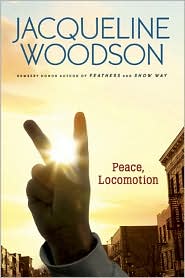
Peace, Locomotion (MG)


Woodson, Jacqueline. 2009. Peace, Locomotion. Penguin. 136 pages.

Imagine Peace

I think it's blue because that's my favorite color.

I think it's soft like flannel sheets in the wintertime.

I think Peace is full--
like a stomach after a real good dinner--
beef stew and corn bread or
shrimp fried rice and egg rolls.

Even better

Than some barbecue chicken.

I think Peace is pretty--like my sister, Lili.

And I think it's nice--like my friend Clyde.

I think if you imagine it, like that
Beatles guy used to sing about?

Then it can happen.

Yeah, I think

Peace can happen.

--Lonnie Collins Motion,
aka Locomotion
Peace, Locomotion is a wonderful novel, very beautiful. It's a companion novel to Locomotion--a novel that was a finalist in the National Book Awards. But I haven't read the first book, and I still was able to appreciate it. So I think it is able to stand alone. (Though reading this one made me want to read the other.)

Locomotion is a twelve year old boy in the foster care system. He is separated from his younger sister, Lili. She's in another foster home. They were not able to be placed together. But that doesn't mean that they've stopped loving (and needing) one another. The novel is his letters to his sister. They show how very much he loves her; how very important family is to him. The letters have it all--good, bad, happy, sad. They journal his emotions, his life.

A beautiful little novel about family, about life, and what it means to belong.

It is not a verse novel. Though the book does contain a few poems. (Lonnie considers himself to be a poet.) Definitely recommended!

© Becky Laney of Becky's Book Reviews

Tuesday, November 04, 2008

Shifty


Hazen, Lynn E. 2008. Shifty.

Here was a novel that surprised me. The cover didn't necessarily show much promise that I'd love it. And if it hadn't been nominated in the Cybils YA category, I might have missed this one. And that would have been wrong. Because I enjoyed this one. I did. The characters are flawed--very human--but the narrator, Soli, (a.k.a Shifty or Solomon) won me over...and quite quickly at that. He is a fifteen year old guy who is doing the best that he can. He's been in the foster care system for a while now--since he was a preschooler essentially--and it hasn't always treated him fairly. But the place he's at now...is the best he's ever known. And he'll do almost anything to stay there. Martha, his foster mom, may not be good at sticking to all the rules...but she sure does have a heart of gold. Soli isn't her only foster child. There is also Sissy and Chance. (Yes, those are their nicknames.) Chance is a baby that was born drug-addicted.

What can I say about this family? I cared. Martha. Soli. Sissy. Their story engaged me in a way that I wasn't expecting. Once I picked this one up, I didn't want to put it down again.

Other reviews: The Ya, Ya, Yas;
http://www.shiftythebook.com/
© Becky Laney of Becky's Book Reviews

Saturday, October 04, 2008

Impossible


Werlin, Nancy. 2008. Impossible.

If you haven't read one of Nancy Werlin's books...you really don't know what you're missing. Here are the books I have read (and loved): Rules for Survival, Double Helix, and Black Mirror. I can now add Impossible to the list. (If anyone is looking for books to read during the 24 Hour Read-a-thon, I'd definitely recommend Werlin!)

What can I say about Impossible? It's good. It's a page turner. It matches my high expectations in a Werlin novel. But that doesn't really do it justice, does it? Lucy Scarborough is our heroine. She's seventeen. It's spring. She's preparing for prom. Little does she know just how at risk she is to falling prey to the old-family-curse. A curse that she, of course, has no knowledge of. She's got her foster parents. She's got her best girl friend, Sarah, and her best guy friend, Zach. She's got a prom date, Gray. She's not quite carefree. She's a bit bothered that her birth mother, Miranda, has popped up in town again. Lucy always finds it hard to deal with her mentally ill, emotionally unbalanced, and homeless mother. But Lucy is full of hope for the future...

Back cover:

From the sting of my curse she can never be free Parsley, sage, rosemary and thyme Unless she unravels my riddlings three She will be a true love of mine

Jacket copy: Lucy has only nine months in which to break an ancient curse.

Lucy Scarborough is seventeen when she discovers that the women of her family have been cursed through the generations, forced to attempt three seemingly impossible tasks or to fall into madness upon their child's birth. How can Lucy succeed when all of her ancestors have tried and and failed? But Lucy is the first girl who won't be alone as she tackles the list. She has her fiercely protective foster parents beside her. And she has Zach, whose strength amazes her more each day. Do they have enough love and resolve to overcome an age-old evil? Inspired by the ballad "Scarborough Fair," this spellbinding novel combines suspense, fantasy, and romance for an intensely page-turning and masterfully original tale.


© Becky Laney of Becky's Book Reviews

Wednesday, June 20, 2007

What I Call Life


Wolfson, Jill. 2005. What I Call Life.

Cal Lavender knows only one thing: the life she is living now...it is not her life. It all started when her mom had an episode at the local library. Now Cal finds herself living in a group home, sharing a bedroom with other foster kids--none of them ‘normal’--and learning to knit from the Knitting Lady. This environment isn’t home. These strange people aren’t her family. She doesn’t know what to think about anything...but day by day she begins to piece together her life and come to some important conclusions. She’ll have to unlearn some habits, but she might just figure out this thing called life.

I, Cal Lavender, was definitely not myself. A fuzz brain, crying and whiny the night before. Definitely not me. But after I brushed my teeth, checked the mirror, and adjusted My Face for Unbearably Unpleasant and Embarrassing Situations, I felt more myself. Or at least as close to myself as an eleven-year-old can be when she is being forced to live not her real life. (44)

It can happen that way, can’t it?? One day, things are one way. And the next day, the life you are living, what you call life, changes forever. (105)

http://www.jillwolfson.com/

Monday, May 14, 2007

Evil Genius


Jinks, Catherine. 2007. Evil Genius.

Cadel Piggott is a genius. There’s no denying it. But that doesn’t always mean he makes smart decisions. The reader first meets the hero, Cadel, when he is seven years old. Already placed several grades ahead, he is a genius when it comes to everything but people. Alone. Isolated. Cadel rarely makes the effort to make friends. After all, his classmates have always been older than him. Significantly older than him. But luckily, Cadel has one person in the world he can talk to. One person who understands him. That person is Dr. Thaddeus Roth. This “counselor” who helps troubled youth takes a special interest in Cadel. But all isn’t what it seems as the story unfolds. Secrets. Lies. Half-truths. Plots. Schemes. Manipulations. Betrayals. Cadel isn’t always a likable hero, but his story is full of one adventure after another.

Read the rest of my review in May's issue of The Edge of the Forest. Also of note: I made the 'best of the blogs' section as well!

Friday, February 23, 2007

Tyrell


Booth, Coe. 2006. Tyrell.

I didn't know what to expect with Tyrell. Typically I pick up a book and get an impression of whether I'm going to like it, love it, or hate it. Not that my impressions are ever foolproof. I often prove myself wrong. I like to be suprised. Still, you can't help as a reader judging a book by its cover. Reading the back of the book, reading the flaps, reading other reviews...and compiling a first impression of sorts. I had heard some great things about the book. So I knew I wanted to read it. But I just want to say how impressed I am with this novel. It is a great book. It has done something that few books can do: create multiple characters in a love triangle that are all equally likable and that you can really relate to and understand their point of view.

Tyrell is a young man who has a lot of hard decisions to make. His father is in jail. His mother and his younger brother are depending on him to help them out of their difficult situation. At the moment, they are homeless and depending on the government to place them in shelters or housing. Their current environment couldn't get much worse. They are living in a run-down hotel that is roach-infested. We're not talking a few roaches now and then. We're talking major roach infestion. They're everywhere and in everything. There is no escape. There is no way to make their hotel room any cleaner. Any nicer. Set during the winter, this new placement is supposed to be temporary, but temporary turns into weeks. He has dropped out of school. He is trying to find a way to support his family that is legal--relatively legal--and not dangerous. He has a turbulent relationship with him mom at best because they disagree on so many things. For example, she doesn't care HOW he brings the money home. She would rather her son be a drug dealer or pimp or both instead of having to find a minimum job wage herself. She feels she is too good to do something menial. She also has no problem doing drugs, drinking, and leaving her young son (maybe seven or eight) at home alone for hours or even a day or so. Often, she'll disappear without warning Tyrell first. So he might be out visiting friends thinking his mom and brother are at home....only to return late that night or the next morning to find his brother has been there alone and scared. Tyrell's girlfriend is a big influence on him. She's his reason for living almost. He lives to love and protect her. But when the relationship begins to break down, he finds comfort and friendship with another girl. A girl who understands him. Who knows what it's like to have so much pressure. Who knows what poverty is like. Who knows about hard choices. Who doesn't judge him. Who doesn't preach at him to be different. To be better. Yes, Tyrell's life is all about hard choices.

Depicting multiple relationships (family, friends, love interests), Tyrell is a wonderfully human novel. Very well-written. Very enjoyable. These characters become people you know and care about.

Tuesday, February 13, 2007

Returnable Girl


Lowell, Pamela. 2006. Returnable Girl.

Ronnie Hartman is a troubled thirteen year old. Abandoned by her mother, rejected by her aunt and uncle, and passed around from foster home to foster home, she is unhappy, angry, bitter, and dishonest. Feeling that even being on her ‘best behavior’ isn’t good enough to get her a real home and family, she’s determined to be wild, reckless, and free. Obeying no one, living only for herself. She thinks love is the most risky thing you can do. Stealing and lying are nothing...but loving, trusting, being vulnerable. It’s foreign territory for her. Can her new foster parent break through to her before she makes a mistake she’ll end up regretting forever? Is there a way to reach her before she reaches rock bottom? RETURNABLE GIRL is a year in the life of an unforgettable narrator.

Returnable Girl has:

Won a place on
VOYA's TOP SHELF FICTION
FOR MIDDLE SCHOOL READERS 2007

WINNER
American Library Association
2007 Quick Picks for Reluctant Young Adult Readers

Been selected for the
Cleveland Public Library
Y READ PROGRAM 2007

Columbus Library TEENSCONNECT "Fearless Female" 12/06

http://pamelalowell.com/

Sunday, February 04, 2007

The Higher Power of Lucky


Ever wondered what it would be to grow up in a town with a population of 43 people? In THE HIGHER POWER OF LUCKY by Susan Patron, the reader gets a guided tour of life in a small, desert town by our young narrator...Lucky. Lucky isn't lucky. Not in the traditional sense at least. She hasn't hit rock bottom, and in fact, she thinks that might be her biggest problem. She knows from eavesdropping on all the various twelve step programs that you have to hit rock bottom before you find the 'higher power' you need to turn your life around. Lucky has never known her father. He divorced Lucky's mother before she was born. And Lucky's mother? You guessed it, has died tragically after a storm while taking a barefoot stroll when she stepped on a downed power line. Lucky's guardian is her father's ex-wife. His first ex-wife. Brigette was leaving in France--she is a French woman after all--when she got the call that her ex-husband needed her to come to California to raise his daughter from his second marriage. What was supposed to be temporary--just until she could be placed into a traditional foster care--became more long term. Thus the sign 'population 43' still rang true despite her mother's death. Readers are introduced to Lucky, Brigette, and a cast of townspeople...some quite colorful such as Miles who makes cookie runs each morning going from house to house to house--or business to business--begging for cookies. Like most books dealing with orphaned/abandoned children, Lucky spends a great deal of time wondering what will happen. Will Brigette adopt her? Will they stay in Hard Pan, California, despite the snakes and scorpions? Or will Brigette return to France and send Lucky into foster care?

The Higher Power of Lucky is the Newbery Award winner this year (2007). And while you almost hate to criticize an award-winner, I have to say that there are better books, more charming books even, on this topic that were written this past year. Foster care was a HUGE theme in 2006. The Road to Paris by Nikki Grimes and Home and Other Big Fat Lies by Jill Wolfson were excellent. Outstanding even. Just truly beautiful books. Different from each other. But wonderful in their own unique way. And I've read the two Newbery Honor books PENNY FROM HEAVEN by Jennifer L. Holm and HATTIE BIG SKY by Kirby Larson. Both of those books were outstanding. Great books. Books that I hope will become classics. But The Higher Power of Lucky doesn't seem like a classic or a future classic to me. It isn't outstanding. It's good. It's not a bad book by any means. But it's not a book that grabbed me. Of the four other books I've mentioned--The Road to Paris, Home and Other Big Fat Lies, Penny From Heaven, Hattie Big Sky--I've not only loved but I've been recommending to everyone I know. They're just so good that I can't stop talking about them. They're books I would want to read and reread and own. The Higher Power of Lucky was a good read once...but I'm not sure I'll ever have the need to read it again. So in conclusion, it's a fine book. There were enjoyable aspects of the book. But it is--to me at least--a forgettable book.

Saturday, February 03, 2007

A Way With Words

Wolfson, Jill. 2006. Home and Other Big, Fat Lies

Whitney is a narrator with a way for words. A foster kid all her life--from two months of age--she is as prepared as she'll ever be for her new foster home in the country.

Let's say you're a kid who's small for her age and some other kids who are way overgrown decide it would be the most hilarious thing in the world to shove the new kid in the house into the clothes dryer and slam it closed. I can tell you how to get out of that dryer by kicking and screaming bloody murder so that the foster mom with the bald spot on the top of her head rescues you in front of the entire snickering ha-ha-ha-ha-ha-ha house full of kids. I can also give you the complete rundown on the most common varieties of foster parents you're likely to run into. Like the look-on-the-bright side ones who go on and on until your head is ready to explode like a potato in a microwave about how lucky you are that you weren't born a foster kid in 1846. Or the one... (3).

Full of advice on how to survive the worst, she is unprepared to give advice on how to expect the best. Hope is a dangerous thing when you're a foster kid and Whitney doesn't want to take any chances on getting hurt.

When she arrives in her new home, in her new town, Forest Glen, she's more than a little restless. And when she throws up in front of her new family right off (minutes after getting out of the car) she's not off to the greatest of starts...

In case you ever need to know, here's what you do when you arrive at a new foster home and the foster mother is rude and you don't know the rules and you're laughing because you don't know what you're feeling and a psycho dog is waiting to attack and there's a kid there who hopes that you drop off the face of the planet: You don't knock. You open the door. And even though you know you don't belong here any more than you've ever belonged anywhere, you walk in like you own the place. (24)

Starting sixth grade in October isn't the easiest way for a new kid to transition, but Whitney does her best and doles out more advice:

Number one: Aim for immediate high noticeability. It doesn't matter what kind. Just get noticed. Be a soldier parachuting into the middle of a battlefield, landing in the muck with a big, fat smack of your shoes. Ta-da! I'm here! That's my style. Don't wait for them to sneak up and ambush you. They're going to call you a weirdo anyway, so be THE weirdo. Be it proudly...Like I said, you can get noticed or--strategy number two--you can let yourself be one of those faceless, gutless, voiceless kids and cross your fingers that you're off to your next foster home before anyone even notices you exist. By the way, I don't recommend the second choice. You will bore yourself to death. Besides, you might think that you're safe. But watch out. They'll find you. And then, you're dead meat. (50-51)

But Whitney's luck may have just changed. Suddenly, in this new school she finds out she's not alone. There are other kids in her class--five or six at least--who are all foster kids. It seems the whole school is full of foster kids. Kids who understand her. Who know the rules of how to survive. Who welcome her. Life has never seemed so good...but can it last???

I mentioned that Whitney has a way with words. I wanted to pull together some examples:

From her conversation with Honeysuckle and Josh--two of the foster kids in her sixth grade class--
Honeysuckle explained, "The social worker said that if Josh sets his mind to it, he can get into Stanford. Stanford's a big college. It's hard to get into." I drummed my fingers on the box [the box Josh is hiding in and has been hiding in since the beginning of the school year] "Must be one of those optometrist social workers." "Optimistic," Honeysuckle tried to correct. "No, optometrist. That social worker needs to get her vision checked." I turned back to Josh. "No offense, kid. This thing about getting into Stanford? It looks like you're having trouble getting through sixth grade." (90)

From her conversation with Striker, her foster brother
I told Striker that of all the members of the Nature and Ecology Club, I was the only one who hadn't been incriminated by him. "Intimidated," he said. "Incriminated means there's evidence that you're guilty of a crime." "I mean incriminated. You made everyone feel guilty just for being alive. (156)

http://jillhwolfson.blogspot.com/
http://www.jillwolfson.com/index.html

Saturday, January 06, 2007

The Mailbox

Shafer, Audrey. 2006. The Mailbox.

The Mailbox is an odd story of a young boy thrown about in the foster care program whose uncle and current guardian suddenly dies. The young boy in a state of shock does not know how to deal with his death. Doesn’t know how to cope. Doesn’t know what to do. How to respond. How to act. Who to call. So he does nothing. The next day he comes home from school to find the body gone and a note left in the mailbox. This unusual correspondence continues through much of the book until the authorities discover that this boy is living by himself with no adult supervision, guidance, or care. It is an odd story, but one that makes you think. Might pair well with Alabama Moon.

Wednesday, December 13, 2006

Keeping God In Your Pocket

Grimes, Nikki. 2006. The Road to Paris.

Paris is a young girl whose never had a home of her own. Not really. Her mother's bad habits and taste in boyfriends/husbands has never created a healthy environment for a growing child. Paris and her brother, Malcolm, have been in dozens of foster homes over the years. Some were horrible, some were livable. But the truth of the matter is, even when they were physically provided for, they've never been loved. When the two run away from their current foster home where they'd been physically and verbally abused, the two flee to their grandmother's house. Surely in this chaotic world, grandma will have pity on them, right? Wrong. She gives them two days and then she's putting them back into the system. Only this time they're being separated.

Now Paris, lonely away from her brother, is nervous and unsure about her newest foster home. The Lincolns seem nice--really nice. There's an older girl--a teen--who's a foster child. And the couple has two sons both younger than Paris. But can Paris ever learn to trust and open up her heart? She just might because one of her 'brothers' David has just let Paris in on a secret to never being afraid: keeping God in your pocket.

Home was such a funny word. For most kids, home was where your mom and dad lived, where you felt safe, where the bogeyman was merely make-believe. Home was where you knew every square inch of the place by heart, where you could wake up in the middle of the night and know exactly where you were without opening your eyes. Paris didn't have a place like that. She didn't even have an address she'd lived at long enough to memorize, no single place that felt familiar as all that. Except maybe the city itself. For Paris, home was more a person, and that person was Malcolm. (30)

The next evening, when Paris and David were alone in the dining room setting the table, David said out of the blue, "I used to be afraid of the dark. And of the bogeyman, and of spiders--all sorts of things." "Really?" said Paris. "Really." "What did you do?" "I started keeping God in my pocket." "Huh?" "It's something my mom told me once. To keep God in my pocket." "I don't understand. How can God fit inside your pocket?" "No that's not it. It just means to keep God close, you know, like he's right there, in your pocket, close enough to call on, or to talk to. That's what I do when I'm afraid." "And that helps?" "Yup. Sure does." And that was all he said on the subject. But it was enough. It was something she'd never forget. (41)

She wasn't afraid anymore. Not of being beaten, or being locked in the closet. Not of the dark, or of never seeing Malcolm again, or of nobody wanting her. . .Paris could hardly recognize the fearless person she was turning into. . .She was learning to keep God in her pocket, and because she had him to talk to, she was beginning to have faith that she'd be all right. (103)

The Road to Paris tells the story of one girl's journey of healing and recovery. A lot can happen in a year. Life can become normal, an address can become more than numbers on a piece of paper, and family can become more than just a word in the dictionary. (145)

http://www.nikkigrimes.com/

Thursday, December 07, 2006

Skate

Harmon, Michael. 2006. Skate.

No doubt about it, Ian McDermott is a troubled teen. A teen raising his brother who’s in fourth grade while their mother vanishes for weeks on end doing drugs and prostituting herself. This is a family in crisis. Searching for pocket change to feed himself and his brother is a daily chore. One of the heartbreaking scenes in the book is when the reader sees him with three dollars cash go to the store and buy a can of tuna and a box of tuna helper. He starts preparing supper and while it’s cooking they go for a skateboard ride in the neighborhood. The boys return to find their mother drugged out and her drug-dealer boyfriend eating their supper unrepentantly. When Ian says that was the only food in the house and he only has seventy cents to his name, his mother shrugs it off and the drug-dealer gets angry. Ian goes back to the store to buy a can of soup. He and his brother eat while hiding in the shed in the backyard while his mother and her drug-dealer do drugs all night. But his problems extend past his home life. His difficulties at school are mainly with the “authority.” He has an administration determined to transfer him if he’ll go quietly or expel him if he protests. His crime? He doesn’t “fit in” with the school’s image. He takes the second or third meeting with the administration relatively calmly. True, he’s angry and he says a few things he shouldn’t have said. But he’s on his way out. He knows that they won’t let him stay. But then he has a confrontation with one of the coaches. The coach is antagonizing him, provoking him, grabbing him. Ian loses it and hits him in the jaw. Then he’s gone. He runs. He flees picking up his younger brother on the way out of town. Now the boys are on the run from the law with very few friends and no cash.

Skate is the journey of a young man to the dark side and back. His determination NOT to be who people want him to be--a mindless street thug drawn to drugs and violence--is strong. His love for his brother is an incredible force. And the book as a whole is a reminder that you shouldn’t judge others based on appearances and first impressions. People can and will surprise you.