Showing posts with label "R" Titles. Show all posts

Tuesday, May 19, 2009

Radiant Darkness (MG, YA)


Whitman, Emily. 2009. Radiant Darkness. HarperCollins.

"Persephone, Daughter of Demeter, the harvest goddess. Kidnapped and forced to--"
Wrong! In every book of myths, the same; in every book, wrong!
Oh, I know it all got complicated because of the choices I made. I'm not trying to pretend I'm blameless. Still, after thousands of years, I wish people knew what really happened when I walked in my mother's flowering vale and the black horses landed, crushing flowers and filling the air with heady perfume. Just once I'd like to set the record straight.


Persephone narrates Radiant Darkness telling her version of how events went down. How she came to be the Queen of the Underworld. What can I say about this one? If you like Greek mythology--novelizations and retellings of mythology--then I think you'll enjoy this one. It's a tell of rebellion and frustration. Perspephone is the daughter of a goddess. And she's tired of it. Tired of her mother alternating between being domineering and controlling and being neglectful. Her mother is always off being worshipped. Off to this or that festival. Persephone feels the time has come. She's ready to be a woman. Ready to be accepted as one. The problem? Her mother treats her like she's six.

So when Persephone meets a tall, dark, handsome stranger, she's all for love. True, she doesn't know his name. True, he's mysterious. But he represents everything that is missing in her life. So she continues meeting him. Again and again. Until one day she learns the truth. He's a god. (Not a big surprise there, after all, her mother is a goddess.) But he's the god of the underworld. If she chooses him, she'll be leaving everything behind. Is she ready to make that choice? To live with her consequences?

© Becky Laney of Becky's Book Reviews
If you're reading this post on another site, or another feed, the content has been stolen.

Wednesday, April 08, 2009

Travel the World: Australia: The Reformed Vampire Support Group


Jinks, Catherine. 2009. The Reformed Vampire Support Group.

Interesting cover and premise. But only moderately pleasing (to me). Nina is a vampire. She's been a vampire since 1973. She's been trapped in a teenagers body for what seems like forever. Nina in her own words, "The plain fact is, I can't do anything much. That's part of the problem. Vampires are meant to be so glamorous and powerful, but I'm here to inform you that being a vampire is nothing like that. Not one bit. On the contrary, it's like being stuck indoors with the flu watching daytime television, forever and ever." (5) Nina and her vampire family don't sparkle, thank goodness, but they're also not fast or strong or powerful. These vampires are nothing like what you read about; instead we find them weak, sickly, powerless, resigned to their oh-so-boring lifestyles. But when one of their own ends up dead--turned to ash--the threat becomes a little too real and pushes them all out of their comfort zones and somewhat unwillingly into an adventure all their own. For what they find is that someone--a stranger--is onto them. Suspects that they are vampires. And is out to kill them "for the good" of mankind. Can they convince this unknown threat that they're no threat?

I was only moderately entertained by this one. The plot seemed a bit too flimsy for me. The storytelling too clumsy. At one point, the author interrupts the action sequence to spoil her own mystery. Something that I found a bit weird and definitely unnecessary. I mean why work up any suspense at all if you're just going to tell your readers the secrets before reaching what should be the climax and explain every little clue away before the "big reveal" that turned out to be mostly deflated by that point.

© Becky Laney of Becky's Book Reviews
If you're reading this post on another site, or another feed, the content has been stolen.

Wednesday, December 24, 2008

Ringside, 1925


Bryant, Jen. 2008. Ringside, 1925: Views from the Scopes Trial.

I'll keep this one short. And I mean it. Something about this one just didn't work for me. Maybe it was the fact that it was in verse. (Verse novels sometimes exist when they should just be prose. And nobody--but the author perhaps--know why they're in verse in the first place.) Maybe it had too many narrators to suit me. (I liked one or two of the narrators, but there were just too many in this case. All the shifting P.O.V's annoyed me. Maybe if it had been told in two--or just one for that matter--I would have liked it better.) The title says it all: Views From the Scopes Trial. It's historical fiction. It's based on fact. It's got multiple voices represented. If you're interested in the Scopes Trial and/or you're interested in American history in general, then you might want to seek it out. It may work for other readers. It may even work well for others. But not for me. Reading is subjective after all. So still give this one a chance if you come across it. You could end up liking it much more than I did.

Read Sarah Miller's review for a really positive spin on the novel that will completely balance mine out.

© Becky Laney of Becky's Book Reviews

Sunday, November 23, 2008

Regency Buck


Heyer, Georgette. 1935. Regency Buck.

"Newark was left behind and the post-chaise-and-four entered on a stretch of flat country which offered little to attract the eye, or occasion remark."

Georgette Heyer was a wonderful writer. A beloved writer, in fact, known for her regency romances in particular. Her books are rich in detail--but not in a burdening, cumbersome way. And her characters are always nicely drawn from human nature--flaws abound, but that's always a good thing. Vices and temptations abound in her works--drinking, gambling (be it at the gaming table or in a sporting arena), keeping bad company, and fashion to name just a few examples. (How is fashion a vice? Well, if you're too vain or selfish and spend too much time primping in front of a mirror, then chances are you're in for a comeuppance. Also, spending too much money on fashion--clothes, hats, gloves, jewelry, etc.--is just one way it can be a vice.)

In Regency Buck, we've got the story of a brother and sister newly arrived in London. Peregrine Tavener, the brother, and his older sister, Judith Tavener. They are coming to set up house, and perhaps even more importantly to meet their guardian. (Both of their parents have died. And the father's will left them under the care of Lord Worth.) They are expecting an older gentleman. A man that would have been the contemporary of their father. Someone with gout presumably. What they find is that Lord Worth is a young man--just a handful of years older. He isn't particularly pleased with this added responsibility, and he's not shy admitting this to his wards. But for one year at least--until Judith's birthday--Lord Worth is their official guardian.

The Taveners do set up their own house. Mrs. Scattergood, a relation (cousin???) of Lord Worth, is Judith's companion. Needed during that time to protect young women and provide them with counsel on how to behave in society. An older woman to act as chaperone. Of course, Peregrine, offers protection to his sister as well. But who's protecting him? Peregrine being prone to gambling and partying. When Peregrine becomes engaged to a young woman, Harriet, then a few strange coicidences occur to threaten his life which convinces Worth that someone is out to kill his ward.

The two stand to inherit much money when they come of age. And for this reason, suitors abound for Judith's hand. One of her most persistent suitors is her cousin, Bernard Tavener. But Lord Worth turns them all away. Saying that no man will marry her while he is still her guardian. Something that both repulses and pleases her. She's known some of the men are completely unsuitable--some as old as her father, all looking for a wealthy wife--but the idea of being controlled by a man irritates her at the same time.

Worth (Julian) and Judith (whom he persists in calling Clorinda) are always bickering. The banter flows easily between these two. While both tend to be a bit cranky around the other, the reader knows without any doubts that these two secretly feel very differently about each other.

I love Worth and Judith. I love the rich-layers of Regency Buck as well. For example, Judith's reading of Sense and Sensibility. And the presence of Lord Byron and the discussion of his poetry. There are a dozen or so other things I could point out, but those are just two examples of bits that made me smile.

© Becky Laney of Becky's Book Reviews

Monday, September 15, 2008

The Road Of Lost Innocence


Mam, Somaly. 2008. The Road of Lost Innocence: The True Story of a Cambodian Heroine.

Powerful. That is one of the best words to describe this heartbreaking memoir of Somaly Mam. Here is how it begins,
"My name is Somaly. At least that's the name I have now. Like everyone in Cambodia, I've had several. Names are the result of temporary choices. You change them the way you'd change lives. As a small child, I was called Ya, and sometimes just Non--"Little One." When I was taken away from the forest by the old man, I was called Aya, and once at a border crossing, he told the guard my name was Viriya--I don't really know why. I got used to people calling me all sorts of names, mostly insults. Then, years later, a kind man who said he was my uncle game me the name Somaly: "The Necklace of Flowers Lost in the Virgin Forest." I liked it; it seemed to fit the idea of who I felt I really was. When I finally had the choice, I decided to keep that name as my own. I will never know what my parents called me. But then I have nothing from them, no memories at all." (1-2)
The book is compelling, gripping, raw and intense, straightforward, and above all else heartbreaking. Her story is powerful in that she survived despite it all; amazing in that she had the courage and strength to go back, to face her demons; inspiring in that she had the determination and heart to do something--to make a change, to become a hero, to take a stand.

Hers is the story of an unloved child. A child broken, beaten, abused and misused in countless cruel ways by the adults in her life. The story of how she was raped, sold into prostitution, endured the unimaginable--years of prostitution against her will, thousands of rapes, thousands of beatings, unimaginable punishments by the brothel owners if she didn't "perform" to their satisfaction. A story that is heartbreaking not only for what she endured, but for what everyone around her endured as well. She was not the only one. She wasn't one of few. This treatment, this abuse, this cruelty, this horror is common. Her story highlights just how abominable and cruel and evil humanity can be. The lack of humane treatment. The lack of justice. The lack of compassion. The lack of human decency and respect.

"It's still happening, today, tonight. Imagine how many girls have been raped and hit since you started to read this book. My story doesn't matter, except that it stands for their story too, and their stories are why I don't sleep at night. They haunt me." (61)

Somaly Mam was able to escape her life of prostitution--though it wasn't easy, though it left her scarred emotionally and psychologically. And after a time--with a little help and support, with some training and a boost in confidence--she was able to face her past and make the decision that would change lives. She'd return (with her husband) to her home country to make a change. To seek out those girls that just like her were sold into prostitution, that were abused daily, that were unloved, unwanted by their families, their society.

"I don't feel like I can change the world. I don't even try. I only want to change this small life that I see standing in front of me, which is suffering. I want to change this small real thing that is the destiny of one little girl. And then another, and another, because if I didn't, I wouldn't be able to live with myself or sleep at night." (129)

This book is heartbreaking to read, but I feel it is important. Definitely recommended.

http://www.somaly.org/

© Becky Laney of Becky's Book Reviews

Monday, August 18, 2008

Rapunzel's Revenge

Hale, Shannon and Dean. 2008. Rapunzel's Revenge. Illustrated by Nathan Hale.

Rapunzel's Revenge is a graphic novel. A great graphic novel of an empowered and spunky Rapunzel who's on a quest for revenge. Really there are no words for how much fun this one is. It does begin in a familiar way, "Once upon a time, there was a beautiful little girl..." and it is loosely based on the fairy tale...but most of the story is original and fun and wonderful. The book really begins to take off when Rapunzel rescues herself from the tower. One of the first things she does is meet her "adventuring hero" who would have rescued her...not. Here's how that exchange goes:
Rapunzel: Ow! What in the--
Would-be-hero: Are you all right?
Rapunzel: Oh...am I...am I all right? Well I was until someone shot my new pet pig. I was going to call him Roger.
Would-be-hero: You're welcome! All in a day's work. I'm an adventuring hero.
Rapunzel: Well, It's nice to meet you. It's nice to meet anyone, really. Can you give me directions to--
Would-be-hero: I was getting so bored watching the workers farm my fields all day. So I left behind the civilized comforts of Husker City, following tales of a beautiful maiden trapped in a high tower.
Rapunzel: Oh! That's so noble of you to come all this way to help her.
Would-be-hero: Yes, noble is a good word for me. I can't actually rescue her, of course. The word is she's Mother Gothel's pet and I won't risk crossing the old lady. But I can tell her I'm going to rescue her. She's bound to be too naive to know the difference, and it'll be such fun in the meantime!
Rapunzel: Oh.
Would be hero: So, tiny ragamuffin, as payment for saving you from that rampaging beast, you may point the way to her mystical tower.
Rapunzel: Uh, yeah, the tower is a huge tree just back that way, but...but she's slightly deaf. If you keep calling out, she'll hear you. Eventually.
Would-be-hero: Excellent! And I'm off.
Rapunzel: Remember to yell as loud as you can!
Narrator: This is where the "once upon a time" part ends, with yours truly finally free from that perpendicular prison.
But Rapunzel's story is far from over. And her adventures have just begun. I loved the story. I loved the style. I loved the illustrations.

I loved this one!!!

Other reviews: Fuse #8, Bookwyrm Chrysalis, BookMoot, Melissa at Estella's Revenge, and others I'm sure...

© Becky Laney of Becky's Book Reviews

Monday, August 11, 2008

Ruby's Imagine


Antieau, Kim. 2008. Ruby's Imagine. September 2008 release.

First sentence: A Butterfly the color of my name did tell me that a Big Spin was coming our way.

Ruby, our narrator, is a teen girl with a unique way of seeing the world, a unique way of talking. Let's just say--long story short--that she likes Capital Letters. (I can imagine that this will irritate some readers.) Her own way of speaking does set her apart from others in her New Orleans community, and it irritates the dickens out of the woman who is raising her, Mammaloose, her grandmother. "Mammaloose never hears my words as glad tidings. She says I is constantly putting a target on myself by using my Ruby words." (2) But her best friend, a young guy named Jacob Lazarus, JayEl sees it differently. He appreciates her in a way only a best friend can. One other thing I should mention, Ruby speaks with "Flying People" and "Rooted People." She has a very hands-on approach to nature, and loves to converse with the trees and plants and insects and birds.

Here's just a snippet so you'll see what I mean about Ruby's voice:
I walked the place where I lives--I calls it my Garden of Neighbors--down toward JayEl's Daddy's Corner of Happiness Store. Some people talks about what ward they lives in. I don't do that. I heard Mammaloose once say that calling where you lives a ward make you sound like you living in some kind of institution. I can only be agreeing with her. I says I is a citizen of the Earth and right now I be living in a place somewheres between the old oak next to the yellow-two-story and the gum tree out front of the pale green double shotgun. I lives in the place where the wisteria dips over the fence to hold hands with the magnolia that dips down to say hello to the Place Where My Vegetables Grow. That's where I lives. (11)
Ruby likes to give unique names to all the people and places in her life. In a limited way, I suppose, you could call Ruby a modern-day Anne of Green Gables.

When the book opens, Ruby has just been warned--by a butterfly, though later warnings come from other animals--that a "Big Spin" is on its way. That danger is coming. Danger with a capital D. And Ruby does warn a few folks as the days pass, but it isn't until the radio and TV start talking about a hurricane--a big hurricane--Hurricane Katrina--that folks really start listening. But listening doesn't mean acting, not necessarily. Ruby and her friends--some by choice, some not so much--do end up braving the storm right where they are, in their own homes.

And it is when the storm hits that Ruby's Imagine transitions from a slightly-irritating, slightly jarring book to a true page-turner. The more intense the action--the storm and its aftermath--the more "normal" Ruby becomes. Her speech, her thoughts, change and shift. In the heat of the moment at least, Ruby is too focused on surviving, on clinging to her friends and family, to "bless" the readers with her uniquely capitalized take on the world around her.

The second half of the book is a page-turner. It is here that the action begins to happen. Here where characters begin to develop, begin to matter. Here where family secrets get thrown to the surface. The book loses some of its foolishness and gets down to business.

The book--especially the second-half--is interesting and worth reading. It's not flawless. I can imagine some readers will feel *elements* of the story to be a bit unbelievable, a bit too coincidental. But at the same time, those elements feel good even if they're not quite credible. I can't go into details of exactly what I mean because it would spoil the story. But if you've read it, you'll probably be able to guess what I'm referring to.

I really really enjoyed Mercy, Unbound.

© Becky Laney of Becky's Book Reviews

Sunday, August 10, 2008

The Redheaded Princess


Rinaldi, Ann. 2008. The Redheaded Princess.

The Redheaded Princess. What can I say about this one? It's a fictional novel--for teens--about Princess Elizabeth. The novel opens when she's a child and she's still estranged from her father, King Henry VIII. The novel closes with the death of her sister, Queen Mary, a.k.a Bloody Mary. In between, there are many ups and downs along the way. Her semi-reconciliation with her father and his newest and latest wife, Katharine. Her relationship with her half-brother, Edward, the boy who would become King (and did in fact become King) yet who never really "reigned" on his own. Too young. Too sickly. Her very, very strange relationship with Thomas Seymour. Her turbulent relationship with her older half-sister, Mary.

Elizabeth's life was strange. No doubt about it. Never knowing her mother, only really hearing about how she had "bewitched" the King into divorcing his wife. She was presented to the girl as a whore and a witch. Someone dangerous to imitate. She had a distant relationship with her father. Sometimes in favor and in court, other times forgotten and left to fend for herself in the country. Not that she was alone. She had her servants, her friends, her tutors. But still. Without parental guidance let's say. And she didn't have normal family relationships with her brother and sister either. When one sibling has the power of life and death over the others, the power to imprison, things can get messy very very quickly.

The plotting. Oh the plotting. The scheming. It seems that there was never an end to the number of people who wanted to use these three children as pawns to gain favor, esteem, wealth, and power. Manipulations. Trying to turn the family against one another time and time again.

The religion. I wonder if readers grasp just how big this Catholic versus Protestant issue was back in the day. Where being one or the other could cost you your life. To realize just how opposing and judgmental they were of one another. It is hard, I think, for readers to grasp until they've studied the era, studied the writers of that time period. This was really and truly life and death stuff. And believers had to be ready to die for how they chose to worship. For how they viewed the sacraments.

Anyway, if you're already familiar with the Tudors, with Henry VIII and his children (Mary, Elizabeth, Edward), then you won't learn much more than you already know. If you're not that familiar, this would be a nice place to start.

This novel would be a good companion to Rinaldi's previous novel, Nine Days A Queen: The Short Life and Reign of Lady Jane Grey.

The real question may be how does this one compare to Carolyn Meyer's series on the Young Tudor women.
Mary, Bloody Mary. Doomed Queen Anne. Patience, Princess Catherine. Beware Princess Elizabeth. And the answer to that would be purely subjective.

© Becky Laney of Becky's Book Reviews

Thursday, August 07, 2008

The Resistance


Malley, Gemma. 2008. The Resistance. (September 2008 Release) This book is the sequel to The Declaration.
Overhead lighting, harsh, bleak and uncompromising, shone from the ceiling down into the small room like a prison guard's searchlight, picking out every speck of dust, every mark on the cheap carpet, every smudged finger on the window sill. It was a room which, Peter suspected, had been used for many purposes; the ghosts of its former inhabitants clung to it like cobwebs.
'Tell me how Peter is. Tell me what he's been thinking about lately.'
Peter looked into the eyes of the woman sitting in front of him and sat back in his chair, circling his ring around his finger, the only possession he'd been found with as a baby.
The chair was padded, obviously intended to make him feel comfortable, to put him at ease, but it wasn't working. He rarely felt comfortable; Anna said it was because he liked to make things difficult for himself, but he wasn't sure. He figured that it just wasn't in his nature to feel too comfortable. Comfort made you lazy. Comfort was the easy option.
(1)
Peter, Anna, and Ben are all technically legal now. All technically allowed to exist in society. All potentially eligible to sign The Declaration and begin taking the wonder-drug Longevity when they come of age. But will they? Could they? Ben is just a baby. His thoughts don't enter into the book at all. But for Anna and Peter there is a great dilemma. Do they become part of the society they hate? Do they assimilate with their former enemies? Do they turn their back on who they once were? Forget all they know about what it is really and truly like to be illegal, to be "a burden." To be a Surplus.

Peter and Anna are living as a couple. Young as they are, they seem to be more than just playing house with one another. There's Ben to look out for. And children of their own to start planning for. This need to procreate, to produce offspring of their own, is fundamental to who they are, to their cause. At least to Anna's cause. (If having a baby is a slap in the face to the powers-that-be, then Anna wants a dozen.) Each want to resist. Each want to play a role in the ongoing struggle between the current authority and the underground resistance movement.

Peter is getting ready to try something risky. Very risky. He's going to join the workforce, join the enemy--Pincent Pharma. He's going to accept the job his grandfather offered him. His goal is to learn how things work and leak that information back to the Underground.

We meet new characters in The Resistance. And we learn more about this world and how it operates. We learn more secrets. I won't go into all that here. It's best not to know too much going into it after all. What fun would it be to have the mystery out in the open too soon?

Anna's character seems a bit unbelievable to me. She seems a bit too certain, a bit too mature. A bit too comfortable at her new role. She's young--fifteen maybe sixteen--and she has the responsibilities of keeping her own house (cleaning, cooking, washing, etc), of having a husband (relationship issues, sex), and of being a mother to her brother who is only a year old. That plus the emotional/mental baggage she should be carrying around from her days as a Surplus. Anna seems a bit too put together to come from this reality. Granted, all of this know-how could have been drilled into her at Grange Hall so that it is in fact easy for her to manage it all and then some. Maybe this no-stress, no-pressure, no-complaining has been a part of her brain's programming. Could be. But there is no whining about how hard life is. How difficult it is to do it all...and on her own for most of the time since Peter is at work so much. Ben must be the best behaved baby in the world not to cause any stress or worry or frustration.

320 pages.

The quote is from the ARC, so there might be some differences between this and the final edition.

© Becky Laney of Becky's Book Reviews

Saturday, July 05, 2008

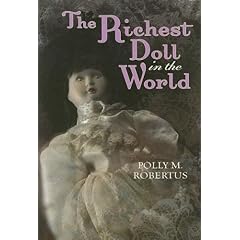
The Richest Doll in the World


Robertus, Polly M. 2008. The Richest Doll in the World.

The flap on this one called it an "exciting, spooky tale that will appeal to anyone who has ever loved a doll." I'm not so sure. The good news? It's short. And the print is large. The bad news? I didn't like many (if any) of the characters.

This is a holiday-based mystery for the 8 to 10 crowd. Emily is an orphan living with her grandmother, Grandma Rose. When the story opens, we see Emily whiningto her Grandma begging her to let her go with her to work. Emily wants to go with her because she's super-curious about her Grandma's 'crazy' employer, Mrs. Bigley. More to the point, she's super-curious about Mrs. Bigley's doll, Delilah. It's the only thing in the world that she could ever ever want for Christmas. But Grandma won't let her go. She wants to keep her job. And Mrs. Bigley is not mentally or emotionally stable enough for visitors. But Emily refuses to take no for an answer. And she follows her grandmother secretly. Super-spy she is not. Emily didn't really realize how cold and how dangerous and how foolhardy this whole plan was to begin with.

I don't really want to say too much more. It'd be a contest to see who was more annoying as a character--Mrs. Bigley or Emily. But needless to say I think someone has been praying for Grandma Rose to have patience--lots and lots of patience.

Spooky? Slightly. Exciting? Hardly. More spooky than exciting. It's definitely darker than most doll books. It'd be a question for the individual reader how much the book redeems itself in the end.

© Becky Laney of Becky's Book Reviews

Saturday, June 07, 2008

The Red Necklace


Gardner, Sally. 2008. The Red Necklace.

This one was good, almost but not quite deliciously good. I think if I hadn't been reading for the 48 Hour Challenge, I could have savored this one a bit more. But even with my focus being a teeny bit distracted by the clock, I must say this one is good. It's historical fiction. It's set in France during the French Revolution. It features some magic-working gypsies. It's got some light romance. But mainly it is all about secrets, mysteries, and murders. Definitely got a dark vibe to it. There are some fantasy elements as well.

It's well written. It's very readable. The prologue:

This is Paris; here the winds of change are blowing, whispering their discontent into the very hearts of her citizens. A Paris waiting for the first slow turn of a wheel that will bring with it a revolution the like of which Europe has never known. In the coming year the people will be called upon to play their part in the tearing down of the Bastille, in the destruction of the old regime, in the stopping of the clocks. This is where the devil goes walking, looking with interest in at the window of Dr. Guillotine, who works night and day to perfect his humane killing machine, sharpening his angled blade on the innocent necks of sheep. Little does the earnest doctor know that his new design will be center stage, a bloody altarpiece in the drama that is about to unfold. But wait, not so fast, King Louis XVI and his queen, Marie Antoinette, are still outside Paris, at Versailles. This is the winter of 1789, one of the worst in living memory. Jack Frost has dug his fingers deep into the heart of this frozen city, so that it looks almost unrecognizable under its thick blanket of snow. All still appears as it should be. All has yet to break...
Isn't the UK book cover lovely? I think it's truer to the book than the American cover. (Though it is pleasing to the eyes as well.) My only problem is that about 70% of the book (at the very least) is narrated by Yann, a young boy who comes to age during the course of the novel.

Definitely recommended.


© Becky Laney of Becky's Book Reviews

Thursday, May 29, 2008

Rumors by Anna Godbersen


Godbersen, Anna. 2008. Rumors: A Luxe Novel.

It's sad (but in this case sad-but-true) when the best thing about a novel is the cover. Releasing (according to Amazon) on June 3, 2008, Rumors is the sequel to the largely delightful but lusty teen novel Luxe. (Read my review here.) The first novel I found to be a guilty but highly enjoyable indulgence. A soap opera in historical costumes if you will. But this second one was a huge disappointment. Don't hate me. I'm just being honest. I found it boring. Really really boring. The characters seem lifeless. It's one thing for characters to be fleshed-out stereotypes. It's quite another when even the superficialness of the stereotypes lack the appearance of the appearance of life. Penelope. Diana. Lina. They all lacked the spark of life, of interest. Never have I been so bored with a novel. That along with the ending, killed any pleasure I might have gotten from reading this one.

Rumors, for me, is such a contrast to the first novel, Luxe. Luxe had life. It sparkled with interest. I cared about the characters--for the most part--and I wanted to know what happened next. Unfortunately that interest didn't transfer over to the sequel. The characters that before I had found so interesting, so fun...now were as dull and lifeless and as pointless as could be.

Penelope wants Henry. Diana wants Henry. Henry wants Diana but won't go after her because of Elizabeth's so-called "death." Henry's friends tell him NOT to go after Diana. No one is happy. Everyone is manipulative or calculating. There are a few new characters introduced, but it wasn't enough to keep me interested in this mindless entertainment.


© Becky Laney of Becky's Book Reviews

Sunday, May 18, 2008

The Road


McCarthy, Cormac. 2006. The Road.

When he woke in the woods in the dark and the cold of night he'd reach out to touch the child sleeping beside him. Nights dark beyond darkness and the days more gray each one than what had gone before. Like the onset of some cold glaucoma dimming away the world. His hand rose and fell softly with each precious breath. He pushed away the plastic tarpaulin and raised himself in the stinking robes and blankets and looked toward the east for any light but there was none. In the dream from which he'd wakened he had wandered in a cave where the child led him by the hand. Their light playing over the wet flowstone walls. Like pilgrims in a fable swallowed up and lost among the inward parts of some granitic beast. Deep stone flues where the water dripped and sang. Tolling in the silence the minutes of the earth and the hours and the days of it and the years without cease. Until they stood in a great stone room where lay a black and ancient lake. And on the far shore a creature that raised its dripping mouth from the rimstone pool and stared into the light with eyes dead white and sightless as...

I'm mean aren't I? But I wanted to hook you. In case you aren't already familiar with the premise, The Road, is the story of a father and his son. This isn't quite your typical father-son bonding story, however, it's the story of a father and son trying to survive on earth after horrific and massive catastrophes have torn everything and everybody apart. We're not told where, when, how, or why. We just see the fragments and remnants of the world as it now is. Ash. The cities especially are covered in ash. It's implied that a few years at least--maybe longer--have passed since IT happened. It is now near impossible to find food by rummaging cities and towns--stores and homes--any and every structure. And the few people they meet are dangerous for the most part. (If you've read it you know just WHAT I mean.) But the boy and his father are on their way, scavenging as best they can. The father is trying to make it to the east coast. I presumed it was the southern east coast though I could be wrong. I don't remember now if I just assumed that or if it said it out right. So don't take my word on that little detail. The key thing is that they're on a journey, they're on "the road."

I won't say much more than this. I don't think I need to. It's an emotional journey you take along with them. It's got it all. And it's certainly one I won't be forgetting.

© Becky Laney of Becky's Book Reviews

Wednesday, February 21, 2007

Raider's Night

Lipsyte, Robert. 2006. Raider’s Night.

First of all, I should probably mention that I am not really a sports person. So I checked out RAIDER’S NIGHT without really reading what it was about, I chose it simply because it made the Librarians’ Choices 2006 list. So when I read that it was a book about football players doing drugs and taking steroids, I was skeptical at best. But it is a well-written novel. If a writer can make me look past the fact that most of the action occurring revolves around sports--whether it is playing, training, or talking--then it is saying something. Seriously. So I was pleasantly surprised that I got anything positive from this novel. Now I know there are many people--adults and teens--who would seek out a sports related novel on purpose. They would actually like it because of the content instead of in spite of the content. But let me begin. Matt Rydek is one of the captains on his football team. It is his senior year, and as the school year approaches he is more than ready for the upcoming season. True at one time he would have preferred playing baseball to football, he has found something he excels at. Thanks to a little help from a fitness trainer who keeps him and his team well supplied with prescription painkillers and steroids. But as training season begins, Matt has no idea what is ahead of him. When his co-captain--an obnoxious jerk--Ramp rapes (with a baseball bat) one of the sophomore students newly transferred to the school and the football team, Matt is one of the senior witnesses. And perhaps more importantly, as captain of the team he bears the responsibility of seeing that justice is done. The rest of the players were blindfolded. Thus begins Matt’s ethical and moral dilemma. Does he ruin the team’s season before it really even gets a chance to begin? Does he throw away his opportunities to impress college scouts? Does he let down the whole team? the whole administration? the whole student body? Does being a team player mean looking out for the whole team? or for each member of the team? As his selfishness wages war with his conscience the reader is along for the ride. What are the consequences of staying silent? And what will happen if he comes forward?

Tuesday, February 13, 2007

Returnable Girl


Lowell, Pamela. 2006. Returnable Girl.

Ronnie Hartman is a troubled thirteen year old. Abandoned by her mother, rejected by her aunt and uncle, and passed around from foster home to foster home, she is unhappy, angry, bitter, and dishonest. Feeling that even being on her ‘best behavior’ isn’t good enough to get her a real home and family, she’s determined to be wild, reckless, and free. Obeying no one, living only for herself. She thinks love is the most risky thing you can do. Stealing and lying are nothing...but loving, trusting, being vulnerable. It’s foreign territory for her. Can her new foster parent break through to her before she makes a mistake she’ll end up regretting forever? Is there a way to reach her before she reaches rock bottom? RETURNABLE GIRL is a year in the life of an unforgettable narrator.

Returnable Girl has:

Won a place on
VOYA's TOP SHELF FICTION
FOR MIDDLE SCHOOL READERS 2007

WINNER
American Library Association
2007 Quick Picks for Reluctant Young Adult Readers

Been selected for the
Cleveland Public Library
Y READ PROGRAM 2007

Columbus Library TEENSCONNECT "Fearless Female" 12/06

http://pamelalowell.com/

Saturday, February 10, 2007

Rules of Survival

Werlin, Nancy. 2006. The Rules Of Survival.

Okay, I admit it. This is the first Nancy Werlin book I’ve ever read. But it won’t be my last. Since reading The Rules of Survival a week or so ago, I’ve read Double Helix and Black Mirror.

The Rules of Survival is a powerful first person narrative of a young boy’s troubling life in an abusive home. As the oldest child, as the ‘man’ of the house, he felt responsible from an early age for the well being of his two younger sisters Callie and Emmy. Their mother was wild, unpredictable, emotionally unstable, verbally abusive, and sometimes physically abusive as well. Fear is something he knows inside and out. His life is ruled by fear.

Matthew’s Rules of Survival:
1) Sometimes, the people who mean you harm are the ones that say they love you.
2) Fear is your friend. When you feel it, act.
3) Protect the little ones.
4) If you coped before, you can cope now.
5) Always remember: In the end, the survivor gets to tell the story.


It is a story told retrospectively. Our narrator, Matthew, has aged from twelve or thirteen to the age of 18. As he’s preparing for college, he’s trying to sort out the last few years and make sense of everything that has happened. It’s a chronicle of his healing process.

Powerful. Emotional. Great writing.

Wednesday, December 13, 2006

Keeping God In Your Pocket

Grimes, Nikki. 2006. The Road to Paris.

Paris is a young girl whose never had a home of her own. Not really. Her mother's bad habits and taste in boyfriends/husbands has never created a healthy environment for a growing child. Paris and her brother, Malcolm, have been in dozens of foster homes over the years. Some were horrible, some were livable. But the truth of the matter is, even when they were physically provided for, they've never been loved. When the two run away from their current foster home where they'd been physically and verbally abused, the two flee to their grandmother's house. Surely in this chaotic world, grandma will have pity on them, right? Wrong. She gives them two days and then she's putting them back into the system. Only this time they're being separated.

Now Paris, lonely away from her brother, is nervous and unsure about her newest foster home. The Lincolns seem nice--really nice. There's an older girl--a teen--who's a foster child. And the couple has two sons both younger than Paris. But can Paris ever learn to trust and open up her heart? She just might because one of her 'brothers' David has just let Paris in on a secret to never being afraid: keeping God in your pocket.

Home was such a funny word. For most kids, home was where your mom and dad lived, where you felt safe, where the bogeyman was merely make-believe. Home was where you knew every square inch of the place by heart, where you could wake up in the middle of the night and know exactly where you were without opening your eyes. Paris didn't have a place like that. She didn't even have an address she'd lived at long enough to memorize, no single place that felt familiar as all that. Except maybe the city itself. For Paris, home was more a person, and that person was Malcolm. (30)

The next evening, when Paris and David were alone in the dining room setting the table, David said out of the blue, "I used to be afraid of the dark. And of the bogeyman, and of spiders--all sorts of things." "Really?" said Paris. "Really." "What did you do?" "I started keeping God in my pocket." "Huh?" "It's something my mom told me once. To keep God in my pocket." "I don't understand. How can God fit inside your pocket?" "No that's not it. It just means to keep God close, you know, like he's right there, in your pocket, close enough to call on, or to talk to. That's what I do when I'm afraid." "And that helps?" "Yup. Sure does." And that was all he said on the subject. But it was enough. It was something she'd never forget. (41)

She wasn't afraid anymore. Not of being beaten, or being locked in the closet. Not of the dark, or of never seeing Malcolm again, or of nobody wanting her. . .Paris could hardly recognize the fearless person she was turning into. . .She was learning to keep God in her pocket, and because she had him to talk to, she was beginning to have faith that she'd be all right. (103)

The Road to Paris tells the story of one girl's journey of healing and recovery. A lot can happen in a year. Life can become normal, an address can become more than numbers on a piece of paper, and family can become more than just a word in the dictionary. (145)

http://www.nikkigrimes.com/

Tuesday, December 12, 2006

More Fun With Rash

I know it's rare for me to devote two blogs to the same book. But I loved RASH by Pete Hautman so much that it was just too hard to pick and choose.

Hautman, Pete. 2006. Rash.

Yesterday I described Rash, but today I want to bring you the author's spin on RASH:

What do smoke-free restaurants, seatbelts and airbags in cars, and bicycle helmets have in common?

Fifty years ago none of those things existed. People smoked cigarettes everywhere--even in hospitals. Cars had no seatbelts or airbags. And any kid dorky enough to wear a helmet while riding a bicycle would have been laughed off the street.

Today, Americans are safer than ever. Accidents, violence, and disease are way, way down. Every year we get safer and safer...and safer...

That's good, right?

I wonder. Being safe is good--to a point--but I sometimes think we are so obsessed with safety we miss out on much of what life has to offer. I mean, if you wanted to be really safe, you would eat nothing but oatmeal, kale and lentils. You would never play contact sports, or ride a skateboard, or go for a hike in the mountains, or speak to a stranger, or drive a car, or give birth to a child...or do much of anything at all.

What if this safety trend continues? What will it be like in another fifty years? How safe do we want to be? Will sneezing in public be considered assault? Will tricycles have airbags? Will overweight people be sent to forced-labor diet farms? Will kitchen knives bear warning labels? (Caution: This implement can cause cuts!) Will french fries be as illegal as crack cocaine?

Thinking about these things was what led me to write Rash , a sometimes funny, sometimes not funny book about a teen growing up in the "United Safer States of America," circa 2074, when pedestrians wear walking helmets, football has been banned, verbal abuse is a misdemeanor, and obesity is a felony.

And because just about everything is illegal, nearly 20% of the population is in jail, where they provide the manual labor that keeps the USSA running.

Bo Marsten, like his imprisoned father and brother, has trouble following the rules. Rash is his story.


http://www.petehautman.com/rash.html

And just for fun, here are some more quotes:

From Bo's History Quiz:

Which of the following crimes were legal prior to 2023?
a) alcohol consumption
b) private ownership of large dogs
c) hunting
d) public defecation
e) driving without a safety web
f) boxing
g) chain saw possession

I had no idea. Every one of the crimes listed struck me as outrageous. It had to be a trick question. I answered: None of the above. (19)

About 'Reading' and 'Novels':

We were studying the ‘novel’ a twentieth-century media format that nobody under the age of sixty cares about anymore. Novels are long documents containing nothing but page after page of black font on a white background: no photos, no graphics, no animations, no audio. Gramps had a whole bookcase full of them in paperback form. He once tried to get me to read one called The Adventures of Huckleberry Finn. I tried but couldn’t make any sense of it. The paper pages felt strange and dry and crisp and like they were sucking all the moisture from my fingertips. Later I found out that the book was banned, so it was just as well I never read it. The novel we were reading for Mr. Peterman’s class was called Harry Potter and the Power Stone, an abridged and updated version of a book that was popular in the late twentieth century. Gramps claimed to have read it when he was eight years old. He said it was better back then. It had a different title, and in the original version some characters actually died. (34)


About Freedom:

There was a time in America when people talked a lot about freedom. It was a big deal back in the 1700s during the American Revolution, and it was a big deal during the Civil War, and in all the other wars. People wrote songs about freedom. America was a place where the most important thing was to be free to make your dreams come true. But people don’t talk about freedom as much as they used to. At least that’s what Gramps says. Most people are more likely to say, ‘what good is freedom if you’re dead?’
I think the change started when our life spans increased. Back in the mid 1900s people only expected to live about sixty or seventy years. But by the end of the millenium most people were living well into their eighties and nineties, unless they had an accident of some sort. People started wearing bicycle helmets and eating organic food and doing other things to fend off a premature death. A hundred years ago people would say to themselves ‘I’m only gonna live seventy years, anyway. What’s the big deal if I smoke a few cigarettes and croak at sixty-five?’ But when it became possible to make it to one hundred, well, folks weren’t so quick to throw those years away. They started taking care of themselves. By the time the 2030s rolled around, researchers at Philip Morris Wellness Center had developed the Telomere Therapies, which increased everybody’s life span by at least another twenty or thirty years--maybe more. Theoretically, unless you caught some horrible virus or poisoned yourself with drugs or walked in front of a suv or choked on a pretzel, you could live forever. Gramps said, ‘I think the country went to hell the day we decided we’d rather be safe than free.’ (59-60)

Monday, December 11, 2006

Rash


Hautman, Pete. 2006. Rash.

Rash by Pete Hautman is an enjoyable novel that is unique in many aspects.

I pledge Allegiance to the Flag of the Safer States of America and to the Republic for which it stands one Nation under Law with Security and Safety for All

Set roughly in the 2070s, Rash provides readers with a clever and imaginative look at the future. Opening, in my opinion, with one of the greatest first lines I've ever read: "Gramps, who was born in 1990, once told me that when he was my age the only way to wind up in prison in the USSA (back when it had only one S) was to steal something, kill somebody, or use illegal drugs" (3). But times have changed quite a lot since then as our hero Bo Marsten finds out.

"Back then there were five of us Marstens serving time: my father, my brother, two cousins, and an aunt. . .Most people don't like to talk about their jailed family members. It's embarrassing. But having five close relatives in the prison system is not that unusual. According to USSA Today, 24 percent of all adults in this country are serving time. My family was only slightly more criminal than average. . .Of course without people like us Marstens, there wouldn't be anybody to do the manual labor that makes this country run. Without penal workers, who would work the production lines, or pick the melons and peaches, or maintain the streets and parks and public lavatories? Our economy depends on prison labor. Without it everybody would have to work--whether they wanted to or not." (4-5)

Bo continues: "Anyway, here's my point: Given my family's history I should have known to keep an eye on my temper. Lose control for one tiny chunk of time and bam--next thing you know you're ripping the legs off shrimp. But at the time...Well, if you look at history, you will see that I was not the first guy to do something really stupid over a girl. Look at how many Greeks died for Helen of Troy. How much self control do you think they had?" (5-6)

Maddy Wilson. The girl who started it all. At least from Bo's perspective. When Bo sees Maddy getting a bit too friendly with the guy he dislikes, Karlohs, his natural reactions lead him into trouble. True, modern readers won't 'understand' what was so wrong with the altercation. After all, no physical violence occured. But in the 2070s, hurting another's feelings by name calling can be just as dangerous according to the law. Judge for yourself: 'She doesn't want anything to do with a pretentious droog like you,' I said, getting right in his face. 'So leave her alone, okay? I don't want your disgusting dog-anus mouth anywhere near her, understand?' Karlohs staggered back as if he had been struck. I felt a moment of satisfaction followed immediately by a sick feeling. I knew I'd gone too far, even though it was true--his mouth really did look like the south end of a beagle. But verbally attacking someone's physical appearance is a class three misdemeanor. Then I watched as Karlohs's eyes went glittery and his anus lips spread across his face in a smile. I picked up my helmet, turned, and walked away with a lead weight in my belly and a prickling on the back of my neck. I already had two violations on my record. Three strikes and you're out. (14-15)

His sentence is handed down several chapters later: "Because I had refused to offer a plea, the judge reviewed my case and my record, asked me a few questions, then handed down an instant judgment: Guilty, guilty, guilty, guilty, guilty, guilty. She sentenced me to three years, let that sink in for a few seconds, then suspended the sentence and told me I could go home. . . You have been tried, judged, and sentenced. However, I am waiving the requirements that you serve your sentence. You will remain free so long as you commit no further criminal acts between now and your nineteenth birthday. . .At the moment you remain free at the pleasure of this court. In other words, the next time you get in trouble, you will be incarcerated. One more verbal assault, one more reckless act, one more instance of self-neglect, and it's off to the rock pile" (68).

It doesn't take a genius to predict that it would practically impossible for a sixteen year old boy to control his temper 24 hours a day, 7 days a week, for 3 years. And sure enough, when he sees Karlohs Mink with his arms around Maddy at the local mall...his brief glimpse of freedom and a future fade away in rage.

Now Bo is being sent away to Prison 387 owned by the McDonald's Rehabilitation and Manufacturing Corporation and located in Canada after all "since the USSA annexed Canada during the Diplomatic Wars of 2055" most of McDonald's prison factories were moving up north.

According to Gramps, McDonald's used to only sell food, back when French fries were legal. But in the 2020s, they merged with a suv company called General Motors under the name the McMotor Corporation of America. A few years later, McMotor was bought by a Chinese company called Wal-Martong. In 2031, during the Pan-Pacific conflict, Wal-Martong was nationalized and privatized by the USSA government and renamed the McDonald's Rehabilitation and Manufacturing Corporation. I guess I learned something in school after all. For all the good it would do me. For the next three years, I would be a worker drone for McDonald's. They would use me however they saw fit, and there was nothing I could do about it. (86-87)

Prison 387 made frozen pizzas for McDonalds. You are no doubt aware of the retro craze for hand-tossed pizza. Until recently most people thought of pizza as just another old-fashioned grandma/grandpa food, like oatmeal or hamburgers. Most towns still have one or two old-fashioned pizzerias that cater to the geriatric crowd, but nobody I knew ate the things until recently, when Keanu Schwarzenegger told PeopleTime magazine that he enjoyed a hand-tossed, hand-topped sausage pizza during breaks on the movie set. That's how these things get started. (102)

But the lessons Bo learns about life, friendship, pizza, and football--which is also illegal by the way--open up his eyes to a whole new world. Prison life may not be easy, in fact it could be deadly, seeing as to how polar bears prowl around the fences of the prison, but Bo must learn to cope and adjust. And as he does so, the reader is taken on a very enjoyable journey.

http://www.petehautman.com/

Friday, November 17, 2006

The Runaway Princess


Coombs, Kate. The Runaway Princess.

Although the cover art is not appealing, Kate Coombs first novel for children, The Runaway Princess, is a charming, entertaining read about one princess’ determination to win her own hand in marriage. In the kingdom of Greeve, the prime minister convinces the king that his daughter is old enough to be married to an eligible prince. And, he asserts, that having a contest for princes to enter would help the economy of Greeve and at the same time rid the country of some of its unpleasant inhabitants--a witch, a dragon, and group of bandits. Choosing the word of his prime minister over that of his wife and daughter, the king announces the contest and the prize at a banquet.

Meg, the princess, hears the news not from her parents privately but in front of the entire kingdom. Anger doesn’t even come close to describing her reaction. Locked away in a tower until the contest’s conclusion, Meg worries about what her father has unleashed on the kingdom. Evil princes are on the loose...if only there was a way she could escape and warn the witch, the dragon, and the bandits. Teaming up with her friends, mostly servants both male and female, Meg escapes the tower and does just that. On a mission to win the contest herself and protect the kingdom against the recklessness of greedy princes.

All the usual characters are presented in THE RUNAWAY PRINCESS, the princess, the princes, the ‘evil’ witch, enchanted frogs, fire-breathing dragons, etc. But Coombs comical take on the traditional fairy tale is unforgettably charming. Readers expecting the novel to end in the trite “and they lived happily ever after...” will be disappointed to discover that instead it is “once upon a time there was a princess who knew she was meant for more than twirling her tresses and swooning” (279).

Related books...
Levine, Gail Carson. Ella Enchanted.
Hale, Shannon. The Princess Acadamy.
Hale, Shannon. The Goose Girl.