Showing posts with label "R" Authors. Show all posts

Wednesday, February 04, 2009

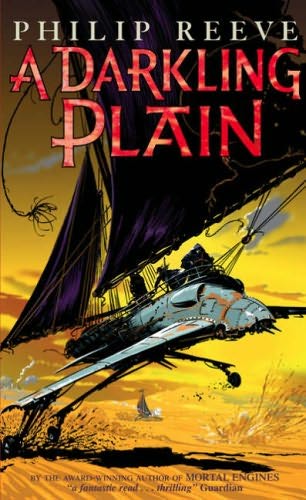
Travel the World: England: A Darkling Plain


Reeve, Philip. 2006. A Darkling Plain. (The Hungry City Chronicles #4). HarperCollins. 559 pages.

Theo had been climbing since dawn; first on the steep roads and paths and sheep tracks behind the city, then across slopes of shifting scree, and up at last onto the bare mountainside, keeping where he could to corries and crevices where the blue shadows pooled.

I don't know if A Darkling Plain was all that much longer than the previous three books in the Hungry City Chronicles, or if it just felt like it. The book is a direct sequel to Infernal Devices. In many ways this is where it all happens, where it all goes down. All the books leading up to this point, this big showdown between warring powers. More action, less set-up. And action is good, right? But here's the thing, I personally liked the less climatic but funnier books which set this one up. That's just me.

There are so many characters--some we've known all along like Stalker Grike, Tom Natsworthy and Hester Shaw; others are newer to us like Wren Natsworthy, Fishcake, and Theo; some have been renamed like Lady Naga; others are completely new. (And let's not forget my personal favorite, Pennyroyal). And the plot is so complex. I'm not even going to try to go there. Needless, to say the "fate" of Earth is to be decided upon in this final book in the Hungry City Chronicles.

I will spend a few minutes, however, trying to convince you that you should read the series for yourself. I liked this series for the most part. The characters were well done. No character was all good or all bad. Most of the 'bad' guys had something about them that made them just a smidgen likable. If not likable, at least understandable. I don't know about you, but one of the things that drives me crazy is when bad guys are bad for no reason. When writers fail to develop these villainous characters, when they expect us to buy into the idea that they're evil incarnate pure and simple and without any humanity at all. The characters are complex. And that's a good thing. No where is that truer than in the case of Hester Shaw, a true love-to-hate, hate-to-love mess of a character. We're conflicted because she's conflicted. The characters are also memorable. Good, bad, or somewhere in between, I don't think I'll be forgetting Pennyroyal or Grike anytime soon. I liked the humor. Yes, this was serious end-of-the-world type drama, but there were enough purely funny moments that it was a delight to read. Mind you, I wouldn't want to live in this world! Bad things can and do happen. The books also had plenty of action and drama. I'm not all-about-action, I'm more character driven than plot driven...but I know plenty of readers who want fast-moving plots--action and adventure and danger and the like. This book had it and then some.


© Becky Laney of Becky's Book Reviews

Friday, January 23, 2009

Predator's Gold


Reeve, Philip. 2003. Predator's Gold. HarperCollins, 325 pages.

Freya awoke early and lay for a while in the dark, feeling her city shiver and sway beneath her as its powerful engines sent it skimming across the ice. Sleepily, she waited for her servants to come and help her out of bed. It took her a few moments to remember that they were all dead.

Predator's Gold is the sequel to The Mortal Engines. It continues the story of Tom and Hester; it's been two years since the destruction of London and the pair's close call. Never wanting to lead a dull life--well, Hester sure doesn't!--the two are always seeking one adventure after another. And adventure is what they find when their fate leads them to the city of Anchorage. Anchorage, like London, is a city on the move. Though to clarify, they're not seeking to destroy other cities, they want merely to survive. Led by a young teen girl, Anchorage has seen better days and then some.

This is a completely new adventure with mostly new characters. It was fun. It was funny. Much funnier than The Mortal Engines. Just the way the story is written--the narrative style--is comical. Such as the names he has for his characters. They're just really something. Completely unique. I guess you'll have to take my word on that!

One of my favorite things about Predator's Gold was the introduction of Professor Nimrod B. Pennyroyal, an alternate "historian" who tells stories of his encounters with the American natives Machine Washable, Allow Twelve Days For Delivery, and Zip Code. Then again, I also liked the very minor character of Widgery Blinkoe and his five wives. And Caul, that little burglar with a big heart, was a pleasure to get to know.

There was so much to love. It's entertaining and satisfying.

© Becky Laney of Becky's Book Reviews

Tuesday, January 06, 2009

Just One Wish


Rallison, Janette. 2009. Just One Wish. Putnam. March 2009. 272 pages.

I would have expected to see this sort of line if, say, Elvis had returned from the dead to give a concert.

Just One Wish is both predictable and heartfelt. On the one hand, we've got Annika Truman, a big sister with all the bravado in the world, who'll do whatever it takes to make her little brother, Jeremy, feel safe and secure heading into his surgery: he's got cancer, brain cancer. She's a girl with no bounds; she'll be in-your-face and won't-take-no-for-an-answer. She'll out-maneuver and outwit anyone and everyone who stands in her way. Rather it be the bully-of-a-man at the toy store who has all the Teen Robin Hood dolls in his basket. Or the real-life star of Teen Robin Hood, Steve Raleigh. You see, she's promised her brother the impossible: that wishes really do come true. Now to prove it, she must get Robin Hood to visit him--Jeremy--in person before his surgery which is just a handful of days away.

Can a girl--no matter how bold and impulsive--and her best friend do the impossible? Go to Hollywood, crash the set of their favorite show, and convince the star himself to go back home with her?

All these elements--a girl who can manipulate herself into and out of a hundred and one crazy scenarios--make for a plot that at first seems so unbelievable that it's hard to care. However, I'll be the first to admit that this silly plot--ordinary girl meets dreamy-celebrity-heartthrob--turns into so much more by the end. Yes, those elements were predictable. And I have a hard time finding them realistic--pure fantasy and wish fulfillment in my opinion. (Like most teen romance movies that you get all giddy about when you see them on the screen.) But as this persona she portrays breaks down--layer by layer by layer--we see the vulnerable-and-achy, scared-silly girl that you can't help loving.

Just One Wish is both a novel about family and a novel about love. As a family drama--the story of a brother and sister, it is heartfelt. Not all of her family is fleshed-out, far from it, but her devotion she feels for her brother--her worry, her hopes, her fears, her genuine love--is there throughout. As a romance, it starts off silly I admit. But by the end, I was satisfied with how it all developed. I liked it.

Author's blog; website;
Jen Robinson's review;


© Becky Laney of Becky's Book Reviews

Monday, December 15, 2008

Thaw


Roe, Monica M. 2008. Thaw.

Our narrator, Dane Rafferty, is a dumb boy. And that's not an exaggeration. He's a boy that really and truly doesn't get it. Doesn't get what it means to be considerate, be nice, be respectful, be humane, be compassionate. Stubborn. Angry. Self-centered. Frustrated.

Dane, when we first meet, him is helpless. Stricken with a disease--Guillain-Barre Syndrome--Dane is paralyzed. The good news, 75% of patients with GBS recover and gain back use of their bodies. Dane is past the worst--he's now able to breathe on his own. But the rest--control of his body from simple things like turning one's head, moving his arms, hands, fingers, sitting up, standing, walking, etc.--is all beyond him. For Dane, an active teen guy--a skier to be exact--this disease has crippled him mentally and emotionally.

The narrative is fractured, told in two parts--then and now. The now is March through May; the then is February. In just a few months, his life has changed--everything has changed. We meet his parents, his girlfriend, his friends through these passages. And what we see is not pretty. Dane is a jerk--pure and simple. But we are also seeing Dane in the present. We understand--or I suppose that should be I understood--why he was bitter and angry and cold. Why he put up such a defensive stand. He's angry at himself. Angry at his body. Frustrated with everybody including himself. He doesn't know how to trust. He doesn't know how to be patient. He doesn't know how to accept help.

The book is well-written. Very authentic. Even when Dane is acting like an a**, it feels like he's an authentic one. His coming-of-age story is powerful in its vulnerable honesty. This one's definitely worth sticking with, the pay off is very satisfying. One of my favorite aspects? The characterization. Everyone has depth. The story and characters are intricately done. Loved it.

Set in Florida and New York.

© Becky Laney of Becky's Book Reviews

Wednesday, December 10, 2008

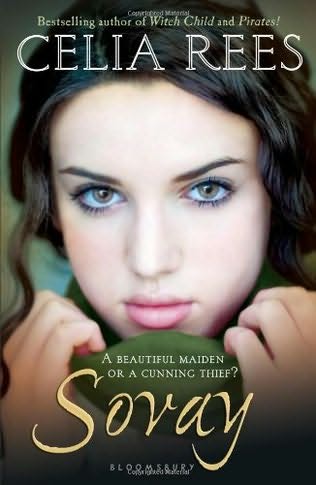
Travel the World: England: Sovay


Rees, Celia. 2008. Sovay.

I liked this one a lot. It is about a female--young teen girl--highwayman. She didn't begin her life of crime out of need, or even for thrills. No, she began--her first armed robbery--solely for revenge. 1790s. England. Sovay is a young woman engaged to be married. When she learns that he has cheated on her, she begins plotting her revenge. But what she doesn't know is how trivial this will all seem within a few days. Sovay's family--her father, her brother especially--will soon be threatened; their lives at danger if they're found. For Sovay learns that her family is about to be charged with treason--among other charges--they stand accused of having the wrong views on the French revolution, of being symphatetic with the uprisers in France. The charges aren't exactly true--they support the philosophies not the murderous actions of the people--but true or not...there are people who will stop at nothing to destroy her family. Sovay is an adventurous, strong, intelligent heroine.

I won't go into much detail. It was fun. It was enjoyable. It was delightful. Most of the reviews of this one that I've come across have found it disappointing in one way or another. The readers have read other books they feel are better or more worthwhile. I haven't had that much experience with this time period, with this subject. So I didn't find it disappointing. I didn't find it unoriginal or uninspired. I found it entertaining and well paced. I enjoyed every minute I spent with this one.

Here is the UK book cover. Which cover do you like best?

© Becky Laney of Becky's Book Reviews

Friday, November 21, 2008

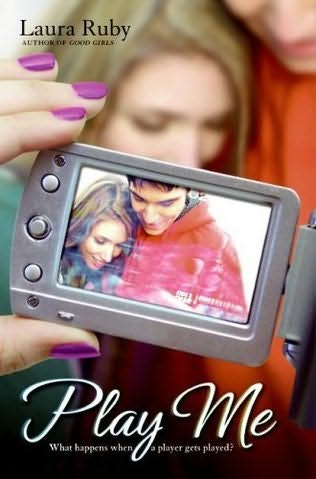
Play Me


Ruby, Laura. 2008. Play Me.

Most people turn into complete morons when you put them in front of the camera, and thank God for that.

I liked the first line. In fact, that's probably my favorite thing about this one. I think this is a case of a reader being disconnected from the book in hand. I don't blame the book for the disconnect. I just failed to connect with the characters and the story. (If I'm going to blame anyone, then I'll lay the blame fully on Tippi Hedren. Tippi is the narrator's pet bird--I'm supposing it's a parrot of some sort since it speaks, though I am FAR from an expert on birds.)

Eddy is a high school student who has big plans. He wants to be a writer, director, and cameraman. He's all about making movies. Right now, his current project--making episodes of Riot Grrl 16, is keeping him plenty busy. If his show gets viewers votes, he could be on his way to making it to MTV. But while his 'professional' life seems to be getting on track--and off track, then back on, then off, then back on, then off, etc.--his love life isn't about love at all. Lust. Lust. Lust. And Eddy is fine with that, fine with being a player. But then he falls and falls hard for the one girl he probably couldn't get anyway: Lucinda Dulko.

I suppose this one classifies as a coming-of-age story where a player gets played and semi-learns a lesson about life and love and friendship. I just didn't care for Eddy.

I think it will appeal to other readers. There are film references galore. The whole movie-pop-culture world really. I'm sure 90% went right over my head. I did catch the reference to llama llama duck.

© Becky Laney of Becky's Book Reviews

Tuesday, November 11, 2008

How To Build A House


Reinhardt, Dana. 2008. How To Build A House.

The third time isn't the charm. (Her first two novels are: A Brief Chapter In My Impossible Life and Harmless.) It may just be time for me to dissent from public opinion and admit that Dana Reinhardt's books just aren't to my liking. It might be easier on both of us. Especially since her books are generally received well. Her first book especially seemed to be buzz-worthy.

I can almost guarantee you will enjoy this one much much more than I did. (I know I'm in the minority in disliking it.) You might even love it. The premise is relatively simple, a teen girl, Harper, goes away for the summer to join a team of other teens. Their project is to build a house for a family whose home was destroyed in a tornado. The themes are love and friendship. It's easily categorized as a coming-of-age story. A story of how this young woman heals herself and becomes older and wiser because she's learned some life-lessons and had some self-realizations. It's a story of a broken woman beginning the journey towards becoming whole. Why does she need healing? Her family is "broken." Her father and stepmother are divorcing. Her stepsister, Tess, is barely speaking to her any more. Her friends-with-benefits, Gabriel, is treating her horribly.

What didn't I like about the novel? The narrator Harper. She's smug. She's condescending. She's a bit stupid. Maybe stupid isn't the best word. She's a bit unwise at times when it comes to acting, thinking, and speaking. She is polar opposite to everything I like. She doesn't believe in wearing jeans--she "can't" wear them. She hates country music*. She's an atheist. Well. Mostly. She's a nonbeliever that is obsessed with listening to Christian rock music** so she can make fun of it. She loves to mock their enthusiasm and passion. She doesn't appreciate it on a musical or spiritual level. And that's not the only thing she mocks. I am not sure if it is the narrator or the author--but something felt very condescending and smug about how the South was treated. But perhaps more annoying than even the mocking of Christianity is her obsession with lecturing every single person she meets with her environmental save-the-world-humans-are-evil spiel.

Did I like nothing about the novel? I did like a few of the characters. In particular, I liked Teddy. I don't know what he saw in Harper. But Teddy himself I liked.

*Now it's not like I *only* love country music. I love many many different types of music. But there are country music phases in my life. In high school particularly I lived for country music--Tim McGraw, George Strait, Garth Brooks, Clay Walker, John Michael Montgomery, Brooks & Dunn, etc.
**I will be the first to admit that a few groups are dinky. And sometimes it feels like the dinky ones are the ones that get the air time. But I seriously doubt if this author listened to actual Christian rock music. If she had, she wouldn't have found much to mock. I have rarely listened to Christian radio. But I'm well-schooled in Christian music because I buy CDs. Have been listening Christian music at least twenty-five years. If she'd called it "gospel" or "Southern gospel" or "praise & worship" or "contemporary" I could understand where she's coming from a bit better. But Christian rock? Methinks she's clueless.

© Becky Laney of Becky's Book Reviews
Friday, August 22, 2008

Impulse and Initiative


Reynolds, Abigail. 2008. Impulse and Initiative: A Pride and Prejudice Variation.

This book sets out to answer these questions, "What if...instead of disappearing from Elizabeth Bennet's life after she refused his offer of marriage, Mr. Darcy had stayed and tried to change her mind? What if...Lizzy as she gets to know Darcy, finds him undeniably attractive and her impulses win out over her sense of propriety? What if...madly in love and mutually on fire, their passion anticipates their wedding?"

I have mixed feelings on this one. I do. Pride and Prejudice is one of those books that is practically perfect in every way. One of those happy-making books that you enjoy reading with a big smile on your face. Mr. Darcy is just so perfect, just the way he is. So I've never thought about him needing improvement. Never imagined him courting Elizabeth any other way. Never thought their relationship lacked sizzle.

And this book sets out to re-imagine those beloved characters. It is a variation in tone, in character, and in plot. Mr. Darcy is madly in love with Elizabeth. But she's hesitant about his wooing. For Darcy, as Reynolds envisions him, this means that he needs to turn up the heat. If she won't respond to his true-heart-revelations, perhaps she'll respond to his touch, his kiss, his embrace. If he can make her melt, drive her wild with passion, then surely she'll consent to become Mrs. Darcy. Right?

The problem with this is that to win her that way, he has to resort to becoming everything he despises. Darcy is fundamentally a gentleman at heart. A Mr. Darcy without morals, without propriety, without thought or concern for a lady's reputation--his lady's reputation--is almost unimaginable until now. Darcy borrowing from Wickham? Really?! An Elizabeth whose reputation is in tatters, who has become the disappointment of her father, who has adopted Lydia's it-feels-so-good-it-can't-be-wrong philosophy?!

The writing. Reynolds' writing is not fundamentally bad. It's not that she doesn't know how to write, how to turn a phrase, how to write scenes that work. Stylistically, on the surface, everything about this one works. The characters. The scenes. All good--maybe not brilliantly, great (award-winning great) but not bad. Certainly entertaining. Certainly on the level of other romance novelists. But it's the fact that it's Mr. Darcy. It's Elizabeth. Their love isn't supposed to be smutty. Respect. Purity. Both qualities that they'd expect to find in the other, and hold themselves to as well.

There were enjoyable aspects of this novel. I must say that I smiled when it was Elizabeth who came home and announced that she'd married first. You know those smug scenes between Lydia and her mother and sisters. The ones where she's bragging that she got married first. That she got her man. That married life was so wonderful. Now it's Elizabeth's turn to boast.
And there are a few other enjoyable scenes as well. I like, in a way, the conversations between Darcy and Elizabeth trying to prove to themselves (reassure themselves) why it was right for them to have sex, but wrong for Wickham and Lydia. I suppose they rationalize it all by intentions. Wickham is a jerk, a lusty jerk that is selfish and only looking out for himself. And Darcy, well his intentions are honorable even if his actions aren't. And while one might think Elizabeth's own tainted (impure) experience might give her sympathy or understanding for her sister and her sister's giving into temptation...you'd be wrong. Elizabeth still feels a bit superior to her sister. Still judges her for the foolish idiot she is.

If you're looking for Pride and Prejudice with smut inserted, then this one is for you.

© Becky Laney of Becky's Book Reviews
Monday, August 18, 2008

Jimmy's Stars


Rodman, Mary Ann. 2008. Jimmy's Stars.

The two people Ellie McKelvey hated most were Adolf Hitler and Victoria Gandeck. Hitler lived in Germany, but Victoria was just across the alley. And right now, Ellie hated Victoria more.

Jimmy's Stars is the story of a family on the homefront in World War II. Ellie, our heroine, is a young girl, only eleven, when her brother Jimmy is sent to war. In one way, she's proud. His being at home won't give anyone in the neighborhood or at her school the ammunition to tease her and her family for being slackers, for being unpatriotic. But most of all, she's worried but doesn't quite want to admit it. (That is she's afraid to admit that Jimmy might die or get wounded.) She'd rather him be safe and here, than brave and over there. It doesn't help matters any that Aunt Toots, her least favorite relative, is moving into their house, moving into Jimmy's room, wearing Jimmy's clothes. War means change, and Ellie doesn't like it one little bit.

Ellie is forced by the war, by these changes both in and outside of her family, to grow up sooner than she'd like.

I've always liked (or almost always liked) fiction and nonfiction books about World War II. Especially about those on the homefront--any home front be it America, England, China, Korea, Germany, Poland, Russia, France, wherever. I like reading about how women and children were effected by war.

This one would fit in nicely with the others in the field. And it's one I'm happy to recommend.

For more on Jimmy's Stars and author Mary Ann Rodman visit:
01 Charger, A Childhood of Dreams, A Christian Worldview of Fiction, A Mom Speaks, All About Children's Books, Becky's Book Reviews, Book Review Maniac, By the Book Reviews, Dolce Bellezza, Fireside Musings, Homeschool Buzz, Looking Glass Reviews, Maggie Reads, Maw Books, Small World Reads, The Friendly Book Nook, The Hidden Side of a Leaf

© Becky Laney of Becky's Book Reviews

Sunday, August 10, 2008

The Redheaded Princess


Rinaldi, Ann. 2008. The Redheaded Princess.

The Redheaded Princess. What can I say about this one? It's a fictional novel--for teens--about Princess Elizabeth. The novel opens when she's a child and she's still estranged from her father, King Henry VIII. The novel closes with the death of her sister, Queen Mary, a.k.a Bloody Mary. In between, there are many ups and downs along the way. Her semi-reconciliation with her father and his newest and latest wife, Katharine. Her relationship with her half-brother, Edward, the boy who would become King (and did in fact become King) yet who never really "reigned" on his own. Too young. Too sickly. Her very, very strange relationship with Thomas Seymour. Her turbulent relationship with her older half-sister, Mary.

Elizabeth's life was strange. No doubt about it. Never knowing her mother, only really hearing about how she had "bewitched" the King into divorcing his wife. She was presented to the girl as a whore and a witch. Someone dangerous to imitate. She had a distant relationship with her father. Sometimes in favor and in court, other times forgotten and left to fend for herself in the country. Not that she was alone. She had her servants, her friends, her tutors. But still. Without parental guidance let's say. And she didn't have normal family relationships with her brother and sister either. When one sibling has the power of life and death over the others, the power to imprison, things can get messy very very quickly.

The plotting. Oh the plotting. The scheming. It seems that there was never an end to the number of people who wanted to use these three children as pawns to gain favor, esteem, wealth, and power. Manipulations. Trying to turn the family against one another time and time again.

The religion. I wonder if readers grasp just how big this Catholic versus Protestant issue was back in the day. Where being one or the other could cost you your life. To realize just how opposing and judgmental they were of one another. It is hard, I think, for readers to grasp until they've studied the era, studied the writers of that time period. This was really and truly life and death stuff. And believers had to be ready to die for how they chose to worship. For how they viewed the sacraments.

Anyway, if you're already familiar with the Tudors, with Henry VIII and his children (Mary, Elizabeth, Edward), then you won't learn much more than you already know. If you're not that familiar, this would be a nice place to start.

This novel would be a good companion to Rinaldi's previous novel, Nine Days A Queen: The Short Life and Reign of Lady Jane Grey.

The real question may be how does this one compare to Carolyn Meyer's series on the Young Tudor women.
Mary, Bloody Mary. Doomed Queen Anne. Patience, Princess Catherine. Beware Princess Elizabeth. And the answer to that would be purely subjective.

© Becky Laney of Becky's Book Reviews

Tuesday, July 29, 2008

Starcross


Reeve, Philip. 2007. Starcross: A Stirring Adventure of Spies, Time Travel, and Curious Hats. "Decorated Throughout" by David Wyatt.

Starcross is the sequel to 2006's Larklight: Or the Revenge of the White Spiders!: Or To Saturn’s Rings and Back!: A Rousing Tale of Dauntless Pluck in the Furthest Reaches of Space. While I found the first book fun and silly, I also was just lukewarm about it. I neither loved it nor hated it. I saw the appeal, but didn't share in it exactly. With the second book, Starcross, everything has changed. I loved it. I mean I LOVED it. Still silly? Yes! Still fun? Yes! Still requires the suspension of disbelief? Of course! Maybe it is because I knew what to expect. Maybe the Moobs just make for a more exciting enemy than the space spiders. Who knows. I just know that I can't recommend this one highly enough!!!

Chapter One:
What a fuss! What storms of dust! What cannonades of hammering and what snarling of wood-saws! What quantities of sawdust and shavings heaping up upon the stairs and filling the very air, making the poor hoverhogs sneeze and cough! What endless, topsy-turvy rearrangements of the household furniture! What confusion! In short, we had the decorators in. Larklight, our dear old huse, which has hung in its lonely orbit north of the Moon for goodness knows how long, gathering space dust and barnacles and generally declining into a picturesque decay, was being renovated from top to bottom.
Our two narrators are Art (Arthur) Mumby and his sister Myrtle. The year is 1851. The plot of this one starts off simple--though as readers we know this cannot last long--the Mumby family is going to vacation--they've just received a special invite in the mail--at Starcross a "Resort" hotel "fitted with the very latest Scientific Furnishings, and staffed exclusively by the most tactful auto-servants. Offering, in addition, fine views, healthful air, & the best opportunities for sea bathing in the Solar System." Mom and the two kids will arrive first, Dad will be along after his business is finished.

At Starcross they meet a few new characters, and bump into a few of their old friends. Most notably Jack Havock who is going by the name the Honourable Ignatius Flint these days. (The rest of the crew of the Sophronia is about as well.) Their hotel is most mysterious, and it doesn't take them many days to figure out that something is wrong--very oddly wrong--about the hotel and its guests.

I loved this book. Loved the plot--the twists and turns. Loved the language. Loved the characters. Loved everything about it really.

Definitely recommended.

© Becky Laney of Becky's Book Reviews

Saturday, July 05, 2008

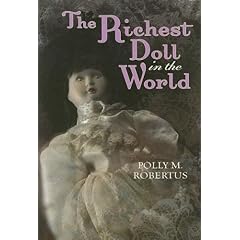
The Richest Doll in the World


Robertus, Polly M. 2008. The Richest Doll in the World.

The flap on this one called it an "exciting, spooky tale that will appeal to anyone who has ever loved a doll." I'm not so sure. The good news? It's short. And the print is large. The bad news? I didn't like many (if any) of the characters.

This is a holiday-based mystery for the 8 to 10 crowd. Emily is an orphan living with her grandmother, Grandma Rose. When the story opens, we see Emily whiningto her Grandma begging her to let her go with her to work. Emily wants to go with her because she's super-curious about her Grandma's 'crazy' employer, Mrs. Bigley. More to the point, she's super-curious about Mrs. Bigley's doll, Delilah. It's the only thing in the world that she could ever ever want for Christmas. But Grandma won't let her go. She wants to keep her job. And Mrs. Bigley is not mentally or emotionally stable enough for visitors. But Emily refuses to take no for an answer. And she follows her grandmother secretly. Super-spy she is not. Emily didn't really realize how cold and how dangerous and how foolhardy this whole plan was to begin with.

I don't really want to say too much more. It'd be a contest to see who was more annoying as a character--Mrs. Bigley or Emily. But needless to say I think someone has been praying for Grandma Rose to have patience--lots and lots of patience.

Spooky? Slightly. Exciting? Hardly. More spooky than exciting. It's definitely darker than most doll books. It'd be a question for the individual reader how much the book redeems itself in the end.

© Becky Laney of Becky's Book Reviews

Friday, July 04, 2008

Poetry Friday: Lady Liberty


Rappaport, Doreen. 2008. Lady Liberty: A Biography. Illustrated by Matt Tavares.

Lady Liberty is both beautifully written and beautifully illustrated. Though I must admit it was the illustrations that first caught my eye. I love Tavares' style. The colors. The tones. There's just something so rich, so expressive. It works for me really really well. I just love the illustrations. They are a large part of why this book is so amazing. The book itself, Lady Liberty, tells the twenty year story of how 'Lady Liberty' came to be.


The Statue of Liberty has come to symbolize America. To symbolize freedom. To symbolize all our nation stands for and believes. This is the story of her creation to her dedication ceremony a little over twenty years later.

The story is told through poems. Poems with many voices or narrators all telling one story, sharing one dream. Two nations, one goal.

My favorite, if I had to choose, is the poem narrated by Emma Lazarus.
Emma Lazarus
Poet
New York City,November 1883

A gala auction is being held
to raise money for Liberty's pedestal.
Famous artists are donating paintings.
I was asked to write a poem
to be sold along with poems
by Longfellow and Whitman.
It is a great honor to be asked.
I can write about anything I want.
But I have had trouble writing lately
because I feel too sad.

In the past few years in Russia,
hundreds of Jews have been killed.
Thousands have been persecuted,
their homes burned, their shops destroyed.
They trek hundreds of miles across Europe
with only the clothes on their backs,
hoping to find ships to take them to America.

We Jews are not new to hatred.
Almost two hundred years ago
my ancestors fled Europe, too.
America was a land of hope for them.
it is still a land of hope.

Soon when people arrive in the New World,
they will be welcomed
by a caring, powerful woman.

Give me your tired, your poor,
Your huddled masses yearning to breathe free,
The wretched refuse of your teeming shore.
Send these, the homeless, tempest-tost to me:
I lift my lamp beside the golden door!

http://www.doreenrappaport.com/
http://matttavares.com/ladyliberty.html

© Becky Laney of Becky's Book Reviews

Tuesday, May 06, 2008

The Battle of the Labyrinth


Riordan, Rick. 2008. The Battle of the Labyrinth.

Oh my. Trust me it's good. Really really good. The Battle of the Labyrinth is the fourth novel in the Percy Jackson series, a contemporary fantasy series built around the premise that the Greek gods are alive and well and living in modern-day America. The others include The Lightning Thief, Sea of Monsters, and The Titan's Curse. Rick Riordan is one of my favorite authors. His Percy Jackson novels in a way illustrate the ultimate when it comes to the can't-put-downability experience. Once you start, you really can't stop. They're just that good, that suspenseful, that magical.

What can I say about The Battle of the Labyrinth? It's good. It's intense. It's very intense. There really isn't a calm or dull moment in its 361 pages. The story? The plot? Well, I won't be spilling that here. For one, I don't think you'll need the incentive to go and read this one if you've read the other three. You'd read it no matter what I said. You might already have a copy in hand or on order. If you haven't read any of the Percy Jackson books yet, you really need to correct that...and soon! It's fun and educational. The weaving of Greek mythology into a modern-day adventure story starring unforgettable characters...is just brilliant. Each novel adds more depth, more substance, more meaning into the story. New characters, new plot twists, new ways of making this series oh-so-magical.

First sentence: The last thing I wanted to do on my summer break was blow up another school.
Last sentence: "Come inside for cake and ice cream," I said. "It sounds like we've got a lot to talk about."

© Becky Laney of Becky's Book Reviews

Monday, May 05, 2008

Nonfiction Monday: Dickens: His Work and His World

Rosen, Michael. Dickens: His Work and His World.

DICKENS: HIS WORK AND HIS WORLD by Michael Rosen is a nice introduction to Charles Dickens life and works. The book does a great job of placing both into their proper context.

The book is divided into five chapters. Chapter one "The Tour" gives a brief overview of Charles Dickens. It provides a glimpse into his talents performing in front of audiences and serves as an introduction as to WHY Dickens is so memorable. Chapter two "The Life" provides the reader a biographical summary of Dickens' life. "Great writers aren't often people born into some special family, nor are they necessarily very rich or very clever or very lucky. They're not always people who have seen or heard hundreds of amazing or odd things. But a great writer has to be someone who spends a good deal of time watching, listening, and wondering--and a good deal more time telling us about it" (12). Chapter Three "London" provides the reader with a description of the world in which Dickens lived and wrote. It discusses the cultural and political as well as physical environment in which he wrote. Chapter Four "The Work" discusses four literary masterpieces: A CHRISTMAS CAROL, OLIVER TRIST, DAVID COPPERFIELD, and GREAT EXPECTATIONS. Rosen devotes most of the chapter to his in-depth analysis of GREAT EXPECTATIONS. Chapter Five "Legacy" is a summary of why Dickens is still relevant to today's culture. The book concludes with a thorough timeline and index. (There is not a bibliography).

Throughout DICKENS: HIS WORK AND HIS WORLD are one and two-page illustrations by Robert Ingpen, winner of the Hans Christian Andersen medal for illustration in 1986, which are magnificent.

Rosen's style is conversational. He writes directly to the reader, often asking the reader to join in his questions and become involved in the text.

© Becky Laney of Becky's Book Reviews

Thursday, February 01, 2007

Larklight


The title of the book I’m reviewing today is in full: Larklight: Or the Revenge of the White Spiders!: Or To Saturn’s Rings and Back!: A Rousing Tale of Dauntless Pluck in the Furthest Reaches of Space.
Quite a mouthful, isn’t it?

Reeve, Philip. 2006. Larklight.
I remember in elementary school having an end of the year awards ceremony where each child received a certificate reflecting their ‘character.’ If Larklight were to receive an award, here are some possibilities: ‘Best 8-Legged Villains’ ‘Quirkiest Flying House’ ‘Longest Chapter Titles in A Work of Fiction’ etc. What is Larklight about you may be wondering?
It’s a historical science fiction/fantasy title. Set in the Victorian era, it answers the question...what could have happened if scientists like Isaac Newton had discovered space flight. The answer, the British would have sought to colonize and rule outer space much like she was known for colonizing earth. (Hence, the saying that the sun never sets on the British empire.) Arthur “Art” Mumby and his sister Myrtle live with their father in a rather unique house ‘Larklight’ that orbits the moon, I believe. With robotic servants and ancient gravity devices, the house is unique in many ways. When our story begins the children are anxiously awaiting the arrival of a visitor. But with the arrival of this visitor, the danger and adventure begins. With aliens of every shape and size, some ‘good’ and some ‘bad,’ the two must find a way to save the British empire before its too late. Art loves living in space, but Myrtle wishes for a simpler life in British--particularly London--society. For those who can suspend their disbelief of absurd and silly adventures defying everything we know about the world we live in, Larklight is sure to entertain. If you’re looking for a fantasy world where pirates and aliens interact...this might be your dream come true.

http://www.philipreeve.co.uk/

Friday, January 19, 2007

Taking Liberty

Rinaldi, Ann. 2002. TAKING LIBERTY: THE STORY OF ONEY JUDGE, GEORGE WASHINGTON’S RUNAWAY SLAVE.

Taking Liberty is the remarkable story--straight from history--of a slave woman who took liberty the only way she could. Born a slave, Oney Judge was the daughter of a slave that was ‘privileged’ enough to work in the big house as a seamstress and a white man who was an indentured servant. Taught and trained in her early years in the arts that would entitle her to work in the house rather than the field, she often thought herself lucky compared to the other slaves. Belonging to George Washington is a kind of privilege as well. Knowing that they belong to such a respectable, important man--the novel begins out in the years leading up to the revolutionary war--gives everyone an air of importance. As she grows up, she becomes a pet not only of the other house servants but of the mistress as well. Martha Washington takes a particular fondness for her. She secretly learns to read with her mistresses’ approval, and she is granted more and more luxuries. Now wearing finer clothes and given more privileges, her mother becomes crazy with jealous. Stressing to her daughter that no matter how much of a ‘pet’ she becomes she will always be a slave, her mother makes attempt after attempt to escape and rebel. During the war years, Oney is a good, obedient slave. She takes pride in her master and mistress. She is now the confidante of Martha. She goes everywhere with her. But her mother--now relegated to the field for her rebellious and crazy nature--remains resolute. When the British soldiers come to the plantation--Mount Vernon--she is one of the slaves that takes the British at the word that they’ll be freed if they switch allegiance. But with each passing year, Oney becomes more and more fascinated with the idea of liberty and freedom. Will she ever be brave enough, smart enough, resourceful enough to wage her own war against the system? Set during the revolutionary war and the first term of his presidency, TAKING LIBERTY is a wonderfully honest and emotional journey of one woman’s journey to freedom.

Sinda was another saltwater Negro. Born in Africa...we children loved to visit her...this was how I learned about life around me, the past of both the whites and the Negroes. It all became my past. Sometimes I mixed up people in Virginia society with African tribes. When there was fear, after the general left, that the British would come up the Potomac and seize Lady Washington and burn the place, I saw in my head Sambo Anderson’s village burned by the Hausa tribe. I saw Lady Washington with a leather thong around her neck, marched for miles to the sea... (19-22)

When you learn about someone, hear their stories, you tote them around. They flow in your blood and your dreams. They become a part of you. So that when something bad happens to you, there is something to liken it to. I know someone else it happened to. And he still lives and breathes. So, when I was four and my daddy left, I cried, but I understood. He became part of the Gone. (23)

It was all Patrick Henry’s fault that my daddy left. That’s what my mama said... ‘Give me Liberty or give me death’ sounded wonderful in there, with the fire crackling and us sewing. It didn’t sound so wonderful in our dwelling when Daddy told Mama he was taking his liberty and leaving. (24)

Sally’s (an old servant who was Mrs. Washington’s personal maid) advice to her replacement:
’White peoples will sometimes say things to each other in front of you. Give no never mind to you bein’ in the room. Like you a chair. If they do, you act like a chair.’ ‘How do I act like a chair?’ ‘Do a chair talk? Do a chair allow that it hear sumpthin’? Do a chair tell what it hear?’ So I acted like a chair. (102)

I don’t suppose it matters if you’re Negro or white. If your mama doesn’t love you, you’ve got no color. You’ve got nothing. (124)

White children have childhoods. Negro slave children don’t. If there are moments of joy, afternoons of splashing in a brook, playing ‘prisoner’s base’ or a game with clay marbles in the dust, the moment lives forever in the memory because it must. So little joy comes after. (132)

Remembering eases the pain. We can choose what we wish to remember and pretend that the things we wish to forget never happened. (136)

Thursday, January 18, 2007

The Color of Fire

Rinaldi, Ann. 2005. THE COLOR OF FIRE. New York: Hyperion. ISBN 0786809388

Based on an historical event, THE COLOR OF FIRE, although fictionalized, is set during the "great Negro plot" of New York City in 1741. Phoebe is a slave of Assemblyman Philipse, and because her owner is a prominent man, she is given some amount of freedom--she is allowed to walk the streets alone and essentially go about her errands unquestioned. Her good friend, Cuffee, isn't so fortunate. Cuffee, who also works for Philipse, is the son of a man the town burned at the stake for allegedly taking place in an uprising. He is watched carefully and is always one of the prime suspects when something troubling happens. In 1741, there are series of fires set all over town. Rumors are flying around that the slaves are uprising. During this time of unrest, an almost unbelievable offer is made. Any slave or indentured servant who will give testimony or evidence against those setting the fires or uprising will earn his/her freedom. Phoebe dreams of one day being free, but is it really moral to gain freedom by naming names...when you don't really know who is setting the fires? Already some of her friends and acquaintances are coming forward listing dozens of names--mostly slaves. More and more slaves are being arrested, questioned, tried, and executed either by hanging or being burned at the stake. Cuffee is one of the slaves being named as a conspirator. When he is arrested, Phoebe's world is shaken. How can innocent people be jailed just because someone accuses them of this horrible wrongdoing just to earn their own freedom. Phoebe's choices are hard ones. But ultimately, she has to make the decision that's right for her.

THE COLOR OF FIRE is a compelling read. It offers an inside-look of an often-unfamiliar time period in American history. It examines the horrors of slavery, the mob mentality often only associated with the Salem witch trials, and the injustice and cruelty of the legal system. It is often difficult to read about the social injustice and prejudice experienced by African-Americans in the past, but it is necessary and benfecial as well. Rinaldi does a good job in THE COLOR OF FIRE of blending fiction with historical fact.

Wednesday, January 17, 2007

In My Father's House

Rinaldi, Ann. 1993. In My Father’s House.

IN MY FATHER’S HOUSE is an interesting historical novel based on actual historical events. Did you know that the land where the first battle of the Civil War took place was owned by the same man whose land provided the place for the signing of the Confederates’ surrender? Yes, the Civil War began on Will McLean’s property and ended on his property. Will McLean was a man who saw the collapse of the South years before the first battle of the Civil War took place. Considering himself a man of the New South, he raised his family to be more open-minded towards life. He even hired a Yankee governess for his children to tutor them. Oscie is Will McLean’s stepdaughter. Her father died when she was a young child--five or six--and Daddy Will has been the one to raise her for better or worse. Oscie is our young narrator. She provides a behind-the-scenes look at life on a plantation from 1852 to the close of the Civil War in 1865. As she grows up, she learns many life lessons--about life, love, family, and duty. She has difficulty at first deciding what exactly she believes and who she supports. Yet, as the civil war begins--she realizes as does her stepfather--that the Confederate cause is not only ill fated or doomed but that it deserves to be defeated so that something better can begin. Not an easy position to take when most of your neighbors would violently oppose your opinions if you aired them. But sometimes the right road isn’t always the easiest.

Tuesday, January 16, 2007

Mine Eyes Have Seen

Rinaldi, Ann. 1998. MINE EYES HAVE SEEN.

MINE EYES HAVE SEEN is a fictional portrayal of an historical event. In the summer of 1859, our heroine Annie Brown makes her way south with her sister-in-law to visit her father, John Brown, who under the name of Isaac Smith, has taken up residence near Harpers Ferry. Annie is fifteen, in love with life, and completely unsure about the sanity of her father. Annie has a love/hate relationship with this power-hungry, irrational abusive man. As do many of her brothers and sisters. Posted as watchdog, Annie provides readers an inside look into a dark period in American history.

Here is what the author's note has to say:

Fifteen years old in 1859, Annie came down from the Brown place in North elba, New York, with her seventeen-year-old sister-in-law, Martha, to help keep house for the Provisional Army and to make life at the Kennedy farm appear normal. She was assigned the task of "watchdog"--keeping watch on the porch for approaching strangers. The farm-house was soon full of men, eighteen in all (one arrived right before Annie and Martha left, two after). It was Annie's job to keep the men from running off, warn the inhabitants of the house when a stranger was approaching, and generally keep curious eyes at bay. John Brown could not have it known that so many men were living at the farmhouse, that he was receiving and storing arms there, and that some of the men were Negro. So Annie had her work cut out for her. Indeed, in some of the books on John Brown there are excerpts of Annie's account of life on the farm that summer. From these accounts, written by Annie in her later years when she was Mrs. Annie Brown Adams, I learned the nucleus of facts about that summer in Maryland, her description of some of the men, her chores, the newspapers her father subscribed to, the dog Cuffee, the description of the house, and, of course Mrs. Huffmaster.