Showing posts with label 2006. Show all posts

Tuesday, September 10, 2024

68. Life As We Knew It

68. Life As We Knew It. Susan Beth Pfeffer. 2006. 337 pages. [Source: Library] [MG Fiction, YA Fiction] [5 stars]

First sentence: Lisa is pregnant.

Premise/plot: As the world is ending--or seeming to--Miranda, our heroine, keeps readers up to speed with her private journal. It starts several days--perhaps a week?--before an asteroid hits the moon. After the asteroid hits the moon, things change drastically, dramatically, and perhaps permanently. Can the human race survive? Will Miranda and her family? 

My thoughts: This novel is bleakity-bleak. However, it is not as bleak as it could be, or perhaps should be. But if it was more bleak would it have any readers reading and recommending it? It isn't as bleak as it could be because it isn't always realistic. One glaring instance is the magical well water that Miranda and her family rely on for months, long months without any electricity whatsoever. Or generators. Wells depend on electricity. What is sad or perhaps ironic is that one person in her family makes the comment how lucky they are to be on well water since the town's water supply depends on electricity and many are without water. Chances are they depend on electricity in different ways.

Even though some of the scenarios are unrealistic--each reader probably could point out one way that sticks out to him/her--the novel does a great job with its characters. This one is without a doubt a disaster/survival novel. It is premise-driven. But it is also very much about family dynamics. The focus is narrow--very narrow. The immediate family of Miranda. But just because there are few characters doesn't mean it isn't great at developing those characters. And it's rare, when you think about it, for a middle grade novel to focus ON family instead of friends and classmates. 

I have reviewed this one so many times because this is one that I keep rereading. 

My favorite quotes:

“Sometimes when Mom is getting ready to write a book she says she doesn’t know where to start, that the ending is so clear to her that the beginning doesn’t seem important anymore. I feel that way now only I don’t know what the ending is, not even what the ending is tonight” (16).

“For a moment I thought about all the people throughout history who saw Halley’s Comet and didn’t know what it was, just that it was there and frightening and awe inspiring. For the briefest flick of a second, I could have been a 16 year old in the Middle Ages looking up at the sky, marveling at its mysteries, or an Aztec or an Apache. For that tiny instant, I was every 16 year old in history, not knowing what the skies foretold about my future.” (18)

“And then it hit. Even though we knew it was going to, we were still shocked when the asteroid actually made contact with the moon. With our moon. At that second, I think we all realized that it was Our Moon and if it was attacked, then we were attacked.” (18-19)
“What about desserts?” I asked. “If the world comes to an end, I’m going to want cookies.” “We’re all going to want cookies if the world comes to an end,” Mrs. Nesbitt agreed. “And chips and pretzels. If the world is coming to an end, why should I care about my blood pressure?” “Okay, we’ll die fat,” Mom said. “Grab what you can grab and ram it into your wagons. But remember if we actually need this stuff, we’re going to be a lot more grateful for a can of soup than for a box of stale cookies.” “Speak for yourself,” Mrs. Nesbitt said. (34)
 “I guess I always felt even if the world came to an end, McDonald’s would still be open.” (46)
“Lately I’ve been trying not to know what’s going on. At least that’s the excuse I’ve been giving myself for not caring about all the stuff that’s happening outside of my little section of Pennsylvania. Who cares about earthquakes in India or Peru or even Alaska?
Okay that’s not fair. I know who cares. Matt cares and Mom cares and if there were any baseball involved, Jonny would care, too. Knowing Dad, he cares. Mrs. Nesbitt, too.
I’m the one not caring. I’m the one pretending the earth isn’t shattering all around me because I don’t want it to be. I don’t want to know there was an earthquake in Missouri. I don’t want to know the Midwest can die, also, that what’s going on isn’t just tides and tsunamis. I don’t want to have anything more to be afraid of.
I didn’t start this diary for it to be a record of death.” (70-71)
“We have clean sheets to sleep on, a clean house, clean clothes, clean dishes. We spent the evening laughing. It wasn’t 90 degrees in the house when we went to bed. We weren’t hungry. We’re not worried about Dad. I know what it feels like to be kissed by a boy. If I could, I would relive this day over and over. I can’t imagine a more perfect one.” (95-96)
“I can’t decide which is worse, no electricity or unreliable electricity. I wonder if I’ll ever have to decide which is worse, life as we’re living or no life at all.” (119)
“Here’s the funny thing about the world coming to an end. Once it gets going, it doesn’t seem to stop.” (120)
“I told Mom I was doing history (she never would have believed me if I said math) and stayed in bed all morning.” (191)

“I know I’m going to have to be strong for the next couple of weeks. No more whining. No more picking fights. I’ll have to do whatever Mom asks me and not protest and not complain. I know I can do it. But for that one moment I felt so weak, so helpless. I felt nothing but fear and despair and the most awful need to be anyplace else. I told myself it was hunger, but I knew that was a lie.
As long as Mom was all right, I could fool myself into thinking we’d all be all right.” (206)
“It’s funny how sorry I feel for Jon these days. I’m 2 1/2 years older than him and I feel like got those 2 1/2 years to go to school and swim and have friends and he got cheated out of them. And maybe he’ll live 2 1/2 years longer than me, or 20 years or 50, but he’ll still never have those 2 1/2 years of normal life.

Every day when I go to sleep I think what a jerk I was to have felt sorry for myself the day before. My Wednesdays are worse than my Tuesdays, my Tuesdays way worse than my Tuesday of a week before. Which means every tomorrow is going to be worse than every today. Why feel sorry for myself today when tomorrow’s bound to be worse?
It’s a hell of a philosophy, but it’s all I’ve got.” (275)


“But I hope when I get closer to death, however old I might be, that I can face it with courage and good sense the way Mrs. Nesbitt does.” (234)

“A while ago Jonny asked me why I was still keeping a journal, who I was writing it for. I’ve asked myself that a lot, especially in the really bad times.
Sometimes I’ve thought I was keeping it for people 200 years from now, so they can see what our lives were like.
Sometimes I’ve thought I’m keeping it for that day when people no longer exist but butterflies can read.
But today, when I am 17 and warm and well fed, I’m keeping this journal for myself so I can always remember life as we knew it, life as we know it, for a time when I am no longer in the sunroom.” (337)


© 2024 Becky Laney of Becky's Book Reviews

Thursday, December 14, 2023

189. Christmas on Deery Street


Christmas on Deery Street and Other Seasonal Stories. Steven Roberts. 2006. 100 pages. [Source: Review copy] [short story collection]

First sentence: Everyone called him Blondie. Most didn't know why.

Premise/plot: Christmas on Deery Street is a collection of short stories by Steven Roberts. This is the third time I've read it, I believe. It features a handful of short stories: "Christmas on Deery Street," "Nanny's Locket," "Magic Socks," "The Angel of Union Station," "Our Star," and "You've Done Enough."

These are holiday-themed short stories almost always focusing on family and friends. 

My thoughts: The stories? How to describe them? They make me feel good. Warm and fuzzy. But not in a cheesy way. I know if I call them heartfelt or sentimental that someone will say, "that's not for me." And that would be a disservice. The stories cover a lot of emotions. There is love and heartache and loss and sadness. There is anger and guilt. There is hope. There is regret. And there is plenty of humor. But above all there is a feeling of genuineness, authenticity, a realness, knowing that these stories are indeed true-to-life and true to the human spirit.

I think I read the collection too quickly this time around. In previous reviews I said I loved all the stories--each and every one. This time around, perhaps because I was rushing it, perhaps because I've been in a reading slump, I found myself loving the first three to four stories and merely 'liking' the remaining. It could be a me thing.

© 2023 Becky Laney of Becky's Book Reviews

Sunday, July 17, 2022

86. The Sea of Monsters


The Sea of Monsters. (Percy Jackson and the Olympians #2) Rick Riordan. 2006. 279 pages. [Source: Library]

First sentence: My nightmare started like this. I was standing on a deserted street in some little beach town. It was the middle of the night. A storm was blowing. Wind and rain ripped at the palm trees along the sidewalk. Pink and yellow stucco buildings lined the street, their windows boarded up. A block away, past a line of hibiscus bushes, the ocean churned. Florida, I thought.

Premise/plot: The Sea of Monsters is the sequel to The Lightning Thief. A year has passed since the events of the first [fantasy] novel. Percy will soon be returning to Camp Half-blood and rejoining his friends, frenemies, and perhaps actual enemies. He's been having troubling dreams the past few days--mainly concerning his friend Grover. He senses danger. He just doesn't know how grave the danger is...for all of them. The tree that [helps] protect the camp from monsters is dying; it has in fact been poisoned. To save the camp may require another quest, but, not everyone thinks the camp needs to be saved. (Could their be traitors at camp still???) 

Annabeth, Percy, and TYSON (a new character introduced) team up to save Grover...but their quest is UNofficial. They do not have permission to leave camp let alone permission to go on a quest for the golden fleece. Their quest will not take them all across the United States but down to Florida to THE SEA OF MONSTERS which is off the coast of Florida. They'll face monsters, monsters, and more monsters. But will their quest be successful?

My thoughts: I have so many memories of The Lightning Thief. Every chapter of the first novel is super familiar. But there was something delightful about reading this second novel. It has been so many years since I first read it (it would have been circa 2006), that it was like experiencing this fantasy-adventure-questing novel for the first time...again. That is rare (in my opinion.) 

I liked Tyson. I did. I missed Grover being an active part of their adventure, but I didn't blame Tyson for being a replacement of sorts. Grover is in the book, just, not an active part of the quest. He's the point of the quest. I thought there were some great character-building scenes in this one. I thought we got a chance to better get to know Annabeth. The siren sequence was quite something. Percy truly risked all--not only for Annabeth, but later for Grover and for Tyson.


© 2022 Becky Laney of Becky's Book Reviews

Saturday, September 25, 2021

120. The Case of the Missing Marquess


The Case of the Missing Marquess. (Enola Holmes #1) Nancy Springer. 2006. 216 pages. [Source: Library]

First sentence: I would very much like to know why my mother named me, "Enola," which, backwards spells alone.

Premise/plot: Enola Holmes, our heroine, has literally just turned fourteen on the day her mother, Lady Eudoria Vernet Holmes, disappears. She contacts her two older brothers soon after. Chances are, dear reader, you may have heard of them: Mycroft and Sherlock Holmes. The two leave London to visit their younger (and now abandoned) sister. And soon these two are planning out her future...without consulting young Enola. When the decision is made that Enola needs to go to a boarding school, well, she takes matters into her own hand. Knowing that her brother, Sherlock, is a world-famous detective, she thinks her best bet is to the unexpected...always. He would probably expect her to disguise herself as a young boy, for example, so she knows that is out of the question!

Enola knows her final destination will be London....but her exact journey, well, that's a mystery even to her. Along the way, she gets distracted by another missing person. (Her mother being the first missing person. Viscount Tewksbury Basilwether being the second missing person.)

My thoughts: I enjoyed this historical mystery. It is very light on the mystery and history. It is set in mid-to-late 1888. (July to November). I would classify it as a cozy mystery for middle grade.

I didn't love it. I liked it. I picked up the book because I had (relatively) recently watched the Enola Holmes movie. The movie definitely adds a good bit of substance to the book. (A good thing in my opinion. The book doesn't really have much depth or substance.) I think it's main job is to orient readers with the new series and the characters.


© 2021 Becky Laney of Becky's Book Reviews

Tuesday, December 17, 2019

Blood on the River: James Town, 1607

Blood on the River. James Town 1607. Elisa Carbone. 2006. 237 pages. [Source: Library]

First sentence: My feet slap, bare and cold, on the cobblestones.

Premise/plot: Samuel Collier stars in this action packed historical coming of age novel for children. He is saved from jail, if you will, when he is chosen to be a servant (indentured?) to a Captain John Smith. Smith is one of many men heading to the New World, to Virginia. Technically one of their goals is to find the lost colony of Roanoke. But mainly, it’s all about the money. What can they find in the new land to turn a quick profit. They are hoping for gold, gold, and more gold. But other natural resources may be a better choice. But the settlers are clueless, naive, inexperienced, short-sighted. Potential wealth isn’t as important as survival. And risks are everywhere. Sometimes coming from natives, sometimes not. Disease, starvation, freezing temperatures also threaten their future. Collier is a part of it all, a witness to the good, the bad, and the ugly. Life is challenging.

My thoughts: This one opens shortly before the ships(3?) leave England for Virginia. It proves a super compelling read from the start. It offers both action and suspense. The characters were all real men, women, and children. The novel is well researched if the bibliography is to be believed. Of course, the primary sources are subjective in nastier as all journals and diaries tend to be. But there are enough sources to offer readers a glimpse of what it might have been like to live through these earliest years in America.


© 2019 Becky Laney of Becky's Book Reviews

Wednesday, September 25, 2019

World at War: Billy Boyle

Billy Boyle (Billy Boyle #1) James R. Benn. 2006. 294 pages. [Source: Library]

First sentence: I typed the date under my name: Lieutenant William Boyle, August 6, 1942.

Premise/plot: Billy Boyle is the lovable, oh-so-human, cop turned soldier starring in James R. Benn’s historical mystery series. Billy is an Irish cop/detective from Boston. After Pearl Harbor, his mom pulls some strings and gets her son an “easy” or “safe” posting. He goes to officer school, becomes a lieutenant, and gets assigned to General Eisenhower’s headquarters in London, England. “Uncle” Ike is pleased to give Boyle a task or two that will utilize his detective skills. His first assignment concerns the Norwegians. He’s told that there is likely a spy among them. He’s also told (by the Norwegians) that a crate or two of gold was stolen during transport—as the government was fleeing for their lives, the treasury was also being transported to safety. But the real investigation is a murder. This will be his first case as lead detective. It is tricky because it’s a delicate political situation. One of the top Norwegians has been murdered. Boyle wants free access to everyone there—regardless to nationality, rank, class, etc. But many answers would be top secret and classified. Can Boyle solve the case? Will justice be done?

My thoughts: I love, love, love this one. I can’t believe this series has been around over a decade and I’m just now hearing about it?! Why did no one tell me?! I love historical fiction. I love books set during the Second World War. I love books set in England. I especially am interested in books about American soldiers serving in England during the war. (My grandfather did.) I love mysteries. This book just screamed out that it was written just for me. Indeed I found it a magical read. I absolutely loved the narrative. Boyle’s voice is unique and charming. I loved the characters—Daphne and Kaz especially. Whether the characters were featured a little or a lot—they felt human and real. The mystery was great. The murder didn’t occur until halfway through which could have proven problematic if the writing wasn’t so wonderful. I “need” all the books in the series.

© 2019 Becky Laney of Becky's Book Reviews

Friday, July 05, 2019

Oh Danny Boy (Molly Murphy #5)

Oh Danny Boy (Molly Murphy #5) Rhys Bowen. 2006. 338 pages. [Source: Library]

First sentence:  There was that maniacal laughter again.

Premise/plot: Molly Murphy stars in her fifth but far from final mystery novel in Oh Danny Boy. In this one, Molly takes on her toughest case yet. Captain Daniel Sullivan is in JAIL. He's been accused of accepting bribes and arranging a prizefight. Daniel assures Molly that he is completely innocent--well mostly. Will she do what she can to clear his name? So long as it doesn't, you know, actually involve talking to anyone who might be dangerous (other police officers, mob bosses and gangsters, etc.) The case he gives her isn't exactly the case she takes up. She will clear his name no matter what. She'll use false names, go dangerous places, follow leads where they lead her.

Clearing Daniel's name isn't the ONLY thing on her mind these days. But a new friend or two helps clarify things there as well. I hope that Mrs. Goodwin sticks around for other books. This lady police officer was a delight.

My thoughts: I definitely found this to be an absorbing read. I was happy that the love triangle did not magically reappear. Though there are obstacles standing in the way of the couple's happily ever after, none of the obstacles are other love interests. 

© 2019 Becky Laney of Becky's Book Reviews
Monday, June 24, 2019

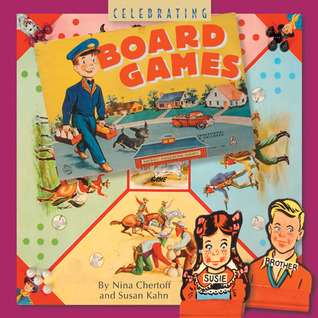
Celebrating Board Games

Celebrating Board Games. Nina Chertoff and Susan Kahn. 2006. 144 pages. [Source: Library]

First sentence: Games are a part of almost everyone's childhood. And board games in particular have a special place in most people's hearts.

Premise/plot: All the board games included in this tiny book belong to one collector. There isn't much text to it. Readers can learn the name of a board game and the year it came out. Occasionally, the author(s) elaborate. "This game is about who can make the most money..." or "the artwork of this one is racially offensive..." or "this game is like parcheesi..." or "this game is based on a tv show...." For each game mentioned, we have a photograph of the box, the game board, and the player pieces.

My thoughts: When I learned that all the games photographed (and included) belong to one person's collection it made a bit more sense as to what was included and what was not. This is not a comprehensive, thorough book that COVERS every board game from every decade. I've heard my mom talk about games she used to play--dad has a few stories as well--and sadly these were not included. Some of my own favorites from childhood were not included either. That's the way of things. (Careers is/was my personal favorite. Chutes and Ladders, Hi-Ho Cherry-O, Scrabble--these are the games off the top of my head that were not included. I never thought about how many games don't have a game board--Yahtzee, Hungry Hungry Hippo, Battleship, Scattergories, Guess Who). 

The book wasn't particularly organized. It would have perhaps to have the book organized into sections: games about making money, games about war or strategy, games based on tv shows or movies, educational games, games of chance, etc. 

I think some of the games were chosen for their rarity and novelty...not because they were super popular, beloved, and representative of their times.

© 2019 Becky Laney of Becky's Book Reviews

Friday, March 29, 2019

The Doctor Wore Petticoats

The Doctor Wore Petticoats. Chris Enss. 2006. 144 pages. [Source: Bought]

First sentence:  The frontier of the wild West resisted attempts to tame it by adventurous pioneers who were hell-bent on making a life for themselves and their families on the open range. The terrain was rough and unyielding, not unlike its new inhabitants. Most of these inhabitants were as stubborn about accepting female doctors as the land was about accepting them.

Premise/plot: This is a nonfiction book sharing biographical sketches of twelve women doctors (ten doctors and two dentists, if you want to get specific). Chris Enss highlights these women: Bethenia Owens-Adair, Georgia Arbuckle Fix, Susan La Flesche Picotte, Susan Anderson, Nellie Mattie MacKnight, Patty Bartlett Sessions, Nellie Pooler Chapman, Lucy Hobbs Taylor, Mary Canaga Rowland, Ellis Reynolds Shipp, Franc Johnson Newcomb, and Flora Hayward Stanford.

My thoughts: I love, love, love this one. I found it fascinating--compelling. I loved how many chapters includes quotes from primary source materials. Readers often get the opportunity to learn about the lives of each individual in her own words. These quotes may be brief--sprinkled here and there throughout the sketch--but they are there. Also each chapter includes a photograph of the subject. It was just a joy to meet each of these women. Their stories are unique--these are not copy-cat cases. Each woman's journey was her own.

I bought this book at a charity shop in town. I probably picked it up because of Dr. Quinn, Medicine Woman if I'm being honest. But it was a million times better than any fictional story set in the "old West." It was so worth the $2 I spent on it. 

© 2019 Becky Laney of Becky's Book Reviews
Wednesday, February 27, 2019

World at War: Hattie Big Sky

Hattie Big Sky. Kirby Larson. 2006. 289 pages. [Source: Library]

First sentence:
December 19, 1917
Arlington, Iowa

Dear Charlie,
Miss Simpson starts every day with a reminder to pray for you--and all the other boys who enlisted. Well, I say we should pray for the Kaiser--he's going to need those prayers once he meets you!
Premise/plot: Hattie Brooks, our heroine, has recently inherited her uncle's claim in Montana. She'll have a little under a year to finish proving her claim. It will require much of her--mentally, physically, emotionally. She's just sixteen--there are grown men, rugged men, who end up failing. Farming isn't ever easy. But some of the biggest challenges she'll face aren't from the land or the country itself. The people. America is at war and the people at home are feeling it. Hattie's closest neighbors--closest friends--are Germans. The community--with a few exceptions--has turned against them and against those that show their support. But Hattie isn't one to abandon her friends. Hattie proves herself to be an incredible woman even if not an incredible farmer.

My thoughts: I first read this one in February 2007. I loved it then. I loved it now. I think I may have loved it even more the second time. It is a compelling, heart-felt story.


© 2019 Becky Laney of Becky's Book Reviews
Friday, February 09, 2018

World History Time Lines

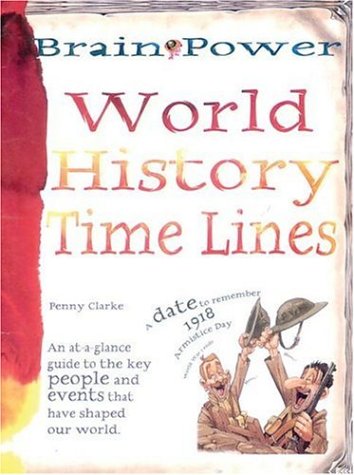
World History Time Lines (Brain Power) Penny Clarke. 2006. 64 pages. [Source: Library]'

First sentence: Can you imagine living without time? Living without not knowing what day it is or what month or year?

Premise/plot: This is an over-sized, heavily illustrated "picture book" for older readers. Each two-page spread covers a different period of world history. Included with each spread is an introduction, a timeline, and a feature starring famous figures related either to the topic, the time period, or both. For example, Cleopatra is mentioned in the spread on "First Civilizations" which technically covers 6000 to 3000 BC when she didn't live until 48-30 BC.

The topics include: "The First Civilizations," "Chariots and Wars," "Long Live the Pharaoh," "The Birth of Democracy," "Empires Rise and Fall," "The Power of Rome," "Powers in Decline," "The End of an Empire," "Land and Sea Raiders," "Raiders to Rulers," "Wars of Religion," "Warfare and Rights," "Palaces and Plague," "An Age of Exploration," "Nationalism vs. Religion," "Exploring the New Worlds," "Tax and a Tea Party," "Revolution!," "Revolutionary Wars," "Crossing Continents," "Icebergs and Ice Caps," "War--and Peace?," "Peace for Our Time?," "A Second World War," "The Race to the Moon," "Changing Regimes," "The End of Communism," "A Future in Space?".

My thoughts: I liked it okay. It is very at-a-glance. This book was made for skimming. There is not a thing wrong with that. Not every book has to be read cover-to-cover, word-by-word. Reference books are important too. That being said, is this the perfect reference book? Maybe for children--the intended audience. Events get a one-sentence mention. That's it. No details. No context. No explanation. Famous Figures may get a couple sentences instead of just one. But everything is kept basic and on the surface. The book is a fairly good reminder that no one can know--can remember--everything. 

I really disliked the illustrations.

© 2018 Becky Laney of Becky's Book Reviews
Thursday, February 01, 2018

Kings & Queens of England and Scotland

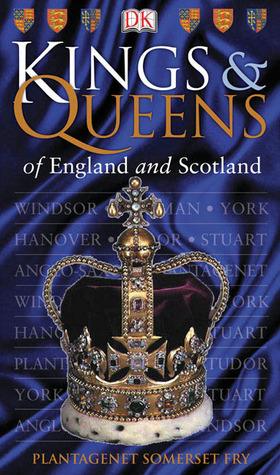
Kings and Queens of England and Scotland. Plantagenet (Peter?) Somerset Fry. 2006. 96 pages. [Source: Library]

First sentence: The Romans ended direct rule of England in the fifth century, and by the early seventh century the country had split into  seven warring kingdoms.

Premise/plot: A nonfiction reference guide to the kings and queens of England...and Scotland. This one is divided into ten chapters: "The First English Kings," "The Normans," "The Plantagenets," "The House of Lancaster," "The House of York," "The Tudors," "The Kings and Queens of Scotland," "The Stuarts," "The Hanoverians," and "The House of Windsor."

The first chapter spans AD 600-1066. We've got one spread on Early Saxon Kings. One spread on Alfred the Great. One page on Saxons and Vikings. One page on Canute.

The other chapters cover the kings and queens the enthusiast is probably already familiar with to some degree. Each dynasty is introduced or summarized briefly (in a two-page spread) before introducing the individual monarch. (Here are four 'first sentences.')
The Normans were originally Vikings who settled in northwest France in the early 10th century. Taking control they became Counts, and later Dukes, of Normandy, and they created a powerful state around the mouth of the river Seine. (14)
The surname of this remarkable family [the Plantagenets] derives from the nickname borne by Geoffrey, Count of Anjou, between 1129 and 1251. Geoffrey, the father of Henry II, wore a sprig of flowering broom (Planta genista) as his personal badge. (19)
A branch of the Plantagenet family, the House of Lancaster was a short dynasty of three kings, all named Henry. (32)
The House of York had a stronger claim to the throne than the House of Lancaster, although both were branches of the House of Plantagenet. (38)
There will be some readers anxious about what he says about Richard III. After all, a measure of a book--for some--is what they have to say about one king.
Richard III was king for barely two years, but once he was dead, historians, clerics, and even playwrights fell over themselves to blacken his name. Most of the propaganda was designed to serve the Tudor dynasty, which began when Henry VII's army defeated and killed Richard at the Battle of Bosworth in 1485. However, in more recent times, historians have questioned whether Richard III really deserves his evil reputation. (42)
My thoughts: I really enjoyed this one. It is concise. It is readable. It is filled with charts and illustrations and oh-the-bullet-points. It's just packed cover-to-cover with details. Now, that being said, this one is an overview. Whole books--long books--have been written about individual monarchs. This will be just a starting place for the real enthusiast, or perhaps a refresher course.

Some might call this a reference book, a guidebook. I see it as an absorbing cover-to-cover read, as compelling perhaps as a bestselling thriller or mystery.

A few years ago, I was completely obsessed with the British children's program, Horrible Histories. This book reminded me of the joys and thrills of watching the show. 


© 2018 Becky Laney of Becky's Book Reviews

Tuesday, December 19, 2017

Among the Free

Among the Free (Shadow Children #7) Margaret Peterson Haddix. 2006. 208 pages. [Source: Library]

First sentence: Luke Garner stood shoulder to shoulder with a dozen other boys, waiting.

Premise/plot: Among the Free is the final book in the Shadow Children series by Margaret Peterson Haddix. This one is all about bringing the whole series together and giving it a mostly tidy ending. Luke, and most of the other children we've met, are now in the ranks of the Population Police. These would-be rebels and spies are not having an easy time communicating with one another. Fortunately, the population police and the government are on the verge of collapse anyway. A few individual acts here and there seem to be enough to start society's downfall. Luke is at first overjoyed; but skepticism sets in, and not without reason. The new leader is not new to readers. His name: Oscar. Luke does not trust him even a little bit. And Luke's suspicions grow more as he watches the new government come together. He's been hesitant to speak up and play a role in the movement in the past, but, in this final novel he finds the motivation he needs. Will it be enough? Or is it too late?

My thoughts: I enjoyed the whole series. I think I enjoyed it even more upon rereading it. I am not sure I appreciated the various narrators the first time around. I wanted Luke and only Luke. But the series is stronger, I feel, because of the various narrators and points of view. One thing I realized is that each narrator illustrates a different way to be strong, to be brave, to take action. There is no one cookie-cutter way to get things done. Also the right action is rarely the easy, comfortable action.
© 2017 Becky Laney of Becky's Book Reviews
Sunday, December 17, 2017

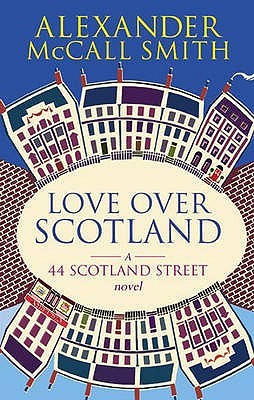
Love Over Scotland

Love Over Scotland (44 Scotland Street #3) Alexander McCall Smith. 2006. 355 pages. [Source: Library]

First sentence: Pat let her gaze move slowly round the room, over the figures seated at the table in the seminar room.

Premise/plot: Love Over Scotland is the third book in the series by Alexander McCall Smith. I have loved each and every one. (44 Scotland Street, Espresso Tales). It is set in Edinburgh. It follows the lives of a handful of characters. Some of the characters are CHARACTERS. Each chapter is short and episodic, the book originally appeared in serial form in the newspaper. It is exactly like a soap opera in print, minus the graphic smut.

My thoughts: I really love some of these characters. My favorite character is without a doubt Bertie. The scene with Bertie and his therapist was one of the funniest I've ever read. The therapist thinks that Bertie has created an imaginary friend named Tofu. Now readers know that Tofu is a real child in his class. But this therapist won't be convinced otherwise! And Bertie finally lets the matter go. He knows what's real and what isn't. And his doctor is NUTS. Bertie also joins a teenage orchestra in this one and goes to PARIS, FRANCE. The good news is that he's at last free from his mother. The bad news is, well, I'm not sure there is bad news. True, the group technically leaves him behind. But that leads to Bertie having the BEST DAY EVER. I also enjoyed Angus and his dog in this one. These two are always great fun. There were so many great moments in this one. (I do like that Pat and Matthew finally start dating in this one. I really like Matthew, but he just can't compete with the six year old Bertie in terms of stealing scenes.

© 2017 Becky Laney of Becky's Book Reviews

Sunday, May 07, 2017

Minerva Louise and the Colorful Eggs

Minerva Louise and the Colorful Eggs. Janet Morgan Stoeke. 2006. 24 pages. [Source: Library]

First sentence: Minerva Louise loved the springtime.

Premise/plot: Minerva is very confused by the Easter egg hunt on the farm. She thinks that there's an absent-minded chicken abandoning her eggs ALL over the place. She rounds up the other hens and has them trying to find the eggs to sit on them to keep them warm. Then they notice the "farmers" picking up the eggs. The other hens are content that all is well. But Minerva is still curious! She asks questions of the "brown bunny" and "yellow chicks" but candy doesn't answer questions!

My thoughts: I loved this one. I'd never thought to imagine how a chicken would view egg hunts! Minerva Louise may get a lot of things wrong, but I love her gumption.

Text: 5 out of 5
Illustrations: 4 out of 5
Total: 9 out of 10

© 2017 Becky Laney of Becky's Book Reviews

Sunday, July 17, 2016

Cyrano

Cyrano. Geraldine McCaughrean. 2006. HMH. 128 pages. [Source: Review copy]

First sentence: The curtain goes up. Silence falls. A painted moon wavers on a painted backdrop. The audience shivers with delight. For what could be better than an evening at a Paris theatre? Who more famous than the evening's glittering star? Enter the magnificent Montfleury, stage right!

Premise/plot: A prose adaptation--for teens--of the French play Cyrano de Bergerac written by British author Geraldine McCaughrean. Now, I do love the play. And I'd probably recommend the play over this adaptation--at least for adults. Especially since I believe it is now out of print. It is sad, right, that by the time I got to this review copy it was already out of print?!

Here's the basic story for those who don't know it: Cyrano is in love with his cousin, Roxane. He finds her to be the most beautiful woman in the world. Roxane is in love with a young soldier (cadet) named Christian. She thinks he is the most handsome man in the world. Christian loves Roxane, but, he lacks the skill to woo her the way she wants to be wooed. She's not interested so much in his kisses as his passionate words of longing. Cyrano who is just as skilled in wordplay as in swordplay steps in to help where he can. He'll give Christian the words to speak to win her heart. When both men go off to war it is Cyrano who risks his life--twice daily--to send letters to her so she won't worry that Christian has been killed. Those letters bring her great joy and drive her mad with wanting him....so much so that she goes into a war zone to find her man. When the two meet she declares, IT IS YOUR SOUL I LOVE, YOU COULD BE THE UGLIEST MAN ALIVE AND I WOULD LOVE YOU STILL, PERHAPS EVEN MORE. Now Christian begs her, PLEASE, PLEASE, PLEASE LOVE ME BECAUSE I'M BEAUTIFUL AND HANDSOME AND SWOON-WORTHY. THAT'S THE WAY I WANT TO BE WANTED. She's confused. But reader's aren't. Christian knows that it is Cyrano whom she truly loves because Cyrano is "his soul." What's to be done?!?!

My thoughts: For readers who are really intimidated by reading plays, then this one is worth seeking out. I do think it serves as a good first introduction to the story. I would hope that readers would grow into the original and seek to experience the story again and again.

© 2016 Becky Laney of Becky's Book Reviews
Monday, June 27, 2016

Audio Book: Life As We Knew It

Life As We Knew It. Susan Beth Pfeffer. 2006. Houghton Mifflin Harcourt. 352 pages. [9 hours, read by Emily Bauer] [Source: Review copy]

Lisa is pregnant.

In an effort to be more well-rounded, I decided to listen to an audio book or two this summer. And since I prefer to listen to only books I've already read and loved, I decided to go with Life As We Knew It by Susan Beth Pfeffer. (This was my second time to listen to the story.)

Premise/plot: Miranda gives readers a behind-the-scenes look at a cataclysmic event that changes life on earth forever when a meteor crashes into the moon changing its orbit and proximity to earth. The book is Miranda's diary, and through her entries we meet her mom (Laura), older brother (Matt), younger brother (Jon), father, stepmother (Lisa), her mother's boyfriend (Peter), and a handful of her friends and classmates (Dan, Megan, Samantha). It reveals one family's struggle to just survive.

This won't be a proper review really. More a rambling list of observations.

From the very first time I read this one, I've really, really, really, really WANTED it turned into a video game.

Miranda and her family don't mention music much at all. But I personally would GO INSANE if I couldn't listen to music. If there was a video game, I'd want the family I create to have at least one musician in it (piano, acoustic guitar, violin, etc.) so that music could be made even without electricity.

Even after having read it so many times (probably six or seven???) I am still bothered by the inaccuracy about the water supply. Miranda makes such a deal of being on well water and their well running dry halfway through the novel. Remember that they've been without electricity for most of the book. (Except for when it comes on in fits and bursts allowing Miranda to vacuum and her mother to do laundry.) Wells don't pump water without electricity. The family would have had to find an alternate source of water practically from the very beginning of the novel. And being without water that much sooner would have complicated all aspects of their lives. (Their main source of water after the well goes dry is to melt snow and ice and boil it for purity.)  

The diary gives Miranda an opportunity to vent. Let's be honest, in her situation, we'd all need a safe place to VENT. Miranda records her many heated arguments with her Mom. She doesn't come out looking like a saint. But I'm not sure she's meant to. As an adult reader probably a lot closer to her mom's age than Miranda's 16, it is easy to form judgments about Miranda.

Miranda is VERY opinionated about Christianity. The book is not faith-friendly. And really in the book's three-hundred-something pages, the only villains (except for some street thugs stealing plywood) are Megan's minister, and the President of the United States (who can't magically make things better for every human on the planet). Miranda and her mom are definitely opinionated in terms of politics as well. (Let's just safely guess that the author was not a Bush fan.)

I do think that a cataclysmic event like this would make everyone--no matter their age--contemplate their own mortality and reflect at least a little on the big questions of life. What happens when I die? Is there a heaven? Is there a hell? How can I know that I will go to heaven? What can I do to be saved? What is heaven like? What is hell like? So the fact that Miranda and a few people in her life are talking about these things seems believable enough to me. And since Miranda does not come from a religious family, it makes sense that she'd be muddled about what Christianity is all about. It makes sense that she'd reflect the modern society of not really believing that there is such a thing as sin. And it also makes sense that she'd reflect society's misunderstanding of what the gospel actually is. I think we very much live in a time and place where even those who've been exposed here and there to "the church" in some form or another--even if only coming through talking vegetables--believe that you earn your way into heaven through good works. That Christianity as translated through our culture is DO THIS, THIS, THIS, THIS. DON'T EVEN THINK OF DOING THAT.

The gospel isn't about a long, rigid list of rules and laws to be kept. The gospel is saying here's the long list of rules [the Old Testament]. You haven't kept these rules and laws since the time they were given to you. You've never been able to manage keeping them. Ever. No matter how many times you try and fail and fail to try, you can't keep these rules. Stop struggling and striving and listen to the good news. For anyone who gives up the fight to be good enough on their own, to all who admit that they are unable and unwilling to keep the law, to all who are honest about their need for help...there's GREAT news. Someone came and perfectly kept the law on your behalf and in your place. Jesus. He DID it all for you. It is done. He lived the life you could never, ever, ever, hope to live. He died the death you deserved. Believe that He has done it all, that it is indeed finished, and eternal life is YOURS.

The gospel is not to be confused with the prosperity gospel. The gospel is not believe in Jesus and get that dream job you've always wanted! Believe in Jesus and be cured of cancer! Believe in Jesus and get that dream body! Believe in Jesus and you'll never need another alcoholic drink in your life. Believe in Jesus and your gambling addiction will be broken forever. Believe in Jesus and your marriage will be saved.

Speaking hypothetically, I think a cataclysmic event of this nature would perhaps bring out the best in true Christianity, perhaps driving a zealous revival and urgent evangelism, perhaps even street evangelism. But reveal all the flaws of the prosperity gospel. The prosperity gospel believes in the power of your words, and that you speak your own reality. That if bad things happen, that it is your fault.

According to Amazon, twenty mentions of the word "God," twenty mentions of the word "hell," sixteen mentions of the word "church," and fifteen mentions of the word "heaven."

I think it is important to remember that her use of religion in this book is for DRAMA and CONFLICT and TENSION. And it was not to be offensive or potentially offensive to a portion of her readers. Megan's pastor, in my humble opinion, falls shy of preaching the true gospel and is much closer to a false teacher.

© 2016 Becky Laney of Becky's Book Reviews

Wednesday, January 13, 2016

The Log Cabin Wedding

The Log Cabin Wedding. Ellen Howard. 2006. Holiday House. 64 pages. [Source: Gift]

The Log Cabin Wedding was a pleasant discovery to me. I found the book among my mom's over thanksgiving weekend. It was a short read that felt so comfy-cozy right. It would pair quite well with Sarah, Plain and Tall.

Elvirey is the young heroine of this historical chapter book. Out of necessity, two families come together to harvest the crops on their farms. One family is a widow woman and her young family. The other, as you might have guessed, is a widower with a family of his own. Elvirey is the daughter of the widower, and, this let's-get-together-with-the-neighbors idea was her own. Unfortunately, Elvirey didn't foresee that the two might just fall for each other in the process! The last thing she wanted was a replacement for her mother...

I liked this one very much. I like that Widow Aiken, among other things, teaches Elvirey how to read.

This one is easy to recommend.

© 2016 Becky Laney of Becky's Book Reviews

Tuesday, October 27, 2015

The Great American Mousical

The Great American Mousical. Julie Andrews Edwards. 2006. HarperCollins. 160 pages. [Source: Library]

I really found The Great American Mousical to be charming and delightful in all the right ways. I'm not quite sure why I tend to like books starring talking mice, but I do, I really do. And if you do too, then this one is a must-read. It is set in New York, in a theatre, in an about-to-be-demolished theatre that has seen better days. The truth is, the mouse theatre hidden within the human theatre is probably in better shape. Readers meet dozens of characters, all of them involved in the theatre. After setting the scene, things really get started after the star of the show, Adelaide, is trapped in a mouse trap and is "kindly" disposed of by one of the human construction workers. (It could have been so much worse!)

Several things keep this story going: will the mice find a way to save the theatre? will they be able to go on with the show without their big star? will Adelaide, the star of the show, make it back to the theatre in time?

The book is a very satisfying, very quick read. 

© 2015 Becky Laney of Becky's Book Reviews
Friday, September 25, 2015

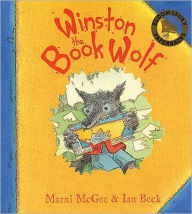
Winston the Book Wolf


Winston the Book Wolf. Marni McGee. Illustrated by Ian Beck. 2006. Walker. 32 pages. [Source: Library]

I definitely enjoyed reading Marni McGee's Winston the Book Wolf. If you enjoy fairy tale twists OR books about books, then this is one to seek out. Winston the Wolf LOVES, LOVES, LOVES to eat words, all sorts of words. He is literally eating the words, thus one of perhaps many reasons why he is banned from the library. But someone has pity on Winston, a girl with a red hood, and shows Winston that there is a BETTER way to devour words: that way, of course, is by READING them. After Winston learns to read, he NEEDS the library; he needs more books, more stories, more words. But sadly, he is banned. Can he and his new friend find a way to sneak him into the library?!

This one is definitely worth reading and sharing.

The illustrations were a bit odd, I admit, but they mostly worked for me. Mainly because they definitely add to the story. Readers can spot, for example, three little pigs on nearly every spread. One thing I didn't quite get, however, was WHY the tables and chairs and such had to have faces.

First sentence: Winston the Wolf swished his tail as he ran past the burger stand. He did slow down to sniff, but he did not drool. Meaty treats were not what Winston had in mind. Winston wanted books, and he knew where to find them.

© 2015 Becky Laney of Becky's Book Reviews