Showing posts with label 1990. Show all posts

Friday, June 19, 2026

44. Jurassic Park


44. Jurassic Park. Michael Crichton. 1990. 466 pages. [Source: Library] [5 stars, adult science fiction, dinosaurs, action/thriller]

First sentence: The tropical rain fell in drenching sheets, hammering the corrugated roof of the clinic building, roaring down the metal gutters, splashing on the ground in a torrent.

Premise/plot: Is there anyone who doesn't know the premise of Jurassic Park?????? Even if you've never actually actually seen the movie, Jurassic Park???? There are companies--individuals--playing God, if you will, who have brought "back" dinosaurs from extinction filling in the blanks as they see fit. But perhaps with not enough caution. Just because you can do something doesn't mean you should do something.

There are many, many, many characters. But essentially the book is mainly about what happens when visitors come to the park ahead of the opening--that is still in the future (or is it???). They are there to "see" what has been done....so far.

My thoughts: I loved, loved, loved, loved, loved this book!!!! I think it is SO much better than the movie. I really got swept up in the story!!!! And I loved how much more substantive the book is--in terms of both characterization and plot. Life finds a way indeed!


© 2026 Becky Laney of Becky's Book Reviews

Tuesday, April 08, 2025

37. The Worthing Saga


37. The Worthing Saga. Orson Scott Card. 1990. Tor. 465 pages. [Source: Library] [5 stars, adult science fiction, short stories, framework stories]

First sentence: In many places in the Peopled Worlds, the pain came suddenly in the midst of the day's labor. It was as if an ancient and comfortable presence left them, one that they had never noticed until it was gone, and no one knew what to make of it at first, though all knew at once that something had changed deep at the heart of the world.   

ETA: I think this is the fourth time I've reviewed it for Becky's Book Reviews. I listened on audio book this time around. IT was mostly great. I absolutely love the first half--the framework stories. The short stories are hit and miss. I like some of them a LOT...and I detest/loathe others. The book as a whole is one that sticks with me vividly.

 Premise/plot: Imagine living in a world where there is no pain, no suffering, no grief, no fear, no anger, no violence, no injury. Wrong actions, in a sense, have ceased to have consequences. If a person were to hurt himself/herself chopping wood or tending the fires, then there would be instant--almost magical--healing. Even morally wrong actions are prevented, on this world there are no children out of wedlock; and the child is always the husband's never the lover's if you're an adulteress. Yes, there is an occasional death, but never for the very young, never for the able-bodied. It is hard to imagine for us this life of easy contentment. A life with no struggles? A life truly worry-free? A world where fire doesn't burn you and ice doesn't freeze you? Surely there must be a catch, right? Some reason why this world isn't a perfect paradise...

The change came in the middle of the night. Imagine going to bed with everything being quite all right, and waking up to find that life is not what you thought it was. Pain. Grief. Suffering. Worry. Fear. Anger. And it wasn't just emotional, as the village learned. It was physical, too. As one accident after another occurred, the villagers soon realized that they could not only be hurt, but they could also DIE. With the whole village (and indeed the whole world) in confusion, no one knows quite what to think. Is God dead? If God is still watching over them, why then is there suffering? Why suffering after all these centuries of watchful care? Folks are going along muttering that God doesn't look out for them anymore.

The old clerk trembled and nodded and his voice quivered as he spoke. 'I have read the books of ancient times,' he began, and all eyes turned to him. 'I have read the books of ancient times, and in them the old ones spoke of wounds that bleed like slaughtered cattle, and great griefs when the living suddenly are dead, and anger that turns to blows among people. But that was long, long ago, when men were still animals, and God was young and inexperienced. (5-6)

Yes, no one understands this Day of Pain. Least of all, Lared, our young hero. But it is Lared who will become the chosen speaker that will write the story and tell the tales that will explain this Day and give it meaning. Two strangers come to the inn, the inn that Lared's parents own, and it is Lared and his sister, Sala, who befriend them. Jason. Justice. A man and woman. The two are mysterious, no doubt about it, and more than one person suspects that they're coming is linked with the Day of Pain.

The two share their stories mostly through dreams and waking visions. Jason will occasionally share one the old-fashioned way, but most are transmitted directly into Lared's mind. Lared doesn't know what to think. He doesn't like the dreams. He doesn't like the uneasy feelings they leave him with...but he also knows that he has been called, chosen, if you will, to write this down. To record them. It is not his place to understand everything, just to write it down as it's been given to him.

Lared and his village provide the framework for the stories that Jason and Justice share. It is a story of two men, one empire, and one powerful drug.

Abner Doon. A name that still strikes fear in people thousands of years after his death. Some even say that he was the devil himself. But was he really? His name is associated with death and destruction, and in some ways, it is easy to understand why. He caused the death and destruction of the EMPIRE. The very arrogant, often corrupt, very stagnant empire. But was the fall of the empire really that bad? Wasn't it better for humanity in general? Jason Worthing certainly thinks so.

Jason Worthing. Another name that people fear to speak aloud. Why? It is a name of reverence. Many people feel that Jason Worthing is God. The creator of life. The sustainer of the universe, even. But was he really? Yes, he had a hand in establishing life and building civilization, at least on one planet, but the creator of all life? No. Just an ordinary man with unusual psychic powers who came from a technologically advanced society.

The empire. It's not that the empire was completely evil. Sure the empire had its fair share of corrupt and power-hungry politicians. More than its fair share. Every branch of the empire had its corrupt officials. And there was nothing that couldn't be bought--as long as you had money. But that wasn't the real crime of the empire. The real crime was that humanity was being robbed of its very soul, its very essence. They had lost the point of living. They were corrupting the very nature of our existence.

Somec. Perhaps the most powerful drug the empire had ever known. What did it do? It put the user into a deep sleep, a coma, if you will. First, the user would have his/her memories downloaded or recorded, if you will, onto a tape or into a bubble. I forget quite how they did it. I just know that there was a way of downloading and uploading memory. Then the assistant would inject somec. It wasn't a pretty picture. It burned. It hurt. It caused severe physical problems--sweating, discomfort, pain--but the user would forever be unaware of it because the memories would never include this part of the experience. Who was it for? At first, it was just for starship pilots. Their skills would be needed throughout a long voyage. And if a trip took hundreds or perhaps thousands of years, then they'd need Somec to function. The computer would always be able to wake them up in case of an emergency. But they'd arrive at their destination intact. So for colonization vessels, it really couldn't be any better. A ship would carry three hundred or so passengers and all the supplies needed to create and establish a civilization on another planet. So there were a few valid uses of the drug, I suppose. But the real corruption began when somec became a common necessity for the people.

Imagine the possibility of immortality. Somec offered immortality. The wealthy. The elite. The powerful. The brilliant minds of society were all given the chance for immortality. The more valuable society deemed you, the longer you would sleep between waking cycles. The common people lived and died naturally enough. But a good portion of society, became obsessed with immortality. But is living a thousand years natural if you spend 70% of it or so asleep? What does it accomplish really? You're not able to have friendships with others unless you're on the same sleep cycle. You're not able to maintain family relationships either. People could theoretically outlive their great-great-great-great-great-grandchildren. Love becomes to a certain extent irrelevant. Most things become irrelevant. No time for the finer things in life. Love. Romance. Music. Art. For not only do most people spend most of their times asleep, what little time they're awake they're obsessed with power, money, fame, greed, control. They always want more, more, more. Never content. There is no longer any joy in living life. But really too few people notice what they're missing. Except for one. The aforementioned Abner Doon.

Abner "rescues" Jason, if you will, and offers him a chance to become a part of something great. Jason becomes a starship pilot, a very famous starship pilot, and he eventually leads a colonization ship. Abner's big plan--besides the fall of the Empire--is to recreate life as it used to be. His plan? To spread humanity throughout the galaxy. To have human civilizations sprout up on thousands of planets. He knows that with the fall of the Empire, with the fall of technology, it will be thousands upon thousands of years before ANY civilization becomes advanced enough for star flight. He sees this as a way for humanity to wipe the slate clean and begin anew.

The Worthing Saga is the story of Jason's planet. How Jason "fathered" or "created" that world. And what happened to its inhabitants. What happened to his descendants. All these stories--and there are many--span thousands of years. Everything is leading the reader back to Lared. Back to the Day of Pain.

The Worthing Saga contains the previously published The Worthing Chronicle and nine short stories.

My Thoughts: Worthing Saga is one of my favorite, favorite books. And my FAVORITE Card novel. (Though I love Ender's Game and Speaker for the Dead.) The Worthing Saga is about the meaning of life. It is about what it means to be human. It asks important questions. It goes where few novels do. It asks what the meaning of pain and suffering is. It asks what the meaning of struggles are. It is ethical in nature. It asks the hard questions. But it is philosophical as well.

I love the world-building. I find the three settings within the book to be fascinating. (There is Lared's home planet which is the present-day setting; there is Capital, the planet from Jason Worthing's memory and stories, Capital becomes "real" to Lared as he experiences Worthing's memories through dreams; there is Worthing, the planet that Jason colonized with a handful of colonists thousands of years before the novel opens, again this planet becomes "real" to Lared as he experiences other people's memories through Justice, Jason's descendant.) Readers get a taste of all these societies and communities. Capital is decadent and immoral and corrupt. It is obsessed with the notion of eternity--of living forever. It "lives forever" by drug use. Somec. You might be under Somec--asleep--for anywhere from one year to ten years, and then awake for anywhere from one day (like the Empress) to three years. But somec disrupts EVERYTHING good and natural about life. An example of the decadence and immorality can be seen in the "lifeloops." People filming/recording their "real" lives for everyone to watch. Most--if not all lifeloops--are graphic in nature. It's hard not to be disgusted by the depiction. (For example, one actress complaining to her agent that he better not hire any seven year old boys for her next film.) Closely connected to the world-building, is the mythology of it. How Abner Doon's name lives on. He IS the devil. How Jason Worthing's name lives on. How people see him as being GOD. Both men are very much human, having strengths and weaknesses, being oh-so-fallible. But they have become collectively so much more than that. They've lost their humanity. Truth has been shaped and reshaped too many times to allow for them to be just human.

I love the characterization. I love getting to know Lared, Sala, Jason, and Justice. Not to mention all the men and women from the memories and stories. (I have a soft spot for Hoom.) I love the storytelling. I love the dialogue. I love how everything is layered together. How the story all comes together. How Lared slowly but surely pieces things together and comes to understand--if understand is the right word--the world. Card's characters are so very human, so vulnerable, so fallible. Readers see humans at their best and at their absolute worst within The Worthing Saga. Moments of compassion and redemption make it so worth while.


I love the ideas. I love the depth and substance. That is not to say that I agree absolutely with every single philosophical idea within the book. But it goes places most fiction doesn't. It asks real questions, tough questions. It explores ideas. One also sees the consequences (or possible consequences) of ideas. But it encourages you to think about deep things, to explore questions like why is there pain? why is there suffering? would the world be a better place without pain, without suffering? Is pain a necessary evil? Do we only feel joy and happiness because we know about pain and sorrow? what makes life beautiful? do we become better people through our struggles with life?


I do enjoy the framework. The Worthing Chronicle (1982) makes up half of The Worthing Saga. This is THE story with Lared being visited by Jason and Justice shortly after the day of pain disrupts his community. (It really is a haunting opening.) The second half of the book consists of short stories. Most of these short stories were written years before The Worthing Chronicle and were previously published. Tales of Capitol (1979): "Skipping Stones," "Second Chance," "Lifeloop," "Breaking the Game," "Killing Children," and "What Will We Do Tomorrow." Tales from the Forest of Waters (1990, 1980): "Worthing Farm," "Worthing Inn," and "The Tinker." Of these stories, I find Skipping Stones, Second Chance, and Breaking the Game to be most memorable. After you've read these stories, you almost need to go back and reread the first section. I'm not sure you can fully appreciate the book without rereading it a few times and absorbing it. Most of the stories--but certainly not all of them--are emotional. I love that the book is a book to be EXPERIENCED. 

ETA: YET I do have to say that I don't absolutely love everything. Some of the stories are EXTREMELY graphic and disturbing...one might even say disgusting. Not all of the stories. Not even most of the stories. And they are there to show the corruption and sickness of what humanity has become...so I guess they somewhat serve a purpose. Yet this one is distasteful in places.

© 2025 Becky Laney of Becky's Book Reviews

Friday, May 28, 2021

48. The Eye of the World


The Eye of the World (Wheel of Time #1) Robert Jordan. 1990. Tor. 814 pages. [Source: Bought]

First sentence: The Wheel of Time turns, and Ages come and pass, leaving memories that become legend. Legend fades to myth, and even myth is long forgotten when the Age that gave it birth comes again. In one Age, called the Third Age by some, an Age yet to come, an Age long past, a wind rose in the Mountains of Mist. The wind was not the beginning. There are neither beginnings nor endings to the turning of the Wheel of Time. But it was a beginning.

Premise/plot: The Eye of the World is the first book in the Wheel of Time series. Three young lads are at the center of this misadventure which has good and evil facing off once again. Rand, Perrin, and Mat are country boys--farmers, sheep farmers, villagers. They never planned or wished for this adventure to befall them. And, truth be told, the excitement wore off quickly. But it's literally all or nothing for their lives are at stake--no, the future of the world is at stake.

They are not alone. There is a fellowship of sorts. Two young women--also from the same community (Emond's Field)--Nynaeve (the village wisdom) and Egwene (her apprentice). Egwene wanted to join in the adventure and is seeking a little something more to life. Nynaeve is distrustful and hesitant. Her mission is to get them all back home safe so life can return to NORMAL. (Well, that's her mission at first). The adults along for the ride are from the outside. There is a gleeman, Thom Merrilin, an Aes Sedai, Moiraine, and her warder, Lan. They also pick up one more along the way, notably Loial. (Would they have made it without him???)

So what should you expect: a tedious journey with a near impossible mission to complete on their quest. Tedious not for the reader--necessarily--but for those actually on the journey. It is full of hardships and literal nightmares. Night and day they must find the strength to keep on keeping on and resisting evil at every single turn.

My thoughts: This is my third time to read The Eye of the World. I really do love it. I forget just how much because I see it on my bookshelf--along with all the OTHER books in this massive series--and I find a plethora of reasons not to read the series....just yet. But I have an oh-so-faithful friend who encouraged me to pick it up again, that now is the time. She had more faith in me than I had in myself. I thought there was no way I could read it in a week, and, she thought YES YOU CAN. She was right. By the third day it was almost easy how right it felt to just read the one book. 

Expect world-building: introducing the world, introducing the cultures and traditions, introducing lore and legends, introducing characters, the formations of relationships--friendship and possibly romantic.

My advice for those that are intimidated by the prologue and perhaps the first few chapters is to keep on keeping on. Don't try to understand/comprehend the WHOLE world at once. Go with the flow and absorb the world at your own pace. 

My review from 2014.
My review from 2012.

© 2021 Becky Laney of Becky's Book Reviews

Friday, April 05, 2019

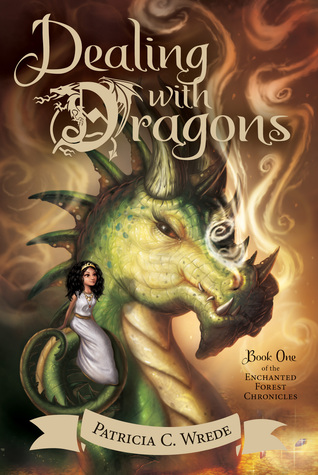
Dealing with Dragons

Dealing with Dragons. (Enchanted Forest Chronicles #1) Patricia C. Wrede. 1990/2015. 208 pages. [Source: Review copy] 

First sentence: Linderwall was a large kingdom, just east of the Mountains of Morning, where philosophers were highly respected and the number five was fashionable. The climate was unremarkable. The knights kept their armor brightly polished mainly for show--it had been centuries since a dragon had come east. There were the usual periodic problems with royal children and uninvited fairy godmothers, but they were always the sort of thing that could be cleared up by finding the proper prince or princess to marry the unfortunate child a few years later. All in all, Linderwall was a very prosperous and pleasant place.
Cimorene hated it.

Premise/plot: Cimorene is the heroine of Patricia Wrede's Dealing with Dragons. Her parents have definite ideas and opinions on what is and is not proper for a princess. Anything--everything--that Cimorene wants to do is improper. At least it feels that way to her. No fencing. No learning magic. No cooking. To name just three. A bit exasperated the King and Queen decide that it's time for Cimorene to marry--she's just sixteen. Their choice for her is a dashingly handsome prince. But Cimorene will have none of him. But is she willing to do more than talk about rebelling? Is she brave enough to actually run away? If she wasn't, this would be a VERY SHORT book, right?!

So dragons. This book has them! Cimorene's scheme to avoid an unwanted marriage is to offer herself voluntarily to the dragons. Snobby dragons love to have their own princess to hold captive, right?! Right! Cimorene is NOT eaten--again that would be a VERY SHORT book--one dragon has mercy on her: Kazul.

Adventure abounds in this one: it has princesses, princes, wizards, witches, knights, and DRAGONS.

My thoughts: I loved, loved, loved this one. Doesn't it have a wonderful opening paragraph?! By the time I read the sentence "Cimorene hated it" I knew I would love it. Isn't it interesting how some books just have a way of HOOKING you?! Needless to say, I read this one in one sitting. It was enjoyable, satisfying, delightful, funny.

I really loved the characters. Cimorene is a GREAT heroine. And I loved, loved, loved Kazul!

"Speaking of dragons, where's yours?"
"Kazul's not my dragon," Cimorene said sharply.
"I'm her princess. You'll never have any luck dealing with dragons if you don't get these things straight. She's gone to the Enchanted Forest on the other side of the mountains to borrow a crepe pan from a witch she knows."
"She's what?" said the knight.
"She's gone to borrow a crepe pan," Cimorene repeated in a louder voice. "Perhaps you'd better have your helmet checked when you get back. They're not supposed to interfere with your hearing, but sometimes--" (26-7)

© 2019 Becky Laney of Becky's Book Reviews

Thursday, February 01, 2018

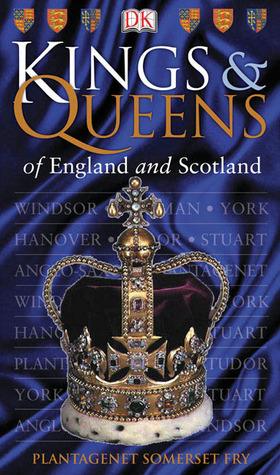
Kings & Queens of England and Scotland

Kings and Queens of England and Scotland. Plantagenet (Peter?) Somerset Fry. 2006. 96 pages. [Source: Library]

First sentence: The Romans ended direct rule of England in the fifth century, and by the early seventh century the country had split into  seven warring kingdoms.

Premise/plot: A nonfiction reference guide to the kings and queens of England...and Scotland. This one is divided into ten chapters: "The First English Kings," "The Normans," "The Plantagenets," "The House of Lancaster," "The House of York," "The Tudors," "The Kings and Queens of Scotland," "The Stuarts," "The Hanoverians," and "The House of Windsor."

The first chapter spans AD 600-1066. We've got one spread on Early Saxon Kings. One spread on Alfred the Great. One page on Saxons and Vikings. One page on Canute.

The other chapters cover the kings and queens the enthusiast is probably already familiar with to some degree. Each dynasty is introduced or summarized briefly (in a two-page spread) before introducing the individual monarch. (Here are four 'first sentences.')
The Normans were originally Vikings who settled in northwest France in the early 10th century. Taking control they became Counts, and later Dukes, of Normandy, and they created a powerful state around the mouth of the river Seine. (14)
The surname of this remarkable family [the Plantagenets] derives from the nickname borne by Geoffrey, Count of Anjou, between 1129 and 1251. Geoffrey, the father of Henry II, wore a sprig of flowering broom (Planta genista) as his personal badge. (19)
A branch of the Plantagenet family, the House of Lancaster was a short dynasty of three kings, all named Henry. (32)
The House of York had a stronger claim to the throne than the House of Lancaster, although both were branches of the House of Plantagenet. (38)
There will be some readers anxious about what he says about Richard III. After all, a measure of a book--for some--is what they have to say about one king.
Richard III was king for barely two years, but once he was dead, historians, clerics, and even playwrights fell over themselves to blacken his name. Most of the propaganda was designed to serve the Tudor dynasty, which began when Henry VII's army defeated and killed Richard at the Battle of Bosworth in 1485. However, in more recent times, historians have questioned whether Richard III really deserves his evil reputation. (42)
My thoughts: I really enjoyed this one. It is concise. It is readable. It is filled with charts and illustrations and oh-the-bullet-points. It's just packed cover-to-cover with details. Now, that being said, this one is an overview. Whole books--long books--have been written about individual monarchs. This will be just a starting place for the real enthusiast, or perhaps a refresher course.

Some might call this a reference book, a guidebook. I see it as an absorbing cover-to-cover read, as compelling perhaps as a bestselling thriller or mystery.

A few years ago, I was completely obsessed with the British children's program, Horrible Histories. This book reminded me of the joys and thrills of watching the show. 


© 2018 Becky Laney of Becky's Book Reviews

Wednesday, March 15, 2017

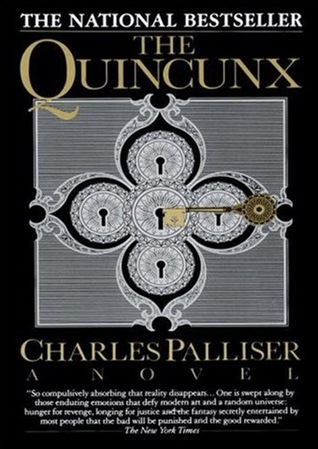
Quincunx

The Quincunx by Charles Palliser. 1990. 787 pages. [Source: Library]
First sentence: It must have been late autumn of that year, and probably it was towards dusk for the sake of being less conspicuous. And yet a meeting between two professional gentlemen representing the chief branches of the law should surely not need to be concealed.

Premise/plot: For readers who have read every Dickens novel a couple of times apiece, Charles Palliser's The Quincunx may hold great appeal. It is historical fiction set in Victorian England. The hero is a young boy--who becomes a young man by the time this CHUNKSTER is finished--who may or may not be heir to a very large estate. The estate is in the hands of a chancery suit. There's a codicil to a will that may change things to his benefit. Also a second will--a later will--that would do away with the codicil, but still leave him the heir. Regardless, he seems to be entitled to the estate. But there are people--adults with a lot of money and to some degree power--that would do ANYTHING and EVERYTHING to keep him from coming forward and being proclaimed heir. These evil agents have dozens if not hundreds of minions working against the poor boy. So much so that anytime John talked to anyone--family friend, complete stranger--you wouldn't be amiss to cry out: DON'T DO IT. DON'T TRUST THAT PERSON. By the end of the book, you can easily see why total depravity of the human race makes sense.

My thoughts: I wanted to enjoy this one. I did. And to a certain degree, I did. I enjoyed meeting some of the characters. (My favorite may have been Johnny and his great-aunt Lydia.) I think this one is realistically bleak. Most of the characters we meet are living in poverty or extreme poverty. Justice is hard to come by. You could have a strong work ethic and be willing to do anything and everything that doesn't violate your conscience, and still end up bad. There is no getting ahead or beating the system. The wealthy are depicted--for the most part--as selfish, proud, corrupt, eager to take every advantage of the poor and weak. One or two even have murder on their minds--a lot! Though you don't have to be rich to be corrupt! The character of Bellringer proves that sure enough.

Throughout the novel, there is a slight hint that a romance might blossom between Johnny and Henrietta when they're grown. But Henrietta seems to be going the way of Miss Havisham as the novel concludes. I thought that after 750 pages of misery and danger, there'd be a more traditional happy ending. I wasn't strongly attached to Henrietta. But I don't think any woman deserves madness as an epilogue.

What strikes me most about this one is SADNESS and MISERY and MADNESS. If you find the book of Ecclesiastes too short, then this one might also be just right for you.   


© 2017 Becky Laney of Becky's Book Reviews

Saturday, February 04, 2017

Fudge-a-mania

Fudge-a-mania. Judy Blume. 1990. 176 pages. [Source: Library]

First sentence: "Guess what, Pete?" my brother, Fudge, said. "I'm getting married tomorrow."

Premise/plot: Fudge-a-mania is the fourth book in the Fudge series by Judy Blume. Though the series is named after Peter's brother, Fudge, the stories are told from Peter's perspective.

It is the summer before Peter (and Sheila's) seventh grade year. The two families will be vacationing in Maine together. Peter and Sheila (to refresh your memory) do not like each other. In fact, they practically HATE each other. Peter doesn't realize that "vacationing next door" to the Tubman family means essentially sharing a duplex. One week will be brightened by Peter's best friend, Jimmy, coming to stay--with his (uninvited) Dad. Readers get to know the Hatcher and Tubman families very, very well. Even the grandparents. This summer vacation is anything but dull.

My thoughts: I really liked this one. I'm not sure I loved, loved, loved it because to be honest, Fudge is not my favorite or best. But I did enjoy aspects of this one: the romance between the grandparents that will link the two families now; also "Tootsie" is a delight and I'm glad that Mr. Fargo will benefit quite a lot from his vacation!

© 2017 Becky Laney of Becky's Book Reviews

Monday, January 11, 2016

The Face of a Stranger

The Face of a Stranger. (William Monk #1) Anne Perry. 1990. 352 pages. [Source: Library]

The Face of a Stranger is a great little mystery, and a fine start to a series, a series that I now want to read more of!

The hero of The Face of a Stranger is William Monk. Readers are just as clueless as to who he is as he is himself. Monk wakes up from an accident with amnesia. He doesn't remember his name, his face, what he does, where he lives. He's clueless. He finds out from others that his name is William Monk and that he's a police detective. Within a few weeks of his release, he's back at work and back to detecting. Just as important to him as getting back to working on cases is solving the mystery of who he is, what kind of man he is. The clues are leading him to suspect that he hasn't been a very nice or kind man. That he's treated others--including his own sister--poorly. He's woken up with a conscience or a change of heart, you might say. His morals have been reset, if you will! He realizes that not many people--if any--actually like him. And that's hard to take, but, he does it well, for the most part. He is not willing to tell everyone that he's clueless, that he has no clue as to his own past. One thing is clear: he's good at noticing details, of finding clues, of putting together theories based on those clues. So along with his own private agenda of finding out WHO he is, he's on an official case with a partner (Evans, I believe). Somebody murdered Major Joscelin Grey. The murder coincidentally enough happened around the same time as his own accident that landed him in the hospital.

Can he solve the murder case? Will he allow pressure from others to influence him into making a quick arrest?

I enjoyed this one oh-so-much!!!!

© 2016 Becky Laney of Becky's Book Reviews

Saturday, December 05, 2015

Seuss on Saturday #49

Oh, the Places You'll Go. Dr. Seuss. 1990. Random House. 44 pages. [Source: Library]

First sentence: Congratulations! Today is your day. You're off to Great Places! You're off and away!

Premise/plot: I'd describe Oh, The Places You'll Go as a motivational picture book for older readers. Not that young children don't need motivation, but, the advice, in my opinion, makes more sense for older readers--grown ups even. You are the you of the title. The whole book is written in second person.

My thoughts: I like this one. Do I love, love, LOVE it. I wouldn't get that carried away. But I do genuinely like it. I like how it's motivational and uplifting all the while being true-to-life and realistic.
Wherever you fly, you'll be best of the best. Wherever you go, you will top all the rest. Except when you don't. Because, sometimes you won't. I'm sorry to say so but, sadly, it's true that Bang-ups and Hang-ups can happen to you. You can get all hung up in a prickle-ly perch.
Have you read Oh, The Places You'll Go! Did you like it? love it? hate it? I'd love to know what you thought of it!

If you'd like to join me in reading or rereading Dr. Seuss (chronologically) I'd love to have you join me! The next book I'll be reviewing is Daisy-Head Mayzie and My Many Colored Days. I'll be doubling up for the rest of the year each Saturday.

© 2015 Becky Laney of Becky's Book Reviews

Friday, July 31, 2015

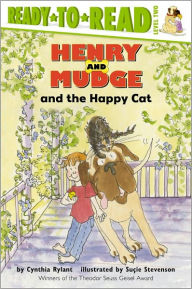
Henry and Mudge and the Happy Cat

Henry and Mudge and the Happy Cat. (Henry and Mudge #8) Cynthia Rylant. Sucie Stevenson. 1990. Simon & Schuster. 48 pages. [Source: Bought]

One night Henry and Henry's father and Henry's big dog Mudge were watching TV.

I enjoyed reading Henry and Mudge and the Happy Cat. I don't remember ever having read any titles in the Henry and Mudge series. So this was my first. My first impressions of the series are good, I think.

Henry's family takes in a stray cat; this stray cat is unique looking: it looks like mashed prunes. The family is happy to take the cat in--for a few days, a few weeks. But because having Mudge is like having five dogs--that they can't take the cat into their home permanently.

The first chapter is about taking the stray cat into their home. The second chapter is about how happy the cat is in her new home, and, how much Mudge loves being mothered by the cat. Essentially the family does come to like the cat. The third chapter is "bittersweet" I suppose. The cat's original owner is found, and the two are reunited. But Henry's family misses the cat.
In one week the shabby cat had become Mudge's mother. It washed Mudge all the time. It washed Mudge's ears. It washed Mudge's eyes. It even washed Mudge's dirty feet.
Have you read the Henry and Mudge series? Do you have a favorite title?

© 2015 Becky Laney of Becky's Book Reviews

Friday, October 17, 2014

Reread #42 The Eye of the World

The Eye of the World (Wheel of Time #1) Robert Jordan. 1990. Tor. 814 pages. [Source: Bought]

The Wheel of Time turns, and Ages come and pass, leaving memories that become legend. Legend fades to myth, and even myth is long forgotten when the Age that gave it birth comes again. In one Age, called the Third Age by some, an Age yet to come, an Age long past, a wind rose in the Mountains of Mist. The wind was not the beginning. There are neither beginnings nor endings to the turning of the Wheel of Time. But it was a beginning.

The Eye of the World is the first in Robert Jordan's Wheel of Time series. I first reviewed this one in October 2012. I thought the book was promising, that it had great potential. As the first book in a long series, it also serves as an introduction. An introduction not just to the world or to the main characters, but an introduction to the writing style: the details, the descriptions, the narration, the foreshadowing. It also hints at the complexity. Hints. (If you think there are a lot of names--both people and place--to keep up with in the first book, then you should know it only becomes more challenging in later books. It isn't necessarily good or bad that this is so. It just is.)

To keep it very simple, The Eye of the World is a coming-of-age adventure-quest story. It is all about the journey, or, you could just as easily say it is all about the chase. Eye of the World is essentially setting the stage for a big battle between the forces of good and evil.

The Eye of the World introduces readers to a handful of characters. Three young men who could potentially change the world for better or worse: Rand, Perrin, and Mat. Two young women who follow them into danger: Egwene and Nynaeve. Both have significant roles to play in the books ahead. Neither really steal the show in this first book. We learn that both women are able to touch the True Source (One Power) though they've not received training. Both women intrigue Moiraine, the Aes Sedai who has promised to protect them all--to the best of her ability. She knows that the Dark One seeks to destroy these three men, and quite possibly all those that stand in his way. Moiraine and Lan, her warder, will do what they can but they know it will be a continual struggle, a challenge, to stay a step or two ahead of the evil that pursues them.

There are also other characters introduced in this book that I'd like to mention. I love, love, love Loial. He's introduced relatively late in this one. But I adore him! He's an Ogier. There is also Thom Merrilin. He's a gleeman--an entertainer, storyteller, musician, juggler, etc. He travels with this group at the very beginning. There's also a young girl, Min, who is able to a certain degree to see the future. Readers also briefly meet Elayne, Gawyn, and Galad. And Queen Morgase. And the queen's Aes Sedai, Elaida.

It had been two years since I'd read this one. It was interesting to see what I remembered, and what I'd completely forgotten. I liked this one very much upon rereading. I enjoyed so many things about it still.

Quotes:
Not more than twenty spans back down the road a cloaked figure on horseback followed them, horse and rider alike black, dull and ungleaming. It was more habit than anything else that kept him walking backward alongside the cart even while he looked. The rider’s cloak covered him to his boot tops, the cowl tugged well forward so no part of him showed. Vaguely Rand thought there was something odd about the horseman, but it was the shadowed opening of the hood that fascinated him. He could see only the vaguest outlines of a face, but he had the feeling he was looking right into the rider’s eyes. And he could not look away. Queasiness settled in his stomach. There was only shadow to see in the hood, but he felt hatred as sharply as if he could see a snarling face, hatred for everything that lived. Hatred for him most of all, for him above all things.
He was hoping his father had not noticed he was afraid when Tam said, “Remember the flame, lad, and the void.” It was an odd thing Tam had taught him. Concentrate on a single flame and feed all your passions into it—fear, hate, anger—until your mind became empty. Become one with the void, Tam said, and you could do anything.
Strangers and a gleeman, fireworks and a peddler. It was going to be the best Bel Tine ever.
Aes Sedai and wars and false Dragons: those were the stuff of stories told late at night in front of the fireplace, with one candle making strange shapes on the wall and the wind howling against the shutters. On the whole, he believed he would rather have blizzards and wolves. Still, it must be different out there, beyond the Two Rivers, like living in the middle of a gleeman’s tale. An adventure. One long adventure. A whole lifetime of it.
“What kind of need would be great enough that we’d want the Dragon to save us from it?” Rand mused. “As well ask for help from the Dark One.”
“I still think you shouldn’t come,” he said. “I wasn’t making it up about the Trollocs. But I promise I will take care of you.” “Perhaps I’ll take care of you,” she replied lightly. At his exasperated look she smiled and bent down to smooth his hair. “I know you’ll look after me, Rand. We will look after each other. But now you had better look after getting on your horse.”
The Aes Sedai you will find in Tar Valon are human, no different from any other women except for the ability that sets us apart. They are brave and cowardly, strong and weak, kind and cruel, warm-hearted and cold. Becoming an Aes Sedai will not change you from what you are.
But hope is like a piece of string when you’re drowning; it just isn’t enough to get you out by itself.

© 2014 Becky Laney of Becky's Book Reviews

Saturday, October 20, 2012

The Great Hunt

The Great Hunt. (Wheel of Time #2) Robert Jordan. Tor. 600 pages.

A few weeks ago I read The Eye of the World the first book in Robert Jordan's Wheel of Time series. I loved it. I loved the promise of it especially. From the start, I felt it was going to be a just-right series for me, that it was going to have characters that I could love and appreciate. The Great Hunt was a great second book. Perhaps the second-half wowed me more than the first half, but, I definitely reached a place where the book became wonderfully intense and almost magical. The Great Hunt features some of the same characters as the first book, but it also introduces a few new characters. And this second book has the characters on somewhat separate journeys.

The men (Rand, Mat, Perrin) join soldiers on a mission to find the Horn of Valere. The women (Egwene, Nynaeve, Elayne) begin their studies at the White Tower in Tar Valon; Nynaeve undergoes a test and becomes Accepted while Egwene and Elayne are novices still. The second half of the book truly focuses on these three characters--and Min--and these chapters were easily my favorite!!! There are three women--Min, Egwene, and Elayne--who have interest in Rand and his uncertain future. All are concerned about where his journey will take him--now and in the future. Will his "destiny" lead to madness and destruction? Can he be saved? '

In The Great Hunt, I felt the story truly begins. I continue to love the series so far.

Read The Great Hunt
  • If you've read and enjoyed The Eye of the World
  • If you enjoy fantasy and adventure
  • If you like world-building and storytelling  
© 2012 Becky Laney of Becky's Book Reviews
Saturday, October 06, 2012

The Eye of the World

The Eye of the World (Wheel of Time #1) Robert Jordan. 1990. Tor. 814 pages. 

Perhaps I was just in the perfect mood for The Eye of The World, or maybe it's just that good. I do know that it was an experience. I read this one in just three days!!! I knew within a chapter or two that this one was just right for me, one that I'd really enjoy through and through. I enjoyed the world-building, the characterization, the storytelling, and, of course, the quest and adventure. If you don't like quests or journeys, or heroes-in-the-making setting out for long, uncertain journeys then perhaps this one wouldn't thrill you.

Three young men (Rand, Mat, and Perrin) are escaping danger and setting forth on a very dangerous journey with a couple of strangers (Moraine and Lan) whom they have reason both to trust and mistrust. On the one hand, Moraine has proven herself by helping to heal the wounded in Two Rivers after a devastating Trolloc attack. She saved Rand's father, Tam, when no one else would even try. So Rand, at least, owes her something. And she is trying to save all their lives--she knows all three are in great danger. On the other hand, Moraine is Aes Sedai, and Lan is her Warder. There has never been a story or tale told where Aes Sedai are good and trustworthy and safe. Also along for the journey are Egwene, a young woman who cares for Rand deeply, and Thom Merrilin, a gleeman--entertainer, storyteller, musician, etc. They are also joined by Nynaeve, a young woman, the local Wisdom, intent on one thing getting all three men back where they belong: Two Rivers.

There is definitely a good amount of uncertainty, mystery, and danger in The Eye of the World. Danger comes in many, many shapes and sizes. And there's plenty of action along the way leading up to some intense chapters at the end. I enjoyed it for the journey just as much as the end. I enjoyed the narrative style, for the most part.

I definitely LOVED it.

Read The Eye of the World
  • If you enjoy fantasy
  • If you really enjoy fantasy
  • If you like coming-of-age, going-on-a-quest fantasy
  • If you like world-building and storytelling

© 2012 Becky Laney of Becky's Book Reviews
Saturday, February 11, 2012

The Worthing Saga

The Worthing Saga. Orson Scott Card. 1990. Tor. 465 pages.

In many places in the Peopled Worlds, the pain came suddenly in the midst of the day's labor. It was as if an ancient and comfortable presence left them, one that they had never noticed until it was gone, and no one knew what to make of it at first, though all knew at once that something had changed deep at the heart of the world. 

The Worthing Saga is one of my favorite, favorite, favorite books. It's one of the few books that I actually crave. I don't always indulge in a reread, after all it isn't fair to all the other books out there. I can't just read and reread Worthing Saga every time I think of it, every time I remember just how much I love it. I have to show some restraint after all. But it has been a few years since my last reread, and I had to save something truly special for Carl's sci-fi experience, didn't I?

So what do I love about The Worthing Saga? I love the stories, the storytelling, the framework. I love the characters. I LOVE the characterization. Even if I don't exactly "love" (have warm, cozy feelings about) each individual character. I think Card did an amazing job with The Worthing Saga in creating good, memorable characters. These are characters that--at least for me--stay with me always. Characters like Hoom, for example. Each chapter is like an old friend. Well, almost all chapters. There are two or perhaps three stories that I could do without completely. The lifeloop acting chapter, for example, I could do without completely!!!! But I think what I love most about The Worthing Saga is the layering, how it has depth and substance. How it has a definite message, but instead of being annoying, it somehow works all the same. This science fiction book is thought-provoking, challenging. It encourages you to think about deep things, to explore questions like why is there pain? why is there suffering? would the world be a better place without pain, without suffering? Is pain a necessary evil? Do we only feel joy and happiness because we know about pain and sorrow? what makes life beautiful? do we become better people through our struggles with life?

The Worthing Saga is a science fiction novel. It is a novel with a framework. Readers first meet a young boy, Lared, and his sister, Sala, on the day of pain, the day when this planet, this society, first experiences an awareness of pain, suffering, grief. From that day on, pain and death become all-too-real possibilities...for the young and old. From that day on, actions have consequences. Soon after 'the day of pain' two strangers come into their lives, come to their parents inn, Jason and Justice. These two choose Lared to be their scribe, to share with the world, their story. A story that spans many, many, many centuries.

The Worthing Saga is a GREAT book that I just LOVE AND ADORE.

Read The Worthing Saga
  • If you love science fiction
  • If you love science fiction set on multiple planets, science fiction with space travel, science fiction with colonization, science fiction with ethical dilemmas
  • If you love books with great characterization and powerful storytelling
  • If you love books that deal with larger issues in life

© 2012 Becky Laney of Becky's Book Reviews
Friday, July 10, 2009

Castle In The Air (MG)


Jones, Diana Wynne. 1990. Castle in the Air. 383 pages.

Far to the south of the land of Ingary, in the Sultanates of Rashpuht, a young carpet merchant called Abdullah lived in the city of Zanzib. As merchants go, he was not rich. His father had been disappointed in him, and when he died, he had only left Abdullah just enough money to buy and stock a modest booth in the northwest corner of the Bazaar. The rest of his father's money, and the large carpet emporium in the center of the Bazaar, had all gone to the relatives of his father's first wife.
Abdullah had never been told why his father was disappointed in him. A prophecy made at Abdullah's birth had something to do with it. But Abdullah never bothered to find out more. Instead, from a very early age, he had simply made up daydreams about it.


Abdullah is quite a dreamer. Whether awake or asleep, his head is always up in the clouds. But can his dreams get him into trouble? Can his dreams lead him into a dangerous adventure? One day Abdullah buys a magic carpet. Not knowing quite where to store this 'magic' carpet to keep it safe, he decides to sleep on it. He's startled a bit that night to see that this magic carpet has taken the liberty of flying off with him. He awakes to find himself in a beautiful garden with a beautiful princess. The princess is a bit startled herself. You see, she's got a prophecy hanging over her as well. (Though she doesn't know it. Her father has kept it from her, of course.) She's never seen another man besides her father. And to suddenly see one in your own private garden appear out of nowhere? That's a bit strange and it takes some getting used to. But as these two warm up to each other, the adventures are only getting started.

This is a fun fantasy novel. It has adventure, danger, mystery, humor, and just a trace of romance.

© Becky Laney of Becky's Book Reviews