Showing posts with label Anthony Trollope. Show all posts

Friday, May 22, 2020

72. Miss Mackenzie

Miss Mackenzie. Anthony Trollope. 1865. 432 pages. [Source: Bought]

First sentence: I FEAR I must trouble my reader with some few details as to the early life of Miss Mackenzie, — details which will be dull in the telling, but which shall be as short as I can make them.

Premise/plot: Easy come, easy go. That sums up Miss Mackenzie quite succinctly.

Our heroine, Margaret MacKenzie, inherits a large fortune when her brother dies. But with all that money comes trouble, worry, and heartache. For Miss Mackenzie who has never had a suitor before suddenly finds herself besieged by men desperately wanting to marry her...Can she find true love in spite of her money?

Three of her suitors are John Ball (a widower, a cousin, a mama's-boy), Samuel Rubb Jr. (a tradesman, the business partner of her younger brother, the wearer of yellow gloves), and Mr. Maguire (a curate who proves himself shamelessly ambitious and greedy).

Miss Mackenzie hasn't determined to marry at all...and yet...she wants to find TRUE LOVE despite the fact that she's "middle aged" (36).

My thoughts: I really enjoyed this one!!! I found it well paced--perhaps with the qualifier of well paced for a Victorian novel. I thought the last half was extraordinary. (Perhaps not better than my favorite, favorite, favorite Trollope novels).

Quotes:
I have no doubt these people are very good in their way; only their ways are not my ways; and one doesn’t like to be told so often that one’s own way is broad, and that it leads — you know where.
He had on bright yellow kid gloves, primrose he would have called them, but, if there be such things as yellow gloves, they were yellow; and she wished that she had the courage to ask him to take them off.
 For me, if I am to live in a moated grange, let it be in the country. Moated granges in the midst of populous towns are very terrible.
It was, however, generally felt that, though Mr Slow was the slowest in his speech, Mr Bideawhile was the longest in getting anything said. Mr Slow would often beguile his time with unnecessary remarks; but Mr Bideawhile was so constant in beguiling his time, that men wondered how, in truth, he ever did anything at all.
Men who can succeed in deceiving no one else will succeed at last in deceiving themselves.

© 2020 Becky Laney of Becky's Book Reviews

Monday, January 20, 2020

12. Can You Forgive Her?

Can You Forgive Her? Anthony Trollope. 1865. 847 pages. [Source: Bought] [Classic; Romance; Dysfunctional Families]

First sentence: WHETHER OR NO, she, whom you are to forgive, if you can, did or did not belong to the Upper Ten Thousand of this our English world, I am not prepared to say with any strength of affirmation.


Premise/plot: Can You Forgive Her? is the first in the Palliser series of novels by Anthony Trollope. The series--as a whole--has been adapted for film.

Does it have a main character? Yes. No. Maybe.

Alice Vavasor, the one Trollope asks readers if they can forgive, is unwise in matters of the heart. Perhaps she's been listening to the Hokey Pokey too much. She's taking herself "in" and "out" of love, "in" and "out" of engagements, a little too frequently to be a proper young lady. (That being said, nothing IMproper happens exactly. Just a bit of confusion on her part as to WHO it is she actually wants to marry and spend her life with.)

George Vavasor, a rascally rascal, is Alice's cousin and Kate's brother. He is Alice's "first" love and fiance. He has ambitions but lacks morals and funds. He sees Alice as his way to succeed politically. If not Alice, perhaps, his sister Kate can use her influence to get money out of some of their other relatives whom he has repulsed.

Kate Vavasor, Alice's "dear" friend and cousin, is blinded by sisterly affection. She loves George so much--and Alice so much--that she just HAS to see them come together and marry. Will her brother ever act so abominably that she cuts him off?!

John Grey, a good, wise, prudent, well-respected man, is Alice's second love and fiance. He could have turned away from the whole Vavasor clan when Alice jilted him--but he has faith that Alice will see George for the RASCAL and RAT that he is and come back to him.

Glencora Palliser, Alice's distant "cousin" and "bosom" friend, is a newly wed that is far from wedded bliss. She was madly, deeply, truly in love with another rascal--a gambling addict always low on funds, Burgo Fitzgerald. But she was persuaded by her elders to marry another. Can she make peace with her new life?!

Plantagenet Palliser, Glencora's husband, is a dignified, well-respected, wealthy and wise man--not a young, super-adorable one. How far will he go for love?! Can he persuade Glencora to give their marriage a chance? It is the Pallisers that will become the SUPERSTARS of the series--as a whole. 

Other characters--relations and friends of the above--also people Trollope's world. A tiny handful have been introduced in Trollope's Barchester series.

So the main stories: Will Plantagenet and Glencora fall in love with each other AFTER the fact, after saying I do?! Will Alice Vavasor marry George OR marry John OR stay single? Will Kate or her aunt--a widow woman--marry? There are TWO suitors both "madly" in love with the aunt--or is it her money?! But Kate is young and beautiful and perhaps an excellent second prize for the loser. Meanwhile, will the GRANDFATHER Vavasor ever die? And who will he leave his money and estate to?!

My thoughts: I really do LOVE, LOVE, LOVE Trollope. I can't say that this one book is my absolute favorite and best. Though I do LOVE the characters of Glencora and Plantagenet. Alice--while deserving forgiveness--is far from being a heroine that I love and adore. John Grey is a GREAT catch--as is Plantagenet. But GEORGE is TROUBLE, TROUBLE, MORE TROUBLE. And I don't see the appeal of Burgo, for that matter.

I would recommend that readers COMMIT to reading the series at a good pace--keeping momentum high. If you only read ONE chapter per week, it will NOT be an enjoyable read and just be a book that you dread picking up. I read chapters 40 through 80 in about two weeks and these chapters were a thousand times more enjoyable than the first 40 which took me over six months to read!!!

Quotes:
  • Most of us know when we enter a drawing-room whether it is a pretty room or no; but how few of us know how to make a drawing-room pretty!
  • People always do seem to think it so terrible that a girl should have her own way in anything.
  • A man never likes having his tooth pulled out, but all men do have their teeth pulled out, — and they who delay it too long suffer the very mischief.
  • We have grown beyond our sugar-toothed ages, and are now men and women.
  • She certainly did not look forty, and who can expect a woman to proclaim herself to be older than her looks? 
  • With all her absurdities I like her. Her faults are terrible faults, but she has not the fault of hiding them by falsehood.
  • I don’t know that I was at all entitled to your good opinion, but I was not entitled to that special bad opinion.
  • He went on saying a good deal about home matters, and foreign matters, proving that everything was right, just as easily as his enemy had proved that everything was wrong.
  • When you discuss the value of a thing just purchased, you must mention the price before you know whether the purchaser has done well or badly.
  • The schoolboy, when he sits down to make his rhymes, dares not say, even to his sister, that he hopes to rival Milton; but he nurses such a hope. The preacher, when he preaches his sermon, does not whisper, even to his wife, his belief that thousands may perhaps be turned to repentance by the strength of his words; but he thinks that the thousand converts are possible.
  • Grief taken up because grief is supposed to be proper, is only one degree better than pretended grief.
  • A woman may forgive deceit, treachery, desertion, — even the preference given to a rival. She may forgive them and forget them; but I do not think that a woman can forget a blow. And as for forgiveness, — it is not the blow that she cannot forgive, but the meanness of spirit that made it possible.
  • You can’t make yourself unconscious of eyes that are always looking at you.
  • If a cook can’t make soup between two and seven, she can’t make it in a week.
  • I am beginning to know myself by degrees.
  • “I like to have a plan,” said Mr Palliser. “And so do I,” said his wife,— “if only for the sake of not keeping it.”
 
 
© 2020 Becky Laney of Becky's Book Reviews

Monday, November 26, 2018

My Victorian Year #49

I am currently reading RUTH by Elizabeth Gaskell and CAN YOU FORGIVE HER? by Anthony Trollope. I am enjoying both of these books very much. Both are rereads.

Quotes from Can You Forgive Her?
  • “And have I been too liberal, Mrs Greenow? What is a young turkey and a stick of celery when a man is willing to give everything that he has in the world?”
  • “There is nothing on earth, Mrs Greenow, I desire so much, as permission to dry those tears.” “Time alone can do that, Captain Bellfield; — time alone.”
  • “But cannot time be aided by love and friendship and affection?” “By friendship, yes. What would life be worth without the solace of friendship?”
  • “And how much better is the warm glow of love?” Captain Bellfield, as he asked this question, deliberately got up, and moved his chair over to the widow’s side.
  • “You shouldn’t think about handsome men, child,” said Mrs Greenow. “And I’m sure I don’t,” said Jeannette. “Not no more than anybody else; but if a man is handsome, ma’am, why it stands to reason that he is handsome.”    
Quotes from Ruth
  • I want to know how I am to keep remembering how old I am, so as to prevent myself from feeling so young?

© 2018 Becky Laney of Becky's Book Reviews

Saturday, November 17, 2018

My Victorian Year #48

I am currently reading RUTH by Elizabeth Gaskell and CAN YOU FORGIVE HER? by Anthony Trollope. I am enjoying both of these books very much. Both are rereads.

Quotes from Can You Forgive Her?
  • Yarmouth is not a happy place for a picnic. A picnic should be held among green things. Green turf is absolutely an essential.
  • She had a wondrous power of smiling; and could, upon occasion, give signs of peculiar favour to half a dozen different gentlemen in as many minutes. 
  • “You can’t suppose that any girl will like to be drenched with sea-water when she has taken so much trouble with her starch,” said Kate.  “Then she shouldn’t come fishing,” said Mr Cheesacre. “I hate such airs.” 
  • When ladies have made up their minds to dance they will dance let the circumstances of the moment be ever so antagonistic to that exercise.
  • A woman’s life is important to her, — as is that of a man to him, — not chiefly in regard to that which she shall do with it. The chief thing for her to look to is the manner in which that something shall be done. It is of moment to a young man when entering life to decide whether he shall make hats or shoes; but not of half the moment that will be that other decision, whether he shall make good shoes or bad. 
  • Babbling may be a weakness, but to my thinking mystery is a vice. 
 Quotes from Ruth
  • As she ran, she prayed with wild eagerness; she prayed that she might see his face once more, even if she died on the spot before him.
  • It was one of those prayers which God is too merciful to grant; but despairing and wild as it was, Ruth put her soul into it, and prayed it again, and yet again.
  • "In the eye of God, she is exactly the same as if the life she has led had left no trace behind. We knew her errors before, Faith." 
  • "Yes, but not this disgrace—this badge of her shame!" "Faith, Faith! let me beg of you not to speak so of the little innocent babe, who may be God's messenger to lead her back to Him.
  • Teach her (and God will teach her, if man does not come between) to reverence her child; and this reverence will shut out sin,—will be purification."
  • You yourself have not greater sorrow over this young creature's sin than I have: the difference is this, you confuse the consequences with the sin."
  • We are both right: I, in the way in which the child ought to be viewed; you, dear good Faith, for thinking of taking her home with us. God bless you, dear, for it!"
  • It is better not to expect or calculate consequences. The longer I live, the more fully I see that. Let us try simply to do right actions, without thinking of the feelings they are to call out in others.
  • My dear Ruth, you don't know how often I sin; I do so wrong, with my few temptations. We are both of us great sinners in the eyes of the Most Holy; let us pray for each other.
  • I cannot abide the way some folk has of denying there's trouble or pain to be met; just as if their saying there was none, would do away with it. Some folk treats one like a babby, and I don't like it. I'm not meaning you, Master Thurstan
  • "But Sally is not 'people.'" "Oh, I see it must be done; she'll talk as much as all the other persons put together, so that's the reason I call her 'people.' Shall I call her?"
  • There's a right and a wrong way of setting about everything—and to my thinking, the right way is to take a thing up heartily, if it is only making a bed.
  • 'Sally, do you think God has put us into the world just to be selfish, and do nothing but see after our own souls? or to help one another with heart and hand, as Christ did to all who wanted help?' ...because everything may be done in a right way or a wrong; the right way is to do it as well as we can, as in God's sight; the wrong is to do it in a self-seeking spirit, which either leads us to neglect it to follow out some device of our own for our own ends, or to give up too much time and thought to it both before and after the doing.'
  • Just try for a day to think of all the odd jobs as has to be done well and truly as in God's sight, not just slurred over anyhow, and you'll go through them twice as cheerfully. 
  • Those summer mornings were happy, for she was learning neither to look backwards nor forwards, but to live faithfully and earnestly in the present.


© 2018 Becky Laney of Becky's Book Reviews

Thursday, November 15, 2018

Me? Listen to Audio?! #42

Miss Mackenzie. Anthony Trollope. 1865. First broadcast on BBC Radio 4 in 2011. Dramatised by Martyn Wade. Directed by Tracey Neale. Starring David Troughton, Hattie Morahan, and Philip Franks. 2 hours.

I had never read the novel, but I couldn't resist listening to this radio drama anyway. I love Trollope. I was hoping that it would be easy enough to follow despite it being new-to-me...and it was...for the first part.

Essentially, it's the story of a young woman, Margaret Mackenzie, inheriting a LOT of money. When she's thought to be a heiress, she's got suitors begging for her hand in marriage. Notably three: Samuel Rubb (a business man), Mr. Maguire (a curate), and John Ball (a widower cousin). But is the money rightfully hers? And are the men "in love" with her for all the right reasons? Will this novel end with wedding bells?

It's a fun, light listen. I enjoyed it. 

© 2018 Becky Laney of Becky's Book Reviews

Saturday, November 10, 2018

My Victorian Year #47

I am currently reading RUTH by Elizabeth Gaskell and CAN YOU FORGIVE HER? by Anthony Trollope. I am enjoying both of these books very much. Both are rereads.

Quotes from Can You Forgive Her?
  • The eschewing of marquises is not generally very difficult. Young ladies living with their fathers on very moderate incomes in or about Queen Anne Street are not usually much troubled on that matter.
  • It’s a very fine theory, that of women being able to get along without men as well as with them; but, like other fine theories, it will be found very troublesome by those who first put it in practice.
  • People always do seem to think it so terrible that a girl should have her own way in anything.
  • I haven’t much of my own way at present; but you see, when I’m married I shan’t have it at all. You can’t wonder that I shouldn’t be in a hurry. A person may wish for a thing altogether, and yet not wish for it instantly.
  • In this world things are beautiful only because they are not quite seen, or not perfectly understood.
  • Poetry is precious chiefly because it suggests more than it declares.
  • You are never cross, though you are often ferocious. 
  • A man never likes having his tooth pulled out, but all men do have their teeth pulled out, — and they who delay it too long suffer the very mischief.
  • I was thinking of something. Don’t you ever think of things that make you shiver?”  “Indeed I do, very often; — so often that I have to do my shiverings inwardly. Otherwise people would think I had the palsy.”
  • “What don’t you understand, aunt?” “You only danced twice last night, and once you stood up with Captain Bellfield.” “But what harm can Captain Bellfield do me?” “What good can he do you? That’s the question. You see, my dear, years will go by.
Quotes from Ruth
  • The daily life into which people are born, and into which they are absorbed before they are well aware, forms chains which only one in a hundred has moral strength enough to despise, and to break when the right time comes—when an inward necessity for independent individual action arises, which is superior to all outward conventionalities.
  • Well, my dear, you must learn to think and work too; or, if you can't do both, you must leave off thinking. Your guardian, you know, expects you to make great progress in your business, and I am sure you won't disappoint him. 
  • The night before, she had seen her dead mother in her sleep, and she wakened, weeping. And now she dreamed of Mr Bellingham, and smiled. And yet, was this a more evil dream than the other? 
  • The poor old labourer prayed long and earnestly that night for Ruth. He called it "wrestling for her soul;" and I think his prayers were heard, for "God judgeth not as man judgeth." 
  • The future lay wrapped in a golden mist, which she did not care to penetrate; but if he, her sun, was out of sight and gone, the golden mist became dark heavy gloom, through which no hope could come. He took her hand. 
  • Low and soft, with much hesitation, came the "Yes;" the fatal word of which she so little imagined the infinite consequences. The thought of being with him was all and everything.
  • I always think it right, for my own morals, to put a little scorn into my manners when such as her come to stay here; but, indeed, she's so gentle, I've found it hard work to show the proper contempt. 
  • Poor Ruth! her faith was only building up vain castles in the air; they towered up into heaven, it is true, but, after all, they were but visions. 
 
© 2018 Becky Laney of Becky's Book Reviews

Saturday, November 03, 2018

Small House at Allington

Small House at Allington. Anthony Trollope. 1864. 695 pages. [Source: Bought]
First sentence: Of course there was a Great House at Allington. How otherwise should there have been a Small House?

Premise/plot: The Small House at Allington is the fifth novel in the Barsetshire series by Anthony Trollope. It primarily focuses on the Dale family. Lily and Bell Dale are sisters--both worthy of being heroines. Mrs. Dale has done quite a good job raising them on her own since her husband's death. Of course they are not all alone in the world, the girls have an uncle--Christopher Dale--who is a squire. Also, one mustn't forget cousin Bernard.

Bernard and Bell would make quite a match of it--at least that's what the squire thinks. He'd LOVE to see these two marry and have children. (Bernard is his heir.) But Bell has different plans for her future--and marrying to please an uncle is decidedly not in her plans. Bell hasn't said NO NEVER to the idea of marriage in general, but she wants LOVE.

Lily. John Eames (aka JOHNNY) loves, loves, loves Lily with all his heart and soul. He has wanted to declare his love for her for years. But before he can speak to her from the depths of his heart, Bernard brings home a showy friend, Mr. Adolphus Crosbie. Crosbie makes a first great impression on a young and naive Lily. Soon the two are ENGAGED. Johnny is disappointed--broken-hearted.

When Crosbie realizes that Lily's dear old uncle has absolutely no intentions of blessing his niece financially--either now or at his passing--he reveals his true colors. CAN HE REALLY TRULY COMMIT TO MARRYING LILY KNOWING THAT SUCH A MARRIAGE WON'T MAKE HIM A DIME RICHER?!?! He is self-aware enough to know it's doubtful. But it's a doubt--not a certainty--so when she asks him if he wants out, if he wants his freedom, he doesn't speak honestly. He doesn't admit his doubts. He leaves her believing that the two will marry.

Within a week or two Crosbie finds himself with a choice to make. He has the opportunity to marry up--to marry a somebody. Or the daughter of a somebody. Though his engagement to Lily is known in some circles, he decides to propose to Alexandrina anyway. If she says yes, he can break it off with Lily. If she says no, well, there's always Lily.

When his engagement to Alexandrina is known or made known, it upsets a lot of people. (Including BERNARD and JOHNNY and the SQUIRE.) Lily is not without friends and family. She is beloved by all because she is an absolute angel of a girl. And like an angel, Lily, when she hears of his inconstancy, decides to forgive him wholeheartedly. She doesn't feel angry, lied to, betrayed. He is simply doing what will make him happy. And isn't his happiness more important than her own?! As long as he is being true to himself isn't that all that matters?! No. She loves, loves, loves him still. He is the husband of her heart; the vows may never have been spoken in church but she's keeping them all the same.

Meanwhile, life goes on. Bell is being courted by a local doctor...will she say yes?! Lily certainly hopes so! Johnny is moving up in the world and making new friends. But some of his old friends and acquaintances are getting into messes. (For that matter he gets into a few messes of his own.) Crosbie finds himself not moving up in the world but taking a few steps back. He wanted his marriage to bring him up and take him places...but it's having the opposite effect. (Do we pity him?! NO. This reader does not.)

This novel also--for whatever reason--introduces Plantagenet Palliser. I love him but he doesn't quite seem to belong in this novel.

My thoughts: I love Anthony Trollope. I do. He's a great author. He doesn't always stay "on task" in his writing. He rambles a bit. He has dozens of characters and perhaps not all of them "matter" in a particular novel. But his characters tend to be fully fleshed. He's peopled a community--a village or two--in this series. There are some characters that you want to boo, hiss. But other characters you absolutely want to spend time with because they are your friends.

Quotes:
  • I would have women, and men also, young as long as they can be young. It is not that a woman should call herself in years younger than her father’s family Bible will have her to be. Let her who is forty call herself forty; but if she can be young in spirit at forty, let her show that she is so.
  • “Ten minutes before the time named; and, of course, you must have understood that I meant thirty minutes after it!” That is my interpretation of the words when I am thanked for coming early.
  • Such were his resolutions, and, as he thought of them in bed, he came to the conclusion that few men were less selfish than he was.
  • It is very hard, that necessity of listening to a man who says nothing.
  • When last days are coming, they should be allowed to come and to glide away without special notice or mention. And as for last moments, there should be none such.
  • I have almost more to think of than I know how to manage.
  •  Nothing on earth can I ever love as I have loved you. But I have a God and a Saviour that will be enough for me.
  • I enjoy a snooze after dinner; I do indeed; I like it; but then, when one comes to go to bed, one does it in such a sneaking sort of way, as though one were in disgrace!
  • And my sister, she thinks it a crime — literally a sin, to go to sleep in a chair. Nobody ever caught her napping!
  • There are deeds which will not bear a gloss, — sins as to which the perpetrator cannot speak otherwise than as a reptile; circumstances which change a man and put upon him the worthlessness of vermin.
  • “What are we to do to him?” said Bernard, after a while. “Treat him as you would a rat. Throw your stick at him, if he comes under your feet; but beware, above all things, that he does not get into your house. That is too late for us now.” “There must be more than that, uncle.”
  • A self-imposed trouble will not allow itself to be banished.
  • Love does not follow worth, and is not given to excellence; — nor is it destroyed by ill-usage, nor killed by blows and mutilation.
  • “I don’t know that any good would be got by knocking him over the head. And if we are to be Christians, I suppose we ought to be Christians.” “What sort of a Christian has he been?” “That’s true enough; and if I was Bernard, I should be very apt to forget my Bible lessons about meekness.”
  • There are some things for which a man ought to be beaten black and blue.” “So that he shouldn’t do them again?” “Exactly.”
  •  My belief is that in life people will take you very much at your own reckoning.
  • No one thinks of defending himself to a newspaper except an ass; — unless it be some fellow who wants to have his name puffed.
  • “It was a matter of course,” said Bell. “It always is right in the novels. That’s why I don’t like them. They are too sweet.” “That’s why I do like them, because they are so sweet. A sermon is not to tell you what you are, but what you ought to be, and a novel should tell you not what you are to get, but what you’d like to get.”      
  • But if we are to have real life, let it be real.
  • The speech was respectable, dull, and correct. Men listened to it, or sat with their hats over their eyes, asleep, pretending to do so;
  • “There are circumstances in which what we call Christianity seems to me to be hardly possible.”
  • “All the books have got to be so stupid! I think I’ll read Pilgrim’s Progress again.” “What do you say to Robinson Crusoe?” said Bell. “Or Paul and Virginia?” said Lily. “But I believe I’ll have Pilgrim’s Progress. I never can understand it, but I rather think that makes it nicer.” “I hate books I can’t understand,” said Bell. “I like a book to be clear as running water, so that the whole meaning may be seen at once.” “The quick seeing of the meaning must depend a little on the reader, must it not?” said Mrs Dale. “The reader mustn’t be a fool, of course,” said Bell. “But then so many readers are fools,” said Lily. “And yet they get something out of their reading.
  • All holiday-making is hard work, but holiday-making with nothing to do is the hardest work of all.
  • Who does not know how terrible are those preparations for house-moving; — how infinite in number are the articles which must be packed, how inexpressibly uncomfortable is the period of packing, and how poor and tawdry is the aspect of one’s belongings while they are thus in a state of dislocation? 
  • To have loved truly, even though you shall have loved in vain, will be a consolation when you are as old as I am.
  • Statistics, he thought, might be made as enchanting as ever, if only they could be mingled with love.
  • Ah! how I hate the smile of a woman who smiles by rote! It made Mr Palliser feel very uncomfortable, — but he did not analyse it, and persevered.           


© 2018 Becky Laney of Becky's Book Reviews

Saturday, October 27, 2018

My Victorian Year #45

I am currently reading Anthony Trollope's Small House at Allington and Elizabeth Gaskell's Wives and Daughters. I am also currently listening to Agnes Grey by Anne Bronte.

Quotes from Small House at Allington:
  • I’ve always had a sort of aptitude for living in a pigsty; — a clean pigsty, you know, with nice fresh bean straw to lie upon.
  • “Are you going to forgive me before I go?” “Forgive you for what?” said she. “For daring to love you; for having loved you almost as long as you can remember; for loving you better than all beside. This alone you should forgive; but will you forgive me for having told it?”
  • Alas! alas! a man cannot so easily repent of his sins, and wash himself white from their stains!
  • “It was a matter of course,” said Bell. “It always is right in the novels. That’s why I don’t like them. They are too sweet.” “That’s why I do like them, because they are so sweet. A sermon is not to tell you what you are, but what you ought to be, and a novel should tell you not what you are to get, but what you’d like to get.”  
  • But if we are to have real life, let it be real.
  • Those slanders always are absurd; but what can we do? We can’t tie up people’s tongues.
  •  Mr Palliser had barely spoken to Mr Crosbie at Courcy, but then in the usual course of his social life he seldom did more than barely speak to anybody.
  • The speech was respectable, dull, and correct. Men listened to it, or sat with their hats over their eyes, asleep, pretending to do so;

Quotes from Wives and Daughters:
  •  'Papa, I should like to get a chain like Ponto's just as long as your longest round, and then I could fasten us two to each end of it, and when I wanted you I could pull, and if you did not want to come, you could pull back again; but I should know you knew I wanted you, and we could never lose each other.' (27)
  • 'I gave her the best advice in my power.' 'Advice! you ought to have comforted her. Poor little Molly!' 'I think that if advice is good it's the best comfort.' (120)
  • 'I did try to remember what you said, and to think more of others, but it is so difficult sometimes; you know it is, don't you?' (136)
  • 'It is difficult,' he went on, 'but by and by you will be so much happier for it.' 'No, I shan't!' said Molly, shaking her head. 'It will be very dull when I shall have killed myself, as it were, and live only in trying to do, and to be, as other people like. I don't see any end to it. I might as well never have lived. And as for the happiness you speak of, I shall never be happy again.' (136)
  • 'I used to think I managed her, till one day an uncomfortable suspicion arose that all the time she had been managing me. Still, it's easy work to let oneself be managed; at any rate till one wakens up to the consciousness of the process, and then it may become amusing, if one takes it in that light.' 'I should hate to be managed,' said Molly, indignantly. 'I'll try and do what she wishes for papa's sake, if she'll only tell me outright; but I should dislike to be trapped into anything.' (160)
  • 'Tell the truth, now and evermore. Truth is generally amusing, if it's nothing else!' (163)
  • Molly knew her father's looks as well as she knew her alphabet; his wife did not; and being an unperceptive person, except when her own interests were dependent upon another person's humour, never found out how he was worried by all the small daily concessions which he made to her will or her whims. (178)
  • 'I wish I could love people as you do, Molly!' 'Don't you?" said the other, in surprise. 'No. A good number of people love me, I believe, or at least they think they do; but I never seem to care much for any one. I do believe I love you, little Molly, whom I have only known for ten days, better than any one.' (219)
  • 'I wish I was good!' 'So do I,' said Molly, simply. 'Nonsense, Molly! You are good...I am not good, and I never shall be now. Perhaps I might be a heroine still, but I shall never be a good woman, I know.' 'Do you think it easier to be a heroine?' 'Yes as far as one knows of heroines from history. I'm capable of a great jerk, an effort, and then a relaxation--but steady, everyday goodness is beyond me. I must be a moral kangaroo.' (220)
  • 'Molly, I cannot have you speaking so to Lady Harriet,' said Mrs. Gibson as soon as she was left alone with her stepdaughter. 'You would never have known her at all if it had not been for me, and don't be always putting yourself into our conversation.' 'But I must speak if she asks me questions,' pleaded Molly. 'Well! if you must, you must, I acknowledge. I'm candid about that, at any rate. But there's no need for you to set up to have an opinion at your age.' 'I don't know how to help it,' said Molly. (293)
  • 'If there is one thing I hate more than another, it is the trying to make out an intimacy with great people.' (293)
  • 'Oh, how good you are, Molly! I wonder, if I had been brought up like you, whether I should have been as good. But I've been tossed about so.' 'Then, don't go and be tossed about no more,' said Molly, softly. (327)

© 2018 Becky Laney of Becky's Book Reviews
Wednesday, October 17, 2018

My Victorian Year #43

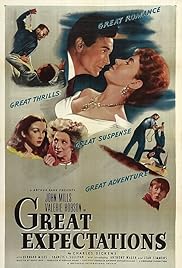
I am still reading Anthony Trollope's Small House at Allington. I will be sharing some quotes from the book. I have finished two books since the last Victorian Year post. The first is Sylvia's Lovers by Elizabeth Gaskell.  The second is Dracula by Bram Stoker. I've also watched an adaptation of Great Expectations (1946).

Great Expectations. 1946. Directed and adapted by David Lean. Starring John Mills, Valerie Hobson, Martita Hunt, Finlay Currie, Alec Guinness, Eileen Erskine, and Bernard Miles.

I feel I should first point out that this is the only adaptation of Great Expectations that I've seen. I have no other film with which to compare it. Is it faithful to the book? Somewhat. It does take liberties. With the ending it takes HUGE liberties. I'm not sure Estella is Estella enough--if that makes sense.

As I was watching it, Mom made the observation that Estella is in many ways similar to Scarlett O'Hara--in her selfish heartlessness. I don't know that Estella deserves a happily-ever-after ending. I would have more respect for Pip, perhaps, if he wasn't so head-over-heels with Estella and blind to her greatest faults. Oh, he knows she has faults. But he seems to ignore/dismiss them. Her insides don't match her outsides--and he seems okay with that, more than okay with that.

But when I really stop and consider Pip--is he a great judge of character in general? He is just as blind when it comes to Joe. The way Pip feels about Joe--the way he's ashamed of him, embarrassed by him, dismissive of him, at times rude to him--if only by default of complete and total ingratitude--makes me angry.

I liked the film okay. I do think they took a few liberties here and there. I'm not sure the film includes all my favorite dialogue-driven scenes. But I'd really have to watch the film again to double-check. (I don't want to.)

Quotes from Small House at Allington
A self-imposed trouble will not allow itself to be banished.
“Ah, that’s so like you. I always said you’d no feeling of real romance. If I cared for a woman I’d give her the coat off my back.” “I’d do better than that,” said Johnny. “I’d give her the heart out of my body. I’d be chopped up alive for a girl I loved; but it shouldn’t be for another man’s wife.”
We saw that he had difficulty in writing it, but the miracle was, that any man could have found it possible to write it.
Love does not follow worth, and is not given to excellence; — nor is it destroyed by ill-usage, nor killed by blows and mutilation.
“Mothers do not often get tired of their children, whatever the children may do of their mothers.”
“I don’t know that any good would be got by knocking him over the head. And if we are to be Christians, I suppose we ought to be Christians.”
“What sort of a Christian has he been?” “That’s true enough; and if I was Bernard, I should be very apt to forget my Bible lessons about meekness.” There are some things for which a man ought to be beaten black and blue.” “So that he shouldn’t do them again?” “Exactly.”

“I don’t know much about being in love with her,” said Johnny, turning very red as he spoke. “But I’d go through fire and water for her, my lord. I knew her years before he had ever seen her, and have loved her a great deal better than he will ever love any one. 
My belief is that in life people will take you very much at your own reckoning.
 There are certain maladies which make the whole body sore.
John Eames had reached his office precisely at twelve o’clock, but when he did so he hardly knew whether he was standing on his heels or his head.
No one thinks of defending himself to a newspaper except an ass; — unless it be some fellow who wants to have his name puffed.

© 2018 Becky Laney of Becky's Book Reviews

Saturday, September 29, 2018

My Victorian Year #37

This week I finished listening to Bleak House on audio. I began listening to Charles Dickens' Great Expectations on audio. I've also continued reading Louisa May Alcott's Little Men and Anthony Trollope's Small House at Allington. It's been a great week.

From Small House at Allington:
I enjoy a snooze after dinner; I do indeed; I like it; but then, when one comes to go to bed, one does it in such a sneaking sort of way, as though one were in disgrace!
And my sister, she thinks it a crime — literally a sin, to go to sleep in a chair. Nobody ever caught her napping!
Few liars can lie with the full roundness and self-sufficiency of truth; and Crosbie, bad as he was, had not yet become bad enough to reach that perfection.
But he was chiefly angry with himself for this, — that he had been a villain without gaining anything by his villainy; that he had been a villain, and was to lose so much by his villainy. 
There are deeds which will not bear a gloss, — sins as to which the perpetrator cannot speak otherwise than as a reptile; circumstances which change a man and put upon him the worthlessness of vermin.
“What are we to do to him?” said Bernard, after a while. “Treat him as you would a rat. Throw your stick at him, if he comes under your feet; but beware, above all things, that he does not get into your house. That is too late for us now.” “There must be more than that, uncle.”
From Little Men:
"Happy is the man who can put temptation in his pocket and learn self-denial from so sweet a little teacher!" added Mr. Bhaer.
Money is the root of all evil, and yet it is such a useful root that we cannot get on without it any more than we can without potatoes.
Daisy knew nothing about women's rights; she quietly took all she wanted, and no one denied her claim, because she did not undertake what she could not carry out, but unconsciously used the all-powerful right of her own influence to win from others any privilege for which she had proved her fitness.
Nan attempted all sorts of things, undaunted by direful failures, and clamored fiercely to be allowed to do every thing that the boys did. They laughed at her, hustled her out of the way, and protested against her meddling with their affairs. But she would not be quenched and she would be heard, for her will was strong, and she had the spirit of a rampant reformer.
"You must put swearing away in your fault-drawer, and lock it up; that's the way I do with my badness." 
"I play that my mind is a round room, and my soul is a little sort of creature with wings that lives in it. The walls are full of shelves and drawers, and in them I keep my thoughts, and my goodness and badness, and all sorts of things. The goods I keep where I can see them, and the bads I lock up tight, but they get out, and I have to keep putting them in and squeezing them down, they are so strong. I don't think there is a lock strong enough to keep my badness shut up. Any way my room is in such a clutter I don't know how to clear it up."


It is never too early to try and plant them [good principles] in a child, and never too late to cultivate them in the most neglected person.

© 2018 Becky Laney of Becky's Book Reviews

Monday, September 24, 2018

My Victorian Year #35

I have continued reading Louisa May Alcott's Little Men and Anthony Trollope's Small House at Allington.

Quotes from Small House at Allington
  • You are my bird that I have shot with my own gun; and the assurance of my success is sufficient for my happiness. [Lily to Crosbie]
  • As she herself had said, he was her bird, the spoil of her own gun, the product of such capacity as she had in her, on which she was to live, and, if possible, to thrive during the remainder of her life.
  • He who was now everything to her might die; nay, it was possible that he might be other than she thought him to be; that he might neglect her, desert her, or misuse her.
  • But she had resolved to trust in everything, and, having so trusted, she would not provide for herself any possibility of retreat.
  • The little sacrifices of society are all made by women, as are also the great sacrifices of life.
  • A man who is good for anything is always ready for his duty, and so is a good woman always ready for a sacrifice.
  • It is, however, no doubt, true that thought will not at once produce wisdom.
  • It may almost be a question whether such wisdom as many of us have in our mature years has not come from the dying out of the power of temptation, rather than as the results of thought and resolution.
  • Last days are wretched days; and so are last moments wretched moments. It is not the fact that the parting is coming which makes these days and moments so wretched, but the feeling that something special is expected from them, which something they always fail to produce.
  • When last days are coming, they should be allowed to come and to glide away without special notice or mention. And as for last moments, there should be none such.
  • I have almost more to think of than I know how to manage.  
  • But listen to me. I should not die if you left me, — not be utterly broken-hearted. Nothing on earth can I ever love as I have loved you. But I have a God and a Saviour that will be enough for me. I can turn to them with content, if it be well that you should leave me. I have gone to them, and— [Lily to Adolphus Crosbie]
  • “And who is the old gentleman who chanted the Litany?” he asked the verger afterwards, as he allowed himself to be shown round the monuments of the cathedral. “That’s our precentor, sir, Mr Harding. You must have heard of Mr Harding.” But Crosbie, with a full apology, confessed his ignorance. “Well, sir; he’s pretty well known too, tho’ he is so shy like. He’s father-in-law to our dean, sir; and father-in-law to Archdeacon Grantly also.” “His daughters have all gone into the profession, then?” “And who is his granddaughter?” “Why Lady Dumbello, as will be the Marchioness of Hartletop.”
 Quotes from Little Men
  • "Why don't I remember you then, Aunty? Was I too young?" asked Demi. "Rather, dear."
  •  "I suppose my memory hadn't come then. Grandpa says that different parts of the mind unfold as we grow up, and the memory part of my mind hadn't unfolded when you were little, so I can't remember how you looked," explained Demi.
 

© 2018 Becky Laney of Becky's Book Reviews

Saturday, September 08, 2018

Me? Listen to Audio?! #35 My Victorian Year #32

Framley Parsonage. Anthony Trollope. 1861. Dramatised by Nick Warburton. Produced and directed by Marion Nancarrow for BBC Radio 4. 3 one hour broadcasts. "Two Different Sets of People." "A Word of Warning." "A Gift of Fire." There are about twenty days left to listen!

I have read Framley Parsonage twice. The first time I liked it just okay. The second time I loved it. Listening to it was PURE DELIGHT. All the BBC Radio 4 adaptations of the Barchester series have featured a narrator-housekeeper. She may not exist in the novels, but, she certainly helps listeners out. (I believe Trollope used the third person omniscient narrative style.)

 Premise/plot: Framley Parsonage is the fourth novel in the Barsetshire series by Anthony Trollope. In my opinion, the women characters are the greatest strength of this novel. Mark's wife, Fanny; Mark's sister, Lucy; Miss Dunstable; Mrs. Crawley; even more difficult to like characters like Mrs. Harold Smith, Mrs. Proudie,  and Lady Lufton.

So what is this one about? Mark Robarts is a vicar at Framley. He is married to a wonderful woman, Fanny, whose true strength and courage is not obvious at first or second glance perhaps. He gets into big, big trouble when he decides to sign his name alongside his new friend's name on a bill. Embarrassed that he could be held responsible for the money if his friend proves to be anything but, he keeps it a secret from almost everyone in his life. That bill--and another that follows it--haunt him throughout the novel until he has his epiphany moment.

At one point, Mark's sister, Lucy, comes to stay at the parsonage. Lord Lufton, Mark's close friend, falls in love with Lucy. But their love seems doomed almost from the start since Lady Lufton (Lord Lufton's (busybody) mother has set ideas about who is and isn't appropriate for her son to marry. She visits Fanny and tells her that Lord Lufton is off limits and that Lucy should make herself scarce. Fanny tells Lucy that she shouldn't fall in love with Lord Lufton, but it's too late.) Will Lord Lufton stand up to his mother? Will Lucy agree to be his wife? Will the novel end with a wedding?


Lady Lufton wants her son to marry Griselda Grantly. She throws them together at multiple social events--both in Barsetshire and in London. But to no avail. Griselda does get some attention from another Lord however.

Miss Dunstable, whom we met before, is still very much single. There are still men in pursuit of her. Mrs. Harold Smith would have her unworthy brother--admittedly unworthy, a scoundrel--Mr. Sowerby marry the incredibly wealthy Miss Dunstable. She even proposes on his behalf. But Miss Dunstable doesn't want that kind of husband. The man she has in mind, well, is more honorable: Dr. Thorne!


Mr. Sowerby features a lot in this one, for better or worse. But every novel, make that every Victorian novel, needs a character to boo and hiss at when they enter the scene, right?!

I really LOVED the characters of Lucy and Fanny and Miss Dunstable. The story line where Mary is trying to play matchmaker with her uncle, Dr. Thorne, and Miss Dunstable were priceless. I adored this couple so much.

Lucy was such a gem of a heroine. She was witty and compassionate. Her observations were great.

I also REALLY loved the fact that so many familiar faces pop up in this one. Even if old friends just show up for a couple of scenes, they're still there, still a reminder that Barchester is a place I'd love to visit.

© 2018 Becky Laney of Becky's Book Reviews

Saturday, September 01, 2018

My Victorian Year #31

I have really missed posting My Victorian Year. But. When you don't read anything Victorian during the week, you can't invent a reason to post on the weekend!

There are three Victorian novels on my 2018 TBR Pile Reading Challenge list. I need to finish these three Victorian chunksters before December 31, 2018. I may need a little cheerleading. I wouldn't mind your help in picking which one to read first. The three books are: Sylvia's Lovers by Elizabeth Gaskell, Blue Fairy Book by Andrew Lang, and Romola by George Eliot.

I haven't decided-decided, but I may abandon The Three Musketeers. I didn't pick it up once in the month of August.

I am currently reading Anthony Trollope's The Small House at Allington. I think I'm six possibly seven chapters into this one--it is a reread. This one is starting slow. But I remember liking it and really loving a few of the characters in it. So far--at least--it is not proving quotable.
I would have women, and men also, young as long as they can be young. It is not that a woman should call herself in years younger than her father’s family Bible will have her to be. Let her who is forty call herself forty; but if she can be young in spirit at forty, let her show that she is so.
 I am also currently reading Louisa May Alcott's Little Men. Of the three books in the series, it is my mom's favorite. I have never read it before. I am excited to see if it is as wonderful as my mom says it is!
A holiday isn't a holiday without plenty of freedom and fun;
Latin, Greek, and mathematics were all very well, but in Professor Bhaer's opinion, self knowledge, self-help, and self-control were more important, and he tried to teach them carefully.
"Yes, I know many people think boys are a nuisance, but that is because they don't understand them. I do; and I never saw the boy yet whom I could not get on capitally with after I had once found the soft spot in his heart. Bless me, I couldn't get on at all without my flock of dear, noisy, naughty, harum-scarum little lads, could I, my Teddy?" and Mrs. Bhaer hugged the young rogue, just in time to save the big inkstand from going into his pocket. Nat, who had never heard anything like this before, really did not know whether Mother Bhaer was a trifle crazy, or the most delightful woman he had ever met. He rather inclined to the latter opinion, in spite of her peculiar tastes, for she had a way of filling up a fellow's plate before he asked, of laughing at his jokes, gently tweaking him by the ear, or clapping him on the shoulder, that Nat found very engaging.
"The big dog is Emil's. His name is Christopher Columbus. Mrs. Bhaer named him because she likes to say Christopher Columbus, and no one minds it if she means the dog," answered Tommy, in the tone of a show-man displaying his menagerie.
Sympathy is a sweet thing, and it worked wonders here, for each boy knew that Father Bhaer was interested in him, and some were readier to open their hearts to him than to a woman, especially the older ones, who liked to talk over their hopes and plans, man to man.
"I shall devote the whole of my plot to the largest crop of patience I can get, for that is what I need most," said Mrs. Jo, so soberly that the lads fell to thinking in good earnest what they should say when their turns came, and some among them felt a twinge of remorse, that they had helped to use up Mother Bhaer's stock of patience so fast.
"We will plant self-denial, and hoe it and water it, and make it grow so well that next Christmas no one will get ill by eating too much dinner. If you exercise your mind, George, it will get hungry just as your body does, and you will love books almost as much as my philosopher here," said Mr. Bhaer;      


© 2018 Becky Laney of Becky's Book Reviews

Saturday, July 21, 2018

Rachel Ray (My Victorian Year #28)

Rachel Ray. Anthony Trollope. 1863. 326 pages. [Source: Bought]

First sentence: There are women who cannot grow alone as standard trees; — for whom the support and warmth of some wall, some paling, some post, is absolutely necessary;

Premise/plot: Rachel Ray would be wooed by Luke Rowan--if only her mother and older sister would allow it. But will they?

Rachel's older sister, Dorothea, aka MRS. Prime, is a busy-body, aka "charitable church woman" whose number one business seems to be making sure that her sister says single and under her management. Is that a fair assessment? Perhaps not. It isn't Rachel she wants to control her so much as everyone within her power--notably her mother. If Rachel won't be bossed by her--dictated to by her--then she'll try applying pressure to their mother. Rachel is the type of daughter who would never, ever, ever, ever disobey her mother.

Is Mrs. Ray easy to manipulate? Yes. No. Usually. Sometimes. Mrs. Ray is equally impressed by whomever she's talking to. So for Mrs. Prime to have an influence on her, she has to stick to her constantly and not let anyone else get a word in. That proves impossible--so Mrs. Ray gains some freedom and independence from her daughter. But will it be enough?

It seems to be once Luke meets Mrs. Ray and the two begin to be friendly with one another. But that's not taking into account his family. And his family seems to be just as dysfunctional as hers.

Will these two ever come together long enough to make a match of it? Probably--it is Trollope and not Hardy. But it will literally take the whole village to sort it out.

My thoughts: I'm so glad that Trollope is Trollope and not Hardy. If Thomas Hardy had written Rachel Ray then Dorothea would have been proven right. Luke Rowan likely would have been a smooth talker who seduced a young naive girl, Rachel Ray, and left her with promises of a ring but no actual intentions. Rachel Ray would have ended up pregnant and the shame of the village--if she didn't kill herself before the town knew she was with child. Luke's rumored debts would not have been rumors but the truth. Mrs. Ray would have probably cried equal amounts in both versions because some things are just unavoidable.

Rachel Ray--the character--is not a feisty heroine. She's not a rule-breaker or a rebel. If her mother says don't write this fellow, she's not going to write him. If her mother says the engagement is off, then Rachel is going to accept it as fact even if it breaks her heart. Does she take the 'honoring her parents' thing a little too much to heart? Perhaps for the modern reader's taste. To submit to the authority of one's parents--especially in love--seems to make you weak and stupid...according to the world today. But what makes Rachel weak by today's standards make her morally good by older standards.

Rachel reminds me a bit of Jane Bennet.

Descriptions of Mrs. Prime:
Her fault was this; that she had taught herself to believe that cheerfulness was a sin, and that the more she became morose, the nearer would she be to the fruition of those hopes of future happiness on which her heart was set.
Such a one as Mrs. Prime is often necessary. But we all have our own pet temptations, and I think that Mrs. Prime’s temptation was a love of power.

Her sister was, in truth, only seven years her senior, but in all the facts and ways of life, she seemed to be the elder by at least half a century.
"Flirting" in Rachel Ray:
“I never knew anybody before called Rachel,” said he. “And I never knew anybody called Luke.” “That’s a coincidence, is it not? — a coincidence that ought to make us friends.
 “one word, and then I will let you go.” “What word?” “Say to me, ‘Dear Luke, I will be your wife.’“
“I don’t dislike you,” she whispered. “And do you love me?” She slightly bowed her head. “And you will be my wife?” Again she went through the same little piece of acting.
“Call me Luke,” he said. “Call me by my own name.”
 
© 2018 Becky Laney of Becky's Book Reviews