Showing posts with label 1865. Show all posts

Thursday, February 05, 2026

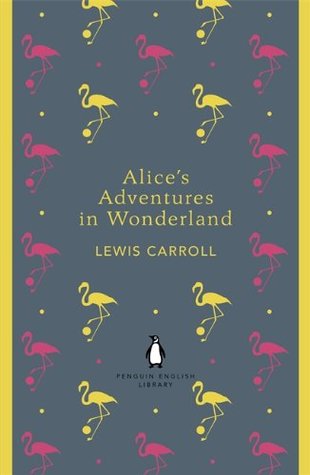
14. Alice's Adventures in Wonderland and Through the Looking Glass


14. Alice's Adventures in Wonderland. Lewis Carroll. Illustrated by John Tenniel. 1865/1871. 247 pages. [Source: Bought]

ETA: I listened to these two books on audio narrated by Christopher Plummer. The first book was AMAZING, AMAZING, AMAZING. The second book had some characters that were very obnoxious to hear narrated. I am not saying Plummer did poorly, just, that it is easier to take obnoxious characters when you don't have to hear them.

First sentence: Alice was beginning to get very tired of sitting by her sister on the bank, and of having nothing to do: once or twice she had peeped into the book her sister was reading, but it had no pictures or conversations in it, ‘and what is the use of a book,’ thought Alice, ‘without pictures or conversations?’

Premise/plot: Alice follows a white rabbit down a rabbit hole and has several fantastical seemingly impossible adventures before waking.  
 
First sentence: One thing was certain, that the white kitten had nothing to do with it – it was the black kitten’s fault entirely. For the white kitten had been having its face washed by the old cat for the last quarter of an hour (and bearing it pretty well, considering): so you see that it couldn’t have had any hand in the mischief.

Premise/plot: Alice doesn't follow a rabbit on her second adventure; no, she crawls through the looking glass into the looking glass house. Just as she always imagined, life is very different on the other side of the mirror. (For one thing, the chess pieces are alive.) Readers follow Alice's adventures as a pawn as she journeys towards being queened. Like the first book, this one is full of fantastical impossibilities.

My thoughts: I love, love, LOVE Lewis Carroll's Alice's Adventures in Wonderland. I couldn't begin to tell you how many times I've read it in my life. It's a magical read filled with silly characters--quite a few I'd deem unforgettable. What stands out to me--even more than the characters--is the writing. There is just something quotable and ever-relevant about the narrative.

Favorite quotes from Alice in Wonderland:
‘Do cats eat bats? Do cats eat bats?’ and sometimes ‘Do bats eat cats?’, for, you see, as she couldn’t answer either question, it didn’t much matter which way she put it. She felt that she was dozing off, and had just begun to dream that she was walking hand in hand with Dinah, and was saying to her, very earnestly, ‘Now, Dinah, tell me the truth: did you ever eat a bat?’, when suddenly, thump! thump! down she came upon a heap of sticks and dry leaves, and the fall was over.
Oh, how I wish I could shut up like a telescope! I think I could, if I only knew how to begin.’ For, you see, so many out-of-the-way things had happened lately, that Alice had begun to think that very few things indeed were really impossible.
She generally gave herself very good advice (though she very seldom followed it), and sometimes she scolded herself so severely as to bring tears into her eyes; and once she remembered trying to box her own ears for having cheated herself in a game of croquet she was playing against herself, for this curious child was very fond of pretending to be two people. ‘But it’s no use now,’ thought poor Alice, ‘to pretend to be two people! Why, there’s hardly enough of me left to make one respectable person!’
Let me think: was I the same when I got up this morning? I almost think I can remember feeling a little different. But if I’m not the same, the next question is “Who in the world am I?” Ah, that’s the great puzzle!’
‘Perhaps it doesn’t understand English,’ thought Alice. ‘I daresay it’s a French mouse, come over with William the Conqueror.’ (For, with all her knowledge of history, Alice had no very clear notion how long ago anything had happened.) So she began again: ‘Où est ma chatte?’, which was the first sentence in her French lesson-book. The Mouse gave a sudden leap out of the water, and seemed to quiver all over with fright. ‘Oh, I beg your pardon!’ cried Alice hastily, afraid that she had hurt the poor animal’s feelings. ‘I quite forgot you didn’t like cats.’
‘It was much pleasanter at home,’ thought poor Alice, ‘when one wasn’t always growing larger and smaller, and being ordered about by mice and rabbits. I almost wish I hadn’t gone down that rabbit-hole – and yet – and yet – it’s rather curious, you know, this sort of life! I do wonder what can have happened to me! When I used to read fairy tales, I fancied that kind of thing never happened, and now here I am in the middle of one! There ought to be a book written about me, that there ought! And when I grow up, I’ll write one – but I’m grown up now,’ she added in a sorrowful tone: ‘at least there’s no room to grow up any more here.’
‘It’s really dreadful,’ she muttered to herself, ’the way all the creatures argue. It’s enough to drive one crazy!’
‘I didn’t know that Cheshire-Cats always grinned; in fact, I didn’t know that cats could grin.’
‘They all can,’ said the Duchess; ‘and most of ’em do.’ ‘I don’t know of any that do,’ Alice said very politely, feeling quite pleased to have got into a conversation. ‘You don’t know much,’ said the Duchess; ‘and that’s a fact.’
‘If it had grown up,’ she said to herself, ‘it would have made a dreadfully ugly child: but it makes rather a handsome pig, I think.’ And she began thinking over other children she knew, who might do very well as pigs, and was just saying to herself ‘if one only knew the right way to change them –’ when she was a little startled by seeing the Cheshire-Cat sitting on a bough of a tree a few yards off.
 ‘Would you tell me, please, which way I ought to go from here?’ ‘That depends a good deal on where you want to get to,’ said the Cat. ‘I don’t much care where –’ said Alice. ‘Then it doesn’t matter which way you go,’ said the Cat. ‘– so long as I get somewhere,’ Alice added as an explanation. ‘Oh, you’re sure to do that,’ said the Cat, ‘if only you walk long enough.’
‘In that direction,’ the Cat said, waving its right paw round, ‘lives a Hatter: and in that direction,’ waving the other paw, ‘lives a March Hare. Visit either you like: they’re both mad.’ ‘But I don’t want to go among mad people,’ Alice remarked. ‘Oh, you ca’n’t help that,’ said the Cat: ‘we’re all mad here. I’m mad. You’re mad.’
‘How do you know I’m mad?’ said Alice. ‘You must be,’ said the Cat, ‘or you wouldn’t have come here.’
‘Then you should say what you mean,’ the March Hare went on. ‘I do,’ Alice hastily replied; ‘at least – at least I mean what I say – that’s the same thing, you know.’ ‘Not the same thing a bit!’ said the Hatter. ‘Why, you might just as well say that “I see what I eat” is the same thing as “I eat what I see”!’
‘You might just as well say,’ added the Dormouse, which seemed to be talking in its sleep, ‘that “I breathe when I sleep” is the same thing as “I sleep when I breathe”!’
Alice thought she had never seen such a curious croquet-ground in her life: it was all ridges and furrows: the croquet balls were live hedgehogs, and the mallets live flamingoes, and the soldiers had to double themselves up and stand on their hands and feet, to make the arches.
The players all played at once, without waiting for turns, quarreling all the while, and fighting for the hedgehogs; and in a very short time the Queen was in a furious passion, and went stamping about, and shouting ‘Off with his head!’ or ‘Off with her head!’ about once in a minute.
“Never imagine yourself not to be otherwise than what it might appear to others that what you were or might have been was not otherwise than what you had been would have appeared to them to be otherwise.” ’ ‘I think I should understand that better,’ Alice said very politely, ‘if I had it written down: but I ca’n’t quite follow it as you say it.’ ‘That’s nothing to what I could say if I chose,’ the Duchess replied, in a pleased tone.
‘I make you a present of everything I’ve said as yet.’
‘A cheap sort of present!’ thought Alice. ‘I’m glad people don’t give birthday-presents like that!’
‘He taught Laughing and Grief, they used to say.’ ‘So he did, so he did,’ said the Gryphon, sighing in his turn; and both creatures hid their faces in their paws. ‘And how many hours a day did you do lessons?’ said Alice, in a hurry to change the subject. ‘Ten hours the first day,’ said the Mock Turtle: ‘nine the next, and so on.’ ‘What a curious plan!’ exclaimed Alice. ‘That’s the reason they’re called lessons,’ the Gryphon remarked: ‘because they lessen from day to day.’
Favorite quotes from Through the Looking Glass:
‘Kitty, can you play chess? Now, don’t smile, my dear, I’m asking it seriously. Because, when we were playing just now, you watched just as if you understood it: and when I said “Check!” you purred! Well, it was a nice check, Kitty, and really I might have won, if it hadn’t been for that nasty Knight, that came wriggling down among my pieces. Kitty, dear, let’s pretend –’ And here I wish I could tell you half the things Alice used to say, beginning with her favourite phrase ‘Let’s pretend.’
Oh, Kitty, how nice it would be if we could only get through into Looking glass House! I’m sure it’s got, oh! such beautiful things in it! Let’s pretend there’s a way of getting through into it, somehow, Kitty. Let’s pretend the glass has got all soft like gauze, so that we can get through. Why, it’s turning into a sort of mist now, I declare! It’ll be easy enough to get through—’ She was up on the chimney-piece while she said this, though she hardly knew how she had got there. And certainly the glass was beginning to melt away, just like a bright silvery mist.
She was out of the room in a moment, and ran down stairs – or, at least, it wasn’t exactly running, but a new invention for getting down stairs quickly and easily, as Alice said to herself. She just kept the tips of her fingers on the hand-rail, and floated gently down without even touching the stairs with her feet: then she floated on through the hall, and would have gone straight out at the door in the same way, if she hadn’t caught hold of the door-post. She was getting a little giddy with so much floating in the air, and was rather glad to find herself walking again in the natural way.
‘It’s a great huge game of chess that’s being played – all over the world – if this is the world at all, you know. Oh, what fun it is! How I wish I was one of them! I wouldn’t mind being a Pawn, if only I might join – though of course I should like to be a Queen, best.’
‘Well, in our country,’ said Alice, still panting a little, ‘you’d generally get to somewhere else – if you ran very fast for a long time as we’ve been doing.’ ‘A slow sort of country!’ said the Queen. ‘Now, here, you see, it takes all the running you can do, to keep in the same place. If you want to get somewhere else, you must run at least twice as fast as that!’ ‘I’d rather not try, please!’ said Alice.
‘He’s dreaming now,’ said Tweedledee: ‘and what do you think he’s dreaming about?’ Alice said ‘Nobody can guess that.’ ‘Why, about you!’ Tweedledee exclaimed, clapping his hands triumphantly. ‘And if he left off dreaming about you, where do you suppose you’d be?’ ‘Where I am now, of course,’ said Alice. ‘Not you!’ Tweedledee retorted contemptuously. ‘You’d be nowhere. Why, you’re only a sort of thing in his dream!’
‘Well, it’s no use your talking about waking him,’ said Tweedledum, ‘when you’re only one of the things in his dream. You know very well you’re not real.’ ‘I am real!’ said Alice, and began to cry. ‘You wo’n’t make yourself a bit realler by crying,’ Tweedledee remarked: ‘there’s nothing to cry about.’ ‘If I wasn’t real,’ Alice said – half-laughing through her tears, it all seemed so ridiculous – ‘I shouldn’t be able to cry.’ ‘I hope you don’t suppose those are real tears?’ Tweedledum interrupted in a tone of great contempt. ‘I know they’re talking nonsense,’ Alice thought to herself: ‘and it’s foolish to cry about it.’
‘The rule is, jam to-morrow and jam yesterday – but never jam to-day.’
‘It must come sometimes to “jam to-day”, ’ Alice objected. ‘No, it ca’n’t,’ said the Queen. ‘It’s jam every other day: to-day isn’t any other day, you know.’ ‘I don’t understand you,’ said Alice. ‘It’s dreadfully confusing!’ ‘That’s the effect of living backwards,’ the Queen said kindly: ‘it always makes one a little giddy at first –’ ‘Living backwards!’ Alice repeated in great astonishment. ‘I never heard of such a thing!’ ‘– but there’s one great advantage in it, that one’s memory works both ways.’
‘Consider what a great girl you are. Consider what a long way you’ve come to-day. Consider what o-clock it is. Consider anything, only don’t cry!’
‘Can you keep from crying by considering things?’ she asked. ‘That’s the way it’s done,’ the Queen said with great decision: ‘nobody can do two things at once, you know.
Why, sometimes I’ve believed as many as six impossible things before breakfast.
‘I never ask advice about growing,’ Alice said indignantly. ‘Too proud?’ the other enquired. Alice felt even more indignant at this suggestion. ‘I mean,’ she said, ‘that one ca’n’t help growing older.’ ‘One ca’n’t, perhaps,’ said Humpty Dumpty; ‘but two can. With proper assistance, you might have left off at seven.’
‘they gave it me – for an un-birthday present.’ ‘I beg your pardon?’ Alice said with a puzzled air. ‘I’m not offended,’ said Humpty Dumpty. ‘I mean, what is an un-birthday present?’ ‘A present given when it isn’t your birthday, of course.’ Alice considered a little. ‘I like birthday presents best,’ she said at last. ‘You don’t know what you’re talking about!’ cried Humpty Dumpty. ‘How many days are there in a year?’ ‘Three hundred and sixty-five,’ said Alice. ‘And how many birthdays have you?’ ‘One.’ ‘And if you take one from three hundred and sixty-five, what remains?’ ‘Three hundred and sixty-four, of course.’
‘When I use a word,’ Humpty Dumpty said, in rather a scornful tone, ‘it means just what I choose it to mean – neither more nor less.’
‘The question is,’ said Alice, ‘whether you can make words mean so many different things.’ ‘The question is,’ said Humpty Dumpty, ‘which is to be master – that’s all.’
‘I can repeat poetry as well as other folk, if it comes to that –’ ‘Oh, it needn’t come to that!’ Alice hastily said, hoping to keep him from beginning.
‘I see nobody on the road,’ said Alice. ‘I only wish I had such eyes,’ the King remarked in a fretful tone. ‘To be able to see Nobody! And at that distance too! Why, it’s as much as I can do to see real people, by this light!’
‘Who did you pass on the road?’ the King went on, holding out his hand to the Messenger for some more hay. ‘Nobody,’ said the Messenger. ‘Quite right,’ said the King: ‘this young lady saw him too. So of course Nobody walks slower than you.’ ‘I do my best,’ the Messenger said in a sullen tone. ‘I’m sure nobody walks much faster than I do!’ ‘He ca’n’t do that,’ said the King, ‘or else he’d have been here first. However, now you’ve got your breath, you may tell us what’s happened in the town.’
‘I was wondering what the mouse-trap was for,’ said Alice. ‘It isn’t very likely there would be any mice on the horse’s back.’ ‘Not very likely, perhaps,’ said the Knight; ‘but, if they do come, I don’t choose to have them running all about.’
‘Always speak the truth – think before you speak – and write it down afterwards.’
 What do you suppose is the use of a child without any meaning? Even a joke should have some meaning – and a child’s more important than a joke, I hope. You couldn’t deny that, even if you tried with both hands.’ ‘I don’t deny things with my hands,’ Alice objected. ‘Nobody said you did,’ said the Red Queen. ‘I said you couldn’t if you tried.’ ‘She’s in that state of mind,’ said the White Queen, ‘that she wants to deny something – only she doesn’t know what to deny!’ ‘A nasty, vicious temper,’ the Red Queen remarked;
‘It’s too late to correct it,’ said the Red Queen: ‘when you’ve once said a thing, that fixes it, and you must take the consequences.’
 It is a very inconvenient habit of kittens (Alice had once made the remark) that, whatever you say to them, they always purr. ‘If they would only purr for “yes”, and mew for “no”, or any rule of that sort,’ she had said, ‘so that one could keep up a conversation! But how can you talk with a person if they always say the same thing?’


© 2026 Becky Laney of Becky's Book Reviews

Thursday, February 03, 2022

19. Our Mutual Friend


Our Mutual Friend. Charles Dickens. 1865. 801 pages. [Source: Bought]

I first read this one in 2011. I don't know why it took me over a decade to reread this one. Since I found it so hard to summarize the first time, I am reposting my initial review. (The plot didn't change after all).

My thoughts, well, they stayed just as enthusiastic or gushy. I still love, love, love this one. This is still my favorite Dickens novel.

First sentence: IN THESE TIMES of ours, though concerning the exact year there is no need to be precise, a boat of dirty and disreputable appearance, with two figures in it, floated on the Thames, between Southwark bridge which is of iron, and London Bridge which is of stone, as an autumn evening was closing in.

How does one begin to describe a novel that is 800 pages long?! A novel that doesn't have one or two main characters--but many. A novel that doesn't have one or two main stories--but many. If you're not familiar with Charles Dickens, you should know that he has his own way of storytelling. His stories and characters unfold slowly but surely. Don't expect to meet all the main characters in the first hundred pages. Or even the first two hundred pages. Dickens won't be rushed. This is something that I have come to appreciate--though other readers may struggle with his pacing. I found it delightful; something to be savored.

Since I have to start somewhere, perhaps I should start with the corpse. Lizzie Hexam and her father, Jesse "Gaffer" Hexam discover a dead body during their night's work on the Thames. Her father's former business partner, Roger Riderhood, witnesses this discovery and later has some unflattering stories to spread to any willing to listen. (Stories that threaten Lizzie Hexam and her brother, Charley.) The body was soon identified as John Harmon--there were clothes and papers identifying him, I think. His death brings changes to several households. For his intended, Miss Bella Wilfer, it ushers in pitifully insincere mourning. She mourns--but for the riches she would have had if they'd married and he'd inherited his father's estate. But the household that changes the most is that of the Boffins. For Mr. and Mrs. Boffin will inherit the Harmon estate now that the heir is dead. Will money prove friend or foe to this lovely couple? One thing we learn early on, is that Mr. Boffin has a heart of gold--for he opens his heart and home to Miss Bella Wilfer. He also hires two men--two very different men--after he comes into his money: Silas Wegg, a man he hired to read to him, and John Rokesmith, a man he hired as his secretary. Is either man who he appears to be?

What did I love best about this one? The characters? I loved Bella Wilfer, John Rokesmith, Mr. and Mrs. Boffin, Melvin Tremlow, Jenny Wren, Mr. Riah, and Lizzie Hexam. And there were characters that I didn't exactly love--they weren't that lovable, after all--but their scenes were enjoyable nevertheless. The Podsnaps. The Veneerings. The Lammles. The Wilfers. Mr. Fledgeby. Mr. Lightwood and Mr. Wrayburn. Some characters added drama; some characters added humor!

Dickens did a great job with his characters. You'll find characters that you'll absolutely love and adore. You'll find characters that are so enjoyable, so fun, to spend time with. You'll find characters that make you laugh--or at least smirk. You might find a few characters that you love to hate, or hate to love. You'll find characters that are just so despicable, so nasty, so horrid that you hate them--with a passion. There might even be a few that drive you crazy! But I hope that you'll find a few characters that genuinely surprise you! I know a few surprised me! There are so many characters. Some are very important to the plot. Others are very minor. But just because they're minor doesn't mean they're pointless. I loved the romances of Bella and Lizzie. 

 The scenes with Bella and her true love made me giddy! And while Lizzie's scenes were a different nature--a bit more melancholy--they were so heartfelt. But it isn't just a romance. There is action, drama, mystery. There are secrets and lies and malicious plotting.


I loved this one. I loved the writing, the descriptions, the characterizations, the storytelling. It's a great, great book.
"Never was an obstinate person yet, who would own to the word!" remarked Miss Potterson, rubbing her vexed nose; "I'm sure I would if I was obstinate; but I am a pepperer, which is different." (74)
"No one is useless in this world," retorted the Secretary, "who lightens the burden of it for any one else."
"But I assure you I don't, Mr. Rokesmith," said Bella, half-crying.
"Not for your father?"
"Dear, loving, self-forgetting, easily-satisfied Pa! Oh, yes! He thinks so."
"It is enough if he only thinks so," said the Secretary. (511-12)

 I don't have a page number for these two, but:

He was too tired to rest in his sleep, until he was even tired out of being too tired, and dropped into oblivion.

People are always calling other people something.


© 2022 Becky Laney of Becky's Book Reviews

Friday, May 22, 2020

72. Miss Mackenzie

Miss Mackenzie. Anthony Trollope. 1865. 432 pages. [Source: Bought]

First sentence: I FEAR I must trouble my reader with some few details as to the early life of Miss Mackenzie, — details which will be dull in the telling, but which shall be as short as I can make them.

Premise/plot: Easy come, easy go. That sums up Miss Mackenzie quite succinctly.

Our heroine, Margaret MacKenzie, inherits a large fortune when her brother dies. But with all that money comes trouble, worry, and heartache. For Miss Mackenzie who has never had a suitor before suddenly finds herself besieged by men desperately wanting to marry her...Can she find true love in spite of her money?

Three of her suitors are John Ball (a widower, a cousin, a mama's-boy), Samuel Rubb Jr. (a tradesman, the business partner of her younger brother, the wearer of yellow gloves), and Mr. Maguire (a curate who proves himself shamelessly ambitious and greedy).

Miss Mackenzie hasn't determined to marry at all...and yet...she wants to find TRUE LOVE despite the fact that she's "middle aged" (36).

My thoughts: I really enjoyed this one!!! I found it well paced--perhaps with the qualifier of well paced for a Victorian novel. I thought the last half was extraordinary. (Perhaps not better than my favorite, favorite, favorite Trollope novels).

Quotes:
I have no doubt these people are very good in their way; only their ways are not my ways; and one doesn’t like to be told so often that one’s own way is broad, and that it leads — you know where.
He had on bright yellow kid gloves, primrose he would have called them, but, if there be such things as yellow gloves, they were yellow; and she wished that she had the courage to ask him to take them off.
 For me, if I am to live in a moated grange, let it be in the country. Moated granges in the midst of populous towns are very terrible.
It was, however, generally felt that, though Mr Slow was the slowest in his speech, Mr Bideawhile was the longest in getting anything said. Mr Slow would often beguile his time with unnecessary remarks; but Mr Bideawhile was so constant in beguiling his time, that men wondered how, in truth, he ever did anything at all.
Men who can succeed in deceiving no one else will succeed at last in deceiving themselves.

© 2020 Becky Laney of Becky's Book Reviews

Wednesday, January 10, 2018

Alice's Adventures in Wonderland

Alice's Adventures in Wonderland. Lewis Carroll. Illustrated by John Tenniel. 1865/1871. 247 pages. [Source: Bought]

First sentence: Alice was beginning to get very tired of sitting by her sister on the bank, and of having nothing to do: once or twice she had peeped into the book her sister was reading, but it had no pictures or conversations in it, ‘and what is the use of a book,’ thought Alice, ‘without pictures or conversations?’

Premise/plot: Alice follows a white rabbit down a rabbit hole and has several fantastical seemingly impossible adventures before waking.  
 
First sentence: One thing was certain, that the white kitten had nothing to do with it – it was the black kitten’s fault entirely. For the white kitten had been having its face washed by the old cat for the last quarter of an hour (and bearing it pretty well, considering): so you see that it couldn’t have had any hand in the mischief.

Premise/plot: Alice doesn't follow a rabbit on her second adventure; no, she crawls through the looking glass into the looking glass house. Just as she always imagined, life is very different on the other side of the mirror. (For one thing, the chess pieces are alive.) Readers follow Alice's adventures as a pawn as she journeys towards being queened. Like the first book, this one is full of fantastical impossibilities.

My thoughts: I love, love, LOVE Lewis Carroll's Alice's Adventures in Wonderland. I couldn't begin to tell you how many times I've read it in my life. It's a magical read filled with silly characters--quite a few I'd deem unforgettable. What stands out to me--even more than the characters--is the writing. There is just something quotable and ever-relevant about the narrative.

Favorite quotes from Alice in Wonderland:
‘Do cats eat bats? Do cats eat bats?’ and sometimes ‘Do bats eat cats?’, for, you see, as she couldn’t answer either question, it didn’t much matter which way she put it. She felt that she was dozing off, and had just begun to dream that she was walking hand in hand with Dinah, and was saying to her, very earnestly, ‘Now, Dinah, tell me the truth: did you ever eat a bat?’, when suddenly, thump! thump! down she came upon a heap of sticks and dry leaves, and the fall was over.
Oh, how I wish I could shut up like a telescope! I think I could, if I only knew how to begin.’ For, you see, so many out-of-the-way things had happened lately, that Alice had begun to think that very few things indeed were really impossible.
She generally gave herself very good advice (though she very seldom followed it), and sometimes she scolded herself so severely as to bring tears into her eyes; and once she remembered trying to box her own ears for having cheated herself in a game of croquet she was playing against herself, for this curious child was very fond of pretending to be two people. ‘But it’s no use now,’ thought poor Alice, ‘to pretend to be two people! Why, there’s hardly enough of me left to make one respectable person!’
Let me think: was I the same when I got up this morning? I almost think I can remember feeling a little different. But if I’m not the same, the next question is “Who in the world am I?” Ah, that’s the great puzzle!’
‘Perhaps it doesn’t understand English,’ thought Alice. ‘I daresay it’s a French mouse, come over with William the Conqueror.’ (For, with all her knowledge of history, Alice had no very clear notion how long ago anything had happened.) So she began again: ‘Où est ma chatte?’, which was the first sentence in her French lesson-book. The Mouse gave a sudden leap out of the water, and seemed to quiver all over with fright. ‘Oh, I beg your pardon!’ cried Alice hastily, afraid that she had hurt the poor animal’s feelings. ‘I quite forgot you didn’t like cats.’
‘It was much pleasanter at home,’ thought poor Alice, ‘when one wasn’t always growing larger and smaller, and being ordered about by mice and rabbits. I almost wish I hadn’t gone down that rabbit-hole – and yet – and yet – it’s rather curious, you know, this sort of life! I do wonder what can have happened to me! When I used to read fairy tales, I fancied that kind of thing never happened, and now here I am in the middle of one! There ought to be a book written about me, that there ought! And when I grow up, I’ll write one – but I’m grown up now,’ she added in a sorrowful tone: ‘at least there’s no room to grow up any more here.’
‘It’s really dreadful,’ she muttered to herself, ’the way all the creatures argue. It’s enough to drive one crazy!’
‘I didn’t know that Cheshire-Cats always grinned; in fact, I didn’t know that cats could grin.’
‘They all can,’ said the Duchess; ‘and most of ’em do.’ ‘I don’t know of any that do,’ Alice said very politely, feeling quite pleased to have got into a conversation. ‘You don’t know much,’ said the Duchess; ‘and that’s a fact.’
‘If it had grown up,’ she said to herself, ‘it would have made a dreadfully ugly child: but it makes rather a handsome pig, I think.’ And she began thinking over other children she knew, who might do very well as pigs, and was just saying to herself ‘if one only knew the right way to change them –’ when she was a little startled by seeing the Cheshire-Cat sitting on a bough of a tree a few yards off.
 ‘Would you tell me, please, which way I ought to go from here?’ ‘That depends a good deal on where you want to get to,’ said the Cat. ‘I don’t much care where –’ said Alice. ‘Then it doesn’t matter which way you go,’ said the Cat. ‘– so long as I get somewhere,’ Alice added as an explanation. ‘Oh, you’re sure to do that,’ said the Cat, ‘if only you walk long enough.’
‘In that direction,’ the Cat said, waving its right paw round, ‘lives a Hatter: and in that direction,’ waving the other paw, ‘lives a March Hare. Visit either you like: they’re both mad.’ ‘But I don’t want to go among mad people,’ Alice remarked. ‘Oh, you ca’n’t help that,’ said the Cat: ‘we’re all mad here. I’m mad. You’re mad.’
‘How do you know I’m mad?’ said Alice. ‘You must be,’ said the Cat, ‘or you wouldn’t have come here.’
‘Then you should say what you mean,’ the March Hare went on. ‘I do,’ Alice hastily replied; ‘at least – at least I mean what I say – that’s the same thing, you know.’ ‘Not the same thing a bit!’ said the Hatter. ‘Why, you might just as well say that “I see what I eat” is the same thing as “I eat what I see”!’
‘You might just as well say,’ added the Dormouse, which seemed to be talking in its sleep, ‘that “I breathe when I sleep” is the same thing as “I sleep when I breathe”!’
Alice thought she had never seen such a curious croquet-ground in her life: it was all ridges and furrows: the croquet balls were live hedgehogs, and the mallets live flamingoes, and the soldiers had to double themselves up and stand on their hands and feet, to make the arches.
The players all played at once, without waiting for turns, quarreling all the while, and fighting for the hedgehogs; and in a very short time the Queen was in a furious passion, and went stamping about, and shouting ‘Off with his head!’ or ‘Off with her head!’ about once in a minute.
“Never imagine yourself not to be otherwise than what it might appear to others that what you were or might have been was not otherwise than what you had been would have appeared to them to be otherwise.” ’ ‘I think I should understand that better,’ Alice said very politely, ‘if I had it written down: but I ca’n’t quite follow it as you say it.’ ‘That’s nothing to what I could say if I chose,’ the Duchess replied, in a pleased tone.
‘I make you a present of everything I’ve said as yet.’
‘A cheap sort of present!’ thought Alice. ‘I’m glad people don’t give birthday-presents like that!’
‘He taught Laughing and Grief, they used to say.’ ‘So he did, so he did,’ said the Gryphon, sighing in his turn; and both creatures hid their faces in their paws. ‘And how many hours a day did you do lessons?’ said Alice, in a hurry to change the subject. ‘Ten hours the first day,’ said the Mock Turtle: ‘nine the next, and so on.’ ‘What a curious plan!’ exclaimed Alice. ‘That’s the reason they’re called lessons,’ the Gryphon remarked: ‘because they lessen from day to day.’
Favorite quotes from Through the Looking Glass:
‘Kitty, can you play chess? Now, don’t smile, my dear, I’m asking it seriously. Because, when we were playing just now, you watched just as if you understood it: and when I said “Check!” you purred! Well, it was a nice check, Kitty, and really I might have won, if it hadn’t been for that nasty Knight, that came wriggling down among my pieces. Kitty, dear, let’s pretend –’ And here I wish I could tell you half the things Alice used to say, beginning with her favourite phrase ‘Let’s pretend.’
Oh, Kitty, how nice it would be if we could only get through into Looking glass House! I’m sure it’s got, oh! such beautiful things in it! Let’s pretend there’s a way of getting through into it, somehow, Kitty. Let’s pretend the glass has got all soft like gauze, so that we can get through. Why, it’s turning into a sort of mist now, I declare! It’ll be easy enough to get through—’ She was up on the chimney-piece while she said this, though she hardly knew how she had got there. And certainly the glass was beginning to melt away, just like a bright silvery mist.
She was out of the room in a moment, and ran down stairs – or, at least, it wasn’t exactly running, but a new invention for getting down stairs quickly and easily, as Alice said to herself. She just kept the tips of her fingers on the hand-rail, and floated gently down without even touching the stairs with her feet: then she floated on through the hall, and would have gone straight out at the door in the same way, if she hadn’t caught hold of the door-post. She was getting a little giddy with so much floating in the air, and was rather glad to find herself walking again in the natural way.
‘It’s a great huge game of chess that’s being played – all over the world – if this is the world at all, you know. Oh, what fun it is! How I wish I was one of them! I wouldn’t mind being a Pawn, if only I might join – though of course I should like to be a Queen, best.’
‘Well, in our country,’ said Alice, still panting a little, ‘you’d generally get to somewhere else – if you ran very fast for a long time as we’ve been doing.’ ‘A slow sort of country!’ said the Queen. ‘Now, here, you see, it takes all the running you can do, to keep in the same place. If you want to get somewhere else, you must run at least twice as fast as that!’ ‘I’d rather not try, please!’ said Alice.
‘He’s dreaming now,’ said Tweedledee: ‘and what do you think he’s dreaming about?’ Alice said ‘Nobody can guess that.’ ‘Why, about you!’ Tweedledee exclaimed, clapping his hands triumphantly. ‘And if he left off dreaming about you, where do you suppose you’d be?’ ‘Where I am now, of course,’ said Alice. ‘Not you!’ Tweedledee retorted contemptuously. ‘You’d be nowhere. Why, you’re only a sort of thing in his dream!’
‘Well, it’s no use your talking about waking him,’ said Tweedledum, ‘when you’re only one of the things in his dream. You know very well you’re not real.’ ‘I am real!’ said Alice, and began to cry. ‘You wo’n’t make yourself a bit realler by crying,’ Tweedledee remarked: ‘there’s nothing to cry about.’ ‘If I wasn’t real,’ Alice said – half-laughing through her tears, it all seemed so ridiculous – ‘I shouldn’t be able to cry.’ ‘I hope you don’t suppose those are real tears?’ Tweedledum interrupted in a tone of great contempt. ‘I know they’re talking nonsense,’ Alice thought to herself: ‘and it’s foolish to cry about it.’
‘The rule is, jam to-morrow and jam yesterday – but never jam to-day.’
‘It must come sometimes to “jam to-day”, ’ Alice objected. ‘No, it ca’n’t,’ said the Queen. ‘It’s jam every other day: to-day isn’t any other day, you know.’ ‘I don’t understand you,’ said Alice. ‘It’s dreadfully confusing!’ ‘That’s the effect of living backwards,’ the Queen said kindly: ‘it always makes one a little giddy at first –’ ‘Living backwards!’ Alice repeated in great astonishment. ‘I never heard of such a thing!’ ‘– but there’s one great advantage in it, that one’s memory works both ways.’
‘Consider what a great girl you are. Consider what a long way you’ve come to-day. Consider what o-clock it is. Consider anything, only don’t cry!’
‘Can you keep from crying by considering things?’ she asked. ‘That’s the way it’s done,’ the Queen said with great decision: ‘nobody can do two things at once, you know.
Why, sometimes I’ve believed as many as six impossible things before breakfast.
‘I never ask advice about growing,’ Alice said indignantly. ‘Too proud?’ the other enquired. Alice felt even more indignant at this suggestion. ‘I mean,’ she said, ‘that one ca’n’t help growing older.’ ‘One ca’n’t, perhaps,’ said Humpty Dumpty; ‘but two can. With proper assistance, you might have left off at seven.’
‘they gave it me – for an un-birthday present.’ ‘I beg your pardon?’ Alice said with a puzzled air. ‘I’m not offended,’ said Humpty Dumpty. ‘I mean, what is an un-birthday present?’ ‘A present given when it isn’t your birthday, of course.’ Alice considered a little. ‘I like birthday presents best,’ she said at last. ‘You don’t know what you’re talking about!’ cried Humpty Dumpty. ‘How many days are there in a year?’ ‘Three hundred and sixty-five,’ said Alice. ‘And how many birthdays have you?’ ‘One.’ ‘And if you take one from three hundred and sixty-five, what remains?’ ‘Three hundred and sixty-four, of course.’
‘When I use a word,’ Humpty Dumpty said, in rather a scornful tone, ‘it means just what I choose it to mean – neither more nor less.’
‘The question is,’ said Alice, ‘whether you can make words mean so many different things.’ ‘The question is,’ said Humpty Dumpty, ‘which is to be master – that’s all.’
‘I can repeat poetry as well as other folk, if it comes to that –’ ‘Oh, it needn’t come to that!’ Alice hastily said, hoping to keep him from beginning.
‘I see nobody on the road,’ said Alice. ‘I only wish I had such eyes,’ the King remarked in a fretful tone. ‘To be able to see Nobody! And at that distance too! Why, it’s as much as I can do to see real people, by this light!’
‘Who did you pass on the road?’ the King went on, holding out his hand to the Messenger for some more hay. ‘Nobody,’ said the Messenger. ‘Quite right,’ said the King: ‘this young lady saw him too. So of course Nobody walks slower than you.’ ‘I do my best,’ the Messenger said in a sullen tone. ‘I’m sure nobody walks much faster than I do!’ ‘He ca’n’t do that,’ said the King, ‘or else he’d have been here first. However, now you’ve got your breath, you may tell us what’s happened in the town.’
‘I was wondering what the mouse-trap was for,’ said Alice. ‘It isn’t very likely there would be any mice on the horse’s back.’ ‘Not very likely, perhaps,’ said the Knight; ‘but, if they do come, I don’t choose to have them running all about.’
‘Always speak the truth – think before you speak – and write it down afterwards.’
 What do you suppose is the use of a child without any meaning? Even a joke should have some meaning – and a child’s more important than a joke, I hope. You couldn’t deny that, even if you tried with both hands.’ ‘I don’t deny things with my hands,’ Alice objected. ‘Nobody said you did,’ said the Red Queen. ‘I said you couldn’t if you tried.’ ‘She’s in that state of mind,’ said the White Queen, ‘that she wants to deny something – only she doesn’t know what to deny!’ ‘A nasty, vicious temper,’ the Red Queen remarked;
‘It’s too late to correct it,’ said the Red Queen: ‘when you’ve once said a thing, that fixes it, and you must take the consequences.’
 It is a very inconvenient habit of kittens (Alice had once made the remark) that, whatever you say to them, they always purr. ‘If they would only purr for “yes”, and mew for “no”, or any rule of that sort,’ she had said, ‘so that one could keep up a conversation! But how can you talk with a person if they always say the same thing?’

© 2018 Becky Laney of Becky's Book Reviews

Monday, February 29, 2016

Hans Brinker, Or, The Silver Skates

Hans Brinker, Or, The Silver Skates. Mary Mapes Dodge. 1865. 244 pages. [Source: Bought]

What did I think of Hans Brinker, or, The Silver Skates? What did I REALLY think? It was something, that's for sure. At times I felt it was going in too many different directions to be a solidly-good read.

There is the Brinker family drama. Hans and Gretel are brother-and-sister in a desperately poor family. Their father has had a brain injury for a little over ten years, and, he is getting worse, beginning to suffer more, and lash out more in his madness. Hans wants to seek out a famous surgeon to see if his father can be helped. But, of course, there is no money to pay the surgeon, and, the surgeon travels around from city to city, and you never know where he is to be actually found.

There is the drama surrounding a dozen village children--boys and girls--all more "better off" than the Brinker children. A group of boys--including one visiting English boy--decide to go off on a sight-seeing adventure together on their skates. They'll cover many, many miles; go through many cities and villages; and spend many days and nights away from home. Throughout their actual adventure, history lessons--dense history lessons--are included in the form of dialogue among the children.

Then there is the drama and excitement of the SKATING RACE. Hans and Gretel *want* to participate of course. And all the other boys and girls ARE participating. Will Hans and Gretel be able to participate too. Perhaps if they can manage to buy *real* skates instead of homemade wooden ones. The prize for the skating race is a pair of silver skates; one pair to be awarded to a boy, another pair to be awarded to a girl.

The book is part action and adventure, part travelogue, part history book, part sentimental coming-of-age. I must admit that I really liked the story line with the doctor/surgeon and the Brinker family--how everything is resolved. I know it's the most sentimental aspect of the story, but, I really enjoyed it all the same. The basics of the story are good, I think, it's just I'm not sure how many readers really, really want detailed history lessons covering centuries worth of material.

© 2016 Becky Laney of Becky's Book Reviews

Tuesday, May 07, 2013

Can You Forgive Her? (1865)

Can You Forgive Her? Anthony Trollope. 1865. 848 pages.

I adore Anthony Trollope. I do. I just love, love, love him. Can You Forgive Her? is the first novel in the Palliser series. There are multiple stories to follow in this one; one or two of the stories are political in nature, the rest of the stories are more focused on relationships (family, friendship, romantic love).

Alice Vavasor might arguably be the main heroine of Can You Forgive Her? She is a young woman contemplating marriage. She contemplates a lot. When readers first meet her, we learn that her first fiancee was her cousin, George Vavasor; that first engagement was broken when she discovered he was unfaithful. At the start of the novel, she is engaged for a second time. Her second fiancee is John Grey. He is eager to marry; she is not.

Kate Vavasor is Alice's cousin and best friend. At the start of the novel, Kate is plotting to get Alice back together with George. Kate thinks her brother, George, is the best hope for her brother's future happiness. She is more than a little selfish and manipulative.

Readers first get the chance to know George when the three go to Europe together on vacation. He is acting chaperon for Alice and Kate. He shares some pleasant times with Alice, and these somewhat private moments give him hope that this wealthy heiress will jilt John Grey and marry him instead. He really, really wants her money and he feels that he could tolerate being married if it was to Alice. George is possibly the most selfish character in the whole novel.

John Grey had his doubts about allowing Alice to go on a trip with her cousins, but, there was little he could do about it. Since Alice's return, she's been more distant than ever. Is Alice having second thoughts, and will he allow her to have those second thoughts? Does John know best in this situation? Alice's father certainly is hopeful that Alice and John will go ahead and marry! As are the rest of Alice's relations.

While Kate spends time with her oh-so-rich widowed aunt, Arabella Greenow, Alice goes visiting some as well. She visits with the newly married couple Lady Glencora (M'Cluskie) and Plantagenet Palliser. She got a chance to know her a little bit while Lady Glencora was courting another man, Burgo Fitzgerald. But now she's getting to know her a lot better. In fact, Lady Glencora is always sharing her most personal thoughts with her! Little things like she's not in love with her husband, that she still thinks of Burgo all-too-often, that she is even contemplating running away with him! Alice is practical and moral.

Can You Forgive Her? has two WONDERFUL heroes. I really, really, really LOVED Plantagenet Palliser and John Grey. It is not just that these two know just what to say in any given situation; it is that their words are well-matched with their actions. They know how to SHOW love. In the opening chapters, I wasn't sure how I was supposed to feel about John Grey. Alice was so doubtful of her readiness to get married to him. Though Alice said she truly loved him, Alice's doubt confused me. And John seemed oh-so-certain that he knew Alice best. I wasn't sure if that was so. It seemed so arrogant, in a way! Readers don't really get a chance to know Plantagenet Palliser until the second half of the novel. And his character wowed me in a way.

Can You Forgive Her? shows three women facing major life decisions. Arabella Greenow, a widow, has to decide IF she wants to remarry. There are two men eager--desperate--to "win" her: Mr. Cheesacre and Captain Bellfield. Lady Glencora is married, true, but she feels that was something her family forced upon her. She's contemplating making her own choice: to go with her love, Burgo, and face the displeasure of society OR stay with her husband whom she barely knows. Alice is trying to decide IF she wants to get married. There are two men in her life as well, John Grey and George Vavasor.

Favorite quotes:
In this world things are beautiful only because they are not quite seen, or not perfectly understood. Poetry is precious chiefly because it suggests more than it declares. 
Babbling may be a weakness, but to my thinking mystery is a vice.
A man can't govern well, simply because he is genuinely anxious that men should be well governed.
Every man to himself is the centre of the whole world;--the axle on which it all turns. All knowledge is but his own perception of the things around him. All love, and care for others, and solicitude for the world's welfare, are but his own feelings as to the world's wants and the world's merits. 
The schoolboy, when he sits down to make his rhymes, dares not say, even to his sister, that he hopes to rival Milton; but he nurses such a hope. The preacher, when he preaches his sermon, does not whisper, even to his wife, his belief that thousands may perhaps be turned to repentance by the strength of his words; but he thinks that the thousand converts are possible.
 Grief taken up because grief is supposed to be proper, is only one degree better than pretended grief.
If a cook can't make soup between two and seven, she can't make it in a week.
My belief is that a girl can have anything forgiven her, if she'll only tell it herself.
Men and women ain't lumps of sugar. They don't melt because the water is sometimes warm.
There are men whose energies hardly ever carry them beyond looking for the thing they want.
"I like to have a plan," said Mr. Palliser. "And so do I," said his wife,--"if only for the sake of not keeping it."
It seems to me that if a man can so train himself that he may live honestly and die fearlessly, he has done about as much as is necessary.
Romance, if it is to come at all, should always come by fits and starts.

© 2013 Becky Laney of Becky's Book Reviews

Saturday, February 19, 2011

Our Mutual Friend

Our Mutual Friend. Charles Dickens. 1864/1865. 880 pages.

First sentence: In these times of ours, though concerning the exact year there is no need to be precise, a boat of dirty and disreputable appearance, with two figures in it, floated on the Thames, between Southwark Bridge which is of iron, and London Bridge which is of stone, as an autumn evening was closing in.

Oh how I loved Our Mutual Friend! I just loved, loved, loved it! I think reading Bleak House last fall helped prepare me to love it. Because it gave me a good taste for Dickens' style, his narrative techniques, his characterization. It showed me that all would be worth it in the end. Did I struggle with Our Mutual Friend? No. Not like I did with Bleak House. I happened to be in just the right mood, perhaps. But I found nothing dull, nothing lifeless about Our Mutual Friend. Nothing lifeless but the dead corpse discovered in chapter one that is!

How does one begin to describe a novel that is 800 pages long?! A novel that doesn't have one or two main characters--but many. A novel that doesn't have one or two main stories--but many. If you're not familiar with Charles Dickens, you should know that he has his own way of storytelling. His stories and characters unfold slowly but surely. Don't expect to meet all the main characters in the first hundred pages. Or even the first two hundred pages. Dickens won't be rushed. This is something that I have come to appreciate--though other readers may struggle with his pacing. I found it delightful; something to be savored.

Since I have to start somewhere, perhaps I should start with the corpse. Lizzie Hexam and her father, Jesse "Gaffer" Hexam discover a dead body during their night's work on the Thames. Her father's former business partner, Roger Riderhood, witnesses this discovery and later has some unflattering stories to spread to any willing to listen. (Stories that threaten Lizzie Hexam and her brother, Charley.) The body was soon identified as John Harmon--there were clothes and papers identifying him, I think. His death brings changes to several households. For his intended, Miss Bella Wilfer, it ushers in pitifully insincere mourning. She mourns--but for the riches she would have had if they'd married and he'd inherited his father's estate. But the household that changes the most is that of the Boffins. For Mr. and Mrs. Boffin will inherit the Harmon estate now that the heir is dead. Will money prove friend or foe to this lovely couple? One thing we learn early on, is that Mr. Boffin has a heart of gold--for he opens his heart and home to Miss Bella Wilfer. He also hires two men--two very different men--after he comes into his money: Silas Wegg, a man he hired to read to him, and John Rokesmith, a man he hired as his secretary. Is either man who he appears to be?

What did I love best about this one? The characters? I loved Bella Wilfer, John Rokesmith, Mr. and Mrs. Boffin, Melvin Tremlow, Jenny Wren, Mr. Riah, and Lizzie Hexam. And there were characters that I didn't exactly love--they weren't that lovable, after all--but their scenes were enjoyable nevertheless. The Podsnaps. The Veneerings. The Lammles. The Wilfers. Mr. Fledgeby. Mr. Lightwood and Mr. Wrayburn. Some characters added drama; some characters added humor!

This is what I said in my Bleak House review, but it proves equally true in the case of Our Mutual Friend:
Dickens did a great job with his characters. You'll find characters that you'll absolutely love and adore. You'll find characters that are so enjoyable, so fun, to spend time with. You'll find characters that make you laugh--or at least smirk. You might find a few characters that you love to hate, or hate to love. You'll find characters that are just so despicable, so nasty, so horrid that you hate them--with a passion. There might even be a few that drive you crazy! But I hope that you'll find a few characters that genuinely surprise you! I know a few surprised me! There are so many characters. Some are very important to the plot. Others are very minor. But just because they're minor doesn't mean they're pointless.
I loved the romances of Bella and Lizzie. The scenes with Bella and her true love made me giddy! And while Lizzie's scenes were a different nature--a bit more melancholy--they were so heartfelt. But it isn't just a romance. There is action, drama, mystery. There are secrets and lies and malicious plotting.

I loved this one. I loved the writing, the descriptions, the characterizations, the storytelling. It's a great, great book.
"Never was an obstinate person yet, who would own to the word!" remarked Miss Potterson, rubbing her vexed nose; "I'm sure I would if I was obstinate; but I am a pepperer, which is different." (74)
"No one is useless in this world," retorted the Secretary, "who lightens the burden of it for any one else."
"But I assure you I don't, Mr. Rokesmith," said Bella, half-crying.
"Not for your father?"
"Dear, loving, self-forgetting, easily-satisfied Pa! Oh, yes! He thinks so."
"It is enough if he only thinks so," said the Secretary. (511-12)
© 2011 Becky Laney of Becky's Book Reviews