Showing posts with label favorite books. Show all posts

Thursday, April 24, 2025

43. The Hobbit


43. The Hobbit. J.R.R. Tolkien. 1937.  320 pages. [Source: Library] [5 stars, MG Fantasy, fantasy, classic] 

First sentence:  In a hole in the ground there lived a hobbit. Not a nasty, dirty, wet hole, filled with the ends of worms and an oozy smell, nor yet a dry, bare, sandy hole with nothing in it to sit down on or to eat: it was a hobbit-hole, and that means comfort.  

ETA: I listened to the audio book narrated by Andy Serkis. It is a little over ten hours, I believe. IT WAS WONDERFUL, FANTASTIC, A JOY AND DELIGHT. He is a talented voice actor. I loved all his voices, except perhaps for some birds? But I recommend the audio a hundred million percent. I would say the audio book is perhaps better than the book. Perhaps. It definitely HELPS the singing portions! I usually skip the poems/songs when I read. But Serkis actually makes them enjoyable!!!!

Premise/plot: Bilbo Baggins has an unexpected adventure in J.R.R. Tolkien's The Hobbit. When this children's classic opens, Bilbo is decidedly not a burglar. But by the end of it, well, you may have to decide for yourself if he is or isn't... Regardless, Bilbo sets off with THIRTEEN dwarves on a get-rich-or-die-trying quest. They're off to face down a DRAGON, but the dragon won't be the only challenge they face. Will Bilbo return to his beloved shire wiser?!

My thoughts: I love, love, love, love, love, love, love this one. I do. I may even love it a tiny bit more than the Lord of the Rings trilogy. Maybe. It's a tricky thing really because in truth, I just LOVE hobbits. I love spending time with hobbits. I love Tolkien's insights about hobbits. One of the things I love about Tolkien is how quotable he is.

Quotes:

“Good Morning!” said Bilbo, and he meant it. The sun was shining, and the grass was very green. But Gandalf looked at him from under long bushy eyebrows that stuck out further than the brim of his shady hat. “What do you mean?” he said. “Do you wish me a good morning, or mean that it is a good morning whether I want it or not; or that you feel good this morning; or that it is a morning to be good on?” “All of them at once,” said Bilbo.
“What a lot of things you do use Good morning for!” said Gandalf. “Now you mean that you want to get rid of me, and that it won’t be good till I move off.”
He liked visitors, but he liked to know them before they arrived, and he preferred to ask them himself. He had a horrible thought that the cakes might run short, and then he—as the host: he knew his duty and stuck to it however painful—he might have to go without.
“Go back?” he thought. “No good at all! Go sideways? Impossible! Go forward? Only thing to do! On we go!”
He was altogether alone. Soon he thought it was beginning to feel warm. “Is that a kind of a glow I seem to see coming right ahead down there?” he thought. It was. As he went forward it grew and grew, till there was no doubt about it. It was a red light steadily getting redder and redder. Also it was now undoubtedly hot in the tunnel. Wisps of vapour floated up and past him and he began to sweat. A sound, too, began to throb in his ears, a sort of bubbling like the noise of a large pot galloping on the fire, mixed with a rumble as of a gigantic tom-cat purring. This grew to the unmistakable gurgling noise of some vast animal snoring in its sleep down there in the red glow in front of him. It was at this point that Bilbo stopped. Going on from there was the bravest thing he ever did. The tremendous things that happened afterwards were as nothing compared to it. He fought the real battle in the tunnel alone, before he ever saw the vast danger that lay in wait.
“You have nice manners for a thief and a liar,” said the dragon. “You seem familiar with my name, but I don’t seem to remember smelling you before. Who are you and where do you come from, may I ask?” “You may indeed! I come from under the hill, and under the hills and over the hills my paths led. And through the air. I am he that walks unseen.” “So I can well believe,” said Smaug, “but that is hardly your usual name.” “I am the clue-finder, the web-cutter, the stinging fly. I was chosen for the lucky number.” “Lovely titles!” sneered the dragon. “But lucky numbers don’t always come off.” “I am he that buries his friends alive and drowns them and draws them alive again from the water. I came from the end of a bag, but no bag went over me.” “These don’t sound so creditable,” scoffed Smaug. “I am the friend of bears and the guest of eagles. I am Ringwinner and Luckwearer; and I am Barrel-rider,” went on Bilbo beginning to be pleased with his riddling. “That’s better!” said Smaug. “But don’t let your imagination run away with you!”
If more of us valued food and cheer and song above hoarded gold, it would be a merrier world.


© 2025 Becky Laney of Becky's Book Reviews

Tuesday, April 08, 2025

37. The Worthing Saga


37. The Worthing Saga. Orson Scott Card. 1990. Tor. 465 pages. [Source: Library] [5 stars, adult science fiction, short stories, framework stories]

First sentence: In many places in the Peopled Worlds, the pain came suddenly in the midst of the day's labor. It was as if an ancient and comfortable presence left them, one that they had never noticed until it was gone, and no one knew what to make of it at first, though all knew at once that something had changed deep at the heart of the world.   

ETA: I think this is the fourth time I've reviewed it for Becky's Book Reviews. I listened on audio book this time around. IT was mostly great. I absolutely love the first half--the framework stories. The short stories are hit and miss. I like some of them a LOT...and I detest/loathe others. The book as a whole is one that sticks with me vividly.

 Premise/plot: Imagine living in a world where there is no pain, no suffering, no grief, no fear, no anger, no violence, no injury. Wrong actions, in a sense, have ceased to have consequences. If a person were to hurt himself/herself chopping wood or tending the fires, then there would be instant--almost magical--healing. Even morally wrong actions are prevented, on this world there are no children out of wedlock; and the child is always the husband's never the lover's if you're an adulteress. Yes, there is an occasional death, but never for the very young, never for the able-bodied. It is hard to imagine for us this life of easy contentment. A life with no struggles? A life truly worry-free? A world where fire doesn't burn you and ice doesn't freeze you? Surely there must be a catch, right? Some reason why this world isn't a perfect paradise...

The change came in the middle of the night. Imagine going to bed with everything being quite all right, and waking up to find that life is not what you thought it was. Pain. Grief. Suffering. Worry. Fear. Anger. And it wasn't just emotional, as the village learned. It was physical, too. As one accident after another occurred, the villagers soon realized that they could not only be hurt, but they could also DIE. With the whole village (and indeed the whole world) in confusion, no one knows quite what to think. Is God dead? If God is still watching over them, why then is there suffering? Why suffering after all these centuries of watchful care? Folks are going along muttering that God doesn't look out for them anymore.

The old clerk trembled and nodded and his voice quivered as he spoke. 'I have read the books of ancient times,' he began, and all eyes turned to him. 'I have read the books of ancient times, and in them the old ones spoke of wounds that bleed like slaughtered cattle, and great griefs when the living suddenly are dead, and anger that turns to blows among people. But that was long, long ago, when men were still animals, and God was young and inexperienced. (5-6)

Yes, no one understands this Day of Pain. Least of all, Lared, our young hero. But it is Lared who will become the chosen speaker that will write the story and tell the tales that will explain this Day and give it meaning. Two strangers come to the inn, the inn that Lared's parents own, and it is Lared and his sister, Sala, who befriend them. Jason. Justice. A man and woman. The two are mysterious, no doubt about it, and more than one person suspects that they're coming is linked with the Day of Pain.

The two share their stories mostly through dreams and waking visions. Jason will occasionally share one the old-fashioned way, but most are transmitted directly into Lared's mind. Lared doesn't know what to think. He doesn't like the dreams. He doesn't like the uneasy feelings they leave him with...but he also knows that he has been called, chosen, if you will, to write this down. To record them. It is not his place to understand everything, just to write it down as it's been given to him.

Lared and his village provide the framework for the stories that Jason and Justice share. It is a story of two men, one empire, and one powerful drug.

Abner Doon. A name that still strikes fear in people thousands of years after his death. Some even say that he was the devil himself. But was he really? His name is associated with death and destruction, and in some ways, it is easy to understand why. He caused the death and destruction of the EMPIRE. The very arrogant, often corrupt, very stagnant empire. But was the fall of the empire really that bad? Wasn't it better for humanity in general? Jason Worthing certainly thinks so.

Jason Worthing. Another name that people fear to speak aloud. Why? It is a name of reverence. Many people feel that Jason Worthing is God. The creator of life. The sustainer of the universe, even. But was he really? Yes, he had a hand in establishing life and building civilization, at least on one planet, but the creator of all life? No. Just an ordinary man with unusual psychic powers who came from a technologically advanced society.

The empire. It's not that the empire was completely evil. Sure the empire had its fair share of corrupt and power-hungry politicians. More than its fair share. Every branch of the empire had its corrupt officials. And there was nothing that couldn't be bought--as long as you had money. But that wasn't the real crime of the empire. The real crime was that humanity was being robbed of its very soul, its very essence. They had lost the point of living. They were corrupting the very nature of our existence.

Somec. Perhaps the most powerful drug the empire had ever known. What did it do? It put the user into a deep sleep, a coma, if you will. First, the user would have his/her memories downloaded or recorded, if you will, onto a tape or into a bubble. I forget quite how they did it. I just know that there was a way of downloading and uploading memory. Then the assistant would inject somec. It wasn't a pretty picture. It burned. It hurt. It caused severe physical problems--sweating, discomfort, pain--but the user would forever be unaware of it because the memories would never include this part of the experience. Who was it for? At first, it was just for starship pilots. Their skills would be needed throughout a long voyage. And if a trip took hundreds or perhaps thousands of years, then they'd need Somec to function. The computer would always be able to wake them up in case of an emergency. But they'd arrive at their destination intact. So for colonization vessels, it really couldn't be any better. A ship would carry three hundred or so passengers and all the supplies needed to create and establish a civilization on another planet. So there were a few valid uses of the drug, I suppose. But the real corruption began when somec became a common necessity for the people.

Imagine the possibility of immortality. Somec offered immortality. The wealthy. The elite. The powerful. The brilliant minds of society were all given the chance for immortality. The more valuable society deemed you, the longer you would sleep between waking cycles. The common people lived and died naturally enough. But a good portion of society, became obsessed with immortality. But is living a thousand years natural if you spend 70% of it or so asleep? What does it accomplish really? You're not able to have friendships with others unless you're on the same sleep cycle. You're not able to maintain family relationships either. People could theoretically outlive their great-great-great-great-great-grandchildren. Love becomes to a certain extent irrelevant. Most things become irrelevant. No time for the finer things in life. Love. Romance. Music. Art. For not only do most people spend most of their times asleep, what little time they're awake they're obsessed with power, money, fame, greed, control. They always want more, more, more. Never content. There is no longer any joy in living life. But really too few people notice what they're missing. Except for one. The aforementioned Abner Doon.

Abner "rescues" Jason, if you will, and offers him a chance to become a part of something great. Jason becomes a starship pilot, a very famous starship pilot, and he eventually leads a colonization ship. Abner's big plan--besides the fall of the Empire--is to recreate life as it used to be. His plan? To spread humanity throughout the galaxy. To have human civilizations sprout up on thousands of planets. He knows that with the fall of the Empire, with the fall of technology, it will be thousands upon thousands of years before ANY civilization becomes advanced enough for star flight. He sees this as a way for humanity to wipe the slate clean and begin anew.

The Worthing Saga is the story of Jason's planet. How Jason "fathered" or "created" that world. And what happened to its inhabitants. What happened to his descendants. All these stories--and there are many--span thousands of years. Everything is leading the reader back to Lared. Back to the Day of Pain.

The Worthing Saga contains the previously published The Worthing Chronicle and nine short stories.

My Thoughts: Worthing Saga is one of my favorite, favorite books. And my FAVORITE Card novel. (Though I love Ender's Game and Speaker for the Dead.) The Worthing Saga is about the meaning of life. It is about what it means to be human. It asks important questions. It goes where few novels do. It asks what the meaning of pain and suffering is. It asks what the meaning of struggles are. It is ethical in nature. It asks the hard questions. But it is philosophical as well.

I love the world-building. I find the three settings within the book to be fascinating. (There is Lared's home planet which is the present-day setting; there is Capital, the planet from Jason Worthing's memory and stories, Capital becomes "real" to Lared as he experiences Worthing's memories through dreams; there is Worthing, the planet that Jason colonized with a handful of colonists thousands of years before the novel opens, again this planet becomes "real" to Lared as he experiences other people's memories through Justice, Jason's descendant.) Readers get a taste of all these societies and communities. Capital is decadent and immoral and corrupt. It is obsessed with the notion of eternity--of living forever. It "lives forever" by drug use. Somec. You might be under Somec--asleep--for anywhere from one year to ten years, and then awake for anywhere from one day (like the Empress) to three years. But somec disrupts EVERYTHING good and natural about life. An example of the decadence and immorality can be seen in the "lifeloops." People filming/recording their "real" lives for everyone to watch. Most--if not all lifeloops--are graphic in nature. It's hard not to be disgusted by the depiction. (For example, one actress complaining to her agent that he better not hire any seven year old boys for her next film.) Closely connected to the world-building, is the mythology of it. How Abner Doon's name lives on. He IS the devil. How Jason Worthing's name lives on. How people see him as being GOD. Both men are very much human, having strengths and weaknesses, being oh-so-fallible. But they have become collectively so much more than that. They've lost their humanity. Truth has been shaped and reshaped too many times to allow for them to be just human.

I love the characterization. I love getting to know Lared, Sala, Jason, and Justice. Not to mention all the men and women from the memories and stories. (I have a soft spot for Hoom.) I love the storytelling. I love the dialogue. I love how everything is layered together. How the story all comes together. How Lared slowly but surely pieces things together and comes to understand--if understand is the right word--the world. Card's characters are so very human, so vulnerable, so fallible. Readers see humans at their best and at their absolute worst within The Worthing Saga. Moments of compassion and redemption make it so worth while.


I love the ideas. I love the depth and substance. That is not to say that I agree absolutely with every single philosophical idea within the book. But it goes places most fiction doesn't. It asks real questions, tough questions. It explores ideas. One also sees the consequences (or possible consequences) of ideas. But it encourages you to think about deep things, to explore questions like why is there pain? why is there suffering? would the world be a better place without pain, without suffering? Is pain a necessary evil? Do we only feel joy and happiness because we know about pain and sorrow? what makes life beautiful? do we become better people through our struggles with life?


I do enjoy the framework. The Worthing Chronicle (1982) makes up half of The Worthing Saga. This is THE story with Lared being visited by Jason and Justice shortly after the day of pain disrupts his community. (It really is a haunting opening.) The second half of the book consists of short stories. Most of these short stories were written years before The Worthing Chronicle and were previously published. Tales of Capitol (1979): "Skipping Stones," "Second Chance," "Lifeloop," "Breaking the Game," "Killing Children," and "What Will We Do Tomorrow." Tales from the Forest of Waters (1990, 1980): "Worthing Farm," "Worthing Inn," and "The Tinker." Of these stories, I find Skipping Stones, Second Chance, and Breaking the Game to be most memorable. After you've read these stories, you almost need to go back and reread the first section. I'm not sure you can fully appreciate the book without rereading it a few times and absorbing it. Most of the stories--but certainly not all of them--are emotional. I love that the book is a book to be EXPERIENCED. 

ETA: YET I do have to say that I don't absolutely love everything. Some of the stories are EXTREMELY graphic and disturbing...one might even say disgusting. Not all of the stories. Not even most of the stories. And they are there to show the corruption and sickness of what humanity has become...so I guess they somewhat serve a purpose. Yet this one is distasteful in places.

© 2025 Becky Laney of Becky's Book Reviews

Sunday, December 03, 2023

185. Anne's House of Dreams


Anne's House of Dreams. L.M. Montgomery. 1919. 227 pages. [Source: Bought]

First sentence: “Thanks be, I’m done with geometry, learning or teaching it,” said Anne Shirley, a trifle vindictively, as she thumped a somewhat battered volume of Euclid into a big chest of books, banged the lid in triumph, and sat down upon it, looking at Diana Wright across the Green Gables garret, with gray eyes that were like a morning sky.

 ETA: I don't know how many times I've read this series--dozens??? scores???? My most recent read through is December 2023. It is just as magical as when I first discovered the series in the late 1980s. 

Premise/plot: Anne Shirley marries Gilbert Blythe in this oh-so-lovely, oh-so-charming book by L.M. Montgomery. Technically, it is the sequel to Anne of the Island! Anne of Windy Poplars was written in the 1930s, decades after Anne's House of Dreams. In this Anne book, the happily married couple settle down in their first home together near Four Winds Harbor and Glen St. Mary. 

Anne's House of Dreams introduces many new characters--some of my favorites I admit--Captain Jim, Miss Cornelia, Leslie Moore, Owen Ford. Marshall Elliot. Susan Baker. Who would ever want to forget their stories? Captain Jim's life-book. Leslie Moore's tragic past but enduring spirit. Miss Cornelia. She's got to be one-of-a-kind. Just a truly spirited character with so much heart and full of gumption. Practically everything out of her mouth is quotable. She sure is great at banter!

My thoughts: I love and adore this one!!! I love how emotionally satisfying it is. The Anne books may have sweet moments, but they pack in reality as well. No one can make me cry like L.M. Montgomery.

Quotes: 

“Stoutness and slimness seem to be matters of predestination,” said Anne.
Jane was not brilliant, and had probably never made a remark worth listening to in her life; but she never said anything that would hurt anyone’s feelings — which may be a negative talent but is likewise a rare and enviable one.
“I’ve heard you criticise ministers pretty sharply yourself,” teased Anne. “Yes, but I do it reverently,” protested Mrs. Lynde. “You never heard me NICKNAME a minister.” Anne smothered a smile.
Their happiness was in each other’s keeping and both were unafraid. 
“Miss Cornelia Bryant. She’ll likely be over to see you soon, seeing you’re Presbyterians. If you were Methodists she wouldn’t come at all. Cornelia has a holy horror of Methodists.”
“I know we are going to be friends,” said Anne, with the smile that only they of the household of faith ever saw. “Yes, we are, dearie. Thank goodness, we can choose our friends. We have to take our relatives as they are, and be thankful if there are no penitentiary birds among them. Not that I’ve many — none nearer than second cousins. I’m a kind of lonely soul, Mrs. Blythe.” There was a wistful note in Miss Cornelia’s voice.
“Were you able to eat enough pie to please her?” “I wasn’t. Gilbert won her heart by eating — I won’t tell you how much. She said she never knew a man who didn’t like pie better than his Bible. Do you know, I love Miss Cornelia.”

“Our library isn’t very extensive,” said Anne, “but every book in it is a FRIEND. We’ve picked our books up through the years, here and there, never buying one until we had first read it and knew that it belonged to the race of Joseph.”
A woman cannot ever be sure of not being married till she is buried, Mrs. Doctor, dear, and meanwhile I will make a batch of cherry pies.
“I wonder why people so commonly suppose that if two individuals are both writers they must therefore be hugely congenial,” said Anne, rather scornfully. “Nobody would expect two blacksmiths to be violently attracted toward each other merely because they were both blacksmiths.”
The p’int of good writing is to know when to stop.
There’s only the one safe compass and we’ve got to set our course by that — what it’s right to do.
Logic is a sort of hard, merciless thing, I reckon.
“Since you are determined to be married, Miss Cornelia,” said Gilbert solemnly, “I shall give you the excellent rules for the management of a husband which my grandmother gave my mother when she married my father.” “Well, I reckon I can manage Marshall Elliott,” said Miss Cornelia placidly. “But let us hear your rules.” “The first one is, catch him.” “He’s caught. Go on.” “The second one is, feed him well.” “With enough pie. What next?” “The third and fourth are — keep your eye on him.” “I believe you,” said Miss Cornelia emphatically.
Cats is cats, and take my word for it, they will never be anything else.


© 2023 Becky Laney of Becky's Book Reviews

Saturday, September 26, 2020

115. Jane Eyre


Jane Eyre. Charlotte Bronte. 1847. 532 pages. [Source: Bought]

First sentence: There was no possibility of taking a walk that day.


Premise/plot: Jane Eyre, our heroine, is an orphan who never in her wildest dreams imagines living happily ever after. Raised by a cruel aunt and taunted by mean-spirited and selfish cousins, she only hopes to escape misery and find contentment--albeit humble. Her adventure--or misadventure--begins after graduating Loward School as she takes the position of governess at Thornfield Hall. There she meets her charming and precocious pupil, Adele, and the brooding Mr. Rochester. The two enjoy each other's company--perhaps because no one else quite understands them. But the two aren't courting--at least not at first. Jane falls for him. But is he falling for her? Could he fall for her? Does she want him to reciprocate her feelings? Could the master of the house and a governess ever marry and live happily ever after?! But it isn't just social class dividing these two--Mr. Rochester has a dark secret from his past that might prove a dangerous obstacle for our loving couple.

My thoughts: I love this book. I do. I absolutely love it. It is one of my favorite books to reread every other year or so.


Quotes:

How all my brain was in tumult, and all my heart in insurrection! Yet in what darkness, what dense ignorance, was the mental battle fought!

Life appears to me too short to be spent in nursing animosity or registering wrongs. We are, and must be, one and all, burdened with faults in this world: but the time will soon come when, I trust, we shall put them off in putting off our corruptible bodies;

A new chapter in a novel is something like a new scene in a play;

“Jane, you offered me your shoulder once before; let me have it now.” “Yes, sir, yes; and my arm.”

“Thank you, Mr. Rochester, for your great kindness. I am strangely glad to get back again to you: and wherever you are is my home—my only home.”

“I ask you to pass through life at my side—to be my second self, and best earthly companion.”

“My bride is here,” he said, again drawing me to him, “because my equal is here, and my likeness. Jane, will you marry me?”

Human beings never enjoy complete happiness in this world. I was not born for a different destiny to the rest of my species: to imagine such a lot befalling me is a fairy tale—a day-dream.

Prejudices, it is well known, are most difficult to eradicate from the heart whose soil has never been loosened or fertilised by education: they grow there, firm as weeds among stones.

Reader, I married him.


© 2020 Becky Laney of Becky's Book Reviews

Tuesday, January 14, 2020

9. The Giver

The Giver. Lois Lowry. 1993. Houghton Mifflin. 180 pages. [Source: Library] [Children's Fiction; Dystopia; MG Fiction; Newbery Medal]

First sentence: It was almost December, and Jonas was beginning to be frightened. No. Wrong word, Jonas thought. Frightened meant that deep, sickening feeling of something terrible about to happen. Frightened was the way he had felt a year ago when an unidentified aircraft had overflown the community twice. He had seen it both times. Squinting toward the sky, he had seen the sleek jet, almost a blur at its high speed, go past, and a second later heard the blast of sound that followed. Then one more time, a moment later, from the opposite direction, the same plane.

Premise/plot: Jonas, a twelve-year-old boy, is chosen to be his community's new Receiver. This assignment is rare; this is truly something that occurs only once per generation--sometimes two or even three. But what is it he is receiving? The Giver--the former Receiver, the old man pictured on the cover--is sharing his memories, but not just HIS memories but many, many, many, many generations of memories. Memories of time before, of history past, of days long before the SAMENESS. These memories will supposedly enable him to see beyond and gain wisdom beyond his years. But can he handle the truth? Once his eyes are opened, can he be content with the way things are?!?! Could you?!?!

My thoughts: The Giver has to be one of my most favorite books of all times. According to my blog, this is my sixth book review of The Giver. According to GoodReads, I've read it ten times now. That sounds about right. I certainly read it before I started blogging. Though I don't think I read it when it came out in 1993.


Favorite quotes:

"We don't dare to let people make choices of their own."
"Not safe?" The Giver suggested.
"Definitely not safe," Jonas said with certainty. "What if they were allowed to choose their own mate? And chose wrong? Or what if," he went on, almost laughing at the absurdity, "they chose their own jobs?'
"Frightening, isn't it? The Giver said.
Jonas chuckled. "Very frightening. I can't even imagine it. We really have to protect people from wrong choices."
"It's safer."
"Yes," Jonas agreed. "Much safer." (98-9)
"Do you love me?"
There was an awkward silence for a moment. Then Father gave a little chuckle. "Jonas, You, of all people. Precision of language, please!"
"What do you mean?" Jonas asked. Amusement was not at all what he had anticipated.
"Your father means that you used a very generalized word, so meaningless that it's become almost obsolete," his mother explained carefully.
Jonas stared at them. Meaningless? He had never before felt anything as meaningful as the memory.
"And of course our community can't function smoothly if people don't use precise language. You could ask, 'Do you enjoy me?' The answer is 'Yes,'" his mother said. "Or," his father suggested, "Do you take pride in my accomplishments?' And the answer is wholeheartedly 'Yes.'"
"Do you understand why it's inappropriate to use a word like 'love'?" Mother asked.
Jonas nodded. "Yes, thank you, I do," he replied slowly.
It was his first lie to his parents. (127)


© 2020 Becky Laney of Becky's Book Reviews

Saturday, October 06, 2018

Cyrano de Bergerac

Cyrano de Bergerac. Edmond Rostand. Translated by Gladys Thomas and Mary F Guillemard. 1897. 240 pages. [Source: Bought]

First sentence: Hollo! You there! Your money!

NOTE: I've read Cyrano de Bergerac several times throughout the years. I believe this is the second time I've reviewed it for Becky's Book Reviews. It is, without a doubt, one of my favorite plays. (The only one that might come close is William Shakespeare's Much Ado About Nothing.)

I decided to reread Cyrano de Bergerac for #Victober. One of the challenges is to read a book published in the last ten years of the Victorian period. Cyrano de Bergerac was published in 1897.

I am cutting and pasting the plot summary from my first review.  The "my thoughts" are new.

Premise/plot: Cyrano de Bergerac is in love with his cousin, Roxane. The problem? He lacks the courage to tell her so because he feels his nose--his hideous, ugliness--will prevent her from ever loving him in return. Also standing in his way is the fact that Roxane declares herself head over heels in love with oh-so-handsome Christian de Neuvillette. How does Christian feel about Roxane? He loves her of course. Why? Because she's beautiful. (At least Cyrano knows Roxane, and, his love isn't based on her beauty alone.) Roxane asks Cyrano to watch over Christian and be his friend. (Christian has just joined the same regiment.) Cyrano tells Christian that Roxane does love him, but, instead of that being the end of it...it is just the start. For Roxane is determined that the man she loves will be brilliant and exceptionally well-spoken. He must win her heart through his words. The problem? Christian's idea of wooing is to say "I love you" and go in for a kiss. NOT WHAT ROXANE WANTS AT ALL. The solution is for Cyrano to give Christian the words to speak to win her heart for once and all. But is that a real solution?! Is a happily ever after possible in this love triangle?!

Cyrano de Bergerac is a five act (French) play by Edmond Rostand written/performed in 1897. It is set in seventeenth century France around the same time as The Three Musketeers. And like The Three Musketeers, it has sword fighting. Lots and lots of sword fighting.

 My thoughts: I love, love, love Cyrano de Bergerac. I'm not sure I equally adore Roxane. Cyrano is already madly in love with her before Act I. His love for her is never in question, and never in doubt. To him, she is absolute perfection. His longed-for ideal. But is he seeing only what he wants to see? How well does he know the real her? Does he love her because she is beautiful? Does he love her because she is so out of reach and unattainable? Does his love of her have roots from their shared childhood?

Roxane doesn't see the real him until it is too late. She has known him most of her life and never actually seen him. That is incredibly sad. I'm just trying to guess if she really was all that he imagined her to be. Was his love was a 'storybook love'--the stuff of daydreams only. Surely Roxane had flaws! Who doesn't have flaws?! Surely Roxane would have proved disappointing or irritating at times if they'd lived together closely.

Christian. How do I feel about him?! I think Cyrano and Christian are using each other--taking advantage of one another. This agreed upon dishonesty isn't all that healthy when all is said and done. Christian realizes--on a fateful day--that he needs more, deserves more. He doesn't want to be loved for his 'fairness' his fineness. He wants to be loved heart and soul for himself. He doesn't want to be an object of lust. Does Christian love Roxane for more than her looks? her body? Does he love her truly heart, soul, mind, body. I'm not sure. Perhaps the play--when scrutinized--reveals how silly "true love" is and how deceptive the human heart can be. Roxane didn't have a clue who Christian was--not really. She never saw him for who he really was. And if Christian had lived instead of died, chances are Roxane would have broken his heart.

Quotes:

A description of Roxane
When one looks at her one thinks of a peach smiling at a strawberry!
Cyrano to Christian
None is a fool who knows himself a fool. And you did not attack me like a fool.
Cyrano to Christian
Will you complete me, and let me complete you? Let me be wit for you, be you my beauty! 
Christian speaks for himself....
CHRISTIAN (sits by her on the bench. A silence): Oh! I love you!
ROXANE (shutting her eyes): Ay, speak to me of love.
CHRISTIAN: I love thee! 
ROXANE: That's The theme! But vary it. 
CHRISTIAN: I. . . 
ROXANE: Vary it!  
CHRISTIAN: I love you so! 
ROXANE: Oh! without doubt!--and then?. . . 
CHRISTIAN: And then--I should be--oh!--so glad--so glad If you would love me!--Roxane, tell me so!  
ROXANE (with a little grimace): I hoped for cream,--you give me gruel! Say How love possesses you? 
CHRISTIAN: Oh utterly! 
ROXANE: Come, come!. . .unknot those tangled sentiments! 
CHRISTIAN: I am grown stupid! 
ROXANE (dryly): And that displeases me, almost as much As 'twould displease me if you grew ill-favored.  
ROXANE: Yes, you love me, that I know. Adieu. (She goes toward her house.) CHRISTIAN: Oh, go not yet! I'd tell you-- 
ROXANE (opening the door): You adore me? I've heard it very oft. No!--Go away!
  Cyrano "saves" the night by speaking for Christian in shadows...
ROXANE: To-day. . . Your words are hesitating.
CYRANO (imitating Christian--in a whisper): Night has come. . . In the dusk they grope their way to find your ear.  
ROXANE: Meseems that your last words have learned to climb. 
CYRANO: With practice such gymnastic grows less hard! 
CYRANO (more and more moved): Stay awhile! 'Tis sweet,. . . The rare occasion, when our hearts can speak Our selves unseen, unseeing! Your eyes Have beams that turn men dizzy!--But to-night Methinks I shall find speech for the first time!
ROXANE: Ay! I am trembling, weeping!--I am thine! Thou hast conquered all of me!
CYRANO: Then let death come! 'Tis I, 'tis I myself, who conquered thee! One thing, but one, I dare to ask--
CHRISTIAN (under the balcony): A kiss
Cyrano on kisses...
A kiss, when all is said,--what is it? An oath that's ratified,--a sealed promise, A heart's avowal claiming confirmation,--A rose-dot on the 'i' of 'adoration,'-- A secret that to mouth, not ear, is whispered,-- Brush of a bee's wing, that makes time eternal,--Communion perfumed like the spring's wild flowers,-- The heart's relieving in the heart's outbreathing, When to the lips the soul's flood rises, brimming!
Cyrano before the last battle
CYRANO: Poets, at last,--by dint of counterfeiting-- Take counterfeit for true--that is the charm! This farewell letter,--it was passing sad, I wept myself in writing it!
CHRISTIAN: Wept? why?
CYRANO: Oh!. . .death itself is hardly terrible,. . . --But, ne'er to see her more! That is death's sting! --For. . .I shall never. . .
Cyrano confesses to Christian
CYRANO: You have. . .written to her oftener than you think. . .
CHRISTIAN: How so?
CYRANO: Thus, 'faith! I had taken it in hand to express your flame for you!.  
CHRISTIAN: But how did you contrive, since we have been cut off, thus. . .to?. . . CYRANO: . . .Oh! before dawn. . .I was able to get through. . . 
CHRISTIAN (folding his arms): That was simple, too? And how oft, pray you, have I written?. . .Twice in the week?. . .Three times?. . .Four?. . . 
 CYRANO: More often still. 
CHRISTIAN: What! Every day? 
CYRANO: Yes, every day,--twice.
Roxane says a little too much...(abbreviated)
ROXANE: 'Tis your fault if I ran risks! Your letters turned my head! Ah! all this month, How many!--and the last one ever bettered The one that went before! Ah! you cannot conceive it! Ever since That night, when, in a voice all new to me, Under my window you revealed your soul-- Ah! ever since I have adored you! Now Your letters all this whole month long!--meseemed As if I heard that voice so tender, true, Sheltering, close! ROXANE: I read, read again--grew faint for love; I was thine utterly. Each separate page Was like a fluttering flower-petal, loosed From your own soul, and wafted thus to mine. Imprinted in each burning word was love Sincere, all-powerful. . . 
CHRISTIAN: At first I loved you only for your face! 
CHRISTIAN (horror-stricken): Roxane! 
ROXANE: And later, love--less frivolous-- Like a bird that spreads its wings, but can not fly-- Arrested by your beauty, by your soul Drawn close--I loved for both at once!
CHRISTIAN: I do not ask such love as that! I would be loved more simply; for..  ROXANE: Ah! how you err! 'Tis now that I love best--love well! 'Tis that Which is thy true self, see!--that I adore! Were your brilliance dimmed. 
ROXANE: I should love still! Ay, if your beauty should to-day depart. . . CHRISTIAN: Say not so!
ROXANE: Ay, I say it!  CHRISTIAN: Ugly? How?

Christian speaks his mind...
CHRISTIAN: I will be loved myself--or not at all! --I'll go see what they do--there, at the end Of the post: speak to her, and then let her choose One of us two!
Cyrano's aside...
CYRANO (aside--drawing his sword): Ay, and let me die to-day, Since, all unconscious, she mourns me--in him!
Cyrano reveals all to Roxane...
CYRANO: His letter! Ah! you promised me one day That I should read it.
ROXANE: What would you?--His letter?
CYRANO: Yes, I would fain,--to-day.  
CYRANO (reading): 'Roxane, adieu! I soon must die! This very night, beloved; and I Feel my soul heavy with love untold. I die! No more, as in days of old, My loving, longing eyes will feast On your least gesture--ay, the least! I mind me the way you touch your cheek With your finger, softly, as you speak! Ah me! I know that gesture well! My heart cries out!--I cry "Farewell"!'  
ROXANE: You read in such a voice--so strange--and yet-- It is not the first time I hear that voice!  
CYRANO: 'Here, dying, and there, in the land on high, I am he who loved, who loves you,--I. . .' 
ROXANE: How can you read? It is too dark to see!  
CYRANO: Roxane! 
ROXANE: 'Twas you! 
CYRANO: No, never; Roxane, no! 
 ROXANE: I see through all the generous counterfeit-- The letters--you! 
CYRANO: No. 
ROXANE: The sweet, mad love-words! You! 
CYRANO: No!  
ROXANE: The voice that thrilled the night--you, you! 
CYRANO: I swear you err. 
ROXANE: The soul--it was your soul!  
CYRANO: I loved you not. 
ROXANE: You loved me not? 
CYRANO: 'Twas he! 
ROXANE: You loved me! 
ROXANE: --Why, why keep silence all these fourteen years, When, on this letter, which he never wrote, The tears were your tears? 
CYRANO (holding out the letter to her): The bloodstains were his.
 Roxane...
I loved but once, yet twice I lose my love!
Cyrano gets the last word in...
I would not bid you mourn less faithfully That good, brave Christian: I would only ask That when my body shall be cold in clay You wear those sable mourning weeds for two, And mourn awhile for me, in mourning him.

© 2018 Becky Laney of Becky's Book Reviews

Wednesday, January 10, 2018

Alice's Adventures in Wonderland

Alice's Adventures in Wonderland. Lewis Carroll. Illustrated by John Tenniel. 1865/1871. 247 pages. [Source: Bought]

First sentence: Alice was beginning to get very tired of sitting by her sister on the bank, and of having nothing to do: once or twice she had peeped into the book her sister was reading, but it had no pictures or conversations in it, ‘and what is the use of a book,’ thought Alice, ‘without pictures or conversations?’

Premise/plot: Alice follows a white rabbit down a rabbit hole and has several fantastical seemingly impossible adventures before waking.  
 
First sentence: One thing was certain, that the white kitten had nothing to do with it – it was the black kitten’s fault entirely. For the white kitten had been having its face washed by the old cat for the last quarter of an hour (and bearing it pretty well, considering): so you see that it couldn’t have had any hand in the mischief.

Premise/plot: Alice doesn't follow a rabbit on her second adventure; no, she crawls through the looking glass into the looking glass house. Just as she always imagined, life is very different on the other side of the mirror. (For one thing, the chess pieces are alive.) Readers follow Alice's adventures as a pawn as she journeys towards being queened. Like the first book, this one is full of fantastical impossibilities.

My thoughts: I love, love, LOVE Lewis Carroll's Alice's Adventures in Wonderland. I couldn't begin to tell you how many times I've read it in my life. It's a magical read filled with silly characters--quite a few I'd deem unforgettable. What stands out to me--even more than the characters--is the writing. There is just something quotable and ever-relevant about the narrative.

Favorite quotes from Alice in Wonderland:
‘Do cats eat bats? Do cats eat bats?’ and sometimes ‘Do bats eat cats?’, for, you see, as she couldn’t answer either question, it didn’t much matter which way she put it. She felt that she was dozing off, and had just begun to dream that she was walking hand in hand with Dinah, and was saying to her, very earnestly, ‘Now, Dinah, tell me the truth: did you ever eat a bat?’, when suddenly, thump! thump! down she came upon a heap of sticks and dry leaves, and the fall was over.
Oh, how I wish I could shut up like a telescope! I think I could, if I only knew how to begin.’ For, you see, so many out-of-the-way things had happened lately, that Alice had begun to think that very few things indeed were really impossible.
She generally gave herself very good advice (though she very seldom followed it), and sometimes she scolded herself so severely as to bring tears into her eyes; and once she remembered trying to box her own ears for having cheated herself in a game of croquet she was playing against herself, for this curious child was very fond of pretending to be two people. ‘But it’s no use now,’ thought poor Alice, ‘to pretend to be two people! Why, there’s hardly enough of me left to make one respectable person!’
Let me think: was I the same when I got up this morning? I almost think I can remember feeling a little different. But if I’m not the same, the next question is “Who in the world am I?” Ah, that’s the great puzzle!’
‘Perhaps it doesn’t understand English,’ thought Alice. ‘I daresay it’s a French mouse, come over with William the Conqueror.’ (For, with all her knowledge of history, Alice had no very clear notion how long ago anything had happened.) So she began again: ‘Où est ma chatte?’, which was the first sentence in her French lesson-book. The Mouse gave a sudden leap out of the water, and seemed to quiver all over with fright. ‘Oh, I beg your pardon!’ cried Alice hastily, afraid that she had hurt the poor animal’s feelings. ‘I quite forgot you didn’t like cats.’
‘It was much pleasanter at home,’ thought poor Alice, ‘when one wasn’t always growing larger and smaller, and being ordered about by mice and rabbits. I almost wish I hadn’t gone down that rabbit-hole – and yet – and yet – it’s rather curious, you know, this sort of life! I do wonder what can have happened to me! When I used to read fairy tales, I fancied that kind of thing never happened, and now here I am in the middle of one! There ought to be a book written about me, that there ought! And when I grow up, I’ll write one – but I’m grown up now,’ she added in a sorrowful tone: ‘at least there’s no room to grow up any more here.’
‘It’s really dreadful,’ she muttered to herself, ’the way all the creatures argue. It’s enough to drive one crazy!’
‘I didn’t know that Cheshire-Cats always grinned; in fact, I didn’t know that cats could grin.’
‘They all can,’ said the Duchess; ‘and most of ’em do.’ ‘I don’t know of any that do,’ Alice said very politely, feeling quite pleased to have got into a conversation. ‘You don’t know much,’ said the Duchess; ‘and that’s a fact.’
‘If it had grown up,’ she said to herself, ‘it would have made a dreadfully ugly child: but it makes rather a handsome pig, I think.’ And she began thinking over other children she knew, who might do very well as pigs, and was just saying to herself ‘if one only knew the right way to change them –’ when she was a little startled by seeing the Cheshire-Cat sitting on a bough of a tree a few yards off.
 ‘Would you tell me, please, which way I ought to go from here?’ ‘That depends a good deal on where you want to get to,’ said the Cat. ‘I don’t much care where –’ said Alice. ‘Then it doesn’t matter which way you go,’ said the Cat. ‘– so long as I get somewhere,’ Alice added as an explanation. ‘Oh, you’re sure to do that,’ said the Cat, ‘if only you walk long enough.’
‘In that direction,’ the Cat said, waving its right paw round, ‘lives a Hatter: and in that direction,’ waving the other paw, ‘lives a March Hare. Visit either you like: they’re both mad.’ ‘But I don’t want to go among mad people,’ Alice remarked. ‘Oh, you ca’n’t help that,’ said the Cat: ‘we’re all mad here. I’m mad. You’re mad.’
‘How do you know I’m mad?’ said Alice. ‘You must be,’ said the Cat, ‘or you wouldn’t have come here.’
‘Then you should say what you mean,’ the March Hare went on. ‘I do,’ Alice hastily replied; ‘at least – at least I mean what I say – that’s the same thing, you know.’ ‘Not the same thing a bit!’ said the Hatter. ‘Why, you might just as well say that “I see what I eat” is the same thing as “I eat what I see”!’
‘You might just as well say,’ added the Dormouse, which seemed to be talking in its sleep, ‘that “I breathe when I sleep” is the same thing as “I sleep when I breathe”!’
Alice thought she had never seen such a curious croquet-ground in her life: it was all ridges and furrows: the croquet balls were live hedgehogs, and the mallets live flamingoes, and the soldiers had to double themselves up and stand on their hands and feet, to make the arches.
The players all played at once, without waiting for turns, quarreling all the while, and fighting for the hedgehogs; and in a very short time the Queen was in a furious passion, and went stamping about, and shouting ‘Off with his head!’ or ‘Off with her head!’ about once in a minute.
“Never imagine yourself not to be otherwise than what it might appear to others that what you were or might have been was not otherwise than what you had been would have appeared to them to be otherwise.” ’ ‘I think I should understand that better,’ Alice said very politely, ‘if I had it written down: but I ca’n’t quite follow it as you say it.’ ‘That’s nothing to what I could say if I chose,’ the Duchess replied, in a pleased tone.
‘I make you a present of everything I’ve said as yet.’
‘A cheap sort of present!’ thought Alice. ‘I’m glad people don’t give birthday-presents like that!’
‘He taught Laughing and Grief, they used to say.’ ‘So he did, so he did,’ said the Gryphon, sighing in his turn; and both creatures hid their faces in their paws. ‘And how many hours a day did you do lessons?’ said Alice, in a hurry to change the subject. ‘Ten hours the first day,’ said the Mock Turtle: ‘nine the next, and so on.’ ‘What a curious plan!’ exclaimed Alice. ‘That’s the reason they’re called lessons,’ the Gryphon remarked: ‘because they lessen from day to day.’
Favorite quotes from Through the Looking Glass:
‘Kitty, can you play chess? Now, don’t smile, my dear, I’m asking it seriously. Because, when we were playing just now, you watched just as if you understood it: and when I said “Check!” you purred! Well, it was a nice check, Kitty, and really I might have won, if it hadn’t been for that nasty Knight, that came wriggling down among my pieces. Kitty, dear, let’s pretend –’ And here I wish I could tell you half the things Alice used to say, beginning with her favourite phrase ‘Let’s pretend.’
Oh, Kitty, how nice it would be if we could only get through into Looking glass House! I’m sure it’s got, oh! such beautiful things in it! Let’s pretend there’s a way of getting through into it, somehow, Kitty. Let’s pretend the glass has got all soft like gauze, so that we can get through. Why, it’s turning into a sort of mist now, I declare! It’ll be easy enough to get through—’ She was up on the chimney-piece while she said this, though she hardly knew how she had got there. And certainly the glass was beginning to melt away, just like a bright silvery mist.
She was out of the room in a moment, and ran down stairs – or, at least, it wasn’t exactly running, but a new invention for getting down stairs quickly and easily, as Alice said to herself. She just kept the tips of her fingers on the hand-rail, and floated gently down without even touching the stairs with her feet: then she floated on through the hall, and would have gone straight out at the door in the same way, if she hadn’t caught hold of the door-post. She was getting a little giddy with so much floating in the air, and was rather glad to find herself walking again in the natural way.
‘It’s a great huge game of chess that’s being played – all over the world – if this is the world at all, you know. Oh, what fun it is! How I wish I was one of them! I wouldn’t mind being a Pawn, if only I might join – though of course I should like to be a Queen, best.’
‘Well, in our country,’ said Alice, still panting a little, ‘you’d generally get to somewhere else – if you ran very fast for a long time as we’ve been doing.’ ‘A slow sort of country!’ said the Queen. ‘Now, here, you see, it takes all the running you can do, to keep in the same place. If you want to get somewhere else, you must run at least twice as fast as that!’ ‘I’d rather not try, please!’ said Alice.
‘He’s dreaming now,’ said Tweedledee: ‘and what do you think he’s dreaming about?’ Alice said ‘Nobody can guess that.’ ‘Why, about you!’ Tweedledee exclaimed, clapping his hands triumphantly. ‘And if he left off dreaming about you, where do you suppose you’d be?’ ‘Where I am now, of course,’ said Alice. ‘Not you!’ Tweedledee retorted contemptuously. ‘You’d be nowhere. Why, you’re only a sort of thing in his dream!’
‘Well, it’s no use your talking about waking him,’ said Tweedledum, ‘when you’re only one of the things in his dream. You know very well you’re not real.’ ‘I am real!’ said Alice, and began to cry. ‘You wo’n’t make yourself a bit realler by crying,’ Tweedledee remarked: ‘there’s nothing to cry about.’ ‘If I wasn’t real,’ Alice said – half-laughing through her tears, it all seemed so ridiculous – ‘I shouldn’t be able to cry.’ ‘I hope you don’t suppose those are real tears?’ Tweedledum interrupted in a tone of great contempt. ‘I know they’re talking nonsense,’ Alice thought to herself: ‘and it’s foolish to cry about it.’
‘The rule is, jam to-morrow and jam yesterday – but never jam to-day.’
‘It must come sometimes to “jam to-day”, ’ Alice objected. ‘No, it ca’n’t,’ said the Queen. ‘It’s jam every other day: to-day isn’t any other day, you know.’ ‘I don’t understand you,’ said Alice. ‘It’s dreadfully confusing!’ ‘That’s the effect of living backwards,’ the Queen said kindly: ‘it always makes one a little giddy at first –’ ‘Living backwards!’ Alice repeated in great astonishment. ‘I never heard of such a thing!’ ‘– but there’s one great advantage in it, that one’s memory works both ways.’
‘Consider what a great girl you are. Consider what a long way you’ve come to-day. Consider what o-clock it is. Consider anything, only don’t cry!’
‘Can you keep from crying by considering things?’ she asked. ‘That’s the way it’s done,’ the Queen said with great decision: ‘nobody can do two things at once, you know.
Why, sometimes I’ve believed as many as six impossible things before breakfast.
‘I never ask advice about growing,’ Alice said indignantly. ‘Too proud?’ the other enquired. Alice felt even more indignant at this suggestion. ‘I mean,’ she said, ‘that one ca’n’t help growing older.’ ‘One ca’n’t, perhaps,’ said Humpty Dumpty; ‘but two can. With proper assistance, you might have left off at seven.’
‘they gave it me – for an un-birthday present.’ ‘I beg your pardon?’ Alice said with a puzzled air. ‘I’m not offended,’ said Humpty Dumpty. ‘I mean, what is an un-birthday present?’ ‘A present given when it isn’t your birthday, of course.’ Alice considered a little. ‘I like birthday presents best,’ she said at last. ‘You don’t know what you’re talking about!’ cried Humpty Dumpty. ‘How many days are there in a year?’ ‘Three hundred and sixty-five,’ said Alice. ‘And how many birthdays have you?’ ‘One.’ ‘And if you take one from three hundred and sixty-five, what remains?’ ‘Three hundred and sixty-four, of course.’
‘When I use a word,’ Humpty Dumpty said, in rather a scornful tone, ‘it means just what I choose it to mean – neither more nor less.’
‘The question is,’ said Alice, ‘whether you can make words mean so many different things.’ ‘The question is,’ said Humpty Dumpty, ‘which is to be master – that’s all.’
‘I can repeat poetry as well as other folk, if it comes to that –’ ‘Oh, it needn’t come to that!’ Alice hastily said, hoping to keep him from beginning.
‘I see nobody on the road,’ said Alice. ‘I only wish I had such eyes,’ the King remarked in a fretful tone. ‘To be able to see Nobody! And at that distance too! Why, it’s as much as I can do to see real people, by this light!’
‘Who did you pass on the road?’ the King went on, holding out his hand to the Messenger for some more hay. ‘Nobody,’ said the Messenger. ‘Quite right,’ said the King: ‘this young lady saw him too. So of course Nobody walks slower than you.’ ‘I do my best,’ the Messenger said in a sullen tone. ‘I’m sure nobody walks much faster than I do!’ ‘He ca’n’t do that,’ said the King, ‘or else he’d have been here first. However, now you’ve got your breath, you may tell us what’s happened in the town.’
‘I was wondering what the mouse-trap was for,’ said Alice. ‘It isn’t very likely there would be any mice on the horse’s back.’ ‘Not very likely, perhaps,’ said the Knight; ‘but, if they do come, I don’t choose to have them running all about.’
‘Always speak the truth – think before you speak – and write it down afterwards.’
 What do you suppose is the use of a child without any meaning? Even a joke should have some meaning – and a child’s more important than a joke, I hope. You couldn’t deny that, even if you tried with both hands.’ ‘I don’t deny things with my hands,’ Alice objected. ‘Nobody said you did,’ said the Red Queen. ‘I said you couldn’t if you tried.’ ‘She’s in that state of mind,’ said the White Queen, ‘that she wants to deny something – only she doesn’t know what to deny!’ ‘A nasty, vicious temper,’ the Red Queen remarked;
‘It’s too late to correct it,’ said the Red Queen: ‘when you’ve once said a thing, that fixes it, and you must take the consequences.’
 It is a very inconvenient habit of kittens (Alice had once made the remark) that, whatever you say to them, they always purr. ‘If they would only purr for “yes”, and mew for “no”, or any rule of that sort,’ she had said, ‘so that one could keep up a conversation! But how can you talk with a person if they always say the same thing?’

© 2018 Becky Laney of Becky's Book Reviews

Wednesday, June 01, 2016

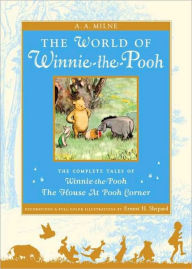
The World of Winnie the Pooh

The World of Winnie the Pooh. A.A. Milne. Illustrated by Ernest Shepard. 1926. 353 pages. [Source: Library]

First sentence: Here is Edward Bear, coming downstairs now, bump, bump, bump, on the back of his head, behind Christopher Robin.

The World of Winnie the Pooh is an omnibus edition of two of A.A. Milne's children's books: Winnie the Pooh and The House of Pooh Corner. I grew up reading a lovely discarded library edition of The World of Pooh, a lovely green edition. There is something delightful and familiar and enchanting about reading Pooh. I love the world-building. I love the sense of community--both the characterization and the relationships. I love the dialogue and narrative. I love the singing. There's just something joyful about it all. Even gloomy-old-Eeyore brings a smile to my face!

The Disney movie is rightly named the MANY adventures of Winnie the Pooh. Adventures is just the right word to describe all the chapters from both books.

Winnie the Pooh:
  • In Which We Are Introduced to Winnie-the-Pooh and Some Bees, and the Stories Begin
  • In Which Pooh Goes Visiting and Gets Into A Tight Place
  • In Which Pooh and Piglet Go Hunting and Nearly Catch a Woozle
  • In Which Eeyore Loses a Tail and Pooh Finds One
  • In Which Piglet Meets a Heffalump
  • In Which Eeyore Has a Birthday and Gets Two Presents
  • In Which Kanga and Baby Roo Come to the Forest, And Piglet Has a Bath
  • In Which Christopher Robin Leads an Expotition to the North Pole
  • In Which Piglet Is Entirely Surrounded by Water
  • In Which Christopher Robin Gives Pooh a Party and We Say Goodbye
The House at Pooh Corner
  • In Which A House Is Built At Pooh Corner for Eeyore
  • In Which Tigger Comes to the Forest and Has Breakfast
  • In Which a Search is Organdized, and Piglet Nearly Meets the Heffalump Again
  • In Which It Is Shown That Tiggers Don't Climb Trees
  • In Which Rabbit Has a Busy Day, And We Learn What Christopher Robin Does in the Mornings
  • In Which Pooh Invents a New Game and Eeyore Joins In
  • In Which Tigger is Unbounced
  • In Which Piglet Does a Very Grand Thing
  • In Which Eeyore Finds the Wolery and Owl Moves Into It
  • In Which Christopher Robin and Pooh Come to An Enchanted Place and We Leave Them There
At first, I thought this review would be packed with quotes. Because Pooh is without a doubt one of the most quotable books...ever. But I've decided instead of trying to quote every single sentence from the book that I LOVE, LOVE, LOVE AND ADORE, I'd try to be more selective.
"When you wake up in the morning, Pooh," said Piglet at last, "what's the first thing you say to yourself?" "What's for breakfast?" said Pooh. "What do you say, Piglet?" "I say, I wonder what's going to happen exciting today?" said Piglet. Pooh nodded thoughfully. "It's the same thing," he said. (147-48)
"I think," said Christopher Robin, "that we ought to eat all our Provisions now, so that we shan't have so much to carry." "Eat all our what?" said Pooh. "All that we've brought," said Piglet, getting to work. "That's a good idea," said Pooh, and he got to work too. "Have you all got something?" asked Christopher Robin with his mouth full. "All except me," said Eeyore. "As usual." He looked round at them in his melancholy way. "I suppose none of you are sitting on a thistle by any chance?" "I believe I am," said Pooh. "Ow!" He got up, and looked behind him. "Yes, I was. I thought so." "Thank you, Pooh. If you've quite finished with it." He moved across to Pooh's place, and began to eat. "It don't do them any Good, you know, sitting on them," he went on, as he looked up munching. "Takes all the Life out of them. Remember that another time, all of you. A little Consideration, a little Thought for Others, makes all the difference." (113)
"I think the bees suspect something!" "What sort of thing?" "I don't know. But something tells me that they're suspicious!" "Perhaps they think that you're after their honey." "It may be that. You never can tell with bees." (19)
 © 2016 Becky Laney of Becky's Book Reviews
Wednesday, January 27, 2016

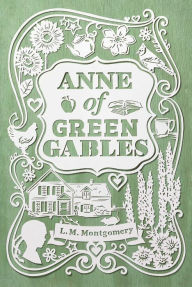
Anne of Green Gables (1908)

Anne of Green Gables. L.M. Montgomery. 1908. 448 pages. [Source: Bought]

I plan on rereading all the Anne books this year. I definitely wanted Anne of Green Gables to be one of the first books I read--or reread this year. It is such a dear favorite of mine. I couldn't begin to give an accurate accounting of just how many times I've read it. Out of all the Anne books, I think I love the first and last best of all. I think it only right that you begin and end the series in tears.

Anne of Green Gables introduces readers to Anne Shirley, Marilla and Matthew Cuthbert, Rachel Lynde, Diana Barry, and Gilbert Blythe. And that's just naming a few. By the time you've read and reread this one a couple of times, the whole community seems to come alive.

The absolute basics: Anne Shirley is an eleven year old orphan who arrives in Avonlea on Prince Edward Island. Marilla and Matthew are a brother-and-sister looking to adopt...a boy. Earlier miscommunication ultimately leads our heroine, young Ann-with-an-e, to the depths of despair. But Matthew, even before he arrives back at Green Gables with Anne, has decided HE WANTS TO KEEP HER FOREVER AND EVER. Marilla is not ready to say "yes" that quickly. Though as you might predict, she does end up keeping her...and loving her dearly.

The book relates to readers her adventures and misadventures. There is never a dull moment because our heroine never makes the same mistake twice. Here are a few additional characters you should know:
  
Diana Barry is Anne's bosom friend. These two are inseparable from their first meeting on. The two are not all that alike, but, they get along so splendidly. Anne forgives Diana her lack of imagination as I would imagine most readers do as well.

Gilbert Blythe is swoon-worthy. Wait, that's me talking. Gilbert is technically the cutest boy in Avonlea. When he first sees Anne, he calls her "Carrots." He desperately wants her attention. But he ends up making an enemy. Anne may forgive Diana her lack of imagination, but, she won't forgive the oh-so-cute boy who called her CARROTS. For most of the book, these two are academic rivals.

Rachel Lynde is Marilla's best friend, for better or worse, and without a doubt the town's biggest gossip. Her first impression of Anne is quickly replaced with a much nicer one after Anne apologizes beautifully. Rachel has a 'soft spot' for Anne, and is, in fact, the one who sews up Anne's first dress with puffed sleeves.

The book is written from multiple points of view. Readers get to know Anne, of course, but also Matthew and Marilla. (The first chapter is told from Rachel Lynde's point of view.) I didn't really pay much attention to how much Marilla we get in this first book in the series until I was an adult. But in many ways, this is Marilla's "coming of age" story just as much as it is Anne's.

Quotes:
The long platform was almost deserted; the only living creature in sight being a girl who was sitting on a pile of shingles at the extreme end. Matthew, barely noting that it WAS a girl, sidled past her as quickly as possible without looking at her. Had he looked he could hardly have failed to notice the tense rigidity and expectation of her attitude and expression. She was sitting there waiting for something or somebody and, since sitting and waiting was the only thing to do just then, she sat and waited with all her might and main.
A child of about eleven, garbed in a very short, very tight, very ugly dress of yellowish-gray wincey. She wore a faded brown sailor hat and beneath the hat, extending down her back, were two braids of very thick, decidedly red hair. Her face was small, white and thin, also much freckled; her mouth was large and so were her eyes, which looked green in some lights and moods and gray in others. 
"Would you rather I didn’t talk? If you say so I’ll stop. I can STOP when I make up my mind to it, although it’s difficult.” 
But if you call me Anne please call me Anne spelled with an E.” “What difference does it make how it’s spelled?” asked Marilla with another rusty smile as she picked up the teapot. “Oh, it makes SUCH a difference. It LOOKS so much nicer. When you hear a name pronounced can’t you always see it in your mind, just as if it was printed out? I can; and A-n-n looks dreadful, but A-n-n-e looks so much more distinguished. 
It’s all very well to read about sorrows and imagine yourself living through them heroically, but it’s not so nice when you really come to have them, is it?
“Do you never imagine things different from what they really are?” asked Anne wide-eyed. “No.” “Oh!” Anne drew a long breath. “Oh, Miss — Marilla, how much you miss!”
Somehow, things never are so good when they’re thought out a second time.
“Saying one’s prayers isn’t exactly the same thing as praying,” said Anne meditatively. 
Boiled pork and greens are so unromantic when one is in affliction. 
Isn’t it good just to be alive on a day like this? I pity the people who aren’t born yet for missing it. They may have good days, of course, but they can never have this one. 
“I think your Gilbert Blythe IS handsome,” confided Anne to Diana, “but I think he’s very bold. It isn’t good manners to wink at a strange girl.” But it was not until the afternoon that things really began to happen. 
Gilbert Blythe wasn’t used to putting himself out to make a girl look at him and meeting with failure. She SHOULD look at him, that red-haired Shirley girl with the little pointed chin and the big eyes that weren’t like the eyes of any other girl in Avonlea school. Gilbert reached across the aisle, picked up the end of Anne’s long red braid, held it out at arm’s length and said in a piercing whisper: “Carrots! Carrots!” Then Anne looked at him with a vengeance! She did more than look. She sprang to her feet, her bright fancies fallen into cureless ruin. She flashed one indignant glance at Gilbert from eyes whose angry sparkle was swiftly quenched in equally angry tears. “You mean, hateful boy!” she exclaimed passionately. “How dare you!” 
“I’m so glad I live in a world where there are Octobers. It would be terrible if we just skipped from September to November, wouldn’t it? Look at these maple branches. Don’t they give you a thrill — several thrills? I’m going to decorate my room with them.” 
I love bright red drinks, don’t you? They taste twice as good as any other color. 
Well, I suppose I must finish up my lessons. I won’t allow myself to open that new book Jane lent me until I’m through. But it’s a terrible temptation, Matthew. Even when I turn my back on it I can see it there just as plain. Jane said she cried herself sick over it. I love a book that makes me cry. But I think I’ll carry that book into the sitting room and lock it in the jam closet and give you the key. And you must NOT give it to me, Matthew, until my lessons are done, not even if I implore you on my bended knees. It’s all very well to say resist temptation, but it’s ever so much easier to resist it if you can’t get the key. 
You didn’t know just how I felt about it, but you see Matthew did. Matthew understands me, and it’s so nice to be understood, Marilla. 
“It’s because you’re too heedless and impulsive, child, that’s what. You never stop to think — whatever comes into your head to say or do you say or do it without a moment’s reflection.” “Oh, but that’s the best of it,” protested Anne. “Something just flashes into your mind, so exciting, and you must out with it. If you stop to think it over you spoil it all. Haven’t you never felt that yourself, Mrs. Lynde?”
When Miss Barry went away she said: “Remember, you Anne-girl, when you come to town you’re to visit me and I’ll put you in my very sparest spare-room bed to sleep.” “Miss Barry was a kindred spirit, after all,” Anne confided to Marilla. “You wouldn’t think so to look at her, but she is. You don’t find it right out at first, as in Matthew’s case, but after a while you come to see it. Kindred spirits are not so scarce as I used to think. It’s splendid to find out there are so many of them in the world.”
There’s such a lot of different Annes in me. I sometimes think that is why I’m such a troublesome person. If I was just the one Anne it would be ever so much more comfortable, but then it wouldn’t be half so interesting.
“Yes; but cakes have such a terrible habit of turning out bad just when you especially want them to be good,” sighed Anne.
“Marilla, isn’t it nice to think that tomorrow is a new day with no mistakes in it yet?” “I’ll warrant you’ll make plenty in it,” said Marilla.
Mrs. Lynde says I’m full of original sin. No matter how hard I try to be good I can never make such a success of it as those who are naturally good. It’s a good deal like geometry, I expect. But don’t you think the trying so hard ought to count for something?
It isn’t very pleasant to be laid up; but there is a bright side to it, Marilla. You find out how many friends you have.
Mrs. Allan says we should never make uncharitable speeches; but they do slip out so often before you think, don’t they? I simply can’t talk about Josie Pye without making an uncharitable speech, so I never mention her at all. You may have noticed that. I’m trying to be as much like Mrs. Allan as I possibly can, for I think she’s perfect.
“Isn’t this evening just like a purple dream, Diana? It makes me so glad to be alive. In the mornings I always think the mornings are best; but when evening comes I think it’s lovelier still.”
Mr. Allan says everybody should have a purpose in life and pursue it faithfully. Only he says we must first make sure that it is a worthy purpose. I would call it a worthy purpose to want to be a teacher like Miss Stacy, wouldn’t you, Marilla? I think it’s a very noble profession.
Why can’t women be ministers, Marilla? I asked Mrs. Lynde that and she was shocked and said it would be a scandalous thing. She said there might be female ministers in the States and she believed there was, but thank goodness we hadn’t got to that stage in Canada yet and she hoped we never would. But I don’t see why. I think women would make splendid ministers. When there is a social to be got up or a church tea or anything else to raise money the women have to turn to and do the work. I’m sure Mrs. Lynde can pray every bit as well as Superintendent Bell and I’ve no doubt she could preach too with a little practice.” “Yes, I believe she could,” said Marilla dryly. “She does plenty of unofficial preaching as it is. Nobody has much of a chance to go wrong in Avonlea with Rachel to oversee them.”
There are so many things to be thought over and decided when you’re beginning to grow up. It keeps me busy all the time thinking them over and deciding what is right. It’s a serious thing to grow up, isn’t it, Marilla? But when I have such good friends as you and Matthew and Mrs. Allan and Miss Stacy I ought to grow up successfully, and I’m sure it will be my own fault if I don’t.
As Mrs. Lynde says, ‘If you can’t be cheerful, be as cheerful as you can.’
It’s good advice, but I expect it will be hard to follow; good advice is apt to be, I think.
“No, I wasn’t crying over your piece,” said Marilla, who would have scorned to be betrayed into such weakness by any poetry stuff. “I just couldn’t help thinking of the little girl you used to be, Anne. And I was wishing you could have stayed a little girl, even with all your queer ways. You’ve grown up now and you’re going away; and you look so tall and stylish and so — so — different altogether in that dress — as if you didn’t belong in Avonlea at all — and I just got lonesome thinking it all over.”
It won’t make a bit of difference where I go or how much I change outwardly; at heart I shall always be your little Anne, who will love you and Matthew and dear Green Gables more and better every day of her life.
“Wouldn’t Matthew be proud if I got to be a B.A.? Oh, it’s delightful to have ambitions. I’m so glad I have such a lot. And there never seems to be any end to them — that’s the best of it. Just as soon as you attain to one ambition you see another one glittering higher up still. It does make life so interesting.”
“That Anne-girl improves all the time,” she said. “I get tired of other girls — there is such a provoking and eternal sameness about them. Anne has as many shades as a rainbow and every shade is the prettiest while it lasts. I don’t know that she is as amusing as she was when she was a child, but she makes me love her and I like people who make me love them. It saves me so much trouble in making myself love them.”
For we pay a price for everything we get or take in this world; and although ambitions are well worth having, they are not to be cheaply won, but exact their dues of work and self-denial, anxiety and discouragement. 
“Well now, I’d rather have you than a dozen boys, Anne,” said Matthew patting her hand. “Just mind you that — rather than a dozen boys. Well now, I guess it wasn’t a boy that took the Avery scholarship, was it? It was a girl — my girl — my girl that I’m proud of.” He smiled his shy smile at her as he went into the yard. Anne took the memory of it with her when she went to her room that night and sat for a long while at her open window, thinking of the past and dreaming of the future. 
It was the last night before sorrow touched her life; and no life is ever quite the same again when once that cold, sanctifying touch has been laid upon it. 
Marilla, I’ve almost decided to give up trying to like Josie Pye. I’ve made what I would once have called a heroic effort to like her, but Josie Pye won’t BE liked. 
When I left Queen’s my future seemed to stretch out before me like a straight road. I thought I could see along it for many a milestone. Now there is a bend in it. I don’t know what lies around the bend, but I’m going to believe that the best does. It has a fascination of its own, that bend, Marilla. I wonder how the road beyond it goes — what there is of green glory and soft, checkered light and shadows — what new landscapes — what new beauties — what curves and hills and valleys further on. 
“Dear old world,” she murmured, “you are very lovely, and I am glad to be alive in you.” 
“‘God’s in his heaven, all’s right with the world,’” whispered Anne softly. softly. 

© 2016 Becky Laney of Becky's Book Reviews