Showing posts with label 1897. Show all posts

Monday, April 25, 2022

52. Cyrano de Bergerac


Cyrano de Bergerac. Edmond Rostand. Translated by Gladys Thomas and Mary F Guillemard. 1897. 240 pages. [Source: Bought]

First sentence: Hollo! You there! Your money!

Premise/plot: Cyrano de Bergerac is in love with his cousin, Roxane. The problem? He lacks the courage to tell her so because he feels his (large) nose will prevent her from ever loving him in return. To be fair, readers can't be sure either. For the most part, he is content loving her from afar. To be in her orbit at all--as a cousin, as a memory from the past, a friend--is enough for him. But when he receives a message from her asking for a private meeting, well, he lets his imagination run away with him--briefly. His heart is uplifted and hope begins to blossom. But when he realizes his mistake the next day, well, once again he puts her needs ahead of his (silly, foolish) hopes and dreams. Of course, Roxane has fallen head over heels with someone she's NEVER spoken to. Of course, Roxane is dreaming of a happily ever after with a super dreamy oh-so-handsome soldier. His name is Christian de Neuvillette. And she has a favor to ask of him--do everything in his power to befriend and protect Christian. And, oh, by the way can you tell him I love and adore him. 


Cyrano tells Christian that Roxane does love him, but, instead of that being the end of it...it is just the start. For Roxane is determined that the man she loves will be brilliant and exceptionally well-spoken. He must win her heart through his words. The problem? Christian's idea of wooing is to say "I love you" and go in for a kiss. NOT WHAT ROXANE WANTS AT ALL. The solution is for Cyrano to give Christian the words to speak to win her heart for once and all. But is that a real solution?! Is a happily ever after possible in this love triangle?!

Cyrano de Bergerac is a five act (French) play by Edmond Rostand written/performed in 1897. It is set in seventeenth century France around the same time as The Three Musketeers. And like The Three Musketeers, it has sword fighting. Lots and lots of sword fighting. The musketeers make a few appearances throughout the play--look for them in the background. It's like playing Where's Waldo.

 My thoughts: I love, love, love Cyrano de Bergerac. I'm not sure I equally adore Roxane. Cyrano is already madly in love with her before Act I. His love for her is never in question, and never in doubt. To him, she is absolute perfection. His longed-for ideal. But is he seeing only what he wants to see? How well does he know the real her? Does he love her because she is beautiful? Does he love her because she is so out of reach and unattainable? Does his love of her have roots from their shared childhood? 

Roxane may or may not be everything Cyrano believes her to be. That's the truth. Christian and Cyrano both think the world of her. As does the MARRIED Duke de Guiche. So maybe there's good reason--besides her outside beauty--for attracting all the guys. Maybe. But maybe not. Again, what do readers know besides the fact that she is a) BEAUTIFUL b) believes in love at first sight c) has preconceived notions of what LOVE is all about d) knows exactly what she wants and doesn't want in a romantic partner. I get the impression that she has mapped out her happily ever after in her imagination and nothing less than perfect will do. (At least at the start.) 


Roxane doesn't see the real worth of Cyrano until it is too late. She has known him most of her life and never actually seen him.  That is incredibly sad. I'm just trying to guess if she really was all that he imagined her to be. Was his love a 'storybook love'-- and the stuff of daydreams only. Surely Roxane had flaws! Who doesn't have flaws?! Surely Roxane would have proved disappointing or irritating at times if they'd lived together closely. 

Christian. How do I feel about him?! I think Cyrano and Christian are using each other--taking advantage of one another. This agreed upon dishonesty isn't all that healthy when all is said and done. Christian realizes--on a fateful day--that he needs more, deserves more. He doesn't want to be loved for his 'fairness' his fineness. He wants to be loved heart and soul for himself. He doesn't want to be an object of lust. Does Christian love Roxane for more than her looks? her body? Does he love her truly heart, soul, mind, body. I'm not sure. Perhaps the play--when scrutinized--reveals how silly "true love" is and how deceptive the human heart can be. Roxane didn't have a clue who Christian was--not really. She never saw him for who he really was. And if Christian had lived instead of died, chances are Roxane would have broken his heart.

Quotes:

A description of Roxane

When one looks at her one thinks of a peach smiling at a strawberry!
Cyrano to Christian
None is a fool who knows himself a fool. And you did not attack me like a fool.
Cyrano to Christian
Will you complete me, and let me complete you? Let me be wit for you, be you my beauty! 
Christian speaks for himself....
CHRISTIAN (sits by her on the bench. A silence): Oh! I love you!
ROXANE (shutting her eyes): Ay, speak to me of love.
CHRISTIAN: I love thee! 
ROXANE: That's The theme! But vary it. 
CHRISTIAN: I. . . 
ROXANE: Vary it!  
CHRISTIAN: I love you so! 
ROXANE: Oh! without doubt!--and then?. . . 
CHRISTIAN: And then--I should be--oh!--so glad--so glad If you would love me!--Roxane, tell me so!  
ROXANE (with a little grimace): I hoped for cream,--you give me gruel! Say How love possesses you? 
CHRISTIAN: Oh utterly! 
ROXANE: Come, come!. . .unknot those tangled sentiments! 
CHRISTIAN: I am grown stupid! 
ROXANE (dryly): And that displeases me, almost as much As 'twould displease me if you grew ill-favored.  
ROXANE: Yes, you love me, that I know. Adieu. (She goes toward her house.) CHRISTIAN: Oh, go not yet! I'd tell you-- 
ROXANE (opening the door): You adore me? I've heard it very oft. No!--Go away!
  Cyrano "saves" the night by speaking for Christian in shadows...
ROXANE: To-day. . . Your words are hesitating.
CYRANO (imitating Christian--in a whisper): Night has come. . . In the dusk they grope their way to find your ear.  
ROXANE: Meseems that your last words have learned to climb. 
CYRANO: With practice such gymnastic grows less hard! 
CYRANO (more and more moved): Stay awhile! 'Tis sweet,. . . The rare occasion, when our hearts can speak Our selves unseen, unseeing! Your eyes Have beams that turn men dizzy!--But to-night Methinks I shall find speech for the first time!
ROXANE: Ay! I am trembling, weeping!--I am thine! Thou hast conquered all of me!
CYRANO: Then let death come! 'Tis I, 'tis I myself, who conquered thee! One thing, but one, I dare to ask--
CHRISTIAN (under the balcony): A kiss
Cyrano on kisses...
A kiss, when all is said,--what is it? An oath that's ratified,--a sealed promise, A heart's avowal claiming confirmation,--A rose-dot on the 'i' of 'adoration,'-- A secret that to mouth, not ear, is whispered,-- Brush of a bee's wing, that makes time eternal,--Communion perfumed like the spring's wild flowers,-- The heart's relieving in the heart's outbreathing, When to the lips the soul's flood rises, brimming!
Cyrano before the last battle
CYRANO: Poets, at last,--by dint of counterfeiting-- Take counterfeit for true--that is the charm! This farewell letter,--it was passing sad, I wept myself in writing it!
CHRISTIAN: Wept? why?
CYRANO: Oh!. . .death itself is hardly terrible,. . . --But, ne'er to see her more! That is death's sting! --For. . .I shall never. . .
Cyrano confesses to Christian
CYRANO: You have. . .written to her oftener than you think. . .
CHRISTIAN: How so?
CYRANO: Thus, 'faith! I had taken it in hand to express your flame for you!.  
CHRISTIAN: But how did you contrive, since we have been cut off, thus. . .to?. . . CYRANO: . . .Oh! before dawn. . .I was able to get through. . . 
CHRISTIAN (folding his arms): That was simple, too? And how oft, pray you, have I written?. . .Twice in the week?. . .Three times?. . .Four?. . . 
 CYRANO: More often still. 
CHRISTIAN: What! Every day? 
CYRANO: Yes, every day,--twice.
Roxane says a little too much...(abbreviated)
ROXANE: 'Tis your fault if I ran risks! Your letters turned my head! Ah! all this month, How many!--and the last one ever bettered The one that went before! Ah! you cannot conceive it! Ever since That night, when, in a voice all new to me, Under my window you revealed your soul-- Ah! ever since I have adored you! Now Your letters all this whole month long!--meseemed As if I heard that voice so tender, true, Sheltering, close! ROXANE: I read, read again--grew faint for love; I was thine utterly. Each separate page Was like a fluttering flower-petal, loosed From your own soul, and wafted thus to mine. Imprinted in each burning word was love Sincere, all-powerful. . . 
CHRISTIAN: At first I loved you only for your face! 
CHRISTIAN (horror-stricken): Roxane! 
ROXANE: And later, love--less frivolous-- Like a bird that spreads its wings, but can not fly-- Arrested by your beauty, by your soul Drawn close--I loved for both at once!
CHRISTIAN: I do not ask such love as that! I would be loved more simply; for..  ROXANE: Ah! how you err! 'Tis now that I love best--love well! 'Tis that Which is thy true self, see!--that I adore! Were your brilliance dimmed. 
ROXANE: I should love still! Ay, if your beauty should to-day depart. . . CHRISTIAN: Say not so!
ROXANE: Ay, I say it!  CHRISTIAN: Ugly? How?

Christian speaks his mind...
CHRISTIAN: I will be loved myself--or not at all! --I'll go see what they do--there, at the end Of the post: speak to her, and then let her choose One of us two!
Cyrano's aside...
CYRANO (aside--drawing his sword): Ay, and let me die to-day, Since, all unconscious, she mourns me--in him!
Cyrano reveals all to Roxane...
CYRANO: His letter! Ah! you promised me one day That I should read it.
ROXANE: What would you?--His letter?
CYRANO: Yes, I would fain,--to-day.  
CYRANO (reading): 'Roxane, adieu! I soon must die! This very night, beloved; and I Feel my soul heavy with love untold. I die! No more, as in days of old, My loving, longing eyes will feast On your least gesture--ay, the least! I mind me the way you touch your cheek With your finger, softly, as you speak! Ah me! I know that gesture well! My heart cries out!--I cry "Farewell"!'  
ROXANE: You read in such a voice--so strange--and yet-- It is not the first time I hear that voice!  
CYRANO: 'Here, dying, and there, in the land on high, I am he who loved, who loves you,--I. . .' 
ROXANE: How can you read? It is too dark to see!  
CYRANO: Roxane! 
ROXANE: 'Twas you! 
CYRANO: No, never; Roxane, no! 
 ROXANE: I see through all the generous counterfeit-- The letters--you! 
CYRANO: No. 
ROXANE: The sweet, mad love-words! You! 
CYRANO: No!  
ROXANE: The voice that thrilled the night--you, you! 
CYRANO: I swear you err. 
ROXANE: The soul--it was your soul!  
CYRANO: I loved you not. 
ROXANE: You loved me not? 
CYRANO: 'Twas he! 
ROXANE: You loved me! 
ROXANE: --Why, why keep silence all these fourteen years, When, on this letter, which he never wrote, The tears were your tears? 
CYRANO (holding out the letter to her): The bloodstains were his.
 Roxane...
I loved but once, yet twice I lose my love!
Cyrano gets the last word in...
I would not bid you mourn less faithfully That good, brave Christian: I would only ask That when my body shall be cold in clay You wear those sable mourning weeds for two, And mourn awhile for me, in mourning him.


© 2022 Becky Laney of Becky's Book Reviews

Monday, October 15, 2018

Dracula

Dracula. Bram Stoker. 1897/2005. 448 pages. [Source: Bought]

First sentence: 3 May. Bistritz. -- Left Munich at 8.35 PM on 1st May, arriving at Vienna early next morning; should have arrived at 6.46, but train was an hour late.

Premise/plot: This classic Victorian horror novel opens with Jonathan Harker's journal. He is soon to meet Count Dracula. He's yet unaware of how quickly his life is about to be turned topsy-turvy. The good news is that he won't have to face this epic battle between good and evil alone. He'll be surrounded by friends: Abraham Van Helsing, Dr. John Seward, Quincey Morris, Arthur Holmwood (aka Lord Godalming), and his wife, Mina Harker.

They were awakened to the danger through the tragic loss of their dear, dear friend and companion Miss Lucy Westenra.

The novel consists of diaries, journals, letters, records, etc.

My thoughts: I first read Dracula in 2007. That almost seems a lifetime ago. I reread Dracula because I needed a qualifying read for the 2018 #Victober reading challenge. Dracula could fulfill Katie's challenge or Kate's challenge.

Quotes:
  • "You may go anywhere you wish in the castle, except where the doors are locked, where of course you will not wish to go. There is reason that all things are as they are, and did you see with my eyes and know with my knowledge, you would perhaps better understand." (31)
  • What does it all mean? I am beginning to wonder if my long habit of life amongst the insane is beginning to tell upon my own brain. (157)
  • "If I could, I would take on myself the burden that you do bear. But there are things that you know not, but that you shall know, and bless me for knowing, though they are not pleasant things. (190)
  • I suppose a cry does us all good at times--clears the air as other rain does. (206)
  • "My friends, this is much; it is a terrible task, that we undertake, and there may be consequence to make the brave shudder. For if we fail in this our fight he must surely win; and then where end we? Life is nothings; I heed him not. But to fail here, is not mere life or death. It is that we become as him; that we henceforward become foul things of the night like him--without heart or conscience, preying on the bodies of those we love best." (269)


© 2018 Becky Laney of Becky's Book Reviews

Saturday, October 06, 2018

Cyrano de Bergerac

Cyrano de Bergerac. Edmond Rostand. Translated by Gladys Thomas and Mary F Guillemard. 1897. 240 pages. [Source: Bought]

First sentence: Hollo! You there! Your money!

NOTE: I've read Cyrano de Bergerac several times throughout the years. I believe this is the second time I've reviewed it for Becky's Book Reviews. It is, without a doubt, one of my favorite plays. (The only one that might come close is William Shakespeare's Much Ado About Nothing.)

I decided to reread Cyrano de Bergerac for #Victober. One of the challenges is to read a book published in the last ten years of the Victorian period. Cyrano de Bergerac was published in 1897.

I am cutting and pasting the plot summary from my first review.  The "my thoughts" are new.

Premise/plot: Cyrano de Bergerac is in love with his cousin, Roxane. The problem? He lacks the courage to tell her so because he feels his nose--his hideous, ugliness--will prevent her from ever loving him in return. Also standing in his way is the fact that Roxane declares herself head over heels in love with oh-so-handsome Christian de Neuvillette. How does Christian feel about Roxane? He loves her of course. Why? Because she's beautiful. (At least Cyrano knows Roxane, and, his love isn't based on her beauty alone.) Roxane asks Cyrano to watch over Christian and be his friend. (Christian has just joined the same regiment.) Cyrano tells Christian that Roxane does love him, but, instead of that being the end of it...it is just the start. For Roxane is determined that the man she loves will be brilliant and exceptionally well-spoken. He must win her heart through his words. The problem? Christian's idea of wooing is to say "I love you" and go in for a kiss. NOT WHAT ROXANE WANTS AT ALL. The solution is for Cyrano to give Christian the words to speak to win her heart for once and all. But is that a real solution?! Is a happily ever after possible in this love triangle?!

Cyrano de Bergerac is a five act (French) play by Edmond Rostand written/performed in 1897. It is set in seventeenth century France around the same time as The Three Musketeers. And like The Three Musketeers, it has sword fighting. Lots and lots of sword fighting.

 My thoughts: I love, love, love Cyrano de Bergerac. I'm not sure I equally adore Roxane. Cyrano is already madly in love with her before Act I. His love for her is never in question, and never in doubt. To him, she is absolute perfection. His longed-for ideal. But is he seeing only what he wants to see? How well does he know the real her? Does he love her because she is beautiful? Does he love her because she is so out of reach and unattainable? Does his love of her have roots from their shared childhood?

Roxane doesn't see the real him until it is too late. She has known him most of her life and never actually seen him. That is incredibly sad. I'm just trying to guess if she really was all that he imagined her to be. Was his love was a 'storybook love'--the stuff of daydreams only. Surely Roxane had flaws! Who doesn't have flaws?! Surely Roxane would have proved disappointing or irritating at times if they'd lived together closely.

Christian. How do I feel about him?! I think Cyrano and Christian are using each other--taking advantage of one another. This agreed upon dishonesty isn't all that healthy when all is said and done. Christian realizes--on a fateful day--that he needs more, deserves more. He doesn't want to be loved for his 'fairness' his fineness. He wants to be loved heart and soul for himself. He doesn't want to be an object of lust. Does Christian love Roxane for more than her looks? her body? Does he love her truly heart, soul, mind, body. I'm not sure. Perhaps the play--when scrutinized--reveals how silly "true love" is and how deceptive the human heart can be. Roxane didn't have a clue who Christian was--not really. She never saw him for who he really was. And if Christian had lived instead of died, chances are Roxane would have broken his heart.

Quotes:

A description of Roxane
When one looks at her one thinks of a peach smiling at a strawberry!
Cyrano to Christian
None is a fool who knows himself a fool. And you did not attack me like a fool.
Cyrano to Christian
Will you complete me, and let me complete you? Let me be wit for you, be you my beauty! 
Christian speaks for himself....
CHRISTIAN (sits by her on the bench. A silence): Oh! I love you!
ROXANE (shutting her eyes): Ay, speak to me of love.
CHRISTIAN: I love thee! 
ROXANE: That's The theme! But vary it. 
CHRISTIAN: I. . . 
ROXANE: Vary it!  
CHRISTIAN: I love you so! 
ROXANE: Oh! without doubt!--and then?. . . 
CHRISTIAN: And then--I should be--oh!--so glad--so glad If you would love me!--Roxane, tell me so!  
ROXANE (with a little grimace): I hoped for cream,--you give me gruel! Say How love possesses you? 
CHRISTIAN: Oh utterly! 
ROXANE: Come, come!. . .unknot those tangled sentiments! 
CHRISTIAN: I am grown stupid! 
ROXANE (dryly): And that displeases me, almost as much As 'twould displease me if you grew ill-favored.  
ROXANE: Yes, you love me, that I know. Adieu. (She goes toward her house.) CHRISTIAN: Oh, go not yet! I'd tell you-- 
ROXANE (opening the door): You adore me? I've heard it very oft. No!--Go away!
  Cyrano "saves" the night by speaking for Christian in shadows...
ROXANE: To-day. . . Your words are hesitating.
CYRANO (imitating Christian--in a whisper): Night has come. . . In the dusk they grope their way to find your ear.  
ROXANE: Meseems that your last words have learned to climb. 
CYRANO: With practice such gymnastic grows less hard! 
CYRANO (more and more moved): Stay awhile! 'Tis sweet,. . . The rare occasion, when our hearts can speak Our selves unseen, unseeing! Your eyes Have beams that turn men dizzy!--But to-night Methinks I shall find speech for the first time!
ROXANE: Ay! I am trembling, weeping!--I am thine! Thou hast conquered all of me!
CYRANO: Then let death come! 'Tis I, 'tis I myself, who conquered thee! One thing, but one, I dare to ask--
CHRISTIAN (under the balcony): A kiss
Cyrano on kisses...
A kiss, when all is said,--what is it? An oath that's ratified,--a sealed promise, A heart's avowal claiming confirmation,--A rose-dot on the 'i' of 'adoration,'-- A secret that to mouth, not ear, is whispered,-- Brush of a bee's wing, that makes time eternal,--Communion perfumed like the spring's wild flowers,-- The heart's relieving in the heart's outbreathing, When to the lips the soul's flood rises, brimming!
Cyrano before the last battle
CYRANO: Poets, at last,--by dint of counterfeiting-- Take counterfeit for true--that is the charm! This farewell letter,--it was passing sad, I wept myself in writing it!
CHRISTIAN: Wept? why?
CYRANO: Oh!. . .death itself is hardly terrible,. . . --But, ne'er to see her more! That is death's sting! --For. . .I shall never. . .
Cyrano confesses to Christian
CYRANO: You have. . .written to her oftener than you think. . .
CHRISTIAN: How so?
CYRANO: Thus, 'faith! I had taken it in hand to express your flame for you!.  
CHRISTIAN: But how did you contrive, since we have been cut off, thus. . .to?. . . CYRANO: . . .Oh! before dawn. . .I was able to get through. . . 
CHRISTIAN (folding his arms): That was simple, too? And how oft, pray you, have I written?. . .Twice in the week?. . .Three times?. . .Four?. . . 
 CYRANO: More often still. 
CHRISTIAN: What! Every day? 
CYRANO: Yes, every day,--twice.
Roxane says a little too much...(abbreviated)
ROXANE: 'Tis your fault if I ran risks! Your letters turned my head! Ah! all this month, How many!--and the last one ever bettered The one that went before! Ah! you cannot conceive it! Ever since That night, when, in a voice all new to me, Under my window you revealed your soul-- Ah! ever since I have adored you! Now Your letters all this whole month long!--meseemed As if I heard that voice so tender, true, Sheltering, close! ROXANE: I read, read again--grew faint for love; I was thine utterly. Each separate page Was like a fluttering flower-petal, loosed From your own soul, and wafted thus to mine. Imprinted in each burning word was love Sincere, all-powerful. . . 
CHRISTIAN: At first I loved you only for your face! 
CHRISTIAN (horror-stricken): Roxane! 
ROXANE: And later, love--less frivolous-- Like a bird that spreads its wings, but can not fly-- Arrested by your beauty, by your soul Drawn close--I loved for both at once!
CHRISTIAN: I do not ask such love as that! I would be loved more simply; for..  ROXANE: Ah! how you err! 'Tis now that I love best--love well! 'Tis that Which is thy true self, see!--that I adore! Were your brilliance dimmed. 
ROXANE: I should love still! Ay, if your beauty should to-day depart. . . CHRISTIAN: Say not so!
ROXANE: Ay, I say it!  CHRISTIAN: Ugly? How?

Christian speaks his mind...
CHRISTIAN: I will be loved myself--or not at all! --I'll go see what they do--there, at the end Of the post: speak to her, and then let her choose One of us two!
Cyrano's aside...
CYRANO (aside--drawing his sword): Ay, and let me die to-day, Since, all unconscious, she mourns me--in him!
Cyrano reveals all to Roxane...
CYRANO: His letter! Ah! you promised me one day That I should read it.
ROXANE: What would you?--His letter?
CYRANO: Yes, I would fain,--to-day.  
CYRANO (reading): 'Roxane, adieu! I soon must die! This very night, beloved; and I Feel my soul heavy with love untold. I die! No more, as in days of old, My loving, longing eyes will feast On your least gesture--ay, the least! I mind me the way you touch your cheek With your finger, softly, as you speak! Ah me! I know that gesture well! My heart cries out!--I cry "Farewell"!'  
ROXANE: You read in such a voice--so strange--and yet-- It is not the first time I hear that voice!  
CYRANO: 'Here, dying, and there, in the land on high, I am he who loved, who loves you,--I. . .' 
ROXANE: How can you read? It is too dark to see!  
CYRANO: Roxane! 
ROXANE: 'Twas you! 
CYRANO: No, never; Roxane, no! 
 ROXANE: I see through all the generous counterfeit-- The letters--you! 
CYRANO: No. 
ROXANE: The sweet, mad love-words! You! 
CYRANO: No!  
ROXANE: The voice that thrilled the night--you, you! 
CYRANO: I swear you err. 
ROXANE: The soul--it was your soul!  
CYRANO: I loved you not. 
ROXANE: You loved me not? 
CYRANO: 'Twas he! 
ROXANE: You loved me! 
ROXANE: --Why, why keep silence all these fourteen years, When, on this letter, which he never wrote, The tears were your tears? 
CYRANO (holding out the letter to her): The bloodstains were his.
 Roxane...
I loved but once, yet twice I lose my love!
Cyrano gets the last word in...
I would not bid you mourn less faithfully That good, brave Christian: I would only ask That when my body shall be cold in clay You wear those sable mourning weeds for two, And mourn awhile for me, in mourning him.

© 2018 Becky Laney of Becky's Book Reviews
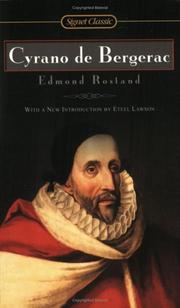
Wednesday, July 06, 2016

Cyrano de Bergerac

Cyrano de Bergerac. Edmond Rostand. Translated by Lowell Blair. 1897. 240 pages. [Source: Library]

First sentence: Stop! You haven't paid your fifteen sols!

Premise/plot: Cyrano de Bergerac is in love with his cousin, Roxane. The problem? He lacks the courage to tell her so because he feels his nose--his hideous, ugliness--will prevent her from ever loving him in return. Also standing in his way is the fact that Roxane declares herself head over heels in love with oh-so-handsome Christian de Neuvillette. How does Christian feel about Roxane? He loves her of course. Why? Because she's beautiful. (At least Cyrano knows Roxane, and, his love isn't based on her beauty alone.) Roxane asks Cyrano to watch over Christian and be his friend. (Christian has just joined the same regiment.) Cyrano tells Christian that Roxane does love him, but, instead of that being the end of it...it is just the start. For Roxane is determined that the man she loves will be brilliant and exceptionally well-spoken. He must win her heart through his words. The problem? Christian's idea of wooing is to say "I love you" and go in for a kiss. NOT WHAT ROXANE WANTS AT ALL. The solution is for Cyrano to give Christian the words to speak to win her heart for once and all. But is that a real solution?! Is a happily ever after possible in this love triangle?!

Cyrano de Bergerac is a five act (French) play by Edmond Rostand written/performed in 1897. It is set in seventeenth century France around the same time as The Three Musketeers. And like The Three Musketeers, it has sword fighting. Lots and lots of sword fighting.

My thoughts: I LOVE it. I really, really, really love it. I think I first saw the 1990 French film with English subtitles. I found it swoon-worthy then. I am not sure when I first read it, probably in high school or college. I don't think I read it more than once, however, so it was like rediscovering a forgotten friend to reread it after all these years.

I do think (like most plays) it is best read in one sitting if at all possible. (I do allow for intermissions! After all, if you were to see it performed live, they'd certainly be at least one break!)

Act five is certainly the most dramatic perhaps, but, it is also for me a wonderfully bittersweet way to end the play. THAT ENDING gets me every time.

I think this play is beautifully written. I adore the character of Cyrano de Bergerac. I love his integrity, his wit, his passion, his dashing courage.

Have you read Cyrano de Bergerac? What did you think?

Favorite quotes:
Cyrano: I have a different idea of elegance. I don't dress like a fop, it's true, but my moral grooming is impeccable. I never appear in public with a soiled conscience, a tarnished honor, threadbare scruples or an insult that I haven't washed away. I'm always immaculately clean, adorned with independence and frankness. I may not cut a stylish figure, but I hold my soul erect. I wear my deeds as ribbons, my wit is sharper than the finest mustache, and when I walk among men I make truths ring like spurs. (40)
Cyrano: Look at me and tell me what hope this protuberance might leave me! I have no illusions. Sometimes, in the blue shadows of evening, I give way to tender feelings. I go into a garden, smelling the fragrance of spring with my poor monstrous nose, and watch a man and a woman strolling together in the moonlight. I think how much I, too, would like to be walking arm in arm with a woman, under the moon. I let myself be carried away, I forget myself--and then I suddenly see the shadow of my profile on the garden wall. (50)
Ragueneau: How can you treat poetry with such disrespect?
Lise: I'll treat poetry however I please!
Ragueneau: I shudder to think of what you might do with prose! (62)
Cyrano: I'll now put down on paper the love letter that I've already written within myself a hundred times. I have only to look into my soul and copy the words inscribed in it. (66)
Cyrano: My poor girl, you're so fond of fine words and gracious wit--what if he should prove to be an uncultured savage?
Roxane: Impossible. He has the hair of one of d'Urfe's heroes!
Cyrano: His speech may be as crude as his hair is elegant.
Roxane: No, there's delicacy in everything he says. I feel it.
Cyrano: Yes, all words are delicate when they come from lips adorned with a shapely mustache...But what if he's a fool?
Roxane: [stamping her foot] Then I'll die! There, are you satisfied? (78)
Cyrano: Shall we complete each other? We'll walk together: you in the light, I in the shadow. I'll make you eloquent, you'll make me handsome. (102)
Roxane: Your words are hesitant tonight. Why?
Cyrano (pretending to be Christian): Because of the darkness, they must grope their way to your ears.
Roxane: My words have no such difficulty.
Cyrano: They go straight to my heart, a goal too large to miss, whereas your ears are small. And your words travel swiftly because they fall, while mine must slowly climb.
Roxane: But they seem to be climbing better now.
Cyrano: They've finally become accustomed to that exercise.
Roxane: It's true that I'm speaking from high above you.
Cyrano: Yes, and it would kill me if you let a harsh word fall on my heart from that height. (126)
Cyrano: After all, what is a kiss? A vow made at closer range, a more precise promise, a confession that contains its own proof, a seal placed on a pact that has already been signed; it's a secret told to the mouth rather than to the ear, a fleeting moment filled with the hush of eternity, a communion that has the fragrance of a flower, a way of living by the beat of another heart, and tasting another soul on one's lips! (133)
Roxane: I've adored you since the evening when under my window, you began to reveal your soul to me in a voice I'd never heard you use before, and when I read your letters it was like hearing that same voice. I could feel its tenderness enveloping me! Finally I had to come to you, no matter what the danger! Penelope wouldn't have calmly stayed home with her weaving if Ulysses had written to her as you've written to me! She would have become as ardent as Helen of Troy, thrown her work aside, and gone off to join him! (184)
Roxane: Ah, how many things have died, and how many have now been born! Why were you silent for fourteen years, knowing that he hadn't written that letter, and that the tears on it were yours?
Cyrano: The blood was his. (218)
© 2016 Becky Laney of Becky's Book Reviews

Saturday, July 02, 2016

Audio Book: Cyrano de Bergerac

BBC Radio 3's Cyrano de Bergerac by Edmond Rostand, translated by Anthony Burgess. Adapted for radio by John Tydeman. First aired 2008.

Cyrano... Kenneth Branagh
Christian... Tom Hiddleston
Roxane... Jodhi May
De Guiche... John Shrapnel
Rageuneau... Jimmy Yuill
Le Bret... Gerard Horan
and others....

After watching the movie and reading the play, I was DELIGHTED to find a radio drama of what is fast becoming my favorite play!

Cyrano is played by Kenneth Branagh. He does a great job with the role as he did a great job with Benedick in Much Ado About Nothing!

Christian is played by Tom Hiddleston. I can easily imagine him as a perfect Christian!

All the actors did a GREAT job bringing this drama to life. It's a great production. It's just a little over two hours long.

Premise/plot: Cyrano, our hero, is madly in love with his cousin, Roxane. Judging himself too ugly to stand a chance with her--or with any woman--he is content to love her from afar. Roxane contacts him, through a maid, letting him know that they must meet. For a few hours he dreams that maybe just maybe he has a small chance with her. But she is meeting him to tell him that she is desperately in love with a young cadet (soon to join his regiment) named Christian. Will he befriend Christian and help them to be together?!?! Christian is "in love" with Roxane too. They've never spoken to each other. They've only seen each other a time or two. And yet both know it's LOVE. Cyrano questions her. What if he turns out to be less than her ideal??? She'll DIE she responds.
Cyrano does as she asks...and more. He turns Christian into the man of her dreams...by giving him the words to speak to win her heart.

There is a third man in Roxane's life, Count De Guiche. He loves her, but, is married. He adds drama and conflict to this French romance....

I would definitely recommend giving this one a listen if you can.


© 2016 Becky Laney of Becky's Book Reviews

Saturday, September 21, 2013

Three for R.I.P

A Houseboat on the Styx. John Kendrick Bangs. 1895. 194 pages. [Source: Bought] 

Earlier this year, I read The Autobiography of Methuselah by John Kendrick Bangs. I enjoyed it very much. I knew he had a series of books set in the underworld that would be PERFECT for R.I.P reading.

Thanks to an amazing college professor (who was a wee bit obsessed with Samuel Johnson and James Boswell) AND Horrible Histories, I LOVED, LOVED, LOVED this collection of short stories. The first story starring Charon sets up the rest. This ferryman is asked to run or manage a houseboat, the other shades use this houseboat as a club. The 'associated shades' are famous historical and/or literary figures: Dr. Johnson, James Boswell, William Shakespeare, Sir Walter Raleigh, Demosthenes, Blackstone, Confucius, Sir Francis Bacon, Nero, Cassius, Diogenes, Mozart, Napoleon, Homer, Ptolemy, Baron Munchausen, Noah, Adam, etc. The book is humorous, full of lighthearted gossip and teasing among ghosts. The book has a surprising cliffhanger ending.

Here is a bit from chapter two. It will give you a taste of what to expect. I can't promise that you'll find it as giddy-making as I did. But I just LOVED, LOVED, LOVED the banter and spirit of it.
How are you, Charon?" said Shakespeare, as the Janitor assisted him on board. "Any one here to-night?"
"Yes, sir," said Charon. "Lord Bacon is up in the library, and Doctor Johnson is down in the billiard-room, playing pool with Nero."
"Ha-ha!" laughed Shakespeare. "Pool, eh? Does Nero play pool?"
"Not as well as he does the fiddle, sir," said the Janitor, with a twinkle in his eye.
Shakespeare entered the house and tossed up an obolus. "Heads-- Bacon; tails--pool with Nero and Johnson," he said.
The coin came down with heads up, and Shakespeare went into the pool- room, just to show the Fates that he didn't care a tuppence for their verdict as registered through the obolus. It was a peculiar custom of Shakespeare's to toss up a coin to decide questions of little consequence, and then do the thing the coin decided he should not do. It showed, in Shakespeare's estimation, his entire independence of those dull persons who supposed that in them was centred the destiny of all mankind. The Fates, however, only smiled at these little acts of rebellion, and it was common gossip in Erebus that one of the trio had told the Furies that they had observed Shakespeare's tendency to kick over the traces, and always acted accordingly. They never let the coin fall so as to decide a question the way they wanted it, so that unwittingly the great dramatist did their will after all. It was a part of their plan that upon this occasion Shakespeare should play pool with Doctor Johnson and the Emperor Nero, and hence it was that the coin bade him repair to the library and chat with Lord Bacon.
"Hullo, William," said the Doctor, pocketing three balls on the break. "How's our little Swanlet of Avon this afternoon?"
"Worn out," Shakespeare replied. "I've been hard at work on a play this morning, and I'm tired."
"All work and no play makes Jack a dull boy," said Nero, grinning broadly.
"You are a bright spirit," said Shakespeare, with a sigh. "I wish I had thought to work you up into a tragedy."
"I've often wondered why you didn't," said Doctor Johnson. "He'd have made a superb tragedy, Nero would. I don't believe there was any kind of a crime he left uncommitted. Was there, Emperor?"
"Yes. I never wrote an English dictionary," returned the Emperor, dryly. "I've murdered everything but English, though."
"I could have made a fine tragedy out of you," said Shakespeare. "Just think what a dreadful climax for a tragedy it would be, Johnson, to have Nero, as the curtain fell, playing a violin solo."
"Pretty good," returned the Doctor. "But what's the use of killing off your audience that way? It's better business to let 'em live, I say. Suppose Nero gave a London audience that little musicale he provided at Queen Elizabeth's Wednesday night. How many purely mortal beings, do you think, would have come out alive?"
"Not one," said Shakespeare. "I was mighty glad that night that we were an immortal band. If it had been possible to kill us we'd have died then and there."
"That's all right," said Nero, with a significant shake of his head. "As my friend Bacon makes Ingo say, 'Beware, my lord, of jealousy.' You never could play a garden hose, much less a fiddle."
"What do you mean my attributing those words to Bacon?" demanded Shakespeare, getting red in the face.
"Oh, come now, William," remonstrated Nero. "It's all right to pull the wool over the eyes of the mortals. That's what they're there for; but as for us--we're all in the secret here. What's the use of putting on nonsense with us?"
"We'll see in a minute what the use is," retorted the Avonian. "We'll have Bacon down here." Here he touched an electric button, and Charon came in answer.
"Charon, bring Doctor Johnson the usual glass of ale. Get some ice for the Emperor, and ask Lord Bacon to step down here a minute."
"I don't want any ice," said Nero.
"Not now," retorted Shakespeare, "but you will in a few minutes. When we have finished with you, you'll want an iceberg. I'm getting tired of this idiotic talk about not having written my own works. There's one thing about Nero's music that I've never said, because I haven't wanted to hurt his feelings, but since he has chosen to cast aspersions upon my honesty I haven't any hesitation in saying it now. I believe it was one of his fiddlings that sent Nature into convulsions and caused the destruction of Pompeii--so there! Put that on your music rack and fiddle it, my little Emperor."
Nero's face grew purple with anger, and if Shakespeare had been anything but a shade he would have fared ill, for the enraged Roman, poising his cue on high as though it were a lance, hurled it at the impertinent dramatist with all his strength, and with such accuracy of aim withal that it pierced the spot beneath which in life the heart of Shakespeare used to beat.
"Good shot," said Doctor Johnson, nonchalantly. "If you had been a mortal, William, it would have been the end of you."
"You can't kill me," said Shakespeare, shrugging his shoulders. "I know seven dozen actors in the United States who are trying to do it, but they can't. I wish they'd try to kill a critic once in a while instead of me, though," he added. "I went over to Boston one night last week, and, unknown to anybody, I waylaid a fellow who was to play Hamlet that night. I drugged him, and went to the theatre and played the part myself. It was the coldest house you ever saw in your life. When the audience did applaud, it sounded like an ice-man chopping up ice with a small pick. Several times I looked up at the galleries to see if there were not icicles growing on them, it was so cold. Well, I did the best could with the part, and next morning watched curiously for the criticisms."
"Favorable?" asked the Doctor.
"They all dismissed me with a line," said the dramatist. "Said my conception of the part was not Shakespearian. And that's criticism!"
"No," said the shade of Emerson, which had strolled in while Shakespeare was talking, "that isn't criticism; that's Boston."
"Who discovered Boston, anyhow?" asked Doctor Johnson. "It wasn't Columbus, was it?"
"Oh no," said Emerson. "Old Governor Winthrop is to blame for that. When he settled at Charlestown he saw the old Indian town of Shawmut across the Charles."
"And Shawmut was the Boston microbe, was it?" asked Johnson.
"Yes," said Emerson.
"Spelt with a P, I suppose?" said Shakespeare. "P-S-H-A-W, Pshaw, M- U-T, mut, Pshawmut, so called because the inhabitants are always muttering pshaw. Eh?"
"Pretty good," said Johnson. "I wish I'd said that."
"Well, tell Boswell," said Shakespeare. "He'll make you say it, and it'll be all the same in a hundred years."
Other quotes:
The first guest to arrive was Confucius, and after him came Diogenes, the latter in great excitement over having discovered a comparatively honest man, whose name, however, he had not been able to ascertain, though he was under the impression that it was something like Burpin, or Turpin, he said. 
"You ought to be up-stairs in the lecture-room, Boswell," said Shakespeare, as the great biographer took his seat behind his friend the Doctor. "Doesn't the Gossip want a report of the debate?"
"It does," said Boswell; "but the Gossip endeavors always to get the most interesting items of the day, and Doctor Johnson has informed me that he expects to be unusually witty this evening, so I have come here."
"Excuse me for saying it, Boswell," said the Doctor, getting red in the face over this unexpected confession, "but, really, you talk too much."
"That's good," said Cicero. "Stick that down, Boz, and print it. It's the best thing Johnson has said this week."
Boswell smiled weakly, and said: "But, Doctor, you did say that, you know. I can prove it, too, for you told me some of the things you were going to say. Don't you remember, you were going to lead Shakespeare up to making the remark that he thought the English language was the greatest language in creation, whereupon you were going to ask him why he didn't learn it?"
"Get out of here, you idiot!" roared the Doctor. "You're enough to give a man apoplexy."
"Hullo! here's Hamlet."
As the Doctor spoke, in very truth the melancholy Dane appeared in the doorway, more melancholy of aspect than ever.
"What's the matter with you?" asked Cicero, addressing the new-comer. "Haven't you got that poison out of your system yet?"
"Not entirely," said Hamlet, with a sigh; "but it isn't that that's bothering me. It's Fate."
"We'll get out an injunction against Fate if you like," said Blackstone. "Is it persecution, or have you deserved it?"
"I think it's persecution," said Hamlet. "I never wronged Fate in my life, and why she should pursue me like a demon through all eternity is a thing I can't understand."
"Maybe Ophelia is back of it," suggested Doctor Johnson. "These women have a great deal of sympathy for each other, and, candidly, I think you behaved pretty rudely to Ophelia. It's a poor way to show your love for a young woman, running a sword through her father every night for pay, and driving the girl to suicide with equal frequency, just to show theatre-goers what a smart little Dane you can be if you try."
"'Tisn't me does all that," returned Hamlet. "I only did it once, and even then it wasn't as bad as Shakespeare made it out to be."
"I put it down just as it was," said Shakespeare, hotly, "and you can't dispute it."
"Yes, he can," said Yorick. "You made him tell Horatio he knew me well, and he never met me in his life."
"I never told Horatio anything of the sort," said Hamlet. "I never entered the graveyard even, and I can prove an alibi."
"And, what's more, he couldn't have made the remark the way Shakespeare has it, anyhow," said Yorick, "and for a very good reason. I wasn't buried in that graveyard, and Hamlet and I can prove an alibi for the skull, too."
"It was a good play, just the same," said Cicero.
"Very," put in Doctor Johnson. "It cured me of insomnia."

In all the clubs I have known the house committees have invariably taken the ground that the complaint-book was established to guard them against the annoyance of hearing complaints.

An Authors' Club, where none but authors are admitted, is a good thing. The members learn there that there are other authors than themselves. Poets' Clubs are a good thing; they bring poets into contact with each other, and they learn what a bore it is to have to listen to a poet reading his own poem.


The Pursuit of the Houseboat Being Some Further Account of the Divers Doings of the Associated Shades. John Kendrick Bangs. 1897. 108 pages. [Source: Bought]

In the last chapter of the first book, the women sneak aboard an unoccupied houseboat. They'd been wanting to see what this men's club was all about. The idea of having a ladies day had come up and been discussed, but not quite settled yet. While on board, the houseboat is commandeered by pirates, by Captain Kidd to be exact. Part of the story is told by the women, but most of the story is still told by the men. Introduced in this one is Sherlock Holmes. I still enjoyed this one! I'm not sure I loved it quite as much as the first book. But it had some good parts!!!

If you enjoy writers poking fun at Holmes, then this one will delight!
"I have made a hobby of the study of cigar ends," said the stranger, as the Associated Shades settled back to hear his account of himself. "From my earliest youth, when I used surreptitiously to remove the unsmoked ends of my father's cigars and break them up, and, in hiding, smoke them in an old clay pipe which I had presented to me by an ancient sea-captain of my acquaintance, I have been interested in tobacco in all forms, even including these self-same despised unsmoked ends; for they convey to my mind messages, sentiments, farces, comedies, and tragedies which to your minds would never become manifest through their agency."
The company drew closer together and formed themselves in a more compact mass about the speaker. It was evident that they were beginning to feel an unusual interest in this extraordinary person, who had come among them unheralded and unknown. Even Shylock stopped calculating percentages for an instant to listen.
"Do you mean to tell us," demanded Shakespeare, "that the unsmoked stub of a cigar will suggest the story of him who smoked it to your mind?"
"I do," replied the stranger, with a confident smile. "Take this one, for instance, that I have picked up here upon the wharf; it tells me the whole story of the intentions of Captain Kidd at the moment when, in utter disregard of your rights, he stepped aboard your House-boat, and, in his usual piratical fashion, made off with it into unknown seas."
"But how do you know he smoked it?" asked Solomon, who deemed it the part of wisdom to be suspicious of the stranger.
"There are two curious indentations in it which prove that. The marks of two teeth, with a hiatus between, which you will see if you look closely," said the stranger, handing the small bit of tobacco to Sir Walter, "make that point evident beyond peradventure. The Captain lost an eye-tooth in one of his later raids; it was knocked out by a marine-spike which had been hurled at him by one of the crew of the treasure-ship he and his followers had attacked. The adjacent teeth were broken, but not removed. The cigar end bears the marks of those two jagged molars, with the hiatus, which, as I have indicated, is due to the destruction of the eye-tooth between them. It is not likely that there was another man in the pirate's crew with teeth exactly like the commander's, therefore I say there can be no doubt that the cigar end was that of the Captain himself."
"Very interesting indeed," observed Blackstone, removing his wig and fanning himself with it; "but I must confess, Mr. Chairman, that in any properly constituted law court this evidence would long since have been ruled out as irrelevant and absurd. The idea of two or three hundred dignified spirits like ourselves, gathered together to devise a means for the recovery of our property and the rescue of our wives, yielding the floor to the delivering of a lecture by an entire stranger on 'Cigar Ends He Has Met,' strikes me as ridiculous in the extreme. Of what earthly interest is it to us to know that this or that cigar was smoked by Captain Kidd?"
"Merely that it will help us on, your honor, to discover the whereabouts of the said Kidd," interposed the stranger. "It is by trifles, seeming trifles, that the greatest detective work is done. My friends Le Coq, Hawkshaw, and Old Sleuth will bear me out in this, I think, however much in other respects our methods may have differed. They left no stone unturned in the pursuit of a criminal; no detail, however trifling, uncared for. No more should we in the present instance overlook the minutest bit of evidence, however irrelevant and absurd at first blush it may appear to be. The truth of what I say was very effectually proven in the strange case of the Brokedale tiara, in which I figured somewhat conspicuously, but which have never made public, because it involves a secret affecting the integrity of one of the noblest families in the British Empire. I really believe that mystery was solved easily and at once because I happened to remember that the number of my watch was 86507B. How trivial and yet how important it was, to what then transpired, you will realize when I tell you the incident."
The stranger's manner was so impressive that there was a unanimous and simultaneous movement upon the part of all present to get up closer, so as the more readily to hear what he said, as a result of which poor old Boswell was pushed overboard, and fell, with a loud splash into the Styx. Fortunately, however, one of Charon's pleasure-boats was close at hand, and in a short while the dripping, sputtering spirit was drawn into it, wrung out, and sent home to dry. The excitement attending this diversion having subsided, Solomon asked:
"What was the incident of the lost tiara?"
"I am about to tell you," returned the stranger; "and it must be understood that you are told in the strictest confidence, for, as I say, the incident involves a state secret of great magnitude. In life--in the mortal life--gentlemen, I was a detective by profession, and, if I do say it, who perhaps should not, I was one of the most interesting for purely literary purposes that has ever been known. I did not find it necessary to go about saying 'Ha! ha!' as M. Le Coq was accustomed to do to advertise his cleverness; neither did I disguise myself as a drum-major and hide under a kitchen-table for the purpose of solving a mystery involving the abduction of a parlor stove, after the manner of the talented Hawkshaw. By mental concentration alone, without fireworks or orchestral accompaniment of any sort whatsoever, did I go about my business, and for that very reason many of my fellow-sleuths were forced to go out of real detective work into that line of the business with which the stage has familiarized the most of us--a line in which nothing but stupidity, luck, and a yellow wig is required of him who pursues it."

The Enchanted Typewriter. John Kendrick Bangs. 1899. 90 pages. [Source: Bought]

The Enchanted Typewriter is a bit different from the two previous books: it is set in the mortal world. It has a wonderfully creepy beginning.
It is a strange fact, for which I do not expect ever satisfactorily to account, and which will receive little credence even among those who know that I am not given to romancing--it is a strange fact, I say, that the substance of the following pages has evolved itself during a period of six months, more or less, between the hours of midnight and four o'clock in the morning, proceeding directly from a type-writing machine standing in the corner of my library, manipulated by unseen hands. The machine is not of recent make. It is, in fact, a relic of the early seventies, which I discovered one morning when, suffering from a slight attack of the grip, I had remained at home and devoted my time to pottering about in the attic, unearthing old books, bringing to the light long-forgotten correspondences, my boyhood collections of "stuff," and other memory-inducing things. Whence the machine came originally I do not recall. My impression is that it belonged to a stenographer once in the employ of my father, who used frequently to come to our house to take down dictations. However this may be, the machine had lain hidden by dust and the flotsam and jetsam of the house for twenty years, when, as I have said, I came upon it unexpectedly. Old man as I am--I shall soon be thirty--the fascination of a machine has lost none of its potency.
The whole premise behind the book being this man owns in his attic, I believe, an old typewriter that types out pages in the middle of the night. The pages reveal the goings on of the underworld.
It was on the morning of the 26th of March last that I discovered the curious condition of affairs concerning which I have essayed to write. My family do not agree with me as to the date. They say that it was on the evening of the 25th of March that the episode had its beginning; but they are not aware, for I have not told them, that it was not evening, but morning, when I reached home after the dinner at the Aldus Club. It was at a quarter of three A.M. precisely that I entered my house and proceeded to remove my hat and coat, in which operation I was interrupted, and in a startling manner, by a click from the dark recesses of the library. A man does not like to hear a click which he cannot comprehend, even before he has dined. After he has dined, however, and feels a satisfaction with life which cannot come to him before dinner, to hear a mysterious click, and from a dark corner, at an hour when the world is at rest, is not pleasing. To say that my heart jumped into my mouth is mild. I believe it jumped out of my mouth and rebounded against the wall opposite back though my system into my boots. All the sins of my past life, and they are many--I once stepped upon a caterpillar, and I have coveted my neighbor both his man-servant and his maid-servant, though not his wife nor his ass, because I don't like his wife and he keeps no live-stock--all my sins, I say, rose up before me, for I expected every moment that a bullet would penetrate my brain, or my heart if perchance the burglar whom I suspected of levelling a clicking revolver at me aimed at my feet.
"Who is there?" I cried, making a vocal display of bravery I did not feel, hiding behind our hair sofa.
The only answer was another click.
"This is serious," I whispered softly to myself. "There are two of 'em; I am in the light, unarmed. They are concealed by the darkness and have revolvers. There is only one way out of this, and that is by strategy. I'll pretend I think I've made a mistake." So I addressed myself aloud.
"What an idiot you are," I said, so that my words could be heard by the burglars. "If this is the effect of Aldus Club dinners you'd better give them up. That click wasn't a click at all, but the ticking of our new eight-day clock."
I paused, and from the corner there came a dozen more clicks in quick succession, like the cocking of as many revolvers.
"Great Heavens!" I murmured, under my breath. "It must be Ali Baba with his forty thieves."
As I spoke, the mystery cleared itself, for following close upon a thirteenth click came the gentle ringing of a bell, and I knew then that the type-writing machine was in action; but this was by no means a reassuring discovery. Who or what could it be that was engaged upon the type-writer at that unholy hour, 3 A.M.? If a mortal being, why was my coming no interruption? If a supernatural being, what infernal complication might not the immediate future have in store for me?
My first impulse was to flee the house, to go out into the night and pace the fields--possibly to rush out to the golf links and play a few holes in the dark in order to cool my brow, which was rapidly becoming fevered. Fortunately, however, I am not a man of impulse. I never yield to a mere nerve suggestion, and so, instead of going out into the storm and certainly contracting pneumonia, I walked boldly into the library to investigate the causes of the very extraordinary incident. You may rest well assured, however, that I took care to go armed, fortifying myself with a stout stick, with a long, ugly steel blade concealed within it--a cowardly weapon, by-the-way, which I permit to rest in my house merely because it forms a part of a collection of weapons acquired through the failure of a comic paper to which I had contributed several articles. The editor, when the crash came, sent me the collection as part payment of what was owed me, which I think was very good of him, because a great many people said that it was my stuff that killed the paper. But to return to the story. Fortifying myself with the sword-cane, I walked boldly into the library, and, touching the electric button, soon had every gas-jet in the room giving forth a brilliant flame; but these, brilliant as they were, disclosed nothing in the chair before the machine. The latter, apparently oblivious of my presence, went clicking merrily and as rapidly along as though some expert young woman were in charge. Imagine the situation if you can. A type-writing machine of ancient make, its letters clear, but out of accord with the keys, confronted by an empty chair, three hours after midnight, rattling off page after page of something which might or might not be readable, I could not at the moment determine. For two or three minutes I gazed in open-mouthed wonder. I was not frightened, but I did experience a sensation which comes from contact with the uncanny.
I liked this one, but I didn't love it. Perhaps reading three Bangs novels in two days was a bit too much?! I would definitely recommend this author though!!! 

Here's another quote:
I don't know how far you are acquainted with home life, but I do know that there is no greater homesickness in the world than that of the man who is sick of home.

© 2013 Becky Laney of Becky's Book Reviews