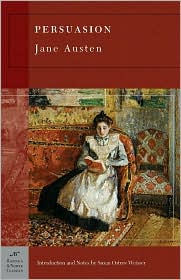
Persuasion. Jane Austen. 1818. 325 pages. [Source: Bought] [Adult fiction; adult romance; adult classic]
First sentence: Sir Walter Elliot, of Kellynch Hall, in Somersetshire, was a man who, for his own amusement, never took up any book but the Baronetage; there he found occupation for an idle hour, and consolation in a distressed one; there his faculties were roused into admiration and respect, by contemplating the limited remnant of the earliest patents; there any unwelcome sensations, arising from domestic affairs changed naturally into pity and contempt as he turned over the almost endless creations of the last century; and there, if every other leaf were powerless, he could read his own history with an interest which never failed.
Premise/plot: Anne Elliot, our heroine spinster, has missed her chance for love and happiness--or has she?! When she broke off her engagement seven years earlier--I believe it to be seven; it is at the very least seven--Anne never expected to see Frederick Wentworth again...
The Elliot family is in financial trouble--Anne the only sensible Elliot. The family decides to rent out their big estate and move to Bath. Anne isn't really necessary for this--she's just Anne--so she remains behind in the neighborhood, staying with her married sister, Mary, and brother-in-law, Charles, and their two children. Lady Russell, Anne's substitute mother of sorts, will bring her to Bath when she comes (several months) later.
The estate is rented out to the Crofts--Admiral and Mrs. Croft. Her brother happens to be....Captain Frederick Wentworth. (If The Bachelor had existed in 1818, he'd have applied to be a contestant.) What he is looking for MARRIAGE. She must be....anyone but Anne. Well, that's what he thinks at the start...
So the two socialize in the same circles; Mary has two sisters-in-law either which would do for Captain Wentworth--if he can choose between them. But Anne is ever in the background. Perhaps especially in her own family. Though at least with the Musgroves she's vital and essential to the every day management of life and comfort and peace. (As opposed to when she's with her father and other sister, Elizabeth, where she might as well be an ugly vase.
My thoughts: I love, love, love, crazy love and ABSOLUTELY adore this one. I've reviewed it
in 2008 (in which I said it was my second time to read it);
in 2011; in
2014 and
2016. I find it a giddy-making read. I love, love, love the romance between Anne and Frederick. I love the last half of the novel especially. There is such incredible build-up in this relationship. It never fails to thrill even when I know exactly how it will end.
Quotes:
Vanity was the beginning and the end of Sir Walter Elliot's character; vanity of person and of situation.
His two other
children were of very inferior value. Mary had acquired a little
artificial importance, by becoming Mrs Charles Musgrove; but Anne, with
an elegance of mind and sweetness of character, which must have placed
her high with any people of real understanding, was nobody with either
father or sister; her word had no weight, her convenience was always to give way--she was only Anne.
To Lady
Russell, indeed, she was a most dear and highly valued god-daughter,
favourite, and friend. Lady Russell loved them all; but it was only in
Anne that she could fancy the mother to revive again.
Lady Russell,
indeed, had scarcely any influence with Elizabeth, and seemed to love
her, rather because she would love her, than because Elizabeth deserved
it.
Half the sum
of attraction, on either side, might have been enough, for he had
nothing to do, and she had hardly anybody to love; but the encounter of
such lavish recommendations could not fail.
They were gradually acquainted, and when acquainted, rapidly and deeply in love.
It would be
difficult to say which had seen highest perfection in the other, or
which had been the happiest: she, in receiving his declarations and
proposals, or he in having them accepted.
She was
persuaded to believe the engagement a wrong thing: indiscreet, improper,
hardly capable of success, and not deserving it.
The belief of
being prudent, and self-denying, principally for his advantage, was her
chief consolation, under the misery of a parting, a final parting; and
every consolation was required, for she had to encounter all the
additional pain of opinions, on his side, totally unconvinced and
unbending, and of his feeling himself ill used by so forced a
relinquishment.
She had been
forced into prudence in her youth, she learned romance as she grew
older: the natural sequel of an unnatural beginning.
To be claimed
as a good, though in an improper style, is at least better than being
rejected as no good at all; and Anne, glad to be thought of some use,
glad to have anything marked out as a duty, and certainly not sorry to
have the scene of it in the country, and her own dear country, readily
agreed to stay.
"There is hardly any personal defect," replied Anne, "which an agreeable manner might not gradually reconcile one to."
Excepting one
short period of her life, she had never, since the age of fourteen,
never since the loss of her dear mother, known the happiness of being
listened to, or encouraged by any just appreciation or real taste.
If there is anything disagreeable going on men are always sure to get out of it, and Charles is as bad as any of them.
A sick child is always the mother's property: her own feelings generally make it so.
You, who have not a mother's feelings, are a great deal the properest person.
He had not
forgiven Anne Elliot. She had used him ill, deserted and disappointed
him; and worse, she had shewn a feebleness of character in doing so,
which his own decided, confident temper could not endure.
She had given him up to oblige others. It had been the effect of over-persuasion. It had been weakness and timidity.
"Yes, here I
am, Sophia, quite ready to make a foolish match. Anybody between fifteen
and thirty may have me for asking. A little beauty, and a few smiles,
and a few compliments to the navy, and I am a lost man. Should not this
be enough for a sailor, who has had no society among women to make him
nice?"
"A strong mind, with sweetness of manner," made the first and the last of the description. "That is the woman I want," said he.
"Something a
little inferior I shall of course put up with, but it must not be much.
If I am a fool, I shall be a fool indeed, for I have thought on the
subject more than most men."
We none of us expect to be in smooth water all our days.
They were
more in love with him; yet there it was not love. It was a little fever
of admiration; but it might, probably must, end in love with some.
He was only wrong in accepting the attentions (for accepting must be the word) of two young women at once.
You are never sure of a good impression being durable; everybody may sway it.
One man's ways may be as good as another's, but we all like our own best.
I have done
very little besides sending away some of the large looking-glasses from
my dressing-room, which was your father's. A very good man, and very
much the gentleman I am sure: but I should think, Miss Elliot," (looking
with serious reflection), "I should think he must be rather a dressy
man for his time of life. Such a number of looking-glasses! oh Lord!
there was no getting away from one's self.
Give him a book, and he will read all day long.
Everybody has
their taste in noises as well as in other matters; and sounds are quite
innoxious, or most distressing, by their sort rather than their
quantity.
There is so
little real friendship in the world! and unfortunately" (speaking low
and tremulously) "there are so many who forget to think seriously till
it is almost too late."
She hoped to be wise and reasonable in time; but alas! alas! she must confess to herself that she was not wise yet.
One does not love a place the less for having suffered in it, unless it has been all suffering, nothing but suffering.
Anne saw
nothing, thought nothing of the brilliancy of the room. Her happiness
was from within. Her eyes were bright and her cheeks glowed; but she
knew nothing about it. She was thinking only of the last half hour, and
as they passed to their seats, her mind took a hasty range over it.
What wild imaginations one forms where dear self is concerned! How sure to be mistaken!
Facts or
opinions which are to pass through the hands of so many, to be
misconceived by folly in one, and ignorance in another, can hardly have
much truth left.
All the
privilege I claim for my own sex (it is not a very enviable one; you
need not covet it), is that of loving longest, when existence or when
hope is gone.
On the
contents of that letter depended all which this world could do for her.
Anything was possible, anything might be defied rather than suspense.
"I can listen
no longer in silence. I must speak to you by such means as are within
my reach. You pierce my soul. I am half agony, half hope. Tell me not
that I am too late, that such precious feelings are gone for ever. I
offer myself to you again with a heart even more your own than when you
almost broke it, eight years and a half ago. Dare not say that man
forgets sooner than woman, that his love has an earlier death. I have
loved none but you. Unjust I may have been, weak and resentful I have
been, but never inconstant. You alone have brought me to Bath. For you
alone, I think and plan. Have you not seen this? Can you fail to have
understood my wishes? I had not waited even these ten days, could I have
read your feelings, as I think you must have penetrated mine. I can hardly
write. I am every instant hearing something which overpowers me. You
sink your voice, but I can distinguish the tones of that voice when they
would be lost on others. Too good, too excellent creature! You do us
justice, indeed. You do believe that there is true attachment and
constancy among men. Believe it to be most fervent, most undeviating, in
F. W. "I must go,
uncertain of my fate; but I shall return hither, or follow your party,
as soon as possible. A word, a look, will be enough to decide whether I
enter your father's house this evening or never."
Such a letter was not to be soon recovered from.
There could
be only the most proper alacrity, a most obliging compliance for public
view; and smiles reined in and spirits dancing in private rapture.
There they
exchanged again those feelings and those promises which had once before
seemed to secure everything, but which had been followed by so many,
many years of division and estrangement. There they returned again into
the past, more exquisitely happy, perhaps, in their re-union, than when
it had been first projected; more tender, more tried, more fixed in a
knowledge of each other's character, truth, and attachment; more equal
to act, more justified in acting.
Who can be in
doubt of what followed? When any two young people take it into their
heads to marry, they are pretty sure by perseverance to carry their
point, be they ever so poor, or ever so imprudent, or ever so little
likely to be necessary to each other's ultimate comfort.
© 2020 Becky Laney of
Becky's Book Reviews