Showing posts with label books reread in 2014. Show all posts

Friday, December 26, 2014

Reread #52 Jane Eyre

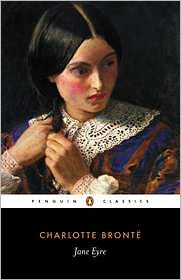
Jane Eyre. Charlotte Bronte. 1847.  300 pages. [Source: Own]

There was no possibility of taking a walk that day.

Can a plain, orphan governess find true love and a happily ever after? Yes, if she's willing to speak her own mind, stay true to herself, and fight for the one she loves. Jane's journey to her happily ever after certainly wasn't easy or typical. 

I have many, many posts about Jane Eyre. But surprisingly, only two book reviews! I first reviewed it--for the blog--in September 2008. My second review is from December 2011. In 2012, I reviewed ten film adaptations of Jane Eyre. Each film got its own review, but I then wrote up a post analyzing them all.

It had been a few years since I'd last read Jane Eyre. After watching it so many times, I needed to take a break. But I knew that I would want to include the book in my year of rereading. It is just wonderful to revisit Jane Eyre again and again and again.

Do you love Jane Eyre too? Do you have a favorite scene? a least favorite scene? What is your favorite adaptation? What scenes do you find essential in an adaptation?

Some of my favorite quotes:
He had been looking two minutes at the fire, and I had been looking the same length of time at him, when, turning suddenly, he caught my gaze fastened on his physiognomy. “You examine me, Miss Eyre,” said he: “do you think me handsome?” I should, if I had deliberated, have replied to this question by something conventionally vague and polite; but the answer somehow slipped from my tongue before I was aware—“No, sir.” “Ah! By my word! there is something singular about you,” said he: “you have the air of a little nonnette; quaint, quiet, grave, and simple, as you sit with your hands before you, and your eyes generally bent on the carpet (except, by-the-bye, when they are directed piercingly to my face; as just now, for instance); and when one asks you a question, or makes a remark to which you are obliged to reply, you rap out a round rejoinder, which, if not blunt, is at least brusque. What do you mean by it?” “Sir, I was too plain; I beg your pardon. I ought to have replied that it was not easy to give an impromptu answer to a question about appearances; that tastes mostly differ; and that beauty is of little consequence, or something of that sort.” “You ought to have replied no such thing. Beauty of little consequence, indeed! And so, under pretence of softening the previous outrage, of stroking and soothing me into placidity, you stick a sly penknife under my ear! Go on: what fault do you find with me, pray? I suppose I have all my limbs and all my features like any other man?” “Mr. Rochester, allow me to disown my first answer: I intended no pointed repartee: it was only a blunder.” “Just so: I think so: and you shall be answerable for it. Criticise me: does my forehead not please you?” He lifted up the sable waves of hair which lay horizontally over his brow, and showed a solid enough mass of intellectual organs, but an abrupt deficiency where the suave sign of benevolence should have risen. “Now, ma’am, am I a fool?” “Far from it, sir. You would, perhaps, think me rude if I inquired in return whether you are a philanthropist?”
“You looked very much puzzled, Miss Eyre; and though you are not pretty any more than I am handsome, yet a puzzled air becomes you; besides, it is convenient, for it keeps those searching eyes of yours away from my physiognomy, and busies them with the worsted flowers of the rug; so puzzle on. Young lady, I am disposed to be gregarious and communicative to-night.” With this announcement he rose from his chair, and stood, leaning his arm on the marble mantelpiece: in that attitude his shape was seen plainly as well as his face; his unusual breadth of chest, disproportionate almost to his length of limb. I am sure most people would have thought him an ugly man; yet there was so much unconscious pride in his port; so much ease in his demeanour; such a look of complete indifference to his own external appearance; so haughty a reliance on the power of other qualities, intrinsic or adventitious, to atone for the lack of mere personal attractiveness, that, in looking at him, one inevitably shared the indifference, and, even in a blind, imperfect sense, put faith in the confidence. “I am disposed to be gregarious and communicative to-night,” he repeated, “and that is why I sent for you: the fire and the chandelier were not sufficient company for me; nor would Pilot have been, for none of these can talk. Adèle is a degree better, but still far below the mark; Mrs. Fairfax ditto; you, I am persuaded, can suit me if you will: you puzzled me the first evening I invited you down here. I have almost forgotten you since: other ideas have driven yours from my head; but to-night I am resolved to be at ease; to dismiss what importunes, and recall what pleases. It would please me now to draw you out—to learn more of you—therefore speak.” Instead of speaking, I smiled; and not a very complacent or submissive smile either. “Speak,” he urged. “What about, sir?” “Whatever you like. I leave both the choice of subject and the manner of treating it entirely to yourself.” Accordingly I sat and said nothing: “If he expects me to talk for the mere sake of talking and showing off, he will find he has addressed himself to the wrong person,” I thought. “You are dumb, Miss Eyre.” I was dumb still. He bent his head a little towards me, and with a single hasty glance seemed to dive into my eyes. “Stubborn?” he said, “and annoyed. Ah! it is consistent. I put my request in an absurd, almost insolent form. Miss Eyre, I beg your pardon. The fact is, once for all, I don’t wish to treat you like an inferior: that is” (correcting himself), “I claim only such superiority as must result from twenty years’ difference in age and a century’s advance in experience. This is legitimate, et j’y tiens, as Adèle would say; and it is by virtue of this superiority, and this alone, that I desire you to have the goodness to talk to me a little now, and divert my thoughts, which are galled with dwelling on one point—cankering as a rusty nail.” He had deigned an explanation, almost an apology, and I did not feel insensible to his condescension, and would not seem so. “I am willing to amuse you, if I can, sir—quite willing; but I cannot introduce a topic, because how do I know what will interest you? Ask me questions, and I will do my best to answer them.”  
Besides, I know what sort of a mind I have placed in communication with my own: I know it is one not liable to take infection: it is a peculiar mind: it is a unique one. Happily I do not mean to harm it: but, if I did, it would not take harm from me. The more you and I converse, the better; for while I cannot blight you, you may refresh me.”
The ease of his manner freed me from painful restraint: the friendly frankness, as correct as cordial, with which he treated me, drew me to him. I felt at times as if he were my relation rather than my master: yet he was imperious sometimes still; but I did not mind that; I saw it was his way. So happy, so gratified did I become with this new interest added to life, that I ceased to pine after kindred: my thin crescent-destiny seemed to enlarge; the blanks of existence were filled up; my bodily health improved; I gathered flesh and strength. And was Mr. Rochester now ugly in my eyes? No, reader: gratitude, and many associations, all pleasurable and genial, made his face the object I best liked to see; his presence in a room was more cheering than the brightest fire. Yet I had not forgotten his faults; indeed, I could not, for he brought them frequently before me. He was proud, sardonic, harsh to inferiority of every description: in my secret soul I knew that his great kindness to me was balanced by unjust severity to many others. He was moody, too; unaccountably so; I more than once, when sent for to read to him, found him sitting in his library alone, with his head bent on his folded arms; and, when he looked up, a morose, almost a malignant, scowl blackened his features. But I believed that his moodiness, his harshness, and his former faults of morality (I say former, for now he seemed corrected of them) had their source in some cruel cross of fate. I believed he was naturally a man of better tendencies, higher principles, and purer tastes than such as circumstances had developed, education instilled, or destiny encouraged. I thought there were excellent materials in him; though for the present they hung together somewhat spoiled and tangled. I cannot deny that I grieved for his grief, whatever that was, and would have given much to assuage it. Though I had now extinguished my candle and was laid down in bed, I could not sleep for thinking of his look when he paused in the avenue, and told how his destiny had risen up before him, and dared him to be happy at Thornfield. 
I had not intended to love him; the reader knows I had wrought hard to extirpate from my soul the germs of love there detected; and now, at the first renewed view of him, they spontaneously arrived, green and strong! He made me love him without looking at me.
“He is not to them what he is to me,” I thought: “he is not of their kind. I believe he is of mine;—I am sure he is—I feel akin to him—I understand the language of his countenance and movements: though rank and wealth sever us widely, I have something in my brain and heart, in my blood and nerves, that assimilates me mentally to him. Did I say, a few days since, that I had nothing to do with him but to receive my salary at his hands? Did I forbid myself to think of him in any other light than as a paymaster? Blasphemy against nature! Every good, true, vigorous feeling I have gathers impulsively round him. I know I must conceal my sentiments: I must smother hope; I must remember that he cannot care much for me. For when I say that I am of his kind, I do not mean that I have his force to influence, and his spell to attract; I mean only that I have certain tastes and feelings in common with him.

© 2014 Becky Laney of Becky's Book Reviews

Tuesday, December 23, 2014

The Christmas Tree

The Christmas Tree. Julie Salamon. 1996. Random House. 118 pages. [Source: Bought]

The Christmas Tree is technically a reread for me, although I haven't reviewed it on my blog. I picked this one up because I remembered enjoying the movie adaptation of it. It didn't disappoint. What I like best about this feel-good Christmas story are the flashbacks.

The chief gardener for Rockefeller Center narrates Julie Salamon's The Christmas Tree. In his own words, this gardener tells of his search, his on-going, never-ending search for THE tree. If he's not looking for this year's tree, his mind is already on finding NEXT year's tree. The book is about one special tree in particular, one that led to an ongoing friendship.

One day the narrator spots THE tree from a helicopter. He learns it's on the property of a convent. He goes. He talks. He asks. He meets Sister Anthony THE nun who will decide if he can have the tree or not. They have more in common than he was expecting certainly. But. She's not ready or willing to part with the tree called, TREE.

Sister Anthony is a storyteller. She is. And the narrator turns out to be a good listener. Over several years at least, he keeps coming back to see her, to visit with her and hear her stories. He has things to share as well. Through these sections, readers learn of Anna.

In the flashbacks, readers meet a young orphan named Anna who eventually came to be raised at the convent. Her story is very personal, and it reveals her affection, her connection to nature. The young girl as you've probably guessed IS Sister Anthony herself.

I loved Anna. I did. Her part in the story is what made it work for me. It was her connection with the tree--in the past and present--that kept me reading.

© 2014 Becky Laney of Becky's Book Reviews

Friday, December 19, 2014

Reread #51 Best Christmas Pageant Ever

The Best Christmas Pageant Ever. Barbara Robinson. 1972. HarperCollins. 128 pages. [Source: Bought]

Is The Best Christmas Pageant Ever the best Christmas book ever? It might just be. I know I prefer it to Charles Dickens' A Christmas Carol. One reason why I do is because the book truly captures the getting-it moment, the moment when one realizes the true meaning of Christmas. A Christmas Carol may do an adequate job of "getting" the generosity of Christmas, but it is a Christ-less Christmas story. There is nothing in A Christmas Carol that would point you towards the real meaning of Christmas: the birth of a Savior. The Best Christmas Pageant does just that. And it doesn't sacrifice entertainment or humor. In fact, it is probably one of the funniest children's books ever. Here's how it opens:
The Herdmans were absolutely the worst kids in the history of the world. They lied and stole and smoked cigars (even the girls) and talked dirty and hit little kids and cussed their teachers and took the name of the Lord in vain and set fire to Fred Shoemaker's old broken-down toolhouse. The toolhouse burned right down to the ground, and I think that surprised the Herdmans. They set fire to things all the time, but that was the first time they managed to burn down a whole building. I guess it was an accident. I don't suppose they woke up that morning and said to one another, "Let's go burn down Fred Shoemaker's toolhouse"...but maybe they did. After all, it was a Saturday, and not much going on.
There are six Herdmans in all: Ralph, Imogene, Leroy, Claude, Ollie, and Gladys. The premise of this one is oh-so-simple: what if the yearly Christmas pageant was overrun with Herdmans? What if the WORST kids in town, possibly the WORST kids in the world, got the best roles in the Christmas pageant? What would it be like for the director(s)? What would it be like for the other kids? What would it be like for the audience? What no one was expecting was that the story itself would have an impact on the actors leading it to be THE BEST CHRISTMAS PAGEANT EVER.

It is narrated in the first person. I believe it is told from the perspective of the director's daughter. As I mentioned, it is hilarious and touching all at the same time. Though the 'touching' bit--the sentimental bit--is towards the very, very end.

I loved this one. I've read it again and again and again and again. It is well worth reading every year or every other year. It has a just-right feel about it. I think it is true enough to life. It captures the familiarity of the Christmas story. Almost everyone knows the story backwards and forwards. Everyone knows it so very well that none of the characters consider it. They don't process it or absorb it. But the Herdmans. Well. They have NEVER heard it. They don't find it boring or irrelevant. They find it absorbing and interesting. The details, big and small, are fresh to them. They are thinking of the story in a fresh way, in a human way. Not in a been-raised-in-church-my-whole-life way. So it captures the DRAMA of the Christmas story in a fresh way. Readers get a behind-the-scenes look at someone seeing/hearing the story for the very first time. The Herdmans take nothing for granted, assume nothing. They have questions, dozens and dozens of questions. The book isn't overly preachy either. It isn't that someone reads the story the first time, and all six kids suddenly decide to pray a little prayer and get baptized. It is not like that at all. Yet I can't help but seeing the spirit working in this story.

© 2014 Becky Laney of Becky's Book Reviews

Tuesday, December 16, 2014

Golden Dreydl

The Golden Dreydl. Ellen Kushner. Illustrated by Ilene Winn-Lederer. 2007. Charlesbridge. 126 pages. [Source: Review copy]

The Golden Dreydl is an interesting Chanukah themed fantasy novel for children. There is an album that goes along with it. The book and album put a Jewish twist on the Nutcracker story.

Sara, the heroine, of The Golden Dreydl has quite the bad attitude about "having" to celebrate Chanukah and "not getting to" celebrate Christmas like all her friends. But to the family gathering she will go--no matter the fuss. (Sara has an older brother, Seth).

Readers briefly meet Sara, Seth, and their many, many cousins. The "kids" of the family are playing dreydl. Sara is still in a mood. A mood that isn't exactly improved when Tante Miriam shows up with presents for one and all. It's not her fault, mind you, Sara even seems a little inclined to like her present: a golden dreydl. But Seth and her get into a bit of a fight. The dreydl ends up flying through the air and hitting the TV and breaking it. That puts most everyone in a mood.

Readers next join Sara later that evening, for a fantasy adventure. She follows a young girl--a girl claiming to be the Golden Dreydl--through the hole in the TV, I believe. They arrive in a fantasy land, of sorts, with demons, peacocks, a fool, and King Solomon and the Queen of Sheba. There is also much talk of a Tree of Life.

Sara is given a quest, of sorts, to save the girl from the demons/demon king. She has the Fool to help her. A few riddle games are played. First, between Sara and the Fool, and, then later between the Demon King and Sara and the Fool.

For those readers who enjoy fantasy novels, going to different worlds, doing quests, this one is enjoyable enough. If you get a chance to listen to the music, it will probably help you 'enjoy' it even more.

© 2014 Becky Laney of Becky's Book Reviews

Sunday, December 14, 2014

My Year with Jane: A Darcy Christmas

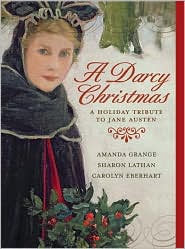
A Darcy Christmas: A Holiday Tribute to Jane Austen. By Amanda Grange, Carolyn Eberhart, and Sharon Lathan. 2010. Sourcebooks. 304 pages. [Source: Library]

I reread two of the three novellas in A Darcy Christmas. I reread Amanda Grange's Christmas Present and Carolyn Eberhart's Mr. Darcy's Christmas Carol. I chose not to reread Sharon Lathan's A Darcy Christmas. Each novella was around a hundred pages. A perfect length, in my opinion, for both stories.

Mr. Darcy's Christmas Carol is an interesting and often entertaining read starring Austen's characters and borrowing much from Charles Dickens. The premise is simple yet not completely predictable. Mr. Darcy is oh-so-happy that Bingley and Jane have married. But. He's still alone this holiday season. Unlike the original, he did not propose marriage to Elizabeth soon after Bingley and Jane's happy announcement. Georgiana, his sister, wants a new sister, a new particular sister for Christmas. His cousin has made a similar request, a particular new cousin. It isn't that Darcy doesn't still love her, want her, need her. But he's a bit proud and stubborn. So on the Christmas Eve in question, Darcy is visited by the ghost of his father who warns him of his faults and promises the visits of three spirits in the night. He adds that they will come with familiar faces. (Can you guess which "familiar face" is the ghost of Christmas future?)

I have conflicting thoughts on Mr. Darcy's Christmas Carol. On the one hand, there would be scenes and passages where I'm: it works, it really works, I can't believe this is working!!! And then perhaps just a page later, I'm: I take it back, this doesn't work at all, how am I suppose to believe this?! So there were plenty of scenes I liked. I liked how she fit it all together and made it work at least some of the time. It would be hard to fit all the great bits of Pride and Prejudice with all the great bits of A Christmas Carol. So I'm surprised it worked as well as it did actually. I like how one of my favorite scenes of A Christmas Carol is reworked from the beginning to the near-ending. That was something! I don't LOVE this one necessarily. As I mentioned, there are places where it is an almost-but-not-quite. It was a fun idea, perhaps, but not absolutely flawless. I alternated between wanting to shout at the book, and cheering. Still, it's worth reading at least once.

What did I think of Amanda Grange's Christmas Present? I liked it very much!!! I tend to like or love Amanda Grange's Austen adaptations. I think she does a great job with keeping Austen's characters as we know them and love them. She is able to capture the essence of each character. In this novella, readers get a glimpse of their second Christmases. (I believe, the two couples married in November or possibly early December?) Bingley and Jane have a baby. Elizabeth and Darcy are oh-so-close to having a baby as well. But have-her-own-way Elizabeth is insistent that even though she is due to have a baby any day, she is perfectly capable of traveling a few hours by carriage so she can spend the holidays with her family. Darcy gives in, of course. So what does a family Christmas look like? Well, this family Christmas borders on insane! Through half-a-dozen coincidences it seems, that most of the family (minus Georgiana) are brought together to share these few days. Including some you might not be expecting to see: Lady Catherine. Mr. Collins. The novella is comical. It's just a satisfying way to spend an afternoon. Sometimes a good, quick read that is light-hearted fun is just what you need.

This is my final post for "My Year With Jane." Here's a look at all the posts about Jane Austen:
© 2014 Becky Laney of Becky's Book Reviews

Friday, December 12, 2014

Reread #50 Les Miserables

Les Miserables. Victor Hugo. Translated by Isabel Florence Hapgood. 1862/1887. 1232 pages.
This book is a drama, whose leading personage is the Infinite. Man is the second.
I have now read Les Miserables three times. This will be my second review of Les Miserables on my blog. My first review was in April 2013. I love Les Miserables. I do. I think I love it more each time I read it. The book has depth. The story it tells is memorable and emotional. It is a book you EXPERIENCE. I love so many things about it: the depth and quality of the writing, the characterization, the narration, the themes.

There are many words that could be used to describe Les Miserables: compelling, political, spiritual, philosophical, dramatic, romantic. It is just as concerned about politics and social justice as it is romance and family. It touches on the subjects of education, crime, poverty, and injustice. It's a novel where ideas matter just as much as characters.

It's also a novel heavy on details. When it's good, it's REALLY good. But at times some of the details are too taste-specific. In other words, some of the details weigh the story down. At times Les Miserables is boring. It's worth reading. It is. It's worth pushing through to the end. It's okay to skim certain sections, in my opinion, because it is one of the most satisfying reading experiences overall. Not that I LOVE the ending, though I think I may have made peace with it this time around.

Who are some of the characters? Bishop Myriel, Jean Valjean, Fantine, Inspector Javert, Cosette, Marius, Eponine, Enjolras, Monsieur and Madame Thenardier, Mabeuf, Monsieur Gillenormand, and Gavroche--just to name a few.  I don't know if I can say I have a favorite. I know which characters I don't like. But I really just like all of them--no matter their strengths and weaknesses.

Do you have a favorite character? a favorite scene?

One of my favorite scenes is early in the novel when Jean Valjean meets Bishop Myriel (Bienvenu). He is an ex-convict who has just been released. He's seeking a place to stay for the night. It is not going well.
"I have knocked at all doors."
"Well?"
"I have been driven away everywhere."
The "good woman" touched the man's arm, and pointed out to him on the other side of the street a small, low house, which stood beside the Bishop's palace.
"You have knocked at all doors?"
"Yes."
"Have you knocked at that one?"
"No."
"Knock there."
It opened wide with a rapid movement, as though some one had given it an energetic and resolute push.
A man entered.
We already know the man. It was the wayfarer whom we have seen wandering about in search of shelter.
He entered, advanced a step, and halted, leaving the door open behind him. He had his knapsack on his shoulders, his cudgel in his hand, a rough, audacious, weary, and violent expression in his eyes. The fire on the hearth lighted him up. He was hideous. It was a sinister apparition.
Madame Magloire had not even the strength to utter a cry. She trembled, and stood with her mouth wide open.
Mademoiselle Baptistine turned round, beheld the man entering, and half started up in terror; then, turning her head by degrees towards the fireplace again, she began to observe her brother, and her face became once more profoundly calm and serene.
The Bishop fixed a tranquil eye on the man.
As he opened his mouth, doubtless to ask the new-comer what he desired, the man rested both hands on his staff, directed his gaze at the old man and the two women, and without waiting for the Bishop to speak, he said, in a loud voice:—
"See here. My name is Jean Valjean. I am a convict from the galleys. I have passed nineteen years in the galleys. I was liberated four days ago, and am on my way to Pontarlier, which is my destination. I have been walking for four days since I left Toulon. I have travelled a dozen leagues to-day on foot. This evening, when I arrived in these parts, I went to an inn, and they turned me out, because of my yellow passport, which I had shown at the town-hall. I had to do it. I went to an inn. They said to me, 'Be off,' at both places. No one would take me. I went to the prison; the jailer would not admit me. I went into a dog's kennel; the dog bit me and chased me off, as though he had been a man. One would have said that he knew who I was. I went into the fields, intending to sleep in the open air, beneath the stars. There were no stars. I thought it was going to rain, and I re-entered the town, to seek the recess of a doorway. Yonder, in the square, I meant to sleep on a stone bench. A good woman pointed out your house to me, and said to me, 'Knock there!' I have knocked. What is this place? Do you keep an inn? I have money—savings. One hundred and nine francs fifteen sous, which I earned in the galleys by my labor, in the course of nineteen years. I will pay. What is that to me? I have money. I am very weary; twelve leagues on foot; I am very hungry. Are you willing that I should remain?"
"Madame Magloire," said the Bishop, "you will set another place."
The man advanced three paces, and approached the lamp which was on the table. "Stop," he resumed, as though he had not quite understood; "that's not it. Did you hear? I am a galley-slave; a convict. I come from the galleys." He drew from his pocket a large sheet of yellow paper, which he unfolded. "Here's my passport. Yellow, as you see. This serves to expel me from every place where I go. Will you read it? I know how to read. I learned in the galleys. There is a school there for those who choose to learn. Hold, this is what they put on this passport: 'Jean Valjean, discharged convict, native of'—that is nothing to you—'has been nineteen years in the galleys: five years for house-breaking and burglary; fourteen years for having attempted to escape on four occasions. He is a very dangerous man.' There! Every one has cast me out. Are you willing to receive me? Is this an inn? Will you give me something to eat and a bed? Have you a stable?"
"Madame Magloire," said the Bishop, "you will put white sheets on the bed in the alcove." We have already explained the character of the two women's obedience.
Madame Magloire retired to execute these orders.
The Bishop turned to the man.
"Sit down, sir, and warm yourself. We are going to sup in a few moments, and your bed will be prepared while you are supping."
At this point the man suddenly comprehended. The expression of his face, up to that time sombre and harsh, bore the imprint of stupefaction, of doubt, of joy, and became extraordinary. He began stammering like a crazy man:—
"Really? What! You will keep me? You do not drive me forth? A convict! You call me sir! You do not address me as thou? 'Get out of here, you dog!' is what people always say to me. I felt sure that you would expel me, so I told you at once who I am. Oh, what a good woman that was who directed me hither! I am going to sup! A bed with a mattress and sheets, like the rest of the world! a bed! It is nineteen years since I have slept in a bed! You actually do not want me to go! You are good people. Besides, I have money. I will pay well. Pardon me, monsieur the inn-keeper, but what is your name? I will pay anything you ask. You are a fine man. You are an inn-keeper, are you not?"
"I am," replied the Bishop, "a priest who lives here."
"A priest!" said the man. "Oh, what a fine priest! Then you are not going to demand any money of me? You are the cure, are you not? the cure of this big church? Well! I am a fool, truly! I had not perceived your skull-cap."
As he spoke, he deposited his knapsack and his cudgel in a corner, replaced his passport in his pocket, and seated himself. Mademoiselle Baptistine gazed mildly at him. He continued:
"You are humane, Monsieur le Curé; you have not scorned me. A good priest is a very good thing. Then you do not require me to pay?"
"No," said the Bishop; "keep your money. How much have you? Did you not tell me one hundred and nine francs?"
"And fifteen sous," added the man.
"One hundred and nine francs fifteen sous. And how long did it take you to earn that?"
"Nineteen years."
"Nineteen years!"
The Bishop sighed deeply.
The man continued: "I have still the whole of my money. In four days I have spent only twenty-five sous, which I earned by helping unload some wagons at Grasse. Since you are an abbe, I will tell you that we had a chaplain in the galleys. And one day I saw a bishop there. Monseigneur is what they call him. He was the Bishop of Majore at Marseilles. He is the cure who rules over the other cures, you understand. Pardon me, I say that very badly; but it is such a far-off thing to me! You understand what we are! He said mass in the middle of the galleys, on an altar. He had a pointed thing, made of gold, on his head; it glittered in the bright light of midday. We were all ranged in lines on the three sides, with cannons with lighted matches facing us. We could not see very well. He spoke; but he was too far off, and we did not hear. That is what a bishop is like."
While he was speaking, the Bishop had gone and shut the door, which had remained wide open.
Madame Magloire returned. She brought a silver fork and spoon, which she placed on the table.
"Madame Magloire," said the Bishop, "place those things as near the fire as possible." And turning to his guest: "The night wind is harsh on the Alps. You must be cold, sir."
Each time that he uttered the word sir, in his voice which was so gently grave and polished, the man's face lighted up. Monsieur to a convict is like a glass of water to one of the shipwrecked of the Medusa. Ignominy thirsts for consideration.
"This lamp gives a very bad light," said the Bishop.
Madame Magloire understood him, and went to get the two silver candlesticks from the chimney-piece in Monseigneur's bed-chamber, and placed them, lighted, on the table.
"Monsieur le Curé," said the man, "you are good; you do not despise me. You receive me into your house. You light your candles for me. Yet I have not concealed from you whence I come and that I am an unfortunate man."
The Bishop, who was sitting close to him, gently touched his hand. "You could not help telling me who you were. This is not my house; it is the house of Jesus Christ. This door does not demand of him who enters whether he has a name, but whether he has a grief. You suffer, you are hungry and thirsty; you are welcome. And do not thank me; do not say that I receive you in my house. No one is at home here, except the man who needs a refuge. I say to you, who are passing by, that you are much more at home here than I am myself. Everything here is yours. What need have I to know your name? Besides, before you told me you had one which I knew."
The man opened his eyes in astonishment.
"Really? You knew what I was called?"
"Yes," replied the Bishop, "you are called my brother."
"Stop, Monsieur le Curé," exclaimed the man. "I was very hungry when I entered here; but you are so good, that I no longer know what has happened to me."
The Bishop looked at him, and said,—
"You have suffered much?"
"Oh, the red coat, the ball on the ankle, a plank to sleep on, heat, cold, toil, the convicts, the thrashings, the double chain for nothing, the cell for one word; even sick and in bed, still the chain! Dogs, dogs are happier! Nineteen years! I am forty-six. Now there is the yellow passport. That is what it is like."
"Yes," resumed the Bishop, "you have come from a very sad place. Listen. There will be more joy in heaven over the tear-bathed face of a repentant sinner than over the white robes of a hundred just men. If you emerge from that sad place with thoughts of hatred and of wrath against mankind, you are deserving of pity; if you emerge with thoughts of good-will and of peace, you are more worthy than any one of us."
This meeting will change his life. The impact of the Bishop on Jean Valjean is huge. And this scene is just the beginning.

In writing this review, I discovered two books releasing in 2015, that I really, really WANT to review--NEED to review. Both are February releases. Candlewick Press is releasing Marcia Williams' retelling of Les Miserables.  Penguin is releasing a NEW translation of Les Miserables by Christine Donougher.

I could not possibly share every quote I loved from the book. There are hundreds. But I will share some with you.

Favorite quotes:

True or false, that which is said of men often occupies as important a place in their lives, and above all in their destinies, as that which they do.
"Jean Valjean, my brother, you no longer belong to evil, but to good. It is your soul that I buy from you; I withdraw it from black thoughts and the spirit of perdition, and I give it to God." 
Teach those who are ignorant as many things as possible; society is culpable, in that it does not afford instruction gratis; it is responsible for the night which it produces. This soul is full of shadow; sin is therein committed. The guilty one is not the person who has committed the sin, but the person who has created the shadow.
The supreme happiness of life consists in the conviction that one is loved; loved for one's own sake—let us say rather, loved in spite of one's self.
To make the poem of the human conscience, were it only with reference to a single man, were it only in connection with the basest of men, would be to blend all epics into one superior and definitive epic.
Diamonds are found only in the dark places of the earth; truths are found only in the depths of thought. It seemed to him, that, after having descended into these depths, after having long groped among the darkest of these shadows, he had at last found one of these diamonds, one of these truths, and that he now held it in his hand, and he was dazzled as he gazed upon it. 
If you wish to gain an idea of what revolution is, call it Progress; and if you wish to acquire an idea of the nature of progress, call it To-morrow. To-morrow fulfils its work irresistibly, and it is already fulfilling it to-day. It always reaches its goal strangely.
Man lives by affirmation even more than by bread.
Peace is happiness digesting.
The bourgeoisie is simply the contented portion of the people. The bourgeois is the man who now has time to sit down. A chair is not a caste.
True history being a mixture of all things, the true historian mingles in everything.
Of all the things that God has made, the human heart is the one which sheds the most light, alas! and the most darkness.
A compliment is something like a kiss through a veil.
Civil war—what does that mean? Is there a foreign war? Is not all war between men, war between brothers? War is qualified only by its object. There is no such thing as foreign or civil war; there is only just and unjust war.
The right to the alphabet, that is where the beginning must be made. The primary school imposed on all, the secondary school offered to all, that is the law. From an identical school, an identical society will spring. Yes, instruction! light! light! everything comes from light, and to it everything returns. Citizens, the nineteenth century is great, but the twentieth century will be happy.
Everything can be parodied, even parody.
He sleeps. Although his fate was very strange, he lived. He died when he had no longer his angel. The thing came to pass simply, of itself, as the night comes when day is gone.
© 2014 Becky Laney of Becky's Book Reviews

Wednesday, December 10, 2014

The 5th Wave (2013)

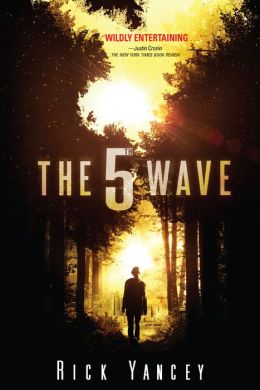
The 5th Wave. Rick Yancey. 2013. Penguin. 457 pages. [Source: Review copy]

Why reread The 5th Wave? Well, I wanted to reread The 5th Wave before beginning the second book in the series, The Infinite Sea. Also, it made sense to reread it for the Sci-Fi Experience!!!

If you're considering reading it for yourself in the near future, you might want to skip this review. Not because I'm planning on including spoilers. I'm not. But because some books should just be experienced as they are--no expectations, no hype.

So what is it about? Alien invasion. Humanity's fight to survive. It's a sci-fi thriller. It's intense and action-packed. Yet not without heart and soul and substance. It's action-packed and emotional. (Not always easy to balance the two to every reader's satisfaction.)

What else should you expect? Well. It's told through multiple narrators. Cassie, "Zombie," and "Nugget" to name a few. Normally this tends to irritate me. But I actually really enjoyed it in The 5th Wave. Yes, it was a bit disconcerting the first transition or two. But overall, it adds to the suspense and tension. The novel is better because of it.

Choices. To trust or not to trust. That is what The 5th Wave is about. Human survivors forced into difficult situations. Should they trust any survivor they come across? Should they assume the worst, and kill before they can be killed. Kill without question, without thinking, no exceptions. Or should they risk their own lives by clinging to hope that their are other survivors out there--survivors that are very much still human? Misplaced trust could prove deadly after all. But becoming a killer robs you of who you were.
This is what the Others have done to us. You can't band together to fight without trust. And without trust, there was no hope. How do you rid the Earth of humans? Rid the humans of their humanity. 
© 2014 Becky Laney of Becky's Book Reviews
Friday, December 05, 2014

Reread #49 Tale of Despereaux

The Tale of Despereaux. Kate DiCamillo. 2003. Candlewick Press. 272 pages. [Source: Bought]

There are so few rereads left in the year, yet, I couldn't miss rereading Kate DiCamillo's The Tale of Despereaux. (I first reviewed this one in September 2007). I've also made a point of rereading Because of Winn Dixie and The Miraculous Journey of Edward Tulane.

I tend to like talking-mice books. I tend to like animal fantasy when it's well done. And in The Tale of Despereaux it is very well done. DiCamillo is a GREAT author. She is. She has a way with words, with phrasing things just so that happens to appeal to me. She's a good, solid storyteller. Her characters are always unique and memorable. That is definitely the case with The Tale of Despereaux.

Do you have a favorite Kate DiCamillo book?

Quotes:
“Stories are light. Light is precious in a world so dark. Begin at the beginning. Tell Gregory a story. Make some light.”
“There are those hearts, reader, that never mend again once they are broken. Or if they do mend, they heal themselves in a crooked and lopsided way, as if sewn together by a careless craftsman. Such was the fate of Chiaroscuro. His heart was broken. Picking up the spoon and placing it on his head, speaking of revenge, these things helped him to put his heart together again. But it was, alas, put together wrong.”
“Reader, you must know that an interesting fate (sometimes involving rats, sometimes not) awaits almost everyone, mouse or man, who does not conform.”
“Once upon a time," he said out loud to the darkness. He said these words because they were the best, the most powerful words that he knew and just the saying of them comforted him.”
“Despereaux looked at his father, at his grey-streaked fur and trembling whiskers and his front paws clasped together in front of his heart, and he felt suddenly as if his own heart would break in two. His father looked so small, so sad.
"Forgive me," said Lester again.
Forgiveness, reader, is, I think, something very much like hope and love - a powerful, wonderful thing.
And a ridiculous thing, too.
Isn't it ridiculous, after all, to think that a son could forgive his father for beating the drum that sent him to his death? Isn't it ridiculous to think that a mouse ever could forgive anyone for such perfidy?
But still, here are the words Despereaux Tilling spoke to his father. He said, "I forgive you, Pa."
And he said those words because he sensed it was the only way to save his own heart, to stop it from breaking in two. Despereaux, reader, spoke those words to save himself.”

© 2014 Becky Laney of Becky's Book Reviews

Friday, November 28, 2014

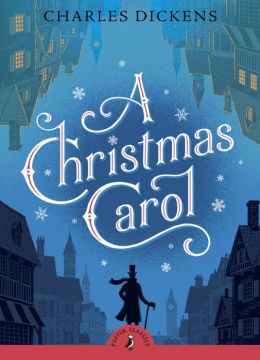
Reread #48 A Christmas Carol

A Christmas Carol. Charles Dickens. 1843. 96 pages. [Source: Bought]

MARLEY WAS DEAD, to begin with. There is no doubt whatever about that.

 I have watched A Christmas Carol more times than I've read it, and I've read it two or three times at least. The story is oh-so-familiar; the phrasing is oh-so-familiar. It's a book that has an old-friend feel even if you haven't read it dozens of times. There are scenes and descriptions that just feel incredibly right and familiar. For example,
Oh! but he was a tight-fisted hand at the grindstone, Scrooge! a squeezing, wrenching, grasping, scraping, clutching, covetous old sinner! Hard and sharp as flint, from which no steel had ever struck out generous fire, secret, and self-contained, and solitary as an oyster. The cold within him froze his old features, nipped his pointed nose, shriveled his cheek, stiffened his gait, made his eyes red, his thin lips blue, and spoke out shrewdly in his grating voice. A frosty rime was on his head, and on his eyebrows, and his wiry chin. He carried his own low temperature always about with him; he iced his office in the dog-days; and didn’t thaw it one degree at Christmas.
and
“A merry Christmas, uncle! God save you!” cried a cheerful voice. It was the voice of Scrooge’s nephew, who came upon him so quickly that this was the first intimation he had of his approach. “Bah!” said Scrooge. “Humbug!” He had so heated himself with rapid walking in the fog and frost, this nephew of Scrooge’s, that he was all in a glow; his face was ruddy handsome; his eyes sparkled, and his breath smoked again.
“Christmas a humbug, uncle!” said Scrooge’s nephew. “You don’t mean that, I am sure?” “I do,” said Scrooge. “Merry Christmas! What right have you to be merry? What reason have you to be merry? You’re poor enough.”
“Come, then,” returned the nephew gaily. “What right have you to be dismal? What reason have you to be morose? You’re rich enough.” Scrooge, having no better answer ready on the spur of the moment, said “Bah!” again; and followed it up with “Humbug!”
“Nephew!” returned the uncle sternly, “keep Christmas in your own way, and let me keep it in mine.” “Keep it!” repeated Scrooge’s nephew. “But you don’t keep it.” “Let me leave it alone, then,” said Scrooge. “Much good may it do you! Much good it has ever done you!” “There are many things from which I might have derived good by which I have not profited, I dare say,” returned the nephew, “Christmas among the rest. But I am sure I have always thought of Christmas-time, when it has come round—apart from the veneration due to its sacred name and origin, if anything belonging to it can be apart from that—as a good time; a kind, forgiving, charitable, pleasant time; the only time I know of, in the long calendar of the year, when men and women seem by one consent to open their shut-up hearts freely, and to think of people below them as if they really were fellow-passengers to the grave, and not another race of creatures bound on other journeys. And therefore, uncle, though it has never put a scrap of gold or silver in my pocket, I believe that it has done me good, and will do me good; and I say, God bless it!”
Other details, I've found, are less memorable perhaps.
“Forgive me if I am not justified in what I ask,” said Scrooge, looking intently at the Spirit’s robe, “but I see something strange, and not belonging to yourself, protruding from your skirts. Is it a foot or a claw?” “It might be a claw, for the flesh there is upon it,” was the Spirit’s sorrowful reply. “Look here.” From the foldings of its robe, it brought two children, wretched, abject, frightful, hideous, miserable. They knelt down at its feet, and clung upon the outside of its garment. “O Man! look here! Look, look, down here!” exclaimed the Ghost. They were a boy and girl. Yellow, meager, ragged, scowling, wolfish; but prostrate, too, in their humility. Where graceful youth should have filled their features out, and touched them with its freshest tints, a stale and shriveled hand, like that of age, had pinched and twisted them, and pulled them into shreds. Where angels might have sat enthroned, devils lurked, and glared out menacing. No change, no degradation, no perversion of humanity, in any grade, through all the mysteries of wonderful creation, has monsters half so horrible and dread. Scrooge started back, appalled. Having them shown to him in this way, he tried to say they were fine children, but the words choked themselves, rather than be parties to a lie of such enormous magnitude. “Spirit! are they yours?” Scrooge could say no more. “They are Man’s,” said the Spirit, looking down upon them. “And they cling to me, appealing from their fathers. This boy is Ignorance. This girl is Want. Beware of them both, and all of their degree, but most of all beware this boy, for on his brow I see that written which is Doom, unless the writing be erased. Deny it!” cried the Spirit, stretching out its hand toward the City. “Slander those who tell it ye! Admit it for your factious purposes, and make it worse! And bide the end!” “Have they no refuge or resource?” cried Scrooge. “Are there no prisons?” said the Spirit, turning on him for the last time with his own words. “Are there no workhouses?” The bell struck Twelve.
I don't recall thinking much of the two children Ignorance and Want, of thinking about what message Dickens was sending. But when I was reading The Man Who Invented Christmas, Standiford stressed their significance. (Standiford called A Christmas Carol, "a bald-faced parable that underscores Dickens's enduring themes: the deleterious effects of ignorance and want.") Why had I not noticed them before? I can only suppose that I've been rushing through the text looking for what was familiar and beloved, not really considering the book as a whole.

I like A Christmas Carol. I don't love, love, love it. I have found it to be a Christ-less Christmas story. A book that doesn't really focus on the Savior--newborn babe or risen Savior--so much as it focuses on humanity improving and changing and saving themselves. The message to Scrooge isn't, you're a bad man; you need a Savior; consider your eternal soul. The message is whether that even Scrooge, as horrible as he was, can change; he can change the way he lives; he can become a good man, a great man. He can avoid after-life horrors by changing his behavior. That isn't a Christian message.

© 2014 Becky Laney of Becky's Book Reviews

Friday, November 21, 2014

Reread #47 Black Beauty

Black Beauty. Anna Sewell. 1877. 245 pages. [Source: Bought]

I have been wanting to reread Black Beauty since I finished it in July 2012. I loved it then. I loved it now upon rereading. In fact, I think I loved it even a tiny bit more since I knew exactly what to expect. I was able to relax a bit more, not worrying that something horrible was about to happen. Granted, plenty of horrible things do happen. If not to Black Beauty then to others. But their is a sweetness, a hopefulness to the book that keeps it from being dark and gloomy.

What I loved best about Black Beauty is the narration. From cover to cover, I was engaged with her story, her narration. I loved the writing. The book is rich in description and observation. The worldview of the book has a just-right feel to it. It's very quotable. I loved the characterization. I cared about the horses. I cared about the humans in the story.

If you haven't read it, you should give it a try. Even if you don't like animal stories.

Favorite quotes:
"I wish you to pay attention to what I am going to say to you. The colts who live here are very good colts, but they are cart-horse colts, and of course they have not learned manners. You have been well-bred and well-born; your father has a great name in these parts, and your grandfather won the cup two years at the Newmarket races; your grandmother had the sweetest temper of any horse I ever knew, and I think you have never seen me kick or bite. I hope you will grow up gentle and good, and never learn bad ways; do your work with a good will, lift your feet up well when you trot, and never bite or kick even in play." I have never forgotten my mother's advice; I knew she was a wise old horse, and our master thought a great deal of her.
The next day I was brought up for my master. I remembered my mother's counsel and my good old master's, and I tried to do exactly what he wanted me to do. I found he was a very good rider, and thoughtful for his horse too. When he came home the lady was at the hall door as he rode up. "Well, my dear," she said, "how do you like him?" "He is exactly what John said," he replied; "a pleasanter creature I never wish to mount. What shall we call him?" "Would you like Ebony?" said she; "he is as black as ebony." "No, not Ebony." "Will you call him Blackbird, like your uncle's old horse?" "No, he is far handsomer than old Blackbird ever was." "Yes," she said, "he is really quite a beauty, and he has such a sweet, good-tempered face, and such a fine, intelligent eye--what do you say to calling him Black Beauty?"
"I suppose it is fashion that makes them strap our heads up with those horrid bits that I was tortured with in London," said Ginger. "Of course it is," said he; "to my mind, fashion is one of the wickedest things in the world. Now look, for instance, at the way they serve dogs, cutting off their tails to make them look plucky, and shearing up their pretty little ears to a point to make them both look sharp, forsooth. I had a dear friend once, a brown terrier; 'Skye' they called her. She was so fond of me that she never would sleep out of my stall; she made her bed under the manger, and there she had a litter of five as pretty little puppies as need be; none were drowned, for they were a valuable kind, and how pleased she was with them! and when they got their eyes open and crawled about, it was a real pretty sight; but one day the man came and took them all away; I thought he might be afraid I should tread upon them. But it was not so; in the evening poor Skye brought them back again, one by one in her mouth; not the happy little things that they were, but bleeding and crying pitifully; they had all had a piece of their tails cut off, and the soft flap of their pretty little ears was cut quite off. How their mother licked them, and how troubled she was, poor thing! I never forgot it. They healed in time, and they forgot the pain, but the nice soft flap, that of course was intended to protect the delicate part of their ears from dust and injury, was gone forever. Why don't they cut their own children's ears into points to make them look sharp? Why don't they cut the end off their noses to make them look plucky? One would be just as sensible as the other. What right have they to torment and disfigure God's creatures?"
"He had no business to make that turn; his road was straight on!" said the man roughly. "You have often driven that pony up to my place," said master; "it only shows the creature's memory and intelligence; how did he know that you were not going there again? But that has little to do with it. I must say, Mr. Sawyer, that a more unmanly, brutal treatment of a little pony it was never my painful lot to witness, and by giving way to such passion you injure your own character as much, nay more, than you injure your horse; and remember, we shall all have to be judged according to our works, whether they be toward man or toward beast."
Master said, God had given men reason, by which they could find out things for themselves; but he had given animals knowledge which did not depend on reason, and which was much more prompt and perfect in its way, and by which they had often saved the lives of men.
But what stuck in my mind was this, he said that cruelty was the devil's own trade-mark, and if we saw any one who took pleasure in cruelty we might know who he belonged to, for the devil was a murderer from the beginning, and a tormentor to the end. On the other hand, where we saw people who loved their neighbors, and were kind to man and beast, we might know that was God's mark." "Your master never taught you a truer thing," said John; "there is no religion without love, and people may talk as much as they like about their religion, but if it does not teach them to be good and kind to man and beast it is all a sham--all a sham, James, and it won't stand when things come to be turned inside out."
"Only ignorance! only ignorance! how can you talk about only ignorance? Don't you know that it is the worst thing in the world, next to wickedness?--and which does the most mischief heaven only knows. If people can say, 'Oh! I did not know, I did not mean any harm,' they think it is all right.

"Right, Joe! you did right, my boy, whether the fellow gets a summons or not. Many folks would have ridden by and said it was not their business to interfere. Now I say that with cruelty and oppression it is everybody's business to interfere when they see it; you did right, my boy."
Every man must look after his own soul; you can't lay it down at another man's door like a foundling and expect him to take care of it.
If a thing is right it can be done, and if it is wrong it can be done without; and a good man will find a way.
Our friend stood still for a moment, and throwing his head a little back, "Do you know why this world is as bad as it is?" "No," said the other. "Then I'll tell you. It is because people think only about their own business, and won't trouble themselves to stand up for the oppressed, nor bring the wrongdoer to light. I never see a wicked thing like this without doing what I can, and many a master has thanked me for letting him know how his horses have been used." "I wish there were more gentlemen like you, sir," said Jerry, "for they are wanted badly enough in this city."

 "My doctrine is this, that if we see cruelty or wrong that we have the power to stop, and do nothing, we make ourselves sharers in the guilt."
"Is it not better," she said, "to lead a good fashion than to follow a bad one? A great many gentlemen do not use check-reins now; our carriage horses have not worn them for fifteen years, and work with much less fatigue than those who have them; besides," she added in a very serious voice, "we have no right to distress any of God's creatures without a very good reason; we call them dumb animals, and so they are, for they cannot tell us how they feel, but they do not suffer less because they have no words.

© 2014 Becky Laney of Becky's Book Reviews
Friday, November 14, 2014

Reread #46 Dark Triumph

Dark Triumph (His Fair Assassin #2) Robin LaFevers. 2013. Houghton Mifflin Harcourt. 387 pages. [Source: Review copy]

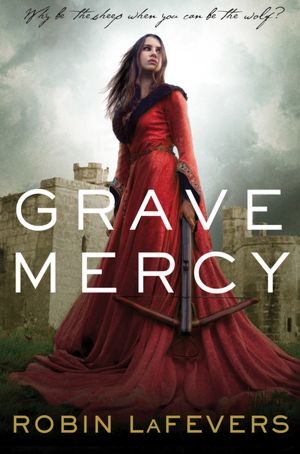
I first read and reviewed Dark Triumph in March 2013. Dark Triumph isn't a book that one necessarily ENJOYS. It's a dark, exposing-ugly-sins historical novel in Robin LaFevers' His Fair Assassin series. (Grave Mercy, which I also recently reread, is the first in the series.)

Both books are dark. Though reading Dark Triumph makes Grave Mercy appear to be light and fluffy. Both books star assassin nuns. Young women trained at a convent who serve Death as a master, who carry out their master's orders, who kill in other words.

Sybella is the heroine in Dark Triumph. Her story is dark, ugly, desperate. She's a strong heroine. She doesn't hold onto hope so much as vengeance. Her will to live comes from a desire--a need--to kill those that have harmed her. The people that have hurt her most are her very own family: her father and brothers. (Readers learn of the events that led her to the convent.) Her father is Lord D'Albret. (A few details are historically accurate--the names of two of his daughters, Charlotte and Louise, for example, but almost everything is fictional. One should not take LaFevers' depiction as fact.)

Dark as it was, as ugly as it was, I enjoyed Sybella as a character. Her story was beautifully told. I especially loved the romance. I loved, loved, loved "The Beast" of Waroch. Their romance was not typical, it was unique and strong and tender and oh-so-right.

© 2014 Becky Laney of Becky's Book Reviews

Sunday, November 09, 2014

Sundays with Jane: Persuasion (1818)

Persuasion. Jane Austen 1818/1992. Knopf Doubleday. 304 pages. [Source: Bought]

Persuasion is my favorite Jane Austen novel. It just is. I believe this is the third time I've reviewed it. April 2011. January 2008. Out of all of Austen's opening lines, I have to admit that Persuasion's first sentence is my least favorite. Wouldn't you agree?

Opening to Sense and Sensibility: The family of Dashwood had long been settled in Sussex.

Opening to Pride and Prejudice: It is a truth universally acknowledged, that a single man in possession of a good fortune, must be in want of a wife.

Opening to Mansfield ParkAbout thirty years ago Miss Maria Ward, of Huntingdon, with only seven thousand pounds, had the good luck to captivate Sir Thomas Bertram, of Mansfield Park, in the county of Northampton, and to be thereby raised to the rank of a baronet's lady, with all the comforts and consequences of an handsome house and large income.

Opening to EmmaEmma Woodhouse, handsome, clever, and rich, with a comfortable home and happy disposition, seemed to unite some of the best blessings of existence; and had lived nearly twenty-one years in the world with very little to distress or vex her. 

Opening to Northanger AbbeyNo one who had ever seen Catherine Morland in her infancy would have supposed her born to be an heroine. Her situation in life, the character of her father and mother, her own person and disposition, were all equally against her. 

Opening to Persuasion: Sir Walter Elliot, of Kellynch Hall, in Somersetshire, was a man who, for his own amusement, never took up any book but the Baronetage; there he found occupation for an idle hour, and consolation in a distressed one; there his faculties were roused into admiration and respect, by contemplating the limited remnant of the earliest patents; there any unwelcome sensations, arising from domestic affairs changed naturally into pity and contempt as he turned over the almost endless creations of the last century; and there, if every other leaf were powerless, he could read his own history with an interest which never failed.

I've already summarized the plot twice before, and, the problem with reread posts is that I have to always (try to) find new ways to say what I've already said.

Anne Elliot is the heroine of Persuasion. If you haven't read Persuasion before let me add this, please, don't expect Anne to be Elizabeth Bennet. Just don't. You'll be happier for letting Anne be Anne and not comparing her to Elizabeth, Emma, Elinor, Marianne, Catherine, or Fanny. Plenty of people misunderstand Anne--the top offenders being her very own family--I don't want you to be one of them. Don't let her family persuade you that Anne is someone to easily dismiss, a nobody.

As I was saying, Anne is the heroine of Persuasion. Eight years before the novel opens, Anne fell in love. It was a forever-love. She wanted to marry Frederick Wentworth. He wanted to marry her too. They loved each other very much. But he had no way to support her. It wasn't just that he couldn't support her in style. Her family disapproved. Her friends disapproved. Long story short, the engagement was broken off. Persuasion is all about her second chance. When Anne and Captain Wentworth meet again, eight years later, can these two come together and make it work, can they have their happily ever after? That is the very simplified version, I suppose! Austen being Austen, there are plenty of characters and stories introduced in Persuasion. It is a very enjoyable read. In places, it is quite giddy-making.

Do you have a favorite Austen hero? Captain Wentworth is perhaps one of the strongest Austen heroes. Of course, everyone is familiar with Darcy. But Wentworth has his fans as well! Perhaps in large part due to his letter to Anne:
I can listen no longer in silence. I must speak to you by such means as are within my reach. You pierce my soul. I am half agony, half hope. Tell me not that I am too late, that such precious feelings are gone forever. I offer myself to you again with a heart even more your own than when you almost broke it eight years and a half ago. Dare not say that a man forgets sooner than woman, that his love has an earlier death. I have loved none but you. Unjust I may have been, weak and resentful I have been, but never inconstant. You alone have brought me to Bath. For you alone I think and plan. (234)
Personally, I love Henry Tilney, Mr. Knightley, and Captain Wentworth.

Favorite quotes:
Excepting one short period of her life, she had never, since the age of fourteen, never since the loss of her dear mother, known the happiness of being listened to, or encouraged by any just appreciation or real taste.
No, it was not regret which made Anne’s heart beat in spite of herself, and brought the colour into her cheeks when she thought of Captain Wentworth unshackled and free. She had some feelings which she was ashamed to investigate. They were too much like joy, senseless joy!
She hoped to be wise and reasonable in time; but alas! alas! she must confess to herself that she was not wise yet.

© 2014 Becky Laney of Becky's Book Reviews
Friday, November 07, 2014

Reread #45 Countdown

Countdown by Deborah Wiles. 2010. May 2010. Scholastic. 400 pages. [Source: Review copy]

I first read and reviewed Deborah Wiles' Countdown in 2010. I loved, loved, loved this documentary novel. If you love historical fiction, or, if you love coming of age stories, you should consider reading this one. It's a great read.

1962. October 1962. The world waits. Will there be war? Can the situation in Cuba be resolved peaceably? Or is this the beginning of the end?

Franny Chapman is the heroine of Countdown. She's eleven. She feels like she's invisible. She feels persecuted. Her sister assures her these feelings are completely normal. Franny herself isn't too sure. Franny struggles with issues big and small in this novel. Of course, there is the shared experience of worrying about the Cuban Missile Crisis. (Franny knows that everyone--adults and kids alike--is worried about this.) But of a more personal nature, Franny is struggling with several things. First, her forever-best-friend, Margie, is acting strange, different. Franny wonders if the two will be able to stay friends. It's more than just drifting apart. Margie seems to suddenly hate her. Second, Franny is worried about Uncle Otts (is he her great-uncle?). He's getting older. His mind isn't always great at distinguishing between past and present. The threat of war isn't helping matters any. He has his own way of reacting to threats and dangers. And to Franny, those ways are just EMBARRASSING, extremely embarrassing. Third, Franny finds herself in love with the boy next door. (His name is Chris. Many girls find themselves in love with Chris).

Readers see Franny at home, at school, at play. I loved meeting Franny and her family. I loved how the novel was put into context through the format itself. This documentary novel is packed with images, photographs, quotes, lyrics. (Everything from photographs of JFK and other world leaders, other politicians, other leaders to Miss America, to images from the Civil Rights movement, to a cover of a Nancy Drew novel.) So while Countdown is a novel, it also serves as a scrapbook. (You can see some of what the book looks like on the author's blog.) I think this one does a good job of capturing a time, a place in American history. It is rich in detail. (For example, I loved hearing about the wonder, the novelty of McDonald's hamburgers--for Franny and her family.)

Quotes:
Jo Ellen has the world's best 45-rpm record collection. Since I can remember, I've sprawled across her big bed when she's in her room doing homework or talking on the phone to her girlfriends, and Jo Ellen has let me play her records, as long as I don't get fingerprints on them or let the needle scratch them. I'm not allowed to touch her albums, but the 45s she lets me rifle through to my heart's content.
I've memorized the geography of every one of those records. "Johnny Angel" has a yellow label, "Twistin' the Night Away" has a tiny scratch at the beginning edge, and "Runaway," which is my current favorite, by my favorite singer, Del Shannon, has a heart drawn on the label--by me. Jo Ellen doesn't know this yet. (75-76)
 My first concrete remembrance of church is going to revival with Miss Mattie in Halleluia, Mississippi. I like revival. It's entertaining. I know almost every hymn in the Methodist hymnal by heart, every verse, and I can play most of them on the piano.
Revival lasts two weeks, so we go every night to church, and every night there is tarnation preaching and seventeen verses of "Just As I Am," until someone walks up to the altar to be saved.
Trouble is, Halleluia is a small town, and most everybody in church has already been saved. So unless somebody new shows up, or an older kid is pushed into the aisle by his mother, we just sing and sing that hymn, until my grandmother stands up and ambles in her square shoes up the aisle with a half-exasperated look on her face, and gets saved once again. Mostly she is saving all of us, and she knows we know it. (130)
"Nobody's the favorite, Franny," she says. "Of course you're important. Just because they don't broadcast it--"
"You're not around enough to notice," I interrupt, standing up straight. "You're all grown up, you're in college--you have loads of friends--you even have new friends! You can do whatever you want."
"That's certainly not true," says Jo Ellen.
I sigh. "I just want to skip all these years in between and go off to college like you, only I want to live in the dorms like Lannie does."
"This, too, shall pass. You don't know how lucky you are, Franny. You go to a good school, your dad's an officer in the military, you eat, shop, play wherever you choose, you can go to any college you want when you grow up. You've got it made. You're privileged."
I toss the tissue in the trash. "I'm invisible around here. I could disappear for days and nobody would miss me."
Now it's Jo Ellen's turn to sigh. "Franny, you're eleven. That's the problem in a nutshell." She pulls an envelope out of her purse. "Everybody feels persecuted when they're eleven. It will pass." (85)

© 2014 Becky Laney of Becky's Book Reviews

Friday, October 31, 2014

Reread #44 Frankenstein

Frankenstein. Mary Shelley. 1818/1831. Oxford World's Classics. 250 pages. [Source: Bought]

Almost every time I read it, I focus on something new, something that I might have missed, something that I hadn't considered before. I thought I would share my observations with you instead of a traditional review.

Stories. Frankenstein is a story within a story. But it's more than that. It's a text that utilizes stories and storytelling even within that framework. The first story, of course, is the one Robert Walton is communicating to his sister, Margaret, through letters. After the first few letters, Walton stops being so introspective and focuses on telling someone else's story. Victor Frankenstein's story. This is written in the letters in first person, as if Victor himself were telling the story--sharing it. Within that big story, are dozens of little stories. The story of how his parents met. The story of his birth and childhood. The story of how Elizabeth was adopted. The story of how he became interested in science. The story of his mother's death. The story of his going away to university. The story of his madness--his obsession--and how he came to create life. The story of his sickness and recovery. The story of his learning about his brother's death/murder. The story of Justine. You get the idea. Each story is crafted and shaped. These stories are how he sees himself and the world, his place in it. Some of the stories are personal and a vital part of the plot. Other stories are more like asides. But this isn't Victor's story alone. Midway through the book, readers learn the creature's story. Even though this is written in first person though the eyes of the creature--the monster--the words are for better or worse being filtered through Victor Frankenstein's memory. He's telling what the monster said. He's telling what the monster heard. And Robert Walton is then passing along Frankenstein's story of the events and conversations. The creature is a storyteller as well. He recalls his life, his memories, his desires and needs. But he also focuses in particular on one family, one French family living in exile. This section has multiple stories. Including one focusing on a young woman. Though it may seem like an aside to readers, the stories matter very much to the narrator, the creature. The stories are providing for him a framework of the world, of how it works, of what life and love are all about. The stories resonate with the creature. He has seen love. He has seen family. He has seen fellowship and community. Because he has seen this, he feels the lack of it in his own life. But it isn't just the unfolding story that he personally witnesses. He is also shaped by the stories--the words--in the books he oh-so-conveniently is able to read. Words and stories matter. The stories we tell ourselves about ourselves, the stories we share with others, they all matter. For example, I think the story the creature told himself over and over and over again was it is all Victor's fault. He made me. He gave me life. He made me this ugly, this revolting. He made me this large and strong. He left me--he abandoned me. He didn't love me. He never loved me. He rejected me. He made it so everyone would reject me. Why does everyone reject me? It's his fault. It's all his fault. He made me have killing-hands. He made me have killing-thoughts. He didn't show me a better way. He didn't teach me. He didn't raise me. I had to learn everything all by myself. It is his fault. I'm not responsible. Why would I be? It is his fault! If it wasn't for him, I wouldn't be so miserable, so alone, so full of angst. I wouldn't feel pain or hunger or thirst. I wouldn't feel at all. The monster has his Job moments. One last thing, Victor Frankenstein speaks of the power of words, of persuasion. He warns that the creature has a way with words, that he can manipulate people by his persuasiveness. He warns Walton not to let himself be manipulated by the creature's story--his words and pleas. Is there any truth to this? Is the creature trying to masquerade himself as an angel of light? His actions say one thing: he's a killer, a murderer, he premeditates at least some of his crimes. His words say another: no one loves me, everyone runs from me, it's all HIS fault.

Questions. It's hard to read Frankenstein without questions. Who is the real monster? Who should be held responsible? Is there anyone who shouldn't be held responsible? Why is human life valued so little by ego-obsessed people? Why does Walton idolize Frankenstein?

Victor Frankenstein, Robert Walton, and the creature share a few things in common. They are introspective, moody, obsessed, and lonely. True, there are differences in their obsessions. Robert Walton is obsessed with glory, with adventure, with discovering the Northwest Passage. Walton has spent years if not decades obsessed with the North Pole, with the arctic regions. This started as a boy with books, with stories and words. His dream shifted slightly for a brief period of time when he wanted to be a poet, but, ultimately he came back to his first love. He didn't give up his poetic personality/nature however. Victor Frankenstein is first obsessed with science, with electricity, with creating life. This playing God leads to no good--it leads to madness and murder. I believe the madness started long before he was successful. I have never understood how he could piece together this creature--this eight-foot creature--and it is only when he is alive that he realizes that it is monstrous and ugly and unnatural and threatening. Why make it eight-feet? Why make it so unhuman? Regardless, having created life, he then becomes obsessed with destroying it--with murdering his demon-creation, his monster. His only reason to live is to track down and kill the monster. The monster's obsession? Well, he's driven by anger and pain. He wants to HURT Frankenstein. He is acting out, having murderous temper-tantrums all to get the attention of the one who gave him life, his father, his creator. He wants what he can't have. He wants love and acceptance. He wants to belong. He wants companionship and family. He wants to be happy. He wants to be treated fairly and humanely. He doesn't want to be judged based on appearances. He taunts and haunts his creator. He wants Frankenstein to be just as miserable and desperate as he is.

Quotes:

Robert Walton meets Victor Frankenstein:
In the morning, however, as soon as it was light, I went upon deck and found all the sailors busy on one side of the vessel, apparently talking to someone in the sea. It was, in fact, a sledge, like that we had seen before, which had drifted towards us in the night on a large fragment of ice. Only one dog remained alive; but there was a human being within it whom the sailors were persuading to enter the vessel. He was not, as the other traveller seemed to be, a savage inhabitant of some undiscovered island, but a European. When I appeared on deck the master said, "Here is our captain, and he will not allow you to perish on the open sea." On perceiving me, the stranger addressed me in English, although with a foreign accent. "Before I come on board your vessel," said he, "will you have the kindness to inform me whither you are bound?" You may conceive my astonishment on hearing such a question addressed to me from a man on the brink of destruction and to whom I should have supposed that my vessel would have been a resource which he would not have exchanged for the most precious wealth the earth can afford. I replied, however, that we were on a voyage of discovery towards the northern pole. Upon hearing this he appeared satisfied and consented to come on board. Good God! Margaret, if you had seen the man who thus capitulated for his safety, your surprise would have been boundless. His limbs were nearly frozen, and his body dreadfully emaciated by fatigue and suffering. I never saw a man in so wretched a condition. We attempted to carry him into the cabin, but as soon as he had quitted the fresh air he fainted. We accordingly brought him back to the deck and restored him to animation by rubbing him with brandy and forcing him to swallow a small quantity. As soon as he showed signs of life we wrapped him up in blankets and placed him near the chimney of the kitchen stove. By slow degrees he recovered and ate a little soup, which restored him wonderfully. Two days passed in this manner before he was able to speak, and I often feared that his sufferings had deprived him of understanding. When he had in some measure recovered, I removed him to my own cabin and attended on him as much as my duty would permit. I never saw a more interesting creature: his eyes have generally an expression of wildness, and even madness, but there are moments when, if anyone performs an act of kindness towards him or does him any the most trifling service, his whole countenance is lighted up, as it were, with a beam of benevolence and sweetness that I never saw equalled. But he is generally melancholy and despairing, and sometimes he gnashes his teeth, as if impatient of the weight of woes that oppresses him.
 Robert shares his big, big dream with Victor:
I was easily led by the sympathy which he evinced to use the language of my heart, to give utterance to the burning ardour of my soul and to say, with all the fervour that warmed me, how gladly I would sacrifice my fortune, my existence, my every hope, to the furtherance of my enterprise. One man's life or death were but a small price to pay for the acquirement of the knowledge which I sought, for the dominion I should acquire and transmit over the elemental foes of our race. At first I perceived that he tried to suppress his emotion; he placed his hands before his eyes, and my voice quivered and failed me as I beheld tears trickle fast from between his fingers; a groan burst from his heaving breast. I paused; at length he spoke, in broken accents: "Unhappy man! Do you share my madness? Have you drunk also of the intoxicating draught? Hear me; let me reveal my tale, and you will dash the cup from your lips!"

And so it begins...
Yesterday the stranger said to me, "You may easily perceive, Captain Walton, that I have suffered great and unparalleled misfortunes. I had determined at one time that the memory of these evils should die with me, but you have won me to alter my determination. You seek for knowledge and wisdom, as I once did; and I ardently hope that the gratification of your wishes may not be a serpent to sting you, as mine has been. I do not know that the relation of my disasters will be useful to you; yet, when I reflect that you are pursuing the same course, exposing yourself to the same dangers which have rendered me what I am, I imagine that you may deduce an apt moral from my tale, one that may direct you if you succeed in your undertaking and console you in case of failure. He then told me that he would commence his narrative the next day when I should be at leisure. This promise drew from me the warmest thanks. I have resolved every night, when I am not imperatively occupied by my duties, to record, as nearly as possible in his own words, what he has related during the day. If I should be engaged, I will at least make notes. This manuscript will doubtless afford you the greatest pleasure; but to me, who know him, and who hear it from his own lips—with what interest and sympathy shall I read it in some future day! Even now, as I commence my task, his full-toned voice swells in my ears; his lustrous eyes dwell on me with all their melancholy sweetness; I see his thin hand raised in animation, while the lineaments of his face are irradiated by the soul within. Strange and harrowing must be his story, frightful the storm which embraced the gallant vessel on its course and wrecked it—thus!
I've reviewed Frankenstein several times in the past. 2007. 2009. 2010. 2011

© 2014 Becky Laney of Becky's Book Reviews

Friday, October 24, 2014

Reread #43 Grave Mercy

Grave Mercy. Robin LaFevers. 2012. Houghton Mifflin Harcourt. 560 pages. [Source: Review copy]

I have now read Grave Mercy by Robin LaFevers three times. (The first review; the second review.) It is a book that is a pleasure to reread. (Not every book is.) I enjoy Grave Mercy because it is intriguing and compelling.

It is set in Brittany in the late 1480s. You can read more about the time period in which this historical novel is set. One of the central characters is Anne of Brittany. Some might feel it is heavy on politics, but, I enjoyed the politics and the tension.

I wish the author had included more, at the very least more real names. For example, instead of "king of England" or "England's king" I wish she'd named him: Henry VII. There were places she could have been more specific, grounded the book more into history. I'd have LOVED an author's note. I'd have also loved an indication of which characters were historical people and which weren't. 

Grave Mercy is not your traditional historical romance. (Well, now that I think about it. If Philippa Gregory can have witches and curses in her Cousins' War series, and be considered "historical" romance, then Grave Mercy might rightly be included as well.) For those that love, love, love romance, I think there is plenty of it in Grave Mercy. I think that is one of its most satisfying features. For those that love fantasy and/or mythology, I think it has some appeal as well. The heroine, Ismae, is Death's daughter and his handmaiden. She lives in a convent, of sorts, dedicated to serving Death. She is a trained assassin. She kills those that her lord (Death) has marked for death.

One of her assignments brings her close to Duval, the half-brother of Anne of Brittany. They share a common goal: to protect Anne, to protect Brittany. But she's been taught--trained--to trust no one, to love no one. So this assignment will test her certainly!

The book has plenty of action, drama, mystery, and politics.
"Are you drunk?" I try to put as much scorn into my words as he did.
"No. Yes. Perhaps a little. Definitely not enough." The bleakness is back and he turns to stare into the flames.
I am torn between wanting to leave him to wallow in his despair and wanting to rush to his side and chase that look from his eyes. That I long to do this appalls me, sets panic fluttering against my ribs.
"I suggest you return to your room," Duval says, his gaze still fixed woodenly on the fire. "Unless you have come to practice your lessons of seduction on me?" His mouth twists in bitter amusement. "That could well entertain me till sunrise."
I jerk my head back as if I have been slapped. "No, milord. I had thought only to pray for your soul if Madame Hivern had seen fit to poison you. Nothing more." And with that, I turn and flee the room, then bolt the door against the disturbing glimpse of both his soul and mine. Whatever games are being played here, he is master at them, and I will do well to remember that. (155)
"What is my fair assassin so afraid of? I wonder."
"I'm not afraid."
Duval tilts his head to the side. "No?" He studies me a long moment, then rises out of his chair. I hold my breath as he crosses to my bed. "Are you afraid I will draw closer, perhaps?" His voice is pitched low, little more than a purr. My breath catches in my throat, trapped by something I long to call fear but that doesn't feel like fear at all. (174)
His smile flashes, quick and surprising in the darkness. "When one consorts with assassins, one must expect to dance along the edge of a knife once or twice. I bid you good night." (218)

© 2014 Becky Laney of Becky's Book Reviews
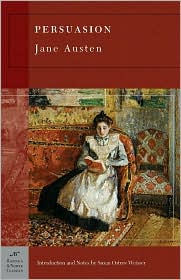
Friday, October 17, 2014

Reread #42 The Eye of the World

The Eye of the World (Wheel of Time #1) Robert Jordan. 1990. Tor. 814 pages. [Source: Bought]

The Wheel of Time turns, and Ages come and pass, leaving memories that become legend. Legend fades to myth, and even myth is long forgotten when the Age that gave it birth comes again. In one Age, called the Third Age by some, an Age yet to come, an Age long past, a wind rose in the Mountains of Mist. The wind was not the beginning. There are neither beginnings nor endings to the turning of the Wheel of Time. But it was a beginning.

The Eye of the World is the first in Robert Jordan's Wheel of Time series. I first reviewed this one in October 2012. I thought the book was promising, that it had great potential. As the first book in a long series, it also serves as an introduction. An introduction not just to the world or to the main characters, but an introduction to the writing style: the details, the descriptions, the narration, the foreshadowing. It also hints at the complexity. Hints. (If you think there are a lot of names--both people and place--to keep up with in the first book, then you should know it only becomes more challenging in later books. It isn't necessarily good or bad that this is so. It just is.)

To keep it very simple, The Eye of the World is a coming-of-age adventure-quest story. It is all about the journey, or, you could just as easily say it is all about the chase. Eye of the World is essentially setting the stage for a big battle between the forces of good and evil.

The Eye of the World introduces readers to a handful of characters. Three young men who could potentially change the world for better or worse: Rand, Perrin, and Mat. Two young women who follow them into danger: Egwene and Nynaeve. Both have significant roles to play in the books ahead. Neither really steal the show in this first book. We learn that both women are able to touch the True Source (One Power) though they've not received training. Both women intrigue Moiraine, the Aes Sedai who has promised to protect them all--to the best of her ability. She knows that the Dark One seeks to destroy these three men, and quite possibly all those that stand in his way. Moiraine and Lan, her warder, will do what they can but they know it will be a continual struggle, a challenge, to stay a step or two ahead of the evil that pursues them.

There are also other characters introduced in this book that I'd like to mention. I love, love, love Loial. He's introduced relatively late in this one. But I adore him! He's an Ogier. There is also Thom Merrilin. He's a gleeman--an entertainer, storyteller, musician, juggler, etc. He travels with this group at the very beginning. There's also a young girl, Min, who is able to a certain degree to see the future. Readers also briefly meet Elayne, Gawyn, and Galad. And Queen Morgase. And the queen's Aes Sedai, Elaida.

It had been two years since I'd read this one. It was interesting to see what I remembered, and what I'd completely forgotten. I liked this one very much upon rereading. I enjoyed so many things about it still.

Quotes:
Not more than twenty spans back down the road a cloaked figure on horseback followed them, horse and rider alike black, dull and ungleaming. It was more habit than anything else that kept him walking backward alongside the cart even while he looked. The rider’s cloak covered him to his boot tops, the cowl tugged well forward so no part of him showed. Vaguely Rand thought there was something odd about the horseman, but it was the shadowed opening of the hood that fascinated him. He could see only the vaguest outlines of a face, but he had the feeling he was looking right into the rider’s eyes. And he could not look away. Queasiness settled in his stomach. There was only shadow to see in the hood, but he felt hatred as sharply as if he could see a snarling face, hatred for everything that lived. Hatred for him most of all, for him above all things.
He was hoping his father had not noticed he was afraid when Tam said, “Remember the flame, lad, and the void.” It was an odd thing Tam had taught him. Concentrate on a single flame and feed all your passions into it—fear, hate, anger—until your mind became empty. Become one with the void, Tam said, and you could do anything.
Strangers and a gleeman, fireworks and a peddler. It was going to be the best Bel Tine ever.
Aes Sedai and wars and false Dragons: those were the stuff of stories told late at night in front of the fireplace, with one candle making strange shapes on the wall and the wind howling against the shutters. On the whole, he believed he would rather have blizzards and wolves. Still, it must be different out there, beyond the Two Rivers, like living in the middle of a gleeman’s tale. An adventure. One long adventure. A whole lifetime of it.
“What kind of need would be great enough that we’d want the Dragon to save us from it?” Rand mused. “As well ask for help from the Dark One.”
“I still think you shouldn’t come,” he said. “I wasn’t making it up about the Trollocs. But I promise I will take care of you.” “Perhaps I’ll take care of you,” she replied lightly. At his exasperated look she smiled and bent down to smooth his hair. “I know you’ll look after me, Rand. We will look after each other. But now you had better look after getting on your horse.”
The Aes Sedai you will find in Tar Valon are human, no different from any other women except for the ability that sets us apart. They are brave and cowardly, strong and weak, kind and cruel, warm-hearted and cold. Becoming an Aes Sedai will not change you from what you are.
But hope is like a piece of string when you’re drowning; it just isn’t enough to get you out by itself.

© 2014 Becky Laney of Becky's Book Reviews