Showing posts with label novellas. Show all posts

Wednesday, February 18, 2026

23. A Canticle for Leibowitz


23. A Canticle for Leibowitz. Walter M. Miller Jr. 1959. 335 pages. [Source: Bought] [4 stars, science fiction, apocalyptic, post-apocalyptic, classic]

First sentence: Brother Francis Gerard of Utah might never have discovered the blessed documents, had it not been for the pilgrim with girded loins who appeared during that young novice's Lenten fast in the desert.

Premise/plot: Canticle for Leibowitz is divided into three parts: "Fiat Homo," "Fiat Lux" and "Fiat Voluntas Tua." Centuries pass between each part, I believe. Essentially what you need to know is that it's post-apocalyptic. The novel opens several centuries (at the very least) after nuclear disaster has wiped out society--at least as we know it. Knowledge is feared and simplicity embraced. A group of monks in the desert cling to what remains of book-knowledge. They memorize. They copy. They wait. They wait knowing that humanity may never be ready for their wisdom. Readers get to know a few monks in each part. The book is not bleak from cover to cover, however, by the end the message is that humanity is incapable of learning from their past mistakes and no matter how many centuries pass, humanity is always its own biggest threat.

My thoughts: This is the first time I ever-ever wished I'd paid more attention in Latin class. Just as Jane Eyre is sprinkled with French, this one is sprinkled with Latin. My general thoughts are that once is not enough to really get everything there is to get. I was reading for big-picture ideas, and not really savoring the details and looking for all possible meanings. My first impression is that it's good, but, depressing. Also thought-provoking.


Favorite quotes:
  • "How can a great and wise civilization have destroyed itself so completely?" "Perhaps," said Apollo, "by being materially great and materially wise, and nothing else." (119)
  • If you try to save wisdom until the world is wise, Father, the world will never have it. (208)
  • It never was any better, it never will be any better. It will only be richer or poorer, sadder but not wiser, until the very last day. (216)
  • The freedom to speculate is essential...(216)
  • Men must fumble awhile with error to separate it from truth, I think--as long as they don't seize the error hungrily because it has a pleasanter taste. (218)
  • If we're born mad, where's the hope of Heaven?" (240)
  • When mass murder's been answered with mass murder, rape with rape, hate with hate, there's no longer much meaning in asking whose ax is the bloodier. Evil, on evil, piled on evil.(259)
  • Too much hope for Earth had led men to try to make it Eden, and of that they might well despair until the time toward the consumption of the world.(264)
  • It is the soul's endurance in faith and hope and love in spite of bodily afflictions that pleases Heaven. (292)
  • The trouble with the world is me. (305)


© 2026 Becky Laney of Becky's Book Reviews

Wednesday, October 09, 2024

81. We'll Prescribe You a Cat

We'll Prescribe You A Cat. Syou Ishida. Translated by E. Madison Shimoda. 2023. 297 pages. [Source: Library] [novellas; international fiction; adult fiction; cats] [4 stars]

First sentence: Shuta Kagawa stood at the end of a shadowy alley, gazing up at a multipurpose building. After getting thoroughly lost, he had finally arrived. 

Premise/plot: We'll Prescribe You a Cat is a collection of loosely connected novellas. Each story features a character that is a little lost, a little out-of-sorts. The character is seeking--though word-of-mouth recommendations--a Clinic for the Soul. Each character believes it is a mental health clinic with doctors and nurses, etc. But the prescriptions ALL turn out to be CATS. Some "patients" are prescribed a cat for a week; others for two weeks. The twist is that this location can *only* be found by those in need. Most people can't find it, or see it. (Think Twilight Zone). 

My thoughts: I love the premise of this one. It is a collection of novellas. The first story by far is the best story (in my opinion). I really was LOVING the first two-thirds of this one. The last two or three novellas, however, left me a bit puzzled and confused. I certainly seemed to be missing the plot in making sense of the story. Perhaps because they were going for a reincarnation theme???? I honestly don't know. I really don't. But the premise is strong. There are cats everywhere. Certainly a good read.


© 2024 Becky Laney of Becky's Book Reviews

Friday, March 08, 2024

31. Across So Many Seas


Across So Many Seas. Ruth Behar. 2024. 272 pages. [Source: Library] [interconnected stories; novellas; historical fiction; mg]

First sentence: The sound of trumpets coming from the direction of our town gates tears me from sleep, my dreams forgotten as I jolt out of bed.

Premise/plot: Across So Many Seas contains four interconnected (three super-connected) historical stories or novellas. The time periods are 1492 (Spain), 1923 (Turkey), 1961 (Cuba), and 2003 (Miami, Florida). 

The novel opens with Benvenida, our twelve-year-old narrator, learning of a new decree. ALL Jews must either a) convert to Christianity b) leave the country [Spain] or c) disobey by staying and risk being hanged. Some of the community--including some of her extended family--do choose to convert. They do not want to leave their homes, businesses, etc. The story chronicles their exodus as they flee their country and seek a new homeland. It's a tough, demanding journey.

The three following stories follow three generations of the same family. Reina, Alegra, and Paloma star in compelling stories of their own. The stories examine coming of age from a Jewish perspective. Though that isn't really doing any of the stories justice. There is great turmoil in the first three stories. In the first, the Jewish population is being persecuted. In the second, the family is living in a newly independent Turkey. In the third, she is coming of age in the midst of Cuba's revolution. The fourth story "closes the circle" or "bridges the gap" the narrator is traveling with her family to Spain to learn more about their cultural history. 

My thoughts: I found this a great read. I really was invested with ALL of the stories. I sped through it. I used to speed through books all the time. As I get older, as my vision worsens, as reading becomes more physically demanding, I don't always give in to "page-turners." But I absolutely loved this one. 

© 2024 Becky Laney of Becky's Book Reviews

Friday, December 08, 2023

188. What You Are Looking For Is In the Library


What You Are Looking For Is In the Library. Michiko Aoyama. Translated by Alison Watts. 2020/2023. 304 pages. [Source: Library] [adult fiction, realistic fiction, books about books, novellas]

First sentence: When Saya sends a text to tell me she has a new boyfriend, I instantly write back: What's he like? But all she replies is: He's a doctor.

Premise/plot: This newly translated novel contains five interconnected novellas. Different protagonists. Varied problems. But all come to the same community library and meet the same reference librarian. Each is recommended a list of books with one quirky book recommendation tagged onto the end that doesn't quite meet their stated search needs. Each receives a gift--something felted--from the librarian. All lives are changed, though perhaps not as dramatically as one might expect. The changes mostly come from within. 

This novella collection celebrates books, libraries, and LIBRARIANS. 

My thoughts: I definitely enjoyed this one. And it went a long way in helping me out of my slump. I don't know it I will stay out of my reading slump. I've been struggling the past few weeks with staying engaged with what I am reading. I loved the focus on BOOKS and reading. I thought the characters were well-developed within the novella format. In fact, you might argue that you learn more about these characters in under a hundred pages than you do some books in four hundred pages. 


© 2023 Becky Laney of Becky's Book Reviews

Wednesday, July 29, 2020

99. And the Last Trump Shall Sound

And the Last Trump Shall Sound. Harry Turtledove. James Morrow. Cat Rambo. 2020. 248 pages. [Source: Review copy]

First sentence of The Breaking of Nations by Harry Turtledove: Nichole Yoshida clicked the remote's channel-up button, first once, then twice.

First sentence of The Purloined Republic by James Morrow: Let's get the snickering over with right away. Yes, I was a porn star.

First sentence of Because It Is Bitter by Cat Rambo: The electric bus was driverless, but you could see the shifting of the driver's wheel back and forth as it adjusted its course, as though someone invisible sat in the seat.

Premise/plot: And The Last Trump Shall Sound is a collection of three novellas set in the 2030s. It is satire slash dystopia. Each story is rooted in the idea that Presidents Trump and Pence have ruined The United States of America beyond all hope of redemption--the only choice remains is for individual states to secede from the USA and form their own nations.

In the first novella, California, Washington, and Oregon secede from the USA--not without threats and rants from President Pence--to form the new nation of Pacifica. (They are not the only states that will secede by the end of the collection, but they are the first three.) The point of view is that Pacifica encapsulates everything good and right and moral...according to a Leftist/Liberal point of view. And the USA encapsulates everything evil, repugnant, and disgusting. To be Southern, to be Christian, to be Conservative, to be Republican, well, you might as well not have a soul, not even be a human being. You are evil, evil, evil, evil, evil. Did you get the idea that you're EVIL. There are no nuances allowed in this satire/dystopia. You can't be a Christian and espouse Christian values and morals and ethics AND question the character and integrity of Trump/Pence. No, if you're a Christian then you are 100% team Republican all the way. Not only team Republican, but TEAM TRUMP AND TEAM PENCE. (As if Republicans aren't divided in some ways about these two). And it's not a good thing to be Christian in this one, no, it automatically makes you evil because you must breathe hate in and out all day long. Again no nuances allowed. Same thing with Southern states. To be born in the South is to automatically be a hater and all kinds of backward. I would assume there's also bias in being WHITE and or white and male and being evil. But by this point, just assume that if you're not well left of anything moderate and common sense then you are just EVIL. There are three stories in all. The first establishes the world that all three are set in. The first story is definitely the weakest--in my opinion.

In the second novella, Polly Nightingale (former porn star) goes undercover for Pacifica and impersonates Reverend Walker Lambert, an advisor to President Pence. Her mission is to speak for the Lord (not really) and convince President Pence to do crazy, outlandish, ridiculous things that even the totally evil people who remain in the USA will find repugnant. Since they are so "warped" in their thinking, Pence's words and actions must be really, really, really, really really out there. Her visions from the Lord must be convincing enough to fool Pence. The climax of this one involves a "supernatural" resurrection of a certain somebody....

In the third novella, Ernst, a worker for GoogleSoft finds himself in a bit of a mess as he leaves the relative safety of Pacifica to venture into the United States pursuing a person who stole his life's work (a research project first started by his grandmother).

My thoughts: I would not recommend this book for Christians, not because I believe--as the authors must???--that ALL Christians must by default be Trump/Pence supporters and be Team Republican until their dying breaths...and maybe even beyond. I would not recommend this book for Christians because it uses crude language, is condescending in its general tone and assumptions, and lacks the depth of being thought provoking. I'm fine completely with critiquing the system and offering political commentary. Political commentary isn't unwelcome--nor is satire, if it's good. Satire, in my opinion, should hold a kernel of truth with some mocking humor. The absolute best writers of satire are equal opportunists--they know that there is plenty worth poking on both sides: Republican and Democrat, Liberal and Conservative, Left and Right, etc. I can laugh at both sides most of the time. I'm not so team anything that I can't find humor in dark and dry places.

The best dystopias have some subtlety thrown in. They draw you into the story in some delightfully creepy ways. Think Twilight Zone, for example. The created worlds can be bizarre, super bizarre, oppressive, weird, horrifying--combinations of all the above. But there is usually some subtlety. Think The Giver...one of the best in the genres. Or think 1984 or Fahrenheit 451. Again the best of the best of the best. This book lacks any hint of subtlety. I would say it would be like applying lipstick with a paintbrush. A smaller brush would do a better job.

This book isn't great at being satire or great at being a dystopia. I will say this....the third story is the best of the three. I would actually rate the third story by itself as closer to four stars. The other two stories--I'm being generous with one and two stars respectively. If all three stories were as clever and as well written as the third story, I would give the book a higher rating.

The book felt lazy to me.


© 2020 Becky Laney of Becky's Book Reviews
Monday, April 20, 2020

57. A Pleasure to Burn

A Pleasure To Burn: Fahrenheit 451 Stories. Ray Bradbury. 2010. Subterranean Press. 400 pages. [Source: Library] [Short stories; Novellas]


A Pleasure to Burn is a collection of stories and novellas that show the progression of an idea that would become an unforgettable classic, a masterpiece: Fahrenheit 451 by Ray Bradbury. Readers can trace this development as they read each story or novella. The two pieces that come closest are Long After Midnight and The Fireman.

It includes

  • The Reincarnate (After awhile you will get over the inferiority complex. Maybe. There's nothing you can do about it. Just be careful to walk around at night. The hot sun is certainly difficult on you.)
  • Pillar of Fire (He came out of the earth, hating. Hate was his father; hate was his mother. It was good to walk again. It was good to leap up out of the earth, off of your back, and stretch your cramped arms violently and try to take a deep breath. He tried. He cried out. He couldn't breathe. He flung his arms over his face and tried to breathe. It was impossible. He walked on the earth, he came out of the earth. But he was dead.)
  • The Library (The people poured into the room. Health officials reeking of disinfectant, sprinklers in their hands. Police officials, fierce with blazing badges.)
  • Bright Phoenix (One day in April 2022, the great library door slammed flat shut. Thunder. Hello, I thought. At the bottom step glowering up at my desk, in a United Legion uniform which no longer hung as neatly upon him as it had twenty years before, stood Jonathan Barnes.)
  • The Mad Wizards of Mars (Their eyes were fire and the breath flamed from out the witches' mouths as they bent to probe the cauldron with greasy stick and bony finger.)
  • Carnival of Madness ("During the whole of a dull, dark and soundless day in the autumn of the year, when the clouds hung oppressively low in the heavens, I had been passing alone on horseback, through a singularly dreary tract of country, and at length found myself, as the shades of evening drew on, within view of the melancholy House of Usher..." Mr. William Stendahl paused in his quotation. There, upon a low black hill, stood the house, its cornerstone bearing the inscription: 2249 A.D.)
  • Bonfire (The thing that bothered William Peterson most was Shakespeare and Plato, and Aristotle, and Jonathan Swift and William Faulkner and the poems of Weller, Robert Frost perhaps and John Donne and Robert Herrick. All of these, mind you, tossed into the Bonfire.)
  • The Cricket on the Hearth (The door slammed and John Martin was out of his hat and coat and past his wife as fluently as a magician en route to a better illusion.)
  • The Pedestrian (To enter out into that silence that was the city at eight o'clock of a misty evening in November, to put your feet upon that buckling concrete walk, to step over grassy seams and make your way, hands in pockets, through the silences, that was what Mr. Leonard Mead most dearly loved to do.)
  • The Garbage Collector (This is how his work was: He got up at five in the cold dark morning and washed his face with warm water if the heater was working and cold water if it the heater was not working.)
  • The Smile (In the town square the queue had formed at five in the morning, while cocks were crowing far out in the rimed country and there were no fires. All about, among the ruined buildings, bits of mist had clung at first, but now with the new light of seven o'clock it was beginning to disperse. Down the road, in twos and threes, more people were gathering in for the day of marketing, the day of festival.)
  • Long After Midnight (Mr. Montag dreamed. He was an old man hidden with six million dusty books. His hands crawled, trembling, over yellow pages, and his face was a smashed mirror of wrinkles by candlelight. Then, an eye at the keyhole! In his dream, Mr. Montag yanked the door. A boy fell in.)
  • The Fireman (The four men sat silently playing blackjack under a green droplight in the dark morning. Only a voice whispered from the ceiling: "One thirty-five a.m. Thursday morning, October 4th, 2052 A.D. One forty a.m....one fifty..." Mr. Montag sat stiffly among the other firemen in the fire house, heard the voice-clock mourn out the cold hour and the cold year, and shivered.)
It also includes three bonus stories: The Dragon Who Ate His Tail, Sometime Before Dawn, and To The Future.


I really LOVED some of these stories. I don't know that I love Long After Midnight and The Firemen MORE than Fahrenheit 451. But I love them all the same.


© 2020 Becky Laney of Becky's Book Reviews

Monday, December 11, 2017

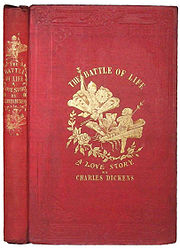
The Battle of Life

The Battle of Life. Charles Dickens. 1846. 88 pages. [Source: Bought]

First sentence: Once upon a time, it matters little when, and in stalwart England, it matters little where, a fierce battle was fought. It was fought upon a long summer day when the waving grass was green.

Premise/plot: Doctor Jeddler has two daughters, Grace and Marion. Marion, the younger daughter, is engaged to Alfred Heathfield. No one could be happier for the couple than Grace. In fact, Grace talks about Alfred morning, noon, and night. The engagement is to be a long one, of several years. As the time nears for Alfred's return, Marion begins acting strangely. This is about the same time that Michael Warden makes plans to leave the country--due to financial disgrace/ruin. Could these two be in love? Perhaps. One thing is certain, Marion does meet secretly with him before Alfred's return. Clemency Newcome, a servant in the home, witnesses this arrangement.

My thoughts: I loved this one. I at least loved it more than I ever thought possible. Dickens introduces some great characters. Dr. Jeddler has a STRANGE philosophy about the meaning of life. As do some of the other characters in this one. (I can't remember now if it was Snitchey or Craggs that philosophizes. But here is the man's philosophy: "Everything appears to me to be made too easy, now-a-days. It’s the vice of these times. If the world is a joke (I am not prepared to say it isn’t), it ought to be made a very difficult joke to crack. It ought to be as hard a struggle, sir, as possible. That’s the intention. But, it’s being made far too easy. We are oiling the gates of life. They ought to be rusty. We shall have them beginning to turn, soon, with a smooth sound.") I really loved Clemency Newcome and Ben Britain, the two servants. They may be my favorite characters in the novella. I hoped that these two would end up together. I was so SATISFIED when they did.

The relationship between Marion and Grace was interesting and strange. I was certainly fooled by Dickens' presentation of Marion. For most of the novella, Marion is portrayed as being completely disinterested in Alfred and matrimony. Certainly there was not any indication that she's madly in love with him. Grace's crush on Alfred was obvious, and once Marion was out of the picture, it was equally obvious that these two would console each other all the way to the altar. Is it a good sign or a bad one that they choose Marion's birthday to be their wedding day?! Marion's big reveal was surprising--when it came. Is it realistic? Is it romantic? Or is it just all kinds of strange?

It did begin in an odd way, I admit. Several pages spent describing in detail a bloody battlefield.  Centuries later--I'm supposing, though it could just be decades--all traces of the battle, of the blood and gore, are gone. What remains is a village full of life.

 Quotes:
My private opinion is, and I hope you agree with me, that we might get on a great deal better than we do, and might be infinitely more agreeable company than we are.
‘Don’t you know it’s always somebody’s birth-day? Did you never hear how many new performers enter on this — ha! ha! ha! — it’s impossible to speak gravely of it — on this preposterous and ridiculous business called Life, every minute?’
She was about thirty years old, and had a sufficiently plump and cheerful face, though it was twisted up into an odd expression of tightness that made it comical. But, the extraordinary homeliness of her gait and manner, would have superseded any face in the world. To say that she had two left legs, and somebody else’s arms, and that all four limbs seemed to be out of joint, and to start from perfectly wrong places when they were set in motion, is to offer the mildest outline of the reality. To say that she was perfectly content and satisfied with these arrangements, and regarded them as being no business of hers, and that she took her arms and legs as they came, and allowed them to dispose of themselves just as it happened, is to render faint justice to her equanimity. Her dress was a prodigious pair of self-willed shoes, that never wanted to go where her feet went; blue stockings; a printed gown of many colours, and the most hideous pattern procurable for money; and a white apron. She always wore short sleeves, and always had, by some accident, grazed elbows, in which she took so lively an interest, that she was continually trying to turn them round and get impossible views of them.
Such, in outward form and garb, was Clemency Newcome; who was supposed to have unconsciously originated a corruption of her own Christian name, from Clementina (but nobody knew, for the deaf old mother, a very phenomenon of age, whom she had supported almost from a child, was dead, and she had no other relation); who now busied herself in preparing the table, and who stood, at intervals, with her bare red arms crossed, rubbing her grazed elbows with opposite hands, and staring at it very composedly, until she suddenly remembered something else she wanted, and jogged off to fetch it.
‘The combatants are very eager and very bitter in that same battle of Life. There’s a great deal of cutting and slashing, and firing into people’s heads from behind. There is terrible treading down, and trampling on. It is rather a bad business.’ ‘I believe, Mr. Snitchey,’ said Alfred, ‘there are quiet victories and struggles, great sacrifices of self, and noble acts of heroism, in it — even in many of its apparent lightnesses and contradictions -not the less difficult to achieve, because they have no earthly chronicle or audience — done every day in nooks and corners, and in little households, and in men’s and women’s hearts — any one of which might reconcile the sternest man to such a world, and fill him with belief and hope in it, though two-fourths of its people were at war, and another fourth at law; and that’s a bold word.’ 
Snitchey and Craggs were the best friends in the world, and had a real confidence in one another; but Mrs. Snitchey, by a dispensation not uncommon in the affairs of life, was on principle suspicious of Mr. Craggs; and Mrs. Craggs was on principle suspicious of Mr. Snitchey. 
‘What! overcome by a story-book!’ said Doctor Jeddler. ‘Print and paper! Well, well, it’s all one. It’s as rational to make a serious matter of print and paper as of anything else. But, dry your eyes, love, dry your eyes. I dare say the heroine has got home again long ago, and made it up all round — and if she hasn’t, a real home is only four walls; and a fictitious one, mere rags and ink. What’s the matter now?’
‘Lor!’ replied his fair companion, with her favourite twist of her favourite joints. ‘I wish it was me, Britain!’ ‘Wish what was you?’ ‘A-going to be married,’ said Clemency. Benjamin took his pipe out of his mouth and laughed heartily. ‘Yes! you’re a likely subject for that!’ he said. ‘Poor Clem!’ Clemency for her part laughed as heartily as he, and seemed as much amused by the idea. ‘Yes,’ she assented, ‘I’m a likely subject for that; an’t I?’ ‘YOU’LL never be married, you know,’ said Mr. Britain, resuming his pipe. ‘Don’t you think I ever shall though?’ said Clemency, in perfect good faith. Mr. Britain shook his head. ‘Not a chance of it!’ ‘Only think!’ said Clemency. ‘Well! — I suppose you mean to, Britain, one of these days; don’t you?’
‘I can’t help liking you,’ said Mr. Britain; ‘you’re a regular good creature in your way, so shake hands, Clem. Whatever happens, I’ll always take notice of you, and be a friend to you.’ ‘Will you?’ returned Clemency. ‘Well! that’s very good of you.’ ‘Yes, yes,’ said Mr. Britain, giving her his pipe to knock the ashes out of it; ‘I’ll stand by you. Hark! That’s a curious noise!’
A month soon passes, even at its tardiest pace. The month appointed to elapse between that night and the return, was quick of foot, and went by, like a vapour. The day arrived. A raging winter day, that shook the old house, sometimes, as if it shivered in the blast.
We count by changes and events within us. Not by years.

© 2017 Becky Laney of Becky's Book Reviews
Saturday, December 09, 2017

The Cricket on the Hearth

The Cricket on the Hearth. Charles Dickens. 1845. 84 pages. [Source: Bought]

First sentence: The kettle began it! Don’t tell me what Mrs. Peerybingle said. I know better. Mrs. Peerybingle may leave it on record to the end of time that she couldn’t say which of them began it; but, I say the kettle did. I ought to know, I hope! The kettle began it, full five minutes by the little waxy-faced Dutch clock in the corner, before the Cricket uttered a chirp.

Premise/plot: This novella doesn't have chapters, it has chirps. Readers meet a happily married couple with a baby: Mr. and Mrs. Peerybingle. (His name is John. Her name is Dot). The couple's wedding anniversary is nearing, and an acquaintance of theirs is soon to be wed. But Tackleton, the groom-to-be is nothing like John. And the bride-to-be, May, is not in love. Tackleton knows this, and is rather proud. He feels Mr. Peerybingle is foolish for loving his wife as he does, and plants seeds of doubt in his mind. Does Dot really truly love him? Or is he blinded by his own love for her? Could his wife even be carrying on with another man behind his back?!

Mr. Peerybingle is not quite as bad as Othello in terms of jealousy. But is that because he's got a Cricket in the hearth watching over his home and preventing the worst of it?! Perhaps. His wife is keeping a secret from her husband, but, it's a good secret. One concerning a friend. She isn't the only one with a secret that's a burden.

Caleb Plummer has been lying to his blind daughter, Bertha, for YEARS. The biggest lie of all is that the man who employs them to make toys--Tackleton--is a kind, good, pleasant man. The problem is, he's mean, inconsiderate, and extremely UNpleasant. She's fallen in love with a lie--a man of her father's creation. Her heart is breaking that Tackleton is marrying.

With Dot's help, Caleb is going to tell her the truth. John will learn the truth as well; some details come from his wife, but others come from the Cricket and the household fairies.

Will May and Tackleton marry? Or does the day hold surprises of its own?

My thoughts: This was my first time to read The Cricket on the Hearth. It had its worrying moments. In the hand of Thomas Hardy, I don't think I could have gone on. John has to walk down a dark valley and be sorely tempted. This one could easily have gone the way of Othello. Fortunately, Dickens did not go that route! Perhaps because this one provides such a contrast of human emotion, the happy ending was all the more joyful.

Favorite quotes:
  • The kettle had had the last of its solo performance. It persevered with undiminished ardour; but the Cricket took first fiddle and kept it. Good Heaven, how it chirped! Its shrill, sharp, piercing voice resounded through the house, and seemed to twinkle in the outer darkness like a star. There was an indescribable little trill and tremble in it, at its loudest, which suggested its being carried off its legs, and made to leap again, by its own intense enthusiasm. Yet they went very well together, the Cricket and the kettle. The burden of the song was still the same; and louder, louder, louder still, they sang it in their emulation.
  • When she came back, and sat down in her former seat, the Cricket and the kettle were still keeping it up, with a perfect fury of competition. The kettle’s weak side clearly being, that he didn’t know when he was beat. There was all the excitement of a race about it. Chirp, chirp, chirp! Cricket a mile ahead. Hum, hum, hum — m — m! Kettle making play in the distance, like a great top. Chirp, chirp, chirp! Cricket round the corner. Hum, hum, hum — m — m! Kettle sticking to him in his own way; no idea of giving in. Chirp, chirp, chirp! Cricket fresher than ever. Hum, hum, hum — m — m! Kettle slow and steady. Chirp, chirp, chirp! Cricket going in to finish him. Hum, hum, hum — m — m! Kettle not to be finished. Until at last they got so jumbled together, in the hurry-skurry, helter-skelter, of the match, that whether the kettle chirped and the Cricket hummed, or the Cricket chirped and the kettle hummed, or they both chirped and both hummed, it would have taken a clearer head than yours or mine to have decided with anything like certainty.
  • Tackleton the Toy-merchant, pretty generally known as Gruff and Tackleton — for that was the firm, though Gruff had been bought out long ago; only leaving his name, and as some said his nature, according to its Dictionary meaning, in the business — Tackleton the Toy-merchant, was a man whose vocation had been quite misunderstood by his Parents and Guardians.
  • ‘We have arranged to keep our Wedding-Day (as far as that goes) at home,’ said John. ‘We have made the promise to ourselves these six months. We think, you see, that home —’ ‘Bah! what’s home?’ cried Tackleton. ‘Four walls and a ceiling! (why don’t you kill that Cricket? I would! I always do. I hate their noise.) There are four walls and a ceiling at my house. Come to me!’ ‘You kill your Crickets, eh?’ said John. ‘Scrunch ’em, sir,’ returned the other, setting his heel heavily on the floor. ‘You’ll say you’ll come? it’s as much your interest as mine, you know, that the women should persuade each other that they’re quiet and contented, and couldn’t be better off. I know their way. Whatever one woman says, another woman is determined to clinch, always. There’s that spirit of emulation among ’em, sir, that if your wife says to my wife, “I’m the happiest woman in the world, and mine’s the best husband in the world, and I dote on him,” my wife will say the same to yours, or more, and half believe it.’
  • Caleb and his daughter were at work together in their usual working-room, which served them for their ordinary living-room as well; and a strange place it was. There were houses in it, finished and unfinished, for Dolls of all stations in life. Suburban tenements for Dolls of moderate means; kitchens and single apartments for Dolls of the lower classes; capital town residences for Dolls of high estate. Some of these establishments were already furnished according to estimate, with a view to the convenience of Dolls of limited income; others could be fitted on the most expensive scale, at a moment’s notice, from whole shelves of chairs and tables, sofas, bedsteads, and upholstery. The nobility and gentry, and public in general, for whose accommodation these tenements were designed, lay, here and there, in baskets, staring straight up at the ceiling; but, in denoting their degrees in society, and confining them to their respective stations (which experience shows to be lamentably difficult in real life), the makers of these Dolls had far improved on Nature, who is often froward and perverse; for, they, not resting on such arbitrary marks as satin, cotton-print, and bits of rag, had superadded striking personal differences which allowed of no mistake.
  • When, suddenly, the struggling fire illumined the whole chimney with a glow of light; and the Cricket on the Hearth began to Chirp! No sound he could have heard, no human voice, not even hers, could so have moved and softened him. The artless words in which she had told him of her love for this same Cricket, were once more freshly spoken; her trembling, earnest manner at the moment, was again before him; her pleasant voice — O what a voice it was, for making household music at the fireside of an honest man! — thrilled through and through his better nature, and awoke it into life and action.
  • ‘All things that speak the language of your hearth and home, must plead for her!’ returned the Cricket. ‘For they speak the truth.’
  • Friends, one and all, my house is very lonely to-night. I have not so much as a Cricket on my Hearth. I have scared them all away. Be gracious to me; let me join this happy party!’ He was at home in five minutes. You never saw such a fellow. What HAD he been doing with himself all his life, never to have known, before, his great capacity of being jovial! Or what had the Fairies been doing with him, to have effected such a change!

© 2017 Becky Laney of Becky's Book Reviews
Sunday, March 29, 2015

The Rector (1863)

The Rector. Margaret Oliphant. 1863. 30 pages. [Source: Bought]

The Rector is a short novella set in the town of Carlingford. Readers meet Morley Proctor, the new rector. Is he the right man for the job? Only time will tell for sure. But his own doubts grow as he gets acquainted with everyone in town, and he realizes the expectations that everyone has of him.

For example, he's expected to pay pastoral visits, to sit and comfort and counsel the sick and dying. He's partly disgusted and partly ashamed. For he hasn't a clue what to say to anyone. He's asked questions and he doesn't have a clue how to talk to people, how to minister or shepherd. He realizes that he has no idea HOW to do his job. He realizes that he's better off as a scholar, keeping his head in books, and away from the practical needs of the people.

I read Miss Marjoribanks first. I'll be reviewing that one in April. This is the first in the series. It is short and not nearly as engaging or satisfying. But I am glad I read it.

© 2015 Becky Laney of Becky's Book Reviews

Friday, February 27, 2015

Lilies of the Field (1962)

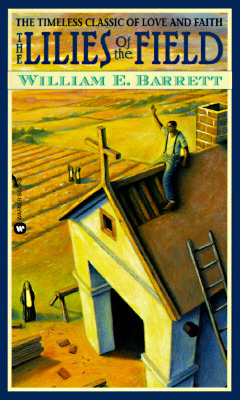
The Lilies of the Field. William Edmund Barrett. 1962/1988. Grand Central Publishing. 128 pages. [Source: Gift]

There is a young legend developing on the west side of the mountains. It will, inevitably, grow with the years. Like all legends, it is composed of falsehood and fact. In this case, the truth is more compelling than the trappings of imagination with which it has been invested. The man who has become a legendary figure was, perhaps, of greater stature in simple reality than he ever will be in the oft-repeated, and expanded, tales which commemorate his deeds. Here before the whole matter gets out of hand, is how it was...
His name was Homer Smith. He was twenty-four. He stood six foot two and his skin was a deep, warm black.

 If you love, love, LOVE the movie--or if you only like it--you should treat yourself and read the book. How does it compare with the movie? Is it as wonderful? as magical? as perfect? I'm not exactly sure it's fair to compare the two. I can easily say it's well worth reading. I loved meeting Homer Smith. I loved meeting all the nuns. I loved seeing Homer at work. I loved his interactions with the sisters, especially seeing him teach them English. There are so many delightful and wonderful things about the book AND the movie. The book isn't better than the movie, in my opinion, but it is at least as good as the movie which is saying something. (My expectations for this one were very high!)

So in case you're unfamiliar with the movie starring Sidney Poitier, here's the basic plot: Homer Smith is a man who likes his independence. He's traveling the country in his station wagon, and, he's a handy man of sorts. He stops when and where he likes and he finds work. He does a few odd jobs for some German nuns. One of them feels that Homer is God's answer to her prayers. She feels that Homer has come specifically to build them a church. Though they don't have enough money or enough resources, they have faith that it will happen and that Homer is the man for the job. Can one man build a chapel?!

So Homer Smith is a delightful character. And the book is a great read.

© 2015 Becky Laney of Becky's Book Reviews
Sunday, December 14, 2014

My Year with Jane: A Darcy Christmas

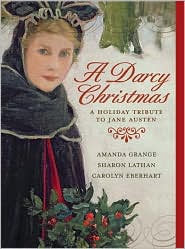
A Darcy Christmas: A Holiday Tribute to Jane Austen. By Amanda Grange, Carolyn Eberhart, and Sharon Lathan. 2010. Sourcebooks. 304 pages. [Source: Library]

I reread two of the three novellas in A Darcy Christmas. I reread Amanda Grange's Christmas Present and Carolyn Eberhart's Mr. Darcy's Christmas Carol. I chose not to reread Sharon Lathan's A Darcy Christmas. Each novella was around a hundred pages. A perfect length, in my opinion, for both stories.

Mr. Darcy's Christmas Carol is an interesting and often entertaining read starring Austen's characters and borrowing much from Charles Dickens. The premise is simple yet not completely predictable. Mr. Darcy is oh-so-happy that Bingley and Jane have married. But. He's still alone this holiday season. Unlike the original, he did not propose marriage to Elizabeth soon after Bingley and Jane's happy announcement. Georgiana, his sister, wants a new sister, a new particular sister for Christmas. His cousin has made a similar request, a particular new cousin. It isn't that Darcy doesn't still love her, want her, need her. But he's a bit proud and stubborn. So on the Christmas Eve in question, Darcy is visited by the ghost of his father who warns him of his faults and promises the visits of three spirits in the night. He adds that they will come with familiar faces. (Can you guess which "familiar face" is the ghost of Christmas future?)

I have conflicting thoughts on Mr. Darcy's Christmas Carol. On the one hand, there would be scenes and passages where I'm: it works, it really works, I can't believe this is working!!! And then perhaps just a page later, I'm: I take it back, this doesn't work at all, how am I suppose to believe this?! So there were plenty of scenes I liked. I liked how she fit it all together and made it work at least some of the time. It would be hard to fit all the great bits of Pride and Prejudice with all the great bits of A Christmas Carol. So I'm surprised it worked as well as it did actually. I like how one of my favorite scenes of A Christmas Carol is reworked from the beginning to the near-ending. That was something! I don't LOVE this one necessarily. As I mentioned, there are places where it is an almost-but-not-quite. It was a fun idea, perhaps, but not absolutely flawless. I alternated between wanting to shout at the book, and cheering. Still, it's worth reading at least once.

What did I think of Amanda Grange's Christmas Present? I liked it very much!!! I tend to like or love Amanda Grange's Austen adaptations. I think she does a great job with keeping Austen's characters as we know them and love them. She is able to capture the essence of each character. In this novella, readers get a glimpse of their second Christmases. (I believe, the two couples married in November or possibly early December?) Bingley and Jane have a baby. Elizabeth and Darcy are oh-so-close to having a baby as well. But have-her-own-way Elizabeth is insistent that even though she is due to have a baby any day, she is perfectly capable of traveling a few hours by carriage so she can spend the holidays with her family. Darcy gives in, of course. So what does a family Christmas look like? Well, this family Christmas borders on insane! Through half-a-dozen coincidences it seems, that most of the family (minus Georgiana) are brought together to share these few days. Including some you might not be expecting to see: Lady Catherine. Mr. Collins. The novella is comical. It's just a satisfying way to spend an afternoon. Sometimes a good, quick read that is light-hearted fun is just what you need.

This is my final post for "My Year With Jane." Here's a look at all the posts about Jane Austen:
© 2014 Becky Laney of Becky's Book Reviews

Wednesday, January 02, 2013

Sidney Chambers and The Shadow of Death (2012)

Sidney Chambers and the Shadow of Death. James Runcie. 2012. Bloomsbury. 400 pages. (Grantchester Mysteries Series #1)

Canon Sidney Chambers stars in six cozy-mystery novellas set in Britain around 1953-1954. There are six mysteries to be solved; some mysteries include a dead body, others do not: in some it's a case of jewelry theft or kidnapping. Though there are six separate mysteries to be solved, there are a handful of characters whose lives we follow from story to story. Readers get to know the people closest to Chambers, and we also get to see into his personal life. There are two women that intrigue him: the first the widow woman introduced in the first story; the second is a glamorous, sparkly woman introduced in the second story. Amanda, the second woman, gives Sidney a Labrador--a dog he names Dickens.

For readers who enjoy cozy mysteries, cozy historical novels with plenty of detail and well-drawn characters, Sidney Chambers and The Shadow of Death is well worth considering. I didn't love all six stories. But I can easily say that I LOVED about three or four of them. The stories are all different from one another. It was easy to love Sidney Chambers.

My favorite stories were "The Shadow of Death," "A Question of Trust," and "A Matter of Time."

"The Shadow of Death"
Canon Sidney Chambers had never intended to become a detective. Indeed, it came about quite by chance, after a funeral, when a handsome woman of indeterminate age voiced her suspicion that the recent death of a Cambridge solicitor was not suicide, as had been widely reported, but murder. (1)
"A Question of Trust"
It was the afternoon of Thursday 31 December 1953, and a light snow that refused to settle drifted across the towns and fields of Hertfordshire. Sidney was tired, but contented, after the exertions of Christmas and was on the train to London. He had seen the festival season through with a careful balance of geniality and theology and he was looking forward to a few days off with his family and friends. (82)
"First, Do No Harm"
One of the clerical undertakings that Sidney least enjoyed was the abstinence of Lent. The rejection of alcohol between Ash Wednesday and Easter Sunday had always been a tradition among the clergy of Cambridge but Sidney noticed that it neither improved their spirituality nor their patience. In fact, it made some of them positively murderous. (148)
"A Matter of Time"
It was the seventh of May 1954 and Sidney had, at last, perfected the art of boiling an egg. (218)

"The Lost Holbein"
Locket Hall, with its grand E-shaped exterior of Ham Hill stone and mullioned windows, had been built at the beginning of the sixteenth century and was one of the finest stately homes in the vicinity of Cambridge. (282)
"Honorable Men"
Sidney was talking to himself again. 'Vanity, vanity, all is vanity, saith the Preacher,' he muttered as he walked towards the Arts Theatre for the first rehearsal of a modern-dress production of Shakespeare's Julius Caesar. (331)
The second novel in the series, Sidney Chambers and The Perils of The Night, will be released in May 2013.

Read Sidney Chambers and The Shadow of Death
  • If you love mysteries
  • If you love cozy mysteries
  • If you love historical fiction set in Britain (1950s)
  • If you enjoy character-driven novels
  • If you like novellas
© 2013 Becky Laney of Becky's Book Reviews
Friday, November 25, 2011

Christmas in Harmony

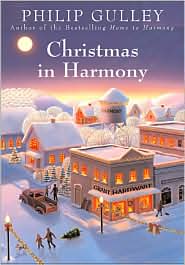
Christmas in Harmony. Philip Gulley. 2002. HarperCollins. 96 pages.

My first memory of Christmas was in 1966. I was five years old and standing in line at Kivett's Five and Dime with my mother and brother, Roger, waiting to see Santa Claus, who looked suspiciously like Bud Matthews, the man in our town who did odd jobs. He smelled like Bud Matthews, too--a blend of Granger pipe tobacco, Old Spice aftershave, and sawdust.

I enjoyed this novella by Philip Gulley. My first introduction to Harmony was Home to Harmony. Home to Harmony is more a collection of short stories about one town--one community, one church--than it is a traditional novel. It introduces readers to some wonderfully eccentric (quirky) characters in a small town. Christmas in Harmony is a novella set within that community of characters. If you haven't met these characters yet, this book is a good place to start. Especially if you are looking for cozy-type Christmas stories. Not that the book is too sweet--far from it! It's very funny, in places, as different members in the congregation have strong opinions on how to have the right Christmas Eve service. One member STRONGLY believing that they should try something new, a progressive live nativity scene, where members drive through town stopping at each place on the map. (One house for the sheep, one house for the shepherds, one house for the wise men, one house for Mary and Joseph, etc. The last stop being of course the place where you find the cocoa and cookies.) Others want a more traditional service--the reading of the nativity in Luke followed by cookies in the basement, I believe. So along with the tension of the present Christmas, there are remembrances of former Christmases. Stories about Christmas trees, shopping, seeing Santa, etc.

I am enjoying reading Philip Gulley, for the most part, and this novella would make a great introduction if you are in a seasonal mood.

© 2011 Becky Laney of Becky's Book Reviews
Tuesday, June 07, 2011

Three At Wolfe's Door

Three at Wolfe's Door. Rex Stout. 1960. Viking. 186 pages.

First sentence from Poison a la Carte: I slanted my eyes down to meet her big brown ones, which were slanted up.
First sentence from Method Three for Murder: When I first set eyes on Mira Holt, as I opened the front door and she was coming up the seven steps to the stoop, she was a problem, though only a minor one compared to what followed.
First sentence from The Rodeo Murder: Cal Barrow was standing at the tail end of the horse with his arm extended and his fingers wrapped around the strands of the rope that was looped over the horn of the cowboy saddle.

Three At Wolfe's Door--a Nero Wolfe Threesome--contains three novellas: Poison A La Carte, Method Three for Murder, The Rodeo Murder. Two of the three entertained me: Poison A La Carte and Method Three For Murder. (The third, well, let's just say that Rex Stout's blending of cowboys and cowgirls into New York City wasn't quite to my liking.)

In Poison A La Carte, Archie Goodwin and Nero Wolfe set out to solve which one of the twelve waitresses (or servers) poisoned Vincent Pyle. The evening was supposed to be pure pleasure. A gourmet meal served by lovely young ladies. Each young woman assigned to a guest. But this evening turned deadly, and it is up to these detectives to find out which woman had the greatest motive to commit murder. It's quite a puzzle, but if anyone can solve it...you can trust Nero Wolfe and Archie Goodwin!

Method Three for Murder is perhaps my favorite of this threesome. For it begins with a heated argument of sorts between Archie Goodwin and Nero Wolfe. An argument that ends with Archie leaving Wolfe's employment! On his way out the door, Archie meets a young woman, Mira Holt, who wants to consult with him. She has this question. She tries to make it hypothetical. What if a woman cab driver came back to her cab and discovered a dead body? Of course, Archie, even before seeing the taxi parked in front had his suspicions. But. He takes the case anyway--rushed into a decision perhaps by the arrival of some cops! Can Archie--with the help of Nero Wolfe--solve this mystery?

Rodeo Murder is my least favorite not only of this collection but of all the novels I've read so far. I'm not sure it's worth mention at all.

I enjoyed this one. I'm not sure I loved any of the novellas. Not when comparing them with the other Nero Wolfe novels I've read. Like The Golden Spiders. Like Some Buried Caesar. But I am glad I read it!

My favorite quote from Method Three For Murder:
Over the years at least a thousand people have asked me what the police think, and I appreciate the compliment though I rarely deserve it. Life would be much simpler if I always knew what the police think at any given moment. It's hard enough to know what I think. (95)
My favorite quote from Poison A La Carte:

A young woman to Archie Goodwin:
"I've seen you and I've seen your picture. You like yourself. Don't you?"
"Certainly. I string along with the majority. We'll take a vote. How many of you like yourselves? Raise your hands." (7)


© 2011 Becky Laney of Becky's Book Reviews

Wednesday, December 01, 2010

A Darcy Christmas

A Darcy Christmas: A Holiday Tribute to Jane Austen. By Amanda Grange, Carolyn Eberhart, and Sharon Lathan. Sourcebooks. 304 pages.

From Mr. Darcy's Christmas Carol by Carolyn Eberhart: Old Mr. Darcy was dead to begin with. There is no doubt whatsoever about that. The clergyman, the clerk, the undertaker, and the chief mourner had all signed the register of his burial. His son signed it. And Fitzwilliam Darcy's name was as good as his father's before him. Old Mr. Darcy was as dead as a doornail.

From Christmas Present by Amanda Grange: It is a truth universally acknowledged, that a married man in possession of a good fortune, must be in want of an heir, and Mr. Darcy of Pemberley was just such a man. Moreover, he was soon to have that want satisfied, for his wife, Elizabeth, was expecting their first child.

From A Darcy Christmas by Sharon Lathan: He set the painting onto the sofa, assuring it was well supported before stepping away. He gazed at the canvas, a smile spreading as he looked upon his family. His family. The family created by him and his wife, just as he had dreamt for so many lonely years. They stood on the portico of Pemberley flanked by their precious children on the steps. All of them were smiling at the artist. A sentimental man by nature, he silently examined the newest portrait of his family and lost himself in happy memories.

For the most part, I liked this one. I did. I really enjoyed two of these novellas! And while I wasn't impressed with "A Darcy Christmas" I would still recommend this collection.

"Mr. Darcy's Christmas Carol" was surprisingly fun. I had my doubts--as you might have your doubts about weaving these two stories together--but I thought it worked. It does a slight variation on the original. What if Jane and Charles Bingley got their happily ever after--after Lydia was "rescued" by Mr. Darcy's intervention--but Mr. Darcy's pride was still in the way of his declaring his love (the second time). This is what that first Christmas might have been like. If he'd been visited by the spirits of Christmas past, present, future.

"Christmas Present" was a great novella by Amanda Grange. I've enjoyed many of her Austen adaptations in the past. This one did not disappoint. She got the characters just right. It felt authentic like what a Darcy Christmas might have *really* been like. Elizabeth and Darcy are expecting their first child, and Charles and Jane just had their first child. So the families are coming together--the extended families--to celebrate. I really enjoyed this one!

"A Darcy Christmas" is a collection of holiday short stories following the Darcy family through twenty or so years of marriage. (I believe we see their twenty-third Christmas as a couple? Although I might have lost track of the last few stories.) Since we only catch glimpses of the family--on Christmas Eve/Christmas--it's hard to precisely follow these stories. We do know that (almost) every Christmas sees Elizabeth either with a new baby or pregnant. (Perhaps these stories do connect to Lathan's previous novels about Elizabeth and Darcy. If that is the case, then the stories might make more sense when it comes to keeping up with their family, friends, etc. Especially in the case of her children's love interests.)

© Becky Laney of Becky's Book Reviews

Tuesday, November 30, 2010

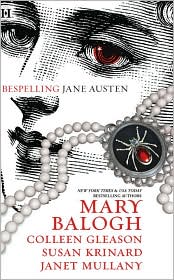
Bespelling Jane Austen

Bespelling Jane Austen. By Mary Balogh, Susan Krinard, Colleen Gleason, Janet Mullany. 2010. Harlequin. 377 pages.

From Almost Persuaded by Mary Balogh: Miss Jane Everett, middle daughter of Sir Horace Everett of Goodrich Hall in Hampshire, did not call as often as she ought at the vicarage in the village nearby. She called everywhere else--on tenants and laborers and others, on those who sick or elderly or in need of any sort. She took her duties very seriously.

From Northanger Castle by Colleen Gleason: Miss Caroline Merrill smoothed her ruffled-hem skirt as she settled into the chair against the wall. She quickly tucked her feet under the seat to keep them from being stepped upon or tripped over, and confirmed that the heavy, bulky reticule still dangled from her wrist. One never knew when one might need one of the accoutrements from within.

From Blood and Prejudice by Susan Krinard: It is a truth universally acknowledged that every decent straight guy who isn't dead broke, is in want of a good woman. As my dear Grandpa Bennet used to say...Bull.

From Little To Hex Her by Janet Mullany: "She turned me into a frog." I bit back the comment that he seemed to have recovered. "I can't tell you how sorry I am, Elton. I know it's no excuse, but it is almost full moon, and Harriet tends to be..." I paused and added a description of my assistant that seemed lame as soon as it was out of my mouth. "Difficult."

Bespelled By Austen is a collection of paranormal novellas "inspired by" four Jane Austen novels. Northanger Castle and Almost Persuaded are historical retellings of Persuasion and Northanger Abbey. (Names and situations have been altered.) Blood and Prejudice and Little To Hex her are modern day adaptations of Pride and Prejudice and Emma. Names have not changed though many aspects of the novel have been updated to reflect a contemporary setting. Each novella is by a different romance novelist. As you can imagine with reading any collection of novellas I have favorites and not so favorites. (My favorites may not be your favorites.)

My thoughts on "Almost Persuaded": I was not almost persuaded to believe in reincarnation. Unfortunately, that seemed to take precedence over the romantic aspects of this retelling of Persuasion. Much of the dialogue between our hero, Captain Mitford, and heroine, Jane Everett, seeming to be about past lives, soul mates, and such. You might not think it would be so intrusive to the text, but I found it to be so. When they weren't talking about the many times they got their love wrong in their past lives, they were doing things that seemed out of place with the historical time period. (Like shedding some clothes to go swimming together, and then getting intimate.) I did NOT like this one at all. Persuasion is my favorite Austen, and to see it "adapted" in this way irritated me.

My thoughts on "Northanger Castle": To be honest, I don't have many thoughts on this one. Unfortunately, I had a headache while reading this one, and I didn't feel a connection with this one. But. I think it was probably my fault. I think I would have been struggling to "enjoy" whatever I was reading at that time.

My thoughts on "Blood and Prejudice": This one was interesting. I thought I wouldn't like the modern-day adaptations. But I found both Blood and Prejudice and Little To Hex Her the best in the collection. Elizabeth, our heroine, finds out a secret about Mr. Darcy--and Mr. Wickham--they're vampires! But she's still doesn't have all her facts straight. Can Elizabeth discover the truth in time to find love for herself and her older sister, Jane? I liked this one.

My thoughts on "Little to Hex Her": This one was my favorite! Dare I say it? This one rivals Clueless for me on my favorite telling of Emma. (Emma is NOT my favorite Austen. I struggled through that one.) Emma, our heroine, is a matchmaker. That's her job. She runs a PARANORMAL dating service. Elton? Well, he's an Elf. Harriet? She's a werewolf. Frank Churchill? A vampire. Jane Fairfax? Well, she's a moody witch. Knightley? Well, he's a wizard. And her ex-boyfriend.  This adaptation was playful and flirty and fun. It worked really well--from the smallest details--"Missy" who can't stop talking about the emails she receives from Jane Fairfax--to the big declaration of love. I just loved this one. It would make a great movie!


© Becky Laney of Becky's Book Reviews
Friday, January 15, 2010

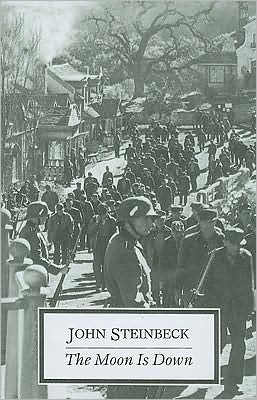
The Moon Is Down


The Moon is Down by John Steinbeck. 1942/1995. Penguin. 144 pages.

By ten-forty-five it was all over. The town was occupied, the defenders defeated, and the war finished.

A novella by John Steinbeck published in the spring of 1942. Set in an unnamed country, an unnamed town even, it features a conquering but-again-nameless army. Of course, it's easy to read between the lines, to see the setting as Northern Europe, and the conquering enemy as the Nazis. And the message of this one is fairly simple. Resist. Resist. Resist. Ordinary people can in very small ways make a difference.

The reader meets a handful of characters on both sides. We get a portrait of those town folks who have been conquered but are determined to fight for their freedom. We get a portrait of the soldiers, the invaders. These soldiers are not as heartless and cruel as evil as you might expect. The picture Steinbeck paints is more human, more complex than that. They are men. Ordinary men who have been given orders, who have been assigned a job to do. For the duration of the war, they have to turn off their emotions, or else go crazy trying to stay on top of them all. The mental crises these soldiers face as the war continues....well, it's disturbing. We see the effect of war on everybody concerned.

How do I feel about this Steinbeck? I liked it. It reminded me of why I love Steinbeck. Of why I love the experience of reading Steinbeck. I love his descriptions, for example.

The paintings on the wall were largely preoccupied with the amazing heroism of large dogs faced with imperiled children. Nor water nor fire nor earthquake could do in a child so long as a big dog was available. (4)


Doctor Winter was a man so simple that only a profound man would know him as profound. (4)


Joseph habitually scowled at furniture, expecting it to be impertinent, mischievous, or dusty. In a world where Mayor Orden was the leader of men, Joseph was the leader of furniture, silver, and dishes. Joseph was elderly and lean and serious, and his life was so complicated that only a profound man would know him to be simple. (4-5)


This is a small book--a novella--about what it means to be a hero; what it is like to fight a war...whether you're a soldier or not.

© Becky Laney of Becky's Book Reviews

Saturday, December 05, 2009

Let It Snow (YA)


Let It Snow: Three Holiday Romances. John Green. Maureen Johnson. Lauren Myracle. Penguin. 352 pages.

Three little novellas await you in this holiday collection: The Jubilee Express by Maureen Johnson, A Cheertastic Christmas Miracle by John Green, and The Patron Saint of Pigs by Lauren Myracle.

These are three somewhat interconnected romances told by some of today's most popular YA authors. So expectations going into this are probably high. And not without reason. It's John Green and Maureen Johnson.

Words can't even begin to describe how wrong Jubilee's Christmas plans are going. She's supposed to be attending her boyfriend's holiday party. (It also happens to be their one year anniversary.) But when she hears the news that her parents--both of her parents--have been arrested and are at that very moment in jail, well, things go downhill from that point. For some reason, Jubilee can't be left home alone for Christmas. So she's sent off--via train--to visit her grandparents on very short notice. But when the big storm stalls the train, Jubilee has to make a few tough decisions...that might just change the direction of her love life.

That's the first story in this collection, and it introduces many of the story lines and characters. There is plenty of humor with the romance. Life is full of awkward moments, and no one does awkward better than these three. Of course, there's plenty of charm as well.

Do yourself a favor, and don't rush the reading experience. I don't know what I was thinking. I just think I probably would have liked this one a bit more if I was less tired.

© Becky Laney of Becky's Book Reviews

Saturday, October 10, 2009

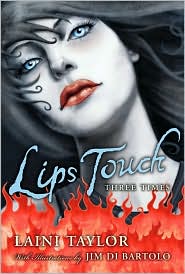
Lips Touch Three Times (YA)


Taylor, Laini. 2009. Lips Touch Three Times. With illustrations by Jim Di Bartolo. Scholastic. 272 pages.

Will I close my eyes?
Will I hold my breath?
Will I wanna cry?
Will our souls connect?
I've been thinking about it when I go to bed
at night I wonder - wonder.

--Mandy Moore, "First Kiss"

Lips Touch Three Times is a collection of three novellas by the oh-so-amazing Laini Taylor. Goblin Fruit. Spicy Little Curses Such As These. Hatchling. Each story revolves around a kiss. Sometimes for good; sometimes for bad.

Are you familiar with Christina Rossetti's Goblin Market? Goblin Fruit uses that story quite cleverly as a basis. If you're already a fan of Goblin Market, I don't know how you could resist this little story. If you're unfamiliar with the original, give this one a try. Trust me. And maybe just maybe you'll want to go back and read Rossetti at some point.

First paragraph of Goblin Fruit:

There is a certain kind of girl the goblins crave. You could walk across a high school campus and point them out: not her, not her, her. The pert, lovely ones with butterfly tattoos in secret places, sitting on their boyfriends' laps? No, not them. The girl watching the lovely ones sitting on their boyfriends' laps? Yes.
Them.
The goblins want girls who dream so hard about being pretty their yearning leaves a palpable trail, a scent goblins can follow like sharks on a soft bloom of blood. The girls with hungry eyes who pray each night to wake up as someone else. Urgent, unkissed, wishful girls.
Like Kizzy. (13)
Kizzy, no questions asked, has a weird family. She grew up listening to her grandmother tell stories about goblins. And her grandmother believed them. Does Kizzy? Everything she knows will be put to the test when Kizzy attracts the attention of the new boy, the oh-so-dreamy new boy at school.

Spicy Little Curses Such As These is the second novella in the collection. And it *may* just be my favorite of the three.

First paragraph of Spicy Little Curses Such As These:

Kissing can ruin lives. Lips touch, sometimes teeth clash. New hunger is born with a throb and caution falls away. A cursed girl with lips still moist from her first kiss might feel suddenly wild, like a little monsoon. She might forget her curse just long enough to get careless and let it come true. She might kill everyone she loves.
She might, and she might not.
A particular demon in India rather hoped that she would.
This is the story of the curse and the kiss, the demon and the girl. It's a love story with dancing and death in it, and singing and souls and shadows reeled out on kite strings. It begins underneath India, on the cusp of the last century when the British were still riding elephants with maharajas and skirmishing on the arid frontiers of the empire.
The story begins in Hell. (69)
This story was a 'wow' one for me. So I don't want to tell too much. I'll just say it's really good and leave it at that. After all, if you're not curious by reading that little intro above, then there's nothing that I can say to persuade you to pick it up! And I don't know about you, but she had me at hello with that name!

The last story is Hatchling. And it is my least favorite of the three. I'm not saying it's a bad story. It may be quite a good story. I don't know. This is one of those where it could be the fact that I was too drowsy to really enjoy it. Or to even understand and appreciate it. Or it could just be that I loved the others so much that this one was a bit of a let down. So it might work for you. (I hope it does!)

Here's how it starts off:

Six days before Esme's fourteenth birthday, her left eye turned from brown to blue. It happened in the night. (145)

It does start off promising, doesn't it?

To set the mood, create the right atmosphere for each novella, each is introduced by a series of illustrations by Jim Di Bartolo. And each novella ends with a closing illustration. (For example, Goblin Fruit has around thirteen pages of illustrations in all.)

This is my first Laini Taylor, but it won't be my last. She has a way with words, a way with fantasy. While not all of the novellas were equally compelling (for me at least), all of them had some oh-so-magical moments. I don't know how to convey just how good she is at creating the right atmosphere for these stories.


Other reviews: Teenreads.com, Reading Rocks, WLS Teens, Em's Bookshelf, Shelf Elf, Charlotte's Library, The Compulsive Reader.

© Becky Laney of Becky's Book Reviews