Showing posts with label John Steinbeck. Show all posts

Tuesday, July 17, 2018

East of Eden

East of Eden. John Steinbeck. 1952. 601 pages. [Source: Bought]
First sentence: The Salinas Valley is in Northern California. 

Premise/plot: East of Eden is near-impossible to summarize in a few sentences. Other than the human condition--the human character itself--I'm not sure it is technically about anything. It examines why we are the way we are, how we justify the choices we make, how easy it is to deceive ourselves and others. Can you ever really know another person and love them unconditionally? Is every person a broken mess? Are some people better at hiding their brokenness?

Cyrus Trask has two sons--each by a different woman. Adam is his first born. Cyrus has IDEAS, fixed ideas about who Adam should be, what Adam should do. Charles is his second son. And Cyrus isn't any better at seeing the real Charles than he is the real Adam. The difference is that Cyrus doesn't even try the tiniest bit to love Charles. Charles from an early age knows that his father doesn't love him the same--treat him the same. And his deep hurt causes him to be mean. Self-control isn't his best quality--especially as a growing boy.

Adam and Charles do come to terms with each other--after their father's death. The two even become surprisingly close considering how volatile the relationship was when they were growing up. But someone does come between them again--a woman.

Cathy. Is Cathy the serpent in the garden of Eden? Perhaps. She's dangerous and manipulative, selfish and controlling. And she becomes the mother of Adam's twin sons: Caleb and Aron.

Caleb and Aron might have easily been orphans or near-orphans. Cathy's flight was interrupted by an extremely shocked Adam. She shot him when he got between her and the door, her and FREEDOM. After he was shot by his wife, he lost the will to live if by living you mean functioning in any normal, healthy way. For the first year--maybe even a little longer--the two boys didn't even have names.

But friends can take the place of family. Enter Samuel Hamilton and Lee. Lee is a "Chinaman" who worked for Adam since he moved to California. (Lee never really liked Cathy, found her unreadable, almost soulless. Samuel, a neighbor, also got a very vibe when around her.) Lee raised the boys, loved them like they were his own flesh and blood. Both Samuel and Lee were able to speak truth--the hard, cold, brutal TRUTH that he desperately needed to hear to wake him up and give him reason to live.

Many years pass in the novel. In fact, most of the novel takes place when Cal and Aron are near-grown sons, in their final years of high school. Readers see that Adam is blind to the fact that he's repeating the exact same mistakes his father made with him and Charles. Oh, he thinks he sees the situation clearly enough NOT to be making those same mistakes. Aron can do no wrong and Adam doesn't see any reason why Aron won't fulfill all his hopes and dreams. Cal's mistakes and brokenness are quite obvious to one and all. He's honest to everyone about his shortcomings. Surprisingly so in many ways. Cal seems all too self-aware; Aron, well, he lives in a dream world of his own making.

A large part of Aron's dream world is ABRA. The two met as children. It didn't take long for Aron to know that she was the one, that she was his storybook love, that their happily ever afters were tied to one another. But this fantasy story isn't enough for Abra. Not when she feels misunderstood and ignored. Aron, she thinks, has no interest in seeing the real her, the flesh-and-blood her, the her that is all-too-human. A future with Aron would mean being or becoming HIS version of Abra. She doesn't want that--but she's not quite sure how to break into Aron's dream world and introduce reality.

Cal accepts reality as is. Oh he has hopes and dreams. One hope is that his father might one day love him as he loves Aron. But he knows that may never happen. Fortunately, Cal has LEE and ABRA to keep him grounded.

Aron's dream world is destined to crash and crumble, and unfortunately Cal is responsible for throwing Aron into the deep end of reality leaving him to sink or swim. He feels that responsibility. One could argue that someone should have taken that responsibility much, much, much earlier. That the secret should never have been a secret that long. Still, it was not done from a place of loving concern but of misdirected anger.

Can Cal ever forgive himself? Can others forgive him too?

My thoughts: I found it a difficult read to get into at first. But by the end I was fully engaged. It is a well-written, thought-provoking read. It touches on the nature versus nurture argument. But what I enjoyed most were the themes of friendship and family.

Quotes:
It doesn't matter that Cathy was what I have called a monster. Perhaps we can't understand Cathy, but on the other hand we are capable of many things in all directions, of great virtues and great sins. And who in his mind has not probed the black water?
Maybe we all have in us a secret pond where evil and ugly things germinate and grow strong. But this culture is fenced, and the swimming brood climbs up only to fall back. Might it not be that in the dark pools of some men the evil grows strong enough to wriggle over the fence and swim free? Would not such a man be our monster, and are we not related to him in our hidden water? It would be absurd if we did not understand both angels and devils, since we invented them. (447)
There are no ugly questions except those clothed in condescension. (482)
"The ways of sin are curious," Samuel observed. "I guess if a man had to shuck off everything he had, inside and out, he'd manage to hide a few little sins somewhere for his own discomfort. They're the last things we'll give up." (484)
When a man says he does not want to speak of something he usually means he can think of nothing else. (586)
Whenever a human has a nickname it is a proof that the name given him was wrong. (588)
"No story has power, nor will it last, unless we feel in ourselves that it is true and true of us." (594)
"IF a story is not about the hearer he will not listen. And I here make a rule--a great and lasting story is about everyone or it will not last. The strange and foreign is not interesting--only the deeply personal and familiar." (596)
In the dawn Dessie was awakened by the chill of pain that came to her at intervals. It was a rustle and a threat of pain; it scampered up from her side and across her abdomen, a nibbling pinch and then a little grab and then a hard catch and finally a fierce grip as though a huge hand had wrenched her. When that relaxed she felt a soreness like a bruise. It didn't last very long, but while it went on the outside world was blotted out, and she seemed to be listening to the struggle in her body. (730)
Nearly everyone has his box of secret pain, shared with no one. (815)
Try to believe that things are neither so good nor so bad as they seem to you now. (829)
Laughter at yourself comes last of all in a mad race with death, and sometimes it isn't in time. (835)
Nobody has the right to remove any single experience from another. Life and death are promised. We have a right to pain. (937)


© 2018 Becky Laney of Becky's Book Reviews

Thursday, February 18, 2010

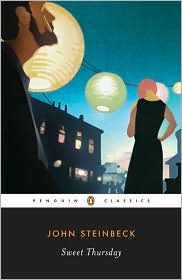
Sweet Thursday


Sweet Thursday. John Steinbeck. 1954. Penguin. 272 pages.

When war came to Monterey and to Cannery Row everybody fought it more or less, in one way or another. When hostilities ceased everyone had his wounds.

Sweet Thursday is the follow-up to Cannery Row. Some characters have carried over to this new novel--some changed by time just a little, others more so, and a few not even a little bit--Doc, Mack, Hazel, and Eddie. (I don't remember if Whitey #1 and Whitey #2 were in Cannery Row or not. They're not really stand-out characters in my mind. So you probably won't see them pop up again in the review anyway.) But readers are also introduced to some new characters, some wonderfully amusing new characters: Suzy, Joseph and Mary (the man who bought Lee Chong's grocery), Fauna (Dora's older sister, the new owner of the Bear Flag), and Joe Elegant (part-time writer, part-time cook; his book was The Pi Root of Oedipus).

There is so much to love about Sweet Thursday. The characters. The humor. The story. The observations of life. The descriptions. The style itself. (Steinbeck has a way with words!)

Some days are born ugly. From the very first light they are no damn good whatever the weather, and everybody knows it. No one knows what causes this, but on such a day people resist getting out of bed and set their heels against the day. When they are finally forced out by hunger or job they find that the day is just as lousy as they knew it would be.
On such a day it is impossible to make a good cup of coffee, shoe strings break, cups leap from the shelf by themselves and shatter on the floor, children ordinarily honest tell lies, and children ordinarily good unscrew the tap handles of the gas range and lose the screws and have to be spanked. This is the day the cat chooses to have kittens and housebroken dogs wet on the parlor rug. (81)
and

The communications system on Cannery Row is mysterious to the point of magic and rapid to the speed of light. (167)

and

It's always hard to start to concentrate. The mind darts like a chicken, trying to escape thinking even though thinking is the most rewarding function of man. (40)
and

Where does discontent start? You are warm enough, but you shiver. You are fed, yet hunger gnaws you. You have been loved, but your yearning wanders in new fields. (19)
and

Change may be announced by a small ache, so that you think you're catching cold. Or you may feel a disgust for something you loved yesterday. It may even take the form of a hunger that peanuts will not satisfy. Isn't overeating said to be one of the strongest symptoms of discontent? And isn't discontent the lever of change? (18)
So what is Sweet Thursday about? It's about a man grown discontented (Doc) and how his friends (Mack, Hazel, Fauna, etc) go about trying to cheer him up. Doc--after the war--is having a midlife crisis of sorts, he's trying to find new purpose in his life. But that isn't always easy. Can he get by with a little help from his friends?

Last spring I read my first Steinbeck novel, Tortilla Flat. It was a novel I just fell in love with. It had me laughing and smiling. It had me wanting more. It was "my favorite and best" Steinbeck until now. I just love, love, loved Sweet Thursday. More than Tortilla Flat. More than Cannery Row. More than Travels with Charley.

Definitely recommended!

© Becky Laney of Becky's Book Reviews

Monday, February 15, 2010

Cannery Row


Cannery Row. John Steinbeck. 1945. Penguin. 208 pages.

Cannery Row in Monterey in California is a poem, a stink, a grating noise, a quality of light, a tone, a habit, a nostalgia, a dream. Cannery Row is the gathered and scattered, tin and iron and rust and splintered wood, chipped pavement and weedy lots and junk heaps, sardine canneries of corrugated iron, honky tonks, restaurants and whore houses, and little crowded groceries, and laboratories and flophouses. Its inhabitants are, as the man once said, "whores, pimps, gamblers, and sons of bitches," by which he meant Everybody. Had the man looked through another peephole he might have said "Saints and angels and martyrs and holy men," and he would have meant the same thing.

I enjoyed this John Steinbeck novel. Steinbeck certainly has a way with words, details, and images. Even if what he is describing is more ugly than beautiful. He has a way of saying it so that it matters. So that you, the reader, care. It does help that this one has a good deal of humor. Not that humor is quite the way I'd put it. (Since early on, we see a suicide or two. But still. It's Steinbeck.)

Lee Chong's grocery, while not a model of neatness, was a miracle of supply. It was small and crowded but within its single room a man could find everything he needed or wanted to live and to be happy--clothes, food, both fresh and canned, liquor, tobacco, fishing equipment, machinery, boats, cordage, caps, pork chops. You could buy at Lee Chong's a pair of slippers, a silk kimono, a quarter pint of whiskey and a cigar. You could work out combinations to fit almost any mood. The one commodity Lee Chong did not keep could be had across the lot at Dora's.
What is Cannery Row about? It's about a surprise party gone wrong. And the men (and women) who come together to make everything right again in the end. Mack and a few of his friends want to do something nice for Doc, one of the town's favorite guys. They think the best way to say that they appreciate him is by throwing him a surprise party. But since they're always down on their luck (in other words low on cash, and not trustworthy enough to extend credit to) they're a bit stumped as to how to go about it. What plan will they come up with?


© Becky Laney of Becky's Book Reviews

Friday, January 15, 2010

The Moon Is Down


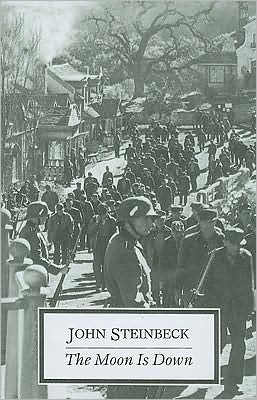
The Moon is Down by John Steinbeck. 1942/1995. Penguin. 144 pages.

By ten-forty-five it was all over. The town was occupied, the defenders defeated, and the war finished.

A novella by John Steinbeck published in the spring of 1942. Set in an unnamed country, an unnamed town even, it features a conquering but-again-nameless army. Of course, it's easy to read between the lines, to see the setting as Northern Europe, and the conquering enemy as the Nazis. And the message of this one is fairly simple. Resist. Resist. Resist. Ordinary people can in very small ways make a difference.

The reader meets a handful of characters on both sides. We get a portrait of those town folks who have been conquered but are determined to fight for their freedom. We get a portrait of the soldiers, the invaders. These soldiers are not as heartless and cruel as evil as you might expect. The picture Steinbeck paints is more human, more complex than that. They are men. Ordinary men who have been given orders, who have been assigned a job to do. For the duration of the war, they have to turn off their emotions, or else go crazy trying to stay on top of them all. The mental crises these soldiers face as the war continues....well, it's disturbing. We see the effect of war on everybody concerned.

How do I feel about this Steinbeck? I liked it. It reminded me of why I love Steinbeck. Of why I love the experience of reading Steinbeck. I love his descriptions, for example.

The paintings on the wall were largely preoccupied with the amazing heroism of large dogs faced with imperiled children. Nor water nor fire nor earthquake could do in a child so long as a big dog was available. (4)


Doctor Winter was a man so simple that only a profound man would know him as profound. (4)


Joseph habitually scowled at furniture, expecting it to be impertinent, mischievous, or dusty. In a world where Mayor Orden was the leader of men, Joseph was the leader of furniture, silver, and dishes. Joseph was elderly and lean and serious, and his life was so complicated that only a profound man would know him to be simple. (4-5)


This is a small book--a novella--about what it means to be a hero; what it is like to fight a war...whether you're a soldier or not.

© Becky Laney of Becky's Book Reviews

Friday, October 02, 2009

Of Mice and Men


Steinbeck, John. 1937. Of Mice and Men. 103 pages.

Short and oh-so-bittersweet. Of Mice and Men is the first Steinbeck that I owned. (Thanks to Jennie!) But I'm glad it wasn't the first that I ever read. (That would be Tortilla Flat.) Because knowing me, if I'd read it first, I don't know that I would have rushed out to read any of his other books. (Does that make me a horrible person?)

Though I'd not read it before, it seemed familiar to me. Without knowing it, I think I'd been exposed to the complex friendship between Lennie and George. These two migrant workers (ranchers) are coming to a new job--having fled their previous one. If you want just a plot summary, there are better places to find it. Because I can't think of ways to describe it without giving everything away.

What I liked about it...

I thought it was well-written. I thought it was complex and intricate. But it wasn't wordy. It didn't need to be in order to have substance and worth. I thought it was clever in its use of foreshadowing for the most part. I thought the characters were well developed and human. I didn't always like them. I didn't always understand them. I found a few to be too gritty. But whether I like them (or not) is not really the point. I felt that they were real. I felt for quite a few of them. These characters (some of them more than others) are tragically drawn. These were men trapped in their circumstances in some ways.

The novel made me sad, but it also made me think. It made me sad because it's a depressing book. A harsh book. A book that examines mental illness. Lennie broke my heart. I wanted there to be a different ending, a happier ending. But the truth is, in that world, in that time, there really couldn't have been a happy ending. Once things were set in motion, there was no going back. And the signs and clues are all there. George couldn't protect Lennie from Lennie. No one could.

So I thought it was good--in a way. But it was a bit too tragic for me to love. (Says the person who finds Frankenstein a comfort read.)

© Becky Laney of Becky's Book Reviews

Wednesday, September 23, 2009

In Which Mom Is Interviewed about Tortilla Flat


To catch up, this interview is part of Me? Read That?! An ongoing mother-daughter challenge where we dare each other to read books. (I pick what she reads; she picks what I read.) This interview is part of the second round. I am asking the questions, mom is answering. The book in question is Tortilla Flat by John Steinbeck. You can read my review of Tortilla Flat that I wrote back in March.

So you've read John Steinbeck before, so you had some idea of what to expect. How do you think Tortilla Flat compares with the other novels you've read by him?

It definitely has a humorous tone. Although it deals with poverty--it does it with sarcasm (mild) and humor. Some of his other works (Grapes of Wrath, The Pearl) deal with tragedy.

What do you think is the book's greatest strength? Do you think the book has any major weaknesses?

Strength: Humor, dialogue, characterizations
Weaknesses: more like a series of short stories instead of a continuous plot.

Do you have a favorite character?

The Pirate and his dogs.

What is your favorite "episode" in the book?

The family with all the kids who got digestive troubles when they ate anything except beans.

Do you think the book is in any way intimidating? Did it change the way you think about 'classics' at all? Do you think it would be a good introduction to Steinbeck?

This book was not intimidating. I've learned not to judge one "classic" by another "classic" written by the same author. I think it would probably be a good introduction to Steinbeck but not a complete picture of the talent of this author.

[I just have to add in mom's first response. "This is considered a classic?!" Which I thought was just cute. No one would hesitate to call Grapes of Wrath or Of Mice and Men or East of Eden classics. I honestly don't know if anyone considers Tortilla Flat a classic or not. It's by an author who is typically valued by the literary community though.]

Were you surprised that my second selection was so "easy" compared to Frankenstein? Are you worried that I'll try to "get you" on the third book?

Yes and yes.


© Becky Laney of Becky's Book Reviews

Thursday, April 16, 2009

To A God Unknown


Steinbeck, John. 1933. To A God Unknown. 186 pages.

Steinbeck seeks the answer to the age-old question, "Can a man love a tree too much?" in his novel To A God Unknown. What? You don't believe me that that is a universal question that everyone is dying to know the answer to? You've never pondered (to yourself or maybe even with a friend) if you could love a tree so much that you begin to worship it?

This novel focuses on the Wayne family. In particular, Joseph Wayne and his brothers. Determined to head west, to settle in California, Joseph disappoints his father, John, and sets out on his own. When Joseph finally arrives, when he finally sets foot on his own land, his own property, he gets a strange feeling. He knows, he feels, that his father has passed. Around the same time, he feels that his father is right there with him, right there watching him, watching the land. He gets the strongest feeling that his father settles into a tree--becomes one with it in a way. So time passes, as it always does, and Joseph convinces his brothers to come and settle near him. To buy adjoining property, to make one large family ranch that they can own all together and settle. And so it begins, at first it's not quite so obvious, the amount of respect, attention, adoration Joseph feels for 'the tree.' But it can't be hidden forever. One brother knows that his brother has lost touch with reality--at least with good Christian faith--when he sees his brother sacrificing wine and food to the tree, leaving offerings under it, sneaking off at night to speak with it. One brother becomes so angry he decides to do the unthinkable....

Does this tree have magical powers? Is Joseph right in assuming that as long as the tree thrives, the ranch will thrive, the family will thrive?

This is one strange book, I'll admit that up front. Joseph is not easily understood. Not by his wife, Elizabeth. Not by his brothers and their wives. Not by his hired hands. Not by the local priest. No, this Joseph is one-of-a-kind. But is he one-of-a-kind crazy? You be the judge!

I don't want to sound too flippant. I think this book has more literary value than I made it sound like in the first paragraph. A lot of symbols, for example. I think it could be discussed and dissected and explored in depth if readers wanted to get every literary drop out of it. I think it builds up on and explores various mythologies and religious symbols. It weaves together a mythology of its own in a way.

Did I like it? Yes and no. It isn't my favorite Steinbeck by any means. I don't think it is his masterpiece. It is his second novel after all. I'm glad I read it. But I'm not going to go out of my way to buy my own copy either.

© Becky Laney of Becky's Book Reviews
If you're reading this post on another site, or another feed, the content has been stolen.

Saturday, March 14, 2009

The Winter of Our Discontent


Steinbeck, John. 1961. The Winter of Our Discontent. 304 pages.

When the fair gold morning of April stirred Mary Hawley awake, she turned over to her husband and saw him, little fingers pulling a frog mouth at her.
"You're silly," she said. "Ethan, you've got your comical genius."
"Oh say, Miss Mousie, will you marry me?"
"Did you wake up silly?"
"The year's at the day. The day's at the morn."
"I guess you did. Do you remember it's Good Friday?"
He said hollowly, "The dirty Romans are forming up for Calvary."


Despite it's rather odd opening, The Winter Of Our Discontent held my interest. It is the story of a man, Ethan Hawley, and his family, his good wife, Mary, his son, Allan, his daughter, Ellen. It's a story of the conflict between ambition and honesty. Ethan has always found himself to be a good man, a just man, an honest man. A man who plays by the rules.

Ethan comes from a legacy, a family with a long history in the area. He's as "established" as he can be. But he's not wealthy. Not anymore. His father lost the family fortune. And now Ethan finds himself--a grown man with two kids--a clerk in a grocery store. He's embarrassed that it's come to this. A Hawley, a man who just twenty years--give or take a few--would have been the big man, the boss man, sunk to working for another man--and not just another man, but an Italian immigrant. Marullo.

But Ethan is noticing the world around him. Noticing that businessmen--including his banking friends--are more concerned with money, with making a profit, than by doing right by their customers. Dollar signs have got them mesmerized. They don't see their family, their friends, their neighbors, their acquaintances. They've lived in town their whole life--know practically everyone--yet when it comes down to it--money comes first and foremost over being kind and compassionate and concerned. Everyone is looking out for their selves. Everyone is greedy. Everyone is selfish. If it's good for you--financially beneficial--then it's right for you no matter who else gets hurt. So Ethan begins to contemplate joining them. If everyone does business this way, lives this way, then maybe it's time he joins them, enters the so-called real world; maybe if he does then his wife will have something to be proud of. She wishes--the children wish as well--for more money. And her friend, Margie, says its in the cards. Her tarot card readings have shown that Ethan is about to strike it rich. With this "prophecy" Ethan decides to go for it...step by step. But will this descent into the "real world" be his undoing? Will his ambition lead to a happily ever after ending? Will his actions--some quite cutthroat when you think about it--be something he can be proud of at the end of the day?

The writing is quite good. Better than good when you think about it. I marked passage after passage. The subject matter is interesting--complex. The hard examination of life, love, marriage, and friendship in a community. I can't say that I "loved" this one; but I did appreciate it. The writing. The language. The complexity and substance.

A day, a livelong day, is not one thing but many. It changes not only in growing light toward zenith and decline again, but in texture and mood, in tone and meaning, warped by a thousand factors of season, of heat or cold, of still or multi winds, torqued by odors, tastes, and the fabrics of ice or grass, of bud or leaf or black-drawn naked limbs. And as a day changes so do its subjects...(514)
"Way I look at it, it doesn't matter about believing. I don't believe in extrasensory perception, or lightning or the hydrogen bomb, or even violets or schools of fish--but I know they exist. I don't believe in ghosts but I've seen them." (560)
A man who tells secrets or stories must think of who is hearing or reading, for a story has as many versions as it has readers. Everyone takes what he wants or can from it and thus changes it to his measure. Some pick out parts and reject the rest, some strain the story through their mesh of prejudice, some paint it with their own delight. A story must have some points of contact with the reader to make him feel at home in it. Only then can he accept wonders. (569)
What a frightening thing is the human, a mass of gauges and dials and registers, and we can read only a few and those perhaps not accurately. (576)
Sometimes I wish I knew the nature of night thoughts. They're close kin to dreams. Sometimes I can direct them, and other times they take their head and come rushing over me like strong, unmanaged horses. (587)
It's hard to know how simple or complicated a man is. When you become too sure, you're usually wrong. (634)
I wonder about people who say they haven't time to think. For myself, I can double think. I find that weighing vegetables, passing the time of day with customers, fighting or loving Mary, coping with the children--none of these prevents a second and continuing layer of thinking, wondering, conjecturing. Surely this must be true of everyone. Maybe not having time to think is not having the wish to think. (676)

© Becky Laney of Becky's Book Reviews
If you're reading this post on another site, or another feed, the content has been stolen.

Wednesday, March 11, 2009

Burning Bright


Steinbeck, John. 1950. Burning Bright. 128 pages.

Burning Bright is a "play in story form." A short novella in three acts revolving around a marriage: Joe Saul and Mordeen. Joe Saul is an older man, and Mordeen is his devoted wife. She'd do anything to please him. What Joe Saul wants more than anything is a child, a son. But what Mordeen knows--and Friend Ed knows as well--is that Joe Saul is sterile. What's a good wife to do? Enter Victor. A man who is mad over Mordeen. At first, the reader doesn't know what kind of madness this is...is it lust, is it love, is it obsession? He wants Mordeen. Mordeen wants a baby to give her husband.

This is a strange little book. If you've read it, I'd be curious to hear what YOU think of it. While the characters remain the same in all three acts, there is a change of particulars. The first act is set at the circus. Joe Saul and Victor are circus men. The second act is set on a farm. Joe Saul and Victor are farmers. The third act is set at sea. Joe Saul and Victor are sailors. See what I mean about strange?

The book explores several things really. The need and desire for children. It examines--in a seemingly small way--nature versus nurture. Joe Saul--in the beginning--is speaking about legacies. Since it's the first act, he's talking about generation of generation of generations in his family being circus men. The circus is something "in the blood." You're born into it. There's a difference--a notable difference in his opinion--between tried-and-true family-born performers and newcomers who are trying to break into show business. Victor--as a newcomer--just doesn't measure up. This is repeated again in the second act, he talks about how farming comes naturally. Passing on the family farm, etc. Learning to hear from the earth, the plants and soil, from the time you can toddle. I can't remember if the third act makes the same connection with the sea or not. But one of the themes is legacies. Are you who you are because of biology? There at the end, Joe Saul, begins to realize that maybe just maybe it is how you are raised, how you are loved that makes the difference.

"Look down. Here he lies sleeping, to teach me. Our dear race, born without courage but very brave, born with a flickering intelligence and yet with beauty in its hands. What animal has made beauty, created it, save only we? With all our horrors and our faults, somewhere in us there is a shining. That is the most important of all facts. There is a shining."


It continues...

"I had to walk into the black to know--to know that every man is father to all children and every child must have all men as father..."

© Becky Laney of Becky's Book Reviews
If you're reading this post on another site, or another feed, the content has been stolen.

Tuesday, March 10, 2009

The Wayward Bus


Steinbeck, John. 1947. The Wayward Bus. 272 pages.

For my third Steinbeck, I chose The Wayward Bus. This is an interesting--though not particularly charming--story of disgruntled individuals brought together by a seemingly-never-ending bus ride. While the book technically revolves around a bus ride, the focus of the story is more on the waywardness of the people. How each of Steinbeck's characters are unhappy each in their own way. The book examines humanity--up, close, and a bit too personal. Each character is distinct in that they all have their own issues, own back stories, own hopes and dreams. All are on the bus for different reasons. All are on different journeys. But they're all similar in that they are all dissatisfied with their lives. No one is living their dream life. No one is happy with what they have. All want something more, something better. Some are unhappy with themselves. Some are unhappy with their circumstances. Some just want to escape and start anew. A few just want to hear themselves talk. Some long for freedom. Some long for love. Some long for fame. Some just long for different--they're bored with the sameness of their life.

Who are the characters? There are Juan and Alice Chicoy, a miserably unhappy married couple. Juan is the bus driver. Alice runs the diner part of the gas station. Pimples "Kit" Carson. A young teenage hormone-driven boy. Norma, a mousy waitress with delusions of grandeur--her obsession of choice? Clark Gable. These four live and work at Rebel Corners. (Alice is not along for the trip. She's back home enjoying her solitude.) The passengers include a family of three on their way to Mexico--businessman, frigid wife, rebellious and lusty daughter, a traveling salesman, a tramp of a lady traveling under a false name, an old man who complains day in and day out who can't agree with anyone about anything. I think that about covers it. Unless I missed one or two silent ones.

The bus ties them all together. They're all on their way to somewhere else. But there are delays caused by weather and road conditions.

What is the book about? Love. Hate. Lust. Anger. Disappointment. Bitterness. Frustration. Insecurity. Addiction. Ambition. The book can almost be read as a series of vignettes. If you're a reader intrigued by humanity--if you read books for their insight on the human condition or the human psyche--then this one might be right for you. It's also an interesting snapshot of the times in which it was written. I think it would take another reading for me to fully get everything the book was trying to capture.

It is interesting to me--and I hope to you too--to see how cover images have chosen to capture what the book is about. Which of these covers is your favorite? Which one would make you want to read the book? I like the prettiness of this Penguin cover. But I think the black-and-white one shows the angst of the book better. The why-me-ness of it. I think the two with the man and woman (in the hay) capitalizes on the theory that sex sells... choosing to focus on one of the more 'sensational' and 'lusty' scenes in the book.

I liked the style of the book--gritty though it may be. I could almost visualize it.

© Becky Laney of Becky's Book Reviews
If you're reading this post on another site, or another feed, the content has been stolen.

Sunday, March 08, 2009

Travels with Charley


Steinbeck, John. 1962. Travels with Charley.

Travels With Charley is my second John Steinbeck book. And it was a delight to read. (In fact I stayed up with this one because I just couldn't put it down!) I recommend it for those that fall into one or more of the following categories: dog lovers--particularly dog owners; travel-lovers--particularly those that dream of taking a cross-country road trip across the U.S.; history-lovers--particularly those that are interested in America's culture and politics; literature-lovers--particularly those that love nice-and-steady prose that satisfies. I love the reflectiveness of the book; it's very straightforward. For those unfamiliar with the premise, it is the story of a man (famous writer though he may be) and his dog as they travel across the United States in 1960. It's also very quotable. I tagged passage after passage after passage. Here's how it starts off:

When I very young and the urge to be someplace else was on me, I was assured by mature people that maturity would cure this itch. When years described me as mature, the remedy prescribed was middle age. In middle age I was assured that greater age would calm my fever and now that I am fifty-eight perhaps senility will do the job.


It continues,
"When the virus of restlessness begins to take possession of a wayward man, and the road away from Here seems broad and straight and sweet, the victim must first find in himself a good and sufficient reason for going. This to the practical bum is not difficult. He has a built-in garden of reasons to choose from. Next he must plan his trip in time and space, choose a direction and destination. And last he must implement the journey. How to go, what to take, how long to stay. This part of the process is invariable and immortal. I set it down only so that newcomers to bumdom, like teenagers in new-hatched sin, will not think they invented it. Once a journey is designed, equipped, and put in process, a new factor enters and takes over. A trip, a safari, an exploration, is an entity, different from all other journeys. It has personality, temperament, individuality, uniqueness. A journey is a person in itself; no two are alike. And all plans, safeguards, policing, and coercion are fruitless. We find after years of struggle that we do not take a trip; a trip takes us. Tour masters, schedules, reservations, brassbound and inevitable, dash themselves to wreckage on the personality of the trip. Only when this is recognized can the blown-in-the-glass bum relax and go along with it. Only then do the frustrations fall away. In this a journey is like marriage. The certain way to be wrong is to think you control it. I feel better now, having said this, although only those who have experienced it will understand it."


Travels with Charley is an intelligent novel; but it's an accessible one as well. Steinbeck might have been smart; he might have had a way with words--but he knows how to tell a story. There's nothing pretentious about it; it's meant to be read and enjoyed. I have several favorite bits. One of the more humorous ones is when Steinbeck is telling about Charley's reaction to the bears in Yellowstone National Park! Though he was in the truck--named Rocinante after Don Quixote's horse--Charley was determined to show those bears what for!

Less than a mile from the entrance I saw a bear beside the road, and it ambled out as though to flag me down. Instantly a change came over Charley. He shrieked wit rage. His lips flared, showing wicked teeth that have some trouble with a dog biscuit. He screeched insults at the bear, which hearing the bear reared up and seemed to me to overtop Rocinante. Frantically I rolled the windows shut and, swinging quickly to the left, grazed the animal, then scuttled on while Charley raved and ranted beside me, describing in detail what he would do to that bear if he could get at him. I was never so astonished in my life. to the best of my knowledge Charley had never seen a bear, and in his whole history had showed great tolerance for every living thing. Besides all this, Charley is a coward, so deep-seated a coward that he has developed a technique for concealing it. And yet he showed every evidence of wanting to get out and murder a bear that outweighed him a thousand to one. I don't understand it. A little farther along two bears showed up, and the effect was doubled. Charley became a maniac. He leaped all over me, he cursed and growled, snarled and screamed. I didn't know he had the ability to snarl. Where did he learn it? Bears were in good supply, and the road became a nightmare. For the first time in his life Charley resisted reason, even resisted a cuff on the ear. He became a primitive killer lusting for the blood of his enemy, and up to this moment he had had no enemies....


And how could I resist his passages about Texas? I couldn't! From his, "Once you are in Texas it seems to take forever to get out, and some people never make it" to his, "Most areas in the world may be placed in latitude and longitude, described chemically in their earth, sky and water, rooted and fuzzed over with identified flora and peopled with known fauna, and there's an end to it. Then there are others where fable, myth, preconception, love, longing, or prejudice step in and so distort a cool, clear appraisal that a kind of high-colored magical confusion takes permanent hold. Greece is such an area, and those parts of England where King Arthur walked. One quality of such places as I am trying to define is that a very large part of them is personal and subjective. And surely Texas is such a place....What I am trying to say is that there is no physical or geographical unity in Texas. Its unity lies in the mind. And this is not only in Texans. The word Texas becomes a symbol to everyone in the world. There's no question that this Texas-of-the-mind fable is often synthetic, sometimes untruthful, and frequently romantic, but that in no way diminishes its strength as a symbol."

But perhaps the most significant section covers Steinbeck's travels into New Orleans to witness the "Cheerleaders" protesting the integration of the schools. You can only read it in awe that it really and truly happened. That hate and prejudice really was so dominant, so loud, so jarring, so front-and-center.

© Becky Laney of Becky's Book Reviews
If you're reading this post on another site, or another feed, the content has been stolen.

Saturday, March 07, 2009

Tortilla Flat


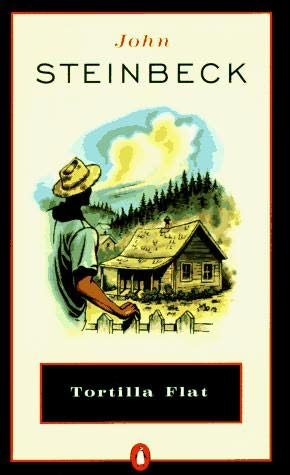
Steinbeck, John. 1935. Tortilla Flat. 207 pages.

From the preface, "This is the story of Danny and of Danny's friends and of Danny's house. It is a story of how these three became one thing, so that in Tortilla Flat if you speak of Danny's house you do not mean a structure of wood flaked with old whitewash, overgrown with an ancient untrimmed rose of Castile. No, when you speak of Danny's house you are understood to mean a unit of which the parts are men, from which came sweetness and joy, philanthropy and, in the end, a mystic sorrow. For Danny's house was not unlike the Round Table, and Danny's friends were not unlike the knights of it. And this is the story of how that group came into being, of how it flourished and grew to be an organization beautiful and wise. This story deals with the adventuring of Danny's friends, with the good they did, with their thoughts and their endeavors. In the end, this story tells how the talisman was lost and how the group disintegrated." (1)

From the first chapter, "When Danny came home from the army he learned that he was an heir and an owner of property. The viejo, that is the grandfather, had died, leaving Danny the two small houses on Tortilla Flat." (5)


I loved this book. I did. Here's why: simple, straightforward, but oh-so-charming storytelling. No pretenses. What you see, is what you get. Danny. Pilon. Big Joe Portagee. Pablo Sanchez. Jesus Maria Corcoran. Pirate and his dogs. Some might argue that none of these are great characters. You might even make the (valid) point that each one is a 'failure' of sorts--since between them they're barely surviving by the world's standards. They live to drink and drink to live. But are they happy? Yes! These are happy-go-lucky guys that know what they want out of life. Wine and women--but no commitments or responsibilities.

The story is essentially this: a young man--a soldier--returns from World War I to learn that he has inherited two houses. After some time in jail, he remembers his new-found wealth and decides to take up residence in one of the houses. But right from the start, Danny is a magnet for like-minded men who love this free and easy lifestyle. First Pilon. Then Pablo. Then the others. These men take up with him because essentially there's just one rule: the bed is off limits. Danny's bed is Danny's bed. The only other rule is share and share alike. IF and when you find yourself in the possession of a gallon or jug of wine (or any other alcoholic beverage) you have to share with everyone living there. Likewise, food is to be shared. No rent is required.

The storytelling. It is so good. So humorous. So accessible. There's a rightness about it. It would be hard to pick a favorite chapter, but I'll narrow it down to two.

I loved "How Danny Was Ensnared By A Vacuum-Cleaner and How Danny's Friends Rescued Him." It was just so funny. Essentially, the story goes something like this. Danny is seduced by a local woman, Dolores Engracia Ramirez ("Sweets" Ramirez). When Danny happens across some money--a rare event as you'll see if you pick this one up--he decides to buy a present for his girl, who in an equally rare state-of-mind has decided to be a one-man woman...temporarily at least. What does he buy her? A vacuum cleaner! The problem? No one in Tortilla Flat has electricity! Does this make the present any less appreciated? No! Sweets prides herself on being the only one with this fancy sweeping tool. And she never ceases to bring it up in conversation. She's seen rolling it around her house and making humming-motor noises. Anyway, hysterical as that is--and I suppose you'll have to trust me on that--his friends aren't happy with Danny's infatuation. So they decide to steal the vacuum and trade it for a gallon or two of wine. So they return home and tell Danny...

The friends received him in silence when he entered Danny's house. He set one jug on the table and the other on the floor.
"I have brought you a present to take to the lady," he told Danny. "And here is a little wine for us."
They gathered happily, for their thirst was a raging fire. When the first gallon was far gone, Pilon held his glass to the candlelight and looked through it. "Things that happen are of no importance," he said. "But from everything that happens, there is a lesson to be learned. By this we learn that a present, especially to a lady, should have no quality that will require a further present. Also we learn that it is sinful to give presents of too great value, for they excite greed."
The first gallon was gone. The friends looked at Danny to see how he felt about it. He had been very quiet, but now he saw that his friends were waiting on him.... (109)


I'll leave you hanging as to what happens next. My second favorite adventure is "How Danny's Friends Threw Themselves To The Aid of a Distressed Lady."

I loved these characters. They're all distinct and wonderfully flawed. Though these men are very simple and seemingly simple-minded, there is a wisdom at times in their words.

Pilon complained, "It is not a good story. There are too many meanings and too many lessons in it. Some of those lessons are opposite. There is not a story to take into your head. It proves nothing."
"I like it," said Pablo. "I like it because it hasn't any meaning you can see, and still it does seem to mean something, I can't tell what." (168)


I recommend this one to folks wanting to read a classic...but who feel somewhat intimidated and bored by more traditional 'classics.' It was just a joy to keep reading.

© Becky Laney of Becky's Book Reviews
If you're reading this post on another site, or another feed, the content has been stolen.