Showing posts with label 1947. Show all posts

Friday, October 02, 2020

117. The Case of the Lazy Lover


The Case of the Lazy Lover (Perry Mason #30) Erle Stanley Gardner. 1947. 212 pages. [Source: Bought]

First sentence: There was usually a big pile of mail on Monday morning. Della Street, Perry Mason’s confidential secretary, having arrived a full half hour before the office was scheduled to open, deftly inserted the paper knife under the flaps of the envelopes, cut them open with one swift wrist motion, read the letters and sorted them into three piles.

Premise/plot: Perry Mason stars in the Case of the Lazy Lover. In this vintage mystery, Perry Mason is surprised to discover two checks in the mail. They are not from a client or anyone he's ever spoken to. Obviously the sender will most likely be seeking his services. But what kind of case will it be? (Though readers of any Perry Mason book can tell you MURDER.)

Lola Faxon Allred is in a bit of a pickle. Can Perry Mason keep her out of prison? 

 My thoughts: I absolutely love and adore the classic television show. I have enjoyed some of the Perry Mason novels as well. Some better than others. But all prove worth reading for one reason or another. I enjoy the banter between Mason and Drake, for example. And it's always fun to see Lieutenant Tragg as well! 

Not all mysteries are quotable. I enjoy when they are. 

Favorite quotes:

“How old is she?” “Forty-two.” “I believe,” Mason said, “that psychologists agree that that is one of the most dangerous ages for a woman.”
Mason said, “We’re allergic to questions until we know what happened.” Inman said, “What the hell! I can take these women down and throw them in the hoosegow if I have to.” “Sure you can,” Mason said, “and I can get a writ of habeas corpus if I have to.”
Gertie said, “Gee that’s swell. I just started one of those diets and I’ve counted calories until I feel like my belt buckle is scraping against my backbone. I’ve just been looking for a good excuse to throw the whole thing overboard, and I think this is it! You always did like tenderloin steaks, Mr. Mason, and my butcher said he’d been saving some for me.
“What the hell,” Mason told him. “Do you want to look a gift horse in the mouth?” “You’re damn right, I do!” Tragg said. “Any time you give me a horse, I’m going to look in his mouth.”

 “Tomorrow morning Tragg is going to interview you. You’re going to talk with him freely and frankly. You’re going to try and talk your way out of a murder rap. It isn’t going to be easy. If you’re telling the truth, you can do it. If you’re not telling the truth, you’d better do a lot of revising …” “I’m telling the truth, Mr. Mason.” “Then,” Mason told her, “that’s all there is to it.” “And I’m to talk to Lieutenant Tragg?” “Sing like a skylark,” Mason told her. “Bare your soul to him. Pose for pictures in the newspapers. Tell everybody everything. Have nothing to conceal. Only be sure that it’s the truth, because if you try to lie, you’ll get caught, and if they catch you in a he it’ll mean life imprisonment, perhaps the death penalty.”

“There are times,” Mason said, “when an artistic lie can crowd the truth right off the stage.


“And don’t ever forget, a good lie can sometimes have all the grace of artistry, but only the truth can have the ring of sincerity.”


“But I’m afraid to have her tie to something unless it’s the truth. Believe me, Paul, when you’re in a jam the truth is the only thing solid enough and substantial enough to rely on.”


“Circumstantial evidence never lies, but it isn’t always easy to interpret it correctly.”

© 2020 Becky Laney of Becky's Book Reviews

Thursday, November 07, 2019

Mr. Adam

Mr. Adam. Pat Frank. 1947. 184 pages. [Source: Library]

First sentence: I suppose it is up to me to tell the story in its entirety, because I broke it in the first place, and I lived with it from then on, and I grew to know Mr. Adam. My name is Stephen Decatur Smith, and before I got involved in the most important story in the world I was a feature writer on the New York staff of AP.

Premise/plot: What if all the men in the world—minus one Homer Adam—were sterile?! Stephen Smith stumbles into a story with global implications. The lead he follows—there are no births scheduled after June 22 in New York City hospitals. Why? Is this true only in New York? Only in the North? Only in the U.S.? Only in the Northern hemisphere? Will any babies ever be conceived again? Is the human race doomed to die out? Many months go by, and then...a baby is born—a baby girl. Turns out that one man at least has not been effected by the nuclear disaster that has completely eradicated the state of Mississippi. His life will never be the same again. Everyone wants to own Mr. Adam and control him. Everyone wants to have a say in how the world is to be repopulated or populated. Not really differing in how—AI. Is artificial insemination the only hope for the human race?

My thoughts: Mr. Adam is a comedy written in 1946. Yes, it’s about a serious subject—the short term and long term effects of nuclear experimentation and use. Will the development of nuclear power and nuclear bombs lead to man’s extinction? Is sterilization a just consequence of man’s rashness or stupidity? At the time it was written, it was assumed that all women wanted to be mothers and that motherhood was the sole way women could lead satisfying or happy lives. Another assumption is that men don’t really care one way or another if they ever have children or not. Fatherhood is not that big a deal. Men don’t need babies in the same way that women do.

The novel is set in an unspecified future year. Frank probably could not have foreseen how AI would actually change the world giving barren couples hope. It was new and experimental, uncertain and controversial. Was it ethical? Should doctors and scientists be “playing God”? Wasn’t conception in God’s hands?

One thing is timeless about the novel—politics and politicians.

© 2019 Becky Laney of Becky's Book Reviews

Wednesday, January 30, 2019

World at War: The Diary of a Young Girl

The Diary of a Young Girl. Anne Frank (The Definitive Edition). Edited by Otto Frank and Mirjam Pressler. Translated by Susan Massotty. 1947/1996. 352 pages. [Source: Bought]

First sentence (from the foreword): Anne Frank kept a diary from June 12, 1942, to August 1, 1944. Initially, she wrote it strictly for herself. Then, one day in 1944, Gerrit Bolkestein, a member of the Dutch government in exile, announced in a radio broadcast from London that after the war he hoped to collect eyewitness accounts of the suffering of the Dutch people under the German occupation, which could be made available to the public. As an example, he specifically mentioned letters and diaries. Impressed by this speech, Anne Frank decided that when the war was over she would publish a book based on her diary. She began rewriting and editing her diary, improving on the text, omitting passages she didn't think were interesting enough and adding others from memory. At the same time, she kept up her original diary.

Premise/plot: Who doesn't know the story of Anne Frank a teenage girl who went into hiding with her family during the second world war? Still it would be wrong to not try to summarize the book in some way. So here I go...

Anne could be any girl in any place and time. But because she was born a Jew--because Hitler came to power--her life--her perfectly ordinary life--was cut short. The Diary of A Young Girl captures both the drama of adolescence on top of extreme political and social upheaval The war. The threat of death. The threat of captivity. The threat of starvation and disease. But it also captures youth. What it means to be young, to be at that ever-awkward stage in life, in development. Always a me-in-the-making, never quite done finding out who you are and what you believe and what you want out of life. The reader gets a glimpse into the lives of real people through the eyes of one very young sometimes-mature, sometimes-immature girl.

The book begins in June of 1942. The last entry is in August of 1944. In these two years, these two turbulent years, Anne and her family and several other people as well all go into hiding in the Secret Annexe. Mr. and Mrs. Frank. Margot, the older sister. Mr. and Mrs. Van Daan. Their son Peter. And Mr. Dussel. Eight people. Cramped living conditions. This isn't reality TV. This is life and death. Yes, every person gets super-cranky and super-sensitive. But wouldn't you?

Each entry is a snapshot into that one day, that one hour, that one moment. When you're young, (and even when you're older and supposedly all grown up) your mood, your outlook changes moment by moment, day by day. Happy one minute, miserable the next. Such is the case with Anne.

The Diary of A Young Girl was originally published in Holland in 1947. It was soon translated into other languages, including English, and printed in the United States. 1952 is the first publication date for the United States. Almost from the very beginning, it was recognized as a good book, a powerful book, a book worthy of time and attention and respect.

My thoughts: I can't remember if I've ever read the definitive edition before or not. I know I've read the other edition at least twice. It is that other edition that has had an impact on my life. I hate to say this but I think I prefer it. Some entries were just too personal, too much information, too unfiltered.

Perhaps this honesty--this rawness--is to be applauded. But I like the idea of not knowing every single thought someone else has ever had. Some might think that the ability to know someone else's every thought would be a good thing--a way to "really" know someone. But I'm not one of them. There are two extremes--filtering too much and filtering not enough.

Since Anne did not survive the war, we'll never know exactly how she'd have edited or rewritten the entries before allowing the public at large to read them. I'm guessing that things she felt at thirteen or fourteen would have been super-embarrassing and eye-rolling to her by the age she was twenty. If not twenty then definitely by forty. It's hard to look back on those awkward years and embrace them to say I LOVED FEELING THIS WAY. THIS AGE WAS AWESOME. I WISH I COULD GO BACK AND EXPERIENCE ALL THIS AGAIN. I am speaking not of Anne's situation--but generally speaking.

This is just my opinion--take it or leave it--but I think if Anne had lived she'd have wanted to "take back" some of what she wrote before publishing. If Anne had survived and her mother and sister still perished--would she regret all the many, many entries where she was hating on them? In particular her mother. Mother-daughter relationships can be incredibly complex. Any family relationship can be super-intense and complicated. Dysfunction isn't unusual. Add in Anne's awkward age and any 'dysfunction' is magnified a hundred times--if not more. But here's the thing--Anne never got the chance to grow out of this I HATE MY MOTHER stage. Anne never got the chance to know her mother as an adult. To see her through grown-up, mature, fully developed eyes. Anne is forever stuck hating on her mother and despising her. Surely if she'd lived even if driven by nothing else but regret and guilt, she'd not have wanted her super-personal entries about how horrible and terrible her mother was to be made public for all the world to see. One thing that haunted me this time around was wondering--would Anne have made peace with her mother if both had lived and survived the war?

I've been focusing in on her relationships...but there's also the matter of the intimate details that she writes about openly. I prefer the filter of the other book to this in-your-face awkward-bluntness. I am not saying that Anne's curiosity was unnatural or abnormal or immoral or wrong. I'm not. I'm saying that it's too personal to share. There should be a difference of some sort between what you think and keep completely private, what you talk about privately with your closest friends and family, and finally what you make PUBLIC and share with anyone, everyone.

  • Paper has more patience than people. (6)
  • Memories mean more to me than dresses. (20)
  • I get frightened myself when I think of close friends who are now at the mercy of the cruelest monsters ever to stalk the earth. And all because they're Jews. (70)
  • No matter what I'm doing, I can't help thinking about those who are gone. I catch myself laughing and remember that it's a disgrace to be so cheerful. But am I supposed to spend the whole day crying? No, I can't do that. This gloom will pass. (70)
  • It's not easy being the badly brought up center of attention of a family of nitpickers. In bed at night, as I ponder my many sins and exaggerated shortcomings, I get so confused by the sheer amount of things I have to consider that I either laugh or cry, depending on my mood. Then I fall asleep with the strange feeling of wanting to be different than I am or being different than I want to be, or perhaps of behaving differently than I am or want to be. Oh dear, now I'm confusing you too. Forgive me, but I don't like crossing things out, and in these times of scarcity, tossing away a piece of paper is clearly taboo. So I can only advise you not to reread the above passage and to make no attempt to get to the bottom of it, because you'll never find your way out again. (72)
  • Sometimes I'm afraid my face is going to sag with all this sorrow and that my mouth is going to permanently droop at the corners. The others aren't doing any better. Everyone here is dreading the great terror known as winter. (135)
  • I cling to Father because my contempt of Mother is growing daily and it's only through him that I'm able to retain the last ounce of family feeling I have left. He doesn't understand that I sometimes need to vent my feelings for Mother. He doesn't want to talk about it, and he avoids any discussion involving Mother's failings. (141)
  • I'm the opposite of Mother, so of course we clash. I don't mean to judge her; I don't have that right. I'm simply looking at her as a mother. She's not a mother to me--I have to mother myself. I've cut myself adrift from them. I'm charting my own course, and we'll see where it leads me. I have no choice, because I can picture what a mother and a wife should be and can't seem to find anything of the sort in the woman I'm supposed to call "Mother." (141)
  • The worst part is that Father and Mother don't realize their own inadequacies and how much I blame them for letting me down. Are there any parents who can make their children completely happy? (141)
  • In recent weeks I've developed a great liking for family trees and the genealogical tables of royal families. I've come to the conclusion that once you begin your search, you have to keep digging deeper and deeper into the past, which leads you to even more interesting discoveries. (176)
  • So should I actually feel more sympathy for Mother? Should I help her? And Father? -- I can't. I'm always imagining another mother. I just can't. How could I? (186)
  • Seriously, though, ten years after the war people would find it very amusing to read how we lived, what we ate and what we talked about as Jews in hiding. Although I tell you a great deal about our lives, you still know very little about us. (245)
  • I know I can write. A few of my stories are good, my descriptions of the Secret Annex are humorous, much of my diary is vivid and alive, but...it remains to be seen whether I really have talent. (250)
  • I always used to bemoan the fact that I couldn't draw, but now I'm overjoyed that at least I can write. And if I don't have the talent to write books or newspaper articles, I can always write for myself. But I want to achieve more than that. I can't imagine having to live like Mother, Mrs. van Daan and all the women who go about their work and are then forgotten. I need to have something besides a husband and children to devote myself to! I don't want to have lived in vain like most people. I want to be useful or bring enjoyment to all people, even those I've never met. I want to go on living even after my death! And that's why I'm so grateful to God for having given me this gift, which I can use to develop myself and to express all that's inside me! When I write I can shake off all my cares. My sorrow disappears, my spirits are revived! But, and that's a big question, will I ever become a journalist or a writer? (251)
  • We've been strongly reminded of the fact that we're Jews in chains, chained to one spot, without any rights, but with a thousand obligations. We must put our feelings aside; we must be brave and strong, bear discomfort without complaint, do whatever is in our power and trust in God. One day this terrible war will be over. The time will come when we'll be people again and not just Jews. Who has inflicted this on us? Who has set us apart from all the rest? Who has put us through such suffering? It's God who has made us the way we are, but it's also God who will lift us up again. (262)
  • One of the many questions that have often bothered me is why women have been, and still are, thought to be so inferior to men. It's easy to say it's unfair, but that's not enough for me; I'd really like to know the reason for this great injustice! (319)
  • It's a wonder I haven't abandoned all my ideals, they seem so absurd and impractical. Yet I cling to them because I still believe, in spite of everything, that people are truly good at heart. It's utterly impossible for me to build my life on a foundation of chaos, suffering and death. (333)


© 2019 Becky Laney of Becky's Book Reviews

Tuesday, April 03, 2018

Uneasy Terms

Uneasy Terms. (Slim Callaghan #7) Peter Cheyney. 1947. 240 pages. [Source: Bought]
 
First sentence: The wind came in from the sea, driving the rain before it. It descended in sheets beating down on the rolling Sussex Downs, forming little rivulets that ran swiftly down the gutters of the winding roads about Alfriston. The wind howled dismally through the woods that topped the long rise of downland behind the village.

Premise/plot: If only the mother could have foreseen that her will would lead to murder...

Viola Alardyse is the oldest daughter. Her inheritance will be lost IF she is married at the time of her mother's death or if she gets married.
Corinne Alardyse is the middle daughter. She gets the inheritance if her older sister marries, but only so long as she remains unmarried herself.
Patricia Alardyse is the youngest daughter. Again, she gets the inheritance if and only if both of her sisters have married and if she herself remains unmarried.

If all three sisters marry, then everything goes to charity.

The book begins with an argument over dinner. The sisters live with their maternal aunt--their mother's sister--and their stepfather--their mother's second husband. The sisters are fighting with each other but also with their stepfather. He shares a startling bit of news: he has heard some rumors and he's going to hire a private investigator to get to the bottom of it.

Enter Slim Callaghan, a private investigator. What will he make of Viola? of Corinne? of Patricia? He won't have a chance to form an opinion of the stepfather--Colonel Stenhurst. Before they can meet, his body is found.

My thoughts: Peter Cheyney is a new-to-me author. This was my first introduction to the British private investigator, Slim Callaghan. He seems to love women and booze. But he stays on task--mainly. Even if he's led in part by his lusty intuition.

I saw a few of the twists coming early on. But I didn't mind because it can be quite satisfying to guess right in a mystery.

Quotes:
'I never take advice, Miss Alardyse,' he said. 'I've found that other people's advice doesn't often interest me. I prefer to make my own mistakes.' He grinned at her, almost insolently. (57)
'I've always believed that as between a client and a private detective there is nothing like the truth, the whole truth, and nothing but the truth.' (101)
'I have broad shoulders and I like a lot of clients.' (193)

© 2018 Becky Laney of Becky's Book Reviews

Friday, May 06, 2016

Happy Little Family (1947)

Happy Little Family. Rebecca Caudill. 1947. 107 pages. [Source: Bought]

I loved, loved, loved Rebecca Caudill's Happy Little Family. I bought this one because it was marketed for "those who love Laura Ingalls Wilder's Little House books." In fact, Rebecca Caudill was a contemporary author of Laura Ingalls Wilder. Happy Little Family was published in 1947, just a handful of years after These Happy Golden Years.

Happy Little Family is set in the Kentucky Mountains. The main character, for the most part, is a little girl named Bonnie who is about five years old. Bonnie has lots of siblings: Debby, Emmy, Chris, and Althy. (Readers also get to know the Mother and Father.) Each chapter is set in a different season of the year.

It opens in January with "Crack the Whip" a story about Bonnie wanting to go skating with her siblings and Father. She's "five" now--just turned five--and she wants to do everything her older sisters do. But skating isn't as easy as it looks, and, being the youngest has its advantages and disadvantages.

"The Pink Sunbonnet" is the story set in spring. Bonnie is jealous of her sisters who get new hats. She doesn't exactly want a new sunbonnet even if it is pink. She thinks only "little" girls wear sunbonnets. One really gets a sense of the family in this story. Even more so than in the first chapter. By this point, it was LOVE for me.

"The Arrowhead" is the story set in summer. The theme this time is BRAVERY.

"The Red Toboggan Cap" is the story set in fall. It is a lost and found story....

"The Journey" is the story set in December. Though she's not quite ready for school full-time, Bonnie gets to visit school for the very first time in this one. It is a bit about bravery too, I suppose, and a lot about growing up or trying to grow up! This story had its precious moments. Like when Bonnie thought she'd be brave enough to cross the oh-so-scary bridge by herself if only she could learn how to read and write the word CAT.

© 2016 Becky Laney of Becky's Book Reviews

Saturday, January 31, 2015

Seuss on Saturday #5

McElligot's Pool. Dr. Seuss. 1947/1974. Random House. 64 pages. [Source: Library]

 First sentence:
"Young man," laughed the farmer, "You're sort of a fool! You'll never catch fish in McElligot's Pool!"
Premise/Plot. Marco, the young boy in the story, is fishing at McElligot's Pool. Though the farmer warns him that the pool is just where people throw junk, the young boy claims he's not foolish or wasting his time fishing there. He tells how the pool could be--might be--connected to the sea itself. And how right this minute even all sorts of fish might be making their way to the pool for him to catch. He describes hundreds of fish, giving his imagination room to shine. But is the farmer convinced? Are readers?

My thoughts: It is nice to see Marco again. (I'm assuming that this Marco is the Marco of And To Think That I Saw It On Mulberry Street, which was published ten years previously.) Marco's imagination is going strong.

Even though I don't like fishing. I liked this book about fishing. I liked it more than I thought I would.
I might catch a thin fish,
I might catch a stout fish.
I might catch a short
or a long, long, drawn-out fish.
Any kind! Any shape! Any color or size!
I might catch some fish that would open your eyes!
and
Oh, the sea is so full of a number of fish
If a fellow is patient, he might get his wish!
This one won a Caldecott Honor. Half the illustrations are in black and white. Half the illustrations are in color.

Have you read McElligot's Pool? Did you like it? love it? hate it? I would love to hear what you thought of it!

If you'd like to join me in reading or rereading Dr. Seuss' picture books (chronologically) I'd love to have you join me! The next book I'll be reviewing is Thidwick The Big-Hearted Moose.

© 2015 Becky Laney of Becky's Book Reviews

Sunday, November 30, 2014

Miracle on 34th Street (1947)

Miracle on 34th Street. Valentine Davies. Illustrated by Tomie de Paola. 1947/2001. HMH. 136 pages. [Source: Library]

I have almost always loved the movie. I can now say that I love the book. If you love the movie, and, if you love to read, then, you should consider reading Miracle on 34th Street. True, it is not substantially different from the movie. But there are subtle differences, I found. I liked these differences small as they may be. The book is sweet and charming in all the right ways. I liked spending time with Kris Kringle, Doris and Susan Walker, and Fred Gayley. The book moves quickly, from scene to scene to scene. The book may not be as detailed and descriptive as a typical novel; it still has a movie-feel to it: going from scene to scene without pausing to ponder or describe. If I read the book first, would I get a sense, true sense, of the characters? I'm not sure. I'd like to think so. But it's hard to come to this story new. I know this story. I love this story.

© 2014 Becky Laney of Becky's Book Reviews

Sunday, July 06, 2014

Do you know Jenny Linsky?

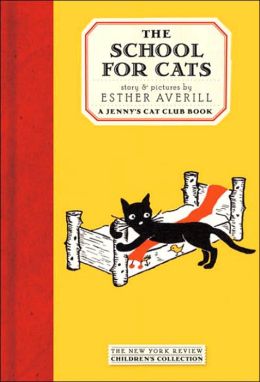
The School for Cats. Esther Averill. 1947/2005. New York Review Children's Collection. 32 pages. [Source: Library]

The School for Cats was originally published in 1947. It is part of a larger series of books starring the (black) cat Jenny Linsky and her friends. The School of Cats is not the first in the series, but, it is the first in the series that my library actually had. In this "Jenny's Cat Club" book, readers meet Jenny as she leaves her home in Greenwich Village to attend school in the country. She is very, very, very unsure about the whole school thing. But her master, Captain Tinker, wants her "to study cat lore in the country." There is definitely something of an adventure in this one when Jenny runs away from school. But it also contains a lesson on friendship and adapting to new situations.

I enjoyed this one. I look forward to reading others in the series.

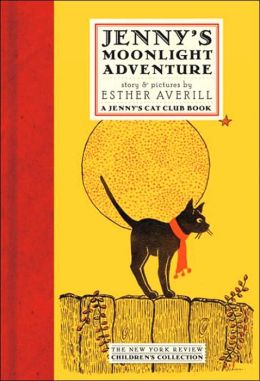
Jenny's Moonlight Adventure. Esther Averill. 1949/2005. New York Review Children's Collection. 32 pages. [Source: Library]

Jenny's Moonlight Adventure was originally published in 1949. It is part of a larger series of books starring Jenny and her friends. I did not like this book as well as The School for Cats. It is a Halloween adventure. Jenny must prove how brave she is both for herself and for her friends. She reluctantly accepts a job that only she can do. She is to carry a nose flute to a sick friend (another cat, of course). The job is "dangerous" because it requires her to be brave and clever enough to get past several unfriendly neighborhood dogs.

For readers who celebrate Halloween, this one might prove charming.

Jenny Goes to Sea. Esther Averill. 1957/2005. New York Review Children's Collection. 140 pages. [Source: Library]

Of the Jenny Linsky books I've read so far, Jenny Goes to Sea is probably my favorite. In this chapter book originally published in 1957, Jenny Linsky and her two brothers, Edward and Checkers, travel the world with their owner, Captain Tinker. These three cats become very good friends with Jack Tar, the ship's cat. These three leave the ship in company with Jack Tar at many of the ports including Capetown, Zanzibar, Singapore, and Bangkok. Adventures come oh-so-naturally.

I definitely recommend this series to cat lovers of all ages.

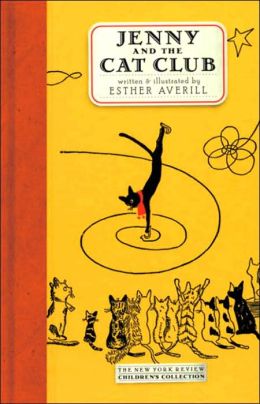
Jenny and the Cat Club: A Collection of Favorite Stories About Jenny Linsky. Esther Averill. 1973/2003. New York Review Children's Collection. 176 pages. [Source: Library]

Jenny and the Cat Club features five stories by Esther Averill. These were originally published in 1944, 1948, 1951, 1952, and 1953. The stories are: "The Cat Club," "Jenny's First Party," "When Jenny Lost Her Scarf," "Jenny's Adopted Brothers," and "How the Brothers Joined the Cat Club."

The Cat Club introduces readers to Jenny Linsky, a "shy little black cat" from New York City. Readers meet Jenny and her owner Captain Tinker. In this adventure, Jenny receives her signature red scarf, a present from her owner who happens to knit. This red scarf helps Jenny gain enough confidence to talk to other cats in the neighborhood. In this one, readers learn about the neighborhood cat club, they are briefly introduced to the other cats, and they learn that members of the cat club must be special.

Jenny's First Party is a story focusing on Jenny and her friend Pickles (the fire cat) teaming up and strolling the neighborhood. Both are looking for fun, fun, fun. But neither have money. (What cat has money?!) They stumble upon a groovy party and a great time is had by all. Readers learn that Jenny can dance a happy little sailor's hornpipe dance.

"When Jenny Loses Her Scarf" is about when Jenny's beloved red scarf was stolen by a dog. The dog, Rob the Robber, refuses to give it back. Jenny seeks help from Pickles the fire cat. Pickles is just the one to help her, it turns out, for justice is dealt out after all. The dog's hangout catches on fire! Pickles retrieves the scarf as he's putting out the fire.

"Jenny's Adopted Brothers" is about when Jenny meets two stray cats: Checkers and Edward. Checkers, readers learn, retrieves things. Edward, we learn, is a poet. Jenny meets these two, feels sorry for them, and introduces them to Captain Tinker. When these two are adopted by the Captain, Jenny feels very jealous! Will having two other cats in the house prove too much?!

"How The Brothers Joined the Cat Club" is obviously about when Edward and Checkers join the club. Jenny is hesitant to include her two new brothers at first. After all, she likes the idea that the club could remain her own little secret and her way to get away from them. But. Being the good little cat that she is, Jenny soon realizes that she could never really keep her brothers from missing out on the awesomeness of the cat club. She helps them discover their talents and introduces them to all her friends.

I liked this one. I did. I like meeting Jenny and the other cats.

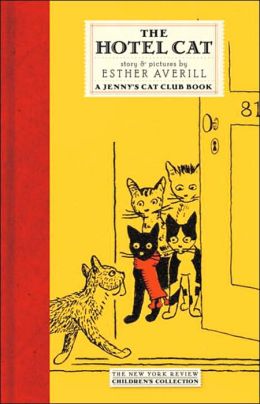
The Hotel Cat. Esther Averill. 1969/2005. New York Review Children's Collection. 180 pages. [Source: Library]

The Hotel Cat is an enjoyable children's novel by Esther Averill. It was originally published in 1969.

The Hotel Cat stars a cat named Tom. He lives at the Royal Hotel, an eight-story building in New York. It is on the older side. And the hotel isn't doing the best business. But all that happens to change during the novel. Tom who is used to having the place to himself, for the most part, at least in terms of CATS ON THE PLACE discovers that there are cats there with their owners. The first few cats he meets he is rude, very rude. But after Tom's owner, Mrs. Wilkins, talks to him, he decides to be more gracious and welcoming. It isn't long before he meets three cats: Jenny, Edward, and Checkers. And those aren't the only cats from the cat club he happens to meet. A difficult winter has resulted in a lot of broken boilers and frustrated cat-owning homeowners are staying at the Royal Hotel. How convenient!

Tom learns a lot about making and keeping friends in The Hotel Cat.

I liked this one.

Captains of the City Streets. Esther Averill. 1972/2005. New York Review Children's Collection. 164 pages. [Source: Library]

Captains of the City Streets is a children's novel by Esther Averill originally published in 1972. Two cats star in Captains of the City Street. In this one, the author provides the back story for two cats who have been a part of essentially the whole series. Sinbad and The Duke. These two stray cats are best buddies. They haven't been "owned" by a human in what seems like a very long time by cat reckoning. They are street cats, traveling cats, going from city to city to city, seeing all there is to see, always seeking handouts, but never becoming dependent on any one human. The two travel to "old New York." They are looking for a place of their own, a safe place to stay. They find it. They also find one old man who dependably gives them food day after day on their own terms. He comes and goes leaving the food, never trying to approach the cats, never pushing a relationship. The two cats slowly but surely decide that maybe just maybe humans aren't all that bad. That is when they stumble upon the Cat Club. They learn that the kind human is Captain Tinker. The first cat they befriend is Macaroni. The two are invited to join the Cat Club, but, are hesitant. Do they want to stick around that long? Do they want the responsibility?

I liked meeting Sinbad and Duke. The stories that focus on Jenny certainly mention these two quite a bit, but, this is the first time that readers really learn about these two in detail. It is a fun book.

Jenny's Birthday Book. Esther Averill. 1954/2005. New York Review Children's Collection. 44 pages. [Source: Library]

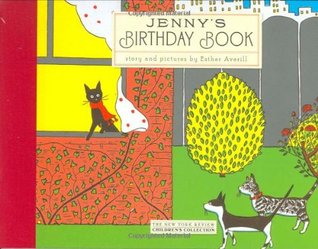
Jenny's Birthday Book by Esther Averill was originally published in 1954. In this cat club book, Jenny Linsky, our star cat, our shy little black cat with the red scarf, has a special birthday with all of her friends whom we've met through the series. Pickles. Sinbad and The Duke. Florio. To name just a few. It is a lovely birthday. The book itself is sweet, simple, and charming. Especially if you like cats and vintage picture books. I think my favorite illustration is of all the cats dancing the Sailor's Hornpipe in the park.

The Fire Cat. Esther Averill. 1960/1983. HarperCollins. 64 pages. [Source: Own]

I enjoyed revisiting The Fire Cat by Esther Averill. I read this one many times as a child. But I had no idea it was part of a larger series of books, the Cat Club series by Esther Averill. The Fire Cat does not star Jenny Linsky. It stars Pickles. Pickles has been a delightful character in almost all of the other books in the series. He is probably one of Jenny's best best friends. In the Fire Cat, readers learn more about Pickles. Was he always a fire cat? Of course not! There was a time he was a hopeless cat that was a little bit bad and a little bit good. One of the firemen takes an interest in him and takes him to the fire station. He is hoping that the chief will allow Pickles to stay. Pickles most definitely wants to stay. He wants to prove himself worthy, so he decides to learn by example. He learns to slide down the pole, for example, he learns how to work a hose. The fire chief is definitely charmed, I imagine cat-loving readers are just as charmed. I certainly was! The Fire Cat is a feel-good read. Readers see Pickles transform from a slightly-naughty homeless cat to a brave and dutiful fire cat. He learns responsibility and compassion. Overall, it's just a good story.


© 2014 Becky Laney of Becky's Book Reviews

Wednesday, October 23, 2013

Prince of Foxes (1947)

Prince of Foxes. Samuel Shellabarger. 1947. 433 pages. [Source: Library]

I really enjoyed reading Prince of Foxes by Samuel Shellabarger. (Thanks Semicolon for the recommendation!) This historical novel was originally published in 1947. It is set circa 1500 during the Italian Renaissance. It features glimpses of four Borgias: Pope Alexander VI, Cesare, Lucrezia, and Angela--a cousin. The hero is an ambitious but not ruthless young man initially in the service of Cesare Borgia. His name is Andrea Orsini. He's been sent to Ferrara in order to pave the way for Lucrezia's third marriage. (The potential groom--or the potential in-laws--are NOT thrilled or receptive to the idea of this marriage.) But Andrea Orsini is good at what he does. He even compels the assassin who was sent to kill him to switch sides. (His name is Mario Belli). But while he is satisfied to stay in Cesare's service when it suits him, when it gets a little too personal, well, he takes a stand for better or worse.

Prince of Foxes is historical romance at its best. Andrea Orsini is a great little hero. He falls hard for the (married) woman that Cesare Borgia promised him. If or when Cesare conquers that city (kingdom-state), Orsini will receive her as his reward for loyal service. Her name is Lady Camilla. She becomes very friendly with him, even flirty, I suppose. But she is a good wife who never leaves Orsini's company without urging him to do EVERYTHING in his power to protect her husband's life. Because his love for her is so strong, so transformative even, he no longer wants to "win" her as a prize. He knows that this husband's death is practically essential to his ambitions, and more importantly to Cesare's ambitions, and, so the conflict will end with him having to make a big decision.

I really loved this one! It is so well written too!

Orsini did not conceal the twinkle in his eyes. "No doubt. There are few who can match the divine genius of my lord Cesare."
"Of course," Lorenzo agreed. He would have liked to add: "Fratricide! Assassin! Bandit!" but he said merely, "Divine genius is well put."
"And let me tell you," smiled Orsini, "that he is not the monster that you people of Venice make him. Is not gossip the mother of monsters, Maestro? He has great ends and lets nothing distract him. Perhaps merely he's too consistent. Hard, if necessary; selfish, yes (and who isn't?); but able, of great virtue and splendor. A valiant prince...I'd wager you'd love him, Messer Lorenzo, unless you stood in his ways."
"Probably," said Lorenzo, doubting it. "I rejoice to learn about him."
"Look you" -- Orsini leaned forward -- "if he were a painter, he would use rich colors. Life is his canvas." (7)
Decidedly, thought Andrea, the illustrious Duke Valentino played in luck. He did not even have to pursue his victims: they came to him. But what could Orsini do about it? Indeed, what did he wish to do? (85)

© 2013 Becky Laney of Becky's Book Reviews

Sunday, July 07, 2013

Sunday Salon: I Saw Esau (1947)

I Saw Esau: The Schoolchild's Pocket Book. Iona and Peter Opie. Illustrations by Maurice Sendak. 1947/2012. Candlewick Press. 160 pages. [Source: Review Copy]

A collection of poems, rhymes (riddles, insults, sayings, etc.) originally compiled and published in 1947. It was an interesting read. Interesting to see what qualified as "funny" or "clever" at one time or another! Such as #59:

Moses was a holy man,
Children he had seven,
He thought he'd hire a donkey cart
And drive them all to heaven.
On the road he lost his way,
He thought he knew it well,
He overturned the donkey cart
And landed them in ----

or #86

Adam and Eve and Pinch-me
Went down to the river to bathe;
Adam and Eve were drowned,
Who'd you think was saved?

Then again it does have #45:

Moses supposes his toes are roses,
But Moses supposes erroneously.
For Moses he knowses his toeses aren't roses,
As Moses supposes his toeses to be. 


© 2013 Becky Laney of Becky's Book Reviews

Tuesday, January 15, 2013

Over the Moon (1947, 1942, 1949)

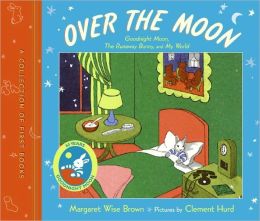
Over the Moon: Goodnight Moon, The Runaway Bunny, and My World. Margaret Wise Brown. Illustrations by Clement Hurd. 1947, 1942, 1949, 2006. HarperCollins. 108 pages.

 Goodnight Moon:
In the great green room there was a telephone and a red balloon and a picture of--
Can you complete the sentence?! Goodnight Moon was originally published in 1947 and it's been pleasing parents and children ever since. Goodnight Moon makes a great read aloud because of its rhythm and rhyme. Do you have a favorite line or two? Mine is "Goodnight comb and goodnight brush...goodnight nobody goodnight mush...and goodnight to the old lady whispering hush".

The Runaway Bunny
Once there was a little bunny who wanted to run away. So he said to his mother, "I am running away." "If you run away," said his mother, "I will run after you. For you are my little bunny."
The Runaway Bunny (1942) is an imaginative story about unconditional love. A little boy wants to run away from his mom, the mom wants to show that no matter what she'll be there for her bunny.  For example, "If you become a rock on the mountain high above me," said his mother, "I will be a mountain climber, and I will climb to where you are" and "If you become a bird and fly away from me," said his mother, "I will be a tree that you come home to." It's a lovely book, one that is easy to recommend.

My World
My book. Mother's book. In my book I only look.
The fire burns. The pages turn.
Mother's chair.
My chair.
A low chair.
A high chair.
But certainly my chair.

My World (1949) is a companion picture book to Goodnight Moon. It certainly rhymes. And some of the rhythms are quite enjoyable. But the story is lacking a little. For example, "My dog. Daddy's dog. Daddy's dog once caught a frog. My spoon. Daddy's spoon. The moon belongs to the man in the moon." The book does focus on a child's world: the day-to-day activities and objects of familiarity.


© 2013 Becky Laney of Becky's Book Reviews

Tuesday, May 15, 2012

Too Many Women

Too Many Women. Rex Stout. 1947/1985. Bantam Books. 176 pages.

It was the same old rigmarole. Sometimes I found it amusing; sometimes it only bored me; sometimes it gave me a pronounced pain, especially when I had had more of Wolfe than was good for either of us.  

With Rex Stout, it's merely a matter of determining if I liked a book or loved a book. There was never a question of if I would like it at all. For I've never read a Nero Wolfe mystery that I didn't at least like. There's just something enjoyable and wonderful about the detective team of Nero Wolfe and Archie Goodwin. I love and adore both characters. In Too Many Women, Archie is the dominant character. While Wolfe is present in the novel, to a certain degree, it is Archie who is doing most of the work. (Now Archie would probably be the first to point out that he's always the one doing all of the work.) Too Many Women sees Archie Goodwin going undercover (well, at least at the start) at a company. He's been hired to investigate a death. One of the company's employees was killed in a hit and run accident. A few fellow employees at least feel that this was intentional and no accident. So Archie's job is to talk with just about all the employees--well, the ones who had dealings with the victim--and find out if it was murder, to catch the murderer if he is to be found. (The premise of this one reminded me of Murder Must Advertise by Dorothy Sayers, in that mystery the detective, Lord Peter Wimsey goes undercover at an agency to find a murderer.)

Was it enjoyable? Yes. Definitely. I never regret spending time with Nero and Archie.

Was it the best, best, best Wolfe mystery ever? Not really. I mean it was a good book, a good mystery. I think for those who like to see Archie flirt with women--he does have a way with women--this one will appeal, or not. (I did find it a little odd that so many women were begging for Archie's favors.) For those looking for great banter between Nero Wolfe and Archie Goodwin, well, this one isn't as good as some of the other novels I've read. In fact, it's probably my least favorite of the Stout novels I've read.
I don't regret reading this one. Perhaps because I would LOVE to read each and every Nero Wolfe novel, novella, short story ever published.

Read Too Many Women
  • If you're a big fan of Nero Wolfe and Archie Goodwin. If you already love the characters and are just looking to spend more time with them. This wouldn't be my first choice for a first introduction to Nero and Archie.
  • If you're a fan of mysteries and are looking for an office/company setting.
  • If you're not bothered by the stereotypical representations of women--especially secretaries.

© 2012 Becky Laney of Becky's Book Reviews

Thursday, August 25, 2011

The 21 Balloons

The Twenty-One Balloons. William Pene du Bois. 1947. Viking 180 pages.

There are two kinds of travel. The usual way is to take the fastest imaginable conveyance along the shortest road. The other way is not to care particularly where you are going or how long it will take you, or whether you will get there or not. 

I should have believed my mother. She's been trying to tell me that this was a good read for many, many years. And she was right. This is a good read. I'm not sure I'd say it was the best, best book I've ever read. Or the best Newbery I've ever read. But this book is anything but boring! It surprised me in all the right ways.

The hero of this one is Professor William Waterman Sherman. This teacher-turned-adventurer left San Francisco in August of 1883 hoping to spend about a year in his balloon. He'd chosen his design carefully and thoughtfully. And he was so excited at the thought of being away from it all--all the cares, all the stress, all the worries of this world. He wanted FREEDOM and then some. But that wasn't to be...

For an accident leaves him stranded on a "deserted" island. The island's community does NOT want to be discovered by the world, so any visitors are welcomed permanently in the community and renamed. I don't want to give away all the quirks of this one though! But I found this one to be quite a read!

Enjoyable and satisfying...a great way to spend the afternoon.

© 2011 Becky Laney of Becky's Book Reviews

Friday, February 04, 2011

Mrs. Mike

Mrs. Mike: "The Heartwarming Classic Story of the Boston Girl Who Married A Rugged Canadian Mountie." by Benedict & Nancy Freedman. 1947. 284 pages.

The worst winter in fifty years, the old Scotsman had told me. I'd only been around for sixteen, but it was the worst I'd seen, and I was willing to take his word for the other thirty-four.

I enjoyed Mrs. Mike. It's a rugged historical romance novel set in the early twentieth century. It stars Katherine Mary O'Fallon and Seargeant Mike Flannigan of the Canadian Mounted Police. When Katherine Mary goes to visit her uncle in Canada, she didn't expect to fall in love with anyone. But when she meets this Mountie, well, it's love. Her love for him will be demanding, will require much sacrifice on her part. For this city girl will be forced into the wilderness, away from everything she's ever known and loved. She'll endure the harshest circumstances, the cruelest hardships. But because of love--her deep love--for her husband, life is good. But their love will face challenges. Realistic challenges, I believe, but heartbreaking ones.

As I said, I enjoyed this one. I enjoyed the historical aspects of this one. I also liked the romance of it. It was a good, clean read. A book that almost anyone of any age could enjoy--if historical romance is their genre of choice. (I know not everyone *loves* historical romance as much as I do!)

My favorite quote:
But death does not stand at the end of life, it is all through it. It is the fear of losing, the knowledge of losing that makes love tender. (276)

© 2011 Becky Laney of Becky's Book Reviews

Tuesday, March 10, 2009

The Wayward Bus


Steinbeck, John. 1947. The Wayward Bus. 272 pages.

For my third Steinbeck, I chose The Wayward Bus. This is an interesting--though not particularly charming--story of disgruntled individuals brought together by a seemingly-never-ending bus ride. While the book technically revolves around a bus ride, the focus of the story is more on the waywardness of the people. How each of Steinbeck's characters are unhappy each in their own way. The book examines humanity--up, close, and a bit too personal. Each character is distinct in that they all have their own issues, own back stories, own hopes and dreams. All are on the bus for different reasons. All are on different journeys. But they're all similar in that they are all dissatisfied with their lives. No one is living their dream life. No one is happy with what they have. All want something more, something better. Some are unhappy with themselves. Some are unhappy with their circumstances. Some just want to escape and start anew. A few just want to hear themselves talk. Some long for freedom. Some long for love. Some long for fame. Some just long for different--they're bored with the sameness of their life.

Who are the characters? There are Juan and Alice Chicoy, a miserably unhappy married couple. Juan is the bus driver. Alice runs the diner part of the gas station. Pimples "Kit" Carson. A young teenage hormone-driven boy. Norma, a mousy waitress with delusions of grandeur--her obsession of choice? Clark Gable. These four live and work at Rebel Corners. (Alice is not along for the trip. She's back home enjoying her solitude.) The passengers include a family of three on their way to Mexico--businessman, frigid wife, rebellious and lusty daughter, a traveling salesman, a tramp of a lady traveling under a false name, an old man who complains day in and day out who can't agree with anyone about anything. I think that about covers it. Unless I missed one or two silent ones.

The bus ties them all together. They're all on their way to somewhere else. But there are delays caused by weather and road conditions.

What is the book about? Love. Hate. Lust. Anger. Disappointment. Bitterness. Frustration. Insecurity. Addiction. Ambition. The book can almost be read as a series of vignettes. If you're a reader intrigued by humanity--if you read books for their insight on the human condition or the human psyche--then this one might be right for you. It's also an interesting snapshot of the times in which it was written. I think it would take another reading for me to fully get everything the book was trying to capture.

It is interesting to me--and I hope to you too--to see how cover images have chosen to capture what the book is about. Which of these covers is your favorite? Which one would make you want to read the book? I like the prettiness of this Penguin cover. But I think the black-and-white one shows the angst of the book better. The why-me-ness of it. I think the two with the man and woman (in the hay) capitalizes on the theory that sex sells... choosing to focus on one of the more 'sensational' and 'lusty' scenes in the book.

I liked the style of the book--gritty though it may be. I could almost visualize it.

© Becky Laney of Becky's Book Reviews
If you're reading this post on another site, or another feed, the content has been stolen.