Showing posts with label 1949. Show all posts

Tuesday, December 24, 2019

Murder for Christmas

Murder for Christmas. Francis Duncan. 1949/2015. 240 pages. [Source: Review copy]

First sentence from the prologue: No one could have foretold how it was going to end. Not even the murderer. It is not to say that the crime was hastily conceived and clumsily executed.

Premise/plot: The book opens on Christmas Eve. Father Christmas, or I should say, a man dressed as Father Christmas is murdered at the foot of the Christmas Tree. The setting is a country house party. One of the guests is a murderer...and one guest happens to be an amateur detective. Coincidence?! Perhaps.

My thoughts: I LOVED, LOVED, LOVED, LOVED, LOVED, LOVED this atmospheric mystery. I believe it is my first time to read Francis Duncan, and my first time to meet Mordecai Tremaine. I want MORE, MORE, MORE....now, now, now. I hope I can track down the rest of the books in this classic series.

I thought the writing was well done. It has a literary feel to it almost. But literary or not--it is definitely suspenseful!

The landscape was a Christmas card in three dimensions. There would have been no incongruity if a sleigh drawn by reindeer had come sweeping over the brow of the downs. It did not, in fact, seem fantastic that the red-robed figure of Father Christmas was outlined in the moonlight, moving quickly along the terrace of the big house. It was, after all, Christmas Eve, when such things—particularly in such a setting—were to be expected. But if one watched carefully, it was sometimes possible, especially when the moon was obscured, to see a faint glow behind the windows of the ground floor. It was a glow that changed its position, as though it owed its origin to a flashlight carried by someone who moved stealthily within the house. And outside in the snow and the shadows there were muffled, hidden figures. Concealed from the house and from each other, they watched intently—and waited upon opportunity. The atmosphere was brooding, tense with foreboding. Fantasy and mystery, violence and death were abroad. It seemed that time was moving reluctantly and with an ever more tightly coiled dread toward some terrible climax. And at last the climax came. It came when the bell had stopped. It came when the moonlight, searching again through the clouds, swept softly across the white lawns, revealing the ragged line of footprints. It came when the cold light flooded up to the half-open french doors and, tracing the moisture on the polished floor, came to rest upon the red thing of horror that was Father Christmas, stark and sprawled upon its face in front of the despoiled Christmas tree. It came with a woman’s scream—desperate, high-pitched, and raw with terror.
I enjoyed the characterization. In mysteries of this sort, it is important that readers really get to know all the suspects and the detective. No complaints here! Duncan did a fantastic job!!!

I almost want to reread this one now that I know who did it to see it again through new eyes. 


© 2019 Becky Laney of Becky's Book Reviews

Monday, April 16, 2018

The Conquering Family

The Conquering Family. Thomas B. Costain. 1949. 291 pages. [Source: Library]

From the introduction: It must be said at the outset that there is no need for another history of England unless it can be given popular appeal. History, on which people depended once for enlightenment and entertainment in reading, is now little read except in classrooms, and this is due to the stern limits which historians have set for themselves.

From chapter one: It was late in September, the year was 1066, and that section of the great north highway which crosses the Aire and the Wharfe and rolls on to the city of York was black with marching soldiers.

Premise/plot: Thomas Costain wrote four (nonfiction) books on the Plantagenets. This is the first in that series. It begins with William the Conqueror and ends with the death of King John. It is packed with drama and adventure. It is an entertaining read. Plenty of familiar details--of course--but I learned many things as well.

From chapter two: The strongest of the three men had won. Never in history, perhaps, have the qualities which make a successful dictator been combined more perfectly and completely in one vigorous frame and one keen brain. William was a great warrior as well as an astute general. (13)

From chapter three: There is only one good thing to be said about the reign of William II, called Rufus or the Red. It was brief. (30)

From chapter four: Good news travels fast, even in a land where most of the roads are no better than cow trails. The word which swept over England immediately after the accession to the throne of the youngest son of William the Conqueror was so good that it set the whole countryside ablaze with joyful expectations. Henry wanted to take a Saxon princess as his bride. (43)

From chapter five: Henry I was not a great man, but was in many respects a great king. (62)

My thoughts: I enjoyed this one very much! I would recommend it to anglophiles everywhere! I enjoyed the narrative style. I enjoyed the stories. It is written to be entertaining to the masses, if you will.

The overall 'so what' of the book is that Costain believes that England was ultimately better off because of the Norman invasion led by William the Conqueror. That it was the blending of Anglo-Saxons and Normans that made the English people GREAT. Yes, these turbulent years might have been bloody at times, unfair to some perhaps--but the ends justify the means.
 

© 2018 Becky Laney of Becky's Book Reviews

Sunday, February 19, 2017

Schoolhouse in the Woods

Schoolhouse in the Woods. Rebecca Caudill. Illustrated by Decie Merwin. 1949. 129 pages. [Source: Library]

First sentence: It was Saturday morning, the last day in July. It seemed like an everyday sort of day.

Premise/plot: Bonnie is the youngest in her family. But she's a baby no longer! Come Monday, she'll be heading off for school along with Debby, Emmy, Chris and Althy. She'll be entering first grade! She'll own her very first book--a reader--her very own slate and slate pencil. There are three other first graders in this one room school house in Kentucky. The book follows the school term: August through December. The book closes with a Christmas play. The teacher is Miss Cora.

My thoughts: Schoolhouse in the Woods is the sequel to Happy Little Family. If you enjoy reading the Little House books OR watching the Little House series, then I'd consider this one a must. It focuses on the one-room school house experience: getting to and from school in all weather conditions, learning lessons and doing recitations, sharing lunches, recess games, school songs, having the teacher stay with them an ENTIRE week. There is a LOT of singing in this one. (Just as there is in Little House). Overall, it is a FUN book for historical fiction lovers of all ages.

Favorite quote:
School was like the biggest storybook in the world, and it would go on and on, story after story, until she had heard every story that had ever been told. (29)

© 2017 Becky Laney of Becky's Book Reviews

Saturday, February 14, 2015

Seuss on Saturday #7

Bartholomew and the Oobleck. Dr. Seuss. 1949. Random House. 56 pages. [Source: Library]

First sentence:
They still talk about it in the Kingdom of Didd as The-Year-the-King-Got-Angry-with-the-Sky. And they still talk about the page boy, Bartholomew Cubbins. If it hadn't been for Bartholomew Cubbins, that King and that Sky would have wrecked that little Kingdom.
Premise/Plot: The King is in a grumbling-complaining mood. He's angry at the sky for only sending down rain, snow, fog and sunshine. He sends for his magicians commanding them to make the sky produce something new. The magicians, well, they mumble a few words and promise to deliver something called 'oobleck.' Only Bartholomew is wise enough to predict that this means TROUBLE, big, big trouble. He is diligent in warning people to beware and be careful. But his words, well, aren't taken all that seriously. Or. In some cases, his words come just a little too late. The king has brought down trouble on his kingdom. How can the kingdom be saved?! Are there MAGIC WORDS the king can say to make the oobleck go away?!

My thoughts: I'd never read Bartholomew and the Oobleck before. I really liked it. I think I liked it even better than The 500 Hats of Bartholomew Cubbins. The King is just as silly and ridiculous. And the situation is even more out of control. I like that the 'magic words' that save the kingdom are "I'm sorry" and "It's all my fault."

Have you read Bartholomew and the Oobleck? Did you like it? Did you love it? Did you hate it? How do you think it compares to The 500 Hats of Bartholomew Cubbins? I'd love to hear what you thought of it!

If you'd like to join me in reading or rereading Dr. Seuss' picture books (chronologically) I'd love to have you join me! The next book I'll be reviewing is If I Ran the Zoo.

© 2015 Becky Laney of Becky's Book Reviews

Sunday, July 06, 2014

Do you know Jenny Linsky?

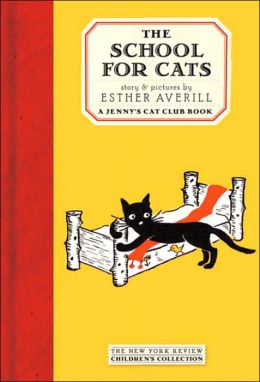
The School for Cats. Esther Averill. 1947/2005. New York Review Children's Collection. 32 pages. [Source: Library]

The School for Cats was originally published in 1947. It is part of a larger series of books starring the (black) cat Jenny Linsky and her friends. The School of Cats is not the first in the series, but, it is the first in the series that my library actually had. In this "Jenny's Cat Club" book, readers meet Jenny as she leaves her home in Greenwich Village to attend school in the country. She is very, very, very unsure about the whole school thing. But her master, Captain Tinker, wants her "to study cat lore in the country." There is definitely something of an adventure in this one when Jenny runs away from school. But it also contains a lesson on friendship and adapting to new situations.

I enjoyed this one. I look forward to reading others in the series.

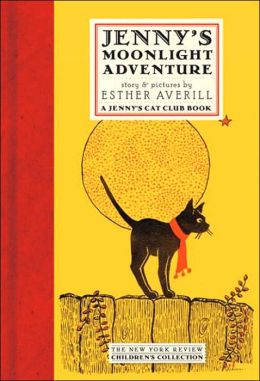
Jenny's Moonlight Adventure. Esther Averill. 1949/2005. New York Review Children's Collection. 32 pages. [Source: Library]

Jenny's Moonlight Adventure was originally published in 1949. It is part of a larger series of books starring Jenny and her friends. I did not like this book as well as The School for Cats. It is a Halloween adventure. Jenny must prove how brave she is both for herself and for her friends. She reluctantly accepts a job that only she can do. She is to carry a nose flute to a sick friend (another cat, of course). The job is "dangerous" because it requires her to be brave and clever enough to get past several unfriendly neighborhood dogs.

For readers who celebrate Halloween, this one might prove charming.

Jenny Goes to Sea. Esther Averill. 1957/2005. New York Review Children's Collection. 140 pages. [Source: Library]

Of the Jenny Linsky books I've read so far, Jenny Goes to Sea is probably my favorite. In this chapter book originally published in 1957, Jenny Linsky and her two brothers, Edward and Checkers, travel the world with their owner, Captain Tinker. These three cats become very good friends with Jack Tar, the ship's cat. These three leave the ship in company with Jack Tar at many of the ports including Capetown, Zanzibar, Singapore, and Bangkok. Adventures come oh-so-naturally.

I definitely recommend this series to cat lovers of all ages.

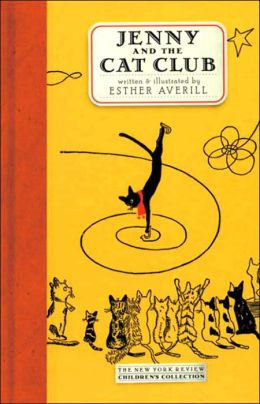
Jenny and the Cat Club: A Collection of Favorite Stories About Jenny Linsky. Esther Averill. 1973/2003. New York Review Children's Collection. 176 pages. [Source: Library]

Jenny and the Cat Club features five stories by Esther Averill. These were originally published in 1944, 1948, 1951, 1952, and 1953. The stories are: "The Cat Club," "Jenny's First Party," "When Jenny Lost Her Scarf," "Jenny's Adopted Brothers," and "How the Brothers Joined the Cat Club."

The Cat Club introduces readers to Jenny Linsky, a "shy little black cat" from New York City. Readers meet Jenny and her owner Captain Tinker. In this adventure, Jenny receives her signature red scarf, a present from her owner who happens to knit. This red scarf helps Jenny gain enough confidence to talk to other cats in the neighborhood. In this one, readers learn about the neighborhood cat club, they are briefly introduced to the other cats, and they learn that members of the cat club must be special.

Jenny's First Party is a story focusing on Jenny and her friend Pickles (the fire cat) teaming up and strolling the neighborhood. Both are looking for fun, fun, fun. But neither have money. (What cat has money?!) They stumble upon a groovy party and a great time is had by all. Readers learn that Jenny can dance a happy little sailor's hornpipe dance.

"When Jenny Loses Her Scarf" is about when Jenny's beloved red scarf was stolen by a dog. The dog, Rob the Robber, refuses to give it back. Jenny seeks help from Pickles the fire cat. Pickles is just the one to help her, it turns out, for justice is dealt out after all. The dog's hangout catches on fire! Pickles retrieves the scarf as he's putting out the fire.

"Jenny's Adopted Brothers" is about when Jenny meets two stray cats: Checkers and Edward. Checkers, readers learn, retrieves things. Edward, we learn, is a poet. Jenny meets these two, feels sorry for them, and introduces them to Captain Tinker. When these two are adopted by the Captain, Jenny feels very jealous! Will having two other cats in the house prove too much?!

"How The Brothers Joined the Cat Club" is obviously about when Edward and Checkers join the club. Jenny is hesitant to include her two new brothers at first. After all, she likes the idea that the club could remain her own little secret and her way to get away from them. But. Being the good little cat that she is, Jenny soon realizes that she could never really keep her brothers from missing out on the awesomeness of the cat club. She helps them discover their talents and introduces them to all her friends.

I liked this one. I did. I like meeting Jenny and the other cats.

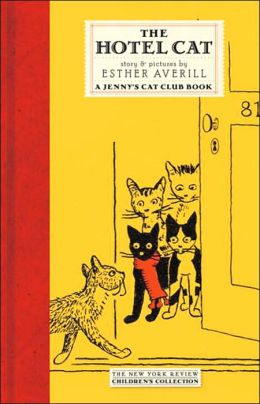
The Hotel Cat. Esther Averill. 1969/2005. New York Review Children's Collection. 180 pages. [Source: Library]

The Hotel Cat is an enjoyable children's novel by Esther Averill. It was originally published in 1969.

The Hotel Cat stars a cat named Tom. He lives at the Royal Hotel, an eight-story building in New York. It is on the older side. And the hotel isn't doing the best business. But all that happens to change during the novel. Tom who is used to having the place to himself, for the most part, at least in terms of CATS ON THE PLACE discovers that there are cats there with their owners. The first few cats he meets he is rude, very rude. But after Tom's owner, Mrs. Wilkins, talks to him, he decides to be more gracious and welcoming. It isn't long before he meets three cats: Jenny, Edward, and Checkers. And those aren't the only cats from the cat club he happens to meet. A difficult winter has resulted in a lot of broken boilers and frustrated cat-owning homeowners are staying at the Royal Hotel. How convenient!

Tom learns a lot about making and keeping friends in The Hotel Cat.

I liked this one.

Captains of the City Streets. Esther Averill. 1972/2005. New York Review Children's Collection. 164 pages. [Source: Library]

Captains of the City Streets is a children's novel by Esther Averill originally published in 1972. Two cats star in Captains of the City Street. In this one, the author provides the back story for two cats who have been a part of essentially the whole series. Sinbad and The Duke. These two stray cats are best buddies. They haven't been "owned" by a human in what seems like a very long time by cat reckoning. They are street cats, traveling cats, going from city to city to city, seeing all there is to see, always seeking handouts, but never becoming dependent on any one human. The two travel to "old New York." They are looking for a place of their own, a safe place to stay. They find it. They also find one old man who dependably gives them food day after day on their own terms. He comes and goes leaving the food, never trying to approach the cats, never pushing a relationship. The two cats slowly but surely decide that maybe just maybe humans aren't all that bad. That is when they stumble upon the Cat Club. They learn that the kind human is Captain Tinker. The first cat they befriend is Macaroni. The two are invited to join the Cat Club, but, are hesitant. Do they want to stick around that long? Do they want the responsibility?

I liked meeting Sinbad and Duke. The stories that focus on Jenny certainly mention these two quite a bit, but, this is the first time that readers really learn about these two in detail. It is a fun book.

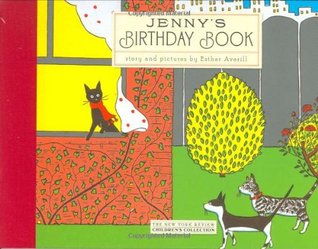
Jenny's Birthday Book. Esther Averill. 1954/2005. New York Review Children's Collection. 44 pages. [Source: Library]

Jenny's Birthday Book by Esther Averill was originally published in 1954. In this cat club book, Jenny Linsky, our star cat, our shy little black cat with the red scarf, has a special birthday with all of her friends whom we've met through the series. Pickles. Sinbad and The Duke. Florio. To name just a few. It is a lovely birthday. The book itself is sweet, simple, and charming. Especially if you like cats and vintage picture books. I think my favorite illustration is of all the cats dancing the Sailor's Hornpipe in the park.

The Fire Cat. Esther Averill. 1960/1983. HarperCollins. 64 pages. [Source: Own]

I enjoyed revisiting The Fire Cat by Esther Averill. I read this one many times as a child. But I had no idea it was part of a larger series of books, the Cat Club series by Esther Averill. The Fire Cat does not star Jenny Linsky. It stars Pickles. Pickles has been a delightful character in almost all of the other books in the series. He is probably one of Jenny's best best friends. In the Fire Cat, readers learn more about Pickles. Was he always a fire cat? Of course not! There was a time he was a hopeless cat that was a little bit bad and a little bit good. One of the firemen takes an interest in him and takes him to the fire station. He is hoping that the chief will allow Pickles to stay. Pickles most definitely wants to stay. He wants to prove himself worthy, so he decides to learn by example. He learns to slide down the pole, for example, he learns how to work a hose. The fire chief is definitely charmed, I imagine cat-loving readers are just as charmed. I certainly was! The Fire Cat is a feel-good read. Readers see Pickles transform from a slightly-naughty homeless cat to a brave and dutiful fire cat. He learns responsibility and compassion. Overall, it's just a good story.


© 2014 Becky Laney of Becky's Book Reviews

Sunday, June 22, 2014

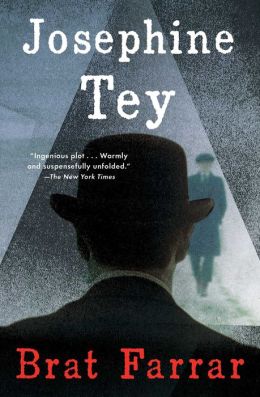
Brat Farrar (1949)

Brat Farrar. Josephine Tey. 1949/1997. 288 pages. [Source: Bought]

I definitely enjoyed reading Brat Farrar. Was it my favorite-favorite Tey novel? Probably not. But I enjoyed it so much more than Miss Pym Disposes and A Shilling for Candles.

In Brat Farrar, the reader is in on the secret. Brat Farrar is impersonating Patrick Ashby. Alec Loding "discovers" Brat Farrar's resemblance to the Ashby family. There were twin brothers Patrick and Simon. Patrick vanished when he was twelve or thirteen, and he was presumed dead. The note he conveniently left behind led everyone to believe it was suicide. Even though Patrick didn't seem the sort. Then again, Patrick would not have been the sort to run away for eight years either. Alec Loding is encouraging his new friend, Brat, to invent such a tale. BE Patrick. Inherit the family estate. He tempts him with horses. If there is one thing our hero can't resist, it's horses. His oh-so-special way with horses gives his life meaning. On the one hand, Brat is essentially a moral guy. He knows right from wrong. He is not the sort to be reckless and cruel for the fun of it. On the other hand, ALL THOSE HORSES. So he allows Loding to coach him, teach him, anything and everything he needs to know to BE PATRICK. (How does Alec know all these details? Sure, a family friend might know some stuff, but everything from the age of three or four on up?! Everything???)

So Patrick Ashby returns from the dead. He takes his place with his family. Everything seems to be off to a good start, but, Brat can't help wondering WHY Simon is so SMUG. Like Brat, readers pick up some clues...not firm, exact clues perhaps...but strong feelings that Simon is, well, the more evil twin.

I liked this one. It was a very quick read.

© 2014 Becky Laney of Becky's Book Reviews

Sunday, February 23, 2014

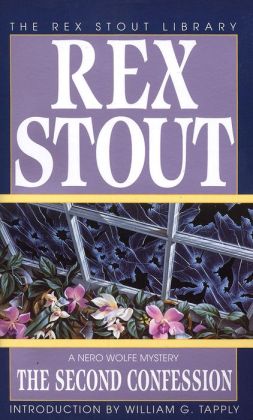
The Second Confession (1949)

The Second Confession (Nero Wolfe). Rex Stout. 1949. 256 pages. [Source: Book I Bought]

The Second Confession might just be my new favorite, favorite Nero Wolfe novel. I didn't think it was possible to love Wolfe and Goodwin more than I already did, but spending two days with this book proved that I had more love to give. I loved, loved, loved every minute of this mystery.

Mr. Sperling hires Wolfe as a private detective "to prove" that his daughter's boyfriend is a communist. Wolfe is reluctant to take on a case with those terms. He argues that what Sperling desires is not proof that this Louis Rony is a Communist, instead what he wants is his daughter to end things with him, period, Communist or not. Wolfe agrees to take the case on his own terms. He will help find proof that will convince this young woman that Rony's not the man for her; he'll even strongly encourage Archie to flirt with the daughter in question and distract her.
"Get invited to his home, socially. Meet Mr. Rony and form an opinion of him. More important, form one of the daughter, as intimately and comprehensively as possible. Make appointments with her. Seize and hold her attention. You should be able to displace Mr. Rony in a week, a fortnight at the most--and that's the objective."
"I'll be damned." I shook my head reproachfully. "You mean to make a pass at her."
"Your terms are yours, and I prefer mine. Mr. Sperling said his daughter is excessively curious. Transfer her curiosity from Mr. Rony to you."
"You mean break her heart."
"You can stop this side of tragedy."
"Yeah, and I can stop this side of starting." I looked righteous and outraged. "You've gone a little too far. I like being a detective, and I like being a man, with all that implies, but I refuse to degrade whatever glamour I may--"
"Archie!" He snapped it.
"Yes, sir."
"With how many young women whom you met originally through your association with my business have you established personal relationships?"
"Between five and six thousand. But that's not--" (9-10)
But the case doesn't go exactly as planned. The relationship is ended. That part was a success. Then again, it's hard to have a relationship with a corpse. Yes, Rony ends up dead, apparently run over by a car in the Sperling driveway. Who murdered him? What was the motive?

This case was very exciting and intense. I loved following it from beginning to end. It was a lot more exciting than most of Wolfe's cases. I love how full of personality it was. It was also very quotable!!!

© 2014 Becky Laney of Becky's Book Reviews

Wednesday, July 10, 2013

The Case of the Cautious Coquette (1949)

The Case of the Cautious Coquette (Perry Mason #34). Erle Stanley Gardner. 1949. 230 pages. [Source: Bought]

I loved, loved, loved this Perry Mason mystery! Paul Drake has placed an ad in several newspapers. He's looking for information about a hit-and-run accident. He receives a letter with a key in it; the anonymous writer assures him that he will find the license plate number for the car in the accident in the desk in the apartment mentioned. The letter even tells him when the apartment will be empty. Drake is extremely suspicious as you might imagine! So, of course, he takes it to Perry Mason. Mason is curious and skeptical. Who sent the letter and the key? Being wise, he goes to see the woman in question, Lucille Barton. Almost from the moment he meets her, he feels that it's a trap, but it will take some time to know WHO set the trap and WHY. Barton knows nothing about any accident, but, she could use a lawyer in a dispute with her ex-husband. Mason declines, but he can't really escape the mess he's in. Not really. If you're familiar with Perry Mason...at all...you know that sooner or later every case turns to murder!

Perry Mason is GREAT in this one. In one situation after another, he just made me SMILE again and again. I especially loved Lt. Tragg in this one!!! There are some WONDERFUL scenes!

This mystery novel is a delight from start to finish!

© 2013 Becky Laney of Becky's Book Reviews

Thursday, June 20, 2013

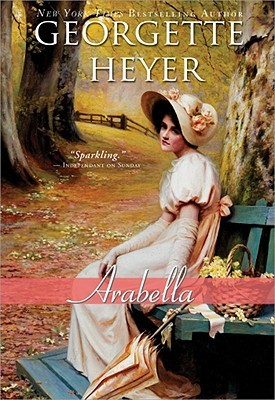
Arabella (1949)

Arabella. Georgette Heyer. 1949/2009. Sourcebooks. 312 pages.

I definitely enjoyed rereading Arabella by Georgette Heyer. Arabella is being treated to a season in London by her godmother. On her way, she runs into a little difficulty. She accidentally meets one of society's most eligible but oh-so-impossible-to-catch bachelors--wealthy of course--Mr. Robert Beaumaris. When she overhears a conversation not to her liking, she impulsively tells a few big lies. She's wealthy too. She understands what it is like to be chased for one's money. She hates all the fuss, too. Of course, at the time she had no idea who he was or how "important" he was in society. She just thought he was arrogant and insufferable! But when her godmother makes much of him, invites him to her debut party, well, Arabella begins to grasp the situation better!

Arabella is enjoyable as a heroine. I also really liked Mr. Beaumaris. I loved getting his point of view! It was fun to see him chase her!


© 2013 Becky Laney of Becky's Book Reviews

Tuesday, January 15, 2013

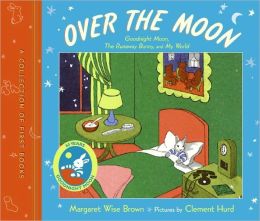
Over the Moon (1947, 1942, 1949)

Over the Moon: Goodnight Moon, The Runaway Bunny, and My World. Margaret Wise Brown. Illustrations by Clement Hurd. 1947, 1942, 1949, 2006. HarperCollins. 108 pages.

 Goodnight Moon:
In the great green room there was a telephone and a red balloon and a picture of--
Can you complete the sentence?! Goodnight Moon was originally published in 1947 and it's been pleasing parents and children ever since. Goodnight Moon makes a great read aloud because of its rhythm and rhyme. Do you have a favorite line or two? Mine is "Goodnight comb and goodnight brush...goodnight nobody goodnight mush...and goodnight to the old lady whispering hush".

The Runaway Bunny
Once there was a little bunny who wanted to run away. So he said to his mother, "I am running away." "If you run away," said his mother, "I will run after you. For you are my little bunny."
The Runaway Bunny (1942) is an imaginative story about unconditional love. A little boy wants to run away from his mom, the mom wants to show that no matter what she'll be there for her bunny.  For example, "If you become a rock on the mountain high above me," said his mother, "I will be a mountain climber, and I will climb to where you are" and "If you become a bird and fly away from me," said his mother, "I will be a tree that you come home to." It's a lovely book, one that is easy to recommend.

My World
My book. Mother's book. In my book I only look.
The fire burns. The pages turn.
Mother's chair.
My chair.
A low chair.
A high chair.
But certainly my chair.

My World (1949) is a companion picture book to Goodnight Moon. It certainly rhymes. And some of the rhythms are quite enjoyable. But the story is lacking a little. For example, "My dog. Daddy's dog. Daddy's dog once caught a frog. My spoon. Daddy's spoon. The moon belongs to the man in the moon." The book does focus on a child's world: the day-to-day activities and objects of familiarity.


© 2013 Becky Laney of Becky's Book Reviews

Wednesday, August 22, 2012

The Story of the Trapp Family Singers

The Story of the Trapp Family Singers. Maria Augusta Trapp. 1949/2001. HarperCollins. 320 pages.

Somebody tapped me on the shoulder. I looked up from the workbooks of my fifth graders, which I was just correcting, into the lined, old face of a little lay sister, every wrinkle radiating kindness. "Reverend Mother Abbess expects you in her private parlor," she whispered. Before I could close my mouth, which had opened in astonishment, the door shut behind the small figure. Lay sisters were not supposed to converse with candidates for the novitiate.

This is the true story that "inspired" my favorite musical The Sound of Music. For the most part, the book is fascinating--especially the first half of the book. Readers meet the young woman sent to be governess to a retired sea captain with many children. In the book, she's to be governess only to one of his daughters, the rest either have nursemaids, attend schools, or have their own tutors. There are definitely some big differences between the book and the movie--between truth and fiction. (For example, the names of the children are different, as is the chronology of the story. The couple married years before Hitler came to power; they married in 1927!) They began singing together as a family out of love for music, yes, but also out of financial necessity.

The book chronicles:

Maria's first eight or nine months as a governess, particular attention is paid to their first Christmas
Maria's new role as wife and mother
Austria's changing economy and politics in the 1930s
The family's flight from Austria and immigration to the United States
The family's first experiences in America as they go on tour and learn English
The family's (forced) return to Europe--fortunately, only for a few months.
The family's return to the United States, their continuing tours
The family's settling down in America (a bit more about their tours, building of their house, building of their music camp)
The private life of the family (recollections of holidays, feast days, birthdays, Christmases, vacations, etc.)

The book is great on capturing the family's dependence on God, their reliance on God to deliver them and provide for them no matter the circumstance. The book is also great at capturing a specific time, place, and culture. For anyone curious about what it was like to be living in Austria in the 1920s and 1930s, this is a must read. For those interested in the immigrant experience during this time period, it is just a fascinating account! To see American culture--and language--from this outside perspective. The book was published in 1949, but it was up to date--so readers do get perspective on World War II from their perspective, also what the family tried to do to help Austria after the war was over.

I really LOVED this one!!!

Favorite quotes:
One of the greatest things in human life is the ability to make plans. Even if they never come true--the joy of anticipation is irrevocably yours. That way one can live many more than just one life. (214)
One night I tenderly consulted by private calendar, "time eaters" we had called them at school, and it showed only thirteen more days in exile. The next morning I started spring cleaning. Under my direction the maids were taking down the curtains and proceeding to brush the walls, when I saw the three youngest children knock on the door of the study. It didn't take long and out they came again. Running over to me as I stood on a ladder washing a big crystal chandelier, they yelled from afar: "Father says he doesn't know whether you like him at all!" "Why, of course, I like him," I answered, somewhat absentmindedly, because I had never washed a chandelier before. I noticed only vaguely that the children disappeared behind the study door again. That same night I was arranging flowers in several big, beautiful oriental vases. This was the last touch, and then the spring cleaning was over, and it had been really successful. When I had arrived at the last vase, the Captain came in. Stepping over to me, he stood and silently watched what I was doing with the peonies. Suddenly he said, "That was really awfully nice of you." An altogether new tone in his voice, like the deep, rich quality of a low bell, made me look up, and I met his eyes, looking at me with such warmth that I lowered mine immediately again, bewildered. Automatically I asked what was so nice of me, as I only remembered that awful letter. "Why," he said, astonished, "didn't you send word to me through the children that you accepted the offer, I mean, that you want to marry me?" Scissors and peonies fell to the floor. "That I want to--marry you?" "Well, yes. The children came to me this morning and said they had had a council among themselves, and the only way to keep you with us would be that I marry you. I said to them that I would love to, but I didn't think you liked me. They ran over to you and came back in a flash, crying that you had said, 'yes I do.' Aren't we engaged now?" Now I was out of gear. I absolutely did not know what to say or what to do; not at all. The air was full of an expectant silence, and all I knew was that in a few days I would be received into my convent, and there stood a real, live man who wanted to marry me. (57-58)
Read The Story of the Trapp Family Singers
  • If you enjoy biography and memoirs
  • If you love The Sound of Music
  • If you want to learn more about Austria/Europe in the 1920s, 1930s
© 2012 Becky Laney of Becky's Book Reviews

Wednesday, February 08, 2012

Earth Abides

Earth Abides. George R. Stewart. 1949/2006. (Introduction to this edition by Connie Willis!) Random House. 368 pages.

Just as he pulled himself up to the rock ledge, he heard a sudden rattle, and felt a prick of fangs.

Earth Abides almost leaves me speechless. I almost don't know what I could say about this one. I am definitely glad I read it.

Did I find it thrilling and compelling and wonderful? Sometimes. Maybe not as thrilling as you might expect a futuristic apocalyptic novel to be. Think more along the lines of Robinson Crusoe. Slow and steady with some adventuresome scenes. But mainly a more thoughtful novel.

Ish Williams, our hero, was bitten by a rattle snake. He makes it to his cabin before the sickness completely overwhelms him, and he does what he can to try to survive the snake bite. But nothing is certain, and he knows it. What he didn't expect, what he couldn't possibly have imagined, is that while he's been off camping, off having his nature-inspired adventures, his own brush with death via snake bite, the whole world has changed. The earth's population has dropped to almost nothing. In fact, it takes Ish a couple of chapters, at least, to find another survivor. And several more chapters to find a survivor sober enough, rational enough to want to spend any amount of time with. But Ish is determined and intellectual, a real thinker. He will find some way to go on with life, find some way to build a little pocket of society again.

The novel is broken into several sections. Some sections cover a few months, a few years, and other sections cover twenty or thirty years. Some sections are very detailed, very focused on individuals, others not so much. Some characters are definitely developed well, others not so much. Ish is definitely one of the most developed characters, most introspective and reflective characters that I've encountered in science fiction. (Perhaps not more than Ender or Andrew Wiggin in his Speaker of the Dead status.) That doesn't mean I love him necessarily, but it may mean I remember him.

Earth Abides isn't as emotional as it might have been or could have been. Ish just isn't a show-your-emotions type of guy. He is reflective and intellectual. He's resourceful. He knows a little bit about everything. He's a handy guy to have around. But he's not going to go on and on and on about his feelings. He's not going to weep or go crazy. He's not going to lose it just because the world as he knows it has ended. He's disconnected, in a way, yet his detachment may enable him to survive in this new world.

Read Earth Abides
  • If you're looking to read vintage science fiction, a classic apocalyptic, post-apocalyptic novel
  • If you're interested in survival stories
  • If you're interested in a generational story

© 2012 Becky Laney of Becky's Book Reviews
Wednesday, April 06, 2011

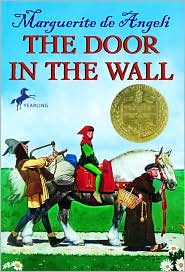
The Door in the Wall (MG)

The Door in the Wall. Marguerite de Angeli. 1949/1990. Random House. 128 pages.

Robin drew the coverlet close about his head and turned his face to the wall. He covered his ears and shut his eyes, for the sound of the bells was deafening. All the bells of London were ringing the hour of Nones. St. Mary le Bow was nearest, St. Swithin's was close by, and not far away stood great St. Paul's. There were half-a-dozen others within soun, each clamoring to be heard. It seemed to Robin as if they were all inside his head screaming to be let out. Tears of vexation started to his eyes, but he held them back, for he remembered that a brave and "gentil" knight does not cry.

This is my first time reading this Newbery winner. It's not a title I would have been drawn to as a kid, much like Adam of the Road, but I am glad I read it as an adult.

Robin, our hero, is all alone. His father is fighting in a war; his mother called to serve the queen. He was supposed to become a page and begin his training to be a knight, but, an illness left him weak, unable to stand or walk. A compassionate monk, Brother Luke, saves him from an uncertain (at best) fate--for his caretaker, his nurse, falls ill with the plague. Robin begins to heal and begins to learn. He learns to read and write. He is strengthened by swimming. And then there's the whittling. (Exciting stuff.) The book chronicles his journey through these dark and sometimes dangerous times. Readers get a glimpse of the Middle Ages.

The Door in the Wall is a pleasant enough read. While I didn't find it the most thrilling book ever, not even the most thrilling book ever set during the Middle Ages, I didn't find it painful either. There are worse ways to spend an afternoon.

You might also be interested in: Adam of the Road, Crispin: The Cross of Lead, Crispin: At The Edge of the World, Crispin: The End of Time. Not to mention Good Masters! Sweet Ladies! Voices from a Medieval Village by Laura Amy Schiltz.

© 2011 Becky Laney of Becky's Book Reviews
Monday, November 23, 2009

Arabella


Heyer, Georgette. 1949/2009. Arabella. Sourcebooks. 312 pages.

The schoolroom in the parsonage at Heythram was not a large apartment, but on a bleak January day, in a household where the consumption of coals was a consideration, this was not felt by its occupants to be a disadvantage.

Arabella Tallant, a young country girl, has been invited by her godmother to London. She's to have her season, an unexpected surprise, in a way, though much hoped for. Her parents--especially her mother--hope she will find a husband during this season--since it will likely be her one and only season in town. Arabella wishes this as well. She's not wanting a magnificently wealthy husband or a titled husband.

When Arabella has an accidental encounter with a well-dressed stranger, well, her temper gets the best of her. And she declares herself to be fabulously wealthy. Before she knows it, everyone in town has heard the news. Arabella is quite an heiress! And she's become the town's new It girl. Everyone simply loves adoring her, making much of her. But can Arabella find a husband who will love her for who she really is?

Arabella is a very likable character. She's spirited and opinionated. And the man who's 'destined' to win her heart is quite nice as well!

I enjoyed spending time in this one! Yes, it's a bit formulaic in places. But I almost always enjoy the books anyway. There is just something comforting, satisfying, and happy-making about them. Most Heyer books feel like good friends.

© Becky Laney of Becky's Book Reviews

Wednesday, February 25, 2009

Travel the World: England: Pemberley Shades


Bonavia-Hunt, D.A. 1949/2008. Pemberley Shades: Pride and Prejudice Continues: A Lightly Gothic Tale of Mr. and Mrs. Darcy. Sourcebooks. 376 pages.

"When old Dr. Robinson, who had been Rector of Pemberley in Derbyshire for over fifty years, died one night in his sleep at the age of eighty-seven, a long life of little eventfulness and placid prosperity came to a not untimely end....Who could have foretold that Dr. Robinson, who had done nothing of note in all his lifetime should, by the common and natural act of dying, set in motion a train of events so strange, so startling, so far removed from probability, as to emulate the rioutous fancies of a disordered mind?" (1, 2)


You can read the first chapter online here. What can I say about this one? Me, the skeptic who remains ever-doubtful that the perfect sequel exists? I loved this one! I did! Last week, I talked about what I expected out of an Austen sequel..."I don't expect the writer to be Jane Austen. I don't expect her to try to channel Austen when she's writing. I don't expect her to match Austen's literary style or her wit. Just a teeny tiny smidgen of it is good. If she can capture just a small trace of the charm or humor (or both) then that's enough. What makes Austen likeable? Is it her focus on love and romance? Is it her focus on women's lives? Is it her focus on society? Is it her focus on class? Is it her focus on these often comical eccentrics? (Like Mr. Collins or Mrs. Jennings or Mrs. Bennet) Is it the fact that she was good at taking snapshots of her world? Of describing life as it was? Is it the fact that she develops so many characters all at once? Her books are never the story of one man and one woman falling in love. They are always so much more than that. There will never be a sequel that can capture anything and everything Austen was...as a writer. But I think the best of the lot will try to be multidimensional. Maybe not as widely as Austen herself was. But more than just one-dimensional."

This one delivers and then some. We've got a nice balance of Austen characters--Elizabeth, Darcy, Georgiana, Kitty, Lady Catherine, Anne, etc.--with new characters: Mr. Mortimer, Miss Robinson, Miss Sophia, Major Wakeford, Stephen Acworth, etc. This blending is so natural, so seamless that it just works. The story is simple: a new rector must be found to fill the parish/living. Mr. Darcy is looking for candidates--good candidates--to interview. The only thing he knows for certain--and Elizabeth agrees--is that it cannot, must not be filled by Mr. Collins! (He does apply for the job!) Temporarily, Mr. Mortimer is filling in as substitute preacher. But while Mr. Darcy feels he is good enough for that, the idea of him becoming the new rector is unlikely. But who will he find? One candidate after another fails to meet Mr. Darcy's standards. But then an old friend contacts him. This old friend has a brother, a younger brother, a young widower. A scholarly man who would be "perfect" for the job. A Mr. Stephen Acworth. Darcy sets off to interview him. And happens to come back with not one but two house guests: Stephen Acworth and Major Wakeford, a soldier who had at one time been quite chummy with him. But though this probation period--of six weeks--has been set in place, been promised, something about Stephen Acworth bothers Darcy. Is this his old sense of prejudice resurfacing? Or is Darcy onto something?

The story is of course more complex than that. It is filled with characters--all well-developed, all flawed, all human, some quite comical or eccentric--all have their own story to tell. There are visits, walks, parties, balls, declarations of love both proper and improper, and much much more. I don't want to say much more, but I don't want to say too little either. I highly recommend this one to skeptics everywhere. Who will like this book best? Those that love Jane Austen and who typically find modern sequels to be sickening. Who find that modern writers just don't get what Elizabeth and Darcy are about. Who will not like this book? If you're all about contemporary sequels that offer sex, sex, sex, and more sex...then this one will disappoint.

One other note: THIS IS NOT A GOTHIC BOOK. Despite the fact that it says "lightly" gothic. The point of the book is that it is an entertaining, sometimes comical, lightly romantic, moderately mysterious sequel.

Other reviews: Austenprose, Austenblog (who didn't like it at all), Curled Up,

© Becky Laney of Becky's Book Reviews
If you're reading this post on another site, or another feed, the content has been stolen.