Showing posts with label 1960. Show all posts

Friday, March 06, 2026

28. To Kill a Mockingbird


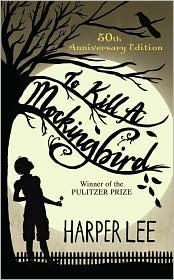
28. To Kill A Mockingbird. Harper Lee. 1960. 281 pages. [Source: Library][Audiobook, 5 stars, classic, coming of age]

First sentence: When he was nearly thirteen, my brother Jem got his arm badly broken at the elbow.

To Kill A Mockingbird is one of my favorite, favorite books. I love, love, love the movie. And I adore the book as well. It's a simple novel rich in truth. I love the narrative voice of Scout. I think Scout is one of the most memorable narrators ever.

One of the things that I think makes the book work so well is how it is able to be serious and dramatic AND comical. It captures the little every-day moments so well. Family relationships. Community relationships. Nosy neighbors or spooky ones. A good balance of summer-time freedom and the structure of school. It's definitely one of the best coming-of-age stories. At the same time, it is a very honest examination of racism and injustice.

To Kill A Mockingbird has a great, compelling story to tell. And Harper Lee knew how to tell a story. But it isn't the story alone that is unforgettable: it is the characters. Such characterization!!! Such depth!!! Who could not love Scout, Jem, and Atticus?! Who could not love Calpurnia, Dill,  Miss Maudie, and Boo Radley?!

I first reviewed it in October 2007. I also reviewed it in August 2010.

Favorite quotes:
Until I feared I would lose it, I never loved to read. One does not love breathing. (18)
"First of all," he said, "if you can learn a simple trick, Scout, you'll get along a lot better with all kinds of folks. You never really understand a person until you consider things from his point of view--"
"Sir?"
"--until you climb into his skin and walk around in it." (30)
"If you shouldn't be defendin' him, then why are you doin' it?"
"For a number of reasons," said Atticus. "The main one is, if I didn't I couldn't hold up my head in town, I couldn't represent the county in the legislature, I couldn't even tell you or Jem not to do something again."
"You mean if you didn't defend that man, Jem and me wouldn't have to mind you any more?"
"That's about right."
"Why?"
"Because I could never ask you to mind me again. Scout, simply by the nature of the work, every lawyer gets at least once in his lifetime that affects him personally. This one's mine, I guess. You might hear some ugly talk about it at school, but do one thing for me if you will: you just hold your head high and keep those fists down. No matter what anybody says to you, don't you let 'em get your goat. Try fighting with your head for a change...it's a good one even if does resist learning. (76)
Atticus said to Jem one day, "I'd rather you shot at tin cans in the back yard, but I know you'll go after birds. Shoot all the bluejays you want, if you can hit 'em, but remember it's a sin to kill a mockingbird."
That was the only time I ever heard Atticus say it was a sin to do something, and I asked Miss Maudie about it.
"Your father's right," she said. "Mockinbirds don't do one thing but make music for us to enjoy. They don't eat up people's gardens, don't nest in corncribs, they don't do one thing but sing their hearts out for us. That's why it's a sin to kill a mockingbird. (90)
It's when you know you're licked before you begin but you begin anyway and you see it through no matter what. You rarely win, but sometimes you do. (112)
In Maycomb County, it was easy to tell when someone bathed regularly, as opposed to yearly lavations: Mr. Ewell had a scalded look; as if an overnight soaking had deprived him of protective layers of dirt, his skin appeared to be sensitive to the elements. Mayella looked as if she tried to keep clean, and I was reminded of the row of red geraniums in the Ewell yard. (179)
"How could they do it, how could they?"
"I don't know, but they did it. They've done it before and they did it tonight and they'll do it again and when they do it--seems that only children weep. Good night." (213)


© 2026 Becky Laney of Becky's Book Reviews

Monday, February 24, 2025

19. My Wonderful World of Slapstick


19. My Wonderful World of Slapstick. Buster Keaton with Charles Samuels. 1960. 340 pages. [Source: Library] [adult biography, adult autobiography; film-making, show business, comedy]

First sentence: Down through the years my face has been called a sour puss, a dead pan, a frozen face, The Great Stone Face, and, believe it or not, "a tragic mask." On the other hand, that kindly critic, the late James Agee, described my face as ranking "almost with Lincoln's as an early American archetype, it was haunting, handsome, almost beautiful." I can't imagine what the great rail-splitter's reaction would have been to this, though I sure was pleased. People may talk it up or talk it down, but my face has been a valuable trade-mark for me during my sixty years in show business. 

Premise/plot: My Wonderful World Of Slapstick is Buster Keaton's autobiography written just six years before his death in 1966. (So it does not cover *all* of his career, but it does cover many years of his career.) Does the book cover anything and everything? Yes and no. There are chapters in his life that remain very much PRIVATE and undisclosed. Keaton is not one to name names--for better or worse.

For example, I am almost completely certain that he never mentions his first or second wives by name. His first wife is called "his future wife" or "my wife"  or "Mrs. Buster Keaton" and the like, but never her actual name or even nickname. She does appear by name in the book, but only because she appears in his filmography because she was his costar in Our Hospitality. There was a good reason he said zip, zilch about his second marriage. (I believe she was fond of lawsuits for ANYTHING and everything, no matter how tangential to the truth). It was his beloved [third] wife, Eleanor, who gets stories.

There are periods of his life where he shares in great detail about his life--both private stories and show business-y stuff. There are periods of his life where the details are harder to come by. Which is fair, in my opinion. He does talk industry both for STAGE and FILM and television. He has stories about people in front of the camera and behind it. He does not go into great detail about his own films. He does not take himself too seriously. It's like he'd rather shift into telling asides and anecdotes than to deep dive into his own brilliance at what he does/what he did. He comes across as very grounded. He says that Charlie Chaplin's problem was that he believed everything that was being said about him, written about him, and began to take himself too seriously and as [an elite] intellectual.

"I never realized I was doing anything but trying to make people laugh when I threw my custard pies and took pratfalls. Like anyone else I enjoy being called a genius. But I cannot take it seriously. Neither does Harold Lloyd, as far as I know. The only one of us who listened and accepted the role of genius intellectual critics thrust upon him was Chaplin. Sometimes I suspect that much of the trouble he's been in started the first time he read that he was a 'sublime satirist' and a first-rate artist. He believed every word of it and tried to live accordingly."

I would have wished for a little more detail about the making of his own films, but perhaps he wanted his films to speak for themselves. Though at the time this was written, his films would not have been readily available for easy viewing. There were revivals of his films--his films being shown again in theatres, etc.,--especially in Europe. He was MUCH BELOVED in Europe, and I believe the book said Keaton was absolutely HUGE, HUGE, HUGE, MEGA-SUPER-POPULAR in Russia. [Which would make sense of the fact that so many Keaton channels on YOUTUBE are Russian.] 

It was his private stories that fascinated me. He writes in one chapter of several different practical jokes that he was in on. If I remember the story correctly, some big studio executive [or similar execs] were coming into town to meet Roscoe Arbuckle, the two came up with a great practical joke: dress Buster Keaton up as his BUTLER and let the comedy follow. He'd be the clumsiest, klutziest butler ever to see if any would recognize him--the theory being that BUTLERS ARE IGNORED--before the big finale. Arbuckle would finally "lose his temper" and let the butler have it to the astonishment of his guests. Meanwhile, Buster would slip out and return as himself--a rising star in his own right--and "meet" the guests. This was just one of many practical jokes he played. Though it was near impossible to pull the same joke twice because word would spread around town. 


It was his outlook on life--though he has repeatedly been called NOT introspective or reflective--that impressed me most. He writes,

"I think I have had the happiest and luckiest of lives. Maybe this is because I never expected as much as I got. What I expected was hard knocks. I always expected to have to work hard. Maybe harder than other people because of my lack of education. And when the knocks came I felt it was no surprise. I had always known life was like that, full of uppercuts for the deserving and undeserving alike. But it would be ridiculous of me to complain. I find it impossible to feel sorry for myself. I count the years of defeat and grief and disappointment, and their percentage is so minute that it continually surprises and delights me."
My thoughts: I absolutely LOVED, LOVED, LOVED, LOVED, LOVED this autobiography. There was just something so grounded and matter of fact about his narrative style. He was amusing and fascinating. I imagine this book covers such a small, small, small fraction of stories he could have told.

Quotes:

  • At any rate it was on purpose that I started looking miserable, humiliated, hounded, and haunted, bedeviled, bewildered, and at my wit's end. Some other comedians can get away with laughing at their own gags. Not me. The public just will not stand for it. And that is all right with me. All of my life I have been the happiest when folks watching me said to each other, "Look at the poor dope, wilya?" Because of the way I looked on the stage and screen the public naturally assumed that I felt hopeless and unloved in my personal life. Nothing could be farther from the fact. As long back as I can remember I have considered myself a fabulously lucky man. From the beginning I was surrounded by interesting people who loved fun and knew how to create it. I've had few dull moments and not too many sad and defeated ones. In saying this I am by no means overlooking the rough and rocky years I've lived through. But I was not brought up thinking life would be easy. I always expected to work hard for my money and to get nothing I did not earn. And the bad years, it seems to me, were so few that only a dyed-in-the-wool grouch who enjoys feeling sorry for himself would complain of them.
  • The cast for our two-reelers was always small. There were usually but three principals--the villain, myself, and the girl, and she was never important. She was there so the villain and I would have something to fight about. The leading lady had to be fairly good-looking, and it helped some if she had a little acting ability. As far as I was concerned I didn't insist that she have a sense of humor. There was always the danger that such a girl would laugh at a gag in the middle of the scene, which meant ruining it and having to remake it.
  • Even when making my two-reelers I worked on the theory that the story was always of first importance. But one thing we never did when making our silent comedies was put the story down on paper. On the other hand I never would agree to start shooting until I had in my mind a satisfactory ending for a story. The beginning was easy, the middle took care of itself, and I knew I could depend on my writers and myself to come up with any gags we might need as we went along.


© 2025 Becky Laney of Becky's Book Reviews

Sunday, June 26, 2016

Best in Children's Books, 31

Best in Children's Books, Volume 31. 1960. Nelson Doubleday. 160 pages. [Source: Bought]

Let's go vintage! This title is the thirty-first volume in a long series of books called Best in Children's Books. It was published in 1960 by Nelson Doubleday. It blends fiction and nonfiction, prose and poetry. It has many contributing authors and illustrators.

Lewis and Clark: Explorers of the Far West by Smith Burnham with illustrations by Edward Shenton. This is an excerpt from Hero Tales from History (1922, 1930, 1938). If there is a politically incorrect buzzword related to Native Americans--this story has it in abundance: savage, powwow, red men, peace-smoke talk, redskins, red braves, war dance, peace dance, scalp dance, snake dance, papoose, etc. There are better stories of Lewis and Clark to share with young readers these days.

Tattercoats by Joseph Jacobs with illustrations by Colleen Browning. This little story reads like a fairy tale. It even has a little romance.

Singh Rajah and the Cunning Little Jackals by Mary Frere with illustrations by Edy Legrand. This is an excerpt from Old Deccan Days or Hindoo Fairy Legends Current in Southern India (1898). This is an animal story about a LION who is tricked by a family of jackals who don't want to be eaten--they are the last animals in the jungle. What I like best about this story are the color illustrations.

The Middle Bear by Eleanor Estes with illustrations by Phyllis Rowand. This is an excerpt from The Middle Moffat (1942). The Moffats are in a play for charity. The play is The Three Little Bears. It's quite charming.

Chips, The Story of a Cocker Spaniel (1944) by Diana Thorne and Connie Moran with illustrations by Phoebe Erickson. This is a sweet though predictable story of boy meets dog.


The Picnic Basket by Margery Clark with illustrations by Maud and Miska Petersham (1924). This is an excerpt from The Poppy Seed Cakes. This one is illustrated in color. And the illustrations are very interesting--bright and colorful. If you enjoy vintage work, then these illustrations will prove appealing. The story itself is about a boy and his Auntie going on a picnic together. There are plenty of twists and turns in this one!

Windy Wash Day and Other Poems by Dorothy Aldis with illustrations by MAURICE SENDAK. The poems come from All Together (1925, 1926, 1934, 1939, 1952). I like the inclusion of poetry. I really like the poem "Naughty Soap Song."
Just when I'm ready to
Start on my ears,
That is the time that my
Soap disappears.
It jumps from my fingers and
Slithers and slides
Down to the end of the
Tub, where it hides.
And acts in a most diso-
Bedient way
AND THAT'S WHY MY SOAP'S GROWING
THINNER EACH DAY. (86)
Go Fly a Kite is a nonfiction piece by Harry Edward Neal with illustrations by Harvey Weiss. I found it boring, you may find it instructional.

Salt Water "Zoos" is another nonfiction piece. No author is given credit. It is essentially about large aquariums and oceanariums. (This book was published several years before the first Sea World opened. My guess is it used to be a lot harder to see dolphins and sharks and the like.) The focus is on Marineland of Florida.

Cornelia's Jewels by James Baldwin with illustrations by Don Freeman. This one is short and historical in nature. The overall tone is very sweet with a focus on family. Cornelia's "jewels" are her two boys.

Three Seeds by Hester Hawkes with illustrations by Hildegarde Woodward (1956). This story is about a boy and his garden. The setting: the Philippines. Luis, the hero, misses his father who works in Manila most of the time. He can only come visit his family once or twice a month. One week he brings home a package of American seeds. The packet must have had a hole, however, because only three seeds remain. (The title spoils it all doesn't it?) The boy has hope, however, and with the help of a kind neighbor, the three seeds are planted...and from those three seeds comes a promising future.

Let's Go to Iceland and Greenland. This is a sad little feature, again no author is given. Readers do get five photographs and one map.


© 2016 Becky Laney of Becky's Book Reviews

Tuesday, April 12, 2016

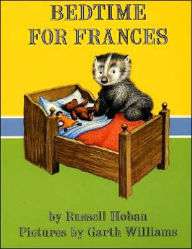
Bedtime for Frances

Bedtime for Frances. Russell Hoban. Illustrated by Garth Williams. 1960/1996. HarperCollins. 32 pages.

First sentence: The big hand of the clock is at 12. The little hand is at 7. It is seven o'clock. It is bedtime for Frances. Mother said, "It is time for bed." Father said, "It is time for bed." Frances said, "I want a glass of milk." "All right," said Father. "All right," said Mother. "You may have a glass of milk." Frances drank the milk.

Premise/plot: Bedtime for Frances is a classic picture book, a bedtime book too. It is the first book in a series starring Frances. Will she have an easy time going to bed?!

My thoughts: I love, love, love Bedtime for Frances. Frances is a badger that is finding it very difficult to sleep. She's had her glass of water. She's been kissed and hugged. She's got her teddy bear and her doll. But Frances imagination is too active to allow her to fall asleep quickly. She thinks there is a tiger in her room. No, a giant in her room. Oh no! There's a crack in the ceiling. What if something scary were to crawl out?! And what is that tapping on her window?! Her parents are kind and gentle--at least at first. But when these interruptions persist, well, her father gets a little grumpy. Frances finally embraces her father's message: every one has a job. It may be the wind's job to make noise; it may be the moth's job to bump into things; but her job is to sleep.

Text: 5 out of 5
Illustrations: 5 out of 5
Total: 10 out of 10

© 2016 Becky Laney of Becky's Book Reviews

Saturday, May 30, 2015

Seuss on Saturday #22

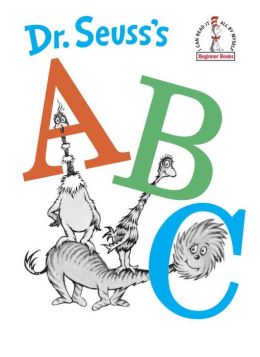
Dr. Seuss's ABC. Dr. Seuss. 1960. Random House. 72 pages. [Source: Library]

First sentence:
Big A
Little a
What begins with A?
Aunt Annie's alligator...A...a...A
Premise/plot: An alphabet book. What more can I say? There are silly sentences for each letter of the alphabet. For example, "Four fluffy feathers on a Fiffer-feffer-feff."

My thoughts: I like this one fine. I don't love it. I don't not-love it. Some sentences are funner or funnier to read aloud. Not all letters are equally delightful.

Have you read Dr. Seuss's ABC book? Did you like it? love it? hate it? I'd love to know what you thought of it!

If you'd like to join me in reading or rereading Dr. Seuss (chronologically) I'd love to have you join me! The next book I'll be reviewing is Hop on Pop.

© 2015 Becky Laney of Becky's Book Reviews

Saturday, April 25, 2015

Seuss on Saturday #17

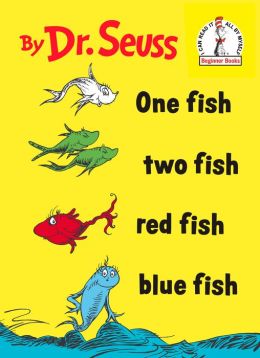
One Fish Two Fish Red Fish Blue Fish. Dr. Seuss. 1960. Random House. 60 pages. [Source: Library]

First sentence:
One fish
two fish
red fish
blue fish.
Black fish
blue fish
old fish
new fish.
This one has a little star.
This one has a little car.
Say! What a lot of fish there are.

Premise/Plot: Does this book have a plot? I'm not sure it does! It does have a premise however. "From there to here, from here to there, funny things are everywhere" (9). "From near to far from here to there, funny things are everywhere" (55). " Readers find plenty of funny things within the pages of the book. Classical Seuss rhymes make this one lovely.

My thoughts: I like this one very much. Some pages are more memorable to me than others perhaps. For example,
Who am I?
My name is Ned.
I do not like
my little bed.
and
My hat is old.
My teeth are gold.
I have a bird
I like to hold.
Have you read One Fish, Two Fish, Red Fish, Blue Fish? Did you like it? Did you love it? I'd love to hear what you thought of it! Both what you liked, and what you didn't like.

If you'd like to join me in reading or rereading Dr. Seuss (chronologically) I'd love to have you join me! The next book I'll be reviewing is Green Eggs and Ham.

© 2015 Becky Laney of Becky's Book Reviews

Sunday, December 07, 2014

Ten Christmas Picture Books

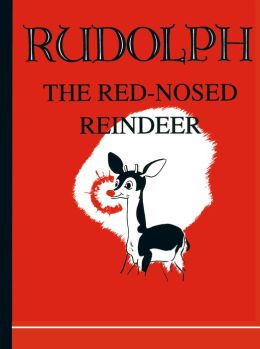
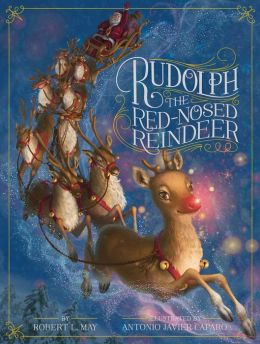
Rudolph the Red-Nosed Reindeer. Robert Lewis May. Illustrated by Denver Gillen. 1939/1990. Applewood Books. 32 pages. [Source: Library]

I enjoyed this one more than I thought I would. This is the original story by Robert L. May with the original illustrations by Denver Gillen. It is so different from the song and the stop-motion animated special. And I think it was the fact that it was different that made me appreciate it more.

The story is told in rhyme. It's essentially one long (perhaps poorly punctuated) poem. Here's how it begins:
Twas the day before Christmas, and all through the hills
The reindeer were playing…enjoying the spills
Of skating and coasting, and climbing the willows…
And hop-scotch and leap-frog (protected by pillows!)
While every so often they'd stop to call names
At one little deer not allowed in their games:--
"Ha ha! Look at Rudolph! His nose is a sight!"
"It's red as a beet!" "Twice as big!" "Twice as bright!"
While Rudolph just wept.
What else could he do?
He knew that the things
they were saying were true!
Readers first meet Rudolph, a young deer who is teased by his peers. He does NOT live at the North Pole. And he's not one of Santa's own reindeer.
What we do learn is that he's a very good, very obedient deer who is expecting Santa to leave him some lovely presents because he's been so very, very good.

Readers then meet Santa and learn of the horrible weather conditions that prove most challenging. Santa starts out on his trip, it isn't until he's delivering presents to Rudolph's house that he notices the brilliant light of his nose.

Santa then decides to wake him up and ask for his help. The rest of the journey goes much easier for Santa!

The book concludes with Santa returning Rudolph to his family, to his hometown. He is now a hero, of course.

I liked this one. I liked some of the rhymes more than others. There are definitely some quirky lines!
Come Dasher! Come Dancer! Come Prancer and Vixen!
Come Comet! Come Cupid! Come Donner and Blitzen!
Be quick with your suppers! Get hitched in a hurry!
You, too, will find fog a delay and a worry!"
And Santa was right. (As he usually is!)
The fog was as thick as a soda's white fizz.
The book is definitely text-heavy. So a longer attention span would be needed for little ones to enjoy this one.

The copy I read was a facsimile edition. A 75th Anniversary edition with new illustrations was released in September 2014.

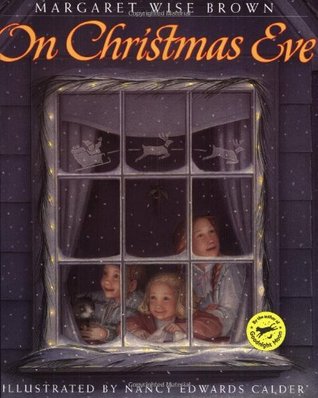
On Christmas Eve. Margaret Wise Brown. Illustrated by Nancy Edwards Calder. 1938/1961/1996. HarperCollins. 32 pages. [Source: Library]

It was the middle of the night. And night of all  nights it was Christmas.

I enjoyed Margaret Wise Brown's On Christmas Eve. It is a descriptive look at what Christmas--at what Christmas Eve--is like for children. It focuses on simple things: what your eyes see, what your ears hear, what your nose smells, what your hands and feet touch. It seeks to capture the emotion of the holiday: the excitement, the waiting, the longing.

Lots of details, lots of adjectives. It's rich in imagery and description. There is also a bit of repetition. The text is lyrical in places.

I can't say that I loved it. But it was very enjoyable. I was also glad to see that one of the presents under the tree was a train. The children are just in awe of the magic of Christmas, of the stockings and packages, of the snow falling outside, of the carolers outside.

It was a sweet story about three siblings.

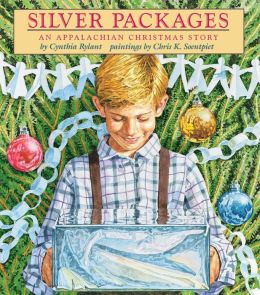
Silver Packages: An Appalachian Christmas Story. Cynthia Rylant. Illustrated by Chris K. Soentpiet. 1987. Scholastic. 32 pages. [Source: Library]

Silver Packages is a picture book for older readers most likely. I wouldn't say it is for an exclusively adult audience. But I think readers need some perspective in order to appreciate the book fully. I think it can resonate with readers, it has the potential. But I don't think the emotional reaction would be--or even should be--automatic. One can't assume that every reader will respond with tears and "this is the best book I've ever read!!!"

Silver Packages is about giving back to the community. In this instance, one very specific community--Appalachia. The book is about the Christmas Train. It starts with one man who wants to show his appreciation for the community that helped him when he needed it. He was injured in an accident, the community took in this stranger and nursed him back to health without asking for anything in return. He decides that he will come every year--by train--and hand out packages to the children who meet the train. These packages are wrapped in silver paper. Every story needs a protagonist. Silver Packages introduces us to Frankie. Readers first meet Frankie as a boy. He's a boy with a dream. He wants to be a doctor. And he really, really, really wants a doctor kit for Christmas. But each year, he's slightly disappointed. He receives a handful of silver packages through the years. Every gift seems to have a toy--something a boy or girl might want--and something a boy or girl might need. The practical gifts include: socks, mittens, hats, scarves, etc. Readers later see Frankie all grown up. He is a doctor. He reflects on his life, on his past Christmases, he has a light-bulb moment. He decides it is his turn to give back to the community in his own special way. It's a book about kindness and gratefulness and community awareness.

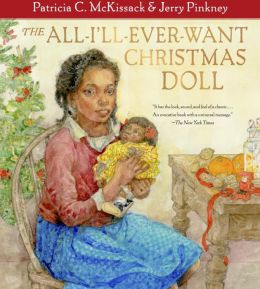
The All-I'll-Ever-Want Christmas Doll. Patricia C. McKissack. Illustrated by Jerry Pinkney. 2007. Schwartz & Wade. 40 pages. [Source: Library]

Christmas always came to our house, but Santy Claus only once in a while.

I haven't read The All-I'll-Ever Want-Christmas Doll in years. It was just as good as I remembered. The book is set during the Depression. A little girl, Nella, knows that her family is poor, that Santy may not come this year at all. Yet, she can't resist writing to him all the same begging for a Baby Betty doll. Her two sisters perhaps think a little less of Nella for her dreaming so big. She shouldn't expect so much from Christmas. But on Christmas morning, there are a few surprises. Each girl gets a Christmas sack filled with walnuts, peppermint candy, an orange, and a box of raisins. But there is one present, one special present remaining: a doll. Nella thinks the doll should be HERS and hers alone. After all, her sisters haven't gone around talking about the doll nonstop, her sisters didn't write Santa a letter begging for the doll. Why should she have to share the doll with them? But does the doll make her happy? Is the doll truly all she'll ever want? She has a few lessons to learn for sure!

I really enjoyed the story and the message.

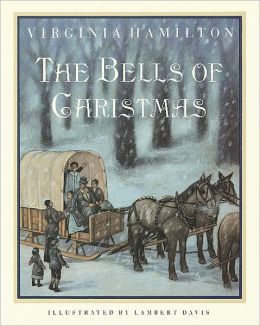
The Bells of Christmas. Virginia Hamilton. Illustrated by Lambert Davis. 1989/1997. Houghton Mifflin Harcourt. 64 pages. [Source: Library]

I didn't dislike Virginia Hamilton's The Bells of Christmas. But I didn't love, love, love it either. I think it depends on what exactly you're expecting from a Christmas book. The Bells of Christmas is very much a celebration of a Christmas long ago. Christmas 1890. Readers meet a young boy, Jason Bell, and experience the holiday through his perspective. We learn about his mom and dad, his brothers and sisters, his cousins, his aunt and uncle, his friend, Matthew. The book is set over a period of several days. Among the things readers learn that Jason's dad is a carpenter, that he wants his sons to join him in his business one day, his dad has only one leg, that his dad wears a peg leg part of the time and is in his wheel chair the rest of the time. Readers also learn that Jason is just a wee bit obsessed with wheels--mainly trains, but, also wagons, etc. The book has plenty of detail and characterization which is a good thing. Jason is waiting for quite a few things: 1) he can't wait for Christmas morning and presents! 2) he can't wait for the Bells to arrive--his uncle and aunt and cousins, 3) he is excited about church, most everyone is performing and participating in some way. (Jason is singing a solo.) The book perhaps seeks to capture one Christmas for one extended family. It is a pleasant, enjoyable book. It isn't quite a chapter book or novel. It isn't quite a picture book.
 
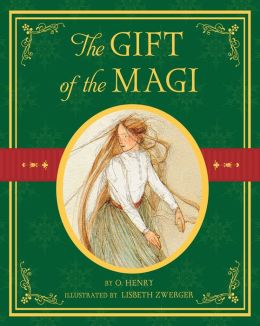
The Gift of the Magi. O. Henry. Illustrated by Lisbeth Zwerger. 1905/2006. Simon & Schuster. 32 pages. [Source: Library]

I've seen adaptations of The Gift of the Magi--who hasn't? (My favorite is Bert and Ernie and Mr. Hooper.) But this is the first time I've read the actual short story. I haven't decided how I feel about it. Is this couple wise or foolish? Or are they at times foolish and at times wise?

The wife, Della, takes extraordinary pride in her long hair. She doesn't seem the vain sort except for when it comes to her hair. And even if she is vain about it, there's no indication it's anything besides a private vanity. The wife apparently has been coveting expensive hair combs as well. The husband, Jim, takes extraordinary pride in the family watch. The narrator uses exaggeration when discussing the woman's long hair and the man's gold watch. I didn't love the narrator. In fact, I think the narrator is a distraction. He won't let the reader forget for a moment that this is a precious story.
Now, there were two possessions of the James Dillingham Youngs in which they both took a mighty pride. One was Jim's gold watch that had been his father's and his grandfather's. The other was Della's hair. Had the queen of Sheba lived in the flat across the airshaft, Della would have let her hair hang out the window some day to dry just to depreciate Her Majesty's jewels and gifts. Had King Solomon been the janitor, with all his treasures piled up in the basement, Jim would have pulled out his watch every time he passed, just to see him pluck at his beard from envy.
The wife can't afford a gift for her husband. The husband can't afford a gift the wife. The wife knows this--or should know this. The husband knows this--or should know this. The wife has saved $1.87. The husband might have saved a small sum as well. Readers don't know one way or the other. Both husband and wife will have something to offer the other, however. Something more than love. For both have decided--quite independently--to give sacrificially. To give up what they supposedly value most: her hair, his watch. And this giving up wasn't to support the family, but, to support the other's vanity.

I think actions can speak more than words. I think the narration took away some of my enjoyment of this one. It felt odd at times. There were sentences that were eloquent and refined and then it would slip into something else.
"It's sold, I tell you--sold and gone, too. It's Christmas Eve, boy. Be good to me, for it went for you. Maybe the hairs of my head were numbered," she went on with sudden serious sweetness, "but nobody could ever count my love for you. Shall I put the chops on, Jim?"
I think I like the adaptations better.

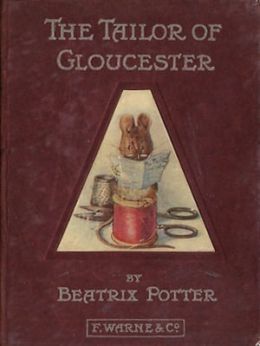
The Tailor of Gloucester. Beatrix Potter. 1903. 58 pages. [Source: Library] 
In the time of swords and periwigs and full-skirted coats with flowered lappets—when gentlemen wore ruffles, and gold-laced waistcoats of paduasoy and taffeta—there lived a tailor in Gloucester.
He sat in the window of a little shop in Westgate Street, cross-legged on a table, from morning till dark.
All day long while the light lasted he sewed and snippeted, piecing out his satin and pompadour, and lutestring; stuffs had strange names, and were very expensive in the days of the Tailor of Gloucester.
I enjoyed rereading Beatrix Potter's The Tailor of Glouchester. In this delightful Christmas tale, readers meet a tailor, a cat named Simpkin, and some lovely mice. It is several days before Christmas. He's working hard to finish a coat and waistcoat for the Mayor of Glouchester. The Mayor is getting married on Christmas day. The tailor has just enough money to finish the coat. Not a penny to spare. He sends his cat, Simpkin, with his money to buy what he needs: a little for himself (food: bread, sausage, milk) a little for his work (one twist of cherry-coloured silk). It is only after the fact that he questions whether he should have sent the cat or gone himself. The cat returns, but, in a mood. The cat is upset for he's discovered that the tailor freed the mice he had captured and hid under the teacups. The cat hides the twist. The man is upset, of course, and sick. He takes to his bed unable to work. The oh-so-thankful mice go to his shop and finish his work for him. But since they are one twist short, they are unable to finish completely. Still, they do what they can, and they do a wonderful job. The cat who spies them at work, I believe, has a change of heart and gives the twist to the old man on Christmas morning. He has just enough time to finish. The Mayor is very, very pleased. And the tailor's luck changes for the better, and his business is much improved. This one is a lovely, delightful read from start to finish.

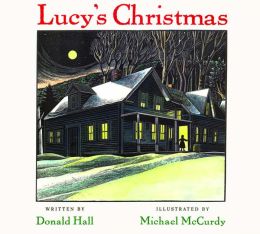
Lucy's Christmas. Donald Hall. Illustrated by Michael McCurdy. 1998. Houghton Mifflin Harcourt. 40 pages. [Source: Library]

I enjoyed reading Lucy's Christmas by Donald Hall. Lucy's Christmas is a picture book set in 1909 in New Hampshire. In the fall of 1909, Lucy and her family start preparing for Christmas. For Lucy, this means starting to make her own gifts for her family and friends. It pays to plan ahead since so many gifts take time, and thought must be placed into each gift. She's not the only one thinking ahead. This year the family is ordering a new stove for the kitchen. The family has spent a lot of time browsing in the Sears catalog. Lucy's choice is the one the family decides upon: the Glenwood Kitchen Range. The focus is not just on gifts: planning, making, giving, receiving. The focus is also on family life and community life. Readers get glimpses of the school and church. Both places are very busy! I enjoyed this glimpse into the past! It was interesting to see the family prepare for the new year--1910. The enthusiasm in the story is sweet. The author's note reveals that this picture book is based on family history.

I really liked this one very much. I liked Lucy and her family. I liked the fact that the church plays such a HUGE role in the Christmas celebrations. There are gifts, it's true. But it's not commercialized and selfish.

Baboushka and the Three Kings. Ruth Robbins. Illustrated by Nicholas Sidjakov. 1960/1986. Houghton Mifflin Harcourt. 32 pages. [Source: Library]

Long ago and far away, on a winter's evening, the wind blew hard and cold around a small hut.

Baboushka and the Three Kings won the Caldecott Medal in 1961. It is Russian folktale with a Christmas setting. The three kings--wise men--come to Baboushka's hut. They only stay a few minutes. Long enough to extend an invitation to the old woman. Will she join them in their procession, in their quest, to find the Babe, the Child? She'd love to join them, she'd love to bring gifts to the Child. But she is not ready to go just yet. Couldn't they all wait until morning? Couldn't they wait for her to finish up a few small, tiny chores first? Couldn't they wait for the storm to clear? Their answer was firm. Their journey to the Child was too important to postpone. They couldn't linger longer. She watched them depart. But they were not easy men to forget. The next morning, she begins a journey of her own. A journey that will take her far. But will her journey lead her to where she wants to go?

It's a simple story, nicely written. "It is no ordinary Babe they seek. Yes! I must go and follow them! To find the new Babe, to offer Him her gift, was now her one yearning. This thought burned in her mind like a candle in the dark." It is also nicely illustrated. The illustrations complement the text well. Both illustrations and text have a different flavor, an authentic flavor, but not exactly American. After several readings, I came to appreciate both a bit more.

In case you're unfamiliar with the story, the book is bittersweet at best. While it is true that Russian children everywhere look forward to Baboushka's gifts each year as her journey continues, it is also true that Baboushka's journey has no happy ending. She never finds the Child. She is never able to give Him her gifts.

Polar Express. Chris Van Allsburg. 1985/2009. Houghton Mifflin Harcourt. 32 pages. [Source: Library]

The Polar Express is one of my favorite Christmas books. It is. The book is a thousand times better than the movie. (Though the soundtrack of the movie isn't bad.) So if you've only seen the movie, you might want to give the book a try to. You might have a different response to it.

The Polar Express is about belief and doubt--in Santa. It's told in the first person, so we never learn the protagonist's name, but it is a little boy with a younger sister named Sarah. One Christmas Eve, the little boy is awakened by The Polar Express. He goes to the North Pole on the Polar Express train, there are other passengers too. All presumably boys and girls on the verge of not-believing. At the North Pole, he sees Santa, reindeer, and elves. He happens to be chosen to receive the first gift of Christmas. He asks for a bell from Santa's reindeer. This gift is not in his possession for long, however, because he has a hole in his pocket. On Christmas day, he receives a special gift under the tree: the bell he had lost. He can hear it. His sister can hear it. But his parents do not. The book ends wonderfully with a message for "all those who truly believe."

I loved this one cover to cover, though I love the ending most of all.


© 2014 Becky Laney of Becky's Book Reviews

Sunday, July 06, 2014

Do you know Jenny Linsky?

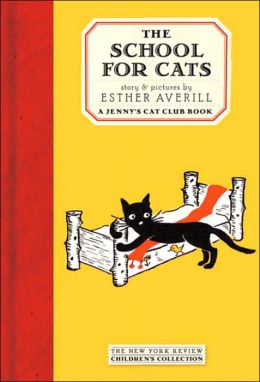
The School for Cats. Esther Averill. 1947/2005. New York Review Children's Collection. 32 pages. [Source: Library]

The School for Cats was originally published in 1947. It is part of a larger series of books starring the (black) cat Jenny Linsky and her friends. The School of Cats is not the first in the series, but, it is the first in the series that my library actually had. In this "Jenny's Cat Club" book, readers meet Jenny as she leaves her home in Greenwich Village to attend school in the country. She is very, very, very unsure about the whole school thing. But her master, Captain Tinker, wants her "to study cat lore in the country." There is definitely something of an adventure in this one when Jenny runs away from school. But it also contains a lesson on friendship and adapting to new situations.

I enjoyed this one. I look forward to reading others in the series.

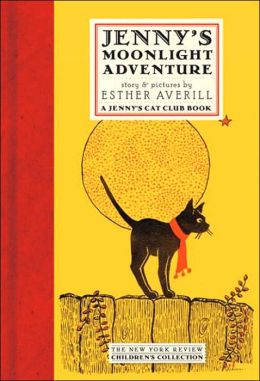
Jenny's Moonlight Adventure. Esther Averill. 1949/2005. New York Review Children's Collection. 32 pages. [Source: Library]

Jenny's Moonlight Adventure was originally published in 1949. It is part of a larger series of books starring Jenny and her friends. I did not like this book as well as The School for Cats. It is a Halloween adventure. Jenny must prove how brave she is both for herself and for her friends. She reluctantly accepts a job that only she can do. She is to carry a nose flute to a sick friend (another cat, of course). The job is "dangerous" because it requires her to be brave and clever enough to get past several unfriendly neighborhood dogs.

For readers who celebrate Halloween, this one might prove charming.

Jenny Goes to Sea. Esther Averill. 1957/2005. New York Review Children's Collection. 140 pages. [Source: Library]

Of the Jenny Linsky books I've read so far, Jenny Goes to Sea is probably my favorite. In this chapter book originally published in 1957, Jenny Linsky and her two brothers, Edward and Checkers, travel the world with their owner, Captain Tinker. These three cats become very good friends with Jack Tar, the ship's cat. These three leave the ship in company with Jack Tar at many of the ports including Capetown, Zanzibar, Singapore, and Bangkok. Adventures come oh-so-naturally.

I definitely recommend this series to cat lovers of all ages.

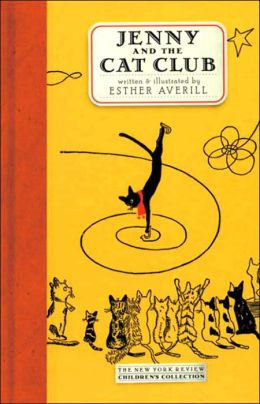
Jenny and the Cat Club: A Collection of Favorite Stories About Jenny Linsky. Esther Averill. 1973/2003. New York Review Children's Collection. 176 pages. [Source: Library]

Jenny and the Cat Club features five stories by Esther Averill. These were originally published in 1944, 1948, 1951, 1952, and 1953. The stories are: "The Cat Club," "Jenny's First Party," "When Jenny Lost Her Scarf," "Jenny's Adopted Brothers," and "How the Brothers Joined the Cat Club."

The Cat Club introduces readers to Jenny Linsky, a "shy little black cat" from New York City. Readers meet Jenny and her owner Captain Tinker. In this adventure, Jenny receives her signature red scarf, a present from her owner who happens to knit. This red scarf helps Jenny gain enough confidence to talk to other cats in the neighborhood. In this one, readers learn about the neighborhood cat club, they are briefly introduced to the other cats, and they learn that members of the cat club must be special.

Jenny's First Party is a story focusing on Jenny and her friend Pickles (the fire cat) teaming up and strolling the neighborhood. Both are looking for fun, fun, fun. But neither have money. (What cat has money?!) They stumble upon a groovy party and a great time is had by all. Readers learn that Jenny can dance a happy little sailor's hornpipe dance.

"When Jenny Loses Her Scarf" is about when Jenny's beloved red scarf was stolen by a dog. The dog, Rob the Robber, refuses to give it back. Jenny seeks help from Pickles the fire cat. Pickles is just the one to help her, it turns out, for justice is dealt out after all. The dog's hangout catches on fire! Pickles retrieves the scarf as he's putting out the fire.

"Jenny's Adopted Brothers" is about when Jenny meets two stray cats: Checkers and Edward. Checkers, readers learn, retrieves things. Edward, we learn, is a poet. Jenny meets these two, feels sorry for them, and introduces them to Captain Tinker. When these two are adopted by the Captain, Jenny feels very jealous! Will having two other cats in the house prove too much?!

"How The Brothers Joined the Cat Club" is obviously about when Edward and Checkers join the club. Jenny is hesitant to include her two new brothers at first. After all, she likes the idea that the club could remain her own little secret and her way to get away from them. But. Being the good little cat that she is, Jenny soon realizes that she could never really keep her brothers from missing out on the awesomeness of the cat club. She helps them discover their talents and introduces them to all her friends.

I liked this one. I did. I like meeting Jenny and the other cats.

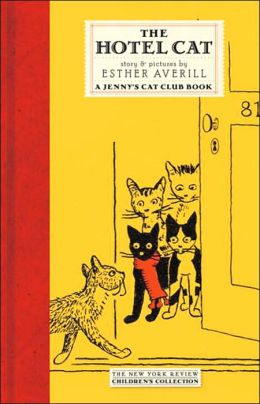
The Hotel Cat. Esther Averill. 1969/2005. New York Review Children's Collection. 180 pages. [Source: Library]

The Hotel Cat is an enjoyable children's novel by Esther Averill. It was originally published in 1969.

The Hotel Cat stars a cat named Tom. He lives at the Royal Hotel, an eight-story building in New York. It is on the older side. And the hotel isn't doing the best business. But all that happens to change during the novel. Tom who is used to having the place to himself, for the most part, at least in terms of CATS ON THE PLACE discovers that there are cats there with their owners. The first few cats he meets he is rude, very rude. But after Tom's owner, Mrs. Wilkins, talks to him, he decides to be more gracious and welcoming. It isn't long before he meets three cats: Jenny, Edward, and Checkers. And those aren't the only cats from the cat club he happens to meet. A difficult winter has resulted in a lot of broken boilers and frustrated cat-owning homeowners are staying at the Royal Hotel. How convenient!

Tom learns a lot about making and keeping friends in The Hotel Cat.

I liked this one.

Captains of the City Streets. Esther Averill. 1972/2005. New York Review Children's Collection. 164 pages. [Source: Library]

Captains of the City Streets is a children's novel by Esther Averill originally published in 1972. Two cats star in Captains of the City Street. In this one, the author provides the back story for two cats who have been a part of essentially the whole series. Sinbad and The Duke. These two stray cats are best buddies. They haven't been "owned" by a human in what seems like a very long time by cat reckoning. They are street cats, traveling cats, going from city to city to city, seeing all there is to see, always seeking handouts, but never becoming dependent on any one human. The two travel to "old New York." They are looking for a place of their own, a safe place to stay. They find it. They also find one old man who dependably gives them food day after day on their own terms. He comes and goes leaving the food, never trying to approach the cats, never pushing a relationship. The two cats slowly but surely decide that maybe just maybe humans aren't all that bad. That is when they stumble upon the Cat Club. They learn that the kind human is Captain Tinker. The first cat they befriend is Macaroni. The two are invited to join the Cat Club, but, are hesitant. Do they want to stick around that long? Do they want the responsibility?

I liked meeting Sinbad and Duke. The stories that focus on Jenny certainly mention these two quite a bit, but, this is the first time that readers really learn about these two in detail. It is a fun book.

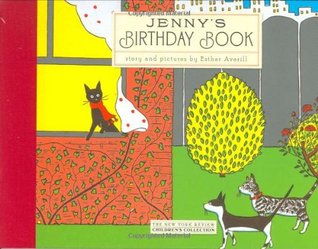
Jenny's Birthday Book. Esther Averill. 1954/2005. New York Review Children's Collection. 44 pages. [Source: Library]

Jenny's Birthday Book by Esther Averill was originally published in 1954. In this cat club book, Jenny Linsky, our star cat, our shy little black cat with the red scarf, has a special birthday with all of her friends whom we've met through the series. Pickles. Sinbad and The Duke. Florio. To name just a few. It is a lovely birthday. The book itself is sweet, simple, and charming. Especially if you like cats and vintage picture books. I think my favorite illustration is of all the cats dancing the Sailor's Hornpipe in the park.

The Fire Cat. Esther Averill. 1960/1983. HarperCollins. 64 pages. [Source: Own]

I enjoyed revisiting The Fire Cat by Esther Averill. I read this one many times as a child. But I had no idea it was part of a larger series of books, the Cat Club series by Esther Averill. The Fire Cat does not star Jenny Linsky. It stars Pickles. Pickles has been a delightful character in almost all of the other books in the series. He is probably one of Jenny's best best friends. In the Fire Cat, readers learn more about Pickles. Was he always a fire cat? Of course not! There was a time he was a hopeless cat that was a little bit bad and a little bit good. One of the firemen takes an interest in him and takes him to the fire station. He is hoping that the chief will allow Pickles to stay. Pickles most definitely wants to stay. He wants to prove himself worthy, so he decides to learn by example. He learns to slide down the pole, for example, he learns how to work a hose. The fire chief is definitely charmed, I imagine cat-loving readers are just as charmed. I certainly was! The Fire Cat is a feel-good read. Readers see Pickles transform from a slightly-naughty homeless cat to a brave and dutiful fire cat. He learns responsibility and compassion. Overall, it's just a good story.


© 2014 Becky Laney of Becky's Book Reviews

Friday, February 14, 2014

Reread #7 To Kill A Mockingbird

To Kill A Mockingbird. Harper Lee. 1960. 281 pages. [Source: Book I Own]

To Kill A Mockingbird is one of my favorite, favorite books. I love, love, love the movie. And I adore the book as well. It's a simple novel rich in truth. I love the narrative voice of Scout. I think Scout is one of the most memorable narrators ever.

One of the things that I think makes the book work so well is how it is able to be serious and dramatic AND comical. It captures the little every-day moments so well. Family relationships. Community relationships. Nosy neighbors or spooky ones. A good balance of summer-time freedom and the structure of school. It's definitely one of the best coming-of-age stories. At the same time, it is a very honest examination of racism and injustice.

To Kill A Mockingbird has a great, compelling story to tell. And Harper Lee knew how to tell a story. But it isn't the story alone that is unforgettable: it is the characters. Such characterization!!! Such depth!!! Who could not love Scout, Jem, and Atticus?! Who could not love Calpurnia, Dill,  Miss Maudie, and Boo Radley?!

I first reviewed it in October 2007. I also reviewed it in August 2010.

Favorite quotes:
Until I feared I would lose it, I never loved to read. One does not love breathing. (18)
"First of all," he said, "if you can learn a simple trick, Scout, you'll get along a lot better with all kinds of folks. You never really understand a person until you consider things from his point of view--"
"Sir?"
"--until you climb into his skin and walk around in it." (30)
"If you shouldn't be defendin' him, then why are you doin' it?"
"For a number of reasons," said Atticus. "The main one is, if I didn't I couldn't hold up my head in town, I couldn't represent the county in the legislature, I couldn't even tell you or Jem not to do something again."
"You mean if you didn't defend that man, Jem and me wouldn't have to mind you any more?"
"That's about right."
"Why?"
"Because I could never ask you to mind me again. Scout, simply by the nature of the work, every lawyer gets at least once in his lifetime that affects him personally. This one's mine, I guess. You might hear some ugly talk about it at school, but do one thing for me if you will: you just hold your head high and keep those fists down. No matter what anybody says to you, don't you let 'em get your goat. Try fighting with your head for a change...it's a good one even if does resist learning. (76)
Atticus said to Jem one day, "I'd rather you shot at tin cans in the back yard, but I know you'll go after birds. Shoot all the bluejays you want, if you can hit 'em, but remember it's a sin to kill a mockingbird."
That was the only time I ever heard Atticus say it was a sin to do something, and I asked Miss Maudie about it.
"Your father's right," she said. "Mockinbirds don't do one thing but make music for us to enjoy. They don't eat up people's gardens, don't nest in corncribs, they don't do one thing but sing their hearts out for us. That's why it's a sin to kill a mockingbird. (90)
It's when you know you're licked before you begin but you begin anyway and you see it through no matter what. You rarely win, but sometimes you do. (112)
In Maycomb County, it was easy to tell when someone bathed regularly, as opposed to yearly lavations: Mr. Ewell had a scalded look; as if an overnight soaking had deprived him of protective layers of dirt, his skin appeared to be sensitive to the elements. Mayella looked as if she tried to keep clean, and I was reminded of the row of red geraniums in the Ewell yard. (179)
"How could they do it, how could they?"
"I don't know, but they did it. They've done it before and they did it tonight and they'll do it again and when they do it--seems that only children weep. Good night." (213)

© 2014 Becky Laney of Becky's Book Reviews

Tuesday, June 07, 2011

Three At Wolfe's Door

Three at Wolfe's Door. Rex Stout. 1960. Viking. 186 pages.

First sentence from Poison a la Carte: I slanted my eyes down to meet her big brown ones, which were slanted up.
First sentence from Method Three for Murder: When I first set eyes on Mira Holt, as I opened the front door and she was coming up the seven steps to the stoop, she was a problem, though only a minor one compared to what followed.
First sentence from The Rodeo Murder: Cal Barrow was standing at the tail end of the horse with his arm extended and his fingers wrapped around the strands of the rope that was looped over the horn of the cowboy saddle.

Three At Wolfe's Door--a Nero Wolfe Threesome--contains three novellas: Poison A La Carte, Method Three for Murder, The Rodeo Murder. Two of the three entertained me: Poison A La Carte and Method Three For Murder. (The third, well, let's just say that Rex Stout's blending of cowboys and cowgirls into New York City wasn't quite to my liking.)

In Poison A La Carte, Archie Goodwin and Nero Wolfe set out to solve which one of the twelve waitresses (or servers) poisoned Vincent Pyle. The evening was supposed to be pure pleasure. A gourmet meal served by lovely young ladies. Each young woman assigned to a guest. But this evening turned deadly, and it is up to these detectives to find out which woman had the greatest motive to commit murder. It's quite a puzzle, but if anyone can solve it...you can trust Nero Wolfe and Archie Goodwin!

Method Three for Murder is perhaps my favorite of this threesome. For it begins with a heated argument of sorts between Archie Goodwin and Nero Wolfe. An argument that ends with Archie leaving Wolfe's employment! On his way out the door, Archie meets a young woman, Mira Holt, who wants to consult with him. She has this question. She tries to make it hypothetical. What if a woman cab driver came back to her cab and discovered a dead body? Of course, Archie, even before seeing the taxi parked in front had his suspicions. But. He takes the case anyway--rushed into a decision perhaps by the arrival of some cops! Can Archie--with the help of Nero Wolfe--solve this mystery?

Rodeo Murder is my least favorite not only of this collection but of all the novels I've read so far. I'm not sure it's worth mention at all.

I enjoyed this one. I'm not sure I loved any of the novellas. Not when comparing them with the other Nero Wolfe novels I've read. Like The Golden Spiders. Like Some Buried Caesar. But I am glad I read it!

My favorite quote from Method Three For Murder:
Over the years at least a thousand people have asked me what the police think, and I appreciate the compliment though I rarely deserve it. Life would be much simpler if I always knew what the police think at any given moment. It's hard enough to know what I think. (95)
My favorite quote from Poison A La Carte:

A young woman to Archie Goodwin:
"I've seen you and I've seen your picture. You like yourself. Don't you?"
"Certainly. I string along with the majority. We'll take a vote. How many of you like yourselves? Raise your hands." (7)


© 2011 Becky Laney of Becky's Book Reviews

Tuesday, August 24, 2010

To Kill A Mockingbird


To Kill A Mockingbird. Harper Lee. 1960. 281 pages.

I love rereading favorite books. I do. I don't get the chance as often as I'd like--too many new books wanting my attention. But rereading this one felt just right. When Annette from A Garden of Books suggested we read this one together, I was very excited!

To Kill A Mockingbird is one of those rare novels--a true classic--with a dozen or more themes in it--but it feels so effortless to read, to savor. Yes, it's about justice, prejudice, race and class, etc. But above all else it is about ordinary people of all ages. Men. Women. Girls. Boys. Ordinary folks--Southern folks--living life as best they can.

Atticus Finch, the father of Scout, our narrator, challenges his children to think about things differently. "If you can learn a simple trick, Scout, you'll get along a lot better with all kinds of folks. You never really understand a person until you consider things from his point of view" (30).

I loved Scout. I just LOVED her. The novel chronicles three years of her life. (Mostly summers--though school does play a role in the novel. And there is a great Christmas chapter!) Readers see Scout in relationship with various people--her father, Atticus, her brother, Jem, her summer-time friend, Dill, Calpurnia, the Finch's housekeeper, Aunt Alexandra, Uncle Jack, Miss Maudie (a neighbor), Mrs. Dubose (yet another neighbor), etc. And then, of course, there is the ever-mysterious Boo Radley. The man that fascinates Scout, Jem, and Dill.

When Atticus Finch is chosen to defend Tom Robinson a black man accused of raping a white woman, life changes--for better or worse--for his two children. Many in the community can't understand why he actually takes the case seriously. Why he is putting his all into it, treating it as a real case. But Atticus says it well when he says, "Scout, I couldn't go to church and worship God if I didn't try to help that man" (104) and "The one thing that doesn't abide by majority rule is a person's conscience" (105).

Harper Lee did a GREAT job with her characters. They're so richly detailed. Many characters feel so real, so human. It is a joy to spend time with Scout. To become a part of her world. To see the world through her eyes. She also did great with descriptions. Whether the scene is serious--heartbreaking--or comical--Harper Lee has a way of describing it in a way that is memorable and true to life.

Until I feared I would lose it, I never loved to read. One does not love breathing. (18)


It's when you know you're licked before you begin but you begin anyway and you see it through no matter what. You rarely win, but sometimes you do. (112)


"How could they do it, how could they?"
"I don't know, but they did it. They've done it before and they did it tonight and they'll do it again and when they do it--seems that only children weep. Good night."
(213)
© Becky Laney of Becky's Book Reviews