Showing posts with label 1939. Show all posts

Wednesday, January 21, 2026

8. By the Shores of Silver Lake


8. By the Shores of Silver Lake. Laura Ingalls Wilder. 1939. 290 pages. [Source: Library] [audiobook, j historical fiction, series book]

First sentence: Laura was washing the dishes one morning when old Jack, lying in the sunshine on the doorstep, growled to tell her that someone was coming. She looked out, and saw a buggy crossing the gravelly ford of Plum Creek. "Ma," she said, "it's a strange woman coming."

By the Shores of Silver Lake is one of five Newbery Honors that Laura Ingalls Wilder received for her historical fiction "Little House" series. (For those that are curious: 1938 for On the Banks of Plum Creek; 1940 for By the Shores of Silver Lake; 1941 for The Long Winter; 1942 for Little Town on the Prairie; 1944 for These Happy Golden Years).

The novel takes the Ingalls family into South Dakota around DeSmet where the rest of the series is set.

As a child, By The Shores of Silver Lake wasn't my favorite of the series. I blame Jack's death for that. But as an adult, I've come to appreciate By The Shores of Silver Lake more, seeing it as more than just a transition between On the Banks of Plum Creek and The Long Winter.

In By the Shores of Silver Lake:
  • Mary goes blind, Laura is "asked" to be her eyes
  • Pa is offered a new job, a job with the railroad, which he takes
  • He goes by wagon, Jack dies BEFORE Pa's departure
  • The rest of the family travels most of the way by train
  • They continue the rest of their journey (a day or two or three) by wagon
  • They settle in for a while, Pa talks about the claim he hopes to claim later that year or whenever his job is finished and he's able to go out seeking a claim of his own
  • Pa's job isn't always safe; he's the paymaster for the railroad, and he has to calm down an angry mob in this one.
  • They meet the Boast family
  • They spend the winter in the 'biggest' house Laura has ever lived in
  • Winter may be lonely (no neighbors, no town) but the spring will see plenty of people come and go. EVERYONE stops at their house on their way west
  • The family learns that there is a school for the blind, they all decide Mary should go there.
  • The family decides to claim land near De Smet, South Dakota
  • Laura catches the tiniest glimpse of Almanzo Wilder's horses
I definitely am enjoying rereading these books. By The Shores of Silver Lake may not be my favorite of the series, but, I'm glad I reread it.

© 2026 Becky Laney of Becky's Book Reviews

Friday, November 08, 2024

93. Superman: The Golden Age Volume 1

93. Superman: The Golden Age #1 Jerry Siegel. Joe Shuster. 2016. (Comics are from June 1938 through December 1939.) 392 pages. [Source: Library] [5 stars] [comic books; graphic novel; superheroes; action]

First sentence: As a distant planet was destroyed by old age, a scientist placed his infant son within a hastily devised space-ship, launching it toward Earth!

Premise/plot: What you see is what you get. This book is a collection of the earliest Superman comic books. The comic books include Action Comics (where he first appeared), New York World's Fair Comics, and the self-titled Superman comics. The main villain in these--appearing more than any other villain, I mean--is Ultra. But more often than not, each comic book has its own villain, or "villain." Sometimes the villain is a greedy businessman who takes shortcuts with the quality of his products, and sometimes they are out-and-out villainous. Ultra, for example, is out for world domination. Superman also at least once--maybe a few more times--does some "aggressive negotiating" with countries at war. He is not above beating out a confession from a villain either. 

My thoughts: A handful of these are extremely moralistic and didactic. To those that have read this book, a handful might not come across as the right word. There are super-incredibly-obvious didactic tactics at play. There are direct moralization at play. There are more subtle and indirect moralization at play. There's a range of spectrum. Even at its worst--it's enjoyable for a giggle. The writing is SO over the top and "special." My new favorites being SHORTLY LATER which appears more often than not in most of the adventures followed up by SHORTLY AFTER. The second half of the book, the writers seemed to have switched up the phrase. IF readers got paid a penny for every time the word "muscles" was used, then they'd be able to afford a LOT of comics. 

I can definitely see the appeal of Superman. Though it's not necessarily a visual appeal in the comics. I think this might just be the times in which they were written, but, it is almost like there were essentially three male faces and one perhaps two female faces that appear. Everybody looks the same, or same-ish. There are no details, no expressions. I thought it was funny--perhaps ironic--that Superman was able to take the place of at least two different people and masquerade as someone else. Once as a football player and once as a boxer??? Honestly, the way these characters are drawn, I believe it. That being said, I enjoyed the vintage-ness of it.


© 2024 Becky Laney of Becky's Book Reviews

Tuesday, September 10, 2024

70. Batman The Golden Age, volume 1

Batman The Golden Age, Volume 1. Bill Finger, Gardner F. Fox, Whitney Ellsworth, et al. 2016. 411 pages. [Source: Library] [4 stars]

First sentence: "Well commissioner, anything exciting happening these days?" "No...except this fellow they call the "Bat-Man" puzzles me!"

Premise/plot: Batman The Golden Age is an omnibus of original Batman (and Robin) comics which originally appeared in Detective Comics and Batman comics. The first issue in the omnibus is Detective Comics #27 from May 1939, and the last issue in the omnibus is Detective Comics #45 from November 1940. All comics predate the Second World War as you can see. There are a variety of villainous villains--including Cat Woman and the Joker--but only one sidekick, Robin the BOY WONDER.The comics are formulaic, as you can imagine, and Batman is never to be outwitted or defeated.

My thoughts: I enjoyed this so much more than I thought I would. Now I don't see myself turning into someone who reads comic books--and superhero action comic books at that--regularly. I do think this is more for adults perhaps. (I wonder if kids would seek out Batman comics on their own???) I say that merely because it would be rare indeed for an entire issue--each issue has multiple stories--to not offend someone in someway these days. But there is something  right in the fact that Batman rarely changes. Action with a hefty side of cheese.

 Some of the stories were GREAT, absolutely worth the read. A few weren't so great. Plenty were just meh. Still I'm glad I read this one.

© 2024 Becky Laney of Becky's Book Reviews

Friday, December 15, 2023

190. The Blind Side


The Blind Side. Patricia Wentworth. 1939. 224 pages. [Source: Library] [Adult fiction; mystery]

First sentence: Craddock House stands at the end of one of those streets which run between the Kings Road and the Embankment. 

Premise/plot: This one is the first in the Ernest Lamb mystery series by Patricia Wentworth. It was my first time--to my recollection--reading Patricia Wentworth. This one is, in many ways, your typical classic British mystery. It involves a murder....and a dysfunctional [extended] family is at the center of the drama. Though not every suspect is a [distant or near] relation.

My thoughts: I enjoyed this one. I would probably have enjoyed it a LOT more if the library due date had not made me rush through the last hundred pages. There's nothing quite like the feeling of having to race through a book because it is due at the library. I enjoyed it enough that I would reread it again at some point and possibly continue on in the series. 


© 2023 Becky Laney of Becky's Book Reviews

Tuesday, July 09, 2019

Madeline

Madeline. Ludwig Bemelmans. 1939. 44 pages. [Source: Library]

First sentence: In an old house in Paris/ that was covered with vines/ lived twelve little girls in two straight lines.

Premise/plot: Madeline is a children's classic set in Paris, France. It stars a brave little girl, Madeline, who has to go to the hospital with her appendix.

My thoughts: I love the setting of Madeline. I do. The illustrations of this one are lovely. The rhyming is nice. But the story itself--when you really stop and think about it--is a bit odd. As a child, I never really stopped to think about where they lived. Was it an orphanage? Were all the girls orphans? Is that why sometimes they were very, very sad? Was it a school? I also never really understood--then or now--why the other girls wanted Madeline's scar?!

Text: 3 out of 5
Illustrations: 4 out of 5
Total: 7 out of 10

© 2019 Becky Laney of Becky's Book Reviews

Saturday, March 25, 2017

Bobbs-Merrill Third Reader

Bobbs Merril Third Reader. Edited by Clara Belle Baker and Edna Dean Baker. 1924/30/39. 293 pages. [Source: Bought]

Premise/plot:This one is a reading/literature textbook from the 1930s. It contains stories and poems mainly. The book is divided into four sections: "Merry Animal Tales," "Folk Fairy Tales and Poems," "Stories of Many Lands," and "Playtime Stories."

My thoughts: My favorite selection from "Merry Animal Tales" was "The Frogs' Travels a Japanese folk tale. There are two frogs: one from a pond near Osaka, the other from a stream in Kioto. Both frogs decide to go traveling. They each reach the top of a mountain. They decide to help each other decide if it's worth continuing the journey on.
"Oh," said the Kioto frog, "we can stand on our hind legs and hold on to each other. Then each can look at the town where he is going."
and
The foolish frogs forgot that their eyes were in the back of their heads. Though their noses pointed to the places toward which they wanted to go, their eyes beheld the places from which they had come.
My favorite section of the book was "Folk Fairy Tales and Poems." I really loved quite a few of these including: "The Good Husband," "The Glass Hill," "Nail Soup," and "The Twelve Months." This section also includes a version of Hansel and Gretel adapted from the opera.

My favorite selection from "Stories of Many Lands," was "The Goose Boy." This one stars a king--the king of Bavaria--and a goose boy. So one day, a king loses a book beneath a tree. Not wanting to exert himself, he tries to hire a goose boy to go and fetch it for him. The goose boy is skeptical that he can earn a gold piece merely by running a mile to fetch a book! And if he did go, who would watch his geese?! The king says he'd be happy to watch the geese while the boy does his errand. But is the king up to such a task?!?! The boy returns with the book to find his geese gone and the king apologetic. The king helps the boy round up the geese again, and, he reveals that he is in fact the king. The boy, still skeptical, says he doesn't know if that is true enough...but he should definitely not be a gooseherd!

My favorite selection from "Playtime Stories," is Moufflou. This one is about a peasant family with a very well-trained dog that may or may not be the making of their fortune. It's a very charming story set in Italy. 

© 2017 Becky Laney of Becky's Book Reviews

Saturday, November 12, 2016

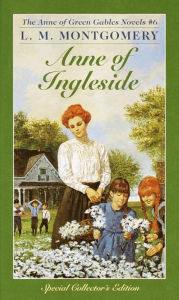
Anne of Ingleside

Anne of Ingleside. L.M. Montgomery. 1939. 274 pages. [Source: Bought]

First sentence: “How white the moonlight is tonight!” said Anne Blythe to herself, as she went up the walk of the Wright garden to Diana Wright’s front door, where little cherry-blossom petals were coming down on the salty, breeze-stirred air. She paused for a moment to look about her on hills and woods she had loved in olden days and still loved. Dear Avonlea! Glen St. Mary was home to her now and had been home for many years but Avonlea had something that Glen St. Mary could never have. Ghosts of herself met her at every turn . . . the fields she had roamed in welcomed her . . . unfading echoes of the old sweet life were all about her . . . every spot she looked upon had some lovely memory. There were haunted gardens here and there where bloomed all the roses of yesteryear. Anne always loved to come home to Avonlea even when, as now, the reason for her visit had been a sad one. She and Gilbert had come up for the funeral of his father and Anne had stayed for a week.

Premise/plot: Anne and Gilbert have been married over a decade when the book begins. Anne is a mother now, and these are her children: Jem, Walter, Nan and Di, Shirley, and Rilla. (Technically, Rilla is still in womb when the novel opens!) This one has a LOT of narrators. Readers alternate spending time with Anne, Jem, Walter, Nan, Di, and Rilla. (I honestly can't remember if there are any Shirley chapters or not! If there are Shirley chapters, I can't remember one adventure he ever had! I know he's Susan's BABY. But little else!)

My thoughts: I liked this one. I didn't love, love, love it. I'd never consider skipping it in my rereading. It's just not as dear to me as some of the others in the series!

Favorite quotes:
“Do you know that it costs six hundred dollars a year to feed an elephant?” said Gilbert solemnly. “An imaginary elephant doesn’t cost anything,” explained Jem patiently. Anne laughed. “We never need to be economical in our imaginations, thank heaven.”
“A hand-me-down cap is bound to fit somebody’s head but it doesn’t follow that it was made for him.” 

© 2016 Becky Laney of Becky's Book Reviews

Wednesday, May 06, 2015

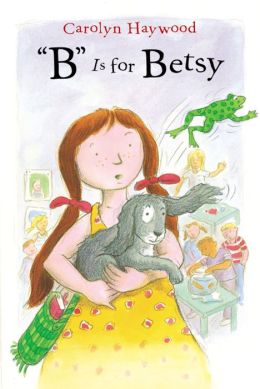
B is for Betsy (1939)

B is for Betsy. Carolyn Haywood. 1939. 144 pages. [Source: Library]

I enjoyed reading "B" is for Betsy by Carolyn Haywood. It's one I've read before, though I don't remember reading the sequels, or all the sequels in this children's series. (Other books include Betsy and Billy, Back to School With Betsy, and Betsy and the Boys). In the first book, readers meet a young girl, Betsy, who is nervous about starting school. Though her anxiety is relieved after a successful day or two at school. The focus throughout the book is on Betsy's life at school and home. Each chapter has an "adventure" of sorts. Some of the adventures are more of an actual adventure. (For example, there is a chapter where Betsy finds and rescues a neighborhood dog from a pit she had fallen into. It may prove more 'exciting' than the chapter on the class' two pet tadpoles.) The book celebrates childhood, family life, friendship, and community.

It was originally published in 1939. In one of the chapters "How Wiggle and Waggle Grew," the class learns about Indians and makes an Indian village.
They made little wigwams of twigs covered with brown paper. They brought little dolls which they colored with reddish-brown paint. Some they dressed as squaws. Miss Grey had told them that the Indian women were called squaws. Some they dressed as Indian Braves. The Braves were the men who did the hunting and fighting while the squaws stayed home and did the work. Ellen brought a tiny doll which Miss Grey fastened on the back of one of the squaws. It was the squaw's papoose, which is the Indian name for baby. Betsy thought the Indian village was beautiful. (50-1)
So it's definitely a product of its time. For better and for worse. Betsy's world is quite different than ours. In Betsy's world, it's safe to walk everywhere, play anywhere, and every adult is a friend.

I wouldn't say it's a must-read children's classic, but, it is an enjoyable enough read for those looking for an old-fashioned read.


© 2015 Becky Laney of Becky's Book Reviews

Sunday, March 08, 2015

By The Shores of Silver Lake

By the Shores of Silver Lake. Laura Ingalls Wilder. 1939. HarperCollins. 291 pages. [Source: Library]

As a child, By The Shores of Silver Lake wasn't my favorite of the series. I blame Jack's death for that. But as an adult, I've come to appreciate By The Shores of Silver Lake more, seeing it as more than just a transition between On the Banks of Plum Creek and The Long Winter.

In By the Shores of Silver Lake:
  • Mary goes blind, Laura is "asked" to be her eyes
  • Pa is offered a new job, a job with the railroad, which he takes
  • He goes by wagon, Jack dies BEFORE Pa's departure
  • The rest of the family travels most of the way by train
  • They continue the rest of their journey (a day or two or three) by wagon
  • They settle in for a while, Pa talks about the claim he hopes to claim later that year or whenever his job is finished and he's able to go out seeking a claim of his own
  • Pa's job isn't always safe; he's the paymaster for the railroad, and he has to calm down an angry mob in this one.
  • They meet the Boast family
  • They spend the winter in the 'biggest' house Laura has ever lived in
  • Winter may be lonely (no neighbors, no town) but the spring will see plenty of people come and go. EVERYONE stops at their house on their way west
  • The family learns that there is a school for the blind, they all decide Mary should go there.
  • The family decides to claim land near De Smet, South Dakota
  • Laura catches the tiniest glimpse of Almanzo Wilder's horses
I definitely am enjoying rereading these books. By The Shores of Silver Lake may not be my favorite of the series, but, I'm glad I reread it.
© 2015 Becky Laney of Becky's Book Reviews

Saturday, January 17, 2015

Seuss on Saturday #3

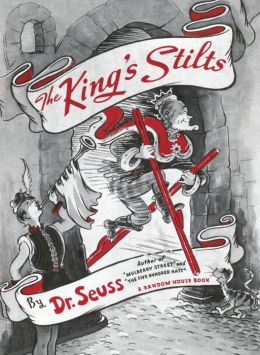
The King's Stilts. Dr. Seuss. 1939/1967. Random House. 56 pages. [Source: Library]

 First sentence:
Naturally, the King never wore his stilts during business hours. When King Birtram worked, he really WORKED, and his stilts stood forgotten in the tall stilt closet in the castle's front hallway.
Setting: The Kingdom of Binn

Premise/Plot. When King Birtram works, he REALLY works, and, when he plays, he REALLY plays. He knows that there is much work to be done in his kingdom. But he also knows that it is important to have fun now and then. This king has fun by walking on stilts. The story is more complex than that, of course. There is the fact that the kingdom is in danger from the sea. The kingdom is protected by the roots of the Dike tree that border the sea. The trees are in danger from the Nizzards--birds that find the tree oh-so-delicious--but the trees are protected from the Nizzards by 1,000 patrol cats. 500 to guard during the day. 500 to guard during the night. The Patrol Cats are essential to the kingdom. And it turns out, the stilts are essential to the king. The book is about what happens when a grinch-like character, Lord Droon, steals the stilts.

My thoughts: This is my very first time reading The King's Stilts. I loved it. I absolutely loved, loved, loved it!!! I love the King. I love Eric, the page boy. And I love the Patrol Cats!!! Yes, the book is text-heavy. So It's definitely a story book, it even has a fairy tale feel to it. But it's oh-so-delightful and rich in detail. It's a good, satisfying story.

Have you read The King's Stilts? What did you think of it? Did you like it? love it? hate it? I'd love to hear what you think of this one!

If you'd like to join me in reading or rereading Dr. Seuss' picture books (chronologically) I'd love to have you join me! The next book I'll be reviewing is Horton Hatches An Egg.

© 2015 Becky Laney of Becky's Book Reviews

Sunday, December 07, 2014

Ten Christmas Picture Books

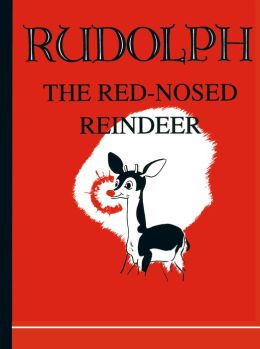
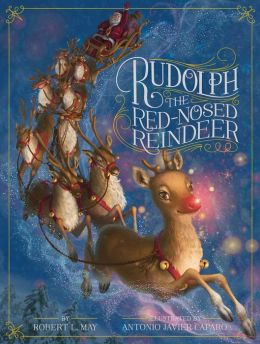
Rudolph the Red-Nosed Reindeer. Robert Lewis May. Illustrated by Denver Gillen. 1939/1990. Applewood Books. 32 pages. [Source: Library]

I enjoyed this one more than I thought I would. This is the original story by Robert L. May with the original illustrations by Denver Gillen. It is so different from the song and the stop-motion animated special. And I think it was the fact that it was different that made me appreciate it more.

The story is told in rhyme. It's essentially one long (perhaps poorly punctuated) poem. Here's how it begins:
Twas the day before Christmas, and all through the hills
The reindeer were playing…enjoying the spills
Of skating and coasting, and climbing the willows…
And hop-scotch and leap-frog (protected by pillows!)
While every so often they'd stop to call names
At one little deer not allowed in their games:--
"Ha ha! Look at Rudolph! His nose is a sight!"
"It's red as a beet!" "Twice as big!" "Twice as bright!"
While Rudolph just wept.
What else could he do?
He knew that the things
they were saying were true!
Readers first meet Rudolph, a young deer who is teased by his peers. He does NOT live at the North Pole. And he's not one of Santa's own reindeer.
What we do learn is that he's a very good, very obedient deer who is expecting Santa to leave him some lovely presents because he's been so very, very good.

Readers then meet Santa and learn of the horrible weather conditions that prove most challenging. Santa starts out on his trip, it isn't until he's delivering presents to Rudolph's house that he notices the brilliant light of his nose.

Santa then decides to wake him up and ask for his help. The rest of the journey goes much easier for Santa!

The book concludes with Santa returning Rudolph to his family, to his hometown. He is now a hero, of course.

I liked this one. I liked some of the rhymes more than others. There are definitely some quirky lines!
Come Dasher! Come Dancer! Come Prancer and Vixen!
Come Comet! Come Cupid! Come Donner and Blitzen!
Be quick with your suppers! Get hitched in a hurry!
You, too, will find fog a delay and a worry!"
And Santa was right. (As he usually is!)
The fog was as thick as a soda's white fizz.
The book is definitely text-heavy. So a longer attention span would be needed for little ones to enjoy this one.

The copy I read was a facsimile edition. A 75th Anniversary edition with new illustrations was released in September 2014.

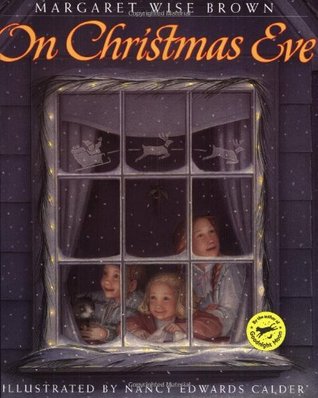
On Christmas Eve. Margaret Wise Brown. Illustrated by Nancy Edwards Calder. 1938/1961/1996. HarperCollins. 32 pages. [Source: Library]

It was the middle of the night. And night of all  nights it was Christmas.

I enjoyed Margaret Wise Brown's On Christmas Eve. It is a descriptive look at what Christmas--at what Christmas Eve--is like for children. It focuses on simple things: what your eyes see, what your ears hear, what your nose smells, what your hands and feet touch. It seeks to capture the emotion of the holiday: the excitement, the waiting, the longing.

Lots of details, lots of adjectives. It's rich in imagery and description. There is also a bit of repetition. The text is lyrical in places.

I can't say that I loved it. But it was very enjoyable. I was also glad to see that one of the presents under the tree was a train. The children are just in awe of the magic of Christmas, of the stockings and packages, of the snow falling outside, of the carolers outside.

It was a sweet story about three siblings.

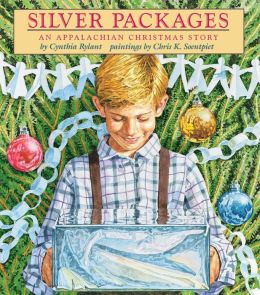
Silver Packages: An Appalachian Christmas Story. Cynthia Rylant. Illustrated by Chris K. Soentpiet. 1987. Scholastic. 32 pages. [Source: Library]

Silver Packages is a picture book for older readers most likely. I wouldn't say it is for an exclusively adult audience. But I think readers need some perspective in order to appreciate the book fully. I think it can resonate with readers, it has the potential. But I don't think the emotional reaction would be--or even should be--automatic. One can't assume that every reader will respond with tears and "this is the best book I've ever read!!!"

Silver Packages is about giving back to the community. In this instance, one very specific community--Appalachia. The book is about the Christmas Train. It starts with one man who wants to show his appreciation for the community that helped him when he needed it. He was injured in an accident, the community took in this stranger and nursed him back to health without asking for anything in return. He decides that he will come every year--by train--and hand out packages to the children who meet the train. These packages are wrapped in silver paper. Every story needs a protagonist. Silver Packages introduces us to Frankie. Readers first meet Frankie as a boy. He's a boy with a dream. He wants to be a doctor. And he really, really, really wants a doctor kit for Christmas. But each year, he's slightly disappointed. He receives a handful of silver packages through the years. Every gift seems to have a toy--something a boy or girl might want--and something a boy or girl might need. The practical gifts include: socks, mittens, hats, scarves, etc. Readers later see Frankie all grown up. He is a doctor. He reflects on his life, on his past Christmases, he has a light-bulb moment. He decides it is his turn to give back to the community in his own special way. It's a book about kindness and gratefulness and community awareness.

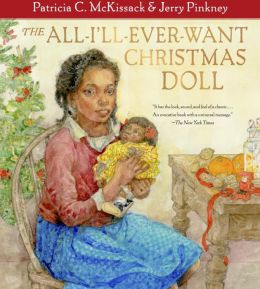
The All-I'll-Ever-Want Christmas Doll. Patricia C. McKissack. Illustrated by Jerry Pinkney. 2007. Schwartz & Wade. 40 pages. [Source: Library]

Christmas always came to our house, but Santy Claus only once in a while.

I haven't read The All-I'll-Ever Want-Christmas Doll in years. It was just as good as I remembered. The book is set during the Depression. A little girl, Nella, knows that her family is poor, that Santy may not come this year at all. Yet, she can't resist writing to him all the same begging for a Baby Betty doll. Her two sisters perhaps think a little less of Nella for her dreaming so big. She shouldn't expect so much from Christmas. But on Christmas morning, there are a few surprises. Each girl gets a Christmas sack filled with walnuts, peppermint candy, an orange, and a box of raisins. But there is one present, one special present remaining: a doll. Nella thinks the doll should be HERS and hers alone. After all, her sisters haven't gone around talking about the doll nonstop, her sisters didn't write Santa a letter begging for the doll. Why should she have to share the doll with them? But does the doll make her happy? Is the doll truly all she'll ever want? She has a few lessons to learn for sure!

I really enjoyed the story and the message.

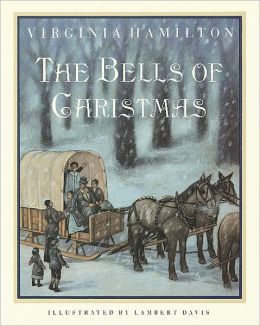
The Bells of Christmas. Virginia Hamilton. Illustrated by Lambert Davis. 1989/1997. Houghton Mifflin Harcourt. 64 pages. [Source: Library]

I didn't dislike Virginia Hamilton's The Bells of Christmas. But I didn't love, love, love it either. I think it depends on what exactly you're expecting from a Christmas book. The Bells of Christmas is very much a celebration of a Christmas long ago. Christmas 1890. Readers meet a young boy, Jason Bell, and experience the holiday through his perspective. We learn about his mom and dad, his brothers and sisters, his cousins, his aunt and uncle, his friend, Matthew. The book is set over a period of several days. Among the things readers learn that Jason's dad is a carpenter, that he wants his sons to join him in his business one day, his dad has only one leg, that his dad wears a peg leg part of the time and is in his wheel chair the rest of the time. Readers also learn that Jason is just a wee bit obsessed with wheels--mainly trains, but, also wagons, etc. The book has plenty of detail and characterization which is a good thing. Jason is waiting for quite a few things: 1) he can't wait for Christmas morning and presents! 2) he can't wait for the Bells to arrive--his uncle and aunt and cousins, 3) he is excited about church, most everyone is performing and participating in some way. (Jason is singing a solo.) The book perhaps seeks to capture one Christmas for one extended family. It is a pleasant, enjoyable book. It isn't quite a chapter book or novel. It isn't quite a picture book.
 
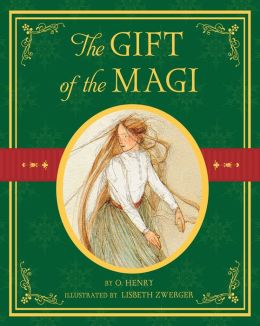
The Gift of the Magi. O. Henry. Illustrated by Lisbeth Zwerger. 1905/2006. Simon & Schuster. 32 pages. [Source: Library]

I've seen adaptations of The Gift of the Magi--who hasn't? (My favorite is Bert and Ernie and Mr. Hooper.) But this is the first time I've read the actual short story. I haven't decided how I feel about it. Is this couple wise or foolish? Or are they at times foolish and at times wise?

The wife, Della, takes extraordinary pride in her long hair. She doesn't seem the vain sort except for when it comes to her hair. And even if she is vain about it, there's no indication it's anything besides a private vanity. The wife apparently has been coveting expensive hair combs as well. The husband, Jim, takes extraordinary pride in the family watch. The narrator uses exaggeration when discussing the woman's long hair and the man's gold watch. I didn't love the narrator. In fact, I think the narrator is a distraction. He won't let the reader forget for a moment that this is a precious story.
Now, there were two possessions of the James Dillingham Youngs in which they both took a mighty pride. One was Jim's gold watch that had been his father's and his grandfather's. The other was Della's hair. Had the queen of Sheba lived in the flat across the airshaft, Della would have let her hair hang out the window some day to dry just to depreciate Her Majesty's jewels and gifts. Had King Solomon been the janitor, with all his treasures piled up in the basement, Jim would have pulled out his watch every time he passed, just to see him pluck at his beard from envy.
The wife can't afford a gift for her husband. The husband can't afford a gift the wife. The wife knows this--or should know this. The husband knows this--or should know this. The wife has saved $1.87. The husband might have saved a small sum as well. Readers don't know one way or the other. Both husband and wife will have something to offer the other, however. Something more than love. For both have decided--quite independently--to give sacrificially. To give up what they supposedly value most: her hair, his watch. And this giving up wasn't to support the family, but, to support the other's vanity.

I think actions can speak more than words. I think the narration took away some of my enjoyment of this one. It felt odd at times. There were sentences that were eloquent and refined and then it would slip into something else.
"It's sold, I tell you--sold and gone, too. It's Christmas Eve, boy. Be good to me, for it went for you. Maybe the hairs of my head were numbered," she went on with sudden serious sweetness, "but nobody could ever count my love for you. Shall I put the chops on, Jim?"
I think I like the adaptations better.

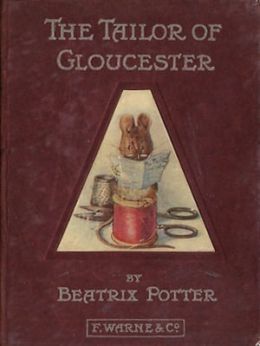
The Tailor of Gloucester. Beatrix Potter. 1903. 58 pages. [Source: Library] 
In the time of swords and periwigs and full-skirted coats with flowered lappets—when gentlemen wore ruffles, and gold-laced waistcoats of paduasoy and taffeta—there lived a tailor in Gloucester.
He sat in the window of a little shop in Westgate Street, cross-legged on a table, from morning till dark.
All day long while the light lasted he sewed and snippeted, piecing out his satin and pompadour, and lutestring; stuffs had strange names, and were very expensive in the days of the Tailor of Gloucester.
I enjoyed rereading Beatrix Potter's The Tailor of Glouchester. In this delightful Christmas tale, readers meet a tailor, a cat named Simpkin, and some lovely mice. It is several days before Christmas. He's working hard to finish a coat and waistcoat for the Mayor of Glouchester. The Mayor is getting married on Christmas day. The tailor has just enough money to finish the coat. Not a penny to spare. He sends his cat, Simpkin, with his money to buy what he needs: a little for himself (food: bread, sausage, milk) a little for his work (one twist of cherry-coloured silk). It is only after the fact that he questions whether he should have sent the cat or gone himself. The cat returns, but, in a mood. The cat is upset for he's discovered that the tailor freed the mice he had captured and hid under the teacups. The cat hides the twist. The man is upset, of course, and sick. He takes to his bed unable to work. The oh-so-thankful mice go to his shop and finish his work for him. But since they are one twist short, they are unable to finish completely. Still, they do what they can, and they do a wonderful job. The cat who spies them at work, I believe, has a change of heart and gives the twist to the old man on Christmas morning. He has just enough time to finish. The Mayor is very, very pleased. And the tailor's luck changes for the better, and his business is much improved. This one is a lovely, delightful read from start to finish.

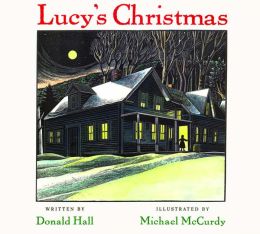
Lucy's Christmas. Donald Hall. Illustrated by Michael McCurdy. 1998. Houghton Mifflin Harcourt. 40 pages. [Source: Library]

I enjoyed reading Lucy's Christmas by Donald Hall. Lucy's Christmas is a picture book set in 1909 in New Hampshire. In the fall of 1909, Lucy and her family start preparing for Christmas. For Lucy, this means starting to make her own gifts for her family and friends. It pays to plan ahead since so many gifts take time, and thought must be placed into each gift. She's not the only one thinking ahead. This year the family is ordering a new stove for the kitchen. The family has spent a lot of time browsing in the Sears catalog. Lucy's choice is the one the family decides upon: the Glenwood Kitchen Range. The focus is not just on gifts: planning, making, giving, receiving. The focus is also on family life and community life. Readers get glimpses of the school and church. Both places are very busy! I enjoyed this glimpse into the past! It was interesting to see the family prepare for the new year--1910. The enthusiasm in the story is sweet. The author's note reveals that this picture book is based on family history.

I really liked this one very much. I liked Lucy and her family. I liked the fact that the church plays such a HUGE role in the Christmas celebrations. There are gifts, it's true. But it's not commercialized and selfish.

Baboushka and the Three Kings. Ruth Robbins. Illustrated by Nicholas Sidjakov. 1960/1986. Houghton Mifflin Harcourt. 32 pages. [Source: Library]

Long ago and far away, on a winter's evening, the wind blew hard and cold around a small hut.

Baboushka and the Three Kings won the Caldecott Medal in 1961. It is Russian folktale with a Christmas setting. The three kings--wise men--come to Baboushka's hut. They only stay a few minutes. Long enough to extend an invitation to the old woman. Will she join them in their procession, in their quest, to find the Babe, the Child? She'd love to join them, she'd love to bring gifts to the Child. But she is not ready to go just yet. Couldn't they all wait until morning? Couldn't they wait for her to finish up a few small, tiny chores first? Couldn't they wait for the storm to clear? Their answer was firm. Their journey to the Child was too important to postpone. They couldn't linger longer. She watched them depart. But they were not easy men to forget. The next morning, she begins a journey of her own. A journey that will take her far. But will her journey lead her to where she wants to go?

It's a simple story, nicely written. "It is no ordinary Babe they seek. Yes! I must go and follow them! To find the new Babe, to offer Him her gift, was now her one yearning. This thought burned in her mind like a candle in the dark." It is also nicely illustrated. The illustrations complement the text well. Both illustrations and text have a different flavor, an authentic flavor, but not exactly American. After several readings, I came to appreciate both a bit more.

In case you're unfamiliar with the story, the book is bittersweet at best. While it is true that Russian children everywhere look forward to Baboushka's gifts each year as her journey continues, it is also true that Baboushka's journey has no happy ending. She never finds the Child. She is never able to give Him her gifts.

Polar Express. Chris Van Allsburg. 1985/2009. Houghton Mifflin Harcourt. 32 pages. [Source: Library]

The Polar Express is one of my favorite Christmas books. It is. The book is a thousand times better than the movie. (Though the soundtrack of the movie isn't bad.) So if you've only seen the movie, you might want to give the book a try to. You might have a different response to it.

The Polar Express is about belief and doubt--in Santa. It's told in the first person, so we never learn the protagonist's name, but it is a little boy with a younger sister named Sarah. One Christmas Eve, the little boy is awakened by The Polar Express. He goes to the North Pole on the Polar Express train, there are other passengers too. All presumably boys and girls on the verge of not-believing. At the North Pole, he sees Santa, reindeer, and elves. He happens to be chosen to receive the first gift of Christmas. He asks for a bell from Santa's reindeer. This gift is not in his possession for long, however, because he has a hole in his pocket. On Christmas day, he receives a special gift under the tree: the bell he had lost. He can hear it. His sister can hear it. But his parents do not. The book ends wonderfully with a message for "all those who truly believe."

I loved this one cover to cover, though I love the ending most of all.


© 2014 Becky Laney of Becky's Book Reviews

Wednesday, December 14, 2011

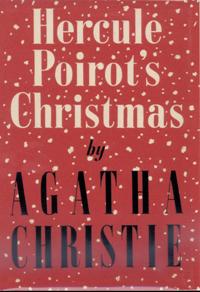
Hercule Poirot's Christmas

Hercule Poirot's Christmas. Agatha Christie. 1938/1939. Black Dog & Leventhal. 272 pages.

Stephen pulled up the collar of his coat as he walked briskly along the platform.

Christmas can be stressful for families--especially unhappy families. For one family, the holidays led to quite a few heated arguments and a very violent death. But which of the family did the old man in?

Simeon Lee, the victim, was a MEAN old man who didn't always treat his children right. (And he never, ever treated his wife right.) And perhaps some of the grown children should have been suspicious when their father invited them for a big family Christmas get-together. After all, he wasn't one for being sociable and nice and loving and happy. But could anyone really have predicted that someone wanted him dead?

Hercule Poirot has his opinions on the crime...and readers are in for a treat with this one.

While this wouldn't be my favorite Agatha Christie, while it wouldn't be my favorite Poirot novel, I did enjoy reading this one!

"The character of the victim has always something to do with his or her murder. The frank and unsuspicious mind of Desdemona was the direct cause of her death. A more suspicious woman would have seen Iago's machinations and circumvented them much earlier. The uncleanness of Morat directly invited his end in a bath. From the temper of Mercutio's mind came his death at the sword's point." (125-126)

"If a human being converses much, it is impossible for him to avoid the truth." (148)

© 2011 Becky Laney of Becky's Book Reviews

Monday, August 15, 2011

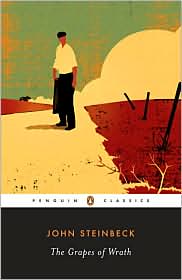
Grapes of Wrath

Grapes of Wrath. John Steinbeck. 1939. Penguin. 619 pages.

To the red country and part of the gray country of Oklahoma, the last rains came gently, and they did not cut the scarred earth. 

It is finished! After three or four false starts, after two library editions and two paperback editions, it is finished. If one word could sum up my experience with this one, it would be sluggish. Of course, I can think of a few other words to describe it. But I'll share just one more: bleak. (Or perhaps bleakity-bleak.)

To sum this one as quickly as possible: The Joad family, devastated by losses in Oklahoma, are forced to pack it all up and head to California where they find that life is just as hard if not harder than they could have ever imagined. There is no happy welcome awaiting them, they are viewed--at best--as mere animals. The only way out of the harsh ugly reality is death. And even death doesn't come easy. The end.

I'm not going to try to convince you that The Grapes of Wrath is a horrible book. I'm not going to try to convince you that The Grapes of Wrath is a wonderful book. I can--at best--only share with you why we're not a good match for one another.

The language. There are certain words that offend me each and every time they're used. It doesn't matter the circumstances. It doesn't matter who or where or why. The Grapes of Wrath uses a great many of these words. (Or should I say repetition of the same word.) Are the words realistic? Probably. But that doesn't change my reaction to those words.

I had big, big, big problems with the character of Jim Casy. This "former preacher" annoyed me every time he opened his mouth. Though annoy isn't quite the right word. I'm not sure offended is the right word either. Simply because people can't use the word offended without people judging them. It's just that his language is so crude, so vulgar. That his "story" is so vulgar--how every time he got worked up "in the spirit" preaching, he had to find sexual release with young women from his church (or audience or wherever). Yes, that was mostly in the past, and yes, this "sin" is what led him to eventually give up faith and religion. Casy, when we meet him, doesn't believe in God, doesn't believe in the church or religion, doesn't believe in prayer, doesn't believe in sin, doesn't believe in the concept of right or wrong, or heaven and hell. Casy doesn't believe in anything at all really. There are no answers, there will never be any answers. Suffer, suffer, suffer, why have hope at all that you will ever do anything but suffer. Any time Casy talked about matters of faith or matters of the heart or anything remotely connected to spirituality or religion or even morals and ethics, I just wanted to yell at him. It doesn't help that according to "experts" Jim Casy is a "Christ figure." I read this on Wikipedia and Spark Notes. There are almost no words for how that makes any sense whatsoever. How someone so foul, so crude, so vulgar, so given-over-to-sin, someone who doesn't believe ANYTHING at all, someone who has no hope, no love, no peace, whose only message is now is all we got, and now is ugly is a "Christ figure." In what way at all--does he resemble Christ? Now, I'm not saying that everyone should hate Jim Casy. I am saying that as a reader I could not stand him.

Another big issue I had with The Grapes of Wrath has to do with style. The narrative style of this one is a bit odd. You have chapters that are clearly narrated by members of the Joad family, chapters that carry this story forward. Then you have chapters that read more like an out of body experience. These may focus on turtles or waitresses or car salesmen. But. They are clearly not like the other chapters in the novel. I never could quite figure out if the people in these chapters were the Joads--as seen from the outside perspective--or if the people (when the focus was on people not trees or turtles, etc.) were meant to represent any family facing this crisis, any family who had been devastated. I don't know that it matters. I just felt a great big disconnect every time we lost the main story, the real story. However, there were a couple of exceptions. There were times when these chapters were beautifully done and the text is richer for them--for the perspective they add to it. (Chapter fourteen comes to mind.)

I struggled with the first sixteen chapters. I did. I wasn't liking it. I wasn't liking it at all. But things began to shift a little with chapter seventeen. I don't know if the story truly improves once the family crosses into California, or if I just was in a better mood that day, but something changed. From that point on, the story while not always pleasant was more compelling. There was still violence to deal with, still some harsh realities to endure, but the second half definitely improved my impressions of the novel.

I am SO GLAD that this wasn't my first introduction to John Steinbeck. If it was, I never would have picked up any of his other books. I would have walked away knowing that I was right, that Steinbeck was not for me. The truth is, that Steinbeck was a good writer--at times great. That he wrote in many, many styles. That he had MANY stories to share with readers. Not just one story over and over and over again. Some of the stories he tells are very funny, very true-to-life, and even in their earthiest moments, there's something there worth reading. His stories can be very raw, very perceptive. The Grapes of Wrath was not for me. Perhaps the message was some things in life are so ugly that no amount of imagination can make them beautiful. I found the lack of hope and the vulgar language to be too much for me. But the very things that I dislike about it--the realistic portrayal of humanity at its weakest and worst--may be the very things some one else loves about it.

I read this book for the Classics Circuit tour. 

© 2011 Becky Laney of Becky's Book Reviews

Thursday, July 21, 2011

Heidi's Children

Heidi's Children. Charles Tritten. 1939. 255 pages. 

Dorfli was still enveloped in a mantle of snow, but the baker, returning from Maienfeld in his wagon, reported that down in the valley it was already spring. 

Heidi's Children is, I believe, the third and final Heidi book. Heidi Grows Up, the second novel, ended triumphantly with Heidi wedding Peter, the goat herding boy she first met when she was just five. This third novel opens with Heidi just a few months away from giving birth to her first child.

Heidi and Peter live with Heidi's grandfather and Peter's mother in the village of Dorfli. (During the summer months, they retreat higher up in the mountains, though the grandfather's original hermit-hut is no more.) As they have the largest house in the village, they also have the local school teacher, Heidi's old school chum, Jamy, living with them. The novel opens with Jamy making a request of Heidi and Peter. She wants them to welcome her younger sister, Marta, into their home. It seems Marta is too difficult for her own parents to handle, and they essentially don't want to have her around...at all. Marta, of course, has figured all this out. Peter has his doubts initially, let the reader never forget how jealous and possessive he can be with Heidi, but eventually he agrees to the plan.

So Marta is the "first" of Heidi's "children" to arrive. A few months later Heidi welcomes twins into the world. A baby boy. A baby girl. And grandfather is there to welcome this next generation. He even suggests the names for both the babies.

This naming scene is funny, in my opinion. For it sees just about everyone from the village coming into their home to give advice and share gossip.
"Well, what do you think of them, Peterli?" his mother asked after he had studied their features for some time without making any comment.
"As alike as two strawberries," he answered, "and just as red. How long will it be before their eyes open?"
"They aren't kittens," laughed Heidi, looking up from her pillows. "Their eyes have already opened and they're as blue as the sky itself. They're sleeping now. Little babies have to sleep."
"Has the Alm-Uncle seen them?" asked Peter his face still thoughtful.
"Oh, yes," answered Heidi. "He was so pleased but he escaped to his own room again as soon as the neighbors came. Their chatter bothers him as it does me, but I can't ask them to leave."
"I'll ask them if you want me to," announced Marta, her eyes still fiery. "They're out there in the living room saying horrid things about everybody in the family and suggesting the most dreadful names for the babies. You won't name them anything they suggest, will you?"
"I swear it!" said Peter, raising his hand as though taking an oath. "Whatever they suggest, the babies shall surely be named something different."
Old age had not affected the Alm-Uncle's hearing, for suddenly he called out so loudly that those in Heidi's bedroom and even the neighbors in the living room beyond could hear it, "If they're her surprise, why not name the girl baby after the child?"
"After me?" said Marta, hardly believing her ears, for the Alm-Uncle had never once spoken her name all the time she had been there.
"As you say, Grandfather!" Heidi called back. "But what shall we name the boy?"
"Your father was an upright man, Heidi. It might be well to remember him."
Heidi had not thought of naming the boy anything but Peter. But since Peter objected to that, why not Tobias? She called again, "Very well, Grandfather. He shall be our little Tobi. The neighbors shall hear at the church what names we have chosen." (84-85)
Marta, Jamy's younger sister, is the real heroine of Heidi's Children. It is her story--her emotional and spiritual journey--that is told within the pages of the book. Her developing relationship with the grandfather, her love for Heidi and Peter, her finding a place to belong, etc. Her story isn't always a happy one. For she's still broken. She's mourning the loss of her grandmother. And she definitely hasn't healed from being completely rejected and abandoned by her parents.

The grandfather also plays a big part in this one. Though I don't want to spoil anything by sharing those details here. Let's just say that this is the first Heidi book where the reader catches glimpses of his past.

I did like Heidi's Children. I liked Marta. I liked how she was able to form a good relationship with the Grandfather. I liked how he was able to help her and reach her in a way that her own parents couldn't or wouldn't. It was nice to see him sharing Bible stories with her, for example. And it was nice how he helped fix her cross necklace.

I have enjoyed all three Heidi books! I do wish I'd read them sooner!


© 2011 Becky Laney of Becky's Book Reviews

Saturday, February 12, 2011

And Then There Were None

And Then There Were None. Agatha Christie. 1939/2000. Buccaneer Books. 192 pages.

In the corner of a first-class smoking carriage, Mr. Justice Wargrave, lately retired from the bench, puffed at a cigar and ran an interesting eye through the political news in the Times. He laid the paper down and glanced out of the window. They were running now through Somerset. He glanced at his watch--another two hours to go.

Ten men and women arrive on Indian island never suspecting the dangers and thrills that are to come. None will leave the island alive. Mr. Justice Wargrave, Vera Claythorne, Captain Philip Lombard, Emily Brent, General MacArthur, Dr. Armstrong, Anthony Marston, Mr. Blore, Mr. and Mrs. Rogers. It seems each has been lured to the island without really knowing their host or hostess. Mr. and Mrs. Rogers being engaged as servants. Miss Vera Claythorne being engaged as a temporary secretary. The others all received letters of invitation. It soon becomes clear that not everything is as it appears.

There are some not-so-hidden clues embodied within a nursery rhyme poem, "Ten Little Indians" (found on pages 21-22 of my edition; you can get an idea of it from this site, though it's not an easy read, it seems it's a combination of two poems, one from 1868 and the other from 1869).  There are also ten little figurines--as each guest dies, a figurine from the table vanishes as well.

Readers get a chance to learn a little about each character. Especially the ones that survive the first few deadly days. None of the characters are particularly likable--none so delightful that you'd want to know them--especially not under these circumstances.

I would say this Christie novel comes the closest to inspiring fear and horror in its readers. There isn't anything particularly cozy or delightful or charming about this one. There are no clever detectives--arrogant or not--to counterbalance the violence. Almost everything that I love about Christie's mysteries seems to be missing in this one. But even though I don't especially "like" this one, I can't deny that it was cleverly written.

© 2011 Becky Laney of Becky's Book Reviews

Friday, February 11, 2011

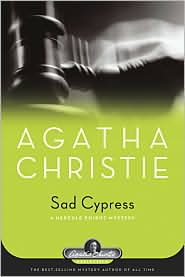
Sad Cypress

Sad Cypress. Agatha Christie. 1939/2007. Black Dog & Leventhal. 256 pages.

"Elinor Katharine Carlisle. You stand charged upon this indictment with the murder of Mary Gerrard upon the 27th of July last. Are you guilty or not guilty?"

Harriet Vane had Lord Peter Wimsey, and Elinor Katharine Carlisle has Peter Lord. Though her hero is not an amateur detective, but a country doctor. Still, Peter Lord, who fell in love with Elinor at first sight, has the wisdom to seek the best of the best to clear her name: Hercule Poirot. He wants Poirot to find evidence that will acquit her of murder. Is love blinding him? Is the woman he loves guilty of murder? It seems that she had opportunity to kill her aunt (supposedly out of greed) and Mary (supposedly out of jealousy). But Lord and Poirot doubt the supposed motives. They see other possibilities. 

I loved this one. I just LOVED it. I loved the characterization! I loved the story! While Peter Lord is no Lord Peter, I did enjoy him very much! I was quite surprised by how pleased I was that Elinor had someone on her side. Not that Elinor was completely lovable. She was flawed--very flawed. But still. By the end, I was seeing her through Peter Lord's eyes, I was seeing her with love.

"One does not practice detection with a textbook! One uses one's natural intelligence." (196)
"One must understand with the cells of one's brain before one uses one's eyes."(196)
"One always likes to know exactly what lies have been told one."
"Did Welman tell you a lie?"
"Definitely."
"Who else has lied to you?"
"Everybody. I think: Nurse O'Brien romantically; Nurse Hopkins stubbornly; Mrs. Bishop venomously; You yourself--"
"Good God!" Peter Lord interrupted him unceremoniously. "You don't think I've lied to you, do you?"
"Not yet," Poirot admitted.
Dr. Lord sank back in his chair. He said, "You're a disbelieving sort of fellow, Poirot." (198)

© 2011 Becky Laney of Becky's Book Reviews