Showing posts with label 1985. Show all posts

Tuesday, July 22, 2025

80. Ender's Game


80. Ender's Game. Orson Scott Card. 1985. 324 pages. [Source: Library]

First sentence: "I've watched through his eyes, I've listened through his ears, and I tell you he's the one. Or at least as close as we're going to get."

ETA: My most recent 'read' of the book is July 2025. I listened on audio. I wanted to reread this one after rewatching the film a few weeks ago. I did like it more than I did in 2020, but less than I have in the past. I think the older I get the more I see how much harm and damage they caused Ender and am more outraged on his behalf. I see less 'cool adventure' and more this is so incredibly wrong.

Premise/plot: Andrew Wiggin, aka "Ender," is six years old and potentially the earth's savior. Two wars have been fought and barely won against the aliens known to readers as Buggers. The third war will take much preparation--decades worth of the International Fleet training up children to be commanders and soldiers.

Ender is one such student or trainee. His older brother, Peter, and older sister, Valentine, didn't make it so far as Battle School in space. Ender's life is wearisome and burdensome. He doesn't make friends easily and his biggest fear is being just as violent and out of control as his brother, Peter. He is prone to self-reflection and self-loathing. But in terms of military genius, strategizing, leadership...he excels.

When the time comes to fight the war, will he be ready?

My thoughts: For a decade I would have considered this one of my favorite, favorite books. Now that it's been almost twenty years or so since I first read it--well, my thoughts and impressions have changed some. I love the last fourth of the novel. That hasn't changed. But the first fourth of the novel, well, it's DISTURBING, uncomfortable, awkward, a bit off. I did NOT remember the use of the n word. I did not remember the jokesy approach to different races (or ethnicities). I did not remember the chokehold scene where Peter is trying to kill his brother. I did not remember some of the crudeness.

One thing that bothers me is Peter. Peter is a psychopath in my opinion. He is cruel to his brother and sister. He is cruel to small animals. He is a bully. He is manipulative. He is egocentric and a narcissist. He dreams of world domination. He is just a sick, sick, sick individual. And I think what readers are outright told about him is just the tip of the iceberg. If Valentine is to be believed about the files and records she's been keeping of her brother. Chances are he might have done even more than she knew about. There was one line that disturbed me where she is telling Ender that you don't know what I had to do to keep Peter from hurting you. Of course, we don't know--she doesn't say. But Card later seems to redeem the character of Peter and seeks to make him sympathetic.

Card does do flawed humans well. I will give him that. Are any of the characters in this one not flawed?!?! I think the most likable characters may be Bean and Petra.


© 2025 Becky Laney of Becky's Book Reviews

Wednesday, June 24, 2020

88. Ender's Game

Ender's Game. Orson Scott Card. 1985. 324 pages. [Source: Library]

First sentence: "I've watched through his eyes, I've listened through his ears, and I tell you he's the one. Or at least as close as we're going to get."

Premise/plot: Andrew Wiggin, aka "Ender," is six years old and potentially the earth's savior. Two wars have been fought and barely won against the aliens known to readers as Buggers. The third war will take much preparation--decades worth of the International Fleet training up children to be commanders and soldiers.

Ender is one such student or trainee. His older brother, Peter, and older sister, Valentine, didn't make it so far as Battle School in space. Ender's life is wearisome and burdensome. He doesn't make friends easily and his biggest fear is being just as violent and out of control as his brother, Peter. He is prone to self-reflection and self-loathing. But in terms of military genius, strategizing, leadership...he excels.

When the time comes to fight the war, will he be ready?

My thoughts: For a decade I would have considered this one of my favorite, favorite books. Now that it's been almost twenty years or so since I first read it--well, my thoughts and impressions have changed some. I love the last fourth of the novel. That hasn't changed. But the first fourth of the novel, well, it's DISTURBING, uncomfortable, awkward, a bit off. I did NOT remember the use of the n word. I did not remember the jokesy approach to different races (or ethnicities). I did not remember the chokehold scene where Peter is trying to kill his brother. I did not remember some of the crudeness.

One thing that bothers me is Peter. Peter is a psychopath in my opinion. He is cruel to his brother and sister. He is cruel to small animals. He is a bully. He is manipulative. He is egocentric and a narcissist. He dreams of world domination. He is just a sick, sick, sick individual. And I think what readers are outright told about him is just the tip of the iceberg. If Valentine is to be believed about the files and records she's been keeping of her brother. Chances are he might have done even more than she knew about. There was one line that disturbed me where she is telling Ender that you don't know what I had to do to keep Peter from hurting you. Of course, we don't know--she doesn't say. But Card later seems to redeem the character of Peter and seeks to make him sympathetic.

Card does do flawed humans well. I will give him that. Are any of the characters in this one not flawed?!?! I think the most likable characters may be Bean and Petra.


© 2020 Becky Laney of Becky's Book Reviews

Tuesday, August 20, 2019

The Handmaid's Tale

The Handmaid's Tale. Margaret Atwood. 1985. 344 pages. [Source: Library]

First sentence: We slept in what had once been the gymnasium.

Premise/plot: The Handmaid's Tale is a dystopian classic by Margaret Atwood. It is narrated by a handmaid, Offred, and set in the Republic of Gilead. Offred, which is her new name not her birth name, remembers a time before--a time when women were free: free to work, free to manage their own money, free to read and write. Because she married a divorced man, when the change happened, her marriage became illegal--immoral. She was retrained/reschooled--taught by "Aunts" in how to be an obedient servant to the Republic. In her new role as handmaid, she will seek to bear the Commander's child. Different women are assigned different tasks. Some are for sex and the bearing of children. Some are for working. Only the poorest of men have econowives--one woman expected to do ALL the household work and tasks.

The novel definitely gives us an ALTERNATE 1980s.

My thoughts: I read this one not because it is a feminist classic but because it is a dystopian classic. I found it a compelling read for the most part. It was strange to see biblical themes appear and reappear throughout the novel in various ways--none of them exactly true to an actual biblical interpretation. It would be sad if readers actually assumed this is the Christian way of thinking and that to be a Christian means you want to live in the Republic of Gilead.

I believe it is written in stream of consciousness. Offred's recollections are mixed in generously with the here and now. It is only a sense--an intuition--that keeps readers discerning what is happening in the present and what may have happened last week, last month, last year, ten years ago. I followed it for the most part. I was swept up in the story. I would not want to be quizzed on the ins and outs of it. But it kept my attention.

A few weeks ago I reviewed We Set the Dark on Fire a novel that supposedly mirrors--for a young adult audience--The Handmaid's Tale. I found it lacking even before reading this one. It just isn't as thought-provoking or as substantive. The world building just isn't there. What the two do have in common is that towards the end the narrators become distracted sexually. Offred becomes enamored--filled with lust--for Nick. And Dani becomes obsessed with Carmen. One big difference between the two is that The Handmaid's Tale is a serious work of fiction that is carefully crafted throughout. We Set the Dark on Fire, on the other hand, has the mere potential to be a serious work. I wanted it to be a political, feminist WORK. I didn't want it to be a silly, flimsy work.

The Handmaid's Tale does leave DOZENS of unanswered questions. But it does so in a way that still builds the world up satisfactorily. The danger is real in Handmaid's Tale. It is never quite in We Set the Dark on Fire.


© 2019 Becky Laney of Becky's Book Reviews

Thursday, April 26, 2018

Here Be Dragons

Here Be Dragons. Sharon Kay Penman. 1985. 704 pages. [Source: Borrowed]
Shropshire, England
July 1183
He was ten years old and an alien in an unfriendly land, made an unwilling exile by his mother's marriage to a Marcher border lord. His new stepfather seemed a kindly man, but he was not of Llewelyn's blood, not one of the Cymry, and each dawning day in Shropshire only intensified Llewelyn's heartsick longing for his homeland. 
Premise/plot: Here Be Dragons by Sharon Kay Penman is a historical romance novel set in thirteenth century England starring King John's illegitimate (but claimed) daughter Joanna. When she's still practically a child--fourteen, I believe--her father arranges her marriage to a Welsh prince--the strongest political/military leader in Wales. His name is Llewelyn. Will it be a love match? Yes.

But being together--staying together--will bring challenges. One of the biggest threats to their marriage? The fact that her father is King John. Llewelyn and John's "alliance" doesn't last long. These two will wage war upon one another relentlessly. Joanna often feels forced to choose between her husband and children and her father.

King John is....well, most people in the novel don't have a hard time describing him as despicable, wicked, cruel. Joanna, well, she has seen another side of him. And she wants there to be some good within him. But is there?

Another huge challenge to overcome is Llewelyn's (illegitimate but) firstborn son, Gruffydd. Joanna tries really hard--especially when Gruffydd is a young child--to get along with her stepson. But he is angry all the time, resentful of her presence.

My thoughts: I enjoyed reading this one! Is it historical fiction or historical romance? It offers more than just romance. It follows politics and warfare in England and Wales during this time.

The book also examines the rights or lack of rights of women. Welsh women had more rights than Norman women, for example.

Marriages were arranged, for the most part, and brides were sometimes super-young. As in married at ten, twelve, or fourteen. (In the case of the ten year old, I believe readers are assured that the marriage was not consummated until she was fourteen or fifteen.) John's bride, Isabella, was thirteen or fourteen. He did not wait for her to grow up any which makes for some awkward seduction scenes early in the novel.

But it is clearly also a romance. The 'romance' between Llewelyn and Joanna is the main story line. Of course, it's not a traditional romance novel in that all of the romance occurs after the wedding. These two didn't meet, I believe, until their wedding. Is it smutty? Yes. To a certain degree. A few scenes here and there. But in a novel this large, the percentage of smut is small and not overwhelming.

There is an author's note to clarify for readers which characters are real (real historical figures) and which are fictional. All of the main characters and many of the minor ones were real.


© 2018 Becky Laney of Becky's Book Reviews

Friday, October 06, 2017

Wilfrid Gordon McDonald Partridge

Wilfrid Gordon McDonald Partridge. Mem Fox. Illustrated by Julie Vivas. 1984/1985. Kane/Miller. 32 pages. [Source: Library]

 First sentence: There was once a small boy called Wilfrid Gordon McDonald Partridge and what's more he wasn't very old either. His house was next door to an old people's home and he knew all the people who lived there.

Premise/plot: Wilfrid Gordon McDonald Partridge has many friends; but his most special friend has four names just like him: Miss Nancy Alison Delacourt Cooper. When he hears that she is losing her memory--or has "lost" her memory, Wilfrid sets out in search of it. But first, he has to know exactly what a memory is. So, being young and curious, he asks. Equipped with descriptions of exactly what memory is, he sets out on a quest. Will the items he collects be just what Miss Nancy needs?

My thoughts: I LOVED, LOVED, LOVED this one. I loved the descriptions of memories:
  • "Something warm, my child, something warm."
  • "Something from long ago, me lad, something from long ago."
  • "Something that makes you cry, my boy, something that makes you cry."
  • "Something that makes you laugh, my darling, something that makes you laugh."
  • "Something as precious as gold, young man, something as precious as gold."
I love the celebration of friendship as well. This picture book is just a gem.


© 2017 Becky Laney of Becky's Book Reviews

Friday, June 23, 2017

Death of a Gossip

Death of a Gossip. M.C. Beaton. 1985. 179 pages. [Source: Library]

First sentence: 'I hate the start of the week,' said John Cartwright fretfully.

Premise/plot: Death of a Gossip is the first mystery starring Hamish Macbeth. The series is set in Scotland. The setting of the first book is largely a fishing school/club and its surrounding rivers and lakes. John and Heather Cartwright manage the school, most of the students are out-of-town tourists. The students this eventful week are: Marvin and Amy Roth, Lady Jane Winters, Jeremy Blythe, Alice Wilson, Charlie Baxter, Major Peter Frame, and Daphne Gore. By the end of the week, one of these guests/students will be dead. Though technically Chief Inspector Blair is the detective on the case, it is really Hamish Macbeth, local constable, that gets the job done.

My thoughts: My mom hasn't read this first book, but she has been LOVING the later books in the series. I remember reading this one and not being all that impressed. But. I wanted to give Hamish Macbeth another try. I hope to see the television series soon. I am still not all that impressed. SO MUCH FISHING. I'm hoping that the series will improve as it goes on.


© 2017 Becky Laney of Becky's Book Reviews

Sunday, January 29, 2017

Mary Lou

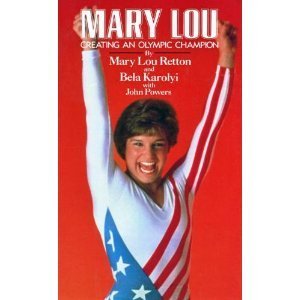
Mary Lou: Creating an Olympic Champion. Mary Lou Rhetton and Bela Karolyi with John Powers. 1985. 170 pages. [Source: Library]

First sentence: The first time I really began dreaming about the Olympics was in 1976, when Nadia won her three gold medals at Montreal. I was eight years old that summer, and I can remember lying on the living room floor back home in Fairmont, watching the whole thing on television.

Premise/plot: This biography features alternating narratives between Mary Lou Retton and Bela Karolyi. They wrote this biography with John Powers. This book focuses almost exclusively on the sport of gymnastics. Mary Lou's chapters focus on her training and competing. One gets a good sense of the mental and emotional struggles that accompany "becoming" an Olympic champion. Bela's chapters focus on his coaching in Romania and the United States. His narrative goes a bit into politics and why he felt he and his family had to defect from Romania and seek to make America their new home. His personality is a strong one. (So is Mary Lou's, by the way). Both narratives the focus is on working hard all the time and never, ever, ever letting go the fight.

My thoughts: This was one of the books that I checked out from my school library in junior high. I've been watching gymnastics since the late 1980s, and I'm a big, big, big fan of the sport. I've been meaning to reread it for quite a while. I had to interlibrary loan it, but, it was worth it!


© 2017 Becky Laney of Becky's Book Reviews

Thursday, December 29, 2016

Koko's Kitten

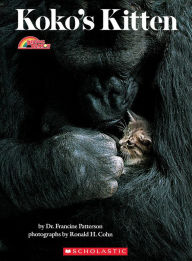
Koko's Kitten. Francine Patterson. Photographs by Ronald H. Cohn. 1985. 32 pages. [Source: Library]

First sentence: Koko's full name is Hanabi-Ko, which is Japanese for Fireworks Child.

Premise/plot: Koko's Kitten is a nonfiction picture book for elementary-aged readers. Though the book is called "Koko's Kitten," the picture book biography (of a gorilla) tells much more than just that one little snippet of her life. It tells of how Koko was/is the subject of a special project, how she started learning sign language, the special bonds she's formed with the humans in her life, etc. The climax of this one, is, of course, how she came to have a kitten of her own.

My thoughts: I remember learning about Koko in the 1980s. And I had fond but vague memories of Koko's Kitten. I remembered she had a kitten. A kitten named All Ball. I remembered that the kitten died and she wanted a new kitten. It turns out I remembered only *some* of this one. I still like it. But it is more wordy than I remembered.

Text: 4 out of 5
Illustrations: 4 out of 5
Total: 8 out of 10

© 2016 Becky Laney of Becky's Book Reviews

Sunday, July 12, 2015

Sarah, Plain and Tall

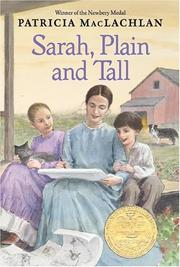
Sarah, Plain and Tall. Patricia MacLachlan. 1985. Houghton Mifflin. 64 pages. [Source: Library]

I've read Sarah, Plain and Tall several times, but, I can't find proof that I've blogged about it. So. Sarah, Plain and Tall won the Newbery in 1986. It is historical fiction for the youngest of readers.

Anna is the heroine of Sarah, Plain and Tall. Through her we meet Caleb, her brother; her father; and Sarah, the woman who may become her step-mother if all goes well. The children want this very much, a new mother.

Sarah comes to visit the family for one month. Will she come to love them? Will they come to love her? Will they belong together? Is this meant to be? Or will Sarah miss her old home and her old life too much to stay?

This is a sweet novel full of innocent longing. I loved all of the characters. There is something so simple and pure about it. Definitely recommended.

© 2015 Becky Laney of Becky's Book Reviews

Sunday, December 07, 2014

Ten Christmas Picture Books

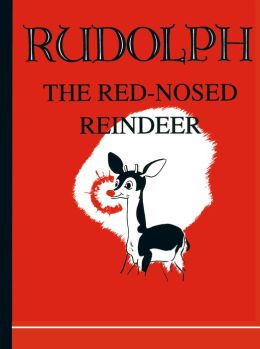
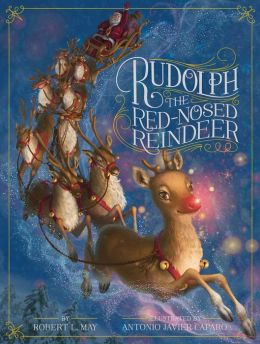
Rudolph the Red-Nosed Reindeer. Robert Lewis May. Illustrated by Denver Gillen. 1939/1990. Applewood Books. 32 pages. [Source: Library]

I enjoyed this one more than I thought I would. This is the original story by Robert L. May with the original illustrations by Denver Gillen. It is so different from the song and the stop-motion animated special. And I think it was the fact that it was different that made me appreciate it more.

The story is told in rhyme. It's essentially one long (perhaps poorly punctuated) poem. Here's how it begins:
Twas the day before Christmas, and all through the hills
The reindeer were playing…enjoying the spills
Of skating and coasting, and climbing the willows…
And hop-scotch and leap-frog (protected by pillows!)
While every so often they'd stop to call names
At one little deer not allowed in their games:--
"Ha ha! Look at Rudolph! His nose is a sight!"
"It's red as a beet!" "Twice as big!" "Twice as bright!"
While Rudolph just wept.
What else could he do?
He knew that the things
they were saying were true!
Readers first meet Rudolph, a young deer who is teased by his peers. He does NOT live at the North Pole. And he's not one of Santa's own reindeer.
What we do learn is that he's a very good, very obedient deer who is expecting Santa to leave him some lovely presents because he's been so very, very good.

Readers then meet Santa and learn of the horrible weather conditions that prove most challenging. Santa starts out on his trip, it isn't until he's delivering presents to Rudolph's house that he notices the brilliant light of his nose.

Santa then decides to wake him up and ask for his help. The rest of the journey goes much easier for Santa!

The book concludes with Santa returning Rudolph to his family, to his hometown. He is now a hero, of course.

I liked this one. I liked some of the rhymes more than others. There are definitely some quirky lines!
Come Dasher! Come Dancer! Come Prancer and Vixen!
Come Comet! Come Cupid! Come Donner and Blitzen!
Be quick with your suppers! Get hitched in a hurry!
You, too, will find fog a delay and a worry!"
And Santa was right. (As he usually is!)
The fog was as thick as a soda's white fizz.
The book is definitely text-heavy. So a longer attention span would be needed for little ones to enjoy this one.

The copy I read was a facsimile edition. A 75th Anniversary edition with new illustrations was released in September 2014.

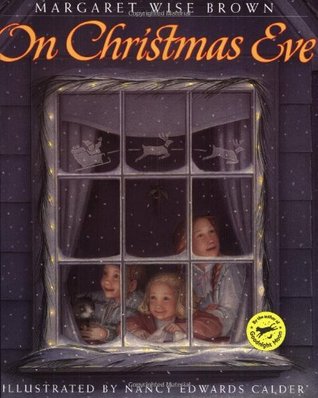
On Christmas Eve. Margaret Wise Brown. Illustrated by Nancy Edwards Calder. 1938/1961/1996. HarperCollins. 32 pages. [Source: Library]

It was the middle of the night. And night of all  nights it was Christmas.

I enjoyed Margaret Wise Brown's On Christmas Eve. It is a descriptive look at what Christmas--at what Christmas Eve--is like for children. It focuses on simple things: what your eyes see, what your ears hear, what your nose smells, what your hands and feet touch. It seeks to capture the emotion of the holiday: the excitement, the waiting, the longing.

Lots of details, lots of adjectives. It's rich in imagery and description. There is also a bit of repetition. The text is lyrical in places.

I can't say that I loved it. But it was very enjoyable. I was also glad to see that one of the presents under the tree was a train. The children are just in awe of the magic of Christmas, of the stockings and packages, of the snow falling outside, of the carolers outside.

It was a sweet story about three siblings.

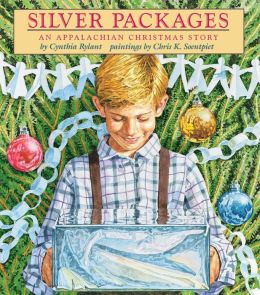
Silver Packages: An Appalachian Christmas Story. Cynthia Rylant. Illustrated by Chris K. Soentpiet. 1987. Scholastic. 32 pages. [Source: Library]

Silver Packages is a picture book for older readers most likely. I wouldn't say it is for an exclusively adult audience. But I think readers need some perspective in order to appreciate the book fully. I think it can resonate with readers, it has the potential. But I don't think the emotional reaction would be--or even should be--automatic. One can't assume that every reader will respond with tears and "this is the best book I've ever read!!!"

Silver Packages is about giving back to the community. In this instance, one very specific community--Appalachia. The book is about the Christmas Train. It starts with one man who wants to show his appreciation for the community that helped him when he needed it. He was injured in an accident, the community took in this stranger and nursed him back to health without asking for anything in return. He decides that he will come every year--by train--and hand out packages to the children who meet the train. These packages are wrapped in silver paper. Every story needs a protagonist. Silver Packages introduces us to Frankie. Readers first meet Frankie as a boy. He's a boy with a dream. He wants to be a doctor. And he really, really, really wants a doctor kit for Christmas. But each year, he's slightly disappointed. He receives a handful of silver packages through the years. Every gift seems to have a toy--something a boy or girl might want--and something a boy or girl might need. The practical gifts include: socks, mittens, hats, scarves, etc. Readers later see Frankie all grown up. He is a doctor. He reflects on his life, on his past Christmases, he has a light-bulb moment. He decides it is his turn to give back to the community in his own special way. It's a book about kindness and gratefulness and community awareness.

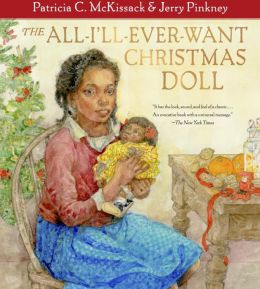
The All-I'll-Ever-Want Christmas Doll. Patricia C. McKissack. Illustrated by Jerry Pinkney. 2007. Schwartz & Wade. 40 pages. [Source: Library]

Christmas always came to our house, but Santy Claus only once in a while.

I haven't read The All-I'll-Ever Want-Christmas Doll in years. It was just as good as I remembered. The book is set during the Depression. A little girl, Nella, knows that her family is poor, that Santy may not come this year at all. Yet, she can't resist writing to him all the same begging for a Baby Betty doll. Her two sisters perhaps think a little less of Nella for her dreaming so big. She shouldn't expect so much from Christmas. But on Christmas morning, there are a few surprises. Each girl gets a Christmas sack filled with walnuts, peppermint candy, an orange, and a box of raisins. But there is one present, one special present remaining: a doll. Nella thinks the doll should be HERS and hers alone. After all, her sisters haven't gone around talking about the doll nonstop, her sisters didn't write Santa a letter begging for the doll. Why should she have to share the doll with them? But does the doll make her happy? Is the doll truly all she'll ever want? She has a few lessons to learn for sure!

I really enjoyed the story and the message.

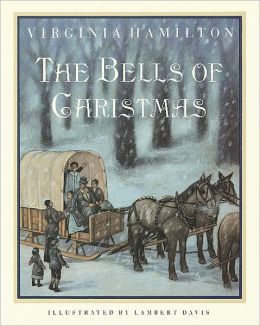
The Bells of Christmas. Virginia Hamilton. Illustrated by Lambert Davis. 1989/1997. Houghton Mifflin Harcourt. 64 pages. [Source: Library]

I didn't dislike Virginia Hamilton's The Bells of Christmas. But I didn't love, love, love it either. I think it depends on what exactly you're expecting from a Christmas book. The Bells of Christmas is very much a celebration of a Christmas long ago. Christmas 1890. Readers meet a young boy, Jason Bell, and experience the holiday through his perspective. We learn about his mom and dad, his brothers and sisters, his cousins, his aunt and uncle, his friend, Matthew. The book is set over a period of several days. Among the things readers learn that Jason's dad is a carpenter, that he wants his sons to join him in his business one day, his dad has only one leg, that his dad wears a peg leg part of the time and is in his wheel chair the rest of the time. Readers also learn that Jason is just a wee bit obsessed with wheels--mainly trains, but, also wagons, etc. The book has plenty of detail and characterization which is a good thing. Jason is waiting for quite a few things: 1) he can't wait for Christmas morning and presents! 2) he can't wait for the Bells to arrive--his uncle and aunt and cousins, 3) he is excited about church, most everyone is performing and participating in some way. (Jason is singing a solo.) The book perhaps seeks to capture one Christmas for one extended family. It is a pleasant, enjoyable book. It isn't quite a chapter book or novel. It isn't quite a picture book.
 
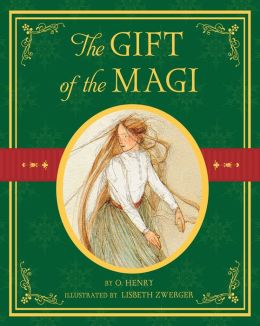
The Gift of the Magi. O. Henry. Illustrated by Lisbeth Zwerger. 1905/2006. Simon & Schuster. 32 pages. [Source: Library]

I've seen adaptations of The Gift of the Magi--who hasn't? (My favorite is Bert and Ernie and Mr. Hooper.) But this is the first time I've read the actual short story. I haven't decided how I feel about it. Is this couple wise or foolish? Or are they at times foolish and at times wise?

The wife, Della, takes extraordinary pride in her long hair. She doesn't seem the vain sort except for when it comes to her hair. And even if she is vain about it, there's no indication it's anything besides a private vanity. The wife apparently has been coveting expensive hair combs as well. The husband, Jim, takes extraordinary pride in the family watch. The narrator uses exaggeration when discussing the woman's long hair and the man's gold watch. I didn't love the narrator. In fact, I think the narrator is a distraction. He won't let the reader forget for a moment that this is a precious story.
Now, there were two possessions of the James Dillingham Youngs in which they both took a mighty pride. One was Jim's gold watch that had been his father's and his grandfather's. The other was Della's hair. Had the queen of Sheba lived in the flat across the airshaft, Della would have let her hair hang out the window some day to dry just to depreciate Her Majesty's jewels and gifts. Had King Solomon been the janitor, with all his treasures piled up in the basement, Jim would have pulled out his watch every time he passed, just to see him pluck at his beard from envy.
The wife can't afford a gift for her husband. The husband can't afford a gift the wife. The wife knows this--or should know this. The husband knows this--or should know this. The wife has saved $1.87. The husband might have saved a small sum as well. Readers don't know one way or the other. Both husband and wife will have something to offer the other, however. Something more than love. For both have decided--quite independently--to give sacrificially. To give up what they supposedly value most: her hair, his watch. And this giving up wasn't to support the family, but, to support the other's vanity.

I think actions can speak more than words. I think the narration took away some of my enjoyment of this one. It felt odd at times. There were sentences that were eloquent and refined and then it would slip into something else.
"It's sold, I tell you--sold and gone, too. It's Christmas Eve, boy. Be good to me, for it went for you. Maybe the hairs of my head were numbered," she went on with sudden serious sweetness, "but nobody could ever count my love for you. Shall I put the chops on, Jim?"
I think I like the adaptations better.

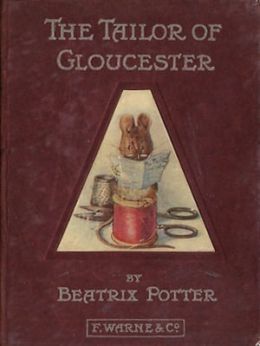
The Tailor of Gloucester. Beatrix Potter. 1903. 58 pages. [Source: Library] 
In the time of swords and periwigs and full-skirted coats with flowered lappets—when gentlemen wore ruffles, and gold-laced waistcoats of paduasoy and taffeta—there lived a tailor in Gloucester.
He sat in the window of a little shop in Westgate Street, cross-legged on a table, from morning till dark.
All day long while the light lasted he sewed and snippeted, piecing out his satin and pompadour, and lutestring; stuffs had strange names, and were very expensive in the days of the Tailor of Gloucester.
I enjoyed rereading Beatrix Potter's The Tailor of Glouchester. In this delightful Christmas tale, readers meet a tailor, a cat named Simpkin, and some lovely mice. It is several days before Christmas. He's working hard to finish a coat and waistcoat for the Mayor of Glouchester. The Mayor is getting married on Christmas day. The tailor has just enough money to finish the coat. Not a penny to spare. He sends his cat, Simpkin, with his money to buy what he needs: a little for himself (food: bread, sausage, milk) a little for his work (one twist of cherry-coloured silk). It is only after the fact that he questions whether he should have sent the cat or gone himself. The cat returns, but, in a mood. The cat is upset for he's discovered that the tailor freed the mice he had captured and hid under the teacups. The cat hides the twist. The man is upset, of course, and sick. He takes to his bed unable to work. The oh-so-thankful mice go to his shop and finish his work for him. But since they are one twist short, they are unable to finish completely. Still, they do what they can, and they do a wonderful job. The cat who spies them at work, I believe, has a change of heart and gives the twist to the old man on Christmas morning. He has just enough time to finish. The Mayor is very, very pleased. And the tailor's luck changes for the better, and his business is much improved. This one is a lovely, delightful read from start to finish.

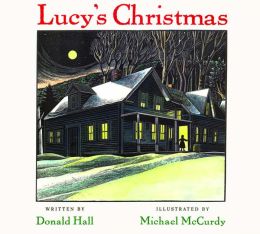
Lucy's Christmas. Donald Hall. Illustrated by Michael McCurdy. 1998. Houghton Mifflin Harcourt. 40 pages. [Source: Library]

I enjoyed reading Lucy's Christmas by Donald Hall. Lucy's Christmas is a picture book set in 1909 in New Hampshire. In the fall of 1909, Lucy and her family start preparing for Christmas. For Lucy, this means starting to make her own gifts for her family and friends. It pays to plan ahead since so many gifts take time, and thought must be placed into each gift. She's not the only one thinking ahead. This year the family is ordering a new stove for the kitchen. The family has spent a lot of time browsing in the Sears catalog. Lucy's choice is the one the family decides upon: the Glenwood Kitchen Range. The focus is not just on gifts: planning, making, giving, receiving. The focus is also on family life and community life. Readers get glimpses of the school and church. Both places are very busy! I enjoyed this glimpse into the past! It was interesting to see the family prepare for the new year--1910. The enthusiasm in the story is sweet. The author's note reveals that this picture book is based on family history.

I really liked this one very much. I liked Lucy and her family. I liked the fact that the church plays such a HUGE role in the Christmas celebrations. There are gifts, it's true. But it's not commercialized and selfish.

Baboushka and the Three Kings. Ruth Robbins. Illustrated by Nicholas Sidjakov. 1960/1986. Houghton Mifflin Harcourt. 32 pages. [Source: Library]

Long ago and far away, on a winter's evening, the wind blew hard and cold around a small hut.

Baboushka and the Three Kings won the Caldecott Medal in 1961. It is Russian folktale with a Christmas setting. The three kings--wise men--come to Baboushka's hut. They only stay a few minutes. Long enough to extend an invitation to the old woman. Will she join them in their procession, in their quest, to find the Babe, the Child? She'd love to join them, she'd love to bring gifts to the Child. But she is not ready to go just yet. Couldn't they all wait until morning? Couldn't they wait for her to finish up a few small, tiny chores first? Couldn't they wait for the storm to clear? Their answer was firm. Their journey to the Child was too important to postpone. They couldn't linger longer. She watched them depart. But they were not easy men to forget. The next morning, she begins a journey of her own. A journey that will take her far. But will her journey lead her to where she wants to go?

It's a simple story, nicely written. "It is no ordinary Babe they seek. Yes! I must go and follow them! To find the new Babe, to offer Him her gift, was now her one yearning. This thought burned in her mind like a candle in the dark." It is also nicely illustrated. The illustrations complement the text well. Both illustrations and text have a different flavor, an authentic flavor, but not exactly American. After several readings, I came to appreciate both a bit more.

In case you're unfamiliar with the story, the book is bittersweet at best. While it is true that Russian children everywhere look forward to Baboushka's gifts each year as her journey continues, it is also true that Baboushka's journey has no happy ending. She never finds the Child. She is never able to give Him her gifts.

Polar Express. Chris Van Allsburg. 1985/2009. Houghton Mifflin Harcourt. 32 pages. [Source: Library]

The Polar Express is one of my favorite Christmas books. It is. The book is a thousand times better than the movie. (Though the soundtrack of the movie isn't bad.) So if you've only seen the movie, you might want to give the book a try to. You might have a different response to it.

The Polar Express is about belief and doubt--in Santa. It's told in the first person, so we never learn the protagonist's name, but it is a little boy with a younger sister named Sarah. One Christmas Eve, the little boy is awakened by The Polar Express. He goes to the North Pole on the Polar Express train, there are other passengers too. All presumably boys and girls on the verge of not-believing. At the North Pole, he sees Santa, reindeer, and elves. He happens to be chosen to receive the first gift of Christmas. He asks for a bell from Santa's reindeer. This gift is not in his possession for long, however, because he has a hole in his pocket. On Christmas day, he receives a special gift under the tree: the bell he had lost. He can hear it. His sister can hear it. But his parents do not. The book ends wonderfully with a message for "all those who truly believe."

I loved this one cover to cover, though I love the ending most of all.


© 2014 Becky Laney of Becky's Book Reviews

Saturday, August 04, 2012

Mansfield Park Revisited

Mansfield Park Revisited. Joan Aiken. 1985/2005. Sourcebooks. 201 pages.

The sudden and unexpected death of Sir Thomas Bertram, while abroad engaged on business relating to his various properties in the West Indies, could be a cause of nothing but sorrow, dismay, and consternation to the baronet's friends in England.

I just LOVE, LOVE, LOVE Joan Aiken's Mansfield Park Revisited. I do. I love the characters, the story, and most of all the redemption. Susan Price, Fanny's younger sister, is the heroine of Joan Aiken's Mansfield Park Revisited. When the novel opens, Edmund and Fanny are on their way to the West Indies with their youngest child.
Susan's day are soon brightened up by the arrival of two people to the neighborhood. A sadder-but-wiser, Mary Crawford, whose health is in decline, and her ever-faithful brother, Henry. Though Susan never knew either Crawford personally, she can't help but be drawn to them--particularly Mary. She knows the two have history with those she loves best--Fanny, Edward, Tom, etc., but she can't help believing that these two have changed for the better through the years. These two are not seeking society in the neighborhood, just a quiet, peaceful place to simply be.

Aiken is great at relationships, and I definitely enjoyed seeing Susan interact with Mary Crawford, Henry Crawford, Tom Bertram, Lady Bertram, Julia Yates, etc. Readers don't know much about Susan from Austen's novel, but, Aiken did a great job giving her life in this sequel. While readers do know more about Mary and Henry Crawford from Austen's Mansfield Park, I can't help believing that Henry Crawford has been misunderstood until Aiken set the story straight. (I do LOVE Henry Crawford.) Mary's redemption was a beautiful thing as well. Aiken did not rewrite the past--or try to justify it exactly--but she has through circumstance after circumstance brought Mary to a reflective, repentant place and given her an opportunity to blossom into a sensitive, perceptive, loving person. 

I loved every page of this one. I loved spending time with these characters. It was just a wonderful treat.

My first review. 

Read Mansfield Park Revisited
  • If you love Mansfield Park, if you like Mansfield Park; even if you were bored with it, you may just find something to love in this historical romance
  • If you love Jane Austen
  • If you like historical romance

© 2012 Becky Laney of Becky's Book Reviews

Wednesday, May 16, 2012

Henrietta's War: News from the Home Front 1939-1942

Henrietta's War: News from the Home Front, 1939-1942. Joyce Dennys. 1985/2010. Bloomsbury. 176 pages.

October 18, 1939
My dear Robert,
It was good to get your letter and hear that you are in a 'perfectly safe place,' though I wonder how much of that is true and how much intended to allay the alarms of your Childhood's Friend. And why, when I and everybody else know that you are in France, must I address my letters to Berkshire? Well, well, I suppose They Know Best, and Ours Not to Reason Why, but I seem to remember that when I wrote to you in the last war I used to put "B.E.F., France," quite boldly on the envelope, thereby no doubt endangering the safety of the British Empire.


I have been wanting to read this book for a year or so now. And in many ways it did not disappoint. It's set in the country, in a small country village. The main character is Henrietta Brown, a doctor's wife. The book is told through a series of letters to her childhood-friend-now-a-soldier, Robert. The first book covers October 1939 through December 1941. (Yes, the cover says 1939-1942, but the truth is the last entry is dated December 31, 1941.) Many letters (or sketches, depending on how you want to view them) are accompanied by small black-and-white drawings. What does Henrietta write about? Well, life in the village, in the country. Everything from tea parties, church rumble sales, various "concerts," and other events--big and small--that concern everyday folk. Simple things like gardening, shopping, rationing, knitting, gossiping, etc.

The setting is definitely enjoyable. I was reminded of Agatha Christie, in a way, especially the Miss Marple series. Because these are set in a small country village, because the characters presented are so quirky. But there are no murders, no mysteries to solve. So the comparison isn't quite fair. I was also reminded, in a way, of Erma Bombeck. Though I admit it that is a bit of a stretch. It's just that Dennys' sketches of what it is like to live in a small country village, in a small community where everyone knows everyone's business, her focus on being a housewife, a mother, a 'good' neighbor and friend, well, it is the finding humor in the common, everyday dealings of life that made me think of Bombeck. True, the humor is sometimes more understated and subtle than Bombeck, but, there are many funny scenes in this one. Is the humor for everyone? Probably not. Some might fight it too quiet.

So I definitely liked it. I'm not exactly, exactly sure I loved it. I am very, very glad I read it. And I'd definitely recommend it to some of my friends. But if you're looking for action, action, more action...it's not going to be for you.

Read Henrietta's War
  • If you like books set in England, especially if you like the period in which this is set, World War II
  • If you like epistolary novels 
  • If you like quirky characters and humor

© 2012 Becky Laney of Becky's Book Reviews

Wednesday, December 22, 2010

Death of a Gossip

Death of a Gossip. A Hamish Macbeth Murder Mystery. M.C. Beaton. 1985/2008. Robinson. 210 pages.

'I hate the start of the week,' said John Cartwright fretfully. 'Beginning with a new group. It's rather like going on stage. Then I always feel I have to apologize for being English. People who travel up here to the wilds of Scotland expect to be instructed by some great hairy Rob Roy, making jokes about saxpence and saying it's a braw bricht moonlicht nicht and lang may your lum reek and ghastly things like that.'

John and his wife, Heather, own a fishing school in Lochdubh. When the novel opens, they are preparing to welcome this week's clients: Marvin and Amy Roth, Lady Jane Winters, Jeremy Blythe, Alice Wilson, Charlie Baxter, Major Peter Frame, and Daphne Gore. From the start, things don't go well. Lady Jane Winters is as rude as can be. She deliberately sets out to annoy and aggravate everyone she encounters. It isn't too long before the others start talking about her. More than one person wishes Lady Jane was dead. More than one threatens to kill her. Still, it is somewhat of a shock when Lady Jane ends up being the catch of the day. One of them fishing her body from the lake--she was strangled and wrapped in chains.

There is a local constable, Hamish Macbeth. And he's delightfully eccentric. But he's not "big enough" to solve a murder...or is he? Officially, he is off the case. A team of detectives, led by Blair, has arrived and are ready to handle this one. They've begun interviewing everyone, and begun examining the evidence. Though he didn't want to solve the murder before Chief Inspector Blair told him not to get in the way of the case, he does now. Can Macbeth piece together the clues before Blair does?

We learn a little about each of the characters with special attention to Alice Wilson and Jeremy Blythe. Two strangers who are drawn together even before this murder investigation begins. But what is love for Alice, is just a meaningless fling for Jeremy. Fortunately, Hamish is there for Alice whether she wants his advice or not.

I NEVER thought I would read a book (voluntarily) about fishing. Then again, before this year, I never thought I would read a mystery. I liked this one. I didn't quite love it. I liked Hamish well enough. And I think this series might have potential. The characters just weren't quite as developed as I would have liked. (Though I know not every character can be equally developed.) I did enjoy the Scottish setting.

© Becky Laney of Becky's Book Reviews

Friday, November 27, 2009

Jacquelyn (MG, YA)


Gordon, Jeffie Ross. 1985. Jacquelyn. Scholastic. Sunfire Romance. 332 pages.

Christmas vacation! Home, presents, and time to spend with Broderick!

This one is set in the Depression. In Chicago. Beginning at the end of 1931, to be exact. Jacquelyn, our heroine, may seem like a spoiled brat at first. But she's about to lose it all. Will what she's learned be enough to keep her and her family together?

The book opens with her coming home for Christmas. What she learns turns her world upside down. Her father has lost it all. There is no family fortune. Not anymore. And the family will have to struggle to survive--to keep food on the table, a roof over their heads. Her family becomes her responsibility when her father suffers a stroke and her mother loses herself in the past and loses touch with reality. Forced into the workplace, Jacquelyn learns just what she's made of. That she's stronger than she ever thought possible. That independence is a good thing.

Jacquelyn is just one of the delightful 'name-books' in the Sunfire Romance series. And it is one of the best in my opinion. It's richly detailed and the writing was so well done. The character development is above and beyond what you might expect. And the story has substance. It had been years--probably at least fifteen--since I'd read it yet I could still recall specific details, scenes, from this one.

I loved this one so very much. It was just as magical for me now--all these years later--as it was the first time around. And it is sad to me that these are out of print. I would so love to see a revival of these!

© Becky Laney of Becky's Book Reviews

Tuesday, March 24, 2009

Mansfield Park Revisited


Aiken, Joan. 1985/2005. Mansfield Park Revisited. Sourcebooks. 201 pages.

The sudden and unexpected death of Sir Thomas Bertram, while abroad engaged on business relating to his various properties in the West Indies, could be a cause of nothing but sorrow, dismay, and consternation to the baronet's friends in England.

I just LOVED this book. It was delightful and charming. But more importantly it is redemptive. With Fanny and Edmund out of the picture--for the most part--the narrative has a chance to focus in on other characters. Susan, Fanny's younger sister, and Tom, Edmund's brother, for example. But it also returns to us the brother-sister villains, Henry and Mary Crawford. (She's come back--and is actually renting a cottage from the Bertrams--but there's a catch: she's dying.) New characters are also introduced--the lovely Mrs. Osborne and her brother, the Reverend Francis Wadham. (He will be taking Edmund's place in the parish temporarily.) The book is full of characters you come to love...and those you love to hate.

Appearances can be deceiving, and such is the case here. All isn't as it first appeared, for example, in Mansfield Park. I have never been a fan of Mansfield Park, but I am a BIG FAN of this sequel. If you're like me, you might want to give this one a try. You might just find yourself surprised!

Like most Austen novels, this one has to do with love and matchmaking. And so much more.

I'm sorry I can't really describe it very well. But it is one of those where sharing a few details might spoil it. It is best to read for yourself and see where the story goes.


© Becky Laney of Becky's Book Reviews
If you're reading this post on another site, or another feed, the content has been stolen.