Showing posts with label books reread in 2017. Show all posts

Thursday, December 07, 2017

Among the Brave

Among the Brave. (Shadow Children #5) Margaret Peterson Haddix. 2004. 256 pages. [Source: Library]

First sentence: Great, Trey thought. I do one brave thing in my entire life, and now it's like, 'Got anything dangerous to do? Send Trey. He can handle it.' Doesn't anyone remember that Cowardice is my middle name?

Premise/plot: Among the Brave is the fifth book in Margaret Pertson Haddix's Shadow Children series. Trey, the narrator, faces great challenges in this one. For Trey, going outside is an act of bravery. So when all of his friends disappear, and the trustworthy adults in his life disappear as well, he's at a loss. He teams up for a while with Luke's brother, Mark. But Mark is CAPTURED leaving Trey on his own to brainstorm a rescue plan. Can Trey find a way to save everyone?

My thoughts: The world Haddix created is turned upside down by revolution. But it's a revolution that won't do third children any favors. Freedom still seems to be an impossible dream. I don't know how Haddix manages to pack so much ACTION into her novels. Usually the more action a book has, the less important character development is. That's so far from the case in this series. The books remain thoughtful--contemplative. Yet there's so much going on! Danger abounds.

© 2017 Becky Laney of Becky's Book Reviews

Wednesday, October 25, 2017

Among the Betrayed

Among the Betrayed. (Shadow Children #3) Margaret Peterson Haddix. 2002. 160 pages. [Source: Library]

First sentence: You were supposed to wake up from nightmares.

Premise/plot: Among the Betrayed is the third book in the fast-paced, action series by Margaret Peterson Haddix. This Shadow Children's novel doesn't focus on Luke--or Lee. The narrative shifts to a girl we met in the second book, Nina. What do we know about Nina from the last book? Well, she attends a girls school close to the school that Lee Grant attends. Nina is good friends with Jason. Lee overhears Jason talking about how he and Nina are getting ready to betray the students who are illegal and trying to pass using fake ids. Lee calls Mr. Talbot and tries to let him know what's going on without saying it in an obvious way. Among the Betrayed is Nina's story.

Nina is being held prisoner; but does she belong in prison? Is she guilty of a crime? Or has she been framed? Nina's loyalty is put to the test.

My thoughts: I am rereading this series. At first I didn't remember this narrative shift. You'd think I remembered that one whole book is narrated by someone else, but, I didn't. Then again, that isn't a big shock. I read a lot of books! I did like Nina. Within a few chapters, I was completely hooked to this one and enjoying it just as much as the previous two novels in the series.

© 2017 Becky Laney of Becky's Book Reviews

Tuesday, October 17, 2017

Among the Impostors

Among the Impostors. Margaret Peterson Haddix. 2001. 172 pages. [Source: Library]

First sentence: Sometimes he whispered his real name in the dark, in the middle of the night. "Luke. My name is Luke."

Premise/plot: Among the Impostors is the second book in the Shadow Children series by Margaret Peterson Haddix. The first novel, Among the Hidden, ended with Luke Garner's life in danger. The second book opens with Lee Grant preparing to enter a school for troubled boys, Hendricks School for Boys. He's been slipped a note by his rescuer, but, he's disappointed when he finally gets a chance to read it. How is a shadow child supposed to blend in seamlessly with other boys his own age? How is he supposed to look like he belongs in a school, in a classroom, in a cafeteria?! He's only ever known his own house, and mainly the attic at that. Still, Lee does his best. It turns out that he's not the only boy struggling to blend in. Could all the boys have something in common? Could they all be shadow children? Is it safe to admit to another shadow child your own real name? Lee wants more than anything to find a true friend, but, he's been taught not to trust.

My thoughts: I am not sure that I loved, loved, loved this one. It could be I'm always in a rush to get through the whole series and experience all the books. So this book is just a stepping stone in a way. Definitely worth reading to get you from one point to another. But is it special on its own? Maybe, maybe not. I did notice some similarities to MANDY. I definitely recommend the whole series. This one introduces two new characters: Nina and Jason. Nina is from a girls school nearby. Jason is one of his roommates.
© 2017 Becky Laney of Becky's Book Reviews

Wednesday, October 11, 2017

Among the Hidden

Among the Hidden. Margaret Peterson Haddix. 1998. 153 pages. [Source: Library]

First sentence: He saw the first tree shudder and fall, far off in the distance. Then he heard his mother call out the kitchen window: "Luke! Inside. Now." He had never disobeyed the order to hide.

Premise/plot: Among the Hidden is the first book in Margaret Peterson Haddix's fast-paced futuristic middle grade series. Luke Garner is a shadow child, an illegal third child; his parents are farmers in a rural community which gave him small doses of freedom--if freedom means breathing fresh air outside--now and then. But when the woods around his house are bulldozed to make room for more houses--or apartments--even that small bit of liberty is lost. Luke "lives" his life in the attic and on the stairs. His family fears the Population Police so much that they don't even allow Luke to eat with them in the kitchen. Things seem to be getting progressively worse; so much so that his mother decides to get a job--in a factory, I believe--leaving Luke alone in the house. One day Luke notices that one of the neighbor's has his lights on when no one is supposed to be home. Then he sees a face; could Luke have found another hidden child? Could this child be his friend? Only if Luke dares to disobey his parents and go outside. Is there life outside the attic?

My thoughts: I remember discovering this series a few years after I first started blogging. It was LOVE. I remember that it was winter. While I had the first two or three checked out at the same time, I finished them all in one day and a snowstorm kept me from getting the rest of the series right when I wanted them, no, NEEDED them. Long story short, CHECK OUT ALL THE TITLES AT ONCE. That's my advice to you. I found the series to be fast-paced, compelling, thoughtful. I really loved Luke and his new friend, Jen.

© 2017 Becky Laney of Becky's Book Reviews

Saturday, September 23, 2017

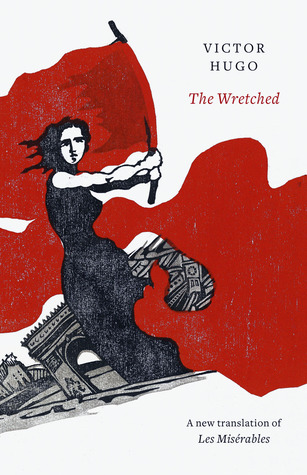
The Wretched

The Wretched. Victor Hugo. Translated by Christine Donougher. 1862/2013. 1456 pages. [Source: Bought]

First sentence: In 1815, Charles-François-Bienvenu Myriel was bishop of Digne. He was an old man of about seventy-five. He had been bishop of Digne since 1806.

Premise/plot: An ex-convict does his best to live life according to his conscience. Will it ever be enough?

My thoughts: I love, love, love Victor Hugo's Les Miserables. I believe this is my third time to review it for the blog? My 2013 review. My 2014 review.

Political, philosophical, spiritual, dramatic, and romantic. Each word describes the novel, in part. While there are many characters in this novel, I loved the narrator the best of all. Who are some of the characters? Bishop Myriel, Jean Valjean, Fantine, Inspector Javert, Cosette, Marius, Eponine, Enjolras, and Gavroche--just to name a few.

Jean Valjean is an ex-convict who seeks shelter from Bishop Myriel one night. Though he's been treated only with kindness, Valjean in his bitterness (he was sent to prison for stealing a loaf of bread), he steals the bishop's silver. When the theft is discovered, the bishop is all compassion telling the officials that there has been a misunderstanding. Valjean did not steal the silver; it was given as a gift. In fact, he's happy to give Valjean his silver candlesticks as well. Valjean is shocked and overwhelmed. The meeting turns out to be quite life-changing.

When readers next meet Valjean, he has a new name and life. Monsieur Madeleine is a successful business man. He has a BIG heart. He's always giving. He's always thinking of others. He's always doing what he can, when he can to make a difference when and where it matters most. One woman he is determined to help is a young, single mother, Fantine. Circumstances have separated Fantine from her child, Cosette, but, Valjean is determined to correct as many wrongs as he can in this situation. He will see to it personally.

Unfortunately, his past catches up with him. He learns that a man has been arrested; "Jean Valjean" has been caught. Of course, Madeleine knows this is nonsense. Can he let another take his place in prison? If he tells the truth then he can no longer help the poor, but if he doesn't tell the truth, how could he live with himself? He does the honorable thing--though it is one of the greatest challenges he's faced so far.

But that means, for the moment, that Cosette is left in unpleasant circumstances...

There comes a time, an opportunity for Valjean to escape. What he does with his freedom--this time he's assumed drowned, I believe--is go and find Cosette. The two become everything to one another. Cosette is the family he's never had, never even knew he needed or wanted... the two end up in Paris.

Almost half of the novel follows the love story between Marius and Cosette. But it isn't only a love story. Marius is a poor man in conflict with his rich grandfather. The two disagree about many things. But their main source of disagreement is politics. At first, Marius is swept up in his father's politics, with a new awareness of who his father was as a soldier, as a man, as a possible hero. But later, Marius begins to think for himself, to contemplate political and philosophical things for himself. He becomes friendly with a political group at this time. But his love of politics dims when he falls in love with Cosette...and she becomes his whole reason for being. For the longest time these two don't even know each other's names! This romance isn't without challenges...

This novel has so much drama! I found it beautifully written. So many amazing passages! Such interesting characters! I'm not sure I loved the ending. And I was frustrated with Marius at times. But. I definitely loved this book!

It's also a novel heavy on details. When it's good, it's REALLY good. But at times some of the details are too taste-specific. In other words, some of the details weigh the story down. At times Les Miserables is boring. It's worth reading. It is. It's worth pushing through to the end. It's okay to skim certain sections, in my opinion, because it is one of the most satisfying reading experiences overall. Not that I LOVE the ending, though I think I may have made peace with it this time around.

I definitely enjoyed this translation of the novel. I LOVED the introductory materials. I found the notes to be thorough. If I were to ever STUDY the book, this would be the translation I'd use because the notes are so extensive. 

Favorite quotes:
  • True or false, what is said about men often figures as large in their lives, and above all in the fate that befalls them, as what they do.
  • ‘To sin as little as possible, that is the law of mankind. Not to sin at all is the angel’s dream. Everything earthly is subject to sin. Sin is a gravitational force.’
  • Where the telescope ends, the microscope begins. Which of the two has the greater vision? You choose.
  • Certain thoughts are prayers. There are moments when, whatever position the body might be in, the soul is on its knees. If you are human, be love.
  • Love is an ardent forgetfulness of everything else.
  • Suspicions are nothing but wrinkles.
  • Alas! to have climbed does not preclude falling. This can be seen in history more frequently than anyone would wish.
  • Everything can be parodied, even parody.
  • To love, or to have loved, is enough. Ask for nothing more. There is no other pearl to be found in life’s shadowy convolutions. To love is an achievement. The first step is nothing, it is the last step that is hard.
  • When the heart is on the slippery slope, there is no stopping it.
  • Love each other always. That’s about the only thing in the world that matters: loving each other.


© 2017 Becky Laney of Becky's Book Reviews

Thursday, July 27, 2017

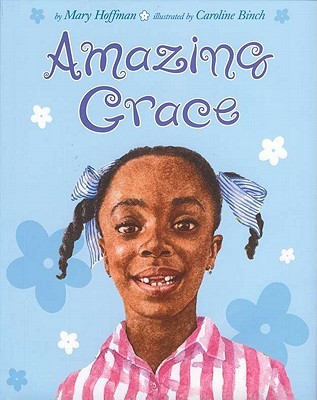
Amazing Grace

Amazing Grace. Mary Hoffman. Illustrated by Caroline Binch. 1991. 32 pages. [Source: Library]

First sentence: Grace was a girl who loved stories. She didn't mind if they were read to her or told to her or made up in her own head.

Premise/plot: Grace, the heroine, loves stories. She loves acting out stories. She does it all the time. So when her class performs Peter Pan, she knows exactly what part she wants--that of Peter Pan. Her classmates, at first, tell her she can't be Peter Pan. She's a girl. She's black. She just doesn't look the part. But Grace knows different. She's been raised to believe that she can be anything she wants. She proves that she can be an amazing Peter Pan.

My thoughts: I liked this one very much. I think Grace is adorable. The kind of girl you'd really love to be friends with in real life.

Text: 4 out of 5
Illustrations: 4 out of 5
Total: 8 out of 10


© 2017 Becky Laney of Becky's Book Reviews

Friday, July 07, 2017

Mouse Paint

Mouse Paint. Ellen Stoll Walsh. 1989. 32 pages. [Source: Library]

First sentence: Once there were three white mice on a white piece of paper. The cat couldn't find them. One day, while the cat was asleep, the mice saw three jars of pain--one red, one yellow, and one blue. They thought it was Mouse Paint. They climbed right in.

Premise/plot: Mouse Paint is a concept picture book about colors. (Red and yellow make orange, etc.) But it's also a fun story about three mice who very much want to escape the attention of the cat.

My thoughts: I really enjoy this one. I have read it several times before, but never given it a review on the blog. My favorite line: "The red mouse stepped into a yellow puddle and did a little dance."

Text: 4.5 out of 5
Illustrations: 3.5 out of 5
Total: 8 out of 10

© 2017 Becky Laney of Becky's Book Reviews

Sunday, June 25, 2017

Prisoner's Base

Prisoner's Base. (Nero Wolfe #21) Rex Stout. 1952. 209 pages. [Source: Bought]

First sentence: In Nero Wolfe's old brownstone house on West Thirty-fifth street that Monday afternoon in June, the atmosphere was sparky. I mention it not to make an issue of Wolfe's bad habits, but because it is to the point. It was the atmosphere that got us a roomer.

Premise/plot: Priscilla Eads shows up at Nero Wolfe's house expecting--hoping--that she can stay there for a week, that she can pay him room and board. She's hiding out from someone--a lawyer, a business partner. Archie lets her in, and tells her she can stay temporarily at least. The final word will come from Nero Wolfe, and he's not to be disturbed at the moment. (Readers can guess why.) Before the evening is out, two things occur: someone comes looking for her and wanting to hire Wolfe to find her AND Wolfe kicks Miss Eads out of his house. The next day, can you guess who's dead?!

Archie blames himself and takes it upon himself to FIND THE KILLER NO MATTER WHAT. And Wolfe finds himself with Archie as a client!!! Miss Eads was an heiress and she was about to come into a lot of stock and money as her birthday approached...

My thoughts: I really enjoy Rex Stout's Nero Wolfe series. I love, love, love, LOVE Archie Goodwin. This is a very satisfying, very quick read.

Quotes:
"If I had said I had read about you and seen a picture of you, and you fascinated me, and I wanted to be near you for one wonderful week, you'd have known I was lying." "Not necessarily. Millions of women feel like that but they can't afford the fifty bucks a day."
© 2017 Becky Laney of Becky's Book Reviews

Friday, June 23, 2017

Death of a Gossip

Death of a Gossip. M.C. Beaton. 1985. 179 pages. [Source: Library]

First sentence: 'I hate the start of the week,' said John Cartwright fretfully.

Premise/plot: Death of a Gossip is the first mystery starring Hamish Macbeth. The series is set in Scotland. The setting of the first book is largely a fishing school/club and its surrounding rivers and lakes. John and Heather Cartwright manage the school, most of the students are out-of-town tourists. The students this eventful week are: Marvin and Amy Roth, Lady Jane Winters, Jeremy Blythe, Alice Wilson, Charlie Baxter, Major Peter Frame, and Daphne Gore. By the end of the week, one of these guests/students will be dead. Though technically Chief Inspector Blair is the detective on the case, it is really Hamish Macbeth, local constable, that gets the job done.

My thoughts: My mom hasn't read this first book, but she has been LOVING the later books in the series. I remember reading this one and not being all that impressed. But. I wanted to give Hamish Macbeth another try. I hope to see the television series soon. I am still not all that impressed. SO MUCH FISHING. I'm hoping that the series will improve as it goes on.


© 2017 Becky Laney of Becky's Book Reviews

Thursday, June 08, 2017

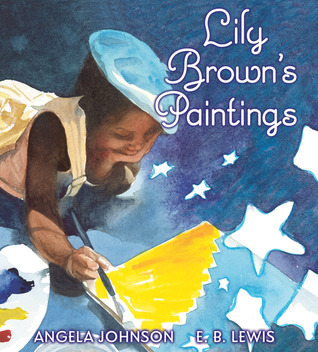
Lily Brown's Paintings

Lily Brown's Paintings. Angela Johnson. 2007. 32 pages. [Source: Review copy]

First sentence: Lily Brown loves her mama, daddy, and baby brother and the world they live in. Sometimes she spins around her room thinking about their world. And it's wondrous. But when Lily Brown paints, her world starts to change.

Premise/plot: Lily lives happily in two worlds. The second world she lives in is one of her own imagination, her own reckoning.
When Lily Brown paints fruit at the corner market, it is striped and polka-dotted. It speaks to people, then laughs out loud. When people put the fruit in bags to take home, the apples sing all the way there.
At the end of the day, when the painting--for now--has all been done, she happily returns to the real world and LOVES it just as much.

My thoughts: What doesn't this picture book celebrate? It celebrates art, freedom of expression, love of life, love of family, JOY, imagination. I'm sure I could think of more if I keep rereading it. It's just a joy to spend time with Lily.

Text: 5 out of 5
Illustrations: 4 out of 5
Total: 9 out of 10


© 2017 Becky Laney of Becky's Book Reviews

Monday, June 05, 2017

Champagne for One

Champagne for One. Rex Stout. 1958. 205 pages. [Source: Bought]

First sentence: If it hadn't been raining and blowing that raw Tuesday morning in March I would have been out, walking to the bank to deposit a couple of checks, when Austin Byne phoned me, and he might have tried somebody else. But more likely not. He would probably have rung again later, so I can't blame all this on the weather.

Premise/plot: When Austin Byne calls Archie Goodwin asking him for a favor, to fill in for him at a charity event, Archie says yes. As a consequence, when a young woman, Faith Usher, dies at the event, Goodwin was there to testify to one thing with all certainty--it was not suicide, but murder. He had been warned that she had cyanide in her purse, so he was watching her and her purse all evening long. The police are unconvinced, especially at first, but they've learned not to rush things when Nero Wolfe is involved. Can Nero Wolfe and company (Archie, Saul, etc.) solve the case?! Who killed Faith and why?!

My thoughts: I ADORE Nero Wolfe and Archie Goodwin. This was a reread for me. And before I reread it, I watched the adaptation of it. But even knowing all the details before picking it up, I have to say it is a fabulous read still.

"Archie." "Yes, sir." "Do I ever intrude in your private affairs?" "Yes, sir. Frequently. But you think you don't, so go right ahead." (11)
I'll try to be fair to him, and I know there is no law against a man having plucked eyebrows and a thin mustache and long polished nails, and my suspicion that he wore a girdle was merely a suspicion, and if he had married Mrs. Albert Grantham for her money I freely admit that no man marries without a reason and with her it would have been next to impossible to think up another one, and I concede that he may have had hidden virtues which I had missed. (18)
"I must apologize for that crack about salary. I forgot you were listening." He grunted. "Your memory is excellent and you shouldn't disparage it. What does that man want of me?" I covered a yawn. "Search me. If I had had some sleep I might risk a guess, but it's all I can do to get enough oxygen for my lungs so my brain's doing without... (60)
"You don't make it any easier, Wolfe." "I don't pretend to make things easier. I only make them manageable--when I can." (63)
 As I entered, my wristwatch said 4:12. Between then and a quarter past six, slightly over two hours, I ate five pieces of pie, two rhubarb and one each of apple, green tomato, and chocolate, and drank four glasses of milk and two cups of coffee, while seated at a table by the front window, from which I could see the entrance to 87, across the street and up a few doors. To keep from arousing curiosity by either my tenure or my diet, I had my notebook and pencil out and made sketches of a cat sleeping on a chair. In the Village that accounts for anything. (155)
"Do you know what a genius is? A genius is a guy who makes things happen without his having any idea that they are going to happen. It's quite a trick." (159)


© 2017 Becky Laney of Becky's Book Reviews

Wednesday, May 31, 2017

Elephants Can Paint Too

Elephants Can Paint Too. Katya Arnold. 2005. 40 pages. [Source: Library]

First sentence: I teach in two schools. One is in the city. The other is in the jungle. Some of my students have hands. Others have trunks. Some students eat grass. Others eat peanut butter and jelly. But they all love cookies.

Premise/plot: Elephants Can Paint Too is a WONDERFUL nonfiction picture book. There is a simple, straightforward text that would be more than suitable for sharing with the youngest of readers. Yet, there's additional text that is just PACKED with fascinating details. I haven't yet decided how to perfectly blend the two when reading aloud. The facts can disrupt the narrative flow, something you probably don't want to do when reading to the youngest listeners, but yet the facts are truly something.

For example,
The elephant's truck is both a hand a nose. Not only can a trunk pick things up, it can smell, snore, trumpet, purr, drink, and spray. Elephants also use their trunks to communicate in a kind of sign language. A young elephant sucks its trunk the way babies suck their thumbs.
Elephants have 150,000 muscles in their trunks. (Our entire body has only 639 muscles.) Some elephants hold the brush by wrapping their trunks around it. Others hold it inside their trunks. If an elephant throws the brush away or eats it, he probably won't become an artist.
My thoughts: I love, love, love, LOVE this one. It's filled with I-didn't-know-that facts. It's engaging and compelling--both text and photographs do a GREAT job telling a compelling story. (I love the photograph of the elephant eating a cookie!!!) I love the comparing and contrasting. It's just a delightful book from start to finish.

Text: 5 out of 5
Photographs: 5 out of 5
Total: 10 out of 10


© 2017 Becky Laney of Becky's Book Reviews
Sunday, May 14, 2017

Big Sister, Little Sister

Big Sister, Little Sister. LeUyen Pham. 2005. 40 pages. [Source: Library]

First sentence: In this family, we have two sisters. She's the Big Sister. I'm the Little Sister. The Big Sister usually does things first. I'm the Little Sister. I'm always catching up.

Premise/plot: Who has it better? The Big Sister or the Little Sister?! Pham celebrates both roles really well, in my opinion. (I'm a LITTLE sister). I could see myself--and my sister--in this one.

My thoughts: I love, love, love, LOVE this one. I was very happy for the chance to read it again. I love the writing. I love the narrative. The Little Sister has such a distinct voice and vibrant personality.

The Big Sister is very neat. I'm the Little Sister. I'm not.
The Big Sister gets to stay up later and watch TV. I'm the Little Sister. I go to bed at 7:30. Sometimes.
The Big Sister isn't afraid of the dark. I'm the Little Sister. Help!
I also love, love, love the illustrations.

Text: 5 out of 5
Illustrations: 5 out of 5
Total: 10 out of 10


© 2017 Becky Laney of Becky's Book Reviews
Saturday, May 13, 2017

Doctor Thorne

Doctor Thorne. Anthony Trollope. 1858. 639 pages. [Source: Bought]

First sentence: Before the reader is introduced to the modest country medical practitioner who is to be the chief personage of the following tale, it will be well that he should be made acquainted with some particulars as to the locality in which, and the neighbours among whom, our doctor followed his profession.

Premise/plot: Frank Gresham LOVES, LOVES, LOVES Mary Thorne, the doctor's niece. BUT. His family is in financial trouble, in debt. It being the nineteenth century and work being a horrible suggestion for a young man, Frank is told that he MUST--no doubt about it--MARRY for MONEY. Since Mary doesn't have money, she won't do at all. His parents have different ways of going about separating the two. But essentially Frank spends a year or two away from 'the love of his life.' And Mary spends those years being shunned by a family that formerly welcomed and received her as one of their own. Meanwhile, Doctor Thorne is busy doctoring a local family of drunkards. He tends first the father, then the son. Unbeknownst to the community, but not unknown to him, these are Mary's maternal relatives--her very, very, very wealthy relatives (Scatcherds). But their background--their status--is low. The doctor knows that there's a possibility that Mary will be extremely rich one day. But he has to keep this a big secret since it's just a possibility. If the current heir lives and is able to overcome his alcoholism...or if he lives past his twenty-fifth birthday...then the money won't be Mary's at all. Mary herself doesn't know the connection.

My thoughts: I really LOVE this third book in the Barsetshire series by Anthony Trollope. It's a romance with plenty of drama and gossip. It's a good, old-fashioned romance. Modern readers may be less than impressed that one of the big love scenes works its way up to holding hands for a few minutes. But as for me, I really enjoyed it for what it was.

I also loved to see the bond between Doctor Thorne and his niece. 

If you appreciate Anthony Trollope, if you look upon him as a particular friend--as I do--then you'll love Doctor Thorne.

Doctor Thorne promising the child's mother to take her in and raise her as his very own:
“She is my niece,” said the doctor, taking up the tiny infant in his huge hands; “she is already the nearest thing, the only thing that I have in this world. I am her uncle, Mary. If you will go with this man I will be father to her and mother to her. Of what bread I eat, she shall eat; of what cup I drink, she shall drink. See, Mary, here is the Bible;” and he covered the book with his hand. “Leave her to me, and by this word she shall be my child.”
Other favorite quotes:
It is so much easier to preach than to practise.
How is one to have an opinion if one does not get it by looking at the things which happen around us? 
Habit is second nature, man; and a stronger nature than the first. 
Our sheep have to put up with our spiritual doses whether they like them or not. 
People must be bound together. They must depend on each other. Of course, misfortunes may come; but it is cowardly to be afraid of them beforehand. 
“You haven’t got another cup of tea, have you?” “Oh, uncle! you have had five.” “No, my dear! not five; only four — only four, I assure you; I have been very particular to count. I had one while I was—” “Five uncle; indeed and indeed.” “Well, then, as I hate the prejudice which attaches luck to an odd number, I’ll have a sixth to show that I am not superstitious.” 
When one is impatient, five minutes is as the duration of all time, and a quarter of an hour is eternity. 
It’s hard to say in these days what is wrong and what is not. 
See the world on all sides if you have an opportunity; and, believe me, a good dinner now and then is a very good thing. 
We strain at our gnats with a vengeance, but we swallow our camels with ease. 
How can I tell him to be sober when I have been a beast all my life myself? How can I advise him? That’s where it is! It is that that now kills me. Advise! Why, when I speak to him he treats me like a child. 
You ain’t worth a shilling, and yet you regret nothing. I am worth half a million in one way or the other, and I regret everything — everything — everything! 
Alas! she-dragons are not easily convinced of the innocence of any one. 
It is so hard to throw off a tyrant; so much easier to yield, when we have been in the habit of yielding. 
“I don’t give a straw for the world.” “That is a mistake, my boy; you do care for it, and would be very foolish if you did not. What you mean is, that, on this particular point, you value your love more than the world’s opinion.” “Well, yes, that is what I mean.” 
when one is specially invited to be candid, one is naturally set upon one’s guard. 
Wounds sometimes must be opened in order that they may be healed. 
Who can console a heart that has lost all that it possessed?
Love can only be paid in its own coin: it knows of no other legal tender.

© 2017 Becky Laney of Becky's Book Reviews

Leo the Late Bloomer

Leo the Late Bloomer. Robert Kraus. Illustrated by Jose Aruego. 1971/1994. 32 pages. [Source: Library]

First sentence: Leo couldn't do anything right. He couldn't read. He couldn't write. He couldn't draw. He was a sloppy eater. And, he never said a word.

Premise/plot: Much of Leo the Late Bloomer covers conversations between a mother and father as they discuss their late bloomer, Leo. The father worries that Leo will never, ever bloom. His mother is confident that Leo will bloom. Seasons come and go but Leo hasn't bloomed. Then one day, he does. And Leo's "first word" isn't a first word, but a sentence: "I made it!"

My thoughts: I did not grow up with this one. In fact, I didn't meet Leo until I was in college. But I definitely connected with him once I met him. I liked the optimism of the mother tiger. I could understand, in part, the frustration of the father. And I cheered the happy, happy ending. Overall, I'm not sure that it's perfectly-perfect in terms of modeling what to do if your child has learning difficulties. But I'm not convinced that it has to be. This isn't a how-to book for children or parents.

Text: 5 out of 5
Illustrations: 4 out of 5
Total: 9 out of 10

© 2017 Becky Laney of Becky's Book Reviews

Thursday, May 11, 2017

Beauty

Beauty. Robin McKinley. 1978/1993. 256 pages. [Source: Library]

First sentence: I was the youngest of three daughters. Our literal-minded mother named us Grace, Hope, and Honour, but few people except perhaps the minister who had baptized all three of us remembered my given name.

Premise/plot: Beauty is a retelling of the fairy tale Beauty and the Beast. It is very much character driven. Beauty, the youngest, is the plain, no-thrills, practical daughter. She's not outstanding or amazing at anything in particular. She's a hard worker, almost Cinderella like. Her father is a dear, but not horribly developed. Her two sisters are pleasant as well. Again not horribly developed, but they are important to her so they're important to us. Over half the book takes place before her father steals a rose thereby endangering Beauty's freedom.

Beauty chooses the path of honor when her father is put into a dilemma. What she finds at the castle surprises her. It may surprise readers too. The castle is beautiful, just awe-inspiring. Her every need is met, almost her every desire. From their first meeting, she finds him well-mannered, kind, considerate, generous. He may be ugly, no woman's dream mate, but a beast he is not. He doesn't stomp around having tantrums. He doesn't yell or scream. He is practically perfect in every way.

Nearly every day ends the same: with a marriage proposal. This always is awkward for Beauty, but, the hours they spend in each other's company each day more than makes up for it. Within weeks, she couldn't imagine life without him.

The library. One of the enchantments of the castle is the fact that the library contains every book that will ever be written. Think about it: ever!!! Every book written past, present, future. This is the stuff of dreams!

The enchantments are mainly invisible and more subtle than Disney would have you believe. Voices mainly that she hears as she's drifting off to sleep.

My thoughts: I loved many things about the book. I loved that Beauty wasn't beautiful in a most beautiful woman in the world way. I loved that most of her appeal, most of her beauty was internal. She was also humble, meek, modest. I also loved that there was no villain. The sisters weren't vain, selfish, immature. There was no Gaston. No angry mob. No wolves even! This was an almost conflict free read.

I also liked the dream aspect of the book. The Beast sends her family true dreams every night so they see that she is happy and safe. He sends her dreams of her family--not as often--so that she can see they are doing well. He very much cares about them and her. He isn't lacking feeling, in fact, he seems a hundred times more compassionate than the average hero. He may need Beauty to agree to marry him to break the spell and restore his humanity. But he isn't redeemed by her. There is nothing beastly about his soul. She doesn't transform him, if anything, he transforms her.

Is it romantic? It depends on how you define romance. If it depends on flirting, longing, and smut...then no. Much more subtle in this one is the romance. Conversations. Reading aloud. Eating together. Riding horses. Walking together. Love sneaks up on her. She's almost the last to know her own heart.

© 2017 Becky Laney of Becky's Book Reviews

Tuesday, May 09, 2017

Corduroy

Corduroy. Don Freeman. 1948/1968. 32 pages. [Source: Library]

First sentence: Corduroy is a bear who once lived in the toy department of a big store.

Premise/plot: Corduroy is a toy bear wearing overalls with a missing button. He didn't exactly realize his button was missing until it was pointed out to him. That night, he searches for his missing button unsuccessfully. Fortunately, the next day a LOVELY little girl buys him and takes him home.
"You must be a friend," said Corduroy. "I've always wanted a friend." "Me too!" said Lisa, and gave him a big hug.
My thoughts: I loved this one as a child. It doesn't really get any sweeter. The ending is just about perfect.

Text: 3 out of 5
Illustrations: 5 out of 5
Total: 8 out of 10


© 2017 Becky Laney of Becky's Book Reviews
Monday, May 01, 2017

Oliver Twist

Oliver Twist. Charles Dickens. 1838/1839. 608 pages. [Source: Bought]
First sentence: Among other public buildings in a certain town, which for many reasons it will be prudent to refrain from mentioning, and to which I will assign no fictitious name, there is one anciently common to most towns, great or small: to wit, a workhouse; and in this workhouse was born; on a day and date which I need not trouble myself to repeat, inasmuch as it can be of no possible consequence to the reader, in this stage of the business at all events; the item of mortality whose name is prefixed to the head of this chapter.
 Premise/plot: Oliver Twist, the 'hero' of Charles Dickens novels, endures much drama before finally getting a happily ever after ending. 

Who is Oliver Twist? He's an orphan born in a workhouse. He's an orphan who dares ask for MORE gruel. He's a boy sold to an undertaker. He's a boy who's bullied to the point of running away. He's a boy who dreams that London holds the answers. He's a boy who falls into bad company. Coincidences surround Oliver. (He happens to be taken in to Mr. Brownlow's household. He happens to be taken into Mrs. Maylie's household. Both Brownlow and the Maylies knew his parent(s). Both care about what happens to him in the future. Both are on his side--Oliver is never truly alone against this mad, bad world.) He's a boy worth risking your life for--if you're Nancy. He's a boy that things happen to. Ever notice how all the drama just happens to him, because of him, around him, and Oliver is just there. (If Oliver is the hero, he's the most boring hero ever.)

The characters that are of interest in this one are: Nancy, Fagin, and Artful Dodger. If the novel is worth reading, it is because Dickens has peopled it with the likes of these, the least of these, the thieves and prostitutes. 

My thoughts: Here's my advice for what it's worth: Read the book before you see the movie or the musical. Every time you're tempted to watch an adaptation, make a point of rereading the book. That may slow down your eagerness some. Why this admittedly weird advice. I read this book years ago--years--and I've since seen about two or three adaptations. (Including the live musical a few weeks ago.) I had forgotten that most adaptations--if not all adaptations--really, really mess around with the plot. Some adaptations are better than others. (One adaptation in particular I wish I could get my time back!) But having all those adaptations in my head really ruined reading Dickens for me. 

For example, in the movie, Nancy helps kidnap Oliver Twist and brings him back to the thieves. He's held hostage until the end finale--the big showdown. A lot of intense stuff happens and Nancy is all about rescuing Oliver from his fate. In the book, Nancy helps kidnap Oliver Twist; Oliver is forced to help in a robbery; he's shot; he's abandoned; he's taken in by a kind and loving family; his happily ever after essentially begins right then and there; the book has hundreds of pages left where Oliver is safe and the drama is moving on without him. Plenty of drama. New characters are introduced--like Monks--old characters are also reintroduced--like Noah and Charlotte, Mr and Mrs. Bumble. But Oliver Twist has disappeared from the plot--almost proving that though this novel has his name, he's the least interesting character in it.

I think if you read the book with the expectation that he will be DOING anything except asking for more and accepting whatever comes his way, you'll be disappointed.

I think the most interesting character in this one is Fagin. Especially in the musical adaptation. He can MAKE the show. His songs are the most interesting, most entertaining, best for energizing the audience.

I think the next most interesting character is Nancy. Her scenes were very emotional. But I don't understand why she would keep going back knowing that her very life was in danger. I don't understand love like that. I hope I never do.


© 2017 Becky Laney of Becky's Book Reviews

Saturday, April 29, 2017

Thunder Cake

Thunder Cake. Patricia Polacco. 1997. 32 pages. [Source: Library]

First sentence: On sultry summer days at my grandma's farm in Michigan, the air gets damp and heavy.

Premise/plot: A young girl (the author) is terrified of thunder until one day she learns how brave she is. The lesson comes from her Grandma. And it involves CHOCOLATE CAKE. As the two hear the storm approaching, the two prepare all the ingredients for making THUNDER CAKE. They gather eggs from the hen house; they milk the cow; they go to a storage shed in the WOODS for chocolate, sugar, and flour; they pick strawberries and tomatoes from the garden. At last when all the ingredients are at hand, the two bake the cake. By the time the storm arrives, the Grandma points out how brave she has been and is being. She is no longer scared of the thunder.

My thoughts: In 1997 or perhaps 1998, I took my first class in children's literature. The class read this book, and, for me it was LOVE. I've been enjoying Polacco's books ever since. Some have been like; some have been love. But this one probably remains my favorite. I love the bond between grandma and granddaughter. I love the baking and eating of cake too. I also love the fact that it's based on the author's childhood.

Text: 5 out of 5
Illustrations: 4 out of 5
Total: 9 out of 10
© 2017 Becky Laney of Becky's Book Reviews

Monday, April 24, 2017

Goin' Someplace Special

Goin' Someplace Special. Patricia McKissack. Illustrated by Jerry Pinkney. 2001. 40 pages. [Source: Library]

First sentence: 'Tricia Ann was about to burst with excitement.

Premise/plot: Goin' Someplace Special is based on the author's childhood. It is set in Nashville in the 1950s. For younger readers unfamiliar with the way things were before (and during) the Civil Rights movement, this is a lovely introduction. The heroine, Tricia, is going by herself to "someplace special." To get to someplace special, she'll face some obstacles, these obstacles mainly exist because of the color of her skin. But the trip will be worth it. The destination? The public library. Someplace special indeed. An author's note points out that the public library was one of the few places in town that was integrated.

My thoughts: What a lovely book! I remember loving this one when I was in library school which was years before I had a blog to keep track of what I read. I have been wanting to reread it for years, but, I couldn't think of the author or the title. I stumbled across this one recently, and, I'll never let myself forget it again!!!

Text: 5 out of 5
Illustrations: 5 out of 5
Total: 10 out of 10
© 2017 Becky Laney of Becky's Book Reviews