Showing posts with label 1978. Show all posts

Friday, April 09, 2021

35. Favorite Poems of Emily Dickinson


Favorite Poems of Emily Dickinson. Emily Dickinson. 1978. 160 pages. [Source: Family copy]

First sentence: Success is counted sweetest by those who ne'er succeed.

Premise/plot: This poem collection features some of Dickinson's poems originally published in Poems (1890) and Poems, Second Series (1891). It was edited by her two friends Mabel Loomis Todd and T.W. Higginson. There are four books: "Life," "Love," "Nature," and "Time and Eternity." Most of the poems are short.

The Mystery of Pain

Pain has an element of blank;
It cannot recollect
When it began, or if there were
A day when it was not.
It has no future but itself,
Its infinite realms contain
Its past, enlightened to perceive
New periods of pain.

My thoughts: I read this in one sitting. It is a book that I've seen about the house for as long as I can remember but have never read. It has my mom's name in it; but if she has been a lover of poetry, she's kept it a pretty good secret.

I like some poems some of the time. Poetry isn't my go-to genre. There are poets that I do tend to love. But more often than not, poetry just doesn't move me, move me like it's supposed to do.

There were definite phrases in some of her poems that nudged me, that made me think. But usually by the end of the poem, I was like I *thought* for a brief flash I was getting the poem and understood it, but then I blinked and lost it.

I think this collection does showcase some of her most famous poems. 

© 2021 Becky Laney of Becky's Book Reviews

Wednesday, April 04, 2018

Find A Stranger, Say Goodbye

Find A Stranger, Say Goodbye. Lois Lowry. 1978/2018. Houghton Mifflin Harcourt. 192 pages. [Source: Review copy]

"If you get a fat letter, it means you've been accepted. If you get a thin letter, forget it."

Natalie Armstrong is about to graduate from high school. The year is 1977. Before she begins college, Natalie wants to search for her biological mother. She loves, loves, loves her parents. Her father is a doctor, and she wants to be one too. Her mother is wonderful kind of crazy. Her younger sister, Nancy, is a true friend. She's not wanting to find her mother out of emptiness or loneliness. Not really. But the need to know her mother, her mother's story, is strong.

Her parents gift her--for graduation--a box with all the information they have on her adoption. Her grandmother gifts her with correspondence. (Letters from her mother to Natalie's grandmother).

Where will her journey take her?

My thoughts: I enjoyed this one very much. It is a thoughtful character-driven novel. I loved spending time with Natalie and her family. My two favorite characters were Natalie and her grandmother, Tallie. I especially loved their conversations together. I also love how it captures the promise and potential of that time of life. Everything is in a state of change, the only thing certain is that one door has closed forever. 
"Sometimes we have to hurt people, in order to keep ourselves whole. We must just do it with love, that's all."
"That doesn't make much sense to me," admitted Natalie.
"Where is it written that anything has to make sense? All I mean is that when you have to hurt someone you love, do it honestly. And you're doing that. You could have sneaked around and done what you're doing. It would have been more difficult, of course, but you could have done it, Natalie. And you didn't. You told them exactly what you were doing. And it hurt, but they know you love them." (63)

© 2018 Becky Laney of Becky's Book Reviews

Thursday, August 24, 2017

Nate the Great and the Sticky Case

Nate the Great and the Sticky Case (Nate the Great #5). Marjorie Weinman Sharmat. Illustrated by Marc Simont. 1978. 80 pages. [Source: Library]

First sentence: I, Nate the Great, was drying off from the rain. I was sitting under a blanket and reading a detective book. My dog, Sludge, was sniffing it.

Premise/plot: Claude hires Nate to find a missing stamp--a stamp with a dinosaur on it. Nate is happy to take the case, though he couldn't help noticing that Claude seems to lose at least a thing or two per day. Nate will do his best to find out how the stamp came to be missing--he doesn't really suspect any of his friends--Annie, Pip, or Rosamond--to have taken it on purpose. It will take some observation and careful thinking to solve this case.

My thoughts: I like this one. I do. Here's one of the notes Nate writes his mom, "Dear mother, I am on a sticky case. When I find something big that is small I will be back. Love, Nate." I would definitely recommend this series. I hope to read more soon.
© 2017 Becky Laney of Becky's Book Reviews

Monday, August 21, 2017

Skitterbrain

Skitterbrain. Irene Bennett Brown. 1978. 112 pages. [Source: Bought]

First sentence: Early dawn glowed softly across the harsh Kansas prairie outside the sod house where Larned "Larnie" Moran was just waking up.

Premise/plot: Skitterbrain is a coming of age novel set in Kansas in 1875. Larnie, the heroine, is responsible for the family's milk cow, Bessie. When Bessie wanders off, Larnie takes the family's mule and heads off after her. (She does not tell her mother or father where she's going or why.) Bessie is not an easily found cow. In fact, little of this search goes as planned. Bessie gets mixed up with other cattle in a cattle herd; Larnie's mule gets stolen; she's forced to decide how badly she wants this. Larnie thinks of only one thing: her mother is days away from having a baby. Her new baby brother--or baby sister--will NEED the milk from that cow to survive. Her mom is just not able. So finding this cow is a matter of life and death--as she sees it. Larnie proves her fierceness in this one.

My thoughts: It wasn't instant love. I can tell you that much at least. At first I was yelling at Larnie a lot. I just didn't understand why she didn't go to her Dad for help within minutes after discovering the cow was gone. Sure, he might have been upset. He might have called her "skitterbrain." But I still think that would have been the right thing to do--the responsible thing to do. I was also upset with the young thief whom Larnie ultimately ends up loving enough to bring back home to her parents saying, please adopt him. It wasn't just that he made one bad mistake; he kept on taking advantage of her time and time and time again. By the end, I was happy enough with how everything turned out. This book was a quick read, and I don't want my time back despite not loving it.


© 2017 Becky Laney of Becky's Book Reviews

Wednesday, August 16, 2017

Sideways Stories from Wayside School

Sideways Stories from Wayside School. Louis Sachar. 1978. 144 pages. [Source: Library]

First sentence: Mrs. Gorf had a long tongue and pointed ears. She was the meanest teacher in Wayside School.

Premise/plot: Wayside School was 'accidentally' build sideways. There are thirty floors, each floor containing one classroom. Sideways Stories from Wayside School contains thirty stories that focus on the students, the teachers, and the school. Primarily on the the classroom on the thirtieth floor. (Mrs. Gorf is only the teacher for one chapter. She's later replaced by Mrs. Jewls.) The stories are odd, strange, and sometimes amusing.

Mrs. Jewls, for example, keeps discipline with her chalkboard. If you're in trouble, your name gets put under 'discipline' on the chalkboard. If you get an additional checkmark and circle, you have to go home at noon on the kindergarten bus. There are a few students in her class that are a tiny bit curious what she does in her classroom from 12 to 2!

My thoughts: I liked this one. It's odd in the way Dahl's Matilda is odd. I love the short chapters. While I enjoyed some chapters more than others, my overall feeling is positive. Sometimes it's refreshing for a book to not be serious and realistic.

© 2017 Becky Laney of Becky's Book Reviews

Wednesday, July 12, 2017

Each Peach Pear Plum

Each Peach Pear Plum. Janet and Allan Ahlberg. 1978. 32 pages. [Source: Library]

First sentence: In this book with your little eye take a look and play 'I spy.' Each Peach Pear Plum I spy Tom Thumb. Tom Thumb in the cupboard I spy Mother Hubbard. Mother Hubbard down the cellar I spy Cinderella. Cinderella on the stairs I spy the Three Bears.

Premise/plot: This "I spy" book is nursery-rhyme, nursery-tale inspired poem for parents to share with little ones. Not every single page reveals a nursery rhyme character. I was surprised to see Robin Hood and the Wicked Witch, for example. But many were. By the end, all the characters were brought together by, you guessed it, a PIE.

My thoughts: I liked this one. I'd have to ask my mom if she ever read it to me as a child--as a library book. I know I didn't own this one! But until I learn otherwise, I'm counting it as a book I discovered as an adult! I'm not a big fan of 'I spy' books in general, but, this one worked for me probably because of the Mother Goose connection, the story book connection.

Text: 3 out of 5
Illustrations: 3 out of 5
Total: 6 out of 10

© 2017 Becky Laney of Becky's Book Reviews

Thursday, May 11, 2017

Beauty

Beauty. Robin McKinley. 1978/1993. 256 pages. [Source: Library]

First sentence: I was the youngest of three daughters. Our literal-minded mother named us Grace, Hope, and Honour, but few people except perhaps the minister who had baptized all three of us remembered my given name.

Premise/plot: Beauty is a retelling of the fairy tale Beauty and the Beast. It is very much character driven. Beauty, the youngest, is the plain, no-thrills, practical daughter. She's not outstanding or amazing at anything in particular. She's a hard worker, almost Cinderella like. Her father is a dear, but not horribly developed. Her two sisters are pleasant as well. Again not horribly developed, but they are important to her so they're important to us. Over half the book takes place before her father steals a rose thereby endangering Beauty's freedom.

Beauty chooses the path of honor when her father is put into a dilemma. What she finds at the castle surprises her. It may surprise readers too. The castle is beautiful, just awe-inspiring. Her every need is met, almost her every desire. From their first meeting, she finds him well-mannered, kind, considerate, generous. He may be ugly, no woman's dream mate, but a beast he is not. He doesn't stomp around having tantrums. He doesn't yell or scream. He is practically perfect in every way.

Nearly every day ends the same: with a marriage proposal. This always is awkward for Beauty, but, the hours they spend in each other's company each day more than makes up for it. Within weeks, she couldn't imagine life without him.

The library. One of the enchantments of the castle is the fact that the library contains every book that will ever be written. Think about it: ever!!! Every book written past, present, future. This is the stuff of dreams!

The enchantments are mainly invisible and more subtle than Disney would have you believe. Voices mainly that she hears as she's drifting off to sleep.

My thoughts: I loved many things about the book. I loved that Beauty wasn't beautiful in a most beautiful woman in the world way. I loved that most of her appeal, most of her beauty was internal. She was also humble, meek, modest. I also loved that there was no villain. The sisters weren't vain, selfish, immature. There was no Gaston. No angry mob. No wolves even! This was an almost conflict free read.

I also liked the dream aspect of the book. The Beast sends her family true dreams every night so they see that she is happy and safe. He sends her dreams of her family--not as often--so that she can see they are doing well. He very much cares about them and her. He isn't lacking feeling, in fact, he seems a hundred times more compassionate than the average hero. He may need Beauty to agree to marry him to break the spell and restore his humanity. But he isn't redeemed by her. There is nothing beastly about his soul. She doesn't transform him, if anything, he transforms her.

Is it romantic? It depends on how you define romance. If it depends on flirting, longing, and smut...then no. Much more subtle in this one is the romance. Conversations. Reading aloud. Eating together. Riding horses. Walking together. Love sneaks up on her. She's almost the last to know her own heart.

© 2017 Becky Laney of Becky's Book Reviews

Wednesday, May 10, 2017

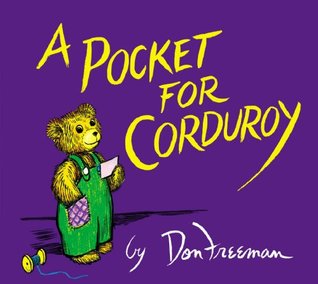
Pocket for Corduroy

Pocket for Corduroy. Don Freeman. 1978. 32 pages. [Source: Library]

First sentence: Late one summer afternoon Lisa and her mother took their laundry to the laundromat. As always on such trip Lisa carried along her toy bear, Corduroy.

Premise/plot: Corduroy is "lost" at the laundromat when he leaves the chair Lisa placed him in, and goes off in search of something to make a pocket out of. Fortunately, he is not washed OR dried. Though his overalls do come off! Corduroy has a unique way of seeing the world--and his take on laundry baskets and soap flakes is interesting. Will he get a pocket at last?

My thoughts: I never knew about this one until I was searching for books published in 1978. I really enjoyed it overall. Lisa has a special bond with her best friend, and, she always understands exactly what he wants or needs. It must be nice to be Corduroy!!!

Text: 4 out of 5
Illustrations: 4 out of 5
Total: 8 out of 10

© 2017 Becky Laney of Becky's Book Reviews

Wednesday, April 26, 2017

Kolyma Tales

Kolyma Tales. Varlam Shalamov. Translated by John Glad. 1978/1994. 508 pages. [Source: Library]

First sentence: How is a road beaten down through the virgin snow? One person walks ahead, sweating, swearing, and barely moving his feet.

Premise/plot: Kolyma Tales is a collection of short stories and essays; what these short stories and essays have in common is a shared setting--Kolyma, a forced-labor camp in the Soviet Union. The stories are not connected to one another; there are no main characters. Some stories are long; some stories are short. All of them are bleak though perhaps some are bleaker than others. The style throughout is matter of fact, almost like there's no extra emotion to spare to dress up the stories. The edition I read has five sections: "Kolyma Tales," "The Left Bank," "The Virtuoso Shovelman," "Essays on the Criminal World," "Resurrection of the Larch."

My thoughts: I wanted to love this one, or at the very least really like it. I almost wish it had been a novel, novella, or memoir. I think I would have connected more with the text if it had not been short stories. Each story was a variation of a theme; each story was the same, yet, not the same. Like no two snowflakes are supposed to be identical, yet snow is snow is snow. There are no words--were no words--for how bad conditions were. Yet here's a whole book of words that makes the attempt.

I am glad I read this one. I don't regret my time by any means. But I would have felt more if they'd been a greater connection. I didn't want to get to know a hundred or two hundred characters a little bit. I wanted to get to know three or four characters really, really well.

Quotes:
Knowing how to live is a real skill. (260)
Death was replaced not by life, but by semi-consciousness, an existence which had no formula and could not be called life. Each day, each sunrise brought with it the danger of some new lurch into death. (285)
Oh, how distant is love from envy, from fear, from bitterness. How little people need love. Love comes only when all other human emotions have already returned. Love comes last, returns last. Or does it return? Indifference, envy, and fear, however, were not the only witnesses of my return to life. Pity for animals returned earlier than pity for people. (287)

© 2017 Becky Laney of Becky's Book Reviews

Saturday, March 11, 2017

Pancakes for Breakfast

Pancakes for Breakfast. Tomie dePaola. 1978. 32 pages. [Source: Library]

Premise/plot: Pancakes for Breakfast is a wordless picture book by Tomie dPaola. (Technically, there are a few words hidden within the illustrations. The recipe for the pancakes. The embroidered phrase on the wall hanging.) A woman wakes up thinking of pancakes. But. It isn't all that simple. She's lacking a few ingredients in her kitchen. Will she get the big stack of pancakes she's been dreaming of?

My thoughts: I really like this one. I like it more than Eric Carle's Pancakes, Pancakes! She has a cat and a dog. And these two add something to the story. It's a cute, fun, "easy to read" story. The illustrations are very straight-forward.

Text: 0 out of 0
Illustrations: 5 out of 5
Total: 5 out of 5

© 2017 Becky Laney of Becky's Book Reviews

Saturday, February 25, 2017

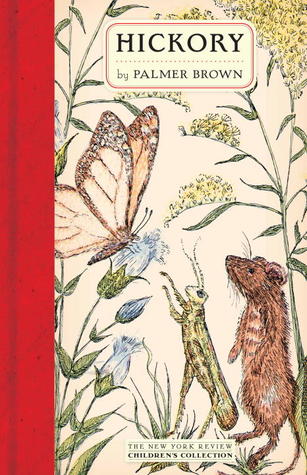
Hickory

Hickory. Palmer Brown. 1978. 42 pages. [Source: Bought]

First sentence: Halfway up the stairs of an old farmhouse, on the broad landing, bright with rose-patterned carpet, stood a tall grandfather clock, ticking time away.

Premise/plot: Hickory, a mouse, leaves his comfortable existence (in a clock in a house) and his family behind as he ventures to move outside into the country side following the example of the field mice. He becomes quite chummy with a grasshopper, Hop, as he makes a new life for himself. But life is fleeting, even more fleeting than he thought. Hop embraces life--every moment of it--fully aware that she'll not survive past summer. Hickory and Hop don't want to see summer come to an end--and set out on a quest to save her life by heading south.

My thoughts: Hickory is not cutesy animal fantasy. It isn't. This early chapter book is sad, bittersweet. The friendship between Hickory and Hop is wonderful to see. But opening the heart to love, to life, to friendship means opening the heart to loss and grief. Hickory will lose Hop. Death is certain and inevitable. How do you live life in face of coming death? How do you make the most of every day? These are heavy topics for an early chapter book. And the book is gentle, I suppose, in dealing with these philosophical questions.

I am so very glad I never read Hickory as a child. I am glad I read it as an adult.

Favorite quotes:
"All stories have their endings in their beginnings, if you know where to look." (10)
"Time is going, never staying, always flowing, ever saying: gone!" (41)

© 2017 Becky Laney of Becky's Book Reviews

Saturday, February 18, 2017

R, My Name Is Rosie

R, My Name is Rosie. Barbara Cohen. 1978. 188 pages. [Source: Book I bought]

First sentence: A rose is a rose is a rose. Rachel said that to me all the time. I didn't know what it meant. It was from some writer. Rachel was always talking about some writer. I tried to keep up, but I wasn't all that interested. Rachel and I are much less alike than she thinks. We care about different things. Her favorite book is Jane Eyre; mine is The Wind in the Willows. But I needed Rachel. There was so much I didn't know.

Premise/plot: R, My Name is Rosie is historical fiction set in either the very late 1940s or very early 1950s. It is definitely a coming of age novel. Rosie's family own an inn. Her mom manages the inn; her dad is dead. She has a brother (Dan) and a sister (Rachel). She's overweight. She doesn't have any friends her own age. She's feeling that different is always a bad thing. Rosie doesn't know exactly how to make her life a happy one, but, she knows one thing: A DOG WOULD HELP A LOT. Her birthday is coming up--as is Christmas. (But the family is Jewish and doesn't celebrate Christmas as a family, just Christmas as a business.) Will she get a dog?!

WARNING. There is a dog on the cover. I repeat a dog on the COVER. Proceed with caution.

My thoughts: Rosie doesn't have any friends her own age, but, the bartender, Tex, at the inn is her friend. The two make up stories together--a fantasy land. Every few chapters, this fantasy story unfolds for readers. So far the two have yet to finish a whole story and get to a happily ever after because one of them always gets bored and wants to start another story. I think these fantasy interludes were my favorite part!!!

One of the guests at the inn has a dog that Rosie sometimes gets to walk. (That's the dog on the cover.) Not much happens in this one in terms of plot. (Rosie goes to school. Rosie gets home from school. Rosie wants to go to a birthday party. Rosie doesn't get to go to a birthday party.) It is definitely character driven.
© 2017 Becky Laney of Becky's Book Reviews

Sunday, January 15, 2017

Rain

Rain. Robert Kalan. Illustrated by Donald Crews. 1978. 32 pages. [Source: Bought]

First sentence: Blue sky. Yellow sun. White clouds. Gray clouds. No sun. Gray sky. Rain.

Premise/plot: Rain is a simple concept book for young children. It's a book about the weather, and, a book about colors. The rain coming down from the gray clouds--the word rain over and over again.

My thoughts: I really like this one. I do. I am most familiar with Donald Crews' Freight Train. And by familiar, I mean essentially have it memorized. This one has a very similar feel. Is it my favorite picture book about rain? Probably not. That would be UMBRELLA by Taro Yashima. But it still works and is worth reading.

Text: 4 out of 5
Illustrations: 3 out of 5
Total: 7 out of 10

© 2017 Becky Laney of Becky's Book Reviews

Sunday, January 08, 2017

Freight Train

Freight Train. Donald Crews. 1978. 26 pages. [Source: Borrowed]

First sentence: A train runs across this track. Red caboose at the back. Orange tank car next. Yellow hopper car.

Premise/plot: Freight Train is a concept book teaching colors, a train-themed concept book teaching colors. It received a Caldecott Honor in 1979, I believe. If I had to guess the most memorized picture book ever, I bet it would be Freight Train or Goodnight Moon. What do you think it would be?

My thoughts: What's not to love about this children's classic? It wasn't the first train book, it certainly won't be the last. What is it about kids and trains?!

Text: 4 out of 5
Illustrations: 4 out of 5
Total: 8 out of 10

© 2017 Becky Laney of Becky's Book Reviews

Sunday, September 25, 2016

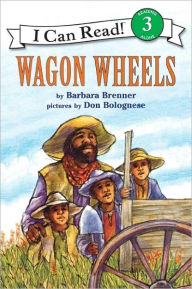
Wagon Wheels

Wagon Wheels. Barbara Brenner. Illustrated by Don Bolognese. 1978. HarperCollins. 64 pages. [Source: Bought]

First sentence: "There it is, boys" Daddy said. "Across this river is Nicodemus, Kansas. That is where we are going to build our house. There is free land for everyone here in the West. All we have to do is go and get it."

Premise/plot: Wagon Wheels is an early chapter book based on a true story. Set in the late 1870s, the book follows the adventures of the Muldie family as they settle in Kansas. First the family settles in Nicodemus, Kansas, a black community. Then the father leaves the boys behind and searches for a better place to settle down and call home, this time near Solomon City. The boys--all on their own--travel to rejoin their father. (The father disliked the flat land and missed trees and hills.)

The book is narrated by Johnny, one of four boys being raised by a widower. The text is simple, and the action is straight-forward. Though simple, it was packed with just the right amount of detail. This book is much, much shorter than any of the Little House books, but, it is just as vivid.

My thoughts: I really liked this one. The edition I picked up is all black-and-white illustrations. I could not tell based on the cover alone that it was a black pioneer family. So I was very pleasantly surprised when I started reading the text to find some diversity. The family--and the community--are saved from starvation by the generosity of Indians--Osage, I believe. Unlike the Little House books, the Indians are portrayed positively. Yes, they are referred to as "Indians" but not savages or redskins or the like.

© 2016 Becky Laney of Becky's Book Reviews

Tuesday, June 07, 2016

Frog and Toad All Year

Frog and Toad All Year. An I Can Read Book. Arnold Lobel. 1976. HarperCollins. 64 pages. [Source: Library]

Frog knocked at Toad's door. "Toad, wake up," he cried. "Come out and see how wonderful the winter is!" "I will not," said Toad. "I am in my warm bed." "Winter is beautiful," said Frog. "Come out and have fun." "Blah," said Toad. "I do not have any winter clothes." Frog came into the house. "I have brought you some things to wear," he said. Frog pushed a coat down over the top of Toad. Frog pulled snowpants up over the bottom of Toad. He put a hat and scarf on Toad's head. "Help!" cried Toad. "My best friend is trying to kill me!" "I am only getting you ready for winter," said Frog.


I love Frog and Toad. I do. Do you?! Are you more like Toad or Frog?! This collection includes five stories--all season-themed stories--"Down the Hill," "The Corner," "Ice Cream," "The Surprise," and "Christmas Eve."

"Down the Hill," the winter-story of the collection, has Frog and Toad out in the snow. Sledding may be fun, Toad admits, but he can't help feeling that BED IS MUCH BETTER!

"The Corner," the spring-story of the collection, has Frog sharing words of wisdom from his father. Something about how spring is around the corner. This made the young Frog curious because which corner is spring around?! So he sets out to find it!

"Ice Cream," the summer-story of the collection, has Toad bringing his best friend some ice cream. But the trip back to Frog, back to the pond, doesn't go according to plan! And ice cream can be a bit messy and sticky. Will these two friends be able to enjoy some delicious ice cream?!

"The Surprise" the autumn-story of the collection, has Frog and Toad 'surprising' each other. Toad rushes to Frog's house to rake his leaves. Frog rushes to Toad's house to rake his leaves. But the wind may have the last laugh! Good thing these friends will never know!

"Christmas Eve" is a holiday story of course! Frog was supposed to come to Toad's house for a big dinner. But. Frog is late. Toad begins to worry and worry and worry. Where is his friend?! Where could he be?! Did something happen to him?! Does Frog need to be saved?! Frog arrives finally with present in hand. He was late because he was wrapping Toad's present. A peaceful Christmas is theirs at last.

I enjoyed this collection. While it isn't quite as magical as Frog and Toad Together, I would still recommend it!

© 2016 Becky Laney of Becky's Book Reviews

Saturday, October 17, 2015

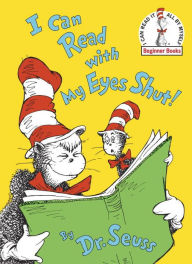
Seuss on Saturday #42

I Can Read With My Eyes Shut. Dr. Seuss. 1978. Random House. 48 pages. [Source: Library]

First sentence: I can read in red. I can read in blue. I can read in pickle color too. 

Premise/plot: The Cat in the Hat is back in Dr. Seuss' I Can Read With My Eyes Shut. In this one, he's showing off--classic Cat style--about how great a reader he is.

My thoughts: I enjoy this one very much. I do agree that "you have to be a speedy reader 'cause there's so, so much to read." With such fun and silly phrases as: "You can read about anchors. And all about ants. You can read about ankles! And crocodile pants!" this one is just a delight.

 Have you read I Can Read With My Eyes Shut? Did you like it? love it? hate it? I'd love to know what you thought of it!

If you'd like to join me in reading or rereading Dr. Seuss (chronologically) I'd love to have you join me! The next book I'll be reviewing is Oh Say Can You Say?  

© 2015 Becky Laney of Becky's Book Reviews
Friday, June 26, 2015

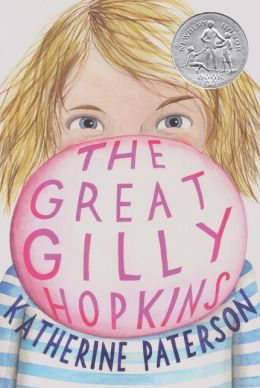
The Great Gilly Hopkins (1978)

The Great Gilly Hopkins. Katherine Paterson. 1978. 256 pages. [Source: Bought]

"Gilly," said Miss Ellis with a shake of her long blonde hair toward the passenger in the back seat. "I need to feel that you are willing to make some effort."

Galadriel Hopkins is the narrator of The Great Gilly Hopkins. What's she like? Angry, sarcastic, bitter, reluctant to make connections. Gilly is a foster kid. She's been in plenty of different foster homes for most of her life. Some slightly better than others. But none of them ever feeling like a real home. To tell the truth, Gilly wouldn't know what to do in a foster home that feels like HOME. For Gilly is clinging tightly to the dream that her mom will come back for her, that her mom loves her very much and actually misses her. When the novel opens, Gilly is getting placed in a new home...

Mrs. Trotter is her new foster mother. She also has another foster kid, William Ernest, in her home. From the very start, I thought Mrs. Trotter was a great character. And I also loved Mr. Randolph, the blind neighbor that comes to the Trotters' house for meals. These two adults were so lovable in comparison to the not-so-lovable Gilly. And the love they show to Gilly is something. I was reminded of hesed love.
"Hesed is one-way love. Love without an exit strategy. When you love with hesed love, you bind yourself to the object of your love, no matter what the response is... Hesed is a stubborn love" ~ Paul Miller, A Loving Life: In A World of Broken Relationships, 24.
Did I love The Great Gilly Hopkins? Not exactly. I liked it. I appreciated it. But I didn't love it.

© 2015 Becky Laney of Becky's Book Reviews

Sunday, June 07, 2015

Meet Professor Moriarty

The Infernal Device. Michael Kurland. 1978. 255 pages. [Source: Library]

I'm caught up on watching Sherlock, but, far from caught up on reading Sherlock--original Sherlock especially. Still when I saw that Moriarty had his own series, well, I had to check it out from the library. In The Infernal Device readers meet Professor Moriarty and his journalist employee, Barnett. (Moriarty having recently "rescued" Barnett from an Eastern prison and certain death--he was framed for murder--he's in Moriarty's debt--or employ--for two years.) How does Barnett like Professor James Moriarty? He admires him, respects him, enjoys his company. Does Barnett see the "real" Moriarty? Or is Moriarty keeping his darker side from his new friend and employee? Certainly Moriarty is aware that there are a handful of people--namely Sherlock Holmes--who thinks Moriarty is pure evil. But convinced, Barnett is not! Holmes does make a handful of appearances in this one. In fact, to solve the mystery, they may have to join together temporarily to save the monarchy.

Readers spend time with both men as the mystery unfolds. The Infernal Device is a mystery with plenty of politics and action.  Did I love it? Well, if I didn't love, love, love it, I certainly LIKED it well enough. 

Death by Gaslight. Michael Kurland. 1982. 279 pages. [Source: Library]

I also enjoyed reading the second in the series, Death by Gaslight. While I didn't rush through it like I did Infernal Device, I found it mostly compelling. It is set two years after The Infernal Device. Barnett has finished--just finished--his "required" time working for him, but, he has no thoughts of leaving Moriarty's service. He's enjoying himself much too much. Life is rarely boring, and, he's even had time to fall in love...

Can Moriarty catch a serial killer? Someone is killing aristocratic gentleman--in their homes, in locked rooms. With only a few clues, can he solve the mystery, find the killer, and see that justice is done? Can he do a better job than the police? a better job than Sherlock Holmes? Perhaps. Especially since Holmes spends nearly the entire book absolutely convinced that Moriarty is behind each and every murder.

I enjoyed this one too. I look forward to reading more books in this series at some point.

© 2015 Becky Laney of Becky's Book Reviews

Wednesday, February 26, 2014

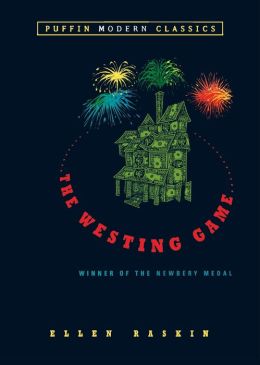
The Westing Game (1978)

The Westing Game. Ellen Raskin. 1978. 182 pages. [Source: Library]

Characters matter more to me than plot most of the time, which is why I probably found The Westing Game a disappointment. I thought the book lacked characterization. Superficial characterization abounded: readers learned at least two or three facts per person. But did any one character EVER reach the point of humanity? In my opinion, not really. The characters that probably came closest were Angela (the reluctant bride whose wedding shower was bombed), and Turtle (the one who connected the dots that no one else was even looking for). So this is a plot-driven book, the focus being on sixteen (or so) people working together or against each other as the case may be to solve the mystery of who murdered Sam Westing. There are eight teams of two people each. Each team is given $10,000 and a handful of word-clues. The clues are a mix of letters, words, and numbers. On the one hand, if they work together and share resources, the inheritance might be won. But. If they do that, then the inheritance would be divided up. The book, I admit, has more than enough plot twists. At the end while I wasn't exactly overwhelmed or confused, I was still left saying WHY and HOW?! The book just did not make any sense to me. The rushed epilogue-of-sorts didn't help me make peace with it either.

© 2014 Becky Laney of Becky's Book Reviews