From an Idea to Disney: How Branding Made Disney a Household Name. Lowey Bundy Sichol. 2019. Houghton Mifflin Harcourt. 112 pages. [Source: Review copy]
First sentence: When you think of Disney, you probably think of Mickey Mouse.
Premise/plot: From An Idea to Disney is one of the books in a new business series published by HMH. (Other titles include From an Idea to LEGO, From an Idea to Nike, From an Idea to Google). This 'biography' of Walt Disney is focused primarily on his career, his company. In fact, almost half of the book focuses on the Disney company/brand after the deaths of Walt and Roy Disney. It covers the highs and lows of Disney. It documents his persistence. Success did not come easy. There were many times when it might have made sense to quit and try something else. Disney kept trying and kept dreaming big.
My thoughts: I enjoyed this one. I didn't ever think of there being a lack of books about business and economics for this age group--elementary students--until I started reading this series. It is nice to see a different twist on the biographical genre. I found it informational. All the books in the series have black and white illustrations.
© 2019 Becky Laney of Becky's Book Reviews
Showing posts with label Houghton Mifflin Harcourt. Show all posts
Thursday, June 27, 2019
Monday, June 17, 2019
From An Idea to LEGO
From An Idea to LEGO: The Building Bricks Behind the World's Largest Toy Company. Lowey Bundy Sichol. 2019. Houghton Mifflin Harcourt. 128 pages. [Source: Review copy]
First sentence from chapter one: Ole (pronounced OH-lay) Kirk Christiansen was born on April 7, 1891, in the small village of Filskov, Denmark.
Premise/plot: This nonfiction book provides young readers with a behind-the-scenes look at LEGO. The LEGO story begins as a very human story--the story of a carpenter and his sons. He didn't set out to make and sell toys--especially not plastic toys, after all he was a carpenter. As for one day being the world's largest toy company--I imagine he'd laugh and cry. The story is packed with details.
My thoughts: Nonfiction can be so fascinating. I really enjoyed this one and would recommend it to just about anyone and everyone. I was familiar with much of the story told within the book. Having watched the LEGO Story movie a couple dozen of times when it first came out. There were still plenty of things I learned from this book.
But this book goes beyond that simple story of how it came to be. It also includes plenty of informational text that focuses on business and economics.
© 2019 Becky Laney of Becky's Book Reviews
First sentence from chapter one: Ole (pronounced OH-lay) Kirk Christiansen was born on April 7, 1891, in the small village of Filskov, Denmark.
Premise/plot: This nonfiction book provides young readers with a behind-the-scenes look at LEGO. The LEGO story begins as a very human story--the story of a carpenter and his sons. He didn't set out to make and sell toys--especially not plastic toys, after all he was a carpenter. As for one day being the world's largest toy company--I imagine he'd laugh and cry. The story is packed with details.
My thoughts: Nonfiction can be so fascinating. I really enjoyed this one and would recommend it to just about anyone and everyone. I was familiar with much of the story told within the book. Having watched the LEGO Story movie a couple dozen of times when it first came out. There were still plenty of things I learned from this book.
But this book goes beyond that simple story of how it came to be. It also includes plenty of informational text that focuses on business and economics.
© 2019 Becky Laney of Becky's Book Reviews
Monday, June 10, 2019
Before They Were Authors
Before They Were Authors: Famous Writers as Kids. Elizabeth Haidle. 2019. Houghton Mifflin Harcourt. 64 pages. [Source: Review copy]
First sentence: What makes a writer? Many of us wonder about the stories behind the stories of best selling authors...
Premise/plot: What do you call a nonfiction book that uses the graphic novel format?! This one is nonfiction. It includes brief biographies of ten--yes, ten--writers. (5 Men. 5 Women.) The writers included are Mark Twain, Maya Angelou, Dr. Seuss, Sandra Cisneros, Roald Dahl, J.K. Rowling, Gene Luen Yang, Beatrix Potter, C.S. Lewis, and Madeleine L'Engle. Some of these writers wrote for children--toddlers, preschoolers, grade school students; some of these writers wrote for young adults or even adults.
Each author biography is told over several pages. As I mentioned earlier, it uses the graphic novel/comic book format to tell the stories. Sprinkled throughout the biographies are quotes from the writers.
My thoughts: I love the idea of loving this one. I do. The truth is very few readers are going to agree on which ten authors "should" be included in the book. There are no right answers here. Some seem obvious to me--Dr. Seuss, for example or even J.K. Rowling. There is one "omission" that saddens me. I would have LOVED, LOVED, LOVED to see Beverly Cleary included here. Her story is surely just as interesting as Beatrix Potter's?! Another "omission" that comes to mind is L.M. Montgomery. Also Mo Willems. And Shannon Hale.
Are these ten authors personal favorites of mine? Not really. That's okay. The subtitle isn't Becky's Favorite Writers As Kids.
© 2019 Becky Laney of Becky's Book Reviews
First sentence: What makes a writer? Many of us wonder about the stories behind the stories of best selling authors...
Premise/plot: What do you call a nonfiction book that uses the graphic novel format?! This one is nonfiction. It includes brief biographies of ten--yes, ten--writers. (5 Men. 5 Women.) The writers included are Mark Twain, Maya Angelou, Dr. Seuss, Sandra Cisneros, Roald Dahl, J.K. Rowling, Gene Luen Yang, Beatrix Potter, C.S. Lewis, and Madeleine L'Engle. Some of these writers wrote for children--toddlers, preschoolers, grade school students; some of these writers wrote for young adults or even adults.
Each author biography is told over several pages. As I mentioned earlier, it uses the graphic novel/comic book format to tell the stories. Sprinkled throughout the biographies are quotes from the writers.
My thoughts: I love the idea of loving this one. I do. The truth is very few readers are going to agree on which ten authors "should" be included in the book. There are no right answers here. Some seem obvious to me--Dr. Seuss, for example or even J.K. Rowling. There is one "omission" that saddens me. I would have LOVED, LOVED, LOVED to see Beverly Cleary included here. Her story is surely just as interesting as Beatrix Potter's?! Another "omission" that comes to mind is L.M. Montgomery. Also Mo Willems. And Shannon Hale.
Are these ten authors personal favorites of mine? Not really. That's okay. The subtitle isn't Becky's Favorite Writers As Kids.
© 2019 Becky Laney of Becky's Book Reviews
Tuesday, April 09, 2019
Searching for Dragons
Searching for Dragons. (Enchanted Forest Chronicles #2) Patricia C. Wrede. 1991/2015. Houghton Mifflin Harcourt. 239 pages. [Source: Review copy]
First sentence: The King of the Enchanted Forest was twenty years old and lived in a rambling, scrambling, mixed-up castle somewhere near the center of his domain.
Premise/plot: Mendanbar is the King of the Enchanted Forest. The Enchanted Forest is experiencing some difficulties--but is it due to wizards or dragons? Mendanbar sets out to investigate the situation which leads him to meeting some of the characters first introduced in Dealing with Dragons--Morwen, the witch, and Cimorene, the dragon's princess. Though Mendanbar had sworn that he would never, ever, ever, ever fall in love with a princess--not really, but close--he can't help being wowed by Cimorene, and not just by her beauty. The two set out on quite an adventure to right some wrongs. They make new friends along the way, of course, including a dwarf named Herman and a magician named Telemain.
My thoughts: If you enjoyed the first adventure, then the second adventure will not disappoint. I will say this--it does not feature dragons as much as the first book. So if love of dragons was your one and only reason for loving the first book, then perhaps this one will not be quite as enjoyable. But there are so many new characters introduced that are just FUN and CLEVER. Plus Cimorene's story advances. She may not be the main character, but without her the story would be going nowhere.
I love the story. I love the characters. I love the writing.
Quotes:
© 2019 Becky Laney of Becky's Book Reviews
First sentence: The King of the Enchanted Forest was twenty years old and lived in a rambling, scrambling, mixed-up castle somewhere near the center of his domain.
Premise/plot: Mendanbar is the King of the Enchanted Forest. The Enchanted Forest is experiencing some difficulties--but is it due to wizards or dragons? Mendanbar sets out to investigate the situation which leads him to meeting some of the characters first introduced in Dealing with Dragons--Morwen, the witch, and Cimorene, the dragon's princess. Though Mendanbar had sworn that he would never, ever, ever, ever fall in love with a princess--not really, but close--he can't help being wowed by Cimorene, and not just by her beauty. The two set out on quite an adventure to right some wrongs. They make new friends along the way, of course, including a dwarf named Herman and a magician named Telemain.
My thoughts: If you enjoyed the first adventure, then the second adventure will not disappoint. I will say this--it does not feature dragons as much as the first book. So if love of dragons was your one and only reason for loving the first book, then perhaps this one will not be quite as enjoyable. But there are so many new characters introduced that are just FUN and CLEVER. Plus Cimorene's story advances. She may not be the main character, but without her the story would be going nowhere.
I love the story. I love the characters. I love the writing.
Quotes:
"Ordinary" was not the right word for anyone who lived in the Enchanted Forest, not if they managed to stay alive and in more or less their proper shape. (23)
He had never thought of himself as one of the hazards of the Enchanted Forest that someone might wish to be prepared for, and he did not like the idea much, now that it had been pointed out to him. (30)
As Mendanbar drew nearer, he saw a tarnished brass handle sticking out of a small hole beside the cave. The handle was level with his waist, and next to it was a sign that read: "WELCOME TO THE CAVE OF THE DRAGON KING. Pull handle to ring bell." On the line below, someone had added in neat letters printed in bright red paint, "ABSOLUTELY NO wizards, salespeople, or rescuers. This means YOU."
Mendanbar stared at the sign for a minute and began to smile. No wonder Zemenar didn't like Kazul's princess. Well, he wasn't a wizard, he wasn't selling anything, and he certainly didn't want to rescue anybody. He gave the handle a pull. (59)
"I think I'm beginning to get the idea," Cimorene said. "It's not just spinning straw into gold that's a family tradition, is it? It's the whole scheme." The dwarf nodded sadly. "Right the first time. Only I can never make it work properly. I can find plenty of girls who're supposed to spin straw into gold, and most of them suggest the guessing game, but I've never had even one who managed to guess my name. "Oh, dear," said Cimorene. "I even changed my name legally, so it would be easier," the dwarf said sadly. "Herman isn't a difficult name to remember, is it? But no, the silly chits can't do it. So I end up with the baby as well as the gold, and babies eat and cry and need clothes and the gold runs out, and I have to find another girl to spin gold for, and it happens all over again, and I end up with another baby. It isn't fair!" (117)
© 2019 Becky Laney of Becky's Book Reviews
Friday, April 05, 2019
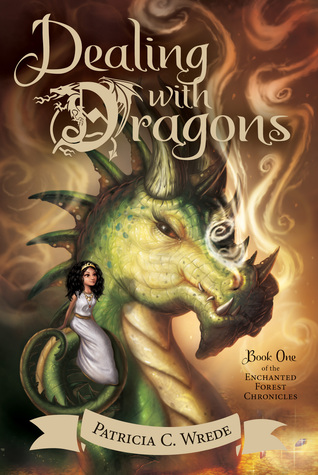
Dealing with Dragons
Dealing with Dragons. (Enchanted Forest Chronicles #1) Patricia C. Wrede. 1990/2015. 208 pages. [Source: Review copy]
First sentence: Linderwall was a large kingdom, just east of the Mountains of Morning, where philosophers were highly respected and the number five was fashionable. The climate was unremarkable. The knights kept their armor brightly polished mainly for show--it had been centuries since a dragon had come east. There were the usual periodic problems with royal children and uninvited fairy godmothers, but they were always the sort of thing that could be cleared up by finding the proper prince or princess to marry the unfortunate child a few years later. All in all, Linderwall was a very prosperous and pleasant place.
Cimorene hated it.
Premise/plot: Cimorene is the heroine of Patricia Wrede's Dealing with Dragons. Her parents have definite ideas and opinions on what is and is not proper for a princess. Anything--everything--that Cimorene wants to do is improper. At least it feels that way to her. No fencing. No learning magic. No cooking. To name just three. A bit exasperated the King and Queen decide that it's time for Cimorene to marry--she's just sixteen. Their choice for her is a dashingly handsome prince. But Cimorene will have none of him. But is she willing to do more than talk about rebelling? Is she brave enough to actually run away? If she wasn't, this would be a VERY SHORT book, right?!
So dragons. This book has them! Cimorene's scheme to avoid an unwanted marriage is to offer herself voluntarily to the dragons. Snobby dragons love to have their own princess to hold captive, right?! Right! Cimorene is NOT eaten--again that would be a VERY SHORT book--one dragon has mercy on her: Kazul.
Adventure abounds in this one: it has princesses, princes, wizards, witches, knights, and DRAGONS.
My thoughts: I loved, loved, loved this one. Doesn't it have a wonderful opening paragraph?! By the time I read the sentence "Cimorene hated it" I knew I would love it. Isn't it interesting how some books just have a way of HOOKING you?! Needless to say, I read this one in one sitting. It was enjoyable, satisfying, delightful, funny.
I really loved the characters. Cimorene is a GREAT heroine. And I loved, loved, loved Kazul!
© 2019 Becky Laney of Becky's Book Reviews
First sentence: Linderwall was a large kingdom, just east of the Mountains of Morning, where philosophers were highly respected and the number five was fashionable. The climate was unremarkable. The knights kept their armor brightly polished mainly for show--it had been centuries since a dragon had come east. There were the usual periodic problems with royal children and uninvited fairy godmothers, but they were always the sort of thing that could be cleared up by finding the proper prince or princess to marry the unfortunate child a few years later. All in all, Linderwall was a very prosperous and pleasant place.
Cimorene hated it.
Premise/plot: Cimorene is the heroine of Patricia Wrede's Dealing with Dragons. Her parents have definite ideas and opinions on what is and is not proper for a princess. Anything--everything--that Cimorene wants to do is improper. At least it feels that way to her. No fencing. No learning magic. No cooking. To name just three. A bit exasperated the King and Queen decide that it's time for Cimorene to marry--she's just sixteen. Their choice for her is a dashingly handsome prince. But Cimorene will have none of him. But is she willing to do more than talk about rebelling? Is she brave enough to actually run away? If she wasn't, this would be a VERY SHORT book, right?!
So dragons. This book has them! Cimorene's scheme to avoid an unwanted marriage is to offer herself voluntarily to the dragons. Snobby dragons love to have their own princess to hold captive, right?! Right! Cimorene is NOT eaten--again that would be a VERY SHORT book--one dragon has mercy on her: Kazul.
Adventure abounds in this one: it has princesses, princes, wizards, witches, knights, and DRAGONS.
My thoughts: I loved, loved, loved this one. Doesn't it have a wonderful opening paragraph?! By the time I read the sentence "Cimorene hated it" I knew I would love it. Isn't it interesting how some books just have a way of HOOKING you?! Needless to say, I read this one in one sitting. It was enjoyable, satisfying, delightful, funny.
I really loved the characters. Cimorene is a GREAT heroine. And I loved, loved, loved Kazul!
"Speaking of dragons, where's yours?"
"Kazul's not my dragon," Cimorene said sharply.
"I'm her princess. You'll never have any luck dealing with dragons if you don't get these things straight. She's gone to the Enchanted Forest on the other side of the mountains to borrow a crepe pan from a witch she knows."
"She's what?" said the knight.
"She's gone to borrow a crepe pan," Cimorene repeated in a louder voice. "Perhaps you'd better have your helmet checked when you get back. They're not supposed to interfere with your hearing, but sometimes--" (26-7)
© 2019 Becky Laney of Becky's Book Reviews
Tuesday, April 02, 2019
The Wagon Train Trek (Oregon Trail #6)
The Oregon Trail: The Wagon Train Trek. Jesse Wiley. 2019. Houghton Mifflin Harcourt. 176 pages. [Source: Review copy]First sentence: It's 1855, and you and your family are headed west to Oregon City to start a new life. Your pa is a doctor--and the leader of your wagon train. You're getting older now, so it's your responsibility to help Pa and Ma, along with your two Newfoundland dogs. You will lead your team of six wagons from Independence, Missouri, all the way to Oregon City. Pa is eager to join a practice there, and you're excited for a new home, wide open spaces, and the journey ahead.
Premise/plot: The Wagon Train Trek is a stand-alone novel in the Choose Your Own Adventure tradition. This one--like the five that came before it--is inspired by the video game, The Oregon Trail. There are twenty-three possible endings, but only one ending that sees you and your family safely arriving in Oregon City. Not every "bad" ending ends in DEATH, but many do.
My thoughts: How do YOU read a Choose Your Own Adventure novel? Do you read ALL the possible endings? Or do you focus on getting the one HAPPY ending?
I read with a pen and paper nearby. I mark all the decisions and their results. I want to make sure that I read all twenty-three endings.
These books are so much fun!
© 2019 Becky Laney of Becky's Book Reviews
Friday, March 08, 2019
Voices: The Final Hours of Joan of Arc
Voices: The Final Hours of Joan of Arc. David Elliott. 2019. Houghton Mifflin Harcourt. 208 pages. [Source: Review copy]
First sentence: I recall it as if it were yesterday.
Premise/plot: Voices is a verse novel starring Joan of Arc. Many of the poems are from Joan's point of view. But many are not. Those that are not almost steal the show--for better or worse. One perspective that we repeatedly hear from is FIRE. We also hear from a candle, a tree, a needle, cows, her virginity, a road, a sword, a dress, a tunic, her hair, an altar, her armor, an arrow, a pitchfork, a warhorse, a crossbow, etc. Sprinkled throughout are excerpts from the Trial of Condemnation and the Trial of Nullification.
My thoughts: My interest in Joan of Arc started with a super-catchy song from Horrible Histories. I've read a few books on her since then. This one is interesting if not a little too abstract. Some of the more abstract poems do use poetic forms from the middle ages. (Some of the human poems also use medieval forms.) So from a literary point of view--and not necessarily a reader's point of view--the book is fascinating.
I liked this one well enough. I wish we'd heard more from humans and less from objects and abstract concepts--virginity and victory to name just two. But I did really enjoy some of the poems. One of my favorites was a shape poem from a needle's point of view. The poem I liked least was 'The Sword' which was all about her holding "my manly parts."
© 2019 Becky Laney of Becky's Book Reviews
First sentence: I recall it as if it were yesterday.
Premise/plot: Voices is a verse novel starring Joan of Arc. Many of the poems are from Joan's point of view. But many are not. Those that are not almost steal the show--for better or worse. One perspective that we repeatedly hear from is FIRE. We also hear from a candle, a tree, a needle, cows, her virginity, a road, a sword, a dress, a tunic, her hair, an altar, her armor, an arrow, a pitchfork, a warhorse, a crossbow, etc. Sprinkled throughout are excerpts from the Trial of Condemnation and the Trial of Nullification.
My thoughts: My interest in Joan of Arc started with a super-catchy song from Horrible Histories. I've read a few books on her since then. This one is interesting if not a little too abstract. Some of the more abstract poems do use poetic forms from the middle ages. (Some of the human poems also use medieval forms.) So from a literary point of view--and not necessarily a reader's point of view--the book is fascinating.
I liked this one well enough. I wish we'd heard more from humans and less from objects and abstract concepts--virginity and victory to name just two. But I did really enjoy some of the poems. One of my favorites was a shape poem from a needle's point of view. The poem I liked least was 'The Sword' which was all about her holding "my manly parts."
© 2019 Becky Laney of Becky's Book Reviews
Thursday, January 24, 2019
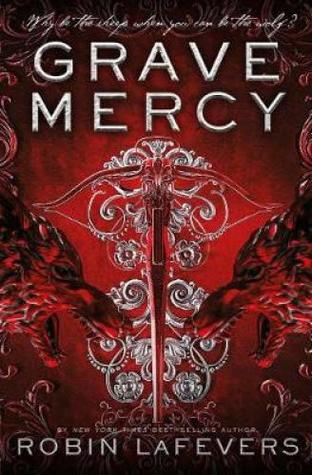
Grave Mercy
Grave Mercy. Robin LaFevers. 2012/2019. Houghton Mifflin Harcourt. 560 pages. [Source: Review copy]
First sentence:
While we do see her first few jobs carried out, most of the novel focuses on one job in particular. The abbess wants her to team up with Duval, the Duchess' older (half) brother and her most trusted friend and advisor. She's to pose as his mistress, and travel with him to the Duchess' household. There she will "help him" find any possible traitors. He doesn't exactly trust her; he knows exactly what she's capable of, and who she serves. He knows that if given orders, she'd kill him to please her Lord. She doesn't exactly trust him either. Though the marque hasn't appeared on him yet--the special sign or symbol that she sees on her victims before they're killed--she knows that he could be lying to her, that his loyalty to the Duchess could be an act. But both know that it is of the utmost importance to protect the Duchess, and to find any traitors and uncover any conspiracies, if that means working together, so be it. Of course, this means spending a LOT of time with one another...
...the time will come when Ismae must choose who to trust and who to believe...
Politics. Romance. Drama. Dysfunctional Families. Poison. Murder. Betrayal. Mystery. Suspense.
It is set in Brittany in the late 1480s. You can read more about the time period in which this historical novel is set. One of the central characters is Anne of Brittany. Some might feel it is heavy on politics, but, I enjoyed the politics and the tension.
My thoughts: This is my FOURTH time to read Grave Mercy. I love, love, love this one. There is now a fourth book in the series. The first three books have been reissued with new covers in paperback. I plan on rereading all three books before tackling the new book. I am SO excited to reread these. Of course I am looking forward to the newest book as well.
This one probably won't please every reader. Some may not be able to get past the premise of old or ancient religions continuing to exist under the guise of Christianity. And this one isn't squeaky clean. For those that have no tolerance whatsoever when it comes to sensuality. (I would consider it mild up until the very end when their relationship changes.) But. For those that can, well, this is one COMPELLING read. My favorite character happens to be Duval. I just LOVED him. I did. He was such a swoon-worthy hero!!! And our heroine, Ismae, is quite strong and resourceful. I loved the drama. I loved the history. I loved seeing the court life and family drama play out. I enjoyed the setting, the characters, the writing. It worked really well for me.
Quotes:
© 2019 Becky Laney of Becky's Book Reviews
First sentence:
Premise/plot: I have two words for you: assassin nuns. Of course, our heroine, Ismae isn't a nun in the Catholic church. No, she's in a special nunnery, the nuns live to serve Death whom they call St. Mortain, and she's received very special training. They've taught her to kill, to be an assassin. The nuns are loyal to the Duchess of Brittany, and the victims are often her political enemies--foreign or domestic--those that pose the greatest threat to Brittany's independence.Brittany 1485I bear a deep red stain that runs from my left shoulder down to my right hip, a trail left by the herbwitch’s poison that my mother used to try to expel me from her womb. That I survived, according to the herbwitch, is no miracle but a sign I have been sired by the god of death himself.I am told my father flew into a rage and raised his hand to my mother even as she lay weak and bleeding on the birthing bed. Until the herbwitch pointed out to him that if my mother had lain with the god of death, surely He would not stand idly by while my father beat her.I risk a glance up at my husband-to-be, Guillo, and wonder if my father has told him of my lineage. I am guessing not, for who would pay three silver coins for what I am? Besides, Guillo looks far too placid to know of my true nature. If my father has tricked him, it will not bode well for our union. That we are being married in Guillo’s cottage rather than a church further adds to my unease.I feel my father’s heavy gaze upon me and look up. The triumph in his eyes frightens me, for if he has triumphed, then I have surely lost in some way I do not yet understand. Even so, I smile, wanting to convince him I am happy—for there is nothing that upsets him more than my happiness.
While we do see her first few jobs carried out, most of the novel focuses on one job in particular. The abbess wants her to team up with Duval, the Duchess' older (half) brother and her most trusted friend and advisor. She's to pose as his mistress, and travel with him to the Duchess' household. There she will "help him" find any possible traitors. He doesn't exactly trust her; he knows exactly what she's capable of, and who she serves. He knows that if given orders, she'd kill him to please her Lord. She doesn't exactly trust him either. Though the marque hasn't appeared on him yet--the special sign or symbol that she sees on her victims before they're killed--she knows that he could be lying to her, that his loyalty to the Duchess could be an act. But both know that it is of the utmost importance to protect the Duchess, and to find any traitors and uncover any conspiracies, if that means working together, so be it. Of course, this means spending a LOT of time with one another...
...the time will come when Ismae must choose who to trust and who to believe...
Politics. Romance. Drama. Dysfunctional Families. Poison. Murder. Betrayal. Mystery. Suspense.
It is set in Brittany in the late 1480s. You can read more about the time period in which this historical novel is set. One of the central characters is Anne of Brittany. Some might feel it is heavy on politics, but, I enjoyed the politics and the tension.
My thoughts: This is my FOURTH time to read Grave Mercy. I love, love, love this one. There is now a fourth book in the series. The first three books have been reissued with new covers in paperback. I plan on rereading all three books before tackling the new book. I am SO excited to reread these. Of course I am looking forward to the newest book as well.
This one probably won't please every reader. Some may not be able to get past the premise of old or ancient religions continuing to exist under the guise of Christianity. And this one isn't squeaky clean. For those that have no tolerance whatsoever when it comes to sensuality. (I would consider it mild up until the very end when their relationship changes.) But. For those that can, well, this is one COMPELLING read. My favorite character happens to be Duval. I just LOVED him. I did. He was such a swoon-worthy hero!!! And our heroine, Ismae, is quite strong and resourceful. I loved the drama. I loved the history. I loved seeing the court life and family drama play out. I enjoyed the setting, the characters, the writing. It worked really well for me.
Quotes:
"Are you drunk?" I try to put as much scorn into my words as he did.
"No. Yes. Perhaps a little. Definitely not enough." The bleakness is back and he turns to stare into the flames.
I am torn between wanting to leave him to wallow in his despair and wanting to rush to his side and chase that look from his eyes. That I long to do this appalls me, sets panic fluttering against my ribs.
"I suggest you return to your room," Duval says, his gaze still fixed woodenly on the fire. "Unless you have come to practice your lessons of seduction on me?" His mouth twists in bitter amusement. "That could well entertain me till sunrise."
I jerk my head back as if I have been slapped. "No, milord. I had thought only to pray for your soul if Madame Hivern had seen fit to poison you. Nothing more." And with that, I turn and flee the room, then bolt the door against the disturbing glimpse of both his soul and mine. Whatever games are being played here, he is master at them, and I will do well to remember that. (155)
"What is my fair assassin so afraid of? I wonder."
"I'm not afraid."
Duval tilts his head to the side. "No?" He studies me a long moment, then rises out of his chair. I hold my breath as he crosses to my bed. "Are you afraid I will draw closer, perhaps?" His voice is pitched low, little more than a purr. My breath catches in my throat, trapped by something I long to call fear but that doesn't feel like fear at all. (174)
His smile flashes, quick and surprising in the darkness. "When one consorts with assassins, one must expect to dance along the edge of a knife once or twice. I bid you good night." (218)
© 2019 Becky Laney of Becky's Book Reviews
Friday, December 21, 2018
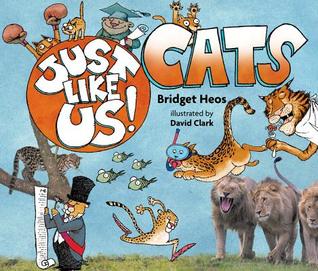
Just Like Us! Cats
Just Like Us! Cats. Bridget Heos. Illustrated by David Clark. 2019. Houghton Mifflin Harcourt. 32 pages. [Source: Review copy]
First sentence: Cats have retractable claws, razor-sharp teeth, and tails for balancing. Humans don't. But in some ways, cats and people are alike.
Premise/plot: Just Like Us! Cats is a nonfiction picture book about cats. You should know, however, this isn't so much focused on house pets as it is wild cats, big cats, prehistoric cats. It is packed with information. Each two-page spread provides one to two paragraphs of insight.
My thoughts: I liked this one. I probably would have enjoyed it more if it featured photographs instead of cartoon-like illustrations. The text was informative though.
© 2018 Becky Laney of Becky's Book Reviews
First sentence: Cats have retractable claws, razor-sharp teeth, and tails for balancing. Humans don't. But in some ways, cats and people are alike.
Premise/plot: Just Like Us! Cats is a nonfiction picture book about cats. You should know, however, this isn't so much focused on house pets as it is wild cats, big cats, prehistoric cats. It is packed with information. Each two-page spread provides one to two paragraphs of insight.
My thoughts: I liked this one. I probably would have enjoyed it more if it featured photographs instead of cartoon-like illustrations. The text was informative though.
© 2018 Becky Laney of Becky's Book Reviews
Thursday, September 20, 2018
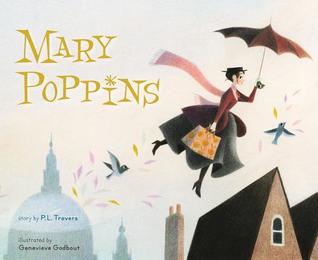
Mary Poppins
Mary Poppins. Based on the novel by P.L. Travers. Adapted by Amy Novesky. Illustrated by Genevieve Godbout. 2018. [October 23, 2018] HMH. 32 pages. [Source: Review copy]
First sentence: If you are looking for Number Seventeen Cherry Tree Lane--and it is likely that you are, for this book is all about this particular house--you'll find it.
Premise/plot: This book is a picture book adaptation of the novel. It is beautifully illustrated by Genevieve Godbout. Amy Novesky, the adapter, has selected a few scenes from the novel to share with young readers. These scenes may or may not be what you expect. (There's no kite-flying, for example. Nor jumping into sidewalk pictures. The match-man is simply the 'match-man' and not BERT.) The children do visit Mr. Wigg and have a tea party on the ceiling, visit a special bakery with gold stars, and visit the zoo at night.
My thoughts: I really enjoyed the illustrations. I thought they were WONDERFUL.
I'm not sure how I feel about the adaptation of the narrative. Perhaps because I've read Mary Poppins several times and I can't imagine leaving out a single scene--or character. Perhaps because it feels a bit rushed.
For example, in this picture book Mary Poppins just shows up. Readers are not told the family was looking for a nanny. There were no advertisements placed. She is just THERE. She moves in without a single person questioning who she is and why she's there. Which brings something else to mind, never once does the picture book mention that this is the BANKS family.
I like the idea of a picture book adaptation. (Though I'd also recommend just reading the original novel aloud to young children. There is something DELIGHTFUL about the novel. Reading novels aloud should be encouraged. One doesn't have to stick with picture books.)
Text: 3 out of 5
Illustrations: 5 out of 5
Total: 8 out of 10
© 2018 Becky Laney of Becky's Book Reviews
First sentence: If you are looking for Number Seventeen Cherry Tree Lane--and it is likely that you are, for this book is all about this particular house--you'll find it.
Premise/plot: This book is a picture book adaptation of the novel. It is beautifully illustrated by Genevieve Godbout. Amy Novesky, the adapter, has selected a few scenes from the novel to share with young readers. These scenes may or may not be what you expect. (There's no kite-flying, for example. Nor jumping into sidewalk pictures. The match-man is simply the 'match-man' and not BERT.) The children do visit Mr. Wigg and have a tea party on the ceiling, visit a special bakery with gold stars, and visit the zoo at night.
My thoughts: I really enjoyed the illustrations. I thought they were WONDERFUL.
I'm not sure how I feel about the adaptation of the narrative. Perhaps because I've read Mary Poppins several times and I can't imagine leaving out a single scene--or character. Perhaps because it feels a bit rushed.
For example, in this picture book Mary Poppins just shows up. Readers are not told the family was looking for a nanny. There were no advertisements placed. She is just THERE. She moves in without a single person questioning who she is and why she's there. Which brings something else to mind, never once does the picture book mention that this is the BANKS family.
I like the idea of a picture book adaptation. (Though I'd also recommend just reading the original novel aloud to young children. There is something DELIGHTFUL about the novel. Reading novels aloud should be encouraged. One doesn't have to stick with picture books.)
Text: 3 out of 5
Illustrations: 5 out of 5
Total: 8 out of 10
© 2018 Becky Laney of Becky's Book Reviews
Friday, September 07, 2018
The Strange True Tale of Frankenstein's Creator Mary Shelley
Mary Shelley: The Strange True Tale of Frankenstein's Creator. Catherine Reef. 2018. Houghton Mifflin Harcourt. 224 pages. [Source: Review copy]
First sentence: Mary Shelley had been dead a year when her son unlocked her portable desk and found the remains of human heart. The heart, he knew, had been his father's. It had rested in the desk for thirty years, unseen and untouched, since the day in 1822 when Mary Shelley tenderly wrapped it in pages of poetry and put it away. Dust and bits of dried-up muscle were all that was left.
Premise/plot: Catherine Reef's newest biography for young adults is Mary Shelley: The Strange True Tale of Frankenstein's Creator. Frankenstein is celebrating its 200th anniversary this year.
Words to describe this one: dramatic, emotional, compelling, fascinating, heartbreaking, thought-provoking.
Mary Shelley's life was just as tragic as it was unconventional. Her parents were near-celebrities among the intellectually elite. Her mother, Mary Wollstonecraft, was an unconventional woman--an early feminist--who believed in living--experiencing--her life on her own terms despite the frowns of society. She believed in following her heart even if it meant breaking all the rules, even if it led to pain and heartbreak. She brought an illegitimate daughter with her into her marriage with William Godwin (Fanny). Godwin was a like-minded free thinker. At least when he was young with no teenage daughters of his own to raise! It would almost be easier to list everything he was against then to list everything he was for. Anti-tradition, anti-religion, anti-marriage, anti-government, etc. Both Godwin and Wollstonecraft were philosophically-minded writers whose works were published and somewhat applauded and celebrated--at least in certain circles. Mary Godwin's mother died when she was just days old. Godwin who at one time believed he'd never, ever marry now found himself marrying a second time. The woman (Mary Jane Clairmont) he married brought two children (Charles and Jane) from a previous relationship. It was a BLENDED family certainly: Fanny, Charles, Jane, Mary--and then "baby" William.
Her father as I mentioned was well-known in certain circles and their house--their bookshop--had plenty of well-known or soon-to-be well-known authors.
When Mary was a teenager--perhaps fifteen--she met a young would-be poet named Percy Bysshe Shelley. He was married--married with children. But neither one cared about conventions or morality. It was LOVE. The choice she made at sixteen to follow her heart's passion would change her life for better or worse forever and ever. Perhaps even more startling to modern readers is Mary's decision to bring her step-sister, Jane, with her. The two of them would run away with Percy Bysshe Shelley to Europe. It wasn't just a departure from England but from convention. (They'd return to England...but never quite to convention.)
Their lives were packed with DRAMA, DRAMA, AND MORE DRAMA. Mary found herself at the center of it all--an eyewitness to an era. The Romantic poets didn't just approach poetry in a "new," "fresh," "innovative," "genius," way. It was a lifestyle; the poems were a result of how they saw the world around them, what they thought, how they thought. It was thrilling AND disturbing. They wouldn't want it any other way. But would Mary? The book does NOT address that. Perhaps we'll never know the many emotional layers of her heart and mind. (How she felt about her husband, her sister, their many friends that brought chaos and fun into their lives.)
My thoughts: Mary Shelley's life was like a wreck--car, train, ship, take your pick--a devastating crash-boom-bang in many ways. But it makes for a fascinating read. I appreciated that the book was more than just a traditional biography. It also focused on her works. It focuses on Frankenstein, of course, but it also focuses on her other works. She didn't just write one book. She kept writing throughout her life. The book includes how her work(s) were critically received (then and now). It also focused on relationships. To read of Mary Shelley is to read of the Romantic poets. For better or worse.
© 2018 Becky Laney of Becky's Book Reviews
First sentence: Mary Shelley had been dead a year when her son unlocked her portable desk and found the remains of human heart. The heart, he knew, had been his father's. It had rested in the desk for thirty years, unseen and untouched, since the day in 1822 when Mary Shelley tenderly wrapped it in pages of poetry and put it away. Dust and bits of dried-up muscle were all that was left.
Premise/plot: Catherine Reef's newest biography for young adults is Mary Shelley: The Strange True Tale of Frankenstein's Creator. Frankenstein is celebrating its 200th anniversary this year.
Words to describe this one: dramatic, emotional, compelling, fascinating, heartbreaking, thought-provoking.
Mary Shelley's life was just as tragic as it was unconventional. Her parents were near-celebrities among the intellectually elite. Her mother, Mary Wollstonecraft, was an unconventional woman--an early feminist--who believed in living--experiencing--her life on her own terms despite the frowns of society. She believed in following her heart even if it meant breaking all the rules, even if it led to pain and heartbreak. She brought an illegitimate daughter with her into her marriage with William Godwin (Fanny). Godwin was a like-minded free thinker. At least when he was young with no teenage daughters of his own to raise! It would almost be easier to list everything he was against then to list everything he was for. Anti-tradition, anti-religion, anti-marriage, anti-government, etc. Both Godwin and Wollstonecraft were philosophically-minded writers whose works were published and somewhat applauded and celebrated--at least in certain circles. Mary Godwin's mother died when she was just days old. Godwin who at one time believed he'd never, ever marry now found himself marrying a second time. The woman (Mary Jane Clairmont) he married brought two children (Charles and Jane) from a previous relationship. It was a BLENDED family certainly: Fanny, Charles, Jane, Mary--and then "baby" William.
Her father as I mentioned was well-known in certain circles and their house--their bookshop--had plenty of well-known or soon-to-be well-known authors.
When Mary was a teenager--perhaps fifteen--she met a young would-be poet named Percy Bysshe Shelley. He was married--married with children. But neither one cared about conventions or morality. It was LOVE. The choice she made at sixteen to follow her heart's passion would change her life for better or worse forever and ever. Perhaps even more startling to modern readers is Mary's decision to bring her step-sister, Jane, with her. The two of them would run away with Percy Bysshe Shelley to Europe. It wasn't just a departure from England but from convention. (They'd return to England...but never quite to convention.)
Their lives were packed with DRAMA, DRAMA, AND MORE DRAMA. Mary found herself at the center of it all--an eyewitness to an era. The Romantic poets didn't just approach poetry in a "new," "fresh," "innovative," "genius," way. It was a lifestyle; the poems were a result of how they saw the world around them, what they thought, how they thought. It was thrilling AND disturbing. They wouldn't want it any other way. But would Mary? The book does NOT address that. Perhaps we'll never know the many emotional layers of her heart and mind. (How she felt about her husband, her sister, their many friends that brought chaos and fun into their lives.)
My thoughts: Mary Shelley's life was like a wreck--car, train, ship, take your pick--a devastating crash-boom-bang in many ways. But it makes for a fascinating read. I appreciated that the book was more than just a traditional biography. It also focused on her works. It focuses on Frankenstein, of course, but it also focuses on her other works. She didn't just write one book. She kept writing throughout her life. The book includes how her work(s) were critically received (then and now). It also focused on relationships. To read of Mary Shelley is to read of the Romantic poets. For better or worse.
© 2018 Becky Laney of Becky's Book Reviews
Friday, August 17, 2018
The Road to Oregon City (The Oregon Trail #4)
The Road to Oregon City. (The Oregon Trail #4) Jesse Wiley. 2018. HMH. 176 pages. [Source: Review copy]
First sentence: You are a young settler headed out West by wagon train in the year 1850.
Premise/plot: This is the fourth book in this choose your own adventure series inspired by the classic computer game Oregon Trail. There are either twenty-three or twenty-four possible endings, but only one sees you reach your dream destination of Oregon City. Some endings are more bleak and dismal than others.
My thoughts: I have enjoyed this series. I have. I've read one a day. I've read all the possible endings for each book in the series. I can easily recommend the series as a whole.
The narrator, the "you" is obviously a child within the story. We don't know if the you is a young man or a young woman. But for better or worse the YOU is trusted with some mighty big decisions. Not just within the family--what will your wagon do--but ultimately what the wagon train does. I don't think that is realistic to the real world. (However it is so realistic to a game.)
The endings tend to be bleak and dismal OR unrealistically cheerful. For example, more than once the family decides to settle elsewhere. Ma is always selling FRUIT PIES and QUILTS wherever the family ends up settling. Often they end up settling because a) someone gets injured or sick b) the wagon is in too poor condition to go on c) the author wanted an excuse to end the story early. Pa is good at hunting and building furniture and repairing things. It is not that I want every ending to end in the grave--I don't. But where is Ma getting the fruit? If fruit trees were that readily available along the trail you'd never have endings where you die of scurvy. Where is Ma getting an endless supply of SUGAR and FLOUR? True, they have a cow. But would one cow really forever and ever produce enough milk and butter to start a bakery? Where is Ma getting fabric? Yes, you can make quilts from old clothes, old blankets, flour sacks, etc. But where would new clothes and new blankets come from? Where would your essentials come from to decide if you're out in the middle of nowhere not close to any forts or settlements?
But overall, I do like the books!
© 2018 Becky Laney of Becky's Book Reviews
First sentence: You are a young settler headed out West by wagon train in the year 1850.
Premise/plot: This is the fourth book in this choose your own adventure series inspired by the classic computer game Oregon Trail. There are either twenty-three or twenty-four possible endings, but only one sees you reach your dream destination of Oregon City. Some endings are more bleak and dismal than others.
My thoughts: I have enjoyed this series. I have. I've read one a day. I've read all the possible endings for each book in the series. I can easily recommend the series as a whole.
The narrator, the "you" is obviously a child within the story. We don't know if the you is a young man or a young woman. But for better or worse the YOU is trusted with some mighty big decisions. Not just within the family--what will your wagon do--but ultimately what the wagon train does. I don't think that is realistic to the real world. (However it is so realistic to a game.)
The endings tend to be bleak and dismal OR unrealistically cheerful. For example, more than once the family decides to settle elsewhere. Ma is always selling FRUIT PIES and QUILTS wherever the family ends up settling. Often they end up settling because a) someone gets injured or sick b) the wagon is in too poor condition to go on c) the author wanted an excuse to end the story early. Pa is good at hunting and building furniture and repairing things. It is not that I want every ending to end in the grave--I don't. But where is Ma getting the fruit? If fruit trees were that readily available along the trail you'd never have endings where you die of scurvy. Where is Ma getting an endless supply of SUGAR and FLOUR? True, they have a cow. But would one cow really forever and ever produce enough milk and butter to start a bakery? Where is Ma getting fabric? Yes, you can make quilts from old clothes, old blankets, flour sacks, etc. But where would new clothes and new blankets come from? Where would your essentials come from to decide if you're out in the middle of nowhere not close to any forts or settlements?
But overall, I do like the books!
© 2018 Becky Laney of Becky's Book Reviews
Thursday, August 16, 2018
The Search for Snake River (Oregon Trail #3)
The Search for Snake River. (Oregon Trail #3) Jesse Wiley. 2018. HMH. 160 pages. [Review copy]
First sentence: You are a young pioneer headed West by wagon train in the year 1850. You and your family have already braved nearly half of the perilous frontier path known as the Oregon Trail, crossing 820 miles of territory in what will later become the states of Kansas, Nebraska, and Wyoming.
Premise/plot: The Search for Snake River is the third book in this Choose Your Own Adventure series inspired by the classic computer game Oregon Trail. There are twenty-three possible endings, but only one ending that will bring you and your family closer to your dream of reaching Oregon City.
The first decision you'll be asked to make is should you head to Fort Bridger OR should you take the Greenwood Cutoff. One choice will lead to four endings. The other closer to twenty possible endings.
Risks abound in this choose your own adventure book. Some of the risks directly relate to your decisions in a logical way. Others not so much.
My thoughts: These books are fun and enjoyable. In spite of the many deaths you might die. Not all failures result in death which I suppose is a good thing. I imagine in the game that is not the case.
Quotes:
© 2018 Becky Laney of Becky's Book Reviews
First sentence: You are a young pioneer headed West by wagon train in the year 1850. You and your family have already braved nearly half of the perilous frontier path known as the Oregon Trail, crossing 820 miles of territory in what will later become the states of Kansas, Nebraska, and Wyoming.
Premise/plot: The Search for Snake River is the third book in this Choose Your Own Adventure series inspired by the classic computer game Oregon Trail. There are twenty-three possible endings, but only one ending that will bring you and your family closer to your dream of reaching Oregon City.
The first decision you'll be asked to make is should you head to Fort Bridger OR should you take the Greenwood Cutoff. One choice will lead to four endings. The other closer to twenty possible endings.
Risks abound in this choose your own adventure book. Some of the risks directly relate to your decisions in a logical way. Others not so much.
My thoughts: These books are fun and enjoyable. In spite of the many deaths you might die. Not all failures result in death which I suppose is a good thing. I imagine in the game that is not the case.
Quotes:
- It will be several months before Pa can walk again, and he's likely to limp for the rest of his life. In the meantime, he'll have to give up his dream, which has become your dream, too, of getting to Oregon.
- Your family decides to stay for a few days in the cave while Pa hunts for food. But then you'll have to figure out how to go on without your wagon or any supplies.
- By the time the oxen are ready to go, you are ready to move on, too...only not to Oregon Territory. You die of dysentery.
- Ma and Pa are so concerned about you that they tell the wagon train to go ahead while they try to nurse you back to health. But soon they have to leave you behind. You die of dysentery.
- But as the water hisses and steams, your insides burn, and you realize that your dreams of getting to Oregon have just evaporated into thin air.
- Hannah and Samuel cry because their legs hurt, and because they are scared to end up looking and feeling like you. They're right to be scared, because you will eventually die of scurvy.
- Without your food supply, the risks of starving on the Trail are too great to continue. In a flash, your dreams of Oregon are over.
- You hate the fort and the idea of being there any longer, but for now it's where your dreams end. Be sure to keep an eye out for snakes!
- But what is real is the fact that you've been wandering in the hot desert for a while and no one knows where you are. Your chances of being found are extremely low.
- "It was a rattler," you manage to whisper. Your eyes start to roll back in your head, and the last thing you see is Pa's stricken face as he cradles you in his arms.
- Even if you make it back to solid land, you'll have to make some hard choices about what to do next. Getting to Oregon City seems impossible now.
- Your family is stranded without any water, any animals to pull your wagon, and, soon, any hopes of survival.
- Pa explains that he wants to start a business with the local people, offering services to other pioneers. "We can help people who have lost animals, want guides, or need food and water," Pa says. "And I'm sure people will want to trade and buy things from us, which will make us a good living!" Your family's dreams of getting to Oregon aren't gone forever, just on hold for a little while.
- Luckily you do wake up, but you are much too weak to continue on this journey. And pretty soon, without any water, the rest of your family is feeling the same as you. You never imagined that something as simple--but as precious--as water would end up destroying your dreams of Oregon.
- You search desperately for water. But there is nothing. Your family cannot survive. As you lie down for the night, parched and weak, you wonder who will pass by your bones.
- While you're waiting, Pa discovers a freshwater spring with clear and delicious water. As you camp there, Ma and Pa start to sell fresh pies, quilts, and other goods to thirsty travelers who stop to rest. By the time Caleb is ready to move on, your family is settled, happy, and convinced that this is a better life than the one on the Trail. You watch the rest of the wagon train roll away, as you help yourself to a big piece of pie.
- Bam! the next rocks are too big to avoid. You crash into them, and right before you are knocked out forever, you wonder if the wagon wheel will still make it to shore.
- But you're wrong. Within moments the fire catches up to all of you and you are engulfed in flames.
- In one dream, you have taken too much medicine and ended up poisoning yourself. Or is that your fate?
- As your oxen start to die, you realize that you won't ever make it to Oregon.
- You never wished for the veggies you used to leave on your plate more than right now.
- You have water in your lungs and will die of pneumonia.
© 2018 Becky Laney of Becky's Book Reviews
Wednesday, August 15, 2018
Danger at the Haunted Gate (Oregon Trail #2)
Danger at the Haunted Gate. (Oregon Trail #2) Jesse Wiley. 2018. Houghton Mifflin Harcourt. 160 pages. [Source: Review copy]
First sentence: You are a young pioneer headed by wagon train to Oregon Territory in the year 1850. You've already traveled almost six hundred miles from Independence, Missouri, to Chimney Rock, in what is now Nebraska. You and your family are on the second leg of your journey across the wild frontier--and you're aiming to reach Devil's Gate, mysterious cliffs in what later becomes Wyoming. Once you get there, your journey West will be nearly over.
Premise/plot: Danger At The Haunted Gate is the second book in Scholastic's OREGON TRAIL series by Jesse Wiley. All four books are choose-your-own-adventure. There are twenty-two possible endings but only ONE ending will see you successfully past Devil's Gate.
My thoughts: I enjoyed the first book. I did. I enjoyed the second one as well. I think that the books are in part a way to test if young readers will follow directions. At the start of each book, the author tells young readers to read the guide to the trail at the end of the book. This guide contains obvious hints on how to make the right choices. Some of the decisions then become obvious. Emphasis on some. There are some things the guide couldn't possibly help you predict!
While some of the twenty-one endings lead to DEATH or almost certain death, not all of them are that dismal. Some just allow for dreams to change OR circumstances. For example, if you become paralyzed...chances are you're not going to keep going to Oregon.
I would recommend the series.
© 2018 Becky Laney of Becky's Book Reviews
First sentence: You are a young pioneer headed by wagon train to Oregon Territory in the year 1850. You've already traveled almost six hundred miles from Independence, Missouri, to Chimney Rock, in what is now Nebraska. You and your family are on the second leg of your journey across the wild frontier--and you're aiming to reach Devil's Gate, mysterious cliffs in what later becomes Wyoming. Once you get there, your journey West will be nearly over.
Premise/plot: Danger At The Haunted Gate is the second book in Scholastic's OREGON TRAIL series by Jesse Wiley. All four books are choose-your-own-adventure. There are twenty-two possible endings but only ONE ending will see you successfully past Devil's Gate.
My thoughts: I enjoyed the first book. I did. I enjoyed the second one as well. I think that the books are in part a way to test if young readers will follow directions. At the start of each book, the author tells young readers to read the guide to the trail at the end of the book. This guide contains obvious hints on how to make the right choices. Some of the decisions then become obvious. Emphasis on some. There are some things the guide couldn't possibly help you predict!
While some of the twenty-one endings lead to DEATH or almost certain death, not all of them are that dismal. Some just allow for dreams to change OR circumstances. For example, if you become paralyzed...chances are you're not going to keep going to Oregon.
I would recommend the series.
© 2018 Becky Laney of Becky's Book Reviews
Tuesday, August 14, 2018
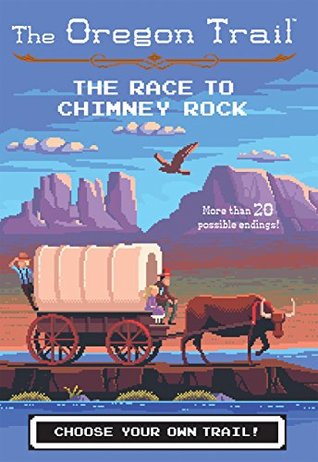
The Race To Chimney Rock (The Oregon Trail #1)
The Race to Chimney Rock. (The Oregon Trail #1) Jesse Wiley. 2018. Houghton Mifflin Harcourt. 160 pages. [Source: Review copy]
First sentence: You are loading up your covered wagon to head out to Oregon Territory, where a square mile of free farmland awaits your family. It's 1850 and there aren't any planes or trains yet, so you'll have to walk while your oxen pull your jam-packed wagon across North America's Great Plains, Rocky Mountains, and the lands of many First Nations tribes, like the Otoe-Missouria, Osage, Cheyenne, Pawnee, Arapaho, and Shoshone.
Premise/plot: The Race to Chimney Rock is the first in a four book series based on the classic computer game Oregon Trail. It is a choose-your-own adventure book with over twenty possible endings. I believe only one will lead you to Chimney Rock and set you up for book two.
Your biggest decision is your first decision. Will you choose to start your journey west in April or May?
If you want a REALLY short story to read, always decide to leave in April. You'll be done with the story in no time. There are just four possible stories with an April beginning.
My thoughts: I really enjoyed this one. I was determined to keep reading until I made it to Chimney Rock.
Are the decisions obvious? Yes. No. Sometimes. Not really. A few do seem easier to discern "wise" from "foolish" actions.
Do all the wrong/foolish decisions lead to death? No. Don't get me wrong. While all wrong decisions hinder you from reaching Chimney Rock and thus keep you from reaching Oregon, not all wrong decisions lead to a grave for you and/or your whole family. I was happily surprised to see some genuinely happy endings. I didn't feel so bad reading the words "The END" if I managed to still be alive. That being said, there were some horrible, horrible endings where you did end up dead.
While I understand that it's necessary to restrict EVERY decision to just two choices in the book and in the game, life doesn't really work like that. A third option makes sense sometimes.
Spoiler:
If you want to reach Chimney Rock
© 2018 Becky Laney of Becky's Book Reviews
First sentence: You are loading up your covered wagon to head out to Oregon Territory, where a square mile of free farmland awaits your family. It's 1850 and there aren't any planes or trains yet, so you'll have to walk while your oxen pull your jam-packed wagon across North America's Great Plains, Rocky Mountains, and the lands of many First Nations tribes, like the Otoe-Missouria, Osage, Cheyenne, Pawnee, Arapaho, and Shoshone.
Premise/plot: The Race to Chimney Rock is the first in a four book series based on the classic computer game Oregon Trail. It is a choose-your-own adventure book with over twenty possible endings. I believe only one will lead you to Chimney Rock and set you up for book two.
Your biggest decision is your first decision. Will you choose to start your journey west in April or May?
If you want a REALLY short story to read, always decide to leave in April. You'll be done with the story in no time. There are just four possible stories with an April beginning.
My thoughts: I really enjoyed this one. I was determined to keep reading until I made it to Chimney Rock.
Are the decisions obvious? Yes. No. Sometimes. Not really. A few do seem easier to discern "wise" from "foolish" actions.
Do all the wrong/foolish decisions lead to death? No. Don't get me wrong. While all wrong decisions hinder you from reaching Chimney Rock and thus keep you from reaching Oregon, not all wrong decisions lead to a grave for you and/or your whole family. I was happily surprised to see some genuinely happy endings. I didn't feel so bad reading the words "The END" if I managed to still be alive. That being said, there were some horrible, horrible endings where you did end up dead.
While I understand that it's necessary to restrict EVERY decision to just two choices in the book and in the game, life doesn't really work like that. A third option makes sense sometimes.
Spoiler:
If you want to reach Chimney Rock
- DO leave in May
- DO buy extra wagon parts
- DO let Joseph help you catch rabbits
- DO go to Papan's Ferry
- DO make friends with an Indian boy
- DO admit to not feeling well
- DO stay with the train instead of following a soldier-guide
- DO go to the Pawnee nation for help with muddy wheels
- DO lower the wagons by your own strength
- DO stop climbing the rock and go back to the wagon when it's time for supper
- DO stand up taller and face the bear
© 2018 Becky Laney of Becky's Book Reviews
Wednesday, July 25, 2018
Road Trip With Max and His Mom
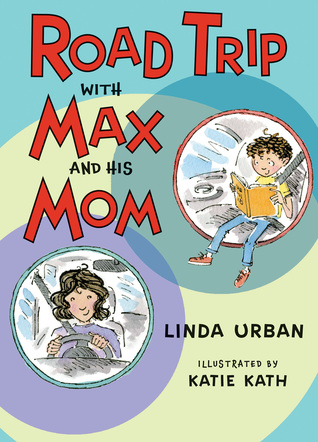
Road Trip with Max and His Mom. Linda Urban. Illustrated by Katie Kath. 2018. Houghton Mifflin Harcourt. 160 pages. [Source: Review copy]
First sentence: On Monday morning after breakfast, Mom made an announcement. "We are going on an adventure. Max was surprised. Mom was not the sort of mom who made announcements about adventures. She was the sort of mom who made announcements about the laundry needing to be put away, or how proud she was of Max's report card, or that Max's hair was getting long and it was time for a trim.
Premise/plot: Road Trip with Max and His Mom is a sequel to Linda Urban's Weekends with Max and His Dad. In the first book, readers met Max and his dad. Max is adjusting to his parents recent divorce. In the second book, Max is skipping one of his weekends with his dad to go with his mom on a trip. Great-Great-Aunt Victory is turning 100 and having a family-reunion-birthday-party at an amusement park. It sounds like an adventure just right for an explorer like Max.
My thoughts: I love, love, love Max. I came to love him in the first book. That's the wonderful thing about series. If you get attached to the characters in the first book, you can just pick up future books with the love already there. Max is over being a spy these days, and now he is all about exploring. He has been LOVING reading biographies about famous and should-be-famous explorers. And I just have to say that having a narrator who gets so excited about books, about reading, about learning is just delightful.
I would definitely recommend both books.
© 2018 Becky Laney of Becky's Book Reviews
First sentence: On Monday morning after breakfast, Mom made an announcement. "We are going on an adventure. Max was surprised. Mom was not the sort of mom who made announcements about adventures. She was the sort of mom who made announcements about the laundry needing to be put away, or how proud she was of Max's report card, or that Max's hair was getting long and it was time for a trim.
Premise/plot: Road Trip with Max and His Mom is a sequel to Linda Urban's Weekends with Max and His Dad. In the first book, readers met Max and his dad. Max is adjusting to his parents recent divorce. In the second book, Max is skipping one of his weekends with his dad to go with his mom on a trip. Great-Great-Aunt Victory is turning 100 and having a family-reunion-birthday-party at an amusement park. It sounds like an adventure just right for an explorer like Max.
My thoughts: I love, love, love Max. I came to love him in the first book. That's the wonderful thing about series. If you get attached to the characters in the first book, you can just pick up future books with the love already there. Max is over being a spy these days, and now he is all about exploring. He has been LOVING reading biographies about famous and should-be-famous explorers. And I just have to say that having a narrator who gets so excited about books, about reading, about learning is just delightful.
I would definitely recommend both books.
© 2018 Becky Laney of Becky's Book Reviews
Tuesday, July 03, 2018
How It Feels To Be A Boat
How It Feels To Be A Boat. James Kwan. 2017. Houghton Mifflin Harcourt. 40 pages. [Source: Review copy]
First sentence: Ahoy, ahoy! Raise your crooked anchor and head out to sea, as your foghorn howls and barnacles tickle your bottom.
Premise/plot: What does it feel like to be a boat? Well, Kwan's imagination has led him to explore just that in his new picture book.
Is this a story picture book for young children encouraging active--or over-active imaginations? Perhaps. Is this a picture book for young adults soon to graduate and enter 'the real world'?
It didn't work for me personally as either. Either as an imaginative storybook or as an allegory or metaphor for life it was just unsettling. Are the different "rooms" in the boat and the different characters who live on the boat representative of desires, needs, wants, opportunities? Do they represent multiple personalities? Because most of the challenging aspects of being a boat come from within the boat itself--not the stormy seas, not the obstacles at sea or near shore.
Text: 3 out of 5
Illustrations: 3 out of 5
Total: 6 out of 10
© 2018 Becky Laney of Becky's Book Reviews
First sentence: Ahoy, ahoy! Raise your crooked anchor and head out to sea, as your foghorn howls and barnacles tickle your bottom.
Premise/plot: What does it feel like to be a boat? Well, Kwan's imagination has led him to explore just that in his new picture book.
In your belly everyone gets along, but sometimes they fight. When they yell your belly aches, your heart shrinks, and your rooms shiver. You are strong, but sometimes you tremble.
From inside your belly you smell a delicious thing and hear your favorite doot-doot tune and feel everyone singing and moving together: lee lee lee doo.My thoughts: My first thought upon reading this one is why does this book exist?! My second thought was who is the intended audience?! Fair or not fair those were my initial impressions.
Is this a story picture book for young children encouraging active--or over-active imaginations? Perhaps. Is this a picture book for young adults soon to graduate and enter 'the real world'?
It didn't work for me personally as either. Either as an imaginative storybook or as an allegory or metaphor for life it was just unsettling. Are the different "rooms" in the boat and the different characters who live on the boat representative of desires, needs, wants, opportunities? Do they represent multiple personalities? Because most of the challenging aspects of being a boat come from within the boat itself--not the stormy seas, not the obstacles at sea or near shore.
Text: 3 out of 5
Illustrations: 3 out of 5
Total: 6 out of 10
© 2018 Becky Laney of Becky's Book Reviews
Monday, June 25, 2018
Red Again
Red Again. Barbara Lehman. 2017. Houghton Mifflin Harcourt. 32 pages. [Source: Review copy]
Premise/plot: Does a book need words to tell a story? Red Again is a companion picture book to Barbara Lehman's The Red Book. Both, I believe, are wordless picture books. I have read Red Again. I have not--so far as I recall--read the Red Book.
In the book, a boy finds a red book in an unexpected place. The book--as it is read--leads him to the unexpected. It leads him to another reader--of the same book. The magic continues as the red book is lost and found yet again.
My thoughts: Typically my answer is "Yes, a book needs words to tell a story." But there are always exceptions to the rule. And to be clear the question does not have a 'right' or 'wrong' answer.
I think Red Again works for me because it is about the wonder and magic of books, of the reading experience. It is all about the act of reading and the delight it can bring you.
Text: 0 out of 0
Illustrations: 3 out of 5
Total: 3 out of 5
© 2018 Becky Laney of Becky's Book Reviews
Premise/plot: Does a book need words to tell a story? Red Again is a companion picture book to Barbara Lehman's The Red Book. Both, I believe, are wordless picture books. I have read Red Again. I have not--so far as I recall--read the Red Book.
In the book, a boy finds a red book in an unexpected place. The book--as it is read--leads him to the unexpected. It leads him to another reader--of the same book. The magic continues as the red book is lost and found yet again.
My thoughts: Typically my answer is "Yes, a book needs words to tell a story." But there are always exceptions to the rule. And to be clear the question does not have a 'right' or 'wrong' answer.
I think Red Again works for me because it is about the wonder and magic of books, of the reading experience. It is all about the act of reading and the delight it can bring you.
Text: 0 out of 0
Illustrations: 3 out of 5
Total: 3 out of 5
© 2018 Becky Laney of Becky's Book Reviews
Friday, June 08, 2018
Bubba and Beau, Best Friends
Bubba and Beau, Best Friends. Kathi Appelt. Illustrated by Arthur Howard. 2002. Harcourt. 32 pages. [Source: Bought]
First sentence: Meet Bubba. Bubba is the son of Big Bubba and Mama Pearl. Right after Bubba was born, Mama Pearl wrapped him in his soft pink blankie and whispered into both of his soft pink ears, "I love you, Bubba Junior." She sighed. He was the perfect little Bubba.
Premise/plot: Bubba (the baby) and Beau (the puppy) are BEST friends. This picture book is written in small chapters. Each chapter written to perfection to highlight the awesomeness of Bubba, Beau, and their blanket. There are many good and happy days in Bubbaville, but this picture book chooses to include a very SAD day in Bubbaville as well. What will happen when Mama Pearl dares to WASH the blanket?!?!
My thoughts: Bubba and Beau, Best Friends has to be one of my absolute favorite, favorite, favorite picture books. It is perfectly perfect I tell you. I love the setting. (It is set in Texas.) I love the characters. I love the illustrations. (Now when I see Arthur Howard I think Mr. Putter and Tabby.) But most of all I love the words--the narrative flavor and flow.
One of my favorite quotes:
Text: 5 out of 5
Illustrations: 5 out of 5
Total: 10 out of 10
© 2018 Becky Laney of Becky's Book Reviews
First sentence: Meet Bubba. Bubba is the son of Big Bubba and Mama Pearl. Right after Bubba was born, Mama Pearl wrapped him in his soft pink blankie and whispered into both of his soft pink ears, "I love you, Bubba Junior." She sighed. He was the perfect little Bubba.
Premise/plot: Bubba (the baby) and Beau (the puppy) are BEST friends. This picture book is written in small chapters. Each chapter written to perfection to highlight the awesomeness of Bubba, Beau, and their blanket. There are many good and happy days in Bubbaville, but this picture book chooses to include a very SAD day in Bubbaville as well. What will happen when Mama Pearl dares to WASH the blanket?!?!
My thoughts: Bubba and Beau, Best Friends has to be one of my absolute favorite, favorite, favorite picture books. It is perfectly perfect I tell you. I love the setting. (It is set in Texas.) I love the characters. I love the illustrations. (Now when I see Arthur Howard I think Mr. Putter and Tabby.) But most of all I love the words--the narrative flavor and flow.
One of my favorite quotes:
It didn't take long for Bubba and Beau to become best friends. For one thing, they both went around on all fours. They were both keen on chewing. Neither one was house-trained. And they could howl to beat the band. They also had a mutual affection for MUD. And a mutual disdain for soap. Sister, those two got along.Honestly, I could quote the whole book. That's how much I love it. The best books become part of the fabric of our lives, become a part of ourselves. Even though I was an adult in 2002--in library school to be exact--this book is part of me.
Text: 5 out of 5
Illustrations: 5 out of 5
Total: 10 out of 10
© 2018 Becky Laney of Becky's Book Reviews
Tuesday, May 22, 2018
Saving Fiona
Saving Fiona: The Story of the World's Most Famous Baby Hippo. Thane Maynard. 2018. Houghton Mifflin Harcourt. 48 pages. [Source: Review copy]
First sentence: This is Fiona. She is a baby hippopotamus, but not just any baby hippopotamus. She is the first premature hippopotamus to be raised by humans. She is a survivor. This is her story.
Premise/plot: Saving Fiona is a nonfiction picture book for young readers. The Cincinnati Zoo was super-excited to welcome hippos to their new African animal habitat. The first two hippos in the exhibit were Henry and Bibi. They were hoping that these two would have a baby. They did! No one expected Fiona would be born several months premature, however. The zookeepers had to step in and raise her....until she was ready to be reunited with her parents. This book is about how they took care of Fiona in those early months.
My thoughts: I have watched Fiona's videos with great enthusiasm and interest. I found the picture book to be fascinating. It is full of pictures. It is full of facts. It's just an absorbing, compelling story. Readers of all ages might find Fiona's story a must read.
Text: 5 out of 5
Photographs: 5 out of 5
Total: 10 out of 10
© 2018 Becky Laney of Becky's Book Reviews
First sentence: This is Fiona. She is a baby hippopotamus, but not just any baby hippopotamus. She is the first premature hippopotamus to be raised by humans. She is a survivor. This is her story.
Premise/plot: Saving Fiona is a nonfiction picture book for young readers. The Cincinnati Zoo was super-excited to welcome hippos to their new African animal habitat. The first two hippos in the exhibit were Henry and Bibi. They were hoping that these two would have a baby. They did! No one expected Fiona would be born several months premature, however. The zookeepers had to step in and raise her....until she was ready to be reunited with her parents. This book is about how they took care of Fiona in those early months.
My thoughts: I have watched Fiona's videos with great enthusiasm and interest. I found the picture book to be fascinating. It is full of pictures. It is full of facts. It's just an absorbing, compelling story. Readers of all ages might find Fiona's story a must read.
Text: 5 out of 5
Photographs: 5 out of 5
Total: 10 out of 10
© 2018 Becky Laney of Becky's Book Reviews
Subscribe to:
Posts (Atom)


