Showing posts with label 2018 Cybils Eligible. Show all posts

Monday, December 03, 2018

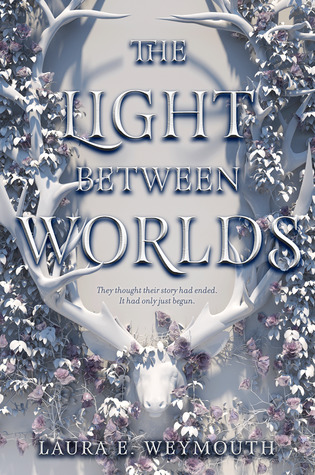
The Light Between Worlds

The Light Between Worlds. Laura E. Weymouth. 2018. HarperCollins. 320 pages. [Source: Library]
First sentence: We're burying Old Nick in the back garden. It's just Jamie and me, and it's raining, and I know he's worried because of the way he stands, head bowed, shoulders tense.

Premise/plot: During the war--the second world war--three British children are transported magically to another world--the Woodlands. Philippa, Evelyn, and Jamie react to this adventure in very different ways. Philippa is uncomfortable, out of sorts. She'd go home instantly if she could. Jamie is up for an adventure, but once he's had it he'll happily return to reality. Evelyn is all in from the start. The Woodlands are HER FOREVER AND EVER AND EVER home. She never wants to go back. This instant bond is unsettling for her brother and sister. Sooner or later, the three will return--return to the exact moment they left, return to being in a London bomb shelter, return to their parents.

The book is set six years AFTER this adventure takes place. Evelyn has had six years to adjust to being back, six long years to reconnect with her life. But she hasn't. She still persists that this world, this reality, is not her home, is not where she belongs. Evelyn is desperate to return to the Woodlands--and she'll never give up trying to get back no matter what this means to her family and friends.

The first half is told from Evelyn's point of view. The second half is told from Philippa's point of view.

My thoughts: I wanted to love The Light Between Worlds. I honestly did. I wanted to be swept up in the fantasy adventure and fall in love with The Woodlands--fall just as hard as Evelyn. I wanted to understand WHY the Woodlands had such a huge hold over her. But I didn't. Perhaps because the Woodlands scenes are a series of flashbacks. Perhaps because instead of experiencing the Woodlands, it's brief flashes of telling--not showing. Perhaps because none of the Woodlands characters are ever really fleshed out. Perhaps because in comparison between this world and that--all of the characterization is spent on this world. Imagining the awesomeness of The Woodlands has been left completely up to the reader--in my opinion. I just couldn't do it. I couldn't make myself build The Woodlands into this awesome, wonderful, inspiring place.

I thought the book was sad. Evelyn was severely depressed, suicidal even. Her depression seemed to follow seasons. Were readers supposed to conclude that all of Evelyn's mental health issues were really not mental health issues just her heart longing to return to the place she called home? Were we supposed to be at peace with Evelyn's self-abuse and melancholy? I know that Philippa was worried--concerned--that her sister might be placed in a mental institution if anyone knew her true state of mind. And since the book was set then--and not now--that would have been its own tragedy of sorts. Either ending--Evelyn staying or Evelyn going--would be tragic and devastating.


© 2018 Becky Laney of Becky's Book Reviews

Friday, November 09, 2018

Joy

Joy. Corrine Averiss. Illustrated by Isabelle Follath. 2018. 32 pages. [Source: Library]

First sentence: Fern loved Nanna. She loved her butterfly cakes, her mantelpiece mice, and her cat, Snowball. Most of all, she loved her smile. But recently, Nanna had stopped baking cakes, the mice were dusty, and Snowball was more like a ball of fuzz. Worst of all, Nanna hardly ever smiled.

Premise/plot: In Corrine Averiss' Joy, Fern, our lovable narrator, goes on a mission--a mission to CATCH or capture joy. She wants to give this captured-joy to her grandmother--her Nanna. Will her hunt for joy succeed? Perhaps. Fern finds herself surrounded by whooshes of joy all over the place. But how do you capture a feeling? How can you give it away?

My thoughts: I really loved this one the first time I read it. I love it when picture books focus on the oh-so-special relationship between child and grandparent--in this case a girl and her grandmother. I loved, loved, loved seeing Nanna's huge SMILE when she was talking to her granddaughter. "You bring me all the joy in the world just by being you." It's SUPER-SUPER sweet.

I didn't love it quite so much the second time I read it. I don't suspect--I know--that I am now overthinking things. Is Fern genuinely worried about Nanna's mental and emotional health? Is Fern being empathetic and compassionate or selfish? Does Fern just want her fun playmate back? Does she just miss the butterfly cakes? Why are the butterfly cakes mentioned first in the things she loves about her grandmother? Doesn't she realize that there will be a time when her Nanna no longer is able to bake cakes?! Doesn't she realize that she's blessed just to have her Nanna around? The cakes are ultimately meaningless. It's Nanna that matters. Not what Nanna can do for her.  She probably doesn't. Fern is in a happy little innocent bubble. She's taking everything for granted. And perhaps that is the way it should be.

But what really bothered me the second time around were the illustrations. Nanna is in a wheel chair. Fern is pushing her chair through the park. The last spread shows Nanna and Fern relaxing on a blanket at the park. Surrounded by multiple cakes. No chair in sight. How did Nanna get down on the ground? How will she get back up again? Getting grandparents back up off the floor--even if they've never spent time in a wheel chair--usually isn't easy. I got down here but how am I going to get back up again. This conversation happens. It's real. So I'm worried even if Fern isn't.

Text: 4 out of 5
Illustrations: 4 out of 5
Total: 8 out of 10

© 2018 Becky Laney of Becky's Book Reviews

Tuesday, October 30, 2018

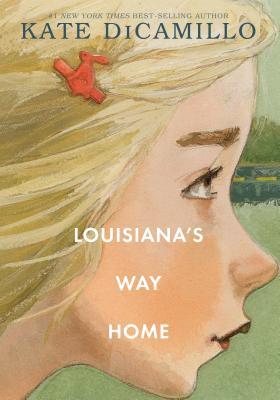
Louisiana's Way Home

Louisiana's Way Home. Kate DiCamillo. 2018. Candlewick Press. 240 pages. [Source: Library]

First sentence: I am going to write it all down, so that what happened to me will be known, so that if someone were to stand at their window at night and look up at the stars and think, My goodness, whatever happened to Louisiana Elefante? Where did she go? they will have an answer. They will know. This is what happened. I will begin at the beginning.

Premise/plot: The character of Louisiana Elefante was first introduced in a lovely little book called Raymie Nightingale. She was a sidekick to the main character. This book is set several years later and it is narrated by Louisiana herself.

Granny has decided that the time has come--the day of reckoning. She has decided that it is time to be moving on. Louisiana learns this the hard way--at 3AM--when she's packed up and put in the car. Soon Louisiana finds herself leaving Florida--not to mention her friends, her pets--behind and entering Georgia. Soon Louisiana finds herself behind the wheel--without a license--when Granny's toothache becomes too unbearable. Her first mission is to find a dentist. This is quickly followed up by finding a place to stay. And then there is her most familiar mission of all--a daily one--finding food to eat. Nothing comes easy for Louisiana--not anymore. (Not that life with Granny in Florida was super-easy, mind you.) But Louisiana finds friends in unlikely places...and her new friends may just be her saving grace.

My thoughts: I loved, loved, LOVED, loved this one. DiCamillo has written a gem of a book. I'm not sure what I loved most: the characterization, the narration, the quotability factor, or the compelling, oh-so-satisfying plot.

This is what happened. We stood on the side of the road. In Georgia. Just past the Florida-Georgia state line. Which is not at all--in any way--a line. Yet people insist that it exists. Think about that. (8)
If you have to choose between smiling and not smiling, choose smiling. It fools people for a short time. It gives you an advantage. (11)
I considered running down the highway, back to Florida. But I did not think I would be able to run fast enough. I have never been able to run fast enough. And by that I mean that no matter where I go, Granny seems to find me. Is that fate? Destiny? The power of Granny? (12)
You have to make small plans. That is one of the things I have discovered in this world. It is pointless to make big plans because you never know when someone is going to wake you up in the middle of the night and says, "The day of reckoning has arrived." Days of reckoning interfere with big plans. So I made small plans. The small plans were: Keep the car on the road. Find a dentist. Never forgive Granny. Although, when I think about it, never forgiving Granny would probably go in the "big plan" category. (34)
She had on her fur coat. Her hair was standing up straight on her head. Suddenly, I saw her like other people might see her and I will not lie to you: it scared me. How can I say this? She did not look trustworthy. She looked like somebody with a curse upon her head. Which, of course, was exactly the case. (46)
Your heart has to be involved with the music, or else there is no point. That is what Granny has always told me, and I believe it to be true. (73)
I sang as if the Blue Fairy from Pinocchio was smiling at me. I sang as if Beverly and Raymie and Archie and Buddy could hear me and would use the song to find their way to me. I sang as if I knew the name of the boy on the roof. I sang as if he knew my name, too. (77)
Whoever Reverend Frank Obertask was, he certainly believed in the power of the written word. And that was fine by me, because I believe in the power of the written word, too. (83)
Granny had always spoken poorly of bologna, but these bologna sandwiches tasted so good that it was just one more reason for me to doubt Granny and the truth of her utterances. And by that I mean this: If you are the kind of person who lies about something as small as bologna, what would stop you from lying about bigger, more important things? (102)
I didn't know if Granny would eat a bologna sandwich. In fact, a bologna sandwich might enrage her. Maybe I was hoping to enrage her. I don't know. But in any case, Burke went into the kitchen and came back out a minute later with two bologna sandwiches wrapped up in a paper towel. I was starting to see what kind of person he was. He was the kind of person who, if you asked him for one of something, gave you two instead. (108)
The next thing I remember is being carried. I smelled something sweet. I said, "What is that smell?" A man's voice answered me. He said, "That's cake, darling." I liked that answer very much. I think that "cake" is a very good word in general and that people should use it as an answer to questions more often. (134)
I ate the whole bowl of ice cream without once letting go of Grandfather Burke's hand. "That's the way to do it," he said. "That's just right." The peanuts on top of the sundae were particularly good. The house smelled like pineapple upside-down cake. Well, the whole world was upside down. But it was still spinning. Wasn't it? (180)
 "I want you to know something, Louisiana. We all, at some point, have to decide who we want to be in this world. It is a decision we make for ourselves. You are being forced to make this decision at an early age, but that does no mean that you cannot do it well and wisely. I believe you can. I have great faith in you. You decide. You decide who you are, Louisiana. Do you understand? (199)
It seems like a good thing to know the star that can keep you from being lost in this world. (216)


© 2018 Becky Laney of Becky's Book Reviews

Monday, October 29, 2018

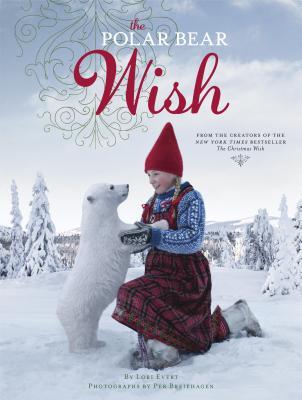
The Polar Bear Wish

The Polar Bear Wish. Lori Evert. Photographs by Per Breiehagen. 2018. Random House. 48 pages. [Source: Review copy]

First sentence: Long, long ago, so high in the mountains and close to the stars that on clear nights you didn't need a lantern, lived an adventurous girl named Anja.

Premise/plot: A girl makes a Christmas wish. Did her wish come true? Or did she have a fantastical dream?

My thoughts: This is the fourth book in the Wish series. This is the first that I've read. Perhaps if I had a previous attachment with Anja or Erik--the (human) stars of this one--then I might have appreciated it more. I thought it was odd. Perhaps surreal is the better word choice. I think some readers will enjoy it very much. This reader didn't really "get it." But picture books are incredibly subjective.

Text: 3 out of 5
Illustrations/photographs: 4 out of 5
Total: 7 out of 10

© 2018 Becky Laney of Becky's Book Reviews
Monday, October 22, 2018

Allie All Along

Allie All Along. Sarah Lynne Reul. 2018. 40 pages. [Source: Library]

First sentence: SNAP! Allie's crayon broke. I blinked. She was suddenly...furious, fuming, frustrated, and so, so, sooo ANGRY. She stomped, smashed, crashed, and threw a tantrum, a fuss, and a fit.

Premise/plot: Allie's brother helps her calm down and work through her many, many feelings in Sarah Lynne Reul's picture book Allie All Along. [For the record, I am guessing that it is her brother; it could just as well be a friend. Though a friend might be more likely to run far, far away until the storm is over. This person knows Allie and her moods very well.]

My thoughts: I LOVED, LOVED, LOVED this one. I haven't loved a book about fits this much since reading FINN THROWS A FIT a few years ago. I'm not sure which of the two I'll end up liking more--only time will tell.

I loved the writing. I loved the concept. I loved the shedding of emotions. I loved the coping skills.  I loved the illustrations. It's a relatable book start to finish. And the ending is oh-so-right.    

Text: 5 out of 5
Illustrations: 5 out of 5
Total: 10 out of 10

© 2018 Becky Laney of Becky's Book Reviews
Thursday, October 18, 2018

I Lost My Tooth

I Lost My Tooth (Unlimited Squirrels #1) Mo Willems. 2018. 96 pages. [Source: Library]

First sentence:  I lost my tooth! Th! What did you say, Zoom Squirrel? Th! Th! Th! I lost my tooth, Th-ip Squirrel. What did Zoom Squirrel say?

Premise/plot: Zoom Squirrel has lost a tooth. His squirrel friends have a hard time understanding what exactly this means. Their confusion goes on for over fifty pages. They imagine first that Zoom's tooth is MISSING. Then when Zoom explains that it was a baby tooth, his friends get really emotional. A BABY tooth is MISSING.

My thoughts: I think I would like this one more if it didn't go on so very long. The first fifty-eight pages are the 'big story.' But the book is ninety-six pages. The remaining pages are filled with junk. What kind of junk? Acorn-y jokes. There are a few non-fiction facts shared as well. I suppose these facts aren't technically junk. There's a page on HUMAN teeth. There's a page on SQUIRREL TEETH. And then there's the a bizarre page that shares facts about bear teeth and shark teeth. We also learn the oh-so-obvious-fact that plants do not have teeth. (Do we really need this quiz and answer page?!?!)

I am super-excited that Mo Willem is still writing books. I love his Pigeon series. I do. I love, love, love, crazy-love his Elephant and Piggie series. I enjoy Knuffle Bunny. There have been a few stand-alone books that I've enjoyed as well. This appears to be the start of a new series. I hope future books are better.


© 2018 Becky Laney of Becky's Book Reviews

Tuesday, October 16, 2018

Quiet

Quiet. Tomie dePaola. 2018. Simon & Schuster. 32 pages. [Source: Library]

First sentence: "My, oh my," the grandfather said. "Everything is in such a hurry."

Premise/plot: One thing I love about picture books is that often what you see is what you get. This is a story celebrating quietness and stillness. A grandfather is on a walk with his grandchildren and a dog. Once the grandfather points out how 'everything' is in a hurry, they all take turns pointing out the busyness they see in nature as they walk along. But soon it is time to sit down and rest, to slow down their minds and bodies, to just be still. Just as nature can be busy, it can also be restful.

My thoughts: I liked this one. I agree with the conclusion--the moral, if you will--of this one: To be quiet and still is a special thing. There is a timelessness to this one which makes it somewhat unique.  I think Mr. Rogers would approve of this one!

Text: 4 out of 5
Illustrations: 4 out of 5
Total: 8 out of 10

© 2018 Becky Laney of Becky's Book Reviews

Friday, October 12, 2018

The Promise

The Promise. Pnina Bat Zvi and Margie Wolfe. Illustrated by Isabelle Cardinal. 2018. 32 pages. [Source: Library]

First sentence: Rachel pulled herself out of her happy dream. In her sleep she was free to be with her friends and go to school. But now, the gong announced the beginning of another day in Auschwitz prison camp.

Premise/plot: Toby and Rachel are sisters held together by love and a promise: to stay together no matter what. Can these two sisters keep that promise even in Auschwitz? Is the promise worth risking everything for?

My thoughts: What an emotional story! The Promise is a nonfiction picture book for older readers. It is NOT for young readers, in my opinion. Of course one could ask when is the right age--the appropriate time--to introduce the subject of the Holocaust to children. I do think it's something that must be taught, shared. Those voices--in particular nonfiction--deserve to be heard in every generation.

There are a few picture books set during the Holocaust or World War II. But there aren't all that many. I do think it's worth reading.

Text: 4 out of 5
Illustrations: 3 out of 5
Total: 7 out of 10


© 2018 Becky Laney of Becky's Book Reviews

Wednesday, October 10, 2018

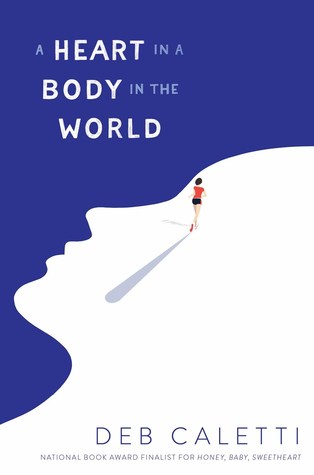
A Heart In a Body in the World

A Heart in a Body in the World. Deb Caletti. 2018. 368 pages. [Source: Library]
First sentence: Annabelle Agnelli is trying to hold it together in the parking lot of Dick's Drive-In. After what just happened, she's stunned. Frozen. And then--imagine it--Annabelle's wrecked self suddenly takes off like a lightning bolt.

Premise/plot: If ever a book needs a freezer, then A Heart in the Body in the World does. Annabelle's story--her nightmare of a story--unfolds slowly throughout the book as she runs across the country. Is she running from her past? running from her present? or running towards her future? Annabelle herself couldn't tell you why she's running--just that she must keep going no matter what. She's supported--for the most part--by her family and friends. Grandpa Ed is driving his RV cross country. Every day these two meet up at the end of the day. (Grandpa Ed has his lady friend and her grandson meet up now and then with them as well. His name is Luke Messenger. Oh-so-reluctantly Annabelle lets herself make a new friend.)

My thoughts: At first I found the slow-reveal to be frustrating. Part of me wanted to know what traumatic event had shattered Annabelle's life and know it now. But as more of her story came out, I lost my frustration. By the time we know everything we are so completely engaged and connected with Annabelle (and those close to her) that her pain is our pain. This has all the feels--thus the need for a FREEZER.

Should every one read A Heart In a Body In the World? Yes. No. Yes. No. Maybe. I will say that this one is not a clean read. This one has language in it--blasphemy. It is not frivolous, trivial, or casual. And the subject matter is so important--so relevant--that I think it is probably worth reading for most. So many discussions could/should be had around this one. It is not age-appropriate for every one. Just because a reader isn't ready now doesn't mean that the reader will never be ready.


© 2018 Becky Laney of Becky's Book Reviews

Tuesday, October 09, 2018

Irving Berlin: The Immigrant Boy Who Made America Sing

Irving Berlin: The Immigrant Boy Who Made America Sing. Nancy Churnin. Illustrated by James Rey Sanchez. 2018. 32 pages. [Source: Library]

First sentence: Irving stood on tiptoe to see over the rail. Behind him, too far to glimpse, was Russia where angry Cossacks had burned his family's home to ashes. Ahead was America. What would they find there?

Premise/plot: Nancy Churnin has written a picture book biography of songwriter Irving Berlin. She begins his story with his family's journey to America. He was five. Life in the new country was hard--strange--but Berlin loved it. The picture book focuses on his early years: how he got started writing songs, how he got into the music business, his most popular songs. But the book specifically highlights his writing "God Bless America."

My thoughts: I enjoyed this one. I found it informative and compelling. I didn't realize how little I knew about his personal life until I read this one. I think we all tend to take certain songs for granted without really thinking about why/how they were written, without thinking about the songwriters behind them. It's a book worth reading.

© 2018 Becky Laney of Becky's Book Reviews
Friday, October 05, 2018

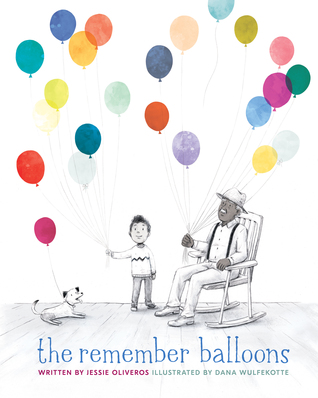
The Remember Balloons

The Remember Balloons. Jessie Oliveros. Illustrated by Dana Wulfekotte. 2018. Simon & Schuster. 48 pages. [Source: Library]

 First sentence: I have lots and lots of balloons, way more than my little brother. "This one's my favorite," I tell him, pointing to the balloon filled with my last birthday party. When I look at it, I can see the pony again. I can still taste the chocolate frosting.

Premise/plot: The balloons in the story symbolize a person's memories. James, our narrator, has many balloons though not as many as his parents and his grandpa. But that changes over the course of the book. His grandpa loses all of his balloons--his memories. This upsets James greatly. But then he notices that while his grandpa's balloons are gone, he has plenty of NEW balloons. Every single story his grandpa shared with him--every single balloon--is now his. His to remember. His to share. His to cherish.
But Grandpa has been having problems with his balloons lately. One will get caught in a tree, and he'll tell me the same story over and over. "Let me tell you about the Christmas I went to Aunt Nelle's farm," Grandpa says, even though he just finished telling me about it. Other times, a balloon will float right out of his hand, and he won't even know it.
My thoughts: I love, love, love, LOVE, crazy-love this one. It is incredibly good. It is sweet, bittersweet, and thought-provoking. It is on a sensitive topic; one that might be difficult for children to understand. (It may be "easy" for adults to grasp what Alzheimer's disease is mentally at least, but it's far from easy to process it in reality.)

This book celebrates FAMILY. I love that. The boy is obviously close with his whole family, but he is especially close with his grandfather. You don't always see that in picture books. It's obvious that these two have a lot of shared memories.

This book also celebrates STORIES. I really love that. Stories are gifts. Storytellers are gifted. Stories create bonds; stories celebrate what matters in life. The good. The bad. The ugly. The hilarious. The sweet. The more you hear a story, the more it becomes YOURS. Stories definitely shape/mold/transform our own memories, our own sense of self, of who we are, of where we belong.

I thought about my own balloons while reading this story. As soon as I read the book, I made my mom read it. Soon after she was, "I have a balloon I want to give you, but I'm not sure of its color." She then started telling me a story about how my sister told the nurse that her mama was going to be giving HER a baby.

Text: 5 out of 5
Illustrations: 5 out of 5
Total: 10 out of 10

© 2018 Becky Laney of Becky's Book Reviews

Mary, Who Wrote Frankenstein

Mary, Who Wrote Frankenstein. Linda Bailey. Illustrated by Julia Sarda. 2018. 56 pages. [Source: Library]

First sentence: How does a story begin? Sometimes it begins with a dream. Here is Mary. She's a dreamer. The kind of girl who wanders alone, who stares at clouds, who imagines things that never were. Mary has a name for her daydreams. She calls them "castles in the air." Mary loves stories too. She tries to write the kind that she reads. But the stories she sees in daydreams are the most thrilling of all. And where does she go to read and dream? She goes to a graveyard and sits at her mother's grave.

Premise/plot: Linda Bailey has written a picture book biography of Mary Shelley. It is a lovely picture book for older readers. It remains age-appropriate all things considered. It does NOT go into detail about the private lives of Mary and her family. If Mary had lived today, her choices would not have broken too many conventions. But living when she lived, Mary broke a lot of society's rules. (As did her sister.) She lived life on her terms, perhaps on her husband's terms; she did things her way.

My thoughts: I thought this one was well written. The narrative is compelling. I recently read Catherine Reef's The Strange True Tale of Frankenstein's Creator. It offers a lot more detail, and for some more detail might signify "better." But the narrative isn't as compelling or engaging, in my opinion. There's something special about Bailey's text. I would recommend both books to older readers.

Picture books are not just for kids.

Text: 5 out of 5
Illustrations: 3 out of 5
Total: 8 out of 10
 

© 2018 Becky Laney of Becky's Book Reviews
Wednesday, October 03, 2018

Al Capone Throws Me A Curve

Al Capone Throws Me A Curve. (Al Capone at Alcatraz #4) Gennifer Choldenko. 2018. Random House. 240 pages. [Source: Review copy]

First sentence: Even when you live on a prison island with crafty criminals plotting ways to knock you off, summer is the best time of the year.

Premise/plot: Al Capone Throws Me a Curve is the fourth book in Gennifer Choldenko's series. The first three are  Al Capone Does My Shirts, Al Capone Shines My Shoes and Al Capone Does My Homework.

Moose Flanagan has worries--worries big and small. He's worried about having to "babysit" the warden's daughter, Piper. She's back for the summer, and, if you've read the series you know she is TROUBLE. Whether Piper ever means to get into trouble is up for debate. But Piper and Moose have history. (If you remember, Piper got into BIG, BIG trouble in the last book for circulating counterfeit money.) He's worried about not getting on a baseball team. Scout really wants to play with the older kids--high schoolers, I think?--and he's wanting MOOSE to help him--help them--get on the team. How?! Using his prison connections to celebrity criminals like Al Capone. Moose loves, loves, loves baseball. He does. But he really doesn't like how Scout is always pressuring him about one thing or another. Nothing ever seems enough for Scout. (If Moose didn't live on Alcatraz, would Scout want to be his friend?) Moose is still worried--at times--about his father. After all, it hasn't been all that long since an attempt was made on his life. Will his father be promoted to warden? What will it mean if he is?

But first and foremost Moose is worried about his sister, Natalie. She's turning SEVENTEEN. Their mom may have given up the pretense of her turning ten every year, but, she's far from at peace with Natalie's real age. How does Natalie fit in the real world? How does she fit into their family? How does she fit into their life on the island?

My thoughts: These books are so good. I'm so glad I decided to reread the whole series in preparation for this new one. I came into the book ATTACHED to the characters. For better or worse, reading all the books so close together makes them weightier somehow. I feel like I've been living in Moose's shoes and carrying his burdens.

© 2018 Becky Laney of Becky's Book Reviews

Tuesday, October 02, 2018

Counting on Katherine: How Katherine Johnson Saved Apollo 13

Counting on Katherine: How Katherine Johnson Saved Apollo 13. Helaine Becker. Illustrated by Dow Phumiruk. 2018. 40 pages. [Source: Library]

First sentence: Katherine loved to count. She counted the steps to the road. The steps up to church. The number of dishes and spoons she washed in the bright white sink. The only thing she didn't count were the stars in the sky. Only a fool, she thought, would try that! Even so the stars sparked her imagination. What was out there?

Premise/plot: Counting on Katherine is a picture book biography of Katherine Johnson. Part of Johnson's story was told in the adult biography Hidden Figures by Margot Lee Shetterly. (Hidden Figures also tells the story of other human computers, women who worked alongside Katherine Johnson. This is the book that inspired the film of the same name.) Both the movie and book were fabulous. It isn't a surprise that someone would want to adapt the story for a younger audience. It is a WONDERFUL story.

My thoughts: I really loved this one. The narrative is lovely. The illustrations are just as lovely. It's a compelling story and one that could inspire readers of all ages.

Text: 5 out of 5
Illustrations: 5 out of 5
Total: 10 out of 10

© 2018 Becky Laney of Becky's Book Reviews

Tuesday, September 25, 2018

The Opposite of Innocent

The Opposite of Innocent. Sonya Sones. 2018. 272 pages. [Source: Library]

First sentence:
The Friend of the Family
I've always been in love with Luke.
For as far back
as I can remember.
I used to climb into his lap,
throw my arms around his neck,
and tell him I was gonna marry him
when I grew up.
And Luke would smile down at me
and say,
"I'll wait for you, Lily. I promise."
 Premise/plot: The Opposite of Innocent is a verse novel for young adults. I hesitate to add for young adults--though perhaps not for the reason you might suspect. (I'll address this in 'my thoughts' below.) Lily, our narrator, is fourteen. She is head over heels in love with Luke, a twenty-nine year old man, a family friend who has known Lily's father practically forever. (Lily's parents think it is SO ADORABLE that their Lily has a "little girl" crush on Luke.) In fact, Luke is living with the family these days as he's looking for his own place. He's in no hurry and neither are they.

If Luke were to leave who would take care of their children? Who would take them to school? pick them up from school? stay home with them when they're sick? help them with their homework? take them to the library? If Luke weren't around, one of them at least would have to actually parent.

Lily doesn't dare to hope that Luke is as madly in love with her as she is with him. But lately she's been noticing him noticing her. Could her dreams finally be coming true at last? Does Luke LOVE her back?

My thoughts: The Opposite of Innocent handles a mature topic--sexual abuse. It is just as much of a must-read as Laurie Halse Anderson's SPEAK, in my opinion. It is intense, compelling, and dramatic. Dare I say more than a little scary?

As far as content goes, it is a mature topic. Lily is NOT ready for the relationship LUKE wants to have with her. Lily does not have the life-experience to know that Luke is manipulating her. Not only in the present tense, but that he has spent years manipulating her--grooming her. Not only her but her parents as well. Lily's parents trust Luke 110%. No reservations. No rules.

So it does get graphic. I won't lie and say this is a clean read when it isn't. But the fact that it is graphic should not keep (strict) parents from allowing their (teen) children to read it. It is too important a topic to ignore. It is a book that needs to be read and discussed. Parents should read the book too.

I'll go a step further. Adults should be reading this one. Parents. Teachers. Librarians. Anyone. Everyone.

The topic does stay front and center, but it is also very much character-driven. If you've not read Sonya Sones' novels before, you should give them a try.


© 2018 Becky Laney of Becky's Book Reviews

Wednesday, September 19, 2018

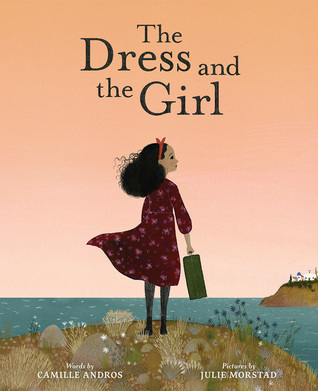
The Dress and the Girl

The Dress and the Girl. Camille Andros. Illustrated by Julie Morstad. 2018. Harry N. Abrams. 40 pages. [Source: Review copy]

First sentence: Back when time seemed slower and life simpler, there was a dress. A dress much like many others, made for a girl by her mother. The dress loved the girl, and the girl loved the dress. They spent each day together, an ordinary girl wearing an ordinary dress. Every day the same story.

Premise/plot: The Dress and The Girl has two narrators: the girl and the dress. (One certainly expects to find the point of view of a girl in a book--a picture book. But one does not expect to ever really read a book from the point of view of a dress.) The two are inseparable until they aren't. What will the dress do without the girl? What will the girl do without the dress?

My thoughts: I just want to say that if you can fall in love with a book based on the end papers alone, I fell in love. It's just that simple. The brown fabric spoke to me, called me by name, said CREATE. I also love the illustrations. They are beautiful and compelling. They compliment the story so well. I'm not as sure about the text as I am the illustrations. I liked it. I did. But at the same time I didn't. I loved when the dress and the girl were together. I liked when the dress and the girl were reunited decades later. But when the dress is on its own, well, the narrative is just so ODD. 

I think adults may appreciate this one more. This book screams out SYMBOLISM. I think the dress symbolizes one's connection to the past, to a way of life, to traditions, to memories; it is tangible reminder of the past, of where you've been. 

Text: 3 out of 5
Illustrations: 5 out of 5
Total: 8 out of 10

© 2018 Becky Laney of Becky's Book Reviews

Tuesday, September 18, 2018

Bob

Bob. Wendy Mass and Rebecca Stead. 2018. Feiwel & Friends. 208 pages. [Source: Library]

First sentence: I feel bad that I can't remember anything about Gran Nicholas's house. On the table in her kitchen Gran has lined up three things I do not remember: A green stuffed elephant in overalls; a net bag full of black chess pieces; a clunky old tape recorder. "You loved these things when you were here before," Gran Nicholas tells me.

Premise/plot: Livy last visited her Australian grandmother when she was five. She is ten now. She'll be spending a week or two with her grandmother as her mother travels around Australia visiting old friends and showing off her new baby. Livy's genuine memories of her time here before are few and far between. She remembers playing a bump-bump game on the stairs. She thinks she might remember a special chicken that was a bit different than the others. But as she settles in, a few things come back to her. First and foremost there is BOB who is waiting for her in "her" closet. Bob, a "zombie" in a "chicken suit" has been waiting patiently/impatiently for her to return. She's both shocked and overjoyed. How could she have forgotten BOB?! But now that she's older and wiser, she can't help thinking WHAT IS BOB? WHY CAN I SEE HIM? CAN OTHERS SEE HIM TOO? WHERE DOES HE COME FROM? DOES HE HAVE FAMILY?

The chapters alternate between Livy and Bob. Livy is determined to find out all she can about Bob before she has to return to the United States.

My thoughts: I really loved this fantasy novel for young readers. At first I thought Bob might be purely imaginary. That would have been a fun story too, but, this wasn't that story. There is a definite mystery surrounding Bob. And Livy has quite a task ahead of her. I loved both narratives.


© 2018 Becky Laney of Becky's Book Reviews
Tuesday, September 11, 2018

Soof

Soof. Sarah Weeks. 2018. Scholastic. 208 pages. [Source: Review copy]

First sentence: I saw a white rabbit with one bent ear hopping over a giant spoon filled with whipped cream. That's what it looked like to me anyway. I'd been lying on my back in the bed of my father's rusty old pickup truck all morning, watching clouds.

Premise/plot: Soof is a companion novel to So B. It. Heidi is NOT the narrator of Soof. Heidi is an adult now--a married woman with a child on the way. Aurora, the daughter of Ruby and Roy, is our narrator. She's heard stories about Heidi from the womb practically. Her mother crediting Heidi's "luck" for her daughter's miraculous conception. Aurora doesn't have a problem with a far-away-Heidi. There's no competition so long as Heidi stays far-away. But with Heidi coming to visit, well, Aurora is feeling out of sorts. She does NOT understand how Ruby can love Heidi like a daughter. Aurora has her own way of seeing the world and coping with the world, a way that makes her seem odd or quirky. Her mother worries that she might be autistic, might be "on the spectrum." She has taken Aurora to countless doctors trying to find a reason for her daughter's social awkwardness. (You can imagine how Aurora feels about her mother's anxiety. Aurora does NOT want to be explained, she wants to be loved unconditionally.)

Aurora's best friend is a dog named DUCK. Consider yourself warned.

My thoughts: I love, love, love the cover. I do. I'm not sure that I love the text. Aurora is not Heidi. She's her own person. I know in my head that that is a good thing. To compare Aurora and Heidi would be a mistake their parents--and readers--should avoid.

My favorite part of the book comes at the very end when Aurora makes her very first (non-related human) friend, Rosemary.  Though Rosemary only stars in two or three pages at best, I instantly loved her. I'm left imagining how incredibly awesome the whole book would have been if she'd been there from the beginning.

Over half of the novel focuses on life without DUCK and how Aurora is struggling with the loss of her best friend. Perhaps because she's lost her coping mechanism--her furry friend--she's unable to handle Heidi's visit.

It was nice to visit with Heidi again. But she's all grown up and practically a stranger. Readers learn, for example, that Bernadette is all better--she's able to leave her apartment and she's even got a steady boyfriend. Heidi is married, as I mentioned, but we learn nothing about whom she married. So many stories that this adult reader wanted to hear. But the novel is from Aurora's point of view. And Aurora is hostile to Heidi. I hope that Ruby and Heidi are confiding in each other and getting properly caught up. Unfortunately, we're not there to eavesdrop.


© 2018 Becky Laney of Becky's Book Reviews

Friday, September 07, 2018

The Strange True Tale of Frankenstein's Creator Mary Shelley

Mary Shelley: The Strange True Tale of Frankenstein's Creator. Catherine Reef. 2018. Houghton Mifflin Harcourt. 224 pages. [Source: Review copy]

First sentence: Mary Shelley had been dead a year when her son unlocked her portable desk and found the remains of human heart. The heart, he knew, had been his father's. It had rested in the desk for thirty years, unseen and untouched, since the day in 1822 when Mary Shelley tenderly wrapped it in pages of poetry and put it away. Dust and bits of dried-up muscle were all that was left.

Premise/plot: Catherine Reef's newest biography for young adults is Mary Shelley: The Strange True Tale of Frankenstein's Creator. Frankenstein is celebrating its 200th anniversary this year. 

Words to describe this one: dramatic, emotional, compelling, fascinating, heartbreaking, thought-provoking.

Mary Shelley's life was just as tragic as it was unconventional. Her parents were near-celebrities among the intellectually elite. Her mother, Mary Wollstonecraft, was an unconventional woman--an early feminist--who believed in living--experiencing--her life on her own terms despite the frowns of society. She believed in following her heart even if it meant breaking all the rules, even if it led to pain and heartbreak. She brought an illegitimate daughter with her into her marriage with William Godwin (Fanny). Godwin was a like-minded free thinker. At least when he was young with no teenage daughters of his own to raise! It would almost be easier to list everything he was against then to list everything he was for. Anti-tradition, anti-religion, anti-marriage, anti-government, etc. Both Godwin and Wollstonecraft were philosophically-minded writers whose works were published and somewhat applauded and celebrated--at least in certain circles. Mary Godwin's mother died when she was just days old. Godwin who at one time believed he'd never, ever marry now found himself marrying a second time. The woman (Mary Jane Clairmont) he married brought two children (Charles and Jane) from a previous relationship. It was a BLENDED family certainly: Fanny, Charles, Jane, Mary--and then "baby" William.

Her father as I mentioned was well-known in certain circles and their house--their bookshop--had plenty of well-known or soon-to-be well-known authors.

When Mary was a teenager--perhaps fifteen--she met a young would-be poet named Percy Bysshe Shelley. He was married--married with children. But neither one cared about conventions or morality. It was LOVE. The choice she made at sixteen to follow her heart's passion would change her life for better or worse forever and ever. Perhaps even more startling to modern readers is Mary's decision to bring her step-sister, Jane, with her. The two of them would run away with Percy Bysshe Shelley to Europe. It wasn't just a departure from England but from convention. (They'd return to England...but never quite to convention.)

Their lives were packed with DRAMA, DRAMA, AND MORE DRAMA. Mary found herself at the center of it all--an eyewitness to an era. The Romantic poets didn't just approach poetry in a "new," "fresh," "innovative," "genius," way. It was a lifestyle; the poems were a result of how they saw the world around them, what they thought, how they thought. It was thrilling AND disturbing. They wouldn't want it any other way. But would Mary? The book does NOT address that. Perhaps we'll never know the many emotional layers of her heart and mind. (How she felt about her husband, her sister, their many friends that brought chaos and fun into their lives.)

My thoughts: Mary Shelley's life was like a wreck--car, train, ship, take your pick--a devastating crash-boom-bang in many ways. But it makes for a fascinating read. I appreciated that the book was more than just a traditional biography. It also focused on her works. It focuses on Frankenstein, of course, but it also focuses on her other works. She didn't just write one book. She kept writing throughout her life. The book includes how her work(s) were critically received (then and now).  It also focused on relationships. To read of Mary Shelley is to read of the Romantic poets. For better or worse.

© 2018 Becky Laney of Becky's Book Reviews

Wednesday, September 05, 2018

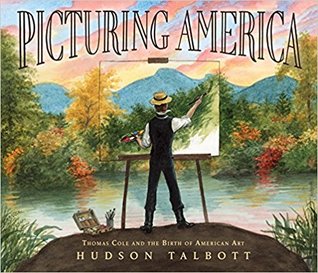
Picturing America: Thomas Cole and the Birth of American Art

Picturing America: Thomas Cole and the Birth of American Art. Hudson Talbott. 2018. Penguin. 32 pages. [Source: Review copy]

First sentence: Thomas Cole was a curious boy.

Premise/plot: Picturing America is a picture book biography of Thomas Cole an American landscape artist. It is an excellent introduction to his art and the man himself. To learn more readers can visit: http://www.explorethomascole.org/  or https://www.wikiart.org/en/thomas-cole

My thoughts: I found Picturing America to be a fascinating book. I am not an art enthusiast. I know very little about art--American or otherwise. I found the book to be a compelling read. Cole makes for an intriguing subject. The more I read, the more I wanted to know.

Text: 5 out of 5
Illustrations: 5 out of 5
Total: 10 out of 10

© 2018 Becky Laney of Becky's Book Reviews