Showing posts with label Penguin. Show all posts

Wednesday, September 05, 2018

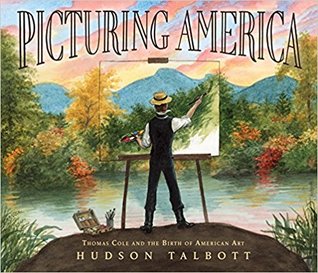
Picturing America: Thomas Cole and the Birth of American Art

Picturing America: Thomas Cole and the Birth of American Art. Hudson Talbott. 2018. Penguin. 32 pages. [Source: Review copy]

First sentence: Thomas Cole was a curious boy.

Premise/plot: Picturing America is a picture book biography of Thomas Cole an American landscape artist. It is an excellent introduction to his art and the man himself. To learn more readers can visit: http://www.explorethomascole.org/  or https://www.wikiart.org/en/thomas-cole

My thoughts: I found Picturing America to be a fascinating book. I am not an art enthusiast. I know very little about art--American or otherwise. I found the book to be a compelling read. Cole makes for an intriguing subject. The more I read, the more I wanted to know.

Text: 5 out of 5
Illustrations: 5 out of 5
Total: 10 out of 10

© 2018 Becky Laney of Becky's Book Reviews

Wednesday, May 18, 2016

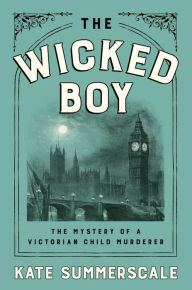
The Wicked Boy

The Wicked Boy: The Mystery of the Victorian Child Murderer. Kate Summerscale. 2016. [July] Penguin. 352 pages. [Source: Review copy]

Because I was expecting to love, love, love it, I find myself a bit disappointed in Kate Summerscale's latest book. I think if I'd had reasonable expectations of it, it would have proved much more satisfying to me!

I did enjoy reading her newest book. I love reading nonfiction about Victorian England. And this is a true-crime book, which should prove appealing enough to readers.

Who is the "Wicked" Boy and was he really, truly wicked?! The subject of this one is Robert Coombes. He was convicted of murdering his mother, Emily Coombes. He didn't exactly try to cover it up. He left her dead body on the bed, exactly where he stabbed her. He left the bloody knife on the bed as well. He merely locked the door to his mother's room, told his brother he'd killed their mother, and both boys went about their business. Not just for a day or two--but for a week or two. When the smell brought persistent visitors--his mother's friends--and the police to the house, he confessed openly that he did it. He was a boy, and, perhaps not quite sane.

In any case, readers learn about his life before and after the murder; the trial, his time in prison/asylum, his release, his eventual immigration to Australia, his time as a soldier in World War I, etc. Everything is placed into context. The book has dozens of little history lessons in it, little asides that take you off the path, if you will, but ultimately lead you back on it again.

The last section of the book goes behind the scenes in the writing and researching of the book. This section helped me appreciate the book more and make sense of the rambling. In other words, knowing the author's purpose and how she saw things helped me to like the book more.

The trial took place in the mid 1890s. He was released from the prison/asylum a few years before World War I started. He moved to Australia before the war started as well. He joined up as soon as England declared war. He was a musician in his regiment's band. There were lots of little details and asides that add depth to this one. But. It isn't a particularly quick and absorbing read.

© 2016 Becky Laney of Becky's Book Reviews

Tuesday, May 17, 2016

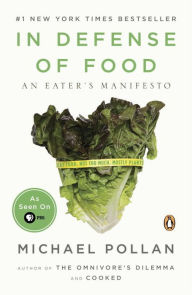
In Defense of Food

In Defense of Food. Michael Pollan. 2008. Penguin. 205 pages. [Source: Library]

After watching the documentary In Defense of Food, I sought out the book. The documentary was released several years after the book, and, it may be a little more up-to-date, in my opinion. It also benefits from the video format. It is engaging, fascinating, and fun. The documentary is able to use photographs, print ads, and commercials throughout. That being said, there is something to be said for the book itself. One can read it at your own pace, slowly digesting the information within, and rereading if necessary to make sure you've truly gotten what you needed.

The book is divided into three sections: "The Age of Nutritionism," "The Western Diet and the Diseases of Civilization," and "Getting Over Nutritionism."

So. The book is an "eater's manifesto," and it begins with seven glorious words: Eat food. Not too much. Mostly plants. Pollan explains those seven words in the final section of the book. Also in the introduction.

The book explores the question: what should I eat? what should I eat to be healthy? He points out that there is something unnatural about even having to ask--a sign that our culture and society has been damaged or upset. Until recently, people everywhere have known what to eat, and relied upon culture and tradition and common sense. It is only in the past century that this question has been taken over by so-called experts--scientists, doctors, politicians, food marketers, etc. Or perhaps I should say it's only in the past century that the majority have people have decided to follow so-called expert advice.

Other questions addressed in the book:
  • What is the Western diet? How did it come to be? What role has technology and new science played in food production?
  • What diseases are linked to the Western diet?
  • What health risks exist in the present and the future for those on the Western diet?
  • What are the alternatives to the Western diet? In other words, how, does one escape eating the Western diet?
  • What is nutritionism? How does it differ from nutrition or nutrition science?
  • How does one know who to trust and what to eat?
  • Can common sense save you after all?
  • What is food? How does "food" differ from "edible-foodlike substances" that you find in grocery stores and restaurants?
  • What should you be buying? What should you be eating?
  • Is it easy to eat healthy? Or difficult?

The book is a true must-read. Or. Perhaps the documentary is the true must?! I haven't made up my mind which is best. What I love is embracing common sense and grounding everything in reality. It isn't snarky or pessimistic. It is encouraging and inspiring.

From the introduction:
My aim in this book is to help us reclaim our health and happiness as eaters. To do this requires an exercise that might at first blush seem unnecessary, if not absurd: to offer a defense of food and the eating thereof... I contend that most of what we're consuming today is no longer, strictly speaking, food at all, and how we're consuming it--in the car, in front of the TV, and increasingly, alone--is not really eating, at least not in the sense that civilization has long understood the term. (7)
That eating should be foremost about bodily health is a relatively new and, I think, destructive idea--destructive not just of the pleasure of eating, which would be bad enough, but paradoxically of our health as well. Indeed, no people on earth worry more about the health consequences of their food choices than we Americans do--and no people suffer from as many diet-related health problems. We are becoming a nation of orthorexics: people with an unhealthy obessession with healthy eating. (9)
From part one:
The first thing to understand about nutritionism is that it is not the same thing as nutrition. As the "-ism" suggests, it is not a scientific subject but an ideology...A reigning ideology is a little like the weather--all pervasive and so virtually impossible to escape. Still we can try. In the case of nutritionism, the widely shared but unexamined assumption is that the key to understanding food is indeed the nutrient. Put another way: Foods are essentially the sum of their nutrient parts. From this basic premise flow several others. Since nutrients, as compared with foods, are invisible and therefore slightly mysterious, it falls to the scientists (and to the journalists through whom the scientists reach the public) to explain the hidden reality of foods to us. In form this is a quasireligious idea, suggesting the visible world is not the one that really matters, which implies the need for a priesthood. For to enter a world where your dietary salvation depends on unseen nutrients, you need plenty of expert help. (28).

We eaters, alas, don't reap nearly as much benefit from nutritionism as food producers. Beyond providing a license to eat more of the latest approved foodlike substance, which we surely do appreciate, nutritionism tends to foster a great deal of anxiety around the experience of shopping for food and eating it. (53)
From part two:
A diet based on quantity rather than quality has ushered a new creature onto the world stage: the human being who manages to be both overfed and undernourished, two characteristics seldom found in the same body in the long natural history of our species. (122)
From part three:
Don't eat anything your great-grandmother wouldn't recognize as food. (148)
Avoid food products that make healthy claims. (154)
Shop the peripheries of the supermarket and stay out of the middle. (157)
Eat meals (188).
Do all your eating from a table (192).


© 2016 Becky Laney of Becky's Book Reviews

Friday, March 04, 2016

A Pig, A Fox, and a Box

A Pig, A Fox, and a Box. Jonathan Fenske. 2015. Penguin. 32 pages. [Source: Library]

Did I enjoy reading A Pig, A Fox, and a Box? Yes and no. No, in that I'm not the intended audience for it, and, it wasn't quite my type of book. I didn't really "like" the illustrations. Yes, in that it was a good, solid book for young readers.

Readers meet two characters: Fox and Pig. Readers quickly see that Fox is tricksy. He is a kidder, a joker. He really, really WANTS to fool his friend, Pig. Time and time again, the joke is on FOX and not Pig after all. So it was FUN in a way.

Here's how it begins: "I am Fox. I am Pig. I am little. I am big. I have a box. I like to play. I think I will trick Pig today."

© 2016 Becky Laney of Becky's Book Reviews

Tuesday, February 16, 2016

Confessions of an Imaginary Friend

Confessions of an Imaginary Friend. Michelle Cuevas. 2015. Penguin. 176 pages. [Source: Library]

Did I enjoy Michelle Cuevas' Confessions of An Imaginary Friend? Yes, for the most part. It is narrated by an imaginary friend who, at first, has no idea that he is imaginary. His name is Jacques Papier.

So the book is a "coming of age" story for an imaginary friend. If he's not "real" if he's the product of someone's very active imagination, then does he "really" exist at all. If he's not real, what is he, if anything? Can he stop being *her* imaginary friend, and, become someone himself? What does freedom for an imaginary friend look like? And what happens to imaginary friends when the child that imagines them grows up? Where do they go? What do they do? Do they cease to exist? Or are they in some way reborn? We get answers to most of these questions at least. And we meet some interesting people...some real...some imaginary like our hero.

The book, as a whole, reminded me of The Miraculous Journey of Edward Tulane. And I mean that in the best way possible; I know not everyone is a fan of Edward Tulane.

I liked it. I did. I definitely liked it. I'm not sure at this point if it's love, LOVE. But it was cute.

© 2016 Becky Laney of Becky's Book Reviews

Sunday, August 16, 2015

The Life of Charlotte Bronte (1857)

The Life of Charlotte Bronte. Elizabeth Gaskell. 1857/1975. Penguin Classics. 623 pages. [Source: Bought]

I should have read it years ago. I really should have. I simply loved, loved, loved Elizabeth Gaskell's biography of Charlotte Bronte. Yes, it's packed with information on the Brontes. But it's more than that. It's how this information is conveyed, it's how the story is written that makes it a compelling read. Not many biographies are impossible to put down. This one was. Gaskell, in many ways, let Charlotte Bronte speak for herself by sharing so many letters or excerpts from letters. One really gets a sense of "knowing" from reading it. And that isn't always the case with biographies, though it is sometimes the case with autobiographies. I appreciated Gaskell's narrative voice very much. It was a real treat. Anyone who loves Victorian literature should read this one. Or anyone who loves Jane Eyre or any other Bronte novel.

Quotes:
I read for the same reason that I ate or drank; because it was a real craving of nature. I wrote on the same principle as I spoke--out of the impulse and feelings of the mind; nor could I help it, for what came, came out, and there was the end of it. ~ Charlotte Bronte in a letter to Mr. Wordsworth, 1837
It is very edifying and profitable to create a world out of your own brains, and people it with inhabitants, who are so many Melchisedecs, and have no father nor mother but your own imagination. ~ Charlotte Bronte, 1840
Some of my greatest difficulties lie in things that would appear to you comparatively trivial. ~ Charlotte Bronte, 1841
Write to me often; very long letters. It will do both of us good. ~ Charlotte Bronte, 1841
If I could, I would always work in silence and obscurity, and let my efforts be known by their results. ~ Charlotte Bronte, 1841
They wanted learning. They came for learning. They would learn. Where they had a distinct purpose to be achieved in intercourse with their fellows, they forgot themselves; at all other times they were miserably shy. ~ Elizabeth Gaskell about Charlotte and Emily going to Brussells 
Any one who has studied her writings,—whether in print or in her letters; any one who has enjoyed the rare privilege of listening to her talk, must have noticed her singular felicity in the choice of words. She herself, in writing her books, was solicitous on this point. One set of words was the truthful mirror of her thoughts; no others, however apparently identical in meaning, would do. She had that strong practical regard for the simple holy truth of expression, which Mr. Trench has enforced, as a duty too often neglected. She would wait patiently searching for the right term, until it presented itself to her. It might be provincial, it might be derived from the Latin; so that it accurately represented her idea, she did not mind whence it came; but this care makes her style present the finish of a piece of mosaic. Each component part, however small, has been dropped into the right place. She never wrote down a sentence until she clearly understood what she wanted to say, had deliberately chosen the words, and arranged them in their right order. Hence it comes that, in the scraps of paper covered with her pencil writing which I have seen, there will occasionally be a sentence scored out, but seldom, if ever, a word or an expression. She wrote on these bits of paper in a minute hand, holding each against a piece of board, such as is used in binding books, for a desk. This plan was necessary for one so short-sighted as she was; and, besides, it enabled her to use pencil and paper, as she sat near the fire in the twilight hours, or if (as was too often the case) she was wakeful for hours in the night. Her finished manuscripts were copied from these pencil scraps, in clear, legible, delicate traced writing, almost as easy to read as print. ~ Elizabeth Gaskell about Charlotte Bronte's writing habits
Even at the risk of appearing very exacting, I can't help saying that I should like a letter as long as your last, every time you write. Short notes give one the feeling of a very small piece of a very good thing to eat,—they set the appetite on edge, and don't satisfy it,—a letter leaves you more contented; and yet, after all, I am very glad to get notes; so don't think, when you are pinched for time and materials, that it is useless to write a few lines; be assured, a few lines are very acceptable as far as they go; and though I like long letters, I would by no means have you to make a task of writing them. . . . ~ Charlotte Bronte, 1847
If "Jane Eyre" has any solid worth in it, it ought to weather a gust of unfavourable wind. ~ Charlotte Bronte, 1847
If I ever DO write another book, I think I will have nothing of what you call 'melodrama;' I think so, but I am not sure. I THINK, too, I will endeavour to follow the counsel which shines out of Miss Austen's 'mild eyes,' 'to finish more and be more subdued;' but neither am I sure of that. When authors write best, or, at least, when they write most fluently, an influence seems to waken in them, which becomes their master—which will have its own way—putting out of view all behests but its own, dictating certain words, and insisting on their being used, whether vehement or measured in their nature; new-moulding characters, giving unthought of turns to incidents, rejecting carefully-elaborated old ideas, and suddenly creating and adopting new ones. ~ Charlotte Bronte, 1848
Every one has a right to form his own conclusion respecting the merits and demerits of a book. I complain not of the judgment which the reviewer passes on "Jane Eyre." Opinions as to its tendency varied then, as they do now. While I write, I receive a letter from a clergyman in America in which he says: "We have in our sacred of sacreds a special shelf, highly adorned, as a place we delight to honour, of novels which we recognise as having had a good influence on character OUR character. Foremost is 'Jane Eyre.' ~ Elizabeth Gaskell on book reviews
I wish you did not think me a woman. I wish all reviewers believed 'Currer Bell' to be a man; they would be more just to him. You will, I know, keep measuring me by some standard of what you deem becoming to my sex; where I am not what you consider graceful, you will condemn me. All mouths will be open against that first chapter; and that first chapter is true as the Bible, nor is it exceptionable. Come what will, I cannot, when I write, think always of myself and of what is elegant and charming in femininity; it is not on those terms, or with such ideas, I ever took pen in hand: and if it is only on such terms my writing will be tolerated, I shall pass away from the public and trouble it no more. Out of obscurity I came, to obscurity I can easily return. Standing afar off, I now watch to see what will become of 'Shirley.' My expectations are very low, and my anticipations somewhat sad and bitter; still, I earnestly conjure you to say honestly what you think; flattery would be worse than vain; there is no consolation in flattery. As for condemnation I cannot, on reflection, see why I should much fear it; there is no one but myself to suffer therefrom, and both happiness and suffering in this life soon pass away. ~ Charlotte Bronte, 1849
You say that you suspect I have formed a large circle of acquaintance by this time. No: I cannot say that I have. I doubt whether I possess either the wish or the power to do so. A few friends I should like to have, and these few I should like to know well. ~ Charlotte Bronte, 1850
I have read Tennyson's 'In Memoriam,' or rather part of it; I closed the book when I had got about half way. It is beautiful; it is mournful; it is monotonous. ~ Charlotte Bronte, 1850
It is my intention to write a few lines of remark on 'Wuthering Heights,' which, however, I propose to place apart as a brief preface before the tale. I am likewise compelling myself to read it over, for the first time of opening the book since my sister's death. Its power fills me with renewed admiration; but yet I am oppressed: the reader is scarcely ever permitted a taste of unalloyed pleasure; every beam of sunshine is poured down through black bars of threatening cloud; every page is surcharged with a sort of moral electricity; and the writer was unconscious of all this—nothing could make her conscious of it. And this makes me reflect,—perhaps I am too incapable of perceiving the faults and peculiarities of my own style. ~ Charlotte Bronte, 1850
You charge me to write about myself. What can I say on that precious topic? My health is pretty good. My spirits are not always alike. Nothing happens to me. I hope and expect little in this world, and am thankful that I do not despond and suffer more. ~ Charlotte Bronte, 1851
Even if it should turn out reasonably well, still I regard it as ruin to the prosperity of an ephemeral book like a novel, to be much talked of beforehand, as if it were something great. People are apt to conceive, or at least to profess, exaggerated expectation, such as no performance can realise; then ensue disappointment and the due revenge, detraction, and failure.~ Charlotte Bronte, 1852

© 2015 Becky Laney of Becky's Book Reviews

Friday, June 12, 2015

The Far Side of Evil

The Far Side of Evil. Sylvia Engdahl. 1971/2003. Penguin. 336 pages. [Source: Library]

The wind is howling through the trees outside, a cold, hateful wind. By standing on the bunk I can just barely reach the window. It's quite dark now, and the stars are brilliant, though they seem terribly far away. They, at least, are familiar and comforting, a reminder of home.
Elana, our heroine, has just graduated from the Federation Anthropological Service Academy. Her first "official" assignment has her going undercover on the youngling planet, Toris. The planet is in the "Critical Stage," and the Federation is sending dozens of agents in undercover. It's an information gathering mission, not one of intervention. The goal: blend in as much as possible with the Younglings, and transmit your observations when possible. It's dangerous because if Toris goes critical--uses nuclear weapons--then all the agents are essentially just as doomed as the younglings themselves. The only other agent Elana knows is another recent graduate. His name is Randil. He's a mess.

Toris has two "warring" governments, which is putting the planet in "Critical Stage." Elana's cover gets blown, and she's captured as a spy. The book is her report of how she become imprisoned and how she's handling the daily torture.

The premise of Far Side of Evil is simple. All civilizations--all planets--evolve through a critical stage, a stage where they choose to use their technology for weapons--nuclear warfare--or they choose to use their technology to go to the stars, to explore and colonize space.

Did I like The Far Side of Evil? Not really. Why? That's a good question. Was it because the chapters were way too long? Perhaps. Was it because it lacked the charm of The Enchantress From the Stars? Perhaps. I will say that Enchantress from the Stars has an almost fairy-tale feel to it in places. It reads like a fantasy book. Was it Randil's fault? Probably. He certainly proves irritating and infuriating. But it wasn't his fault alone. I also found Elana's narration to be less than ideal. I found her to be smug, arrogant, condescending, and repetitive. Why was Elana so likeable in Enchantress from the Stars and so unlikeable in Far Side of Evil? I think in the first book she was more vulnerable, and less confident in her abilities. She wasn't alone. She was acting under the advice of other older-and-wiser Federation agents, including her father. Both books are premise-driven to a certain extent; but Far Side of Evil is only premise-driven, and Enchantress from the Stars is plot-driven and character-driven too.

© 2015 Becky Laney of Becky's Book Reviews

Sunday, May 17, 2015

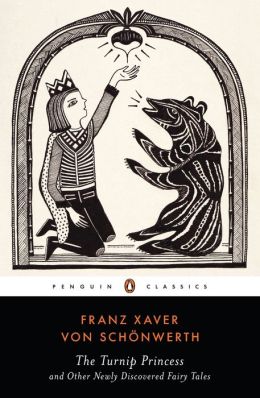
Turnip Princess and Other Newly Discovered Fairy Tales

The Turnip Princess and Other Newly Discovered Fairy Tales. Franz Xaver Von Schonwerth. Translated by Maria Tatar. 2015. Penguin. 288 pages. [Source: Review copy]

I loved reading this collection of newly discovered fairy tales. Franz Xaver Von Schronwerth was a contemporary of  the Grimm brothers. His fairy tales were collected in the 1850s in Bavaria. His manuscripts were recently rediscovered--or discovered--and translated into English.

The book is divided into six sections: "Tales of Magic and Romance," "Enchanted Animals," "Otherworldly Creatures," "Legends," "Tall Tales and Anecdotes," and "Tales About Nature." Some sections have more stories than others.

Most of the stories tend to be short. How short is short? Well, the shortest in the collection are just one page. (Plenty are three pages or so.)

Commentary is provided for each story at the back of the book. The commentary provides context for the story, often describing the type of story it is, and what other stories it's like. 

I found the book to be a quick read and a delightful one. I enjoyed reading all the stories. It was a fun way to spend the weekend.

Is it for children? No. Probably more for adults. But I think that's a good thing. Adults need treats too.

The Turnip Princess
One day a prince lost his ways in the woods. He found shelter in a cave and slept there for the night. When he woke up, an old woman was hovering over him. She had a bear by her side and treated it like a pet dog. The old woman was very kind to the prince. She wanted him to live with her and become her husband. The prince did not like her at all, but he was unable to leave. (3)
The Talking Bird, The Singing Tree, and The Sparkling Stream
A nobleman had three daughters, each more beautiful than the next. One day the girls were sitting in the royal gardens, chattering away about their wishes and dreams. The eldest wanted to marry the king's counselor, the second hoped to marry his chamberlain, and the third declared that she would be quite satisfied with the king himself. It happened that the king was also in the gardens, and he overheard the entire conversation. He summoned the three sisters to ask them what they had been talking about in the garden. The first two confessed everything; the youngest was less eager to do so. But then all at once the king declared: "Your three wishes will be granted." (71)
The Three Spindles
A young farmer's daughter got herself in trouble, and her parents threw her out of the house. She wandered around aimlessly until finally, in desperation, she sat down on a tree stump with three crosses carved into it. She began to weep. Suddenly a wood sprite raced toward her, pursued by a group of frenzied hunters. The girl jumped to her feet to make room for the sprite, for she knew that it would find safety there from what where known as the devil's hunters, hordes of demons that rode in with the winter storms. (107)
The Mouse Catcher, or, The Boy and the Beetle
Once there was a village so badly infested with mice that no one knew what to do. A stranger arrived in town and told the farmers that he would be able to get rid of the mice. They promised him a generous reward in return. The stranger pulled out a little whistle and blew into it. All the mice in the village ran after the man, who took them to a big pond, where they all drowned. The stranger returned to the village and asked for his reward. But the farmers refused to give him the full amount. The man blew into another little whistle, and this time all the children in the village came running after him. (175)
The Talker
There once lived a couple, and they were both stupid is as stupid does. The wife ruled the roost, and one day she sent her husband to the marketplace to sell their cow. "Whatever you do, don't sell it to talker," she shouted as he was going out the door. "Did you hear me? Don't sell it to talker." Her husband promised to do just as she had said. (187)
Sir Wind and His Wife
The wind and his wife were both present at the creation of the world. The two were overweight, and on top of that, Sir Wind had a long beard that wrapped around his body three times. Still, both were able to pass easily through a mere crack in a wall, or any opening at all, for that matter. (205)
© 2015 Becky Laney of Becky's Book Reviews

Saturday, March 28, 2015

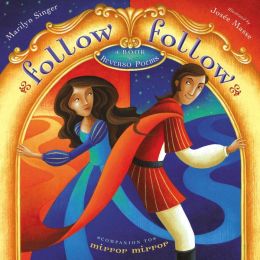
Follow Follow (2013)

Follow  Follow. A Book of Reverso Poems. (Companion to Mirror Mirror) Marilyn Singer. Illustrated by Josee Masse. 2013. Penguin. 32 pages. [Source: Library]

I loved, loved, LOVED reading Marilyn Singer's Follow Follow. If you love fairy tales, you MUST read Follow Follow. If you love good poetry, you MUST read Follow Follow. If you're new to reverso poems, to the concept of this form of poetry, you should really read Follow Follow or its companion Mirror Mirror. I love how the form itself is so engaging. It takes poetry to a whole new level for me! (It may do the same for you. I hope it does!)

Author's note:
The reverso, a form I created, is made up of two poems. Read the first down and it says one thing. Read it back up, with changes only in punctuation and capitalization, and it means something completely different. When you flip the poem, sometimes the same narrator has a different point of view. Other times, there is another narrator all together.
The poems:
  • Your Wish Is My Command (Aladdin)
  • Birthday Suit (The Emperor's New Clothes)
  • Silly Goose (The Golden Goose)
  • Ready, Steady, Go (The Tortoise and the Hare)
  • Will the Real Princess Please Stand Up (The Princess and the Pea)
  • The Little Mermaid's Choice (The Little Mermaid)
  • Panache (Puss in Boots)
  • Follow Follow (The Pied Piper)
  • No Bigger Than Your Thumb (Thumbelina)
  • Can't Blow This House Down (The Three Little Pigs)
  • The Nightingale's Emperor (The Nightingale)
  • On With The Dance (The Twelve Dancing Princesses)
I think I LOVED almost all of the poems. There were a few that I LOVED, LOVED, LOVED however.

The Little Mermaid's Choice

For love,
give up your voice.
Don't
think twice.
On the shore,
be his shadow.
Don't
keep your home
in the unruly sea.
Be docile.
You can't
catch him
playing
"You'll never catch me!"

You'll never catch me
playing
"Catch him."
You can't
be docile
in the unruly sea.
Keep your home.
Don't
be his shadow
on the shore.
Think twice!
Don't
give up your voice
for love.

Reading these poems is just a JOY. I love how engaging it is. How it makes you think and reflect on the familiar stories. I love how the poems play around with voice and perspective!!! So very clever!

Read this book!!!


© 2015 Becky Laney of Becky's Book Reviews

Thursday, March 19, 2015

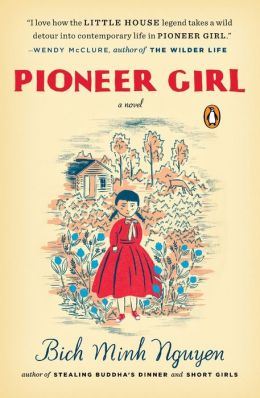
Pioneer Girl

Pioneer Girl. Bich Minh Nguyen. 2014/2015. Penguin. 296 pages. [Source: Review copy]

At first, I wanted to love Pioneer Girl. I then settled for wanting to like it. It has an interesting premise: A Vietnamese coming-of-age story with a Little House connection. Lee grew up reading the Little House books. She may not want to admit to liking or loving the TV show, but, the books she loves, has always loved. Her parents came from Vietnam to America in the 1970s. She was born and raised in the Midwest. Her parents, particularly her mother and her grandfather, were almost always in the restaurant business: managing bad buffets mostly. The older she got the more she wanted to distance herself.

So where is the connection to Laura Ingalls Wilder?! Well, her grandfather brought a gold pin with him to America. It was a pin that had belonged to an older woman, a white woman, a reporter doing a story on the war. Lee, as an adult, is convinced that woman was Rose Wilder Lane. Furthermore, she has a feeling that the pin is *the* pin described in These Happy Golden Years, a gift from Almanzo to Laura. The novel also introduces a "what-if" mystery.

The book drifts between her structured thoughts on Laura Ingalls Wilder, Rose Wilder Lane, and the Little House books AND her own meaningless (at least in the moment as she sees it) life. She's a twenty-something young woman, still sorta in school, but wanting to find something more in life: a good job would be nice, but validation maybe that she's made it. Lots of family drama. Bit of angst. These two focuses connect now and then. Lee travels and does research. Or should I just call it what it is: theft.

The BIG, BIG, BIG problem I have with the novel is Lee herself. Lee goes to a library with a special research collection: Lee steals a photograph from the collection. Lee goes to a museum: Lee not only breaks the rules and enters rooms she's not supposed to enter at all, but, she steals more stuff. A letter. A first edition book with scribbles/notes from Rose. Does she have a guilty conscience? No! In fact, she's proud and thinks herself the cleverest of all. I exaggerate perhaps. But the fact that she does think herself super-clever and is proud of what she's done and tells of her exploits says something about her character.

Pioneer Girl is a new adult novel. It's a thoughtful novel, reflective in places. Lee poses a good question now and then, seeking insight into deeper matters. But the book left me unsatisfied. I do LOVE the cover however.

© 2015 Becky Laney of Becky's Book Reviews

Thursday, January 15, 2015

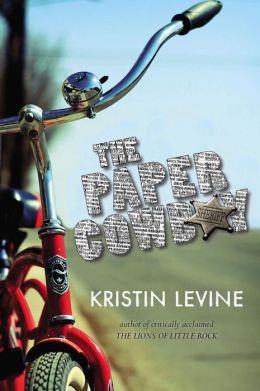
The Paper Cowboy (2014)

The Paper Cowboy. Kristin Levine. 2014. Penguin. 352 pages. [Source: Library]

"Hands up!"
My best friend, Eddie Sullivan, had a newspaper rolled and pointed at me like a gun. He was only twelve, but over the summer he'd grown so much, he looked big enough to be in high school. 

I've yet to be disappointed by Kristin Levine's fiction. I loved, loved, loved The Best Bad Luck I Ever Had. I loved, loved, loved The Lions of Little Rock. I still would love to find time to reread both books. Her newest book is The Paper Cowboy. The author's note reveals much: The Best Bad Luck I Ever Had is loosely based on her maternal grandfather's memoirs; The Lions of Little Rock was inspired by her mother's childhood in Arkansas. This newest book? Well, it is based on/influenced by her father's childhood. It is set during the McCarthy era, when the threat of communist spies was very strong no matter how big or small the community.

I'm tempted to keep it brief: READ THIS. But would that do it justice? Probably not. But I don't want to give away too much either.

I love The Paper Cowboy for its humanity. It almost aches with its humanity. There's not one perfect, flawless character within. Tommy, the protagonist, is far from perfect. In fact, he's a bit of a bully. But it's almost impossible to keep standing in judgment of Tommy once you get a glimpse of his home life. Time and time again, readers see a powerless Tommy in heartbreaking situations.

I love The Paper Cowboy for its look at family life. Every member of the family is fully developed. (Well, perhaps with the exception of the baby. Tommy's youngest sister is just three months old when the novel opens!!!) But one really gets relationships in this book. Tommy in relationship with his dad, with his mom, with his older sister, with his younger sisters. And the relationships--no matter if they're "good" or "healthy" or not-so-much, the relationships feel completely authentic. The sibling Tommy is closest to is his sister, Mary Lou, who is badly burned--an accident--near the start of the novel.

I love The Paper Cowboy for its sense of community. I loved getting to know folks in his community. Particularly, I loved his developing relationships with several adults within the community: Mr. McKenzie and Mrs Glazov, Mrs. Scully and Pa and Ma Konecky. I just came to CARE for all the characters, no matter how 'minor.' For example, Mrs. Glazov never felt 'minor' to me at all! I just LOVED, LOVED, LOVED her.

I love The Paper Cowboy for its look at friendship and school life and even bullying. I didn't "love" the book because of its examination or treatment on bullying. I wasn't seeking out a book on bullying. I certainly wasn't expecting a book on the subject of bullying told primarily from the bully's point of view. But sometimes a book just finds you, you don't have to seek it out. I do think it's interesting to consider Tommy as a whole person. Yes, at recess at his school, he can pick on his classmates and get away with it because he has a way with his teachers. But the reader sees deeper and sees beneath the surface. Yes, absolutely Tommy's actions are just WRONG. But when a character is fleshed out so completely, so thoroughly that compassion may just come easier than judgment. One friendship comes about so slowly that it deserves attention. I loved the character of Sam McKenzie. 

I love The Paper Cowboy because its one that makes you feel--sometimes so much it leaves you aching. It's an emotionally intense read. There are just some TOUGH moments to witness in this coming-of-age novel.

© 2015 Becky Laney of Becky's Book Reviews

Sunday, January 11, 2015

Millions of Cats (1928)

Millions of Cats. Wanda Gag. 1928. Penguin. 40 pages. [Source: Library]

Once upon a time there was a very old man and a very old woman. They lived in a nice clean house which had flowers all around it, except where the door was. But they couldn't be happy because they were so very lonely. 
"If we only had a cat!" sighed the very old woman. "A cat?" asked the very old man. "Yes, a sweet little fluffy cat," said the very old woman. "I will get you a cat, my dear," said the very old man.
And he set out over the hills to look for one. 

Millions of Cats is a Newbery Honor book from 1929.

Premise/Plot: A very old man and a very old woman long for a cat. The husband goes on a quest to bring back a "sweet little fluffy cat" to please them both. Is his quest successful? Yes. A little too successful. For in fact he finds
Cats here, cats there,
Cats and kittens everywhere,
Hundreds of cats,
Thousands of cats,
Millions and billions and trillions of cats.
How is he ever to choose just ONE cat from so many?! Especially since as he picks up or pets each one he sees, he finds it to be the prettiest cat. He can't bring himself to leave any of the cats behind. But it isn't practical to bring home hundreds, thousands, millions, billions, and trillions of cats. You can probably guess what his wife's response will be! Surely, they can't keep them all. For better or worse, he lets the cats decide amongst themselves. One scrawny cat remains, but, it may be the best one of all.

My thoughts: I loved this one growing up. I loved the repetition. I thought it was a fun story. I didn't--at the time--take the man's conclusion that the trillions of cats ate each other up literally. Is the book violent? Perhaps. Perhaps not. See for yourself.  "They bit and scratched and clawed each other and made such a great noise that the very old man and the very old woman ran into the house as fast as they could. They did not like such quarreling." This one might pair well with Eugene Field's "The Duel." (The gingham dog and the calico cat).

Have you read Millions of Cats? Did you like it? love it? hate it?

© 2015 Becky Laney of Becky's Book Reviews

Wednesday, April 30, 2014

Poem Depot: Aisles of Smiles (2014)

Poem Depot: Aisles of Smiles. Douglas Florian. 2014. Penguin. 160 pages. [Source: Library]

I loved, loved, loved Douglas Florian's Poem Depot: Aisles of Smiles. I just LOVED it. After finding five or six poems that I loved, I thought this one would be well worth recommending. But as I kept reading, I kept finding more and more poems to LOVE. This isn't a "good" collection with a handful of poems to love. Generally, that is how I think of poetry books: find one with a handful of poems to LOVE, really LOVE, and you've got yourself a good book worth reading and rereading. To find a poetry book with so very many poems that you love and enjoy--poems with the potential to turn children of all ages into POETRY LOVERS--and you've got something magical, something worth GUSHING about!!! Poem Depot is worth gushing about!!!

Poems I Loved: "Insect Asides," "Driven," "More," "My Closet," "I Hate Broccoli," "Mean Meat Loaf," "Soup of the Day," "Water Water," "What A Monster Ate," "Hair Scare," "This Chair," "Where My Cat Sleeps," "Hold Your Horses," "I Am A Robot," "The Computers Are Down," "Zero," "Alphabetter," and "My Mother Has Two Voices."

Poems I Really Loved: "Train to Nowhere," "Exercise," "Appetite," "Alligator Calculator," "Rome and Room," "The Greatest Invention," and "Windshield Wipers."

© 2014 Becky Laney of Becky's Book Reviews

Thursday, January 02, 2014

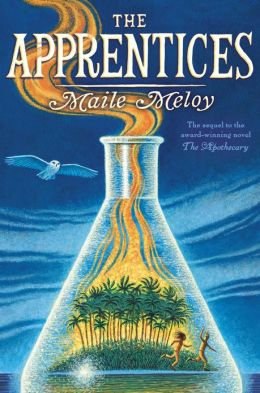
The Apprentices (2013)

The Apprentices. Maile Meloy. Illustrated by Ian Schoenherr. 2013. Penguin. 432 pages. [Source: Review Copy]

I still have mixed feelings on both books in this series. (The first book is The Apothecary). On the one hand, there are lovely little historical details in both books that make me want to love these books. (The books are set in the 1950s. The first book was mainly set in England. The second book is set in America and Asia. Multiple locations in Asia.) On the other hand, there is a fantasy element to be dealt with. A fantasy based on science, chemistry, and transformation. Main characters take potions to transform into birds in both books. Main characters take potions to be invisible, etc. In this one, there is a potion or recipe for long-distance telepathy. I found this strange to say the least. One can experience the world through-the-eyes-of-another. I had a hard time comprehending how this works, why this works; it was convenient to the story obviously. But my main issue was how romance factored into it. It just didn't work for me. For example, why does the hero send someone across the ocean to "protect" the heroine from a rival love-interest (a classmate, a waiter). It is like he's refusing to see the actual real threat right in front of his eyes; the truth is that she is in danger, in a dangerous position because she's blinded from real threats as well. But no one is really able to do anything right then and there to take her from the situation because the whole plot depends on her being the bait.

© 2014 Becky Laney of Becky's Book Reviews

Friday, April 19, 2013

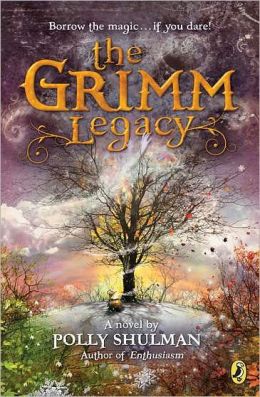
The Grimm Legacy (2010)

The Grimm Legacy. Polly Shulman. 2010. Penguin. 325 pages.

 The Grimm Legacy has an intriguing premise. Wouldn't it be fun if fairy tales were true and there were magical artifacts gathered together in a library collection in New York? Wouldn't it be fun to work in such a library, such a collection? To be able to 'try' some of these artifacts yourself. But it isn't all fun as our heroine, Elizabeth Rew, and her fellow pages (Marc Merrit, Anjali Rao, Aaron Rosendom) learn. For someone is attempting to steal the real magical objects and replace them with fakes. And the attempt is succeeding. These four teens (Elizabeth, Marc, Anjali, and Aaron) must learn to work together--despite great personality conflict--to solve the mystery of WHO is stealing from the Grimm Collection. This fantasy novel has mystery and drama for it's a dangerous task before them.

While I liked the book well enough to keep reading, I didn't love it. I just didn't make a good connection with the characters. Some of the characters were interesting; for example, Anjali has a very spirited sister that plays an important role in the novel. But I wasn't satisfied with their development; the characters just didn't feel believable enough.

Read The Grimm Legacy
  • If you enjoy YA fantasy
  • If you enjoy fantasy 
  • If you are interested in the second novel in the series which involves time travel! It's called The Wells Bequest!
© 2013 Becky Laney of Becky's Book Reviews

Tuesday, December 25, 2012

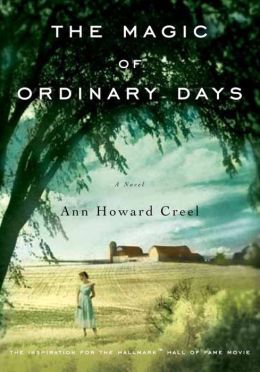
The Magic of Ordinary Days

The Magic of Ordinary Days. Ann Howard Creel. 2001. Penguin. 304 pages.

I picked this one up after watching the movie adaptation. I just loved the movie. It felt like it would be my kind of book too: set just in the right time period for me to love, World War II. But would I like the book or movie better?

Olivia (Livvy) Dunne finds herself married to a stranger, Ray Singleton--a farmer--after she finds herself in an unfortunate situation: she's pregnant. Her father arranges with another minister to marry off 'poor' Livvy to a good, stable man. The two meet on their wedding day. She asks him WHY he's willing to marry a stranger and IF he'll be able to love the baby. His answer surprises her, he feels it's God's will to bring them together, and, of course, he'll love her baby. It is the raising of a child that makes a father.

The novel chronicles their lives together that first year as she adjusts to an isolated country lifestyle, as she tries to find ways to occupy her time and grasp the fringes of her true dreams. She loves history and archaeology. She loves finding and discovering old things. She loves finding out about the past, imagining herself in that past. Ray is only a little helpful, it is Ray's sister, Martha, who is able to help her the most. For Martha has stories about their parents, grandparents, etc. It is Martha who is able to tell her about the settling of the place, the original structures built, how their family lived and worked and struggled to create a legacy for the family. And Livvy does see how very much Ray loves the farm, the land, the strong connection he feels to the past and present.

Livvy is lonely still, however. She becomes friendly with two Japanese women living at a nearby Japanese internment camp. She actually meets them in her own fields--for they have been hired to help with the harvest. It seems they are an answer to her prayers; they are so nice and friendly and pleasant to talk with. They even volunteer their tailoring services--providing her with a maternity dress and suit. But is the friendship genuine? I think it's as genuine as it can be since Livvy doesn't like being vulnerable and the two sisters almost by necessity don't feel comfortable telling all their secrets either. I'm not even sure Livvy realizes this until the end when she sees that by protecting herself, protecting her heart, always keeping things inside, she's keeping love out too.

Livvy's perspective provides insights to readers about what it was like to live during this time. Livvy tries to keep up with the war through newspapers--though she has to content herself with news that is a day or two old since the delivery is so slow. The travel restrictions also keep Livvy at home with Ray instead of allowing her to visit her family at Christmas and New Years--like she originally planned. ("I'll Be Home for Christmas" would have still been a 'new' Christmas song, having been done in 1943. "Have Yourself a Merry Little Christmas" would have been another 'new' holiday song first introduced in the 1944 musical, Meet Me in St. Louis. "The Christmas Song" was written in 1944, but not recorded until 1946.) 

I really enjoyed this novel. I loved Ray and Livvy. I loved Martha and her daughter too.

Read The Magic of Ordinary Days
  • If you like historical fiction with a touch of romance
  • If you like stories set during World War II
  • If you like rural/country stories set on farms
  • If you like marriage-of-convenience or arranged marriage stories 
  • If you enjoyed the movie

© 2012 Becky Laney of Becky's Book Reviews

Monday, August 27, 2012

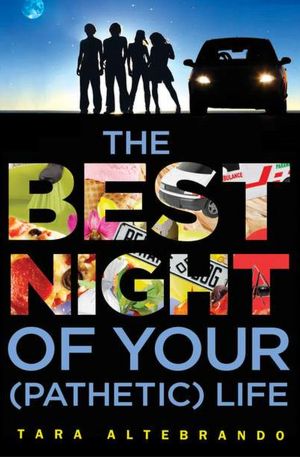
The Best Night of Your (Pathetic) Life (YA)

The Best Night of Your (Pathetic) Life. Tara Altebrando. 2012. Penguin. 304 pages.

It was exactly one forty-five when we pulled into The Pines--the old tree-dotted parking lot behind the football field. The was a sort of extreme blue that seemed just right. 

In The Best Night of Your (Pathetic) Life, Mary, Patrick, Dez, and Winter team up to participate in one of the final events of Senior Week. The event is an all-afternoon-all-night scavenger hunt, and readers will see teams in fierce competition with one another to win the coveted Yeti and the honor of masterminding next year's scavenger hunt. Mary is fierce, determined, and taking it a bit too seriously, in my opinion. Winning the scavenger hunt means a little something different for every team member. For Mary and in a way for the other members, it means that they are not losers, that they are not "also ran." It means being remembered, it means making memories worth remembering. It means finding your voice just in time to say goodbye to high school. So Mary does make a big symbol out of it, it is more than just a scavenger hunt to her.

So is it just about a scavenger hunt? Yes and no. I mean it's about relationships and feelings. It's about facing up to the truth and having tough conversations. For example, *something* happened between Patrick and Mary at prom that Mary does NOT want to talk about. And *something* happened between Carson and Winter at prom that Winter, at least, does NOT want to come out. (Could be because he has a girl friend, Jill, who is supposed to be part of their circle of friends. And "the truth" will not just hurt Jill, but Mary as well, since she's loved and adored Carson since he moved to town and joined their class.) But it isn't just romantic relationships at stake in Best Night of Your (Pathetic) Life. Friendships are tested as well as family relationships. Mary's sister, Grace, for example makes an appearance. (I almost wish we had more on Mary and her family.) So on the one hand, this book is seemingly about nothing: a harmless-or-not-so-harmless night of teens behaving wildly, collecting objects great and small. And their race for silly, novel items seems to me at least a bit silly and pointless and so what. (Then again, I've never gotten the "school spirit" or "team spirit" thing.) But on the other hand, there is a make-every-moment-count-because-this-night-will-never-come-around-again feel to it.

While I didn't love, love, love The Best Night Of Your (Pathetic) Life, I liked many things about it. I liked that it covers just one day. I liked that it didn't rush a romance or rush a relationship. There were a couple of directions this one could have gone in the hands of another writer. Mary could have been rushed into a relationship with the best friend after realizing that her crush was a jerk. Mary could have fallen for Lucas, a guy we learn is a student at the college Mary's going to in the Fall. (They do have a tiny bit of a connection, in my opinion). Mary could have tried to flirt her way into an oh-so-short-summer-fling with her crush. (He did seem to flirt with her a bit, but then again, I think he was flirting with a handful of girls.) But no, Mary is allowed to just be Mary, to take this time to grow a little herself. I like that Mary is almost forced into reflecting. Mary wants to avoid some things, but her friends push her to be honest and present, which Mary may not have wanted but I think she needed. I liked Patrick the best of all, I think. I am not sure that I liked Mary. And I didn't really feel a connection with Winter. And I felt we barely got to know Dez at all in any depth. I mean we see that he is someone his friends really care about, for the most part, though even they can be insensitive and blind. And Carson, well, Mary tries to make excuses for Carson as to why he's oh-so-wonderful, but actions do speak louder than words, perhaps. So in the end, I'm not sure I "liked" the characters as much as I'd have liked. But. I though this one did a nice job with complex relationships.

Read The Best Night Of Your (Pathetic) Life:
  • If you like YA Fiction, particularly YA Realistic Fiction
  • If you like the idea of the scavenger hunt 

© 2012 Becky Laney of Becky's Book Reviews
Tuesday, August 21, 2012

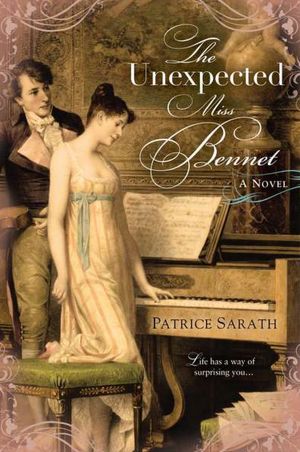
The Unexpected Miss Bennet

The Unexpected Miss Bennet. Patrice Sarath. 2011. Penguin. 304 pages.

It is a comforting belief among much of society, that a plain girl with a small fortune must have no more interest in matrimony than matrimony has in her. 

I loved this one. I just LOVED, LOVED, LOVED it. Set several years perhaps after the events of Pride and Prejudice, this novel shows the transformation of Mary Bennet. And the transformation is both believable and giddy-making. 

One day at a Lucas party, Mary is playing the piano. A young gentleman asks her to dance with him, before she can even start a reply someone cuts in and tells him that she is just Mary, she just plays the piano so others can dance, she isn't there to dance. Mary is puzzled at how this makes her feel. The fact that a man noticed her and wanted to dance with her, the fact that everyone assumed that Mary wouldn't want his attention or to dance, the fact that he took this answer and left to dance with someone else. Mary realizes that everyone has an idea of WHO Mary is and WHAT Mary does, and the ideas are very fixed. Mary wants to change that--one of the first things she does is to give up playing or practicing the piano. She starts taking more walks, she starts reflecting more on who she is and what she wants.

Around this same time, Jane starts worrying about her younger sister, Mary. She's already invited Kitty to spend some time with her and Bingley, so while she's not able to entertain her sister at this time, she's hoping that Elizabeth will be able to invite Mary to Pemberley.

At first, Mary accepts the invitation because she thinks Elizabeth is homesick and in need of one of her sisters, and she's happy to do her duty. But it doesn't take long for Mary to realize that Elizabeth is very happy indeed. For the first time, Mary sees what it would be like to live away from Mr. and Mrs. Bennet. For the first time, Mary reads a novel--or two or three. For the first time, Mary is happy. So when she gets a second opportunity with a certain gentleman who just happens to be an acquaintance of Mr. Darcy, she knows she'll dance. Of course, that's only a hint of what this one is about...

I enjoyed this one. I enjoyed what Sarath did with all the characters! Including Mr. and Mrs. Collins, Catherine de Bourgh and her daughter, Anne, etc. I definitely liked Mr. Aikens, the love interest of Mary, and I thought their courtship was just about right.

Read The Unexpected Miss Bennet
  • If you enjoy Jane Austen
  • If you love Pride and Prejudice
  • If you want Mary Bennet to have a happily ever after
  • If you like clean, historical romance 

© 2012 Becky Laney of Becky's Book Reviews

Tuesday, August 14, 2012

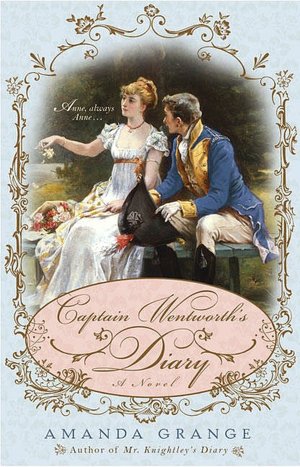
Captain Wentworth's Diary

Captain Wentworth's Diary. Amanda Grange. 2007. Penguin. 304 pages.

Thursday 5 June
At last I am on my way to Somerset!

I do like Amanda Grange's series, and, sometimes I really LOVE her books. But I didn't quite love Captain Wentworth's Diary. Persuasion is one of my favorite books, and definitely my favorite Jane Austen novel. I think I prefer the story from Anne's perspective.

Captain Wentworth's diary begins before he first meets Anne Elliot. The book portrays the courtship of the two, the sweet proposal, the bitter disappointment after she changes her mind. The novel then jumps ahead to Wentworth's successful return. Readers then see the events and scenes of Persuasion through Wentworth's eyes, for the most part. Though it's just a fraction of the story.

I liked this one. I felt Grange got the characters right, for the most part. And it was interesting to see their first meeting. Their first conversation was something. But. It just wasn't as amazing as Austen's original.

Read Captain Wentworth's Diary
  • If you're a fan of Amanda Grange 
  • If you're a fan of Jane Austen
  • If you like historical romances told in diary format 

© 2012 Becky Laney of Becky's Book Reviews