Showing posts with label 1857. Show all posts

Sunday, March 05, 2017

Barchester Towers

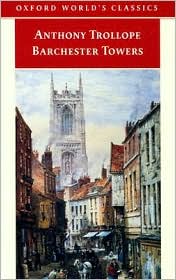
Barchester Towers. Anthony Trollope. 1857. 418 pages. [Source: Bought]

First sentence: Who Will Be the New Bishop? In the latter days of July in the year 185––, a most important question was for ten days hourly asked in the cathedral city of Barchester, and answered every hour in various ways — Who was to be the new bishop?

Premise/plot: Barchester Towers is the second book in the Chronicles of Barsetshire series by Anthony Trollope. Readers once again spend a good deal of time with Mr. Harding and his family: his daughter, Eleanor Bold (newly widowed), Susan Grantly (his daughter) and her husband Archdeacon Grantly. (His grandchildren are mentioned ever-so-briefly). New to the neighborhood are Dr. and Mrs. Proudie (the new bishop and the new bishop), Mr. Slope (the Proudies' private chaplain), the Stanhope family (notably Bertie, the disgraced son, Charlotte, the matchmaking daughter, and Madeline Neroni, the crippled and disgraced daughter who is a charming beauty), and last but not least Mr. Arabin, a new reverend. (Also towards the end of the novel we meet the Thornes).

What is this one about? The old bishop has died. A new bishop has been appointed. Dr. Proudie has two things working against him being well-liked in the neighborhood. First, his wife MRS. PROUDIE who dominates every room she's in--including her husband's office. She's the BOSS of the family, and her presumption is found distasteful by men and women alike. Second, Mr. Slope is in a serious battle with Mrs. Proudie to rule--dominate--Mr. Proudie and be the behind-the-scenes bishop. He's a comical character. (He is definitely more comical than Mr. Collins.) He wants EVERYTHING: money, power, and a beautiful wife. He loses no time in making enemies. Notably, Archdeacon Grantly HATES him head-to-toe. 

Plenty of courting goes on in this one. Eleanor Bold and Madame Neroni primarily receive most of the attention--wanted or not. 

My thoughts: This one is a GREAT novel. It's just a joy to read. 

Favorite quotes:
How much kinder is God to us than we are willing to be to ourselves!
It is not my intention to breathe a word against the character of Mrs. Proudie, but still I cannot think that with all her virtues she adds much to her husband’s happiness. The truth is that in matters domestic she rules supreme over her titular lord, and rules with a rod of iron. Nor is this all. Things domestic Dr. Proudie might have abandoned to her, if not voluntarily, yet willingly. But Mrs. Proudie is not satisfied with such home dominion, and stretches her power over all his movements, and will not even abstain from things spiritual.
He, therefore, — he, Mr. Slope, — would in effect be Bishop of Barchester. Such was his resolve, and to give Mr. Slope his due, he had both courage and spirit to bear him out in his resolution. He knew that he should have a hard battle to fight, for the power and patronage of the see would be equally coveted by another great mind — Mrs. Proudie would also choose to be Bishop of Barchester.
And now, had I the pen of a mighty poet, would I sing in epic verse the noble wrath of the archdeacon
“I don’t think I shall ever like that Mr. Slope,” said Mr. Harding. “Like him!” roared the archdeacon, standing still for a moment to give more force to his voice; “like him!” All the ravens of the close cawed their assent. The old bells of the tower, in chiming the hour, echoed the words, and the swallows flying out from their nests mutely expressed a similar opinion.
There is, perhaps, no greater hardship at present inflicted on mankind in civilized and free countries than the necessity of listening to sermons. No one but a preaching clergyman has, in these realms, the power of compelling an audience to sit silent and be tormented.
We are all too fond of our own voices, and a preacher is encouraged in the vanity of making his heard by the privilege of a compelled audience.
Believe me, my child, that Christian ministers are never called on by God’s word to insult the convictions, or even the prejudices of their brethren, and that religion is at any rate not less susceptible of urbane and courteous conduct among men than any other study which men may take up. 
“What,” said he to himself, “can a man’s religion be worth if it does not support him against the natural melancholy of declining years?”
We must talk, think, and live up to the spirit of the times, and write up to it too, if that cacoethes be upon us, or else we are nought.
Our doctrine is that the author and the reader should move along together in full confidence with each other.
There is no way of writing well and also of writing easily.
“Wars about trifles,” said he, “are always bitter, especially among neighbours. When the differences are great, and the parties comparative strangers, men quarrel with courtesy. What combatants are ever so eager as two brothers?”
It is ordained that all novels should have a male and a female angel and a male and a female devil. If it be considered that this rule is obeyed in these pages, the latter character must be supposed to have fallen to the lot of Mrs. Proudie. But she was not all devil. There was a heart inside that stiff-ribbed bodice, though not, perhaps, of large dimensions, and certainly not easily accessible.
There is no happiness in love, except at the end of an English novel. 
All of us who presume to teach are bound to do our utmost towards fulfilling our own lessons. 
But we should hardly judge by what we see — we see so very, very little. 

© 2017 Becky Laney of Becky's Book Reviews

Sunday, August 16, 2015

The Life of Charlotte Bronte (1857)

The Life of Charlotte Bronte. Elizabeth Gaskell. 1857/1975. Penguin Classics. 623 pages. [Source: Bought]

I should have read it years ago. I really should have. I simply loved, loved, loved Elizabeth Gaskell's biography of Charlotte Bronte. Yes, it's packed with information on the Brontes. But it's more than that. It's how this information is conveyed, it's how the story is written that makes it a compelling read. Not many biographies are impossible to put down. This one was. Gaskell, in many ways, let Charlotte Bronte speak for herself by sharing so many letters or excerpts from letters. One really gets a sense of "knowing" from reading it. And that isn't always the case with biographies, though it is sometimes the case with autobiographies. I appreciated Gaskell's narrative voice very much. It was a real treat. Anyone who loves Victorian literature should read this one. Or anyone who loves Jane Eyre or any other Bronte novel.

Quotes:
I read for the same reason that I ate or drank; because it was a real craving of nature. I wrote on the same principle as I spoke--out of the impulse and feelings of the mind; nor could I help it, for what came, came out, and there was the end of it. ~ Charlotte Bronte in a letter to Mr. Wordsworth, 1837
It is very edifying and profitable to create a world out of your own brains, and people it with inhabitants, who are so many Melchisedecs, and have no father nor mother but your own imagination. ~ Charlotte Bronte, 1840
Some of my greatest difficulties lie in things that would appear to you comparatively trivial. ~ Charlotte Bronte, 1841
Write to me often; very long letters. It will do both of us good. ~ Charlotte Bronte, 1841
If I could, I would always work in silence and obscurity, and let my efforts be known by their results. ~ Charlotte Bronte, 1841
They wanted learning. They came for learning. They would learn. Where they had a distinct purpose to be achieved in intercourse with their fellows, they forgot themselves; at all other times they were miserably shy. ~ Elizabeth Gaskell about Charlotte and Emily going to Brussells 
Any one who has studied her writings,—whether in print or in her letters; any one who has enjoyed the rare privilege of listening to her talk, must have noticed her singular felicity in the choice of words. She herself, in writing her books, was solicitous on this point. One set of words was the truthful mirror of her thoughts; no others, however apparently identical in meaning, would do. She had that strong practical regard for the simple holy truth of expression, which Mr. Trench has enforced, as a duty too often neglected. She would wait patiently searching for the right term, until it presented itself to her. It might be provincial, it might be derived from the Latin; so that it accurately represented her idea, she did not mind whence it came; but this care makes her style present the finish of a piece of mosaic. Each component part, however small, has been dropped into the right place. She never wrote down a sentence until she clearly understood what she wanted to say, had deliberately chosen the words, and arranged them in their right order. Hence it comes that, in the scraps of paper covered with her pencil writing which I have seen, there will occasionally be a sentence scored out, but seldom, if ever, a word or an expression. She wrote on these bits of paper in a minute hand, holding each against a piece of board, such as is used in binding books, for a desk. This plan was necessary for one so short-sighted as she was; and, besides, it enabled her to use pencil and paper, as she sat near the fire in the twilight hours, or if (as was too often the case) she was wakeful for hours in the night. Her finished manuscripts were copied from these pencil scraps, in clear, legible, delicate traced writing, almost as easy to read as print. ~ Elizabeth Gaskell about Charlotte Bronte's writing habits
Even at the risk of appearing very exacting, I can't help saying that I should like a letter as long as your last, every time you write. Short notes give one the feeling of a very small piece of a very good thing to eat,—they set the appetite on edge, and don't satisfy it,—a letter leaves you more contented; and yet, after all, I am very glad to get notes; so don't think, when you are pinched for time and materials, that it is useless to write a few lines; be assured, a few lines are very acceptable as far as they go; and though I like long letters, I would by no means have you to make a task of writing them. . . . ~ Charlotte Bronte, 1847
If "Jane Eyre" has any solid worth in it, it ought to weather a gust of unfavourable wind. ~ Charlotte Bronte, 1847
If I ever DO write another book, I think I will have nothing of what you call 'melodrama;' I think so, but I am not sure. I THINK, too, I will endeavour to follow the counsel which shines out of Miss Austen's 'mild eyes,' 'to finish more and be more subdued;' but neither am I sure of that. When authors write best, or, at least, when they write most fluently, an influence seems to waken in them, which becomes their master—which will have its own way—putting out of view all behests but its own, dictating certain words, and insisting on their being used, whether vehement or measured in their nature; new-moulding characters, giving unthought of turns to incidents, rejecting carefully-elaborated old ideas, and suddenly creating and adopting new ones. ~ Charlotte Bronte, 1848
Every one has a right to form his own conclusion respecting the merits and demerits of a book. I complain not of the judgment which the reviewer passes on "Jane Eyre." Opinions as to its tendency varied then, as they do now. While I write, I receive a letter from a clergyman in America in which he says: "We have in our sacred of sacreds a special shelf, highly adorned, as a place we delight to honour, of novels which we recognise as having had a good influence on character OUR character. Foremost is 'Jane Eyre.' ~ Elizabeth Gaskell on book reviews
I wish you did not think me a woman. I wish all reviewers believed 'Currer Bell' to be a man; they would be more just to him. You will, I know, keep measuring me by some standard of what you deem becoming to my sex; where I am not what you consider graceful, you will condemn me. All mouths will be open against that first chapter; and that first chapter is true as the Bible, nor is it exceptionable. Come what will, I cannot, when I write, think always of myself and of what is elegant and charming in femininity; it is not on those terms, or with such ideas, I ever took pen in hand: and if it is only on such terms my writing will be tolerated, I shall pass away from the public and trouble it no more. Out of obscurity I came, to obscurity I can easily return. Standing afar off, I now watch to see what will become of 'Shirley.' My expectations are very low, and my anticipations somewhat sad and bitter; still, I earnestly conjure you to say honestly what you think; flattery would be worse than vain; there is no consolation in flattery. As for condemnation I cannot, on reflection, see why I should much fear it; there is no one but myself to suffer therefrom, and both happiness and suffering in this life soon pass away. ~ Charlotte Bronte, 1849
You say that you suspect I have formed a large circle of acquaintance by this time. No: I cannot say that I have. I doubt whether I possess either the wish or the power to do so. A few friends I should like to have, and these few I should like to know well. ~ Charlotte Bronte, 1850
I have read Tennyson's 'In Memoriam,' or rather part of it; I closed the book when I had got about half way. It is beautiful; it is mournful; it is monotonous. ~ Charlotte Bronte, 1850
It is my intention to write a few lines of remark on 'Wuthering Heights,' which, however, I propose to place apart as a brief preface before the tale. I am likewise compelling myself to read it over, for the first time of opening the book since my sister's death. Its power fills me with renewed admiration; but yet I am oppressed: the reader is scarcely ever permitted a taste of unalloyed pleasure; every beam of sunshine is poured down through black bars of threatening cloud; every page is surcharged with a sort of moral electricity; and the writer was unconscious of all this—nothing could make her conscious of it. And this makes me reflect,—perhaps I am too incapable of perceiving the faults and peculiarities of my own style. ~ Charlotte Bronte, 1850
You charge me to write about myself. What can I say on that precious topic? My health is pretty good. My spirits are not always alike. Nothing happens to me. I hope and expect little in this world, and am thankful that I do not despond and suffer more. ~ Charlotte Bronte, 1851
Even if it should turn out reasonably well, still I regard it as ruin to the prosperity of an ephemeral book like a novel, to be much talked of beforehand, as if it were something great. People are apt to conceive, or at least to profess, exaggerated expectation, such as no performance can realise; then ensue disappointment and the due revenge, detraction, and failure.~ Charlotte Bronte, 1852

© 2015 Becky Laney of Becky's Book Reviews

Sunday, March 06, 2011

Little Dorrit

Little Dorrit. Charles Dickens. 1855-1857. Penguin. 928 pages.

Thirty years ago, Marseilles lay burning in the sun, one day. 

Little Dorrit is the third full-length Dickens that I've read*. Last fall, I read Bleak House, and last month I read Our Mutual Friend. Did I like Little Dorrit? Not as much as Bleak House. Not as much as Our Mutual Friend. But there were plenty of things I liked about it. Like the heroine, Amy Dorrit, and her love-interest, Arthur Clennam.

Arthur first meets 'Little Dorrit' in his mother's home. He is returning from a LONG absence, returning after his father's death. His parents marriage being a disaster, he spent part of his time with his mother in England, part of his time with his father in China. Little Dorrit (Amy) is quiet, not one to call attention to herself. But there is something about her that intrigues him. So he sets out to befriend, to learn all he can about her. What he learns is that she was born to her father and mother in Marshalsea--a debtor's prison. Her father has been a long-time resident. She's never known freedom, she leaves the gates most every day to earn what she can--she's a good seamstress, happy to find work where she can, like at the Clennams. But to Marshalsea she returns each evening before the gates are locked. She's happy to have a friend in Arthur. But while she may think of him as something-more-than-a-friend, he's settled into thinking of her as a daughter. He's twenty years older than Amy, and, well, he's not the smartest of men when it comes to realizing the obvious. (He has to be TOLD by someone he barely knows that Amy is in love with him, has always been in love with him.) He decides that the best way to help Amy is to help get her father out of debtor's prison. So with the help of a few friends, he sets out to do just that. But is Amy suited to riches?! Does society really hold a place for Amy, Fanny (her older sister), Tip (her older brother), her father, and her uncle? Can money buy happiness? Can money redeem past wrongs? What do you think?!


The minor characters and subplots didn't thrill me in Little Dorrit. Don't get me wrong, there were times when I found it very comical. Dickens had a good sense of humor. And there are some great sketches of characters here and there. Arthur's old love-interest, for example, is almost always good for a laugh. Though it is a laugh at her expense. And Mr. Sparkler, Fanny's love interest, is good for comic relief too. There's a scene between him and Fanny--after they're married--that had me laughing a great deal! (And just when I needed it too!) And Little Dorrit offers a certain amount of drama--drama that for me might have been spoiled by having seen the adaptation two years ago. I thought that the book would clarify things for me, that characters that didn't make a lot of sense in the film would become clearer when I read the book. But I didn't find that to be the case. There are still pieces of the puzzle that I'm missing. There are still characters that leave me confused and puzzled. Which I suppose is why Little Dorrit isn't a book that I can love, love, love. However, I do like it. I am glad I read it.

He had a certain air of being a handsome man--which he was not; and a certain air of being a well-bred man--which he was not. It was mere swagger and challenge; but in this particular, as in many others, blustering assertion goes for proof, half over the world (25).

In our course through life we shall meet the people who are coming to meet us, from many strange places and by many strange roads and what is set to us to do to them, and what it is set to them to do to us will be done. (39)

Flora, always tall, had grown to be very broad too, and short of breath; but that was not much. Flora, whom he had left a lily, had become a peony; but that was not much. Flora, who had seemed enchanting in all she said and thought, was diffuse and silly. That was much. Flora, who had been spoiled and artless long ago, was determined to be spoiled and artless now. That was a fatal blow. This is Flora! (165)


*Not including GREAT EXPECTATIONS which was required reading in high school. Or A Christmas Carol which is so familiar that I'm not sure it should count.  

© 2011 Becky Laney of Becky's Book Reviews

Monday, June 29, 2009

Barchester Towers


Trollope, Anthony. 1857. Barchester Towers. 528 pages.

In the latter days of July in the year 185--, a most important question was for ten days hourly asked in the cathedral city of Barchester, and answered every hour in various ways. Who was to be the new Bishop?

Barchester Towers is the second novel in Trollope's Barset series. The first in the series, The Warden, I reviewed several months ago. What characters carry over to the second one? Mr. Harding, the former warden, and his two daughters: Susan, married to Dr. Grantly, the archdeacon, the son of the very recently deceased Bishop, and Eleanor Bold, a (somewhat-recent) widow and the mother of young Johnny Bold.

Barchester Towers is about how complicated and convoluted relationships can become. It's not just about church politics. It's about social relationships as well. Though church politics does capture much of it. Who will be the new Bishop? Who will be the new warden of Hiram's Hospital? Who will be the new Dean?

The novel is a romantic comedy of sorts. Eleanor, a widow, is quite the catch and there are plenty of men in the neighborhood who would do almost anything to win her heart. But not all of them are worthy of it. And some of them are more interested in her money than in her. Her three suitors are Mr. Obadiah Slope (boo, hiss if you like, trust me he deserves it!), Mr. Bertie Stanhope, and Mr. Francis Arabin. Two of the three are church men. Mr. Slope is chaplain and in the employ of the new bishop, Mr. Proudie. And Mr. Arabin is the vicar of St. Ewold. Mr. Stanhope is a gambler mostly, an idle man who thinks only of living in the moment. Does Eleanor want to be courted? Is she looking for a second husband? A step-father for young Johnny? Whether or not this is the case, it can't be denied that the men in the neighborhood are looking at her.

I said Barchester Towers is a comedy, and that is very much the case. Comical characters abound in Barchester Towers! Mr. Slope. Dr. Proudie. Mrs. Proudie. Those three can get into so much trouble all on their own! I feel a bit sorry for Mr. and Mrs. Quiverful and their fourteen (living) children, a family that gets caught in this tug-of-war power play. Will he or won't he be named the new warden? And those are just a handful of the characters we meet in this second novel. There are the Stanhopes (including the married and attention-grabbing Madame Neroni), the Thornes, and the lower-class sort including the Lookalofts and the Greenacres. I believe Miss Thorne's party is the delight of the novel--spanning about eight chapters.

The order of the day was to be as follows. The quality, as the upper classes in rural districts are designated by the lower with so much true discrimination, were to eat a breakfast, and the non-quality were to eat a dinner. Two marquees had been erected for these two banquets: that for the quality on the esoteric or garden side of a certain deep ha-ha; and that for the non-quality on the exoteric or paddock side of the same. Both were of huge dimensions—that on the outer side was, one may say, on an egregious scale—but Mr. Plomacy declared that neither would be sufficient. To remedy this, an auxiliary banquet was prepared in the dining-room, and a subsidiary board was to be spread sub dio for the accommodation of the lower class of yokels on the Ullathorne property.

No one who has not had a hand in the preparation of such an affair can understand the manifold difficulties which Miss Thorne encountered in her project. Had she not been made throughout of the very finest whalebone, riveted with the best Yorkshire steel, she must have sunk under them. Had not Mr. Plomacy felt how much was justly expected from a man who at one time carried the destinies of Europe in his boot, he would have given way, and his mistress, so deserted, must have perished among her poles and canvas.

In the first place there was a dreadful line to be drawn. Who were to dispose themselves within the ha-ha, and who without? To this the unthinking will give an off-hand answer, as they will to every ponderous question. Oh, the bishop and such-like within the ha-ha, and Farmer Greenacre and such-like without. True, my unthinking friend, but who shall define these such-likes? It is in such definitions that the whole difficulty of society consists. To seat the bishop on an arm-chair on the lawn and place Farmer Greenacre at the end of a long table in the paddock is easy enough, but where will you put Mrs. Lookaloft, whose husband, though a tenant on the estate, hunts in a red coat, whose daughters go to a fashionable seminary in Barchester, who calls her farm-house Rosebank, and who has a pianoforte in her drawing-room? The Misses Lookaloft, as they call themselves, won't sit contented among the bumpkins. Mrs. Lookaloft won't squeeze her fine clothes on a bench and talk familiarly about cream and ducklings to good Mrs. Greenacre. And yet Mrs. Lookaloft is no fit companion and never has been the associate of the Thornes and the Grantlys. And if Mrs. Lookaloft be admitted within the sanctum of fashionable life, if she be allowed with her three daughters to leap the ha-ha, why not the wives and daughters of other families also? Mrs. Greenacre is at present well contented with the paddock, but she might cease to be so if she saw Mrs. Lookaloft on the lawn. And thus poor Miss Thorne had a hard time of it.

And how was she to divide her guests between the marquee and the parlour? She had a countess coming, an Honourable John and an Honourable George, and a whole bevy of Ladies Amelia, Rosina, Margaretta, &c; she had a leash of baronets with their baronnettes; and, as we all know, she had a bishop. If she put them on the lawn, no one would go into the parlour; if she put them into the parlour, no one would go into the tent. She thought of keeping the old people in the house and leaving the lawn to the lovers. She might as well have seated herself at once in a hornet's nest.
Anthony Trollope is fast-becoming one of my favorite authors. I am just falling in love with him. His style, his wit, his humor, his characterizations. The way he can talk about anything (and everything) and make me care. Even the bad guys. Trollope develops these scummy characters with such grace and charm that even though you know they're no good, you enjoy spending time with them.


© Becky Laney of Becky's Book Reviews