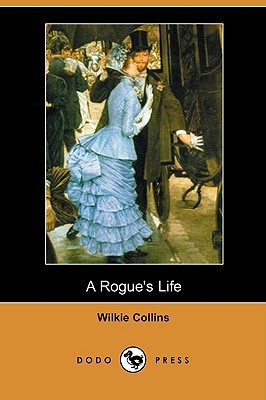
A Rogue's Life. Wilkie Collins. 1856. 159 pages. [Source: Book I bought]
I am going to try if I can't write something about myself. My life has been rather a strange one. It may not seem particularly useful or respectable; but it has been, in some respects, adventurous; and that may give it claims to be read, even in the most prejudiced circles.
Who is the rogue in Wilkie Collins A Rogue's Life? None other than Frank Softly. He comes from a respectable (though not wealthy) family. He falls OUT of favor with his parents and INTO a good bit of trouble. Debt factoring into this rogue's story quite often. He doesn't really "fit" with any of the "respectable" professions allowed to his class. And I believe his first "profession" is as a caricaturist. He sells his work, has it published, is quite successful using a pseudonym... for a while But. When people match his real identity with his pseudonym...well, that just won't do. That is when his parents make a stand.
A Rogue's Life is a short, pleasant read. It's told in first-person narrative. And the narration is quite lively. His adventures and misadventures are a bit crazy perhaps, making the whole too complex to easily summarize for review. But. It is an easy enough story to follow when you're actually reading it.
Essentially when this 'rogue' falls madly in love--and, of course, it's love AT FIRST SIGHT, with a beautiful yet mysterious young woman, there is NOTHING he won't do to find out who she is...he will woo her no matter what it costs him...
Another 'fun' element (if 'fun' is the right word?) is the speculation involving an inheritance. Frank's sister will inherit a good deal of money from someone (I can't remember who) IF and only IF Frank can outlive the grandmother. So throughout the book, there is all this speculation about the future! The grandmother is very old and determined to live forever, and, of course, Frank's misadventures (including prison time) could lead to his dying young...
It's an odd book in a way. But overall, it was a pleasant way to spend an hour.
© 2014 Becky Laney of Becky's Book Reviews
Showing posts with label 1856. Show all posts
Sunday, March 16, 2014
Sunday, March 06, 2011
Little Dorrit
Little Dorrit. Charles Dickens. 1855-1857. Penguin. 928 pages.
Thirty years ago, Marseilles lay burning in the sun, one day.
Little Dorrit is the third full-length Dickens that I've read*. Last fall, I read Bleak House, and last month I read Our Mutual Friend. Did I like Little Dorrit? Not as much as Bleak House. Not as much as Our Mutual Friend. But there were plenty of things I liked about it. Like the heroine, Amy Dorrit, and her love-interest, Arthur Clennam.
Arthur first meets 'Little Dorrit' in his mother's home. He is returning from a LONG absence, returning after his father's death. His parents marriage being a disaster, he spent part of his time with his mother in England, part of his time with his father in China. Little Dorrit (Amy) is quiet, not one to call attention to herself. But there is something about her that intrigues him. So he sets out to befriend, to learn all he can about her. What he learns is that she was born to her father and mother in Marshalsea--a debtor's prison. Her father has been a long-time resident. She's never known freedom, she leaves the gates most every day to earn what she can--she's a good seamstress, happy to find work where she can, like at the Clennams. But to Marshalsea she returns each evening before the gates are locked. She's happy to have a friend in Arthur. But while she may think of him as something-more-than-a-friend, he's settled into thinking of her as a daughter. He's twenty years older than Amy, and, well, he's not the smartest of men when it comes to realizing the obvious. (He has to be TOLD by someone he barely knows that Amy is in love with him, has always been in love with him.) He decides that the best way to help Amy is to help get her father out of debtor's prison. So with the help of a few friends, he sets out to do just that. But is Amy suited to riches?! Does society really hold a place for Amy, Fanny (her older sister), Tip (her older brother), her father, and her uncle? Can money buy happiness? Can money redeem past wrongs? What do you think?!
The minor characters and subplots didn't thrill me in Little Dorrit. Don't get me wrong, there were times when I found it very comical. Dickens had a good sense of humor. And there are some great sketches of characters here and there. Arthur's old love-interest, for example, is almost always good for a laugh. Though it is a laugh at her expense. And Mr. Sparkler, Fanny's love interest, is good for comic relief too. There's a scene between him and Fanny--after they're married--that had me laughing a great deal! (And just when I needed it too!) And Little Dorrit offers a certain amount of drama--drama that for me might have been spoiled by having seen the adaptation two years ago. I thought that the book would clarify things for me, that characters that didn't make a lot of sense in the film would become clearer when I read the book. But I didn't find that to be the case. There are still pieces of the puzzle that I'm missing. There are still characters that leave me confused and puzzled. Which I suppose is why Little Dorrit isn't a book that I can love, love, love. However, I do like it. I am glad I read it.
*Not including GREAT EXPECTATIONS which was required reading in high school. Or A Christmas Carol which is so familiar that I'm not sure it should count.
© 2011 Becky Laney of Becky's Book Reviews
Thirty years ago, Marseilles lay burning in the sun, one day.
Little Dorrit is the third full-length Dickens that I've read*. Last fall, I read Bleak House, and last month I read Our Mutual Friend. Did I like Little Dorrit? Not as much as Bleak House. Not as much as Our Mutual Friend. But there were plenty of things I liked about it. Like the heroine, Amy Dorrit, and her love-interest, Arthur Clennam.
Arthur first meets 'Little Dorrit' in his mother's home. He is returning from a LONG absence, returning after his father's death. His parents marriage being a disaster, he spent part of his time with his mother in England, part of his time with his father in China. Little Dorrit (Amy) is quiet, not one to call attention to herself. But there is something about her that intrigues him. So he sets out to befriend, to learn all he can about her. What he learns is that she was born to her father and mother in Marshalsea--a debtor's prison. Her father has been a long-time resident. She's never known freedom, she leaves the gates most every day to earn what she can--she's a good seamstress, happy to find work where she can, like at the Clennams. But to Marshalsea she returns each evening before the gates are locked. She's happy to have a friend in Arthur. But while she may think of him as something-more-than-a-friend, he's settled into thinking of her as a daughter. He's twenty years older than Amy, and, well, he's not the smartest of men when it comes to realizing the obvious. (He has to be TOLD by someone he barely knows that Amy is in love with him, has always been in love with him.) He decides that the best way to help Amy is to help get her father out of debtor's prison. So with the help of a few friends, he sets out to do just that. But is Amy suited to riches?! Does society really hold a place for Amy, Fanny (her older sister), Tip (her older brother), her father, and her uncle? Can money buy happiness? Can money redeem past wrongs? What do you think?!
The minor characters and subplots didn't thrill me in Little Dorrit. Don't get me wrong, there were times when I found it very comical. Dickens had a good sense of humor. And there are some great sketches of characters here and there. Arthur's old love-interest, for example, is almost always good for a laugh. Though it is a laugh at her expense. And Mr. Sparkler, Fanny's love interest, is good for comic relief too. There's a scene between him and Fanny--after they're married--that had me laughing a great deal! (And just when I needed it too!) And Little Dorrit offers a certain amount of drama--drama that for me might have been spoiled by having seen the adaptation two years ago. I thought that the book would clarify things for me, that characters that didn't make a lot of sense in the film would become clearer when I read the book. But I didn't find that to be the case. There are still pieces of the puzzle that I'm missing. There are still characters that leave me confused and puzzled. Which I suppose is why Little Dorrit isn't a book that I can love, love, love. However, I do like it. I am glad I read it.
He had a certain air of being a handsome man--which he was not; and a certain air of being a well-bred man--which he was not. It was mere swagger and challenge; but in this particular, as in many others, blustering assertion goes for proof, half over the world (25).
In our course through life we shall meet the people who are coming to meet us, from many strange places and by many strange roads and what is set to us to do to them, and what it is set to them to do to us will be done. (39)
Flora, always tall, had grown to be very broad too, and short of breath; but that was not much. Flora, whom he had left a lily, had become a peony; but that was not much. Flora, who had seemed enchanting in all she said and thought, was diffuse and silly. That was much. Flora, who had been spoiled and artless long ago, was determined to be spoiled and artless now. That was a fatal blow. This is Flora! (165)
*Not including GREAT EXPECTATIONS which was required reading in high school. Or A Christmas Carol which is so familiar that I'm not sure it should count.
© 2011 Becky Laney of Becky's Book Reviews
Labels:
1800-1900,
1855,
1856,
1857,
adult fiction,
classics,
library book
Subscribe to:
Posts (Atom)
