Showing posts with label J Poetry. Show all posts

Tuesday, August 25, 2026

63. Thank You, Sun


63. Thank You, Sun. Douglas Florian. 2026. 40 pages. [Source: Library] [children's poetry, 4 stars]

First sentence: Thank you, sun. You give us light. You shine all day until the night. You warm our planet as you burn--and ask for nothing in return.

Premise/plot: Douglas Florian's newest poetry picture book is Thank You, Sun. It is a book celebrating nature. Each poem is illustrated by the author. The poems are accessible and lovely.

My thoughts: I don't always read poetry but when I do...it is usually Douglas Florian. I really love his poetry. I am SO thankful to have found his works. Do seek him out if you're looking to add poetry books to your classroom library or home library.

© 2026 Becky Laney of Becky's Book Reviews

Monday, August 05, 2024

59. In and Out the Window

In and Out The Window. Jane Yolen. Illustrated by Cathrin Peterslund. 2024. 208 pages. [Source: Library] [Children's Poetry] [3 out of 5 stars]

First sentence: Why to Write a Poem
To sing up the sunshine,
To bargain the moon,
To follow the rainbow,
Apostrophize June,
To swing into summer,
To tumble through fall,
To stumble through grammar,
And capitalize all.

In and Out The Window is a collection of Jane Yolen's poems for children. There are over a hundred collected in this new book. 

The good news: There are SO many poems, you're sure to find a few (at least) to enjoy.
The bad news: There are a LOT of poems you won't necessarily enjoy to wade through to find *your* favorites.

Is it possible for me to read a poem and absolutely crazy love-love-love it? YES. Is it possible for me to really love a collection of poems? Yes. Rare but not impossible. Is it more likely that I will like some and dislike some? YES. Poetry is SO subjective. And every single reader will likely have a different poem that is his/her favorite and best. Not every reader will enjoy/appreciate every poem. The thing with poetry is not to push it--necessarily. In other words, the right poem will find the right readers. Poetry can be surprising like that. You can *think* oh, I don't like poetry, and then find so many poems that are the exception to the rule. It is okay to not love every poem you ever read. 

Hook in the Water
Each poem a hook
floating in the tide.
An invitation
to open wide.
Come, little fishes,
take the hook.
Open right up
and read my book. (page 97)

Cat Thoughts
Whoever thought that
you can outthink a cat
has never owned one. (page 54)

The Poem In Your Heart
The poem in your heart
Is beating.
The poem in your head
Is musing.
The poem in your hand
Is writing itself.
The poem in your mouth
Is sharing its beauty,
Speaking its truth
Loud enough for everyone
To hear. (page 125)


© 2024 Becky Laney of Becky's Book Reviews

Tuesday, May 21, 2019

Voices from the Underground Railroad

Voices from the Underground Railroad. Kay Winters. Illustrated by Larry Day. 2018. 48 pages. [Source: Library]

First sentence: Tonight's the night.

Premise/plot: Jeb and Mattie are two slaves that have decided to run away. Their stories are told in verse. The perspectives alternate between the two. Occasionally readers hear other voices as well from men and women working on the underground railroad.

My thoughts: I would definitely recommend this picture book for older readers. It is a compelling story told completely in verse. The back matter includes an author's note and extensive bibliography. The illustrations are lovely.

Text: 5 out of 5
Illustrations: 4 out of 5
Total: 9 out of 10


© 2019 Becky Laney of Becky's Book Reviews

Friday, May 17, 2019

Did You Hear What I Heard?

Did You Hear What I Heard? Kay Winters. Illustrated by Patrice Barton. 2018. 40 pages. [Source: Library]

First sentence: Breakfast is a flurry. Eggs in a hurry. People pop up like the toast.

Premise/plot: Kay Winters has written a collection of school-themed poems. This collection covers the whole school year--beginning to end. You'll find poems appropriate to share with students any time of year.

My thoughts: I liked this one. Poetry collections are interesting to review. Usually you find poems that you love and poems that are more meh. I definitely would say I found poems I enjoyed in this picture book. I didn't love each and every poem. But that's not really to be expected.

Text: 3 out of 5
Illustrations: 4 out of 5
Total: 7 out of 10

© 2019 Becky Laney of Becky's Book Reviews

Monday, May 06, 2019

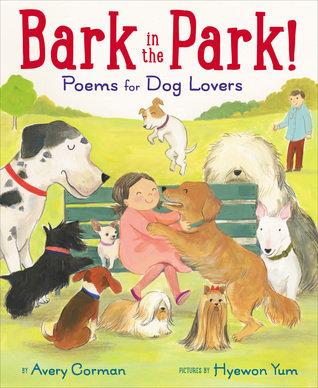
Bark in the Park

Bark in the Park! Poems for Dog Lovers. Avery Corman. Illustrated by Hyewon Yum. 2019. 48 pages. [Source: Review copy]

First sentence:
Afghan Hound
Although he's noble and aloof,
He's still a dog, so he still says, "Woof!"

Basset Hound
For things she can smell,
She's a comer and goer.
She's much like a Beagle,
But longer and lower.

Beagle
The beagle is bent
On tracking a scent.
He follows his nose
wherever it goes.
 Premise/plot: A collection of poems about dogs/dog breeds. Each poem is short. Some poems are just two lines; other poems are all of four lines. All rhyme--for better or worse.

My thoughts: I like the idea of liking this one. I do. But sometimes I wish authors knew that poems don't always, always, always have to rhyme in order to be poetry. Sometimes poems come across as forced. You can always tell when a poem chooses a word just because--only because--it "rhymes."

That being said, there were definitely quite a few poems in this one that I really enjoyed.

© 2019 Becky Laney of Becky's Book Reviews

Monday, January 28, 2019

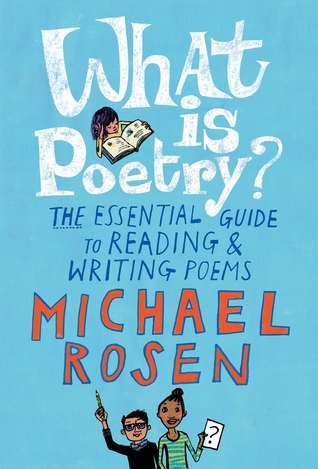
What Is Poetry?

What is Poetry? The Essential Guide to Reading and Writing Poems. Michael Rosen. Illustrated by Jill Calder. 2019. Candlewick Press. 208 pages. [Source: Library]

First sentence from the introduction: Poetry belongs to all of us; everyone can read poems, make up poems, or share poems with others.

First sentence from chapter one: A poem is a poem if the writer and the reader agree it's a poem. But people don't always agree, and when they argue about it, they try to find some special things about poetry that you can't find in other kinds of writing.

Premise/plot: This lovely little book is divided into seven chapters: "What Is Poetry?", "What Can You Do With a Poem?", "My Thoughts as I Was Writing Some Poems," "Ways To Start A Poem," "Writing Poems," "Some Technical Points About Poems," "So What Is Poetry?".

The first chapter should really be named "What Can Poetry Do?" Rosen sets out to illustrate what poems can do. It's show and tell time with poetry. He'll introduce a poem--often a classic--and then write out the thinking process as it's read and reread. He showcases a poem for each point.
  • Poetry Can Suggest Things
  • Poetry Can Give an Impression
  • Poetry Can Play with Words
  • Poetry Can Be Symbolic
  • Poetry Can Be Personal
  • Poetry Can Borrow Voices
  • Poetry Can Capture A Moment
  • Poetry Can Be Ironic
  • Poetry Can Make New Sense
  • Poetry Can Make Familiar Things Feel Unfamiliar and Unfamiliar Things Feel Familiar
Perhaps the list isn't exhausting or comprehensive. But it's a great beginning.

The second chapter is just as valuable and practical as the first. It asks not 'What Can Poetry Do?' but 'What can YOU do with a Poem?' He begins with the obvious, 'read it,' but the list is longer than you might think. I love what he has to say about memorizing poems:
"People say that it's important to memorize poems. I think differently. I reckon it's important only when it's important to you. So if you love a poem, you might want to learn it by heart." (83)
I also love his conclusion:
"In fact, you can do anything you want with a poem. You can ignore it, forget it, decide you don't like it--or leave it for fifty years and rediscover it later." (88)
If chapter one gives readers a behind the scenes glimpse of how Rosen reads poems, then chapter three gives readers a behind the scenes glimpse of how Rosen WRITES poems. He shares one of his own poems and then shares his thoughts on the writing of it.

Chapters four and five are about WRITING poems--some tips and suggestions on how readers can write their own poems.

Chapter six includes some 'technical' details about poems. A traditional approach to teaching poetry might have started with this chapter. Rhythm and Rhyme. Alliteration. Assonance. Metaphor. Simile. Metonymy. Personification. Persona. Allusion.

Chapter seven is BLANK essentially. It gives readers blank pages to answer the question for themselves...what is poetry?

My thoughts: I really thought this was a great little introduction to a subject often thought to be super-intimidating. Poetry doesn't have to be intimidating, overwhelming, scary. Poetry can be FUN, delightful, memorable. I love how we get to see poetry from all sides. I really loved some of the chapters. I can't say that I loved all the chapters equally. Some of his examples were a bit difficult to understand. BUT Rosen gives his readers permission to not understand, to dislike or hate, to skip.


© 2019 Becky Laney of Becky's Book Reviews

Wednesday, January 02, 2019

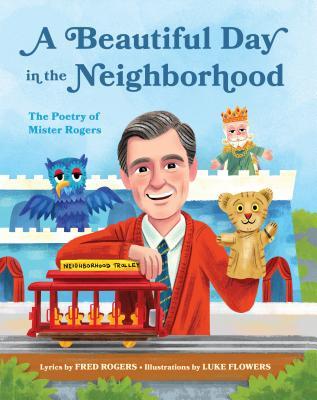
A Beautiful Day in the Neighborhood

A Beautiful Day in the Neighborhood: The Poetry of Mister Rogers. Illustrated by Luke Flowers. 2019. [March] Quirk. 144 pages. [Source: Review copy]

First sentence: 
Won't You Be My Neighbor
It's a beautiful day in this neighborhood
A beautiful day for a neighbor.
Would you be mine?
Could you be mine?
Premise/plot: Quirk is publishing the poetry of Mister Rogers. I'll give you a moment or two to squeal. Most of the pieces are by Fred Rogers. But quite a few are by Josie Carey with the music being by Fred Rogers. These poems--or lyrics if you prefer--are noted as such. The book contains pieces that you'd expect: "Won't You Be My Neighbor," "Everything Grows Together," "Many Ways To Say I Love You," "You Are Special," "I'm Proud of You," "It's You I Like," and "What Do You Do With the Mad That You Feel." But it also contains pieces that you've likely unfamiliar with. The songs that I did not know sometimes offered the most poetic food for thought.

I do not believe the book contains every poem--or song--by Mister Rogers. I can think of a handful it doesn't seem to include. (For example, "I'm Taking Care of You," "Look and Listen," "Peace and Quiet," "One and One are Two," "Everybody's Fancy."

This site seems to have a thorough listing of all the songs--including the ones from the operas

My thoughts: I LOVED this one. I especially loved the illustrations that were connected with Mister Rogers' Neighborhood. For example, the illustration that goes with "It's You I Like" shows Mr. Rogers singing with a boy in a wheel chair. Adults most likely will make the connection to a very memorable episode. I'm not sure if children will be as familiar with the show. But whether your little one knows the shows or not--the words have a way of speaking for themselves. Some of them are timeless and WONDERFUL.

Excerpts from some of my favorites.
It's Good To Talk
People weren't born to be silent
Our tongues make wonderful sounds.
Just try a few phrases for practice
You'll see there are very few bounds.
Things Are Different
You never know the story
By the cover of the book.
You can't tell what a dinner's like
By simply looking at the cook.
Sometimes Isn't Always
Sometimes I DON'T feel like combing my hair.
I DON'T feel like washing my face sometimes.
Sometimes I DON'T feel like saying okay.
But sometimes isn't always.
Are You Brave?
Are you brave and don't know it?
Are you brave and can't tell?
Are you brave and just don't show it?
While others know it very well?
Are you brave and you wonder?
Are you brave and you doubt?
Then Your Heart Is Full of Love
Love is fragile as your tears.
Love is stronger than your fears.
When your heart can sing another's gladness
Then your heart is full of love.
When your heart can cry another's sadness
Then your heart is full of love.

© 2019 Becky Laney of Becky's Book Reviews

Monday, May 14, 2018

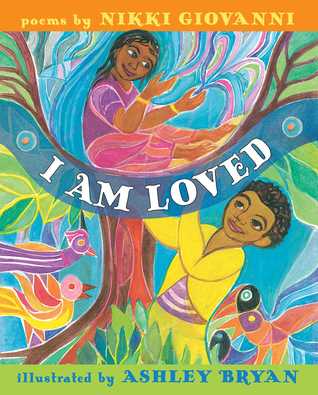
I Am Loved

I Am Loved. Nikki Giovanni. Illustrated by Ashley Bryan. 2018. Simon and Schuster. 32 pages. [Source: Library]

First sentence:
Because
I wrote a poem
for you because
you are
my little boy
I wrote a poem
for you because
you are
my darling daughter
and in this poem
I sang a song
that says
as time goes on
I am you
and you are me
and that's how life
goes on

Premise/plot: I Am Loved is a collection of poems by Nikki Giovanni newly illustrated by Ashley Bryan.

My thoughts: I want to like poetry more than I actually like poetry. I wanted to enjoy this collection. I did. But with the exception of one or two poems, I didn't. The poems I did like were "Quilts" and "Three/Quarters Time." Beauty is in the eye of the beholder. All books are subjective; perhaps poetry is even more so. You may enjoy this collection more than I did. (I hope you do!)

Personally, the lack of punctuation--and the lack of proper capitalization in some cases--bothered me way too much. I realize that poetry is ART. There is no one "right" way to do it.

Text: 3 out of 5
Illustrations: 3 out of 5
Total: 6 out of 10

© 2018 Becky Laney of Becky's Book Reviews

Tuesday, March 20, 2018

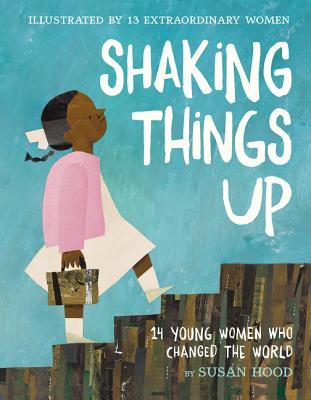
Shaking Things Up

Shaking Things Up: 14 Young Women Who Changed the World. Susan Hood. Illustrated by Selina Alko, Sophie Blackall, Lisa Brown, Hadley Hooper, Emily Winfield Martin, Oge Mora, Julie Morstad, Sara Palacios, LeUyen Pham, Erin K. Robinson, Isabel Roxas, Shadra Strickland, and Melissa Sweet. 2018. HarperCollins. 40 pages. [Source: Library]

Premise/plot: Shaking Things Up is a nonfiction (biographical) poetry book celebrating remarkable women past and present. The fourteen women included are Molly Williams (first known female firefighter in the U.S.), Mary Anning (paleontologist), Nellie Bly (journalist), Annette Kellerman (athlete and designer/inventor of the modern swimsuit), Pura Belpre (Latina author/librarian), Frida Kahlo (artist), Jacqueline and Eileen Nearne (secret agents), Frances Moore Lappe (anti-hunger activist/author), Ruby Bridges (civil rights pioneer), Mae Jemison (first African American astronaut), Maya Lin (architect and sculptor), Angela Zhang (scientist and cancer researcher), Malala Yousafzai (youngest winner of the Nobel Peace Prize).

Each spread includes a biographical poem and is illustrated by a different artist. Just as there is variety in the women highlighted in the book, the poems are written in a variety of styles or forms.

My favorite poem:
TURNING THE TIDE
There once was a mermaid queen,
lovely and lithesome and lean,
who swam afternoons
without pantaloons--
her swimsuit was deemed obscene!
The lady was quickly arrested.
Unafraid, she calmly protested:
Who can swim fifty laps
wearing corsets and caps?
Her statement could not be contested.
She streamlined the suit of the day
and invented our water ballet.
By changing the fashions
she fueled swimming passions
as women made waves in the spray. (15)
My thoughts: I really loved this one overall! Some of the women were completely new to me. I was glad that the back matter included a suggested reading list for each woman. I would recommend this one to anyone who enjoys nonfiction OR poetry OR inspirational reads in general.

Text: 5 out of 5
Illustrations: 4 out of 5
Total: 9 out of 10

© 2018 Becky Laney of Becky's Book Reviews

Friday, March 16, 2018

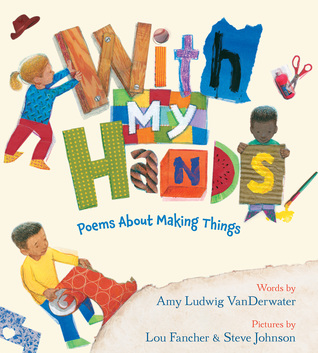
With My Hands

With My Hands: Poems About Making Things. Amy Ludwig VanDerwater.  Illustrated by Lou Fancher and Steve Johnson. 2018. Houghton Mifflin Harcourt. 32 pages. [Source: Review copy]

First sentence: I am a maker.

Premise/plot: With My Hands is a themed collection of poems by Amy Ludwig VanDerwater. The theme of the collection is "making things." What kinds of things? All sorts. Not just artsy things like drawings, paintings, cards, and collages. But all sorts. For example, I wasn't expecting a poem about soap carving or making shadow puppets on the wall! I think there is enough variety to inspire and encourage every young reader to say I want to try that!

My thoughts: I enjoyed this collection very much. It celebrates creativity in all its forms. And it captures the joy of play and creation. I had a few favorite poems in this one. I thought "Card" was a sweet poem celebrating a child's love for his/her dad. (The poem is written in first person. The speaker could be a girl or a boy. But the illustration is of a boy.) But my favorite poem is "Mess."

Mess
Yes. It's a mess.
Do not let it distress you.
I'm making a project
that might just impress you.
Projects are messy--
all makers agree.
And the messiest maker
of projects is....me.

I LOVE, LOVE, LOVE, LOVE, LOVE that poem because it is so me.

I think this book would pair well with Peter Reynold's Happy Dreamer.

© 2018 Becky Laney of Becky's Book Reviews

Monday, February 26, 2018

Before She Was Harriet

Before She Was Harriet. Lesa Cline-Ransome. Illustrated by James Ransome. 2017. [November] Holiday House. 32 pages. [Source: Library]

First sentence: Here she sits/ an old woman/ tired and worn/ her legs stiff/ her back achy/ but before wrinkles formed/ and her eyes failed/ before she reached/ her twilight years/ she could walk for miles/ and see clearly/ under a sky lit only with stars.

Premise/plot: Before She Was Harriet is a picture book biography of Harriet Tubman written in verse. The picture book opens and closes with Harriet as an old woman. The poem looks backwards on her life. Each section begins with "Before she was..." For example,
  • Before she was an old woman/ she was a suffragist/
  • Before she was a suffragist/ she was General Tubman/
  • Before she was General Tubman/ she was a Union spy/
The poem packs in a lot of information while remaining very much a poem. It is beautiful!

My thoughts: I enjoyed this one very much! I loved the writing. I loved the illustrations. This picture book was honored with a Coretta Scott King Illustrator Honor. I must admit that I loved the text even more than the illustrations. But both are great.

The narrative is so beautiful!

Text: 5 out of 5
Illustrations: 4 out of 5
Total: 9 out of 10


© 2018 Becky Laney of Becky's Book Reviews
Wednesday, June 21, 2017

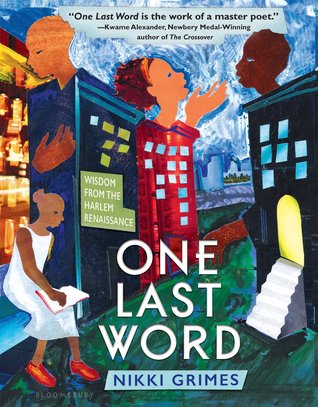
One Last Word

One Last Word. Nikki Grimes. 2017. Bloomsbury. 128 pages. [Source: Library]

First sentence: I was thirteen years old when I read my poetry aloud in front of an audience for the first time.

Premise/plot: Nikki Grimes shares some of her favorite poems from the Harlem Renaissance in her newest book. After sharing the original poem, she follows it with one of her own. All of Grimes' poems are written in the poetry form Golden Shovel.
The idea of a Golden Shovel poem is to take a short poem in its entirety, or a line from that poem (called a striking line), and create a new poem, using the words from the original.
The framework for this poetry collection is a brother and sister discouraged by watching the news come to find hope and inspiration from reading poetry from the Harlem Renaissance. The introductory poem asks, "Can I really find fuel for the future in the past?" In the last poem, we return to the framework. He has found his answer: "The past is a ladder that can help you keep climbing."

The collection includes poems from Gwendolyn Bennett, Countee Cullen, William Waring Cuney, Paul Laurence Dunbar, Langston Hughes, Georgia Douglas Johnson, Clara Ann Thompson, and Jean Toomer. (Biographies for each poet can be found in the back matter.) Each poem features an illustration. So many illustrators contributed to this book.

My thoughts: I really LOVED, LOVED, LOVED this one. I was unfamiliar with the Golden Shovel form before picking this one up, but, WOW what an incredible idea. I imagine it is very challenging yet extremely satisfying to write. I loved the poems Grimes shared. I was familiar with some of these poets, but, not all of them. I think I'll have to seek out more Georgia Douglas Johnson. I also loved Grimes' new poems. What this collection does really well is show how timeless poetry is, and how relevant it remains in our lives.

If you read only one poetry book this year, I'd recommend it be this one. It's SO good.

© 2017 Becky Laney of Becky's Book Reviews
Tuesday, April 18, 2017

Steppin' Out

Steppin' Out: Jaunty Rhymes for Playful Times. Lin Oliver. Illustrated by Tomie DePaola. 2017. 32 pages. [Source: Library]

First sentence: When I open my front door,/ There's a whole world to explore.

Premise/plot: The book is a collection of poetry written to be shared with little ones--preschoolers to be exact. The common theme is 'steppin' out.' These are poems about little ones experiencing the world around them: going to the library, eating out, playing outside, visiting family, going up and down on elevators and escalators, going to the car wash, shopping at the mall, getting a hair cut, buying groceries, going to the beach, playing on the playground, sharing with other kids, being in a dance class, going to preschool or daycare. These are all common-place experiences, ordinary moments that Lin Oliver has used as inspiration for her verses.

My thoughts: I think my favorite poem may have been "At the Mall." In this one, a little girl is shopping with her Mom at the mall. She's told she can pick ONE THING and only one thing. She picks out a pink koala bear, and, when she gets home, she shares it with her baby sister. Is it realistic? Maybe, maybe not. Is it cute and sweet? Definitely!

From Playground Fling:
The swing
is a fling
in
the
air.

From Rainy Day at Grandpa's:
There's nothing like a rainy day
When streets are seas of puddles,
And afterward a cup of tea
with snuggly Grandpa cuddles.

© 2017 Becky Laney of Becky's Book Reviews
Saturday, April 08, 2017

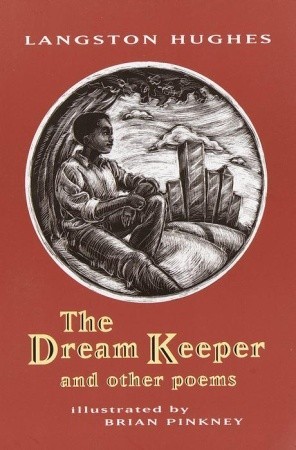
The Dream Keeper and Other Poems

The Dream Keeper and Other Poems. Langston Hughes. 1996. 96 pages. [Source: Library]

First sentence: Bring me all your dreams, You dreamers, Bring me all of your Heart melodies That I may wrap them In a blue cloud-cloth Away from the too-rough fingers Of the world.

Premise/plot: This is an anniversary edition of a collection of Langston Hughes poems originally published in 1932. It is illustrated by Brian Pinkney. The poems are divided into sections: The Dream Keeper, Sea Charm, Dressed Up, Feet o' Jesus, Walkers with the Dawn, and Additional Poems.

My thoughts: I didn't love all sections equally. (Sea Charm has to be my least favorite section.) I did love the sections The Dream Keeper and Dressed Up. Walkers with the Dawn also had some truly memorable poems. The poem you most likely know--perhaps even have memorized is--I, Too which begins: I, too, sing America. I am the darker brother.

Poem
I loved my friend.
He went away from me.
There's nothing more to say.
The poem ends,
Soft as it began--
I loved my friend. (12)
Other favorites:
  • Fairies
  • Song
  • My People
  • I, Too
From Song:
Open wide your arms to life,
Whirl in the wind of pain and strife,
Face the wall with the dark closed gate,
Beat with bare, brown fists--
And wait. (29) 

© 2017 Becky Laney of Becky's Book Reviews
Friday, March 31, 2017

Rooster Crows

The Rooster Crows. Maud and Miska Petersham. 1945. (Caldecott Medal) 64 pages. [Source: Library]

First sentence: Here is part of America's heritage--gay verses beautifully illustrated by famous artists.

Premise/plot: The Rooster Crows is a Caldecott award-winner from the 1940s. It is a collection of poetry really. Rhymes and Jingles. Finger Games. Rope Skipping Rhymes. Counting-Out Rhymes. Games. Yankee Doodle.
I asked my mother for fifty cents
To see the elephant jump the fence.
He jumped so high
He reached the sky
And never came back till the Fourth of July.
Mary had a little lamb,
Its fleece was black as tar.
And everywhere that Mary went
They thought it was a b-a-a-r.
I eat my peas with honey,
I've done it all my life.
It makes the peas taste funny,
But it keeps them on my knife.
My thoughts: It was a pleasant enough read. Some of the illustrations were absolutely amazing. I really enjoyed looking this one through. Some rhymes were more enjoyable than others. But overall I liked it.

Text: 3 out of 5
Illustrations: 4 out of 5
Total: 7 out of 10

© 2017 Becky Laney of Becky's Book Reviews
Thursday, March 30, 2017

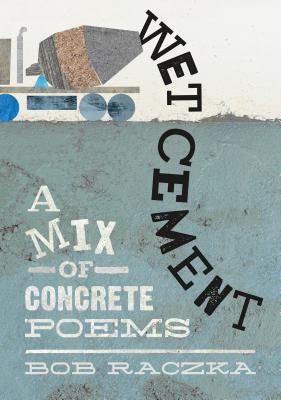
Wet Cement

Wet Cement. Bob Raczka. 2016. 48 pages. [Source: Library]

First sentence: I like to think of poems as word paintings. A poet uses words like colors to paint pictures inside your head. In concrete poems, or shape poems, the words also paint pictures on the page.

Premise/plot: Wet Cement is a collection of concrete poems by Bob Raczka. In the author's own words, "In the title of each poem, I've created pictures with letters. In the poems themselves, I've created pictures with words."

My thoughts: I wasn't expecting to love this one. Poetry tends to be hit or miss with me. I either really make a connection, or NOT. I really LOVED, LOVED, LOVED this one. I think my favorite poem is "Dominoes." Both the title and the text of the poem paint the picture of dominoes falling. It's a fun and effective image.
Just one push
here we go
follow through
feel the flow
brace yourself
stay in line
steady now
doing fine
forward march
don't look back
can't stop now
still on track
coming down
single file
do your part
join the pile
tag you're it
falling fast
pass it on
what a blast!
looking good
almost there
stay on course
don't be scared
hang on tight
rock 'n' roll
what are we?
Dominoes!

Other poems I enjoyed: "Orbiting," "Corners," "Word Cross," and the opening poem, "Take-off."


This is a poetry book I'm excited to recommend!


© 2017 Becky Laney of Becky's Book Reviews
Sunday, February 12, 2017

Freedom Over Me

Freedom Over Me: Eleven Slaves, their Lives and Dreams Brought to Life. Ashley Bryan. 2016. 56 pages. [Source: Library]

First sentence: I mourn the passing of my husband, Cado Fairchilds. He managed our estate alone. Eleven Negro slaves, they carried out the work that made our estate prosper.

Premise/plot: After the death of her husband, Mrs. Fairchilds decides to sell her estate--all of her estate including eleven slaves--and return to Britain. The eleven slaves were: Peggy, John, Athelia, Betty, Qush, Jane, Stephen, Mulvina, Bacus, Charlotte and Dora.

What you should know: Ashley Bryans, the author and illustrator, was inspired to write this picture book by slave documents he'd acquired. This estates appraisal dates from 1828. This picture book is written almost exclusively in verse. The book begins with Mrs. Fairchilds poem, her reasoning as to why she's selling the slaves and leaving the South. The remaining poems are all from the point of view of the eleven slaves. Each slave gets two poems. One poem for how things are; one poem for their dreams, how they want things to be.

From John:
Secretly, Stephen and Jane
are teaching me to read and write.
They say, "We'll be free one day!
And you will teach others."
My thoughts of escaping
to freedom
grow stronger every day.
Oh Freedom, Oh Freedom,
Oh Freedom over me!
From John Dreams:
I plan one day
to draw freely
from free Negro people.
I will create
loving portraits
of their strength
and beauty.
 You should also know that this is a Newbery Honor book, a Coretta Scott King Author Honor book, a Coretta Scott King Illustrator Honor book.

My thoughts: Freedom Over Me is worth reading no matter your age. (By that I mean you're never too old to read a 'children's book.' You can definitely be too young for a book, but never too old.) It would pair well with Julius Lester's Day of Tears--if memory serves--or his To Be A Slave. This is such compelling, emotional book.

© 2017 Becky Laney of Becky's Book Reviews

Saturday, February 11, 2017

Garvey's Choice

Garvey's Choice. Nikki Grimes. 2016. 120 pages. [Source: Library]

First sentence: When I was seven/ and crazy for Mr. Spock,/ a Star Trek lunch box/ was all I craved. Instead, Dad/ bought one blaring the logo/ of some football team/ I'd never heard of./ I shoved that thing in/ the coal black of my closet,/ then celebrated with cake.

Premise/plot: Garvey's Choice is a verse novel. (The verse is written in tanka.) Garvey is an overweight teen who'd much rather sing or read than play sports. There exists between father and son a gap that nothing seems to fill. At least at first. Garvey tries--unsuccessfully--to fill this gap with food. Garvey's dad may talk about sports--a lot--but I don't get the impression that he's actually cruel to his son. The two just aren't speaking the same love languages.

My thoughts: In the novel, Garvey makes several choices. Will he choose to try out for chorus and risk rejection or humiliation? He ultimately decides that he has nothing to lose and everything to gain. After all, he's already being teased by his classmates; he's already hating lunch time. What he finds out is that he's really talented at singing; and his singing not only makes him happy in the process, but makes others happy too. That and he makes a second friend. Another choice he makes regards his weight. Will he try to lose weight? Should he try to lose weight? How should he go about it? What can he change in his life to be healthier and happier?

This aspect of the verse novel was a bit iffier for me. I hated to see him get in the cycle of dieting in unhealthy ways, ways that are doomed to fail. I was yelling DON'T DO IT. JUST DON'T. I think the verses are authentic in that many, many, many, many people turn to food as a way to deal with emotions they don't know how to handle any other way. It's not the best way perhaps, but it is the easy way. I liked how singing took the place of food in some ways as a way to cope with the ups and downs of life.

One of the songs mentioned throughout the book is "Dance with My Father." I encourage you to give it a listen if you pick this one up.

One of my favorite poems: "Summer Lost and Found"
Stories are breadcrumbs.
Just follow the trail of books
and you will find me
lost among the galaxies
of scorched stars and ships to Mars. (4)
And here's another: "Alien"
Over breakfast, Dad
eyes me like an alien
never seen before.
Sometimes, I could swear that he's
hoping to make first contact. (17) 

© 2017 Becky Laney of Becky's Book Reviews
Tuesday, December 27, 2016

Echo Echo

Echo Echo: Reverso Poems About Greek Myths. Marilyn Singer. Illustrated by Josee Masse. 2016. 32 pages. [Source: Library]


First sentence: Ancient Greece: an age of marvelous myths, gone, but not forgotten. Heroes that rise and fall.

Premise/plot: This is the third collection of reverso poems by Marilyn Singer. The first two were: Mirror, Mirror and Follow, Follow. Both of those were fairy tale inspired poetry collections. This third book is inspired by Greek mythology.

So what is a reverso poem? A poem that is both read top to bottom, and bottom to top. The two 'versions' of the poem might tell completely different stories! Word order and punctuation can accomplish a LOT. Much more than I ever thought about!!! Most of the reverso poems in this collection have two narrators. For example, with "King Midas and His Daughter," the first poem is from the daughter's perspective (top to bottom), and the second poem (bottom to top) is from the King's perspective.

My thoughts: I really enjoyed this one. I'm not sure I loved, loved, loved it as much as the previous volumes. But. It's been a few years since I've read them, and, I'd have to reread all three closer together to truly decide which is my favorite. I can tell you that I do like Greek mythology. (Thanks in small part to Edith Hamilton and good old Percy Jackson.)

I think my favorite poem might be "Pygmalion and Galatea."
Wondrous!/ How/ life-/ like! There is nothing in this world/ so perfect. Oh, these lips, hands, eyes!/ The artist/ is in love with/ his creation./ Let a heartfelt wish be granted,/ kind Venus:/ Only you could make this stone breathe!
Only you could make this stone breathe!/ Kind Venus/ let a heartfelt wish be granted./ His creation/ is in love with/ the artist./ Oh, these lips, hands, eyes--/ so perfect!/ There is nothing in this world/ like/ life! How/ wondrous!
*The book does have at least one typo. And I wouldn't have noticed it if I hadn't chosen to share it. I would have just auto-corrected in my head without thinking twice. "There is nothing is this world." I include it here just in case it hasn't been caught yet and fixed already for future editions.

© 2016 Becky Laney of Becky's Book Reviews

Wednesday, November 30, 2016

Won Ton and Chopstick

Won Ton and Chopstick: A Cat and Dog Tale Told in Haiku. Lee Wardlaw. Illustrated by Eugene Yelchin. 2015. 40 pages. [Source: Library]

First sentence: It's a fine life, Boy. Nap, play, bathe, nap, eat, repeat. Practice makes purrfect.

Premise/plot: Won Ton returns in a second picture book in Won Ton and Chopstick. Won Ton is most upset--at least at first--at the new 'surprise' at his house. The surprise is a PUPPY. The family may call the puppy, "Chopstick," but Won Ton calls him PEST. This picture book has plenty of adventures for the pair.

My thoughts: I really loved Won Ton. And this second book is fun. I thought the repeating refrain of the first book was fun, but I think it's even better the second time around.
Puthimoutputhimoutputhimoutputhim--wait! I said him, not me!
That never gets old!!!

Text: 4 out of 5
Illustrations: 4 out of 5
Total: 8 out of 10


© 2016 Becky Laney of Becky's Book Reviews