Showing posts with label YA poetry. Show all posts

Thursday, August 15, 2024

61. Grace Notes

61. Grace Notes: Poems About Families. Naomi Shihab Nye. 2024. 240 pages. [Source: Library] [4 stars] [poetry, nonfiction]

First sentence (from the introduction): Families. They're our first circle. We wake up to them as babies, clicking into focus, identifying, absorbing...forever discovering who they are. Who we think they are is only one little window.

First poem:
My whole life
would not have happened without
a man whose name I do not know
who died in the snow.
He was young,
had been married only three months
to my mama's best friend.


This one is a themed poetry collection; it is without a doubt POETRY. But is it also a memoir or autobiography??? I think one could argue that it might very well be. I believe the author is writing personal poems about HER family. But it's not described as a memoir in its description so I'm hesitant to say emphatically that all the poems are autobiographical and this is a memoir in verse.

The target audience? I think the target audience would be older and not younger. These poems are COMPLEX, layered even. Sure, the words themselves may not be mature in nature, but the meanings and themes are so deep--philosophical and/or abstract in nature--that readers need as much life experience as possible to unpack the meaning. The poems are also REFLECTIVE and best read in the context of how they were written--during the grieving process. The parent-child relationship can be complex no matter the age, but the parent and adult-child relationship is more at play in this collection. It is more a journeying alongside the author as she explores relationships in the family through more adult eyes.

I do NOT under any circumstance expect all books to be written with a Christian point of view. I don't. I don't think that would be fair in general, however, I will note that this one is a patchwork--piecework--of many, many, many religions and spiritual faiths, none of which are particularly Christian. So you have a very reflective, philosophical, abstract book of poetry without a christian world view. This is neither good nor bad--it just is. Again, I do not expect all books to be Christian. 

Quotes

From "How Parents Ever Get Together Anyway"
The fact we exist at all
is a random grace note
of a forgotten symphony.

From "Mother Muscle"
Mother muscles become tough. They have to.
People pulling on them
all the time. Ferocious mamas
stomping through the tangled wilderness
searching for berries. Mamas worrying
night and day.

From "Sides of the Family"
These grandmas did not meet. But I think there were little lines
between them like dotted ripples in a star constellation diagram.
Big Dipper, small dipper, they both shone down on us
all our lives. They were constants.

From "Union Boulevard, St. Louis"
Life
is full of mysteries.
They're not mine, not yours.
They're life's.

From "Out"
No one is big enough to notice
all that might be noticed.
No one is small enough,
no one is big enough.

From "Every Age"
If you open the door
to happiness
what comes through?
Friends come through.
Something new comes through.

 From "Every Age"
Is it possible
to be every age at once,
forever?
Some say so.

From "The Pleaser"
Why do we need someone to say
you make me happy,
you're great.
Is that a basic need
like sleeping and eating?

From "In Morning"

Each morning
we put ourselves together
Try to imagine
what we will do,
gathering tools and
thoughts.
We carry the mysteries
no one explains.

Title: Write a seven-word autobiography right now

  • Addicted to simplicity from very first day.
  • Ever hopeful, every growing always asking why.
  • So many places we haven't seen yet.
  • The space around the poem is best.


© 2024 Becky Laney of Becky's Book Reviews

Tuesday, October 03, 2023

165. Kin: Rooted In Hope


Kin: Rooted in Hope. Carole Boston Weatherford. Illustrated by Jeffery Boston Weatherford. 2023. [February] 193 pages. [Source: Library]

First sentence: Before Alex Haley's novel Roots
proved otherwise, few Black people
thought it possible to trace ancestry
beyond the cold heart of enslavement
to the warm sun of Africa.

My thoughts, initial impression: This is one of those books that just give off Important and Significant vibes. It just screams, "I am a serious book about a serious subject--be in awe of me." I have a love-hate relationship with heavy, "serious" books. Part of me feels obligated to keep up and read every Serious book that comes out just in case they end up winning a literary award. That's why I checked it out from the library.

Premise/plot: Kin is written ALL in verse. There is not a single narrator or protagonist. Not every speaker [narrator] is human. Some of the poems are, I believe, written from the point of view or perspective of more abstract speakers. (Places, objects, abstract subjects?) The premise is that she is giving an account of her ancestry or family tree. That's what it's about on the most surface-level. I think it probably has layers to it.

My thoughts: I found it confusing. I am not objectively saying that it IS confusing just that I found it to be so. It's like some readers see a beautiful cross-stitch embroidery, and I'm seeing the back of it. Poetry can be intimidating. Especially when each poem is from a different speaker, different point of view...especially when the reader is the one mostly responsible for piecing together the poems. Is it worth putting in the work? Maybe. Probably. I don't know because I didn't go the extra mile. 


© 2023 Becky Laney of Becky's Book Reviews

Friday, August 05, 2022

94. African Town


African Town: Inspired by the True Story of the Last American Slave Ship. Irene Latham and Charles Waters. 2022. 448 pages. [Source: Library]

First sentence: Be still, my children. Listen with your ears
and your heart. Our story starts with this
mark on my right cheek, these chipped teeth.
See? This is how you know I am who I say I am.
De town where I was born is called Bante.
It's nowhere near here, not in African Town, not
in Alabama. This town's way across de ocean,
on de west coast of Africa in de kingdom
of Dahomey. My family's home was a round,
two-story adobe with a terrace. Surrounded by hills,
about eight days' walk to de sea. Someday maybe
you will see de world de way I have seen it
in Bante. Then you will know how de sun
kisses de earth, melts like honey over de land--
it's no wonder I believed all of life would be
bright and sweet. No wonder it still shocks me
that de world can be so hard, so dark.
But that darkness, it brought me here.
It brought you here. This is our story.

Premise/plot: African Town is a verse novel based on or inspired by a true story. Long after the importation of slaves was illegal--though not slavery itself--one ship, the Clotilda, was used to smuggle in a shipment of slaves. The year was 1860. 

It is a verse novel that spans a little over four decades. It opens around 1859/1860 and closes around 1901. The poems alternate narrators...and in doing so alternates perspectives. Though by far the greatest representation are the men and women captured, enslaved, sold. Other narrators include white men in the slave trade, slave owners, and VERY VERY VERY oddly the ship Clotilda. 

It isn't "just" the story of African slaves. It is the story of how these last slaves bonded and formed a community--literally and figuratively. This is the story of the formation of African Town or Africatown.

My thoughts: Powerful. Compelling. Important. These are the words I'd use to describe this verse novel. It is a heavy novel in its subject matter. The characters--[loosely] based on real people--are well developed. The characters were easy to care about. I got swept up into this one. I knew a little bit about the Clotilda from previous reading. But this was an absorbing read. I thought the verse novel format was a perfect fit for this one.

© 2022 Becky Laney of Becky's Book Reviews

Monday, June 27, 2022

78. Garvey in the Dark


Garvey in the Dark. Nikki Grimes. 2022. [October] 176 pages. [Source: Review copy]

First sentence: Different. The same... That's my answer if you ask how I am after the Invisible Beast broke into our house, and our world.

Premise/plot: Garvey (from Garvey's Choice) returns for a second book in Garvey in the Dark. Garvey's life has been looking up, up, and up. Things are good, really good. He's playing music; he's singing; he's got good, solid friends; he's beginning to have a strong, solid relationship with his father; he's comfortable in his own skin. But life is about to be turned upside down because of COVID-19. The book is set in the spring and summer of 2020. The poems process his experiences and emotions. 

My thoughts: I wonder if this was a book that *needed* to be written. In other words, did Nikki Grimes need to write this book in order to help process the messy-messy-mess that was 2020? Between COVID-19 and the murder of George Floyd and the subsequent protests, 2020 was just...there aren't even words. There are ten billion memes but no words. Garvey, our protagonist, seems an authentic narrator who is trying day by day to survive 2020 and make sense of it all. He's got questions, doubts, worries, concerns. The poems are very straight-forward and honest. Like when his dad has COVID and he's standing outside his dad's bedroom door just listening to make sure he's still breathing. The pain is almost touchable, if that makes any sense at all. 

It was not an easy read. I'm being fair, I think. I don't mean the poetry isn't wonderful. I don't. I mean reading these poems takes you right back in time and it's like you're living through 2020 a second time. Which has its pros and cons. On the one hand, I do think it's a time capsule of sorts. I also imagine that writing the poetry had its healing moments. A way to put into words your thoughts, emotions, etc. Also I think it could be a reminder that you can share your emotions and talk through your stuff. There's no reason that you *have* to keep it bottled up inside, hiding your pain and worries. Another point is that this will be an authentic way to share what it was like to future generations. On the other hand, it's like living through 2020 a second time. It took me RIGHT BACK.


© 2022 Becky Laney of Becky's Book Reviews

Tuesday, June 14, 2022

72. And We Rise


And We Rise. Erica Martin. 2022. 160 pages. [Source: Library]

First sentence: It's 1877 when
Jim Crow laws says it's
    acceptable
    legal
    lawful
to segregate Blacks
&
    whites
based on the color of
their skin.

And We Rise is a free verse poetry book on the Civil Rights Movement, centering on the 1950s and 1960s.
The subject matter is heavy--weighty. These poems may best be appreciated when read slowly allowing for absorption and digestion. If you rush through the poems, I think (some) of the power of these poems is lost. 

Free verse poems. Poetry isn't for everyone. Poems can add an extra step or two (or three) to the reading process. Poems have to be unpacked and interpreted. Sometimes you have to read between the lines, look at how the words are arranged on the page, take notice of SPACE, perhaps even take time to notice what is not being said directly. 

I don't know that this would be a good introduction to the Civil Rights Movement. I think other books might be best for introducing the subject. The poems may best be appreciated by those with at least a little familiarity with the subject. You need that background to better grasp, comprehend, appreciate the poems. 

This one could definitely be used to supplement a study of the Civil Rights movement. It is good to see the subject being presented in multiple formats--graphic novels, memoirs, biographies, poetry, and even to some extent fictional novels. 


© 2022 Becky Laney of Becky's Book Reviews

Monday, March 25, 2019

Shout

Shout. Laurie Halse Anderson. 2019. Penguin. 304 pages. [Source: Library]

First sentence:
When he was eighteen years old, my father
saw his buddy's head sliced into two pieces,
sawn just above the eyebrows by an exploding
brake drum, when he was in the middle
of telling a joke.

Premise/plot: Shout is the memoir of Laurie Halse Anderson; it is written in verse. Anderson may best be known for her young adult novel, Speak. Speak stars a young girl, a freshman, named Melinda. In the summer Melinda was raped--the boy who raped her, aka IT, attends the same school. Melinda struggles. I was going to try to find the right words to say what she struggles with--but there are no right words. Her whole life is effected by what happened and the fact that she has not spoken up or shared her story with anyone is largely what the novel is about. Well, partly. The book, in my opinion, is about the injustices embedded within the system. Everyone makes assumptions about who Melinda is--makes judgments--without bothering to get to know Melinda. Speak is not strictly autobiographical. But Laurie Halse Anderson has her own experiences to share, her own IT from the past. One doesn't just "get over" sexual assault. The memoir shares her journey from childhood to adulthood. The memoir also gives readers a behind the scenes glimpse of an author's life. (How she got started writing, the long, long struggle to get published, the writing of Speak and other books, author visits and tours, receiving mail from readers, etc.) Speak resonated--has continued to resonate--with readers. It has helped people speak up about their own experiences with sexual assault. Many have shared their stories with Laurie Halse Anderson.

My thoughts: This is a compelling read. It is a dark read in some ways but also an inspirational one. It isn't without hope or "light" at the "end of the tunnel." The subject matter is mature. But the mature content doesn't mean it's inappropriate or "bad." The truth is that sexual assault can happen at any age. In a perfect, perfect world sheltering kids--tweens, teens--from the harsh realities of the potential dangers would make sense. But our world is far from perfect. Not speaking about something doesn't make that something go away. (That being said, how a subject is discussed differs with the age of the audience.) Shout uses strong language but not in an excessive, inappropriate way. (At least 99% of the time.) Shout is honest even when it ventures into the raw emotions of pain and confusion. There is something to be said for honesty, for putting away the mask that everything is fine, that everything is okay.

From the poem, "Lovebrarians"
I unlocked the treasure chest
and swallowed the key. (27)

From the poem, "Payback"
After Charlotte's Web
but before Little Women,
my sister stole the key
to my green plastic diary,
and blackmailed me
with what she found. (33)
Maybe I owe her,
my sister,
for stealing the key, toying
with my secrets, and thus igniting
the slow-fused inevitablity
of me weaving stories
in the dark. (34)

From the poem, "Diagnosis"
untreated pain
is a cancer of the soul
that can kill you. (69)
From the poem "How the Story Found Me"
too many grown-ups tell kids to follow
their dreams
like that's going to get them somewhere
Auntie Laurie says follow your nightmares instead
cuz when you figure out what's eating you alive
you can slay it. (160)
© 2019 Becky Laney of Becky's Book Reviews

Monday, November 05, 2018

Mary's Monster

Mary's Monster: Love, Madness, and How Mary Shelley Created Frankenstein. Lita Judge. 2018. 320 pages. [Source: Library]

From the Prologue:
The Creature
Most people didn't believe Mary Shelley,
a teenage girl, unleashed me,
a creature powerful and murderous
enough to haunt their dreams.
They expected girls to be nice
and obey the rules.
They expected girls to be silent
and swallow punishment and pain.
She was cast out from society
because she loved a married man.
Her friends reviled her.
Her father banished her from his home.
But she did not hide.
She was not silenced.
She fought against the cruelty of human nature
by writing.
She conceived me.
I took shape like an infant,
not in her body, but in her heart,
growing from her imagination
till I was bold enough to climb out of the page
and into your mind.
Now Mary is the ghost
whose bones have turned to dust
and it is I who live on.
But hear her voice!
She wrote my story,
and now she will reach beyond the grave
and tell you her own. 
Premise/plot: This biography of Mary Shelley is written in free verse and features black and white illustrations from the author. Her story is told in nine parts--not counting a prologue and epilogue. The format of the book lends itself well to the drama--or melodrama--of Shelley's personal life. Judge does a good job placing her story within the larger context of the times in which she lived.

My thoughts: There have been MANY books published this year about Mary Shelley, and about the creation of Frankenstein. Some are for children; some are for young adults; some are for adults. The ones for children clean things up and focus on her writing and creativity. This one is for young adults. It isn't cleaned up.

Mary's background was radical for her times. Her mother--and to some extent her father--believed in free love (aka sexual freedom). Her father also--at one point at least--was a political radical. Mary was not raised to conform gently and neatly into a little box. She had opinions. She had passions. She had a strong will. Yet she could not escape--or at least not completely escape--the consequences of living out her beliefs. These consequences were largely social but also financial. Mentally, emotionally, Mary Shelley was strained. She endured. She survived. She persevered. But there was nothing easy or comfortable about her life or lifestyle. I'd say EXHAUSTING or DRAINING would sum it up well.

The book does focus on her creativity and imagination. But Shelley's talent is the only thing to catch my notice. Judge has done a great job in her storytelling.

Quotes:
I Am Seventeen
Already
I am daughter to a ghost
and mother to bones. (160)

Shadows Touching
At first, writing feels like falling
where there is nothing to hold on to
to keep from slipping off the edge of the world.
But then the dark presence of another begins to whisper
from the corners of my mind,
and his shadow grows and touches my own.
Together, we take one step toward finding a word,
and then another,
and another,
until the struggle drops away
and the only thing that is left
is everything that matters. (228)


© 2018 Becky Laney of Becky's Book Reviews
Thursday, June 28, 2018

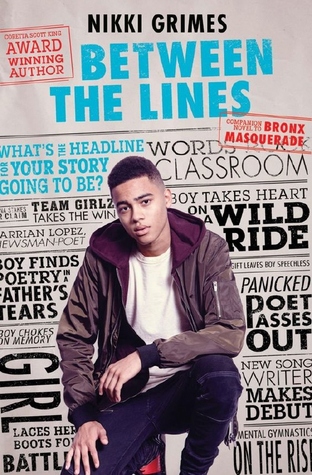
Between the Lines

Between the Lines. Nikki Grimes. 2018. 216 pages. [Source: Library]

First sentence: I check out Mr. Ward's classroom early, find dark walls covered with poetry hanging in picture frames bright as jelly beans. Who wrote all these poems? And where exactly does Open Mike Friday take place?

Premise/plot: Nikki Grimes' Between the Lines is a companion novel to the award-winning Bronx Masquerade. It is a new school year and this is a new class. So it isn't exactly a sequel. But if you enjoyed the first one, you'll love the second as well.

This YA novel written in prose and verse celebrates the human spirit. Readers meet a handful of students--young men, young women from diverse backgrounds and experiences.

Wild Words by Li Cheng
Words
crack me open.
Only the right ones, of course,
those laced with beauty
or infused with the sweetness
of a ripe peach.
Each word, each lyrical phrase,
often powerful enough
to break, or heal,
the heart.
But you knew this
from the start.
Why else would you
come offering to share
your own wild words
with plain, ordinary me?
Words are clearly
the truest thing
we have in common.
Still, why me?
Never mind.
Your clever lines
have lassoed
my attention.
I'm listening.
My thoughts: Bronx Masquerade and Between the Lines remind me of Glee. In a good way. Both are about high school students finding a safe haven to be themselves and find their voices. Both are about high school students coming together and forming strong bonds of friendship. There are some differences. There is less drama--no melodrama--in these novels. That's a relief. The characters have struggles--internal and external--to deal with on a daily basis. Poetry is how they express themselves and deal with all the pressures and uncertainties of life. Honesty is important, and these poems offer it with amazing vulnerability. The students are brave, in a way, but their trust is not misplaced.


© 2018 Becky Laney of Becky's Book Reviews

Wednesday, May 16, 2018

Bronx Masquerade

Bronx Masquerade. Nikki Grimes. 2001/2017. Penguin. 192 pages. [Source: Library]

First sentence: I ain't particular about doing homework, you understand.

Premise/plot: Mr. Ward is exciting a high school class about poetry. He is giving his students ongoing opportunities to share their own poetry. Writing and sharing poetry changes them in immeasurable ways. This YA novel is told in multiple voices in prose and poetry. The novel spans a school year, I believe.

 Black Box
by Devon Hope
In case I forgot to tell you,
I'm allergic to boxes:
Black boxes, shoe boxes
New boxes, You boxes--
Even cereal boxes
Boasting champions.
(It's all a lie.
I've peeked inside
And what I found
Were flakes.)
Make no mistake,
I make no exceptions
For Cracker Jack
Or Christmas glitter.
Haven't you noticed?
I'm made of skeleton,
Muscle and skin.
My body is the only box
I belong in.
But you like your boxes
So keep them.
Mark them geek, wimp, bully.
Mark them china doll, braniac,
Or plain dumb jock.
Choose whatever
Box you like, Mike.
Just don't put me
In one, son.
Believe me,
I won't fit. (84-5)

My thoughts: What a great novel!!! I would recommend this one even to those who think they HATE--abhor--poetry. Is there a difference between thinking you hate something and actually hating something? I think so. Until you've tried something--genuinely tried something--it's not fair to say you hate it. I think poetry comes in so many different shapes and sizes. And disliking one doesn't mean disliking all. Anyway, what I was trying--and failing--to say was that poetry can speak soul to soul and have relevance in or out of a classroom.

The book was honored with the Coretta Scot King Author Award in 2003.

© 2018 Becky Laney of Becky's Book Reviews

Tuesday, May 15, 2018

For Every One

For Every One. Jason Reynolds. 2018. Simon & Schuster. 112 pages. [Source: Library]

First sentence: Dear Dreamer, this letter is being written from a place of raw honesty and love but not at all a place of expertise on how to make your dreams come true. I don't know nothing about that.

Premise/plot: For Every One is a poetic essay on the meaning of life. Is that an exaggeration? Maybe. It is a motivational--though realistic and honest--piece on ATTITUDE and PERSPECTIVE. If attitude and perspective don't play a major role in how you define the meaning of life, I don't know what does. Reynolds' piece is above all grounded in reality yet saturated in hope or optimism. This essay is written in verse.

My eyes
are swollen with exhaustion,
my body sputtering
on its way down,
but my dream
won't stop crying,
screaming
like a colicky
infant.
Sometimes I think
it needs to be changed.
Usually
It just needs to be fed.
So I feed it everything
I have.
And it feeds me everything
I have. (52-3)

My thoughts: I read this one twice. I really, really liked it. I hope it gets some love from readers of all ages.

The book celebrates the journey that all dreamers find themselves on. It's a journey that most--if not all--can relate to easily. It is a book for everyone. But even the author acknowledges that not every single book is for every single person. There are many books on dreams, on dreaming, on pursuing your dreams, on pursuing this evasive thing called SUCCESS. Not every book is a keeper. I hope this one is a keeper.


© 2018 Becky Laney of Becky's Book Reviews
Wednesday, June 21, 2017

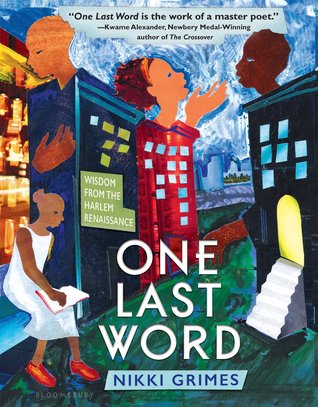
One Last Word

One Last Word. Nikki Grimes. 2017. Bloomsbury. 128 pages. [Source: Library]

First sentence: I was thirteen years old when I read my poetry aloud in front of an audience for the first time.

Premise/plot: Nikki Grimes shares some of her favorite poems from the Harlem Renaissance in her newest book. After sharing the original poem, she follows it with one of her own. All of Grimes' poems are written in the poetry form Golden Shovel.
The idea of a Golden Shovel poem is to take a short poem in its entirety, or a line from that poem (called a striking line), and create a new poem, using the words from the original.
The framework for this poetry collection is a brother and sister discouraged by watching the news come to find hope and inspiration from reading poetry from the Harlem Renaissance. The introductory poem asks, "Can I really find fuel for the future in the past?" In the last poem, we return to the framework. He has found his answer: "The past is a ladder that can help you keep climbing."

The collection includes poems from Gwendolyn Bennett, Countee Cullen, William Waring Cuney, Paul Laurence Dunbar, Langston Hughes, Georgia Douglas Johnson, Clara Ann Thompson, and Jean Toomer. (Biographies for each poet can be found in the back matter.) Each poem features an illustration. So many illustrators contributed to this book.

My thoughts: I really LOVED, LOVED, LOVED this one. I was unfamiliar with the Golden Shovel form before picking this one up, but, WOW what an incredible idea. I imagine it is very challenging yet extremely satisfying to write. I loved the poems Grimes shared. I was familiar with some of these poets, but, not all of them. I think I'll have to seek out more Georgia Douglas Johnson. I also loved Grimes' new poems. What this collection does really well is show how timeless poetry is, and how relevant it remains in our lives.

If you read only one poetry book this year, I'd recommend it be this one. It's SO good.

© 2017 Becky Laney of Becky's Book Reviews
Saturday, April 08, 2017

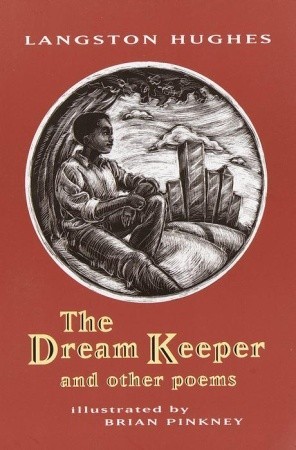
The Dream Keeper and Other Poems

The Dream Keeper and Other Poems. Langston Hughes. 1996. 96 pages. [Source: Library]

First sentence: Bring me all your dreams, You dreamers, Bring me all of your Heart melodies That I may wrap them In a blue cloud-cloth Away from the too-rough fingers Of the world.

Premise/plot: This is an anniversary edition of a collection of Langston Hughes poems originally published in 1932. It is illustrated by Brian Pinkney. The poems are divided into sections: The Dream Keeper, Sea Charm, Dressed Up, Feet o' Jesus, Walkers with the Dawn, and Additional Poems.

My thoughts: I didn't love all sections equally. (Sea Charm has to be my least favorite section.) I did love the sections The Dream Keeper and Dressed Up. Walkers with the Dawn also had some truly memorable poems. The poem you most likely know--perhaps even have memorized is--I, Too which begins: I, too, sing America. I am the darker brother.

Poem
I loved my friend.
He went away from me.
There's nothing more to say.
The poem ends,
Soft as it began--
I loved my friend. (12)
Other favorites:
  • Fairies
  • Song
  • My People
  • I, Too
From Song:
Open wide your arms to life,
Whirl in the wind of pain and strife,
Face the wall with the dark closed gate,
Beat with bare, brown fists--
And wait. (29) 

© 2017 Becky Laney of Becky's Book Reviews

Saturday, February 11, 2017

Garvey's Choice

Garvey's Choice. Nikki Grimes. 2016. 120 pages. [Source: Library]

First sentence: When I was seven/ and crazy for Mr. Spock,/ a Star Trek lunch box/ was all I craved. Instead, Dad/ bought one blaring the logo/ of some football team/ I'd never heard of./ I shoved that thing in/ the coal black of my closet,/ then celebrated with cake.

Premise/plot: Garvey's Choice is a verse novel. (The verse is written in tanka.) Garvey is an overweight teen who'd much rather sing or read than play sports. There exists between father and son a gap that nothing seems to fill. At least at first. Garvey tries--unsuccessfully--to fill this gap with food. Garvey's dad may talk about sports--a lot--but I don't get the impression that he's actually cruel to his son. The two just aren't speaking the same love languages.

My thoughts: In the novel, Garvey makes several choices. Will he choose to try out for chorus and risk rejection or humiliation? He ultimately decides that he has nothing to lose and everything to gain. After all, he's already being teased by his classmates; he's already hating lunch time. What he finds out is that he's really talented at singing; and his singing not only makes him happy in the process, but makes others happy too. That and he makes a second friend. Another choice he makes regards his weight. Will he try to lose weight? Should he try to lose weight? How should he go about it? What can he change in his life to be healthier and happier?

This aspect of the verse novel was a bit iffier for me. I hated to see him get in the cycle of dieting in unhealthy ways, ways that are doomed to fail. I was yelling DON'T DO IT. JUST DON'T. I think the verses are authentic in that many, many, many, many people turn to food as a way to deal with emotions they don't know how to handle any other way. It's not the best way perhaps, but it is the easy way. I liked how singing took the place of food in some ways as a way to cope with the ups and downs of life.

One of the songs mentioned throughout the book is "Dance with My Father." I encourage you to give it a listen if you pick this one up.

One of my favorite poems: "Summer Lost and Found"
Stories are breadcrumbs.
Just follow the trail of books
and you will find me
lost among the galaxies
of scorched stars and ships to Mars. (4)
And here's another: "Alien"
Over breakfast, Dad
eyes me like an alien
never seen before.
Sometimes, I could swear that he's
hoping to make first contact. (17) 

© 2017 Becky Laney of Becky's Book Reviews
Wednesday, March 21, 2012

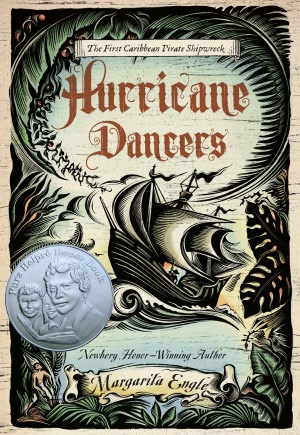
Hurricane Dancers (YA)

Hurricane Dancers: The First Caribbean Pirate Shipwreck. Margarita Engle. 2011. Henry Holt. 160 pages.

Historical setting: Spanish ships reached the western Caribbean Sea in 1492, searching for Asia and spices. Instead, the explorers found peaceful islanders, and enslaved them. By 1510, the Bahamas, Hispaniola, Puerto Rico, and Jamaica had been conquered. Only Cuba, the largest Caribbean isle, was still free. It was a time of hurricanes on an island of hope.

If you're a fan of Margarita Engle, then you're going to want to read one of her latest verse novels, Hurricane Dancers: The First Caribbean Pirate Shipwreck. I have read and enjoyed so very many of her verse novels in the past that when I hear of a new one, I get a little thrill. Her work is something that I just look forward to. I have found her historical verse novels set in Cuba to be so good, so fascinating, so amazing. Hurricane Dancers did not disappoint. Though I'm not sure it is my favorite, favorite. (I don't think I could name a favorite, by the way.)

So Hurricane Dancers has five narrators: Quebrado (our main hero), Bernandino de Talavera (one of our villains), Alonso de Ojeda (another of our villains), Narido and Caucubu (a young couple madly in love with one another, but their parents don't approve).

Quebrado

I listen
to the song
of creaking planks,
the roll and sway
of clouds in sky,
wild music
and thunder,
the groans
of wood,
a mourning moan
as this old ship
remembers
her true self,
her tree self,
rooted 
and growing,
alive,
on shore.

Read Hurricane Dancers

If you're a fan of Margarita Engle
If you're looking for a good book set in Cuba in the sixteenth century
If you're a fan of verse novels
If you're a fan of historical fiction
If you're looking for a good multicultural book
If you're looking to read a Pura Belpre Honor Book
If you're looking for a good coming-of-age story

© 2012 Becky Laney of Becky's Book Reviews
Friday, February 24, 2012

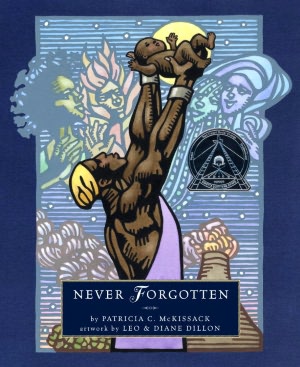
Never Forgotten

Never Forgotten. Patricia C. McKissack. Illustrated by Leo and Diane Dillon. 2011. Random House. 48 pages.

Never Forgotten by Patricia C. McKissack won a 2012 Coretta Scott King Author Honor. It is a picture book for older readers, a collection of poems focused on the slavery experience from Africa to the Americas. While the book addresses, in a way, slavery as a whole, it is also a personal narrative in that it focuses on one young man--taken from his family, his community. The book has folklore elements to it as well, as several of the poems are narrated by wind, water, fire, etc.

I definitely liked the text more than the artwork, but that is just me. (Judging illustrations is so subjective--or it seems that way to me.) I liked the personal aspect to it--tracing the loss in his family, in his community. The always-wanting, always-missing, always-wondering aspect of it. This one is more a story about those left behind. So it is unique, in my opinion.

Read Never Forgotten
  • If you're a fan of poetry
  • If you're a fan of multicultural poetry
  • If you're looking to read Coretta Scott King winners/honors
  • If you're a fan of folklore
© 2012 Becky Laney of Becky's Book Reviews
Friday, February 10, 2012

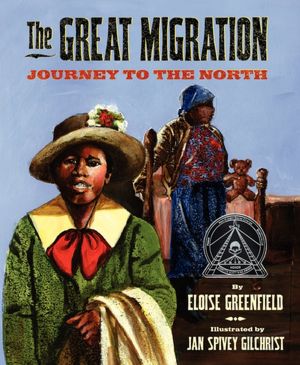
The Great Migration

The Great Migration: Journey to the North. Eloise Greenfield. Illustrations by Jan Spivey Gilchrist.  2011. HarperCollins. 26 pages.

Between 1915 and 1930, more than a million African Americans left their homes in the South, the southern part of the United States, and moved to the North. This movement was named "the Great Migration." 

The Great Migration is a poetry book that won a 2012 Coretta Scott King Honor in the author category. What I liked best about this poetry book is the diversity of narrative voices. Greenfield tells the story of the Great Migration through a series of different voices--old, young, man, woman, boy, girl. Some find leaving bittersweet; others can't wait to start a new life. Some are anxious, hesitant. Others are exuberant and confident. All of the poems feel personal.

My favorite may be "IV. Question: Men and Women"

Will I make a good life
for my family,
for myself?
The wheels are singing,
"Yes, you will,
you will, you will!"
I hope they're right.
I think they're right.
I know they're right.
We're going to have
a great life. Got to try it.
Going to do it. Going to
make it. No matter what.

Read The Great Migration
  • If you enjoy poetry written for children
  • If you enjoy poetry with a historical subject
  • If you're interested in this time period, 1915-1930
  • If you are interested in African American history

© 2012 Becky Laney of Becky's Book Reviews

Saturday, January 14, 2012

Every Thing On It

Every Thing On It. Shel Silverstein. 2011. HarperCollins. 208 pages.

Years From Now


Although I cannot see your face
As you flip these poems awhile,
Somewhere from some far-off place
I hear you laughing--and I smile.

Every Thing On It made me giddy. It did. I just LOVED, LOVED, LOVED it. I think it is my favorite of the later Shel Silverstein collections. It is just as worthy to be on everyone's shelves as Where The Sidewalk Ends, A Light in the Attic, and Falling Up. It is so, so, so much better than recent offerings like Runny Babbit A Billy Sook and Don't Bump the Glump and Other Fantasies. If you grew up LOVING Shel Silverstein's poetry, then this newest collection is an absolute must!!!

Some of these poems are just fabulous. Just wonderful. Some are happy; some are sad. Quite a few are quirky and weird. A few are beautifully bittersweet. Some are very thoughtful and insightful. Others are just as silly as can be. I think this collection has something for every reader.

I think this is a book EVERYONE needs to read. I just loved, loved, loved it.

Here's one called The Dollhouse

You can't crawl back in the dollhouse--
You've gotten too big to get in.
You've got to live here
Like the rest of us do.
You've got to walk roads
That are winding and new.
But oh, I wish I could
Crawl back with you,
Into the dollhouse again. (151)

and here's a little one called Spider:
A spider lives inside my head
Who weaves a strange and wondrous web
Of silken threads and silver strings
To catch all sorts of flying things,
Like crumbs of thoughts and bits of smiles
And specks of dried-up tears,
And dust of dreams that catch and cling
For years and years and years.... (190)

And here is Eatin' Soup
Eatin' soup with chopsticks--
I should be finished soon.
Eatin' soup with chopsticks
While whistlin' a tune.
Eatin' soup with chopsticks
Because I have no spoon.
Eatin' soup with chopsticks
Can take all afternoon. (185)

And here's The Clock Man
"How much will you pay for an extra day?"
The clock man asked the child.
"Not one penny," the answer came,
"For my days are as many as smiles."

"How much will you pay for an extra day?"
He asked when the child was grown.
"Maybe a dollar or maybe less,
For I've plenty of days on my own."

"How much will you pay for an extra day?"
He asked when the time came to die.
"All of the pearls in all of the seas,
And all of the stars in the sky." (95)

And here's the final poem of the collection:

When I Am Gone

When I am gone what will you do?
Who will write and draw for you?
Someone smarter--someone new?
Someone better--maybe YOU! (194)
Read Every Thing On It:
  • If you are a fan of Shel Silverstein
  • If you grew up reading Where The Sidewalk Ends, A Light in the Attic, and Falling Up
  • If your only experience with Shel Silverstein is The Giving Tree, and you've been meaning to give him another try
  • If you're looking for a poem collection that appeals to readers of all ages; there are plenty of poems with kid-appeal (though I didn't necessarily quote those in this review); but there are so many that will appeal to older readers as well. A few I think are meant more for adults than kids. But that's the great thing about collections--different poems speak to different people.
  • If you're looking to read poems that you can actually understand and relate to.
To read more poems from this collection, here's a post about the book. (Poems shared "Every Thing On It," "Dirty Clothes," "Happy Birthday," and "Italian Food.") And this site seems to share many, many Silverstein poems. Including Happy Ending?

© 2012 Becky Laney of Becky's Book Reviews
Friday, May 21, 2010

Poetry Friday: Borrowed Names


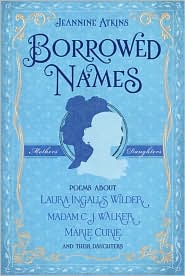
Borrowed Names: Poems About Laura Ingalls Wilder, Madam C.J. Walker, Marie Curie. Jeannine Atkins. 2010. March 2010. Henry Holt. 224 pages.

I liked this one. It was strange, but in a good way. All three women--Laura Ingalls Wilder, Madam C.J. Walker, Marie Curie--were born in 1867; all three women were mothers. The poems are about these three women--their relationships with their daughters, their personal lives, their careers. What were these successful women really like? What kind of relationships did they have with their daughters?

Laura Ingalls Wilder was the only woman whose story I was familiar with. I did enjoy getting to know these other two women. All three women had very different different experiences, different hardships, different strengths and weaknesses.

© Becky Laney of Becky's Book Reviews
Friday, April 09, 2010

Poetry Friday: Think Again


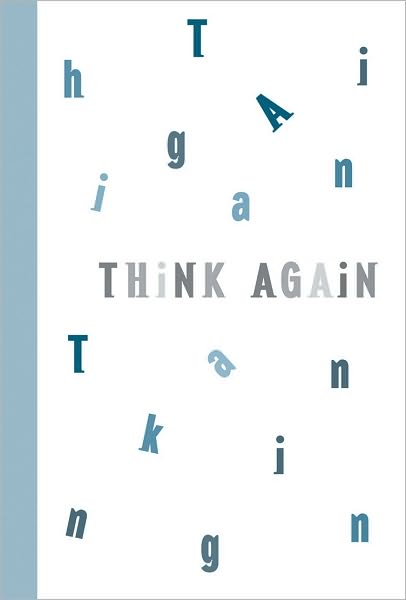
Think Again. JonArno Lawson. Illustrated by Julie Morstad. 2010. Kids Can Press. 64 pages.

I really enjoyed this poetry book! I was actually surprised by how much I liked it. The jacket describes this one as a "collection of quietly beautiful and surprisingly humorous short poems" that "reveals first love's uncertainties, frustrations, and joys." I don't usually mention the jacket description of a book, but in this case, I think they said it much better than I ever could.

What did I like about these short poems? Well, I found them to be true, to feel authentic. I thought they were very good, very short observations of life, of love. Some poems are self-reflections.

I enjoyed so many of these poems: Thoughtless, Up For Grabs, Pleasant, The Heart, and Oh Star I Never Wished Upon.

Here are two about time. In fact, both are named Time.

Time

The past cannot be paid for
And the future can't be bought:
You've got the present moment and
That's really all you've got. (29)


Time

Time comes quick and raw, it can't be
Slowed or refined
It moves so fast because
it's leaving everything behind. (53)


© Becky Laney of Becky's Book Reviews

Friday, July 24, 2009

A Mirror to Nature


Yolen, Jane. 2009. A Mirror To Nature: Poems About Reflection. Photographs by Jason Stemple. Wordsong.

A picture book of nature poems. Yolen has written twelve reflective poems and paired them with some incredible photographs taken by her son, Jason Stemple. Each poem also includes a side note about the animal subject. What kind of animals? Alligators, racoons, deer, snails, frogs, coyotes, and several different species of birds. This one could appeal to animal lovers, nature lovers, environmentalists, and poetry lovers.

© Becky Laney of Becky's Book Reviews